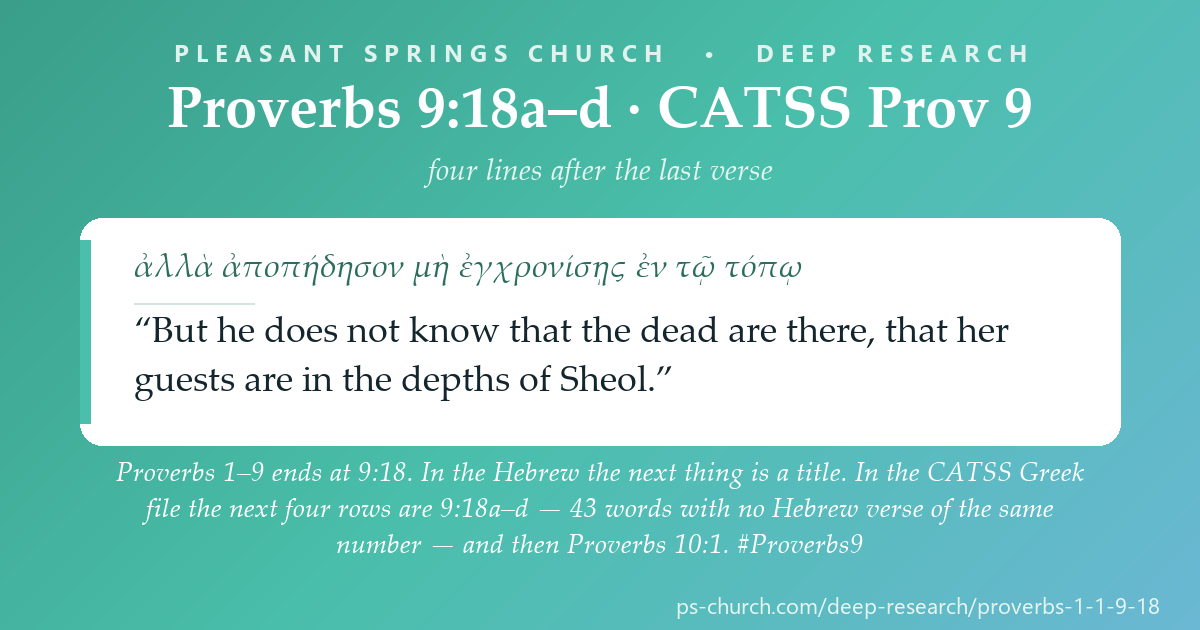
Proverbs 1–9 is one long invitation, and it ends at 9:18 with a woman's guests in the depths of Sheol. In the Hebrew, the next thing is a title: The proverbs of Solomon. In the CATSS Greek text of Proverbs, the next four rows are 9:18a, 9:18b, 9:18c and 9:18d — forty-three words with no Hebrew verse of the same number — and then, with nothing between, Proverbs 10:1, which carries no title at all. Chapter 9 has eight lettered rows against eighteen numbered verses, the highest ratio of any of the thirty-one chapter labels in the file, and the highest by raw count too. Across chapters 1–9 the Greek file runs to 272 rows against the 256 verses of Masoretic Proverbs: eighteen rows carrying a letter, and two Hebrew verse numbers — 4:7 and 8:33 — with no Greek row to match. This page counts rows and labels in two files. It does not say that anything was added to, or taken from, anything. See the method →
Proverbs 1:1–9:18 (selections)
Hebrew · Greek (CATSS, Rahlfs’ Septuaginta) · ESV18b οὕτως γὰρ διαβήσῃ ὕδωρ ἀλλότριον καὶ ὑπερβήσῃ ποταμὸν ἀλλότριον
18c ἀπὸ δὲ ὕδατος ἀλλοτρίου ἀπόσχου καὶ ἀπὸ πηγῆς ἀλλοτρίας μὴ πίῃς
18d ἵνα πολὺν ζήσῃς χρόνον προστεθῇ δέ σοι ἔτη ζωῆς9:18a–d · CATSS Prov 9:18a, 9:18b, 9:18c, 9:18d · no Hebrew versesFour rows, forty-three Greek words, and no Hebrew verse numbered any of them. They read: but leap away, do not linger in the place, nor fix your eye on her… keep away from another’s water, and do not drink from another’s spring… that you may live a long time, and years of life be added to you. The next row in the file is Proverbs 10:1.
In the CATSS Greek text of Proverbs as it sits on disk, chapter 9 carries eight lettered rows — 9:10a, 9:12a, 9:12b, 9:12c, 9:18a, 9:18b, 9:18c and 9:18d — against eighteen numbered verses. That is the highest ratio of lettered rows to numbered verses of any of the thirty-one chapter labels in the file: 0.444, against 0.156 for the next chapter, and the band at the maximum has exactly one member. It is also the highest by raw count — eight against five — so it is not only an artefact of chapter 9 being short.
Four of the eight stand after the chapter’s last numbered verse. In file order Prov 9:18 is followed by 9:18a, 9:18b, 9:18c and 9:18d, and then immediately by Prov 10:1, with nothing between — and Prov 10:1 is where the Solomon collection begins. Those four rows carry 43 Greek words against the 14 of the numbered verse they follow.
Across chapters 1–9 the Greek file carries 272 rows against the 256 verses of Masoretic Proverbs 1–9: eighteen rows carrying a letter, and two Hebrew verse numbers — 4:7 and 8:33 — with no Greek row of the same number. Eighteen minus two is the net sixteen.
The Shape of the Passage
Sequence — ten discourses, two women, and a seamBoth files name Solomon at 1:1, and the Greek row says a little more. Hebrew מִשְׁלֵי שְׁלֹמֹה בֶן־דָּוִד מֶלֶךְ יִשְׂרָאֵל — five words; CATSS Prov 1:1 παροιμίαι Σαλωμῶντος υἱοῦ Δαυιδ ὃς ἐβασίλευσεν ἐν Ισραηλ — eight. At 10:1, where the Hebrew repeats the title to open the next collection, the Greek row carries no title at all.
Author
Solomon, by the title in both files. The book names him again at 10:1 and at 25:1, so the collections are marked off by their own headings rather than by anything this page measures.
What this page does not say. The commentary tradition reads chapters 1–9 as a prologue composed later than the sentence collections it introduces. Nothing on disk can date either, and no dating claim is made here. What can be counted is how the two files line up, and that is what is printed.
Audience
A son, addressed directly and repeatedly. The vocative בְּנִי, my son, is the collection’s organising address, and the discourses are framed as a parent speaking.
And a reader being asked to choose between two invitations. Chapter 9 sets Wisdom’s banquet and Folly’s side by side, in the same shape of words: both build or sit, both call from the high places of the town, both address the one who is simple. The page reports that the two speeches are parallel in shape; it does not claim to have measured a chiasm or a diptych, because no such test was run.
Orient on the collections of Proverbs, on Lady Wisdom, and on the Greek text of the book.
Search by topic: Proverbs, structure and collections; wisdom personified; the strange woman; the Greek Proverbs and its arrangement; Proverbs 8:22 in the Arian controversy.
Which articles are relevant?
- Anchor Bible Dictionary — “Proverbs, Book of,” “Wisdom in the OT,” “Septuagint,” “Arianism.”
- Dictionary of the OT: Wisdom, Poetry & Writings (IVP) — “Proverbs, Book of,” “Woman Wisdom and Woman Folly,” “Fear of the Lord,” “Translations, Ancient.”
- NIDOTTE — חכמה, יראה, מוסר, זרה.
The one thing the reference works will tell you that this page cannot check
Every standard treatment says the Greek of Proverbs is a freer translation than most of the Greek Old Testament, and that its arrangement of the collections after chapter 24 differs from the Hebrew. The second half of that is visible in the file: the Greek chapter labels run 1–24 and then 30–36, with no chapters numbered 25–29 at all.
The first half is a judgement about translation technique, and this page does not make it. What is printed here is the count of rows and labels in the two files. That the Greek runs longer in chapters 1–9 is a fact about the files; why it does is not.
The seam, counted.
Chapter 9, row by row
Here is every row the Greek file carries under the label Prov 9, in file order, against the eighteen verses of Masoretic Proverbs 9:
| File order | Hebrew verse of the same number? |
|---|---|
| 9:1 … 9:10 | yes |
| 9:10a | no |
| 9:11, 9:12 | yes |
| 9:12a, 9:12b, 9:12c | no |
| 9:13 … 9:18 | yes |
| 9:18a, 9:18b, 9:18c, 9:18d | no |
| 10:1 | yes |
Eighteen numbered verses, eight lettered rows, twenty-six rows in all. The eight cluster at three points, and four of them stand after the chapter’s last numbered verse.
How that compares with the rest of the book
Nineteen of the thirty-one chapter labels in the file carry at least one lettered row; twelve carry none. Ranked by lettered rows per numbered verse:
| Chapter label | Lettered | Numbered | Ratio |
|---|---|---|---|
| 9 | 8 | 18 | 0.444 |
| 15 | 5 | 32 | 0.156 |
| 24 | 5 | 34 | 0.147 |
| 20 | 3 | 21 | 0.143 |
The band at the maximum has exactly one member. And chapter 9 is also first by raw count, at eight against five.
Stated against itself: Masoretic Proverbs 9 is the shortest chapter in the book — eighteen verses against a mean of 29.5 — so a small denominator does flatter the ratio. That is why the raw count is given beside it: on raw count, with no denominator at all, chapter 9 still comes first.
What the four rows say, and one word they share with the rest of the collection.
The four rows after 9:18
9:18a — ἀλλὰ ἀποπήδησον μὴ ἐγχρονίσῃς ἐν τῷ τόπῳ μηδὲ ἐπιστήσῃς τὸ σὸν ὄμμα πρὸς αὐτήν
9:18b — οὕτως γὰρ διαβήσῃ ὕδωρ ἀλλότριον καὶ ὑπερβήσῃ ποταμὸν ἀλλότριον
9:18c — ἀπὸ δὲ ὕδατος ἀλλοτρίου ἀπόσχου καὶ ἀπὸ πηγῆς ἀλλοτρίας μὴ πίῃς
9:18d — ἵνα πολὺν ζήσῃς χρόνον προστεθῇ δέ σοι ἔτη ζωῆς
Forty-three words: leap away, do not linger, do not fix your eye on her; keep from another’s water and another’s spring; that you may live long. The English here is a working gloss made for this page and checked against no published version, because no English translation of these four rows was consulted.
ἀλλότριος, counted
Counted on the CATSS lemma column, the word ἀλλότριος stands on eleven rows in Greek chapters 1–9 — and four of those eleven are inside these last four rows: ὕδωρ ἀλλότριον and ποταμὸν ἀλλότριον at 9:18b, ὕδατος ἀλλοτρίου and πηγῆς ἀλλοτρίας at 9:18c.
The same word stands in the Greek rows at 2:16, 5:20 and 7:5, where the Hebrew verses carry זָרָה and/or נׇכְרִיָּה.
Two things this page will not say about that. It will not say the Greek renders one Hebrew word by another — that is a claim about translation, not about counting. And it will not say that every “strange woman” verse in the collection carries the word: it does not. Of the four Masoretic verses with זָרָה as a noun (2:16, 5:3, 5:20, 7:5), the Greek row at 5:3 carries no ἀλλότριος-family form at all, reading φαύλῃ γυναικί and γυναικὸς πόρνης; and at 6:24 the ἀλλοτρίας attaches to γλώσσης, not to a woman. An earlier draft of this page asserted the universal and it was false.
Two Hebrew words worth the count
חׇכְמָה, wisdom. Counted prefix-aware on the consonantal stem, the form stands 37 times in Proverbs — 16 of them in chapters 1–9 and 21 in 10–31. Proverbs 4:7 is the only verse in all 915 that carries it twice, and it is one of the two verses with no Greek row of the same number.
יִרְאַת, the fear of. Fifteen tokens end in that form across the book, and all fifteen are immediately followed by יְהֹוָה. Five of the fifteen stand in chapters 1–9.
Both are form counts on consonantal spellings with prefixes allowed, not lemma counts — there is no Hebrew lemmatiser in this library, so no root claim is made.
One verse that is carried entire into the New Testament, and a comparison that did not survive.
Proverbs 3:12 and Hebrews 12:6
Rahlfs’ Greek Proverbs 3:12 and Hebrews 12:6 stand as the same eleven word-forms in the same order — the whole of each verse.
ὃν γὰρ ἀγαπᾷ κύριος παιδεύει, μαστιγοῖ δὲ πάντα υἱὸν ὃν παραδέχεται
No other verse among the 7,927 in the SBL Greek New Testament held here holds that run. And the measurement does not depend on the elision table: it returns eleven with the table and eleven without it.
What a run length is measured against
A tie band is reported as the set of New Testament verses that reach a verse’s maximum run — not as the number of verses holding one particular n-gram. The two definitions differ by factors of three to twelve, and a page that prints a band without saying which it used is not reporting anything.
Under that definition Proverbs 3:7 reaches three words, and fifteen New Testament verses reach it. So no single verse is named for it here. Proverbs 3:11 reaches nine with Hebrews 12:5, band of one; Proverbs 3:34 reaches six, band of exactly two — James 4:6 and 1 Peter 5:5.
Proverbs 3:34 is inside this study: Masoretic Proverbs 3 runs to 35 verses and the Greek chapter has 35 numbered rows.
A comparison this page ran, and then withdrew
An earlier version of this study reported that Proverbs 1–9 is bound more tightly to its own book than to the rest of the canon — that measured against the rest of Scripture it sits unusually low. That claim is withdrawn.
It was produced by using the Psalter as the yardstick. Run on the identical pipeline, the share of chapters whose deepest contact with the other thirty-eight books reaches four or more consonantal words is:
| Corpus | reaches 4+ | reaches 5+ |
|---|---|---|
| Proverbs 1–9 | 11.1% | 0% |
| Proverbs 10–31 | 9.1% | 4.5% |
| Job | 9.5% | 7.1% |
| Ecclesiastes | 25.0% | 0% |
| Psalter | 24.0% | 13.3% |
Proverbs 1–9 is indistinguishable from the rest of its own book and from Job. The Psalter is the outlier, not Proverbs. Measured against the wisdom books, the effect the earlier draft reported is simply absent, and this page reports the withdrawal rather than quietly dropping it.
What the counting supports, and what it cannot reach.
What was checked and came back negative
No verse of Proverbs 1–9 reaches a five-word run with any verse of the other thirty-eight books. The ceiling is four, and it is reached once. Scoped to the Masoretic text on disk and to consonantal forms as spelled under the shelf rule, which splits on whitespace and maqqef.
That ceiling is created by the word rule and the page says so. Two of the four words in the deepest pair are אֶת and כׇּל, maqqef-bound clitics. Re-run with maqqef treated as a joiner rather than a separator, the ceiling for Proverbs 1–9 drops from four to three. A number that moves when the tokenisation moves is a number that has to be printed with its tokenisation.
What could not be checked at all
No Hebrew or Greek critical apparatus. No Qumran manuscript of Proverbs and no Cairo Geniza fragment. No Syriac, no Vulgate, no Aquila, Symmachus or Theodotion. No manuscript evidence of any kind bearing on the lettered rows or on the two Hebrew verses without a Greek row of the same number.
And no published English rendering of the eighteen lettered rows was consulted — the glosses in stage 3 are working translations made for this page.
What it means to read a book in two files that do not agree on where it stops.
The seam is the interesting part
Proverbs 1–9 is a single sustained appeal, and both files end it in the same place: a house, a table, and guests who do not know where they are. What differs is what stands in the gap before the next collection begins.
In the Hebrew, a title. In the Greek file, four more lines — and they are not a summary or a moral, but an instruction to leave: leap away, do not linger, do not look at her, keep away from the water that is not yours.
That is a description of two files, not an account of how either came to read that way. This page has no way to tell you which arrangement is older, and does not guess.
Every Deep Research page traces its passage across the whole sweep — the Old Testament, the Second-Temple world between the testaments (historical witnesses, not Scripture), and the New Testament. Follow the thread:
Pleasant Springs Church — Deep Research
Research method after Michael S. Heiser’s Bible Research Method (examine dictionaries → ancient literature → important words → textual connections → academic publications → share), with the Pleasant Springs “Author & Audience” foundation. Scripture set in the Hebrew, the Greek editions named on each page and the ESV (Old Testament), and the Greek New Testament and the ESV (New Testament), per the practice of Pleasant Springs Church. Proverbs 1–9 research grounded in Fox (Proverbs 1–9, Anchor Yale), Waltke (The Book of Proverbs, NICOT), Clifford and Longman. Text: Hebrew from the Masoretic text as printed in the editions consulted — Sefaria’s Miqra according to the Masorah; no critical apparatus was consulted for the Hebrew. Greek from Rahlfs’ Septuaginta as digitized by CATSS; Greek New Testament from the SBL edition. The standing caution for this shelf applies: these pages say “the CATSS Greek text reads…” and never call a Greek reading early or late. ⚠️ Everything on this page is a count of rows and labels in two files. “No Greek row of the same number” is a statement about what Proverbs.mlxx labels, not a claim about the existence of any text anywhere. Nothing is called early or late, and nothing is said to have been added to or taken from anything. ⚠️ The parsing trap, stated because it is easy to fall into. CATSS rows are fixed-width and the Greek form is columns 0–24. The shelf’s general-purpose reader matches its verse header with a regex that is unanchored at the end, so a row labelled Prov 9:18a matches as 9:18 and its words are appended to that verse. Verse counts then look correct while verse text is silently lengthened — read that way, Proverbs 9:18 returns 57 words instead of 14, because all four lettered rows have been folded into it. Every Greek reading on this page was parsed with the row label anchored, keeping 9:18a distinct from 9:18. ⚠️ The chapter-label trap. The Greek chapter labels in this file run 1–24 and then 30–36; there are no labels 25–29. A naive chapter-by-chapter comparison therefore reports Masoretic chapters 25–27 as having no Greek at all, which is an artefact of the numbering. This study is chapters 1–9 and is not affected, and no whole-book statement is made that would depend on it. ⚠️ The counts, stated so they can be repeated. Masoretic Proverbs: 31 chapters, 915 verses; chapters 1–9, 256 verses and 1,847 words. Proverbs.mlxx: 939 verse rows, of which 48 carry a letter, leaving 891 numbered rows; chapters 1–9, 272 rows. Lettered rows by chapter label: 3×2, 4×2, 6×4, 7×1, 8×1, 9×8, 10×1, 12×2, 13×2, 15×5, 17×2, 18×1, 20×3, 22×3, 24×5, 32×2, 33×1, 34×2, 35×1 — 18 in chapters 1–9, 24 in 10–24 and 6 in 30–36, with twelve chapter labels carrying none. Hebrew word counts follow the shelf rule: split on whitespace and maqqef, count a token only if it carries a letter in the range א–ת, count a ketiv/qere pair once. Under that rule the Psalter comes to 19,586 words in 2,527 verses and the thirty-nine books held here to 305,579 words. ⚠️ A tie band on this page is the set of verses reaching a maximum, not the holder-count of one n-gram. The two definitions differ by factors of three to twelve. Under the definition used here Proverbs 3:7 reaches 3 against a band of 15, so no verse is named for it; Proverbs 3:11 reaches 9 against a band of 1; Proverbs 3:34 reaches 6 against a band of 2. ⚠️ A comparison was withdrawn. An earlier draft reported that Proverbs 1–9 is unusually self-contained against the rest of the canon. Run against Proverbs 10–31, Job and Ecclesiastes on the identical pipeline the effect disappears — the Psalter, which the first draft used as its yardstick, is the outlier. The claim is withdrawn on the page rather than deleted from it. Typology is handled per the house position: what the text says, what the New Testament itself draws, and what we see from this side of the cross — with the seeing left to the reader.
Scripture quotations marked ESV are from the ESV® Bible (The Holy Bible, English Standard Version®), © 2001 by Crossway, a publishing ministry of Good News Publishers. ESV Text Edition: 2016. Used by permission. All rights reserved. The ESV text may not be quoted in any publication made available to the public by a Creative Commons license, and the ESV may not be translated in whole or in part into any other language. www.esv.org
|
Did this study bless you today? 💚 Give to Support PS Church100% of gifts go to the General Fund — thank you. |