The sayings copied by Hezekiah’s men end here, and the thing these last three chapters do most is repeat. Three of their eighty-two verses repeat another verse of the book at five or more consecutive words — 27:13 with 20:16 at seven consecutive words, 28:19 with 12:11 at six, 28:6 with 19:1 at five, each with a tie band of one. A fourth, 27:12, is the proverb of 22:3 word for word under three conjunctions, and the form screen therefore measures it at only three. And the two files do not say the same things twice. Twenty-four Masoretic verse numbers in Proverbs have no Greek row at all; only two of those twenty-four are themselves deeply repeated verses, and both — 19:1 and 20:16 — are the twins of verses in this passage. Their partners here have Greek rows; they do not. And the Greek file carries a repetition the Hebrew does not have. Between the rows numbered 28:17 and 28:18 stands an unnumbered row, 35:17a, whose first line is the proverb that stands at 36:17 — Hebrew 29:17, discipline your son — five consecutive words in common. Screened against all 30,348 Greek Old Testament verse units held here, each of those two rows is the other’s single deepest match, band of one. See the method →
Proverbs 27:1–29:27 (selections)
Hebrew · Greek (CATSS, Rahlfs’ Septuaginta) · ESVEvery Masoretic number in 27:1–29:27 has a Greek row of the same verse number — 27, 28 and 27 of them, nothing absent on either side. Three Greek rows have no Masoretic number at all: 34:20a, 34:21a and 35:17a. And one row, 34:27, carries material that is not the material of Masoretic 27:27.
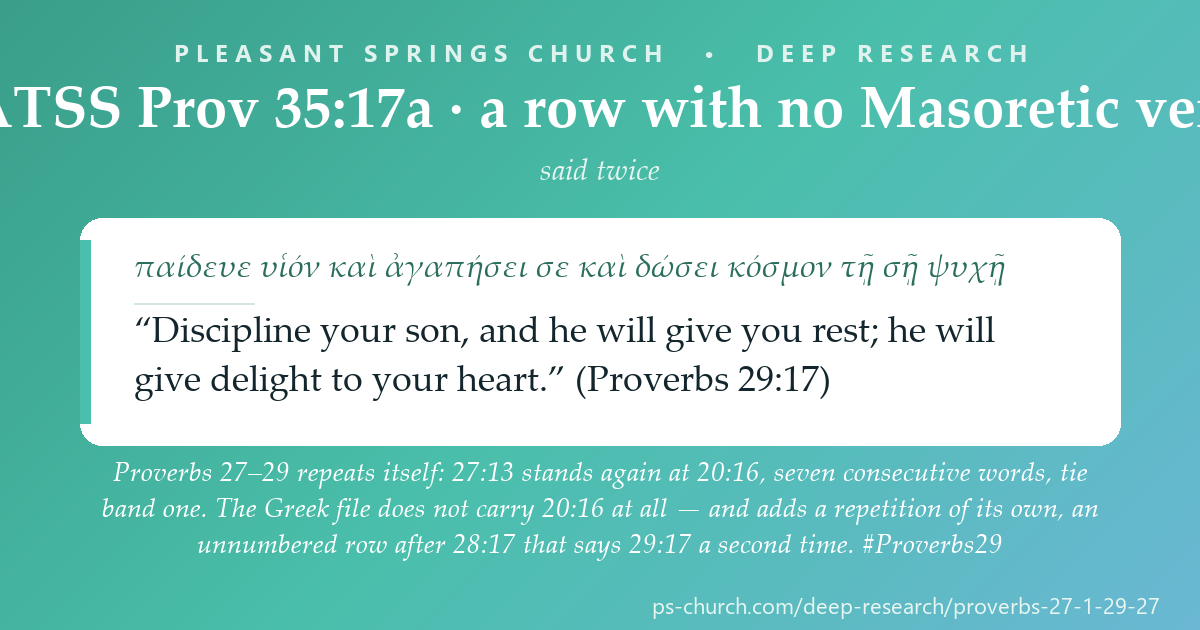
The repetitions do not line up between the two files. Three verses here repeat another verse of the book at five or more consecutive words — 27:13 with 20:16 at seven, 28:19 with 12:11 at six, 28:6 with 19:1 at five, every one of them with a tie band of one; a fourth, 27:12, is 22:3 under three conjunctions and the form screen therefore measures it at three. Two of those three twins, 19:1 and 20:16, have no Greek row anywhere. Meanwhile the Greek file carries a repetition the Hebrew does not have at all: the unnumbered row 35:17a and the row at 36:17 share five consecutive words, and across 30,348 Greek Old Testament verse units each is the other’s single deepest match.
The Shape of the Passage
Sequence — single sayings, one bound paragraph, and one bracketThis passage carries no superscription of its own. It is the back half of the unit headed at 25:1 — גַּם־אֵלֶּה מִשְׁלֵי שְׁלֹמֹה אֲשֶׁר הֶעְתִּיקוּ אַנְשֵׁי חִזְקִיָּה מֶלֶךְ־יְהוּדָה, “these also are proverbs of Solomon which the men of Hezekiah king of Judah copied” — and it runs to the end of that unit at 29:27. The Greek row at 32:1 keeps both names and calls the copyists οἱ φίλοι, the friends, rather than the men. The page takes the heading as the text’s own claim about itself and measures what a copied collection looks like. It does not adjudicate authorship.
Author
A collection that says it was copied. Whatever else 25:1 means, הֶעְתִּיקוּ is a word about moving text from one place to another. And what the screens find in these three chapters is repetition: three verses that repeat another verse at five or more consecutive words, one of them at seven with a tie band of one — and a fourth, 27:12, that is 22:3 under three conjunctions.
That is a measurement about the material, not about a person. A repeated proverb tells you the collection overlaps another collection. It does not tell you who copied which way, or when, and this page does not guess. Proverbs 20:16 and 27:13 are the same seven words; the page prints both and says nothing about priority.
Audience
A court and a farm at once. Kings, rulers and officials run through chapters 28 and 29 — 28:2, 28:15, 28:16, 29:4, 29:12, 29:14, 29:26 — and 27:23–27 is five verses about flocks, grass and goats’ milk. The Greek row at 34:27 turns even that into a father speaking to a son.
And a reader expected to notice a repeat. The bracket at 28:12 and 28:28 only works on someone who has read both. That is a literary observation and is offered as one; the run screen scores both verses at zero.
Orient on the Hezekiah collection, on the book’s repeated sayings, and on the Greek Proverbs.
Search by topic: Proverbs, the Hezekian collection (25–29); variant repetitions in Proverbs; doublets; the Septuagint of Proverbs; the additional stichoi.
Which articles are relevant?
- Anchor Bible Dictionary — “Proverbs, Book of,” “Wisdom Literature,” “Hezekiah.”
- Dictionary of the OT: Wisdom, Poetry & Writings (IVP) — “Proverbs, Book of,” “Sayings Collections,” “Septuagint.”
- NIDOTTE — תּוֹעֵבָה, תּוֹרָה, עָתַק.
- Commentaries consulted for orientation — Fox, Proverbs 10–31 (Anchor Yale); Waltke, Proverbs 15–31 (NICOT); Clifford; Longman.
What a dictionary will tell you, and what it will not
Every handbook says Proverbs repeats itself. What none of them prints is how deep any particular repeat runs, or how many verses in a given stretch have no repeat at all. Those are countable, and they are what this page counts.
Counted over the whole book, 302 of the 915 Masoretic verses of Proverbs — 33.0% — share no two consecutive words with any other verse in the Hebrew Bible once their own chapter is set aside. In 27:1–29:27 the figure is 23 of 82, 28.0%. This passage is slightly more connected than the book it sits in, not less.
Zero here means one specific thing. On the Hebrew screen single words are not counted, so a verse reported at zero shares no two consecutive words with any other verse. It may share — and generally does share — a great many individual words. This is the convention the Obadiah page on this shelf used, and it is not the convention used on the Greek side.
A collection that says it was copied, and a Greek book with forty-eight rows nobody numbered.
The lettered rows
The CATSS Greek Proverbs holds 939 rows. Forty-eight of them carry a letter after the verse number and answer no Masoretic verse. Six of the forty-eight fall inside the material answering Masoretic 25–29, and three of those six are in these three chapters: 34:20a, 34:21a and 35:17a.
Set against the Masoretic side, the same stretch has the opposite problem in the earlier chapters:
| Greek labels | Masoretic | numbers with no Greek row | rows with no Masoretic number |
|---|---|---|---|
| 1–24 | Prov 1–24 | 24 (nineteen of them in 16–22) | 42 |
| 30, 31 | Prov 30, 31 | 0 | 0 |
| 32, 33 | Prov 25, 26 | 0 | 3 |
| 34, 35, 36 | Prov 27, 28, 29 | 0 | 3 |
Read at the labels the file actually uses, nothing is missing here. The three extra rows are the whole of the difference in count — and one row, 34:27, differs in content without differing in count.
A five-word run into Sirach
Proverbs 27:1 in Greek ends οὐ γὰρ γινώσκεις τί τέξεται ἡ ἐπιοῦσα. Sirach 8:18 ends οὐ γὰρ γινώσκεις τί τέξεται.
Five consecutive words, and across the 30,348 Greek Old Testament verse units screened here the tie band is one: no other row comes as close to Proverbs 34:1 as Sirach does. Both files sit on the same disk. The page reports the overlap and says nothing about which way it runs, or when, or whether both are drawing on a proverb older than either.
What this is not. It is not evidence that Sirach used Proverbs, and it is not evidence that a Greek translator of Proverbs used Sirach. A shared five-word idiom in two Greek wisdom books is exactly the kind of contact that can arise from either direction or from neither.
The anatomy of a row that nobody numbered.
Three rows in the whole screened Greek Old Testament carry these two words in this order, and all three are in Proverbs: 19:18, 35:17a and 36:17.
Two rows in the whole screened Greek Old Testament: 35:17a and 36:17. Nowhere else.
Three rows, all in Proverbs: 33:3, 35:17a and 36:18.
The unnumbered row is made out of the book’s own words
παίδευε υἱόν καὶ ἀγαπήσει σε καὶ δώσει κόσμον τῇ σῇ ψυχῇ · οὐ μὴ ὑπακούσῃς ἔθνει παρανόμῳ
| piece of 35:17a | where else it stands | rows carrying it, of 30,348 |
|---|---|---|
| παίδευε υἱόν | Prov 19:18; Prov 36:17 | 3 (all in Proverbs) |
| σε καὶ δώσει κόσμον τῇ | Prov 36:17 | 2 (both these rows) |
| ἔθνει παρανόμῳ | Prov 33:3; Prov 36:18 | 3 (all in Proverbs) |
Every distinctive phrase in the row stands somewhere else in this same Greek book. Its long clause is the row at 36:17; its closing pair is the close of the first line of 36:18, the very next row after that one. So the unnumbered row stands twenty-eight rows before the two rows it corresponds to, and it corresponds to them in sequence.
What the page will not say. It will not say the row is a doublet of 36:17–18, nor that it was moved, nor that a scribe wrote it twice. Those are claims about direction and about process, and nothing measured here can decide them. What is measured is that the language is shared and where.
An abomination with no verse under it
The noun βδέλυγμα stands in eleven rows of the Greek Proverbs: 11:1, 11:20, 12:22, 15:8, 15:9, 15:26, 16:12, 20:23, 21:27, 34:20a and 36:27.
Ten of the eleven sit at a number whose Masoretic verse reads תּוֹעֵבָה. The eleventh is 34:20a, which has no Masoretic verse at all.
On the Hebrew side תּוֹעֵבָה stands 21 times in Proverbs, three of them in this passage: once at 28:9 and twice at 29:27, the last verse of the collection. The Greek row at 28:9 answers it with the verb ἐβδέλυκται rather than the noun, which is why 35:9 is not in the list of eleven.
Which things are said twice, in each file — and what the New Testament does not do here.
The Hebrew twins, and where their partners went
| verse here | stands again at | run | band | does the twin have a Greek row? |
|---|---|---|---|---|
| 27:13 | Proverbs 20:16 | 7 | 1 | no |
| 28:19 | Proverbs 12:11 | 6 | 1 | yes — and the Greek rows share five, band 1 |
| 28:6 | Proverbs 19:1 | 5 | 1 | no |
| 27:21 | Proverbs 17:3 | 4 | 1 | yes |
| 29:1 | Proverbs 6:15 | 4 | 1 | yes |
| 27:12 | Proverbs 22:3 | 3 | 1 | yes |
| 29:20 | Proverbs 26:12 | 3 | 1 | yes |
One row of that table is deeper than it measures. Proverbs 27:12 and 22:3 are the same seven-word proverb. They differ in three prefixed conjunctions and one spelling — פְּתָאיִם here against וּפְתָיִים there — and the ESV prints the two verses word for word alike. The screen counts FORMS, so a prefixed waw cuts the run and the pair measures three. It is a whole-verse doublet the measurement cannot see, and the three named above are the three that reach five or more.
Twenty-four Masoretic verse numbers in Proverbs have no Greek row anywhere in the file. Screened against the rest of the Hebrew Bible with their own chapter set aside, exactly two of those twenty-four reach four or more: 19:1 at five and 20:16 at seven. Both are twins of verses in this passage. The other twenty-two reach three, two or zero.
Two of twenty-four is a small number and the page treats it as one. The absence of these rows was not selected for by the twin relation, and the co-occurrence is reported as a co-occurrence. The obvious story — that someone rendering the book passed over a saying he had already rendered — is a claim about process and about direction, and nothing measured here can test it. It is not asserted.
The deepest Greek contact in the passage is an accident of idiom
Proverbs 35:9 (Masoretic 28:9) and Isaiah 59:1 share six consecutive words, tie band one.
τὸ οὖς αὐτοῦ τοῦ μὴ εἰσακοῦσαι
Across all 85 rows of this passage screened against the 30,348 Greek Old Testament verse units held here, that is the deepest run there is. In Isaiah it is God’s ear and it is not too heavy to hear; here it is the man’s ear and he turns it away from the law. Same six words, opposite subjects. Nothing about direction follows.
The full distribution of the 85 rows against the screened Greek Old Testament, self excluded — exact counts, not cumulative: 4 rows top out at one, 31 at two, 38 at three, 7 at four, 4 at five, and 1 at six. (The New Testament figures in the next panel are cumulative, in the shelf’s usual wording.)
And the New Testament does almost nothing with these chapters
Across the 85 CATSS rows against 7,927 verses of the Greek New Testament: 73 reach two, 20 reach three, and nothing reaches four.
For scale, the previous page on this shelf measured Proverbs 25:22 against Romans 12:20 at ten, and Proverbs 3:12 against Hebrews 12:6 at eleven. In these three chapters the ceiling is three, and the deepest threes are formulas: τὸν οἶκον τοῦ at 34:10 with a band of 14, εἰς τὴν ζωήν at 34:27 with a band of 12.
The page prints its own counter-examples.
| the connection every commentary makes | measured run |
|---|---|
| Proverbs 27:1 → James 4:13–14 (on not knowing what tomorrow brings) | 1 — the word αὔριον |
| Proverbs 29:23 → Luke 14:11 (on exalting and humbling oneself) | 0 — not one shared word form |
| Proverbs 28:13 → 1 John 1:9 (“if we confess our sins”) | 0 — not one shared word form |
These zeros are the other convention. A named pair comparison has no unigram fallback and no tie band; 0 there means the two verses share no word form at all after normalisation. It does not mean the thought is unrelated. Luke 14:11 and Proverbs 29:23 say something very close in Greek that has no word in common, which is precisely what a run screen is built to be unable to see.
What was not consulted, what could not be checked, and where this page is weakest.
What could not be checked at all
No Hebrew or Greek critical apparatus was consulted. No Qumran or Cairo Geniza fragment of Proverbs, no Syriac, no Vulgate, no Aquila, Symmachus or Theodotion, no Sahidic. Nothing bearing on whether the three lettered rows stand in every Greek witness or only in the tradition Rahlfs printed — which is a question about manuscripts, and the shelf holds no manuscripts.
That last gap matters more here than usual. The central finding of this page is about a row that exists in one edited Greek text. If 35:17a is weakly attested, the finding shrinks to a fact about Rahlfs. The page cannot tell you either way, and it should not be read as though it could.
Three results this page ran and will not publish as stated
1. That the Greek file ‘drops’ Proverbs 19:1 and 20:16 because they were already rendered at 28:6 and 27:13. That is the natural story and it may well be right. It is also a claim about the direction of work and about a person’s intention, and nothing on this disk can test it. What is measurable is the co-occurrence: two of the twenty-four absent numbers are the two most deeply repeated of the twenty-four, and both of their partners are in this passage. That is what is printed.
2. That 34:27 ‘replaces’ Masoretic 27:27. Withdrawn as worded. What is measured is that the row at that number carries other material and that no row in the file carries the goats’-milk verse. Whether something was removed, or never rendered, or stood somewhere the file does not preserve, is not decidable here.
3. That the bracket at 28:12 and 28:28 is an inclusio. Kept, but demoted. The two verses share two words, one of which carries a conjunction in one of them, and the run screen scores both at zero against the entire Hebrew Bible. It is a reading supported by a lexical repetition, not a measured structure, and the structure diagram labels the whole passage a sequence for that reason.
Where this page is weakest
The content alignment of the eighty-two rows was checked by eye, not by lexicon. Each Greek row was read beside the English of the Masoretic verse of the same number, and one row — 34:27 — was judged to carry other material. Several others render very freely: 34:16 turns 27:16 into a saying about the north wind, 34:19 negates 27:19 (as faces are not like faces), 36:25 renders 29:25 twice inside one row. Those were judged to be free renderings of the same verse rather than different material, and a different reader could draw the line elsewhere.
The Hebrew figures are form counts. No Hebrew lemmatiser is held here, so ‘shares no two consecutive words’ means no two consecutive forms. The deepest twin in the passage illustrates the cost precisely: 27:13 and 20:16 measure seven on the qere and five on the ketiv, because 20:16 has ketiv נכרים against qere נׇכְרִיָּה. The shelf reads the qere, so seven is the published figure and five is printed beside it. The ESV itself splits at exactly that point — “an adulteress” at 27:13, “foreigners” at 20:16 — so the English columns of the two verses do not look like twins even though the consonants very nearly are.
And the corpus is not the Septuagint. It is the 64 CATSS files held here. Run screens see 30,348 of the 30,637 verse units on disk, because the Odes are excluded: Ode 9 is Luke 1 and Ode 13 is Luke 2 copied into a Greek Old Testament manuscript, and ten more Odes are second copies of passages already in the corpus, which would double a tie band for no textual reason. Every ‘band of one’ on this page is a band of one across those 30,348.
What a copied collection looks like when you count it.
The heading told the truth
25:1 says these sayings were copied. Three chapters later the counting agrees with the heading in the plainest possible way: the material repeats, and the two files do not repeat the same things.
The Hebrew says one proverb twice at 20:16 and 27:13, seven words apiece. The Greek does not have 20:16 at all, and says a different proverb twice instead, once with a number and once without. Neither file is tidier than the other. Both are collections that grew.
And the most quoted line in the passage is the loneliest one in it. “Iron sharpens iron” shares no two consecutive words with any other verse in the Hebrew Bible. It has been repeated more than any other verse here, and the book itself never repeats it once.
If you have read this far, tell us what you would count next. The screens are exhaustive and deterministic, and a question you can state precisely is a question this shelf can answer.
Every Deep Research page traces its passage across the whole sweep — the Old Testament, the Second-Temple world between the testaments (historical witnesses, not Scripture), and the New Testament. Follow the thread:
Pleasant Springs Church — Deep Research
Research method after Michael S. Heiser’s Bible Research Method (examine dictionaries → ancient literature → important words → textual connections → academic publications → share), with the Pleasant Springs “Author & Audience” foundation. Scripture set in the Hebrew, the Greek editions named on each page and the ESV (Old Testament), and the Greek New Testament and the ESV (New Testament), per the practice of Pleasant Springs Church. Proverbs 27–29 research grounded in Fox (Proverbs 10–31, Anchor Yale), Waltke (NICOT), Clifford and Longman. Text: Hebrew from the Masoretic text as printed in the editions consulted — Sefaria’s Miqra according to the Masorah; no critical apparatus was consulted for the Hebrew. Greek from Rahlfs’ Septuaginta as digitized by CATSS; Greek New Testament from the SBL edition via MorphGNT. The standing caution for this shelf applies: these pages say “the CATSS Greek text reads…” and never call a Greek reading early or late, and never assert which text is prior. ⚠️ THE OFFSET. There is no verse-level offset. Every Masoretic verse number in 27:1–29:27 — 27, 28 and 27 numbers — has a Greek row of the same verse number, and no number is absent on either side. The offset is at chapter level and it is +7: Masoretic 27, 28 and 29 stand in the CATSS file at labels 34, 35 and 36. Physically the block occupies rows 833–917 of the file’s 939, immediately after the row answering Masoretic 26:28; the whole 32–36 block, rows 774–917, is what stands between the row answering Masoretic 31:9 and the row answering Masoretic 31:10. The file’s own row order runs Masoretic 1–24:22, then 30:1–14, then 24:23–34, then 30:15–31:9, then 25–29 at labels 32–36, then 31:10–31. Read literally the labels would report 82 absent numbers here; that figure is an artefact of the labelling and is not used. The ESV follows the Masoretic numbering throughout, so no English verse number on this page differs from the Hebrew. ⚠️ Three rows have no Masoretic number and one row differs in content. 34:20a, 34:21a and 35:17a answer no Masoretic verse and carry no ESV line. 34:27 carries material that is not that of Masoretic 27:27; that judgement was made by reading each of the 82 rows beside the English of the verse of its number, not by a lexicon, and stage 5 names the rows where a different reader could draw the line elsewhere. ⚠️ Two run conventions are in play and they mean different things by zero. Hebrew-side screens run without a unigram fallback, so 0 means “shares no two consecutive words with any other verse” — the verse still shares individual words. Greek-side corpus screens run with the fallback, so a row sharing only isolated words reports 1. A named pair comparison has neither fallback nor tie band: 0 there means no shared word form at all, and that is what the Luke 14:11 and 1 John 1:9 rows in stage 4 report. ⚠️ Hebrew counts are FORM counts, and the qere is read. No Hebrew lemmatiser is held here. Word counts follow the shelf rule: split on whitespace and maqqef, count a token only if it carries a letter in the range א–ת, count a ketiv/qere pair once, and read the qere. The deepest twin in this passage — 27:13 with 20:16 — measures seven on the qere and five on the ketiv, and both figures are printed. Proverbs is 915 Masoretic verses; this study is 82 of them. ⚠️ The screened corpus is not “the Septuagint”. 64 CATSS files are held, 30,637 verse units. A run screen sees 30,348, because the Odes are excluded: Ode 9 is Luke 1 and Ode 13 is Luke 2 copied into a Greek Old Testament manuscript, and ten further Odes are second copies of Exodus 15, Deuteronomy 32, 1 Samuel 2, Habakkuk 3, Isaiah 26, Jonah 2, Daniel 3, Isaiah 5 and Isaiah 38. Every tie band on this page is a band across those 30,348. Cross-corpus runs against the Greek New Testament apply MorphGNT’s own spelling equivalences — ou/ouk/ouch, ek/ex and the movable nu — so figures here are not comparable with figures published on this shelf before 30 August 2026. ⚠️ The parsing trap. CATSS rows are fixed-width and a general-purpose reader folds a lettered row into its base verse. Every Greek reading here was parsed with the label anchored, and the parsed key order was checked to equal the file’s physical row order — which is how the three lettered rows and the block position at rows 833–917 were established. Typology is handled per the house position: what the text says, what the New Testament itself draws, and what we see from this side of the cross — with the seeing left to the reader.
Scripture quotations marked ESV are from the ESV® Bible (The Holy Bible, English Standard Version®), © 2001 by Crossway, a publishing ministry of Good News Publishers. ESV Text Edition: 2016. Used by permission. All rights reserved. The ESV text may not be quoted in any publication made available to the public by a Creative Commons license, and the ESV may not be translated in whole or in part into any other language. www.esv.org
|
Did this study bless you today? 💚 Give to Support PS Church100% of gifts go to the General Fund — thank you. |