Screen every verse of Proverbs 13:1–21:31 against every other verse in the Hebrew Bible — all 23,204 of them — and seventeen of its 268 verses reach a run of four whole words or more. Every one of the seventeen has a tie band of one, and in every one of the seventeen the verse it reaches is another verse of Proverbs. Not a single one of the deepest runs leaves the book. They make thirteen pairs; six of the thirteen reach into chapters 25–29, the collection whose own heading says it was copied out by other men in the days of Hezekiah. Then look at the same numbers in the Greek. Three of the thirteen pairs are still twins there. Two of the thirteen have no Greek row on this side at all, so the doublet stands once instead of twice. And the Greek file has deep pairs of its own at places where the Hebrew pairs nothing. Meanwhile eighty-two of the section’s 268 verses share no two consecutive words with any other verse in the Hebrew Bible. The same nine chapters are the most self-repeating and the most isolated text on the shelf at once — and stage 5 says plainly which half of that is remarkable and which half is not. See the method →
Proverbs 13:1–21:31 (selections)
Hebrew (Masoretic) · Greek (CATSS, Rahlfs’ Septuaginta) · ESVIn the Hebrew columns the bold words are the longest contiguous sequence this verse shares with its twin. In the Greek columns the bold words are the longest contiguous sequence the two Greek rows at the answering numbers share — which is a different and usually much shorter thing.
⚠️ Seventeen verses, thirteen pairs, every band 1. Screened one verse at a time against the other 23,203 verse units of the Masoretic corpus, seventeen of this section’s 268 verses reach a run of four words or more. All seventeen have a tie band of 1 — exactly one verse in the Hebrew Bible reaches that depth with each of them — and in every one of the seventeen that verse is another verse of Proverbs. Not one of them reaches out of the book.
⚠️ And eighty-two share no two consecutive words with anything. 82 of 268, 30.6%. On this screen a zero means no two consecutive words in common with any other verse in the Hebrew Bible; every one of the eighty-two does share individual words. Read stage 5 before treating that as remarkable: Job runs higher.
The Shape of the Passage
Sequence — nine chapters inside one headingless collectionVersification. Between the Masoretic text and the ESV there is no offset anywhere in this section: chapters 13 to 21 hold 25, 35, 33, 33, 28, 24, 29, 30 and 31 verses in both, 268 in each, and every number answers its own number. The Greek is where the numbering parts. The CATSS file carries 262 rows labelled in chapters 13 to 21 — 249 numbered and 13 lettered — and nineteen Masoretic numbers in the span have no Greek row of that number: 15:31, 16:1, 16:3, 16:4, 16:6, 18:23, 18:24, 19:1, 19:2, 20:14 through 20:22, and 21:5. The lettered rows are 13:9a, 13:13a, 15:18a, 15:27a, 15:28a, 15:29a, 15:29b, 17:6a, 17:16a, 18:22a, 20:9a, 20:9b and 20:9c. Elsewhere the same file labels its chapters 1–24 and then 30–36, so Masoretic 25 to 29 are read at the labels 32 to 36 throughout this page.
Author
Solomon, by the heading at 10:1, which governs everything down to 22:16. Nothing inside these nine chapters names anyone. The next heading in the Hebrew is at 22:17, דברי חכמים, the words of the wise.
What the counting can say about the section. 268 verses, 2,028 Hebrew word forms, mean 7.567 words a verse against 7.610 across the whole book — the sayings here are the ordinary length for Proverbs, not longer or shorter. The tetragrammaton stands in 43 of the 268 verses, 16.0%, against 87 of 915 in the book, 9.5%.
And what it cannot. Nothing measured on this page bears on who wrote any of it, when, or in what order. Where two verses stand word for word beside each other the page prints the pair and stops; it never says which one is first.
Audience
A reader being handed one-line sayings, 268 of them, with no argument between them. No narrative, no named addressee anywhere in the nine chapters, no heading between 10:1 and 22:17. The dominant form is the third-person sentence and it does not develop — a reader can enter at any verse and lose nothing.
A reader, therefore, who can meet the same saying twice and not notice. 14:12 and 16:25 are the same eight words, eighty-one verses apart. 19:5 and 19:9 are six shared words four verses apart. 17:15 and 20:10 end with the identical four-word colon. Whether that is deliberate arrangement or the ordinary behaviour of an anthology is not something this page can settle, and it does not try.
Orient on the Solomonic sentence collection and on the doublet as a described feature.
Search by topic: Proverbs, the Solomonic collections; the Hezekiah collection of 25:1; doublets and variant repetitions in Proverbs; the sentence proverb; the Septuagint of Proverbs.
Which articles are relevant?
- Anchor Bible Dictionary — “Proverbs, Book of,” “Wisdom in the OT,” “Septuagint.”
- Dictionary of the OT: Wisdom, Poetry & Writings (IVP) — “Proverb, Genre of,” “Sayings Collection,” “Translations, Ancient.”
- NIDOTTE — תועבה, מקור, עד.
What every treatment says, and what only counting can add
That Proverbs repeats itself is in every introduction to the book. The lists of “doublets” or “variant repetitions” are old, and no commentary needed a computer to find 14:12 and 16:25.
What a full screen adds is the negative half, which a list cannot give you. A published list tells you which verses repeat. It does not tell you that nothing else in the section reaches four words with anything, anywhere in the Hebrew Bible, or that every one of those runs has a tie band of exactly one, or how far down the next candidate sits. Those are the figures this page is for.
What was not consulted. No commentary’s doublet list was opened, before or after. The thirteen pairs here were produced by the screen and by nothing else, which means the page cannot tell you whether they agree with Fox’s list or Snell’s. They were found by a threshold of four shared words, and a doublet that shares three would not be in them.
The thirteen pairs, and where their partners sit.
The thirteen pairs
| In 13:1–21:31 | stands beside | Hebrew run | partner sits in |
|---|---|---|---|
| 14:12 | 16:25 | 8 — the whole verse | this section |
| 18:8 | 26:22 | 7 — the whole verse | Hezekiah collection |
| 20:16 | 27:13 | 7 (qere; 5 on the ketiv) | Hezekiah collection |
| 21:9 | 25:24 | 7 (qere; 4 on the ketiv) | Hezekiah collection |
| 19:5 | 19:9 | 6 | this section, four verses away |
| 13:14 | 14:27 | 5 | this section |
| 19:1 | 28:6 | 5 | Hezekiah collection |
| 15:20 | 10:1 | 4 | Proverbs 10–12 |
| 16:5 | 11:21 | 4 | Proverbs 10–12 |
| 17:3 | 27:21 | 4 | Hezekiah collection |
| 17:15 | 20:10 | 4 | this section |
| 18:11 | 10:15 | 4 | Proverbs 10–12 |
| 19:24 | 26:15 | 4 | Hezekiah collection |
Thirteen pairs, seventeen source rows, every tie band 1, no partner outside Proverbs. Six partners sit in 25–29, four inside this section, three in 10–12.
Why six pointing at chapters 25–29 is worth naming, and how far the naming goes
Proverbs 25:1 carries its own heading: these also are proverbs of Solomon which the men of Hezekiah king of Judah copied.
So six of the thirteen deepest pairs in this section have their other member in a block the book itself labels as a later copying. That is a fact about where the verses stand and about what the heading at 25:1 says.
It is not evidence of direction and this page does not use it as any. A shared run of seven words tells you the two verses are the same saying. It does not tell you which collection had it first, whether either was copied from the other, or whether both drew on something neither of them is. The heading at 25:1 is a claim inside the book, not a measurement, and nothing here tests it.
The book as a whole, for scale
Screened the same way, every verse of Proverbs against every other verse in the Hebrew Bible, the whole book gives 29 verses at four, 11 at five, 4 at six, 6 at seven and 4 at eight.
Every run of six or more in the entire book — fourteen verses, seven pairs — points at another verse of Proverbs, every one with a tie band of 1: 6:10 with 24:33, 12:11 with 28:19, 14:12 with 16:25, 18:8 with 26:22, 19:5 with 19:9, 20:16 with 27:13, 21:9 with 25:24. Seven of those fourteen verses are in this section.
Which repetitions are pairs and which are formulas.
The test that separates them is the tie band
A run with a band of 1 has exactly one partner in 23,204 verses. A run with a band of 14 has fourteen, and is a stock phrase.
| Verse | deepest run | band | reading |
|---|---|---|---|
| 17:15 | 4 | 1 | תּוֹעֲבַת יְהוָה גַּם־שְׁנֵיהֶם — and its only holder is 20:10 |
| 17:17 | 2 | 14 | בְּכָל־עֵת — a stock phrase |
| 18:10 | 2 | 27 | מִגְדַּל־עֹז and שֵׁם יהוה |
| 17:13 | 3 | 5 | Genesis 44:4, 1 Samuel 25:21, Psalms 35:12, 38:21, 109:5 — repaying evil for good is common property |
The abomination line is the sharpest case on the page. תּוֹעֲבַת יְהוָה alone stands in 19 verses of the Hebrew Bible, 11 of them in Proverbs; on two words it is a formula. Extended to the four-word colon an abomination to the Lord, both alike, it stands in exactly two, 17:15 and 20:10, and it is a pair. Where the formula stops and the pair begins is at word three.
Eighty-two verses that pair with nothing
82 of the 268 verses in this section — 30.6% — share no two consecutive words with any other verse in the Hebrew Bible. They are spread evenly: 11 in chapter 13, 17 in 14, 8 in 15, 4 in 16, 7 in 17, 10 in 18, 6 in 19, 8 in 20, 11 in 21.
Some of the section’s best-known lines are among them — 13:12 hope deferred makes the heart sick, 13:20 whoever walks with the wise becomes wise, 13:24 whoever spares the rod hates his son, 15:1 a soft answer turns away wrath, 14:34 righteousness exalts a nation, and 21:31 the horse is made ready for the day of battle.
What that zero means, exactly. This screen was run with the Hebrew-side convention, no single-word fallback, so 0 means no two consecutive words in common — not no words in common. Every one of the eighty-two shares individual words with plenty of verses. And read stage 5 before treating the figure as a property of this section: it is not.
The near-miss the threshold excludes
17:25 and 19:13 share three words and a band of 1 — each is a foolish son who is a grief to his father, and neither reaches the four-word threshold this page uses.
So do 13:2 with 12:14 and 18:20, at three with a band of 2. The thirteen pairs are what a threshold of four produces; they are not the complete set of repetitions in the section, and this page does not claim they are. Lowering the threshold to three adds 25 more source rows and starts admitting formulas, which is why it was not lowered.
The same thirteen pairs read in the Greek, and the New Testament.
Thirteen pairs in Hebrew; three still pairs in Greek
For each of the thirteen, the two CATSS rows at the answering numbers were measured against each other on the same rule — longest contiguous run of whole word forms.
| Pair | Hebrew run | Greek run at the same numbers |
|---|---|---|
| 15:20 / 10:1 | 4 | 7 — υἱὸς σοφὸς εὐφραίνει πατέρα υἱὸς δὲ ἄφρων |
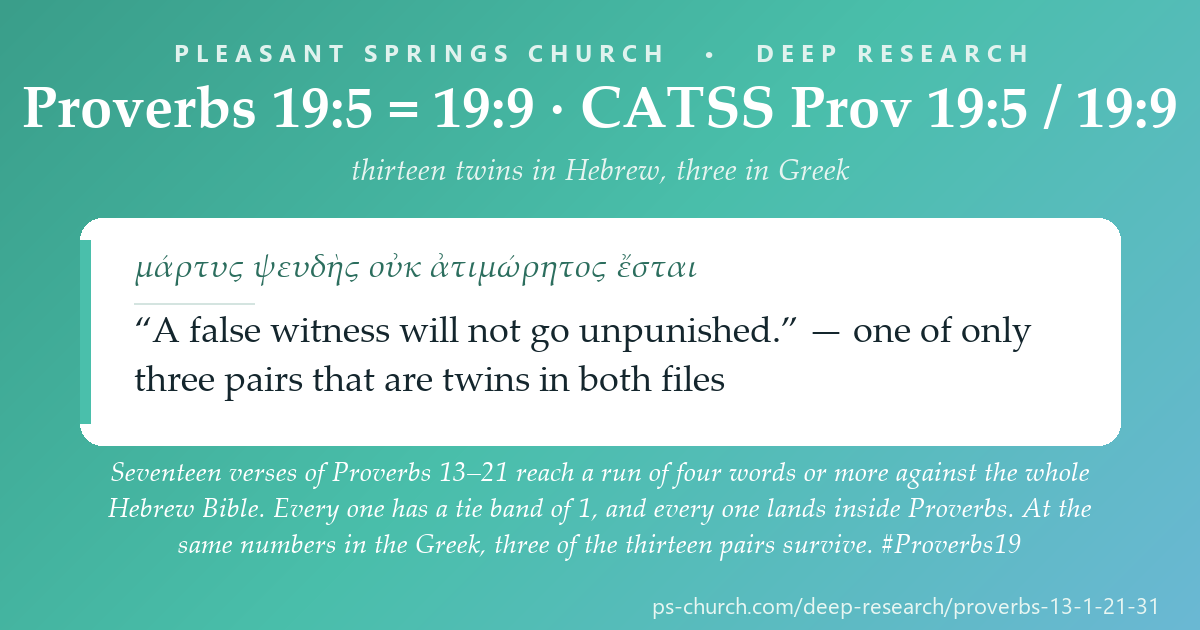
| 19:5 / 19:9 | 6 | 5 — μάρτυς ψευδὴς οὐκ ἀτιμώρητος ἐσται, band 2 |
| 16:5 / 11:21 | 4 | 4 |
| 14:12 / 16:25 | 8 | 3 |
| 21:9 / 25:24 | 7 | 3 |
| 13:14 / 14:27 | 5 | 2 |
| 18:11 / 10:15 | 4 | 2 |
| 18:8 / 26:22 | 7 | 1 — the Greek row numbered 18:8 carries a different saying entirely |
| 17:15 / 20:10 | 4 | 1 |
| 17:3 / 27:21 | 4 | 1 |
| 19:24 / 26:15 | 4 | 1 |
| 20:16 / 27:13 | 7 | no Greek row numbered 20:16 |
| 19:1 / 28:6 | 5 | no Greek row numbered 19:1 |
Three of the thirteen reach four or more in the Greek; two reach five. Two have no Greek row on the 13–21 side at all — and in both of those the partner outside the section does have one, so in the Greek file the doublet stands once.
And the Greek file has pairs the Hebrew does not
Run the same screen inside the Greek file — each of the 262 rows labelled 13–21 against the other 938 rows of CATSS Proverbs — and 26 reach four, 9 reach five, 1 reaches seven. Four of those 26 rows sit at numbers the Hebrew pairs, and they make three of the Hebrew’s thirteen pairs.
| Greek pair | Greek run | Hebrew run at the same numbers |
|---|---|---|
| 13:3 / 19:16 | 6 — τηρεῖ τὴν ἑαυτοῦ ψυχήν ὁ δὲ | 2 |
| 14:31 / 17:5 | 6 — παροξύνει τὸν ποιήσαντα αὐτόν ὁ δὲ | 2 |
| 19:20 / 1:8 | 5 — ἄκουε υἱέ παιδείαν πατρός σου | 1 |
| 13:15 / 9:10a | 5 | not measurable — there is no Masoretic verse numbered 9:10a |
So it is not that one file repeats and the other does not. Both files carry sayings twice. They largely do not carry the same sayings twice, and this page reports that as a difference between two documents and says nothing whatever about how either of them came to be as it is.
The New Testament: two runs of four, and both are accidents
All 262 CATSS rows in 13:1–21:31 were swept against all 7,927 verses of the SBL Greek New Testament. 217 reach two, 53 reach three, 2 reach four, and nothing reaches five.
Both fours have a tie band of 1, and both are strings of function words:
| Row | NT verse | the shared four |
|---|---|---|
| CATSS Prov 14:2 | John 20:25 | τὸν κύριον ὁ δέ — …we have seen the Lord. But he said… |
| CATSS Prov 21:23 | Acts 8:35 | τὸ στόμα αὐτοῦ καί — …Philip opened his mouth and… |
Neither is a use of Proverbs. They are printed because they are the deepest thing the screen found, and a page that printed only its best number would be lying by arrangement.
Measured across all 939 rows of the Greek Proverbs file, every run of five or more with the Greek New Testament falls outside this section — 3:11 and 3:12 with Hebrews 12:5 and 12:6 at nine and eleven, 32:22 with Romans 12:20 at ten, 11:31 with 1 Peter 4:18 at nine, 3:34 with James 4:6 and 1 Peter 5:5 at six, 24:12 with Romans 2:6 at five, 32:21 with Romans 12:20 at five. Seven rows in the book reach five with the New Testament and not one of them is in chapters 13 to 21.
The controls, the counter-examples, and what this page could not check.
The isolation figure is not this section’s, and here is the proof
30.6% of the verses here share no two consecutive words with any other verse in the Hebrew Bible. That sounds like a finding. Run the identical screen on other books and it stops being one.
| Book | verses | sharing no two consecutive words with any other verse |
|---|---|---|
| Job | 1,070 | 412 — 38.5% |
| Proverbs, all 31 chapters | 915 | 293 — 32.0% |
| Proverbs 13:1–21:31 | 268 | 82 — 30.6% |
| Psalms | 2,527 | 624 — 24.7% |
| Isaiah | 1,291 | 190 — 14.7% |
| Ecclesiastes | 222 | 25 — 11.3% |
| Genesis | 1,533 | 36 — 2.3% |
This section is below its own book and well below Job. The isolation belongs to short poetic lines with no narrative formulas in them, not to Proverbs 13–21. The figure stays on the page because it is true and because it is the honest companion to the twin count — but it is not a finding about this section, and the sentence that would have said so has been removed.
Two of the four deepest pairs depend on reading the qere
20:16 and 21:9 both reach seven words with their partners on the qere. On the ketiv they reach five and four.
20:16 is written נכרים and read נָכְרִיָּה, which is what 27:13 has; 25:24 is written מדונים and read מִדְיָנִים, which is what 21:9 has.
The whole screen was therefore re-run on the ketiv, and the shape does not move. Still 268 verses, still exactly 17 at four or more, still every tie band 1, still not one partner outside Proverbs, still exactly 82 zeros. Only the depths shift: on the ketiv the distribution is 8 at four, 4 at five, 2 at six, 1 at seven, 2 at eight, against 7, 3, 2, 3, 2 on the qere. The individual depths are qere-dependent; the finding is not.
Three things this page checked and will not claim
1. That the section is unusually self-referential. It is not measured against anything that would show that. What is measured is that its deep runs all stay inside Proverbs — and so do the book’s, in every one of the seven pairs at six or more. The behaviour is the book’s; this section holds seven of the fourteen verses involved.
2. That the Greek “lost” ten of the thirteen pairs. Nothing on this page says lost, dropped, removed, harmonised or corrected. What is measured is that at the answering numbers the two Greek rows run to four or more in three cases out of thirteen, and that two of those numbers carry no Greek row. Why the file is as it is — the history of the Greek, of the Hebrew, or of the numbering applied to either — is not something a run screen can reach, and no direction of influence is asserted anywhere on this page.
3. That the six pairs reaching into chapters 25–29 tell you anything about Hezekiah’s men. Six of thirteen is worth printing. It is a count of where verses sit. The heading at 25:1 is a claim the book makes about itself and this page neither confirms nor doubts it.
What could not be checked at all
No Hebrew or Greek critical apparatus. No Qumran manuscript of Proverbs, no Cairo Geniza fragment, no Syriac, no Vulgate, no Aquila, Symmachus or Theodotion. No manuscript evidence bearing on any of the thirteen pairs, on the nineteen absent numbers, or on the thirteen lettered rows in this span. No published doublet list — not Snell, not Fox, not Waltke — was consulted before or after, so the page cannot say whether its thirteen agree with anyone’s. No lemmatiser: every Hebrew and Greek count here is a count of written forms, so two forms of one word do not match and a doublet rewritten in different grammar would be invisible to the screen. And the Greek glosses of rows without an English edition to hand — 13:12, 18:8, 33:22 — are working translations made here.
Where this page is weakest: the threshold. Four shared words is a line drawn by hand. It was chosen because three admits formulas — the abomination colon proves that at word two — and because at four every single hit in the section came back with a band of 1, which is the behaviour of a pair and not of a phrase. That is a good reason and it is still a choice, and a different threshold would give a different thirteen.
A book that quotes itself, and a reader who was never told.
Nobody points it out
Read Proverbs 14:12 and then read Proverbs 16:25 and you have read the same eight words twice, eighty-one verses apart, and the book says nothing about it. No as it is written, no again, no cross-reference. The repetition is simply there.
Thirteen times in these nine chapters a saying stands beside another saying that is word for word or nearly. Six of those partners are in a block the book says was copied out generations later. And four times — 19:5 and 19:9 are four verses apart — the twin is close enough that a reader going straight through will hear it.
What is worth sitting with is the other 82. Nearly a third of this section shares no two consecutive words with anything else in the Bible — hope deferred makes the heart sick, a soft answer turns away wrath, the horse is made ready for the day of battle. The lines you can quote from memory are mostly the ones that stand alone. Which of the two facts is the more interesting is a question the measurement cannot answer, and you can.
Every Deep Research page traces its passage across the whole sweep — the Old Testament, the Second-Temple world between the testaments (historical witnesses, not Scripture), and the New Testament. Follow the thread:
Pleasant Springs Church — Deep Research
Research method after Michael S. Heiser’s Bible Research Method (examine dictionaries → ancient literature → important words → textual connections → academic publications → share), with the Pleasant Springs “Author & Audience” foundation. Scripture set in the Hebrew, the Greek editions named on each page and the ESV (Old Testament), and the Greek New Testament and the ESV (New Testament), per the practice of Pleasant Springs Church. Proverbs 13–21 research grounded in Fox (Proverbs 10–31, Anchor Yale), Waltke (NICOT), Clifford and Longman — as background reading, not as a source of any figure on this page. Text: Hebrew from the Masoretic text as printed in the editions consulted — Sefaria’s Miqra according to the Masorah; no critical apparatus was consulted for the Hebrew. Greek from Rahlfs’ Septuaginta as digitized by CATSS; Greek New Testament from the SBL edition via MorphGNT. The standing caution for this shelf applies: these pages say “the CATSS Greek text reads…” and never call a Greek reading early or late. ⚠️ Every figure here is a count of contiguous runs of whole word forms. Never lemmas, never roots. Exhaustive and deterministic; nothing sampled, so no seed applies. The tie band — how many verses reach the same maximum — is printed beside every run, because a run without its band is misleading. ⚠️ The Hebrew screen and what its zero means. Each of the 268 verses was screened against the other 23,203 verse units of the 39-book Masoretic corpus held here, the verse itself excluded and nothing else. Markup stripped, the qere read (and the whole screen re-run on the ketiv as a control), cantillation and vowel points removed, final letter-forms folded to medial, maqqef treated as a word separator and never as a weld. Run with no single-word fallback, so 0 means “shares no two consecutive words with any other verse” and not “shares no word”. Distribution on the qere: 82 at zero, 144 at two, 25 at three, 7 at four, 3 at five, 2 at six, 3 at seven, 2 at eight. On the ketiv: 82, 146, 23, 8, 4, 2, 1, 2. Seventeen rows at four or more on either reading, every band 1, every partner inside Proverbs. ⚠️ The Greek screens. Intra-book: each of the 262 CATSS rows labelled 13–21 against the other 938 rows of Proverbs.mlxx, the row itself excluded, no single-word fallback — 25 at zero, 138 at two, 73 at three, 17 at four, 4 at five, 4 at six, 1 at seven. Cross-corpus: the same 262 rows against all 7,927 SBLGNT verses with the single-word fallback on, which is the shelf convention there, so 1 is the floor and no row scored 0 — 45 at one, 164 at two, 51 at three, 2 at four, none at five. Cross-corpus runs apply MorphGNT’s own spelling equivalences (ou/ouk/ouch, ek/ex, the movable nu), so these figures are higher than anything this shelf published before 30 August 2026 and were re-measured rather than copied from a neighbouring page. The Greek Old Testament held here is 64 CATSS files and 30,637 verse units; a run screen sees 30,348, because the Odes are excluded — Ode 9 is Luke 1 and Ode 13 is Luke 2 copied into a Greek Old Testament manuscript, and ten more Odes are second copies of passages already in the corpus. ⚠️ Versification. Masoretic and ESV agree verse for verse through all nine chapters — 25, 35, 33, 33, 28, 24, 29, 30, 31; 268 in each; no offset anywhere in this section. The Greek file carries 262 rows in the same span, 249 numbered and 13 lettered (13:9a, 13:13a, 15:18a, 15:27a, 15:28a, 15:29a, 15:29b, 17:6a, 17:16a, 18:22a, 20:9a, 20:9b, 20:9c), and nineteen Masoretic numbers have no Greek row of that number: 15:31, 16:1, 16:3, 16:4, 16:6, 18:23, 18:24, 19:1, 19:2, 20:14–20:22, 21:5. Masoretic chapters 25–29 are read at the CATSS labels 32–36 throughout, the mapping the shelf established on the 16:1–22:16 page. ⚠️ The parsing trap, again. CATSS rows are fixed-width and a reader that matches the verse header unanchored folds Prov 20:9a into 20:9. Every Greek reading on this page was parsed with the label anchored, which is why 13:9a, 13:13a, 15:18a and the rest are counted as rows of their own and not silently welded to the verse above. ⚠️ Hebrew counts are FORM counts. No Hebrew lemmatiser is held here. Word counts follow the shelf rule: split on whitespace and maqqef, count a token only if it carries a letter in the range א–ת, count a ketiv/qere pair once. Under that rule Proverbs 13:1–21:31 = 268 verses and 2,028 words, mean 7.567, against 915 verses and 6,963 words for the book, mean 7.610. The 87 tokens carrying the tetragrammaton in Proverbs stand in 87 distinct verses; 43 of them are in this section. Typology is handled per the house position: what the text says, what the New Testament itself draws, and what we see from this side of the cross — with the seeing left to the reader.
Scripture quotations marked ESV are from the ESV® Bible (The Holy Bible, English Standard Version®), © 2001 by Crossway, a publishing ministry of Good News Publishers. ESV Text Edition: 2016. Used by permission. All rights reserved. The ESV text may not be quoted in any publication made available to the public by a Creative Commons license, and the ESV may not be translated in whole or in part into any other language. www.esv.org
|
Did this study bless you today? 💚 Give to Support PS Church100% of gifts go to the General Fund — thank you. |