Proverbs 2 opens with a father saying my son, if you receive my words and treasure up my commandments with you, and fifteen verses later warns him about a woman. Proverbs 7 opens the same way, and warns him about the same woman in the same words. Measured on consonantal forms, 2:1 and 7:1 share four consecutive words and 2:16 and 7:5 share five — and in both cases no third verse in the Hebrew Bible reaches them. The form מִנׇּכְרִיָּה occurs in exactly two verses of the whole Masoretic corpus, and they are those two. In the CATSS Greek file neither pair survives: the first shares two words, the second shares one, and the Greek row numbered 2:16 names no woman at all. Of the 169 Hebrew verses in these six chapters, twelve reach a four-word run with some other verse in the Bible; eleven of the twelve point back into Proverbs. This page counts words in two files. It never says which way anything travelled. See the method →
Proverbs 2:1–7:27 (selections)
Hebrew · Greek (CATSS, Rahlfs’ Septuaginta) · ESV8b ἧς τοὺς πόνους βασιλεῖς καὶ ἰδιῶται πρὸς ὑγίειαν προσφέρονται ποθεινὴ δέ ἐστιν πᾶσιν καὶ ἐπίδοξος
8c καίπερ οὖσα τῇ ῥώμῃ ἀσθενής τὴν σοφίαν τιμήσασα προήχθη6:8a–c · CATSS Prov 6:8a, 6:8b, 6:8c · no Hebrew versesThree rows, forty Greek words, and no Hebrew verse numbered any of them. They read: or go to the bee, and learn how industrious she is, and how honourable a work she performs; whose labours kings and commoners take for health; she is desired by all and held in honour; and though weak in strength, she has been advanced by honouring wisdom. The English here is a working gloss made for this page and checked against no published version. The next row in the file is Proverbs 6:9.
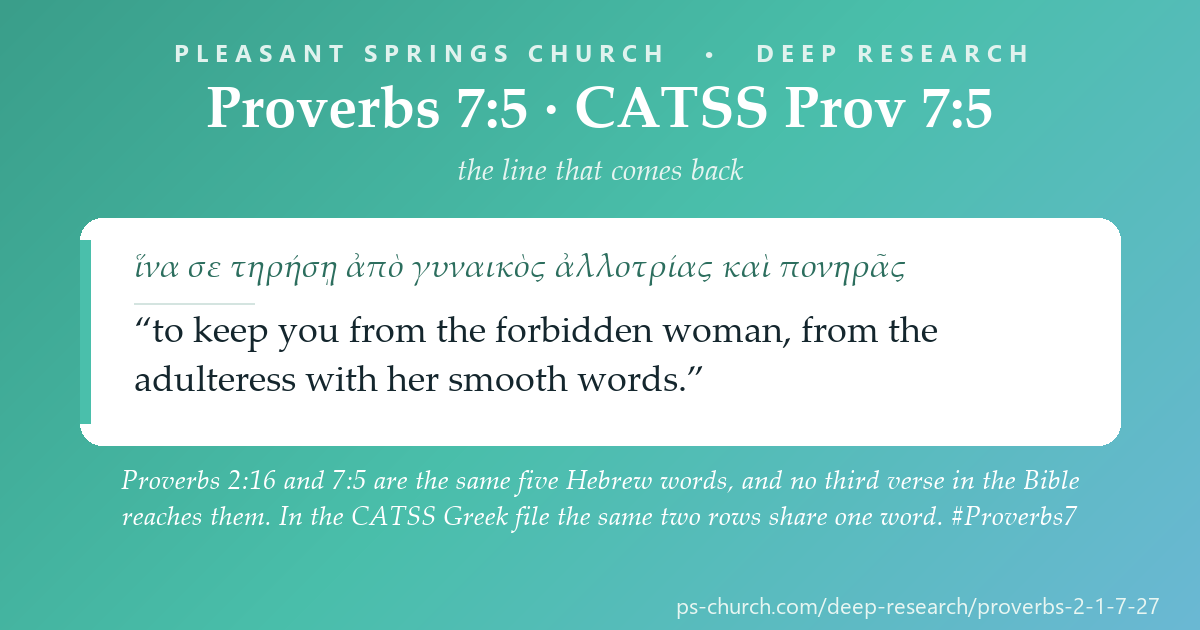
Proverbs 2:1 and 7:1 hold four consecutive consonantal words in common — אֲמָרַי וּמִצְוֺתַי תִּצְפֹּן אִתָּךְ — and no third verse in the 23,204 verse units of the Masoretic corpus held here reaches them. Proverbs 2:16 and 7:5 hold five — מֵאִשָּׁה זָרָה מִנׇּכְרִיָּה אֲמָרֶיהָ הֶחֱלִיקָה — and again no third verse reaches them. Both bands are one, and both were re-checked as whole-corpus phrase searches rather than only as screen maxima: the four-word sequence returns exactly Proverbs 2:1 and 7:1, and the five-word sequence exactly Proverbs 2:16 and 7:5.
The order is the same both times: the address first, the warning after. At the start of the section they stand fifteen verses apart; at the end, four. That is a frame stated twice in the same order — not a ring, and this page does not call it one.
⚠️ In the CATSS Greek file neither pair survives. Greek 2:1 and 7:1 share two words, παρὰ σεαυτῷ. Greek 2:16 and 7:5 share one, σε — and the Greek row numbered 2:16 names no woman at all. The repetition that binds these six chapters in one file is not the repetition that binds them in the other; and where the Hebrew of 6:20 and 1:8 runs five words together, the Greek of the same two rows runs eight.
The Shape of the Passage
Sequence — a frame stated twice, in the same orderNothing in chapters 2–7 names an author. The title at 1:1 names Solomon and the next Masoretic title is at 10:1; these six chapters stand between them with no heading of their own in either file. What they do carry is an address, and it is countable: בְּנִי, my son, stands 22 times in Masoretic Proverbs and 12 of the 22 are here.
Author
Solomon, by the book’s own title at 1:1 — and by nothing inside this passage. Neither the Masoretic text nor the CATSS Greek file puts a heading anywhere between 1:1 and 10:1. This study sits inside that unheaded stretch.
What this page does not say. The commentary tradition reads chapters 1–9 as ten discourses and debates whether they were composed before or after the sentence collections. Nothing on disk can date either, and no dating claim is made here. Nothing on this page says a reading is early or late, or that anything was added to or taken from anything.
Audience
A son, addressed twelve times by name in these six chapters. בְּנִי stands at 2:1; 3:1, 3:11, 3:21; 4:10, 4:20; 5:1, 5:20; 6:1, 6:3, 6:20; 7:1 — one in chapter 2, three in chapter 3, two in chapter 4, two in chapter 5, three in chapter 6 and one in chapter 7. The vocalised form stands 22 times in Proverbs. The consonantal string בני does not distinguish it from בְּנֵי, sons of, and counts 1,707 times in the whole Masoretic corpus held here and 30 times in Proverbs; almost all of that corpus figure is the plural construct, not the address.
And a young man who is watched rather than addressed. Chapter 7 turns the camera round: the speaker looks out of a window and sees a young man lacking sense. The address stops and a scene begins. That is a change of mode the page can point at; it is not a measurement, and it is not offered as one.
Orient on the ten discourses, on the figure called the strange woman, and on the Greek text of Proverbs.
Search by topic: Proverbs, the instruction genre; the strange woman (אִשָּׁה זָרָה); adultery in Israelite law; the Greek Proverbs and its pluses; Egyptian instruction literature and Amenemope.
Which articles are relevant?
- Anchor Bible Dictionary — “Proverbs, Book of,” “Wisdom in the OT,” “Adultery,” “Septuagint.”
- Dictionary of the OT: Wisdom, Poetry & Writings (IVP) — “Proverbs, Book of,” “Woman, Strange,” “Adultery,” “Translations, Ancient.”
- NIDOTTE — זור, נכר, נצר, שמר.
- Dictionary of Deities and Demons in the Bible — “Rephaim,” for the word behind γηγενεῖς at 2:18.
The one thing the reference works will tell you that this page cannot check
Every standard treatment identifies chapters 1–9 as a set of parental discourses and disagrees about how many there are — usually ten, sometimes twelve, depending on whether 6:1–19 is counted as an interruption. That is a judgement about literary units. This page did not make it and could not; there is no marker on disk that divides a discourse from the next.
What is on disk is the address and the repetition. Twelve occurrences of בְּנִי in these six chapters, and two sentences that stand twice with a band of one. The page builds on those and leaves the discourse count to the commentaries.
The bee, and the inventory of the two files.
The bee — Proverbs 6:8a, 6:8b, 6:8c
The Hebrew of Proverbs 6 sends the sluggard to the ant and stops there. The CATSS Greek file has three more rows, forty words, and then goes on to 6:9.
ἢ πορεύθητι πρὸς τὴν μέλισσαν καὶ μάθε ὡς ἐργάτις ἐστὶν τήν τε ἐργασίαν ὡς σεμνὴν ποιεῖται
ἧς τοὺς πόνους βασιλεῖς καὶ ἰδιῶται πρὸς ὑγίειαν προσφέρονται ποθεινὴ δέ ἐστιν πᾶσιν καὶ ἐπίδοξος
καίπερ οὖσα τῇ ῥώμῃ ἀσθενής τὴν σοφίαν τιμήσασα προήχθη
Or go to the bee, and learn how industrious she is, and how honourable a work she performs; whose labours kings and commoners take for health; she is desired by all and held in honour; and though weak in strength, she has been advanced by honouring wisdom.
The gloss above is a working translation made for this page. No published English rendering of these three rows was consulted, and none of the patristic writers who quote them was read for this study. The page states the rows exist and what they say; it does not say where they came from.
The inventory, chapter by chapter
Masoretic verses against CATSS rows, for the six chapters of this study:
| Chapter | Hebrew verses | Greek rows | of them lettered | numbered |
|---|---|---|---|---|
| 2 | 22 | 22 | 0 | 22 |
| 3 | 35 | 37 | 2 — 3:16a, 3:22a | 35 |
| 4 | 27 | 28 | 2 — 4:27a, 4:27b | 26 |
| 5 | 23 | 23 | 0 | 23 |
| 6 | 35 | 39 | 4 — 6:8a, 6:8b, 6:8c, 6:11a | 35 |
| 7 | 27 | 28 | 1 — 7:1a | 27 |
| 2–7 | 169 | 177 | 9 | 168 |
Nine rows carry a letter; one Hebrew verse number has no Greek row to match. That number is 4:7 — the Greek file runs 4:6, 4:8 — and it is why chapter 4 shows 26 numbered rows against 27 Hebrew verses. Nine minus one is the net eight.
“No Greek row of this number” is a statement about what Proverbs.mlxx labels, not a claim about the existence of any text anywhere. Row labels were matched anchored, so Prov 7:1a is kept distinct from Prov 7:1; read unanchored, the lettered rows fold into the numbered ones and the verse text is silently lengthened while the verse count still looks right.
One more row with no Hebrew verse: 7:1a
Between the Greek rows numbered 7:1 and 7:2 the file carries a row labelled 7:1a.
υἱέ τίμα τὸν κύριον καὶ ἰσχύσεις πλὴν δὲ αὐτοῦ μὴ φοβοῦ ἄλλον — Son, honour the Lord and you shall be strong; and besides him fear no other.
Twelve words. It stands immediately after the row that is the Greek counterpart of the Hebrew line this page has been following since 2:1 — and it is the only lettered row in chapter 7.
Four Hebrew forms, each of which occurs a countable number of times in the whole corpus.
Exactly 2 occurrences in the 23,204 verse units held here — Proverbs 2:16 and Proverbs 7:5. Both are in this study, and they are its first and last warning.
11 verses in the Masoretic corpus carry this consonantal form; 3 of them are in Proverbs — 2:16, 5:3, 7:5 — and all 3 are inside this passage. Five of the other 8 are strange fire, strange incense or a strange breath (Exod 30:9; Lev 10:1; Num 3:4; 26:61; Job 19:17). The remaining three are the unrelated verb to winnow, to scatter, spelled the same without the points — Num 17:2 זְרֵה, Isa 30:24 and Ruth 3:2 זֹרֶה.
4 verses in the whole corpus — Deuteronomy 23:15, Jeremiah 1:19, Proverbs 2:12 and Proverbs 2:16. Two of the four are eight lines apart, opening the two halves of Proverbs 2.
4 verses in the whole corpus — Exodus 23:20, Psalm 91:11, Proverbs 6:24 and Proverbs 7:5. Two of the four are in this passage, and the second of them is the verse that repeats 2:16.
What that does and does not establish
It establishes concentration, and nothing else. A form that occurs four times and twice lands here is a fact about distribution. It is not evidence that one verse was written with the other in view, and this page does not say it is.
These are form counts on consonantal spellings, not lemma counts. There is no Hebrew lemmatiser in this library, so no root claim is made. The count folds final letter-forms to medial, drops vowel points and cantillation, reads the qere, and treats maqqef as a word separator. Change the maqqef rule and some of these numbers move — for instance מֵאִשָּׁה זָרָה is unaffected, but any count touching אֶת־כׇּל is not.
On the Greek side, one adjective and where it lands
Counted on the CATSS form column, a word of the ἀλλότριος family stands on six of the 177 Greek rows in chapters 2–7: 2:16, 5:10, 5:17, 5:20, 6:24 and 7:5.
It does not track the Hebrew “strange woman” verses. At 2:16 it attaches to γνώμης, judgement, with no woman in the row at all; at 6:24 it attaches to γλώσσης, the tongue; at 5:3, which is one of the three Hebrew זָרָה verses, it does not appear — that row has φαύλῃ γυναικί and γυναικὸς πόρνης. Only at 7:5 do a Hebrew זָרָה and a Greek ἀλλοτρίας stand in rows of the same number with a woman in both.
That is a count of where forms sit in two files. It is not a statement that one word renders another, which would be a claim about translation rather than about counting.
The Hebrew screen, the Greek New Testament screen, and the two accidents this page prints against itself.
Proverbs 2–7 against the rest of the Hebrew Bible
All 169 verses were screened against the 39-book Masoretic corpus held here — 23,204 verse units — on contiguous runs of whole consonantal word forms, each chapter run against everything but itself. Forty-nine of the 169 share no two consecutive words with any other verse in the Bible.
| Longest run | verses |
|---|---|
| 0 — shares no two consecutive words | 49 |
| 2 | 92 |
| 3 | 16 |
| 4 | 8 |
| 5 | 3 |
| 8 | 1 |
Twelve verses reach four or more. Eleven of the twelve have Proverbs itself as their only partner.
| Verse | Run | Band | Partner |
|---|---|---|---|
| 6:10 | 8 | 1 | Proverbs 24:33 |
| 2:16 | 5 | 1 | Proverbs 7:5 |
| 6:20 | 5 | 1 | Proverbs 1:8 |
| 7:5 | 5 | 1 | Proverbs 2:16 |
| 2:1 | 4 | 1 | Proverbs 7:1 |
| 3:3 | 4 | 1 | Proverbs 7:3 |
| 5:7 | 4 | 2 | Proverbs 7:24 · Proverbs 8:32 |
| 6:15 | 4 | 1 | Proverbs 29:1 |
| 6:31 | 4 | 1 | Song of Songs 8:7 |
| 7:1 | 4 | 1 | Proverbs 2:1 |
| 7:3 | 4 | 1 | Proverbs 3:3 |
| 7:24 | 4 | 2 | Proverbs 5:7 · Proverbs 8:32 |
Two counter-examples the page prints against its own headline. First: the deepest pair of all, 6:10 with 24:33 at eight words, leaves this study — 24:33 is in the sayings of the wise, seventeen chapters on. The section is not sealed. Second: the one row whose partner is outside Proverbs is 6:31 with Song of Songs 8:7, four words, band of one — אֶת־כׇּל־הוֹן בֵּיתוֹ, all the goods of his house. Two of those four words are the maqqef-bound clitics אֶת and כׇּל; under a tokenisation that welds maqqef rather than splitting it, that run is shorter. It is an idiom, not a quotation, and the page says so rather than letting it stand as a Proverbs–Song link.
Greek Proverbs 2–7 against the Greek New Testament
All 177 CATSS rows were screened against the 7,927 verses of the SBL Greek New Testament. Across the 177 rows: 154 reach two, 42 reach three, 6 reach four, 3 reach six, 2 reach nine, 1 reaches eleven, and nothing reaches twelve.
| Row | Run | Band | Reached by | Citation? |
|---|---|---|---|---|
| 3:12 | 11 | 1 | Hebrews 12:6 | yes |
| 3:11 | 9 | 1 | Hebrews 12:5 | yes |
| 3:34 | 6 | 2 | James 4:6 · 1 Peter 5:5 | yes |
| 5:19 | 4 | 1 | Ephesians 6:18 | no — accident |
| 7:3 | 4 | 1 | Revelation 20:9 | no — accident |
| 7:20 | 4 | 6 | Mt 9:7, Lk 1:23, 5:25, 8:41, 18:14, Ac 10:22 | no — formula |
Every run above four in these six chapters is in chapter 3, and every one of the three is a New Testament citation. Chapters 2, 4 and 6 never reach four at all: their ceilings are three. Chapter 5 reaches four once and chapter 7 twice, and none of the three is a citation.
The two fours with a band of one, printed so they are not misread. Proverbs 5:19 and Ephesians 6:18 share ἐν παντὶ καιρῷ ἐν — at all times in a marriage poem and at all times in an exhortation to pray. Proverbs 7:3 and Revelation 20:9 share ἐπὶ τὸ πλάτος τῆς — the breadth of a heart and the breadth of the earth. A band of one means only that no other New Testament verse reaches the same length; it does not make the contact meaningful. That is exactly why the shelf reports the band and then reads the verse.
The spelling fold moves one figure here, and the page says which. Cross-corpus runs on this shelf now apply MorphGNT’s own equivalences — οὐ / οὐκ / οὐχ, ἐκ / ἐξ, and the movable nu. Re-run without the table, every figure in the six-row table above comes back identical: 11, 9, 6, 4, 4, 4, with the same bands. One figure on the page does move: without the fold 41 rows reach three rather than 42. On other pages the fold raises the deep runs; here it raises nothing above three.
The same repetitions, measured in both files
Six of the Hebrew repetitions above have Greek rows of the same numbers on both sides. Four shrink; two grow.
| Pair | Hebrew run | Greek run | What is shared in Greek |
|---|---|---|---|
| 6:10 ↔ 24:33 | 8 | 2 | ὀλίγον δέ |
| 2:16 ↔ 7:5 | 5 | 1 | σε |
| 6:20 ↔ 1:8 | 5 | 8 | πατρός σου καὶ μὴ ἀπώσῃ θεσμοὺς μητρός σου |
| 2:1 ↔ 7:1 | 4 | 2 | παρὰ σεαυτῷ |
| 7:3 ↔ 3:3 | 4 | 1 | δέ |
| 5:7 ↔ 7:24 | 4 | 6 | νῦν οὖν υἱέ ἄκουέ μου καί |
This is the page’s finding, and it runs both ways. The two repetitions that frame this section in the Hebrew all but vanish in the Greek file; two other repetitions, at 6:20 and 5:7, run deeper in the Greek than in the Hebrew. The set of sentences that binds these six chapters together is not the same set in the two files. The page does not say which arrangement is older and has no way to tell.
One of the twelve Hebrew pairs has no Greek row of the same number: 6:15 ↔ 29:1. The CATSS labels for Proverbs run 1–24 and then 30–36, with no labels 25–29, because after 24:22 the Greek file carries this material in an order different from the Masoretic text. That is a real difference between the two files, not a bare labelling artefact, and this page makes no claim about how either order arose. The Greek of Masoretic 29:1 is in the file, at row 36:1 — chapter 36 carries 27 rows against the 27 verses of Masoretic 29, and 36:1 and 36:27 are the Greek of 29:1 and 29:27. Measured that way the pair reaches one word, ἐξαπίνης.
What the counting supports, what it cannot reach, and where this page is weakest.
What was checked and came back negative
No verse of Proverbs 2–7 reaches six or more consonantal words with any verse outside Proverbs. The ceiling outside the book is four, reached once, at 6:31 with Song of Songs 8:7 — and two of those four words are maqqef-bound clitics.
No Greek row in chapters 2, 4 or 6 reaches four words with the Greek New Testament. Their ceilings are three — and six of those threes sit in a band of one (2:21, 4:27, 4:27b, 6:3, 6:13 and 6:27), which is why the band is printed and never the run alone.
The Greek NT screen was run against 7,927 verses; the Greek Old Testament held here is 64 CATSS files and 30,637 verse units, of which a run screen sees 30,348. The difference is the Odes, which are excluded: Ode 9 is Luke 1 and Ode 13 is Luke 2 copied into a Greek Old Testament manuscript, and ten further Odes are second copies of Exodus 15, Deuteronomy 32, 1 Samuel 2, Habakkuk 3, Isaiah 5, Isaiah 26, Isaiah 38, Jonah 2 and Daniel 3. Screening against them would return the same text twice and inflate every band.
What could not be checked at all
No Hebrew or Greek critical apparatus was consulted. No Qumran manuscript of Proverbs, no Cairo Geniza fragment, no Syriac, no Vulgate, no Aquila, Symmachus or Theodotion. No manuscript evidence of any kind bearing on the nine lettered rows in these chapters, or on the missing row numbered 4:7.
No patristic citation of the bee passage was read, although the rows are known to be quoted in antiquity. No commentary on Proverbs was opened for the measurements; the works listed at the foot of this page are the standing scholarly frame for the passage, not sources for any number printed here.
And no published English rendering of Proverbs 6:8a–c or 7:1a was consulted — those glosses are working translations made for this page.
Where this page is weakest
First: the headline rests on two pairs, and two pairs is a small number. 2:1↔7:1 and 2:16↔7:5 are striking because their bands are one, but a band of one on a four- or five-word run is not rare in a book that repeats itself as much as Proverbs does. Eleven of the twelve deepest rows in this passage point back into Proverbs; that is the frame in which the two pairs should be read, and it makes them less exceptional than they look in isolation.
Second: the Greek comparison is a comparison of one modern edition against one digitised Hebrew text. It says what Rahlfs as digitised by CATSS reads beside what Sefaria’s Miqra according to the Masorah reads. It is not a text-critical result and cannot be used as one.
Third: the structure diagram is a description, not a proof. The frame A B … A′ B′ is measured — the runs and the bands are printed. The labelling of 3:1–4:27 and 5:1–6:19 as the material between the frames is editorial, and no test was run that would divide those chapters into discourses.
What it means that a father says the same thing twice.
The repetition is the teaching
A father tells a son to keep his words. Five chapters later he tells him again, in the same words, and warns him about the same woman in the same words. Nothing between the two statements has been forgotten; the second is not a correction. It is the same sentence, again.
Instruction that is worth giving once is worth giving twice, and Proverbs is not embarrassed about it. The measurement here simply shows how exact the repetition is: four words and five words with no third verse in the Bible reaching them.
And it shows something about translation, without judging it. In the Greek file the two framing sentences no longer match each other — but two other sentences in the same six chapters match more closely there than they do in the Hebrew. Whatever the reader takes from that, the page has no way to tell you which came first, and does not guess.
Every Deep Research page traces its passage across the whole sweep — the Old Testament, the Second-Temple world between the testaments (historical witnesses, not Scripture), and the New Testament. Follow the thread:
Pleasant Springs Church — Deep Research
Research method after Michael S. Heiser’s Bible Research Method (examine dictionaries → ancient literature → important words → textual connections → academic publications → share), with the Pleasant Springs “Author & Audience” foundation. Scripture set in the Hebrew, the Greek editions named on each page and the ESV (Old Testament), and the Greek New Testament and the ESV (New Testament), per the practice of Pleasant Springs Church. Proverbs 2–7 research framed by Fox (Proverbs 1–9, Anchor Yale), Waltke (The Book of Proverbs, NICOT), Clifford, Longman and Yoder. Those works frame the passage; none of them is the source of any number on this page. Text: Hebrew from the Masoretic text as printed in the editions consulted — Sefaria’s Miqra according to the Masorah; no critical apparatus was consulted for the Hebrew. Greek from Rahlfs’ Septuaginta as digitized by CATSS; Greek New Testament from the SBL edition via MorphGNT. English is the ESV. The standing caution for this shelf applies: these pages say “the CATSS Greek text reads…” and never call a Greek reading early or late. Nothing here says that anything was added to, or taken from, anything. ⚠️ Versification. For Proverbs 2–7 there is no offset: chapter and verse numbers agree in the Masoretic text, in the CATSS Greek file and in the ESV — 2:1 is 2:1 in all three and 7:27 is 7:27 in all three. What differs is the inventory, not the numbering. The Greek file carries nine rows whose label ends in a letter (3:16a, 3:22a, 4:27a, 4:27b, 6:8a, 6:8b, 6:8c, 6:11a, 7:1a) and carries no row numbered 4:7, so 169 Hebrew verses stand against 177 Greek rows of which 168 are numbered. Elsewhere in the same file the chapter labels run 1–24 and then 30–36, with no labels 25–29 — that affects only the one comparison noted in stage 4 and no other figure on this page. ⚠️ A tie band on this page is the set of verses reaching a maximum, not the holder-count of one n-gram. The two definitions differ by factors of three to twelve, and a band printed without its definition reports nothing. Under the definition used here: Greek Proverbs 3:12 reaches 11 against a band of 1; 3:11 reaches 9 against 1; 3:34 reaches 6 against 2; 5:19 and 7:3 reach 4 against 1; 7:20 reaches 4 against 6. ⚠️ Cross-corpus runs apply MorphGNT’s own spelling equivalences — οὐ / οὐκ / οὐχ, ἐκ / ἐξ and the movable nu. Re-run without them the six-row table in stage 4 returns identical, and the only figure that moves is the three-count in the distribution sentence: 41 rows rather than 42. Figures measured 31 August 2026 against 64 CATSS files, 30,637 Greek Old Testament verse units of which a run screen sees 30,348 (the Odes are excluded, because twelve of them are second copies of text already in the corpus), 23,204 Masoretic verse units and 7,927 Greek New Testament verses. ⚠️ The counts, stated so they can be repeated. Masoretic Proverbs 2–7: 169 verses, 1,225 words — the shelf’s raw tokeniser returns 1,240, because fifteen verses in these chapters end with a Masoretic section marker, פ or ס, which it reads as a word; the fifteen are subtracted here and the raw figure is printed beside the corrected one rather than quietly dropped, and three of the maxima in the stage-4 distribution table — at 2:22, 6:11 and 7:27 — end on that marker, so drop the markers from the screen and that table reads 51 / 91 / 15 / 8 / 3 / 1 instead of 49 / 92 / 16 / 8 / 3 / 1, while none of the twelve four-or-deeper pairs moves. Proverbs.mlxx chapters 2–7: 177 rows, 2,160 words. Hebrew word counts follow the shelf rule — split on whitespace and maqqef, count a token only if it carries a letter in the range א–ת, count a ketiv/qere pair once. Form counts: מִנׇּכְרִיָּה 2 verses; זָרָה 11; נׇכְרִיָּה 10; לְהַצִּילְךָ 4; לִשְׁמׇרְךָ 4; בְּנִי 22 in Proverbs, 12 of them in chapters 2–7. The consonantal string בני does not distinguish that from בְּנֵי, sons of, and counts 1,707 in the corpus and 30 in Proverbs. ⚠️ A zero on the Hebrew screen and a zero on the Greek screen are different things. The Hebrew screen runs without a unigram fallback, so the 49 verses reported at 0 share no two consecutive words with any other verse — they may still share single words. The Greek New Testament screen runs with the fallback, so a 0 there would mean no shared word at all, and none occurs in this passage. Typology is handled per the house position: what the text says, what the New Testament itself draws, and what we see from this side of the cross — with the seeing left to the reader.
Scripture quotations marked ESV are from the ESV® Bible (The Holy Bible, English Standard Version®), © 2001 by Crossway, a publishing ministry of Good News Publishers. ESV Text Edition: 2016. Used by permission. All rights reserved. The ESV text may not be quoted in any publication made available to the public by a Creative Commons license, and the ESV may not be translated in whole or in part into any other language. www.esv.org
|
Did this study bless you today? 💚 Give to Support PS Church100% of gifts go to the General Fund — thank you. |