The book called 3 Maccabees never mentions the Maccabees: the name occurs thirty-one times in the 30,348 screened Greek Old Testament units, and not once in these seven chapters. It is a story of the Jews of Egypt under Ptolemy IV Philopator, who wins at Raphia, tries to enter the inner sanctuary at Jerusalem, is struck down after a priest’s prayer, and goes home to destroy the Jews of his own kingdom — by enrolment, by deportation, and at last by five hundred elephants drugged on wine and frankincense. A second prayer, two angels, and the elephants turn on his army. The surprise this page measures is in the two prayers. Between them they recall seven old stories from Scripture — in Simon’s, three judgments on the arrogant (the giants of the flood, Sodom, Pharaoh); in Eleazar’s, two oppressors destroyed and three servants rescued (Pharaoh, Sennacherib; the three in the furnace, Daniel among the lions, Jonah in the fish) — and measured against the Greek of the chapters they recall, no line shares more than three consecutive words; the Sodom and Jonah lines share no two. The oppressors are given instead audacity, a word the book uses six times of its own king. Where the prayers ask, the wording is shared: six words that stand, in the screened Greek Old Testament, only in 3 Maccabees 2:20 and Psalm 79:8 (78:8 in the Greek), and a promise found in Leviticus 26:44, introduced with as you said. It is not Scripture for us: it is filed with the Apocrypha, and nothing taught here rests on it. There is no Hebrew, no Latin, no King James and no ESV text of this book on this disk, and the page says what that costs. See the method →
3 Maccabees is a Second-Temple Jewish narrative in Greek, set in the reign of Ptolemy IV (221–204 BC) and dated in the literature anywhere from the late second century BC to the early Roman period. As the reference literature summarises the churches’ lists, it is received among the Old Testament books of the Eastern Orthodox churches and is not in the Roman Catholic canon; and it was not among the Apocrypha of the 1611 King James Bible. It is not Scripture for us. We read it as a window into the world the New Testament was written in — how Jews in a Greek kingdom prayed under threat, how they remembered the stories of their Scriptures, and how they marked a deliverance with a festival — critically, gratefully for the light it throws, and testing everything by the canon.
⚠️ What this page can and cannot measure — read this first.
HELD: the Greek of 3 Maccabees in full (CATSS 3Macc.mlxx, 228 rows, every label a plain chapter and verse); its English in the Bagster translation of c. 1900 (228 rows); the Greek New Testament (7,927 verses, SBLGNT); and the Greek Old Testament files this shelf screens — 30,348 verse units, the Odes appendix left out by house convention because it duplicates other books and Luke 1–2.
NOT HELD: any Hebrew or Aramaic 3 Maccabees — none is known, and reference works describe the book as composed in Greek; any Latin — the Clementine Vulgate on this disk has no 3 Maccabees (measured: it is not in the file list); any King James text — the 1769 KJV Apocrypha on this disk has no 3 Maccabees (measured: the loader raises); an ESV we may print; and any manuscript witness beyond the one edited Greek text.
CONSEQUENCE: every Hebrew-side screen this shelf owns cannot be run on this book. Hebrew appears nowhere on this page, because no canonical comparison here needed it to make its point. Everything measured is Greek against Greek, except one count in the Aramaic of Daniel (the word for dew, Stage 2). The run engine finds contiguous runs of identical word forms; on every Greek screen here a run of 1 means a single shared word and 0 would mean none at all.
3 Maccabees — ten verses, two witnesses
Greek: CATSS (Rahlfs) · English: anonymous translation in Bagster’s Septuagint with Apocrypha (c. 1900), public domainThe engine of the whole book. The king, struck by the order of the temple, resolves εἰς τὸν ναὸν εἰσελθεῖν — to enter the sanctuary. His own letter says it again at 3:17 in the other order, εἰσελθεῖν εἰς τὸν ναὸν; that four-word order stands in one of the 30,348 screened Greek Old Testament units and in one New Testament verse, Revelation 15:8. Stage 4 prints it beside its twin and explains why the page makes nothing of either.
The first story: the giants and the flood — a judgment, not a rescue. Against the 68 rows of Greek Genesis 6–8 the deepest shared run is two words, γίγαντες ἦσαν (Genesis 6:4). The giants are given θράσει, audacity — the word the book uses six times of the king himself.
Sodom, the second judgment — and not two consecutive words shared with the 71 rows of Greek Genesis 18–19. Genesis 19:24 reads θεῖον καὶ πῦρ; this line reads πυρὶ καὶ θείῳ, the other order and another case. That dative sequence stands in no other of the 30,348 screened units, and in two New Testament verses, Revelation 14:10 and 21:8.
Six words — the deepest a prayer row reaches, tied only by 6:15. ταχὺ προκαταλαβέτωσαν ἡμᾶς οἱ οἰκτιρμοί σου — six words that stand in exactly two of the 30,348 screened units: here, and Psalm 78:8 in the Greek numbering (79:8 in the Hebrew and the ESV). Tie band 1 from both sides.
A royal letter, and four words found elsewhere only in Greek Esther. καὶ τοῖς ἑαυτῶν εὐεργέταις — and their own benefactors. Here the king says the Jews alone of the nations hold their heads high against kings and their own benefactors; at Esther 8:12c (Addition E) the king says that many who are honoured try to scheme against their own benefactors. Tie band 1 from both sides.
The three in the furnace. Against Greek Daniel 3 in both texts (194 rows) the deepest shared run is three small words. But διάπυρον δροσίσας κάμινον, bedewing the fiery furnace, has its counterpart in the Greek Daniel, πνεῦμα δρόσου at 3:50 in both texts. Measured: the Aramaic Daniel 3 held here (33 verses) has no word for dew.
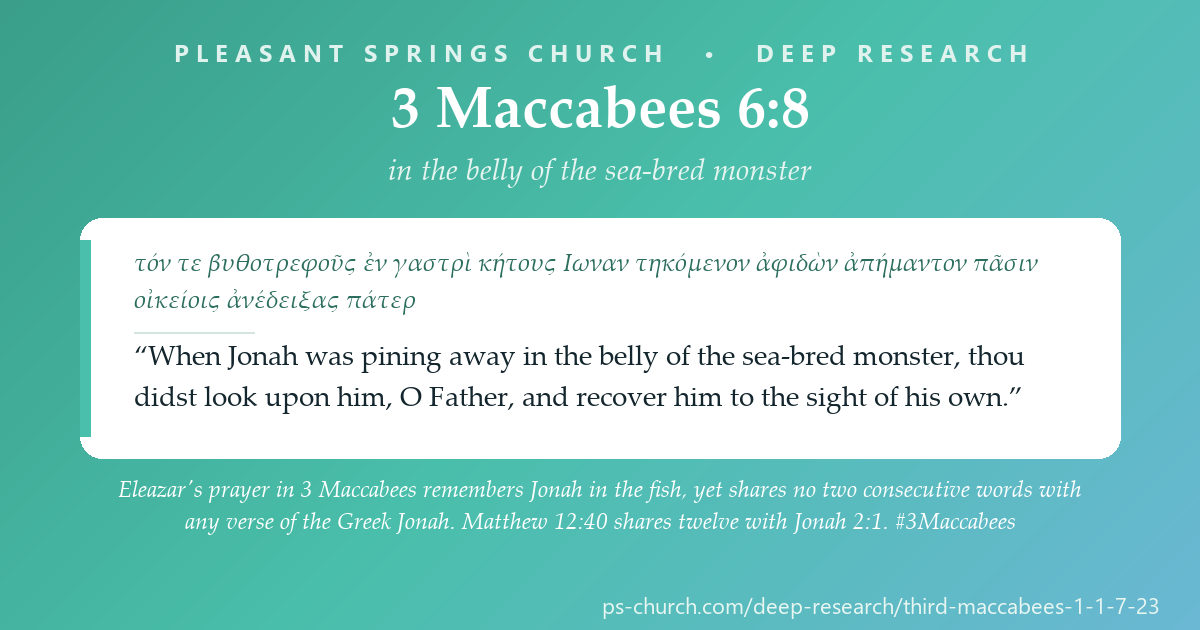
Jonah — and not two consecutive words shared with any verse of the Greek book of Jonah (48 rows). The prayer has ἐν γαστρὶ κήτους; Jonah 2:1 (1:17 in the ESV) has ἐν τῇ κοιλίᾳ τοῦ κήτους. The two verses share single words — the article, in, Jonah’s name, the sea-creature — and never two in a row. Matthew 12:40 shares twelve consecutive words with Jonah 2:1.
One of the two places where a prayer recalls what God said, and the only one introduced with as you said. Simon recalls a promise at 2:10, ἐπηγγείλω διότι, you promised that; Eleazar prays καθὼς εἶπας, as you said. What follows here, ἐν τῇ γῇ τῶν ἐχθρῶν αὐτῶν, stands in four verses of Leviticus 26, and only one of the four also carries the verb form that comes next: Leviticus 26:44. Stage 4.
What follows the second prayer. δύο φοβεροειδεῖς ἄγγελοι, two angels of fearful aspect, visible to everyone but the Jews. Eleazar had asked God to ἐπιφάνηθι, appear (6:9); here the narrator has God ἐπιφάνας, making appear his holy face — another form of the same verb. The first prayer is followed at once too (2:21–22): the king shaken “as a reed” and thrown to the pavement.
The last line of the book. ὁ ῥύστης Ισραηλ, the deliverer of Israel. The noun stands in five of the 30,348 screened units — four in the Psalms, and this one — and nowhere in the Greek New Testament.
Versification — stated, as on every page here, and here in the third state: no Masoretic text and no ESV.
There is no Masoretic/Septuagint/ESV offset to report, because there is neither a Masoretic nor an ESV 3 Maccabees. The shelf’s versification table has no entry for the book, and the page will not manufacture one.
• The Greek: 228 rows, seven chapters of 29 · 33 · 30 · 21 · 51 · 41 · 23, labelled 1:1–7:23, every label a plain chapter and verse.
• The English (Bagster, c. 1900): 228 rows of the same shape and the same labels. Equality of labels was not assumed; it was checked by content. Every proper name in the Greek was looked for in the English row with the same number: 98 of 100 found, and the two misses are paraphrases inside the right row. The ratio of English to Greek words per row runs from 0.80 to 2.38, with no run of rows drifting. Offset: none.
• The King James Apocrypha: no 3 Maccabees (the loader raises). The Clementine Vulgate: no 3 Maccabees. Hebrew: none.
• The canonical verses quoted on this page are cited in Greek numbering with the English numbering beside: Greek Psalm 78:8 = Hebrew and ESV Psalm 79:8; Greek Isaiah 64:6 = Hebrew 64:6 = ESV 64:7; Jonah 2:1 (Greek and Hebrew) = ESV 1:17, printed in the ESV; Leviticus 26:44 has the same number in all three. Greek Esther’s additions are cited by the lettered labels of the Greek file (3:13a–g, 8:12a–x).
The Shape of the Passage
A sequence, with three doublets (pillars and letters counted, prayers read) — NOT a chiasm, NOT parallel panelsWhat is not claimed. The doublets come in the order prayer, pillar, letter — then prayer, letter, pillar. They do not mirror each other and they are not evenly spaced. So the shape is printed as what it is, a sequence, and not as a chiasm or as parallel panels. The colours pair the three doublets; the pillar and letter pairs are counted, the prayer pair is a reading.
⚠️ Where this page sits. As the reference literature summarises the churches’ lists (reported here, not checked against a printed Orthodox Bible), 3 Maccabees is received among the Old Testament books of the Eastern Orthodox churches; it is not in the Roman Catholic canon; and it was not among the Apocrypha of the 1611 King James Bible — measured here: the 1769 King James Apocrypha on this disk has no 3 Maccabees. This library reads it as a Second-Temple witness, files it under Apocrypha / Deuterocanon, and rests nothing taught at Pleasant Springs on it.
Author
Anonymous. Measured over word forms: 18.1 per cent of the book’s 5,110 words are forms found in no other book of the Greek Old Testament screened here — second only to 4 Maccabees (19.6). Eleazar’s Pharaoh is drowned ποντοβρόχους, Jonah’s monster is βυθοτρεφοῦς, and God is μίσυβρι, hater of insolence: each the only occurrence of its stem in the screened Greek Old Testament.
Not a Maccabean book. The name occurs thirty-one times in the screened Greek Old Testament — six in 1 Maccabees, twenty-five in 2 Maccabees — and not once in 3 Maccabees (nor in 4 Maccabees). Nobody called Judas appears in it. The title is the tradition’s, not the text’s: nothing in the book’s own words claims it. Its story opens at the battle of Raphia, which Polybius narrates (Histories 5.79–86) and which is commonly dated to 217 BC — some fifty years before the Maccabean revolt.
When it was written is argued, not known. Victor Tcherikover argued for the early Roman period from the word λαογραφίαν, census, at 2:28 — measured here, the only occurrence of that stem in the screened Greek Old Testament. Earlier datings, from the late second century BC on, are reported in the reference literature, not checked against the works named in Stage 1, none of which was read for this page. Nothing measured on this page decides it.
Audience
Jews of Egypt. The danger is in Alexandria and in the countryside, the deportation is by boat to Schedia, the execution ground is the hippodrome, and the deliverance ends with a festival kept ἐπὶ τὸν τῆς παροικίας αὐτῶν χρόνον, for the time of their sojourning (7:19).
Loyal subjects, in the narrator’s account. The narrator insists that the Jews τὴν μὲν πρὸς τοὺς βασιλεῖς εὔνοιαν καὶ πίστιν ἀδιάστροφον ἦσαν φυλάσσοντες, kept their goodwill and unswerving loyalty towards the kings (3:3). The first letter calls them ill-disposed (3:19, 3:25); the second lays the blame on τῶν φίλων τινὲς, some of the friends (7:3), and says the God of heaven is always fighting on the Jews’ side as a father for his sons (7:6).
And a community drawing its own lines. Near its end the book has the Jews ask and receive leave from the king to put to death those of their own people who had broken the law of God — for their bellies’ sake, the petition says (7:11). More than three hundred are killed (7:15). The page reports what the text says and draws no lesson from it.
Orient on the book, on the king, and on where the book stands among the churches.
Search by topic: Maccabees, Third Book of; Ptolemy IV Philopator; Raphia; Jews in Ptolemaic Egypt; Alexandria; laographia; Esther, Additions to; Apocrypha; anagignoskomena.
Which articles are relevant?
- Anchor Bible Dictionary — its entries on 3 Maccabees, on the Ptolemies, on Alexandria, and on the Greek additions to Esther.
- Eerdmans Dictionary of Early Judaism — its entries on 3 Maccabees, on Egypt and on the Diaspora.
- Dictionary of New Testament Background (IVP) — its entries on the Maccabean books, on Alexandria and on the Ptolemies. Entry titles vary between these works; search by topic. None was read for this page.
- On the text and the canon — any article that says which manuscripts carry the book. Reported, not checked here: 3 Maccabees is in Codex Alexandrinus and not in Codex Vaticanus or Codex Sinaiticus. This disk holds an edited Greek text, not manuscripts.
Bibliography surfaced:
- N. Clayton Croy, 3 Maccabees (Septuagint Commentary Series, Brill, 2006).
- Sara Raup Johnson, Historical Fictions and Hellenistic Jewish Identity: Third Maccabees in Its Cultural Context (University of California Press, 2004).
- Hugh Anderson, “3 Maccabees”, in J. H. Charlesworth (ed.), The Old Testament Pseudepigrapha, vol. 2 (1985).
- Moses Hadas, The Third and Fourth Books of Maccabees (1953).
- C. W. Emmet, “The Third Book of Maccabees”, in R. H. Charles (ed.), The Apocrypha and Pseudepigrapha of the Old Testament, vol. 1 (1913).
- NETS (the New English Translation of the Septuagint), which includes the book. Not the English quoted on this page; named as the obvious next step for a reader.
A Greek historian on the same battle, a Jewish historian on a similar elephant story, and a Greek book of Esther with letters of its own.
Two passages below were read for this study online: Polybius in W. R. Paton’s translation (LacusCurtius) and Josephus in William Whiston’s (Project Gutenberg; a sacred-texts copy of the same translation is also held on this disk). Each is paraphrased with its reference; no wording from either is measured.
Which parallels shed light on the world of the text?
- Polybius, Histories 5.79–86 → 3 Maccabees 1:1–7. Polybius narrates the battle of Raphia between Ptolemy IV and Antiochus III. At 5.81 Theodotus the Aetolian gets into the camp at early dawn, while it is still too dark for his face to be recognised, with two others, and bursts into the tent where the king dined and did business — and does not find him, because the king habitually slept outside his official tent. At 5.83–84 his sister Arsinoe is with the king as he rides along the line before the battle; Polybius mentions neither her hair nor any promise of money. 3 Maccabees tells the attempt with another reason for its failure: Theodotus comes νύκτωρ, by night (1:2), and the king is not there because Δοσίθεος, a Jew by birth who had abandoned the laws, has put an obscure man in his place (1:3); and Arsinoe goes along the ranks with her hair loosed, promising two minas of gold a man (1:4).
- Josephus, Against Apion book 2 (section 5 in Whiston’s division) → 3 Maccabees 5–6. Josephus tells of the Jews of Alexandria, with their children and wives, exposed naked and in bonds to elephants that had been made drunk; the elephants leave the Jews and fall on the king’s friends; the king sees an apparition and is entreated by his concubine; and the Alexandrian Jews keep the day. His king is a later Ptolemy, Physcon (Ptolemy VIII), not Philopator. The page reports the two settings and does not decide between them.
- Greek Esther, Additions B and E → 3 Maccabees 3:12–29 and 7:1–9. A Persian king’s edict to destroy the Jews and his second edict reversing it, each given in full; the Hebrew Esther has neither. Stage 4 measures the four letters against each other. Noah Hacham’s article “3 Maccabees and Esther: Parallels, Intertextuality, and Diaspora Identity” (Journal of Biblical Literature, 2007) studies the relation. It was not consulted for this page.
- Greek Daniel 3 → 3 Maccabees 6:6. The dew in the furnace is a detail of the Greek chapter only. Measured: both Greek texts carry δρόσου at 3:50, inside the 67 rows labelled 3:24–90 — the Prayer of Azariah and the Song of the Three, which the Aramaic chapter does not contain; the Aramaic chapter held here (33 verses) has no word for dew — in Aramaic Daniel it first appears at 4:12 (Hebrew-Bible numbering).
- Ptolemy IV and Dionysus → 3 Maccabees 2:29–30. The enrolled are to be branded with κισσοφύλλῳ, an ivy leaf, the emblem of Dionysus, and offered equal citizenship with the Alexandrians if they join the initiates (2:30). Reported, not checked here: the literature on 3 Maccabees connects these verses with a papyrus edict, published as BGU VI 1211 and assigned to Ptolemy IV, that orders those who perform Dionysiac initiations to register at Alexandria. The papyrus was not read for this page.
One word for the king that the prayers give to Pharaoh, one verb the book shares with a psalm, and one name the book never uses.
Every count is over the 30,348 Greek Old Testament verse units screened here (the Odes excluded) or the 7,927 verses of the Greek New Testament, matched on normalised word forms (accents and breathings dropped). It is not a count over “the Septuagint.” A stem count matches the stated beginning of a word, so it gathers a family of forms; the page says which.
Eleven words beginning thras- in 3 Maccabees, out of 29 in the screened Greek Old Testament — Proverbs is next with seven, two of them the compound thrasykardios (14:14, 21:4). Six are the king (1:26, 2:2, 2:14, 2:21, 2:26, 6:20); four are the oppressors of the past whom the prayers recall — the giants (2:4), Pharaoh twice (2:6, 6:4), Sennacherib (6:5); and one is the citizens of Jerusalem who take courage (1:22). None of the canonical chapters the prayers recall uses the word at all, and the Greek New Testament never does. Of the eighteen occurrences outside 3 Maccabees, one stands in a royal edict: Greek Esther’s first, at 3:13b, where the king disclaims τῷ θράσει τῆς ἐξουσίας, the audacity of authority. The past oppressors are given the word the book uses six times of its own king.
This form stands in two of the 30,348 screened units: 3 Maccabees 2:20 and Psalm 78:8 (79:8 in the Hebrew and the ESV), each time with the same subject, your compassions, and each time inside the same six words. Not in the Greek New Testament.
Forms spelled apograph- stand nine times in the screened Greek Old Testament and seven of them are 3 Maccabees (the other two: 2 Maccabees 2:1 and the Old Greek of Daniel 10:21). The registration of the Jews is the instrument of the persecution — ordered at 2:28–29, run for forty days from sunrise to sunset (4:15), and abandoned when paper and pens fail (4:20). In the Greek New Testament forms spelled apograph- stand four times: Luke 2:1, 2:2, 2:3, and Acts 5:37. The verb of the same family also stands in spellings this count does not gather (apograps-, apegraps-, apogegramm-): 3 Maccabees 6:34, Proverbs 22:20 and Judges (A) 8:14, making twelve in the screened Greek Old Testament; Luke 2:5 and Hebrews 12:23, making six in the New Testament.
Eight occurrences in 3 Maccabees, every one in chapter 5 (5:1–48), counting the two of the elephant-master’s title. In the Greek New Testament the stem occurs once, and it is not an animal: ἐλεφάντινον, ivory, in the merchandise of Babylon.
Thirty-one occurrences in the screened Greek Old Testament: six in 1 Maccabees, twenty-five in 2 Maccabees, none in 3 Maccabees and none in 4 Maccabees. The word is shown here from 1 Maccabees 2:4, where Judas is first named with it. The book this page studies has no occurrence to show.
Counted here, not assumed:
- 228 Greek rows, 5,110 words, chapters of 29 · 33 · 30 · 21 · 51 · 41 · 23 rows. Every label a plain chapter and verse; no lettered rows, no verse-only rows, no unnumbered heading rows.
- Simon’s prayer is 19 rows (2:2–20); Eleazar’s is 14 (6:2–15). Between them they recall seven stories in ten rows (219 words) — 2:4–8 and 6:4–8 — and the other 23 rows (462 words) invoke, confess and ask.
- The two letters: the first is eighteen rows and 417 words (3:12–29), the second nine rows and 215 words (7:1–9). They open with the same six words.
- The word for pillar: twice, 2:27 and 7:20. The book’s persecution begins with an inscription on a pillar and its festival ends with one.
- The book has no Maccabee in it. No form of the name, and no Judas.
- Many of the book’s word forms are its own. 18.1 per cent of its words are forms found in no other book screened here; 4 Maccabees, at 19.6, is the only book higher. Forms, not lemmas: an unusual inflection of a common verb counts.
Seven stories retold without the canonical wording, two petitions with it, four royal letters, and a New Testament that never comes closer than four words.
Every 3 Maccabees row screened against the other 30,120 units of the screened Greek Old Testament, and against all 7,927 verses of the Greek New Testament. Contiguous runs of whole word forms; the tie band — how many verses reach the same depth — beside every run, from both sides where a pairing is discussed. The screen finds verbatim contact, not allusion, and never says which text came first.
The two lists of old stories, measured against the chapters they recall:
Simon’s prayer recalls three judgments on the arrogant — the giants, Sodom, Pharaoh (with Israel brought safely through the sea, 2:7). Eleazar’s recalls two oppressors destroyed — Pharaoh again, and Sennacherib — and three servants rescued — the three in the furnace, Daniel, Jonah. Each line was screened against the Greek of the chapters it recalls, and against the whole screened Greek Old Testament.
| Row | Story recalled | Canonical Greek searched | Deepest run there | Deepest run anywhere in the screened Greek OT |
|---|---|---|---|---|
| 2:4 | the giants and the flood | Genesis 6–8 (68 rows) | 2, band 1 — γίγαντες ἦσαν (Gen 6:4) | 2, band 66 |
| 2:5 | Sodom | Genesis 18–19 (71 rows) | 1 — no two consecutive words | 2, band 51 |
| 2:6 | Pharaoh and the plagues | Exodus 1–15 (415 rows) | 3, band 6 — τὸν λαόν σου | 4, band 4 |
| 2:7 | Pharaoh at the sea | Exodus 1–15 | 3, band 1 — σὺν ἅρμασιν καὶ (Exod 15:19) | 3, band 1 |
| 2:8 | those brought through praise | Exodus 1–15 | 2, band 1 | 2, band 21 |
| 6:4 | Pharaoh and his chariots | Exodus 1–15 | 1 — no two consecutive words | 2, band 12 |
| 6:5 | Sennacherib | 2 Kings 18–19, Isaiah 36–37, 2 Chronicles 32 (167 rows) | 2, band 4 | 3, band 1 |
| 6:6 | the three in the furnace | Daniel 3, both Greek texts (194 rows) | 3, band 1 — τοὺς κατὰ τὴν | 3, band 1 |
| 6:7 | Daniel among the lions | Daniel 6 and Bel, both Greek texts (138 rows) | 2, band 7 | 2, band 25 |
| 6:8 | Jonah in the fish | all of Jonah (48 rows) | 1 — no two consecutive words | 2, band 51 |
Across the ten rows the deepest run into the chapters recalled is three words. Two of the three-word runs are small words — τὸν λαόν σου, your people, and τοὺς κατὰ τὴν, those in the. Three rows share no two consecutive words with the chapters they recall: Sodom, Eleazar’s Pharaoh, and Jonah. Against the whole screened Greek Old Testament the deepest is four, at 2:6, and it is τὸν λαόν σου τὸν — your people, the — shared with four other verses (band 4).
⚠️ The third three-word run is the exception, and the page prints it. Simon’s Pharaoh pursues σὺν ἅρμασιν καὶ, with chariots and; Exodus 15:19 has Pharaoh’s cavalry go into the sea σὺν ἅρμασιν καὶ. In the 30,348 screened units that sequence stands in two — these two — and 2:7’s deepest partner anywhere is Exodus 15:19 alone. From the Exodus side it is not mutual: Exodus 15:19’s own deepest partner is Exodus 14:29, at eleven words. Three words in the right verse is real contact, and it is still three words.
The New Testament recalls one of the same stories in the canonical words. ἐν τῇ κοιλίᾳ τοῦ κήτους [our literal gloss: in the belly of the sea-monster] — Matthew 12:40 shares twelve consecutive words with Jonah 2:1 (ESV Jonah 1:17: “And the Lord appointed a great fish to swallow up Jonah. And Jonah was in the belly of the fish three days and three nights.”). Eleazar’s Jonah line reaches one word against any verse of Jonah, and one against Matthew 12:40.
Where the prayers ask — and the wording is shared:
Simon, 2:20 → Psalm 78:8 (79:8 in the Hebrew and ESV) — six words, tie band 1 from both sides. ταχὺ προκαταλαβέτωσαν ἡμᾶς οἱ οἰκτιρμοί σου — and the psalm, ταχὺ προκαταλαβέτωσαν ἡμᾶς οἱ οἰκτιρμοί σου (ESV Ps 79:8: “Do not remember against us our former iniquities; let your compassion come speedily to meet us, for we are brought very low.”). In the 30,348 screened units the six-word sequence stands in exactly these two, and Psalm 78:8’s deepest partner in the whole screened Greek Old Testament is 3 Maccabees 2:20 alone. It is one of only three rows of the book that reach six against any other Greek Old Testament unit.
Eleazar, 6:15 — the only as you said in either prayer. (Simon also recalls what God said, at 2:10: you promised that, if we come to this place and pray, you will hear.) καθὼς εἶπας ὅτι οὐδὲ ἐν τῇ γῇ τῶν ἐχθρῶν αὐτῶν ὄντων ὑπερεῖδον αὐτούς [our literal gloss: as you said: ‘not even when they were in the land of their enemies did I overlook them’]. The six words ἐν τῇ γῇ τῶν ἐχθρῶν αὐτῶν stand in five screened units — this verse and Leviticus 26:36, 39, 41 and 44. The verb form ὑπερεῖδον stands in five. The only Greek Old Testament verse carrying both is Leviticus 26:44: οὐδ' ὧς ὄντων αὐτῶν ἐν τῇ γῇ τῶν ἐχθρῶν αὐτῶν οὐχ ὑπερεῖδον αὐτοὺς [our literal gloss: not even so, while they were in the land of their enemies, did I overlook them]. The prayer marks what follows as God’s own word, and the measurement finds which verse carries it.
And the same verse ties at six with a second text. οὐκ ἀπέστρεψας τὸ πρόσωπόν σου ἀφ' ἡμῶν [our literal gloss: you have not turned your face from us]; Isaiah 64:6 (64:7 in the ESV) reads ὅτι ἀπέστρεψας τὸ πρόσωπόν σου ἀφ' ἡμῶν [our literal gloss: because you have turned your face from us]. Same six words; Isaiah says God has turned his face away, the prayer says he has not. Isaiah 64:6’s deepest partner in the screened Greek Old Testament is 3 Maccabees 6:15 alone; from the 3 Maccabees side the band is 5, because the four Leviticus verses tie at six with a different phrase.
The distribution, both prayers. Of the 23 rows that invoke and ask, two reach six, three reach five or more, and seven reach four or more; of the ten rows that recall the old stories, none reaches five and one reaches four. The petitions are not uniformly deep — five of Eleazar’s reach only two — but every run of five or more in the two prayers is in a petition. Simon’s opening κύριε κύριε βασιλεῦ stands in three units: here, Moses’ intercession at Deuteronomy 9:26, and Mordecai’s prayer in Greek Esther (4:17b).
Two kings’ letters — 3 Maccabees and Greek Esther:
3 Maccabees gives the text of two letters of Philopator: 3:12–29 (18 rows, 417 words), ordering the Jews of Egypt brought in chains to die, and 7:1–9 (9 rows, 215 words), releasing them. Greek Esther gives the text of two edicts of Artaxerxes: Addition B, 3:13a–g (7 rows, 245 words), ordering the Jews destroyed, and Addition E, 8:12a–x (21 rows, 471 words), reversing it. Every letter row was screened against every edict row.
Two runs of four, one of three, and nothing else above two.
- 3:19 ↔ Esther 8:12c — four words, band 1 from both sides across the whole screened Greek Old Testament. καὶ τοῖς ἑαυτῶν εὐεργέταις and καὶ τοῖς ἑαυτῶν εὐεργέταις. The sequence stands in these two units and nowhere else in the screened Greek Old Testament or the Greek New Testament. In 3 Maccabees it is the king’s charge against the Jews; in Esther E it is the king’s charge against many who, honoured by their benefactors, scheme against them.
- 3:25 ↔ Esther 3:13f — four words. σὺν γυναιξὶ καὶ τέκνοις and σὺν γυναιξὶ καὶ τέκνοις, with wives and children, in each destruction order. From the 3 Maccabees side the band is 1; from the Esther side it is 3, because Esther 3:13f also shares of the twelfth month Adar with 2 Maccabees 15:36 and Esther 8:12s. With the movable final nu allowed, the same words also stand in 2 Maccabees 12:3 and in Acts 21:5.
- 7:8 ↔ Esther 8:12s — three words, ἐν παντὶ τόπῳ, in every place — a formula, not a link: the same three words stand in seventeen of the 30,348 screened units (this verse and Esther 8:12s among them) and in four New Testament verses, and against the rest of the screened Greek Old Testament 7:8’s deepest run is three, tied by eighteen units.
The letter formulae are each book’s own. Each book’s two letters open alike — 3 Maccabees’ with six identical words, Esther’s with thirteen from βασιλεὺς μέγας Ἀρταξέρξης on — but between the books the headings share no two consecutive words, only single ones: βασιλεὺς (king), τοῖς, καὶ, and, with Edict E, the bare greeting χαίρειν (8:12b). 3 Maccabees greets with χαίρειν καὶ ἐρρῶσθαι (in the screened Greek Old Testament, only its two letters) and closes with ἔρρωσθε (five units: four in 2 Maccabees and this one; in the New Testament, Acts 15:29 only). Esther has no form of that farewell word anywhere.
And the same sanction in different words. Both books threaten the place that defies the edict — in 3 Maccabees, any place found sheltering a Jew; in Esther, any city or country that does not act on it — with fire and with being made untrodden for ever: ἄβατος καὶ πυριφλεγὴς γινέσθω and δόρατι καὶ πυρὶ καταναλωθήσεται … ἄβατος. Measured run between the two verses: two — τὸ σύνολον. Same threat, own words: the pattern of the prayers again.
The New Testament: the distribution, and both sides of every run of four:
3 Maccabees, 228 rows, against the 7,927 verses of the Greek New Testament: 226 reach two, 121 reach three, eight reach four, and nothing reaches five. Two rows share no two consecutive words with any New Testament verse: 6:2, the opening of Eleazar’s prayer, and 6:32.
That is a low ceiling, measured against the shelf. Of the 58 Greek Old Testament texts screened here (six books held in two recensions each, counted separately), 34 run to five thousand words or more, and only two of those never reach five consecutive words with the New Testament: 3 Maccabees and the Wisdom of Solomon. Against the rest of the Greek Old Testament the same holds: 3 Maccabees reaches six at most (three rows), and every one of the 33 texts longer than it reaches seven or more.
| 3 Macc | The four words | New Testament | Band among NT verses | Greek OT units carrying the four words | The NT verse’s own band among Greek OT units |
|---|---|---|---|---|---|
| 2:10 | εἰς τὸν τόπον τοῦτον | Luke 16:28 | 1 | 17 | 17 |
| 2:19 | τὰς ἁμαρτίας ἡμῶν καὶ | Luke 11:4 | 1 | 5 | 5 |
| 2:30 | δέ τινες ἐξ αὐτῶν | Acts 11:20 | 1 | 1 | 1 |
| 3:1 | ἐπὶ τὸ αὐτὸ καὶ | Acts 2:44; 1 Cor 14:23 | 2 | 16 | 16 |
| 3:17 | εἰσελθεῖν εἰς τὸν ναὸν | Revelation 15:8 | 1 | 1 | 4 |
| 3:25 | σὺν γυναιξὶ καὶ τέκνοις | Acts 21:5 | 1 | 3 | 6 |
| 4:11 | εἰς τὴν πόλιν καὶ | seven verses (Mark 5:14, 14:13, 14:16; Luke 8:34; John 4:28; Acts 9:6, 14:20) | 7 | 15 | 15–18 at four; Mark 14:16 reaches six and Acts 14:20 five, elsewhere |
| 7:13 | καὶ πᾶν τὸ πλῆθος | Luke 1:10 | 1 | 3 | 3 |
Read across a row before reading anything into it. Four of the eight are formulae that the Greek Old Testament carries five to seventeen times. Two more are sequences it carries three times — with wives and children, and all the multitude. The last two are four-word sequences that stand in one Greek Old Testament unit and one New Testament verse, and they are the page’s first counter-example: the pair that looks most like contact has a twin.
⚠️ The page’s own counter-examples:
3:17 → Revelation 15:8. εἰσελθεῖν εἰς τὸν ναὸν and εἰσελθεῖν εἰς τὸν ναὸν [our literal gloss: to enter into the sanctuary]. The king writes that the Jews forbade him to enter the sanctuary; Revelation says that no one could enter the sanctuary until the seven plagues were finished. The four-word order stands in one Greek Old Testament unit and one New Testament verse, and the 3 Maccabees band is 1. On the theme of this book it looks like the find of the page.
2:30 → Acts 11:20 measures as well, and from the New Testament side better. δέ τινες ἐξ αὐτῶν and δέ τινες ἐξ αὐτῶν [our literal gloss: but some of them]: the decree’s clause that any Jews who join the initiates shall be citizens equal with the Alexandrians, and the men of Cyprus and Cyrene who spoke to the Hellenists at Antioch. Four words, unique in both corpora, band 1 from both sides — where Revelation 15:8’s own band among Greek Old Testament units is 4. No reader would call but some of them a link. The number cannot tell these two apart, so the page claims neither. Note also that the temple run depends on word form: the participle in Luke 1:9, entering the sanctuary, does not match.
6:38 → 1 Maccabees 4:59 — the verse that institutes Hanukkah. πέμπτης καὶ εἰκάδος τοῦ and πέμπτης καὶ εἰκάδος τοῦ, the twenty-fifth of the: four words, band 1 from the 3 Maccabees side, and in the screened Greek Old Testament these two units only. From the other side it is not mutual: 1 Maccabees 4:59’s own deepest partners are Genesis 50:8 and 50:22, at seven words. It is a date. 1 Maccabees means the twenty-fifth of Chislev; 3 Maccabees means the twenty-fifth of Pachon, the day the enrolment began. The book with no Maccabee in it comes nearest the Hanukkah verse in a calendar formula — its next-deepest contact with that verse is three words, μετ' εὐφροσύνης καὶ, with gladness and, a sequence nine screened units carry.
1:4 → 2 Maccabees 12:11 — the third of the book’s three six-word runs, band 1 from both sides. γενομένης δὲ καρτερᾶς μάχης καὶ τῶν [our literal gloss: a hard battle having been fought, and of the]. In 3 Maccabees the next words are Antiochus’s fortunes; in 2 Maccabees they are the men of Judas. The opening of a battle report — and the verse it is shared with names Judas, which is as near as this book’s wording comes to a Maccabee.
It settles that the two prayers do not retell the old stories in the canonical Greek wording. On this corpus, with this screen, no story line shares more than three consecutive words with the chapters it recalls, while the petitions carry the book’s two six-word runs into books of the Hebrew Bible (its third six is with 2 Maccabees), and one of them is introduced as God’s own word.
It does not settle why. A writer with a free hand, a different Greek Bible, a liturgical habit of retelling history in fresh words — the measurement cannot tell these apart, and the page does not choose. Nor can it see allusion: the story lines are allusions by definition. What it shows is what they are not.
And it does not settle that the New Testament never touches the book. It settles that the deepest verbatim contact is four words, and that every run of four is a formula the Greek Old Testament carries five times or more, a sequence it carries three times, or one of the two pairs the page prints side by side.
What this page could not check, and where it is weakest.
This is the section that makes the shelf trustworthy.
⚠️ What this page could NOT check:
- Any Semitic text. None is known for this book, and none is held. The Hebrew-side screens cannot run, and nothing here depends on a Hebrew or Aramaic original.
- The manuscripts. This disk holds one edited Greek text. Which codices carry the book, and how they differ, is reported from the handbooks and not checked.
- The Greek behind the English. The c. 1900 volume prints its own Greek beside the English, and it is not the CATSS text. One difference is legible in the scan of that volume: at 2:3 it prints prassontas ti where CATSS has τι πράσσοντας. The English column is a witness to that edition, not a translation of the Greek printed beside it here; only its verse division has been aligned, by content.
- The commentaries. Croy, Johnson, Anderson, Hadas and Emmet are named in Stage 1 and were not read for this page; nor was Hacham on 3 Maccabees and Esther. The date argument attributed to Tcherikover is reported from the literature, not from his article.
- Polybius and Josephus. Read online for the two passages named in Stage 2, in Paton’s and Whiston’s translations; not measured. Polybius is not held on this disk; Whiston’s Against Apion 2 is (a sacred-texts copy), and the self-check confirms that its section 5 carries each detail of the Stage 2 summary. The Dionysiac papyrus is reported, not read.
- Allusion. The run engine finds contiguous identical word forms. It cannot see a paraphrase, and a story line that shares one word with its source is not shown to be independent of it.
⚠️ Where this page is weakest:
- The line between ‘story’ rows and ‘petition’ rows is the page’s own. It is drawn by reading: 2:4–8 and 6:4–8 recall the past, the rest invoke and ask. Two rows are borderline — 2:8 (who saw your works and praised you) and 6:3 (look upon the seed of Abraham). Moving either across the line changes none of the depths reported: 2:8 and 6:3 each reach only two against the whole screened Greek Old Testament.
- ‘The chapters recalled’ is a choice. Sodom is also recalled in Wisdom, Sirach and the prophets, and Pharaoh in the Psalms. That is why the whole-Greek-Old-Testament column is printed beside each row: no unit anywhere shares more than four consecutive words with any story line.
- ‘Judgments’ and ‘rescues’ are the page’s reading. Simon’s list is introduced by God who judges the insolent (2:3); Eleazar’s names two oppressors destroyed (6:4–5) and three servants brought out alive (6:6–8). Pharaoh stands in both lists, and the labels sort rows; they measure nothing.
- Polybius and Josephus rest on reading in English translation. Both were read online for this page, and neither Greek text of those passages is held here. The Polybius summary cannot be re-derived by the page’s self-check; the Josephus summary is checked, in English only, against the copy of Whiston held on this disk.
- The English is a weaker column than the shelf’s usual one. It is quotation from a named public-domain edition whose own Greek differs from the CATSS Greek it sits beside. Its rows were aligned by content, not by label: 100 occurrences of proper names in the Greek were looked for in the same-numbered English row and 98 were found; the two misses are paraphrases within the row (2:6 thy people for your holy people Israel; 7:10 those of their race for those of the race of the Jews).
- The comparisons with other books are over this shelf’s files. “A low ceiling” is measured against the 58 texts screened here (recensions counted separately), with recension partners (Tobit, Daniel, Susanna, Bel, Judges, Joshua) kept out of each other’s targets. It is not a claim about the Septuagint.
- The canon summary is a summary. The churches’ lists are stated as the reference works state them; the page does not adjudicate them and the shelf does not measure them.
Commentaries & studies:
- N. Clayton Croy, 3 Maccabees (Brill, 2006).
- Sara Raup Johnson, Historical Fictions and Hellenistic Jewish Identity (2004).
- Hugh Anderson, “3 Maccabees”, in The Old Testament Pseudepigrapha 2 (1985).
- Noah Hacham, “3 Maccabees and Esther: Parallels, Intertextuality, and Diaspora Identity”, Journal of Biblical Literature (2007).
- Victor Tcherikover, “The Third Book of Maccabees as a Historical Source of Augustus’ Time”, Scripta Hierosolymitana 7 (1961).
- Polybius, Histories 5.79–86, tr. W. R. Paton; Josephus, Against Apion 2, tr. W. Whiston.
A book about a king who wanted into the holy place, and two prayers that remember in their own words.
Name what you learned, why it matters, and one concrete response.
What should we carry away — and do?
- Remembering is not quoting. Two priests under threat recall seven old stories, and recall them in words of their own — even the belly of Jonah’s sea-creature is a different word from the one in Greek Jonah. Why, the measurement cannot say; see the end of Stage 4.
- But when they ask, the wording is shared. Six Greek words — quickly let your compassions come first to meet us (our literal gloss) — stand word for word in Simon’s petition and in the Greek Psalter (78:8), and Eleazar holds God to a promise found in Leviticus 26:44 with as you said. The page does not say which came first.
- The book about the Maccabees that has no Maccabees in it. A title is a library’s label. Measure the book, not the spine.
- The deepest-looking link is sometimes an accident. To enter the sanctuary and but some of them measure the same.
- One concrete response. Pray Psalm 79:8–9 this week in the ESV, and then tell God — in your own words — one deliverance you remember.
3 Maccabees 6:8 · to share
Greek (CATSS) · English (Bagster, c. 1900)Every Deep Research page traces its passage across the whole sweep — the Old Testament, the Second-Temple world between the testaments (historical witnesses, not Scripture), and the New Testament. Follow the thread:
Pleasant Springs Church — Deep Research
Research method after Michael S. Heiser’s Bible Research Method (examine dictionaries → ancient literature → important words → textual connections → academic publications → share), with the Pleasant Springs “Author & Audience” foundation. Scripture set in the Hebrew, the Greek editions named on each page and the ESV (Old Testament), and the Greek New Testament and the ESV (New Testament), per the practice of Pleasant Springs Church. ⚠️ Status: 3 Maccabees is not part of the Protestant canon or of the Roman Catholic; as the reference literature summarises it, it is received among the Old Testament books of the Eastern Orthodox churches. This study is filed under Apocrypha / Deuterocanon and nothing taught at Pleasant Springs rests on it. Greek text: the CATSS morphologically analysed Septuagint (file 3Macc.mlxx), quoted at verse level with attribution; every row count, run depth and tie band was re-derived from the files for this study. English: the anonymous translation printed in Bagster’s Septuagint with Apocrypha (London, c. 1900), public domain in the United States — made for that edition and not Brenton’s own — quoted verbatim from the eBible.org verse-per-line digitisation held here with its provenance; every English line on this page is checked character for character against that file by the page’s self-check. No ESV, King James or Vulgate text of this book exists on this disk; the two canonical verses printed in the ESV (Psalm 79:8 and Jonah 1:17) come from the shelf’s cached chapters, and every other English rendering of a canonical or New Testament verse is our own literal gloss, marked. Polybius and Josephus were read online in translation for two passages and are not measured. Direction of influence is nowhere asserted. Croy, Johnson, Anderson, Hadas, Emmet, Hacham and Tcherikover are named and were not consulted.
Scripture quotations marked ESV are from the ESV® Bible (The Holy Bible, English Standard Version®), © 2001 by Crossway, a publishing ministry of Good News Publishers. ESV Text Edition: 2016. Used by permission. All rights reserved. The ESV text may not be quoted in any publication made available to the public by a Creative Commons license, and the ESV may not be translated in whole or in part into any other language. www.esv.org
|
Did this study bless you today? 💚 Give to Support PS Church100% of gifts go to the General Fund — thank you. |