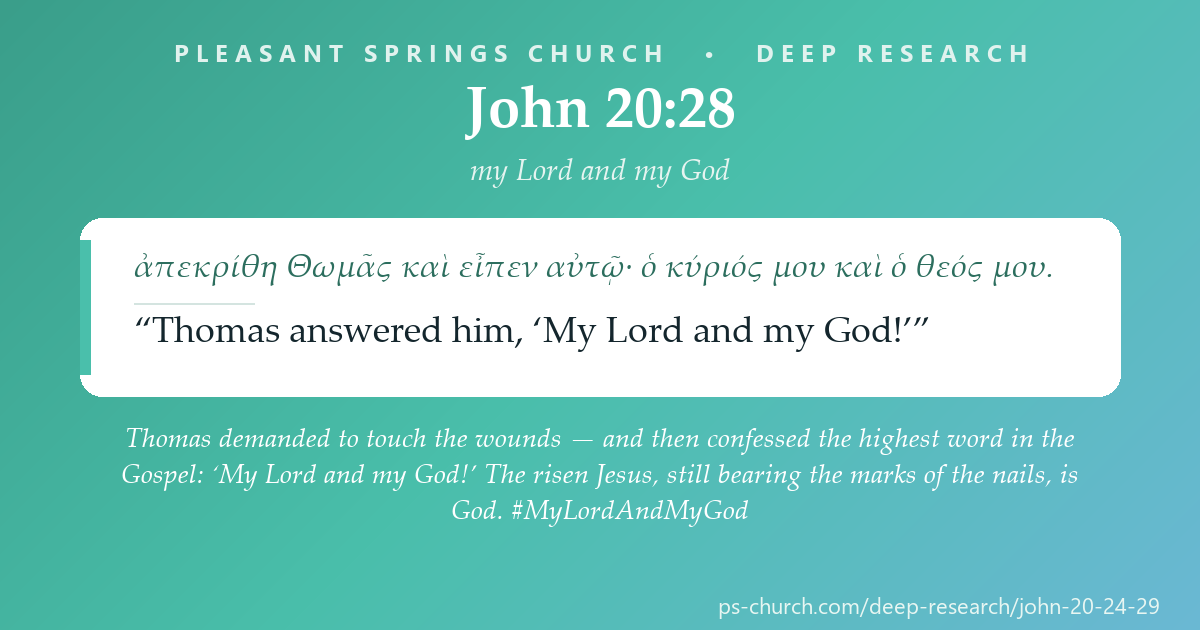
“My Lord and my God!” Thomas would not believe on the others’ word — “unless I see the mark of the nails… I will never believe.” Eight days later the risen Jesus comes through locked doors and meets his exact demand: “Put your finger here… do not disbelieve, but believe.” And Thomas answers with the climactic confession of the whole Gospel, spoken to Jesus’ face — the risen Christ is Lord and God. This study works John 20:24–29 — doubting Thomas — from a demand to touch the wounds to the beatitude on all who have not seen and yet believe. See the method →
John 20:25–29
Greek NT · ESVThe Shape of the Passage
Ring compositionThe risen Jesus meets a disciple who refuses secondhand faith — and draws from him the climactic confession of the whole Gospel. Thomas’ “My Lord and my God” answers the prologue’s “the Word was God”; the Gospel opens and closes calling Jesus God.
Author
John saves his highest note for last. From the opening line — “the Word was God” (1:1) — the Gospel has been building toward a moment when a human being will look at the crucified-and-risen Jesus and call him exactly that. Thomas is that moment. He will not believe on the others’ report; he demands to see and touch the wounds. And when Jesus meets him, Thomas does not merely say “you are risen” — he says, “My Lord and my God!” The two titles (ho kyrios mou kai ho theos mou) are spoken, the narrator says, to him (20:28): Jesus is the addressee. And Jesus does not correct him, as creatures do when wrongly worshiped (Acts 10:26; Rev 22:9); he receives the confession and blesses the faith behind it. The Gospel that began “the Word was God” ends with a man saying it to Jesus’ face.
Doubt met, not scorned. Thomas is not the villain of the story. Jesus gives him precisely the evidence he asked for — “Put your finger here” — and the wounds are real: the marks of the nails, the pierced side, a body genuinely raised and genuinely his. The risen Christ is no phantom (cf. “flesh and bones,” Luke 24:39), though gloriously changed (he comes through locked doors). Faith and evidence are not enemies here; Jesus supplies the evidence and then pronounces a blessing on all who will believe on the strength of the testimony now written down.
Audience
Thomas — and every later reader. The beatitude of 20:29 (“Blessed are those who have not seen and yet have believed”) reaches past the room to us. We do not get to put our fingers in the wounds; we get the apostolic testimony, and John tells us plainly why he wrote it: “these are written so that you may believe that Jesus is the Christ, the Son of God, and that by believing you may have life in his name” (20:31). This is not a blessing on believing without evidence but on believing on the right evidence — the reliable witness of those who did see.
One God, and the Son confessed as God. A first-century Jew like Thomas held the Shema: “the Lord our God, the Lord is one” (Deut 6:4); to call any creature “my God” would be blasphemy. That Thomas says it to Jesus — and Jesus accepts it — means Thomas is confessing the risen Christ as the one God of Israel, not a second god beside him. This is the deity of the Son held within Jewish monotheism: the Son is God of God, distinct in person from the Father yet one in being. Thomas’ cry is the Gospel’s whole Christology in four words.
Orient on the resurrection appearances, the deity of Christ, faith, and doubt.
Search by topic: resurrection appearances, deity of Christ / Christology, faith and doubt, Thomas, confession.
Which articles are relevant?
- Anchor Bible Dictionary — “Resurrection,” “Christology,” “Thomas,” “Faith.”
- Dictionary of Jesus and the Gospels — “Resurrection,” “God,” “Christology,” “Faith.”
- NIDNTT / TDNT — κύριος (kyrios, Lord), θεός (theos, God), πιστεύω (pisteuō, believe).
Bibliography surfaced:
- D. A. Carson (Pillar), Craig Keener (2 vols.), Raymond Brown (Anchor Yale), Andreas Köstenberger (BECNT), J. Ramsey Michaels (NICNT) on John.
- Richard Bauckham, Jesus and the God of Israel; Murray Harris, Jesus as God.
- Beale & Carson, Commentary on the NT Use of the OT (John).
A Jew confessing a Jew as God, and the reality of the risen body.
Read Thomas’ confession against the hard monotheism of his world, then weigh the tangible wounds and the beatitude on faith.
Which parallels shed light on religion and worldview?
Why the confession is staggering. First-century Judaism was famously uncompromising: worship and the title “God” belonged to the Creator alone. Jews would offer sacrifice for Caesar but never to him (Josephus records their refusal), and the Wisdom of Solomon mocks those who deify rulers and creatures (Wis 13–15; a witness, not Scripture). Against that backdrop, a Jew addressing a fellow Jew as “my God” is either blasphemy or the highest truth — and Jesus’ acceptance of it settles which. Thomas’ words closely echo the psalmist’s cry to the God of Israel, “my God and my Lord” (Ps 35:23), now reordered and spoken to the risen Jesus. (When John’s Gospel circulated, the emperor Domitian was demanding to be styled “our lord and god” — making the confession of the crucified Jesus as “my Lord and my God” a pointed counter-claim.)
The wounds are real. Jesus meets Thomas’ exact terms: see the mark of the nails (τύπος, the imprint left in the flesh), reach into the pierced side. The risen body is the same body that was crucified — continuous, physical, touchable — and yet transformed (it passes through locked doors). John insists on this against every “merely spiritual” or visionary theory of the resurrection: the tomb was empty, and the One who stands before Thomas still bears the marks of the cross.
The beatitude on later faith. “Blessed are those who have not seen and yet have believed” (20:29) is not a rebuke of Thomas for wanting evidence — Jesus gave him the evidence. It is a benediction on everyone who will come after, who cannot touch the wounds but can trust the testimony of those who did. And John tells us that testimony is now a book: “these are written so that you may believe” (20:31). The blessing rests on Scripture-grounded faith — not credulity, but reliance on the reliable witness of the apostles.
- Psalm 35:23; Isaiah 45:22–23; Deuteronomy 6:4 — “my God and my Lord”; “I am God, and there is no other… to me every knee shall bow”; the Shema: the exclusive worship of the one God that Thomas confesses of Jesus.
- Luke 24:39; John 20:20, 26 — “flesh and bones… touch me”; the hands and side shown; through locked doors: the real, glorified body.
- John 1:1, 18; 1 John 5:20 — “the Word was God”; “the only God… has made him known”; “he is the true God and eternal life”: the deity of the Son framing the Gospel.
The attempts to soften Thomas’ confession all founder on the same rock: the text will not let it be anything less than what it says. Some have wanted to read it as a startled oath flung heavenward — “my God!” in the modern sense — but the narrator blocks that escape: Thomas “said to him” (20:28), and Jesus is unmistakably the one addressed. Others have wanted “God” here to mean something thinner than full deity, but the article rules that out: it is not “a god” but “the God” — and it lands in a Gospel that opened by calling the Word God and will not tolerate a second deity beside the one God of Israel. The only reading the grammar and the context allow is the one the church has always heard: Thomas, a monotheist Jew, looks at the wounds of the crucified and confesses the risen Jesus as his Lord and his God. And the crowning detail is Jesus’ response. When Barnabas and Paul are taken for gods at Lystra they tear their clothes in horror (Acts 14:14–15); when John falls at an angel’s feet he is told, “You must not do that… worship God” (Rev 22:9). Jesus does the opposite: he accepts the confession and blesses the faith it expresses. The Gospel that began “the Word was God” ends with a man saying it to Jesus — and Jesus saying, in effect, yes.
The vocabulary of confession, the wounds, and faith.
Watch the two articular titles addressed to Jesus, the tangible “mark of the nails,” and the beatitude on unseen faith.
“My Lord and my God” — two articular nouns (the Lord, the God) in the nominative used as a direct address to Jesus (a standard Koine idiom). The narrator’s “said to him” binds both titles to Jesus. The Gospel’s climactic confession of Christ’s deity; an inclusio with 1:1.
“God” — here articular (ho theos) and predicated of the risen Jesus, the strongest possible confession. Answers the anarthrous theos of 1:1 (“the Word was God”): the Gospel opens and closes calling Jesus God.
“The mark of the nails” — the visible imprint left in the crucified-and-risen body. Underscores a physical resurrection continuous with the pierced body (cf. Luke 24:39, “flesh and bones”) — against docetism.
“Do not become unbelieving but believing” — a present imperative framing belief as a state to enter and hold. The pist- root saturates the scene (25, 27, 29) and ties to the purpose statement (20:31, “that you may believe”).
“Blessed” — a beatitude (as in Matt 5) on later believers who trust the written apostolic testimony without seeing. Not a rebuke of evidence but a blessing on Scripture-grounded faith, pointing to 20:31.
How the New Testament fills out the confession:
- John 1:1, 18; 20:30–31 — “the Word was God”; “the only God… has made him known”; the purpose statement: the deity of the Son and the aim of the book.
- Romans 10:9–13; Philippians 2:9–11; Titus 2:13 — “Jesus is Lord”; “every knee… every tongue” (Isa 45); “our great God and Savior Jesus Christ”: the confessed deity of Christ.
- 1 John 5:20; Revelation 22:8–9 — “he is the true God”; the angel refuses worship (unlike Jesus, who receives it): the risen Christ rightly worshiped.
- 1 Peter 1:8–9 — “though you have not seen him, you love him… you believe”: the blessing of 20:29 in the church’s life.
From 'the Word was God' to 'My Lord and my God.'
Trace the deity of the Son from the prologue, through the wounds shown, to the church’s worship of the risen Christ.
Which cross-references matter?
- Deuteronomy 6:4; Isaiah 45:22–23; Psalm 35:23 — the Shema; “I am God… every knee shall bow”; “my God and my Lord”: the one God Thomas confesses of Jesus.
- John 1:1–18; 5:18; 10:30–33 — the Word was God; “making himself equal with God”; “I and the Father are one”: the deity claimed and now confessed (see In the beginning was the Word).
- John 19:34–37; 20:20, 27 — the pierced side; the hands and side shown: the wounds that prove the risen body (see It is finished).
- John 20:1–18; Matthew 28:9, 17 — “I have seen the Lord”; the risen Christ worshiped: the resurrection confessed (see the empty tomb, the Great Commission).
- Romans 10:9–13; Philippians 2:9–11 — “Jesus is Lord”; the name above every name: the confession the whole church makes.
It has become fashionable to imagine that the deity of Christ was a late idea, imported into a simpler Jewish faith by Greek philosophy centuries after Jesus. Thomas’ confession is one of the texts that make that story impossible. Here, at the climax of the most Jewish and most theological of the Gospels, a first-century Jewish disciple looks at the risen Jesus and includes him within the unique identity of the one God of Israel — “my Lord and my God.” This is not the language of a demigod or an exalted hero; it is the language the Old Testament reserves for YHWH alone, now spoken to the crucified and risen Jesus, and accepted by him. And it is not a lapse into polytheism, because the Gospel has been careful throughout: the Son is distinct from the Father (he prays to him, is sent by him, returns to him) and yet shares his very being (“the Word was God”; “I and the Father are one”). What Thomas confesses, and what the church later spelled out at Nicaea, is not a new god but the astonishing truth that the one God of Israel has a Son who is himself God — and that this God has hands that still bear the marks of the nails. To confess Christ’s deity is not to leave Jewish monotheism behind but to see it opened up around the risen Jesus.
The scholarship on John 20:24-29.
The commentators on the Thomas pericope; the studies of Johannine Christology and the purpose statement.
Commentaries & studies:
- D. A. Carson (Pillar), Craig S. Keener (2 vols.), Raymond E. Brown (Anchor Yale), Andreas J. Köstenberger (BECNT), J. Ramsey Michaels (NICNT) on John.
- Richard Bauckham, Jesus and the God of Israel; Murray J. Harris, Jesus as God.
- Bruce Metzger on the John 20:31 pisteu[s]ēte variant (aorist vs. present).
Interpretation notes worth keeping:
- A confession, not an oath. “My God” is addressed to Jesus (20:28, “said to him”) and accepted by him — not a startled exclamation to the Father. The Arian/Socinian dodge fails on the grammar and the context.
- Articular ‘God,’ within monotheism. “The God” predicated of Jesus, with the Shema and Isaiah 45 in the background, identifies him with the one God of Israel — Trinitarian, not ditheistic; the Son homoousios with the Father.
- Real, glorified body. The wounds are visible and touchable (Luke 24:39, “flesh and bones”), yet the body passes locked doors: physical resurrection, against docetism and “merely spiritual” theories.
- A beatitude, not a scolding. Jesus met Thomas’ demand for evidence; 20:29 blesses later believers who rest on the written testimony (20:31) — Scripture-grounded faith, not fideism against evidence.
- The purpose statement. 20:30–31 names John’s aim (“that you may believe… and have life”); the pisteu[s]ēte variant (come-to-believe vs. keep-believing) is text-critically open and does not overturn the point.
From a demand to touch the wounds to the church's confession.
Name what you learned, why it matters, and one concrete response.
What should we carry away — and do?
- The risen Jesus is God. Thomas’ four words are the Gospel’s whole Christology: the crucified and risen Christ is “my Lord and my God.” To worship him is not to add a god but to know the one God of Israel.
- He meets honest doubt. Jesus did not shame Thomas for wanting evidence; he gave it. Bring your doubts to the risen Lord — and let the wounds he still bears answer them.
- Blessed are you who have not seen. We cannot touch the wounds, but we have the written testimony “that you may believe.” The blessing of 20:29 rests on Scripture-grounded faith — on us.
Step in response: make Thomas’ confession your own this week — say it, personally, to the risen Christ: “My Lord and my God.” And where doubt lingers, do not despise the evidence God has given: return to the written witness John left “so that you may believe… and have life in his name.”
John 20:28 · to share
Greek NT + ESVEvery Deep Research page traces its passage across the whole sweep — the Old Testament, the Second-Temple world between the testaments (historical witnesses, not Scripture), and the New Testament. Follow the thread:
Pleasant Springs Church — Deep Research
Research method after Michael S. Heiser’s Bible Research Method (examine dictionaries → ancient literature → important words → textual connections → academic publications → share), with the Pleasant Springs “Author & Audience” foundation. Scripture set in the Hebrew, the Greek editions named on each page and the ESV (Old Testament), and the Greek New Testament and the ESV (New Testament), per the practice of Pleasant Springs Church. John 20:24–29 research grounded in Carson, Keener, Brown, Köstenberger, and Michaels, with Bauckham (Jesus and the God of Israel) and Murray Harris (Jesus as God) on the confession; “My Lord and my God” read as a direct address to Jesus [“said to him”] confessing his full deity within Jewish monotheism (not an oath to the Father, not ditheism); the risen body real and glorified against docetism; 20:29 as a beatitude on Scripture-grounded faith; the 20:31 pisteu[s]ēte variant noted.
Scripture quotations marked ESV are from the ESV® Bible (The Holy Bible, English Standard Version®), © 2001 by Crossway, a publishing ministry of Good News Publishers. ESV Text Edition: 2016. Used by permission. All rights reserved. The ESV text may not be quoted in any publication made available to the public by a Creative Commons license, and the ESV may not be translated in whole or in part into any other language. www.esv.org
|
Did this study bless you today? 💚 Give to Support PS Church100% of gifts go to the General Fund — thank you. |