Two chapters that look like one long inventory turn out to be two completely different kinds of text, and the measurements say so. Exodus 37 — the ark, the mercy seat, the table, the lampstand, the golden altar — repeats the command of Exodus 25 at up to eighteen consecutive words, and 26 of its 29 verses match with a tie band of one. Exodus 38 — the bronze altar, the basin, the court, the accounts — never reaches eight, in any of its thirty-one verses. The seam is a seam of metal too: chapter 37 names gold in seventeen verses and bronze in none; chapter 38 names bronze in thirteen and gold in exactly one, the line that totals it. And the Greek column of Exodus reorders these very chapters and never narrates the making of the golden altar of incense at all. This study works Exodus 37:1–38:31 in Hebrew, Greek and English, and prints its own counter-examples. See the method →
Exodus 37:1–38:31 (selections) — Hebrew numbering, with the CATSS Greek number beside each row
Hebrew (Masoretic) · Greek (CATSS/Rahlfs) · ESVThe Shape of the Passage
Sequence — inward to outward, gold to bronzeSame Author and audience as Exodus 25 and Exodus 27 — but the mood of the verbs has changed. There the Lord said you shall make. Here a man named Bezalel made.
Author
The Torah of Moses, in the long construction account that runs from Exodus 35 to 40. Chapters 37 and 38 are its middle: after the people bring their offering (35:20–29) and the curtains and frames are woven and framed (36:8–38), Bezalel makes the furniture. The order is not the order of the command. In chapters 25–30 the Lord gave the ark, table and lampstand first (ch. 25), then the tent (ch. 26), then the bronze altar and court (ch. 27), then the priests (chs. 28–29), and only afterwards the golden altar, the ransom, the basin and the oil (ch. 30). The making re-sorts all of it by material and by zone: everything gold in chapter 37, everything bronze and silver in chapter 38, and the whole moving outward from the ark to the courtyard pegs. The one gold word in chapter 38 is in the accounts.
An inventory that is also an argument. Modern readers skim these chapters; ancient readers did not. Every measurement, every ring, every socket is repeated because the point of the section is correspondence — that what God said and what Israel built are the same thing. The narrator says it outright at 38:22: “Bezalel… made all that the Lord commanded Moses.” And the repetition is not rhetorical decoration; it is measurable. Screened against the whole Hebrew Bible, verse after verse of chapter 37 reproduces the wording of Exodus 25 at eleven, thirteen, fourteen, eighteen consecutive words, and does so with a tie band of one — that is, the words stand nowhere else in the Hebrew Bible in that order. The obedience is on the page as verbatim text.
And then the narrator stops copying. Chapter 38 — the bronze altar, the basin, the court, the accounts — never reaches eight consecutive shared words at any point in its thirty-one verses. Some of that is simple: the court command in Exodus 27:9–19 is terse to begin with, and the metal reckoning of 38:21–31 has no command behind it at all. But the effect is a real change of register, and it is where the chapter division falls. The holy things are quoted; the outer works are reported; the metals are counted. Two of the three totals the accounts give are figures that cannot be derived from anything else in the book — and those two are exactly the ones where the Hebrew and the Greek columns disagree (Stage 4).
Audience
Israel — a people who had, one chapter earlier in the story, melted their gold into a calf (Ex 32). That is the shadow these chapters are written against, and it is why the tedium is the message. The same metal, the same craftsmen, the same eager giving; and this time the pattern is not their own. Everything here is made because it was commanded, in the shape it was commanded, to the measure it was commanded. A congregation that had already proved it could build the wrong thing beautifully needed to be told, at length and in detail, what building the right thing looks like.
The basin, and the women. One verse in this passage refuses to be an inventory. Exodus 38:8 says the bronze basin and its stand were made from the mirrors of the ministering women who ministered at the entrance of the tent of meeting. The participle the Hebrew uses of them stands in exactly two verses of the whole Hebrew Bible. Here it is written defectively, הַצֹּבְאֹת, and that spelling is unique; the other verse is 1 Samuel 2:22, which spells it plene, הַצֹּבְאוֹת, and is the only other place Scripture puts women serving at that door. The two verses share three consecutive words: פֶּתַח אֹהֶל מוֹעֵד. The text does not tell us what their service was. It tells us they gave up their bronze mirrors, and that the priests washed in what those women gave.
For the church. Two plain things. First, faithfulness is boring on the surface and glorious underneath. Nobody memorises Exodus 38. But the reason the chapter exists is that God keeps a record of exactly what was done with what was given — down to 730 shekels of gold and 2,400 shekels of bronze — and the record is kept publicly, “the responsibility of the Levites under the direction of Ithamar” (38:21). Church money and church work have been audited since Sinai. Second, the innermost thing is made first and named last. The one object here whose Greek name the New Testament picks up is the ἱλαστήριον, the mercy seat (37:6): a slab of gold with nothing on it but two facing cherubim and the space between them where God said he would meet Israel. Paul uses that word of Christ (Rom 3:25), and Hebrews uses it of this very lid (Heb 9:5).
Orient on the ark, the mercy seat, the table, the lampstand, the bronze altar, the basin, the court, and the weights.
Search by object and by material: ark of the covenant, mercy seat / kapporet, cherubim, table of the bread of the Presence, lampstand / menorah, altar of incense, altar of burnt offering, laver / basin, court of the tabernacle, talent, shekel, Bezalel, Oholiab, Ithamar.
Which articles are relevant?
- Anchor Bible Dictionary — “Ark of the Covenant,” “Mercy Seat,” “Cherubim,” “Lampstand,” “Tabernacle,” “Weights and Measures.”
- Dictionary of the OT: Pentateuch — “Tabernacle,” “Sacred Space,” “Craftsmanship,” “Furniture of the Tabernacle.”
- NIDOTTE / TDOT — כַּפֹּרֶת (kappōreṯ, mercy seat), מְנוֹרָה (mĕnôrāh, lampstand), חָצֵר (ḥāṣēr, court), כִּכָּר (kikkār, talent), פְּקוּדִים (pĕqûḏîm, records / musterings), צבא (ṣāḇā’, to serve, to muster).
- TDNT / EDNT — ἱλαστήριον, σκηνή, λυχνία, καταπέτασμα — because the Greek column of this passage carries the tabernacle vocabulary the Greek New Testament also uses.
Bibliography surfaced:
- Childs (OTL), Durham (WBC), Propp (Anchor Yale, Exodus 19–40), Sarna (JPS), Stuart (NAC) on Exodus.
- Menahem Haran, Temples and Temple-Service in Ancient Israel; Carol Meyers, The Tabernacle Menorah; G. K. Beale, The Temple and the Church’s Mission.
- On the Greek: John William Wevers, Notes on the Greek Text of Exodus and Text History of the Greek Exodus — the standard treatment of the rearranged chapters 35–40. Named, not consulted for this page; see Stage 5.
Gilded shrines, hammered lampstands, bronze mirrors, and how the Second-Temple world read the golden lid.
Read the objects against ancient craft and against the writers between the testaments — and keep the witnesses labelled as witnesses.
Which parallels shed light on religion and worldview?
A portable, gilded, carried shrine. Nothing in Exodus 37 would have puzzled an ancient craftsman. Gilded wooden chests with carrying poles and outstretched winged figures are known from Egypt — the nested gilded shrines and the poled chest from Tutankhamun’s tomb are the standing comparison — and thrones flanked by winged composite creatures are found across Syria and Canaan. The craft is shared; that is not in dispute and it is not a problem. What is unshared is the top of the box. The כַּפֹּרֶת carries two cherubim and nothing between them. In every neighbouring culture the winged guardians flank an image; here they flank an empty space, and God says he will speak from it (Ex 25:22; Num 7:89). The page does not argue from this that Israel borrowed or did not borrow. It notes what the object has and what it conspicuously lacks.
Hammered from one piece. The lampstand is מִקְשָׁה, hammered work — base, stem, branches, cups, calyxes and flowers “of one piece with it” (37:17), out of a single talent of pure gold (37:24). A talent is the heaviest weight in the Israelite system, worked by hand into an almond-blossom tree. Whatever else the menorah is, it is a tree of light standing in a tent, and it is the one tabernacle object of which we have an ancient picture: the Arch of Titus in Rome, erected soon after AD 81, shows a seven-branched lampstand carried in triumph out of Jerusalem. That is the Second Temple’s menorah, not Bezalel’s; but it is the object’s afterlife in stone.
Bronze mirrors. A polished bronze hand-mirror was ordinary, valuable and personal — Egyptian tombs are full of them. Exodus 38:8 says the priests’ washing basin was cast from a collection of them, given by women who served at the door of the tent. The Greek column of the same verse has τῶν νηστευσασῶν, αἳ ἐνήστευσαν, “of those who fasted, who fasted,” and adds “on the day he pitched it.” The two columns carry the same three consonants, צבא, and give them different senses. The two readings are printed side by side above. This page does not adjudicate between them and does not describe either as a mistake.
How the golden lid was read between the testaments. The Greek name of the mercy seat, ἱλαστήριον, stands 28 times across the 30,348 Greek Old Testament rows screened here — thirteen in Exodus, seven in Leviticus 16, five in Ezekiel 43, once in Numbers 7:89, once at Amos 9:1, and once outside the canon, at 4 Maccabees 17:22, where the deaths of the martyrs are called τοῦ ἱλαστηρίου τοῦ θανάτου αὐτῶν, “their atoning death,” through which “divine Providence preserved Israel.” 4 Maccabees is a witness to how Greek-speaking Jews used the word in the first century, not Scripture and not evidence of what Paul meant. It is worth knowing that the word was live and that it could be used of a death.
- Josephus, Antiquities 3.134–150 — the ark, the table and the lampstand described for a Roman readership; Philo, Life of Moses 2.71–108 — the same furniture allegorised (witnesses to interpretation, not Scripture).
- 4 Maccabees 17:20–22 — ἱλαστήριον of a martyr’s death; measured from the CATSS file on this shelf, quoted here as a Second-Temple usage.
- The Arch of Titus, Rome (AD 81) — the seven-branched lampstand of the Second Temple carried in triumph; the object’s afterlife, not a picture of Bezalel’s work.
- 1 Samuel 2:22 — the only other passage that places women serving at the entrance of the tent of meeting; it shares three consecutive words with Exodus 38:8.
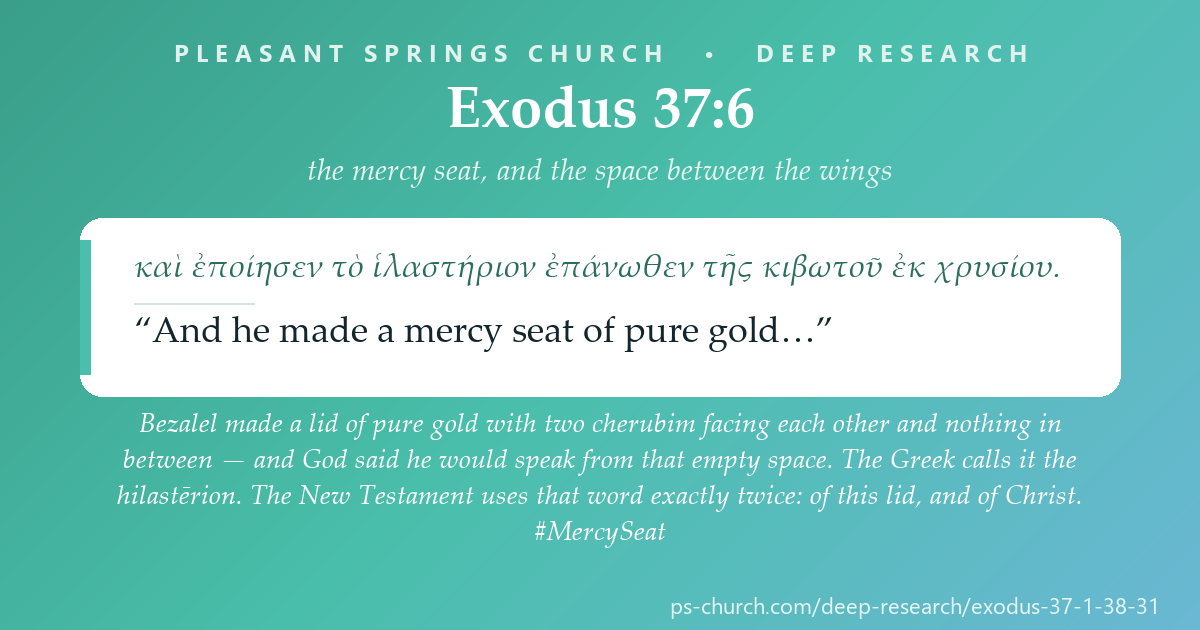
Of everything Bezalel made, the strangest is the simplest. A lid of pure gold, two and a half cubits by one and a half — roughly a metre by two-thirds — with a hammered cherub rising from each end, wings stretched forward and up, faces turned toward each other and down toward the lid. And nothing in between. Every other throne in the ancient world had a king on it or a god on it or an image of one; the Lord commanded a throne with a vacancy at its centre, and then said, ‘There I will meet with you, and from above the mercy seat, from between the two cherubim… I will speak with you’ (Ex 25:22). Numbers 7:89 records that it happened: Moses went in, and heard the voice speaking to him from above the mercy seat. The chapter in front of us reports the making of that lid in a single unhurried sentence — וַיַּעַשׂ כַּפֹּרֶת זָהָב טָהוֹר, ‘and he made a mercy seat of pure gold’ — and moves straight on to its dimensions. The Greek column renders it ἱλαστήριον. That is the word Paul reaches for in Romans 3:25 when he says God put Christ forward publicly; it is the word Hebrews 9:5 uses of this very slab of gold, and then declines to expand: ‘of these things we cannot now speak in detail.’ The gap between the wings is where the blood went on the Day of Atonement (Lev 16:14), and where the voice came from. It was never empty. It was reserved.
The vocabulary of the making: the gold lid, the hammered tree, the refrain, the women, the ledger.
Counts below were run against the corpora on this shelf — 23,204 Masoretic verse units, 30,348 screened Greek Old Testament rows, and 7,927 Greek New Testament verses — not taken from a concordance.
The mercy seat — the solid gold lid of the ark, with the two cherubim of one piece with it. The bare, unprefixed form stands twice in the Hebrew Bible: Exodus 25:17, where it is commanded, and Exodus 37:6, where it is made. LXX ἱλαστήριον — 28 occurrences across the 30,348 Greek Old Testament rows screened here, and exactly two in the Greek New Testament: Romans 3:25 and Hebrews 9:5.
Hammered work — beaten from a single mass, not cast and not assembled. The lampstand’s base, stem, branches, cups, calyxes and flowers are all מִמֶּנָּה, “of one piece with it,” out of one talent of gold (37:24). LXX renders the lampstand στερεάν, solid.
“And he made” — the refrain of the whole construction account. Twenty-one of the sixty verses of Exodus 37–38 open with it (thirteen in ch. 37, eight in ch. 38); across Exodus 35–40 the count is thirty-eight. It is the narrative answer to the command chapters’ תַּעֲשֶׂה, you shall make — and, because a run screen matches word forms and not roots, it is also the word that cuts almost every measured run (Stage 4).
The ministering women — a feminine plural participle of צבא, the verb used of armies mustering and Levites serving. This exact (defective) form occurs once in the whole Hebrew Bible: here. The plene spelling הַצֹּבְאוֹת stands at 1 Samuel 2:22, of women at the same door. The Greek column of the same verse has τῶν νηστευσασῶν, “of the women who fasted.” The page prints both and adjudicates neither.
The records / musterings — the same root as the census counts of Numbers. Exodus 38:21 opens the audit: the tabernacle’s materials, weighed, tallied, and assigned to a named accountable officer, Ithamar. The Greek has ἡ σύνταξις, the arrangement or schedule.
The Greek name of the mercy seat. Across the 30,348 CATSS rows screened here it stands 28 times — Exodus 13, Leviticus 16 seven, Ezekiel 43 five, Numbers 7:89, Amos 9:1, and 4 Maccabees 17:22. In the Greek New Testament it stands twice: Romans 3:25 (of Christ) and Hebrews 9:5 (of this lid).
“The tent of witness” — the Greek Old Testament’s standing name for the tabernacle. The genitive string occurs 91 times across the 30,348 Greek OT rows screened here (Numbers 35, Leviticus 31, Exodus 19, Deuteronomy 3, 1 Chronicles 2, Joshua 1). It is also the phrase behind this passage’s single deepest New Testament run — which is exactly why that run is not a citation (Stage 4).
“This man made” — a Greek refrain with no Hebrew counterpart. Nine consecutive verses of CATSS Exodus, 38:18 through 38:26, open with οὗτος, and they are the only nine verses in Greek Exodus 35–40 that do. The Hebrew’s refrain names no one and simply says and he made.
How the New Testament takes these up:
- Romans 3:25; Hebrews 9:5 — the two occurrences of ἱλαστήριον in the Greek New Testament: Christ publicly set forth, and the golden lid itself (see Just and the Justifier).
- Hebrews 9:1–5 — the New Testament’s own inventory of this furniture: the lampstand, the table, the bread of the Presence, the golden altar, the ark, the jar of manna, Aaron’s rod, the tablets, and the cherubim overshadowing the mercy seat. Measured against Greek Exodus 37–38 it reaches two words — the page’s own counter-example, printed in Stage 4.
- Acts 7:44; Revelation 15:5 — the only two places the Greek New Testament uses the Septuagint’s name for the tabernacle, ἡ σκηνὴ τοῦ μαρτυρίου (see The Same Twelve Words).
- Numbers 7:89 — the voice speaking to Moses “from above the mercy seat that was on the ark of the testimony, from between the two cherubim” (see the voice from the mercy seat).
- Leviticus 16:14–15 — the blood sprinkled on and before the כַּפֹּרֶת on the Day of Atonement (see the Day of Atonement).
The command against the making; the Hebrew column against the Greek; and the whole passage against the New Testament.
Everything in this stage was run for this page against the corpora on this shelf. Hebrew against Hebrew: each verse against every other verse of the 39-book Masoretic corpus (Sefaria’s Miqra according to the Masorah), cantillation and vowel points removed, final letters folded to medial, maqqef read as a word separator; contiguous runs of whole consonantal word forms, never lemmas and never roots; a row reported as 0 would share no two consecutive words with any other verse. Greek against Greek: CATSS FORM column, beta-code converted, against MorphGNT’s normalised word; both sides lowercased, accents and breathings dropped, final sigma folded, and MorphGNT’s own spelling equivalences applied (ou/ouk/ouch, ek/ex, the movable nu), so a run is not cut where the two editions merely spell a word differently. Exhaustive and deterministic; nothing sampled, so no seed applies. Every run is reported with its tie band.
1. The command and the making — and where the copying stops
Exodus 35–40 narrates the building of what Exodus 25–31 commanded. The obvious question is how closely. Each of the four ‘making’ chapters was screened, verse by verse, against every other verse of the Hebrew Bible. The result is not uniform, and the sharpest break in the whole account falls exactly at the seam this page sits on.
| making chapter | what is made | deepest run | rows reaching 8+ | where the matches land |
|---|---|---|---|---|
| Exodus 36 (38 rows) | curtains, frames, veil | 15 | 11 of 38 | Exodus 26 |
| Exodus 37 (29 rows) | ark, mercy seat, table, lampstand, golden altar | 18 | 12 of 29 | Exodus 25 (21 of the 29 rows) |
| Exodus 38 (31 rows) | bronze altar, basin, court, the accounts | 7 | 0 of 31 | Exodus 27 and Numbers 7 |
| Exodus 39 (43 rows) | the priestly garments | 14 | 6 of 43 | Exodus 28 (17 of the 43 rows); its six deepest rows land in Exodus 35 and Numbers |
Chapter 37 has the highest ceiling of the four and chapter 38 has the lowest — and they are adjacent. Exodus 38 is the only one of the four whose ceiling never reaches eight: not one of its thirty-one verses shares eight consecutive words with anything in the Hebrew Bible. Chapter 37, next door, does it twelve times.
Here is chapter 37 in detail. Every deep row is band 1 — the words stand nowhere else in the Hebrew Bible in that order — and 26 of the 29 rows are band 1 overall.
| row | deepest partner | run | tie band | the shared words |
|---|---|---|---|---|
| Exodus 37:21 | Exodus 25:35 | 18 | 1 | “and a calyx under two branches of it…” — the whole verse but its last word |
| Exodus 37:9 | Exodus 25:20 | 14 | 1 | the cherubim spreading their wings over the mercy seat |
| Exodus 37:18 | Exodus 25:32 | 14 | 1 | six branches, three from one side and three from the other |
| Exodus 37:3 | Exodus 25:12 | 13 | 1 | four rings on its four feet, two on one side and two on the other |
| Exodus 37:1 | Exodus 25:10 | 11 | 1 | acacia wood, two and a half cubits… |
| Exodus 37:19 | Exodus 25:33 | 11 | 1 | three cups made like almond blossoms… |
| Exodus 37:8 | Exodus 25:19 | 10 | 1 | one cherub on the one end, one on the other |
| Exodus 37:26 | Exodus 30:3 | 10 | 1 | pure gold, its top, its sides, its horns |
Why eighteen, and why there? The run engine matches word forms. The command chapters say תַּעֲשֶׂה, you shall make; the making chapters say וַיַּעַשׂ, and he made — so the transposition from command to report cuts almost every run at the verb. The eighteen-word run at 37:21 is the longest precisely because the stretch it copies contains no verb at all: it is the triple repetition of ‘and a calyx under two branches of it.’ It runs from the first word of the verse to the eighteenth — one word short of the end of Exodus 37:21, which has nineteen words, and two short of the end of Exodus 25:35, which has twenty — because Exodus 25:35 finishes ‘going out of the lampstand’ where Exodus 37:21 finishes ‘going out of it.’ The ceiling is set by grammar as much as by fidelity, and a page that reported the 18 without that sentence would be overselling it.
2. Chapter 38, and the page’s own counter-examples
The low ceiling of chapter 38 is real, but it must not be read as unfaithfulness, and the bands say why.
| row | deepest partner | run | tie band | what that means |
|---|---|---|---|---|
| Exodus 38:30 | Exodus 39:39 | 7 | 1 | the chapter’s ceiling — and it matches a later summary list, not a command |
| Exodus 38:6 | Exodus 37:15 and 37:28 | 7 | 2 | “and he made the poles of acacia wood and overlaid them” — matching itself, one chapter back (37:15 the table’s poles, 37:28 the incense altar’s) |
| Exodus 38:26 | Exodus 30:14; Numbers 1:46; Numbers 2:32 | 7 | 3 | census formula, shared with Numbers |
| Exodus 38:18 | Exodus 26:31, 26:36, 27:16, 28:15 … | 6 | 10 | “blue and purple and scarlet yarns and fine twined linen” — a stock phrase, not a quotation |
| Exodus 38:8 | Exodus 29:4, 29:11, 29:32 … | 3 | 40 | “the entrance of the tent of meeting” — the most formulaic line in the chapter |
| Exodus 38:29 | Exodus 12:40, 12:41; Ezra 1:11 … | 2 | 26 | the bronze total: numbers, and nothing else |
Three honest qualifications, printed here rather than buried. (a) Chapter 38’s material is different in kind: the court command in Exodus 27:9–19 is terse and largely numerical to begin with, and the metal accounts of 38:21–31 have no command behind them at all — there is nothing for them to repeat. (b) Its deepest run is not even a command match: 38:6 at seven words matches itself, the poles of the table and of the incense altar one chapter back. (c) Its widest bands are stock phrases. ‘Blue and purple and scarlet yarns and fine twined linen’ reaches six words at a band of ten; ‘the entrance of the tent of meeting’ reaches three at a band of forty. A run of six with a band of ten is a formula, not a quotation, and this page counts it as one.
3. The Greek column is a different book here
CATSS/Rahlfs Exodus does not merely number chapters 35–40 differently. It arranges them differently. The correspondence below was established row by row from the files on this shelf.
| Masoretic / ESV | what is made | CATSS Greek |
|---|---|---|
| 36:8–38 | curtains, frames, veil, screen | 37:1–6 (the frames are not narrated) |
| 37:1–24 | ark, mercy seat, table, lampstand | 38:1–17 |
| 37:25–28 | the golden altar of incense | — no counterpart in CATSS Exodus 35–40 — |
| 37:29 | the anointing oil and the incense | 38:25 |
| 38:1–7 | the bronze altar | 38:22–24 |
| 38:8 | the bronze basin | 38:26–27 |
| 38:9–20 | the court | 37:7–18 |
| 38:21–23 | the records; Bezalel and Oholiab named | 37:19–21 |
| 38:24–31 | the reckoning of the metals | 39:1–8 |
| 38:17, 19, 20, 28 | silvered pillars, hooks, capitals, pegs | 38:18–21 (a summary block; subject-level, not verse-level) |
| 39:1–31 | the priestly garments | 36:8–38 |
One block has nowhere to go. Hebrew Exodus 37:25–28 — the making of the golden altar of incense, 58 Hebrew word tokens — has no counterpart anywhere in CATSS Exodus 35–40. The Greek book has the object: at 40:5 Moses is told to place τὸ θυσιαστήριον τὸ χρυσοῦν εἰς τὸ θυμιᾶν before the ark, and at 40:26 he does it. What the Greek construction account never narrates is anyone making it. This page states the fact and stops there. It does not say the Greek is shorter because something dropped out, and it does not say the Hebrew is longer because something was added; both explanations are current in the literature and neither is measurable from these files.
Length, measured within each language rather than across them. Comparing Hebrew word tokens with Greek word tokens tells you about tokenisation, not about text, so the useful comparison is each column against itself. In the Masoretic column the construction account (35–40) runs at 88% of the length of the instruction account (25–31) — 2,772 tokens against 3,156. In the Greek column it runs at 67% — 3,204 against 4,806. Verse units: 214 Masoretic against 173 CATSS.
Two Greek sentences with no Hebrew counterpart, printed above in the codex. At LXX 38:22 the bronze altar is made ἐκ τῶν πυρείων τῶν χαλκῶν, ἃ ἦσαν τοῖς ἀνδράσιν τοῖς καταστασιάσασι μετὰ τῆς Κορε συναγωγῆς — from the bronze censers of the men who rebelled with Korah’s company. The name Korah stands in Greek Exodus at exactly three places: 6:21, 6:24 and 38:22. Its subject matter is that of Numbers 16–17, but the longest run LXX Exodus 38:22 shares with LXX Numbers 17:4, the censer verse, is zero — and on the Greek side of this shelf a zero means the two verses share no word form at all. The link is topical, not verbatim, and the page will not call it a quotation. And at LXX 38:26 the basin is cast from the mirrors τῶν νηστευσασῶν, αἳ ἐνήστευσαν — of the women who fasted — where the Hebrew has הַצֹּבְאֹת אֲשֶׁר צָבְאוּ, the women who served, plus a Greek plus, “on the day he pitched it.”
And the accounts do not agree.
| total | Masoretic / ESV | CATSS Greek | |
|---|---|---|---|
| gold | 29 talents + 730 shekels (38:24) | 29 talents + 720 shekels (39:1) | differ by 10 |
| silver | 100 talents + 1,775 shekels (38:25) | 100 talents + 1,775 shekels (39:2) | agree |
| bronze | 70 talents + 2,400 shekels (38:29) | 70 talents + 1,500 shekels (39:6) | differ by 900 |
| men counted | 603,550 (38:26) | 600,000 + 3,550 (39:3) | agree |
Note which two agree. The silver figure is the one total in the passage that can be derived: 603,550 men at half a shekel each is 301,775 shekels, which at 3,000 shekels to the talent is exactly 100 talents and 1,775 shekels — and the text says so itself at 38:27–28, casting one talent per base for a hundred bases. Both columns carry that figure and both carry the head-count. The gold and the bronze cannot be computed from anything, and those are the two that differ. That is an observation about the numbers, not a theory about how either column came to read as it does, and this page offers no such theory.
4. The passage against the whole Greek New Testament — and why the deepest run is not a quotation
All 48 CATSS rows of Greek Exodus 37–38 were screened against all 7,927 verses of the Greek New Testament. Across the 48 rows: all 48 reach two, 23 reach three, 5 reach four, 1 reaches five, and nothing reaches six. For scale, the whole of Greek Exodus reaches thirteen — Exodus 20:11 against Acts 14:15 and Acts 4:24, band 2.
Mind the chapter labels. Because the Greek rearranges these chapters, ‘Greek Exodus 37–38’ is not the same 60 verses as ‘Hebrew Exodus 37–38.’ The 48 CATSS rows screened here carry all of Hebrew 37:1–24 and 37:29, all of Hebrew 38:1–23, and also six rows belonging to Hebrew 36:8–38 — while Hebrew 38:24–31, the metal totals, sit in Greek chapter 39, which was screened separately and is reported below. The Hebrew verse is given beside every Greek label.
| row | deepest NT partner | run | tie band | the shared words |
|---|---|---|---|---|
| LXX Exod 38:26 (= Heb 38:8) | Revelation 15:5 | 5 | 1 | τῆς σκηνῆς τοῦ μαρτυρίου ἐν |
| LXX Exod 37:16 (= Heb 38:18) | Revelation 21:16 | 4 | 1 | τὸ μῆκος καὶ τό |
| LXX Exod 37:19 (= Heb 38:21) | Revelation 15:5 | 4 | 1 | τῆς σκηνῆς τοῦ μαρτυρίου |
| LXX Exod 37:5 (= Heb 36:37) | Revelation 15:5 | 4 | 1 | τῆς σκηνῆς τοῦ μαρτυρίου |
| LXX Exod 38:27 (Heb 38:8, expanded) | John 4:12; Luke 21:12 | 4 | 2 | καὶ οἱ υἱοὶ αὐτοῦ |
Now the counter-example this page is obliged to print. Three of the five deepest runs land on the same verse, Revelation 15:5 — ‘the sanctuary of the tent of witness in heaven was opened.’ It is tempting to read that as Revelation reaching back to the building of the tabernacle. It is not. ἡ σκηνὴ τοῦ μαρτυρίου is simply the Septuagint’s ordinary name for the tabernacle: the genitive string occurs 91 times across the 30,348 Greek Old Testament rows screened here — 35 in Numbers, 31 in Leviticus, 19 in Exodus, 3 in Deuteronomy, 2 in 1 Chronicles, 1 in Joshua. A run of four or five on those words is a title, not a citation, and it would score the same against a hundred other verses in the Pentateuch. The measurement finds verbatim contact; it does not find allusion, and here the difference is the whole story.
Meanwhile the New Testament passage that really does describe this furniture measures at the floor. Hebrews 9:1–5 walks through the lampstand, the table, the bread of the Presence, the golden altar, the ark, the cherubim and the mercy seat — the exact contents of Exodus 37 — and against every verse of Greek Exodus 37–38 it reaches two words.
| New Testament verse | what it is about | deepest run vs Greek Exodus 37–38 | tie band |
|---|---|---|---|
| Hebrews 9:2 | the lampstand, the table, the bread of the Presence | 2 — ἐν ᾗ | 1 |
| Hebrews 9:3 | the second veil, the Most Holy Place | 2 — τὸ δεύτερον | 2 |
| Hebrews 9:4 | the golden altar, the ark, the manna, the rod, the tablets | 2 — καὶ αἱ | 14 |
| Hebrews 9:5 | the cherubim of glory overshadowing the ἱλαστήριον | 2 — τὸ ἱλαστήριον | 2 |
| Hebrews 9:21 | the tent and the vessels sprinkled with blood | 3 — τὰ σκεύη τῆς | 2 |
| Acts 7:44 | “the tent of witness” in the wilderness | 2 — τοῦ μαρτυρίου | 5 |
Hebrews 9:5 and LXX Exodus 38:5 both contain τὸ ἱλαστήριον, and that two-word run is the whole of their measured contact. Nobody would conclude from this that Hebrews is not thinking about Exodus 37. Obviously it is. What the number shows is that Hebrews is describing the tabernacle in its own words rather than copying a Greek column — which is precisely the distinction a run screen can see and a thematic reading cannot. It is also the reason this shelf reports the band beside every run and refuses to convert depth into dependence.
And there is a coda that sharpens the point rather than softening it. Greek Exodus 39 — the chapter that carries the Hebrew metal totals of 38:24–31 and then the long list of finished furniture handed over to Moses — was screened too, and it does reach Hebrews. Across its 23 CATSS rows: all 23 reach two, 16 reach three, 6 reach four, 2 reach five, and nothing reaches six. Both fives are Hebrews, both band 1: LXX Exodus 39:14 against Hebrews 9:4 at καὶ τὴν κιβωτὸν τῆς διαθήκης, and LXX Exodus 39:19 against Hebrews 9:21 at καὶ πάντα τὰ σκεύη τῆς. Both Greek rows are lists — inventories of finished objects being carried in — and so is Hebrews 9. The Greek verses that report the making reach two; the Greek verses that report the inventory reach five. That is not a claim that Hebrews used those verses; it is a demonstration that a run screen measures genre and phrasing as much as it measures dependence, which is why this shelf never reads a run as a citation on its own.
Which cross-references matter?
- Exodus 25:10–40 — the command that chapter 37 reproduces, at up to eighteen consecutive words (see the ark, table and lampstand).
- Exodus 27:1–19; 30:1–10, 17–21 — the commands behind the bronze altar, the court, the golden altar and the basin (see the bronze altar and the court and the altar of incense).
- Exodus 32:1–6 — the same gold, the same eager giving, the wrong pattern (see the golden calf).
- Exodus 39:32–43; 40:34–38 — the work inspected and blessed, and the glory that fills it (see the tabernacle built and the glory fills the tabernacle).
- Numbers 7:1–89 — the tabernacle anointed, the leaders’ offerings weighed in the same sanctuary shekel, and the voice from the mercy seat (see the offerings of the leaders).
- Numbers 16:1–17:13 — the censers of Korah’s company, which the Greek column of Exodus 38:22 names and the Hebrew does not (see Korah’s rebellion).
It is worth sitting with the plainest measurement on this page, because it is the kind of thing you can check yourself with a concordance and an afternoon. In the Hebrew of Exodus 37, the word זָהָב, gold, appears in seventeen of the twenty-nine verses. Bronze appears in none. Silver appears in none. Then the chapter turns over, and in Exodus 38 bronze appears in thirteen verses and silver in seven — and gold appears in exactly one, verse 24, which is not an object at all but the line that adds the gold up. The chapter division is a metal division. And the metal division is a distance division: gold for what stands inside the veil and in the Holy Place, bronze for what stands out in the open where the people can come. The nearer you get to the ark, the softer and costlier the metal, until at the very centre there is a lid of pure gold with two facing cherubim and a space between them. Israel could not walk that road; only Aaron could, and only once a year, and only with blood. The letter to the Hebrews takes exactly this arrangement and says the Holy Spirit was indicating by it ‘that the way into the holy places is not yet opened as long as the first section is still standing’ (Heb 9:8) — and then that Christ entered once for all (Heb 9:12). The gold and the bronze were a diagram of a distance. The distance is what was closed.
The scholarship on Exodus 35–40, and an honest list of what was not checked.
This is the section that makes the rest of the page trustworthy. Everything below either names a work that was not consulted or names a question this page could not settle.
Commentaries & studies:
- Brevard Childs (OTL), John Durham (WBC), William H. C. Propp (Exodus 19–40, Anchor Yale), Nahum Sarna (JPS), Douglas Stuart (NAC) on Exodus.
- John William Wevers, Text History of the Greek Exodus and Notes on the Greek Text of Exodus; Anneli Aejmelaeus and the Finnish school on the translation technique of Greek Exodus — the standard literature on the rearranged chapters 35–40.
- Menahem Haran, Temples and Temple-Service in Ancient Israel; Carol Meyers, The Tabernacle Menorah; G. K. Beale, The Temple and the Church’s Mission; Beale & Carson, Commentary on the NT Use of the OT (Rom 3:25; Heb 9).
What this page could not check, and where it is weakest
- No critical apparatus was consulted, on either side. The Hebrew is the Masoretic text as printed in Sefaria’s Miqra according to the Masorah. The Greek is CATSS’s digitisation of Rahlfs. Neither the Samaritan Pentateuch nor the Qumran Exodus manuscripts (4QpaleoExodm and its relatives) were examined — and for chapters 35–40 those are precisely the witnesses a specialist would reach for first. Every statement here about “the Greek” means these files, not the whole Greek tradition.
- The missing golden altar is reported, not explained. Whether CATSS Exodus 35–40 is short because a Hebrew Vorlage was short, or because a translator abridged, or because the Hebrew grew, is the central disputed question in the literature on these chapters (Wevers, Aejmelaeus, Gooding). This page takes no position and could not, from local files. It measures absence; it cannot measure why.
- The ten-shekel and nine-hundred-shekel differences in the metal totals are reported without a cause. The observation that the two divergent totals are the two that cannot be derived arithmetically is an observation, not a demonstration. Numerals are notoriously unstable in transmission in every direction, and nothing on this shelf can tell you which column stands nearer an original.
- The run screen finds verbatim contact and nothing else. It cannot see paraphrase, allusion, shared imagery or common structure. Hebrews 9:1–5 measuring two is the demonstration, printed in Stage 4 for exactly that reason. A low number here is not evidence of independence, and a high number is not evidence of borrowing.
- The Hebrew screen’s zeros mean “no two consecutive words” (single words are not counted), while the Greek screen’s convention would report 1 for a row sharing only isolated words. No row in this passage came out at zero on either convention, so nothing on this page turns on the difference — but the two conventions are not interchangeable and the distinction is stated here rather than assumed.
- Numbers 7 was screened against, not for. Several Exodus 38 rows find their nearest partner in Numbers 7’s offering lists rather than in Exodus 27. This page reports the fact and does not build on it; the direction of that relationship is exactly the kind of claim the house rules forbid.
- No acrostic or letter screen was run, because the passage is prose inventory and there is nothing for such a screen to find. No Second-Temple Greek corpus outside the CATSS files was searched; the 4 Maccabees datum is from the file on this shelf, and Josephus and Philo are cited from the standard editions and were not measured.
- The ESV is the English column. No Crossway API key has ever been issued to this site; the ESV here is quoted under Crossway’s standing permission, and the shelf tracks its footprint per book. This page adds sixteen verses of Exodus.
From a gold lid with nothing on it to the God who kept the record.
Name what you learned, why it matters, and one concrete response.
What should we carry away — and do?
- Obedience is measurable, and here it was measured. Exodus 37 repeats the command of Exodus 25 at up to eighteen consecutive words, and the words stand nowhere else in the Hebrew Bible in that order. The chapter is not filler. It is a receipt.
- God keeps the accounts in public. Twenty-nine talents and 730 shekels of gold; 100 talents and 1,775 of silver; 70 talents and 2,400 of bronze — audited, assigned, and put under a named officer (38:21). Church money and church work have been open books since Sinai.
- Somebody gave what they could not replace. The priests washed in bronze that had been women’s mirrors (38:8). The participle Scripture uses of those women stands in only one other verse in the whole Hebrew Bible — 1 Samuel 2:22, of women at the same door. Their names are gone; their gift is still in the text.
- At the centre there is a space. The mercy seat had two cherubim and nothing between them — and God said he would speak from there. Paul calls Christ the ἱλαστήριον (Rom 3:25); Hebrews uses the same word of that lid (Heb 9:5). The vacancy was a promise.
Step in response: this week, do one unglamorous, exactly-as-asked piece of work for God’s people and let nobody know you did it — the kind of thing that would end up in a chapter nobody memorises. Then give something you would rather keep, as those women gave their mirrors. And take five quiet minutes at the gold lid: two cherubim, an empty space, a voice. That is where the blood went; that is where the voice came from; and that is the word the New Testament reaches for when it wants to say what the cross was.
Exodus 37:6 · to share
Hebrew · LXX · ESVEvery Deep Research page traces its passage across the whole sweep — the Old Testament, the Second-Temple world between the testaments (historical witnesses, not Scripture), and the New Testament. Follow the thread:
Pleasant Springs Church — Deep Research
Research method after Michael S. Heiser’s Bible Research Method (examine dictionaries → ancient literature → important words → textual connections → academic publications → share), with the Pleasant Springs “Author & Audience” foundation. Scripture set in the Hebrew, the Greek editions named on each page and the ESV (Old Testament), and the Greek New Testament and the ESV (New Testament), per the practice of Pleasant Springs Church. Exodus 37:1–38:31 research grounded in Childs (OTL), Durham (WBC), Propp (Anchor Yale) and Sarna (JPS), with Haran (Temples and Temple-Service), Meyers (The Tabernacle Menorah) and Beale (The Temple and the Church’s Mission). Text: Hebrew from the Masoretic text as printed in the edition consulted — Sefaria’s Miqra according to the Masorah; no critical apparatus was consulted for the Hebrew, and neither the Samaritan Pentateuch nor the Qumran Exodus manuscripts were examined. Greek from Rahlfs’ Septuaginta as digitised by CATSS; Greek New Testament from the SBL edition via MorphGNT. English is the ESV, quoted under Crossway’s standing permission; this page adds sixteen verses of Exodus to the shelf’s footprint. The standing caution for this shelf applies: these pages say “the CATSS Greek row reads…” and never call a Greek reading early or late, and never assert a direction of influence. ⚠️ VERSE NUMBERING. The Masoretic text and the ESV number this passage identically — Exodus 37:1–29 and 38:1–31 in both, 60 verses, no offset of any kind. (Elsewhere in Exodus there are two: Masoretic chapter 20 runs to 23 verses where the ESV runs to 26, and Masoretic 21:37 = ESV 22:1, so that Masoretic 22:1–30 = ESV 22:2–31. Neither touches these chapters.) The Greek is different in kind. CATSS Exodus does not renumber chapters 35–40, it rearranges them: Hebrew 37:1–24 = CATSS 38:1–17; Hebrew 37:29 = CATSS 38:25; Hebrew 38:1–8 = CATSS 38:22–24, 26–27; Hebrew 38:9–20 = CATSS 37:7–18; Hebrew 38:21–23 = CATSS 37:19–21; Hebrew 38:24–31 = CATSS 39:1–8; and Hebrew 39:1–31 = CATSS 36:8–38 (Hebrew 39:32–43, the work brought to Moses, stands at CATSS 39:10–23). Hebrew 37:25–28, the making of the golden altar of incense, has no counterpart in CATSS Exodus 35–40 at all. The correspondence was established row by row from the files on this shelf and the Greek number is printed beside every codex row above. ⚠️ The Hebrew measurement, in full. Hebrew against Hebrew. Each verse of Exodus 36, 37, 38 and 39 against every other verse of the 39-book Masoretic corpus — 23,175 non-source verse units for chapter 37, 23,173 for chapter 38. Markup stripped, the qere read, cantillation and vowel points removed, final letter-forms folded to medial, maqqef treated as a word separator and never as a weld. Contiguous runs of whole consonantal word forms, never lemmas and never roots — which is why the imperative-to-narrative switch cuts almost every run at the verb. Single words are not counted, so a row reported as 0 would share no two consecutive words with any other verse; no row in this passage came out at 0. Exhaustive and deterministic; nothing sampled, so no seed applies. Ceilings: Exodus 36 = 15, Exodus 37 = 18, Exodus 38 = 7, Exodus 39 = 14. ⚠️ The Greek measurement, in full. Greek against Greek. CATSS FORM column (cols 0–24), beta-code transliterated first; MorphGNT field 6, the normalised word. Both sides lowercased, accents and breathings dropped, final sigma folded, then filtered to Greek letters — the same filter applied to both corpora — and MorphGNT’s own spelling equivalences applied (ou/ouk/ouch, ek/ex, the movable nu), so figures on this page are HIGHER than pages written before 30 August 2026 report. Word forms, never lemmas. Corpus: the 48 CATSS rows of Greek Exodus 37–38 against 7,927 verses across 27 MorphGNT files. The whole Greek Old Testament held here is 64 CATSS files and 30,637 verse units; a run screen sees 30,348, because the Odes are excluded — Ode 9 is Luke 1 and Ode 13 is Luke 2 copied into a Greek Old Testament manuscript, and ten more Odes are second copies of passages already in the corpus. ⚠️ The structure diagram is a sequence, and is labelled one. No chiasm is claimed for this passage and none is present. The diagram reports the order of making, the metal distribution (gold in 17 of 29 verses of ch. 37 and in 1 of 31 of ch. 38; bronze in 0 and 13 respectively) and the וַיַּעַשׂ refrain (21 of the 60 verses), all counted from the Masoretic text on this shelf.
Scripture quotations marked ESV are from the ESV® Bible (The Holy Bible, English Standard Version®), © 2001 by Crossway, a publishing ministry of Good News Publishers. ESV Text Edition: 2016. Used by permission. All rights reserved. The ESV text may not be quoted in any publication made available to the public by a Creative Commons license, and the ESV may not be translated in whole or in part into any other language. www.esv.org
|
Did this study bless you today? 💚 Give to Support PS Church100% of gifts go to the General Fund — thank you. |