Psalms 7, 11, 21 and 26 were the last four chapters of the Psalter that no study on this shelf had ever quoted — they sit inside ranges other pages covered, and every time the verses that got printed came from a neighbour. They were chosen by a coverage map, not by a theme. Which makes what turned up worth reporting. Two of the four carry the only two occurrences in the entire Hebrew Bible of the words judge me, O LORD — and the Greek Psalter agrees independently, printing κρῖνόν με κύριε at exactly those two places and nowhere else. Most readers never see it, because the ESV renders one judge me and the other vindicate me. Both are right. Between them the link vanishes. And the page's deepest New Testament contact is a warning about its own instrument: a run of four with a tie band of one at Psalm 21:6 — the shelf's signal for distinctive contact — turns out to be contact with a New Testament quotation of a different psalm, because the band is only ever counted on the New Testament side. See the method →
Psalms 7, 11, 21 and 26 (selections)
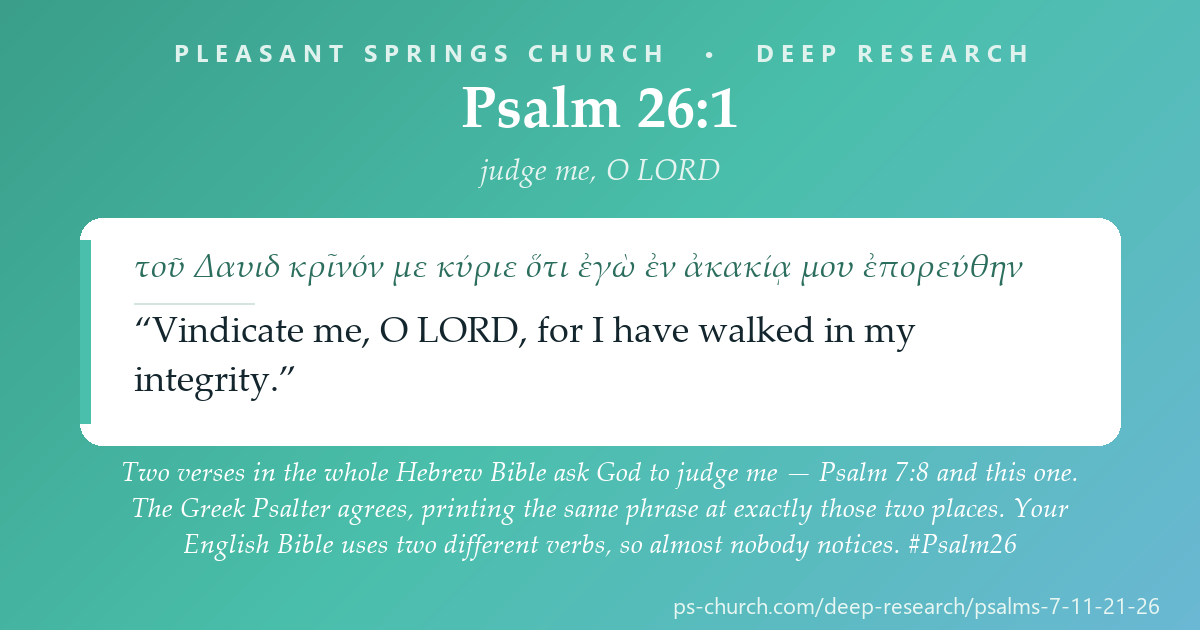
Hebrew (Masoretic) · Greek (CATSS / Rahlfs’ Psalter) · ESVPsalm 7:8 — שׇׁפְטֵנִי יְהֹוָה. Psalm 26:1 — שׇׁפְטֵנִי יְהֹוָה. Searched here across all 23,204 verse units of the Masoretic corpus: two hits, and these are both of them. The Greek agrees, and independently: κρῖνόν με κύριε occurs twice in the 30,348 Greek Old Testament verse units screened here, at LXX Psalm 7:9 and LXX Psalm 25:1 — the same two psalms.
Most readers never notice, because the ESV renders them with two different verbs. “Judge me” at 7:8; “vindicate me” at 26:1. Both are defensible — the Hebrew verb does both jobs — and neither is wrong. The cost is that a reader in English cannot see that the same man is making the same demand twice, and that nobody else in the Bible makes it at all.
Both requests come with the same collateral: תֹּם — integrity, wholeness. “According to the integrity that is in me” (7:8); “for I have walked in my integrity” (26:1). The Greek uses one word for it both times: ἀκακία, literally no-badness.
⚠️ This page did not choose these four psalms. The coverage map did. Psalms 7, 11, 21 and 26 were the four chapters of the Psalter that no page on this shelf had ever quoted a verse from — they sit inside ranges other studies covered, and each time the verses that got printed came from a neighbour. That the set turned out to contain both of the Bible’s only two “judge me” psalms is an accident of housekeeping, and is reported as one.
The Shape of the Passage
Four separate psalms — a sequence, not a unitThe one link that is real runs between the outer two. Psalm 7:8 and Psalm 26:1 are the only two verses in the Hebrew Bible that say judge me, O Lord, and both of them stake the request on the same word for integrity. They are coloured as a pair above for that reason and no other.
This page closes the Psalter on this shelf. Psalms 7, 11, 21 and 26 were the last four chapters of the book that no study here had quoted. They were chosen by a coverage map, not by a theme — which makes what they share worth reporting.
Author
He asks to be put on trial. Twice, in two psalms, in the only two verses in the Hebrew Bible that do it: judge me, O LORD. Not acquit me. Not spare me. Hear the case.
He invites the examination he cannot survive on his own terms. Test my kidneys and my heart (26:2) is a request to be searched in the part of a person nobody sees — and 7:9 says God does it anyway, asked or not.
And he refuses good advice. Psalm 11 opens with friends telling him to run, and he answers not with courage but with a location: the LORD is in his holy temple. The argument against fleeing is that someone is watching.
Audience
People who had been advised to leave. Flee like a bird to your mountain is not the counsel of enemies. It is what people who love you say when they can see the arrows already on the string.
People who processed around an altar. Psalm 26:6 washes hands and circles the altar — a liturgy, not a metaphor. The psalm was sung by people doing what it describes.
And people who knew a king could be glad and an enemy could burn from the same presence. Psalm 21 says the joy of your face in verse 6 and the time of your face in verse 9. It does not soften the second.
Orient on protestations of innocence, on the royal psalms, and on the divine face.
Search by topic: protestations of innocence; oath of clearance; royal psalms; the face of God; entrance liturgies; testing and refining; theophany.
Which articles are relevant?
- Anchor Bible Dictionary — “Psalms, Book of,” “Oath,” “King and Kingship,” “Face of God.”
- Dictionary of the OT: Wisdom, Poetry & Writings (IVP) — “Lament, Psalms of,” “Kingship Psalms,” “Innocence, Protestations of,” “Imprecation.”
- NIDOTTE / TDOT — שָׁפַט (šāpaṭ, judge / vindicate), תֹּם (tōm, integrity), בָּחַן (bāḥan, test), פָּנִים (pānîm, face), חָזָה (ḥāzāh, behold).
- On the entrance liturgy — Psalm 26:6 belongs beside Psalms 15 and 24, both already on this shelf (Psalms 15–17, Psalms 24–25).
Bibliography surfaced:
- John Goldingay, Psalms 1–41 — the working commentary for this stretch.
- Robert Alter, The Book of Psalms — candid where the Hebrew is hard, and useful at 11:1 and 11:3.
- NETS Psalms, with Rahlfs — for the negation at 7:12, the plus at 10:4 and the reversal at 10:7.
- Emanuel Tov, Textual Criticism of the Hebrew Bible — for how to speak about a Greek reading that differs without calling either one earlier.
A trial you ask for, a bird you are told to be, and a face that does two things.
Read Psalm 7:3–5 aloud and notice that the speaker is calling down a curse on himself if he is lying. That is the cultural form.
Which parallels shed light on these psalms?
An oath of clearance is a legal instrument, not a mood. “O Lord my God, if I have done this… let the enemy pursue my soul and overtake it” (7:3–5) is the self-imprecation of a man submitting to a court he cannot convene. The ancient Near East had procedures for exactly this: where evidence failed, a defendant could swear conditional self-curse and the deity was the judge. Psalm 7 is that procedure in verse, and Psalm 26 is the same request with the curse left off.
Washing hands before approaching an altar is liturgy. Psalm 26:6 is describing something the singer is doing while singing it — hands washed, altar circled. The gesture is about fitness to approach, not about guilt avoided. Which is why the New Testament’s most famous hand-washing is a poor match for it, as measured below.
“Fire and sulfur” is a fixed pair, and a rare one. אֵשׁ וְגׇפְרִית occurs exactly twice in the Hebrew Bible — here and at Ezekiel 38:22, in the Gog oracle. The Greek pair πῦρ καὶ θεῖον is likewise exactly twice in the Greek Old Testament held here, at the same two places. Two independent screens, two hits each, the same two verses.
And the face of God is not a metaphor with one setting. Psalm 21 uses פָּנֶיךָ twice — you make him glad with your face (v.6) and as a blazing oven at the time of your face (v.9). Nothing in the psalm reconciles them. The Greek keeps both, with the same noun.
- Ezekiel 38:22 → Psalm 11:6. The only other fire and sulfur in either Bible — see Gog of Magog.
- Genesis 19:24. Sulfur and fire — the same two nouns in the other order, which is why the two-word screen does not join it to Psalm 11.
- Jeremiah 17:10 → Psalm 7:9 and 26:2. I the Lord search the heart and test the kidneys. The prophet reports what these psalms request.
- Proverbs 17:3 → Psalm 7:9. The crucible for silver… but the Lord tests hearts. Band of 1 on the Hebrew screen: these two verses share וּבֹחֵן לִבּוֹת and nothing else in the Bible does.
- Psalm 73:13 → Psalm 26:6. I have washed my hands in innocence — and Psalm 73 says it was for nothing. See Psalm 73.
- Psalm 15 and Psalm 24 → Psalm 26. Who may ascend the hill of the Lord? — the entrance-liturgy question Psalm 26 answers in the first person.
The deepest New Testament run anywhere in these four psalms is a run of four at Psalm 21:6, with a tie band of 1. On this shelf that combination is the signal for distinctive contact. Here it is a trap, and it is worth walking into it slowly.
The Greek of Psalm 21:6 (LXX 20:7) ends μετὰ τοῦ προσώπου σου — with your face. Exactly one verse in the whole Greek New Testament shares four consecutive words with it: Acts 2:28. Band of one. No ties. On the face of it, Peter is standing in Psalm 21.
He is not. Acts 2:25 says what he is doing: Δαυὶδ γὰρ λέγει εἰς αὐτόν — for David says concerning him — and then he quotes four verses. Screened against the same Greek New Testament, LXX Psalm 15 (our Psalm 16) verses 8, 9, 10 and 11 measure 14, 20, 15 and 11 against Acts 2:25–28, every one of them with a tie band of 1. Acts 2:28 is LXX Psalm 15:11 word‑for‑word for eleven words.
So why did Psalm 21 light up at all? Because μετὰ τοῦ προσώπου σου occurs twice in the 30,348 Greek Old Testament verse units screened here — at Psalm 15:11 and at Psalm 20:7 — and the run screen only ever computes its tie band on the target side. The band of 1 was counting New Testament verses. It never said “only this psalm.”
Tested across all nine of the band‑of‑one runs in these four psalms, the result is nine out of nine. Every phrase that produced a band of 1 against the New Testament turns out to have at least one other home in the Greek Old Testament — from πῦρ καὶ θεῖον with one other (Ezekiel 38:22) to εἰς τὸ τέλος with fifty‑seven. Not one of the nine was unique to its psalm.
None of this makes the runs worthless. It makes the band a one‑sided number, and this page says so where a reader can see it. Direction of influence is not claimed anywhere here — not for Acts, not for Psalm 16, not for Psalm 21.
Counted across the whole corpus, not sampled.
Every count below was run over the full text held here — 23,204 Masoretic verse units, 30,348 Greek Old Testament verse units, 7,927 Greek New Testament verses.
Counted here, not assumed:
- שׇׁפְטֵנִי יְהֹוָה — 2 hits in the Hebrew Bible. Psalm 7:8 and Psalm 26:1. The Greek κρῖνόν με κύριε — 2 hits in the Greek Old Testament held here, the same two psalms.
- יֶחֱזוּ — 3 occurrences in the Hebrew Bible. Isaiah 26:11, Psalm 11:4, Psalm 11:7.
- The consonantal form בעזך — 4 hits. Exodus 15:13, Psalm 21:1, Psalm 21:13, Psalm 74:13. Two of the four are the two ends of Psalm 21, though the two are pointed differently.
- בְּתֻמִּי — 3 hits. Psalm 26:1, Psalm 26:11, Psalm 41:12. כְּצִדְקוֹ — 1 hit in the whole Hebrew Bible: Psalm 7:17.
- בְּנִקָּיוֹן כַּפָּי — 2 hits. Psalm 26:6 and Psalm 73:13, and Psalm 73 calls it worthless.
- אֵשׁ וְגׇפְרִית — 2 hits (Psalm 11:6, Ezekiel 38:22); πῦρ καὶ θεῖον — 2 hits (LXX Psalm 10:6, Ezekiel 38:22). Two screens, two languages, the same answer.
- μετὰ τοῦ προσώπου σου — 2 hits in 30,348 Greek Old Testament verse units: LXX Psalm 15:11 and LXX Psalm 20:7.
- Verse counts. Psalm 7: 17 English, 18 Hebrew, 18 Greek. Psalm 11: 7 / 7 / 7. Psalm 21: 13 / 14 / 14. Psalm 26: 12 / 12 / 12. Psalms 7 and 21 count their superscriptions as verse 1; Psalms 11 and 26 fold their short titles into verse 1.
“Judge me, O Lord.” Exactly two occurrences in the whole Hebrew Bible, and both are on this page. The verb is the ordinary courtroom word; it covers try the case and find for me at once, which is why the ESV can render it judge me at 7:8 and vindicate me at 26:1 without being wrong either time. The Greek prints one phrase for both: κρῖνόν με κύριε, itself exactly twice in the Greek Old Testament held here.
“Integrity, completeness.” Not innocence in the sense of never having done anything — it is wholeness, the absence of a double motive. בְּתֻמִּי occurs three times in the Hebrew Bible; two of them are the first and eleventh verses of Psalm 26, once past and once future. The Greek is ἀκακία — literally no-badness.
“Your face.” The same noun, six verses apart, doing opposite things. At 21:6 the king is made glad with your face; at 21:9 the enemies become a furnace at the time of your face. The Greek keeps the noun in both: μετὰ τοῦ προσώπου σου and εἰς καιρὸν τοῦ προσώπου σου. English “presence” and “when you appear” are both faithful and both hide the repetition.
“They behold.” Three occurrences in the entire Hebrew Bible — Isaiah 26:11, and both ends of Psalm 11. At verse 4 God’s eyes do the beholding; at verse 7 the upright do. The looking is returned, and the psalm is seven verses long.
“Kidneys.” The anatomy is the point — in Hebrew physiology the kidneys are the seat of the deepest impulses, the part of a person nobody sees. Both psalms name them, and the Greek keeps the organ both times: νεφρούς. The same pairing stands next door at Psalm 26:2 in the neighbouring study and at Jeremiah 17:10.
“Not bringing wrath.” The Hebrew of 7:11 says God is indignant every day; the Greek says he is long‑suffering and does not bring wrath every day. The two readings are not reconcilable by translation, and nothing here decides which is earlier. Reported, not adjudicated.
“Guilelessness” — the Greek Psalter’s standing word for תֹּם. It is a privative: a-kakia, without-badness. Psalm 26 opens and closes on it, and Psalm 7:8 uses it for the same Hebrew word — which is how the Greek preserves a link the English loses.
Four runs of four, none of them reaching five — and what each one is worth.
Screen each psalm against the whole Greek New Testament, then screen the phrase that produced the run back across the Greek Old Testament. The second step is the one that changes the reading.
What the New Testament screen returns:
Nothing in these four psalms reaches a run of five against the Greek New Testament. Four rows reach four; the rest sit at three or two, which is where shared Greek grammar lives rather than shared text. All four runs of four, with their tie bands:
- Psalm 21:6 (LXX 20:7) — run 4, band 1 — Acts 2:28, μετὰ τοῦ προσώπου σου. The deepest and apparently the cleanest — and Acts 2:28 is quoting Psalm 16:11, which measures 11 against the same verse.
- Psalm 26:6 (LXX 25:6) — run 4, band 2 — Luke 24:39 and John 20:27, τὰς χεῖράς μου καὶ. Both are the risen Jesus showing his hands. The psalm is washing them. The shared four words are “my hands and” and a first-person verb before it; the subject matter has nothing in common.
- Psalm 7:17 (LXX 7:18) — run 4, band 1 — Matthew 6:33, τὴν δικαιοσύνην αὐτοῦ καὶ. “Seek first the kingdom and his righteousness, and…” The phrase also stands at Genesis 24:27 and LXX Psalm 96:6.
- Psalm 21:3 (LXX 20:4) — run 4, band 3 — Romans 12:20, Revelation 10:1, Revelation 19:12, ἐπὶ τὴν κεφαλὴν αὐτοῦ. A band of three is the honest shape of this one: it is a formula for putting something on a head.
The New Testament hand-washing everybody thinks of is Pilate’s, and it is the weakest match on this page.
Psalm 26:6 — νίψομαι ἐν ἀθῴοις τὰς χεῖράς μου, “I will wash my hands in innocence.” Matthew 27:24 — λαβὼν ὕδωρ ἀπενίψατο τὰς χεῖρας… ἀθῷός εἰμι, “he took water and washed his hands… I am innocent.” Two verbs from the same root, and the innocence word in both.
Measured, the run is 2 — τὰς χεῖρας, and that is all. Pilate’s hands are not “my hands”, and his verb is compounded and aorist where the psalm’s is future. Meanwhile the accidental match, Luke 24:39, measures 4.
So the deeper number belongs to the verse with no thematic connection, and the shallower to the verse everyone hears. That is what a verbatim screen does and does not find. It finds shared words. It does not find allusion — and where Matthew is or is not reaching for Psalm 26, this page has no measurement to offer and does not guess.
On the Hebrew side, screened against the whole Masoretic corpus:
- Psalm 11:7 → Daniel 9:14 — run 3, band 1. כִּי־צַדִּיק יְהֹוָה, for the Lord is righteous. Two verses in the Hebrew Bible, and one is a psalm of confidence while the other is a confession of national ruin.
- Psalm 7:9 → Proverbs 17:3 — run 2, band 1. וּבֹחֵן לִבּוֹת, and testing hearts.
- Psalm 11:3 → Numbers 23:23 — run 2, band 1. מַה־פָּעָל, what has he done. Balaam’s oracle and the collapsed foundations share two words and nothing else.
- Psalm 26:11 → Psalm 41:12 — run 2, band 1. וַאֲנִי בְּתֻמִּי.
- Psalm 11:6 → Ezekiel 38:22 — run 2, band 1. Fire and sulfur. The one place where the Hebrew screen and the Greek screen return the same partner verse independently.
The counter-check this page ran on itself:
Twelve of the fifty-one Hebrew verses in these four psalms share no two consecutive words with any other verse in the Hebrew Bible. Five of eighteen in Psalm 7, four of fourteen in Psalm 21, three of twelve in Psalm 26, none at all in Psalm 11. That looked striking until it was measured against the book.
Screened verse by verse across all one hundred and fifty psalms — 2,527 verses, each against the other 23,203 verse units — 680 come back at zero. That is 26.9 per cent. These four psalms come in at 23.5 per cent: slightly below average, not above it. There is nothing unusual about them, and the page says so rather than printing the raw twelve and letting it sound like a finding.
Psalm 11 is the mild exception in the other direction: seven verses, and every one of them shares at least two consecutive words with somewhere else. On a seven-verse sample that is not a result either.
What this page could not check, and where it is weakest.
This section exists to name the limits. A study that only prints what it found is not reporting; it is advertising.
Commentaries & studies:
- John Goldingay, Psalms 1–41; Robert Alter, The Book of Psalms.
- NETS Psalms, with Rahlfs — for 7:12, 10:3, 10:4 and 10:7.
- Emanuel Tov, Textual Criticism of the Hebrew Bible.
What was NOT consulted, and what could not be checked:
- No critical apparatus for the Hebrew. The Hebrew here is Sefaria’s Miqra according to the Masorah as printed; no BHS or BHQ apparatus was opened, and no Dead Sea Psalms manuscript was consulted. Where a Greek reading differs from the Hebrew on this page, the question of which is earlier is left entirely open.
- No Greek apparatus either. The Greek is the CATSS digitization of Rahlfs’ Psalter — a modern critical reconstruction, not a manuscript. “Rahlfs reads…” is the strongest thing this page ever says about it.
- The 7:11 negation was not resolved and is not resolvable here. Hebrew: God is indignant every day. Greek: he does not bring wrath every day. Whether the Greek translator read a different consonantal text, or made a theological decision, cannot be settled from the resources on this desk. It is printed as a difference and left there.
- The 11:7 reversal likewise. The upright shall behold his face against his face has seen uprightness — a difference of subject and object that no measurement here can adjudicate.
- The Greek Old Testament screened here is 30,348 verse units, not 30,637. The Odes are held but excluded from every run screen on this page — Ode 9 is Luke 1 and Ode 13 is Luke 2 copied into a Greek Old Testament manuscript, and ten further Odes are second copies of Exodus 15, Deuteronomy 32, 1 Samuel 2, Habakkuk 3, Isaiah 26, Jonah 2, Daniel 3, Isaiah 5 and Isaiah 38. Leaving them in would have produced New Testament “matches” that are the New Testament, and duplicate Old Testament hits that are the same text twice.
- Run figures on this page are not comparable with older pages on this shelf. Since 30 August the cross-corpus screen applies MorphGNT’s own spelling equivalences — ou/ouk/ouch, ek/ex, and the movable nu — so figures here run higher than anything published before that date. Every number on this page was re-measured; none was copied from a sibling.
- Whether Psalm 21 is pre-exilic royal liturgy, a coronation text, or later is not settled — and nothing on this page depends on the answer.
- The weakest paragraph on this page is the entrance-liturgy claim in Stage 2. That Psalm 26:6 describes a real procession is widely held and is not measured here. It is an inference from the text plus the standard literature, and it is labelled as one.
Three things reported as unsettled:
- Whether the “judge me” pairing is design or coincidence. That the phrase occurs exactly twice is measured; that the two psalms were meant to be read together is not. They are fifteen psalms apart and this page makes no claim about editing.
- Whether Psalm 11:3 asks about the righteous or reports what they did. Hebrew: what can the righteous do? Greek: what did he do? after what you prepared, they tore down. Both readings are ancient.
- Whether any New Testament writer is reaching for Psalm 21:6. The measurement says only that Acts 2:28 shares four words with it and eleven with Psalm 16:11. Direction of influence is not asserted here for any verse on this page.
A request nobody else in the Bible makes.
Name what you learned, why it matters, and one concrete response.
What should we carry away — and do?
- Two verses in the whole Hebrew Bible say judge me, O Lord, and they are Psalm 7:8 and Psalm 26:1. Nobody else asks. Most prayer in Scripture asks God to look away from the case; these two ask him to hear it.
- Your English Bible hides it, and not by mistake. The ESV reads “judge me” at 7:8 and “vindicate me” at 26:1 — both accurate, and between them the connection disappears. This is what reading the underlying text is for; it is not a criticism of the translation.
- The collateral in both requests is integrity, not innocence. תֹּם is wholeness — the absence of a second motive — not a claim to have never sinned. Psalm 26 asks God to test the kidneys, which is to say: look at the part of me nobody sees.
- And the psalm that says it best says it was pointless. “I have washed my hands in innocence” stands in exactly two verses — Psalm 26:6, which means it, and Psalm 73:13, which adds all in vain. The Psalter keeps both.
- One concrete response. Pray Psalm 26:2 once, slowly, and mean it. “Prove me, O Lord, and try me; test my kidneys and my heart.” Then notice how quickly you want to add conditions.
Psalm 26:1 · to share
Hebrew + Greek (CATSS / Rahlfs) + ESVEvery Deep Research page traces its passage across the whole sweep — the Old Testament, the Second-Temple world between the testaments (historical witnesses, not Scripture), and the New Testament. Follow the thread:
Pleasant Springs Church — Deep Research
Research method after Michael S. Heiser’s Bible Research Method (examine dictionaries → ancient literature → important words → textual connections → academic publications → share), with the Pleasant Springs “Author & Audience” foundation. Scripture set in the Hebrew, the Greek editions named on each page and the ESV (Old Testament), and the Greek New Testament and the ESV (New Testament), per the practice of Pleasant Springs Church. Psalms 7, 11, 21 and 26 research grounded in Goldingay and Alter on the Hebrew, with NETS and Rahlfs for the Greek and Tov for how to speak about a variant without ranking it. Text: Hebrew from the Masoretic text as printed in the edition consulted — Sefaria’s Miqra according to the Masorah; no critical apparatus was consulted for the Hebrew and no Dead Sea manuscript was collated. Greek from the CATSS digitization of Rahlfs’ Greek Psalter. The standing caution for this shelf applies: these pages say “Rahlfs’ Greek Psalter reads…” and never call a Greek reading early or late; direction of influence is not asserted anywhere on this page. ⚠️ Verse numbering. Psalm 7 is Psalm 7 in Hebrew, Greek and English; Psalms 11, 21 and 26 are LXX Psalms 10, 20 and 25, because the Greek numbering runs one behind the Hebrew from Psalm 9/10 through 147. Inside the psalms, Psalms 7 and 21 count their superscriptions as verse 1 in Hebrew and Greek, so ESV 7:17 = MT/LXX 7:18 and ESV 21:6 = MT 21:7 = LXX 20:7; Psalms 11 and 26 fold their short titles into verse 1 and carry no internal offset at all. Verse totals were checked in all three columns: 17/18/18, 7/7/7, 13/14/14 and 12/12/12. ⚠️ Every figure on this page was computed, not repeated. The Hebrew screens ran over 23,204 Masoretic verse units with the qere read, cantillation and points stripped, final forms folded and maqqef treated as a separator; a row reported as zero shares no two consecutive words with any other verse and may still share single words. The Greek Old Testament screens ran over 30,348 verse units — the 64 CATSS files less the Odes, which are excluded because Ode 9 is Luke 1, Ode 13 is Luke 2, and ten more are second copies of passages already counted. Cross-corpus runs against the 7,927-verse Greek New Testament apply MorphGNT’s own spelling equivalences (ou/ouk/ouch, ek/ex, the movable nu), so these figures are higher than anything this shelf published before 30 August 2026 and must not be compared with them. Tie bands are printed beside every run, and the page states plainly that a band is computed on the target corpus only — the nine band-of-one runs in these four psalms were each re-screened against the Greek Old Testament and all nine phrases occur elsewhere in it. The Psalter-wide zero-run baseline (680 of 2,527 verses, 26.9%) was computed for this page so that the twelve zero rows in these four psalms could be reported as below average rather than presented as a finding. The literary structure is labelled a sequence, not a chiasm, because that is what it is: four separate poems, each with a ring verified by counting word forms across the whole corpus. Typology is handled per the house position: what the text says, what the New Testament itself draws, and what we see from this side of the cross — with the seeing left to the reader.
Scripture quotations marked ESV are from the ESV® Bible (The Holy Bible, English Standard Version®), © 2001 by Crossway, a publishing ministry of Good News Publishers. ESV Text Edition: 2016. Used by permission. All rights reserved. The ESV text may not be quoted in any publication made available to the public by a Creative Commons license, and the ESV may not be translated in whole or in part into any other language. www.esv.org
|
Did this study bless you today? 💚 Give to Support PS Church100% of gifts go to the General Fund — thank you. |