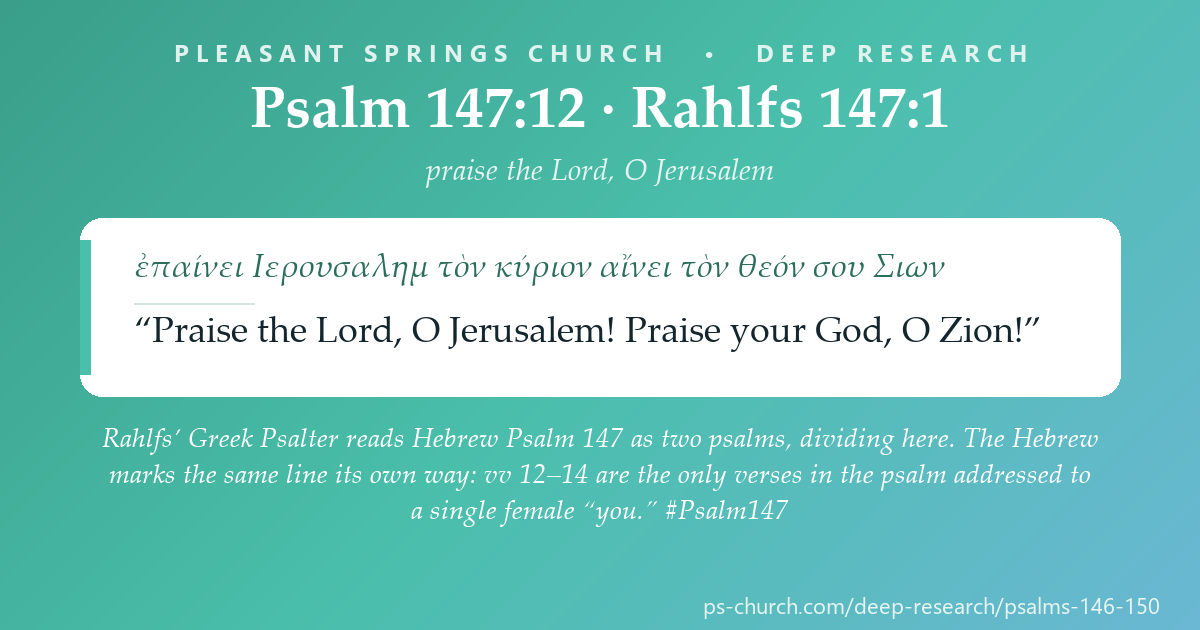
The Psalter ends with five psalms that each open and close on the same word. It also ends with the one place in the book where the two texts disagree about how many psalms there are. Hebrew Psalm 147 runs twenty verses; Rahlfs' Greek Psalter reads it as two — eleven verses, then nine — dividing between Hebrew verse 11 and verse 12. And the Hebrew marks that same line on its own account. Ask which verses of Psalm 147 address a single female "you," a question with nothing to do with the Greek, and the answer is three of the twenty: verses 12, 13 and 14, where Jerusalem and Zion are spoken to directly. They are consecutive, and they are exactly the first three verses of Rahlfs' second psalm. The division also settles the numbering — splitting one psalm into two restores the count that had run one behind ever since Rahlfs read Hebrew Psalms 9 and 10 as one, so Psalms 148, 149 and 150 carry the same number in both texts. The book ends in agreement.
Psalms 146–150 (selections)
Hebrew · Greek (Rahlfs’ Psalter) · ESVHebrew Psalm 147 runs twenty verses. Rahlfs’ Greek Psalter reads it as two psalms: 146, of eleven verses, and 147, of nine. The division falls between Hebrew verse 11 and Hebrew verse 12.
Now take the Hebrew alone and ask a question that has nothing to do with the Greek: which verses of Psalm 147 address a single female “you”?
Three of the twenty do — verses 12, 13 and 14, where Jerusalem and Zion are spoken to directly. They are consecutive, and they are the first three verses of Rahlfs’ second psalm.
Whatever the Greek is doing, the Hebrew changes who it is talking to at exactly the same line.
The Shape of the Passage
Sequence — five psalms that all begin and end the same wayThe Hebrew names nobody in any of these five psalms. Rahlfs’ Greek names two prophets at the head of four of them. Rahlfs 145:1, 146:1, 147:1 and 148:1 all open αλληλουια Αγγαιου καὶ Ζαχαριου — Hallelujah, of Haggai and Zechariah. Rahlfs 149:1 and 150:1 open with αλληλουια alone. In the Hebrew all five psalms open הַֽלְלוּ־יָהּ and nothing more.
Author
Anonymous in the Hebrew throughout. No לְדָוִד, no Asaph, no Korah, no choirmaster. The Hallelujah is the whole heading.
The Greek attribution is reported, not endorsed. This shelf says what Rahlfs’ edition carries at a given verse. It does not say the Greek added a heading, does not call the reading early or late, and does not treat the naming of Haggai and Zechariah as evidence about when these psalms were composed. No critical apparatus was consulted for either text.
Audience
Everything with breath. Psalm 148 calls on angels, sun, moon, stars, sea creatures, weather, mountains, trees, animals, kings and children. Psalm 150 ends the book by widening the call to כֹּ֣ל הַ֭נְּשָׁמָה, everything that breathes.
With one narrower stretch. Psalm 147:12–14 speaks to a single female addressee — Jerusalem, named, and Zion — and that is the only place in these five psalms where it happens. It is also, in Rahlfs, the opening of a separate psalm.
Orient on the Final Hallel, on psalm numbering, and on the shape of the book's ending.
Search by topic: Hallel and Final Hallel; the doxological close of the Psalter; psalm numbering between the Hebrew and Greek traditions; Zion as addressee; Haggai and Zechariah.
Which articles are relevant?
- Anchor Bible Dictionary — “Hallel,” “Psalms, Book of,” “Septuagint,” “Zion.”
- Dictionary of the OT: Wisdom, Poetry & Writings (IVP) — “Hymns,” “Book of Psalms: Structure,” “Doxology,” “Praise.”
- NIDOTTE — הלל, נשמה, שבח, תהלה.
What the reference works say about the division of Psalm 147
The standard treatments note the division and generally explain it as a later editorial join in the Hebrew or a later split in the Greek, depending on the author. Both are claims about the history of the text, and neither can be tested from the files on disk.
What can be tested is whether the Hebrew text as it stands shows anything at that point. It does, and stage 3 sets out the test and the screen it used. Finding a seam in the Hebrew at the place the Greek divides does not tell you which text moved, and this page does not say.
The numbering, and where it comes back together.
How one split cancels an offset that ran for 138 psalms
Rahlfs reads Hebrew Psalms 9 and 10 as one psalm of thirty-nine verses, and 21 + 18 is 39. From Hebrew Psalm 11 onward the Greek number therefore runs one behind (with a further join and split in the 114–116 stretch that cancel each other out), and it stays behind all the way to Psalm 147. Then it closes, because Rahlfs reads one Hebrew psalm as two.
| Hebrew | Rahlfs | |
|---|---|---|
| 146 (10 verses) | 145 (10 verses) | one behind |
| 147 (20 verses) | 146 (11 verses) | one behind |
| 147 (9 verses) | the offset closes | |
| 148 (14 verses) | 148 (14 verses) | same number |
| 149 (9 verses) | 149 (9 verses) | same number |
| 150 (6 verses) | 150 (6 verses) | same number |
Eleven and nine make twenty. The verse count of the two Greek psalms is exactly the verse count of the one Hebrew psalm; no verse is gained or lost at the join, only a psalm number. And because both texts contain 150 psalms, the last three had to arrive back in step somewhere.
Four psalms with two prophets' names at their head
Rahlfs 145:1, 146:1, 147:1 and 148:1 each open αλληλουια Αγγαιου καὶ Ζαχαριου. Those are Hebrew Psalms 146, 147 (both halves) and 148. Rahlfs 149:1 and 150:1 carry αλληλουια alone.
Reported as what the edition on disk carries. This page does not say when the attribution arose, does not treat it as evidence for the date of the psalms, and does not call the reading early or late. Rahlfs’ edition is a modern reconstruction of the Greek wording; no manuscript was examined here.
The test that found the seam, and the screen that made it trustworthy.
Which verses of Psalm 147 speak to a single female “you”?
Hebrew marks a second-person feminine singular possessive with a final kaf. But a final kaf is not by itself a suffix — it is also a root letter and a verb ending, so a naive search returns false hits. In this psalm it returns four verses, and one of them is wrong.
| Token | Verse | Naive test | Screened |
|---|---|---|---|
| אֱלֹהַ֣יִךְ your God | 12 | ✓ | ✓ |
| שְׁעָרָ֑יִךְ your gates | 13 | ✓ | ✓ |
| בָּנַ֣יִךְ your children | 13 | ✓ | ✓ |
| בְּקִרְבֵּֽךְ within you | 13 | ✓ | ✓ |
| גְּבוּלֵ֥ךְ your borders | 14 | ✓ | ✓ |
| יַשְׂבִּיעֵֽךְ he fills you | 14 | ✓ | ✓ |
| בֵּרַ֖ךְ he has blessed | 13 | ✓ | ✗ — a verb, not a suffix |
| מַשְׁלִ֣יךְ casting | 17 | ✓ | ✗ — the kaf is a root letter |
The screen: a final kaf counts only when it is preceded directly by tsere, or by a yod carrying hiriq. That is what the suffix looks like and what בֵּרַךְ and מַשְׁלִיךְ do not. Meteg and sof pasuq are stripped before the test — without that the last token of verse 13 and the last of verse 14 are both missed, because the mark sits between the tsere and the end of the string. Under the screen, the answer is verses 12, 13 and 14, and no others in the psalm.
Verse 17 is the reason this page prints its screen rather than just its result. Without it the finding would have been “verses 12, 13, 14 and 17,” which is not a clean seam and would have been wrong.
What that gives, stated carefully
The three verses are consecutive, and Rahlfs’ division begins at exactly the first of them.
If a dividing line were dropped at random into one of the nineteen places it could go inside a twenty-verse psalm, the chance of it landing on this particular verse is one in nineteen, about 5%. That is the whole of the arithmetic, and the model it assumes — a uniform choice among nineteen positions — is stated so it can be argued with.
This is not evidence that the Greek division is original, or that the Hebrew join is secondary. A change of addressee is a normal thing for a psalm to do mid-poem, and Psalm 147 would not be unusual in doing it. What can be said is narrower: the two texts mark the same line, one by starting a new psalm and one by changing who it speaks to. Which of those is the older arrangement cannot be settled from anything on disk.
The frame that runs across all five psalms.
Every one of these five psalms opens and closes on the same word
In the Hebrew, Psalms 146, 147, 148, 149 and 150 each begin with הַֽלְלוּ־יָהּ and each end with it. Ten occurrences, five at the head and five at the foot.
Eight psalms in the book are framed that way — 106, 113, 135, and then 146, 147, 148, 149 and 150. Five of the eight are the last five psalms of the book, in a row. Nowhere else do even two consecutive psalms do it.
In Rahlfs’ Greek the openings all match — every one of Rahlfs 145 through 150 begins αλληλουια. The closings do not.
| Hebrew ends | Rahlfs ends | |
|---|---|---|
| 146 = Ra 145 | הַֽלְלוּ־יָֽהּ׃ | γενεὰν καὶ γενεάν |
| 147 = Ra 146 | — | τὸ ἔλεος αὐτοῦ |
| 147 = Ra 147 | הַֽלְלוּ־יָֽהּ׃ | οὐκ ἐδήλωσεν αὐτοῖς |
| 148 = Ra 148 | הַֽלְלוּ־יָֽהּ׃ | λαῷ ἐγγίζοντι αὐτῷ |
| 149 = Ra 149 | הַֽלְלוּ־יָֽהּ׃ | τοῖς ὁσίοις αὐτοῦ |
| 150 = Ra 150 | הַֽלְלוּ־יָֽהּ׃ | τὸν κύριον αλληλουια |
Rahlfs 150:6 is the only verse in the whole Greek Psalter that ends αλληλουια. The Greek does once, at the very end of the book, what the Hebrew does at the end of all five.
A note on Hebrew verse 147:20 and the last word of the book
Hebrew 150:6 reads כֹּ֣ל הַ֭נְּשָׁמָה תְּהַלֵּ֥ל יָ֗הּ הַֽלְלוּ־יָֽהּ׃ — the short name stands twice in five words, once as the object of the verb and once inside the closing formula.
That is where the book stops, in both texts, at the same number.
What this study can support and what it cannot.
The limits on the seam finding
It is a real feature of the Hebrew text and a real feature of the Greek, and the two coincide. Both halves of that are checkable in a few lines of code and both are printed above with the rule that produced them.
It is not a demonstration of anything about the history of either text. A single coincidence at a single point, with a one-in-nineteen null, is interesting and is not proof. The page reports it at that weight and no more.
What was checked and came back negative
No token anywhere else in Psalm 147 passes the second-person feminine singular screen. Scoped to the Hebrew text on disk — Sefaria’s Miqra according to the Masorah — and to the screen exactly as printed in stage 3: final kaf preceded directly by tsere, or by a yod carrying hiriq, with meteg stripped first. A different screen could return a different set, which is why this one is published.
Three psalms outside this study also open and close with הַֽלְלוּ־יָהּ: 106, 113 and 135. The frame is not unique to the last five; what is true of them is that they are the only consecutive run.
And the deepest New Testament contact in these five psalms is seven words. Rahlfs 145:6 — Hebrew Psalm 146:6 — shares τὴν θάλασσαν καὶ πάντα τὰ ἐν αὐτοῖς with Acts 4:24. The next deepest is five, at Rahlfs 148:6 with Hebrews 1:8.
The end of the book, and the end of this shelf's walk through it.
A hundred and fifty psalms, two texts, one ending
The Psalter spends most of its length with the two texts out of step by a single number, and then, in its last five psalms, they come back together. The mechanism is a disagreement — one text reads a psalm the other reads as two — and the effect is agreement.
And at the seam of that disagreement the Hebrew turns and speaks to Jerusalem by name, in the second person, for the only time in these five psalms.
Then both texts do the same thing at the same moment. They call on everything that breathes, and they stop.
Every Deep Research page traces its passage across the whole sweep — the Old Testament, the Second-Temple world between the testaments (historical witnesses, not Scripture), and the New Testament. Follow the thread:
Pleasant Springs Church — Deep Research
Research method after Michael S. Heiser’s Bible Research Method (examine dictionaries → ancient literature → important words → textual connections → academic publications → share), with the Pleasant Springs “Author & Audience” foundation. Scripture set in the Hebrew, the Greek editions named on each page and the ESV (Old Testament), and the Greek New Testament and the ESV (New Testament), per the practice of Pleasant Springs Church. Psalms 146–150 research grounded in Goldingay (Psalms 90–150), Hossfeld and Zenger (Psalms 3), Wilson and Alter. Text: Hebrew from the Masoretic text as printed in the editions consulted — Sefaria’s Miqra according to the Masorah; no critical apparatus was consulted for the Hebrew. Greek from Rahlfs’ Greek Psalter (CATSS digitization); Greek New Testament from the SBL edition. The standing caution for this shelf applies: these pages say “Rahlfs’ Greek Psalter reads…” and never call a Greek reading early or late. ⚠️ The seam measurement, stated so it can be repeated. Verse counts read off the files: Hebrew Psalm 147 = 20 verses; Rahlfs 146 = 11 and Rahlfs 147 = 9, and 11 + 9 = 20. Every token of Hebrew Psalm 147 was then tested for a 2fs pronominal suffix under a published screen — accents (U+0591–U+05AF), meteg (U+05BD) and sof pasuq (U+05C3) stripped, then a token counts only if it ends in tsere + final kaf, or in yod + hiriq + final kaf, optionally followed by shewa. The screen is the claim. A naive final-kaf test returns verses 12, 13, 14 and 17; the screen rejects מַשְׁלִיךְ at verse 17, where the kaf is a root letter, and בֵּרַךְ at verse 13, where it is a verb ending. Under the screen the answer is six tokens across verses 12, 13 and 14, and no others in the psalm. Both false positives are printed above rather than quietly dropped — this shelf has been caught twice before by exactly this class of homograph, once with היה matching a test for יָהּ and once with בִּשְׂדֵי matching a test for שַׁדַּי. ⚠️ The one-in-nineteen figure is a null, not a result. It assumes a dividing line placed uniformly at random in one of the 19 internal positions of a 20-verse psalm, and asks for the chance of it landing on verse 12. That model is stated so it can be disputed; no stronger probability claim is made, and no claim at all is made about which arrangement is older. ⚠️ The Hallelujah frame. Hebrew: all five psalms open and close הַֽלְלוּ־יָהּ, ten occurrences. Greek: all six of Rahlfs 145–150 open αλληλουια; searched as a final token across all 2,534 Greek Psalter verses, only Rahlfs 150:6 ends with it. ⚠️ New Testament runs are reported against the Psalter’s own baseline — 68.0% of the 2,534 Greek Psalter verses reach a 3-word run, 16.1% reach 4+, 5.1% reach 5+, maximum 20. A 3-word run is the Psalter norm, not evidence of contact. ⚠️ The baseline was re-measured on 30 August 2026, and it moved. CATSS and MorphGNT spell one Greek word two ways depending on the next word’s first letter — the negative (οὐ / οὐκ / οὐχ), the preposition (ἐκ / ἐξ) and the movable nu (ἐστι / ἐστιν). MorphGNT folds each pair in the column measured here; CATSS does not, so until this was corrected every run compared across the two editions stopped dead at the first such word. The comparison now applies MorphGNT’s own equivalence table — 106 pairs, 1,326 tokens — to both sides. Before the correction this page printed 67.8% reaching 3+ and 16.0% reaching 4+; the re-measurement gives 68.0% and 16.1%. The fold could only ever break a shared run, never invent one, so every figure it touched was too low and none was overstated. 144 of the 2,534 Psalter rows moved. One verse of this study moved: Rahlfs 145:3 — Hebrew Psalm 146:3 — from 2 to 3, in a tie band of 1 (with Luke 12:24). The deepest contact in the five psalms is unchanged: Rahlfs 145:6 at seven words, in a tie band of 2 — Acts 4:24 and Acts 14:15 both carry the seven — and the next deepest are Rahlfs 145:1 with Luke 1:46 and Rahlfs 148:6 with Hebrews 1:8, at five apiece. ⚠️ Hebrew counts are FORM counts. No Hebrew lemmatiser is on disk, so no root or lemma claim is made — the 2fs screen is a test on spelling and pointing, not on grammar, which is exactly why its two false positives had to be handled by hand and printed. Word counts follow the shelf rule: split on whitespace and maqqef, count a token only if it carries a Hebrew letter, count a ketiv/qere pair once. Under that rule the Psalter totals exactly 19,586 words and 2,527 verses. Ps 146 = 85 words / 10 verses; 147 = 141 / 20; 148 = 111 / 14; 149 = 63 / 9; 150 = 37 / 6. ⚠️ What could not be checked. No Qumran manuscript of these psalms, no Cairo Geniza fragment, no Syriac, no Vulgate or Gallican Psalter, no Aquila, Symmachus or Theodotion, and no manuscript evidence of any kind bearing on the division of Psalm 147 or on the attribution to Haggai and Zechariah — which is why stages 2 and 3 report what each text carries and decline to say how the difference arose. Typology is handled per the house position: what the text says, what the New Testament itself draws, and what we see from this side of the cross — with the seeing left to the reader.
Scripture quotations marked ESV are from the ESV® Bible (The Holy Bible, English Standard Version®), © 2001 by Crossway, a publishing ministry of Good News Publishers. ESV Text Edition: 2016. Used by permission. All rights reserved. The ESV text may not be quoted in any publication made available to the public by a Creative Commons license, and the ESV may not be translated in whole or in part into any other language. www.esv.org
|
Did this study bless you today? 💚 Give to Support PS Church100% of gifts go to the General Fund — thank you. |