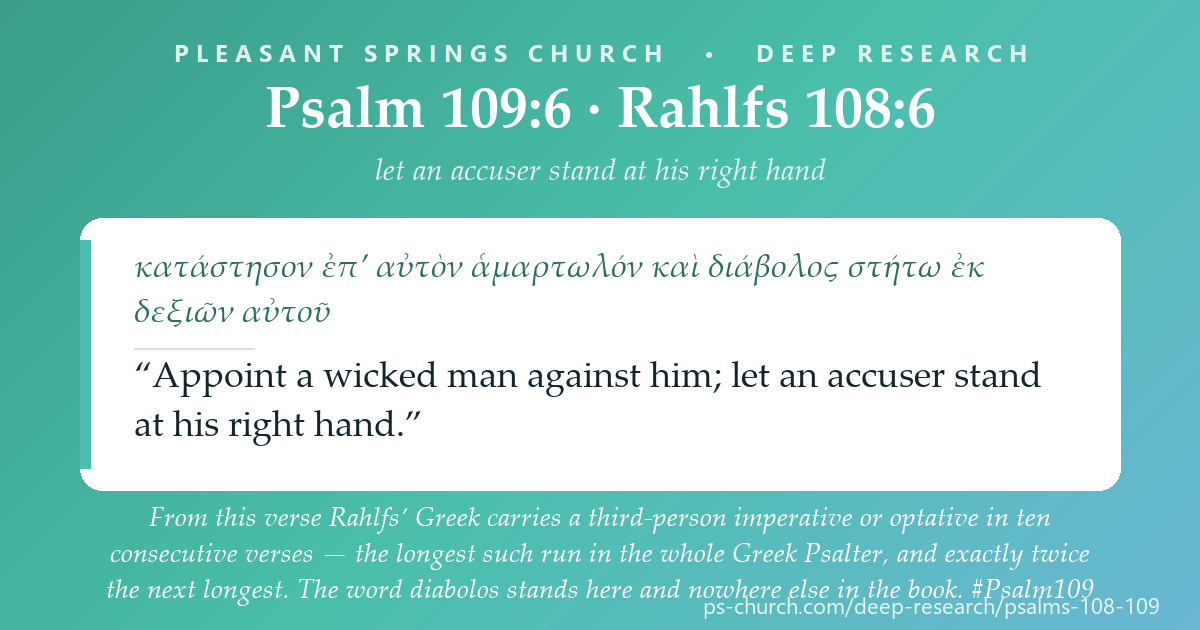
Rahlfs' Greek Psalm 108 — our Psalm 109 — carries a third-person imperative or optative in ten consecutive verses, at 108:6–15. That is the longest such run anywhere in the 150-psalm Greek Psalter, and it is exactly twice the next longest. Inside it stands one word that occurs nowhere else in the book: at 108:6, where the Hebrew has an accuser, Rahlfs has διάβολος. The Hebrew clusters that root here — four of its six Psalter occurrences are in this one psalm — and Rahlfs answers all four with forms of a single Greek stem. Alongside it, Psalm 108: fourteen verses, every one of which also stands in Psalm 57 or Psalm 60. Along the way: what Acts 1:20 actually shares with Psalm 109:8, and five famous cross-references that do not survive being measured. See the method →
Psalms 108 and 109 (selections)
Hebrew · Greek (Rahlfs’ Psalter) · ESVEvery verb form in the Greek Psalter was checked against its CATSS parse and flagged where the mood is imperative or optative and the person is third. Then, for every psalm, the longest run of consecutive verses each carrying at least one such form:
• Rahlfs 108 — 10 verses (6–15) = our Psalm 109
• Rahlfs 118 — 5 verses (76–80) = our Psalm 119
• Rahlfs 66 — 5 verses (4–8) = our Psalm 67
• Rahlfs 68 — 4 verses (23–26) = our Psalm 69
• Rahlfs 34 — 4 verses (24–27) = our Psalm 35
The longest run in the book is exactly twice the next longest. Nothing else in the Greek Psalter sustains that mood for anything like as long.
⚠️ And one word inside it stands nowhere else. At Rahlfs 108:6, where the Hebrew has וְ֝שָׂטָ֗ן — an accuser — Rahlfs has διάβολος. That word occurs once in the whole 150-psalm Greek Psalter, and this is it.
⚠️ The Hebrew clusters the root, and the Greek follows it one for one. The accuser-root stands six times in the whole Hebrew Psalter — at 38:21, 71:13, and then four times here, at 109:4, 6, 20 and 29. Rahlfs has a form of one Greek stem at all four of those verses — ἐνδιέβαλλον, διάβολος, ἐνδιαβαλλόντων, ἐνδιαβάλλοντες.
⚠️ What this page will not do with that. It will not tell you who the accuser at 109:6 is. The Hebrew word is the ordinary noun for an adversary or a prosecutor and stands for human opponents twice in this same psalm; the Greek word is the ordinary Greek for a slanderer and became a proper name later. Both facts are true at once, and a page that resolved them would be adding something the texts do not carry. It also does not adjudicate whether verses 6 to 19 are the psalmist speaking or the psalmist quoting his enemies — there is no quotation marker in the Hebrew, none in the Greek, and no section break inside the block in this edition. The seeing is left to the reader.
The Shape of the Passage
Sequence — a psalm made of two psalms, and a psalm with one turn in itWhat holds is a single phrase used twice, in opposite directions. At 109:6 an accuser stands at his right hand. At 109:31 God stands at the right hand of the needy man. The same words, the same position in the line, and the parties reversed. Both the Hebrew and Rahlfs carry it in both places.
⚠️ And Psalm 108 is not the only psalm made of other psalms. It is the clearest case, and a page should not say it is the only one. Which text stood first — Psalm 108 or the two psalms its material also stands in — is not decidable from a count of shared words, and this page does not decide it. It reports that the same material stands in three places and stops.
⚠️ The two psalms in this unit have different English offsets. Psalm 108’s heading is counted as verse 1 in Hebrew, so Hebrew 108:2 is English 108:1. Psalm 109’s heading shares a verse with the poem’s first line, so the Hebrew and English numbers agree all the way through. The Greek chapter numbers are 107 and 108, one behind the Hebrew.
Author
David in both headings, and in both languages. Psalm 108 is a song, a psalm, of David; Psalm 109 is to the choirmaster, of David, a psalm. Neither Greek heading carries an element the Hebrew does not.
Psalm 108 is assembled. Its first half stands in Psalm 57 and its second in Psalm 60. The page reports the overlap and asserts no direction. It also notes what changes: Psalm 108 has no Selah, and every Selah in the two psalms its material also stands in falls outside the shared verses.
And its divine names belong to a different book. Psalm 108 sits in Book V, and uses God six times — the profile of the Elohistic psalms of Book II, where its material also stands.
Psalm 109 is the Psalter’s hardest prayer. Fourteen verses asking for things most readers would rather not ask for. The page reports what it says and does not soften it.
Audience
A congregation that already knew two other psalms. Anyone singing Psalm 108 in Hebrew would have recognised every line of it.
Someone under accusation. In return for my love they accuse me… they reward me evil for good, and hatred for my love. The accuser-word stands four times in Psalm 109, which is more than in the rest of the Psalter put together.
Readers who will be asked what to do with verses 6 to 19. The text gives no marker either way. There is no quotation mark in the Hebrew, none in the Greek, and no section break inside the block in this edition.
And one apostle, reading it as a book. Acts 1:20 introduces its two citations with it is written in the book of Psalms. The second of the two is this psalm’s eighth verse.
Orient on imprecation, on the composite psalm, and on the accuser.
Search by topic: imprecatory psalms; satan; composite psalms; Acts 1 and the replacement of Judas; optative mood in the Greek Psalter.
Which articles are relevant?
- Anchor Bible Dictionary — “Curse,” “Satan,” “Imprecation,” “Acts of the Apostles.”
- Dictionary of the OT: Wisdom, Poetry & Writings (IVP) — “Imprecation,” “Lament, Individual,” “Enemies.”
- NIDOTTE / TDOT — וְ֝שָׂטָ֗ן (śāṭān, adversary, accuser), פְּ֝קֻדָּת֗וֹ (pəquddātō, his office).
- On the Greek — the NETS Psalms introduction, with Rahlfs 108:4, 6, 20 and 29 read together before anything is said about the word at verse 6.
- On Acts 1:20 — any treatment that prints the Greek of Rahlfs 68:26 and 108:8 beside the verse rather than an English psalm.
Bibliography surfaced:
- John Goldingay, Psalms 90–150; Robert Alter, The Book of Psalms.
- Frank-Lothar Hossfeld and Erich Zenger, Psalms 3 (Hermeneia).
- Erich Zenger, A God of Vengeance? — the standard treatment of the imprecatory psalms as a group.
A psalm that stands in three places, and five cross-references that fail.
Every overlap and every run below was measured before it was described.
Which parallels shed light on these psalms?
Psalm 108 stands in three places in the Psalter. Its first half also stands in Psalm 57 and its second half in Psalm 60, verse for verse and in order. The Greek shows the overlap differently from the Hebrew — there is one place where the two Greek verses diverge and the two Hebrew verses are identical. That is a fact about the Greek text held here. It is not evidence about which Hebrew text stood first, and the page draws none from it.
And Psalm 108 is not the only psalm built that way. Psalm 70 stands inside Psalm 40 on the same measure. Psalm 108 is the clearest case and not a unique one.
- Psalm 57:7–11 → Psalm 108:1–5. The first half, verse for verse.
- Psalm 60:5–12 → Psalm 108:6–13. The second half.
- Psalm 109:8 → Acts 1:20. 4 unbroken words. The other half of the same verse in Acts comes from Psalm 69:25, and reaches four as well.
- Psalm 40:13–17 → Psalm 70. The other clear composite in the book.
“Romans 15:9 quotes Psalm 108:3.” Three words. Romans 15:9 runs five deep against Psalm 18:49 instead.
“The head-wagging at the cross comes from Psalm 109:25.” Two words. The scene at Matthew 27:39 and Mark 15:29 does not reproduce this psalm, and it does not cleanly reproduce Psalm 22 either.
“They hated me without a cause at John 15:25 is Psalm 109:3.” Two words, and the same two stand in two other psalms. The verb decides it, and the verb is not this psalm’s.
“Romans 3:13 draws on Psalm 109:2.” Zero. Romans 3:13’s catena runs fifteen unbroken words against Psalm 14:3 and nine against Psalm 5:9. It does not touch this psalm at all.
“These psalms are full of rare words.” Psalm 108 has the second-lowest rate of Psalter-unique vocabulary of any psalm in the book — which is what you would expect of a psalm assembled from two others. Psalm 109 is exactly average.
One word that stands once in the book, and a phrase used twice against itself.
Every count below was run on this library’s own texts and is stated with its scope, so a reader can repeat it and get the same number or show that it is wrong.
“An accuser, an adversary.” The root stands six times in the whole Psalter and four of the six are in this psalm — at verses 4, 6, 20 and 29. Where the Hebrew has it here, Rahlfs has διάβολος. In this same psalm the Hebrew uses the root twice of human opponents, at verses 20 and 29. The page reports the range and does not decide the referent at verse 6.
“Slanderer, accuser.” This word occurs exactly once in the whole 150-psalm Greek Psalter. Rahlfs uses participles from the same stem at the psalm’s three other accuser-verses, so the cluster the Hebrew makes with one root the Greek makes with one stem.
“His office, his charge.” Rahlfs has τὴν ἐπισκοπὴν αὐτοῦ, and Acts 1:20 has the same three words. The unbroken run Acts shares with this verse is four words long.
“At the right hand of.” The psalm uses this phrase twice and reverses who is standing there. At verse 6 an accuser stands at the wicked man’s right hand; at verse 31 God stands at the needy man’s. Rahlfs has ἐκ δεξιῶν in both.
“Steadfast, fixed.” The widest divergence in Psalm 108. The Hebrew line has my heart is steadfast, O God once; Rahlfs 107:2 has ἑτοίμη ἡ καρδία μου twice, once on either side of the address.
The rule. Every verb in the Greek Psalter was read off its CATSS parse code and flagged where the mood is imperative or optative and the person is third. Then, per psalm, the longest run of consecutive verse numbers each carrying at least one flagged form.
The leaderboard. Rahlfs 108 — 10 (verses 6–15). Rahlfs 118 — 5 (76–80). Rahlfs 66 — 5 (4–8). Rahlfs 68 — 4 (23–26). Rahlfs 34 — 4 (24–27).
Why it is worth printing. Not because ten is a large number, but because the gap is: the longest run in the book is twice the next longest, and the next two are tied.
What the page does not claim. No null test applies — this is a census of the whole Greek Psalter, not a sample. And the figure is about the Greek text held here: the Hebrew of the same verses uses jussives and imperfects that a reader may or may not read as volitional, which is exactly why the ESV footnotes three of them as alternative readings.
One quotation, and the cross-references that do not survive.
Runs are longest unbroken sequences of tokens measured on the SBL edition against the CATSS texts, under one normalisation applied to both sides.
Where does the New Testament take up these psalms?
Once, in Acts 1:20. Peter joins two psalm lines into one citation and introduces them together: it is written in the book of Psalms. The second half is this psalm’s eighth verse, and the run is four unbroken words. The first half comes from Psalm 69:25, and it reaches four as well.
And nothing else in either psalm reaches five words anywhere in the New Testament. Every n-gram of both psalms’ Greek was swept against all 7,927 verses of the SBL edition; nothing clears four.
One coincidence is worth naming so it can be dismissed. Psalm 108:11 shares an exact three-word run with Acts 8:31 — the Ethiopian’s how can I, unless someone guides me? The identical three words also stand in Psalm 60, which is where Psalm 108 gets that verse. A phrase in two psalms cannot point at one of them, and the resemblance to Acts is chance.
- Psalm 109:8 → Acts 1:20b. 4 words. The only quotation in the unit.
- Psalm 69:25 → Acts 1:20a. 4 words. The other half of the same citation; see Psalm 69.
- Psalm 108:3 → Romans 15:9. 3 words. Romans routes through Psalm 18:49 at five.
- Psalm 109:25 → Matthew 27:39 · Mark 15:29. 2 words.
- Psalm 109:3 → John 15:25. 2 words, and not distinctive.
- Psalm 109:2 → Romans 3:13. 0.
- Psalm 109:6 → nothing. The one verse in the Greek Psalter with the word for devil in it is not quoted or alluded to anywhere in the New Testament.
What is settled, what is contested, and what this page refuses to decide.
What is the state of the discussion?
Settled: that Psalm 108 shares its material with Psalms 57 and 60. The correspondence is verse for verse and can be checked in minutes.
Contested for centuries, and left contested here: whether Psalm 109:6–19 is the psalmist cursing or the psalmist quoting the curse laid on him. There is no quotation marker in the Hebrew, none in the Greek, and no section break inside the block in the edition used here. Both readings are ancient and the page reports the absence of a marker rather than choosing.
Contested, and left contested: the referent of the accuser at 109:6. The same Hebrew root stands twice in this psalm for human opponents. And the ESV’s three revocalisation footnotes in this psalm fall exactly in the three verses where the Hebrew and Rahlfs agree that the mood is not volitional — which is a useful check on where the real ambiguity sits.
- Hossfeld and Zenger, Psalms 3 (Hermeneia) — on both psalms.
- Zenger, A God of Vengeance? — on what to do with Psalm 109.
- The NETS Psalms volume — for 108:6 and the optatives read as translation.
Where this lands.
What is worth carrying out of Psalms 108 and 109?
A psalm can be made of older psalms and still be a psalm. Every line of Psalm 108 stands somewhere else, and the book keeps it anyway. What is new is the arrangement.
The hardest prayer in the book ends by naming where God stands. At verse 6 an accuser is at a man’s right hand. At verse 31 God is at the poor man’s. The psalm does not withdraw a word of the fourteen verses in between. It just says who else is standing.
One concrete response. Read Psalm 109 all the way through, out loud, without stopping at verse 19. The psalm is built so that the last verse is the one you are left holding.
Every Deep Research page traces its passage across the whole sweep — the Old Testament, the Second-Temple world between the testaments (historical witnesses, not Scripture), and the New Testament. Follow the thread:
Pleasant Springs Church — Deep Research
Research method after Michael S. Heiser’s Bible Research Method (examine dictionaries → ancient literature → important words → textual connections → academic publications → share), with the Pleasant Springs “Author & Audience” foundation. Scripture set in the Hebrew, the Greek editions named on each page and the ESV (Old Testament), and the Greek New Testament and the ESV (New Testament), per the practice of Pleasant Springs Church. Psalms 108–109 research grounded in Goldingay (Psalms 90–150), Hossfeld and Zenger (Psalms 3), Zenger (A God of Vengeance?) and Alter. Text: Hebrew from the Masoretic text as printed in the editions consulted — Sefaria’s Miqra according to the Masorah; no critical apparatus was consulted for the Hebrew, the paseq is not reproduced in the codex lines, and neither psalm carries a ketiv/qere or a Selah. Greek from Rahlfs’ Greek Psalter (CATSS digitization, with the CATSS morphology files for the parse codes); Greek New Testament from the SBL edition. The standing caution for this shelf applies: these pages say “Rahlfs’ Greek Psalter reads…” and never call a Greek reading early or late. ⚠️ The ten-verse run, stated so it can be repeated. Both CATSS Psalms morphology files were parsed; every verb was flagged whose parse code has mood D (imperative) or O (optative) with person 3; then the longest run of consecutive verses carrying at least one such form was computed for each of the 150 psalms. Result: Rahlfs 108 = 10 (vv 6–15); Rahlfs 118 = 5 (76–80); Rahlfs 66 = 5 (4–8); Rahlfs 68 = 4 (23–26); Rahlfs 34 = 4 (24–27). This is a census of the whole Greek Psalter, so no significance test applies. The figure is a fact about the Greek text held here — the Hebrew of the same verses uses jussive and imperfect forms whose force is a matter of reading, which is why the ESV footnotes three of them. ⚠️ The accuser count. The root was scanned across the whole MAM Psalter allowing both the defective and the plene spelling: six occurrences, at 38:21, 71:13, 109:4, 109:6, 109:20 and 109:29. Rahlfs carries a form of one Greek stem at all four of the Psalm 109 verses, and διάβολος occurs once in the whole Greek Psalter. ⚠️ The English offsets differ inside this unit — 1 for Psalm 108 and 0 for Psalm 109 — and the Greek chapter numbers are 107 and 108. Every citation on this page carries all three numbers where they differ. ⚠️ Hebrew word counts on this page split on whitespace, maqqef and paseq, exclude Masoretic section markers, count a ketiv/qere pair once, and require a token to carry at least one Hebrew letter. That rule reproduces a Psalter total of exactly 19,586 words. Psalm 108 = 98 words in 14 verses; Psalm 109 = 227 words in 31 verses. ⚠️ What this page refuses to decide. Whether Psalm 109:6–19 is the psalmist speaking or quoting — there is no marker in either text and no section break in this edition. Who the accuser at 109:6 is — the Hebrew root stands twice in this same psalm for human opponents. And which of Psalms 57, 60 and 108 stood first — a count of shared words cannot decide it. ⚠️ What was not consulted. No Qumran manuscript of either psalm, no Cairo Geniza fragment, no Syriac, no Vulgate or Gallican Psalter, no Aquila, Symmachus or Theodotion, and no critical apparatus for any text compared. Verse counts verified in all three columns (Hebrew 14 and 31, Rahlfs 14 and 31, ESV 13 and 31). Typology is handled per the house position: what the text says, what the New Testament itself draws, and what we see from this side of the cross — with the seeing left to the reader.
Scripture quotations marked ESV are from the ESV® Bible (The Holy Bible, English Standard Version®), © 2001 by Crossway, a publishing ministry of Good News Publishers. ESV Text Edition: 2016. Used by permission. All rights reserved. The ESV text may not be quoted in any publication made available to the public by a Creative Commons license, and the ESV may not be translated in whole or in part into any other language. www.esv.org
|
Did this study bless you today? 💚 Give to Support PS Church100% of gifts go to the General Fund — thank you. |