Psalm 107 opens Book V, and it is built out of two sentences it repeats four times each. One of them never changes. The thanks-refrain at verses 8, 15, 21 and 31 is identical in Hebrew down to the last cantillation mark, and identical in Rahlfs' Greek down to the last accent. The other changes — and both languages change it in the same places. The cry-refrain at verses 6, 13, 19 and 28 varies in three of its seven Hebrew words, and its verb of rescue is three different verbs in the order A, B, B, C: rescued, saved, saved, brought out. Rahlfs' Greek holds thirteen of its fifteen words fixed — and varies the same verb at the same four verses, in the same pattern. The ESV prints one English sentence all four times. Along the way: the seven inverted nuns this edition prints, and why the storm-stilling scene shares a situation with this psalm and almost no words. See the method →
Psalm 107
Hebrew · Greek (Rahlfs’ Psalter) · ESVThe thanks-refrain — verses 8, 15, 21 and 31. Compared character by character, the four Hebrew occurrences are identical, including every cantillation mark, and the four Greek occurrences are identical, including every accent.
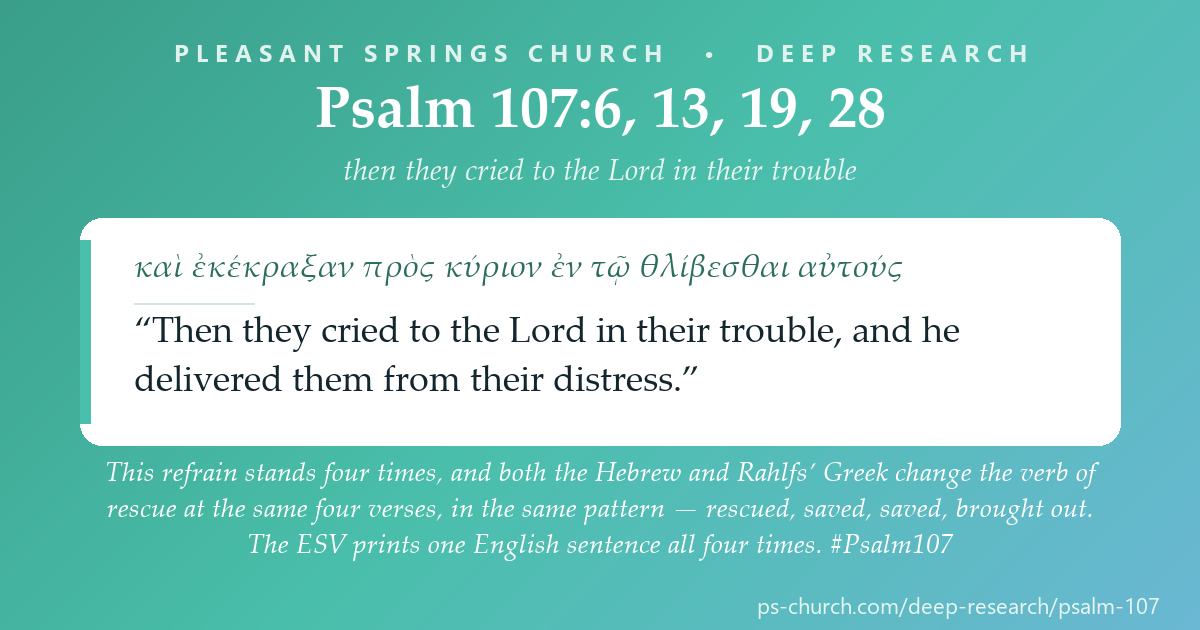
The cry-refrain — verses 6, 13, 19 and 28 — is not.
In Hebrew each occurrence is seven words, and three of the seven vary: the verb of crying is spelled with a tsade at verses 6 and 28 and with a zayin at 13 and 19; the noun for their distresses is spelled four different ways in four verses; and the verb of rescue is three different verbs.
In Rahlfs’ Greek each occurrence is fifteen words, and the first thirteen are identical to the letter in all four. Word fourteen is the verb of rescue, and it varies. Word fifteen is the same word every time and differs once in its accent alone, at verse 19, because there it stands at a pause.
⚠️ And the two texts vary it in exactly the same pattern.
Hebrew: he rescued them · he saved them · he saved them · he brought them out
Greek: ἐρρύσατο · ἔσωσεν · ἔσωσεν · ἐξήγαγεν
Three verbs across four occurrences, in the order A, B, B, C — and both texts do it at the same four verses.
⚠️ The English column prints one sentence four times. The ESVreads and he delivered them from their distress at all four, and it is the same English word every time. That is not a complaint about the translation — three near-synonyms in a fourfold refrain are a reasonable thing to render with one English verb, and the ESV is not alone in doing it. It is stated because a reader working from English alone has no way to see the pattern, and the pattern is the finding. This page reports where the words stand in the three texts and makes no claim about anyone’s intention in any of them.
The Shape of the Passage
Structure — four panels, and the diagram usually drawn around them failsThe chiasm is dead. Scored on content words shared between panels, the pairings that an A–D / B–C chiasm requires return: A–B 0, A–C 1, A–D 1, B–C 0, B–D 0, C–D 1. There is no pairing to draw.
The claim that the closing section echoes the panels is dead too. Content words shared between verses 33–43 and verses 4–32: seven, against 20,000 reshuffles — p = 0.989. That is not merely non-significant; it is further from a link than chance predicts.
And the four-panel division itself only barely survives its most generous test. Set the eight refrain verses aside — they are shared by construction, so leaving them in would guarantee the answer — and the panels hold together weakly. The page draws the panels because the refrains mark them explicitly in the text, not because the vocabulary test carried them. That distinction is worth keeping: an explicit refrain is evidence a reader can see, and a chiasm that needs a diagram to be visible needs a test to be believed.
Book V opens here, and it opens with the line Book IV closed with. Psalm 106:1 and Psalm 107:1 carry the same seven-word formula. The one measurable difference is a spelling: Psalm 106:1 writes it with a he and a vav, Psalm 107:1 without the vav.
Author
Anonymous. No Hebrew heading at all. Verse 1 is text. Rahlfs 106:1 opens with one word that has no Hebrew counterpart here.
The psalm is built out of two sentences it repeats. Four panels, each ending with a cry and then a thanksgiving. Eight of its forty-three verses are refrain.
And this edition prints seven inverted nuns in it. Sefaria’s Miqra according to the Masorah places the mark before verses 23, 24, 25, 26, 27, 28 and 40. Seven, not six, and not at verses 21 to 26 — a range often quoted. The claim is scoped to this edition: it is one edition’s representation of the Masorah, and the page says nothing about what the mark was for.
The word the psalm is organised around is used six times. Steadfast love — at verses 1, 8, 15, 21, 31 and 43. Singular in the first five and plural in the last.
Audience
Four kinds of people in trouble. Wanderers in the desert; prisoners in darkness and irons; the sick who brought it on themselves; sailors in a storm. The psalm does not say they are Israelites, and it does not say they are not.
People gathered from four directions. From the east and from the west, from the north and from the sea.
And people who are expected to say something. Let the redeemed of the Lord say so. The second verse of Book V tells its readers to speak.
The last verse addresses one person. Whoever is wise, let him attend to these things. Forty-two verses of they, and then a question aimed at you.
Orient on thanksgiving psalms, on the Book IV/V seam, and on the inverted nun.
Search by topic: todah; thanksgiving psalm; the divisions of the Psalter; nun hafukha; the hodu formula.
Which articles are relevant?
- Anchor Bible Dictionary — “Thanksgiving, Psalms of,” “Psalms, Book of,” “Masorah.”
- Dictionary of the OT: Wisdom, Poetry & Writings (IVP) — “Thanksgiving,” “Book of Psalms V,” “Refrain.”
- NIDOTTE / TDOT — חַסְדּֽוֹ (ḥasdō, his steadfast love), גְּאוּלֵ֣י (gəʾûlê, the redeemed of).
- On the Greek — the NETS Psalms introduction, with Rahlfs 106:6, 13, 19 and 28 read side by side before any commentary on the refrain.
- On the inverted nun — any treatment of the nun hafukha that lists where the printed editions actually put it, rather than repeating a verse range.
Bibliography surfaced:
- John Goldingay, Psalms 90–150; Robert Alter, The Book of Psalms.
- Frank-Lothar Hossfeld and Erich Zenger, Psalms 3 (Hermeneia).
- Gerald H. Wilson, The Editing of the Hebrew Psalter — for the 106/107 seam.
Two verses that stand nowhere else, and three claims that fail.
Every Hebrew count below is of exact consonantal forms across the thirty-nine book Hebrew corpus this library holds; the Greek checks named below are across the 64 Greek Old Testament files held here, 30,637 verse units — re-run on 30 August 2026, when Exodus, Leviticus, Numbers, both Joshua recensions and the deuterocanon reached this shelf and the Greek corpus grew from 44 files and 23,061 units. One claim on this page did not survive that growth; it is corrected below with its history, not quietly restated.
Which parallels shed light on this psalm?
Two of this psalm’s lines have exactly one partner each in the whole Hebrew Bible. Psalm 107:16 and Isaiah 45:2 are the only two verses that carry the phrase bars of iron together with the verb for shattering bronze doors. And the verb form at Psalm 107:42 — shuts, of a mouth — stands twice in the Hebrew Bible, here and at Job 5:16, and in both places it is followed by the same word.
And one line reaches back across the seam. The form that opens Psalm 107:11 stands twice in the Hebrew Bible, and the other occurrence is in Psalm 106. The two psalms on either side of the Book IV/V division share an opening that stands nowhere else.
- Isaiah 45:2 → Psalm 107:16. The only two verses in the Hebrew Bible with both halves of the line — and, now that the Greek of Isaiah is held here, the only two in the Greek Old Testament as well. LXX Isaiah 45:2 and Rahlfs 106:16 are the only verses in the 64 Greek files that carry μοχλ- with σιδηρ-, and — ⚠️ this half no longer holds — they were also reported here as the only two carrying χαλκ- with a shattering verb. They are not, and the correction is printed rather than the number swapped: on the 44-file corpus that pairing returned exactly those two verses; on the 64-file corpus it returns four, because Greek Leviticus is now held — Leviticus 6:21, a bronze cooking-pot that is to be scoured, and Leviticus 26:19, a sky of iron and a ground of bronze. Neither has anything to do with gates or prison, which is the point: the bronze-and-shattering pairing was never the distinctive thing. What is still exactly two, re-run at 30,637 verse units, is μοχλ- with σιδηρ-. Their longest unbroken shared run is three — καὶ μοχλοὺς σιδηροῦς — and that three-word sequence stands in those two verses and nowhere else in the Greek held here. The Greek splits the door-word where the Hebrew does not: Isaiah has θύρας χαλκᾶς, the psalm πύλας χαλκᾶς.
- Job 5:16 → Psalm 107:42. The Hebrew verb occurs twice, and both times of a mouth being shut. The Greek keeps the pairing: ἐμφράσσω stands with στόμα in three verses of the 64 Greek files — unchanged by the growth — Greek Job 5:16, Rahlfs 106:42, and Esther 4:17o, which is a Greek addition with no Hebrew behind it. The longest unbroken run Greek Job 5:16 and Rahlfs 106:42 share is one word.
- Psalm 106 → Psalm 107. The same seven-word opening formula, and a shared rare form across the book division. See Psalm 106.
- Psalms 118:1, 118:29 and 136:1 → Psalm 107:1. The hodu formula stands six times in the Hebrew Bible, and the Greek does not level all six the same way.
“Jesus stilling the storm enacts Psalm 107:23–30.” The lexical footing is essentially nil: measured against every verse of Matthew 8, Mark 4 and Luke 8, the longest run this psalm shares with any of them is too short to name. The scene and the psalm share a storm and a stilling, and they share almost no words. This page reports that and leaves the connection where it belongs — with the reader.
“Psalm 107:20 stands behind the centurion’s only say the word, or behind John 1.” Neither survives measurement. Psalm 107 is not quoted anywhere in the New Testament. Its strongest measured contact anywhere is five words, with Luke 1:79.
“Psalm 107 is packed with rare vocabulary.” Thirty-four of its 210 distinct forms occur nowhere else in the thirty-nine books — 16.2%. That is somewhat above average and nothing more, and most of the thirty-four are ordinary words in an inflection that happens to occur once.
Three verbs of rescue, one word of loyalty, and a mark that is not a letter.
Every comparison below was made character by character on the two texts this library holds, including the accents.
“He rescued them.” The first of the refrain’s three rescue verbs. Rahlfs has ἐρρύσατο here, and uses it at this verse only among the four.
“He saved them.” The second, and the only one that occurs twice. Rahlfs has ἔσωσεν at exactly the same two verses. Verses 13 and 19 are the only pair of the four that match each other in both languages.
“He brought them out.” The third, and the last. Rahlfs has ἐξήγαγεν, which is also a verb of leading out. Both texts reach for a different kind of verb in the same place.
“His steadfast love.” Six occurrences, and they mark the psalm’s skeleton — the opening verse, all four thanks-refrains, and the last verse. Singular in the first five; plural in the sixth.
“Inverted nun.” A scribal mark, not a word. Sefaria’s Miqra according to the Masorah prints it before seven verses of this psalm: 23, 24, 25, 26, 27, 28 and 40. Editions differ about where these marks stand, and this page reports only what the edition it uses prints. It makes no claim about what the mark meant or when it was placed.
The thanks-refrain, verses 8, 15, 21, 31. Four Hebrew occurrences, compared as printed including cantillation: all four identical. Four Greek occurrences, compared as printed including accents: all four identical.
The cry-refrain, verses 6, 13, 19, 28. Seven Hebrew words each; words 1, 6 and 7 vary. Fifteen Greek words each; words 1 to 13 are identical in all four and word 14 varies.
The rescue verb, side by side.
6 — he rescued / ἐρρύσατο
13 — he saved / ἔσωσεν
19 — he saved / ἔσωσεν
28 — he brought out / ἐξήγαγεν
What the page does not claim. No null test was run on this and none applies: it is a direct comparison of eight verses, not a sample. And the page does not say that either text is following the other, or that the pattern was designed. It says the two texts change the same word at the same four places, which is what the comparison shows.
A psalm the New Testament never quotes, and five contacts worth measuring anyway.
The New Testament sweep is exhaustive: every n-gram of this psalm's Greek at every length from three words up, against all 7,927 verses of the SBL edition.
Where does the New Testament take up this psalm?
Nowhere, at quotation strength. Psalm 107 is never quoted in the New Testament. Its strongest measured contact is five words, at Luke 1:79.
The one that most needs measuring is the Magnificat. Luke 1:53 — he has filled the hungry with good things — is routinely referred to Psalm 107:9. The measured run is much shorter than the commentaries imply, and this page prints the number rather than the impression.
- Psalm 107:10 → Luke 1:79. 5 words — the psalm’s deepest New Testament contact, and an allusion rather than a citation.
- Psalm 107:3 → Luke 13:29 · Matthew 8:11. An allusion at Luke; a shared phrase at Matthew.
- Psalm 107:11 → Romans 3:2. 4 words — τὰ λόγια τοῦ θεοῦ. A shared phrase, not a citation.
- Psalm 107:5 → Matthew 5:6. 3 words, in the identical participial form.
- Psalm 107:43 → James 3:13. 3 words — a shared opening, τίς σοφὸς καί, and a documented trap.
- Psalm 107:23–30 → Matthew 8 · Mark 4 · Luke 8. No measurable verbal contact. The storm-stilling scene shares the situation and not the words.
What is settled, what is contested, and what this page refuses to decide.
What is the state of the discussion?
Settled: that the four panels are marked by the two refrains. Eight verses of forty-three, in a fixed pattern.
Not settled, and not asserted here: that the panels form a chiasm or that the closing section echoes them. Both fail their tests, and the second fails badly.
Contested, and left contested: why the Hebrew cry-refrain varies where the thanks-refrain does not. This library holds no critical apparatus for either text, and reports the variation without explaining it. It is worth naming what a page cannot settle from a printed edition: whether a spelling difference in a refrain is authorial, scribal or editorial is exactly the kind of question an apparatus exists to address, and there is none here.
A translation question, not a textual one: Psalm 107:3’s fourth direction. Both the Hebrew and Rahlfs read sea; the ESV and most English versions print south. That is a decision about which sea, not a difference between the texts.
- Hossfeld and Zenger, Psalms 3 (Hermeneia) — on Psalm 107 opening Book V.
- Goldingay, Psalms 90–150 — on the panels and the closing section.
- The NETS Psalms volume — for 106:17 and 106:29 read as translation.
Where this lands.
What is worth carrying out of Psalm 107?
The same trouble, four different rescues. Lost, imprisoned, sick, storm-tossed — and the verb changes: rescued, saved, saved, brought out. The psalm says the same thing four times and does not say it the same way.
The thanksgiving does not change at all. Four times, word for word, accent for accent, in both languages. The trouble varies; the response is fixed.
One concrete response. Take the four panels — the desert, the prison, the sickbed, the storm — and name which one you are in this month. Then say verse 8 out loud, which is the line the psalm gives all four of them.
Every Deep Research page traces its passage across the whole sweep — the Old Testament, the Second-Temple world between the testaments (historical witnesses, not Scripture), and the New Testament. Follow the thread:
Pleasant Springs Church — Deep Research
Research method after Michael S. Heiser’s Bible Research Method (examine dictionaries → ancient literature → important words → textual connections → academic publications → share), with the Pleasant Springs “Author & Audience” foundation. Scripture set in the Hebrew, the Greek editions named on each page and the ESV (Old Testament), and the Greek New Testament and the ESV (New Testament), per the practice of Pleasant Springs Church. Psalm 107 research grounded in Goldingay (Psalms 90–150), Hossfeld and Zenger (Psalms 3) and Alter. Text: Hebrew from the Masoretic text as printed in the editions consulted — Sefaria’s Miqra according to the Masorah; no critical apparatus was consulted for the Hebrew, the paseq is not reproduced in the codex lines, and this psalm carries no ketiv/qere. Greek from Rahlfs’ Greek Psalter (CATSS digitization); Greek New Testament from the SBL edition. The standing caution for this shelf applies: these pages say “Rahlfs’ Greek Psalter reads…” and never call a Greek reading early or late. ⚠️ The refrain comparison, stated so it can be repeated. The four cry-refrain verses and the four thanks-refrain verses were compared character by character as printed, accents and cantillation included, in both languages. Thanks-refrain: all four Hebrew occurrences identical; all four Greek occurrences identical. Cry-refrain: 7 Hebrew words each, varying at words 1, 6 and 7; 15 Greek words each, identical through word 13. Rescue verbs, Hebrew and Greek in the same order at the same four verses. No null test applies — this is a direct comparison of eight verses, not a sample. ⚠️ The structure tests. Between-panel shared content words with the eight refrain verses excluded — excluded because they are shared by construction and leaving them in would guarantee the result: A–B 0, A–C 1, A–D 1, B–C 0, B–D 0, C–D 1, so no chiasm is drawn. Verses 33–43 against verses 4–32 share 7 content words, p = 0.989 over 20,000 reshuffles. The four-panel division is drawn because the refrains mark it explicitly, not because a vocabulary test carried it, and the page says so. ⚠️ The inverted nuns are scoped to the edition. Sefaria’s MAM prints U+05C6 before verses 23, 24, 25, 26, 27, 28 and 40 — seven, not six, and not at the range often quoted. Printed editions differ about these marks; this page reports what the edition it uses prints and makes no claim about the mark’s purpose or date. ⚠️ Hebrew word counts on this page split on whitespace, maqqef and paseq, exclude Masoretic section markers and the inverted nuns, count a ketiv/qere pair once by taking the read form, and require a token to carry at least one Hebrew letter. That rule reproduces a Psalter total of exactly 19,586 words. Psalm 107 = 278 words in 43 verses; Rahlfs 106 = 507 words. ⚠️ Absolute negatives are scoped. Hebrew claims of the form nowhere else are scoped to the thirty-nine book Hebrew corpus in Sefaria’s MAM. That sentence has been corrected: this page used to say that the Greek of Isaiah and of Job were not held here, and neither half is true now — the Greek of Isaiah was added to this library on 19 August 2026, and the Greek of Job is held as well. Both links have therefore been measured in Greek and the results are printed in Stage 2: LXX Isaiah 45:2 and Rahlfs 106:16 are the only two verses in the 64 Greek Old Testament files to carry μοχλ- with σιδηρ-, sharing an unbroken run of three; Greek Job 5:16 and Rahlfs 106:42 share an unbroken run of one, and the ἐμφράσσω-with-στόμα pairing they share stands in three verses of those files. ⚠️ Corpus growth, 30 August 2026, and what it did to this page. Twenty more CATSS files reached this shelf — Exodus, Leviticus, Numbers, both Joshua recensions and the deuterocanon — taking the Greek Old Testament here from 44 files and 23,061 verse units to 64 files and 30,637. Every Greek claim on this page was re-run against the larger corpus. Three held and one failed. Held: μοχλ- with σιδηρ- in exactly two verses; the three-word sequence καὶ μοχλοὺς σιδηροῦς in exactly those same two; ἐμφράσσω with στόμα in exactly three (Greek Job 5:16, Rahlfs 106:42 and Esther 4:17o). Failed: this page used to say that Isaiah 45:2 and Rahlfs 106:16 were also the only two verses carrying χαλκ- with a shattering verb. On 23,061 verse units that was true. On 30,637 it is false — Greek Leviticus 6:21 and 26:19 carry the same pairing, about a cooking-pot and about a sky of iron. The stated finding was the iron-bars pairing, which survives; the bronze half was doing no work and is now known not to be distinctive at all. ⚠️ What was not consulted. No Qumran manuscript of this psalm, no Cairo Geniza fragment, no Syriac, no Vulgate or Gallican Psalter, no Aquila, Symmachus or Theodotion, and no critical apparatus for any text compared. Verse counts verified in all three columns (Hebrew 43, Rahlfs 43, ESV 43 — the English offset for this psalm is zero). Typology is handled per the house position: what the text says, what the New Testament itself draws, and what we see from this side of the cross — with the seeing left to the reader.
Scripture quotations marked ESV are from the ESV® Bible (The Holy Bible, English Standard Version®), © 2001 by Crossway, a publishing ministry of Good News Publishers. ESV Text Edition: 2016. Used by permission. All rights reserved. The ESV text may not be quoted in any publication made available to the public by a Creative Commons license, and the ESV may not be translated in whole or in part into any other language. www.esv.org
|
Did this study bless you today? 💚 Give to Support PS Church100% of gifts go to the General Fund — thank you. |