A door opens in heaven, and John is called up to see a throne, already occupied, before a single seal is broken. Around it: a rainbow, twenty-four elders, lightning, seven torches, a sea of glass, and four living creatures who never stop saying Holy, holy, holy. Measured before this page was written, that line turned out to be the rarest contact in the chapter — three “holy”s in a row stand in exactly one verse of the Greek Old Testament, Isaiah 6:3 — and not the deepest: the four words it shares with Isaiah are outrun by six it shares with Amos. This study works Revelation 4:1–11, and it reads as one scene with Revelation 5. See the method →
Revelation 4:1–3, 5–8, 10–11
Greek New Testament (SBLGNT / MorphGNT) · ESVThe Shape of the Passage
Sequence in two panels — the room, then the liturgy (not a chiasm)Chapters 4 and 5 are one throne-room scene. Chapter 4 sets the room and sings to the Creator — worthy are you… for you created all things (4:11). Chapter 5 brings the scroll and the Lamb into the same room and sings the same “worthy” to the Redeemer. Read Revelation 5:1–14 next →
Author
John, on Patmos, has just written seven letters. Chapters 2–3 were addressed to churches on earth, each told what the risen Christ sees in it. Chapter 4 turns the camera round. After this I looked, and behold, a door standing open in heaven — and the same trumpet-like voice of 1:10 says Come up here. The verb is a singular imperative, spoken to John (MorphGNT parses it second person singular); its only twin in the book, Come up here at 11:12, is plural and spoken to the two witnesses. What John is taken up to see is not first the future but the centre: a throne, already standing, already occupied, before a single seal is broken.
He describes God without describing God. The one seated is never given a shape, a face, or a name in this chapter: he has the appearance of jasper and carnelian. Ezekiel, at the same moment of his vision, saw, above the likeness of a throne, a likeness with a human appearance (Ezek 1:26). John stops at the stones. Everything else in the room is described in detail precisely so that the one at its centre need not be.
Audience
Seven small congregations in the province of Asia, some poor (Smyrna), some compromised (Pergamum, Thyatira), one comfortable and lukewarm (Laodicea), living under an emperor whose court had its own throne, its own acclamations and its own vassal kings. To them chapter 4 says, before anything else happens in the book: the throne is occupied, and it is not that one.
And the first thing heaven does is worship. The seals, trumpets and bowls all come later and all come from this room. The order is the message: whatever is about to be shaken on earth, the creatures around the throne do not stop — day and night they never cease to say, Holy, holy, holy. Ten chapters later the same six Greek words, reordered, describe the worshipers of the beast: they have no rest, day or night (14:11). Stage 4 measures the pair; the contrast is in the text.
Orient on the throne, the living creatures, the elders, and the thrice-holy.
Search by topic: throne of God, cherubim and seraphim, living creatures, elders (Revelation), trisagion, Almighty, creation.
Which articles are relevant?
- Anchor Bible Dictionary — “Throne,” “Cherubim,” “Seraphim,” “Elders (NT),” “Revelation, Book of.”
- Dictionary of the Later New Testament & Its Developments — “Worship,” “Old Testament in Revelation,” “Heaven, Heavenly.”
- NIDNTT / TDNT — θρόνος, ἅγιος, παντοκράτωρ, ἄξιος, κτίζω.
- Dictionary of Deities and Demons in the Bible — “Cherubim,” “Seraphim,” “Sabaoth” (for the title the Greek renders two ways: Stage 4).
Bibliography surfaced:
- G. K. Beale (NIGTC), David E. Aune (WBC 52A), Craig R. Koester (Anchor Yale), Grant R. Osborne (BECNT), Robert H. Mounce (NICNT) on Revelation 4–5.
- Richard Bauckham, The Climax of Prophecy (the storm series 4:5 / 8:5 / 11:19 / 16:18) and The Theology of the Book of Revelation (the throne as the book’s centre).
- G. K. Beale & Sean McDonough, “Revelation,” in Commentary on the New Testament Use of the Old Testament — Beale argues Daniel 2 stands behind 1:1, 1:19 and 4:1. Named, not consulted for any number on this page.
Throne visions before John, and a throne room under Rome.
Set the chapter beside the Bible’s other throne visions and the court ceremony of the empire John’s readers lived under.
Which parallels shed light on religion and worldview?
John stands in a line of prophets who saw the throne. Micaiah saw “the Lord sitting on his throne, and all the host of heaven standing beside him” (1 Kgs 22:19). Isaiah saw the Lord “sitting upon a throne, high and lifted up,” with six-winged seraphim crying holy three times (Isa 6:1–3). Ezekiel saw four living creatures with four faces — human, lion, ox, eagle — under a crystal expanse, a throne like sapphire, and a brightness like the bow in the cloud (Ezek 1). Daniel saw thrones set in place and the Ancient of Days take his seat (Dan 7:9–10). John’s room has something in common with each of them: Ezekiel’s creatures, faces and eyes; Isaiah’s six wings and thrice-holy; Daniel’s plural thrones. And it is not a copy of any of them. Each creature has one face, not Ezekiel’s four; six wings, not Ezekiel’s four (Ezek 1:6); and the order of the faces is John’s own — lion, ox, man, eagle, where Ezekiel 1:10 runs man, lion, ox, eagle.
The twenty-four elders. Twenty-four is the number of the priestly courses David appointed (1 Chr 24:7–18, which names twenty-four lots); it is also twelve and twelve, and Revelation 21:12–14 puts the twelve tribes on the gates of the city and the twelve apostles on its foundations. Others read the elders as an angelic council. The text calls them elders, robes them in white, crowns them in gold, and seats them on thrones, and this page leaves the identification open, because the chapter does.
Crowns cast before a throne. Commentators (Aune among them) set 4:10 beside Roman court ceremony, and in particular the account in Tacitus (Annals 15.29) of the Parthian prince Tiridates laying his diadem before an image of Nero in AD 63, to receive it back as a client king. The parallel is reported from the commentators; the Latin was not checked for this page. Read against it, the elders do what vassal kings did — and they do it to the one on this throne, not Caesar’s.
Between the testaments. 1 Enoch 14 has Enoch taken up to a house of fire with a lofty throne, crystal, wheels like the sun, cherubim, and one seated whose raiment was brighter than the sun. 1 Enoch is not held in Greek on this shelf, so the comparison is reported, not measured. The later Jewish merkavah (chariot-throne) literature is later than Revelation and is not used here as background.
- 1 Kings 22:19; Isaiah 6:1–4 — the Lord enthroned with the host of heaven; the seraphim and the thrice-holy (see Isaiah 1:1–6:13).
- Ezekiel 1:4–28; 10:1–22 — the living creatures, the eyes, the crystal, the throne, the bow in the cloud; in chapter 10 Ezekiel names them cherubim (see Ezekiel 1:1–5:17).
- Daniel 7:9–10 — thrones placed, the Ancient of Days seated, fire before him (see Daniel 7:9–14).
Every count here was made off disk, against SBLGNT and the CATSS Greek Old Testament.
Word FORMS, accents and breathings folded, counted over the 7,927 verses of the Greek New Testament and the 30,348 verse units of the Greek Old Testament (64 CATSS files less the Odes). Lexeme counts take every inflected form.
“Throne” — 14 times in these 11 verses. Counted off disk: 62 times in the whole Greek New Testament, 47 of them in Revelation. Nearly a quarter of the New Testament’s thrones are in this one chapter.
“All around.” It occurs three times in the Greek New Testament, and all three are in Revelation 4 — the rainbow around the throne, the thrones around the throne, the eyes all around. The Greek Old Testament uses it often (88 verses), including Ezekiel 1:18 and 1:28. In the New Testament it belongs to this room.
“Rainbow.” Twice in the New Testament (4:3; 10:1) and not once in the Greek Old Testament held here. Ezekiel 1:28 and Genesis 9:13 call the bow in the cloud τόξου (toxou; Genesis 9:13 has toxon), the archer’s bow. John’s rainbow is the same image in a word the Greek Ezekiel never uses.
“Full of eyes.” Ezekiel’s creatures and wheels are full of eyes too, but the Greek of Ezekiel 1:18 and 10:12 says πλήρεις ὀφθαλμῶν. Same image, different adjective — and so, measured, Revelation 4:8 against Ezekiel 1:18 shares no two consecutive words. Neither phrase occurs in the other Testament.
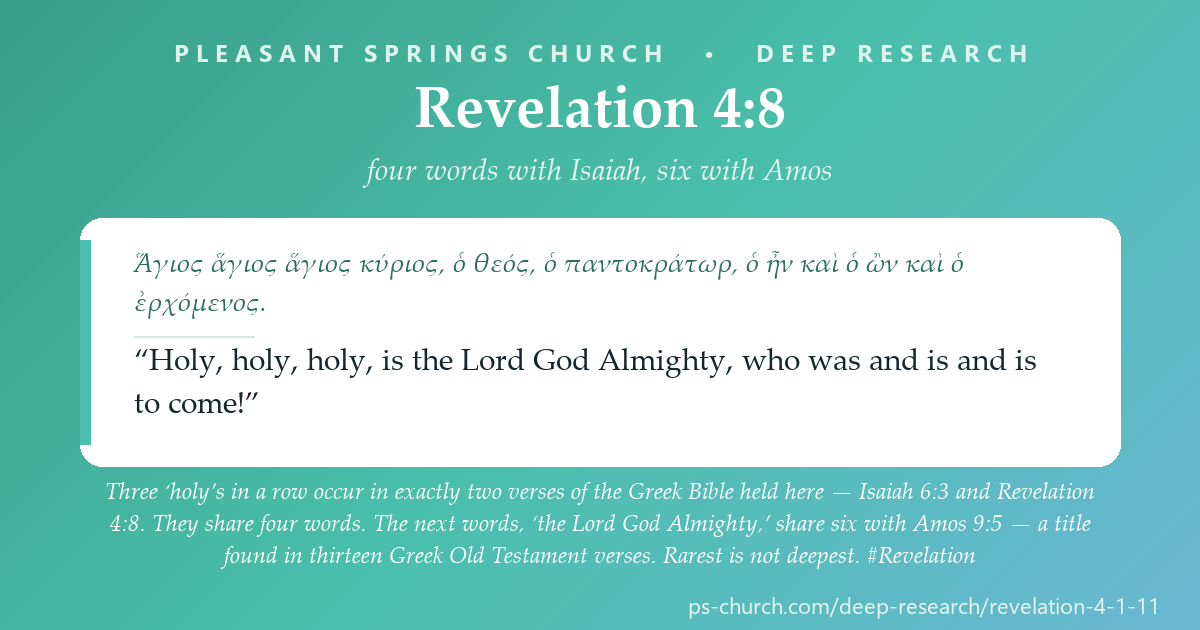
“Holy, holy, holy.” Three consecutive ἅγιος occur in exactly one verse of the Greek Old Testament held here — Isaiah 6:3 — and exactly one verse of the Greek New Testament — this one.
“Almighty” — ten times in the Greek New Testament, nine of them in Revelation (the tenth is 2 Cor 6:18, itself an Old Testament citation). In the Greek Old Testament it is one of several ways the title Lord of hosts is rendered (another is Lord of the powers); Isaiah’s Greek instead transliterates it σαβαωθ. Stage 4 measures what that does.
“Worthy.” The exact pair Ἄξιος εἶ, worthy are you, occurs twice in the Greek Bible held here: 4:11, to the Creator, and 5:9, to the Lamb. None in the Greek Old Testament. The two chapters are joined by it.
“You created.” The verb κτίζω stands three times in Revelation: twice in 4:11 and once in 10:6 — him who lives forever and ever, who created heaven… That is the same verse that shares this chapter’s deepest New Testament run (Stage 4).
How the New Testament fills out the throne room:
- Revelation 1:4, 8; 11:17; 16:5 — who is and who was: the divine name of the book, which 4:8 alone turns round to who was and is and is to come.
- Revelation 5:9–14 — the same room, the same “worthy,” now sung to the Lamb (see Revelation 5:1–14).
- Revelation 21:11, 18–20; 22:1 — jasper, carnelian, emerald and crystal come back as the city’s walls and foundations: ἴασπις occurs four times in the New Testament, at 4:3 and three times in chapter 21 (see Revelation 21:1–22:5).
- Hebrews 4:16; 8:1; 12:2 — the throne of grace, the Son seated at its right hand.
Measured before the page was written: every verse of the chapter against the whole Greek Old Testament and the rest of the Greek New Testament.
Contiguous runs of shared word FORMS (not lemmas), accents folded, punctuation ignored, one verse at a time. The tie band is how many target verses reach the same maximum — a run of 5 with a band of 1 is rare, a run of 3 with a band of 27 is a formula. Greek-side screen, so a zero means no word shared at all; in the named pairs below, and alone means nothing more than and.
The surprise: the most famous line is the rarest contact, not the deepest
Holy, holy, holy is the one place in this chapter where nobody needs a measurement to see Isaiah. And the measurement agrees that it is unique: three ἅγιος in a row occur in one verse of the Greek Old Testament and one verse of the Greek New Testament, Isaiah 6:3 and Revelation 4:8. But the run is four words, and four is not the deepest number in the verse. The verse goes on the Lord God Almighty, and those words — κύριος ὁ θεός ὁ παντοκράτωρ — are where Revelation 4:8 reaches furthest into the Greek Old Testament: six words with Amos 9:5, tie band 1.
Read correctly, the two numbers say opposite things. The four is small and rare: one partner in thirty thousand verse units. The six is large and common: strip the trailing article and it is a five-word title that stands in thirteen verses, ten of them in Amos. Depth and rarity are different measurements, and this verse is the cleanest demonstration of that on the shelf. Behind both stands the Hebrew word צְבָאוֹת, hosts — Isaiah’s יְהֹוָה צְבָאוֹת, Amos’s וַאדֹנָי יֱהֹוִה הַצְּבָאוֹת — which the Greek of Isaiah transliterates and the Greek of Amos translates; Revelation’s Greek has the translation.
That is a statement about shared wording, not about sources. Nothing here says John took the trisagion from Isaiah and the title from Amos; it says which Greek verses carry the same words in the same order, and how many others do too.
The Old Testament lines, in Hebrew, Greek and English
Every verse of the chapter, screened against both corpora
Rows: the 11 MorphGNT verses of Revelation 4. Targets: 30,348 Greek Old Testament verse units (the 64 CATSS files less the Odes), and the other 7,916 verses of the Greek New Testament.
| verse | words | deepest run, Greek OT | tie band | partner(s) | deepest run, rest of NT | tie band | partner(s) |
|---|---|---|---|---|---|---|---|
| 4:1 | 33 | 5 | 1 | Dan 2:45 (Theodotion) | 5 | 1 | Rev 7:9 |
| 4:2 | 16 | 5 | 2 | 1 Chr 29:11; Joel 3:3 (Eng 2:30) (formula) | 5 | 1 | Rev 5:13 |
| 4:3 | 17 | 3 | 1 | Lev 15:6 (accident) | 3 | 5 | Rev 6:2, 6:5, 6:8, 7:15, 19:11 |
| 4:4 | 26 | 4 | 3 | Josh 7:6 (B); 1 Kgs 20:32 (Greek 3 Kgdms 21:32); Ezek 23:42 | 5 | 1 | Rev 9:7 |
| 4:5 | 25 | 3 | 27 | formula | 6 | 3 | Rev 11:19, 16:18; 5:6 |
| 4:6 | 25 | 4 | 1 | Judg 12:4 (B) (accident) | 5 | 1 | Rev 5:6 |
| 4:7 | 29 | 3 | 14 | formula | 3 | 3 | Rev 8:7, 8:9, 8:12 |
| 4:8 | 41 | 6 | 1 | Amos 9:5 | 5 | 3 | Rev 11:17, 19:6, 21:22 |
| 4:9 | 22 | 5 | 3 | Ps 83:5 (Eng 84:4); Tob 14:15 (S); 4 Macc 18:24 (formula) | 7 | 1 | Rev 10:6 |
| 4:10 | 29 | 5 | 4 | the same three + Exod 12:29 | 7 | 1 | Rev 10:6 |
| 4:11 | 30 | 5 | 2 | Dan 2:37 (OG); Dan 5:18 (Th) (accident) | 5 | 1 | Rev 21:26 |
Distribution of the deepest Greek Old Testament run per verse: 3 × 3, 2 × 4, 5 × 5, 1 × 6. Ten of the eleven verses reach as far or further into the rest of the New Testament than into the Old; the one exception is 4:8 (6 against 5) — and the New Testament partners are, all eleven times, other verses of Revelation.
The standard backgrounds, measured one by one
The verses every commentary sets beside Revelation 4, each measured as a named pair:
| Revelation | against | run | shared |
|---|---|---|---|
| 4:8 | Isaiah 6:3 | 4 | ἅγιος ἅγιος ἅγιος κύριος |
| 4:8 | Isaiah 6:2 (six wings) | 1 | and |
| 4:2 | Isaiah 6:1 (a throne, high and lifted up) | 1 | and |
| 4:2 | Ezekiel 1:26 (a throne) | 2 | καὶ ἐπὶ |
| 4:3 | Ezekiel 1:28 (the bow in the cloud) | 1 | and |
| 4:5 | Ezekiel 1:13 (fire, torches, lightning) | 3 | καὶ ἐκ τοῦ (formula) |
| 4:5 | Exodus 19:16 (voices and lightnings at Sinai) | 2 | ἀστραπαὶ καὶ |
| 4:6 | Ezekiel 1:5 (four living creatures) | 2 | and in |
| 4:7 | Ezekiel 1:10 (the four faces) | 2 | ἀνθρώπου καὶ |
| 4:8 | Ezekiel 1:18 (full of eyes) | 1 | and |
| 4:2 | Daniel 7:9, both Greek columns (thrones placed) | 1 | and |
| 4:2 | 1 Kings 22:19 (Micaiah) | 1 | and |
| 4:1 | Daniel 2:45, Theodotion | 5 | ἃ δεῖ γενέσθαι μετὰ ταῦτα |
| 4:1 | Daniel 2:45, Old Greek | 1 | and |
| 4:8 | Amos 9:5 | 6 | κύριος ὁ θεὸς ὁ παντοκράτωρ ὁ |
| 4:8 | Amos 4:13 | 5 | κύριος ὁ θεὸς ὁ παντοκράτωρ |
| 4:8 | Psalm 98:9 Greek (= 99:9 Eng) | 4 | ἅγιος κύριος ὁ θεὸς |
| 4:8 | Exodus 3:14 (I am who I am) | 3 | ὁ ὤν καὶ … across a sentence break |
Ezekiel 1 — the chapter that shares with Revelation 4 its creatures, faces, eyes, crystal, throne and rainbow — never reaches more than 3 against any verse of Revelation 4, and the 3s are εἶδον καὶ ἰδοὺ, καὶ ἐκ τοῦ, Καὶ ἐν μέσῳ and ἐν μέσῳ τοῦ. The same result stands on this shelf’s Ezekiel 1:1–5:17 page, measured from the other side. The images are shared with Ezekiel; the Greek words are almost never the Greek Ezekiel’s. Where John’s nouns could have matched they often do not: ἶρις for τόξου, γέμω for πλήρεις, ὑάλινος (of glass, not in the Greek Old Testament at all) beside a κρύσταλλος that Ezekiel 1:22 does share.
Inside Revelation: the deepest run of all, and a room that is joined to the rest of the book
The chapter’s deepest run anywhere is 7, tie band 1, and the partner is Revelation 10:6 — τῷ ζῶντι εἰς τοὺς αἰῶνας τῶν αἰώνων, him who lives forever and ever, reached by both 4:9 and 4:10. Revelation 10:6 continues who created heaven and what is in it, and it is the only verse outside 4:11 in which Revelation uses the verb κτίζω. The pairing of the ever-living God with the God who created occurs twice in the book: here, and when the mighty angel swears his oath.
The storm. Revelation 4:5’s ἀστραπαὶ καὶ φωναὶ καὶ βρονταί returns with a run of 6 at 11:19 and at 16:18, each time with more added: three items here, four at 8:5 (with an earthquake), five at 11:19 (earthquake and hail). Revelation 8:5 has the same items in reverse order and so measures only 3. Exodus 19:16 — Sinai, the best-known scene of thunder and lightning before God — shares 2.
The page’s own counter-examples — printed so the runs above are not over-read
- Revelation 4:11 and Daniel 2:37 / Theodotion Daniel 5:18: a run of 5, tie band 2. καὶ τὴν τιμὴν καὶ τὴν — and the honor and the. As deep as the Theodotion Daniel 2:45 run on 4:1 and about nothing at all. A five-word run proves nothing on its own.
- Revelation 4:6 and Judges 12:4 (B text): a run of 4, tie band 1. Καὶ ἐν μέσῳ τοῦ — and in the midst of the. Band 1, and an accident.
- Revelation 4:8 and Revelation 14:11: the same six words, measured 3. The creatures ἀνάπαυσιν οὐκ ἔχουσιν ἡμέρας καὶ νυκτὸς; the worshipers of the beast οὐκ ἔχουσιν ἀνάπαυσιν ἡμέρας καὶ νυκτός. One word moved, and the screen sees only ἡμέρας καὶ νυκτός. A per-verse run cannot see reordering — which is also why Revelation 8:5 scores 3 against the storm of 4:5.
- Revelation 4:1 and Theodotion Daniel 2:45: the five words cross a full stop. The SBLGNT punctuates ἃ δεῖ γενέσθαι. μετὰ ταῦτα — and the screen ignores punctuation. Read with the ESV’s punctuation the run is a clause; read with the SBLGNT’s it is a clause and the first two words of the next sentence. The number is the same either way; what it means is not.
What the scholarship says, what this page did not consult, and where it is weakest.
Commentaries & studies:
- G. K. Beale, The Book of Revelation (NIGTC); David E. Aune, Revelation 1–5 (WBC 52A); Craig R. Koester, Revelation (Anchor Yale); Grant R. Osborne (BECNT); Robert H. Mounce (NICNT); Ian Paul (TNTC).
- Richard Bauckham, The Climax of Prophecy and The Theology of the Book of Revelation; Steve Moyise, The Old Testament in the Book of Revelation.
- G. K. Beale & Sean McDonough, “Revelation,” in Commentary on the New Testament Use of the Old Testament.
Interpretation notes worth keeping:
- ‘Come up here’ and the rapture. Some read 4:1 as a picture of the church taken up before the judgments of chapters 6–19. The imperative is singular and addressed to John; the text does not say the church is taken up. This church’s position is historic premillennialism, and this page builds no timing of the return of Christ on 4:1.
- The one on the throne is God the Father here, and the Lamb shares the throne in chapter 5. The worship of 4:8–11 is given to the Creator; the identical worship of 5:8–14 is given to the Lamb as well. Read the two chapters together.
- The creatures look like cherubim and seraphim at once. Ezekiel’s faces and eyes (Ezekiel 10:20 calls those creatures cherubim), Isaiah’s six wings and song. John does not name them; he calls them ζῷα, living creatures, Ezekiel’s Greek word.
⚠️ What this page did not consult, and could not check
- None of the commentaries above was consulted for any number on this page. Every count and run was produced off disk by the shelf’s own tools before a word of prose was written. Where a scholar’s view is reported (Beale on Daniel 2; Aune on Roman court ceremony; Bauckham on the storm series), it is reported from general knowledge of the literature and is not quoted.
- No critical apparatus was consulted on either side. Whether manuscripts of Revelation vary the number of ἅγιος in 4:8, how NA28 punctuates the end of 4:1, and what the Greek witnesses do at Ezekiel 10:14 were not checked. The page says “the SBLGNT reads” and “the CATSS Greek row reads,” and never calls a reading early or late.
- Ezekiel 10:14 is in the Hebrew and the ESV and not in the Greek held here. It is the verse where the ox’s face becomes the face of the cherub — פְּנֵי הַכְּרוּב. It could not be measured against Revelation 4:7, and this page does not guess why it is absent.
- Which Greek Daniel? The run of 5 at 4:1 is with Theodotion, not the Old Greek. Theodotion as we have it is commonly dated after Revelation, though readings of a Theodotion type are found in the New Testament and earlier; this page does not decide which Greek Daniel, if any, the author of Revelation read.
- 1 Enoch is not held in Greek on this shelf, and the Aramaic fragments are not held at all. The comparison with 1 Enoch 14 in Stage 2 is reported, not measured. The Latin of Tacitus was not checked.
- What a per-verse screen cannot see. Runs do not cross verse boundaries, and reordering destroys a run without changing a word (4:8 against 14:11; 4:5 against 8:5, both printed above). And the screen finds verbatim contact, not allusion: Ezekiel 1 measures almost nothing and is plainly the chapter’s closest Old Testament parallel in imagery.
- Where this page is weakest: the shape. The literary-structure diagram reads verses 2–7 as a map drawn outward from the throne. The prepositions and the θρόνος count (11 and 3) are measured; that they make a deliberate geography is our reading, and a reader may fairly see a simple list. It is labelled a sequence, not a chiasm, because no mirror was found.
From the open door to the cast crowns.
Name what you learned, why it matters, and one concrete response.
What should we carry away — and do?
- The throne is occupied. Before any seal is opened, John is shown the centre of everything, and there is someone on it. Whatever chapter 6 brings, chapter 4 came first.
- Holy is the first word. The creatures do not begin with power or judgment but with holiness, three times — the song Isaiah heard, sung here without a pause. Day and night they never cease.
- Worth is grounded in creation. The elders give the reason in a single clause: for you created all things, and by your will they existed and were created. You exist because he willed it.
- Crowns go down. Those who are given thrones in heaven spend them by casting their crowns before his. Every honor we are given is held to be given back.
Step in response: this week, before you pray about anything you need, say what the creatures say and what the elders say — that God is holy, and that he is worthy because he made all things, including you. Then name one “crown” you are holding — a success, a title, a reputation — and lay it down before him in so many words.
Holy, holy, holy Lord God Almighty, you are worthy of glory and honor and power, for you created all things and by your will we exist. We lay down every crown we hold before your throne. Teach us to worship you without ceasing, as heaven does. In the name of Jesus, Amen.
Revelation 4:8 · to share
Greek NT + ESVEvery Deep Research page traces its passage across the whole sweep — the Old Testament, the Second-Temple world between the testaments (historical witnesses, not Scripture), and the New Testament. Follow the thread:
Pleasant Springs Church — Deep Research
Research method after Michael S. Heiser’s Bible Research Method (examine dictionaries → ancient literature → important words → textual connections → academic publications → share), with the Pleasant Springs “Author & Audience” foundation. Scripture set in the Hebrew, the Greek editions named on each page and the ESV (Old Testament), and the Greek New Testament and the ESV (New Testament), per the practice of Pleasant Springs Church. Revelation 4:1–11 research. Commentaries named in Stage 5 (Beale, Aune, Koester, Osborne, Mounce, Bauckham, Moyise) were not consulted for any number on this page. Text: Greek New Testament from the SBL edition as digitized by MorphGNT; Greek Old Testament from Rahlfs’ Septuaginta as digitized by CATSS; Hebrew and Aramaic from the Masoretic text as printed in Sefaria’s Miqra according to the Masorah; English from the ESV via Crossway’s API. No critical apparatus was consulted and no manuscript was examined. ⚠️ VERSE NUMBERING — no offset. SBLGNT Revelation 4 and the ESV both have 11 verses, verse for verse; the SBLGNT full stop inside 4:1 is punctuation, not numbering. Old Testament offsets touched: Psalm 98:9 Greek = 99:9 English; Psalm 83:5 Greek = 84:5 Hebrew = 84:4 English; 3 Kingdoms 21:32 Greek = 1 Kings 20:32 Hebrew and English (the Greek swaps chapters 20 and 21); Theodotion Daniel 4:34 = ESV 4:34 = Aramaic 4:31; Hosea 12:6 Hebrew and Greek = 12:5 English; Joel 3:3 Hebrew and Greek = 2:30 English. Ezekiel 10:14 is absent from the CATSS Greek. ⚠️ The measurement. Greek against Greek: MorphGNT normalised word against the CATSS FORM column, both lowercased, accents and breathings dropped, final sigma folded. Contiguous runs of whole word forms, never lemmas, within single verses. Corpus: the 11 verses of Revelation 4 against 30,348 Greek Old Testament verse units (64 CATSS files less the Odes, which duplicate Luke 1–2 and other canticles) and against the other 7,916 verses of the Greek New Testament. Exhaustive and deterministic. Scripts: _rev4_measure.py, _rev4_pairs.py. The tie band is printed beside every run. Deuterocanonical books (Tobit, 4 Maccabees) appear in tie bands as witnesses, not Scripture. ⚠️ Direction of influence is never asserted. Nothing here says Revelation quotes Isaiah, Amos, Ezekiel or either Greek Daniel; it reports shared words in order, with tie bands, and stops.
Scripture quotations marked ESV are from the ESV® Bible (The Holy Bible, English Standard Version®), © 2001 by Crossway, a publishing ministry of Good News Publishers. ESV Text Edition: 2016. Used by permission. All rights reserved. The ESV text may not be quoted in any publication made available to the public by a Creative Commons license, and the ESV may not be translated in whole or in part into any other language. www.esv.org
|
Did this study bless you today? 💚 Give to Support PS Church100% of gifts go to the General Fund — thank you. |