Screened word for word against the other 7,823 verses of the Greek New Testament, only two rows in Philippians 3–4 reach past four consecutive shared words. One is the doxology at 4:20. The other is the closing grace at 4:23, which is word-for-word identical with Philemon 25 — ten words, tie band one. Both are stock forms, and the band of one is an accident of a single pronoun: Galatians 6:18 writes the same benediction with our after Lord and drops to six. Meanwhile the theology matches nothing. Chapter 3 — the pedigree, the rubbish, the righteousness from God, the prize, the citizenship in heaven — never exceeds a run of four. Philippians 4:13, the most quoted verse in the letter, reaches two, in a tie band of four hundred. There is a countable reason for all of it: twenty-four words in these forty-four verses occur nowhere else in the Greek New Testament — twice the rate of Philippians 1–2, and sixteen of the twenty-four are absent from the whole Greek Old Testament held here as well. A passage that matches nothing because it was largely written out of words nobody else used. See the method →
Philippians 3:1–4:23 (selections)
Greek New Testament (SBLGNT, via MorphGNT) · ESV★ And here is the shape of these forty-four verses: the deep runs are all in the furniture. Only two rows in Philippians 3–4 reach past four consecutive shared words, and they are the doxology at 4:20 (run 8) and the closing grace at 4:23 (run 10). Chapter 3 — the pedigree, the loss and gain, the righteousness from God, the resurrection, the prize, the citizenship in heaven — never exceeds four. What is here instead is vocabulary: twenty-four words in these forty-four verses occur nowhere else in the Greek New Testament. Stage 3 lists them; Stage 4 gives the runs, the tie bands, and the counter-examples.
The Shape of the Passage
A sequence with a countable frame — and one real reversal inside itThe letter names Paul and Timothy in its first verse and names its readers once, at 4:15. “And you Philippians yourselves know…” (4:15) — Φιλιππήσιοι, which is one of the twenty-four words in this passage that occur nowhere else in the Greek New Testament. Everything past that is inference, and this page keeps the inference separate from the count.
Author
A man in custody, and the letter says so twice in chapter 1. The Philippians 1 study works that ground. What chapters 3 and 4 add is a self-description: circumcised on the eighth day, of the tribe of Benjamin, a Hebrew of Hebrews, as to the law a Pharisee, as to zeal a persecutor of the church, as to righteousness under the law blameless. Seven items, and against the other 7,823 verses of the Greek New Testament the pedigree verse shares a run of 2, in a tie band of 8.
The same verb does the persecuting and the pressing on. διώκω occurs three times in Philippians and all three are in chapter 3: at 3:6 it is persecuting the church; at 3:12 and 3:14 it is I press on. That is a count, and what to make of it is a reading. The page reports the count.
And the word for what he thinks is his signature. φρονέω stands 26 times in the Greek New Testament and ten of them are here. Romans, at four times the length, has nine. No other New Testament book approaches it: Matthew, Mark, Acts, 1 Corinthians, 2 Corinthians, Galatians and Colossians have one apiece, and that is the whole 26.
Audience
A congregation in a Roman colony, addressed with a word for civic belonging. πολίτευμα at 3:20, πολιτεύομαι at 1:27 — the root twice in the letter and nowhere in between. That Philippi was a colonia settled with Roman veterans is read here from the reference works and from Acts 16:12, not measured. What is measured is that πολίτευμα occurs nowhere else in the Greek New Testament, and ★ that a claim this page used to make about the Greek Old Testament is now false. On the 44-file corpus the word returned zero hits in 23,061 verse units, and the page said so. On the 64-file corpus it returns one, at 2 Maccabees 12:7 — where it is the citizen-body of Joppa that Judas means to root out. 2 Maccabees is a witness, not Scripture, on this shelf. The two verses share a run of one. What the new hit gives is not contact but sense: the ordinary civic meaning of the word, in a Greek Jewish text, on this disk.
They are quarrelling, and the letter names two of them. Euodia and Syntyche (4:2) are asked τὸ αὐτὸ φρονεῖν ἐν κυρίῳ — the same two words that 2:2 asks of the whole church, with the verb in another form (τὸ αὐτὸ φρονῆτε). Both names occur once in the Greek New Testament, as does Clement in the next verse, and the γνήσιε σύζυγε of 4:3 — true yokefellow — is a New Testament hapax whose referent nobody has identified. The page does not identify him either.
They had sent money more than once, and 4:15–18 is an accounting. λῆμψις (receiving, 4:15), ἀπέχω and πεπλήρωμαι at 4:18 are commercial vocabulary; λῆμψις occurs nowhere else in the Greek New Testament. That these are the words of a receipt is reported from the lexica — the documentary papyri are not on this disk, and Stage 5 says so.
Orient on Philippi, on the letter’s integrity question, and on the vocabulary of athletics, citizenship and commerce — before touching a single number.
Search by topic: Philippi; Philippians, Letter to; Roman colony; partition theories; hapax legomenon; mystery religions; Euodia and Syntyche; Caesar’s household; doxology; epistolary closing.
Which articles are relevant?
- Anchor Bible Dictionary — “Philippi,” “Philippians, Letter to the,” “Colonies, Roman,” “Euodia,” “Syntyche.”
- Dictionary of Paul and His Letters (IVP) — “Philippians, Letter to,” “Righteousness, Righteousness of God,” “Citizenship,” “Prison, Prisoner,” “Financial Support.”
- New International Dictionary of NT Theology & Exegesis — φρονέω, πολίτευμα, σκύβαλον, μυέω, αὐτάρκης, βραβεῖον.
- Moulton & Milligan, Vocabulary of the Greek Testament illustrated from the Papyri — the standard place to check whether ἀπέχω and λῆμψις at 4:15–18 are commercial receipt language.
- None of these were consulted for the measurements below. The measurements were run on the text files named in the footer.
Settle the numbering first — and note what is different about a New Testament page
Every page on this shelf states its versification offset, including the pages where there is none. On a New Testament book the answer is stronger than that: there is no second column to be offset from.
| ch 1 | ch 2 | ch 3 | ch 4 | total | |
|---|---|---|---|---|---|
| SBLGNT (MorphGNT) | 30 | 30 | 21 | 23 | 104 |
| ESV | 30 | 30 | 21 | 23 | 104 |
The SBLGNT row was counted off disk; the ESV row is the printed edition’s shape, because no ESV Philippians file is held here. There is no Masoretic and no Septuagint Philippians, so the columns on this page are Greek New Testament and English, and every chapter-and-verse number means the same verse in both.
The offset is still in the room, because the comparisons on this page run into the Greek Psalter. The Greek Old Testament verse that comes closest to Philippians 4:20 is numbered Psalm 83:5 in the Septuagint, Psalm 84:5 in the Hebrew and Psalm 84:4 in the English. The Greek Psalter runs one psalm behind the Hebrew from Psalm 9/10 through Psalm 147, and the verse numbers move too, because the Greek and the Hebrew both count the superscription as verse 1 and the English does not — checked against the Masoretic Psalms held on this disk, where Psalm 84:1 is the superscription and Psalm 84:5 is Blessed are those who dwell in your house. A page that wrote ‘Psalm 84:4’ while measuring against a file numbered 83:5 would be citing a verse it never looked at. This page prints both numbers every time.
A Roman colony, an initiation word, an athletic prize, and a phrase from a sacrificial system this disk cannot fully see.
Philippi was a Roman colony — and that is read, not measured
Acts 16:12 calls Philippi κολωνία, a Latin loan-word that occurs once in the Greek New Testament. The reference works add what the text does not: that Philippi was refounded as Colonia Iulia Augusta Philippensis after Actium and settled with veterans, so that its leading citizens held Roman citizenship in a Macedonian town. That is history from the books, not a result from this disk, and the page marks it as such.
What was measured: πολίτευμα (3:20) occurs nowhere else in the Greek New Testament, and ★ exactly once in the 30,637 verse units of Greek Old Testament this shelf now holds — at 2 Maccabees 12:7, a witness and not Scripture, where it means the citizen-body of Joppa. This corrects the page: when the shelf held 44 files and 23,061 units the word returned zero, and this section said the standard lexical parallel — that πολίτευμα was used of a resident community’s own civic body — “could not be verified from anything on this disk.” It can be now, in that one verse. The two verses share a run of one; this is a lexical parallel and not verbal contact, and the page does not inflate it into one. πολιτεύομαι (1:27) occurs twice in the New Testament, here and at Acts 23:1. The two words that carry the letter’s political metaphor stand three times in the whole New Testament and Philippians has two of them. The other πολιτ- words — πολίτης, πολιτεία, συμπολίτης, πολιτάρχης — stand nine times more, and none of the nine is in Philippians.
⚠️ What was not checked. No inscriptions, no coins, no Latin sources, no documentary papyri. The claim that πολίτευμα was used of a resident foreign community’s own civic body — the standard lexical parallel — is reported from the lexica and could not be verified from anything on this disk.
“I have been initiated” — a mystery-cult verb in a thank-you note
Philippians 4:12 says μεμύημαι. The ESV renders it I have learned the secret. The verb is the one used for initiation into a mystery religion.
Measured: μυέομαι occurs once in the Greek New Testament, here. The exact form μεμύημαι occurs zero times in the 30,637 verse units of Greek Old Testament held here. ⚠️ A stem search for μυε- returns four Greek Old Testament hits and every one of them is a different word — μυελός, marrow, at Genesis 45:18 and Job 21:24 and 33:24, and μύες, mice, at 1 Kingdoms 5:6. The page prints the false positives because a screen that is never shown failing is a screen nobody can check.
What that does and does not license. It means the word carried an initiatory register in Greek. It does not mean Paul is borrowing from a mystery cult, and the measurement cannot tell you whether the register was still live or had worn down into ordinary Greek for I have been let in on it. The page reports the count and leaves the register to the lexica.
The prize, the goal and the runner — and the watchman the Old Testament sees instead
Philippians 3:12–14 is built out of the stadium: διώκω, καταλαμβάνω, ἐπεκτεινόμενος, σκοπόν, βραβεῖον.
| word | Greek NT | Greek OT held here |
|---|---|---|
| ἐπεκτείνομαι 3:13 | 1 (here) | 0 occurrences of the form |
| σκοπός 3:14 | 1 (here) | ★ 10 of the same form σκοπόν (7 on the 44-file corpus) — 4 a watchman (Ezek 3:17; 33:2; 33:7; Isa 21:6), 4 an archery target (Job 16:12; Lam 3:12; Wisdom 5:12 and 5:21, both of an arrow shot at a mark), 1 a figured stone set up to be looked at (Leviticus 26:1), 1 unclear (Hos 9:10). Wisdom is a witness, not Scripture, on this shelf. |
| βραβεῖον 3:14 | 2 (here; 1 Cor 9:24) | not found |
The σκοπός row is the useful one, and it cut against this page’s first draft, and the larger corpus has now doubled the evidence for the correction. That row originally read “always meaning a watchman.” Checked verse by verse on 44 files, four of the seven were watchmen and two were Paul’s sense. On 64 files there are ten, and four of them are exactly Paul’s sense — a mark set up to be shot at — because Wisdom 5:12 and 5:21 both use it of an arrow in flight. ‘Occurs nowhere else’ is always a claim about one named corpus, and a word can be a New Testament hapax while being ordinary, in the very same meaning, a few files away.
“A fragrant offering” — and the three books this disk does not have
Philippians 4:18 calls the Philippians’ money ὀσμὴν εὐωδίας, θυσίαν δεκτήν — the Greek Old Testament’s standing formula for an accepted sacrifice.
★ THE HISTORY OF THIS SECTION, PRINTED RATHER THAN SWEPT AWAY. This section used to be headed “the three books this disk does not have.” The shelf held 44 CATSS files, 23,061 verse units; it found the phrase six times; it called the gap “the largest single hole on the page”; and it made a prediction: “Anyone re-running this screen after fetching those books should expect the row to move, and to move toward more contact rather than less.” The shelf now holds 64 files, 30,637 verse units, Exodus, Leviticus and Numbers among them. The prediction can now be graded, and it was half right and half wrong.
| what this page claimed, on 44 files | what 64 files return |
|---|---|
| ὀσμὴν εὐωδίας occurs 6 times — Genesis 8:21; Ezekiel 6:13; 16:19; 20:28; Daniel 4:37a; Sirach 50:15 | 37 times — RIGHT, and by a wide margin. Numbers 20 (15:3, 5, 7, 10, 13, 14, 24; 18:17; 28:2, 6, 8, 13, 24, 27; 29:2, 6, 8, 11, 13, 36) · Leviticus 7 (2:12; 4:31; 6:14; 8:21; 17:4; 17:6; 23:18) · Exodus 3 (29:18, 25, 41) · Ezekiel 3 · Genesis 1 · Daniel 1 · Sirach 1 · Judith 16:16. The phrase really is thickest in the sacrificial legislation, exactly as this page said it would be. Judith and Sirach are witnesses, not Scripture, on this shelf, and are labelled so wherever they supply a result. |
| “The run of 2 is a fact about the corpus, not about the phrase… expect the row to move toward more contact” | WRONG — the row did not move. Philippians 4:18 still reaches 2 against the Greek Old Testament; only its tie band grew, from 190 to 310. Checked pair by pair against all 37 hits, every single one stops at exactly ὀσμὴν εὐωδίας: the Greek formula continues into κυρίῳ or a case-ending or the next sacrifice, and Paul continues into θυσίαν δεκτήν. The 2 was a fact about the phrase all along. |
| ἐν ὀσμῇ εὐωδίας — 1, at Ezekiel 20:41 | unchanged at 64 files |
What this row is worth keeping for. The page named a gap, said in advance what it expected to find in it, and then the gap was filled. Half of what it expected was there and half was not — and the half that was not is the half the page had leaned on. Paul is not quoting the sacrificial legislation at Philippians 4:18. He is using two of its words and then saying something the legislation never says: that money sent to a prisoner is θυσίαν δεκτήν, εὐάρεστον τῷ θεῷ.
Twenty-four words in forty-four verses that occur nowhere else in the Greek New Testament — and how far that goes.
Philippians 3:2, and nowhere else in the Greek New Testament. The exact form returns zero hits in the 30,637 verse units of Greek Old Testament held here. One letter-group away from περιτομή, which is the next word of the next verse.
Philippians 3:8, and nowhere else in the Greek New Testament. The exact form σκύβαλα occurs once in the Greek Old Testament held here, at Sirach 27:4 — what is left in a sieve after shaking. The ESV renders it rubbish; the word is coarser than that and the lexica disagree about how much coarser.
Philippians 3:13, and nowhere else in the Greek New Testament; zero occurrences of the form in the Greek Old Testament held here. A double compound — ἐπί + ἐκ + τείνω — of a runner leaning over the line.
Philippians 3:20, and nowhere else in the Greek New Testament; zero in the Greek Old Testament held here. The related verb πολιτεύομαι is at 1:27 and Acts 23:1, and that is the whole New Testament use of those two words: three occurrences, two of them in this letter. The wider πολιτ- family — πολίτης, πολιτεία, συμπολίτης, πολιτάρχης — stands nine times more and never in Philippians.
Philippians 4:12, and nowhere else in the Greek New Testament; the form μεμύημαι is zero in the Greek Old Testament held here. The verb of the mystery religions, used of learning how to be hungry.
Not rare — the opposite. 26 occurrences in the Greek New Testament by the MorphGNT lemma column, and ten of them are in Philippians: 1:7; 2:2 (twice); 2:5; 3:15 (twice); 3:19; 4:2; 4:10 (twice). Romans, four times as long, has nine. Seven other books have one apiece — Matthew, Mark, Acts, 1 Corinthians, 2 Corinthians, Galatians, Colossians — and that is the whole 26.
The full list: twenty-four words that occur nowhere else in the Greek New Testament
Counted from the MorphGNT lemma column across all 27 New Testament files: the Greek New Testament has 5,461 distinct lemmas and 1,966 of them occur exactly once. Twenty-four of those 1,966 fall inside Philippians 3:1–4:23.
| verse | form | lemma | exact form in the Greek OT held here |
|---|---|---|---|
| 3:2 | κατατομήν | κατατομή | — |
| 3:5 | ὀκταήμερος | ὀκταήμερος | — |
| 3:8 | σκύβαλα | σκύβαλον | Sirach 27:4 |
| 3:10 | συμμορφιζόμενος | συμμορφίζομαι | — |
| 3:11 | ἐξανάστασιν | ἐξανάστασις | Genesis 7:4 |
| 3:13 | ἐπεκτεινόμενος | ἐπεκτείνομαι | — |
| 3:14 | σκοπόν | σκοπός | 10 — 4 a watchman (Ezek 3:17; 33:2; 33:7; Isa 21:6), 4 an archery target (Job 16:12; Lam 3:12; Wisdom 5:12; 5:21 — witness, not Scripture), 1 a figured stone (Leviticus 26:1), 1 unclear (Hos 9:10) |
| 3:15 | ἑτέρως | ἑτέρως | — |
| 3:17 | συμμιμηταί | συμμιμητής | — |
| 3:20 | πολίτευμα | πολίτευμα | — |
| 4:1 | ἐπιπόθητοι | ἐπιπόθητος | — |
| 4:2 | Εὐοδίαν | Εὐοδία (name) | 2 — but a common noun there |
| 4:2 | Συντύχην | Συντύχη (name) | — |
| 4:3 | σύζυγε | σύζυγος | — |
| 4:3 | Κλήμεντος | Κλήμης (name) | — |
| 4:8 | προσφιλῆ | προσφιλής | Sirach 4:7; 20:13 |
| 4:8 | εὔφημα | εὔφημος | — |
| 4:10 | μεγάλως | μεγάλως | 9 |
| 4:10 | ἀνεθάλετε | ἀναθάλλω | — |
| 4:10 | ἠκαιρεῖσθε | ἀκαιρέομαι | — |
| 4:11 | αὐτάρκης | αὐτάρκης | Sirach 31:28 |
| 4:12 | μεμύημαι | μυέομαι | — |
| 4:15 | Φιλιππήσιοι | Φιλιππήσιος (name) | — |
| 4:15 | λήμψεως | λῆμψις | Sirach 41:21 |
Sixteen of the twenty-four are absent from the Greek Old Testament held here as well, tested by exact normalised form. Which is a coarse test and the page says so: a different inflection of the same word would be missed by it. It is exact and reproducible, which is why it is the test used, but a lemma-level Greek Old Testament screen would probably find a few more.
How much is twenty-four? The comparison the page will actually defend
Philippians 3–4: 24 New Testament hapax legomena in 44 verses — 0.545 per verse.
Philippians 1–2: 16 in 60 verses — 0.267 per verse.
Twice the rate, inside one short letter, counted the same way on both sides. ⚠️ Four of the twenty-four are proper names — Euodia, Syntyche, Clement, Philippians — and chapters 1–2 contribute no proper names to their sixteen. Strip the names out and the comparison is 20 in 44 (0.455) against 16 in 60 (0.267), which is still a difference of about 1.7 times. Both figures are printed because the honest one is the smaller one.
Against the whole New Testament, the claim has to be narrower. Philippians as a book carries 40 hapaxes in 104 verses, 0.385 per verse, which ranks it eleventh of the twenty-seven books — unremarkable. At the chapter-pair level, only five whole books beat 0.545 (2 Peter 0.852, 2 Timothy 0.723, Titus 0.674, Jude 0.640, 1 Timothy 0.593), and at 0.455 without the names, seven do (add 1 Peter 0.533 and James 0.509). So the defensible statement is the internal one: the back half of this letter is roughly twice as lexically singular as the front half. Anything larger than that, the numbers do not support.
Every verse of Philippians 3–4 screened twice — once against the rest of the Greek New Testament, once against the Greek Old Testament held here — with the tie band beside every run.
The two screens, in full
All 44 verses of Philippians 3:1–4:23 were run against the other 7,823 verses of the Greek New Testament, and against the 30,637 verse units of the Greek Old Testament held on this disk. Contiguous runs of whole word forms, never lemmas, with the tie band beside every run.
Against the rest of the New Testament, across the 44 rows: 43 reach two, 30 reach three, 13 reach four, 2 reach eight, 1 reaches ten, and nothing reaches eleven. There is nothing at five, six or seven at all — the distribution stops dead at four and then jumps to the two closing formulas. Against the Greek Old Testament (64 files, 30,637 units): all 44 reach two, 21 reach three, 5 reach four, and 1 reaches eight — there is nothing at five, six or seven. ★ On the 44-file corpus the same screen gave 19 at three, 5 at four and 1 at five; the row that reached five now reaches eight, and it is the row this page calls a form.
| row | deepest partner in the rest of the NT | run | band | deepest partner in the Greek OT held here | run | band |
|---|---|---|---|---|---|---|
| Php 4:23 | Philemon 25 | 10 | 1 | Ezekiel 11:5 · Isaiah 33:11 | 3 | 2 |
| Php 4:20 | Galatians 1:5 · 2 Timothy 4:18 | 8 | 2 | 4 Maccabees 18:24 witness, not Scripture | 8 | 1 |
| Php 3:8 | 1 Tim 1:2 · 2 Tim 1:2 · Heb 2:10 | 4 | 3 | 1–2 Kingdoms, courtly ‘my lord’ | 3 | 22 |
| Php 3:14 | 1 Thessalonians 5:18 | 4 | 1 | ‘of God in’ | 3 | 17 |
| Php 3:21 | Ephesians 1:19 | 4 | 1 | various | 3 | 14 |
| Php 4:2 | Romans 15:5 | 4 | 1 | nothing above two | 2 | — |
| Php 4:7 | Colossians 3:15 · 1 Cor 16:24 · Col 1:4 | 4 | 3 | Joel 2:13 | 4 | 1 |
| Php 4:9 | 2 Corinthians 13:11 · 1 Thess 5:23 | 4 | 2 | Genesis 24:7 | 4 | 1 |
| Php 4:19 | ‘but God’ ὁ δὲ θεός — the μου is in the Greek OT run only | 3 | 55 | Genesis 28:3 · Genesis 43:14 | 4 | 2 |
| Php 4:13 | ‘in the’ | 2 | 400 | — | 2 | — |
Exactly two rows measure deeper against the Greek Old Testament than against the rest of the New Testament — Philippians 3:2 (2 against 1) and Philippians 4:19 (4 against 3). Twenty-four more tie. The two ties worth printing are Philippians 4:7 with Joel 2:13 and Philippians 4:9 with Genesis 24:7: a run of 4 each, at a tie band of 1 on the Old Testament side against bands of 3 and 2 on the New. ⚠️ Neither is a citation and the page will not present them as one. The Joel words are τὰς καρδίας ὑμῶν καί — Joel is saying rend your hearts, Philippians is saying guard your hearts, and the four shared words are two nouns, a pronoun and a conjunction. The Genesis words are καὶ ὁ θεὸς τῆς, cut out of the middle of Abraham’s the God of heaven and the God of the earth — so the run ends on an article belonging to a phrase Philippians is not building. A run of four at a band of one can still be nothing, and here it is nothing twice.
The headline result, and the reason it is not a discovery
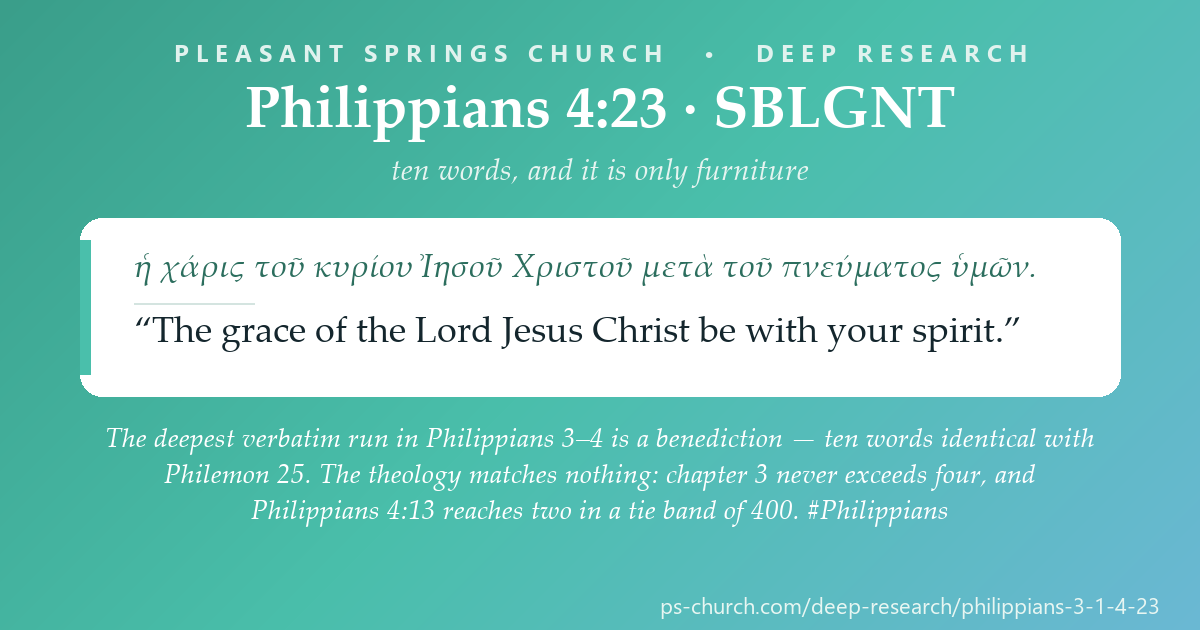
Philippians 4:23 and Philemon 25 are, word for word, ἡ χάρις τοῦ κυρίου Ἰησοῦ Χριστοῦ μετὰ τοῦ πνεύματος ὑμῶν — ten consecutive words, tie band 1.
| letter | closing grace | run with Php 4:23 |
|---|---|---|
| Philemon 25 | ἡ χάρις τοῦ κυρίου Ἰησοῦ Χριστοῦ μετὰ τοῦ πνεύματος ὑμῶν | 10 |
| Galatians 6:18 | ἡ χάρις τοῦ κυρίου ἡμῶν Ἰησοῦ Χριστοῦ μετὰ τοῦ πνεύματος ὑμῶν, ἀδελφοί· ἀμήν | 6 |
| 2 Corinthians 13:13 | ἡ χάρις τοῦ κυρίου Ἰησοῦ Χριστοῦ καί… | 6 |
| 1 Corinthians 16:23 · Revelation 22:21 | ἡ χάρις τοῦ κυρίου Ἰησοῦ μετά… | 5 |
| 1 Thess 5:28 · 2 Thess 3:18 · Romans 16:20 | ἡ χάρις τοῦ κυρίου ἡμῶν… | 4 |
Every letter in the corpus signs off with a version of this sentence. Philippians and Philemon happen to spell it identically; Galatians spells it with one extra pronoun and falls out of the tie band; three more do the same and fall to four. The band of one does not mean two letters are related. It means the other letters spelled the formula slightly differently. The Philippians 1 study printed this same row for the same reason, and this page prints it again because it is the deepest number on the page and the one most likely to be misread.
⚠️ What the page will not say. Not that Philippians and Philemon were written together. Not that one is copying the other. Not that the identity dates them. Direction of influence is never asserted on this shelf, and this particular run could not carry it even if the shelf allowed it.
The counter-examples, printed in the same section
1. Philippians 4:13 — the most quoted verse in the letter, run 2, tie band 400.
πάντα ἰσχύω ἐν τῷ ἐνδυναμοῦντί με is six words long. Its deepest agreement with any of the other 7,823 verses of the Greek New Testament is ἐν τῷ, and four hundred verses tie for it. Nothing on this page is a ranking of importance.
2. Philippians 3:9 — the doctrine everyone cross-references, and the screen sees nothing.
| comparison | run | shared words |
|---|---|---|
| Php 3:9 vs Romans 3:22 | 2 | διὰ πίστεως |
| Php 3:9 vs Galatians 2:16 | 2 | διὰ πίστεως |
| Php 3:9 vs Romans 10:3 | 2 | θεοῦ δικαιοσύνην |
These four verses are printed together in every treatment of justification in Paul, and rightly. The screen cannot distinguish them from any other pair of Pauline sentences. Verbatim contact is not the same thing as theological relationship, and this row is where the difference is widest.
3. Philippians 1:2 — twelve identical words, and it means nothing.
Outside this page’s passage, and printed anyway. The opening greeting of Philippians is word-for-word identical with 1 Corinthians 1:3, 2 Corinthians 1:2, Ephesians 1:2 and Philemon 3, and sits whole inside the longer Romans 1:7: a run of twelve at a tie band of five, deeper than anything in chapters 3 and 4. It is the deepest run in Philippians and it is a form. The Philippians 1 study works it in full.
4. Only twelve groups of verses in the whole Greek New Testament are identical for ten words or more across a book boundary — and Philippians supplies two of them.
Every one of the 7,927 verses was reduced to its normalised word sequence and grouped. Nineteen groups of two or more verses come out wholly identical at six words or longer; twelve of those groups cross a book boundary at ten words or longer. Nine of the twelve are Synoptic or Acts parallels (Matthew 13:15 = Acts 28:27 at 34 words is the longest). The other three are Ephesians 6:22 = Colossians 4:8, the five-letter opening greeting that includes Philippians 1:2, and Philippians 4:23 = Philemon 25. Two of the twelve are Philippians, and both of them are epistolary furniture. That is the finding this page actually rests on: in these two chapters, the depth is all in the frame and none of it is in the argument.
Where this page is weakest, what it could not reach, and what would break it.
The thing most likely to break the headline: the SBLGNT flags both verses
⚠️ The MorphGNT files carry the SBLGNT’s apparatus sigla in the text column, and they sit on exactly the words that make Philippians 4:23 and Philemon 25 identical.
| verse | as the file has it |
|---|---|
| Philippians 4:23 | ἡ χάρις τοῦ κυρίου Ἰησοῦ Χριστοῦ μετὰ ⸂τοῦ πνεύματος⸃ ⸀ὑμῶν. |
| Philemon 25 | Ἡ χάρις τοῦ ⸀κυρίου Ἰησοῦ Χριστοῦ μετὰ τοῦ πνεύματος ⸀ὑμῶν. |
A siglum in the SBLGNT marks a place where its printed text differs from at least one of the four editions it collates. Both of these verses are flagged, and Philippians 4:23 is flagged across the span τοῦ πνεύματος and again at ὑμῶν — three of the ten words in the run. The apparatus itself is not on this disk, only the sigla, so this page cannot tell you what the variants are. What it can tell you is that the identity of the two verses is an identity of two printed texts at points their own editor marked as contested, and that a different edition could shorten it or break it. That is the single largest threat to the deepest number on this page, and it is printed here rather than in a footnote.
One smaller thing in the same place: Philemon 25 begins with a capital Ἡ and Philippians 4:23 with a lower-case ἡ. The normaliser lowercases both, which is correct for a word-form comparison and is still a decision the page is making on the reader’s behalf.
★ The corpus holes, named — and then filled
★ This section used to open: ‘Greek Exodus, Leviticus and Numbers are not on this disk.’ They are now. When this page was made the shelf held 44 CATSS files and 23,061 verse units; it holds 64 files and 30,637 verse units, and every number on this page has been re-measured against the larger corpus. Older pages on this shelf print 23,061 and 44 files, and they were correct when they were made.
| what the growth changed | and what it did not |
|---|---|
| Php 4:20 went from 5 (band 2) to 8 (band 1), and the new partner is 4 Maccabees 18:24 — a witness, not Scripture. It is now the deepest Greek Old Testament run in the passage. | The passage’s deepest New Testament run is untouched: Php 4:23 against Philemon 25, ten words, tie band 1. |
| Php 4:11 went from 2 (band 47) to 3 (band 1) — ἐν οἷς εἰμι, at Numbers 11:21, where Moses says it of the people he is stuck among and Paul says it of any circumstance at all. | Every other row kept its run. Thirty-four of the 44 rows changed only their tie band, upward, which is what a bigger corpus does to a band by definition. |
| πολίτευμα is no longer a zero. It stands once, at 2 Maccabees 12:7 — a witness, not Scripture. | The other negatives all survived the enlargement: κατατομή, ἐπεκτεινόμενος, μεμύημαι and βραβεῖον still return zero across 30,637 units, and the μυε- stem still returns exactly the same four false positives. |
| σκοπόν went from 7 to 10, and Paul’s archery sense from 2 of 7 to 4 of 10 (Wisdom 5:12 and 5:21). | σκύβαλα is still one hit, Sirach 27:4. |
| The 4:18 sacrificial formula went from 6 hits to 37 — and the ROW did not move. See stage 2. | That is the one place on this page where filling the gap made the page’s own self-criticism wrong rather than merely incomplete. |
Still not held: no documentary papyri, no manuscripts, no apparatus, no versions, no patristic citations, no inscriptions and no Latin sources.
No documentary papyri. The claim that ἀπέχω and λῆμψις at 4:15–18 are the vocabulary of a commercial receipt is the standard one from Deissmann and Moulton–Milligan. It is reported on this page and it was not verified here, because the papyri are not held.
No manuscripts, no apparatus, no versions, no patristic citations. P46 carries Philippians and was not consulted; neither were the Latin, Syriac or Coptic versions, nor any Father. Every Greek figure on this page comes from one printed edition on each side.
What the method cannot do, on this passage in particular
It finds verbatim contact. It does not find allusion, and Philippians 3–4 is the passage where that gap is widest on the whole shelf.
Philippians 3:9 and Romans 3:22 are talking about the same thing in almost the same categories and share a run of 2. Philippians 3:21 and 1 Corinthians 15 describe the same transformation and share a run of 3. Philippians 2:6–11, next door, is quoted more than any passage in the letter and would not show up on a run screen as related to any of it. If a reader comes away from this page thinking Philippians 3 has no connection to the rest of Paul, the page has failed, and this paragraph is the correction. What the page establishes is narrower and duller: the specific words are not shared.
The hapax count depends on a lemmatiser. The 24 figure comes from MorphGNT’s lemma column, which is one team’s decisions about what counts as the same word. A different lemmatiser would move the number a little in either direction. The comparison with Philippians 1–2 is safer than the absolute figure, because both sides were counted with the same tool, and that is why the page leads with the comparison.
And the structure diagram is a reading. The τὸ λοιπόν frame and the ἐν κυρίῳ cord are counts. The unit boundaries between them are judgements, and the 4:7/4:9 reversal was found by eye and is invisible to every screen used on this page. No chiasm is claimed, because the vocabulary will not carry one.
The historical questions this page does not touch
Whether Philippians is one letter or two or three stitched together — the partition theories all turn on the seam at 3:1, which is where this page’s passage begins. Counting shared word-runs cannot decide it and this page does not try. Nor does it decide where Paul was imprisoned, when the letter was written, or whether the opponents of 3:2 are the same people as the enemies of 3:18.
It is worth saying plainly that the one number on this page which bears on the partition question — the τὸ λοιπόν at 3:1 and 4:8 — cuts both ways. A repeated marker can be a seam or a frame. The page has drawn it as a frame because that is what makes the best diagram, and a reader who wants to see two seams there is looking at the same two words.
Reading list
- Gordon D. Fee, Paul’s Letter to the Philippians (NICNT, 1995).
- Peter T. O’Brien, The Epistle to the Philippians (NIGTC, 1991).
- Markus Bockmuehl, The Epistle to the Philippians (BNTC, 1998).
- Moises Silva, Philippians (BECNT, 2nd ed. 2005).
- G. Walter Hansen, The Letter to the Philippians (Pillar, 2009).
- Adolf Deissmann, Light from the Ancient East — the receipt vocabulary of 4:15–18, reported on this page and not verified here.
- None of these were consulted for the measurements on this page, which were run on the text files named in the footer.
A passage that matches nothing, and what that turned out to mean.
Nothing to quote
The back half of Philippians is the part people carry around. Whatever gain I had, I counted as loss. Forgetting what lies behind and straining forward. Our citizenship is in heaven. Rejoice in the Lord always. The peace of God, which surpasses all understanding. I can do all things through him who strengthens me. Measured against every other verse in the Greek New Testament, not one of those sentences shares more than four consecutive words with anything.
The two places where the numbers do go deep are the doxology and the sign-off — the parts a first-century letter-writer did not have to compose. Eight words with Galatians, ten with Philemon. The furniture matches. The house does not.
And there is a reason, and it is countable. Twenty-four words in these forty-four verses occur nowhere else in the Greek New Testament — a cutting, a pile of scraps, a runner leaning over a line, a commonwealth, an initiation, a yokefellow, a woman called Euodia and a woman called Syntyche. Twice the rate of the letter’s own first two chapters. A passage largely built out of words nobody else in the New Testament used will not match anything, and it does not.
None of which is a judgement about the passage, and the page wants that said out loud. The righteousness from God that depends on faith is not less true for sharing two words with Romans 3:22. The measurement is a description of vocabulary, and vocabulary is the smallest thing about a sentence. What the counting is good for is the opposite service: it stops a page arguing from a resemblance that is not there, and it stops a reader taking a run of ten in a benediction for something more than a man ending a letter the way he always ended letters.
Every Deep Research page traces its passage across the whole sweep — the Old Testament, the Second-Temple world between the testaments (historical witnesses, not Scripture), and the New Testament. Follow the thread:
Pleasant Springs Church — Deep Research
Research method after Michael S. Heiser’s Bible Research Method (examine dictionaries → ancient literature → important words → textual connections → academic publications → share), with the Pleasant Springs “Author & Audience” foundation. Scripture set in the Hebrew, the Greek editions named on each page and the ESV (Old Testament), and the Greek New Testament and the ESV (New Testament), per the practice of Pleasant Springs Church. Philippians research grounded in Fee (NICNT), O’Brien (NIGTC), Bockmuehl (BNTC), Silva (BECNT) and Hansen (Pillar) — none of which were consulted for any number on this page. Text: Greek New Testament from the SBL edition as digitized by MorphGNT; Greek Old Testament from Rahlfs’ Septuaginta as digitized by CATSS. No critical apparatus was consulted on any side — only the SBLGNT’s sigla, which the page reports where they touch its own headline. The standing caution for this shelf applies: these pages say “the SBLGNT row reads…” and never call a reading early or late. ⚠️ VERSE NUMBERING — Philippians is a New Testament book, so there is no Masoretic or Septuagint column and no offset to state. Counted anyway: SBLGNT Philippians runs 30 / 30 / 21 / 23 = 104 verses off disk, and the ESV prints the same shape — no ESV Philippians file is held here to count. Stated because this shelf states it everywhere, including where there is nothing to convert. The offset does bear on the page once: on the 44-file corpus the Greek psalm that came closest to Philippians 4:20 was Psalm 83:5 in the Septuagint, Psalm 84:5 in the Hebrew and Psalm 84:4 in the English, and all three numbers were printed wherever it was named. ★ On the 64-file corpus that row’s partner is no longer a psalm at all — it is 4 Maccabees 18:24, at eight words with a tie band of one, a book with no Hebrew to be offset from. ⚠️ The measurement, in full. Greek against Greek. MorphGNT field 6, the normalised word (the column that already resolves elision and the movable nu); CATSS FORM column (cols 0–24), beta-code transliterated first. Both sides lowercased, accents and breathings dropped, final sigma folded, then filtered to Greek letters — the same filter applied to both corpora. Contiguous runs of whole word FORMS, never lemmas. Corpus: the 44 MorphGNT rows of Philippians 3–4 against the other 7,823 verses of the Greek New Testament, and against 30,637 verse units across 64 CATSS files. Exhaustive and deterministic; nothing sampled, so no seed applies. The tie band — how many target verses reach the same maximum — is printed beside every run. Zeros on this page use the Greek-side convention: a row that shares even one isolated word reports 1, so a 0 means the two verses have no word in common at all. ⚠️ The hapax count. MorphGNT lemma column across all 27 New Testament files: 5,461 distinct lemmas, 1,966 occurring exactly once, of which 24 fall inside Philippians 3:1–4:23 and 16 inside Philippians 1:1–2:30. Four of the 24 are proper names; the page prints the figure both with and without them. Greek Old Testament checks on those words were made by exact normalised form, which is coarse and would miss a different inflection. ⚠️ ★ THE CORPUS GREW, AND THIS SECTION USED TO SAY THE OPPOSITE. When this page was made the shelf held 44 CATSS files and 23,061 verse units, and this note read: “Greek Exodus, Leviticus and Numbers are not among the CATSS files held here, so the sacrificial phrase at Philippians 4:18 could not be run against the books that carry it most densely.” The shelf now holds 64 files and 30,637 verse units, all three books among them, and every figure on this page is against the larger corpus. The phrase went from 6 hits to 37 — twenty of them in Numbers — and the row it sits in did not move off 2. Philippians 4:20 went from 5 (band 2) to 8 (band 1), at 4 Maccabees 18:24, and is now the passage’s deepest Greek Old Testament run; 4:11 went from 2 to 3, band 1, at Numbers 11:21; πολίτευμα stopped being a zero, at 2 Maccabees 12:7; and σκοπόν went from 7 hits to 10. The deuterocanonical books are held as witnesses, not Scripture, and are labelled so every time they supply a result. Older pages on this shelf print 23,061 and 44 files, and they were correct when they were made. ⚠️ What is STILL not measurable. No manuscripts, no apparatus, no versions, no patristic citations, no documentary papyri, no inscriptions, no coins and no Latin sources. ⚠️ Direction of influence is never asserted. Nothing here says Philippians and Philemon were written together, that either depends on the other, or that Paul is drawing on a fixed liturgical formula rather than his own habit. The page reports that the two closing sentences are identical, that the tie band of one is produced by one pronoun in Galatians, and stops. Typology is handled per the house position: what the text says, what the New Testament itself draws, and what we see from this side of the cross — with the seeing left to the reader.
Scripture quotations marked ESV are from the ESV® Bible (The Holy Bible, English Standard Version®), © 2001 by Crossway, a publishing ministry of Good News Publishers. ESV Text Edition: 2016. Used by permission. All rights reserved. The ESV text may not be quoted in any publication made available to the public by a Creative Commons license, and the ESV may not be translated in whole or in part into any other language. www.esv.org
|
Did this study bless you today? 💚 Give to Support PS Church100% of gifts go to the General Fund — thank you. |