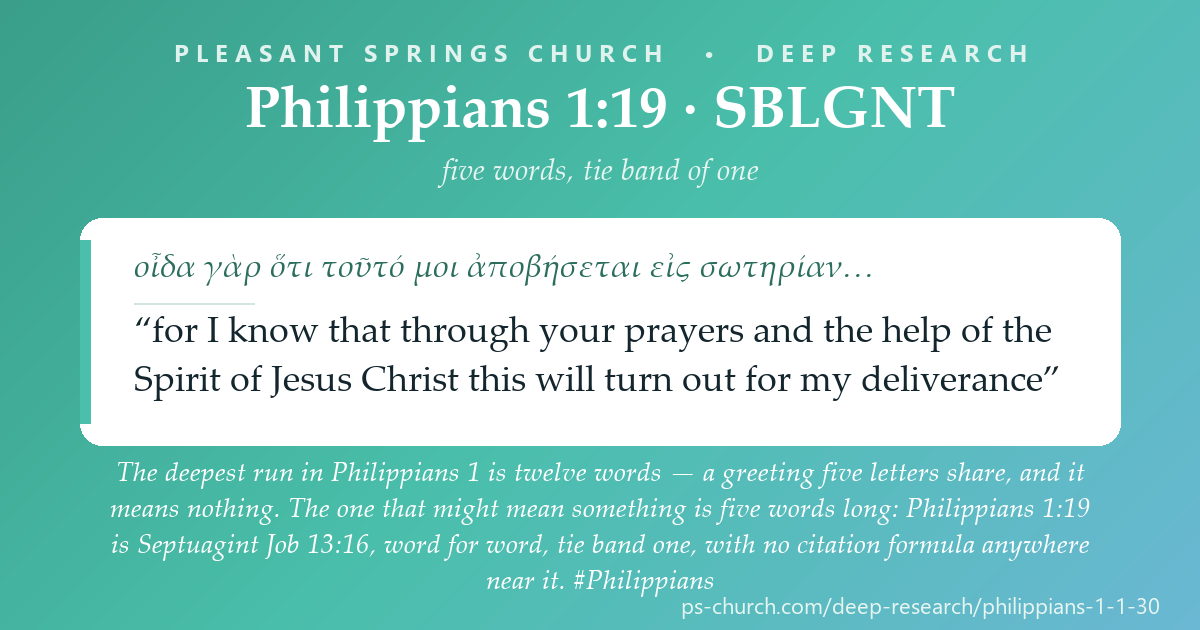
Screened word for word against all 7,823 other verses of the Greek New Testament, the deepest run anywhere in Philippians 1 is twelve consecutive words — and it is the greeting, grace to you and peace from God our Father and the Lord Jesus Christ, carried identically by Romans, 1 Corinthians, 2 Corinthians, Ephesians and Philemon. Tie band of five. It means nothing. Below it the chapter falls off a cliff: nothing at all between five and eleven, six rows topping out at four and eighteen at three. Then the same thirty verses were run against the Greek Old Testament — 30,348 verse units screened, of 30,637 held in 64 CATSS files, re-run on 24 September 2026 — and one row came back with five consecutive words at a tie band of one — τοῦτό μοι ἀποβήσεται εἰς σωτηρίαν, Philippians 1:19, which is Septuagint Job 13:16 word for word, with no citation formula anywhere near it. This page will not tell you Paul is quoting Job. It prints the five words, the band, the run of ten at a band of one that is unmistakably a stock benediction, and the Greek idiom Luke uses independently — and then it lets you decide. See the method →
Philippians 1:1–30 (selections)
Greek New Testament (SBLGNT, via MorphGNT) · ESV★ And the two headline numbers on this page point in opposite directions. Philippians 1:2 shares twelve consecutive words with five other letters and is a form. Philippians 1:19 shares five with Septuagint Job 13:16 at a tie band of one, with no citation formula in sight. Depth alone decides nothing and band alone decides nothing, and Stage 4 prints a run of ten at a tie band of one that is also, unmistakably, a form.
The Shape of the Passage
A sequence held by two counted brackets — and deliberately not a chiasmThe letter names two writers, one city and two offices in its first verse, and then tells you where the writer is from a single Latin word. Everything else about the setting is inference, and this page keeps the inference separate from the count.
Author
“Paul and Timothy, servants of Christ Jesus.” Two names, and then a plural noun — δοῦλοι — that covers them both. The letter then speaks in the first person singular from verse 3 to the end of the chapter, so whatever the joint address means, the voice of Philippians 1 is one voice. Timothy reappears at 2:19–23 in the third person.
He is in custody, and the one word that says so is Latin. πραιτώριον, 1:13 — praetorium. Counted across all 27 MorphGNT files it stands eight times, and in seven of them (Matthew 27:27, Mark 15:16, John 18:28 twice, 18:33, 19:9, Acts 23:35) it is a building. Only here is it as naturally the guard as the guardhouse, and the English versions split: the ESV reads imperial guard, the King James palace. δεσμός — chain, bond — occurs four times in Philippians and all four are in this chapter: 1:7, 1:13, 1:14, 1:17.
⚠️ Which imprisonment, and which city, this page does not decide. Rome, Ephesus and Caesarea have all been argued, on grounds that are historical and geographical rather than lexical. Counting Greek words cannot settle it, and a page that pretended otherwise would be selling a guess as a measurement.
Audience
“To all the saints in Christ Jesus who are at Philippi, with the overseers and deacons.” Philippi was a Roman colony — Acts 16:12 calls it that — and the chapter’s single command is πολιτεύεσθε, conduct yourselves as citizens. The verb occurs twice in the New Testament, here and Acts 23:1. The noun πολίτευμα returns at Philippians 3:20, where the readers’ citizenship is said to be in heaven. Whether the colony status is why Paul reaches for that word is a judgement; that the word is rare and that it is the chapter’s only command are counts.
The word all keeps coming back. πᾶς stands twelve times in the thirty verses (1:1, 3, 4 twice, 7 twice, 8, 9, 13, 18, 20, 25), and the second-person pronoun ὑμεῖς stands twenty-two times. Christ is named in seventeen of the thirty verses. This is a letter about a church the writer is fond of, and the vocabulary shows it before the sentiment does.
They have been partners “from the first day until now” (1:5) — and they are already suffering. 1:28–30 says so plainly: opponents, ἀγών, and a grant that includes πάσχειν. Nothing in the chapter treats their difficulty as a surprise.
Orient on the city, the imprisonment, the two offices and the Greek Job before touching a single number.
Search by topic: Philippi; Philippians, Letter to; Roman colony; praetorium; overseer / bishop; deacon; imprisonment of Paul; Job, Book of; Job, Greek version of; partnership (koinonia).
Which articles are relevant?
- Anchor Bible Dictionary — “Philippi,” “Philippians, Letter to the,” “Praetorium,” “Bishop,” “Deacon,” “Job, Book of.”
- Dictionary of Paul and His Letters (IVP) — “Philippians, Letter to,” “Prison, Prisoner,” “Citizenship,” “Church Order and Government.”
- New International Dictionary of NT Theology & Exegesis — κοινωνία, προκοπή, πολιτεύομαι, χαρά, σωτηρία.
- Commentary on the New Testament Use of the Old Testament, ed. G. K. Beale and D. A. Carson (Baker, 2007) — the Philippians chapter, which is where the Job 13:16 question is discussed at length.
- These were not consulted for the measurements below. The measurements were run on the text files named in the footer.
Settle the numbering first — and note what is different about a New Testament page
Every page on this shelf states its versification offset, including the pages where the answer is that there is none. On a New Testament book the answer is stronger than that: there is no second column to be offset from.
| ch 1 | ch 2 | ch 3 | ch 4 | total | |
|---|---|---|---|---|---|
| SBLGNT (MorphGNT) | 30 | 30 | 21 | 23 | 104 |
| ESV | 30 | 30 | 21 | 23 | 104 |
The SBLGNT row was counted off disk. There is no Masoretic Philippians and no Septuagint Philippians, so the columns on this page are Greek New Testament and English, and every chapter-and-verse number means the same verse in all of them.
But the offset problem is still in the room, because the row this page is built on reaches into a book that has one. The CATSS Greek Job held here carries 1,083 numbered units against the Masoretic Job’s 1,070, and the surplus is not scattered: it is 2:9a–e (five extra lines given to Job’s wife), 42:17a–e (five extra lines after the last Hebrew verse), and short pluses at 19:4a, 23:15a and 36:28a–b. One Masoretic label, 23:14, has no separately numbered counterpart in the CATSS file. ‘Job 13:16’ means the same verse in both columns. It does not mean the same book.
A Roman colony, a Latin word in Greek letters, and a Greek Job with speeches the Hebrew does not have.
Philippi was a colony, and the chapter’s only command is a colony word
Acts 16:12 calls Philippi a κολωνία — a Latin word transliterated into Greek, and the only occurrence of it in the New Testament. Counted off the MorphGNT files.
Philippians 1:27 is the chapter’s single imperative, and the verb is πολιτεύεσθε — from πόλις, the verb for living as a member of a city. It occurs twice in the Greek New Testament: here and Acts 23:1. The related noun πολίτευμα stands once, at Philippians 3:20 — our citizenship is in heaven — and πολίτης four times. The ESV renders 1:27 let your manner of life be worthy, which is accurate and drops the civic metaphor; the older English versions kept it (let your conversation be as it becometh).
⚠️ What was not checked. The Latin inscriptions of Philippi are not on this disk, and neither are the documentary papyri. That Philippi was a veteran colony with Italic rights, and that its inscriptions are disproportionately Latin, is reported here from the reference works — it was not measured. What was measured is the New Testament word counts.
“The whole praetorium” — a Latin word doing two jobs
Philippians 1:13 is the only one of the eight New Testament occurrences of πραιτώριον where the word may be people rather than a place.
| verse | what it plainly is |
|---|---|
| Matthew 27:27 · Mark 15:16 | the governor’s headquarters in Jerusalem |
| John 18:28 (twice) · 18:33 · 19:9 | the same building |
| Acts 23:35 | Herod’s praetorium in Caesarea |
| Philippians 1:13 | ‘in the whole praetorium’ — a building, or the guard that staffs it |
The English versions divide, and the division is old: the King James took the building, the ESV takes the men. The Greek does not settle it and neither does this page. What can be said off disk is that this is the only one of the eight that is genuinely open.
The Greek Job is not the Hebrew Job, and the page says so before it uses it
Philippians 1:19’s five words come from a book that, in the Greek held here, has speeches the Hebrew does not.
| text | numbered units | the difference |
|---|---|---|
| Masoretic Job (Sefaria, Miqra according to the Masorah) | 1,070 | — |
| CATSS Greek Job (Rahlfs) | 1,083 | 2:9a–e — Job’s wife given a five-part speech; 42:17a–e — five lines after the Hebrew ends, including a line that Job will rise again with those whom the Lord raises; plus 19:4a, 23:15a, 36:28a–b |
⚠️ What that does and does not license. It means a reader of the Greek Job in the first century met a book with more in it than the Hebrew Job has. It does not mean Paul read those additions — the deepest run the screen finds between any verse of Philippians and Job 2:9a–e or 42:17a–e is two words, and the deepest of those — κενὸν ἐκοπίασα, Philippians 2:16 against Job 2:9b — is noise at that depth. The page asserts nothing about which Job he knew. Raw word totals are not comparable across two languages and the page does not compare them; what is compared is the count of numbered units.
And the verse immediately before the one Philippians touches is a famous textual crux
Job 13:15 — the verse just above 13:16 — carries one of the best-known ketiv/qere divergences in the Hebrew Bible, and it is on this disk.
| reading | Hebrew | sense |
|---|---|---|
| ketiv (as written) | הֵן יִקְטְלֵנִי לא אֲיַחֵל | though he slay me, I will not hope |
| qere (as read) | הֵן יִקְטְלֵנִי לוֹ אֲיַחֵל | though he slay me, I will hope in him |
| CATSS Greek 13:15 | ἐάν με χειρώσηται ὁ δυνάστης… ἦ μὴν λαλήσω καὶ ἐλέγξω ἐναντίον αὐτοῦ | a third sentence again — no verb of hoping at all |
Read off the Masoretic text held here, both readings, and off the CATSS Job. The page reports the divergence and does not say which reading is prior. It is printed because the sentence Philippians 1:19 touches is the very next line, and a reader who wants to think about what Paul is doing with Job should know what kind of neighbourhood verse 16 lives in.
Five words that carry the chapter, and how rare each one actually is.
Philippians 1:19. Searched across all 64 CATSS files — the complete set — nine occurrences of this form, and eight of the nine are in Job (8:14; 13:5; 13:12; 13:16; 15:31; 15:35; 18:5; 34:20). ⚠️ This count moved on 30 August 2026 and the page prints the move. It read “eight occurrences, and all eight are in Job,” measured over the 44 files then held. On the complete 64 the ninth stands at Wisdom of Solomon 2:3 — a WITNESS, NOT SCRIPTURE, the deuterocanonical book of Wisdom, in the speech the ungodly make: οὗ σβεσθέντος τέφρα ἀποβήσεται τὸ σῶμα, when it is quenched the body will turn to ashes. The concentration claim weakens from eight-of-eight to eight-of-nine, and the one that broke it is a book about the fate of the righteous and the ungodly. In the Greek New Testament the verb ἀποβαίνω stands four times — Luke 5:2, Luke 21:13, John 21:9 and here — and Luke 21:13 uses the identical construction with a different noun: ἀποβήσεται ὑμῖν εἰς μαρτύριον. That is the page’s own counter-evidence and Stage 4 prints it.
Three occurrences in the whole Greek New Testament, and two of them are in this chapter — 1:12 and 1:25; the third is 1 Timothy 4:15. At 1:12 it is the gospel’s advance, produced by Paul’s chains; at 1:25 it is the readers’ advance, the reason he expects to stay alive. The two ends of the same section, and the second structural bracket on this page.
Philippians 1:27, and the only imperative form in the chapter’s thirty verses. Counted off the MorphGNT parsing column: 25 imperative forms in Philippians, 24 of them in chapters 2–4. The verb occurs twice in the New Testament (here, Acts 23:1) and its noun πολίτευμα once, at Philippians 3:20. To a Roman colony, the one command of the chapter is a citizenship word.
Philippians 1:5; also 2:1 and 3:10. The ESV renders it partnership here rather than fellowship, and 4:15–16 shows why: the same root is used of money that actually moved. The word occurs 19 times in the Greek New Testament; three of them are in this letter.
Philippians 1:28, and nowhere else in the Greek New Testament. Outside the Bible it is used of horses shying. It is one of three words the New Testament uses exactly once that stand in this chapter — with αἴσθησις (1:9) and ἁγνῶς (1:17). Not frightened by the opponents: not spooked.
The chapter counted, word by word
501 words, 183 distinct lemmas, 30 verses — counted off the MorphGNT file. The whole letter is 1,626 words and 442 lemmas across 104 verses.
| word | times in Philippians 1 | where |
|---|---|---|
| Χριστός | 18 | in 17 of the 30 verses; 37 times in the letter |
| ὑμεῖς (2nd person plural) | 22 | spread over 17 of the 30 verses |
| πᾶς | 12 | 1:1, 3, 4 (2×), 7 (2×), 8, 9, 13, 18, 20, 25 |
| Ἰησοῦς | 8 | 1:1 (2×), 2, 6, 8, 11, 19, 26 — always with Χριστός |
| εὐαγγέλιον | 6 | 1:5, 7, 12, 16, 27 (2×) — six of the letter’s nine |
| θεός | 5 | 1:2, 3, 8, 11, 28 |
| δεσμός | 4 | 1:7, 13, 14, 17 — all four of the letter’s |
| χαρά / χαίρω | 4 | 1:4, 1:18 (2×), 1:25 |
| κύριος | 2 | 1:2 and 1:14 only |
| ἐπίσκοπος / διάκονος | 1 each | 1:1, and nowhere else in the letter |
| νόμος | 0 | all three occurrences in Philippians are in chapter 3 |
The three words this chapter uses that the New Testament never uses again: αἴσθησις (1:9), ἁγνῶς (1:17), πτύρομαι (1:28). Fourteen more of the chapter’s lemmas occur three times or fewer in the whole Greek New Testament, among them ἀποκαραδοκία, ἐπιχορηγία, βεβαίωσις, ἐνάρχομαι, συναθλέω, εἰλικρινής and ἀναλύω.
Joy: the densest book in the New Testament of any length
Counted across all 27 MorphGNT files — the lemmas χαρά, χαίρω and συγχαίρω together, divided by verses:
| book | joy words | verses | per verse |
|---|---|---|---|
| 2 John | 4 | 13 | 0.308 |
| Philippians | 16 | 104 | 0.154 |
| 3 John | 2 | 15 | 0.133 |
| 1 Thessalonians | 6 | 89 | 0.067 |
| 2 Corinthians | 13 | 256 | 0.051 |
| Philemon | 1 | 25 | 0.040 |
| Colossians | 3 | 95 | 0.032 |
| 1 Peter | 3 | 105 | 0.029 |
| James | 3 | 108 | 0.028 |
| John | 18 | 866 | 0.021 |
The two books above and below Philippians are thirteen and fifteen verses long, which is not a comparison, and the page marks their verse counts in italics for that reason. Among books of any size Philippians is first, and it is not close. The caveat: this counts three lemmas. It does not count χάρις, χαρίζομαι or εὐφραίνω, and a different word list would move every row. Four of the sixteen fall in chapter 1 — the chapter is less joy-dense than the letter as a whole.
One five-word run that might be a quotation, one twelve-word run that certainly is not, and a ten-word run at a tie band of one that settles the question of what a band proves.
The measurement
All 30 verses of Philippians 1 were screened twice: once against the other 7,823 verses of the Greek New Testament, once against the 30,348 screened verse units of the complete 64-file Greek Old Testament on this disk. Contiguous runs of whole word forms, never lemmas, with the tie band beside every run.
| run depth | rows reaching it vs the NT | rows reaching it vs the Greek OT 64 files, less the Odes · 30,348 units | as published, over 44 files · 23,061 |
|---|---|---|---|
| 2 | 30 of 30 | 30 of 30 | 30 of 30 |
| 3 | 25 | 17 | 16 |
| 4 | 7 | 5 | 4 |
| 5 | 1 | 1 | 1 |
| 6–11 | 1 — 1:2 again, on its way to 12 | 0 | 0 |
| 12 | 1 — the greeting | 0 | 0 |
⚠️ The right-hand column is the corpus this page was published on, kept beside the current one rather than overwritten. On 30 August 2026 the last twenty CATSS files arrived — Exodus, Leviticus, Numbers, both Joshuas and the deuterocanon — and the Greek Old Testament went from 44 files and 23,061 verse units to 64 and 30,637, a third larger. A tie band can only grow when the corpus grows, and a distribution can only shift upward. Both did, exactly as far as a third more text should move them: one more row reaches three, one more reaches four. The row at five did not move, and that is the whole page. Philippians 1:19 against Septuagint Job 13:16 is still five words, still a tie band of one, now against 7,576 more verse units than when it was published.
The single row that reaches 5 against the New Testament is 1:2 on its way to 12. Strip the greeting and no verse in Philippians 1 shares five consecutive words with anything in the rest of the New Testament. Against the Greek Old Testament the one row that reaches 5 is 1:19, and its partner is Job 13:16.
| row | deepest partner in the rest of the NT | run | band | deepest partner in the Greek OT held here | run | band |
|---|---|---|---|---|---|---|
| Php 1:2 | Ro 1:7 · 1Co 1:3 · 2Co 1:2 · Eph 1:2 · Phm 3 | 12 | 5 | Genesis 31:1 | 3 | 1 |
| Php 1:19 | 1Th 3:7 · 2Ti 3:15 · Mt 28:5 · Ro 7:18 | 3 | 4 | Job 13:16 | 5 | 1 |
| Php 1:5 | 2 Corinthians 9:13 | 4 | 1 | Daniel (Th) 10:12 | 4 | 1 |
| Php 1:10 | Romans 12:2 | 4 | 1 | nothing above two | 2 | 454 · was 322, then 456 |
| Php 1:11 | Ephesians 1:5 | 4 | 1 | 2 Chronicles 3:6 · Jeremiah 13:11 · Psalms of Solomon 2:31 (witness, not Scripture) | 3 | 3 · was 2 |
| Php 1:8 | Ro 1:9 · Mk 15:34 · Ac 11:17 · 1Th 2:10 | 3 | 4 | Bel and the Dragon (Th) 38 (witness, not Scripture) | 4 | 1 · new row — reached 3 on the 44-file corpus |
| Php 1:13 | 2 Corinthians 13:2 | 4 | 1 | 1 Esdras 2:19 · 1 Macc 12:14 · Numbers 12:7 · both Tobits · … | 3 | 10 · was 6 |
| Php 1:20 | Galatians 6:17 | 4 | 1 | Job 6:4 | 4 | 1 |
| Php 1:27 | 1Co 12:13 · Eph 2:18 · Ac 3:16 · … | 3 | 5 | Job 42:8 | 3 | 1 |
| Php 1:21 | ‘to live is Christ’ matches nothing | 2 | 142 | the same | 2 | 818 · was 575, then 820 |
| Php 1:25 | nothing above two | 2 | 352 | nothing above two | 2 | 851 · was 594 · unchanged by the Odes |
Every band in the right-hand column grew and none of the runs did — which is exactly what a third more text should do. The two rows that matched nothing above two now match nothing above two in half again as many places; the rows with a single unrivalled partner mostly kept it. Growth in a band is not a finding. Survival of a run through that growth is.
⚠️ AND THE RIGHT-HAND COLUMN WAS CORRECTED AGAIN ON 30 AUGUST 2026, DOWNWARD, WHEN THE ODES CAME BACK OUT OF THE CORPUS. The Odes are the liturgical canticles bound after the Greek Psalter. They arrived with the last twenty files and they are now held on this disk but not screened, for two reasons that have nothing to do with canon. Two of them are New Testament text — Ode 9 is Luke 1, the Magnificat and the Benedictus; Ode 13 is Luke 2, the Nunc Dimittis — and screened as Old Testament, Ode 9:48 matches Luke 1:48 at eighteen consecutive words, which is a Gospel measuring its own text. Ten more are second copies of passages already in the corpus (Ode 1 = Exodus 15, Ode 2 = Deuteronomy 32, Ode 4 = Habakkuk 3, Ode 11 = Isaiah 38, and so on), so a verse standing once appears to stand twice and any band touching a canticle is doubled. The shelf holds 30,637 units and screens 30,348.
What that cost this page: two tie bands, both of them in the ‘matches nothing above two’ rows. 1:10 falls from 456 to 454 and 1:21 from 820 to 818; 1:25 stays at 851. Not one run moved, not one partner changed, and the distribution is identical: 30 rows reach two, 17 reach three, 5 reach four, 1 reaches five. Philippians 1:19 against Septuagint Job 13:16 is still five words at a tie band of one — it has now survived the corpus growing by a third and then shrinking by 289. ★ And it is worth saying which way the two corrections point: the twenty new files made every band on this page bigger, and the Odes coming out made two of them smaller. A band is a property of the corpus, not of the verse, which is exactly why this page prints the corpus beside it.
⚠️ Nothing on this page was ever an Ode 9 or Ode 13 hit. No row of Philippians 1 had a canticle as its deepest partner at any depth, so no result here was ever Luke matching Luke. The two bands that fell were fallback counts at a run of two, where a doubled Exodus 15 or Habakkuk 3 is simply two more verses sharing two very common words. That is the smallest possible version of the error, and the page reports it because a reader cannot tell from a number which pages the trap bit.
Three rows of the thirty measure deeper against the Greek Old Testament than against the rest of the New Testament: 1:19 (5 against 3), 1:7 (4 against 3), and — new on the complete corpus — 1:8 (4 against 3), whose partner is Bel and the Dragon in the Theodotion recension, a witness, not Scripture, and whose four shared words are γάρ μου ὁ θεός. Only one of the three is interesting, and it is the same one as before.
The five words, and the three texts they are not quite the same in
Philippians 1:19 against Septuagint Job 13:16: five consecutive words, tie band one. Nothing else in the complete 64 CATSS files — all 30,348 screened verse units — reaches five with any verse of this chapter.
| text | the sentence |
|---|---|
| Philippians 1:19 | οἶδα γὰρ ὅτι τοῦτό μοι ἀποβήσεται εἰς σωτηρίαν διὰ τῆς ὑμῶν δεήσεως… |
| CATSS Job 13:16 | καὶ τοῦτό μοι ἀποβήσεται εἰς σωτηρίαν· οὐ γὰρ ἐναντίον αὐτοῦ δόλος εἰσελεύσεται |
| Masoretic Job 13:16 | גַּם הוּא לִי לִישׁוּעָה כִּי לֹא לְפָנָיו חָנֵף יָבוֹא — he also shall be my salvation, for a godless man shall not come before him |
| ESV Job 13:16 | “This will be my salvation, that the godless shall not come before him.” |
Two divergences, both worth naming. First: the Hebrew has no verb corresponding to ἀποβήσεται at all. גַּם הוּא לִי לִישׁוּעָה is a verbless clause — also he, to me, for salvation. The word Philippians shares with the Greek Job is one of the words the Greek Job supplied. Second: where the Hebrew has חָנֵף, a godless person, the CATSS Greek has δόλος, deceit — a person in one column and an abstraction in the other. The page reports both divergences and says nothing about which reading is prior or what produced the difference.
And there is no citation formula. Philippians 1:19 is introduced by οἶδα γὰρ ὅτι — for I know that. Not as it is written, not the Scripture says, not καθὼς γέγραπται, which Paul uses freely elsewhere. Whatever this is, the letter does not flag it as a quotation, and this page will not flag it either.
The counter-examples, printed in the same section
1. A run of twelve that means nothing — and the single word that proves it.
| Philippians 1:2 against… | run | why |
|---|---|---|
| Romans 1:7 · 1 Cor 1:3 · 2 Cor 1:2 · Eph 1:2 · Phm 3 | 12 | identical — tie band 5 |
| Colossians 1:2 | 8 | stops after πατρὸς ἡμῶν; Colossians has no and the Lord Jesus Christ |
| Galatians 1:3 | 7 | the same greeting with ἡμῶν moved — one pronoun in a different place |
| 2 Thessalonians 1:2 | 7 | the same greeting with ἡμῶν absent — one pronoun |
| Titus 1:4 | 5 | a different second half |
| 1 Timothy 1:2 · 1 Thess 1:1 | 4 | — |
All thirteen letters in the Pauline corpus open with a version of this sentence. Five of the other twelve carry the identical twelve words; two differ by a single pronoun and fall to seven. The whole apparent difference between a ‘deep’ run and a shallow one, on this row, is one word of two syllables.
2. ⚠️ A run of TEN at a tie band of ONE — and it is still a form.
Philippians 4:23 and Philemon 25 are, word for word, ἡ χάρις τοῦ κυρίου Ἰησοῦ Χριστοῦ μετὰ τοῦ πνεύματος ὑμῶν — ten consecutive words, tie band 1. On this shelf a band of one is normally the mark of a signal. Here it is an accident of one pronoun. Galatians 6:18 carries the same benediction with ἡμῶν inserted after κυρίου, so its run drops to 6 and it falls out of the tie band entirely; 1 Thessalonians 5:28, 2 Thessalonians 3:18 and Romans 16:20 do the same and drop to 4. The band of one does not mean two letters are related. It means the other letters spelled the formula slightly differently. This row is not in the passage this page studies and it is printed anyway, because it is the sharpest available warning against reading the Job result as more than it is.
3. The construction Philippians shares with Job is idiomatic Greek, and Luke uses it independently.
| verse | the clause |
|---|---|
| Philippians 1:19 | τοῦτό μοι ἀποβήσεται εἰς σωτηρίαν |
| Luke 21:13 | ἀποβήσεται ὑμῖν εἰς μαρτύριον |
| CATSS Job 13:16 | τοῦτό μοι ἀποβήσεται εἰς σωτηρίαν |
Philippians 1:19 and Luke 21:13 share a run of 1. The construction is the same — it will turn out for X unto Y — but the words around it are different, so the screen sees almost nothing. That is the honest weakness of the headline result: if ἀποβαίνω εἰς was ordinary Greek for result in, then Paul and the Greek Job could reach the same five words by both using an idiom with the same very common noun, and no reading would be involved at all. Against that: the form ἀποβήσεται occurs nine times in the complete 64 CATSS files and eight of the nine are in Job, which is a small fact and the only one the page has — and it is a slightly smaller fact than it was, because on the 44-file corpus this page published it as eight of eight. The ninth is Wisdom 2:3, a witness, not Scripture.
4. Three of the chapter’s seven band-of-one Old Testament contacts are in Job — and seven is not a sample.
Of the thirty rows, seven have a single unrivalled deepest partner in the Greek Old Testament: 1:2 (Genesis 31:1), 1:5 (Daniel Th 10:12), 1:15 (Exodus 10:8), 1:19 (Job 13:16), 1:20 (Job 6:4), 1:27 (Job 42:8), and — new on the complete corpus — 1:8 (Bel Th 38, a witness, not Scripture). ⚠️ This list read six until 30 August 2026 and it should have read seven: 1:15 against Greek Exodus 10:8, a run of three at a band of one, was left off. That was a miscount when the twenty new files landed, not an Odes artefact — the row stands at three with a band of one whether the canticles are screened or not — and it is corrected here rather than tidied away. It makes the Job cluster three of seven instead of three of six, which is slightly less striking and slightly more honest. ⚠️ 1:23 was on this list and is not now. Over 44 files its single partner was 1 Maccabees 9:12; over 64 it ties at three with 2 Maccabees 3:18 and 6:10 as well, a band of three, so it is no longer unrivalled. The list has changed membership twice and its length is not evidence of anything. Job holds 1,083 of the 30,348 units this shelf screens — 3.6%, down from the 4.7% this page published when the shelf held 23,061 — and three of the seven. The ratio got more striking and it is still not a finding, because seven is not a number. Two of the three Job hits are three and four words long, which is the depth at which this screen produces coincidences by the hundred. The page prints the cluster and refuses to draw a line through three points.
Where this page is weakest, what it could not reach, and what would break it.
The headline result is one row, and it may be an idiom
Everything distinctive on this page rests on Philippians 1:19 and its five words. One row. Not a pattern, not a sample, not a tendency — one verse out of thirty, whose partner is one verse out of 30,348.
And the page has already printed the thing most likely to dissolve it. ἀποβαίνω εἰς is ordinary Greek for result in; Luke 21:13 uses it without any relation to Job. If the construction was common, then two writers reaching for it with the very common noun σωτηρία and the dative μοι could produce five identical words without either having read the other. The measurement cannot rule that out and does not try. What the measurement says is narrow and exact: these five words, in this order, occur in the Greek Old Testament held here exactly once, at Job 13:16.
What would settle it is something this disk does not have. A corpus of non-biblical Koine — the documentary papyri, Josephus, Philo, the Apostolic Fathers — would show how common ἀποβαίνω εἰς actually was outside the Bible. None of that is held here, and its absence is the single largest hole in this page.
What is not on this disk
⚠️ This section used to open “the Greek Old Testament corpus here is 44 CATSS files, 23,061 verse units, 39 books,” and list Exodus, Leviticus, Numbers, Joshua, Wisdom, Judith, Tobit, 2–4 Maccabees, Baruch, the Epistle of Jeremiah, Odes, the Psalms of Solomon and the Susanna and Bel supplements as not among them. All twenty arrived on 30 August 2026. The corpus is now the complete CATSS set: 64 files, 30,637 verse units held — of which 30,348 are screened, the Odes being held and not screened. Every screen above has been re-run against it, and the warning that section carried — “a row whose real nearest neighbour is in Exodus would be reported as reaching something shallower somewhere else” — has now been tested rather than merely conceded. It was a real risk and it caught one row. Philippians 1:8’s nearest neighbour was among the missing books — not in Exodus but in Bel and the Dragon — and it was indeed being reported a word shallower. 1:19 was not: Job was held all along, and Job 13:16 is still its unrivalled partner.
What remains genuinely out of reach is no longer a list of books. It is that CATSS is one edition of the Greek Old Testament, lemmatised one way; that the doubled books (Joshua A and B, Judges A and B, both Daniels, both Tobits, both Susannas, both Bels) are counted as the files hold them; and that the deuterocanonical books now in the count are WITNESSES, NOT SCRIPTURE — measurement partners for the Greek, named as such wherever this page reports a hit in one.
On the New Testament side there is no critical apparatus. The Greek is the SBL edition as digitised by MorphGNT, one printed text. P46 carries Philippians and was not consulted; neither were P16, P61 or any manuscript, version, lectionary or patristic citation. The run of 12 at 1:2 and the run of 5 at 1:19 are exact agreements between printed texts; a different edition could lengthen or shorten either.
And the English column was not machine-read. There is no ESVPhilippians file on this disk — the ESV in the codex is transcribed from the printed edition, and the ESV verse counts in Stage 1 are the printed edition’s shape, not a count off disk.
What the screen structurally cannot do
It compares word forms, not lemmas, and not meanings. Two forms of the same verb do not match; a reordering breaks a run; a synonym is invisible. That is why Philippians 1:19 and Luke 21:13 — the same construction — measure 1. A lemma-based screen would give different numbers everywhere on this page, and would be a different measurement, not a better one.
It finds verbatim contact, never allusion. If Paul is thinking of Job while writing 1:19–26 — and the themes of vindication, of speaking boldly before God, of life and death weighed against each other, are Job’s themes — the screen has no way to see it except where words repeat. The absence of a run is not the absence of a relationship.
And a number can be true and mean nothing. The word-midpoint of Philippians 1 falls at word 250.5 of 501, which lands exactly on the seam between 1:16 and 1:17 — between those who preach Christ from love and those who preach him from rivalry. The page prints that and makes nothing whatever of it. Paul did not count words, the verse divisions are medieval, and this is the kind of arithmetic that produces a thesis if you let it.
The historical questions the measurement is silent on
Where Paul was imprisoned; whether Philippians is one letter or two or three joined; what ἐπίσκοποι and διάκονοι meant in Philippi in the first century; whether 1:19 is a quotation, an echo, or an idiom; whether the ‘deliverance’ of 1:19 is release from prison or vindication at the judgement. Counting shared word-runs cannot decide any of that, and this page does not pretend otherwise. What it offers is the measurement the arguments have to fit.
Reading list
- Peter T. O’Brien, The Epistle to the Philippians (NIGTC, 1991).
- Gordon D. Fee, Paul’s Letter to the Philippians (NICNT, 1995).
- Markus Bockmuehl, The Epistle to the Philippians (BNTC, 1998).
- John Reumann, Philippians (Anchor Yale Bible 33B, 2008).
- Moises Silva, Philippians (BECNT, 2nd ed. 2005) — and his chapter on Philippians in Beale & Carson, Commentary on the New Testament Use of the Old Testament, which is where the Job 13:16 question is argued.
- Claude E. Cox and the NETS Iob introduction — on the relationship between the Old Greek Job and the Hebrew, including the asterisked material.
- None of these were consulted for the measurements on this page, which were run on the text files named in the footer.
Thirty verses, one command, and five words that may or may not have come from Job.
What the counting actually turned up
Philippians 1 is thirty verses long and contains one imperative. Twenty-nine verses of thanksgiving, prayer, report, and a man weighing whether he would rather live or die — and then, once: live as citizens worthy of the gospel of Christ. The other twenty-four commands in the letter are all in chapters 2, 3 and 4. Whatever else the chapter is doing, it is not mostly telling anyone what to do.
The deepest agreement it makes with any other New Testament verse is twelve words long, and five letters share it: grace to you and peace from God our Father and the Lord Jesus Christ. A form. Worth nothing as evidence, and printed second from the top of the codex so that nothing below it can be misread. Below that the chapter goes quiet — nothing at all between five and eleven, and once the greeting is removed, not one verse of Philippians 1 shares five consecutive words with anything in the rest of the New Testament.
Then the same thirty verses were run against the Greek Old Testament, and one row came back. Philippians 1:19 — τοῦτό μοι ἀποβήσεται εἰς σωτηρίαν — is Septuagint Job 13:16, five words, word for word, tie band one. A man in chains, writing about whether he will live — and the same five words stand in the mouth of a man on an ash-heap arguing that God will vindicate him. And the Hebrew of that verse has no verb where the Greek has ἀποβήσεται, so the shared word is one that stands in the Greek column and not in the Hebrew.
The page does not tell you Paul is quoting Job, and it will not. There is no citation formula. The construction is ordinary Greek and Luke uses it independently. And on the same page there is a run of ten words at a tie band of one — Philippians 4:23 and Philemon 25 — which is a stock benediction that only looks unique because Galatians spells it with one extra pronoun. Depth proves nothing on its own. Band proves nothing on its own. Both numbers are printed here beside a result the page is unwilling to overstate.
What is left after all the hedging is a small thing and it is still there: the letter that is the most joyful book in the New Testament was written by a man in custody, and the one sentence in its first chapter that touches the older scriptures at all touches Job. For to me to live is Christ, and to die is gain — nine words that, measured against 7,823 other verses of the Greek New Testament, match nothing at all.
Every Deep Research page traces its passage across the whole sweep — the Old Testament, the Second-Temple world between the testaments (historical witnesses, not Scripture), and the New Testament. Follow the thread:
Pleasant Springs Church — Deep Research
Research method after Michael S. Heiser’s Bible Research Method (examine dictionaries → ancient literature → important words → textual connections → academic publications → share), with the Pleasant Springs “Author & Audience” foundation. Scripture set in the Hebrew, the Greek editions named on each page and the ESV (Old Testament), and the Greek New Testament and the ESV (New Testament), per the practice of Pleasant Springs Church. Philippians research grounded in O’Brien (NIGTC), Fee (NICNT), Bockmuehl (BNTC), Reumann (Anchor Yale) and Silva (BECNT) — none of which were consulted for any number on this page. Text: Greek New Testament from the SBL edition as digitized by MorphGNT; Greek Old Testament from Rahlfs’ Septuaginta as digitized by CATSS; Hebrew from the Masoretic text as printed in Sefaria’s Miqra according to the Masorah. No critical apparatus was consulted on any side. The standing caution for this shelf applies: these pages say “the CATSS Greek row reads…” and never call a reading early or late. ⚠️ VERSE NUMBERING — Philippians is a New Testament book, so there is no Masoretic or Septuagint column and no offset to state. Counted anyway: SBLGNT Philippians runs 30 / 30 / 21 / 23 = 104 verses off disk, and the ESV prints the same shape. Stated because this shelf states it everywhere, including where there is nothing to convert. The offset does bear on one row: the CATSS Greek Job carries 1,083 numbered units against the Masoretic Job’s 1,070 — 2:9a–e, 42:17a–e, 19:4a, 23:15a and 36:28a–b are Greek-only, and Masoretic 23:14 has no separately numbered counterpart in the CATSS file. ⚠️ The measurement, in full. Greek against Greek. MorphGNT field 6, the normalised word (the column that already resolves elision and the movable nu); CATSS FORM column (cols 0–24), beta-code transliterated first. Both sides lowercased, accents and breathings dropped, final sigma folded, then filtered to Greek letters — the same filter applied to both corpora. Contiguous runs of whole word FORMS, never lemmas. Corpus: the 30 MorphGNT rows of Philippians 1 against the other 7,823 verses of the Greek New Testament, and against the 30,348 screened verse units of the 30,637 held across all 64 CATSS files — the 289 units of the Odes are held and not screened. Exhaustive and deterministic; nothing sampled, so no seed applies. The tie band — how many target verses reach the same maximum — is printed beside every run on this page. ⚠️ THE CORPUS GREW UNDER THIS PAGE ON 30 AUGUST 2026. This attribution used to read “Greek Exodus, Leviticus, Numbers, Joshua, Wisdom, Judith, Tobit, 2–4 Maccabees, Baruch, the Epistle of Jeremiah, Odes, Psalms of Solomon, Susanna and Bel are not among the CATSS files held here.” All twenty arrived that day and the shelf went from 44 files and 23,061 verse units to 64 and 30,637. Every figure above has been re-derived against the complete set, and stage 4 keeps both columns side by side. What moved: one more row reaches three, one more reaches four, four tie bands grew, 1:8 gained an unrivalled partner in Bel (Th), 1:23 lost one, and ἀποβήσεται went from eight-of-eight in Job to eight-of-nine. What did not move: Philippians 1:19 against Job 13:16, five words, tie band one. The deuterocanonical books are WITNESSES, NOT SCRIPTURE and are labelled so at every hit. ⚠️ And two of the new files are a hazard, not a witness: Odes 9 is Luke 1 and Odes 13 is Luke 2, gathered into the Greek Psalter’s appendix, so a New-Testament-against-Greek-Old-Testament screen can now return Luke as a match for Luke — Odes 9:48 against Luke 1:48 runs to eighteen consecutive words. So they came back out the same day: the Odes are held on this disk and are not screened, and every Greek Old Testament figure on this page is now over 30,348 units, not 30,637. Nothing in Philippians 1 ever touched Ode 9 or Ode 13; what the removal cost was two fallback tie bands, 1:10 from 456 to 454 and 1:21 from 820 to 818, both of them the duplication arm of the problem rather than the Luke arm. ⚠️ What is still NOT measurable. No non-biblical Koine corpus is held at all — no papyri, no Josephus, no Philo, no Apostolic Fathers — so the page cannot say how common ἀποβαίνω εἰς was outside the Bible, which is exactly the question its headline result turns on. P46 carries Philippians and was not consulted. There is no ESV Philippians file on disk; the English column is transcribed from the printed edition. ⚠️ Direction of influence is never asserted. Nothing here says Paul is quoting Job, that he read the Greek Job rather than the Hebrew, or that Luke 21:13 is related to either. The page reports that five consecutive words of Philippians 1:19 stand in Septuagint Job 13:16 and nowhere else in the books held, that there is no citation formula, and that the construction is idiomatic Greek — and stops. Typology is handled per the house position: what the text says, what the New Testament itself draws, and what we see from this side of the cross — with the seeing left to the reader.
Scripture quotations marked ESV are from the ESV® Bible (The Holy Bible, English Standard Version®), © 2001 by Crossway, a publishing ministry of Good News Publishers. ESV Text Edition: 2016. Used by permission. All rights reserved. The ESV text may not be quoted in any publication made available to the public by a Creative Commons license, and the ESV may not be translated in whole or in part into any other language. www.esv.org
|
Did this study bless you today? 💚 Give to Support PS Church100% of gifts go to the General Fund — thank you. |