The Catechism of the Catholic Church says that its teaching on the final purification it calls Purgatory is “also based on the practice of prayer for the dead”, and quotes a sentence about Judas Maccabeus as 2 Maccabees 12:46. In the Greek and in the King James Apocrypha, chapter 12 ends at verse 45, and the sentence is the second half of it. Only the Latin, of the three witnesses printed here, gives the clause a number of its own — and the Latin does not word it as the Greek does. The Greek says Judas τὸν ἐξιλασμὸν ἐποιήσατο, made the atonement, for the dead; the Latin says that it is a holy and wholesome thought to pray for them. Measured, the eight verses of the passage share no more than three consecutive words with any of the 7,927 verses of the Greek New Testament or with any Greek Old Testament unit outside the book, and six of their words stand nowhere else in the 30,348 units screened. This page reads the passage in all three witnesses, quotes three positions on it by name and adopts none, and measures the rest of chapters 11–15: four letters, Razis, the dream of Onias and Jeremiah, the defeat of Nicanor, and the epitomist’s farewell. It is not Scripture for us: 2 Maccabees is filed with the Apocrypha, and nothing taught here rests on it. There is no Hebrew 2 Maccabees on this disk; the English is the King James Apocrypha of 1769. See the method →
2 Maccabees is a Second-Temple Jewish history, commonly held to have been written in Greek, abridging a lost five-volume work by Jason of Cyrene (2:23), and ending with the defeat of Nicanor, whose day it decrees be kept on the thirteenth of Adar. It is canonical in the Roman Catholic and Orthodox churches, was printed among the Apocrypha in the Protestant Bibles of the Reformation era — the King James Bible quoted here among them — and is absent from the Hebrew Bible. It is not Scripture for us. We read it as a witness to how Jews in the generations before Christ spoke of resurrection, of the dead, and of the temple, and we test everything by the canon.
On the violence and on Razis. These chapters describe massacres, an execution in a tower of ash, the death of Razis by his own hand, and the display of Nicanor’s head and hand. This page quotes speeches and prayers, not descriptions, and reports the narrator’s approval of Razis as the narrator’s.
⚠️ What this page can and cannot measure — read this first.
HELD: the Greek of 2 Maccabees in full (CATSS 2Macc.mlxx, 555 rows, 15 chapters, every label parsing), and of 1, 3 and 4 Maccabees; the whole Greek Old Testament as CATSS holds it, 30,348 verse units screened of 30,637 held (the Odes are left out of every screen by house rule, because they duplicate canonical canticles and Luke 1–2); the Greek New Testament (SBLGNT, 7,927 verses); the KJV Apocrypha’s 2 Maccabees (555 verses); the Clementine Vulgate’s (558 verses).
NOT HELD: any Hebrew or Aramaic 2 Maccabees — the book is not in the Tanakh, and the Masoretic corpus on this disk has 39 books and no Apocrypha; the critical Greek edition (the Göttingen Septuagint) and its apparatus; the Old Latin, the Syriac and the Nova Vulgata; any other English translation of 2 Maccabees — the KJV Apocrypha is the one English column; and the five books of Jason of Cyrene that 2:23 says this book abridges.
CONSEQUENCE: every number below is Greek against Greek — contiguous runs of whole word forms, with the tie band beside every run — or a count of words in a named file. A run finds shared wording; it cannot see allusion, and it cannot settle a doctrine. Where this page reports what churches have taught about 12:43–45, it quotes them and does not adjudicate.
2 Maccabees 11–15 — thirteen verses, three witnesses
Greek: CATSS (Rahlfs) · English: KJV Apocrypha (1769 standard text, public domain) · Latin: Clementine VulgateThe first of four letters, and the phrase that introduces it. περιέχουσαι τὸν τρόπον τοῦτον, containing this manner, stands in two of the 30,348 Greek Old Testament units screened here: this one, and 1 Maccabees 15:2, where it introduces a letter of King Antiochus to Simon. The greeting χαίρειν stands in the address of all four letters in this chapter (11:16, 11:22, 11:27, 11:34).
VULGATE 11:16 Nam erant scriptæ Judæis epistolæ a Lysia quidem hunc modum continentes : Lysias populo Judæorum salutem.
The one row of the 555 in 2 Maccabees that shares not a single word with the Greek New Testament — the Romans’ farewell and date. ὑγιαίνετε, be well, stands once in the 30,348 Greek Old Testament units. And 11:33 and 11:38 share six consecutive words, ἔτους ἑκατοστοῦ τεσσαρακοστοῦ ὀγδόου Ξανθικοῦ πεντεκαιδεκάτῃ: the king’s letter to the Jews and the Romans’ letter carry the same date.
VULGATE 11:38 Bene valete. Anno centesimo quadragesimo octavo, quintadecima die mensis Xanthici.
What was found on the dead. ἱερώματα — KJV things consecrated to the idols of the Jamnites, Latin de donariis idolorum — stands once in the 30,348 Greek Old Testament units. The verse names the law that forbids them and draws its own conclusion: διὰ τήνδε τὴν αἰτίαν τούσδε πεπτωκέναι, for this cause these had fallen.
VULGATE 12:40 Invenerunt autem sub tunicis interfectorum de donariis idolorum quæ apud Jamniam fuerunt, a quibus lex prohibet Judæos : omnibus ergo manifestum factum est, ob hanc causam eos corruisse.
Three witnesses, two sums. The Greek row has δραχμὰς δισχιλίας, two thousand drachmas, and so does the KJV; the Latin has duodecim millia, twelve thousand. And the Latin names the dead in this verse where the Greek row does not: for the Greek περὶ ἁμαρτίας θυσίαν, a sacrifice for sin (KJV a sin offering), it has pro peccatis mortuorum sacrificium, a sacrifice for the sins of the dead. ὑπὲρ ἀναστάσεως, on behalf of resurrection, stands in no other Greek Old Testament unit.
VULGATE 12:43 Et facta collatione, duodecim millia drachmas argenti misit Jerosolymam offerri pro peccatis mortuorum sacrificium, bene et religiose de resurrectione cogitans
The verb for prayer is here, one verse before the disputed sentence. ὑπὲρ νεκρῶν εὔχεσθαι, to pray on behalf of the dead: the three words stand once in the 30,348 Greek Old Testament units and nowhere in the 7,927 verses of the Greek New Testament. The sentence is a condition — if he had not expected the fallen to rise, it would have been superfluous to pray for them. For its nearest New Testament neighbour in argument, 1 Corinthians 15:29, see Stage 4.
VULGATE 12:44 (nisi enim eos qui ceciderant resurrecturos speraret, superfluum videretur et vanum orare pro mortuis),
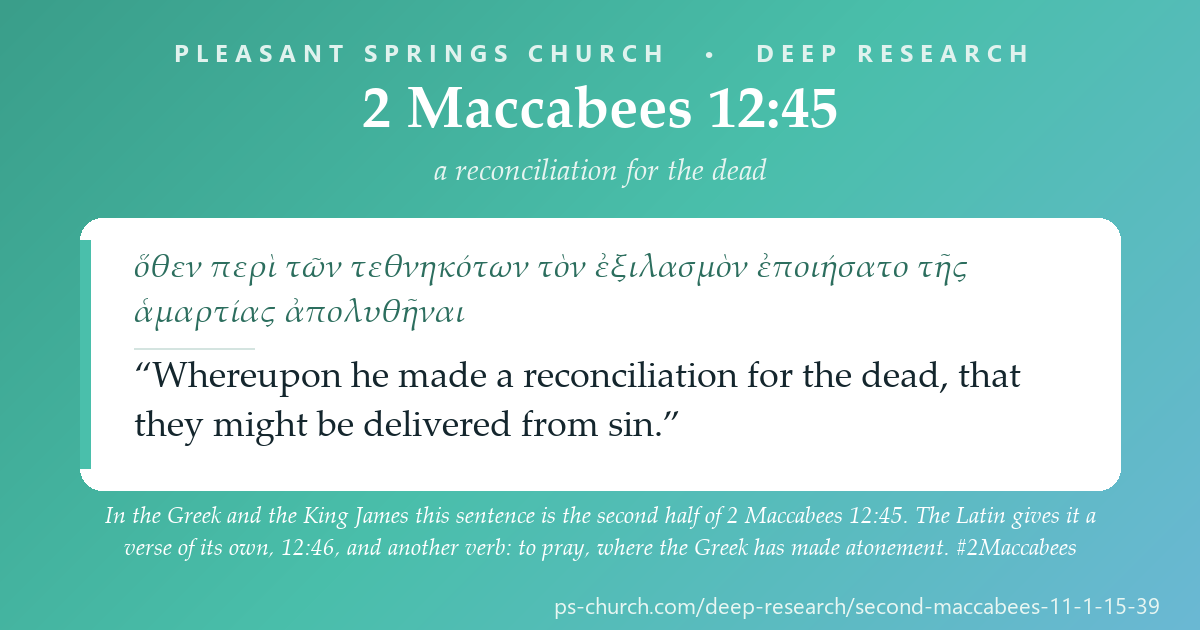
The sentence this page turns on. In the Greek row and in the KJV it is the second half of 12:45. The Clementine Latin divides the verse after the reward laid up and numbers the rest 12:46 — a rest that opens one clause before the Greek’s whence, with the holy thought (Sancta ergo et salubris est cogitatio; Greek ὁσία καὶ εὐσεβὴς ἡ ἐπίνοια). Chapter 12 has 45 verses in the Greek and the KJV and 46 in the Latin, and this is where the extra one is. And the two do not word it alike. The Greek: ὅθεν περὶ τῶν τεθνηκότων τὸν ἐξιλασμὸν ἐποιήσατο τῆς ἁμαρτίας ἀπολυθῆναι [our literal gloss: whence he made the atonement for those who had died, that they be released from the sin]. The Latin 12:46: pro defunctis exorare, ut a peccatis solvantur [our literal gloss: to pray for the dead, that they be loosed from sins]. The Greek clause has a past-tense verb of doing and the noun atonement; the Latin verse has an infinitive of praying and no word for atonement. The Greek noun for sin is singular, with the article; the Latin’s is plural. The KJV agrees with the Greek row here: “he made a reconciliation for the dead, that they might be delivered from sin.”
VULGATE 12:45 et quia considerabat quod hi qui cum pietate dormitionem acceperant, optimam haberent repositam gratiam.
VULGATE 12:46 Sancta ergo et salubris est cogitatio pro defunctis exorare, ut a peccatis solvantur.
A prayer that the end of chapter 15 answers. διατήρησον and ἀμίαντον — keep, undefiled — each stand in exactly two rows of 2 Maccabees: this one, and 15:34, where the people bless the one ὁ διατηρήσας τὸν ἑαυτοῦ τόπον ἀμίαντον, who has kept his own place undefiled. And the KJV verse is longer than the Greek row: and stop every unrighteous mouth has no counterpart in the CATSS row or in the Latin. See Stage 5.
VULGATE 14:36 Et nunc, Sancte sanctorum, omnium Domine, conserva in æternum impollutam domum istam, quæ nuper mundata est.
Razis, an elder of Jerusalem. Surrounded by soldiers sent to arrest him, he turns his sword on himself (14:41), and the narrator says why: εὐγενῶς θέλων ἀποθανεῖν, wishing to die nobly rather than fall into the hands of the wicked. The page reports the narrator’s verdict; it does not adopt it. It quotes Razis’s last prayer in Stage 4 and does not describe his wounds.
VULGATE 14:42 eligens nobiliter mori potius quam subditus fieri peccatoribus, et contra natales suos indignis injuriis agi.
The deepest New Testament contact in these five chapters — and a rare one. Five words, τοῦ νόμου καὶ τῶν προφητῶν, the law and the prophets, which Acts 13:15 and Romans 3:21 carry (tie band 2), and which only two of the 30,348 Greek Old Testament units carry: this verse and the first line of the prologue to Sirach (tie band 2 from the New Testament side too). A shared name for the Scriptures; not a citation. The Sirach study measured the same five words from the other end.
VULGATE 15:9 Et allocutus eos de lege et prophetis, admonens etiam certamina quæ fecerant prius, promptiores constituit eos :
A dead high priest names a dead prophet, in a dream. Onias, whose killing 4:34–36 reports, points out a man of grey hair and glory: ὁ φιλάδελφος οὗτός ἐστιν [our literal gloss: the lover of the brothers is this one], ὁ πολλὰ προσευχόμενος περὶ τοῦ λαοῦ [our literal gloss: who prays much for the people] … Ιερεμιας ὁ τοῦ θεοῦ προφήτης. Both of the last two phrases stand once in the 30,348 Greek Old Testament units screened. The Latin is longer by two phrases: et populi Israël and universa.
VULGATE 15:14 Respondentem vero Oniam dixisse : Hic est fratrum amator, et populi Israël : hic est qui multum orat pro populo et universa sancta civitate, Jeremias propheta Dei.
Two books, one night, two verbs. 1 Maccabees 7:41 puts the same precedent in Judas’s mouth before the same battle, with the same number, ἑκατὸν ὀγδοήκοντα πέντε χιλιάδας, which four Greek Old Testament units carry in this accusative form (a fifth, 2 Maccabees 8:19, has the same number with the nominative, ἑκατὸν ὀγδοήκοντα πέντε χιλιάδες). The number is the deepest run the two prayers share. 1 Maccabees carries the verb 2 Kings 19:35 carries, ἐπάταξεν; 2 Maccabees carries Isaiah 37:36’s, καὶ ἀνεῖλεν ἐκ τῆς παρεμβολῆς — five words that stand in those two units and no others.
VULGATE 15:22 Dixit autem invocans hoc modo : Tu Domine, qui misisti angelum tuum sub Ezechia rege Juda, et interfecisti de castris Sennacherib centum octoginta quinque millia :
The epitomist’s apology, in the first person singular — as is the sentence before it, καταπαύσω, I will stop; here μοι, for me. Calvin pointed to this verse in arguing that the book is not Scripture (Stage 5). The Latin numbers it 15:39, because it divides the Greek’s 15:36 into two verses.
VULGATE 15:39 Et si quidem bene, et ut historiæ competit, hoc et ipse velim : sin autem minus digne, concedendum est mihi.
The last sentence of the book, and its last image: wine mixed with water. Its opening, καθάπερ γὰρ, ties for the deepest run it shares with the preface (2:19–32): two words, tie band 4 — 2:22, 2:26, 2:29 and 2:31 each reach two with 15:39, the other three on function-word pairs (and the, but also). At 2:29 the pair opens the preface’s own simile; it is a common connective, standing in seven of the 30,348 Greek Old Testament units screened, five of them in 4 Maccabees. Its word for the readers, τῶν ἐντυγχανόντων, is the verb the narrator uses of them at 2:25 and 6:12. A frame of voice, not of wording: see the structure note.
VULGATE 15:40 Sicut enim vinum semper bibere, aut semper aquam, contrarium est ; alternis autem uti, delectabile : ita legentibus si semper exactus sit sermo, non erit gratus. Hic ergo erit consummatus.
Versification — stated, as on every page here, including where the usual frame does not exist.
There is no Masoretic text of 2 Maccabees, so there is no MT/LXX offset to report, and the one English column is the KJV Apocrypha. The offsets that do exist are between the three witnesses printed, and each was counted:
• Greek (CATSS) against the KJV Apocrypha. Identical chapter by chapter through all fifteen chapters: 555 verses each, and 38 · 45 · 26 · 46 · 39 in chapters 11–15. Aligned by content, label for label, at every line this page prints — but agreement of count is not agreement of division: KJV 11:13 ends “he sent unto them,”, a verb the Greek has at the head of 11:14 (προσαποστείλας).
• Greek against the Clementine Vulgate. 558 verses against 555: the Latin has one more verse than the Greek in chapters 2, 12 and 15. In chapter 12 the extra verse is 12:46: the Latin divides the Greek’s 12:45 after the reward laid up, so its 12:46 carries the holy thought clause and the clause on the dead. In chapter 15 the Latin divides the Greek’s 15:36 into two verses, so Greek 15:37–39 is Latin 15:38–40, and the codex prints the Latin under its own numbers. Inside equal counts the Latin sometimes divides a sentence elsewhere: its 13:23 opens with commisit cum Juda, superatus est., which the Greek has at the end of 13:22.
• Verse-only and lettered labels: none in this book; every one of the 555 CATSS labels is chapter:verse and parses.
• Canonical verses cited are given in English numbering, with the Greek where it differs: 2 Kings 19:35 (4 Kingdoms 19:35 in the Greek), Proverbs 25:1 (CATSS 32:1). Esther 3:13f and 8:12s are lettered rows of the Greek Additions to Esther.
The Shape of the Passage
Sequence, with one measured frame — not a chiasm• diatēreō, keep, and amiantos, undefiled, each stand in exactly two rows of 2 Maccabees, 14:36 and 15:34 — the priests’ prayer and the people’s blessing. The adjective stands in five of the 30,348 Greek Old Testament units; the other three are in Wisdom.
• proteinō, stretch out, stands six times in the book, and four of the six fall between 14:33 and 15:15: Nicanor’s right hand (14:33), the priests’ hands (14:34), Onias’s hands (15:12), Jeremiah’s right hand (15:15). The other two are 3:20 and 7:10.
• τὰς χεῖρας εἰς τὸν οὐρανὸν, the hands to heaven, stands in four Greek Old Testament units: 2 Maccabees 3:20, 14:34 and 15:21, and 3 Maccabees 5:25.
And the run engine scores 14:36 against 15:34 at one word: the forms differ (keep! against who has kept). The frame is in the vocabulary, not in a repeated sentence. The book’s own outer frame — the preface at 2:19–32 and the close at 15:37–39 — is fainter still: the deepest run between them is two words, reached by four preface verses against 15:39 (tie band 4: 2:22, 2:26, 2:29, 2:31). Three of the four are function-word pairs; the fourth is καθάπερ γὰρ (2:29 and 15:39), a connective that seven Greek Old Testament units carry. What joins them is a voice — the narrator’s word for his readers at 2:25, 6:12 and 15:39 — and two similes from the dining room, a banquet at 2:27 and mixed wine at 15:39. The diagram claims no more than those counts.
⚠️ Where this page sits. 2 Maccabees is canonical in the Roman Catholic and Orthodox churches, was printed among the Apocrypha in the Reformation-era Protestant Bibles, and is absent from the Hebrew Bible. This library reads it as a Second-Temple witness, not as Scripture, and files it under Apocrypha / Deuterocanon. Nothing taught at Pleasant Springs rests on it — and that is the church’s stated way of reading the book, not a verdict this page derives from its measurements.
Author
An abridger, who opens and closes the book in his own voice. The preface (2:19–32) speaks mostly as we — πειρασόμεθα (2:23), ἐφροντίσαμεν (2:25), ἀρξώμεθα (2:32) — with one I, δοκῶ (2:29). The close speaks as I: καταπαύσω (15:37) and μοι (15:38). The KJV: “And here will I make an end.”
He names his readers three times, with one verb. τοῖς ἐντυγχάνουσιν (2:25), τοὺς ἐντυγχάνοντας (6:12), τῶν ἐντυγχανόντων (15:39): those who come upon the book. Measured: the verb stands four times in 2 Maccabees, and the fourth (4:36) is of Jews petitioning a king.
Audience
People who keep feasts. The book opens with letters urging Jews in Egypt to keep the days of the month Chislev (1:9, 1:18), and closes these chapters with another decree: Nicanor’s day, the thirteenth of Adar (15:36). It explains days to people who keep them.
And Greek readers who know what a letter looks like. Chapter 11 sets four letters into the story whole — greetings, body, farewells, dates by year and named month — and chapter 15 closes with a figure from the drinking party. The KJV’s last words: “even so speech finely framed delighteth the ears of them that read the story. And here shall be an end.”
Previous studies. This is the last of three studies of the book: 2 Maccabees 1:1–5:27 and 6:1–10:38 come before it.
Orient on the book, Judas’s last campaigns, prayer for the dead, and the feasts.
Search by topic: Maccabees, Second Book of; Judas Maccabeus; Nicanor; Day of Nicanor; Razis; Onias III; Jeremiah in later tradition; prayer for the dead; resurrection in Second-Temple Judaism; Greek letter-writing.
Which articles to look for (entry titles not checked against the printed volumes):
- Anchor Bible Dictionary — “Maccabees, Books of,” “Nicanor,” “Judas Maccabeus,” “Resurrection (Early Judaism).”
- Eerdmans Dictionary of Early Judaism — “2 Maccabees,” “Afterlife,” “Letters.”
- Dictionary of New Testament Background (IVP) — “Maccabean Literature,” “Letters, Greco-Roman.”
- On the text — any article that distinguishes the Greek editions (Rahlfs; the Göttingen edition) from the Latin and English traditions. Two lines in these chapters show the KJV reading something other than the Greek row printed here (Stage 5).
Bibliography surfaced:
- Jonathan A. Goldstein, II Maccabees (Anchor Bible 41A, 1983).
- Robert Doran, 2 Maccabees: A Critical Commentary (Hermeneia, 2012).
- Daniel R. Schwartz, 2 Maccabees (Commentaries on Early Jewish Literature, 2008).
- NETS (the New English Translation of the Septuagint), 2 Maccabees. Not the edition quoted here; named as the obvious next step for a reader.
- Named, not consulted for this page — see Stage 5.
The passage in order, the same war in another book, the same night in two others, and Greek letters.
Where a text is held on this disk it is measured. The passage at 12:38–45 is described here in the order the Greek row tells it, before any reading of it is reported.
12:38–45, in the order the text tells it:
- 12:38 — Judas brings the army to Adullam; the seventh day comes; they purify themselves κατὰ τὸν ἐθισμὸν, according to the custom, and keep the sabbath.
- 12:39–40 — the next day they go to take up the bodies of the fallen and bury them with their kin. Under the tunic of each of the dead they find objects consecrated to the idols of Jamnia, “which is forbidden the Jews by the law” (KJV), and it becomes plain to all that this is why they fell.
- 12:41–42 — all bless the Lord, τοῦ δικαιοκρίτου κυρίου, the righteous judge, who makes hidden things plain; they turn to supplication ἀξιώσαντες τὸ γεγονὸς ἁμάρτημα τελείως ἐξαλειφθῆναι [our literal gloss: asking that the sin that had been committed be wholly blotted out]; and Judas urges the people to keep themselves from sin, having seen what happened to the fallen.
- 12:43 — he takes up a collection, two thousand drachmas of silver in the Greek row and the KJV, and sends it to Jerusalem to offer περὶ ἁμαρτίας θυσίαν, acting πάνυ καλῶς καὶ ἀστείως, very well and honourably, ὑπὲρ ἀναστάσεως διαλογιζόμενος [our literal gloss: taking thought on behalf of resurrection].
- 12:44 — the narrator’s reason: had he not expected the fallen to rise, περισσὸν καὶ ληρῶδες ὑπὲρ νεκρῶν εὔχεσθαι — KJV “it had been superfluous and vain to pray for the dead.”
- 12:45 — and looking to the reward laid up for those who fall asleep in piety — ὁσία καὶ εὐσεβὴς ἡ ἐπίνοια, holy and pious the thought — ὅθεν περὶ τῶν τεθνηκότων τὸν ἐξιλασμὸν ἐποιήσατο τῆς ἁμαρτίας ἀπολυθῆναι.
Said, in so many words: the dead had carried idol-objects; the living prayed that the sin be blotted out; Judas sent money for a sin offering; the narrator ties the act to the hope of resurrection, calls prayer for the dead pointless without that hope, and says Judas made atonement for the dead that they be released from the sin.
Not said in so many words, and argued over: whose the prayer of 12:42 was meant to help; what state the dead were thought to be in; whether the narrator’s comment states a teaching or praises one man’s act. The Greek leaves those questions to its readers, and the readers have answered them differently. Stage 5 quotes three of them.
The same war in 1 Maccabees — measured as contact, not as dependence:
- 2 Maccabees 11–15 against all 924 rows of 1 Maccabees: all 194 rows reach one word, 172 two, 63 three, 11 four, 2 five, 1 six. The six is a list, and a rare one: 12:21 against 1 Maccabees 1:32, τὰς γυναῖκας καὶ τὰ τέκνα καὶ, the women and the children and. The six words stand in those two of the 30,348 Greek Old Testament units and no others (tie band 1); their first five, the women and the children, stand in five (adding Judith 7:27 and 7:32 and Bel, Theodotion’s text, verse 21). For comparison, chapters 1–10 (361 rows) reach five and no further.
- Nicanor in two books. 1 Maccabees tells his campaign, his oath against the temple and his defeat in one chapter (1 Maccabees 7); 2 Maccabees in two (14–15). Measured: the 85 rows of 2 Maccabees 14–15 against the 50 rows of 1 Maccabees 7 — 52 reach two words, 4 reach three, one reaches four, and the four is a number (15:22, below). Both books tie the victory to the thirteenth of Adar (1 Maccabees 7:43, 7:49; 2 Maccabees 15:36); both display his head and the hand he had stretched out (1 Maccabees 7:47; 2 Maccabees 15:30–32). The same events, in other words: no shared run in those verses is longer than two.
- Sennacherib’s camp, 15:22. In both books Judas prays before the battle by recalling an angel who struck down ἑκατὸν ὀγδοήκοντα πέντε χιλιάδας — 2 Maccabees naming Hezekiah and Sennacherib, 1 Maccabees only οἱ παρὰ τοῦ βασιλέως ὅτε ἐδυσφήμησαν, those from the king, when they blasphemed. Four Greek Old Testament units carry that number in the accusative: 2 Kings 19:35 (4 Kingdoms in the Greek), Isaiah 37:36, 1 Maccabees 7:41, 2 Maccabees 15:22; a fifth, 2 Maccabees 8:19, has it with the nominative chiliades, also naming Sennacherib. 1 Maccabees 7:41 carries Kings’ verb, ἐπάταξεν; 2 Maccabees 15:22 carries Isaiah’s, καὶ ἀνεῖλεν ἐκ τῆς παρεμβολῆς — five words found in those two units only. 15:22’s deepest Greek Old Testament contact is five words, tie band 2: Isaiah 37:36, and the heading in Greek Proverbs (CATSS 32:1; English 25:1) that names Εζεκιου τοῦ βασιλέως τῆς Ιουδαίας. The measurement reports which wording each book carries; it does not say how either came by it.
- Nicanor’s day and Mordecai’s day, 15:36. The decree fixes the thirteenth τοῦ δωδεκάτου μηνὸς Αδαρ, of the twelfth month, Adar — four words that, outside 2 Maccabees, stand in two Greek Old Testament units, both royal letters in the Greek Additions to Esther (CATSS Esther 3:13f and 8:12s). The day is πρὸ μιᾶς ἡμέρας τῆς Μαρδοχαϊκῆς ἡμέρας; Mordecai’s stands once in the 30,348 units, and so does τῇ Συριακῇ φωνῇ, in the Syrian tongue.
Greek letters: 2 Maccabees 11, 1 Maccabees 10–15, and two in Acts:
- The greeting. The infinitive χαίρειν stands 26 times in 25 Greek Old Testament units: ten in 1 Maccabees, every one of them in chapters 10–15, and seven in 2 Maccabees, four of them the four letters of chapter 11. In the Greek New Testament it stands in seven verses; three are letter openings (Acts 15:23, Acts 23:26, James 1:1).
- The farewell. ἔρρωσθε stands in five Greek Old Testament units: 2 Maccabees 9:20, 11:21, 11:28 and 11:33, and 3 Maccabees 7:9. At 9:20 and 11:28 it is a wish for health inside a letter; at 11:21, 11:33 and 3 Maccabees 7:9 it ends one. It stands nowhere in 1 Maccabees, and neither does the other farewell of chapter 11. The New Testament has it once, at the end of the council’s letter, Acts 15:29.
- The dates. Three of chapter 11’s four letters end with a year and a named month — Διὸς Κορινθίου once (11:21), Ξανθικοῦ twice (11:33, 11:38), and that month is named again in the body of a letter at 11:30. In the 30,348 Greek Old Testament units, Xanthicus stands only in these three rows of 2 Maccabees 11; 1 Maccabees, which names the months Chislev, Adar, Elul and Shebat, has neither name. The king’s letter to Lysias (11:22–26) has no farewell and no date. Which calendar the month at 11:21 belongs to is argued in the commentaries and left open here.
- Shared letter phrasing, rare and formal. 11:16 shares four words with 1 Maccabees 15:2 (περιέχουσαι τὸν τρόπον τοῦτον), and 11:34 four with 1 Maccabees 8:29, the Roman treaty, τῷ δήμῳ τῶν Ιουδαίων, to the people of the Jews; each phrase stands in those two units only. And a name, by coincidence: the letter at 11:16 opens Λυσίας τῷ πλήθει, and Acts 23:26 opens Κλαύδιος Λυσίας τῷ — a run of two words (three shared singly, with the greeting), by two different men named Lysias. Of the 23 rows of the four letters, none reaches four words with any verse of the New Testament.
To pray, atonement, a reward laid up, undefiled, a lover of the brothers, farewell.
Every count below is over the CATSS Greek Old Testament files held here — 30,348 verse units screened, the Odes excluded — and the 7,927 verses of the SBLGNT. It is not a count over ‘the Septuagint’. Counts are of verse units unless the sentence says tokens.
The phrase ὑπὲρ νεκρῶν εὔχεσθαι stands once in the 30,348 Greek Old Testament units and in none of the 7,927 New Testament verses; so does this form of the verb. The New Testament’s one verse with on behalf of the dead is 1 Corinthians 15:29, βαπτιζόμενοι ὑπὲρ τῶν νεκρῶν [our literal gloss: being baptised on behalf of the dead] — with the article, which 12:44 lacks. The Greek Old Testament never has the phrase with the article; the New Testament never has it without.
Sixteen Greek Old Testament units carry the noun — Exodus 30:10 and Leviticus 23:27 and 23:28 (the Day of Atonement) among them, six in Sirach — and the Greek New Testament has no word of the exilas- family at all. In this form, with the article, τὸν ἐξιλασμὸν, it stands in three units: here, Ezekiel 43:23 and Sirach 18:12; with the article in the genitive it stands in three more (1 Chronicles 28:11, Exodus 30:10, Ezekiel 45:19). The count is of the noun exilasmos only; the neuter noun exilasma, which CATSS lemmatises separately, is not in it. The KJV renders it “reconciliation”; the Latin verse that carries this clause has no word for it.
Once in the 30,348 Greek Old Testament units, and nowhere in the New Testament. What is laid up for those who fall asleep in piety: KJV “great favour”, Latin optimam haberent repositam gratiam.
Five Greek Old Testament units: 2 Maccabees 14:36 and 15:34, and Wisdom 3:13, 4:2 and 8:20; four New Testament verses (Hebrews 7:26 and 13:4, James 1:27, 1 Peter 1:4). In 2 Maccabees it is the temple the priests ask God to keep undefiled, and the place the people bless him for keeping so — the frame of the structure diagram.
Onias’s word for Jeremiah. Six Greek Old Testament units carry the family: this one and five in 4 Maccabees, all between 4 Maccabees 13:21 and 15:10. In the New Testament the family stands in eight verses — six for brotherly love, two for the city of Philadelphia (Revelation 1:11, 3:7).
Five Greek Old Testament units, four of them in 2 Maccabees, none in 1 Maccabees; one New Testament verse, Acts 15:29. KJV Fare ye well; Latin Valete.
Counted here, not assumed:
- Words standing once in the 30,348 units, all in 12:38–45: ἱερώματα (12:40), δικαιοκρίτου (12:41), ἀνδρολογίαν (12:43), ληρῶδες (12:44), χαριστήριον (12:45), and the verb ἀπείργει (12:40), forbids. Six words in eight verses that the rest of the Greek Old Testament does not use, counted by stem. The CATSS lemma column gives a seventh: it files the adverb ἀστείως (12:43) apart from the adjective it comes from, which stands in seven other units; counted by stem, as here, the adverb is not unique.
- The noun ἀναστάσεως, resurrection: six Greek Old Testament units, two of them in 2 Maccabees (7:14 and 12:43); 42 occurrences in 40 verses of the Greek New Testament.
- Razis: his name, the epithet φιλοπολίτης (lover of his city) and the title πατὴρ τῶν Ιουδαίων each stand once in the 30,348 units. εὐγενῶς, nobly, stands in six — 14:42 and five in 4 Maccabees; ἀνδρωδῶς, manfully, in two (1 Maccabees 6:31 and 14:43).
- Jeremiah in 2 Maccabees: named in five rows — 2:1, 2:5 and 2:7, where he gives the exiles the law and hides the tent, the ark and the altar of incense, and 15:14 and 15:15, the dream. Onias: 15 times in 14 rows, twelve of them in chapters 3–4 and the last two in the dream (15:12, 15:14).
- The katapaus- family, rest: twice in the book — τῇ τῆς καταπαύσεως ἡμέρᾳ, the day of rest, when Nicanor plans to attack (15:1), and the epitomist’s καταπαύσω (15:37). The page notes the pair and claims no design.
- The Clementine Latin reads differently from the Greek row at least five times in these chapters, and the KJV agrees with the Greek row each time: 12:20 sex millibus (six thousand, a number the Greek row lacks); 12:43 duodecim millia (twelve thousand where the Greek has two) and mortuorum; 13:2 quinque millia (five thousand where the Greek has five thousand three hundred); 14:4 centesimo quinquagesimo (the 150th year where the Greek has the 151st).
The disputed passage shares almost no wording with anything; the deepest contact is a name for Scripture.
Every row of 2 Maccabees 11–15 screened against all 7,927 verses of the SBLGNT: contiguous runs of whole word forms, accents and breathings dropped, the two editions’ spelling equivalences applied. The tie band — how many New Testament verses reach the same depth — is printed beside every run, and so is the reverse: how many of the 30,348 Greek Old Testament units reach that same depth with the New Testament verse. On this screen a zero means no shared word at all.
The distribution, all 194 rows:
Across the 194 CATSS rows against the 7,927 verses of the Greek New Testament: 193 reach one, 189 reach two, 99 reach three, 8 reach four, 1 reaches five, and nothing reaches six. One row reaches nothing at all (11:38), and four reach only one (11:21, 11:33, 14:7, 14:25) — three of the five are the farewells and dates of the letters.
By chapter, the deepest run: chapter 11, four; chapter 12, four; chapter 13, four; chapter 14, four; chapter 15, five.
Every row that reaches four or more, all eight, with the band from both sides:
| 2 Macc | Shared words | New Testament | Run | NT band | Greek OT units reaching the same depth with that NT verse | What it is |
|---|---|---|---|---|---|---|
| 15:9 | τοῦ νόμου καὶ τῶν προφητῶν | Acts 13:15 · Rom 3:21 | 5 | 2 | 2 · 2 | The law and the prophets. The two Greek Old Testament units that reach five with either verse are this one and Sirach’s prologue. |
| 11:5 | εἰσελθὼν δὲ εἰς τὴν | Acts 19:8 | 4 | 1 | 1 | Band 1 both ways, and an accident: Lysias entering Judea; Paul entering the synagogue. |
| 12:3 | σὺν γυναιξὶν καὶ τέκνοις | Acts 21:5 | 4 | 1 | 6 | With wives and children; six Greek Old Testament units reach four with Acts 21:5. |
| 12:11 | καὶ ἐν τοῖς λοιποῖς | Rom 1:13 | 4 | 1 | 1 | Band 1 both ways, and an accident: and in the rest. |
| 12:21 | καὶ τὰ τέκνα καὶ | Matt 18:25 · Luke 14:26 | 4 | 2 | 8 · 9 | And the children and — a list formula. (Both New Testament verses reach five with Exodus 21:5, tie band 1; the 8 and 9 count the units that reach four or more.) |
| 13:5 | δὲ ἐν τῷ τόπῳ | John 19:41 | 4 | 1 | 2 | There was in the place: a tower of ash, and a garden. |
| 14:14 | οἱ δὲ ἐπὶ τῆς | Luke 8:13 | 4 | 1 | 1 | Band 1 both ways, and an accident: a connective. |
| 15:17 | διὰ τὸ καὶ τὴν | Acts 27:9 | 4 | 1 | 1 | Band 1 both ways, and an accident: a connective. |
The whole book, all 555 rows — the distribution this series has been building:
554 reach one, 547 reach two, 298 reach three, 42 reach four, 7 reach five, 3 reach six, and 1 reaches seven. Chapter by chapter the deepest run is 5, 7, 4, 4, 4, 3, 6, 4, 5, 4, 4, 4, 4, 4, 5. The seven is 2:10 against Revelation 20:9 (tie band 1), measured on the first study; from Revelation’s side it is the wording of Elijah’s fire, which 2 Kings 1:10 and 1:12 share with it at eight. And one row of the 555 shares no word at all with the Greek New Testament: 11:38, the Romans’ ὑγιαίνετε and their date.
The law and the prophets — depth and rarity, for once, together:
15:9 → Acts 13:15 and Romans 3:21 — five words, tie band 2; and from the New Testament side, tie band 2 again. Judas encourages his men ἐκ τοῦ νόμου καὶ τῶν προφητῶν; Acts 13:15 has τὴν ἀνάγνωσιν τοῦ νόμου καὶ τῶν προφητῶν [our literal gloss: the reading of the law and the prophets], and Romans 3:21 μαρτυρουμένη ὑπὸ τοῦ νόμου καὶ τῶν προφητῶν [our literal gloss: witnessed by the law and the prophets]. The five words stand in two of the 30,348 Greek Old Testament units: this verse and διὰ τοῦ νόμου καὶ τῶν προφητῶν in the first line of Sirach’s prologue. On the previous study of this book the deepest run was a formula ten Greek Old Testament verses carry; here the deepest is carried by two.
What the engine cannot see. Counting the pairing in any case — a law-word followed directly by and or or, an article if any, and a prophet-word — it stands in four Greek Old Testament units (2 Maccabees 15:9; 4 Maccabees 18:10; Sirach’s prologue, lines 1 and 24) and six New Testament verses (Matthew 5:17 and 7:12, Luke 16:16, John 1:45, Acts 13:15, Romans 3:21). A name for the Scriptures, shared in its genitive form by two books on each side. It is not a quotation in either direction, and no text here says it is.
12:38–45 against both Greek corpora — the page’s finding:
Not one of the eight rows reaches four consecutive words with any verse of the Greek New Testament or with any Greek Old Testament unit outside 2 Maccabees. Against the New Testament seven of the eight reach two and no more; the eighth, 12:39, reaches three with Acts 20:15 — τῇ δὲ ἐχομένῃ, and on the next day — tie band 1, and Acts 20:15 reaches three with this unit alone. A phrase of time, band 1 both ways like the counter-examples below — the three words stand in this unit and Acts 20:15 and nowhere else in the two corpora — and the passage’s deepest New Testament contact. Against the Greek Old Testament outside 2 Maccabees, four of the eight rows reach three words and none reaches four: κατὰ τὸν ἐθισμὸν (12:38; 1 Kings 18:28 and Judith 13:10, tie band 2); καὶ μετὰ τῶν and τὰ σώματα τῶν (12:39, tie band 9 — the first in eight units, the second in Esther 9:14 alone); εἰ μὴ γὰρ (12:44, three units); and the sum of money at 12:43, which 3 Maccabees 3:28 also names (ἀργυρίου δραχμὰς δισχιλίας, tie band 1). Inside 2 Maccabees one row goes deeper: 12:39 reaches four with 14:18, οἱ περὶ τὸν Ιουδαν, those around Judas, tie band 1; the four words stand in those two rows of the 30,348 units and no others.
1 Corinthians 15:29 — a run of one. Ἐπεὶ τί ποιήσουσιν οἱ βαπτιζόμενοι ὑπὲρ τῶν νεκρῶν εἰ ὅλως νεκροὶ οὐκ ἐγείρονται τί καὶ βαπτίζονται ὑπὲρ αὐτῶν [our literal gloss: Otherwise what will those do who are baptised on behalf of the dead? If the dead are not raised at all, why are they baptised on behalf of them?] The two verses argue the same way — an act done on behalf of the dead would be pointless if the dead do not rise — and share no two consecutive words. Four words stand in both, never two of them side by side: εἰ (if), καὶ (and), ὑπὲρ (on behalf of) and νεκρῶν (dead) — the last two apart because Paul’s phrase has the article between them and 12:44’s does not. The page sets the two side by side because the arguments meet; the wording does not, and nothing here says either writer knew the other.
Acts 3:19 — a run of one. 12:42 asks that the sin τελείως ἐξαλειφθῆναι, be wholly blotted out; Peter tells his hearers to repent πρὸς τὸ ἐξαλειφθῆναι ὑμῶν τὰς ἁμαρτίας [our literal gloss: so that your sins may be blotted out]. The infinitive stands in five Greek Old Testament units and in this one New Testament verse; the run between the two verses is one word long, and they share two words singly, the infinitive and an article.
It shows that 12:38–45 is written in its own words. Six of its words stand nowhere else in the 30,348 Greek Old Testament units screened (Stage 3), and outside the book its deepest runs stop at three words.
It does not show what the passage means, or that the New Testament agrees or disagrees with it. A run of one is not evidence of independence, and a shared argument is not evidence of a source. Readers who come to this passage for a doctrine will have to decide it on other grounds; Stage 5 quotes three who did.
⚠️ The page’s own counter-examples — band 1 both ways, and meaningless:
11:5 → Acts 19:8 (εἰσελθὼν δὲ εἰς τὴν): Lysias entering Judea and Paul entering the synagogue at Ephesus. 12:11 → Romans 1:13 (καὶ ἐν τοῖς λοιποῖς), 14:14 → Luke 8:13 (οἱ δὲ ἐπὶ τῆς) and 15:17 → Acts 27:9 (διὰ τὸ καὶ τὴν). Four words each, tie band 1 among New Testament verses, and each New Testament verse reaches four with this one Greek Old Testament unit and no other. Unique pairings in both directions, and ordinary Greek with nothing behind them. The page prints them so that 15:9’s band of 2 is read for what it is — a rare shared name — and not for more.
Razis and the mother of the seven — vocabulary without a run:
Razis’s last words, at 14:46, are a prayer: he calls on τὸν δεσπόζοντα τῆς ζωῆς καὶ τοῦ πνεύματος ταῦτα αὐτῷ πάλιν ἀποδοῦναι [our literal gloss: the one who is master of the life and the spirit, to give these back to him again]. The mother of the seven brothers says the Creator τὸ πνεῦμα καὶ τὴν ζωὴν ὑμῖν πάλιν ἀποδίδωσιν [our literal gloss: gives you back the spirit and the life again] at 7:23. Measured: life and spirit stand together in three rows of the book — 7:22, 7:23 and 14:46 — and again directly before give back in three Greek Old Testament units: 7:23, 14:46 and Sirach 29:2, where it is a loan repaid. The run engine scores 14:46 against 7:23 at one word: the nouns are in the other order and other cases, and the verb is in another form. The same hope, in other words.
Onias and Jeremiah — and two of this shelf’s Jeremiah studies:
The Jeremiah 16–20 and Jeremiah 26–30 studies both quote 15:14, and the Greek the first prints, Ιερεμιας ὁ τοῦ θεοῦ προφήτης, agrees with the file here word for word. One measured qualification: 2 Maccabees names Jeremiah in five rows, and only one of them, 15:14, has him praying; three (2:1, 2:5, 2:7) remember him for giving the exiles the law and hiding the tent, the ark and the altar of incense, and 15:15 has him hand Judas a golden sword. In this book he is named three times in the story of the fire, the law and the hidden tent, and twice in the dream; he is praying in one.
How the passage has been read, what this page could not check, and where it is weakest.
This is the section that makes the shelf trustworthy. Read it before quoting anything above.
How 12:43–45 has been read — three positions, quoted and attributed, not adjudicated:
- The Roman Catholic Church, Catechism of the Catholic Church §1032 (read online at vatican.va, 2026-10-10), after its paragraphs on the purification it calls Purgatory: “This teaching is also based on the practice of prayer for the dead, already mentioned in Sacred Scripture:” and it quotes “made atonement for the dead, that they might be delivered from their sin,” citing “2 Macc 12:46”. Measured against the three witnesses on this page: the Catechism’s English carries the Greek clause’s wording (made atonement); its verse number is the one only the Latin, of the three, gives that clause. Not held here, and so not checked: the Nova Vulgata and the Catholic English Bibles, whose own numbering and wording any conclusion about the Catechism’s citation would need.
- The Church of England, Articles of Religion (the Thirty-Nine Articles; read online at Wikisource in the text printed among the Historical Documents of the Episcopal Church’s prayer book, 2026-10-10). Article VI lists “The Second Book of Maccabees” among the books the Church reads “for example of life and instruction of manners;” “but yet doth it not apply them to establish any doctrine”. Article XXII calls the Roman doctrine concerning purgatory — together with pardons, the worship of images and relics, and the invocation of saints — a “fond thing”, “grounded upon no warranty of Scripture”.
- John Calvin, Institutes of the Christian Religion III.5.8 (read online in the English translation at the Christian Classics Ethereal Library, whose page does not name its translator, 2026-10-10). He declines to reply to the Maccabees passage, “lest I should seem to include that work among the canonical books,” and points to the book’s own last page: its writer, “when in the end he asks pardon for any thing less properly expressed,” in Calvin’s words “certainly proclaims that they are not oracles of the Holy Spirit.” The online text gives the references as “1 Macc. 12:43” for the passage — the passage is in 2 Maccabees — and “2 Macc. 15:38” for the apology, which is the verse printed in the codex above. Measured against the three witnesses there, ‘asks pardon’ fits the Latin’s wording of that verse, concedendum est mihi [our literal gloss: it must be granted to me] (Latin 15:39); the Greek row and the KJV state a limit — “it is that which I could attain unto.” — and ask no pardon.
- Pleasant Springs reads 2 Maccabees as a Second-Temple witness and not as Scripture, and builds no doctrine on it. That is the church’s reading of the book; on prayer for the dead this page reports what the text says and what the three sources above say about it, and argues neither side. Not consulted: the decrees of the Council of Trent, Luther, the Orthodox churches, and Jewish practice of prayer for the dead — all of which a fuller account would need.
⚠️ What this page could NOT check:
- Anything Hebrew or Aramaic. 2 Maccabees is not in the Masoretic corpus, so the acrostic and Hebrew-parallel screens cannot run on it. The book is commonly held to have been composed in Greek; that is reported, not tested.
- The critical Greek text. The Greek printed and measured is CATSS (Rahlfs’s edition). The Göttingen edition and its apparatus are not held, so no variant reading behind any line on this page was checked — including the first word of the CATSS row at 12:45, which the file gives as εἶτε', with the apostrophe; this page prints it as the file has it.
- Two places where the KJV reads something the CATSS row does not. At 13:15 the Greek row has εἰς ἄνδρας δισχιλίους, about two thousand men; the KJV has “about four thousand men” and the Latin viros quatuor millia. At 14:36 the KJV alone has “and stop every unrighteous mouth”. At these two places the English does not read with the Greek row printed here; what text its translators had before them there, this disk cannot say.
- The Latin’s numbers and its mortuorum at 12:43 were found by reading, not traced to a source; the Old Latin is not held.
- The commentaries. Goldstein, Doran and Schwartz are named in Stage 1 and were not consulted. The historical questions they argue — the order and authenticity of the four letters, the Seleucid dates, the identity of the month at 11:21 — are left exactly where they are.
- The three positions above were read online in short extracts and are quoted only in the fragments that were checked; none was read in full context, and none is summarised beyond what it says.
- Razis. The narrator approves his death. How Jewish and Christian readers have judged it was not consulted for this page, and the page does not supply a judgement in its place.
⚠️ Faults in the files, found while building this page — reported, not patched:
- The KJV Apocrypha file has what look like transcription slips in chapter 14: “them aforersaid” (14:8), “Ludas placed” (14:22), “he love the man” (14:24). Not checked against a printed 1769 text; none of the three verses is quoted on this page beyond the fragments above.
- The Clementine file carries a paragraph mark inside a verse. Its 13:23 has a backslash in the middle of the line, where the shelf’s reader strips only a trailing one. Only its opening clause, before the mark, is printed here (in the versification note).
⚠️ Where this page is weakest:
- Its central finding is a matter of division and wording between witnesses, not of meaning. That the Latin numbers the clause 12:46 and words it with exorare is measured; what follows from that for the doctrine is not something a count can settle, and the page does not try. And the witnesses most likely to explain the Catechism’s numbering — the Nova Vulgata and the Catholic English Bibles — are not held.
- The frame in the structure diagram is a frame of vocabulary — two words, each found twice in the book — and the run engine gives the two verses a single shared word. It is a modest claim, and it is the only structural claim the page makes.
- Counts by stem are only as good as the stems. The proteinō, katapaus- and entynchan- counts were made by hand-written patterns, and the self-check runs the same patterns. Review caught two that were too narrow or too wide before publication — a pattern for Onias that missed the genitive, and one for exilasmos that also caught exilasma — and the count of words unique to 12:38–45 is six by stem and seven by the CATSS lemma column.
- The English is quotation, not a measured parallel. Its verse division agrees with the Greek row at every line printed here, but its wording does not always agree with the Greek row (13:15, 14:36).
Commentaries, sources & studies:
- Jonathan A. Goldstein, II Maccabees (Anchor Bible 41A, 1983).
- Robert Doran, 2 Maccabees: A Critical Commentary (Hermeneia, 2012).
- Daniel R. Schwartz, 2 Maccabees (CEJL, 2008).
- Catechism of the Catholic Church, §1032 — read online at vatican.va.
- Articles of Religion, VI and XXII — read online at Wikisource.
- John Calvin, Institutes of the Christian Religion, III.5.8 — read online at ccel.org.
A verse number is part of a citation, and a citation is a choice of witness.
Name what you learned, why it matters, and one concrete response.
What should we carry away — and do?
- Ask which text a verse number belongs to. “2 Maccabees 12:46” is a real reference in one numbering and does not exist in another. Two people can quote the same sentence by different numbers, or different sentences by the same one.
- Ask which wording you are quoting. The Greek clause says Judas made atonement; the Latin verse says it is a holy and wholesome thought to pray. Both are old, and they are not the same sentence.
- Read a disputed text before the dispute. 12:38–45 is eight verses about men who died carrying idol-objects, comrades who buried them and prayed, and a commander who sent an offering to Jerusalem. Whatever one concludes, the passage is first a story about grief and hope.
- Hold Scripture and witness apart. This book is a witness to how Jews before Christ spoke about resurrection; for what the resurrection is, the church goes to 1 Corinthians 15, where Paul argues from Christ’s own rising — and, in one verse, from an act done on behalf of the dead.
- One concrete response. The next time you quote a verse in a disagreement, check it in the translation the other person uses — its number and its words — before you answer.
2 Maccabees 12:45 · to share
Greek (CATSS) · KJV Apocrypha (1769) · LatinVULGATE 12:45 et quia considerabat quod hi qui cum pietate dormitionem acceperant, optimam haberent repositam gratiam.
VULGATE 12:46 Sancta ergo et salubris est cogitatio pro defunctis exorare, ut a peccatis solvantur.
Every Deep Research page traces its passage across the whole sweep — the Old Testament, the Second-Temple world between the testaments (historical witnesses, not Scripture), and the New Testament. Follow the thread:
Pleasant Springs Church — Deep Research
Research method after Michael S. Heiser’s Bible Research Method (examine dictionaries → ancient literature → important words → textual connections → academic publications → share), with the Pleasant Springs “Author & Audience” foundation. Scripture set in the Hebrew, the Greek editions named on each page and the ESV (Old Testament), and the Greek New Testament and the ESV (New Testament), per the practice of Pleasant Springs Church. ⚠️ Status: 2 Maccabees is not part of the Protestant canon. It is canonical in the Roman Catholic and Orthodox churches, was printed among the Apocrypha in the Reformation-era Protestant Bibles, and is absent from the Hebrew Bible. This study is filed under Apocrypha / Deuterocanon and nothing taught at Pleasant Springs rests on it. Greek text: the CATSS morphologically analysed Septuagint (Rahlfs), quoted at verse level with attribution; every row count, word count, run depth and tie band was re-derived from 2Macc.mlxx and the other CATSS files for this study. Greek New Testament: SBLGNT via MorphGNT. English: the KJV Apocrypha (1769 standard text, public domain), the verse-per-line edition held on this disk; every English line on the page is read from that file when the page is built and checked against it by the page’s self-check. No other English translation of 2 Maccabees is held or printed here; New Testament and canonical Old Testament verses are given in Greek with our own literal gloss, marked as such. Latin: the Clementine Vulgate (public domain), a fourth witness, not a source for the English. Read online, 2026-10-10: the Catechism of the Catholic Church §1032 (vatican.va), the Articles of Religion VI and XXII (Wikisource), and Calvin, Institutes III.5.8 (ccel.org). Direction of influence is nowhere asserted.
Scripture quotations marked ESV are from the ESV® Bible (The Holy Bible, English Standard Version®), © 2001 by Crossway, a publishing ministry of Good News Publishers. ESV Text Edition: 2016. Used by permission. All rights reserved. The ESV text may not be quoted in any publication made available to the public by a Creative Commons license, and the ESV may not be translated in whole or in part into any other language. www.esv.org
|
Did this study bless you today? 💚 Give to Support PS Church100% of gifts go to the General Fund — thank you. |