Two letters from Jerusalem to the Jews of Egypt open this book, both asking them to keep the days of the purification of the temple in the month Chislev — the feast whose founding 1 Maccabees 4 narrates. Then a writer steps forward in the first person, says he is cutting Jason of Cyrene’s five volumes down to one, and begins: Heliodorus scourged at the treasury, the high priesthood bought twice over, Antiochus in the sanctuary. Other ancient books tell these same events — 1 Maccabees, 4 Maccabees, Josephus — and they do not share the words. Against every verse of 1 Maccabees these 185 Greek verses never share more than four consecutive words; the two letters share at most three with 1 Maccabees’ own account of the feast, and those three-word runs are the date, ‘and the altar’ and ‘and in the’. The deepest verbatim contact anywhere in these five chapters is somewhere else entirely: ten consecutive words that the first letter’s blessing shares with Exodus 2:24, and that no other verse of the Greek Old Testament held here carries. This is not Scripture for us: it is filed with the Apocrypha, read as a Second-Temple witness, and nothing taught here rests on it. There is no Hebrew 2 Maccabees, and no ESV text of it is held here; the English is the King James Apocrypha of 1769, and the page says plainly what that costs. See the method →
2 Maccabees is a Second-Temple Jewish history written in Greek. By its own account (2:23) it is a one-volume abridgement of a five-volume work by Jason of Cyrene, and two letters about the feast stand in front of it (1:1–2:18). The commentaries usually date it between the later second century and the first century BC. It is canonical in the Roman Catholic and Orthodox churches, was printed among the Apocrypha in the Reformation-era Protestant Bibles — the King James Bible quoted on this page among them — and is absent from the Hebrew Bible. It is not Scripture for us. We read it as a witness to the world the New Testament was written in: a temple whose treasury held widows’ deposits, a high priesthood that could be bought, a winter feast that John 10:22 names. We read it critically, and we test everything by the canon.
This is the first of three studies of the book. The passage on prayer for the dead (12:39–45), on which Roman Catholic teaching draws, falls in the third; it will be described there precisely, with the church’s view labelled as the church’s view.
⚠️ What this page can and cannot measure — read this first.
HELD: the Greek of 2 Maccabees in full (CATSS 2Macc.mlxx: 555 verse rows, 11,917 Greek words, every label parsing; 185 rows in this study); the King James Apocrypha’s 2 Maccabees (555 verses); the Clementine Vulgate’s (558 verses); the Greek New Testament (7,927 verses); the Greek Old Testament — 30,348 verse units screened of 30,637 held, the Odes excluded — which includes 1, 3 and 4 Maccabees and the Greek Ezra–Nehemiah; and the Greek of Josephus’s Antiquities (Niese’s edition, Perseus digitisation, 7,376 sections), fetched to this disk for a sister study and used here as a measured ancient witness; and the SBLGNT apparatus for Luke, Romans and Revelation, fetched for this page (CC BY 4.0).
NOT HELD: a Hebrew 2 Maccabees — the book presents itself as an abridgement made in Greek, and whether either prefixed letter goes back to a Hebrew or Aramaic original is argued in the commentaries and cannot be tested here; Jason of Cyrene’s five books; the Göttingen critical edition and its apparatus; any manuscript of 2 Maccabees; any ESV text of this book — none is held or used here.
CONSEQUENCE: the Hebrew-side screens cannot run on 2 Maccabees at all. Hebrew appears on this page once, for the canonical verse the first letter shares ten words with.
2 Maccabees 1:1–5:27 — twelve lines from the three documents and the narrative
Greek: CATSS (Rahlfs) · English: KJV Apocrypha (1769 standard text, public domain) · Latin: Clementine VulgateBoth letters are addressed to the Jews of Egypt — this one to “the brethren, the Jews that are throughout Egypt,” the second (1:10) to Aristobulus, teacher of King Ptolemy, “and to the Jews that were in Egypt.”
VULGATE 1:1 Fratribus qui sunt per Ægyptum Judæis, salutem dicunt fratres qui sunt in Jerosolymis Judæi, et qui in regione Judææ, et pacem bonam.
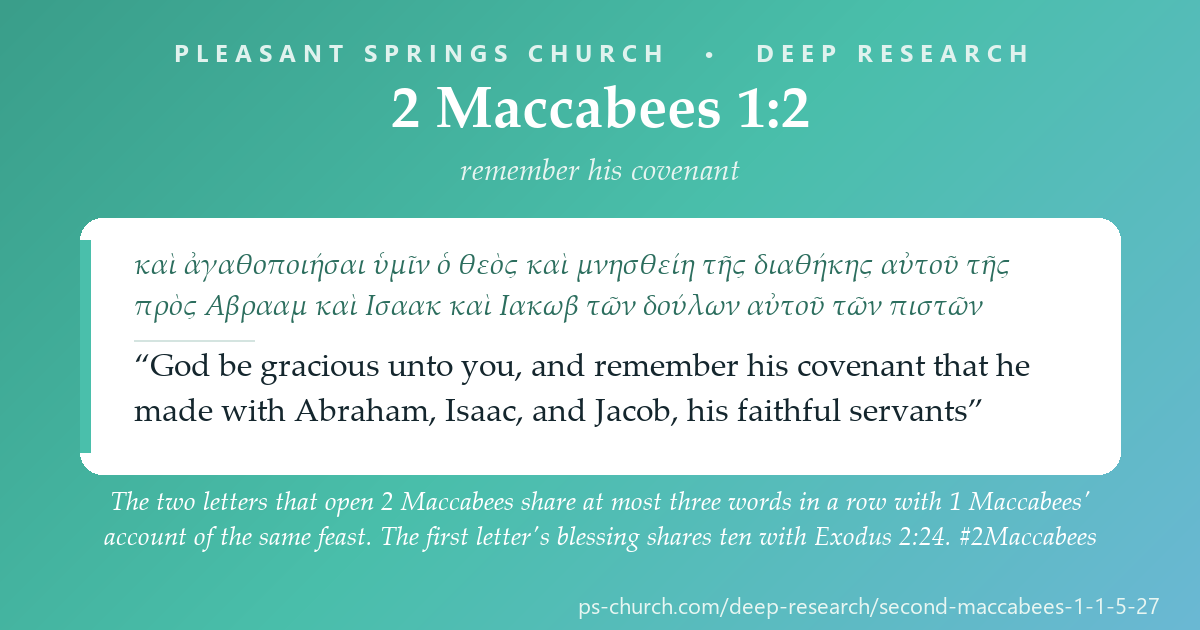
Ten consecutive words that also stand in Exodus 2:24, where God hears Israel groaning in Egypt and remembers his covenant with Abraham and Isaac and Jacob [gloss]. No other verse in the 29,793 Greek Old Testament units outside this book carries them, and Exodus 2:24’s own deepest partner in the whole screen is this verse. See Stage 4.
VULGATE 1:2 Benefaciat vobis Deus, et meminerit testamenti sui, quod locutus est ad Abraham, et Isaac, et Jacob servorum suorum fidelium :
Where the year falls changes which letter it dates. In this Greek text the bolded words — in the year one hundred and eighty-eight — close 1:9 and so date the FIRST letter. The King James and the Vulgate open 1:10 with them (“In the hundred fourscore and eighth year”; Anno centesimo octogesimo octavo), dating the SECOND. And the feast is called the days of tabernacles of the month Chislev.
VULGATE 1:9 Et nunc frequentate dies scenopegiæ mensis Casleu.
“the five and twentieth day” — one of three three-word runs the two letters share with 1 Maccabees’ own account of the feast (4:52), and the only one that is not and the altar or and in the. Here too Nehemiah is said to have “builded the temple and the altar”: see Stage 2.
VULGATE 1:18 Facturi igitur quinta et vigesima die mensis Casleu purificationem templi, necessarium duximus significare vobis : ut et vos quoque agatis diem scenopegiæ, et diem ignis, qui datus est quando Nehemias ædificato templo et altari obtulit sacrificia.
The bolded noun — a gathering-together — stands once in the 30,348 screened Greek Old Testament units, here, and twice in the New Testament (2 Thessalonians 2:1; Hebrews 10:25).
VULGATE 2:7 Ut autem cognovit Jeremias, culpans illos dixit : Quod ignotus erit locus donec congreget Deus congregationem populi, et propitius fiat :
The deepest New Testament run in these five chapters: seven words with Revelation 20:9. It is the wording of Elijah’s fire in 2 Kings 1:10 and 1:12 — which Revelation 20:9 shares at eight. A formula, not a find: see Stage 4.
VULGATE 2:10 Sicut et Moyses orabat ad Dominum, et descendit ignis de cælo et consumpsit holocaustum, sic et Salomon oravit, et descendit ignis de cælo et consumpsit holocaustum.
Six words, and exactly two verses in either corpus carry them: this one and Luke 17:24. Band one from both sides. One of the six, the article, is absent in the Byzantine text: see Stage 5. The Latin stops this verse early: its 2:19 is the Greek’s closing clause.
VULGATE 2:18 sicut promisit in lege, speramus quod cito nostri miserebitur, et congregabit de sub cælo in locum sanctum.
The book’s own account of itself: Jason of Cyrene, five books, one abridgement. Reported as the text’s claim; no copy of Jason’s work is held here or known to survive.
VULGATE 2:24 Itemque ab Jasone Cyrenæo quinque libris comprehensa tentavimus nos uno volumine breviare.
Heliodorus falls to the ground. Against Acts 9:4, where Saul falls to the ground, the run is two words — the bolded the ground — because the verbs and the prepositions differ.
VULGATE 3:27 Subito autem Heliodorus concidit in terram, eumque multa caligine circumfusum rapuerunt, atque in sella gestatoria positum ejecerunt.
“Hellenism”: the only occurrence of the word in the 30,348 screened Greek Old Testament units, and it is not in the New Testament. Three words on stands foreign-ness, which occurs twice, here and at 6:24.
VULGATE 4:13 Erat autem hoc non initium, sed incrementum quoddam, et profectus gentilis et alienigenæ conversationis, propter impii et non sacerdotis Jasonis nefarium, et inauditum scelus :
The book’s own theology of the temple, set immediately after the plundering it has just described.
VULGATE 5:19 Verum non propter locum, gentem : sed propter gentem, locum Deus elegit.
Judas Maccabeus. The preface names him at 2:19; between there and this verse the name does not occur once.
VULGATE 5:27 Judas autem Machabæus, qui decimus fuerat, secesserat in desertum locum, ibique inter feras vitam in montibus cum suis agebat : et fœni cibo vescentes, demorabantur, ne participes essent coinquinationis.
Versification — stated, as on every page here, in the third state this shelf now has: no Masoretic text and no ESV text held. There is no Hebrew/Greek offset to report because there is no Hebrew. The offsets that DO exist are between the three witnesses printed, and each was counted from its own file and aligned by content, not by label:
• Greek (CATSS). Chapters 1–5 carry 185 rows: 36–32–40–50–27. The whole book: 555 rows in 15 chapters. No lettered, verse-only or unnumbered labels anywhere in the file.
• King James Apocrypha (1769). 36–32–40–50–27, identically — and identical in all fifteen chapters (555 verses). Agreement of count is not agreement of division. Read side by side, four sentences sit across a verse line differently: the year 188, which closes Greek 1:9 and opens English 1:10 (see the codex); Nehemiah’s order to draw the liquid, which closes Greek 1:20 and opens English 1:21 (“Then commanded he them to draw it up, and to bring it”); Sostratus’s demand for the money, which opens Greek 4:28 and closes English 4:27; and the drawing of swords in the sky, the last words of Greek 5:2 and part of English 5:3.
• Clementine Vulgate. 36–33–40–50–27 — 186 verses where the Greek has 185. The Latin divides Greek 2:18 in two: its 2:19 is the Greek’s closing clause (Eripuit enim nos de magnis periculis, et locum purgavit), so Vulgate 2:20–33 is Greek 2:19–32, and Greek 2:23 — the Jason of Cyrene verse — is Vulgate 2:24. Over the whole book the Latin has 558 verses, one more in chapters 2, 12, 15. It also places the year 188 in 1:10, and divides 1:20/21, 4:27/28 and 5:2/3 where the English does (Et jussit eos haurire, et afferre sibi opens Vulgate 1:21; Sostratus is in Vulgate 4:27; gladiis districtis is in Vulgate 5:3) — so all four of the English’s division differences from the Greek are the Latin’s too.
Where this page cites a verse it uses the Greek number, and names the English or Latin number wherever it differs.
The Shape of the Passage
Sequence — three documents, then three narrative panels and a coda (two measured frames; not a chiasm)This is NOT offered as a chiasm. Three documents stand one after another, and the narrative runs forward in time. Panel 2 sits between two treasury stories, but nothing in the text marks it as a centre, and the diagram does not pretend otherwise.
⚠️ Where this page sits. 2 Maccabees is canonical in the Roman Catholic and Orthodox churches, printed among the Apocrypha in the older Protestant Bibles, and absent from the Hebrew Bible. This library reads it as a witness and files it under Apocrypha / Deuterocanon. Nothing taught at Pleasant Springs rests on it.
Author
Three voices, not one. The first letter speaks for “the Jews that be at Jerusalem and in the land of Judea” (1:1); the second for “the people that were at Jerusalem and in Judea, and the council, and Judas” (1:10); and from 2:19 a single writer speaks as I and we about his own labour. Whether the letters were part of his book from the start or attached to it later is argued in the commentaries, and this page does not decide it.
The epitomator describes his work in three images. Abridging is “a matter of sweat and watching” (2:26); it is like preparing a banquet for other people’s pleasure (2:27); and he is the decorator of the house, not its architect (2:29–31). He leaves “the exact handling of every particular” to the author (2:28).
He narrates with a theology on the surface. Heaven appears for those who fight for Judaism (2:21); the Sovereign of spirits makes a great manifestation (3:24); and when the temple is plundered without anyone being struck down, the narrator stops to explain why (5:17–20).
Audience
Jews in Egypt, first. Both letters are addressed there, and both ask the same thing: keep these days. A feast kept in Jerusalem is being commended to a diaspora that did not see the temple purified.
Readers of history, second. The epitomator says whom he is writing for: those who want to read for pleasure, those who want to commit it to memory, and “all into whose hands it comes” (2:25).
And anyone whose sacred place has been handed to the highest bidder. Chapter 4 is a story of an office bought twice in three years and of temple vessels stolen and sold (4:32, 39). The question the narrator keeps answering is why God let it happen — and his answer at 5:19 is that the place was chosen for the people, not the people for the place.
Orient on the book, its two letters, its sources, and the people in chapters 3–5.
Search by topic: Maccabees, Books of; Jason of Cyrene; Hanukkah / Dedication, Feast of; Onias III; Jason (high priest); Menelaus; Heliodorus; Gymnasium; Hellenism; Seleucid era.
Which articles are relevant?
- Anchor Bible Dictionary — “Maccabees, Books of,” “Jason of Cyrene,” “Onias,” “Menelaus,” “Heliodorus,” “Dedication, Feast of.”
- Eerdmans Dictionary of Early Judaism — “Maccabees, Second Book of,” “Hanukkah,” “Hellenism,” “High Priests.”
- Dictionary of New Testament Background (IVP) — “Maccabean Literature,” “Hellenism,” “Festivals and Holy Days: Jewish.” These are subjects to look up; the exact entry titles were not checked, and none of these works is held on this disk.
- On the feast — any article that keeps its names apart: tabernacles of Chislev (2 Maccabees 1:9, 18), the purification (2 Maccabees 1:18; 2:16), the dedication (1 Maccabees 4:56, 59; 2 Maccabees 2:19), and the Encaenia of John 10:22. They are four different Greek words, and Stage 3 counts them.
Bibliography surfaced:
- Jonathan A. Goldstein, II Maccabees (Anchor Bible).
- Robert Doran, 2 Maccabees: A Critical Commentary (Hermeneia).
- Daniel R. Schwartz, 2 Maccabees (Commentaries on Early Jewish Literature).
- Martin Hengel, Judaism and Hellenism — on Jason’s reform and the gymnasium.
- NETS (A New English Translation of the Septuagint), 2 Makkabees — a modern English made from the Greek. Not the edition quoted here; named because it is the obvious next step for a reader.
- Named, not consulted for this page — see Stage 5.
Four tellings of one decade, set side by side and measured; and two prophets, Nehemiah and Jeremiah, given work their own books do not record.
Every comparison below is a contiguous run of whole Greek word forms, computed on the files named. A run measures shared wording, not shared knowledge: two writers can know the same events, or each other’s books, and share no sentence. The page reports the wording and does not infer who read whom.
The same story in other words — measured:
| the same event | 2 Maccabees | the other telling | longest shared run |
|---|---|---|---|
| The feast of the 25th of Chislev | 1:1–2:18 (54 rows; the two letters only — the book’s own narrative of the feast, 10:1–8, is outside this study: see below) | 1 Maccabees 4:36–59 (24 rows) | 3 — the date, πέμπτῃ καὶ εἰκάδι; and the altar; and in the |
| The gymnasium in Jerusalem | 4:7–17 | 1 Maccabees 1:11–15 | 2 — in Jerusalem |
| The plundering of the temple | 5:11–21 | 1 Maccabees 1:16–28 | 2 — and the |
| A death of Antiochus | 1:10–17 | 1 Maccabees 6:1–16 | 3 — into Persia |
| The raid on the treasury | 3:1–40 | 4 Maccabees 4:1–14 | 3, at three rows — and Apollonius (3:7 ↔ 4:8), into heaven (3:20 ↔ 4:11) and and he, for his part (3:29 ↔ 4:14); see below |
| Jason, Menelaus, the sack of the city | 4:1–5:27 | Josephus, Antiquities 12.237–264 (28 sections) | 5, tie band one from both sides — and the women and the (5:24 ↔ 12.256) |
| All 185 rows | 1:1–5:27 | every verse of 1 Maccabees | 4, at four rows |
Six panels, three other books, and the deepest shared wording in any of them is five words — four of them grammar. The run against Josephus is the women and the: in 2 Maccabees the women and the young are to be sold (5:24); in Josephus the sentence concerns the persecution’s victims (12.256). Across the whole of book 12 of the Antiquities the deepest run with these five chapters is still five; across all twenty books six rows reach five or more and one reaches six, tie band one from both sides (2:5 ↔ 5.107), and that one is and the tent and the ark — Phinehas rebuking the tribes who built an altar beyond the Jordan, in Josephus’s retelling of Joshua 22 (5.107), set against Jeremiah’s cave (2:5).
One limit on the first row of the table. The feast is told twice in 2 Maccabees, and this study holds only the first telling, the two letters. The book’s own narrative of the purification (10:1–8) lies outside it, and there the run with 1 Maccabees 4:52 is five: τῇ πέμπτῃ καὶ εἰκάδι τοῦ (10:5), on the five-and-twentieth of the — the date again. Tie band one from 10:5’s side against 1 Maccabees 4:36–59 (two against the whole book, where 1:59 dates the sacrifices on the idol altar in the same words), and band one from 4:52’s side against all 555 rows of 2 Maccabees. So the letters’ maximum of three is a figure about the letters, not about the book.
And most of the cast is missing. Heliodorus is named thirteen times in the Greek Old Testament files and Menelaus seventeen times — every one of them in 2 Maccabees. The high priest Jason reaches one other book, once: 4 Maccabees 4:16, as Ιασονα. That is a spelling trap, and it caught this page’s first draft: in the same case 2 Maccabees writes the name with an omega (Ἰάσωνα, 4:24), 4 Maccabees and 1 Maccabees with an omicron, so a search on 2 Maccabees’ spelling reports him as unique to it. 1 Maccabees’ own three Jasons are an envoy and a father’s name (8:17; 12:16; 14:22), not the high priest. Counted on both spellings, the name stands fifteen times in the Greek Old Testament files: eleven in 2 Maccabees (one of them Jason of Cyrene, 2:23), three in 1 Maccabees, one in 4 Maccabees.
Where the tellings disagree on the facts — quoted, not adjudicated:
- Who Menelaus was. 2 Maccabees 4:23 sends “Menelaus, the aforesaid Simon’s brother” — the Simon of 3:4, a Benjaminite and the temple’s overseer. Josephus makes him the youngest brother of Onias and of Jason, and gives both men Hebrew names: ὁ μὲν οὖν Ἰησοῦς Ἰάσονα αὑτὸν μετωνόμασεν, ὁ δὲ Ὀνίας ἐκλήθη Μενέλαος. (Antiquities 12.239) — so Jesus renamed himself Jason, and Onias was called Menelaus [gloss]. Two Greek witnesses, two different families for the same high priest.
- When Onias died. In Josephus he is already dead when Jason receives the office (12.237). In 2 Maccabees he is alive through all of Jason’s tenure and is killed later, lured out of sanctuary at Daphne on Menelaus’s instigation (4:33–34).
- Who asked for the gymnasium. 2 Maccabees: Jason, as part of the price (4:9). Josephus: Menelaus and the sons of Tobias (12.240–241).
- Who went into the treasury, and who came against him. 2 Maccabees 3: Heliodorus goes in; Apollonius is the governor who told the king (3:5–7); “an horse with a terrible rider” and “two other young men” appear (3:25–26), and the word angel does not occur in the chapter. 4 Maccabees 4 sends Apollonius himself (4:8), and its riders from heaven are ἄγγελοι — angels (4:10). The deepest run between the two tellings is three words, and three rows tie at it, band one each: the man’s name; into heaven, where hands are stretched toward it — by the women of Jerusalem in one (3:19–20), by the fallen Apollonius in the other; and, opening a sentence about the stricken man, and he, for his part. None of the three is about the riders.
- How Antiochus died — three ways. The second letter: a king named Antiochus, with his army, cut down in the temple of Nanaea in Persia by its priests, who threw down stones from a hidden door in the ceiling (1:13–16). 2 Maccabees 9: struck with an incurable pain in the bowels (9:5), thrown from his chariot (9:7), worms (9:9), death in the mountains (9:28). 1 Maccabees 6: sickness from grief on hearing of his defeat (6:8), and “So king Antiochus died there” (6:16), after a campaign in Persia (6:1–5). The letter does not say which Antiochus it means; the commentaries discuss whether it is the same king as chapter 9, and this page does not settle it. Measured: the letter’s account shares three words in a row with 1 Maccabees 6 and three with 2 Maccabees 9 — and the three with chapter 9 come at two rows: the letter-greeting formula, greeting and good health (1:10; 9:19), and of those around the (1:13; 9:1).
Nehemiah’s fire — checked against Greek Nehemiah:
The second letter says that when the fathers were taken to Persia, priests hid the altar fire in a dry well; that Nehemiah, sent by the king of Persia, sent their descendants for it; that they found thick water; and that when it was sprinkled on the sacrifice and the sun came out, a great fire blazed (1:19–22). Nehemiah’s company called it nephthar, which the Greek explains as purification (the KJV: “which is as much as to say, a cleansing”), and most people called it nephthai (1:36). Those two words occur nowhere else in the Greek Old Testament held here; the nearest is naphtha, fuel for Nebuchadnezzar’s furnace, in both Greek Daniels at 3:46.
Greek Nehemiah (2 Esdras 11–23 in the Septuagint’s numbering, 392 rows) has none of it. Screened against the 37 rows of the fire story and the Jeremiah story (1:18–2:18), the deepest shared run is three words. Ten rows reach it, and every one of them is a phrase like O Lord God, into the place or of all the people — or the date, πέμπτῃ καὶ εἰκάδι, the twenty-fifth, which in Nehemiah is the day the wall was finished, in Elul (2 Esdras 16:15 = Nehemiah 6:15). Fire, in Greek Nehemiah, is the burned gates (Nehemiah 1:3; 2:3, 13, 17) and the pillar of fire in the prayer (9:12, 19) — six rows, no altar fire, no well. The altar appears once: the lots cast for the wood offering, to burn upon the altar of the Lord our God, as it is written in the law [gloss] (2 Esdras 20:35 = Nehemiah 10:35 in the Hebrew numbering, 10:34 in English).
Who built the altar, in the canonical account? Greek Ezra 3:2 (2 Esdras 3:2): Jeshua son of Jozadak and Zerubbabel son of Shealtiel and their brothers. Nehemiah is not named there. 2 Maccabees 1:18 credits Nehemiah with the temple and the altar; Sirach, another Second-Temple witness, remembers him for something else — τοῦ ἐγείραντος ἡμῖν τείχη πεπτωκότα, raising for us the walls that had fallen (Sirach 49:13). The name stands eight times in Greek Ezra–Nehemiah (some of them namesakes in the lists), eight times in 2 Maccabees — all eight between 1:18 and 2:13 — two in 1 Esdras and one in Sirach.
One more thing the search found, and a trap in it. Greek Nehemiah’s first verse is dated in the month of Chislev — the feast’s month — but CATSS spells it Χασεηλου (2 Esdras 11:1), so a search for the spelling the Maccabean books use, Χασελευ, misses it.
Jeremiah, the tent, the ark and the altar of incense:
“It is also found in the records” (2:1): Jeremiah told the exiles to take the fire, gave them the law, and — warned by an oracle — took the tent and the ark to “the mountain, where Moses climbed up, and saw the heritage of God,” found a cave, put the tent, the ark and the altar of incense inside and blocked the door (2:4–5). Those who followed could not find it again, and he rebuked them: the place would stay unknown until God gathers the gathering of the people (2:7).
The mountain is not named. Nebo, in the spelling Deuteronomy uses (Ναβαυ), stands ten times in the Greek Old Testament files, including the two places where Moses is sent up it, and goes up it, to see the land (Deuteronomy 32:49; 34:1); the Nebo of the Ezra lists is spelled differently, at two more rows (2 Esdras 2:29; 10:43). Neither spelling occurs in 2 Maccabees. Identifying the cave’s mountain as Nebo is a reader’s inference from Deuteronomy, a natural one, and the text leaves it to the reader. Nothing of the story is in the book of Jeremiah; two of this shelf’s Jeremiah studies quote it as the afterlife the Second Temple gave the prophet — one in its Greek, which agrees with the file here word for word, and one in an English of its own.
A Greek city inside Jerusalem — the institutions of chapter 4:
- The gymnasium and the ephebate (4:9, 12). γυμνάσιον, a gymnasium, stands four times in the Greek Old Testament files — 1 Maccabees 1:14, 2 Maccabees 4:9 and 4:12, 4 Maccabees 4:20 — and ἐφηβεῖον, the ephebate, only in 2 Maccabees 4:9 (4:12 has ἐφήβων, the young men themselves — a different word). A Greek civic education for young men, opened “under the tower itself.”
- The broad-brimmed hat (4:12) — πέτασον, the petasos: Jason “made them wear a hat” (KJV). Once in the Greek Old Testament held here; the other four rows that begin with the same letters are forms of a verb for flying.
- The games at Tyre (4:18–20) — a contest the Greek calls πενταετηρικοῦ, five-yearly (the KJV: “every fifth year”), with the king present, and a sacrifice to Heracles; Jason’s envoys bring 300 drachmas for it, and the bearers themselves have the money spent on warships instead.
- Daphne by Antioch (4:33) — a place of asylum, from which Onias is lured out with sworn pledges and killed.
- Antiochus “Epiphanes” (2:20; 4:7) — the king’s title means manifest, and the very next verse after its first use speaks of the manifestations from heaven (2:21). Stage 3 counts the word.
The book’s word for itself, the first “Judaism” and the only “Hellenism” in the corpus, and four names for one feast.
Every count is over the Greek Old Testament files held here — 30,348 verse units screened, the Odes excluded — and the 7,927 verses of the Greek New Testament. It is not a count over “the Septuagint,” and every count is of word forms by their spelling, so a different spelling is a different word unless the page says otherwise.
Four occurrences of the verb and the noun together in the 30,348 screened Greek Old Testament units, and all four stand in 2:23–32 — the verb at 2:23 and 2:32, framing the preface; the noun at 2:26 and 2:28. The book’s word for what it is occurs nowhere else in the corpus.
Five occurrences in the Greek Old Testament files: four in 2 Maccabees (2:21; 8:1; 14:38 twice) and one in 4 Maccabees (4:26). 2 Maccabees’ first is here, in the preface: those who strove zealously on behalf of Judaism. In the Greek New Testament it occurs two times, both in Galatians 1:13–14, where Paul describes his former life ἐν τῷ Ἰουδαϊσμῷ. Different case-forms of the word, so the run screen finds no run longer than one word between 2:21 and either verse, and the words they share singly are function words — and, the, and a preposition; the count is the finding.
One occurrence in the 30,348 screened Greek Old Testament units — 2 Maccabees 4:13 — and none in the New Testament. Three words on in the same verse stands ἀλλοφυλισμοῦ, foreign-ness, which occurs twice in the corpus (4:13; 6:24). The only “Hellenism” in the corpus, and the first of 2 Maccabees’ four “Judaism”s, both fall inside the range of this one study.
The noun occurs twelve times in the Greek Old Testament files, and six of them are 2 Maccabees — three inside this study: the manifestations from heaven (2:21), the great manifestation that stops Heliodorus (3:24), and the apparition in the sky over the city (5:4). And the king who plunders the temple carries the adjective as his title — Epiphanes, at 2:20 and 4:7. In the Greek New Testament the noun occurs six times, all in 2 Thessalonians and the Pastoral letters (2 Thessalonians 2:8; 1 Timothy 6:14; 2 Timothy 1:10; 4:1, 8; Titus 2:13).
Once in the Greek Old Testament held here — Jeremiah’s word in 2:7 — and twice in the New Testament: our being gathered together to him (2 Thessalonians 2:1, ἐπισυναγωγῆς) and not neglecting to meet together (Hebrews 10:25). Counted, not interpreted: the page makes no identification the text does not make.
Seven times in the Greek Old Testament files: 1 Maccabees 1:54, 4:52, 4:59; 2 Maccabees 1:9, 1:18, 10:5; Zechariah 7:1 — plus Greek Nehemiah 1:1 under another spelling. The feast’s names are four different words. 2 Maccabees calls it the days of tabernacles of Chislev (1:9, and again 1:18) and the purification (1:18; 2:16); the noun tabernacles occurs nine times in the Greek Old Testament files, and 1:9 and 1:18 are the only ones set in Chislev. 1 Maccabees calls it τοῦ ἐγκαινισμοῦ τοῦ θυσιαστηρίου (4:59), the dedication of the altar; 2 Maccabees’ preface says τὸν τοῦ βωμοῦ ἐγκαινισμὸν (2:19), with the other word for altar. And John 10:22 calls it τὰ ἐγκαίνια — a word that occurs in neither book of Maccabees; it stands in four Greek Old Testament rows, for the dedication of the rebuilt temple (Ezra 6:16–17), of the wall (Nehemiah 12:27), and of Nebuchadnezzar’s image (Theodotion’s Daniel 3:2). Measured: 2 Maccabees 1:9 and John 10:22 share no word at all.
Ten words shared with Exodus; a formula the Elijah story also carries; one idiom shared, in the corpora screened, with Luke alone; and a run of five that is only grammar.
Every row of 2 Maccabees 1–5 screened against all 7,927 verses of the Greek New Testament, and separately against the 29,793 Greek Old Testament units outside 2 Maccabees (the 30,348 screened, less the book’s own 555 rows). Contiguous runs of whole word forms. The tie band is printed from both sides: how many verses on the far side reach the same depth with the 2 Maccabees row, and how many units in the Greek Old Testament reach the same depth with the far-side verse. A zero here means shares no word at all.
The distributions:
Against the Greek New Testament: across the 185 rows, 183 reach two, 93 reach three, 21 reach four, 4 reach five, 2 reach six, 1 reaches seven, and nothing reaches eight. Every row shares at least one word; two rows (1:28 and 5:3) share only one.
Against the Greek Old Testament outside this book: 182 reach two, 127 reach three, 39 reach four, 10 reach five; then nothing at six, 3 rows at seven or more, and 1 at ten. The deepest run anywhere in these five chapters is an Old Testament one.
The one that does not dissolve — ten words, and nowhere else:
2 Maccabees 1:2 → Exodus 2:24 — a run of ten, tie band 1; and from the other side, Exodus 2:24’s deepest partner among the other 30,347 screened units is this verse, at ten, band 1.
Exodus 2:24
Hebrew: Masoretic (Sefaria MAM) · Greek: CATSS · English: a literal gloss, marked as suchMeasured further: the six-word core τῆς διαθήκης αὐτοῦ τῆς πρὸς Αβρααμ occurs in exactly two Greek Old Testament units — this verse and Exodus 2:24 — and in no New Testament verses. The shorter Abraham and Isaac and Jacob is common: eighteen Greek Old Testament units, four New Testament verses.
Context, reported and not interpreted. Exodus 2:24 is God hearing Israel in Egypt. 2 Maccabees 1:2 is a blessing on the Jews in Egypt. And the letter’s second-deepest Old Testament contact, two verses later, is seven words with the Greek of Jeremiah 44:23 (Septuagint 51:23), band 1 from both sides — ἐν τῷ νόμῳ αὐτοῦ καὶ ἐν τοῖς, in his law and in the — a chapter whose heading addresses all the Jews living in the land of Egypt [gloss] (Septuagint 51:1). Only one of those seven words, law, is not a preposition, an article, a pronoun or a conjunction, and the next word differs (commandments in 2 Maccabees, testimonies in Jeremiah) — though Jeremiah’s verse has the same noun for commandments earlier, so both of 1:4’s nouns stand in it, in the other order. The page notes that both deepest partners concern Israel in Egypt and asserts nothing about why.
The deepest New Testament run is a formula — and the page’s first counter-example:
2 Maccabees 2:10 → Revelation 20:9 — a run of seven, tie band 1. And fire came down from heaven and… It looks like the find of the page. From Revelation’s side it is not even in the band: Revelation 20:9’s deepest partners in the Greek Old Testament are 2 Kings 1:10 and 1:12, at eight, band 2 — Elijah calling down fire on the captains of fifty. The five-word core κατέβη πῦρ ἐκ τοῦ οὐρανοῦ occurs in four Greek Old Testament units (2 Maccabees 2:10 and 2 Kings 1:10, 12, 14) and in one New Testament verse.
Revelation 20:9
Greek: SBLGNT · English: a literal gloss, marked as suchAnd it is not even the wording of the events 2:10 describes. 2:10 says that Moses prayed and fire came down, and that Solomon prayed and fire came down. Against the Greek of Solomon’s own fire (2 Chronicles 7:1) the run is four; against the fire that consumes the first tabernacle sacrifice in Leviticus 9:24 — the Torah’s nearest account — it is two; against Elijah’s fire it is seven. Reported as wording, not as a theory about the writer.
Six words shared with Luke — and, in both corpora, only with Luke:
2 Maccabees 2:18 → Luke 17:24 — a run of six, tie band 1; and from Luke’s side, Luke 17:24’s deepest partner in the whole Greek Old Testament is this verse, at six, band 1. The words are an idiom: from [the region] under heaven to.
Luke 17:24
Greek: SBLGNT · English: a literal gloss, marked as suchMeasured further: the five-word core ἐκ τῆς ὑπὸ τὸν οὐρανὸν stands in four Greek Old Testament units — 2 Maccabees 2:18 and three in the Torah, Exodus 17:14 and Deuteronomy 25:19 and 29:19 (29:20 in English), every one of those three a blotting out from under heaven — and in one New Testament verse. Add the sixth word and only two verses in either corpus remain: 2 Maccabees 2:18 and Luke 17:24. The Torah uses the idiom for erasure; these two use it as a span, from here to there — gathering from under heaven into the holy place, lightning from one side of the sky to the other.
What that does and does not show. It is the one place in these chapters where the run and its band survive from both directions and the words are not a formula. It is still an idiom, its sixth word is a preposition, and in the Byzantine text one of the six, the article, is not there (Stage 5). It is not evidence that Luke read 2 Maccabees, and the page does not say who is reading whom. Note too: 2:18’s verb ἐπισυνάξει, he will gather, stands in Mark 13:27 (ἐπισυνάξει) — and against Mark 13:27 the run is two.
⚠️ Band one from both sides, and it means nothing — the second counter-example:
2 Maccabees 1:10 → Romans 15:31 — a run of five, tie band 1; and from the other side, Romans 15:31’s deepest Greek Old Testament partner is this verse, at five, band 1. By its bands it matches the Luke run — one from both sides — at five words against six. The words are ἐν τῇ Ιουδαίᾳ καὶ ἡ / ἐν τῇ Ἰουδαίᾳ καὶ ἡ — in Judea, and the. In 2 Maccabees, those in Judea, and the senate; in Romans, the disobedient in Judea, and [that] my service. A place name and four words of grammar, running across a clause break in both. The phrase occurs in exactly one Greek Old Testament unit and one New Testament verse, and that makes it rare, not related. This page prints it so that its other band-one runs are not read as more than they are.
And the run of five that belongs to everyone:
2 Maccabees 1:2 → four New Testament verses at once — a run of five, tie band 4 (Matthew 8:11; Luke 13:28; Acts 3:13; 7:32): Abraham and Isaac and Jacob. From the other side not one of the four has 2 Maccabees 1:2 as its partner; each reaches six with verses elsewhere in the Greek Old Testament. A formula, and reported as one.
⚠️ Connections a reader might expect — measured:
- 2 Maccabees 3 (Heliodorus) → Acts 9:1–9 (the Damascus road) — run of two. Across all 171 verse pairs between Acts 9:1–9 and 2 Maccabees 3:22–40, nine reach two, 131 share a single word and 31 share none. The twos are joins (but he, but they), to the high priest — and the ground: Heliodorus falls πρὸς τὴν γῆν (3:27), Saul falls ἐπὶ τὴν γῆν (Acts 9:4). Same act, different verb forms, different prepositions. This agrees with the figure already published on this shelf’s Acts 9 study, which reports two.
- 2 Maccabees 2:5 (the ark and the altar of incense hidden) → Hebrews 9:4 — run of three, and the ark. Hebrews names the golden incense altar with a different word. → Revelation 11:19 (the ark seen in the heavenly temple) — two at most across 2:4–8, and the two are of God.
- 2 Maccabees 1:9 (the feast named) → John 10:22 (the feast named) — ZERO. The two verses share no word at all; see Stage 3.
- 2 Maccabees 5:19 (not the nation for the place’s sake, but the place for the nation’s) → Mark 2:27 (the sabbath was made for man) — two, for the sake of. A shared shape of argument, not shared wording.
- 2 Maccabees 5:27 (Judas in the wilderness, living like the wild beasts) → Mark 1:13 (with the wild beasts) — one.
It settles that no verse of the 7,927 in the SBLGNT shares more than seven consecutive words with these five chapters, and that none of the deepest contacts reads as a citation: the deepest is a formula that Revelation 20:9 shares more deeply with 2 Kings 1, the next an idiom that also stands in the Torah, the next a run of grammar.
It does not settle that the book was unknown. A screen for verbatim contact cannot see a shared world: a winter feast in the temple (John 10:22), the word Judaism in Paul’s account of his past (Galatians 1:13–14), a gathering-together of God’s people (2 Thessalonians 2:1). Those are counted in Stage 3 and left there.
What this page could not check, where its numbers are softest, and what it found wrong on the shelf.
This is the section that makes the shelf trustworthy, and it is long on purpose.
⚠️ The three deepest single-partner New Testament runs each pass through a disputed word — and what the other editions read:
The SBLGNT prints signs where its editor weighed manuscript readings. Every one of the three deepest band-one runs in Stage 4 crosses one (the fourth row at five or more, 1:2, is the Abraham and Isaac and Jacob formula, band four, and is not tabled here):
- Luke 17:24 — ἐκ τῆς ⸂ὑπὸ τὸν⸃ οὐρανὸν εἰς.
- Revelation 20:9 — καὶ κατέβη πῦρ ⸂ἐκ τοῦ οὐρανοῦ⸃ καὶ.
- Romans 15:31 — ἐν τῇ Ἰουδαίᾳ ⸀καὶ ἡ.
The apparatus that explains those signs was not on this disk, so it was fetched for this page — the SBLGNT’s own apparatus (Michael W. Holmes, ed.; Faithlife, CC BY 4.0), stored with its source address and checksums. For these three verses it cites four editions: Westcott–Hort (WH), Tregelles (Treg), Nestle–Aland 28 (NA28) and Robinson–Pierpont (RP), the Byzantine text. Each run, re-measured under each edition’s reading:
| run | reading | editions | run under that reading |
|---|---|---|---|
| Luke 17:24 ↔ 2 Maccabees 2:18 | ὑπὸ τὸν | WH · Treg · NA28 | 6 |
| ὑπʼ | RP | 3 | |
| Revelation 20:9 ↔ 2 Maccabees 2:10 | ἐκ τοῦ οὐρανοῦ | WH · NA28 | 7 (2 Kings 1:10: 8) |
| ἀπὸ τοῦ θεοῦ ἐκ τοῦ οὐρανοῦ | Treg | 4 (2 Kings 1:10: 5) | |
| ἐκ τοῦ οὐρανοῦ ἀπὸ τοῦ θεοῦ | RP | 6 (2 Kings 1:10: 6) | |
| Romans 15:31 ↔ 2 Maccabees 1:10 | καὶ | WH · Treg · NA28 | 5 |
| + ἵνα | RP | 4 |
What that changes. The Luke idiom stands at six in three of the four editions and falls to three in the Byzantine text, which lacks the article. The Revelation run stands at seven in WH and NA28, falls to four in Tregelles, and is six in Robinson–Pierpont — where 2 Kings 1:10 is also six, and in no edition is 2 Maccabees closer to Revelation 20:9 than Elijah’s fire is. The Romans run of grammar is five in three editions and four in one. The page’s figures are the SBLGNT’s; the table says how far each depends on that choice. The apparatus records only where these five editions differ, not the manuscripts behind them.
⚠️ What this page could NOT check:
- Anything Hebrew. There is no Hebrew 2 Maccabees, so the acrostic and Masoretic-parallel screens cannot run. Whether the two letters were first written in Hebrew or Aramaic is a question for the commentaries, reported as open and not tested here.
- The Greek text itself. CATSS gives one edited text. No manuscript of 2 Maccabees and no critical apparatus is held, so where editions differ — including the very placement of the year 188, which this page shows the KJV and the Vulgate putting in a different verse — the page can report the difference between the files it holds and nothing beyond them.
- Jason of Cyrene. The five books are known only from 2:23. Nothing on this page can test what the epitomator kept or cut.
- The dates. The letters carry the years 169 (1:7) and 188 (1:9) and 1 Maccabees dates the dedication to 148 (4:52). Converting those to years BC depends on the Seleucid era and on which reckoning of it each writer used — a question for the commentaries, never measured here.
- The commentaries themselves. Goldstein, Doran, Schwartz and Hengel are named in Stage 1; none of them is held on this disk and none was consulted for this page. Where the page says what “the commentaries” discuss — the book’s date, whether the letters belonged to it from the start, which Antiochus the second letter means — it reports that a question is open, not any one commentator’s answer.
- Josephus. The Greek is Niese’s edition in the Perseus digitisation, quoted at section level; Josephus’s own sources for these chapters are not held and are not guessed at.
- Polybius and the Seleucid historians, who are usually brought into any account of Antiochus IV, were not consulted for this page.
- Whether the shared idioms are dependence. A run of six is not proof of copying and a run of one is not proof of independence.
⚠️ Where this page is weakest:
- The English is quotation, not a measured parallel. The King James Apocrypha was translated from Greek texts of its own day, and the page prints it as the English witness it is — not as a translation of the CATSS text. Where its verse division differs, the page says so.
- The table in Stage 2 compares panels the page chose. The boundaries (1 Maccabees 1:11–15 for the gymnasium, and so on) are a reader’s judgement of where the same event is told. Widening them moves the numbers by a word or two; the full-book figure against 1 Maccabees (four) is printed beside them so that no one panel carries the argument. And the feast panel holds the two letters only: the book’s second telling of the feast (10:1–8), outside this study, reaches five with 1 Maccabees 4:52 (Stage 2).
- Low runs between parallel accounts are what the page reports, not what it explains. Two writers telling one event in their own Greek will share little wording whatever they knew of each other.
- The structure diagram claims two counted frames and one textual cross-reference (5:18, back to Heliodorus). The name Maccabeus at 2:19 and 5:27 is counted and described but not drawn as a pair, because 5:27 is where this study stops, not where the book closes. The rest is sequence, and labelled so.
⚠️ What the measuring turned up on the shelf itself:
- Two Jeremiah studies disagree about how long after Jeremiah this book was written. The Jeremiah 33–38 study says “More than four centuries after the cistern”; the Jeremiah 39–44 study says “Two centuries later”. The letters’ own years are 169 and 188 of an era that the commentaries place in the late fourth century BC, which puts them well over four centuries after the fall of Jerusalem. Reported for correction; this page does not edit another page.
- The Jeremiah 33–38 study places the cave “on Nebo”. The Greek names no mountain (Stage 2). The identification is a fair inference; it is not the text’s word.
- The Acts 9 study’s figure stands — two, against 2 Maccabees 3:22–40, re-measured here. Its gloss on the two shared words, “both of them are joins”, misses that the ground and to the high priest also reach two.
- Two comments in the shelf’s own tooling still say 2 Maccabees is unmapped (in paths.py and test_regression.py). It has been mapped since 9 October 2026, and every figure on this page was read through that mapping.
Commentaries & studies:
- Jonathan A. Goldstein, II Maccabees (Anchor Bible).
- Robert Doran, 2 Maccabees: A Critical Commentary (Hermeneia).
- Daniel R. Schwartz, 2 Maccabees (Commentaries on Early Jewish Literature).
- Martin Hengel, Judaism and Hellenism.
- Josephus, Jewish Antiquities 12 — Greek text of B. Niese (1885–1890), Perseus Digital Library digitisation, CC BY-SA 4.0.
Several tellings, almost no shared sentences — and a blessing that shares ten words with Exodus.
Name what you learned, why it matters, and one concrete response.
What should we carry away — and do?
- The same events, in other words. 2 Maccabees, 1 Maccabees, 4 Maccabees and Josephus tell overlapping stories and share almost no wording; they even disagree about who Menelaus was and how Antiochus died. When the ancient sources disagree, the honest thing is to say so and quote them, which is what this page has tried to do.
- The deepest contact is with Exodus. A letter written to Jews far from the temple opens with the prayer that God will “remember his covenant that he made with Abraham, Isaac, and Jacob” — and ten words of it, in the Greek, also stand in Exodus 2:24, where God hears Israel groaning in Egypt.
- The place for the people. “Nevertheless God did not choose the people for the place’s sake, but the place for the people’s sake.” (5:19, KJV). A sentence worth weighing wherever a building, an office or a programme starts to matter more than the people it was for.
- One concrete response. The first letter is a prayer for people far away, the Jews of Egypt: “And give you all an heart to serve him, and to do his will, with a good courage and a willing mind; And open your hearts in his law and commandments, and send you peace,” (1:3–4, KJV). Pray it this week, by name, for believers in another country.
2 Maccabees 1:2 · to share
Greek (CATSS) · KJV Apocrypha (1769) · Clementine VulgateVULGATE 1:2 Benefaciat vobis Deus, et meminerit testamenti sui, quod locutus est ad Abraham, et Isaac, et Jacob servorum suorum fidelium :
Every Deep Research page traces its passage across the whole sweep — the Old Testament, the Second-Temple world between the testaments (historical witnesses, not Scripture), and the New Testament. Follow the thread:
Pleasant Springs Church — Deep Research
Research method after Michael S. Heiser’s Bible Research Method (examine dictionaries → ancient literature → important words → textual connections → academic publications → share), with the Pleasant Springs “Author & Audience” foundation. Scripture set in the Hebrew, the Greek editions named on each page and the ESV (Old Testament), and the Greek New Testament and the ESV (New Testament), per the practice of Pleasant Springs Church. ⚠️ Status: 2 Maccabees is not part of the Protestant canon. It is canonical in the Roman Catholic and Orthodox churches, was printed among the Apocrypha in the Reformation-era Protestant Bibles, and is absent from the Hebrew Bible. This study is filed under Apocrypha / Deuterocanon and nothing taught at Pleasant Springs rests on it. Greek text: the CATSS morphologically analysed Septuagint (2Macc.mlxx and, for comparison, the other CATSS files named on the page), quoted at verse level with attribution; every row, word count, run and tie band was re-derived from those files for this study. English: the King James Apocrypha, standardised 1769 text, public domain, quoted verbatim from the verse-per-line file held on this disk; no ESV of 2 Maccabees is held or licensed here, and the English lines given for canonical comparison verses are the page’s own literal glosses, marked [gloss]. Latin: the Clementine Vulgate (public domain), printed as a fourth witness with its own verse count. Hebrew: Exodus 2:24 only, from Sefaria’s Miqra according to the Masorah. Greek New Testament: SBLGNT via MorphGNT; SBLGNT apparatus (Michael W. Holmes, ed.; Society of Biblical Literature and Faithlife), CC BY 4.0. Josephus: Greek text of B. Niese (1885–1890), Perseus Digital Library digitisation, CC BY-SA 4.0, quoted at section level. Direction of influence is nowhere asserted.
Scripture quotations marked ESV are from the ESV® Bible (The Holy Bible, English Standard Version®), © 2001 by Crossway, a publishing ministry of Good News Publishers. ESV Text Edition: 2016. Used by permission. All rights reserved. The ESV text may not be quoted in any publication made available to the public by a Creative Commons license, and the ESV may not be translated in whole or in part into any other language. www.esv.org
|
Did this study bless you today? 💚 Give to Support PS Church100% of gifts go to the General Fund — thank you. |