Six stories, four kings, two
languages. A boy declines the palace rations. A king demands a dream he refuses to describe.
Three men say “but if not” before they know how it ends. The most
powerful man alive spends seven periods eating grass and writes the account himself. A hand
appears at a feast and writes four words on the plaster. And an old man leaves his windows open
toward a city that no longer exists and prays three times a day —
as he had done previously.
Then the measurement. Screened against all 7,927 verses of the Greek New
Testament, the 196 verses of Theodotion Daniel that answer to the Hebrew and Aramaic reach a
ceiling of six shared consecutive words. Exactly one verse reaches it, with a tie band of
one — and it is not a prophecy, not a vision, not anything Daniel says. It is the
last line of a Persian bureaucrat-king’s memo: he works signs and wonders
in heaven and on earth. The New Testament verse it matches is Matthew 28:18.
And the three places the New Testament plainly does have these chapters in view measure
1, 1 and 0. This page prints the numbers that go against it as carefully as the ones
that go for it.
See the method →
Daniel 1:1–6:28 (selections)
Hebrew & Aramaic · Greek (Theodotion) · ESVThe book changes language mid-sentence at 2:4b and stays in Aramaic to the end of chapter 7. Daniel 1:1–2:4a is Hebrew; 2:4b–6:28 is Imperial Aramaic, the administrative language of the empire the stories are set in. The codex above crosses that seam at row four, and the left-hand column simply changes language.
⚠️ Which Greek? Daniel is the one book with two complete and independent Greek texts — the Old Greek and Theodotion — and they are not variants of one another. Most printed Septuagints give Theodotion, which is also the text the early church read; this page prints Theodotion in the Greek column throughout and names the Old Greek explicitly wherever it is quoted. Both are held here as separate files (413 verse units of Old Greek, 424 of Theodotion). They are furthest apart in chapter 5, where the Old Greek runs to 508 words against Theodotion’s 830 — 61% — and lacks 5:14–15, 5:18–22, 5:24 and 5:25 altogether. In chapter 4 it runs the other way: 1,376 words to Theodotion’s 1,078, 128%. These are two editions, not two translations. Counted here, file by file.
⚠️ Both Greek texts carry 67 verses inside chapter 3 that have no Hebrew or Aramaic counterpart — 3:24–90, the Prayer of Azariah and the Song of the Three Young Men. Greek Daniel 3 runs to 97 verses where the Aramaic has 30. Apocrypha — witnesses, not Scripture in our confession, and canonical in Roman Catholic and Orthodox Bibles. They are quoted nowhere in this codex, and where they affect a measurement the page says so and gives the figure both ways.
The Shape of the Passage
Sequence, with a measured concentric core (chapters 3–6)• 3 with 6 — maximum run 10, the deepest of any of the fifteen pairs, and deeper than any other run in Daniel 1–6 that crosses a chapter boundary. It joins the greeting of Nebuchadnezzar’s decree (MT 3:31 = ESV 4:1) to the greeting of Darius’s decree (MT 6:26 = ESV 6:25), word for word.
• 4 with 5 — seven rows at four or deeper, more than any other pair, driven by one sentence: the Most High rules the kingdom of men and gives it to whom he will, at 4:14, 4:22 and 4:29 and then thrown back at Belshazzar in 5:21 (six words, tie band 1, each time).
And the third pair the standard concentric reading requires does not appear. André Lenglet’s widely cited chiasm of the Aramaic section pairs 2 with 7 (the four kingdoms), 3 with 6 (deliverance) and 4 with 5 (judgement on a king). Chapters 3/6 and 4/5 are the two strongest verbal links in the matrix. Chapter 2 against chapter 7 reaches only four, with one row at that depth and a mean run of 1.33 — the weakest of chapter 2’s five links, weaker than 2 with 3, 2 with 4, 2 with 5 or 2 with 6.
That does not disprove the chiasm. The 2/7 correspondence is thematic — four kingdoms seen twice, once as metals and once as beasts — and a thematic correspondence is invisible to a screen that counts consecutive identical word forms. It does mean the outer pair is carried by an argument this page cannot check, while the inner two are carried by numbers it can. Chapter 7 lies outside this study in any case; it is a page of its own.
Six stories about staying recognisably yourself inside a system that renames you, feeds you, promotes you and occasionally tries to kill you. Read them as narrative before reading them as prophecy — the visions begin at chapter 7.
Author
He is a miniaturist, and he repeats himself on purpose. Counted here: the list of instruments is recited four times in chapter 3 (3:5, 7, 10, 15) and the list of officials three (3:2, 3, 27) — seven recitations in a chapter of thirty verses. The greeting of a royal decree is reproduced word for word across two chapters, and the sentence about the Most High ruling the kingdom of men four times. Nothing here is padding; the diagram above was built from them.
He is bilingual and does not hide it. The book opens in Hebrew, switches to Aramaic in the middle of 2:4 — at the exact moment the Chaldeans open their mouths — and stays there for five chapters. The seam is not tidied. Whatever its cause, the effect is that the court tales are told in the language of the court.
And he lets the pagans do the theology. The great confessions of these chapters are not on Daniel’s lips. They are on Nebuchadnezzar’s (2:47; 4:34–37) and on Darius’s (6:26–27). The most theologically loaded verse in the six chapters — and, as measured below, the one verse whose Greek runs deepest into the New Testament — is a line in a Persian king’s official correspondence.
Audience
People who have to work for the empire. Not martyrs in hiding — senior civil servants. Daniel and his friends are trained at state expense, promoted, and made responsible for provinces. The question the stories answer is not how to escape a pagan system but where inside one the line falls: the food, yes; the image, yes; the window, yes. The job, the name, the training, the promotion — no objection is raised.
People who need to hear “but if not.” The three men do not say God will deliver them. They say he is able to, and that if he does not, they still will not bow (3:17–18). The refusal is made before the outcome is known, which is the only form of it that costs anything.
People counting kings. The six chapters name Nebuchadnezzar, Belshazzar, Darius the Mede and Cyrus, and the historical difficulties in that list are real and are not papered over on this page (see Stage 5). What the stories say about them is uniform and blunt: they hold their thrones on loan. The Most High rules the kingdom of men and gives it to whom he will.
Orient on the Aramaic, the two Greek texts, the court tale as a genre, and the kings.
Search by topic: Daniel, Book of; Aramaic, Biblical; Theodotion; Old Greek Daniel; court tale / diaspora novella; Nebuchadnezzar; Belshazzar; Darius the Mede; Additions to Daniel; boanthropy; satrap; Median and Persian law.
Which articles are relevant?
- Anchor Bible Dictionary — “Daniel, Book of,” “Daniel, Additions to,” “Aramaic Language,” “Theodotion,” “Belshazzar,” “Darius the Mede,” “Nabonidus.”
- Dictionary of the OT: Prophets (IVP) — “Daniel, Book of,” “Court Tales,” “Wisdom and Prophecy,” “Persia, Persians.”
- Lexica for the Aramaic — פְּלַח (pəlaḥ, to serve or render cultic service), רָז (rāz, mystery — a Persian loanword), טְעֵם (ṭəʿēm, decree), שַׁלִּיט (šalliṭ, ruling, having authority), עִלָּאָה (ʿillāʾāh, the Most High).
- On the Greek — the NETS introduction to Daniel, which prints the Old Greek and Theodotion in parallel and is the fastest way to see how far apart they are. Also the article “Theodotion” in any standard Septuagint handbook: his Daniel displaced the Old Greek in Christian manuscripts so thoroughly that the Old Greek survives in essentially two witnesses.
Bibliography surfaced:
- John J. Collins, Daniel (Hermeneia) — the fullest technical treatment of the court tales, the two Greek texts and the historical questions.
- John E. Goldingay, Daniel (WBC, and the 2019 revision) — strong on the Aramaic and on structure.
- Tremper Longman III, Daniel (NIVAC) and Iain Duguid, Daniel (REC) — for the preaching of the narratives.
- R. Timothy McLay, The OG and Th Versions of Daniel — the standard study of the two Greek texts and of which one the New Testament writers appear to know.
- André Lenglet, “La structure littéraire de Daniel 2–7,” Biblica 53 (1972) — the concentric proposal tested against measurement in the diagram above.
Two Greek Daniels, sixty-seven inserted verses, a Persian law, and a king who ate grass.
First the manuscript situation, because it changes what a measurement of “Daniel in Greek” even means. Then the culture the stories assume. The figures below were counted on the files held here, not repeated from a handbook.
Which parallels shed light on these chapters?
There are two Greek Daniels, and the difference is not cosmetic. The Old Greek and Theodotion are held here as separate files — 413 and 424 verse units. Counted chapter by chapter across Daniel 1–6, they track each other closely for three chapters and then come apart: chapter 1, 515 Old Greek words to 498 Theodotion; chapter 2, 1,283 to 1,229; chapter 3, 1,980 to 1,910. Then chapter 4: 1,376 to 1,078 — the Old Greek is 28% longer. And chapter 5: 508 to 830 — the Old Greek is 39% shorter, and simply does not contain 5:14–15, 5:18–22, 5:24 or 5:25, and runs 5:26–28 together as a single unit. Its chapter 5 has nineteen verse units where the Aramaic has thirty.
At the two most famous moments in these chapters the two Greek texts do not agree. In the furnace, Theodotion reads ὁμοία υἱῷ θεοῦ (“like a son of God”) where the Old Greek reads ὁμοίωμα ἀγγέλου θεοῦ (“the likeness of an angel of God”) — and the Aramaic underneath both has לְבַר־אֱלָהִֽין, “a son of the gods,” with a plural noun. At the feast, Theodotion transliterates three Aramaic words, μανη θεκελ φαρες; the Old Greek transliterates none, and gives Daniel the interpretation directly. And at 6:1 the Old Greek gives the kingdom to Artaxerxes, where the Aramaic and Theodotion give it to Darius — though the Old Greek names Darius in the same sentence, as a man “full of days and honoured in old age.” Read off the files; not adjudicated here.
Sixty-seven Greek verses inside chapter 3 have no Semitic counterpart. Both Greek texts insert the Prayer of Azariah and the Song of the Three Young Men between 3:23 and 3:24 of the Aramaic, numbered 3:24–90, so Greek Daniel 3 runs to 97 verses against the Aramaic’s 30. Theodotion 3:91 resumes at Aramaic 3:24. This is a measurement hazard, not only a canon question — four of the twenty-five deepest Theodotion rows in this study fall inside that insert, and Stage 4 gives the numbers with the insert and without it.
- The Prayer of Azariah and the Song of the Three, Greek Daniel 3:24–90 (Apocrypha — witnesses, not Scripture in our confession; canonical for Roman Catholic and Orthodox readers) — a penitential prayer in exile, a prose bridge about the furnace being stoked forty-nine cubits, and a litany calling on all creation to bless the Lord. Not quoted in the codex above.
- Susanna and Bel and the Dragon (Greek Daniel 13–14; Apocrypha — witnesses) — two more court tales attached to the Greek book, absent from the Hebrew and Aramaic entirely. Held here as separate CATSS files (SusOG, SusTh, BelOG, BelTh) and not part of any figure on this page.
- The Prayer of Nabonidus (4Q242) (Dead Sea Scrolls — a witness, not Scripture) — an Aramaic fragment in which Nabonidus, not Nebuchadnezzar, is afflicted for seven years at Teima and is healed after a Jewish exorcist tells him to give glory to God. The relationship to Daniel 4 is much discussed and is not settled; this page reports the fragment’s existence and content and draws no conclusion about priority in either direction.
- The Nabonidus Chronicle and the Verse Account of Nabonidus (Babylonian; witnesses) — Nabonidus, last king of Babylon, spent about ten years at Teima in Arabia while his son Belshazzar held the kingship in Babylon. This is why Daniel 5 can offer Daniel the position of third ruler in the kingdom (5:7, 16, 29) rather than second.
- Herodotus, Histories 3.31; 3.118–119 (Greek historian; a witness) — on the Persian court, its judges and the fate of conspirators’ families. Daniel 6:24 has the accusers and their wives and children thrown to the lions; both Greek texts keep it.
- Esther 1:19; 8:8 and Daniel 6:8, 12, 15 — the same convention of a Medo-Persian law that cannot be revoked, used in both books to corner a king who wishes he could undo it. Whether Achaemenid practice was actually this rigid is doubted by historians, and Herodotus shows Xerxes reversing himself; the narratives simply take it as given.
The greeting of a royal decree is reproduced word for word in two different kings’ letters. Nebuchadnezzar’s opens (MT 3:31 = ESV 4:1) with לְֽכׇל־עַֽמְמַיָּ֞א אֻמַּיָּ֧א וְלִשָּׁנַיָּ֛א דִּֽי־דָיְרִ֥ין בְּכׇל־אַרְעָ֖א שְׁלָמְכ֥וֹן יִשְׂגֵּֽא — “to all peoples, nations and languages that dwell in all the earth: peace be multiplied to you.” Darius’s decree opens (MT 6:26 = ESV 6:25) with the same ten words in the same order. Screened against every other verse of the 39-book Masoretic corpus, that is the deepest run between any two chapters of Daniel 1–6, and its tie band is 1 — no third verse in the Hebrew Bible reaches it. Four runs in these chapters go deeper and every one is a repetition inside one chapter (MT 4:12/4:20 and 4:22/4:29 at sixteen words, 6:8/6:13 at eleven). Theodotion preserves the join at exactly the same depth: γλώσσαις τοῖς οἰκοῦσιν ἐν πάσῃ τῇ γῇ εἰρήνη ὑμῖν πληθυνθείη, ten Greek words.
Two kings, two empires, two chapters apart, and the same sentence. The text does not comment on it. It simply lets a Babylonian and a Persian file the same paperwork about the same God.
One Aramaic verb that only Daniel uses, one Persian loanword, and one greeting filed twice.
Read 3:17–18 and 6:17–21 together and notice that the same verb carries both. Then read 4:17, 4:25, 4:32 and 5:21 in order and hear the sentence repeat.
“To serve” — and in Biblical Aramaic it is cultic service, what you owe a god. Counted here: nine times in the whole Masoretic corpus the verb takes a god as its object, and all nine are in Daniel — seven of them in these six chapters, and the last two at 7:14 and 7:27. The same Aramaic root stands twice in Ezra, as a noun and as a substantive participle — Ezra 7:19 (“for the service of the house of your God”) and Ezra 7:24 (“servants of the house of God”). (A separate Hebrew noun פֶּלַח, “a slice” or “a millstone,” and a Hebrew verb meaning “to cleave,” account for the other consonantal matches.) The three men say we will not serve your gods (3:18); Darius twice calls Daniel the man whom you serve continually (6:17, 21); and in the vision that follows, all peoples serve the one like a son of man (7:14).
“Mystery” — a Persian loanword, not Semitic. Counted here: nine occurrences in the Hebrew Bible, every one of them in Daniel, eight of them in chapter 2. Theodotion renders it with mystērion — at 2:28, ἀποκαλύπτων μυστήρια, “revealing mysteries” — the word Paul and Revelation take up. A mystery in this book is not something unknowable; it is something known in heaven and disclosed on request.
“May your peace be multiplied.” The last two words of a ten-word greeting that appears twice, identically, in two different kings’ decrees. The deepest verbatim run between any two chapters of Daniel 1–6 — ten words, tie band 1 (only repetitions inside a single chapter go deeper). The same greeting formula turns up in Aramaic in the Elephantine letters, and the Greek two-word close εἰρήνη πληθυνθείη occurs twice in the Greek New Testament, at 1 Peter 1:2 and 2 Peter 1:2. Measured, though, that is all it is: Theodotion 6:26 against 1 Peter 1:2 is a run of 1, because Theodotion writes eirēnē hymin plēthyntheie and Peter writes charis hymin kai eirēnē plēthyntheie — the words are shared and the sequence is not.
Three weights: a mina, a shekel, and halves — and each is then read as a verb. Mənēʾ: numbered. Təqēl: weighed. Pərēs: divided — and Pāras is Persia. The Aramaic has four words and the interpretation explains three, and the third is given in the singular (5:28) where the writing had a plural. Theodotion transliterates three; the Old Greek transliterates none. This page prints the divergence and does not resolve it.
“The Most High rules the kingdom of men — and gives it to whom he will.” Six words, and they recur four times across two chapters with a tie band of 1 each time: three times as the sentence passed on Nebuchadnezzar, once as the history Belshazzar was supposed to have learned from. It is the reason chapters 4 and 5 have more rows at four-or-deeper than any other pair in the book.
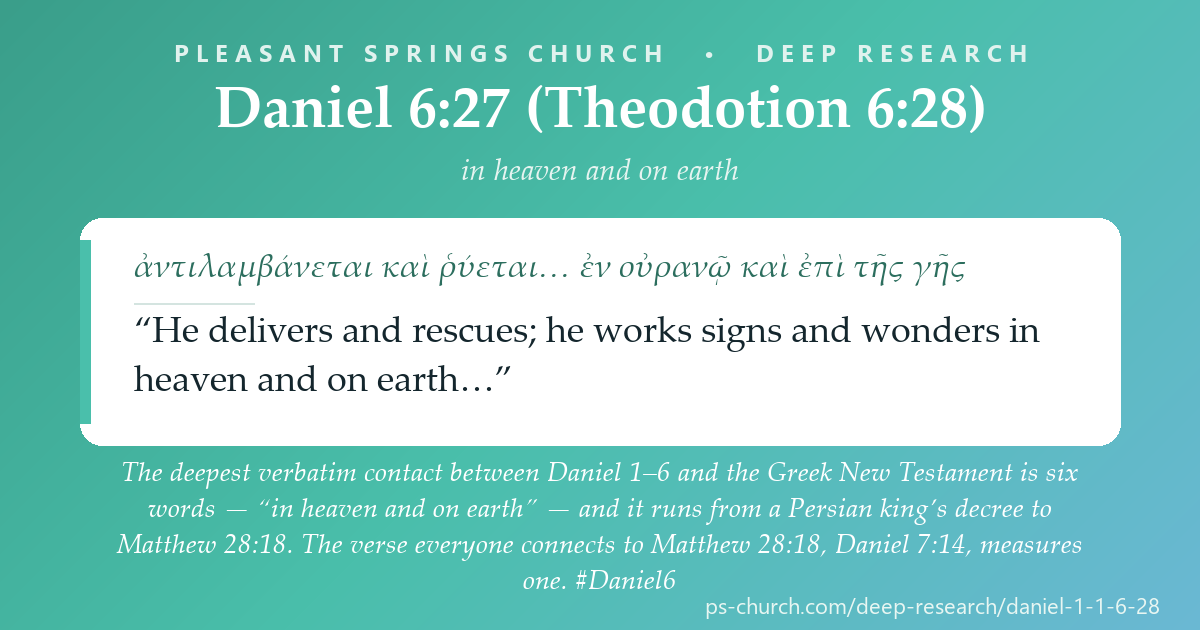
“In heaven and on earth.” Darius, having spent the night fasting, writes to the whole empire that Daniel’s God works signs and wonders in heaven and on earth. Theodotion’s Greek here, ἐν οὐρανῷ καὶ ἐπὶ τῆς γῆς, is the single deepest verbatim contact between Daniel 1–6 and the Greek New Testament — six words, tie band 1, against Matthew 28:18. What that does and does not prove is Stage 4.
Counted here rather than assumed:
- The Aramaic verb פלח with a god as its object occurs nine times in the 23,204 verse units of the Masoretic corpus, and all nine are in Daniel — 3:12, 14, 17, 18, 28; 6:17, 21; 7:14, 27. Exhaustive over the consonantal text, which returns 23 hits in all: the other fourteen are the Hebrew noun “slice / millstone,” the Hebrew verb “to cleave,” the personal name Pilha at Nehemiah 10:25, and — the same Aramaic root — Ezra 7:19 and Ezra 7:24.
- רז occurs nine times, and all nine are in Daniel — eight in chapter 2 and one at 4:6. The only other hits the pattern returns in the whole corpus are two at Isaiah 24:16, which is a different root.
- The ten-word decree greeting: run 10, tie band 1, MT 3:31 against MT 6:26, screened against 23,203 other verse units. The Theodotion greeting matches at the same depth, ten Greek words.
- Twelve of the 196 verses of Daniel 1–6 share no two consecutive words with any other verse in the Hebrew Bible (Hebrew-side convention: unigram_fallback=False, so a zero means no shared PAIR, not no shared word; each verse screened against the other 23,203). Among them are 2:21 (“he changes times and seasons”), 5:27 (the interpretation of TEKEL), 5:30 (“that very night Belshazzar was killed”) and 6:28, the verse this page is named for. Exclude each verse’s own chapter as well, so that a formula repeated a few verses away does not count, and the figure is twenty-one.
- Old Greek against Theodotion, word counts on the files held here: ch.1 515/498; ch.2 1,283/1,229; ch.3 1,980/1,910; ch.4 1,376/1,078; ch.5 508/830; ch.6 873/775. One block is left out of those figures and is named here: the CATSS Old Greek file carries an unnumbered 88-word preface to chapter 5, standing between 4:37c and 5:1. Counted in, Old Greek chapter 5 is 596 words in twenty units rather than 508 in nineteen — still the chapter where the two Greek texts stand furthest apart.
The measurement, its ceiling, its one run of six — and the three places it fails.
Every verse of Greek Daniel 1–6 screened against all 7,927 verses of the Greek New Testament: longest contiguous run of identical word forms, with the tie band — how many New Testament verses reach the same maximum — reported beside every figure. Then the Hebrew and Aramaic screened against every other verse of the 39-book Masoretic corpus. Nothing sampled; both screens exhaustive.
What the Greek New Testament screen returns:
Theodotion Daniel 1–6 is 263 verse units, of which 196 answer to the Hebrew and Aramaic and 67 are the insert at 3:24–90. Taking only the 196: all 196 reach two shared words, 164 reach three, 59 reach four, 21 reach five, one reaches six, and nothing reaches seven. The Old Greek, screened separately over its 251 rows, gives the same ceiling: all 251 reach two, 209 reach three, 68 reach four, 18 reach five, one reaches six.
The one Theodotion row at six is 6:28 (ESV 6:27), tie band 1, against Matthew 28:18 — ἐν οὐρανῷ καὶ ἐπὶ τῆς γῆς / ἐν οὐρανῷ καὶ ἐπὶ τῆς γῆς. Darius writes that Daniel’s God works signs and wonders in heaven and on earth; the risen Christ says all authority in heaven and on earth has been given to me. The six-word sequence occurs exactly once in the 7,927 verses of the Greek New Testament and exactly twice in the 30,348 Greek Old Testament verse units screened — here, and at 2 Chronicles 6:14, in Solomon’s prayer at the dedication of the temple: ἐν οὐρανῷ καὶ ἐπὶ τῆς γῆς.
The Old Greek’s one run of six is somewhere else entirely — at its 4:37, a doxology to the one who made the heaven and the earth, matching Acts 4:24, Acts 14:15 and Revelation 14:7 at six words with a tie band of 3. Same depth, three matches instead of one, and a creation formula rather than a distinctive phrase. That is exactly what the tie band is for.
The three places where the New Testament unmistakably has Daniel 1–6 in view measure 1, 1 and 0.
Hebrews 11:33 — “stopped the mouths of lions,” ἔφραξαν στόματα λεόντων — against Theodotion 6:23, ἐνέφραξεν τὰ στόματα τῶν λεόντων: run of 1. The shared word is stomata. Hebrews writes ephraxan, Theodotion enephraxen; the same verb, but not the same form, and the screen matches forms and never lemmas.
Hebrews 11:34 — “quenched the power of fire” — against Theodotion 3:27: run of 0. In a single named pair a zero means the two verses share no word at all. Against 3:17 it reaches 1, and the shared word is pyros.
Revelation 13:15 — the image of the beast that must be worshipped on pain of death — against Theodotion 3:5, 3:12 and 3:15: run of 2, tēi eikoni.
And one more, because it shows exactly why. Daniel 2:21 says God changes times and seasons, καιροὺς καὶ χρόνους; Acts 1:7 says it is not for you to know χρόνους ἢ καιροὺς. Two of the three words are the same words. The run is 1 — because Luke reverses the order and swaps the conjunction, and a contiguous-run screen cannot see through either. The same measurement returns 1 for both the Old Greek and Theodotion.
And four of the twenty-five rows that reach five or more are not in the Bible we confess. Theodotion 3:26 and 3:52 both reach five with a tie band of 3, matching Acts 3:13, 5:30 and 22:14 on ὁ θεὸς τῶν πατέρων ἡμῶν — “the God of our fathers.” Both verses are inside the Prayer of Azariah, and 3:25 and 3:36 sit in the same block — sixty-seven Greek verses with no Hebrew or Aramaic counterpart at all. That is why the headline figures above are given for the 196 canonical rows and not the 263.
And the sharpest of them all, which this page will not build anything on. Theodotion 4:30 (= ESV 4:30, MT 4:27) is Nebuchadnezzar on the roof — is not this great Babylon, which I have built… by the might of my power, ἐν τῷ κράτει τῆς ἰσχύος — and it reaches five with a tie band of 1 against Ephesians 6:10, be strong in the Lord and in the strength of his might. The identical five words carry a boast in one text and a benediction in the other. It is a coincidence of vocabulary and it is printed here as one.
And the furnace formula. Theodotion 3:6, 3:11, 3:15 and 3:20 each reach five against Matthew 13:42 and 13:50 — εἰς τὴν κάμινον τοῦ πυρὸς, “into the furnace of fire.” Tie band 2, and the two Matthew verses are a doublet of each other. The phrase is a formula repeated four times inside Daniel 3 itself. It is worth noticing; it is not evidence that Matthew is quoting Daniel.
Where the measurement and the tradition agree:
- Theodotion Daniel 2:45 → Revelation 4:1 — run of 5, tie band 1. ἃ δεῖ γενέσθαι μετὰ ταῦτα / ἃ δεῖ γενέσθαι. μετὰ ταῦτα (the full stop is a modern editor’s; the screen strips punctuation), “what must take place after this.” The five-word sequence occurs exactly once in the Greek New Testament and exactly once in the 30,348 Greek Old Testament verse units screened. The shorter phrase ha dei genesthai occurs three times in the New Testament — Revelation 1:1, 4:1 and 22:6 — and at Daniel 2:28 and 2:29 in both Greek texts; the Old Greek does not carry it at 2:45 at all. But the five-word form is Theodotion’s alone: the Old Greek of 2:45 reaches 1 against Revelation 4:1. Revelation names no source, and this page asserts no direction of influence; it reports what the numbers are. Twenty-one canonical rows reach five or more, fifteen of them with a tie band of 1 — depth alone distinguishes nothing here. What distinguishes 2:45 is rarity: its five words occur once in each corpus, while the five words of 2:17 (matching Acts 10:22) occur 23 times in the Greek Old Testament, three of them in Theodotion Daniel itself.
- Daniel 1:5 → 2 Kings 25:30 — run of 4, tie band 1, Hebrew against Hebrew. הַמֶּ֜לֶךְ דְּבַר־י֣וֹם בְּיוֹמ֗וֹ — “the king… a portion day by day.” The book of Kings ends with Jehoiachin eating a daily ration at a Babylonian table; Daniel opens with four young Judeans being assigned one. It is the only run of four or more anywhere in Daniel 1–6 that reaches a book other than Daniel or Ezra.
- Aramaic Daniel → Aramaic Ezra. Of the nine rows in Daniel 1–6 that reach four or more outside the book of Daniel, eight land in Ezra — and every one of those eight lands in Ezra 4:8–6:18, the Aramaic section. Daniel 3:1 with Ezra 6:3 (dimensions in cubits); Daniel 3:10 and 3:29 with Ezra 6:11 (a decree is made by me); Daniel 5:3 with Ezra 5:16 (the house of God which is in Jerusalem). This is chancery Aramaic behaving like chancery Aramaic, and it is a reminder that a verbal overlap can be a register rather than a relationship.
- 1 Maccabees 2:60 → 2 Timothy 4:17 — and a warning. The earliest surviving reading of Daniel 6, in Mattathias’ deathbed speech, is Δανιηλ ἐν τῇ ἁπλότητι αὐτοῦ ἐρρύσθη ἐκ στόματος λεόντων — “Daniel, in his innocence, was rescued from the mouth of lions.” Paul writes at 2 Timothy 4:17 errysthēn ek stomatos leontos, “I was rescued from the lion’s mouth.” The two share two words, and the singular is the tell: Paul’s exact three words ἐκ στόματος λέοντος occur once in the Greek New Testament and once in the 30,348 Greek Old Testament verse units screened — at Psalm 21:22 (LXX) = Psalm 22:21, run of 3, not in Daniel at all. 1 Maccabees is Apocrypha — a witness, not Scripture in our confession, and is cited here only to show that a Second-Temple summary of the lions’ den and a New Testament sentence about lions can look related and measure two.
- Daniel 6:8, 12, 15 and Esther 1:19; 8:8 — the unalterable Medo-Persian law in two books, used in both to trap a king into destroying someone he wants to save. See the Esther study, which prints the same device from the other side.
- Daniel 1:2 → Daniel 5:2–3 → Ezra 1:7 — and a measured failure. The temple vessels are the strongest narrative thread in these six chapters: carried to Shinar in chapter 1, drunk from in chapter 5, carried home in Ezra 1. The run engine sees almost none of it. Daniel 1:2 against Ezra 1:7 reaches 2; against Daniel 5:2 it reaches 0 and against 5:3 it reaches 1 — because Daniel 1 is Hebrew and says כְּלֵי while Daniel 5 is Aramaic and says מָאנֵי. Printed here as a limit on the method, not as a finding about the text.
The historical problems, the date, the two Greek texts — and what this page could not check.
Collins, Goldingay, McLay. Then the questions, including the ones where this page is weakest. What follows is the honest ledger, not a defence.
Commentaries & studies:
- John J. Collins, Daniel (Hermeneia) — the reference technical commentary; fullest on the Greek texts, the Aramaic and the historical questions.
- John E. Goldingay, Daniel (WBC / revised) — the best treatment of the Aramaic and of how the chapters are put together.
- R. Timothy McLay, The OG and Th Versions of Daniel — on the two Greek texts and on which of them the New Testament writers appear to know.
- Carey A. Moore, Daniel, Esther and Jeremiah: The Additions (AB) — the place to read the Prayer of Azariah, the Song of the Three, Susanna and Bel properly.
- André Lenglet, Biblica 53 (1972) — the concentric reading of Daniel 2–7 tested in the diagram above.
Interpretation notes worth keeping:
- The date of the book is genuinely disputed, and this page does not settle it. The critical consensus places the final form in the 160s BC, largely on the precision of chapter 11; a conservative tradition holds to a sixth-century Daniel. Nothing measured on this page depends on the answer — a run length between two Greek texts is the same number under either view — and no argument for either position is offered here.
- Darius the Mede is a real historical problem and it is not solved below. No Median king of that name between Belshazzar and Cyrus is attested outside Daniel. The proposals — that he is Gubaru/Ugbaru, that “Darius the Mede” is a throne name for Cyrus, that the figure is a literary construction — are all argued and none is demonstrated. The Old Greek does not help: at its 6:1 it is Artaxerxes who receives the kingdom, and Darius is named in the same verse as someone else. Reported; not resolved.
- Belshazzar was not Nebuchadnezzar’s son and was never technically king. He was the son of Nabonidus and acted as regent. Chapter 5 calls Nebuchadnezzar his “father” throughout, which in Semitic usage can mean predecessor or ancestor — and the offer of the third place in the kingdom fits a co-regency exactly. The description is defensible; it is not a modern genealogical claim.
- What this page did NOT check. No Dead Sea Scrolls Daniel manuscript was consulted — 1QDan, 4QDana-e and the Prayer of Nabonidus are described from the secondary literature and were not collated here. No commentary above was read for this page in the sense of being quoted; they are named as where to go, not as sources leaned on. No Syriac, Latin or Coptic witness was examined. The Aramaic was not checked against a critical apparatus — the Masoretic text used is Sefaria’s Miqra according to the Masorah, read as it stands. Josephus, Antiquities 10.186–281, retells these chapters and was not screened.
- Where this page is weakest. The structural diagram tests two of Lenglet’s three pairs and confirms them; it cannot test the third, because chapter 7 is out of scope and because a thematic correspondence is invisible to a word-form screen. A reader who concludes from the matrix that the chiasm is disproved would be over-reading it. Equally, the headline finding — six words shared with Matthew 28:18 — is a fact about two Greek texts and not an argument that Matthew is using Daniel. Matthew 28:18 is usually connected to Daniel 7:14, on the strength of authority was given; and Theodotion Daniel 7:14 against Matthew 28:18 measures 1, the shared word being kai. The verse everyone connects measures one; the verse nobody connects measures six. That is the whole lesson of this stage, and it cuts against the page as much as for it.
- On the Additions. The Prayer of Azariah, the Song of the Three, Susanna and Bel are handled as Apocrypha — witnesses, not Scripture in our confession, with the plain acknowledgement that Roman Catholic and Orthodox Bibles receive them as canonical. They are never quoted in the codex, and every figure they could distort is given with them and without them.
Six stories about where the line falls, and a sentence a Persian king put in writing.
Name what you learned, why it matters, and one concrete response.
What should we carry away — and do?
- “But if not.” The three men state that their God is able to deliver them and then say that if he does not, they still will not bow (3:17–18). The refusal is made before the outcome is known. Every other version of that sentence — obedience conditional on rescue — is a bargain rather than a faith.
- The line does not fall where we expect it. Daniel eats an empire’s education, answers to an empire’s name, runs an empire’s provinces, and draws the line at the table, the image and the window. Working inside a system is not the compromise; the question is which three things you will not do.
- He opened the windows. Daniel 6:10 does not say he began to pray. It says the windows were already open toward Jerusalem and he prayed three times a day as he had done previously. The crisis did not produce the habit; the habit was there to meet the crisis.
- The theology is on the pagans’ lips. The two great confessions in these six chapters are a Babylonian king’s and a Persian king’s. God is capable of getting himself confessed by people who do not belong to him, in official correspondence, to an entire empire.
- One concrete response. Name the one practice you would keep if it were made illegal on Tuesday — and then check whether you are actually doing it this week. Daniel’s courage in chapter 6 is entirely a matter of not changing anything.
Daniel 6:27 · to share
Aramaic (MT 6:28) + Greek (Theodotion 6:28) + ESVEvery Deep Research page traces its passage across the whole sweep — the Old Testament, the Second-Temple world between the testaments (historical witnesses, not Scripture), and the New Testament. Follow the thread:
Pleasant Springs Church — Deep Research
Research method after Michael S. Heiser’s Bible Research Method (examine dictionaries → ancient literature → important words → textual connections → academic publications → share), with the Pleasant Springs “Author & Audience” foundation. Scripture set in the Hebrew, the Greek editions named on each page and the ESV (Old Testament), and the Greek New Testament and the ESV (New Testament), per the practice of Pleasant Springs Church. Daniel 1–6 research grounded in Collins (Hermeneia), Goldingay (WBC), McLay on the two Greek versions, and Lenglet on the structure of the Aramaic section. Text: Hebrew and Aramaic from the Masoretic Text (Sefaria, Miqra according to the Masorah); Greek from Theodotion (CATSS digitization of Rahlfs), with the Old Greek named explicitly at every point it is quoted; Greek New Testament from SBLGNT via MorphGNT; English ESV. ⚠️ Daniel has two complete and independent Greek texts and they are treated as two columns and never merged; the Greek column of the codex is Theodotion throughout and is labelled as such on every row. ⚠️ Three verse numberings run through this passage and all three are printed on every codex row. MT 3:31–33 = ESV 4:1–3 = Theodotion 4:1–3, so the Hebrew runs three verses behind the Greek and English through chapter 4; MT and Theodotion 6:1 = ESV 5:31, so the Hebrew and the Greek together run one verse ahead of the English through chapter 6; and both Greek texts carry 67 verses at 3:24–90 with no Semitic counterpart, so Theodotion 3:91 resumes at Aramaic 3:24. Everywhere else the three numberings agree — Daniel 1, Daniel 2, 3:1–23 and 5:1–30 are numbered alike in all three columns. Derived from the files on this disk, not from a table. ⚠️ Run figures are re-measured, not inherited. The cross-corpus screen applies MorphGNT’s own spelling equivalences (ou / ouk / ouch, ek / ex, the movable nu), so these numbers are higher than any figure published on this shelf before 30 August 2026; the Greek Old Testament comparison set is 30,348 verse units — the 30,637 held here less the Odes, which are excluded because ten of them are second copies of passages already in the corpus and two are Luke 1 and Luke 2. ⚠️ Every run is reported with its tie band, and the two zero conventions are distinguished wherever a zero appears: the Hebrew-side screen reports 0 for “shares no two consecutive words,” and a named single pair reports 0 for “shares no word at all.” The page’s counter-examples are printed against its own case — Hebrews 11:33 at 1, Hebrews 11:34 at 0, Revelation 13:15 at 2, the Matthew 13:42/13:50 furnace formula at a tie band of 2, four of the twenty-five deepest rows sitting inside the Greek insert, and Theodotion Daniel 7:14 measuring 1 against the very verse this page’s headline run matches. The literary structure is labelled a sequence, not a chiasm; Lenglet’s concentric proposal is tested pair by pair against a fifteen-pair overlap matrix, two of its three pairs are confirmed by measurement, the third is reported as not visible to this method, and the page states plainly that this neither proves nor disproves it. Direction of influence is never asserted. Stage 5 lists what was not consulted — the Dead Sea Scrolls Daniel manuscripts, any critical apparatus, Josephus, and the versions — and names where the page is weakest.
Scripture quotations marked ESV are from the ESV® Bible (The Holy Bible, English Standard Version®), © 2001 by Crossway, a publishing ministry of Good News Publishers. ESV Text Edition: 2016. Used by permission. All rights reserved. The ESV text may not be quoted in any publication made available to the public by a Creative Commons license, and the ESV may not be translated in whole or in part into any other language. www.esv.org
|
Did this study bless you today? 💚 Give to Support PS Church100% of gifts go to the General Fund — thank you. |