A ram with two horns, a goat that crosses the earth without touching it, and a horn that reaches up and pulls stars down. Then Gabriel, named for the first time in Scripture. Then Michael. Then forty-four verses of kings of the south and kings of the north. This page asked one question of those four chapters and answered it by counting: how much of this language exists anywhere else? Three screens were run — the Hebrew against the whole Masoretic corpus, Daniel's two independent Greek translations against each other, and both Greek columns against the whole Greek New Testament — and all three land on chapter 11. It is the most isolated chapter in the book of Daniel: no verse in its forty-five reaches a run of four, and nine of them share no two consecutive words with any other verse in the Hebrew Bible. It is also the chapter where Daniel's two Greek translators agree least. And its most famous verse, 11:31, is the most isolated verse of all — its two Greek columns share one word with each other, and one word with Matthew 24:15, the verse that made it famous. Influence and verbatim overlap are not the same thing, and this page is built on the gap between them. See the method →
Daniel 8:1–11:45 (selections)
Hebrew (Masoretic) · Greek (Theodotion) · ESV(1) The Hebrew. All 120 verses of Daniel 8–11, chapter by chapter, against the 23,204-unit Masoretic corpus held here. Chapter 11 is the most isolated chapter in the book of Daniel. No verse in its forty-five reaches a run of four; its mean longest run is 1.73 words, the lowest of any chapter in Daniel; and nine of its verses share no two consecutive words with any other verse in the Hebrew Bible. Chapter 10, two columns away, has none.
(2) The two Greek Daniels. Daniel survives in two independent Greek translations — the clearest double Greek tradition in the Old Testament — and both are on this disk. Measured verse against verse, chapter 10 is where they agree most — a median longest shared run of 7 words, and one stretch of 25 consecutive identical words at 10:6 — and chapter 11 is where they agree least, median 3, with twelve of its forty-five verses sharing two words or fewer. The chapter that shares least with the rest of Scripture is also the chapter its own two translators rendered least alike. The page reports the coincidence of the two profiles; it does not claim one causes the other.
(3) The Greek New Testament. All 120 rows of each Greek column against all 7,927 verses of the Greek New Testament. Nothing anywhere reaches six. In Theodotion five rows reach five; in the Old Greek three do. All eight are enumerated in Stage 4 and none is hidden. Five of them are counter-examples — four stock phrases standing in seven, twenty-one, five and seven verses of the Greek Old Testament, and one (Daniel 9:7 against Acts 4:10) a stock way of addressing the nation. Two of the remaining three are the two Greek columns of one verse, Daniel 10:3, against Acts 11:8. That leaves one, and it sits in the Old Greek column — not in the Theodotion the church received: Daniel 8:10 against Revelation 12:4.
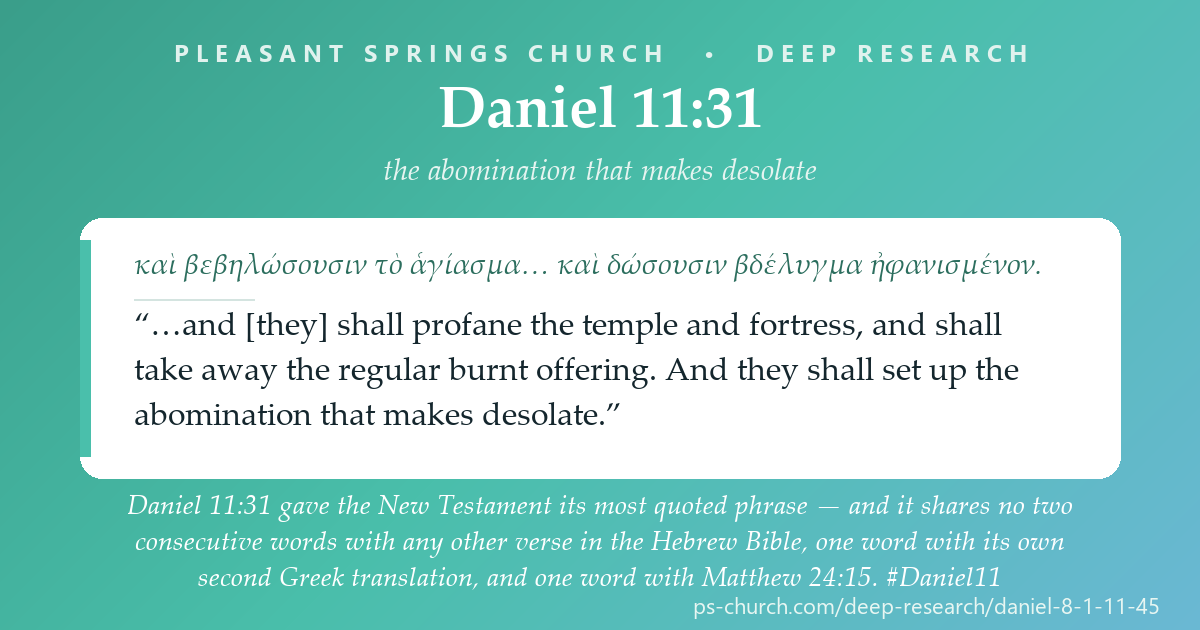
And the famous link measures 1. “The abomination of desolation spoken of by the prophet Daniel” is the New Testament’s one explicit citation of this part of Daniel. Against Daniel 11:31 — the verse the commentaries send you to — Matthew 24:15 measures 1 in Theodotion and 1 in the Old Greek. Verbatim measurement finds contact. It does not find allusion, and this page never lets a number stand in for the reading.
The Shape of the Passage
Sequence — three dated vision reports, and one that has no frame at allOne thread runs through the first three panels and changes hands in the fourth, and it is countable. The Hebrew root בין, to understand, sounds sixteen times in Daniel 8–10 — 8:5, 8:15, 8:16, 8:17, 8:23, 8:27; 9:2, 9:22 (twice), 9:23 (twice); 10:1 (twice), 10:11, 10:12, 10:14 — including three imperatives spoken to Daniel himself (הָבֵן at 8:16, 8:17, 10:11). In Daniel 11 it sounds four times — 11:30, 11:33 and 11:37 (twice) — and not one of the four is spoken to Daniel, and not one is an imperative: twice the king does not understand his fathers’ gods (11:37), once he gives heed to those who forsake the covenant (11:30), and once it is the wise among the people who give understanding to many (11:33). (The homograph בֵּין, “between,” is a different word and is excluded from that count; it stands at 8:5, 8:16, 8:21 and 11:45.)
What chapter 11 has instead is a different root and a different addressee. Twice it speaks of מַשְׂכִּילִים (11:33, 11:35), those among the people who are wise — not Daniel, but a group — and those are the people the book goes on to speak of at 12:3 and 12:10. The visions stop being explained to the seer and start being addressed to a community who will need them later. That is an observation about vocabulary distribution; it is not offered as proof of anything about the book’s composition.
Two neighbouring studies take other parts of this book: 7:9–14 on the Son of Man and the Ancient of Days, and 9:24–27 on the seventy weeks. This page covers the four chapters between and after them, and asks a narrower question than either: how much of this language exists anywhere else?
Author
Whoever set these chapters down wrote them in a Hebrew that has almost no neighbours. Screened against the whole 23,204-verse Masoretic corpus, chapter 11 reaches a longest shared run of three words — in six of its forty-five verses — and nothing higher. Nine of those verses share no two consecutive words with anything else in the Hebrew Bible. That is not what a text made out of other texts looks like. Chapter 9, forty verses earlier, is the opposite: its prayer is quarried out of Deuteronomy, 1 Kings 8, Jeremiah and Nehemiah, with five-word runs and named partners.
He also broke the language of his own book to write them. Daniel is bilingual — the Aramaic runs from 2:4b to 7:28 — and chapter 8 returns to Hebrew and stays there. So the ram and the goat are told in the language the reader had not heard since chapter 2. This page does not use that fact to argue for a date or a redaction; it names it because a reader deserves to know that the Hebrew figures above are measured against a Hebrew corpus, and the Aramaic chapters cannot fairly be compared with them at all.
And he named names. Gabriel and Michael are the only two angels named in the whole Hebrew Bible, and every occurrence of either as an angel is in this book — Gabriel twice (8:16; 9:21), Michael three times (10:13; 10:21; 12:1). Before Daniel, the messengers of God in Scripture are anonymous.
Audience
People who wanted to know how long. The question at the centre of chapter 8 is not “what does it mean” but “for how long?” (8:13), and the answer is a number: 2,300 evenings and mornings. Every reader of this book since has done arithmetic with it, and the arithmetic has embarrassed the church in every generation that treated it as a calendar rather than a promise of a limit.
People living under a king who had defiled the temple. By the second century BC the community that read these chapters had watched Antiochus IV stop the daily sacrifice and set something on the altar that 1 Maccabees calls, in Greek, βδέλυγμα ἐρημώσεως — the Old Greek’s exact wording at Daniel 11:31. Whatever else Daniel 11 is, it was read as a description of something that had happened to them.
And people who were not going to be told everything. Chapter 8 ends with the seer sick and uncomprehending. Chapter 12 answers his last question with Go your way, Daniel, for the words are shut up and sealed until the time of the end (12:9). The book that names angels and dates visions to the year is also the book that says plainly there is a part you are not going to get.
Orient on the visions, on the two Greek Daniels, and on the second-century crisis.
Search by topic: Daniel, Book of; apocalyptic; Gabriel; Michael; angels, named; Antiochus IV Epiphanes; abomination of desolation; Theodotion; Old Greek Daniel; the daily sacrifice (tamid); Seleucids and Ptolemies.
Which articles are relevant?
- Anchor Bible Dictionary — “Daniel, Book of,” “Apocalypses and Apocalypticism,” “Gabriel,” “Michael,” “Antiochus,” “Abomination of Desolation,” “Theodotion.”
- Dictionary of the OT: Prophets (IVP) — “Daniel, Book of,” “Apocalypticism,” “Angels,” “Hellenistic Period,” “Septuagint / Greek Versions.”
- NIDOTTE / TDOT — שִׁקּוּץ (šiqqûṣ, detestable thing), שָׁמֵם (šāmēm, be desolate), תָּמִיד (tāmîḏ, the regular offering), שַׂר (śar, prince), צְבִי (ṣəḇî, beauty / glory).
- On the Greek — the standard handbooks on the two Greek Daniels: Ziegler’s Göttingen Susanna, Daniel, Bel et Draco, Munnich’s revision, and the NETS introduction to Daniel. None of the three is on this disk; the Greek here is the CATSS digitisation of Rahlfs. See Stage 5.
Bibliography surfaced:
- John J. Collins, Daniel (Hermeneia); James A. Montgomery, Daniel (ICC); John E. Goldingay, Daniel (WBC); Carol A. Newsom, Daniel (OTL); Joyce G. Baldwin, Daniel (TOTC); Stephen R. Miller (NAC); Andrew E. Steinmann (Concordia).
- T. J. Meadowcroft, Aramaic Daniel and Greek Daniel; R. Timothy McLay, The OG and Th Versions of Daniel — the two book-length treatments of the double Greek tradition.
- G. K. Beale & D. A. Carson, eds., Commentary on the NT Use of the OT (Matthew and Mark on the abomination; Revelation on Daniel’s imagery).
Two Greek Daniels, a king who stopped the sacrifice, and nine Hebrew words nobody translated.
Read Daniel 11:31 in Theodotion and then in the Old Greek. Then read Matthew 24:15. Three sentences, and the shape of the whole question.
Which parallels shed light on these chapters?
Daniel survives in two independent Greek translations — the clearest double Greek tradition in the Old Testament — and both are held here. The church received Theodotion’s Daniel; the Old Greek survives in a very small number of witnesses and was, for most of Christian history, effectively lost. They are not variants of one another. Measured verse by verse across Daniel 8–11, their median longest shared run is 5 words and their range is enormous: 25 consecutive identical words at 10:6, and a single shared word at 11:23, 11:31 and 11:32. Across all 120 verses there is no verse where they share nothing at all — but the gradient runs steadily downhill from chapter 10 to chapter 11.
Theodotion leaves Hebrew words standing in Greek letters; the Old Greek mostly does not. At nine places in these four chapters Theodotion transliterates rather than translates — Ουβαλ (8:2, 3, 6, 16, the watercourse), φελμουνι (8:13), Εδδεκελ (10:4, the Tigris), βαδδιν (10:5, linen), Ωφαζ (10:5), θαρσις (10:6), μαωζιν (11:38, fortresses), σαβι (11:16, 11:41, 11:45, glory) and εφαδανω (11:45, his pavilion). At those same nine places the Old Greek transliterates twice (φελμουνι, θαρσις), carries the transliterated river name Ουλαι where Theodotion has Ουβαλ at 8:16, and otherwise renders: gate, Tigris, fine linen, land, of the desire. That count is by inspection of nine named places, not by a machine screen, and it is labelled so.
The crisis these chapters were read against is dated and documented. In 167 BC Antiochus IV Epiphanes stopped the daily offering in Jerusalem and set a foreign altar-cult on the altar of burnt offering. 1 Maccabees 1:54 describes it in Greek as a βδέλυγμα ἐρημώσεως built on the altar. Measured, that verse’s longest run against the Old Greek of Daniel 11:31 is exactly those two words, and its longest run against Theodotion’s is one word — Theodotion does not contain the phrase at all. How the vision relates to that event, and whether it also looks past it, is a question this page holds open; that Second-Temple Jews read it of Antiochus is not in doubt.
- 1 Maccabees 1:20–64 (Apocrypha — a Second-Temple witness, not Scripture) — the plundering of the temple, the stopping of the tamid, and “a desolating sacrilege on the altar of burnt offering” (1:54).
- 2 Maccabees 5–6 (Apocrypha) — the same events told differently; the temple renamed for Olympian Zeus.
- Josephus, Antiquities 10.11.7 and 12.5.4 (a first-century historian — a witness, not Scripture). Not held on this disk and not consulted for this page. Named because he is where the ancient identification of Daniel’s little horn with Antiochus is usually cited from.
- 4QDana-e (Qumran) — five Daniel manuscripts, covering parts of these chapters and older than any complete Greek witness. Not held on this disk. Every Hebrew figure on this page is a figure about the Masoretic text alone.
- 1 Enoch 85–90, the Animal Apocalypse (Second Temple — a witness, not Scripture) — empires as beasts, and stars falling from heaven. Not held on this disk.
The one New Testament contact in these four chapters that measures deep and does not look like an accident is in the Greek column the church did not use.
The Old Greek of Daniel 8:10 reads καὶ ὑψώθη ἕως τῶν ἀστέρων τοῦ οὐρανοῦ καὶ ἐρράχθη ἐπὶ τὴν γῆν. Revelation 12:4 reads ἡ οὐρὰ αὐτοῦ σύρει τὸ τρίτον τῶν ἀστέρων τοῦ οὐρανοῦ καὶ ἔβαλεν αὐτοὺς εἰς τὴν γῆν. Five consecutive words, tie band 1. The sequence ἀστέρων τοῦ οὐρανοῦ occurs exactly once in the 30,348 Greek Old Testament verse units screened here and exactly once in the 7,927 verses of the Greek New Testament.
Theodotion, at the same verse, measures 3 — because he writes τῆς δυνάμεως τοῦ οὐρανοῦ, the power of heaven, where the Old Greek writes the stars of heaven. The New Testament’s Daniel is normally and rightly said to be Theodotion’s. This page’s deepest measured contact is not, and saying so is the honest thing to do with the number.
What this does NOT establish. It does not show that John of Patmos read the Old Greek of Daniel. Both texts are describing the same image — a power reaching up and pulling stars down — and Greek has a limited number of ways to say the stars of heaven. It shows that two verses share five words and that the sequence is rare in both corpora. That is all a run screen can ever show, and the page stops there.
A hapax, two angels, three occurrences of an idea nobody spelled twice, and one rare Greek phrase.
Every count below was produced by an exhaustive search of the corpus named beside it — 23,204 Masoretic verse units, 30,348 screened Greek Old Testament verse units, 7,927 Greek New Testament verses. Nothing was sampled.
“The abomination that makes desolate.” The phrase stands three times in Daniel and never twice in the same form: שִׁקּוּצִים מְשֹׁמֵם at 9:27, הַשִּׁקּוּץ מְשֹׁמֵם here, שִׁקּוּץ שֹׁמֵם at 12:11. No two of the three share two consecutive word forms — the pair runs measure 1, 1 and 1. The noun שִׁקּוּץ occurs 28 times in 26 verses of the Hebrew Bible; outside Daniel it is almost always an idol (Jeremiah, Ezekiel, Deuteronomy 29:16, 1 Kings 11:5, 7, 2 Kings 23:13, 24, Isaiah 66:3, Hosea 9:10, Nahum 3:6, Zechariah 9:7, 2 Chronicles 15:8).
“A certain one” — a hapax legomenon: one occurrence in 23,204 Masoretic verse units. Usually explained as a contraction of pəlōnî ʾalmōnî, “so-and-so.” Theodotion and the Old Greek both transliterate it as φελμουνι rather than translate it, which is what a translator does with a word he cannot construe.
“Gabriel.” Two occurrences in the whole Hebrew Bible, and both are in this study. With Michael he is one of only two angels the Old Testament ever names. In the Greek New Testament Γαβριήλ appears twice, both in Luke 1. The run screen measures 1 between Daniel 9:21 and either Lukan verse — the link is a name, not a sentence.
“Michael.” The name occurs thirteen times in the Hebrew Bible. Ten are ordinary Israelite men — Numbers 13:13, Ezra 8:8, and eight occurrences in Chronicles (1 Chronicles 5:13, 5:14, 6:25, 7:3, 8:16, 12:21, 27:18; 2 Chronicles 21:2). The three that are the angel are all in Daniel. Theodotion at 10:21 calls him ὁ ἄρχων ὑμῶν, your prince; the Old Greek calls him ὁ ἄγγελος, the angel.
“Prince, commander.” In Daniel 1 it is a palace official — the chief of the eunuchs. From chapter 8 on it is used of powers that are not human: the prince of the host (8:11), the Prince of princes (8:25), and in chapter 10 a prince of the kingdom of Persia and a prince of Greece who oppose an angel while Michael, one of the chief princes, comes to help. The Old Greek renders the opposing figures στρατηγός, ‘general’, where Theodotion has ἄρχων.
“Greece / Javan.” Seven occurrences in the Hebrew Bible; three of them are in these four chapters. The others are the table of nations (Genesis 10:4; 1 Chronicles 1:7), a trade list (Ezekiel 27:13) and Zechariah 9:13. At 8:20–21 the interpreting angel decodes the vision by naming the empires outright — Media and Persia, then Greece. No screen was run over the other prophetic visions, so nothing is claimed about them.
“Beauty, glory” — and so, of a country, the glorious land. The definite form הַצְּבִי occurs five times in the Hebrew Bible and three of them are in this study (8:9; 11:16; 11:41). The other two mean something else entirely: a gazelle (Deuteronomy 12:22) and your glory, O Israel (2 Samuel 1:19). Theodotion transliterates it σαβι at 11:16, 11:41 and 11:45; the Old Greek translates it away — χώρα, ‘land’, at 11:16 and 11:41, θελήσεως, ‘of the desire’, at 11:45.
“An abomination made to vanish.” Theodotion’s rendering at 11:31 does not contain the word ἐρημώσεως at all; the Old Greek at the same verse has βδέλυγμα ἐρημώσεως, the phrase Matthew 24:15 and Mark 13:14 carry. βδέλυγμα and its forms occur six times in the Greek New Testament — Matthew 24:15, Mark 13:14, Luke 16:15, Revelation 17:4, 17:5, 21:27 — and three times in each Greek Daniel (9:27; 11:31; 12:11). The page prints both columns and asserts nothing about which the evangelists had in front of them.
“Entered my mouth.” Two rows in the 30,348-unit Greek Old Testament screened here carry this exact five-word sequence, and they are the two Greek columns of the same verse. In the Greek New Testament it stands once: Acts 11:8, Peter before the Jerusalem church — nothing common or unclean has ever entered my mouth. Tie band 1. Two Jews describing what they would not eat. No direction of influence is claimed, and Ezekiel 4:14 says the same thing in a form the screen cannot match.
Counted here, not assumed:
- The Hebrew isolation profile of Daniel, chapter by chapter. Longest run against every other verse of the Masoretic corpus, mean per chapter: ch 8 — 2.07 (max 4, four verses at zero); ch 9 — 2.85 (max 5, two at zero); ch 10 — 2.76 (max 5, none at zero); ch 11 — 1.73 (max 3, nine at zero). For comparison the book’s other Hebrew chapters run 2.24 (ch 1) and 2.15 (ch 12). Chapter 11 has the lowest mean in the book, the most verses at zero, and no verse above three. ⚠️ Chapters 2:4b–7:28 are Aramaic and are deliberately excluded from that comparison — screening Aramaic against a Hebrew corpus measures the language barrier, not the text.
- Zero means “no two consecutive words” on the Hebrew screen. Fifteen of the 120 verses in this study reach it: 8:9, 8:12, 8:22, 8:24; 9:5, 9:9; 11:3, 11:5, 11:10, 11:22, 11:23, 11:31, 11:32, 11:34, 11:44. Every one of them still shares individual words with other verses; what none of them shares is a pair.
- The two Greek Daniels, verse by verse across chapters 8–11. Median longest shared run per chapter: ch 8 — 5; ch 9 — 5; ch 10 — 7; ch 11 — 3. Verses where they share two words or fewer: 3, 2, 2 and 12. Deepest agreement anywhere: 10:6, twenty-five consecutive identical words. Thinnest: 11:23, 11:31 and 11:32, one word each.
- The Greek New Testament screen. Nothing reaches six. Theodotion 8–11, 120 rows: five reach five, forty reach four. Old Greek 8–11, 120 rows: three reach five, twenty-five reach four. One row in the whole of the Old Greek column reaches only 1 — Old Greek Daniel 9:25 shares no two consecutive words with any New Testament verse, and its tie band at that depth is 5,186, because thousands of verses share καί. On the Greek screen a 1 means “only isolated words”; a 0 would mean “no word at all”, and there are none of those.
- Sixteen occurrences of the root בין, “understand,” in Daniel 8–10, three of them imperatives to Daniel (8:16, 8:17, 10:11); four in Daniel 11 — 11:30, 11:33 and 11:37 (twice) — none of them addressed to Daniel and none an imperative. The homograph בֵּין, “between,” is excluded and occurs at 8:5, 8:16, 8:21 and 11:45.
- ⚠️ One place the eye sees more than the screen. Daniel 8:13, 11:31 and 12:11 all speak of the same abomination, and a reader recognises it instantly. Measured, the three verses share one word with each other, pairwise. A run figure is evidence of contact and never evidence of its absence.
Eight runs of five, five of them accidents, and the citation that measures one.
Read Daniel 11:31 beside Matthew 24:15 and count the shared words yourself. Then read Daniel 8:10 beside Revelation 12:4 and do the same. The famous one is shorter.
Which cross-references matter?
- Matthew 24:15; Mark 13:14 ↔ Daniel 11:31. The New Testament’s one explicit, named citation of this part of Daniel — the abomination of desolation spoken of by the prophet Daniel. The naming is Matthew’s; Mark 13:14 carries the phrase without it. Measured: 1 against Theodotion, 1 against the Old Greek. (For completeness, and outside this study’s chapters: the same phrase measures 4 against the Old Greek of Daniel 12:11 and 1 against Theodotion’s, because Theodotion writes the phrase without articles.) This is the single clearest demonstration on the shelf that a citation and a deep run are different things.
- Revelation 12:4 ↔ Daniel 8:10 (Old Greek). Five words, band 1, and the sequence ἀστέρων τοῦ οὐρανοῦ is unique in both corpora. Theodotion measures 3 at the same verse. The deepest measured contact in the study, and it is not a citation — no New Testament text signals one here.
- Acts 11:8 ↔ Daniel 10:3. Five words, band 1, identical in both Greek Daniels. Peter and Daniel both saying what has not entered their mouths. Ezekiel 4:14 says it too and measures 4, because of one different verb form.
- Revelation 1:14 ↔ Daniel 10:6. His eyes like flaming torches / his eyes like a flame of fire. The vision of the man in linen is behind the vision of the risen Christ in Revelation 1 in every commentary, and the whole shape of the description agrees — body, face, eyes, feet of bronze, voice. The deepest run between Daniel 10:6 and any verse of Revelation 1 is four — καὶ οἱ ὀφθαλμοὶ αὐτοῦ, at Revelation 1:14, a sequence that stands in exactly one verse of the Greek New Testament. (Daniel 10:6’s own tie band against the whole New Testament is 4, because three unrelated verses also reach four.) The dependence is obvious to any reader and the measurement is shallow. Both facts are printed.
- Daniel 11:45 ↔ Lamentations 1:7. וְאֵין עוֹזֵר, two words, band 1 — the only other verse in the Hebrew Bible with the pair. Said of Jerusalem there; said of the king who defiles her sanctuary here.
- Daniel 9:2 ↔ Jeremiah 14:1; 46:1; 47:1; 49:34. Five words, band 4 — the deepest Hebrew run in the study, and it is Jeremiah’s own oracle-heading formula, in the verse where Daniel says he was reading Jeremiah.
- 2 Thessalonians 2:3–4 ↔ Daniel 11:36. He shall exalt himself above every god / the man of lawlessness… who exalts himself against every so-called god. Measured, the deepest run between Daniel 11:36 in either Greek column and 2 Thessalonians 2:4 is 2. A thematic heir, not a verbal one.
All eight runs of five, and why most of them mean nothing:
- Daniel 8:5 (Th) ↔ Luke 21:35 — run 5, band 1. ἐπὶ πρόσωπον πάσης τῆς γῆς. The goat crosses the face of the whole earth; the day comes on all who dwell on the face of the whole earth. The same five words stand in seven verses of the Greek Old Testament (Genesis 11:8, 11:9; Deuteronomy 11:25; 1 Samuel 30:16; 2 Samuel 18:8; Zechariah 5:3; here). The band of 1 is an artefact of the New Testament being a small corpus.
- Daniel 8:25 (Th) ↔ Matthew 3:12 — run 5, band 1. ἐν τῇ χειρὶ αὐτοῦ καί. Deceit in the little horn’s hand; the winnowing fork in the hand of the coming one. Twenty-one verses of the Greek Old Testament carry the sequence, twenty-two times. Nothing.
- Daniel 11:20 (Th) ↔ Revelation 9:6 — run 5, band 1. καὶ ἐν ταῖς ἡμέραις ἐκείναις. A date formula. Five verses of the Greek Old Testament have it and the four-word core is in six New Testament verses.
- Daniel 11:42 (Th) ↔ Revelation 14:16 — run 5, band 1. αὐτοῦ ἐπὶ τὴν γῆν καί. Seven Greek Old Testament verses carry it. The angel puts in his sickle; the king stretches out his hand. Five identical words and no relation whatever.
- Daniel 9:7 (OG) ↔ Acts 4:10 — run 5, band 1. καὶ παντὶ τῷ λαῷ Ἰσραήλ. Daniel confesses shame belonging to Judah, to those in Jerusalem and to all the people of Israel; Peter tells the council and all the people of Israel that Jesus was raised. The sequence stands once in the Greek Old Testament and once in the Greek New Testament, so both bands are 1 — and it is nevertheless a stock way of addressing the nation, not contact. Printed here rather than left out, because a page that shows only its convenient fives is not measuring.
- And the remaining two are the two Greek columns of Daniel 10:3 against Acts 11:8, treated above. So of the eight deepest New Testament runs in these four chapters, exactly two are worth a second look — Daniel 8:10 and Daniel 10:3 — and neither is a citation.
- Held against all of them, Daniel 11:31 is the interesting case — and the screen cannot see it. Matthew names Daniel out loud and measures 1. This is why every run on this page is printed with its band, and why the page does not rank its findings by run length.
What was not consulted, what could not be checked, and where this page is weakest.
Named first, because the honesty of the rest depends on it.
Commentaries & studies named but not quoted:
- John J. Collins, Daniel (Hermeneia) — the standard critical commentary, and the fullest treatment of the relation between the two Greek versions. Not on this disk. Named, not consulted.
- James A. Montgomery (ICC), John E. Goldingay (WBC), Carol A. Newsom (OTL), Joyce G. Baldwin (TOTC), Stephen R. Miller (NAC), Andrew E. Steinmann — the commentary range from critical to conservative. None consulted.
- Ziegler–Munnich, Susanna, Daniel, Bel et Draco (Göttingen) and R. Timothy McLay, The OG and Th Versions of Daniel — the two works that would let this page say anything responsible about the textual history behind the divergences it measures. Neither is held here.
- NETS Daniel (tr. McLay), which prints both Greek columns in English. Not held here. The English on this page is the ESV, which translates the Hebrew; the Greek columns above are printed untranslated except where a note gives a rendering, and those renderings are this page’s own.
Seven things this page cannot do, stated plainly:
- It cannot say why the two Greek Daniels diverge, or which is prior at any verse. The measured gradient — close in chapter 10, far apart in chapter 11 — is a fact about two files. Whether it reflects two independent translations of the same Hebrew, one revising the other, or two different Hebrew texts, is exactly the question Ziegler, Munnich and McLay exist to answer, and none of them is on this disk. The page reports the profile and refuses the explanation.
- It cannot rule out that the Hebrew isolation of chapter 11 is an artefact of subject matter. Chapter 11 is about Hellenistic dynastic politics, and no other book in the Hebrew Bible is about that. A text with an unshared subject will have unshared vocabulary whatever its origin. This is the strongest objection to the page’s central finding and it is not answered here. The finding is that the isolation is measurable and extreme, not that it proves anything about who wrote the chapter or when.
- The correlation between the two profiles is a correlation over four data points. Four chapters, two screens. That is not a statistical result and this page does not present it as one. It is offered as a pattern worth noticing, with the numbers printed so a reader can decide how much weight it carries.
- It could not check the Qumran Daniel manuscripts. 4QDana–e cover parts of these chapters and are older than any complete witness to either Greek column. None is held on this disk. Every Hebrew statement here is a statement about the Masoretic text alone, and every Greek statement is about the CATSS digitisation of Rahlfs alone.
- It cannot separate genuine Old Greek from later contamination. The Old Greek of Daniel survives in very few witnesses and its text is contested at many points. CATSS/Rahlfs carries no critical apparatus and no Aristarchian signs, so where this page says “the Old Greek reads…” it means the file on this disk reads, and nothing stronger.
- The transliteration count is by inspection, not by screen. Nine places were identified by reading the two columns side by side and checking the Hebrew behind them. An automated screen for ‘words that are not Greek’ was tried and abandoned because it cannot distinguish a transliterated Hebrew noun from a rare but genuine Greek form. The nine are named so the count can be checked; it is not offered as exhaustive.
- Tooling scope, named so nobody is misled. The Greek Old Testament corpus on disk is 64 CATSS files holding 30,637 verse units, of which 30,348 are what a run or lexeme screen actually sees — the Odes are excluded as second copies (Ode 9 is Luke 1 and Ode 13 is Luke 2; ten more repeat Exodus 15, Deuteronomy 32, 1 Samuel 2, Habakkuk 3, Isaiah 26, Jonah 2, Daniel 3, Isaiah 5 and Isaiah 38). Every Greek count on this page is against the 30,348. Note that two of the excluded Odes are Theodotion’s Daniel 3, so Daniel is one of the books the exclusion actually protects.
What it means when the most quoted verse is the least shared one.
Name what you learned, why it matters, and one concrete response.
What should we carry away — and do?
- The verse everyone quotes is the verse nobody else wrote. Daniel 11:31 shares no two consecutive words with any other verse in the Hebrew Bible; its two Greek translations share one word; and it shares one word with the Gospel verse that made it famous. Its influence and its measurable overlap run in opposite directions — which is a standing warning against letting a number decide what matters.
- Daniel prayed with a Bible open. The one place in these chapters where the Hebrew runs five words deep into another book is 9:2, the verse where he says he was reading Jeremiah — and what he shares is Jeremiah’s own way of introducing a word from God. The man who received visions still did his reading.
- The angel’s job was to make him understand, and by chapter 11 nobody is telling Daniel to. Sixteen occurrences of understand in chapters 8 to 10, three of them imperatives spoken to Daniel; four in chapter 11, and not one of them addressed to him. Some of what God gives is given to be understood, and some is given to be kept — 12:4 tells Daniel to shut up the words and seal the book until the time of the end, and 12:9 sends him on his way.
- One concrete response. The next time someone tells you what a prophecy proves, ask which words of it they are actually holding. 2,300 evenings and mornings has been made into a calendar date many times and has never once been right. The sanctuary is restored to its rightful state; the king comes to his end with none to help him. Those are the promises the text makes, and they are enough.
Daniel 11:31 in three columns · to share
Hebrew · Greek (Theodotion) · ESVEvery Deep Research page traces its passage across the whole sweep — the Old Testament, the Second-Temple world between the testaments (historical witnesses, not Scripture), and the New Testament. Follow the thread:
Pleasant Springs Church — Deep Research
Research method after Michael S. Heiser’s Bible Research Method (examine dictionaries → ancient literature → important words → textual connections → academic publications → share), with the Pleasant Springs “Author & Audience” foundation. Scripture set in the Hebrew, the Greek editions named on each page and the ESV (Old Testament), and the Greek New Testament and the ESV (New Testament), per the practice of Pleasant Springs Church. VERSE NUMBERING — Daniel 8–11. There is no offset in these chapters, and that was derived from the files on this disk rather than taken from a table. Masoretic Daniel and both Greek columns carry 27, 27, 21 and 45 verses in chapters 8, 9, 10 and 11 — identical in the Hebrew, in DanielOG and in DanielTh — so every reference on this page means the same verse in all three columns, and the ESV follows the same numbering. That is not true earlier in the book, and the page says so rather than implying Daniel has no offset at all. Both Greek Daniels insert the Prayer of Azariah and the Song of the Three inside chapter 3, so where the Hebrew has 33 verses the Greek has 97; chapter 4 runs 34 in the Hebrew, 35 in the Old Greek and 37 in Theodotion; chapter 5 runs 30, 19 and 30; chapter 6 runs 29, 30 and 29. From chapter 7 onward all three agree exactly. Susanna and Bel and the Dragon stand as chapters 13 and 14 in the Greek and are absent from the Hebrew entirely; they are not part of this study. Text: Hebrew from Sefaria’s Miqra according to the Masorah with markup, section markers, the paseq and the thin spaces stripped; no critical apparatus was consulted for the Hebrew and no Qumran witness was available. Greek from the CATSS digitisation of Rahlfs’s Septuaginta, in two files — DanielTh.mlxx in the Greek column of every row, and DanielOG.mlxx quoted only inside translation notes, always named. The measurements: the Hebrew screen ran all 120 verses of 8:1–11:45 chapter by chapter against the 39-book Masoretic corpus of 23,204 verse units minus the source chapter (23,177 targets for chapters 8 and 9; 23,183 for chapter 10; 23,159 for chapter 11), reading the qere, stripping points and cantillation, folding final letter-forms and treating maqqef as a separator; a row reported as zero shares no two consecutive words with any other verse, and still shares individual words. The Greek New Testament screen ran all 120 rows of each Greek column against all 7,927 verses of MorphGNT, applying that edition’s own spelling equivalences — ou/ouk/ouch, ek/ex, the movable nu — so runs are higher than figures published on this shelf before 30 August 2026, and no figure here was copied from a sibling page. The Old Greek / Theodotion comparison ran the same 120 verse labels against each other, both sides CATSS. Lexical counts are exhaustive over 64 CATSS files, 30,637 verse units held, of which 30,348 are what a screen sees, the Odes being excluded as second copies. Every run on this page is printed with its tie band, and all eight runs of five against the New Testament are enumerated in Stage 4, five of them as counter-examples with their Greek Old Testament frequencies, so that the remaining three are not read as more than they are. No direction of influence is asserted anywhere on this page: Daniel 8:10 and Revelation 12:4 are reported as two verses that share five words, not as a quotation; Theodotion and the Old Greek are reported as two columns that differ, never as one correcting the other. The literary shape is labelled a sequence, because that is what it is — no chiasm is claimed, and the one thread drawn across the diagram is a counted distribution of a Hebrew root, not a literary conjecture. Collins, Montgomery, Goldingay, Newsom, Baldwin, Miller, Steinmann, Ziegler–Munnich, McLay, NETS Daniel, Josephus and the Qumran Daniel manuscripts are named but were not consulted; none is held on this disk, which is why this page offers no text-historical explanation of the divergences it measures. The strongest objection to the page’s central finding — that chapter 11’s isolation may simply reflect a subject no other biblical book treats — is stated in Stage 5 and is not answered. Typology is handled per the house position: what the text says, what the New Testament itself draws, and what we see from this side of the cross — with the seeing left to the reader.
Scripture quotations marked ESV are from the ESV® Bible (The Holy Bible, English Standard Version®), © 2001 by Crossway, a publishing ministry of Good News Publishers. ESV Text Edition: 2016. Used by permission. All rights reserved. The ESV text may not be quoted in any publication made available to the public by a Creative Commons license, and the ESV may not be translated in whole or in part into any other language. www.esv.org
|
Did this study bless you today? 💚 Give to Support PS Church100% of gifts go to the General Fund — thank you. |