Seven men fished all night and caught nothing. At dawn a man on the shore told them where to cast, and the net filled with a hundred and fifty-three large fish and did not tear. When they came to land there was a charcoal fire already burning, with fish on it and bread. That word — anthrakia — occurs twice in the whole Greek New Testament: once in a high priest’s courtyard, where Peter warmed himself and said three times that he did not know the man, and once here. This study measures John 21 against the Greek Old Testament, against the rest of the New Testament, against Luke’s catch of fish, and against itself — and prints the tie band beside every run, including the ones that turned out to be nothing. See the method →
John 21:3, 5–7, 9, 11–12, 14–19, 22, 25
Greek NT · ESVThe Shape of the Passage
Two framed panels and a colophon — a sequence, not a chiasmJohn has already written an ending (20:30–31). Then he writes another chapter. This study asks what the added chapter is for — and answers it, wherever it can, with counts rather than with atmosphere.
Author
John writes chapter 21 as an epilogue that is not an afterthought. The Gospel’s stated purpose has already been given — “these are written so that you may believe” (20:31) — and now one more scene is added, not to prove the resurrection again but to settle what the resurrection does to a man who failed. The chapter is written with the same hand: the same narrator’s aside about a coming death (“this he said to show by what kind of death…”, a formula that occurs three times in the New Testament and all three in John), the same title for the unnamed disciple, the same fondness for a detail that carries the weight of the scene — here a fire of coals.
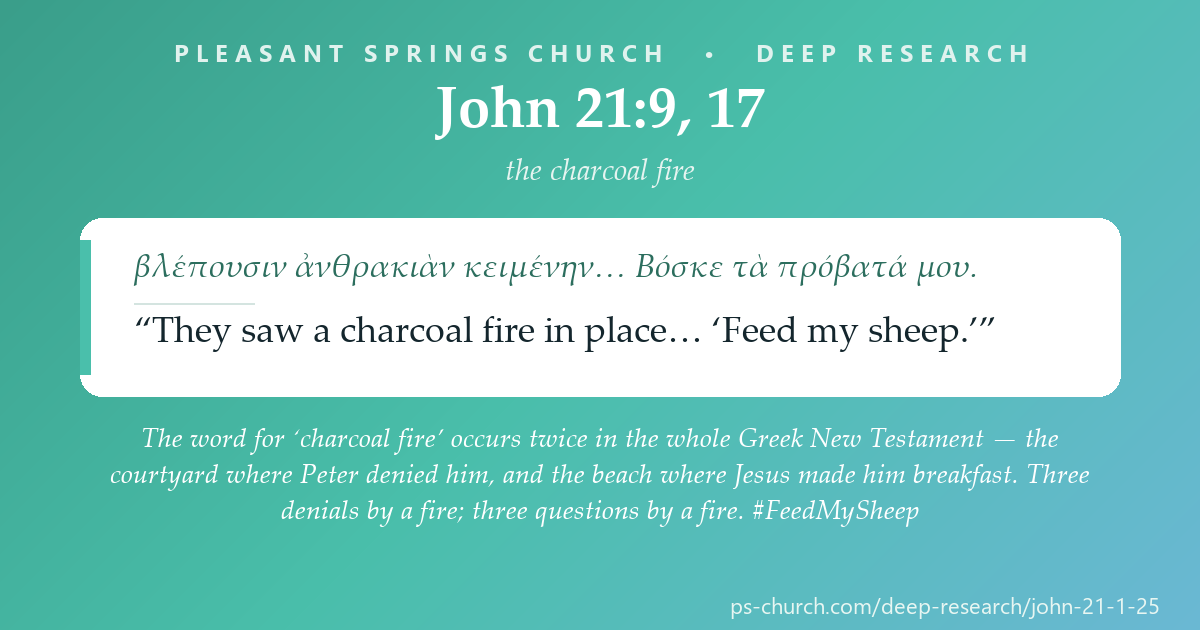
The detail that does the work. John does not say “a fire.” He says anthrakian, a charcoal fire. He used that word once before, in a high priest’s courtyard on the night of the arrest, where Peter stood warming himself and denied his Lord (18:18). Those are the only two occurrences of the word in the entire Greek New Testament. The author does not explain the echo; he simply lights the same fire on a beach and lets Peter walk up to it. That is how this Gospel usually preaches — by putting a thing in front of you twice.
Audience
A church that had buried Peter and was burying John. Two of the chapter’s concerns only make sense to readers who already knew how Peter died and were watching the last eyewitness grow old. Verse 19 explains the sign: the stretched-out hands and the being carried where you do not wish to go are the death by which Peter would “glorify God.” And verses 20–23 exist to kill a rumour: the saying went out among the brothers that this disciple was not to die. John quotes what Jesus actually said, word for word, twice in two verses, and lets the exact repetition do the correcting.
And a church that needed its failures restored, not merely forgiven. Peter is not told that his denial is overlooked. He is asked, in front of the others, whether he loves — three times, until it hurts — and each time he is handed sheep. Forgiveness is assumed; what is being given back is work. The chapter ends with the same two words the Gospel used to begin calling people at all (1:43): Follow me.
Orient on the epilogue, on Peter, on the shepherd image — and settle the numbering before quoting anything.
Search by topic: John, Gospel of — epilogue / appendix; Peter; resurrection appearances; shepherd; fishing in the Sea of Galilee; the beloved disciple; martyrdom.
Which articles are relevant?
- Anchor Bible Dictionary — “John, Gospel of,” “Peter,” “Beloved Disciple,” “Fishing,” “Shepherd.”
- Dictionary of Jesus and the Gospels (IVP) — “Resurrection,” “Peter,” “Discipleship,” “Beloved Disciple.”
- NIDNTTE / TDNT — ἀγαπάω, φιλέω, βόσκω, ποιμαίνω, ἀρνίον, φανερόω.
- These were not consulted for any measurement below. Every number on this page came from the text files named in the footer.
Settle the numbering first — and note what is different about a New Testament page
Every page on this shelf states its versification offset, including the pages where the answer is that there is none. On a New Testament book the answer is stronger than that: there is no Masoretic column and no Septuagint column, so there is nothing to be offset from.
| text | John 21 | whole Gospel |
|---|---|---|
| SBLGNT (MorphGNT) | 25 | 866 |
| ESV | 25 | 879 |
| Modern English versification, counted off disk | 25 | 879 |
The SBLGNT row and the modern-English row were counted off disk; the ESV row is the printed edition’s shape, because no ESV John file is held here. Chapter 21 is 25 verses in all three, so every number in the codex above means the same verse in every column.
But the whole book does carry a counting difference, and it is worth naming precisely, because it is not an offset — it is an omission. The Greek John held here runs 866 verses; the printed English John runs 879. The gap is exactly thirteen, and the thirteen are exactly John 5:4 (the angel troubling the water) and John 7:53–8:11 (the woman caught in adultery) — one verse plus twelve. The SBLGNT does not carry them in its running text; the English versions print them with a note. 866 + 1 + 12 = 879. Verified by counting the verse labels in the file: 51 / 25 / 36 / 54 / 46 / 71 / 52 / 48 / 41 / 42 / 57 / 50 / 38 / 31 / 27 / 33 / 26 / 40 / 42 / 31 / 25, with no 5:4 and no 7:53–8:11 rows present at all.
⚠️ What this does and does not affect. Nothing on this page. Chapter 21 sits after both gaps and is numbered identically everywhere. It is stated because the shelf states it everywhere — and because a reader who counts John’s verses in two Bibles and gets two answers deserves to know why.
A fire of coals, a working man’s coat, the morning meal — and a number nobody can account for.
The measurement this page is built on: the charcoal fire
John 21:9 says the disciples came ashore and saw ἀνθρακιάν — not a fire, a charcoal fire. The word occurs twice in the whole Greek New Testament. Both are in John. Both have Peter standing at them.
| where | the scene | Peter |
|---|---|---|
| John 18:18 | the high priest’s courtyard, a cold night, servants and officers had made a charcoal fire and were warming themselves | “Peter also was with them, standing and warming himself” — and three times denied |
| John 21:9 | the shore of Tiberias at dawn, a charcoal fire already laid, with fish on it and bread | “Simon Peter went aboard and hauled the net ashore” — and three times was asked |
Screened exhaustively over 7,927 verses of the SBLGNT for any word normalising to a stem in ἀνθρακι-: two hits, John 18:18 and John 21:9. In the Greek Old Testament files held here the same stem returns five hits — 4 Maccabees 9:20, Esther 1:7, Sirach 11:32 and Tobit 13:17 in both recensions — and not one of them is a fire on a shore or in a courtyard.
⚠️ And here is the counter-measurement, which matters more. If you screen the restoration scene (21:15–17) against the denial scene (18:15–27) for shared wording, the deepest run is two words — “ὁ Πέτρος” and “καὶ εἶπεν” — and 21:15 and 21:16 reach only one. The link between the denial and the restoration is not a verbal parallel. It is carried by a single noun, ἀνθρακιά, and by a number, three. That is a real link and a thin one, and this page will not dress it up as more.
The clothes, the meal, and the fish
“He was naked” does not mean what it sounds like. Peter ἦν γὰρ γυμνός — stripped for work, in an under-tunic or less, the ordinary state of a man handling wet nets. What he ties on before jumping is his ἐπενδύτης, an outer coat. The word occurs once in the Greek New Testament (here) and once in the Greek Old Testament files held here — 2 Samuel 13:18, the long robe of Tamar, a king’s virgin daughter. Peter dresses to meet his Lord and then swims in the clothes; the detail is a man’s instinct, not a theology.
Breakfast, not supper. ἀριστήσατε is the first meal of the day; δεῦτε ἀριστήσατε, “come, have breakfast,” occurs once in the Greek New Testament, here. The meal is bread and ὀψάριον — and that word for cooked fish occurs five times in the New Testament, all five in John: 6:9 and 6:11, the boy’s loaves and fish before five thousand, and 21:9, 10, 13, the loaf and fish before seven. The other Evangelists say ἰχθύς. Bread and opsarion is John’s pairing, and he uses it twice: once when Jesus feeds a crowd, and once when he feeds the men who ran away.
Two more first-and-only words sit in these verses. προσφάγιον (“anything to eat with bread”, 21:5) is a New Testament hapax and returns zero hits in the Greek Old Testament files held here. And αἰγιαλός, the beach, is a word of six New Testament occurrences — two in Matthew’s parable chapter, three in Acts (21:5 on the beach at Tyre, and the shipwreck at 27:39–40), and this one.
- 2 Samuel 13:18 — the ependytēs, the only other occurrence of Peter’s coat in the Greek texts held here.
- John 6:1–14 — bread and opsarion for five thousand; the same two words, the same lake, the same author (see I am the bread of life).
- Luke 24:41–43; Acts 10:41 — the risen Jesus eats; “we ate and drank with him after he rose from the dead”: the meal as evidence of a real body.
The number 153 — what can and cannot be checked
John counts the fish. He is the only Evangelist who counts anything like this, and he gives a number that has been explained for eighteen centuries and never settled.
What was screened here: the Greek Old Testament files on disk were searched for the number itself in four word orders — ἑκατὸν πεντήκοντα τριῶν, ἑκατὸν πεντήκοντα τρεῖς, τριῶν καὶ πεντήκοντα, πεντήκοντα καὶ τρεῖς. All four return zero. (τρεῖς καὶ πεντήκοντα does occur three times — Numbers 1:43, 2:30 and 26:31 — but every one is a census figure in the tens of thousands, not 153.) And John 21:11 was screened against Ezekiel 47:9–10, the passage most often proposed as its background: the deepest shared run between them is one word, καί.
NOT VERIFIABLE FROM LOCAL CORPORA. Jerome’s report that ancient naturalists counted 153 species of fish, the gematria proposals, the triangular-number reading (153 is the sum of 1 to 17), and the Ezekiel 47 fishermen — none of these can be confirmed or refuted from the files held here, and this page does not adjudicate between them. What it can say is narrower and firmer: the number 153 does not occur in the Greek Old Testament text on this disk, and the Ezekiel passage shares no phrase with John 21:11. Whatever the number means, it is not being quoted from anywhere measurable.
Notice what John actually does with the number. He does not say the catch was miraculous; he says the net held a hundred and fifty-three large fish and was not torn. The two halves of the sentence belong together. In Luke’s catch the nets begin to break and the boats begin to sink; here the load is specified and the net holds. A man who has counted the fish is a man who was there, on wet sand, with his hands in the net — the number reads first as the memory of an eyewitness who could not stop himself counting.
And that is the safest thing to say about it. The allegories may be right; several of them are beautiful. But this shelf reports what it can measure, and what it can measure is that the number is unattached — it quotes nothing, echoes nothing, and matches nothing in the Greek Old Testament on this disk. Sometimes a detail in Scripture is simply a fact that a witness remembered, and the honest reading is to let it be one.
The shepherd who is given a flock — the ancient background
“Shepherd” was the standing ancient title for a ruler — in Mesopotamian royal inscriptions, in Homer’s shepherd of the people, and above all in Israel’s own Scriptures, where the Lord is the shepherd (Ps 22/23), David is taken from the sheepfolds to shepherd Israel (2 Sam 5:2; Ps 77/78:70–72), and the shepherds of Israel are indicted for feeding themselves instead of the flock (Ezek 34). Against that background, handing a man a flock is not a compliment. It is an appointment, and it comes with the standard by which shepherds are judged.
Ezekiel 34 is the nearest thing to a source, and the measurement says the contact is real but shallow — three words. Screened: John 21:15, 16 and 17 against the 31 verses of Greek Ezekiel 34. 21:16 and 21:17 both reach a run of three — τὰ πρόβατά μου, “my sheep” — with a tie band of nine, because nine verses of Ezekiel 34 contain that exact phrase. John 21:15 reaches one: it says τὰ ἀρνία μου, “my lambs,” and Ezekiel 34 never says that. So two of the three commissions sit on Ezekiel’s phrase and the first does not. That is a link; it is not a citation, and John gives no signal that he is quoting.
- Ezekiel 34:1–16, 23 — “Should not shepherds feed the sheep?”; “I will set up over them one shepherd, my servant David”: the indictment and the promise. No Deep Research page on Ezekiel 34 exists yet; the passage is cited here from the CATSS Greek text directly.
- Psalm 22/23; 2 Samuel 5:2; Psalm 77/78:70–72 — the Lord as shepherd, and David taken from the sheepfolds. Psalm numbering: Greek 22 = English 23; Greek 77 = English 78 (see Psalm 23).
- Jeremiah 23:1–4; Zechariah 11:4–17; 13:7 — worthless shepherds and the shepherd who is struck: the prophetic frame Jesus stands inside.
- Homer, Iliad 2.243 and the Mesopotamian royal titulary — “shepherd of the people” as a ruler’s title (historical witnesses, not Scripture).
Where the vocabulary is countable — and where the popular sermon does not survive the count.
Each figure below is an exhaustive count over the 7,927 verses of the SBLGNT or the 30,348 verse units of Greek Old Testament screened here, of the 30,637 held in 64 CATSS files. Where a word is counted the count is on MorphGNT’s lemma column; where a phrase is counted it is on the normalised word form, contiguous and in order. Nothing is sampled.
A fire of charcoal, not wood. Two occurrences in the entire Greek New Testament — John 18:18 and John 21:9 — and Peter is standing at both. John never comments on the repetition.
Cooked fish, the relish eaten with bread. Five New Testament occurrences, all five in John: 6:9, 6:11 (the boy’s fish) and the three here. The other Gospels say ichthys.
“Feed” and “tend/shepherd.” boskō occurs nine times in the Greek New Testament; seven of the nine are herds of pigs (Matt 8:30, 33; Mark 5:11, 14; Luke 8:32, 34; Luke 15:15). The other two are these.
“My lambs.” arnion stands 30 times in the SBLGNT on MorphGNT’s lemma column: twenty-nine of the thirty are in Revelation — twenty-eight of them Revelation’s title for Christ himself, and one (13:11) a beast with two horns “like a lamb” — and the thirtieth is this. Outside Revelation the word is spoken once in the New Testament, and it is spoken about Peter’s flock. (A stem search on ἀρνι- returns 31 because it also catches Ἀρνί, the indeclinable name Arni at Luke 3:33 — a different lemma, not this word.)
The famous exchange. phileō occurs 25 times in the Greek New Testament, 13 of them in John, and five of those thirteen are in this chapter — more than in any other chapter of the New Testament. See the table below for why the “two loves” reading cannot be carried by John’s own usage.
“He revealed.” The verb occurs nine times in John; three of the nine are in this chapter, twice in 21:1 and once in 21:14 — opening and closing the sea-and-breakfast panel, and never appearing again.
“Signifying by what kind of death.” Three occurrences in the Greek New Testament, all three in John: 12:33 and 18:32, both of Jesus’ own death — and here, of Peter’s. The narrator’s formula for the crucifixion is used, on its last outing, for a disciple.
“Follow me.” Twice in John: 1:43 to Philip and 21:19 to Peter — the first man summoned with these words and the last. (Andrew and Simon come to Jesus earlier, at 1:37–42, but not with this summons.) Twelve occurrences of the pair in the New Testament: eleven in that order, and one reversed (21:22, sy moi akolouthei) — on the SBLGNT’s text; see the limits in Stage 5.
“Do you agapaō me?” — and why the two-loves reading will not hold
The best-loved reading of this passage is that Jesus asks twice for the higher love, agapaō, Peter can only offer the lower brotherly love, phileō, and on the third asking Jesus comes down to Peter’s word. It preaches beautifully. John’s own usage does not support it, and the evidence is countable.
| the same person or relation | said with ἀγαπάω | said with φιλέω |
|---|---|---|
| the disciple whom Jesus loved | 13:23; 21:7; 21:20 — ὃν ἠγάπα ὁ Ἰησοῦς (3×) | 20:2 — ὃν ἐφίλει ὁ Ἰησοῦς (1×) |
| the Father’s love for the Son | 3:35; 10:17; 15:9; 17:24 | 5:20 — ὁ… πατὴρ φιλεῖ τὸν υἱόν |
| the Father’s love for the disciples | 14:21, 23; 17:23 | 16:27 — αὐτὸς… ὁ πατὴρ φιλεῖ ὑμᾶς |
| Jesus’ love for Lazarus | 11:5 | 11:3, 36 |
Counted: ἀγαπάω 143 times in the Greek New Testament, 37 in John; φιλέω 25 times, 13 in John, 5 of them in chapter 21. The phrase ὃν ἠγάπα ὁ Ἰησοῦς occurs exactly three times and ὃν ἐφίλει ὁ Ἰησοῦς exactly once, and they name the same man.
The four things that actually vary — and the one thing that does not.
| Jesus asks | Peter answers | the flock | the charge | |
|---|---|---|---|---|
| first | ἀγαπᾷς με πλέον τούτων; | οἶδας… φιλῶ σε | τὰ ἀρνία lambs | βόσκε feed |
| second | ἀγαπᾷς με; | οἶδας… φιλῶ σε | τὰ πρόβατα sheep | ποίμαινε tend |
| third | φιλεῖς με; | πάντα σὺ οἶδας, σὺ γινώσκεις… φιλῶ σε | τὰ πρόβατα sheep | βόσκε feed |
Four columns move, and they do not move together. If the shift from agapaō to phileō were the point, the flock words and the charge words would be steady and only the love word would change. Instead every column varies, in different patterns — the charge goes feed / tend / feed, doubling back; the flock goes lambs / sheep / sheep. This is a writer varying his vocabulary, which is what this writer does everywhere. And John tells us plainly what stung. He does not write “Peter was grieved because he said phileis.” He writes ἐλυπήθη ὁ Πέτρος ὅτι εἶπεν αὐτῷ τὸ τρίτον — because he said to him the third time. The wound is the count, and the count is the one thing the Greek explicitly names.
⚠️ Held honestly. None of this proves the two verbs are perfect synonyms everywhere in Greek, and it does not prove the traditional reading false. What it shows is that this author uses both verbs of the highest loves in his book, including of the same man in the same sentence-frame — so an argument that rests on a fixed difference between them is resting on something John’s own text does not supply.
Where the vocabulary points outside the chapter:
- Revelation 5:6–14; 7:17 — the Lamb (arnion) who is the shepherd: the twenty-nine Revelation occurrences that make John 21:15 the odd one out, and the Lamb who “will be their shepherd” (see the Lamb who was slain).
- John 10:1–18 — “I am the good shepherd… I lay down my life for the sheep”: whose sheep Peter is being handed (see the good shepherd).
- Acts 20:28; 1 Peter 5:1–4 — “shepherd the flock of God… not domineering… and when the chief Shepherd appears”: Peter, decades later, passing on the charge he was given on that beach, in the same verb.
- John 13:36–38 — “Lord, why can I not follow you now? I will lay down my life for you”… “you will deny me three times”: the upper-room promise chapter 21 answers (see the upper room).
The run screens: how deep John 21’s verbatim contact goes, in every direction, with the tie band beside each one.
Method: every verse of John 21, normalised on MorphGNT field 6, screened for the longest contiguous run of identical word forms against a whole corpus. The tie band is the number of target verses that reach that same depth — a run of five with a band of one is a signal; a run of four with a band of fifteen is a formula. Exhaustive and deterministic; nothing sampled.
1. John 21 against the rest of the Greek New Testament
Across the 25 rows against the other 7,902 verses of the Greek New Testament: all 25 reach three, 16 reach four, 4 reach five, and nothing reaches six.
| row | run | band | the shared words — and what they are |
|---|---|---|---|
| 21:2 | 5 | 1 | ἐκ τῶν μαθητῶν αὐτοῦ δύο → John 1:35. Two of his disciples, at the Gospel’s beginning and its end — and the band of one means nowhere else. |
| 21:5 | 5 | 1 | λέγει οὖν αὐτοῖς ὁ Ἰησοῦς → John 7:6. A narrator’s formula. |
| 21:21 | 5 | 1 | ὁ Πέτρος λέγει τῷ Ἰησοῦ → Mark 9:5. A narrator’s formula. |
| 21:23 | 5 | 2 | εἶπεν δὲ αὐτῷ ὁ Ἰησοῦς → Luke 10:37, 18:19. A narrator’s formula. |
| 21:17 | 4 | 15 | λέγει αὐτῷ ὁ Ἰησοῦς — fifteen verses tie. This is what a formula looks like in the numbers. |
| 21:19 | 4 | 4 | εἶπεν σημαίνων ποίῳ θανάτῳ → John 18:32 — and three of those four (σημαίνων ποίῳ θανάτῳ) stand again at John 12:33, which reads ἔλεγεν and so does not tie here. Read the band: the other three verses in it (Matt 8:22, 9:9, Mark 2:14) tie on a different four words, λέγει αὐτῷ ἀκολούθει μοι. On the death-formula itself only John 18:32 ties — not a formula: a signature. |
| 21:20 | 4 | 1 | ὃν ἠγάπα ὁ Ἰησοῦς → John 13:23. The title, unique to this Gospel. |
Read the bands. Three of the four deepest runs are stock narrative connectives that happen to be five words long. The rows that actually mean something — 21:19 and 21:20 — are only four deep. Depth is not significance; the band is what tells them apart.
2. John 21 against the whole Greek Old Testament — the honest zero
Across the 25 rows against the 30,348 verse units of Greek Old Testament screened here (of 30,637 held): all 25 reach two, 20 reach three, 7 reach four, and nothing reaches five. John 21 does not quote the Old Testament. Not once.
| row | run | band | deepest partner | verdict |
|---|---|---|---|---|
| 21:7, 21:12 | 4 | 1 | ὅτι ὁ κύριός ἐστιν → Job 19:6, “know then that it is the Lord who has troubled me” | coincidence |
| 21:20 | 4 | 1 | αὐτοῦ καὶ εἶπεν κύριε → 2 Chronicles 14:10 | coincidence |
| 21:3 | 4 | 1 | καὶ ἐν ἐκείνῃ τῇ → Daniel (OG) 12:1 | coincidence |
| 21:18 | 4 | 9 | τὰς χεῖράς σου καί → nine verses tie | formula |
| 21:23 | 4 | 6 | εἶπεν δὲ αὐτῷ ὁ → six verses tie | formula |
| 21:6 | 4 | 2 | ἀπὸ τοῦ πλήθους τῶν → Ezekiel 26:10, Genesis 36:7 | coincidence |
Look hard at the first row. Three rows tie for the deepest and rarest verbal contact between this chapter and the entire Greek Old Testament on this disk. The one worth staring at is the four words shared with Job, because two separate rows of John 21 land on it, in a verse where Job protests that God has wronged him. It is a run of four with a band of one — the exact profile of a “find” — and it is almost certainly an accident of common vocabulary. This shelf reports it as an accident, and prints it here so that no one else has to rediscover it and mistake it for a discovery.
What a zero means here. This screen uses the Greek-side convention, with unigram fallback on, so a score of 1 means “shares only a single word” and not “shares nothing.” And the corpus is 30,348 verse units screened, of the 30,637 held in 64 CATSS files on this disk (the 289 Odes units are held but not screened: Odes 9 and 13 are Luke 1–2, and ten others duplicate passages already in the corpus) — which includes the deuterocanonical books, both Greek Daniels and both Greek Judges — not the whole Septuagint tradition, and with no apparatus. Re-run on 24 September 2026 with and without the Odes: every figure in this screen is the same either way.
3. The chapter’s deepest verbatim contact is with itself
| comparison | run | the shared words |
|---|---|---|
| John 21:15 vs 21:16 | 11 | λέγει αὐτῷ· ναί, κύριε, σὺ οἶδας ὅτι φιλῶ σε. λέγει αὐτῷ |
| John 21:22 vs 21:23 | 9 | ἐὰν αὐτὸν θέλω μένειν ἕως ἔρχομαι, τί πρὸς σέ |
| John 21:16 vs 21:17 | 5 | ὅτι φιλῶ σε. λέγει αὐτῷ |
| John 21:15 vs 21:17 | 5 | ὅτι φιλῶ σε. λέγει αὐτῷ |
| John 20:30 vs 21:25 | 3 | ἐποίησεν ὁ Ἰησοῦς — all the two endings share |
Eleven and nine are deeper than anything John 21 shares with the other 7,902 verses of the New Testament (five) or with the whole Greek Old Testament (four). The chapter’s most exact repetitions are internal, and both of them are doing a job:
The eleven-word run is the second exchange repeating the first word for word — and then the third exchange breaks it, dropping to five, exactly where Jesus changes the verb and Peter is grieved. The pattern is set so that its breaking can be felt.
The nine-word run is John correcting a rumour by quoting. “The saying spread abroad that this disciple was not to die” — and John answers it not by arguing but by printing the sentence again, unchanged: ἐὰν αὐτὸν θέλω μένειν ἕως ἔρχομαι, τί πρὸς σέ. This shelf cannot date it against anything else and does not claim it is the earliest such correction on record; what is measurable is the method — exact repetition.
4. The counter-example this page owes you: John 21 and Luke 5
The catch of fish in Luke 5:1–11 is constantly set beside this one, and the two scenes do look alike: Simon Peter, a boat, a night of nothing, a word from Jesus, a net that fills. They share almost no wording at all.
| direction | deepest run | the words |
|---|---|---|
| John 21:1–14 → Luke 5:1–11 | 3 | ἀπὸ τῆς γῆς (John 21:8 / Luke 5:3) — “from the land” |
| Luke 5:1–11 → John 21:1–14 | 3 | the same three words, the same pair of verses |
| everything else in both passages | 2 or 1 | Σίμων Πέτρος, τῶν ἰχθύων, τὴν γῆν — and not even the net, because the two texts do not spell it alike: John has δίκτυον, Luke 5:2, 4, 5, 6 has δίκτυα, and this engine matches forms, never lemmas |
The deepest contact between the two most similar fishing narratives in the New Testament is a three-word prepositional phrase meaning “from the land.” Whatever the relationship between these accounts is, it is not verbal — and this page names no direction of influence between them, because the measurement cannot supply one.
Why this table is here. It is the control for everything above it. If two narratives this alike can share only three words, then a run of four or five between John 21 and some other text is worth very little on its own — and the page’s own runs of five need reading with that in mind.
5. The threads that do hold — each one named for what it is
- John 13:36–38 → 21:18–19 — a promise answered, not a phrase reused. In the upper room: “where I am going you cannot follow me now, but you will follow afterward”; “I will lay down my life for you”; “you will deny me three times.” On the beach: the three questions, the death foretold, and “follow me.” Measured: the deepest run between them is four words, and it is the solemn formula itself — ἀμὴν ἀμὴν λέγω σοι, John 13:38 against 21:18, band one. Strip that formula out and nothing else in the two passages reaches three: 21:19 against 13:36 and 13:37 is two words, 21:18 against 13:36 and 13:37 is one. The connection is of substance and of a shared formula, not of reused wording, and the page says so.
- John 12:33; 18:32 → 21:19 — a genuine four-word signature. σημαίνων ποίῳ θανάτῳ occurs three times in the New Testament and all three are John’s: twice of Jesus’ own death, once of Peter’s.
- John 3:3, 5, 11; 13:38 → 21:18 — a formula whose last two uses are both to Peter. The double-amen with a singular “you,” ἀμὴν ἀμὴν λέγω σοι, occurs five times in the New Testament, all in John: three to Nicodemus, then 13:38 (“you will deny me three times”) and 21:18 (“another will carry you where you do not wish to go”).
- John 1:43 → 21:19 — the Gospel’s two calls. ἀκολούθει μοι occurs exactly twice in John: the first man summoned with those words (Philip, 1:43 — Andrew and Simon had already come to Jesus by another route) and the last (Peter). The Gospel opens and closes its calling with the same two words.
- Ezekiel 34 → John 21:16–17 — three words, band nine. τὰ πρόβατά μου; and the verb boskō that Jesus uses stands nine times in Greek Ezekiel 34, more than in any other single chapter of the Greek Old Testament held here. Real contact, shallow depth, no citation signal.
Put the screens side by side and a shape appears that no single one of them shows. John 21 quotes nothing. Its deepest contact with the Old Testament is four words with Job, by accident. Its deepest contact with the rest of the New Testament is five words of stock narration. Its deepest contact with the story it most resembles, Luke’s catch of fish, is three words meaning “from the land.” And its own deepest verbatim run — eleven words — is with itself, one verse against the next.
That is not a chapter assembled out of other texts. It is a chapter built out of repetition: a fire lit twice, a question asked three times, a sentence printed twice to stop a rumour, two words of calling said at the start of the book and again at the end. John is not arguing from Scripture here. He is doing what he did in the garden on Easter morning — putting one small thing in front of you a second time and waiting for you to recognise it. Peter smelled the charcoal before he heard the question.
The scholarship, and an honest account of where this page is thin.
This is the section that makes the shelf trustworthy. It names what was not consulted, what could not be checked, and which claims above would fall first.
Commentaries & studies (none of which produced any number above):
- D. A. Carson (Pillar), Craig S. Keener (2 vols.), Raymond E. Brown (Anchor Yale), Andreas J. Köstenberger (BECNT), J. Ramsey Michaels (NICNT), Rudolf Schnackenburg, C. K. Barrett on John — the standing disagreement over whether chapter 21 is by the Evangelist, by his circle, or an authorial epilogue planned from the start.
- Richard Bauckham, Jesus and the Eyewitnesses and The Testimony of the Beloved Disciple; Martin Hengel, The Johannine Question.
- On the agapaō / phileō question: Carson and Morris (synonymous variation) against Hendriksen, Trench and Westcott (a real distinction) — a genuinely divided question, not a settled one.
- On 153: Jerome, Commentary on Ezekiel 14 (the fish species); Augustine, Tractates on John 122 (the triangular number of 17); a large modern literature, none of it decisive.
⚠️ What was NOT consulted, and what could NOT be checked
- No critical apparatus was consulted, on any side. The Greek is the SBL edition as digitized by MorphGNT, read as a running text. The edition’s own sigla were stripped before printing and were not treated as an apparatus.
- The one claim above that depends on an editorial choice. The statement that σύ μοι ἀκολούθει (21:22) is the only reversed occurrence of “follow me” in the New Testament holds on the SBLGNT text. That verse is one of the places where the SBL editor marks a difference from the editions he compares; other printed Greek texts read ἀκολούθει μοι there. Which editions differ cannot be checked here — no apparatus file is held. If yours does, the count becomes twelve and zero, and the observation about the frame in the structure diagram weakens to a repetition rather than a reversal.
- No manuscript evidence was examined for the authenticity of chapter 21. The standard statement — that no surviving Greek manuscript containing the end of John lacks chapter 21 — is reported here from the literature, not measured. Nothing on this disk can confirm or refute it. The stylistic arguments on both sides were likewise not tested.
- No Aramaic or Syriac corpus is held. The frequent suggestion that the agapaō/phileō alternation reflects a single underlying Semitic verb, or that the Syriac versions flatten it, is NOT VERIFIABLE FROM LOCAL CORPORA. The counts above are of Greek only.
- No ESV file is held for John. The English column was typeset by hand from the printed 2016 text edition; the ESV verse total for John in the numbering table is the printed edition’s shape, not a count off disk. The SBLGNT total was counted off disk, and so was that of the modern English edition held here for versification.
- The Greek Old Testament screened is not the whole Septuagint. It is 30,348 verse units screened, of the 30,637 held in 64 CATSS files on this disk (the 289 Odes units are held but not screened). A zero here is a zero on that corpus.
- Nothing on this page establishes a direction of influence. Not between John 21 and Luke 5, not between John 21 and Ezekiel 34, not between John 21 and Job 19:6. The screens find verbatim contact; they do not find borrowing, and they cannot tell which way a borrowing ran.
Where this page is weakest — ranked
- 1. The charcoal-fire link is thin by design, and the page leans on it. Two occurrences of one noun is a real and rare pattern; it is also one word. The measured counter-evidence is printed in Stage 2: the restoration scene and the denial scene share no run longer than two words. A reader who thinks the echo is coincidence has the numbers to argue with, above.
- 2. The structure diagram is a sequence, and the second frame rests on the variant discussed above. The phaneroō frame (21:1 / 21:14) is secure — three of nine occurrences in John, and countable. The follow me frame is secure as a repetition and only probable as a reversal.
- 3. The 153 is left unexplained, deliberately. That will dissatisfy readers on both sides. The page states only what the corpora support: the number is not in the Greek Old Testament on this disk, and Ezekiel 47:9–10 shares one word with John 21:11.
- 4. The reading of the four-column variation table is an argument, not a measurement. The counts in it are exact; the inference — that varying four columns at once indicates stylistic variation rather than four separate points of doctrine — is a judgement, and a competent scholar could take the same table the other way.
- 5. Peter’s martyrdom. That 21:18–19 was understood in the early church as foretelling crucifixion is historical report (Tertullian, Eusebius), not measurement. Nothing here verifies it.
Interpretation notes worth keeping:
- Restoration, not re-conversion. Peter is not being saved again; he is being given work again. The threefold questioning restores a called man to a public commission before witnesses.
- The commission is pastoral and derivative. They are Christ’s lambs and Christ’s sheep throughout — my lambs, my sheep. Peter is handed a charge over a flock that is never his (cf. 1 Peter 5:2–4, Acts 20:28).
- Do not build doctrine on the love-verb variation. The synonymous reading is at least as well supported by John’s own usage as the distinction is; preach the count and the commission, which the text names outright.
- “What is that to you?” The last recorded exchange of the Gospel is a rebuke of comparison. Peter’s calling is Peter’s; the other disciple’s is his own; the answer to both is the same two words.
- 21:23 is a warning about handling Jesus’ words. A saying was repeated slightly wrong and became a false expectation inside the church. The correction is to quote him exactly. That is a method, and it is the method of this whole shelf.
From a fire in a courtyard to a fire on a beach.
Name what you learned, why it matters, and one concrete response.
What should we carry away — and do?
- He lights the same fire. The charcoal fire is one of only two in the New Testament, and Peter stood at both. Christ does not tiptoe around the place where you failed; he cooks breakfast there and calls you over.
- The wound is the count, and so is the healing. Three denials by a fire; three questions by a fire. John says outright that what grieved Peter was the third time — and the third time is exactly what put every denial back on the table and answered it.
- Forgiveness gives back work. Peter is not told he is excused. He is handed lambs, then sheep, then sheep — and then told how he will die. Being restored by Christ means being put back to work for Christ’s flock, not Christ’s flock being taken away from you.
- Stop comparing. “Lord, what about this man?” — “What is that to you? You follow me.” The Gospel’s last words to a disciple are the same two it opened with, and they are addressed to you singular.
Step in response: name the fire you have been avoiding — the room, the person, the anniversary, the memory of the night you said you did not know him. Then go there on purpose this week, with Christ, and ask him what work he is giving back to you on the other side of it. Do not ask him what he is doing with anybody else.
John 21:17 · to share
Greek NT + ESVEvery Deep Research page traces its passage across the whole sweep — the Old Testament, the Second-Temple world between the testaments (historical witnesses, not Scripture), and the New Testament. Follow the thread:
Pleasant Springs Church — Deep Research
Research method after Michael S. Heiser’s Bible Research Method (examine dictionaries → ancient literature → important words → textual connections → academic publications → share), with the Pleasant Springs “Author & Audience” foundation. Scripture set in the Hebrew, the Greek editions named on each page and the ESV (Old Testament), and the Greek New Testament and the ESV (New Testament), per the practice of Pleasant Springs Church. John 21 research oriented by Carson, Keener, Brown, Köstenberger, Michaels and Bauckham — none of which were consulted for any number on this page. Text: Greek New Testament from the SBL edition as digitized by MorphGNT, screened on field 6 (the normalised form) and printed from field 4 with the edition’s sigla stripped; Greek Old Testament from Rahlfs’ Septuaginta as digitized by CATSS, 64 files and 30,637 verse units held, 30,348 of them screened (the Odes held, not screened). No critical apparatus was consulted on any side, and the standing caution for this shelf applies: these pages say “the row reads…” and never call a reading early or late, and never assert a direction of influence. ⚠️ VERSE NUMBERING — John is a New Testament book, so there is no Masoretic and no Septuagint column and no offset to state. Counted anyway: John 21 runs 25 verses in the SBLGNT and in the ESV alike, so every reference on this page means the same verse in both columns. The book as a whole does differ — the SBLGNT John held here has 866 verses against the printed English 879 — but that gap is not an offset; it is exactly the thirteen verses at John 5:4 and John 7:53–8:11, which the SBLGNT does not carry in its running text. Chapter 21 is unaffected. Stated because this shelf states it everywhere, including where there is nothing to convert.
Scripture quotations marked ESV are from the ESV® Bible (The Holy Bible, English Standard Version®), © 2001 by Crossway, a publishing ministry of Good News Publishers. ESV Text Edition: 2016. Used by permission. All rights reserved. The ESV text may not be quoted in any publication made available to the public by a Creative Commons license, and the ESV may not be translated in whole or in part into any other language. www.esv.org
|
Did this study bless you today? 💚 Give to Support PS Church100% of gifts go to the General Fund — thank you. |