Screen all 59 verses of John 16 and 17 against the other 7,868 verses of the Greek New Testament and the deepest thing in them is six consecutive words — twice, and both times with the same verse. John 17:14 and John 17:16 each share six words with John 8:23, at a tie band of one. John 8:23 is not a prayer and not a farewell; it is the hardest exchange in the Gospel, spoken to opponents in the temple: you are of this world, I am not of this world. The sentence Jesus levels at his accusers in chapter 8 is the sentence he says over his friends in chapter 17. Then take the Fourth Gospel out of the target corpus and the whole passage goes quiet. Against the 7,061 New Testament verses outside John, nothing in these two chapters reaches six at all, and the deepest survivor is John 17:1 against Luke 6:20 — five words, tie band one, describing a man lifting up his eyes. The most quoted prayer in Christendom has almost no verbatim contact with any book but its own. Its one real reach outward is measured too: John 16:22 shares six consecutive words with Septuagint Isaiah 66:14, with no quotation formula anywhere near it. See the method →
John 16:1–17:26 (selections)
Greek New Testament (SBLGNT, via MorphGNT) · ESV★ None of that touches this page. John 16 has 33 verses and John 17 has 26 in the SBLGNT and in the ESV alike, so every reference printed here means the same verse in both columns. The offset is stated because this shelf states it everywhere, including where the answer is that there is none. What there is instead is a measurement: screened against the other 7,868 verses of the Greek New Testament, these 59 rows top out at six consecutive shared words, twice, both times with John 8:23. Remove the Fourth Gospel from the target corpus and nothing reaches six at all. Stage 4 gives the tables.
The Shape of the Passage
A framed discourse, then a prayer on a spine of vocatives — and not a chiasmThese two chapters are the last private words in the Gospel, and the book itself tells you almost nothing about who wrote them down. The Fourth Gospel names no author in its body and identifies itself only at 21:24, as the testimony of the disciple whom Jesus loved. This page keeps that question separate from every number below, because none of the numbers depends on it.
Author
Anonymous in the text, and the earliest witnesses to the name are not on this disk. The Gospel calls its source ὁ μαθητὴς whom Jesus loved (13:23; 19:26; 20:2; 21:7, 20) and closes by saying he wrote these things. The name John is attached by Irenaeus and by the manuscript titles, neither of which is held here and neither of which was consulted.
What is measurable is the vocabulary, and it is unmistakable. κόσμος occurs 185 times in the Greek New Testament and 78 of them are in this Gospel — more than twice any other book. ἀληθ- words, the ἄρχων of this world, ἀποσυνάγωγος, παροιμία, παράκλητος — the concentrations are extreme and they are the reason the next paragraph matters.
⚠️ And that concentration is exactly what makes the central measurement on this page cut both ways. When the deepest runs in John 16–17 all land inside John, that is a fact about a writer with a small and repeated vocabulary as much as it is a fact about these chapters. The page reports the control it ran: John 14–15, screened the same way, reaches eight (15:20 against 13:16), so the shallowness of 16–17 is not an artefact of the method. It is still one author’s habit, and the page says so before it says anything else.
Audience
Inside the story: eleven men, at night, after a meal, with Judas already gone. The discourse runs from 13:31 to 16:33 and the prayer from 17:1 to 17:26; 18:1 is the crossing of the Kidron. Nothing in these two chapters is spoken to a crowd, and 17:20 is the one place the prayer looks past the room — those who will believe in me through their word.
Outside the story: readers who are being put out of synagogues. 16:2 says so plainly, and the word it uses, ἀποσυνάγωγος, occurs three times in the Greek New Testament and all three are in this Gospel (9:22; 12:42; 16:2). That is a count, not a date. Whether it points to a formal first-century exclusion, and if so which one, is a historical argument this page does not enter and could not settle from a word list.
The prayer names its own audience twice, and it is not the world. 17:9 — I am not praying for the world — and 17:20, those who will believe through their word. Yet the reason given for the asking, at 17:21 and again at 17:23, is that the world may believe and may know. The two statements sit eleven verses apart, and the page prints both.
Orient on the farewell discourse, the Paraclete, and the high-priestly prayer — before touching a single number.
Search by topic: John, Gospel of; Farewell Discourse; Paraclete; Holy Spirit; High-Priestly Prayer; glory / doxa; sanctification; birkat ha-minim; aposynagogos; unity of the church.
Which articles are relevant?
- Anchor Bible Dictionary — “John, Gospel of,” “Paraclete,” “Holy Spirit,” “Glory.”
- Dictionary of Jesus and the Gospels (IVP, 2nd ed.) — “Farewell Discourse,” “Holy Spirit,” “Prayer,” “Glory.”
- New International Dictionary of NT Theology & Exegesis — παράκλητος, ἐλέγχω, ἁγιάζω, δοξάζω, κόσμος, παροιμία.
- Commentary on the New Testament Use of the Old Testament, ed. G. K. Beale and D. A. Carson (Baker, 2007) — the John chapter, which is where the question of whether John 16–17 alludes to Isaiah 66 is actually argued.
- These were not consulted for the measurements below. The measurements were run on the text files named in the footer.
Settle the numbering first — and note what is different about a New Testament page
Every page on this shelf states its versification offset, including the pages where the answer is that there is none. On a New Testament book there is no second ancient column to be offset from — but John is the one Gospel where the Greek and the English still do not count the same.
| John, whole book | ch 16 | ch 17 | |
|---|---|---|---|
| SBLGNT (MorphGNT) | 866 | 33 | 26 |
| Full English versification | 878 | 33 | 26 |
| ESV | 878 in the text | 33 | 26 |
Both numbered rows were counted off disk. The twelve-verse difference is entirely in one place: 7:53–8:11, the woman taken in adultery, is not in the SBLGNT running text and is in the full English numbering. 5:4, the angel troubling the water, is in neither — the SBLGNT has no such row and the English file carries the number with an empty line, so John 5 has 46 verses of text and runs to the number 47 in both. The ESV prints 7:53–8:11 inside double brackets with a note that the earliest manuscripts do not include it, and prints John 5 with no verse 4 in the text, the wording relegated to a footnote.
None of that reaches this page. John 16 is 33 verses and John 17 is 26 verses in every column, so every reference on this page means the same verse on both sides. It is stated because a page that says ‘no offset’ and stops would have hidden a real twelve-verse divergence sitting nine chapters away.
A synagogue expulsion, a legal advocate, a woman in labour, and a phrase famous from a scroll this disk does not hold.
Put out of the synagogue — a word with no Greek pedigree
16:2 uses ἀποσυνάγωγος, one word, and it occurs three times in the Greek New Testament: John 9:22, John 12:42, John 16:2. Nowhere else, by any writer.
Searched further: the adjective does not occur in the 30,637 verse units of Greek Old Testament held on this disk either. On the corpora available here it is a Johannine coinage or near enough, and the ESV has to render it as a clause — they will put you out of the synagogues.
⚠️ What was not checked, and it is the thing everyone wants to know. The standard discussion ties these verses to the birkat ha-minim, the benediction against heretics in the Eighteen Benedictions, and argues about whether a formal expulsion of Jewish Christians stands behind the Gospel. No rabbinic text is held on this disk. The Mishnah, the Talmuds, the Cairo Geniza recensions of the Amidah — none of them were consulted and none could be. The page reports a word count in the New Testament and declines the historical reconstruction entirely.
παράκλητος — five occurrences, and the fifth changes the other four
The word occurs five times in the whole Greek New Testament: John 14:16, 14:26, 15:26, 16:7 — and 1 John 2:1.
| verse | who the Paraclete is |
|---|---|
| John 14:16 | “another Paraclete” — the Spirit of truth |
| John 14:26 | the Holy Spirit, sent by the Father in Jesus’ name |
| John 15:26 | the Spirit of truth, sent by Jesus from the Father |
| John 16:7 | will not come unless Jesus goes |
| 1 John 2:1 | Jesus Christ the righteous, with the Father |
14:16 says ἄλλον παράκλητον, another Paraclete, which already implies a first one; 1 John 2:1 names him. That is a relation between two texts, stated as a count and a reading, not as a claim about which was written first.
⚠️ Not checked. Whether παράκλητος is a legal term of art in the papyri and the orators, and what the Aramaic peraqlit in the rabbinic literature does with it, is reported in the reference works and is not measurable here. The documentary papyri, Philo and the rabbinic corpus are not on this disk.
The Spirit of truth — a phrase this disk finds four times and cannot trace
The exact sequence τὸ πνεῦμα τῆς ἀληθείας occurs four times in the Greek New Testament (John 14:17; 15:26; 16:13; 1 John 4:6) and zero times in the 30,637 verse units of Greek Old Testament held here.
⚠️ And the corpus where it is famous is not on this disk. The Qumran Community Rule (1QS 3:13–4:26) sets a spirit of truth against a spirit of deceit, and every commentary on John 16:13 discusses it. The Dead Sea Scrolls are not held here, in Hebrew or in translation, and were not searched. A zero on this page means zero in the Greek Old Testament files named in the footer, and it means nothing whatever about Qumran.
The woman in labour — and the parallel that measures nothing
16:21 is the one extended image in the chapter: a woman in labour has sorrow because her hour has come, and forgets the anguish for joy that a human being has been born into the world.
The obvious ancient background is Isaiah 66:7–9, where Zion gives birth before her labour comes on her. Measured against the Greek Isaiah held here, John 16:21 shares no run of three or more with any of Isaiah 66:7, 8 or 9. The vocabulary is simply different: Isaiah has ὠδίνω and τίκτω, John has τίκτῃ once and then γεννήσῃ.
★ And the very next verse reaches six. John 16:22 shares six consecutive words with Septuagint Isaiah 66:14, tie band 1 — καὶ χαρήσεται ὑμῶν ἡ καρδία καί. The thematic parallel everyone cites measures nothing and the verse after it measures the deepest Old Testament contact in these two chapters. That is the whole lesson of this method in two adjacent verses: verbal contact and thematic parallel are different things, and neither one proves the other.
Six words, and how rare each one actually is.
Five occurrences in the whole Greek New Testament — John 14:16, 14:26, 15:26, 16:7 and 1 John 2:1. The noun itself does not occur once in the 30,637 verse units of Greek Old Testament held here — though two neighbours from the same root do, and the page names them rather than rounding them away: παρακλήτορες at Job 16:2 (miserable comforters are you all) and παρακλητικούς at Zechariah 1:13. The ESV renders it Helper; the older English was Comforter, and Advocate is the standing alternative. The word does not decide between them and neither does this page.
John 16:8, and the only thing this Gospel says the Paraclete will do to the world. Seventeen occurrences in the Greek New Testament, three of them in John (3:20; 8:46; 16:8). It is a forensic verb: to bring to light, to prove in the wrong. Everything else the Paraclete does in chapters 14–16 — teach, remind, testify, guide, declare — is done for the disciples.
Five occurrences in the Greek New Testament; four of them in John (10:6; 16:25 twice; 16:29), the fifth at 2 Peter 2:22. And παραβολή, the Synoptics’ word, occurs 50 times in the Greek New Testament and not once in John. Two Gospels traditions, two nouns, no overlap at all.
17:17 and 17:19 twice — three of the four Johannine occurrences are in this one chapter, the fourth at 10:36. Twenty-eight occurrences across the Greek New Testament. It is the altar word, and the prayer uses it of the one praying (I consecrate myself) in the same breath as of the disciples.
Eighteen occurrences in the 26 verses of John 17, against eight in the whole 33 verses of John 16. Across the Greek New Testament the noun stands 185 times and 78 of those are in this Gospel — more than twice the next book (1 John, 23). And the chapter that says it eighteen times is the chapter that says at 17:9, I am not praying for the world.
John 16:33, and nowhere else in the Gospel of John. Counted by lemma across all 27 New Testament files: Revelation 17, 1 John 6, Romans 3, Luke 1, John 1. The verb that carries Revelation from end to end is spoken once by Jesus in this Gospel, in the last sentence before he stops speaking to the disciples and starts speaking to the Father.
John 17 is the densest ἵνα chapter in the New Testament, on both measures
Counted by lemma off the MorphGNT files, across all 260 chapters of the Greek New Testament: John 17 carries 19 occurrences of ἵνα in 26 verses — 0.73 per verse, and 38.2 per thousand words. It is first on both. On the per-verse measure nothing else is close; on the per-word measure the runner-up is Titus 2 at 31.7.
| chapter | ἵνα | verses | per verse | per 1,000 words |
|---|---|---|---|---|
| John 17 | 19 | 26 | 0.73 | 38.2 |
| 1 Corinthians 9 | 12 | 27 | 0.44 | 26.7 |
| Titus 2 | 6 | 15 | 0.40 | 31.7 |
| Colossians 4 | 7 | 18 | 0.39 | 24.6 |
| 2 John | 5 | 13 | 0.38 | 20.4 |
| John 15 | 9 | 27 | 0.33 | 18.0 |
| John 16 | 8 | 33 | 0.24 | 13.8 |
The whole Greek New Testament averages 0.08 occurrences per verse; John as a book averages 0.17. John 17 runs at more than four times its own Gospel’s rate. The conjunction is the chapter’s grammar: it defines eternal life (17:3), it asks for oneness (17:11, 21, 22), it gives the reason (17:21, 23), and it carries the last clause of the prayer (17:26).
The caveat: this counts the conjunction as MorphGNT lemmatises it, and chapter divisions are medieval, not authorial. A differently divided text would move every row. The comparison is honest only because the same division was applied to all 260 chapters.
Every “Father” in John 17 is a vocative. Not one in John 16 is.
Counted off the MorphGNT parsing column, which tags case directly: πατήρ occurs six times in John 17, and all six are parsed vocative singular masculine — 17:1, 5, 11, 21, 24, 25. It occurs eleven times in John 16, and not one of those eleven is a vocative.
| occurrences of πατήρ | vocative | other cases | |
|---|---|---|---|
| John 16 | 11 | 0 | 11 |
| John 17 | 6 | 6 | 0 |
Chapter 16 talks about the Father eleven times and never to him. Chapter 17 talks to him six times and never about him. The vocative πάτερ occurs 24 times in the Greek New Testament; nine of them are in John, and six of those nine are in this chapter. Two of the six are qualified — πάτερ ἅγιε at 17:11 and πάτερ δίκαιε at 17:25 — and those are the only two places in the Greek New Testament where an adjective is attached to the vocative. (Matthew 11:25 and Luke 10:21 have πάτερ κύριε, which is a noun in apposition, and Luke 16 has πάτερ Ἀβραάμ, a name.) The six vocatives are also the joints of the prayer, which is what the structure diagram above is built from.
The two chapters counted against each other
| lemma | John 16 (33 vv) | John 17 (26 vv) | whole Gospel |
|---|---|---|---|
| κόσμος | 8 | 18 | 78 |
| ἵνα | 8 | 19 | 144 |
| δίδωμι | 1 | 17 | 75 |
| πατήρ | 11 (0 vocative) | 6 (6 vocative) | 136 |
| λύπη | 4 — all four in the Gospel | 0 | 4 |
| χαρά | 4 | 1 | 9 |
| τηρέω | 0 | 4 | 18 |
| ἁγιάζω | 0 | 3 | 4 |
| εἷς (the numeral) | 0 | 5 | 38 |
| ἀγαπάω / ἀγάπη | 0 | 4 + 1 | 37 + 7 |
| μικρόν | 7, all in 16:16–19 | 0 | 11 |
| ἐρωτάω / αἰτέω | 5 / 4 | 4 / 0 | 27 / 11 |
Two chapters, one scene, no narrative break between them — and the word-lists barely overlap. Chapter 16 is the chapter of sorrow, joy, a little while, and asking; chapter 17 is the chapter of giving, keeping, sanctifying, and being one. ἀγαπάω does not appear in chapter 16 at all and appears four times in the last four verses of chapter 17.
Two runs of six, one control, and one result that shows why a tie band of one is not the same thing as a meaning.
The measurement
All 59 verses of John 16 and 17 were screened three times: against the other 7,868 verses of the Greek New Testament; against the 7,061 New Testament verses outside the Gospel of John; and against the 30,637 verse units of Greek Old Testament held on this disk. Contiguous runs of whole word forms, never lemmas, with the tie band beside every run.
| target corpus | the distribution across the 59 rows |
|---|---|
| rest of the Greek NT (7,868) | all 59 reach two, 48 reach three, 25 reach four, 6 reach five, 2 reach six, and nothing reaches seven |
| the NT outside John (7,061) | all 59 reach two, 41 reach three, 13 reach four, 1 reaches five, and nothing reaches six |
| Greek OT held here (30,637) | all 59 reach two, 47 reach three, 10 reach four, 2 reach five, 1 reaches six, and nothing reaches seven |
| row | deepest partner | run | band | what it is |
|---|---|---|---|---|
| John 17:14 | John 8:23 | 6 | 1 | the same six words spoken to opponents in the temple |
| John 17:16 | John 8:23 | 6 | 1 | the same six words again, two verses later |
| John 16:11 | John 12:31 | 5 | 1 | ὁ ἄρχων τοῦ κόσμου τούτου — the phrase occurs twice in the New Testament and these are the two |
| John 16:5 | John 7:33 | 5 | 1 | ὑπάγω πρὸς τὸν πέμψαντά με |
| John 17:1 | Luke 6:20 | 5 | 1 | ⚠️ a stage direction — and the deepest thing left once John is removed |
| John 16:20 | John 5:24, 5:25, 8:34, 10:7, 13:21 | 5 | 5 | ἀμὴν ἀμὴν λέγω ὑμῖν ὅτι — a formula, and the band says so |
| John 16:23, 16:26 | Mt 7:22, Mt 22:23, Mk 2:20, Lk 6:23 … | 4 | 36 · 17 | ἐν ἐκείνῃ τῇ ἡμέρᾳ — the largest tie bands on the page |
| John 16:22 | LXX Isaiah 66:14 | 6 | 1 | the deepest Old Testament contact, with no citation formula |
★ Two runs of six, and both of them point back into chapter 8
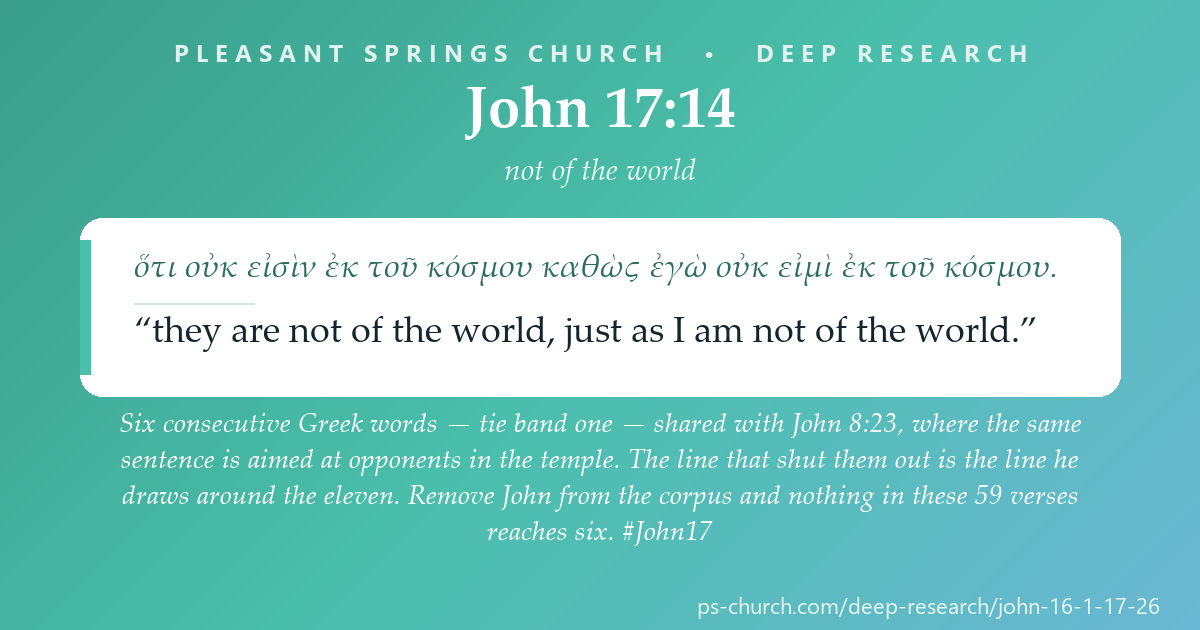
John 17:14 — … ὅτι οὐκ εἰσὶν ἐκ τοῦ κόσμου καθὼς ἐγὼ οὐκ εἰμὶ ἐκ τοῦ κόσμου.
John 8:23 — ὑμεῖς ἐκ τῶν κάτω ἐστέ, ἐγὼ ἐκ τῶν ἄνω εἰμί· ὑμεῖς ἐκ τούτου τοῦ κόσμου ἐστέ, ἐγὼ οὐκ εἰμὶ ἐκ τοῦ κόσμου τούτου.
The shared run is ἐγὼ οὐκ εἰμὶ ἐκ τοῦ κόσμου — six words, tie band one, in both 17:14 and 17:16. Chapter 8 is the temple controversy: the sentence is a line drawn against people who are about to pick up stones. Chapter 17 says it in a prayer, about the eleven. Same six words, opposite room.
⚠️ The honest qualification, and it is not small. John 17:14 and 17:16 are near-duplicates of each other — measured directly they share seven consecutive words. Both are inside the source block, so neither can be the other’s target; the screen excludes the source from its own corpus, which is the standing convention on this shelf and the reason John 8:23 comes out on top for both rows. A reader who wants the largest number in these two chapters should be told it is seven, and that it is John repeating himself.
⚠️ The control, and the page’s own counter-example
Remove the Fourth Gospel from the target corpus and these two chapters go almost silent. Against 7,061 verses — every book of the New Testament except John — nothing in the 59 rows reaches six, and only one row reaches five.
| row | deepest partner outside John | run | band |
|---|---|---|---|
| John 17:1 | Luke 6:20 — ἐπάρας τοὺς ὀφθαλμοὺς αὐτοῦ εἰς | 5 | 1 |
| John 16:13 | 1 John 4:6 — τὸ πνεῦμα τῆς ἀληθείας | 4 | 1 |
| John 16:21 | Revelation 14:7, 14:15 — ὅτι ἦλθεν ἡ ὥρα | 4 | 2 |
| John 16:20 | Matthew 16:28 and 20 others — ἀμὴν λέγω ὑμῖν ὅτι | 4 | 21 |
The one that reaches five is the counter-example. Luke 6:20 opens the Beatitudes: and he lifted up his eyes on his disciples and said… John 17:1: and lifting up his eyes to heaven he said… Five consecutive Greek words, a tie band of one, and no relationship at all beyond two writers describing the same gesture in the ordinary way of describing it. It is printed here, at the same size as the runs of six, so that nobody reads a tie band of one on this page as more than a tie band of one. John’s own other lifting of the eyes, at 11:41, uses a different verb and shares two words with this verse.
And a second control, so the shallowness is not read as an artefact. John 14–15, the other half of the same discourse, screened exactly the same way against the rest of the Greek New Testament, reaches eight — John 15:20 against John 13:16, tie band 1 — and four rows reach six. The engine finds deep runs in this discourse when they are there. Chapter by chapter across the whole Gospel, John 16 (max 5) and John 21 (max 5) are the two shallowest chapters in the book; John 5 and John 6 reach ten, at each other.
★ John 16:22 and Septuagint Isaiah 66:14 — six words, no formula
John 16:22 — … πάλιν δὲ ὄψομαι ὑμᾶς, καὶ χαρήσεται ὑμῶν ἡ καρδία, καὶ τὴν χαρὰν ὑμῶν οὐδεὶς αἴρει ἀφ’ ὑμῶν.
Septuagint Isaiah 66:14 — καὶ ὄψεσθε, καὶ χαρήσεται ὑμῶν ἡ καρδία, καὶ τὰ ὀστᾶ ὑμῶν ὡς βοτάνη ἀνατελεῖ…
The shared run is καὶ χαρήσεται ὑμῶν ἡ καρδία καί — six consecutive words, tie band one, the deepest Old Testament contact anywhere in these two chapters. There is no καθὼς γέγραπται, no ἵνα πληρωθῇ, no naming of Isaiah. John 16 quotes nothing formally and John 17 quotes nothing formally — 17:12’s ἵνα ἡ γραφὴ πληρωθῇ names no scripture at all.
The one word before the run is where the two texts part. Isaiah has ὄψεσθε, you shall see; John has ὄψομαι ὑμᾶς, I will see you. The subject of the seeing is reversed, and the six-word agreement starts at the next word.
⚠️ What this does not establish, and one divergence inside the same verse. Six words with a band of one is a real agreement and it is not a citation; the page does not say John is quoting Isaiah, does not say he is not, and asserts nothing about direction. The Hebrew of Isaiah 66:14 agrees with the Greek in the clause that matters — וּרְאִיתֶם וְשָׂשׂ לִבְּכֶם, you shall see and your heart shall rejoice — but the two texts part company later in the same verse: the Masoretic text has the hand of the Lord known to his servants and his indignation toward his enemies, while the Greek held here reads τοῖς σεβομένοις αὐτόν, to those who fear him, and τοῖς ἀπειθοῦσιν, the disobedient. That divergence is outside the six shared words, and it is printed because this shelf does not report an agreement without reporting the disagreement beside it.
Three more connections the counting found, and what each is worth
| phrase | where it occurs in the Greek NT | reading |
|---|---|---|
| ὁ υἱὸς τῆς ἀπωλείας (17:12) | exactly twice: John 17:12 and 2 Thessalonians 2:3 | a run of 4. Two very different referents — Judas here, the man of lawlessness there. No direction asserted |
| πρὸ καταβολῆς κόσμου (17:24) | exactly three times: John 17:24, Ephesians 1:4, 1 Peter 1:20 | the commoner form is ἀπὸ καταβολῆς κόσμου, six times, and never in John. καταβολή occurs once in the Greek OT held here, at 2 Maccabees 2:29, of a house |
| ὁ ἄρχων τοῦ κόσμου τούτου (16:11) | exactly twice: John 12:31 and John 16:11 | John 14:30 has the same words reordered and the engine scores it lower on purpose. Contiguity is the measurement |
Each row is a phrase count, not an argument. Two texts sharing a fixed phrase may both be drawing on something older, on each other, or on nothing; the counting cannot tell them apart and this page does not pretend otherwise.
What this page could not check, where it is weakest, and what would overturn it.
Where the page is weakest
⚠️ The headline result is partly a fact about a writer, not only about a passage. “The deepest runs all land inside John” is true and it is also what you would expect from a book with 78 occurrences of κόσμος and a famously narrow vocabulary. The control — John 14–15 reaching eight against the same corpus — shows the method still finds depth where it exists, but it does not separate “these chapters are unusually self-contained” from “this author repeats himself”. The page reports both readings and prefers neither.
⚠️ A run of six is not a large number. On the Septuagint pages of this shelf, citations routinely reach eight, ten and more. Six with a band of one is a real agreement and a modest one, and two of the three headline results on this page sit at exactly six. A reader should hold them loosely.
⚠️ The source block is excluded from its own target corpus. That is why 17:14’s partner is John 8:23 and not John 17:16, which shares seven words with it. The convention is consistent across the shelf and it is stated here because on this particular passage it changes the headline number.
⚠️ The normaliser compares word forms, not lemmas. Accents and breathings dropped, final sigma folded, the two editions’ spelling equivalences applied. That is why John 14:30 scores lower than John 12:31 against 16:11 although both carry the same title: one has the words in a different order. A lemma-based or an order-insensitive screen would give different numbers everywhere on this page, and would be a different measurement, not a better one.
What could not be checked at all
No Greek critical apparatus. No papyri were consulted and no manuscript contents were checked here at all. No majuscules, no versions (Latin, Syriac, Coptic), no patristic citations. No Dead Sea Scrolls, which is the corpus every commentary reaches for at John 16:13. No rabbinic literature, which is the corpus every commentary reaches for at John 16:2. No Philo, no documentary papyri, no Mandaean or Hermetic material. No commentary on John was read for any figure on this page.
And the historical questions stay open, because counting is silent on them. Who wrote the Fourth Gospel; whether chapters 15–17 are a later insertion after the “rise, let us go from here” of 14:31; whether John 17 reflects a liturgy; what παράκλητος meant to its first hearers; whether 16:2 refers to a specific first-century exclusion — none of that can be settled by shared word-runs, and this page does not try.
One more that is easy to overstate. “John 17 is the densest ἵνα chapter in the New Testament” is exhaustive over all 260 chapters and true on both per-verse and per-word measures — but chapter divisions are medieval. The unit John 17 is not an authorial unit, and a text divided differently would rank differently. The comparison is fair only because the same medieval division was applied to every chapter in the corpus.
What would overturn the page
A run of seven or more anywhere in these 59 verses against the Greek New Testament would move the headline. A run of six or more against a book outside John would demolish the control result. Both are checkable: the screen is exhaustive and deterministic, nothing is sampled, and anyone with MorphGNT and the CATSS files can reproduce every number here. If Greek Isaiah were replaced by a different edition, the John 16:22 result could change; it was run on the CATSS text named in the footer and on no other.
Reading list
- Raymond E. Brown, The Gospel According to John XIII–XXI (Anchor Bible 29A) — the standard treatment of the farewell discourse and of the Paraclete sayings.
- C. K. Barrett, The Gospel According to St John, 2nd ed. (1978).
- D. A. Carson, The Gospel According to John (Pillar, 1991).
- Craig S. Keener, The Gospel of John: A Commentary, 2 vols. (2003) — the fullest collection of the Jewish and Greco-Roman background this page could not search.
- J. Louis Martyn, History and Theology in the Fourth Gospel, 3rd ed. (2003) — the classic case for reading ἀποσυνάγωγος against a synagogue expulsion, and the case that has been most contested since.
- Marianne Meye Thompson, John: A Commentary (NTL, 2015).
- None of these were consulted for the measurements on this page, which were run on the text files named in the footer.
A prayer that reaches almost nothing outside its own book, and says the same six words over its friends that it once said against its enemies.
Six words, twice
The high-priestly prayer is quoted at more ordinations, more unity services and more funerals than almost any other chapter of the New Testament. Screened word for word against every other verse in the Greek New Testament, its deepest contact is six consecutive words with John 8:23 — and John 8:23 is the moment in the temple where the argument turns lethal. You are of this world; I am not of this world.
In chapter 8 that sentence is a wall. In chapter 17 the same six words are a shelter: they are not of the world, just as I am not of the world. The line that shut his opponents out is the line he draws around the eleven. The measurement does not say that; the measurement says six words, tie band one, twice. What to make of it is the reader’s.
And then the silence. Take the Fourth Gospel away and these 59 verses have almost nothing left to say to the rest of the New Testament. No verse reaches six. One reaches five, and it is a description of a man raising his eyes. The most-quoted prayer in the church quotes nobody and is quoted verbatim by nobody. Its one reach outward is six words of Isaiah 66:14 with no formula, no attribution, and a reversal in the verb just before them — Isaiah says you will see, John says I will see you.
The chapter that says κόσμος eighteen times in twenty-six verses, and says at verse 9 that it is not praying for the world, gives as its reason for everything it does ask — twice — that the world may believe, that the world may know. Both sentences are in the prayer. This page prints both and resolves neither.
Every Deep Research page traces its passage across the whole sweep — the Old Testament, the Second-Temple world between the testaments (historical witnesses, not Scripture), and the New Testament. Follow the thread:
Pleasant Springs Church — Deep Research
Research method after Michael S. Heiser’s Bible Research Method (examine dictionaries → ancient literature → important words → textual connections → academic publications → share), with the Pleasant Springs “Author & Audience” foundation. Scripture set in the Hebrew, the Greek editions named on each page and the ESV (Old Testament), and the Greek New Testament and the ESV (New Testament), per the practice of Pleasant Springs Church. John research grounded in Brown (Anchor), Barrett, Carson (Pillar), Keener, Martyn and Thompson — none of which were consulted for any number on this page. Text: Greek New Testament from the SBL edition as digitized by MorphGNT; Greek Old Testament from Rahlfs’ Septuaginta as digitized by CATSS; Hebrew from the Masoretic text as printed in Sefaria’s Miqra according to the Masorah. No critical apparatus was consulted on any side. The standing caution for this shelf applies: these pages say “the CATSS Greek row reads…” and never call a reading early or late. ⚠️ VERSE NUMBERING — John is a New Testament book, so there is no Masoretic or Septuagint column and no Hebrew-to-Greek offset to state. Counted anyway, and the answer is not simply ‘none’: SBLGNT John runs 866 verses off disk and a complete English versification of John runs 878. The twelve are 7:53–8:11, which the SBLGNT does not print in its running text and the full English numbering does; 5:4 has no text in either column, and the ESV keeps the first in double brackets with a note and puts the wording of the second in a footnote. John 16 is 33 verses and John 17 is 26 verses in every column, so every reference on this page means the same verse on both sides. ⚠️ The measurement, in full. Greek against Greek. MorphGNT field 6, the normalised word (the column that already resolves elision and the movable nu); CATSS FORM column (cols 0–24), beta-code transliterated first. Both sides lowercased, accents and breathings dropped, final sigma folded, then filtered to Greek letters — the same filter applied to both corpora. Contiguous runs of whole word FORMS, never lemmas. Corpus: the 59 MorphGNT rows of John 16–17 against the other 7,868 verses of the Greek New Testament, against the 7,061 New Testament verses outside the Gospel of John, and against 30,637 CATSS verse units. Exhaustive and deterministic; nothing sampled, so no seed applies. The source block is excluded from its own target corpus, which is why John 17:14’s partner is John 8:23 rather than John 17:16, with which it shares seven words. The tie band — how many target verses reach the same maximum — is printed beside every run on this page. ⚠️ What was NOT measurable. No Dead Sea Scrolls are held here, so the spirit of truth of 1QS could not be searched and the zero reported for τὸ πνεῦμα τῆς ἀληθείας in the Greek Old Testament says nothing about Qumran. No rabbinic corpus is held, so nothing could be checked about the birkat ha-minim behind 16:2. No papyri, no apparatus, no versions, no patristic citations, no Philo, no documentary papyri. ⚠️ The word and parsing counts. Lemma column and parsing column of MorphGNT, across all 27 New Testament files. The ἵνα ranking is exhaustive over all 260 chapters and is reported on two measures, per verse and per thousand words, because chapter lengths differ; chapter divisions are medieval and the page says so. The six vocatives of John 17 were read off the parsing column directly, not inferred from accentuation. ⚠️ Direction of influence is never asserted. Nothing here says John 17 is drawing on John 8, that John 16:22 is quoting Isaiah, that 2 Thessalonians knows John or John knows 2 Thessalonians, or that Luke 6:20 has anything to do with John 17:1 at all — the last is printed precisely as a warning against reading a tie band of one as a relationship. The page reports the runs, the bands and the controls, and stops. Typology is handled per the house position: what the text says, what the New Testament itself draws, and what we see from this side of the cross — with the seeing left to the reader.
Scripture quotations marked ESV are from the ESV® Bible (The Holy Bible, English Standard Version®), © 2001 by Crossway, a publishing ministry of Good News Publishers. ESV Text Edition: 2016. Used by permission. All rights reserved. The ESV text may not be quoted in any publication made available to the public by a Creative Commons license, and the ESV may not be translated in whole or in part into any other language. www.esv.org
|
Did this study bless you today? 💚 Give to Support PS Church100% of gifts go to the General Fund — thank you. |