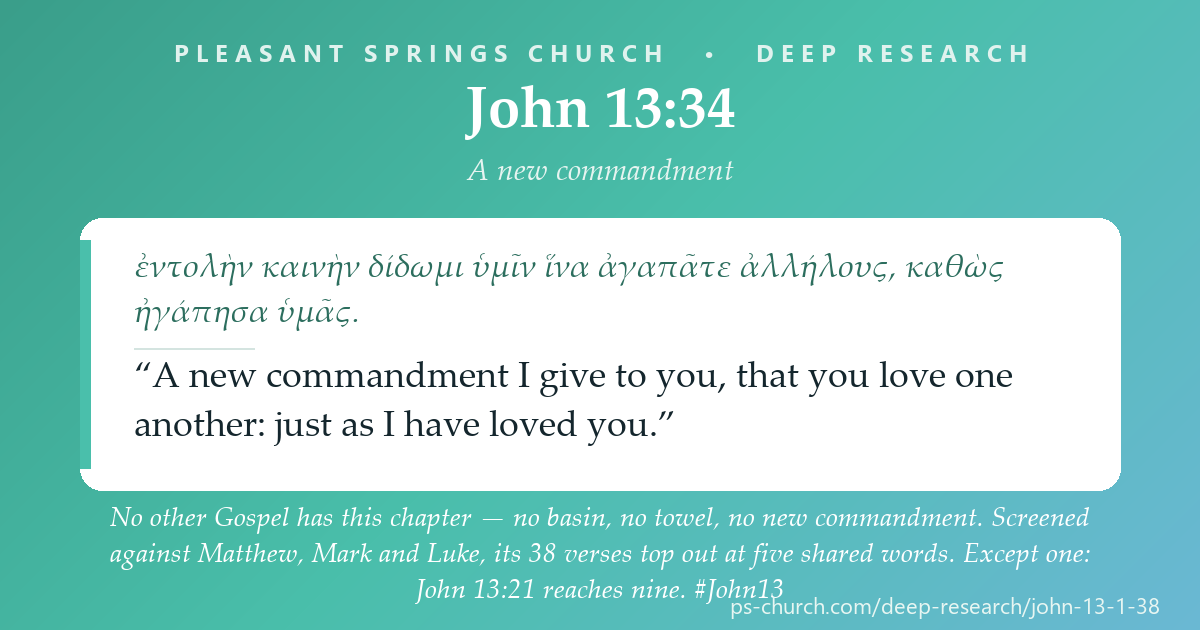
No other Gospel has this chapter. Matthew, Mark and Luke have a last meal; none of them has a basin, a towel, or a new commandment. So screen John 13 word for word against the three of them and see what the overlap looks like. Across all 38 rows the ceiling is five — and nothing reaches six, or seven, or eight. Then John 13:21 reaches nine: truly I say to you, one of you will betray me, the identical nine consecutive Greek words standing in Matthew 26:21 and in Mark 14:18, tie band 2. The chapter no one else narrates touches the other Gospels at exactly the one sentence they also carry, and nowhere else. Now turn to the other screen. John 13:18 is the only verse in the chapter that says that the Scripture may be fulfilled, and what it quotes is Psalm 41:9. Against the Septuagint verse it is quoting, the run is two words. Reverse the screen and it is worse: run that Greek Psalm against all 7,927 verses of the Greek New Testament and its best partners reach three — and John 13:18, the verse quoting it, is not among them. The deepest agreement in this chapter is with a Gospel it never mentions; the shallowest is with the Psalm it names. See the method →
John 13:1–38 (selections)
Greek New Testament (SBLGNT, via MorphGNT) · ESV⚠️ John’s own numbering has two gaps, and neither is in this chapter. Counted off disk: SBLGNT John holds 866 verses under a numbering that runs to 879, because the Greek printed here has no 5:4 and no 7:53–8:11. Chapter 13 runs 1 to 38 with no gap in either the Greek or the ESV, so every reference on this page means the same verse in both columns.
★ The two numbers this page is built on. Against the three Synoptic Gospels, the 38 rows of John 13 reach a ceiling of five — except John 13:21, which reaches nine, tie band 2. Against the Greek Old Testament held here, the chapter’s ceiling is four — and John 13:18, the one row carrying a citation formula, reaches two against the Psalm it names. Stage 4 gives both screens, both distributions, and the counter-examples.
The Shape of the Passage
A sequence inside a Peter frame — and deliberately not a chiasmThis chapter is where the Gospel introduces the figure it will use to sign itself, and it does not give him a name. 13:23: εἷς ἐκ τῶν μαθητῶν αὐτοῦ … ὃν ἠγάπα ὁ Ἰησοῦς. The page reports what the text says and keeps the identification separate from the count.
Author
The book never names its writer inside the narrative. It names him at the end, obliquely: this is the disciple who is bearing witness about these things, and who has written these things (21:24) — pointing back to the figure first introduced here, in 13:23. Every ancient and modern proposal about who that is rests on evidence this page did not measure, and the page takes no position.
What is measurable is the writing. The double ἀμὴν ἀμὴν λέγω occurs 25 times in the whole Greek New Testament and all 25 are in John. Four of the 25 are in this chapter (13:16, 20, 21, 38) — tied with chapter 6 for the most in any chapter of the Gospel. No Synoptic writer uses the doubled form once.
And a habit of repeating himself. 13:16 comes back almost word for word at 15:20 (eight consecutive words, tie band 1); 13:34 comes back at 15:12 (six, band 1); 13:33 comes back from 8:21 (seven, band 2). Three of this chapter’s four deepest runs against the whole New Testament are with John itself.
Audience
The room is small and the address is intimate. 13:33 opens τεκνία, little children — the only occurrence of that word in the four Gospels. It stands eight times in the Greek New Testament and the other seven are all in 1 John. Whoever the Gospel was written for, at this point in it the narrator has Jesus speaking to disciples as a father speaks to children.
Readers who need the Aramaic and the customs explained. Elsewhere this Gospel translates ῥαββί, Μεσσίας and Σιλωάμ for its readers. Here it explains nothing about the washing — no note on whose job it was, no note on the meal — but it does explain why the disciples misread Jesus’ word to Judas (13:29): because Judas had the moneybag. The narrator assumes readers who need motives explained more than customs.
Readers who already know how the story ends. 13:19 gives the reason for the whole chapter’s foretelling: I am telling you this now, before it takes place, that when it does take place you may believe that I am he. The chapter is written to be re-read.
Orient on the footwashing, on the farewell-discourse form, and on the beloved disciple before touching a single number.
Search by topic: footwashing; Last Supper; farewell discourse; beloved disciple; Judas Iscariot; Passover chronology in John; love command; Johannine community.
Which articles are relevant?
- Anchor Bible Dictionary — “John, Gospel of,” “Beloved Disciple,” “Foot Washing,” “Last Supper,” “Judas Iscariot.”
- Dictionary of Jesus and the Gospels (IVP, 2nd ed.) — “Farewell Discourse,” “Love,” “Last Supper,” “Servant.”
- New International Dictionary of NT Theology & Exegesis — ἀγαπάω, ἐντολή, νίπτω, λούω, ὑπόδειγμα, δοξάζω.
- Commentary on the New Testament Use of the Old Testament, ed. G. K. Beale and D. A. Carson (Baker, 2007) — the John chapter, which is where the form of the Psalm 41:9 citation is argued at length.
- These were not consulted for the measurements below. The measurements were run on the text files named in the footer.
Settle the numbering first — twice, because this page needs it twice
1. The passage itself carries no offset. John is a New Testament book. There is no Masoretic or Septuagint John, so there is nothing to convert. SBLGNT John 13 = 38 verses, and the ESV prints 38. Every reference on this page means the same verse in both columns.
2. The Gospel around it does have gaps, and this shelf states them. Counted off disk, SBLGNT John holds 866 verses under a printed numbering that runs to 879. The difference is thirteen verses in two places: 5:4 (the stirring of the water) and 7:53–8:11 (the woman taken in adultery), neither of which the SBL edition prints in its running text. Neither gap falls in chapter 13, and this page makes no argument about either.
3. The Psalm the chapter quotes carries two offsets at once.
| column | reference | why |
|---|---|---|
| ESV | Psalm 41:9 | English does not number the superscription |
| Masoretic Hebrew | Psalm 41:10 | the Hebrew counts לַמְנַצֵּחַ מִזְמוֹר לְדָוִד as verse 1 |
| CATSS Greek (Rahlfs) | Psalm 40:10 | the Greek Psalter runs one psalm behind the Hebrew from 9/10 through 147 |
So the single verse John quotes is 41:9, 41:10 and 40:10 depending on which book is open. Getting this wrong would not be a rounding error; it would name a different Psalm. Every citation on this page is written in all three.
Two questions the local corpora can answer, and two they cannot.
Who washed feet in the ancient world?
The reference works are unanimous that footwashing was the work of a slave, and this page did not measure that.
What can be measured is the Greek Old Testament held here. Screened for verse units carrying both a νιπτ- form and a word for feet, the 64 CATSS files return twelve verse units in eleven distinct places — Judges 19:21 stands in both the A and the B text — and they fall into three settings.
| setting | where | who does the washing |
|---|---|---|
| hospitality | Genesis 18:4 · 19:2 · 24:32 · 43:24 · Judges 19:21 | the guests wash their own feet; water is brought to them |
| the priesthood | Exodus 30:19 · 30:21 · 38:27 | Aaron and his sons wash their own hands and feet before entering the tent |
| ordinary washing | 2 Kingdoms 11:8 · Song 5:3 · 1 Kingdoms 25:41 | Uriah and the bride wash their own; Abigail offers to wash the feet of David’s servants |
In the Greek Old Testament held here there is no scene in which a superior washes an inferior’s feet. The one offer to wash somebody else’s runs the other way: Abigail says ἰδοὺ ἡ δούλη σου εἰς παιδίσκην, behold, your servant is a slave-girl, and then offers the basin. And the Greek Old Testament does have a word for a washing basin — λουτήρ, the laver Moses makes at Exodus 38:27 so that the priests may wash. John 13:5 does not use it. It uses νιπτήρ, a word that occurs nowhere else in either testament as held on this disk.
⚠️ What that does and does not establish. It establishes that the local Greek Old Testament has no precedent for the action. It does not establish that no such precedent existed — the Mishnah, the papyri, Josephus, Philo and the Greek and Latin novelists are not on this disk and were not consulted. An absence in 64 files is an absence in 64 files.
The meal, the Passover, and a chronology this page will not settle
John 13:1 dates the scene before the Feast of the Passover; the Synoptic accounts have the supper as a Passover meal.
The four bolded words at 13:1 — τῆς ἑορτῆς τοῦ πάσχα — reach this chapter’s ceiling against the whole Greek Old Testament: run 4 against CATSS Exodus 34:25, tie band 1. That is a calendar phrase agreeing with a calendar law. Seven of the 38 rows reach four against the Greek Old Testament and none reaches five; three of the seven, this one among them, do it in a tie band of 1. It settles nothing about the chronology. The screen finds shared words; the disagreement between John and the Synoptics here is about a day, and days are not words.
Every reconstruction of the Johannine Passover chronology — a different calendar, a different reckoning of before the feast, a theological arrangement, a straightforward contradiction — is compatible with the number above. The page reports the run and declines the reconstruction.
A Latin word in the room
λέντιον is not a Greek word. It is the Latin linteum, a linen cloth, written in Greek letters.
It occurs twice in the Greek New Testament, both times in this chapter (13:4, 13:5), and it does not occur at all in the 30,637 verse units of the Greek Old Testament held here. Whether its presence says anything about where or for whom the Gospel was written is a question about loanword distribution in first-century Greek, and answering it would need documentary papyri this page does not hold. The page reports the word and stops.
Six words that carry the chapter, and how rare each one actually is.
John 13:5, and nowhere else in the Greek New Testament. Nor anywhere in the 64 CATSS files held here. The Gospel had to reach for a word for the thing, and the word it reached for is used once in the whole canon.
John 13:18, and nowhere else in the Greek New Testament — and it is inside the quotation. The Greek Psalm being quoted does not use this word; it uses the abstract noun πτερνισμός, heel-lifting, supplanting. The one hapax in the citation is a word the source verse does not have. The stem πτερν- does stand 18 times in the Greek Old Testament held here, including Genesis 3:15 and Genesis 25:26; the page reports the vocabulary and draws nothing from it.
Six occurrences in the Greek New Testament: four in John 6, one at Matthew 24:38, and this one. Where the Greek Psalm reads ὁ ἐσθίων, John 13:18 reads ὁ τρώγων — the same verb the bread discourse used five chapters earlier. The page reports the overlap in vocabulary and does not argue from it.
Four occurrences in the Greek New Testament, and all four are in this chapter — 13:26 twice, 13:27, 13:30. The word narrows the scene to a single object and then follows it out the door: after receiving the morsel, he went out.
John 13:15. Six occurrences in the Greek New Testament, and this is the only one in the four Gospels — the others are Hebrews 4:11, 8:5, 9:23, James 5:10 and 2 Peter 2:6. In Hebrews 8:5 it is what Moses was shown on the mountain. It is not simply an instance; it is a pattern displayed to be copied.
Four occurrences of the two-word phrase in the Greek New Testament: John 13:34, 1 John 2:7, 1 John 2:8 and 2 John 5 — and three of the four qualify or deny it. καινός occurs twice in this whole Gospel: here, and of the tomb in which no one had yet been laid (19:41).
The chapter counted, word by word
38 verses, 660 words in the Greek printed here. Counted off the MorphGNT file.
| word | in John 13 | in John | in the Greek NT |
|---|---|---|---|
| ἀγαπάω / ἀγάπη | 7 | 44 | 259 |
| ἀλλήλων and forms | 5 — more than any other chapter of John | 15 | 100 |
| ἀμὴν ἀμὴν λέγω | 4 — tied with chapter 6 for the most | 25 | 25, all in John |
| νίπτω | 8 | 13 | 17 |
| ἄρτι | 4 — more than any other chapter of John | 12 | 36 |
| ὕστερον (this form) | 1 (13:36) | 1 — John’s only one | 11 |
| ἐξῆλθεν (this form) | 3 — 13:3, 13:30, 13:31 | 19 | — |
| δοξάζω | 5, all in 13:31–32 | 23 | 61 |
| ψωμίον | 4 | 4 | 4 |
| λέντιον | 2 | 2 | 2 |
| νιπτήρ · πτέρνα | 1 each | 1 each | 1 each |
| τεκνία | 1 (13:33) | 1 | 8 — the other seven are all in 1 John |
Four of the words the Synoptic institution accounts turn on are absent from this chapter entirely: σῶμα, αἷμα, ποτήριον and εὐχαριστέω; ἄρτος appears once, inside the quotation (13:18). διαθήκη is not in this chapter either, but that is not a fact about the chapter — the word does not occur anywhere in this Gospel. The chapter is a supper narrative with no institution in it, and that is a count, not an argument. One more count in the same spirit: πιστεύω stands 98 times in John and exactly once in this chapter — at 13:19, where it is the reason given for the foretelling.
Where the love-word turns on
44 occurrences of ἀγαπάω / ἀγάπη in John. Eight of them are in chapters 1–12.
| chapters | occurrences | share of the book |
|---|---|---|
| 1–12 — the public ministry, 573 verses | 8 | 18% |
| 13–17 — the upper room, 155 verses | 31 | 70% |
| 18–21 — arrest to epilogue, 138 verses | 5 | 11% |
Inside the upper room the distribution is uneven again: 7 in chapter 13, 10 in chapter 14, 9 in chapter 15, none at all in chapter 16, 5 in chapter 17. The caveat: this counts the ἀγαπ- group only. φιλέω is a separate word and is not in these figures — it stands 13 times in John, including 5 in chapter 21, and a page that folded the two together would get a different shape.
Three screens, two headline numbers, and four results printed to keep them honest.
The measurement
All 38 verses of John 13 were screened three times: against the 2,890 verses of Matthew, Mark and Luke; against the other 828 verses of John; and against the 30,637 verse units of the Greek Old Testament held on this disk. Contiguous runs of whole word forms, never lemmas, with the tie band beside every run.
Against the three Synoptic Gospels, across the 38 rows: all 38 reach two, 26 reach three, 9 reach four, 3 reach five, and then a single row carries the whole tail: 1 reaches six, seven, eight and nine — the same row each time — and nothing reaches ten, so no row’s ceiling is six, seven or eight. Against the rest of John: all 38 reach two, 26 reach three, 17 reach four, 7 reach five, 4 reach six, 2 reach seven, 1 reaches eight, nothing reaches nine. Against the Greek Old Testament: all 38 reach two, 23 reach three, 7 reach four, and nothing reaches five.
| row | deepest in the Synoptics | run | band | deepest in the rest of John | run | band |
|---|---|---|---|---|---|---|
| John 13:21 | Matthew 26:21 · Mark 14:18 | 9 | 2 | John 6:26 | 6 | 1 |
| John 13:16 | Matthew 10:42 | 4 | 4 | John 15:20 | 8 | 1 |
| John 13:33 | Matthew 28:20 | 3 | 1 | John 8:21 · 8:22 | 7 | 2 |
| John 13:34 | Mark 1:38 | 2 | 19 | John 15:12 | 6 | 1 |
| John 13:31 | Mark 2:28 — the Sabbath saying | 5 | 1 | John 3:13 | 4 | 4 |
| John 13:38 | Matthew 5:26 — the debtor’s prison | 5 | 1 | John 3:3 | 4 | 4 |
| John 13:23 | Matthew 11:2 | 3 | 12 | John 6:8 | 5 | 1 |
| John 13:20 | Matthew 6:2 | 3 | 42 | John 6:47 | 5 | 3 |
| John 13:18 | Matthew 16:11 | 2 | 21 | John 17:12 · 19:24 · 19:36 — the citation formula | 4 | 3 |
| John 13:30 | Matthew 6:23 | 2 | 19 | John 19:40 | 2 | 27 |
Two shapes are visible in that table before any interpretation. First: John 13:21 is alone. The Synoptic column has a solid block at two to five and then a gap of three whole run-lengths before the nine. Second: this chapter’s real conversation partner is itself. Three of the four deepest runs against the whole New Testament — 8, 7 and 6 — are with other chapters of John.
★ The citation that does not measure: John 13:18 and Psalm 41:9
John 13:18 is the only verse in the chapter carrying a quotation formula. Here are the three texts, side by side.
| text | the sentence |
|---|---|
| Masoretic Psalm 41:10 (ESV 41:9) | גַּם־אִישׁ שְׁלוֹמִי אֲשֶׁר־בָּטַחְתִּי בוֹ אוֹכֵל לַחְמִי הִגְדִּיל עָלַי עָקֵב |
| CATSS Psalm 40:10 (= the same verse) | καὶ γὰρ ὁ ἄνθρωπος τῆς εἰρήνης μου ἐφ’ ὃν ἤλπισα ὁ ἐσθίων ἄρτους μου ἐμεγάλυνεν ἐπ’ ἐμὲ πτερνισμόν |
| John 13:18 | ὁ τρώγων μου τὸν ἄρτον ἐπῆρεν ἐπ’ ἐμὲ τὴν πτέρναν αὐτοῦ |
Measured, the two Greek sentences share two consecutive words: ἐπ’ ἐμέ.
Four separate divergences, and they run in different directions.
| Hebrew | CATSS Greek | John 13:18 |
|---|---|---|
| אֲשֶׁר־בָּטַחְתִּי בוֹ — in whom I trusted | ἐφ’ ὃν ἤλπισα — in whom I hoped | absent — John quotes only the second half of the line |
| אוֹכֵל לַחְמִי — eating my bread | ὁ ἐσθίων ἄρτους μου — loaves, plural | ὁ τρώγων μου τὸν ἄρτον — a different verb, the bread, singular |
| הִגְדִּיל — he made great, magnified | ἐμεγάλυνεν — he magnified, matching the Hebrew exactly | ἐπῆρεν — he lifted up |
| עָקֵב — heel, a noun | πτερνισμόν — a heel-lifting, abstract | τὴν πτέρναν αὐτοῦ — his heel, concrete |
Now reverse the screen, which is the harder test. Take CATSS Psalm 40:10 and run it against all 7,927 verses of the Greek New Testament. Its deepest partners reach 3, in a tie band of 5: Mark 10:45, John 4:23, Romans 15:3, Hebrews 12:29 and 2 Thessalonians 2:3 — four of the five on the words καὶ γὰρ ὁ, and 2 Thessalonians 2:3 on ὁ ἄνθρωπος τῆς. John 13:18 — the verse that names this Psalm and quotes it — is not among them. Run it the other way and John 13:18’s own best contact anywhere in the Greek Old Testament is 3, tie band 7, and Psalm 40:10 is not among the seven either. Neither screen can find the citation from the other side.
⚠️ What this does and does not show. It shows that John 13:18 is not a verbatim reproduction of the Greek Psalm on this disk. It does not show that John is quoting the Hebrew, that John is quoting from memory, that a different Greek Psalter lay in front of him, or that the Gospel is paraphrasing on purpose. All four of those explanations are live, and this method cannot choose between them. One more thing worth saying plainly: the ESV’s English at Psalm 41:9 — has lifted his heel against me — renders the Hebrew idiom with John’s verb rather than the Hebrew’s, because the Hebrew idiom הִגְדִּיל … עָקֵב is obscure and the English tradition has settled on the Gospel’s picture. A reader comparing the two English texts will see an agreement the two Greek texts do not have.
★ The one sentence three Gospels share
John 13:21 against Matthew 26:21 and Mark 14:18: nine consecutive words, tie band 2, and the identical nine both times.
| text | the sentence |
|---|---|
| John 13:21 | … καὶ εἶπεν· Ἀμὴν ἀμὴν λέγω ὑμῖν ὅτι εἷς ἐξ ὑμῶν παραδώσει με. |
| Matthew 26:21 | καὶ ἐσθιόντων αὐτῶν εἶπεν· Ἀμὴν λέγω ὑμῖν ὅτι εἷς ἐξ ὑμῶν παραδώσει με. |
| Mark 14:18 | … ὁ Ἰησοῦς εἶπεν· Ἀμὴν λέγω ὑμῖν ὅτι εἷς ἐξ ὑμῶν παραδώσει με, ὁ ἐσθίων μετ’ ἐμοῦ. |
| Luke 22:21 | πλὴν ἰδοὺ ἡ χεὶρ τοῦ παραδιδόντος με μετ’ ἐμοῦ ἐπὶ τῆς τραπέζης. — run of 1 with John |
John begins the formula with a second ἀμήν, which is his own habit and which the run therefore starts after. Luke has the same scene and shares one word. Matthew 26:23 and Mark 14:20 — the dipping-in-the-dish sentences that stand nearest to John’s morsel — each share one word with John 13:21 as well.
⚠️ Direction of influence is never asserted. Nothing here says John is using Mark, that Mark is using John, that both draw on a common tradition, or that the sentence was simply remembered the same way in more than one place. The page reports nine words, a tie band of two, and the fact that no other row in the chapter reaches past five against these three Gospels — and stops.
The counter-examples, printed in the same section
1. John 13:38 and the denial. Three Gospels predict it; the deepest run is with a debtor’s prison.
John 13:38’s deepest Synoptic partner is Matthew 5:26, run 5, tie band 1 — ἀμὴν λέγω σοι οὐ μή, followed in Matthew by you will never get out until you have paid the last penny. The three parallel predictions measure 3 (Matthew 26:34), 3 (Mark 14:30) and 2 (Luke 22:34), and in the first two the three words are just the formula.
2. John 13:31 and the Son of Man. Run of 5 with Mark 2:28, and Mark 2:28 is about the Sabbath.
The five words are ὁ υἱὸς τοῦ ἀνθρώπου καί. A standing title plus a conjunction will generate runs across any two books that both use the title.
3. John 13:16 and the servant-and-master saying. Matthew 10:24 and Luke 6:40 measure 2 each.
The proverb is the same proverb in all three; the Greek is not. John 15:20 repeats John’s wording and measures 8. Sameness of sense is invisible to this screen.
4. John 13:10 and John 13:29 both reach 4 on the string λέγει αὐτῷ ὁ Ἰησοῦς, in tie bands of 16 and 15 — measured against the Greek New Testament outside John 13.
Those are narrative furniture. A run of four in a tie band of sixteen is a formula, not a signal, and the page prints it beside the nine at 13:21 for exactly that reason.
The Obadiah page prints Luke 19:46 against Obadiah 18 so that its other runs of four are not read as more than they are. These four are this page’s version of the same discipline. Two of the chapter’s five-word Synoptic runs are accidents, and they sit in the same table as the nine.
Where the scholarship goes, and — the part that matters — everything this page could not check.
The questions the literature argues, which this page does not settle
1. Is the footwashing about cleansing or about service? 13:8 (you have no share with me) pulls one way; 13:14–15 (you also ought) pulls the other. The chapter says both and the counting adjudicates neither.
2. Is except for the feet at 13:10 original? The SBL edition marks the clause. Some printed editions and some manuscripts read the sentence without it, which changes the theology of the verse considerably. No apparatus was consulted for this page and no manuscript was examined. The page prints the SBL text and reports that the editions differ.
3. Who is the disciple whom Jesus loved? The Gospel introduces him here without a name and signs itself with him at 21:24. The page takes no position.
4. Does John know Mark? The nine words at 13:21 are the sharpest single datum this page produces, and they are compatible with literary dependence in either direction, with a shared oral tradition, and with two independent memories of a sentence short enough to be remembered exactly. Direction of influence is never asserted on this shelf, and nine words do not license it.
⚠️ What this page could not check, stated plainly
No manuscripts, no apparatus, no versions. P66 and P75 both carry John 13 and neither was consulted. No Old Latin, no Syriac, no Coptic. The only textual information used is the SBL edition’s own printed sigla, which record disagreement among modern printed editions — not manuscript weight, not date, not geography. Counting sigla is not textual criticism, and the page does not pretend it is.
No Second Temple or rabbinic sources. The Mishnah, the Tosefta, Qumran, Josephus and Philo are not on this disk. Everything said above about who washed whose feet rests on the 64 CATSS files of the Greek Old Testament held here, and that is a narrow base.
No documentary papyri. The claim that λέντιον is a Latin loan is a lexical fact from the reference works; its distribution in first-century Greek was not measured.
No Hebrew screen was run on this chapter — there is nothing to run: John has no Hebrew text. The Hebrew of Psalm 41:10 was read directly and compared by eye, not screened.
Allusion is invisible here. Readers have long heard Genesis 3:15, the Jacob narratives, Exodus 30 and Isaiah 52–53 behind parts of this chapter. None of those would register on a word-run screen, and their absence from the numbers is not evidence against them. The screen finds verbatim contact and nothing else.
Where this page is weakest. Three places. (a) The headline negative result — that John 13:18 barely touches its own Psalm — depends on the CATSS text of Psalm 40:10 being a fair witness to the Greek Psalter available in the first century, and it may not be. (b) The distribution statements are computed against the corpora on this disk, which are not the whole of ancient Greek. (c) The literary structure above is supported by word-counts at its frame and by sense at its middle, and sense is not a measurement. The frame is measured; the B / B′ pairing is a reading, and the diagram says so.
Reading list
- Raymond E. Brown, The Gospel According to John XIII–XXI (Anchor Bible 29A, 1970) — the standard treatment of the footwashing’s two interpretations.
- C. K. Barrett, The Gospel According to St John (2nd ed., 1978).
- Craig S. Keener, The Gospel of John: A Commentary (2003), vol. 2.
- Maarten J. J. Menken, Old Testament Quotations in the Fourth Gospel (1996) — the chapter on John 13:18 is where the form of this quotation is argued in detail.
- Andrew T. Lincoln, The Gospel According to Saint John (BNTC, 2005).
- None of these were consulted for the measurements on this page, which were run on the text files named in the footer.
A basin, a morsel, a door, and two numbers that will not line up the way anyone expects.
Nine and two
John 13 is the chapter nobody else wrote. There is no basin in Matthew, no towel in Mark, no new commandment in Luke. And when you set it beside those three books and count, the chapter answers back in a shape you can see: thirty-eight rows that will not reach past five — and then one row at nine. The sentence they all have. One of you will betray me.
Then the other number. The chapter opens its Bible exactly once, at 13:18, and says that the Scripture may be fulfilled. Measured against the Greek Psalm it is quoting, the agreement is two words. Run the Psalm back against the whole New Testament and it cannot find its own quotation. The verse that names its source agrees with it least.
The page does not know what to make of that pairing, and says so. It could be that the Gospel quotes freely and remembers exactly. It could be that a different Greek Psalter stood behind 13:18. It could be that the betrayal sentence was so short and so often repeated that three books preserve it identically without any of them reading the others. The measurement establishes the two facts and stops there — and on the same page it prints a run of five between Peter’s denial and a parable about a debtor’s prison, so that nobody reads a tie band of one as more than a tie band of one.
Between the nine and the two there is a room with a basin in it. The chapter that opens by saying he loved them to the end spends its middle on a man taking a morsel and walking out, and the narrator gives that exit three words: and it was night. Then the door shuts, and the first thing said in the room is now.
Every Deep Research page traces its passage across the whole sweep — the Old Testament, the Second-Temple world between the testaments (historical witnesses, not Scripture), and the New Testament. Follow the thread:
Pleasant Springs Church — Deep Research
Research method after Michael S. Heiser’s Bible Research Method (examine dictionaries → ancient literature → important words → textual connections → academic publications → share), with the Pleasant Springs “Author & Audience” foundation. Scripture set in the Hebrew, the Greek editions named on each page and the ESV (Old Testament), and the Greek New Testament and the ESV (New Testament), per the practice of Pleasant Springs Church. John research grounded in Brown (Anchor Bible), Barrett, Keener, Lincoln (BNTC) and Menken on the Old Testament quotations — none of which were consulted for any number on this page. Text: Greek New Testament from the SBL edition as digitized by MorphGNT; Greek Old Testament from Rahlfs’ Septuaginta as digitized by CATSS; Hebrew from the Masoretic text as printed in Sefaria’s Miqra according to the Masorah, read directly for Psalm 41:10 and not screened. No critical apparatus was consulted on any side. ⚠️ VERSE NUMBERING — John is a New Testament book, so there is no Masoretic or Septuagint John and no MT/LXX offset for the passage itself. Counted off disk: SBLGNT John 13 = 38 verses, and the ESV and the ESV prints 38, so every reference on this page means the same verse in both columns. (The Gospel as a whole does carry two gaps — the Greek printed here has no 5:4 and no 7:53–8:11, so SBLGNT John holds 866 verses under a numbering that runs to 879 — and neither gap falls in this chapter.) The offset that does apply here is the Psalter’s, and it is a double one. The verse quoted at John 13:18 is ESV Psalm 41:9 = Masoretic Psalm 41:10 = CATSS Psalm 40:10: the Hebrew counts the superscription as verse 1, and the Greek Psalter runs one psalm behind the Hebrew from Psalm 9/10 through Psalm 147. Every citation on this page is written in all three numberings. ⚠️ The measurement, in full. Greek against Greek. MorphGNT field 6, the normalised word (the column that already resolves elision and the movable nu); CATSS FORM column (cols 0–24), beta-code transliterated first. Both sides lowercased, accents and breathings dropped, final sigma folded, then filtered to Greek letters — the same filter applied to both corpora, together with the editions’ own spelling equivalences (οὐ/οὐκ/οὐχ, ἐκ/ἐξ, the movable nu). Contiguous runs of whole word FORMS, never lemmas. Corpus: the 38 MorphGNT rows of John 13 against the 2,890 verses of Matthew, Mark and Luke; against the other 828 verses of John; against the 7,889 non-John-13 verses of the Greek New Testament; and against 30,637 verse units across the 64 CATSS files held here. The Psalm census screened all 7,927 Greek New Testament verses against one CATSS verse. Exhaustive and deterministic; nothing sampled, so no seed applies. The tie band — how many target verses reach the same maximum — is printed beside every run on this page. ⚠️ What a zero and a two mean here. These screens run with the unigram fallback ON, the Greek-side convention on this shelf: a row that shares no two-word sequence still reports 1 if any single word matches. So the run of 2 between John 13:18 and CATSS Psalm 40:10 means the two sentences share exactly one two-word sequence and no longer one — it is not a rounding of zero. ⚠️ What was NOT measurable. No manuscripts, no apparatus, no versions, no papyri, no patristic citations. No Mishnah, no Qumran, no Josephus, no Philo, no documentary papyri on Latin loanwords. The apparatus-sigla counts reported for John 13:10 and 13:26 count marks the SBL edition prints where modern printed editions differ; they are not manuscript evidence and are not weighted. Allusion is invisible to this screen entirely. ⚠️ Direction of influence is never asserted. Nothing here says John is reading Mark, that Mark is reading John, that either is reading Matthew, or that any of them draws on a common source; and nothing here says John 13:18 is quoting the Hebrew, the Greek, or a text no longer held. The page reports the runs, the tie bands and the divergences, and stops. Typology is handled per the house position: what the text says, what the New Testament itself draws, and what we see from this side of the cross — with the seeing left to the reader.
Scripture quotations marked ESV are from the ESV® Bible (The Holy Bible, English Standard Version®), © 2001 by Crossway, a publishing ministry of Good News Publishers. ESV Text Edition: 2016. Used by permission. All rights reserved. The ESV text may not be quoted in any publication made available to the public by a Creative Commons license, and the ESV may not be translated in whole or in part into any other language. www.esv.org
|
Did this study bless you today? 💚 Give to Support PS Church100% of gifts go to the General Fund — thank you. |