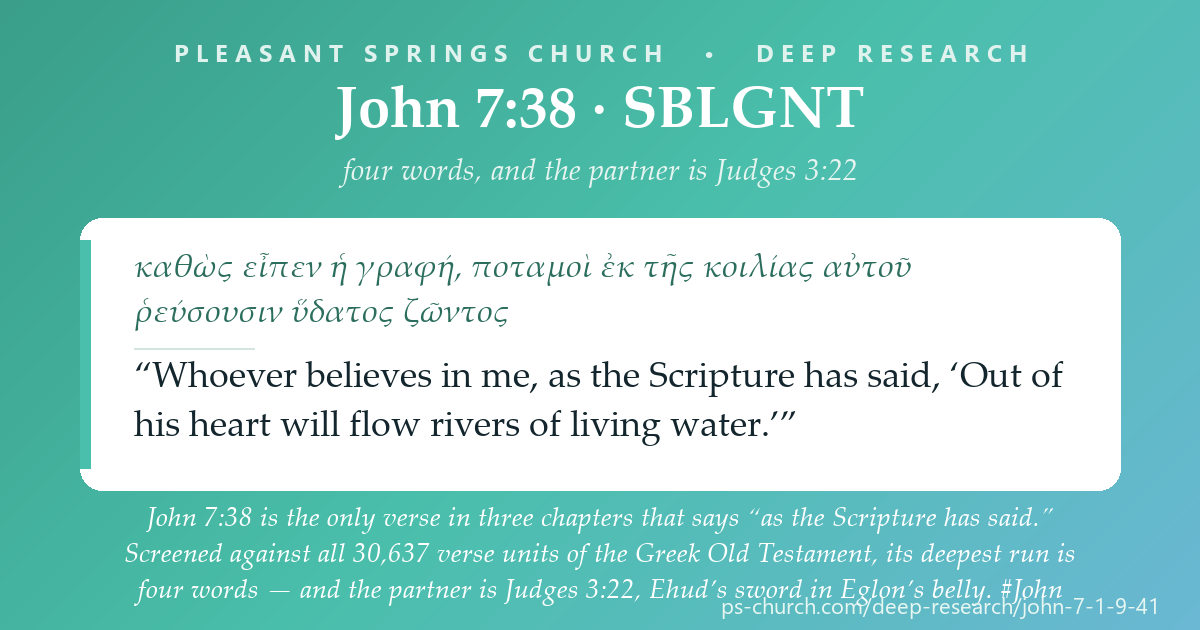
One verse in these three chapters says out loud where it is getting its words. John 7:38 — as the Scripture has said, out of his heart will flow rivers of living water — names Scripture as its source. It is the one verse in the passage whose source the measurement cannot find. Screened against all 30,348 screened verse units of the Greek Old Testament, its deepest run is four words, ἐκ τῆς κοιλίας αὐτοῦ, and the tie band of two is Judges 3:22, where a sword will not come out of a fat king’s belly. Against every verse it is usually traced to — Jeremiah 2:13 and 17:13, Zechariah 14:8, Isaiah 12:3, 44:3 and 58:11, Ezekiel 47:1 — it returns a contiguous run of one word or none. And that turns out to be the shape of the whole passage. Across 141 Greek verses nothing reaches six words shared with the Greek Old Testament, and nothing reaches six with the New Testament outside John. Inside John’s own Gospel, one verse reaches eight. See the method →
John 7:1–9:41 (selections)
Greek New Testament (SBLGNT, via MorphGNT) · ESV⚠️ THERE IS A TWELVE-VERSE GAP, AND IT IS NOT A NUMBERING DIFFERENCE. The ESV numbers this passage 53 + 59 + 41 = 153 verses. The Greek edition this page measures — SBLGNT as distributed by MorphGNT — holds 52 + 48 + 41 = 141 rows for the same three chapters: 7:1–52, then 8:12–59, then 9:1–41. The difference is exactly the twelve verses of John 7:53–8:11, the woman taken in adultery, for which the file has no rows at all. Every count on this page is a count over those 141 rows. Some would not move if the twelve verses were added — the pericope contains neither blind nor Abraham, so the thirteen blindnesses and the eleven Abrahams stand either way. Two would move: Moses is named at 8:5 and the root for sin stands at 8:11. Both are flagged where the counts are printed rather than left for a reader to discover.
The Shape of the Passage
Three panels with a measured frame — and deliberately not a chiasm⚠️ And one of those counts is hostage to a textual decision. “Moses is not named in chapter 8” is true of the edition on disk and false of any Bible that prints John 8:5, where Moses commands that such a woman be stoned. The page states the count and states what it depends on rather than letting the pattern look cleaner than the evidence.
These three chapters are the place where the Fourth Gospel’s own situation shows through most plainly. A word that occurs three times in the New Testament and only in this Gospel — ἀποσυνάγωγος, put out of the synagogue — falls in the middle of chapter 9. What that word implies about when and for whom the Gospel was written is a live argument, and this page reports the count without joining it.
Author
The book does not name him inside these chapters. The Gospel’s self-description comes at 21:24, well past this passage: this is the disciple who is bearing witness about these things, and who has written these things. Nothing in 7:1–9:41 identifies a narrator, and the passage carries no first-person aside at all.
What the passage does show is a writer with a habit no other Gospel has. The doubled ἀμὴν ἀμὴν λέγω ὑμῖν — truly, truly, I say to you — occurs twenty times in the Greek New Testament and all twenty are in John. The other Gospels use the single amen. Counted, not asserted: the four-word sequence returns 20 hits across 7,927 verses, every one in this book, and zero hits across the Greek Old Testament.
Audience
Readers who need the feast explained. 7:2 does not simply say Tabernacles; it says the feast of the Jews, Tabernacles. The Gospel glosses its own festival, the way a writer does for people outside the practice. The same hand translates Siloam at 9:7.
And readers for whom expulsion is a real cost. 9:22 is an aside to the reader, explaining why the parents will not answer. The narrative stops to say what the danger was. A story does not usually pause to explain a threat its audience does not recognise.
Orient on Tabernacles, on the synagogue ban, and on twelve verses that are not in the Greek file.
Search by topic: Tabernacles / Booths, Feast of; Siloam, Pool of; synagogue, expulsion from; Birkat ha-Minim; pericope adulterae; John, Gospel of — signs; light, imagery of; blindness in the Bible.
Which articles are relevant?
- Anchor Bible Dictionary — “Booths, Feast of,” “Siloam,” “Synagogue,” “John, Gospel of,” “Blindness.”
- Dictionary of Jesus and the Gospels (IVP) — “Feasts,” “Light,” “Signs and Wonders,” “Healing,” “Synagogue.”
- NIDNTTE — σκηνοπηγία, φῶς, τυφλός, ἀποσυνάγωγος.
- Dictionary of NT Use of the OT (Beale & Carson) — the John 7:38 entry, which is where the disagreement about the citation is laid out.
Settle the numbering first — and it is not a numbering problem
John is a New Testament book. There is no Hebrew of it and no Septuagint of it, so the MT/LXX offset that governs this shelf’s Old Testament pages does not apply. The Greek New Testament and the ESV agree on every chapter and verse number in John 7–9. What they do not agree on is how many verses there are.
| ch 7 | ch 8 | ch 9 | total | |
|---|---|---|---|---|
| ESV | 53 | 59 | 41 | 153 |
| SBLGNT / MorphGNT (this page) | 52 | 48 (8:12–59) | 41 | 141 |
The gap is exactly twelve verses and it is exactly John 7:53–8:11. The file runs 7:52 and then 8:12. This is not a chapter-division difference, and it is not an offset: no verse in the file carries a number that the ESV gives to a different sentence. Twelve verses are simply not there.
What this page does with that. It prints no Greek for 7:53–8:11, offers no measurement of them, and takes no position on them. Every count on the page is a count over 141 rows, and where a count would change if the twelve verses were included — the Moses distribution in the structure diagram is the clearest case — the page says so at the point where the count is made. The ESV prints the passage with a bracketed note of its own; readers who want the question argued should start there and with a critical commentary, not here.
A festival with water and lamps in it — and an honest account of how much of that this page actually checked.
The feast, and the one Old Testament chapter that has both halves of John 7 in it
The word σκηνοπηγία, Tabernacles, occurs once in the Greek New Testament — John 7:2 — and nine times in the Greek Old Testament files held here.
| where | how many |
|---|---|
| Deuteronomy 16:16, 31:10 | 2 |
| Zechariah 14:16, 14:18, 14:19 | 3 |
| 1 Esdras 5:50; 1 Maccabees 10:21; 2 Maccabees 1:9, 1:18 | 4 |
| Greek New Testament, all 7,927 verses | 1 — John 7:2 |
Zechariah 14 is the only Old Testament chapter that holds both of the things John 7 holds. It has three of the nine occurrences of the festival name, and at 14:8 it has ὕδωρ ζῶν — living water — going out from Jerusalem. John 7 is set at Tabernacles and speaks of living water. That is a thematic convergence and this page reports it as one.
⚠️ And now the counter-measurement, which is the point. John 7:38 against Greek Zechariah 14:8 returns a contiguous run of one: the word εἰς. The two-word sequence ὕδωρ ζῶν that Zechariah 14:8 uses does not appear in John 7:38 at all — John has ὕδατος ζῶντος, a different case, and the spelling fold this shelf applies does not join two different case forms. The convergence is of subject matter. It is not verbal contact, and a page that printed only the first half of that would be misleading its readers.
Direction is never asserted. Nothing here says John is using Zechariah, and nothing says he is not. The measurement can say what words the two passages share, which is almost none, and the thematic reading is left where it belongs — with the reader and the commentaries.
The water-drawing and the lamps — and what was NOT consulted
⚠️ This is the largest hole in the page and it is being put in the middle of the page rather than at the end of it.
Nearly every sermon and commentary on John 7:37 and 8:12 explains them from two ceremonies described in the Mishnah — the daily water-drawing from Siloam and the lighting of the great lamps in the Court of the Women during Tabernacles (Mishnah Sukkah 4–5). The connection is old, it is widely held, and it is the reason “if anyone thirsts” and “I am the light of the world” are read the way they are.
No rabbinic text was consulted for this page. The Mishnah is not on this shelf. It is not held in any corpus this page measures, it was not read, and nothing above or below rests on it. It is named here as the kind of evidence the standard reading depends on, not as something checked — and a reader should notice that the strongest cultural argument for how to hear John 7:37 and 8:12 is precisely the argument this page cannot make.
What the page can say from its own corpora is narrower and duller. Neither ceremony is described anywhere in the Old Testament’s own instructions for the feast: Leviticus 23:33–43, Numbers 29:12–38 and Deuteronomy 16:13–15 prescribe booths, offerings, rejoicing and pilgrimage, and say nothing about drawing water or lighting lamps. That was checked rather than assumed: across those 41 Greek verses, not one carries the root ὑδ- (water), λυχν- (lamp), λαμπ- or φω- (light) at all. The ceremonies are later practice, and later practice is exactly what a biblical-text corpus cannot see.
Siloam, and a translation the Gospel supplies itself
9:7 stops to gloss the name: Siloam (which means Sent). The Gospel does this twice in the passage — it glosses Tabernacles as the feast of the Jews at 7:2, and it glosses Siloam at 9:7. Both glosses are the narrator’s, not a character’s.
The name is measurable, and it is rarer than readers expect. Σιλωαμ occurs once across all 30,348 screened verse units of the Greek Old Testament held here — Isaiah 8:6, the waters of Siloam that go softly. It is not carried over into the Greek of Nehemiah 3:15, where an English Bible reads the Pool of Shelah. That one occurrence was not reached by any run screen on this page; it is named because the place is the same place, which is a geographical statement and not a textual one.
No archaeological report was consulted. The excavation of the Second-Temple pool south of the City of David is well known and is not evidence this page handled.
Five words, four of them counted across the whole Greek Bible.
John 7:2. The only occurrence in the whole Greek New Testament — one hit across 7,927 verses. Nine in the Greek Old Testament, and three of the nine are Zechariah 14:16, 18, 19.
John 9:22. Three occurrences in the Greek New Testament and all three are in John — 9:22, 12:42, 16:2. Zero in the Greek Old Testament. The count is a fact about vocabulary; it settles nothing about the history of the practice.
John 7:43 and 9:16 — the only two occurrences in these three chapters, one in each outer panel. In the Greek Old Testament it stands three times and every one is physical: clefts of the rocks at Isaiah 2:19 and 2:21, and the clefts of the mountains at Jonah 2:6. ⚠️ This read FOUR until 30 August 2026, the fourth being Odes 6:6 — which is Jonah 2:6 copied out again as a canticle, the same verse counted twice. In John the tear is in a crowd.
Thirteen occurrences in John 7–9 and every one of the thirteen is in chapter 9. Fifty in the whole Greek New Testament, so a single 41-verse chapter carries more than a quarter of them.
Three occurrences in the whole unit — twice in 8:12, once in 9:5, and nowhere else in these 141 verses. The three-word phrase φῶς τοῦ κόσμου does not occur in the Greek Old Testament at all.
“I am” — six times in three chapters, and the sixth is a beggar
The two words ἐγώ εἰμι stand in six verses of John 7–9.
| verse | who is speaking | what it means there |
|---|---|---|
| 8:12 | Jesus | I am the light of the world — with a predicate |
| 8:18 | Jesus | I am the one bearing witness about myself |
| 8:24 | Jesus | unless you believe that I am — no predicate |
| 8:28 | Jesus | then you will know that I am — no predicate |
| 8:58 | Jesus | before Abraham was, I am — the separate study on this shelf |
| 9:9 | the healed beggar | I’m the man — the ordinary sense |
A word-form screen cannot tell those apart, and the page will not pretend otherwise. Across the whole Greek New Testament the two-word sequence stands in 47 verses, 24 of them in John. Across the Greek Old Testament it stands in 182 (183 until 30 August 2026 — the 183rd was Odes 2:39, which is Deuteronomy 32:39 copied out again as a canticle, and the Odes are no longer screened). Most of those 182 are somebody ordinary saying “it is I”. Which occurrences carry the weight of the divine name is a judgement made from context, from the reaction of the hearers, and from the shape of the sentence — not from a count.
The clearest internal evidence in these chapters is not lexical but narrative: after 8:58 they pick up stones, and after 9:9 they ask the man how his eyes were opened. The same two words, and two entirely different rooms.
The article that disappears between 8:12 and 9:5
He says I am the light of the world twice, and the Greek is not the same twice.
| verse | Greek | shape |
|---|---|---|
| 8:12 | ἐγώ εἰμι τὸ φῶς τοῦ κόσμου | pronoun, verb, article, noun, genitive — the phrase intact |
| 9:5 | φῶς εἰμι τοῦ κόσμου | noun first, no article, verb inside the phrase |
Because the verb sits between the noun and its genitive at 9:5, a contiguous-word screen does not join these two verses past two words. They are the same claim and they are not the same string, and this is the clearest illustration on the page of what a sequence screen is blind to. The ESV renders both identically, which is a translator’s judgement about sense and is the right judgement — but it hides the difference the Greek shows.
Three screens, one result: John 7-9's deepest verbal partner is John.
The headline measurement
All 141 Greek rows of John 7:1–9:41 were screened three times: against the Greek Old Testament, against the New Testament outside John, and against the rest of the Greek New Testament including John’s own Gospel. The results are not close.
| screened against | size of target | deepest run | rows reaching it |
|---|---|---|---|
| the Greek Old Testament (CATSS) | 30,348 verse units screened | 5 | 2 |
| the Greek New Testament outside John | 7,061 verses | 5 | 8 |
| the rest of the Greek New Testament, John included | 7,786 verses — everything but these 141 rows | 8 | 1 |
Nothing in these three chapters reaches six shared words with anything in the Greek Bible — except with John.
| run length | rows reaching it vs the Greek OT | vs the NT outside John | vs the NT with John |
|---|---|---|---|
| at least 2 | 141 | 141 | 141 |
| at least 3 | 122 | 114 | 130 |
| at least 4 | 27 | 40 | 78 |
| at least 5 | 2 | 8 | 29 |
| at least 6 | 0 | 0 | 7 |
| at least 7 | 0 | 0 | 4 |
| at least 8 | 0 | 0 | 1 |
What this does not mean. It does not mean John 7–9 is unconnected to the Old Testament. Chapter 7 argues about circumcision and the law of Moses; chapter 8 argues about Abraham; chapter 9 argues about the Sabbath. The passage is soaked in the Old Testament at the level of subject. What the measurement shows is that it is not quoting: it argues about Scripture without reproducing its sentences.
⚠️ The screening corpus shrank on 30 August 2026, and three figures on this page moved
The Odes came off this shelf’s Greek Old Testament. They are still on disk; they are no longer screened. Two of the numbers this page published were counting the same verse twice, and a third was a tie band inflated the same way.
| figure | was | now | what the removed hit was |
|---|---|---|---|
| John 8:28, tie band at four words | 5 | 4 | Odes 2:39 = Deuteronomy 32:39, already in the band |
| ἐγώ εἰμι, Greek Old Testament verses holding it | 183 | 182 | Odes 2:39 again, the same Deuteronomy verse |
| σχίσμα, occurrences in the Greek Old Testament | 4 | 3 | Odes 6:6 = Jonah 2:6, already counted |
| size of the screened corpus | 30,637 | 30,348 | the 289 Odes verse units |
Nothing else on the page moved. The deepest run against the Greek Old Testament is still five, still two rows, still John 7:13 against Esther 8:17 and John 9:40 against Genesis 24:54, both tie band one. The distribution table is unchanged at every threshold. John 7:38 still measures four with a band of two, and the band is still Judges 3:22 in the A text and the B text.
Why the Odes were removed, in the shelf’s words rather than a summary. The Odes are the fourteen liturgical canticles bound after the Greek Psalter, and they are not an independent witness to anything. Ten of the fourteen are second copies of passages the corpus already holds — Ode 1 is Exodus 15, Ode 2 Deuteronomy 32, Ode 3 1 Samuel 2, Ode 4 Habakkuk 3, Ode 5 Isaiah 26, Ode 6 Jonah 2, Odes 7 and 8 Daniel (Theodotion) 3, Ode 10 Isaiah 5, Ode 11 Isaiah 38. A verse standing once appeared to stand twice, so every tie band touching a canticle was doubled, which is precisely what happened at John 8:28.
⚠️ And the other reason is worse, though it never touched this page. Two of the Odes are New Testament text. Ode 9 is Luke 1 — the Magnificat and the Benedictus — and Ode 13 is Luke 2, the Nunc Dimittis. Screened as Greek Old Testament, Ode 9:48 matches Luke 1:48 at eighteen consecutive words. A page could report that as a Gospel’s deepest Old Testament contact while measuring nothing but its own text. No hit removed from this page was in Ode 9 or Ode 13 — John is not Luke, and the two Odes rows this page ever touched were Ode 2 and Ode 6, both plain duplicates. The trap is named here anyway, because the instrument can do that and a reader is entitled to know it was checked.
Held and screened are now different numbers, and this page uses the right one in each place. The shelf HOLDS 30,637 CATSS verse units in 64 files. It SCREENS 30,348 in 63; the difference is exactly the 289 units of the Odes. Every “screened against” sentence on this page reads 30,348.
The two rows that reach five against the Old Testament, and why they are accidents
| row | partner | run | tie band | the shared words |
|---|---|---|---|---|
| John 7:13 | Esther 8:17 | 5 | 1 | διὰ τὸν φόβον τῶν Ἰουδαίων |
| John 9:40 | Genesis 24:54 | 5 | 1 | οἱ μετ’ αὐτοῦ ὄντες καὶ |
Genesis 24:54 is Abraham’s servant and his men eating and drinking at Bethuel’s house. The five words are those who were with him, and. There is no argument to be made from that and the page makes none.
Esther 8:17 is the better warning. The five words — because of the fear of the Jews — are a real phrase with real content, and they sit in a verse about Gentiles submitting out of dread. It would be easy to build something on that. Do not. The same five words stand twice more in John itself — 19:38, where Joseph of Arimathea is a secret disciple, and 20:19, where the doors are locked — and nowhere else in the New Testament. It is John’s own stock phrase, used three times, and its appearance in Esther is a coincidence of common vocabulary.
The eight-word run, and why it is not a citation either
| row | partner | run | band | the shared words |
|---|---|---|---|---|
| John 8:34 | John 10:7 | 8 | 1 | αὐτοῖς ὁ Ἰησοῦς Ἀμὴν ἀμὴν λέγω ὑμῖν ὅτι |
| John 8:21 & 8:22 | John 13:33 | 7 | 1 | ὅπου ἐγὼ ὑπάγω ὑμεῖς οὐ δύνασθε ἐλθεῖν |
| John 8:53 | John 4:12 | 7 | 1 | μὴ σὺ μείζων εἶ τοῦ πατρὸς ἡμῶν |
| John 8:23 | John 17:14, 17:16 | 6 | 2 | ἐγὼ οὐκ εἰμὶ ἐκ τοῦ κόσμου |
⚠️ The deepest run on the page is built on a house formula and is therefore the weakest kind of eight. Four of John 8:34’s eight words are ἀμὴν ἀμὴν λέγω ὑμῖν — a formula that occurs twenty times in the Greek New Testament and all twenty in John. A writer with a catchphrase will score high against himself. An eight-word run inside one author’s own book is evidence of idiom, not of quotation, and reporting it as anything more would be exactly the error these pages exist to avoid.
Which is why the finding is stated in the negative and not the positive. The claim is not John 8:34 quotes John 10:7. The claim is that the passage has no six-word partner outside its own Gospel at all — not in the Law, not in the Prophets, not in Paul, not in the Synoptics.
A note on the spelling fold, checked rather than assumed. This shelf folds οὐ / οὐκ / οὐχ and ἐκ / ἐξ together before matching, so a run is not cut at a word two editions merely spell differently — which means a fold can lengthen a run that the printed texts do not actually share. The four rows in the table above were checked against the unfolded text and none of them depends on it: John 8:23, 17:14 and 17:16 all read οὐκ in the SBLGNT, so the six-word run stands without the fold. The fold is applied to every screen on every page and is documented in the footer.
John 7:38: a citation formula with no locatable citation
John 7:38 says καθὼς εἶπεν ἡ γραφή — as the Scripture said. It is the only explicit citation formula in these three chapters. Here is every candidate, measured.
| candidate (Greek numbering) | run vs John 7:38 | the longest shared run |
|---|---|---|
| Jeremiah 2:13 (the fountain of living water) | 1 | ὁ |
| Jeremiah 17:13 | 1 | τῆς |
| Zechariah 14:8 (living water out of Jerusalem) | 1 | εἰς |
| Isaiah 12:3 (draw water from the wells of salvation) | 1 | ἐκ |
| Isaiah 44:3 | 0 | no shared word at all |
| Isaiah 58:11 | 1 | ὁ |
| Ezekiel 47:1 (water from under the threshold) | 0 | no shared word at all |
| Proverbs 18:4 | 0 | no shared word at all |
| Psalm 77:16 (ESV 78:16, streams from the rock) | 1 | ἐκ |
| Genesis 26:19 (a well of living water) | 2 | ὕδατος ζῶντος |
| Judges 3:22 (A and B texts) | 4 | ἐκ τῆς κοιλίας αὐτοῦ |
The last column is the longest contiguous run, not a list of every word the two verses share. A row measured at one can still share several isolated words — John 7:38 and Jeremiah 2:13 share ὁ, ἐμέ and ὕδατος; John 7:38 and Zechariah 14:8 share εἰς, ἐκ and αὐτοῦ — but in none of them do two shared words stand next to each other. A zero means no word at all is shared.
The deepest Old Testament contact of the only verse in John 7–9 that claims a Scripture is Ehud’s sword in Eglon’s belly. Judges 3:22: the fat closed over the blade, for he did not draw the sword out of his belly. Four words, tie band of two — and the two are the same verse in the A text and the B text, so the band is really one verse counted twice. It is not a source. It is what a four-word run looks like when there is nothing better in the corpus.
Two supporting counts. The two-word sequence ὕδατος ζῶντος occurs in exactly three Greek Old Testament verses — Genesis 21:19, Genesis 26:19 and Song of Songs 4:15 — and every one of the three is a literal well or spring, none of them a person. And ποταμοὶ ὕδατος, rivers of water, occurs nowhere — zero in the Greek Old Testament and zero in the Greek New Testament, John 7:38 included, because the two words stand five words apart here rather than side by side.
Two honest limits on this result. First, a contiguous-run screen measures reproduction, not paraphrase; a writer summarising several passages at once would score exactly this low, and many commentators think that is what is happening here. The measurement rules out copying; it does not rule out composite allusion, and nothing on this page should be read as saying the verse has no Old Testament background. Second, where the sentence divides is editorial. The oldest manuscripts carry no punctuation, and whether out of his heart belongs to the believer or to Christ depends entirely on where a modern editor puts the stop. This page prints the Greek as the SBLGNT punctuates it and takes no position on the division.
John 9 against the Synoptic healings of blind men
All 41 rows of John 9 were screened against the Synoptic blind-man pericopes — Mark 8:22–26, Mark 10:46–52, Matthew 9:27–31, Matthew 20:29–34 and Luke 18:35–43, 32 verses in all.
| result | value |
|---|---|
| deepest run | 3 |
| rows reaching 3 | 6 |
| rows reaching only 1 — a single isolated word | 18 of 41 |
| rows reaching 4 or more | 0 |
Four of the six threes are narrative furniture — and he said, Jesus said to him, Jesus said to them, he said to him, go. The other two are worth naming: John 9:6 and John 9:15 both share with Mark 8:25 ἐπὶ τοὺς ὀφθαλμούς, on the eyes — and Mark 8 is the one Synoptic healing in which Jesus uses spittle and touches the eyes, as here.
Three shared words, and one of them the preposition. That is not a literary relationship and this page does not claim one. It is reported because the two episodes are constantly compared, and a reader deserves to know that the comparison is a comparison of method, made by readers, and not of wording, which the texts do not share.
What this page could not check, and where it is weakest.
The three things that would most change this page
1. The Mishnah was not consulted, and it is the backbone of the standard reading. Mishnah Sukkah 4–5 on the water-drawing and the lamps in the Court of the Women is where nearly every commentator grounds John 7:37 and 8:12. It is not on this shelf, it was not read, and no claim on this page rests on it. That means the page’s cultural stage is the thinnest stage it has, and stage 2 says so in its own body rather than burying it here.
2. John 7:53–8:11 was not measured, because the Greek file does not have it. No manuscript, no critical apparatus beyond the SBLGNT’s own sigla, and no patristic citation was examined. The page cannot say anything about those twelve verses and does not try. The one structural claim they touch — that Moses is not named in chapter 8 — is flagged at the diagram itself.
3. Every number here is a number about two specific editions. “Nothing reaches six” is a statement about the SBLGNT as distributed by MorphGNT, screened against the CATSS Greek Old Testament files held on this shelf. A different Greek New Testament, or a fuller Septuagint, could move it. The CATSS collection here does not include every Greek witness, and where a book exists in two Greek forms — Judges A and B, Daniel OG and Theodotion — both are counted, which inflates tie bands. The Judges 3:22 band of two in stage 4 is exactly that: one verse in two recensions.
What was not consulted at all
No Greek critical apparatus beyond the SBLGNT’s own marks. For scale: the SBLGNT flags 126 apparatus notes across these three chapters, in 83 of the 141 verses — nearly three verses in five carry at least one point where the edition records a difference from another printed text. None of those was examined; the page uses the SBLGNT’s text as it stands and strips the marks for display.
No Mishnah, Tosefta, Talmud or Targum. No Josephus. No Dead Sea Scrolls. No patristic commentary — and John 9 has a very large one in Augustine’s tractates, which was not read. No Syriac, Latin or Coptic version. No archaeological report on the Pool of Siloam.
And one methodological limit that applies to every screen above. These screens find verbatim contact — contiguous runs of the same word forms. They do not find allusion, echo, paraphrase, or argument from a passage. A zero on the Greek side means the two verses share no word at all, which is a strong result about wording and a weak one about meaning. John 7–9 argues with Scripture continuously and reproduces it almost never, and only the first half of that sentence is something this page measured.
Reading list
- Raymond E. Brown, The Gospel According to John I–XII (Anchor Bible 29).
- C. K. Barrett, The Gospel According to St John, 2nd ed.
- D. A. Carson, The Gospel According to John (Pillar).
- Craig S. Keener, The Gospel of John: A Commentary — the fullest treatment of the Tabernacles background.
- Chris Keith, The Pericope Adulterae, the Gospel of John, and the Literacy of Jesus.
- None of these were consulted for the measurements on this page, which were run on the text files named in the footer.
A man who could only say one thing, and said it.
One thing I know
Chapter 9 is an interrogation. The neighbours question him, the Pharisees question him, the parents are questioned and refuse to answer, and then the Pharisees question him again. He is asked the same thing five different ways by people who already know what answer they want.
And in the middle of it he says the sentence that has outlived every argument in the chapter: whether he is a sinner I do not know; one thing I do know, that though I was blind, now I see. He does not win the theological exchange. He is not equipped to. What he has is one fact he cannot be argued out of, and he holds it until they throw him out.
Then — and this is the part the interrogation scene is built to set up — Jesus goes and finds him (9:35). The man is not restored to the synagogue. He is found by the one who healed him, outside it.
What the numbers on this page are for. Not much of chapter 9 could be traced to anywhere else; 18 of its 41 verses share no more than a single isolated word with the Synoptic healings, and the whole passage has no six-word partner in the Old Testament. The measurement’s honest conclusion is that this story is told in John’s own words and nobody else’s. Which is worth knowing before anyone builds a sermon on a parallel that the wording does not support.
Every Deep Research page traces its passage across the whole sweep — the Old Testament, the Second-Temple world between the testaments (historical witnesses, not Scripture), and the New Testament. Follow the thread:
Pleasant Springs Church — Deep Research
Research method after Michael S. Heiser’s Bible Research Method (examine dictionaries → ancient literature → important words → textual connections → academic publications → share), with the Pleasant Springs “Author & Audience” foundation. Scripture set in the Hebrew, the Greek editions named on each page and the ESV (Old Testament), and the Greek New Testament and the ESV (New Testament), per the practice of Pleasant Springs Church. John 7–9 research grounded in Brown (Anchor), Barrett, Carson (Pillar) and Keener. Text: Greek New Testament from the SBL Greek New Testament as distributed by MorphGNT; English from the ESV. There is no Hebrew column and no Septuagint column on this page, because John is a Greek New Testament book and neither exists for it. Old Testament verses named above are measured in Greek — CATSS, Rahlfs’ Septuaginta — and are cited in Greek chapter and verse numbering, which differs from an English Bible in the Psalms in particular (Psalm 77:16 here is ESV 78:16; 63:10 is ESV 64:9; 65:5 is ESV 66:5). ⚠️ VERSE NUMBERING — no offset, but a twelve-verse gap. The Greek New Testament and the ESV number John 7, 8 and 9 identically; no verse on this page carries a different number in the two columns. But the ESV holds 53 + 59 + 41 = 153 verses for these chapters and the MorphGNT file holds 52 + 48 + 41 = 141 rows, running 7:1–52, then 8:12–59, then 9:1–41. The twelve missing rows are John 7:53–8:11. Every count on this page is over those 141 rows; the page prints no Greek for the twelve verses, measures nothing about them, and takes no position on them. ⚠️ The Greek measurement, in full. Greek against Greek. MorphGNT field 6, the normalised word — the column that already resolves elision and the movable nu; CATSS FORM column (cols 0–24), beta-code transliterated first. Both sides lowercased, accents and breathings dropped, final sigma folded, then filtered to Greek letters — the same filter applied to both corpora, and οὐ / οὐκ / οὐχ, ἐκ / ἐξ and the movable nu folded together so a run is not cut at a word two editions merely spell differently. Contiguous runs of whole word FORMS, never lemmas. Corpus: the 141 MorphGNT rows of John 7:1–9:41 against 30,348 CATSS verse units across the 63 Greek Old Testament files screened — 64 files and 30,637 units are held on disk; the Odes, 289 units, are held and not screened — and against 7,927 MorphGNT verses across 27 files. Exhaustive and deterministic; nothing sampled, so no seed applies. ⚠️ Tie bands are printed beside every run, and two of them are inflated by design. Where the CATSS collection holds a book in two Greek forms, both are counted: the Judges 3:22 band of two at John 7:38 is one verse in the A text and the B text, and that is said at the point where the number is printed. ⚠️ The second inflated band on this page has been removed rather than annotated. The John 8:28 band read five and the fifth was Odes 2:39, Deuteronomy 32:39 copied out again as a liturgical canticle. On 30 August 2026 the Odes came off this shelf’s screening corpus altogether. Ten of the fourteen canticles are second copies of passages the corpus already holds (Exodus 15, Deuteronomy 32, 1 Samuel 2, Habakkuk 3, Isaiah 26, Jonah 2, Daniel 3 twice, Isaiah 5, Isaiah 38), so every tie band touching a canticle was doubled; and two of them are New Testament text — Ode 9 is Luke 1 and Ode 13 is Luke 2. No figure removed from this page was in Ode 9 or Ode 13, so nothing here was ever Luke measured against Luke; the three figures that moved — the John 8:28 band, the Greek Old Testament count of ἐγώ εἰμι, and the count of σχίσμα — all moved because one verse was being counted twice. ⚠️ The structure diagram is built from word counts over the 141 rows, not from a commentary’s outline, and it is labelled a frame rather than a chiasm because nothing in it inverts. One of its counts — that Moses is not named in chapter 8 — is true of the edition on disk and false of any Bible printing John 8:5, and the diagram says so. ⚠️ Direction of influence is never asserted. Nothing here says John is quoting Zechariah, Judges, Esther or Ezekiel; nothing says John 9 depends on Mark 8; nothing says Matthew 5:14 and John 8:12 stand in any order. The page reports shared word forms and their tie bands and stops there. Typology is handled per the house position: what the text says, what the New Testament itself draws, and what we see from this side of the cross — with the seeing left to the reader.
Scripture quotations marked ESV are from the ESV® Bible (The Holy Bible, English Standard Version®), © 2001 by Crossway, a publishing ministry of Good News Publishers. ESV Text Edition: 2016. Used by permission. All rights reserved. The ESV text may not be quoted in any publication made available to the public by a Creative Commons license, and the ESV may not be translated in whole or in part into any other language. www.esv.org
|
Did this study bless you today? 💚 Give to Support PS Church100% of gifts go to the General Fund — thank you. |