John 5 is the chapter where a healing turns into a trial. A man who has been ill for thirty-eight years is told to get up and carry his mat; the day is a Sabbath; and by verse 18 the question is no longer about the mat. Three things on this page were measured rather than assumed, and two of them were not what we expected. First: John’s Gospel almost never shares wording with the Synoptics — and the deepest verbal contact John 5 has with any other Gospel is six words in a row with Mark 2, in a healing story about a different man in a different town. Matthew and Luke, retelling that very Markan story, measure one. Second: the verse everyone pairs with the Old Testament here — “all who are in the tombs” — lands on Isaiah 26:19, not on the Daniel 12:2 the commentaries name; Daniel measures one and two. And third: “You search the Scriptures” is among the shallowest measurable contacts with the Scriptures anywhere in the chapter — a run of two, in a tie band of ninety-five, and one of nine rows that stop at two. See the method →
John 5:1–47 (sixteen rows out of forty-six)
Greek New Testament (SBLGNT via MorphGNT) · ESV⚠️ BUT THE CHAPTER HAS A NUMBERING PROBLEM OF ITS OWN: VERSE 4 IS A NUMBER WITH NO VERSE. The chapter is numbered to 47, and the critical Greek text this page measures has 46 rows. There is no John 5:4 in it. Counted across the whole Greek New Testament, fifteen chapters carry an interior gap in their verse numbering like this — and two of the fifteen are in John: chapter 5, and chapter 8. The ESV prints the missing sentence in a footnote. Stage 1 sets out what it says and what this page can and cannot check about it.
The Shape of the Passage
Sequence — a sign, a charge, a defence bracketed by one sentence said twice, and six witnessesJohn 5 is the first place in this Gospel where a miracle becomes a trial. Chapters 2 to 4 have signs and conversations. Here a sign produces a charge, the charge produces a defence, and the defence produces a list of witnesses — and from this chapter on the Gospel is, in large part, a lawsuit. Read the chapter as a courtroom and its shape stops being strange.
Author
The evangelist writes as a man laying evidence before a court. The μαρτυρ- root — witness, testimony, to bear witness — occurs 141 times in the Greek New Testament. Thirty-eight are in this Gospel, and nine of those are in this one chapter — more than in any other chapter of the New Testament, 1 John 5 (eight) coming next. That is not a theme the reader has to supply; it is the chapter’s own vocabulary, counted.
And he tells us how the case is to be judged. “If I alone bear witness about myself, my testimony is not true” (5:31) assumes the law of Deuteronomy 19:15 — nothing stands on one witness — which John 8:17 will state outright: “In your Law it is written that the testimony of two people is true.” Six witnesses are then produced in nine verses (5:31–39), and the last of them is the Scriptures themselves.
Audience
People who already read the Scriptures — carefully. The chapter does not argue that the Bible is trustworthy. It argues with people who are certain it is, and says the certainty has stopped short: “you search the Scriptures because you think that in them you have eternal life… yet you refuse to come to me that you may have life” (5:39–40). The charge is not too little Bible study. It is Bible study that terminates on itself.
And people who know what a Sabbath rule is. The man is stopped not for being healed but for carrying — the mat is the offence (5:10; cf. Jeremiah 17:21–22). A reader who does not know that will think the objection petty. A reader who does will hear 5:17 for what it is: not a denial that the Sabbath matters, but a claim about who the Sabbath belongs to.
Orient on Bethesda, on the Sabbath carrying rule, on witness law — and on a verse number with no verse.
Search by topic: Bethesda / Bethzatha; Sheep Gate; Sabbath, work on; witness, law of; Son of Man, judgment; resurrection, two; John, Gospel of — discourses; textual criticism, John 5:4.
Which articles are relevant?
- Anchor Bible Dictionary — “Bethesda,” “Sheep Gate,” “Sabbath,” “Witness,” “Resurrection (Early Judaism and Christianity).”
- Dictionary of Jesus and the Gospels (IVP, 2nd ed.) — “Sabbath,” “Signs and Wonders,” “Son of God,” “John, Gospel of.”
- NIDNTTE — μαρτυρέω / μαρτυρία, ὑγιής, ἐργάζομαι, ἐραυνάω, κρίσις.
- Metzger, A Textual Commentary on the Greek New Testament — on 5:2 (the name of the pool) and on 5:3b–4 (the angel and the water).
Settle John 5:4 first — the number that has no verse
The chapter is numbered to forty-seven. The Greek text this page measures has forty-six rows. There is no verse 4 in it. Modern English Bibles print the chapter the same way: verse 3 ends, verse 5 begins, and the missing sentence goes into a footnote.
| rows present | highest number | gap | |
|---|---|---|---|
| SBLGNT John 5 | 46 | 47 | v.4 |
| SBLGNT John 8 | 48 | 59 | vv.1–11 |
| whole Greek NT | 15 chapters carry an interior numbering gap of this kind — and two of the fifteen are in John | ||
What the missing sentence says. The later Greek tradition adds, at the end of v.3 and as v.4, an explanation of why the sick were lying there. Because that text is not in the corpus this page measures, it is quoted here from the King James Version, which follows that tradition and is in the public domain:
…waiting for the moving of the water. For an angel went down at a certain season into the pool, and troubled the water: whosoever then first after the troubling of the water stepped in was made whole of whatsoever disease he had.John 5:3b–4, King James Version
Why it matters for reading the chapter, and why it changes less than people fear. Without v.4 the pool is simply a place where sick people gathered, and the man’s reply in v.7 — “when the water is stirred up, I have no one to put me into the pool” — is his own account of the belief rather than the narrator’s endorsement of it. The stirring of the water is in v.7 either way. What the shorter text removes is the angel and the guarantee, not the man’s hope.
This page reports what the SBL edition contains and what the King James tradition contains. It does not say which is earlier, does not call either reading original, and has consulted no manuscript — see Stage 5.
And settle the name of the pool, because the editions differ
The Greek text on this shelf reads Βηθεσδά, Bethesda. Other printed editions and translations read Bethzatha or Bethsaida at 5:2, and the variation is old and well known. Βηθεσδά occurs once in the Greek New Testament this page holds — here — so the corpus offers no second occurrence to test it against.
What can be said from the corpus: John flags the name as a local one. Ἑβραϊστί, in Hebrew/Aramaic, occurs seven times in the Greek New Testament — five in John and two in Revelation. This is the first of John’s five; the other four are Gabbatha, Golgotha, the title on the cross, and Mary’s “Rabboni.” John reaches for that word at a pool, a pavement, a hill, a placard and a grave.
A pool with five porticoes, a mat that was the offence, and a very old argument about whether God keeps the Sabbath.
Five colonnades — and where the Sheep Gate is in the Greek Old Testament
John 5:2 gives an architectural detail that serves no narrative purpose: the pool has five roofed colonnades. Nothing in the story depends on the number. It is the kind of detail a writer includes because he has seen the place or been told about it by someone who had.
What the corpus can add is the gate. ἡ προβατική, the Sheep [Gate], occurs once in the Greek New Testament — here. In the Greek Old Testament held on this shelf it occurs three times, and all three are in Nehemiah (2 Esdras 13:1, 13:32, 22:39 = Neh 3:1, 3:32, 12:39). In Nehemiah 3 the Sheep Gate is the first thing rebuilt and the point the circuit of the wall closes on, and it is the priests who build it. The one gate the Greek Old Testament names by that word is the gate John puts this pool beside.
Stated as a lexical fact, not as an allusion. John does not mention Nehemiah, and this page does not claim he is thinking of him. What can be said is that a reader who knew the Greek Old Testament had met this word in exactly one book.
The offence was the mat, not the healing
Nobody in the chapter objects to the man being well. The objection at 5:10 is specific: it is not lawful for you to take up your bed. Carrying a burden from one domain to another on the Sabbath is prohibited in the Scriptures themselves — Jeremiah 17:21–22 forbids bearing a burden on the Sabbath day and bringing it in by the gates of Jerusalem; Nehemiah 13:15–19 has Nehemiah shutting the gates over it. The Mishnah’s tractate Shabbat lists carrying from one domain to another among the thirty-nine categories of prohibited work — last in the list at m. Shab. 7:2, though the tractate opens with it at 1:1 — and it treats a bed explicitly.
The Mishnah was compiled around AD 200 and is a historical witness, not Scripture, and it is later than this Gospel. It is cited here for what the categories of the debate looked like, not as evidence of what any first-century person was thinking. The Jeremiah and Nehemiah texts are the ones inside the canon.
Does God rest? The argument behind 5:17
“My Father is working until now, and I am working” enters an argument that was already old. If God rested on the seventh day and rests still, the world runs unattended. If God does not stop — because rain falls, children are born and the sun rises on Sabbaths — then work in God’s case must mean something other than what the commandment forbids. Philo of Alexandria, writing in Greek in the first century, takes exactly this line: God never ceases making, and “rest” said of God is not idleness (Legum Allegoriae 1.5–6; De Cherubim 87). Later rabbinic discussion works the same ground with the examples of birth and death.
What John 5:17 does with it is not to settle the question but to stand inside the exception. Whatever God’s unceasing work is, the speaker claims to be doing it — κἀγὼ ἐργάζομαι, and I too am working. Verse 18 shows that his hearers understood the sentence exactly that way.
Philo is a historical witness, not Scripture. He is cited here from the standard editions and not measured against any corpus on this shelf — we hold no Philo text to measure. See Stage 5.
Five words this chapter owns, counted across the whole Greek New Testament.
Every count below is a screen of the normalised MorphGNT word column over all 7,927 verses of the Greek New Testament, and — where stated — over the 30,348 Greek Old Testament verse units screened here — the 30,637 held in 64 CATSS files, less the 289 units of the Odes, which stay on the disk and are not screened (stage 4 says why). Word forms, never lemmas — except at three cards below that say so in so many words (ὑγιής, θέλω and ἐργάζομαι), because there an augment or a shared stem makes a surface screen count the wrong thing. The surface figures are reproducible with python -m dr_tools lexeme gnt <pattern>; the lemma figures with the MorphGNT lemma column.
Eleven occurrences in the whole Greek New Testament, and zero in the Greek Old Testament held here. Five are in Mark (2:4, 9, 11, 12; 6:55), four are in John 5 (vv. 8, 9, 10, 11) and two are in Acts (5:15; 9:33). Matthew and Luke never use it — not even when they are telling Mark’s own paralytic story: Matthew 9:6 has κλίνη and Luke 5:24 has κλινίδιον. It is a Latin loanword (grabatus), a cheap mat, and it is the word Mark and John both reach for.
Eleven occurrences in the Greek New Testament. Five of them are in John 5 (vv. 6, 9, 11, 14, 15). No other chapter has more than one. ⚠️ A surface screen on forms beginning ὑγι- returns 23; twelve of those are the separate verb ὑγιαίνω, to be in good health, and are not this word. It is not “healed” — John has other words for that — but sound, whole, in one piece, the word behind English hygiene. Jesus asks for it in 5:6 and pronounces it in 5:14, and the chapter’s argument begins from a man who has it.
The μαρτυρ- root stands 141 times in the Greek New Testament. Nine of them are in John 5 — more than in any other single chapter. (1 John 5 has eight; John 8 has seven.) Thirty-eight of the 141 are in this Gospel. The chapter is not about witness by inference; it says the word nine times in forty-six verses.
Six occurrences in the Greek New Testament, and two of them are in John — 5:39 and 7:52. The other four are Romans 8:27 (the Spirit who searches hearts), 1 Corinthians 2:10, 1 Peter 1:11 and Revelation 2:23. The form ἐραυνᾶτε at 5:39 is spelled identically as an indicative (“you search”) and as an imperative (“search!”). The ESV reads it as an indicative; the King James reads it as an imperative. The Greek does not settle it, and no measurement on this page can.
Six occurrences of the θελ- root in John 5, at the two ends and in the middle — the verb θέλω four times and the noun θέλημα twice. 5:6 θέλεις — do you want to be made well?; 5:21 θέλει — the Son gives life to whom he wills; 5:30 θέλημα twice — not my own will; 5:35 ἠθελήσατε — you were willing to rejoice for an hour; 5:40 θέλετε — you are not willing to come to me. One root runs from the pool to the refusal. ⚠️ This is the one count on the page that is not a plain surface screen, and it has to be said exactly. A screen on word forms beginning θελ- returns five, because the augment on ἠθελήσατε at 5:35 hides it; the lemma column returns four for θέλω, because θέλημα is a different lemma. The six is the root, counted across both words — said plainly so that anyone re-running either screen knows why the two numbers differ.
One more, because it is the hinge of verse 17
ἐργάζομαι, to work, occurs 41 times in the Greek New Testament by lemma. Eight are in John, and two of the eight are in this one verse — “My Father ἐργάζεται… and I ἐργάζομαι” (5:17). The Gospel uses it also at 3:21, 6:27, 6:28, 6:30 and twice at 9:4 — and 9:4 is the other Sabbath healing: “we must work the works of him who sent me while it is day.” ⚠️ A surface screen on forms beginning ἐργαζ- returns 33, and seven in John, because eight augmented forms — including εἰργασμένα at John 3:21 — do not begin with those letters. The same augment problem as θέλω above, and it is named here for the same reason.
Two screens, run end to end, with the tie band beside every run.
Screen A: the 46 SBLGNT rows of John 5 against the 30,348 Greek Old Testament verse units screened here — the 30,637 held in 64 CATSS files, less the 289 units of the Odes. Screen B: the same 46 rows against the other 7,881 verses of the Greek New Testament. Screen C: the same 46 rows against Matthew, Mark and Luke alone, 2,890 verses. All three count contiguous runs of whole normalised word forms, never lemmas; all three are exhaustive and deterministic, so no seed applies. Every run below is printed with its tie band — the number of distinct target verses that reach the same depth. A run without its band is misleading.
Screen A — John 5 against the whole Greek Old Testament: the ceiling is four
Across the 46 rows: all 46 reach two, 37 reach three, 8 reach four, and nothing reaches five.
| row | run | band | deepest target | the shared words |
|---|---|---|---|---|
| 5:28 | 4 | 1 | Isaiah 26:19, alone (this cell read ‘band 2 — Isaiah 26:19 · Odes 5:19’ until 30 August 2026) | οἱ ἐν τοῖς μνημείοις |
| 5:12 | 4 | 1 | Genesis 24:65 | τίς ἐστιν ὁ ἄνθρωπος |
| 5:21 | 4 | 1 | 4 Maccabees 7:11 | ὥσπερ γὰρ ὁ πατήρ |
| 5:26 | 4 | 1 | 4 Maccabees 7:11 | ὥσπερ γὰρ ὁ πατήρ |
| 5:25 | 4 | 1 | 2 Chronicles 30:16 | τοῦ θεοῦ καὶ οἱ |
| 5:38 | 4 | 1 | Sirach 13:23 | καὶ τὸν λόγον αὐτοῦ |
| 5:43 | 4 | 26 | — formula — | τοῦ πατρός μου καί |
| 5:9 | 4 | 33 | — formula — | ἐν ἐκείνῃ τῇ ἡμέρᾳ |
Read that table with the band column, not the run column. Eight rows reach four. Two of the eight do it with phrases that occur in thirty-three and twenty-six different Greek Old Testament verses — 5:9 on that day (band 33) and 5:43 of my father and (band 26). Those are the language of the corpus, not links to anything. Five more rows — 5:12, 5:21, 5:25, 5:26 and 5:38 — land on four band-of-one phrases (5:21 and 5:26 land on the same one) that are ordinary Greek and are about nothing in particular: who is the man, for just as the Father, of God and the, and his word.
Which leaves one. John 5:28 — all who are in the tombs will hear his voice — shares four contiguous words with Isaiah 26:19, those in the tombs shall be raised. Its band prints as 2, and the second member is Odes 5:19; Ode 5 is the canticle of Isaiah and its verse 19 is word for word Isaiah 26:19. So the tie band of two was a single text counted twice, and John 5:28 is the only row in the chapter whose deepest Old Testament run lands on a passage about the same subject.
★ That collapse is no longer something this page does by hand. On 30 August 2026 the Odes came out of the screening corpus and the instrument returns the band of one by itself. The Odes are the fourteen liturgical canticles appended to the Greek Psalter. They stay on this disk and they are out of anything the shelf calls the Greek Old Testament, for two independent reasons. (1) Ten of them are second copies of passages the corpus already holds — Ode 1 = Exodus 15, 2 = Deuteronomy 32, 3 = 1 Samuel 2, 4 = Habakkuk 3, 5 = Isaiah 26, 6 = Jonah 2, 7 and 8 = Daniel (Th) 3, 10 = Isaiah 5, 11 = Isaiah 38 — so a verse standing once appeared to stand twice and every tie band touching a canticle was inflated. (2) Two of them are New Testament text: Ode 9 is Luke 1 (the Magnificat and the Benedictus) and Ode 13 is Luke 2 (the Nunc Dimittis). 30,637 units held, 30,348 screened.
Two bands in the table above moved, and both moved for reason (1). John 5:28 goes from 2 to 1, losing Odes 5:19, which is Isaiah 26:19 — the row it was tied with. John 5:43 goes from 27 to 26, losing Odes 1:2, which is Exodus 15:2, likewise already in the band. Nothing else on this page moved: the ceiling is still four, the distribution is still 46 / 37 / 8, and the six other four-word rows keep their partners and their bands. No hit removed from this page was in Ode 9 or Ode 13 — John 5 touches neither Luke canticle — so nothing here was ever a Gospel measured against itself. That trap is real and it is worth the reader knowing about: screened with the canticles in, Ode 9:48 matches Luke 1:48 at eighteen consecutive words, which would read as a Gospel’s deepest Old Testament contact and is in fact Luke matching Luke. It was caught by asking which file each hit came out of rather than by any number looking wrong.
The counter-example this page is obliged to print: Daniel 12:2
Ask any commentary what stands behind John 5:28–29 and it will say Daniel 12:2. “Many of those who sleep in the dust of the earth shall awake, some to everlasting life, and some to shame and everlasting contempt” — a two-outcome resurrection, exactly the shape of John 5:29. Measured, the verbal contact is almost nothing.
| pair | longest contiguous run | the words |
|---|---|---|
| John 5:29 vs Theodotion Daniel 12:2 | 1 | καί |
| John 5:29 vs Old Greek Daniel 12:2 | 2 | οἱ δέ |
| John 5:28 vs Isaiah 26:19 | 4 | οἱ ἐν τοῖς μνημείοις |
This is not a refutation of the commentaries, and it must not be read as one. Daniel 12:2 and John 5:29 share a structure — two groups, two destinies, one resurrection — and a structure is a real thing. What the screen measures is verbatim contact, and that is a different thing. The honest summary is: the idea in John 5:29 is Daniel’s shape; the four words in John 5:28 are Isaiah’s. And this page asserts no direction of influence in either case.
Note also what the two Greek Daniels do to each other. Old Greek 12:2 has three outcomes (life · reproach · dispersion and shame); Theodotion has two. The two-outcome shape John 5:29 matches is the Theodotion shape — and Theodotion is the column that measures one word. The page reports this and takes no position on what it means.
Screen B — John 5 against the rest of the Greek New Testament, and the Mark 2 result
Across the 46 rows: all 46 reach two, 39 reach three, 22 reach four, 10 reach five, 6 reach six, 2 reach seven, 1 reaches ten, and nothing reaches eleven.
| row | run | band | where it lands | the shared words |
|---|---|---|---|---|
| 5:30 | 10 | 1 | John 6:38 | τὸ θέλημα τὸ ἐμὸν ἀλλὰ τὸ θέλημα τοῦ πέμψαντός με |
| 5:25 | 7 | 1 | John 4:23 | ἔρχεται ὥρα καὶ νῦν ἐστιν ὅτε οἱ |
| 5:8 | 6 | 2 | Mark 2:11 · Mark 2:9 | ἔγειρε ἆρον τὸν κράβαττόν σου καί |
| 5:11 | 6 | 1 | Mark 2:9 | ἆρον τὸν κράβαττόν σου καὶ περιπάτει |
| 5:24 | 6 | 1 | 1 John 3:14 | ἐκ τοῦ θανάτου εἰς τὴν ζωήν |
| 5:43 | 6 | 1 | John 10:25 | ἐν τῷ ὀνόματι τοῦ πατρός μου |
| 5:14 | 5 | 1 | John 10:23 | ὁ Ἰησοῦς ἐν τῷ ἱερῷ |
| 5:18 | 5 | 1 | John 7:1 | ἐζήτουν αὐτὸν οἱ Ἰουδαῖοι ἀποκτεῖναι |
| 5:19 | 5 | 2 | John 6:32 · John 13:16 | ἀμὴν ἀμὴν λέγω ὑμῖν οὐ |
| 5:37 | 5 | 1 | John 8:16 | καὶ ὁ πέμψας με πατήρ |
Ten rows reach five or more. Seven of them land inside John’s own Gospel and one lands in 1 John. The remaining two both land in Mark 2.
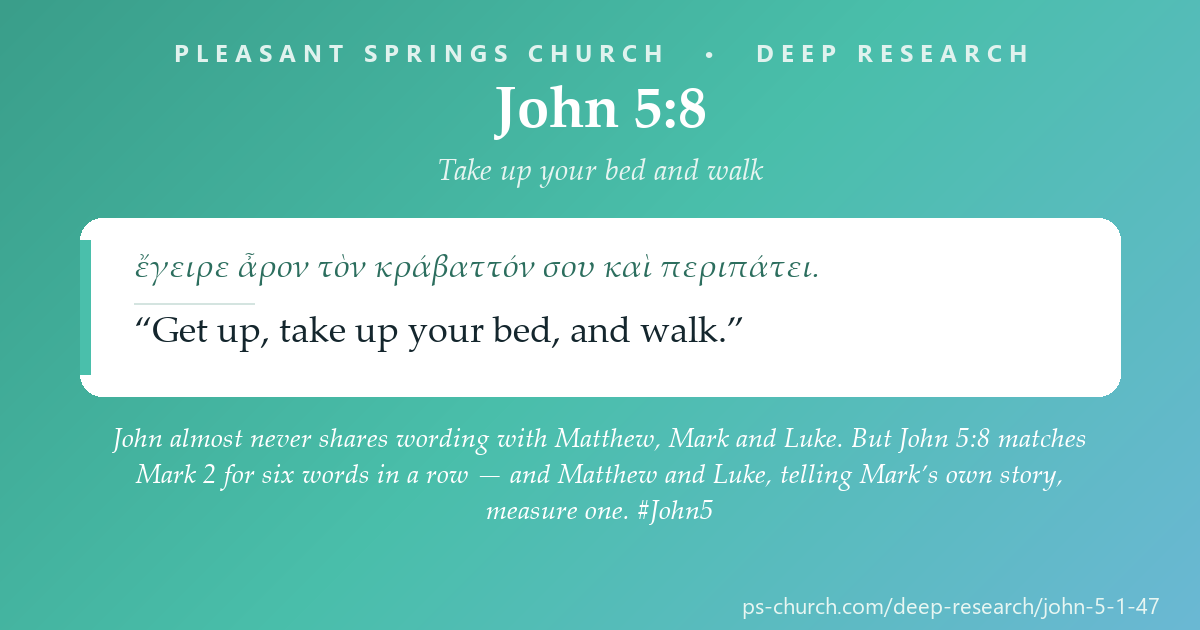
Run the screen a third time against Matthew, Mark and Luke alone — 2,890 verses — and the shape of it is unmistakable. Across the 46 rows: 44 reach two, 28 reach three, 10 reach four, 2 reach five and the same 2 reach six, and nothing reaches seven. Put the other way round: eight rows stop at four, no row stops at five, and two rows go straight to six. There is a hole in the distribution exactly where a gradual relationship would put its mass, and then two rows standing alone on the far side of it — John 5:8 and John 5:11, both to Mark 2. The eight rows that stop at four are 5:9 on that day (band 6), 5:14 in the temple and (band 5), 5:19 (band 5), 5:21 so also the Son (band 1), 5:24 and 5:25 truly I say to you that (bands 21 and 22), 5:42 the love of God (band 1) and 5:43 (band 3). Six of the eight are formulas by their bands; the two band-of-one runs are four words of ordinary Greek about nothing in particular. The two sixes are a sentence.
John 5:8 is ἔγειρε ἆρον τὸν κράβαττόν σου καὶ περιπάτει, seven words. Mark 2:11 supplies the first six of them; Mark 2:9 supplies the last six. Between the two Markan verses every word of John’s sentence is accounted for, and neither Markan verse on its own accounts for all of it — Mark 2:9 has arise καί take up where John has no and, and Mark 2:11 finishes and go to your house where John has and walk. Then John 5:11 repeats the command in the mouth of the healed man, and it matches Mark 2:9 for six.
And the counter-check that keeps the Mark result honest
If six shared words meant literary dependence, then Matthew and Luke — who are telling Mark’s paralytic story and are as close to Mark as two texts get — ought to measure at least as high. They do not.
| pair | longest contiguous run | the words |
|---|---|---|
| John 5:8 vs Mark 2:11 | 6 | ἔγειρε ἆρον τὸν κράβαττόν σου καί |
| John 5:8 vs Mark 2:9 | 6 | ἆρον τὸν κράβαττόν σου καὶ περιπάτει |
| John 5:8 vs Matthew 9:6 | 1 | λέγει |
| John 5:8 vs Luke 5:24 | 1 | ὁ |
The reason is in the vocabulary. Matthew and Luke both replace Mark’s κράβαττος — Matthew with κλίνη, Luke with κλινίδιον — and neither ever uses the word anywhere. John keeps it, four times in this chapter.
So what does the six mean? It means that on the shortest, most formulaic sentence in either story — a command of five or six words that has only so many ways of being said — John and Mark say it the same way, using a word Matthew and Luke avoid. It does not mean John read Mark, and this page does not say he did. It equally does not mean he did not. The direction of influence is not measurable from a run length, and no run length on this page is asked to carry one.
Two more connections the chapter makes but does not make verbally
5:17 and Genesis 2. “My Father is working until now” is a claim about the seventh day. Measured against the Greek column of Genesis 2:2 and Genesis 2:3, John 5:17 shares a contiguous run of one word with each, and the word is the article. The Sabbath argument is not conducted by quotation.
Worth recording while we are there, because it is a real divergence and this shelf does not hide them: at Genesis 2:2 the Hebrew says God finished his work בַּיּוֹם הַשְּׁבִיעִי, on the seventh day, and the Greek column reads ἐν τῇ ἡμέρᾳ τῇ ἕκτῃ, on the sixth day. The two columns differ on which day God stopped. The page reports the difference and asserts nothing about how it arose or which is prior.
5:31–32 and the law of witnesses. “If I alone bear witness about myself, my testimony is not true” assumes Deuteronomy 19:15, and John 8:17 afterwards cites it in so many words: in your Law it is written… Measured against the Greek Deuteronomy 19:15, John 5:31 shares a run of one, and John 8:17 — which announces that it is quoting — also shares a run of one. An explicit citation formula and a verbatim run of one word, in the same sentence. If anything on this page shows why run length is not a measure of dependence, it is that.
What was not consulted, what could not be checked, and where this page is weakest.
The literature this study would be checked against
- Raymond E. Brown, The Gospel According to John I–XII (Anchor Yale) — the standard treatment of 5:1–47 as a unit and of the “trial” reading of the Gospel.
- C. K. Barrett, The Gospel According to St John, 2nd ed. — on 5:2 and the topography, and on the Sabbath argument.
- D. A. Carson (Pillar), Andreas Köstenberger (BECNT), Craig Keener (2 vols.) on John.
- A. T. Lincoln, Truth on Trial: The Lawsuit Motif in the Fourth Gospel — the monograph on precisely the theme this chapter’s vocabulary counts point to.
- Bruce Metzger, A Textual Commentary on the Greek New Testament, 2nd ed. — on 5:2 and 5:3b–4.
- Urban C. von Wahlde, “The Puzzling Pool of Bethesda,” and the excavation reports for the site north of the Temple Mount by St Anne’s.
What this page did NOT consult, stated plainly
No commentary was read to produce the measurements on this page, and none was read to produce its structure diagram. The diagram in “The Shape of the Passage” was built from the Greek text of the chapter: the repeated sentence at 5:19 and 5:30, the six occurrences of the θελ- root, and the enumerated witnesses at 5:31–39. It is offered as one reading of the shape and is labelled a sequence, not a chiasm, because it is not one. Commentators divide the chapter in several ways — commonly 1–18 / 19–30 / 31–47 — and this page’s division differs from that only in where it puts 5:40.
No manuscript was examined. Everything said about John 5:4 and about the name of the pool at 5:2 rests on two printed editions — the SBL Greek New Testament as digitised in MorphGNT, and the King James Version’s underlying text as printed. No critical apparatus was consulted, no papyrus or uncial was inspected, and this page does not know and does not say which reading is earlier. Anyone who needs that question answered should go to Metzger and to a Nestle-Aland apparatus, neither of which is held here.
No archaeological report was read. The five colonnades are discussed above as a detail in the text. The excavations by the Church of St Anne, and the identification of the twin pools, are known to this page only at second hand and are not evidence it can weigh. Stage 2 says what the corpus can add — the προβατική count — and stops there.
No Philo and no rabbinic text is on this shelf as a measurable corpus. The references to Legum Allegoriae, De Cherubim and Mishnah Shabbat in Stage 2 are cited from standard editions and were not screened against anything. They carry no run length and no tie band, and they should be read as orientation, not as findings.
What could not be checked at all
The 38 years. Deuteronomy 2:14 also has thirty-eight years. Whether John intends the reader to hear it is not measurable, and a word screen cannot help: the two texts share a number, not a phrase. Many commentators read the two together; Augustine, expounding this very verse, did not — he read the thirty-eight as forty less two, the two commandments of love (Tractates on the Gospel of John 17.6–7). This page reports the coincidence of the figure and declines to build on it.
The identity of the feast in 5:1. Not stated in the text and not recoverable from it. Proposals include Passover, Tabernacles, Pentecost and Purim; the chronology of the Gospel turns on the answer. NOT VERIFIABLE FROM LOCAL CORPORA.
Whether ἐραυνᾶτε at 5:39 is indicative or imperative. The form is identical either way. No corpus screen can resolve a mood ambiguity, and the page says only which way the two English translations printed here took it.
Direction of influence — anywhere on this page. Not between John 5:8 and Mark 2; not between John 5:28 and Isaiah 26:19; not between John 5:24 and 1 John 3:14; not between John 5:29 and either Greek Daniel. Run length measures contact. It does not measure who wrote first, and nothing here is asked to.
Where this page is weakest
The Mark 2 result is the page’s headline and it is also its most fragile claim. Six is not a large number. The sentence is a short imperative with few degrees of freedom, and two writers describing the same kind of action in the same language can land on the same six words without either having read the other. What makes the result worth printing is not the six; it is the κράβαττος — a word Mark and John use and Matthew and Luke systematically avoid — and the fact that no other row in the chapter reaches another Gospel at all. A reader who wants to discount the finding should discount it on those grounds and not on the arithmetic, which is straightforward.
The second weakest point was the Isaiah 26:19 band, and it has been repaired at the corpus rather than on the page. This paragraph used to read: “Collapsing a band of 2 to a band of 1 because Odes 5 is the canticle of Isaiah is a judgement about the corpus, not a measurement. It is correct — the two rows are word for word identical — but it is the kind of step that should be shown rather than performed silently, so it is shown.” It is still a judgement about the corpus. What changed on 30 August 2026 is that the judgement was made once, at the corpus, instead of once per page: the Odes were withdrawn from the screening set, and the screen now returns 1 without anyone adjusting anything afterwards. The published band is a measurement again. The weakness that remains is the one worth naming: a reader has to trust that the decision about what counts as ‘the Greek Old Testament’ was made on textual grounds and not to make a number look better. The grounds are printed in stage 4 — ten canticles are duplicates and two are Luke — and they were settled for the whole shelf, not for this row. A hand-collapsed band on one page is a judgement; the same judgement applied to every page at once, in public, is a policy.
A man who could not get in, and a people who would not come.
The two ends of the chapter
It opens with a question nobody expected and the man does not answer. “Do you want to be made well?” He does not say yes. He says why he cannot: “Sir, I have no one to put me into the pool… while I am going, another steps down before me.” Thirty-eight years of coming second.
It closes with the same verb turned inside out. “You search the Scriptures because you think that in them you have eternal life… yet you refuse to come to me that you may have life.” The Greek behind refuse is οὐ θέλετε, you are not willing. The man at the pool could not get in. The men in the temple would not come.
And between the two stands the sentence the whole defence is built on, said twice: “the Son can do nothing of his own accord” — “I can do nothing on my own.” The one person in the chapter with a claim to independence is the one person who disclaims it.
What the measurement adds, and it is a strange gift. The chapter that says the Scriptures bear witness to Christ turns out to have almost no verbatim contact with them — two words, in a band of ninety-five. Whatever John means by the Scriptures witnessing, he does not mean a chain of quotations. He means something the measurement cannot reach, and it is honest to say that the measurement cannot reach it.
What would you want measured next in John 5? The verses this page left unquoted — 5:20–23 on honour, 5:33–36 on John the Baptist as a burning lamp — are unscreened here only for space, not for want of interest. Write to us and say so.
Every Deep Research page traces its passage across the whole sweep — the Old Testament, the Second-Temple world between the testaments (historical witnesses, not Scripture), and the New Testament. Follow the thread:
Pleasant Springs Church — Deep Research
Research method after Michael S. Heiser’s Bible Research Method (examine dictionaries → ancient literature → important words → textual connections → academic publications → share), with the Pleasant Springs “Author & Audience” foundation. Scripture set in the Hebrew, the Greek editions named on each page and the ESV (Old Testament), and the Greek New Testament and the ESV (New Testament), per the practice of Pleasant Springs Church. John research grounded in Brown (Anchor Yale), Barrett, Carson (Pillar), Köstenberger (BECNT), Keener and Lincoln (Truth on Trial). Text: Greek New Testament from the SBL edition as digitised in MorphGNT; Greek Old Testament from Rahlfs’ Septuaginta as digitized by CATSS; Hebrew, where cited, from Sefaria’s Miqra according to the Masorah. English is the ESV, with the King James Version where a reading absent from the SBL text had to be quoted. ⚠️ VERSE NUMBERING — there is no Septuagint offset in a New Testament passage, and this page states that rather than passing over it. Chapter and verse in John 5 are identical in the Greek and in every English edition; nothing on this page needs a second number beside it. What the chapter does have is an interior gap: verse 4 is a number with no verse in the critical text, which carries 46 rows for a chapter numbered to 47. Counted across the whole Greek New Testament, fifteen chapters carry a gap of that kind, and two of the fifteen are in John — chapter 5 and chapter 8. ⚠️ The measurement, in full. Greek against Greek. MorphGNT field 6, the normalised word (the column that already resolves elision and the movable nu); CATSS FORM column (cols 0–24), beta-code transliterated first. Both sides lowercased, accents and breathings dropped, final sigma folded, then filtered to Greek letters — the same filter applied to both corpora. Contiguous runs of whole word FORMS, never lemmas. Corpora: the 46 SBLGNT rows of John 5 against 30,348 Greek Old Testament verse units screened out of the 30,637 held across 64 CATSS files — the 289 units of the Odes are held and not screened — and against the other 7,881 verses of the 7,927-verse Greek New Testament. Exhaustive and deterministic; nothing sampled, so no seed applies. ⚠️ The tie band is printed beside every run on this page, and it is the number that matters. John 5:9 and John 5:28 both reach four against the Greek Old Testament. One has a band of thirty-three and is the phrase on that day; the other has a band of one and is Isaiah 26:19. Same depth, different findings. That second band printed as 2 and was collapsed by hand on the page until 30 August 2026, when the Odes were withdrawn from the screening corpus and the screen began returning 1 on its own. Two bands moved that day — John 5:28 from 2 to 1 (Odes 5:19 is Isaiah 26:19) and John 5:43 from 27 to 26 (Odes 1:2 is Exodus 15:2) — and the corpus figure moved with them, from 30,637 held to 30,348 screened. ⚠️ Direction of influence is never asserted. Nothing here says that John read Mark, that Mark read John, that John 5:28 quotes Isaiah, that 1 John 3:14 depends on John 5:24, or what produced any reading — including the absence of 5:4 from the critical text, the variation in the pool’s name at 5:2, and the divergence between the Hebrew and Greek columns of Genesis 2:2 on which day God finished. ⚠️ What this page could not check is set out in Stage 5 and is not decoration. No manuscript was examined, no critical apparatus was consulted, no excavation report was read, and neither Philo nor the Mishnah is held here as a measurable corpus. Typology is handled per the house position: what the text says, what the New Testament itself draws, and what we see from this side of the cross — with the seeing left to the reader.
Scripture quotations marked ESV are from the ESV® Bible (The Holy Bible, English Standard Version®), © 2001 by Crossway, a publishing ministry of Good News Publishers. ESV Text Edition: 2016. Used by permission. All rights reserved. The ESV text may not be quoted in any publication made available to the public by a Creative Commons license, and the ESV may not be translated in whole or in part into any other language. www.esv.org
|
Did this study bless you today? 💚 Give to Support PS Church100% of gifts go to the General Fund — thank you. |