John opens the public ministry with a wedding and a whip. At Cana the wine runs out and the water set aside for ritual washing becomes the best wine of the feast — the first of the signs. Days later, at Passover, Jesus drives the trade out of the temple court, and when he is asked for a sign he gives one nobody can read: “Destroy this temple, and in three days I will raise it up.” This study measured every verse of John 2 against 30,637 verse units of the Greek Old Testament and 7,902 other verses of the Greek New Testament, and the numbers came back with a surprise: the one verse John himself labels as Scripture is not the deepest verbal contact in its own chapter — an incidental household list goes a word deeper, and a stock phrase matches it — and the five-word run it does carry lands on two psalms, not one — in the Greek. In the Hebrew it lands on one. See the method →
John 2:1, 3, 4, 6, 10, 11, 13, 15, 16, 17, 19, 20, 21, 22, 24, 25
Greek NT · ESVThe verse the disciples remembered — Psalm 69:9 ESV · MT 69:10 · LXX 68:10
Hebrew · Greek OT · ESVThe Shape of the Passage
Parallel panels (a diptych) — not a chiasmJohn opens the public ministry with two scenes and no explanation of why they belong together. A wedding runs out of wine; a temple runs a market. In the first Jesus supplies what is missing; in the second he removes what does not belong. Both scenes end with disciples believing, and the chapter ends by refusing to be sentimental about belief.
Author
John has just spent a chapter counting days — “the next day… the next day… the next day” (1:29, 35, 43) — and chapter 2 opens “on the third day.” He is a writer who tells you what things mean only after he has let them happen: the steward tastes the wine and does not know where it came from (2:9); the crowd hears “destroy this temple” and thinks of masonry (2:20); the narrator has to step in and say “he was speaking about the temple of his body” (2:21). Twice in this chapter John writes the sentence his disciples remembered — and by an exhaustive screen of the Greek New Testament, that exact five-word sequence stands in these two verses and nowhere else. Understanding, in John, is retrospective. It arrives after the resurrection.
The one text he quotes. The Synoptic temple scenes quote Isaiah 56:7 and Jeremiah 7:11 — “a house of prayer… a den of robbers.” John quotes neither. He flags a psalm instead, and flags it explicitly (γεγραμμένον ἐστίν, “it is written”): “Zeal for your house will consume me” (Psalm 69:9). It is not a text about the temple’s misuse. It is a text about what caring for God’s house costs the one who cares.
Audience
Readers on the far side of the resurrection — which is to say, readers who are in a position to do exactly what 2:22 describes. John writes for people who can now hear “in three days I will raise it up” and know what it meant, and who are therefore under a particular obligation not to be smug about the crowd in 2:20 who could not.
And readers who need 2:23–25. The chapter does not end with the disciples believing. It ends with a crowd believing — on the basis of signs — and with Jesus declining to commit himself to them. John uses one verb for both halves of that sentence (ἐπίστευσαν… οὐκ ἐπίστευεν), and the ESV has to use two English words, “believed” and “entrust,” to carry it. The warning is not that sign-faith is worthless — John wrote his whole book of signs “so that you may believe” (20:31). The warning is that a faith which has only ever been impressed is a faith Jesus knows better than we do. “He himself knew what was in man.”
Orient on Cana, wedding customs, the temple courts, and the Johannine “sign.”
Search by topic: Cana; marriage and wedding feast; wine; purification / ritual washing; temple (Herod’s); money-changers and the temple tax; sign (semeion); Passover.
Which articles are relevant?
- Anchor Bible Dictionary — “Cana of Galilee,” “Marriage,” “Wine,” “Purity and Purification,” “Temple, Jerusalem,” “Money-changers,” “Passover.”
- Dictionary of Jesus and the Gospels — “Signs and Wonders,” “Temple Cleansing,” “Miracles,” “Chronology,” “Feasts.”
- NIDNTTE / TDNT — σημεῖον (sēmeion, sign), δόξα (doxa, glory), ὥρα (hōra, hour), ναός / ἱερόν (sanctuary / precinct), ζῆλος (zēlos, zeal).
- Dictionary of New Testament Background — “Temple, Herodian,” “Purity,” “Josephus,” “Banquets.”
Bibliography surfaced:
- Raymond E. Brown (Anchor Yale), C. K. Barrett, D. A. Carson (Pillar), Craig S. Keener (2 vols.), Andreas J. Köstenberger (BECNT), J. Ramsey Michaels (NICNT), Herman Ridderbos, Rudolf Schnackenburg on John.
- G. K. Beale & D. A. Carson, eds., Commentary on the New Testament Use of the Old Testament (John, by Andreas Köstenberger).
- Studies of the Johannine sēmeia; of the temple act and its chronology; of Herod’s temple and its finances.
A wedding that runs dry, a sanctuary that runs a market, and a temple already cleansed once in living memory.
Read the temple-cleansing precedent in 1 Maccabees, the trader in Zechariah 14:21, and the abundance-of-wine oracles — then measure how much of any of it is actually in John’s words. The answer, in every case here, is: none of it verbally.
Which parallels shed light on religion and worldview?
A wedding was a village-scale, week-long obligation. Running out of wine was not an inconvenience; it was a public failure of hospitality that the family would carry for years. John does not explain this, and neither will we beyond saying it: the shame is the point of the miracle’s setting, and the six stone jars are the point of its substance. Stone vessels were held not to contract ritual impurity as pottery does — a rule stated in the Mishnah, which is not among the texts held on this machine and is reported here as received background — and that is the usual explanation for why the jars are stone, and why John tells us they stood there “for the Jewish rites of purification.” That word, καθαρισμός, is the only purification word in the whole chapter — and it belongs to the wedding, not to the temple. Reading the MorphGNT lemma column across John 2, no καθαρ– word occurs in the temple scene at all. The scene everyone calls “the cleansing of the temple” contains no cleansing vocabulary.
The temple had been cleansed, and everyone knew it. In 164 BC Judas Maccabeus took back the desecrated sanctuary: “let us go up to cleanse the sanctuary and dedicate it” (καθαρίσαι τὰ ἅγια καὶ ἐγκαινίσαι, 1 Maccabees 4:36), “and they cleansed the sanctuary” (4:43) — the eight-day feast that follows (4:59) is Hanukkah, which John himself will name at 10:22. That is the live precedent in the room. And John 2 does not touch it verbally. Measured against 1 Maccabees 4:36, 4:41 and 4:43, John 2:14, 2:15 and 2:16 return runs of 1 or 0 — on the Greek-side convention used here, that means they share no two consecutive words with those verses, and in one case no word at all. The connection is historical and thematic. It is not verbal, and this page will not pretend otherwise.
Zechariah 14:21, and an honest note about the Hebrew. The last line of Zechariah is the obvious candidate: on the day of the Lord, “there shall no longer be a כְנַעֲנִי in the house of the Lord of hosts.” The Hebrew word can mean “Canaanite” or “trader,” and translations split on it — the ESV renders “trader,” the Greek of Zechariah 14:21 reads Χαναναῖος, “Canaanite.” If the trader sense is right, the verse is a startlingly close prophecy of what Jesus does. But measured, John 2:16 against Greek Zechariah 14:21 returns a run of 1: no two consecutive words in common. That is worth stating plainly, because the parallel is quoted in sermons as though it were a quotation. It is not one.
The wine of the age to come. The prophets promise a day when the mountains drip sweet wine (Amos 9:13; Joel 3:18, LXX 4:18) and the Lord spreads a feast of “well-aged wine” for all peoples (Isaiah 25:6). Cana is often read against that horizon, and the reading is theologically defensible. It is also, on this shelf’s method, unmeasurable: John 2:3, 2:9 and 2:10 each return a run of 1 against all three of those Greek texts. Whatever the resonance is, it is not verbal contact, and a page that printed it as though it were would be overclaiming.
- 1 Maccabees 4:36–59 — the Maccabean cleansing and rededication of the sanctuary (a historical witness, not Scripture); the origin of Hanukkah, which John names at 10:22. Measured contact between John 2:14–16 and 1 Maccabees 4:36, 4:41 and 4:43: runs of 0–1. Widened to the whole of 4:36–59 the temple-scene verses reach 2, and the chapter’s maximum against that passage is 3 — the household formula at 2:12.
- Zechariah 14:21 — “no trader / Canaanite in the house of the Lord”; MT כְנַעֲנִי is ambiguous, the Greek reads Χαναναῖος. Measured contact with John 2:16: run of 1.
- Amos 9:13; Joel 3:18 (LXX 4:18); Isaiah 25:6 — the abundance of wine in the age to come. Measured contact with John 2:3, 9, 10: run of 1 in every pairing.
- Malachi 3:1–3 — “the Lord whom you seek will suddenly come to his temple… he will purify the sons of Levi”: the expectation of a coming purification of the sanctuary, with the same caution about measurement.
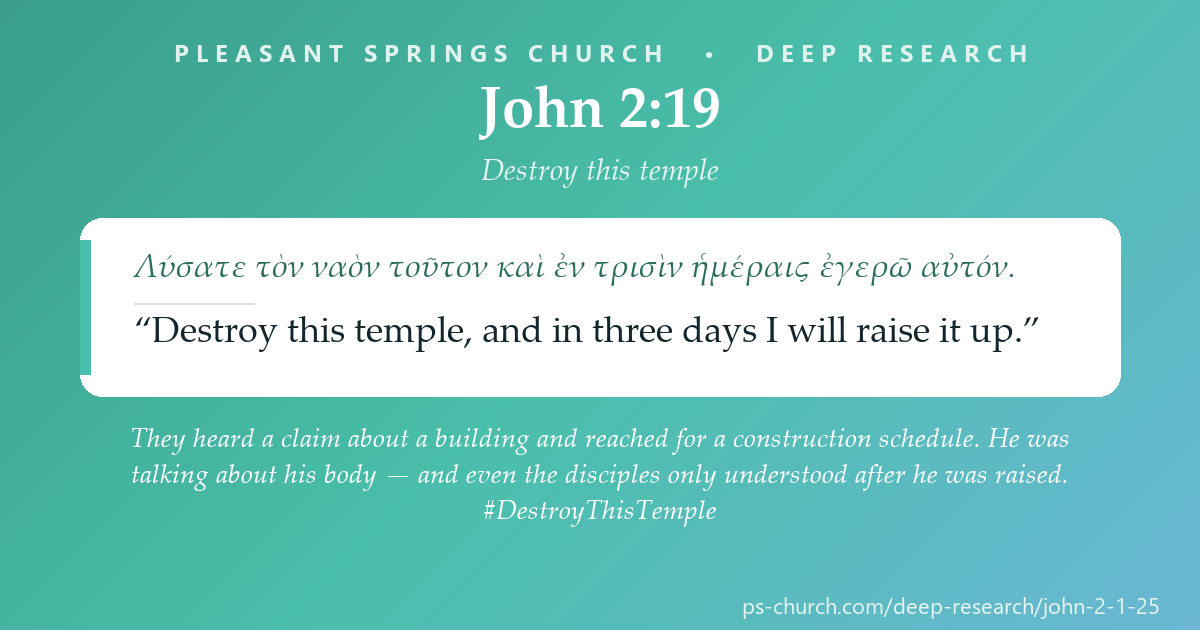
“It has taken forty-six years to build this temple” (2:20) is the one datable sentence in the chapter, and the usual reckoning runs from the eighteenth year of Herod the Great, when Josephus says the rebuilding began, to a Passover in the late twenties AD. That reckoning could not be verified here. Josephus is not among the corpora held on this machine; the figure is reported as the standard scholarly reconstruction and nothing more. What can be said from the text is smaller and stranger: the crowd’s answer is not a refusal but a miscalculation. They hear a claim about a building and reach for a construction schedule. John lets the mistake stand for four verses before telling us, in a single flat sentence, that Jesus was talking about his body — and then tells us that even the disciples did not get it until he was raised. The chapter is unusually honest about how long understanding takes.
Signs, the hour, two words for temple, and one verb turned around.
Every count below comes from an exhaustive screen of the corpora held here: MorphGNT/SBLGNT for the Greek New Testament (7,927 verses), the CATSS Greek Old Testament (30,637 verse units), and Sefaria’s Miqra according to the Masorah (23,204 verse units). Word FORMS, never lemmas, except where the lemma column is named.
“The beginning of the signs.” An exhaustive phrase screen of the Greek New Testament returns one occurrence of this three-word sequence: here. John does not say “his first miracle” but “the beginning of the signs” — announcing a series he will number again at 4:54 and finally sum up at 20:30–31. ἐφανέρωσεν τὴν δόξαν, “manifested his glory,” is also a single occurrence in the Greek New Testament, and it answers the prologue’s “we have seen his glory” (1:14).
Literally “what to me and to you?” The exact four-word sequence stands three times in the Greek New Testament — and the other two are on the lips of demoniacs (Mark 5:7; Luke 8:28). That is arresting and it is also a trap: the tie band tells the truth better than the shock does. The same idiom returns six rows in the Greek Old Testament held here — and because Judges 11:12 is counted twice, once in each of the A and B recensions, that is five distinct verses: Judges 11:12; 1 Kings 17:18 (3 Kingdoms); 2 Kings 3:13 (4 Kingdoms); 2 Chronicles 35:21; and 1 Esdras 1:24, the parallel to that last. There it is a way of setting distance between two parties whose business is not the same — a widow to Elijah, a prophet to a king, Jephthah to Ammon. It is not a rebuke of his mother. It is Jesus saying that his timetable is not hers.
“My hour.” The exact three-word form occurs once in the Greek New Testament: here, at the beginning, negated — “my hour has not yet come.” John will keep the clock running (7:30; 8:20; 12:23; 13:1; 17:1) until it strikes. The hour is the cross.
Two words, both translated “temple,” and John switches between them at the exact moment the subject changes. ἱερόν is the whole precinct — where the animals and tables were, 2:14 and 2:15 — and it stands ten times across John’s Gospel. ναός is the sanctuary proper, the dwelling; and reading the lemma column of the whole Gospel, it stands exactly three times, all of them in 2:19, 2:20 and 2:21, and never again in John. The word for the place God dwells enters the Gospel, is applied to a body, and leaves.
Five words that stand in the Greek Old Testament without a variation. Screened against the 30,637 verse units of the Greek Old Testament held here, that sequence occurs twice — Psalm 68:10 and Psalm 118:139 (ESV 69:9 and 119:139). So John 2:17’s run of five carries a tie band of 2, not 1. The Hebrew tells a different story: קִנְאַת בֵּיתְךָ occurs once in 23,204 verse units of the Masoretic corpus, at Psalm 69:10, because the Hebrew of Psalm 119:139 reads only קִנְאָתִי, “my zeal” — the Greek there has “of your house” and the Hebrew does not.
“A whip of cords” — a Latin loan (flagellum), and the noun occurs once in the Greek New Testament. Its cognate verb occurs twice, and both are the flogging of Jesus: φραγελλώσας, Matthew 27:26 and Mark 15:15. Three occurrences of the stem in the whole New Testament; Jesus holds it once and is under it twice. That is an observation about a word list, not an argument, and the page will not build on it — but it is exactly and checkably true.
John uses two different words for money-changer, one verse apart. κερματιστής (2:14) occurs once in the Greek New Testament and is John’s own; κολλυβιστής (2:15) occurs three times — here and in the Synoptic temple scenes (Matthew 21:12; Mark 11:15). Also singular to this chapter: ἀρχιτρίκλινος (steward of the feast, 2:8–9), all three New Testament occurrences in John 2; μετρητής (measure, 2:6), once; ἐμπόριον (house of trade, 2:16), once.
The same verb, πιστεύω, in consecutive verses, pointing opposite ways: the crowd “believed in his name” and Jesus “did not entrust himself to them.” English needs two words for it; Greek does not. Note also that ἐπίστευσαν εἰς αὐτόν — “believed in him” with εἰς — occurs seven times in the Greek New Testament and all seven are in John (2:11; 4:39; 7:31; 8:30; 10:42; 11:45; 12:42). The first is here.
How the rest of the New Testament fills these out:
- John 1:14; 12:41; 20:30–31 — “we have seen his glory”; Isaiah “saw his glory”; “these are written so that you may believe.” τὴν δόξαν αὐτοῦ stands six times in the Greek New Testament, three of them in John, at 1:14, 2:11 and 12:41.
- John 4:46–54 — the second sign, again at Cana; ὑδρία, the water jar of 2:6–7, appears once more at 4:28, in the hands of the Samaritan woman.
- John 7:30; 8:20; 12:23; 13:1; 17:1 — the hour that has not come, and then has.
- 1 Corinthians 3:16; 6:19; Ephesians 2:21 — the church and the believer as ναός: the trajectory John 2:21 starts. 1 Peter 2:5 belongs to the same trajectory but uses a different word — οἶκος πνευματικός, a spiritual house, not ναός.
What the measurement found — including the places where the deepest number is the least interesting one.
Every verse of John 2 was screened, form for form, against the 30,637 verse units of the Greek Old Testament held here and against the 7,902 other verses of the Greek New Testament. Contiguous runs of whole word forms, never lemmas; both sides lowercased, accents and breathings dropped, final sigma folded, with the editions’ own spelling equivalences (ouk/ouch, ek/ex, the movable nu) applied so that a shared run is not cut at a word the two editions merely spell differently. Exhaustive and deterministic. The tie band — how many other verses reach the same depth — is printed beside every run, because a run without its band is misleading.
John 2 against the Greek Old Testament: the whole distribution
Across the 25 rows of John 2, screened against 30,637 verse units of the Greek Old Testament: all 25 reach three, twelve reach four, three reach five, one reaches six, and nothing reaches seven. Here are the only three rows that reach five or more — and the order they come in is the finding.
- John 2:12 — run of 6, tie band 1. καὶ ἡ μήτηρ αὐτοῦ καὶ οἱ, “and his mother and his…”, against 2 Kings 24:12 (4 Kingdoms), where the king of Judah goes out to the king of Babylon “himself and his servants and his mother and his officials.” This is the deepest verbal contact between John 2 and the entire Greek Old Testament, and nobody would call it a quotation. It is the shape of a household list.
- John 2:16 — run of 5, tie band 8. τὸν οἶκον τοῦ πατρός μου, “my father’s house,” reaching eight rows in the corpus as held — Genesis 24:38; 28:21; Joshua 2:13; Judges 9:18 (in both the A and B recensions, so seven distinct places); 1 Samuel 22:15; 2 Samuel 14:9; 1 Chronicles 28:4. A band of eight is the signature of a stock phrase, not an allusion.
- John 2:17 — run of 5, tie band 2. ὁ ζῆλος τοῦ οἴκου σου, against Psalm 68:10 and Psalm 118:139. This is the one verse in the chapter that the text itself labels as Scripture — γεγραμμένον ἐστίν — and by depth it is beaten by 2:12 and matched by 2:16, both of which are accidents of ordinary phrasing.
The flagged citation is not the deepest measured contact in John 2. An incidental family list in 2:12 is one word deeper, and a stock phrase in 2:16 is equally deep and four times commoner — a band of eight against a band of two. If this page had gone hunting for the chapter’s strongest Old Testament link by depth alone, it would have found Jehoiachin’s mother and written a paragraph about her. Depth is not significance. The band, the direction of the text’s own signposting, and the reader’s eye do the work the number cannot. What the number does establish is worth having: John 2:17 reproduces its source without a single variation for five words, and the two candidates it lands on are both psalms about zeal for God’s house, which is not something a coincidence produces.
Why the tie band of 2 is only a Greek fact
The five-word run lands on two verses because the Greek and the Hebrew do not agree about Psalm 119:139. In the Greek, Psalm 118:139 reads ἐξέτηξέν με ὁ ζῆλος τοῦ οἴκου σου, “zeal for your house has melted me.” In the Hebrew, Psalm 119:139 reads צִמְּתַתְנִי קִנְאָתִי, “my zeal has consumed me” — with no “your house” in it at all. So an exhaustive phrase screen returns two hits on the Greek side and one on the Hebrew side: קִנְאַת בֵּיתְךָ occurs exactly once in 23,204 verse units of the Masoretic corpus, at Psalm 69:10. The band John 2:17 actually carries is the Greek one, because John 2:17 is in Greek — but the divergence is real and it is reported here rather than smoothed over. This page does not claim to know which reading is older, and the measurement cannot tell.
The temple saying, and where its wording actually lands
“Destroy this temple, and in three days I will raise it up” is the most theologically loaded sentence in the chapter. Measured, it is close to invisible.
- Against the rest of the Greek New Testament, John 2:19 reaches 5 — but with a tie band of 3, and on the wrong words. The run is ἀπεκρίθη Ἰησοῦς καὶ εἶπεν αὐτοῖς, “Jesus answered and said to them,” shared with John 6:43, 7:21 and 8:14. That is a narrative formula, not a saying.
- John 2:19 against Mark 14:58 (the trial witnesses): run of 3 — τὸν ναὸν τοῦτον. That two-word-plus-article phrase is worth its own note: an exhaustive screen finds τὸν ναὸν τοῦτον in exactly two verses of the Greek New Testament, Mark 14:58 and John 2:19. But the verbs differ (καταλύσω, “I will destroy,” against John’s imperative λύσατε, “you destroy”) and so does the speaker.
- John 2:19 against Matthew 27:40 (the mockers at the cross): run of 4 — καὶ ἐν τρισὶν ἡμέραις; against Mark 15:29, run of 3. So the deepest verbal contact between John’s temple saying and the Synoptics is not with the trial witnesses at all. It is with the crowd jeering at Golgotha.
- The phrase ἐν τρισὶν ἡμέραις occurs four times in the Greek New Testament — Matthew 27:40, Mark 15:29, John 2:19, John 2:20 — and nowhere else. The trial scenes in Matthew 26:61 and Mark 14:58 use a different construction, διὰ τριῶν ἡμερῶν.
- Against the Greek Old Testament, John 2:19 and 2:20 reach 4 and 3, with bands of 1 and 12. The three-day language of the temple saying has no measurable Old Testament anchor in the corpora held here.
No direction of influence is asserted anywhere in that list, and none can be. The run engine registers that two texts share words in the same order. It cannot say who wrote first, who heard whom, or whether John and the Synoptics describe one event or two — a question this page deliberately leaves open in Stage 5.
The Synoptic temple scenes quote texts John does not
This is the clearest measured difference in the chapter, and it is worth four numbers.
- Mark 11:17 against Isaiah 56:7 — run of 8: οἶκος μου οἶκος προσευχῆς κληθήσεται πᾶσιν τοῖς ἔθνεσιν. Matthew 21:13 reaches 5 on the same text; Luke 19:46 reaches 4.
- All three Synoptics reach 3 against Jeremiah 7:11: ὁ οἶκός μου, carrying σπήλαιον λῃστῶν, “a den of robbers,” with them in the other direction.
- John 2:16 against Isaiah 56:7: run of 1. Against Jeremiah 7:11: run of 1. Against Zechariah 14:21: run of 1. On the Greek-side convention used here a run of 1 means the verse shares no two consecutive words — only isolated words, in this case καί.
- Instead John flags Psalm 69:9, and his wording agrees with the Greek of it for five words. The Synoptics never quote that psalm at the temple; John never quotes theirs.
Isaiah 56:7 and Jeremiah 7:11 are texts about a misused house: a house of prayer turned into a robbers’ cave. Psalm 69 is not about the house at all. It is the lament of a righteous sufferer whose loyalty to God has made him a stranger to his own brothers, who is drowning, hated without cause, given vinegar to drink — a psalm the New Testament returns to again and again at the cross. By quoting that psalm at the temple, John frames the act not as a reform but as a cost. The disciples do not remember “my house shall be called a house of prayer.” They remember a line about what zeal for that house is going to do to the man showing it. And then, in the same paragraph, he says the words that will be quoted back at him by false witnesses and by mockers, and John tells us the temple in question was his body.
The scholarship — and a full accounting of what this page could not check.
This is the section that makes the shelf trustworthy. Everything below is either a source that was consulted, a source that was not, or a claim on this page that a careful reader should hold loosely.
Commentaries & studies (surfaced, not all consulted):
- Raymond E. Brown, The Gospel According to John I–XII (Anchor Yale); C. K. Barrett; D. A. Carson (Pillar); Craig S. Keener, The Gospel of John: A Commentary, 2 vols.; Andreas J. Köstenberger (BECNT); J. Ramsey Michaels (NICNT); Herman Ridderbos; Rudolf Schnackenburg.
- Andreas J. Köstenberger, “John,” in Beale & Carson, eds., Commentary on the New Testament Use of the Old Testament — the standard treatment of John 2:17 and the Psalm 69 citation, including the aorist/future question.
- Studies of the Johannine sign-source and the sēmeia; of the chronology of the temple act; of Herod’s temple and the temple tax; of Psalm 69 in the New Testament.
What this page could NOT check — stated as limits, not hedges:
- No commentary was read for this page. The bibliography above lists what a full study should consult; it is a reading list, not a citation of consulted work. Where a scholar is named on this page it is for a position that is standard and attributable, not for a claim derived from reading them here.
- Josephus is not held on this machine. The forty-six years of 2:20 are conventionally reckoned from the eighteenth year of Herod (Antiquities 15.380); that figure is reported as received scholarship and was not verified against a primary text here.
- The ESV column was typed, not fetched. No Crossway API key is present on this machine, so the English in the codex above was set from the printed ESV by hand and was not machine-verified against Crossway’s text. Nothing in the English column on this page was checked against a file held here.
- No Second-Temple Jewish literature outside the Greek Old Testament corpus was screened. 2 Baruch 29:5 (the messianic vine yielding a thousand branches), 1 Enoch, the Mishnah tractates on temple trade and on wedding custom, and the Dead Sea Scrolls are not held here. The wine-of-the-age-to-come background is therefore reported only from the canonical Greek texts that are held, all of which measure at 1.
- Textual criticism was not performed. The Greek is SBLGNT as distributed by MorphGNT; its apparatus sigla were stripped for display. Variants at 2:1, 2:4, 2:5, 2:6, 2:8, 2:10, 2:11, 2:12, 2:15, 2:17, 2:22 and 2:24 are marked in that edition and were not adjudicated here. In particular, 2:24 αὑτόν/αὐτόν is a breathing-level variant that the normaliser folds away, so no measurement on this page turns on it.
- The one-cleansing-or-two question is left open. John places this at the beginning of the ministry and the Synoptics at the end. This page reports what the words share and does not decide the history. That is a real gap, not a diplomatic one: the measurement is simply the wrong instrument for the question.
- The corpus itself has limits. “Greek Old Testament” here means the CATSS/Rahlfs files on disk, 30,637 verse units. A negative is a negative on that corpus. Where this page says a run is 1, it means no two consecutive words in those texts.
Where this page is weakest:
- The diptych labels. That John 2 falls into two panels is uncontroversial. That the panels pair rung for rung — A with A′, D with D′ and so on — is a reading. Three joints are measured (the numerals ἕξ and τρεῖς, the μαθητής+πιστεύω closes, the twin ἐμνήσθησαν οἱ μαθηταὶ αὐτοῦ); the rest are literary judgement and should be weighed as such.
- The φραγέλλιον observation. That the only other occurrences of the stem are the flogging of Jesus is exactly true and completely uninterpreted. A noun and a verb sharing a Latin loan-stem is a small fact. It is printed because it is checkable, and it is fenced because a page that let it swell into an argument would be doing what this shelf exists not to do.
- The τί ἐμοὶ καὶ σοί demoniac parallel is the kind of statistic that reads as a revelation and is really a small sample. Three occurrences is three occurrences. The five Old Testament places are the better guide to what the idiom means.
- Nothing here settles the aorist-to-future shift at 2:17. The Greek Old Testament has κατέφαγέν, John has καταφάγεται, the Masoretic pointing is a perfect. Whether John cites a Greek text that already read a future, adjusts the tense himself, or reflects a different Hebrew is not decidable from anything on this machine, and the page asserts none of the three.
What the wine and the whip have to do with each other.
Name what you learned, why it matters, and one concrete response.
What should we carry away — and do?
- The jars were for purification, and he filled them with joy. Six stone jars stood there for washing. Jesus did not empty them or rebuke them; he filled them, and what came out was the best wine anyone had tasted. The old provision was not despised. It was surpassed.
- Zeal costs the zealous. The disciples did not remember a verse about cleaning house. They remembered a verse about being consumed. Anyone who cares about God’s house enough to act should know in advance what the text says that will cost.
- Understanding is allowed to be slow. Twice in this chapter the disciples only get it later — once after the resurrection. John is not embarrassed by this. If you are waiting for a word of God to make sense, you are in the company of the people who were standing there.
- Believing and being trusted are two different things. The crowd believed; Jesus did not entrust himself. He knew what was in them, and he knows what is in us, and he loves us anyway — but he is not fooled, and neither should we be about ourselves.
Step in response: take one thing you are “selling in the courts” — one place where something reasonable has quietly taken over ground that belonged to God — and clear it out this week. Then read Psalm 69 all the way through, slowly, and notice how far past the temple it goes.
John 2:19 · to share
Greek NT + ESVEvery Deep Research page traces its passage across the whole sweep — the Old Testament, the Second-Temple world between the testaments (historical witnesses, not Scripture), and the New Testament. Follow the thread:
Pleasant Springs Church — Deep Research
Research method after Michael S. Heiser’s Bible Research Method (examine dictionaries → ancient literature → important words → textual connections → academic publications → share), with the Pleasant Springs “Author & Audience” foundation. Scripture set in the Hebrew, the Greek editions named on each page and the ESV (Old Testament), and the Greek New Testament and the ESV (New Testament), per the practice of Pleasant Springs Church. John 2:1–25 measured with dr_tools against MorphGNT/SBLGNT (7,927 verses), the CATSS Greek Old Testament (30,637 verse units) and Sefaria’s Miqra according to the Masorah (23,204 verse units); runs of contiguous word forms with the tie band printed beside every figure, and no direction of influence asserted anywhere. Verse numbering: John is a New Testament book, so there is no Masoretic and no Septuagint column and no offset to state — John 2 runs 25 verses in the SBLGNT and in the ESV alike. The one Old Testament reference on this page does carry an offset, and it was checked on disk: ESV Psalm 69:9 = MT 69:10 = LXX68:10. Background reading surfaced from Brown, Barrett, Carson, Keener, Köstenberger and Beale & Carson; Stage 5 lists what was not consulted and where the page is weakest.
Scripture quotations marked ESV are from the ESV® Bible (The Holy Bible, English Standard Version®), © 2001 by Crossway, a publishing ministry of Good News Publishers. ESV Text Edition: 2016. Used by permission. All rights reserved. The ESV text may not be quoted in any publication made available to the public by a Creative Commons license, and the ESV may not be translated in whole or in part into any other language. www.esv.org
|
Did this study bless you today? 💚 Give to Support PS Church100% of gifts go to the General Fund — thank you. |