From the first-formed father of the world to the drowning of an army in the sea, chapter 10 of the Wisdom of Solomon retells Genesis and Exodus in 21 verses and never once names a person. The man Genesis calls Noah is, here, a righteous man; so is Abraham, so is Lot, so is Jacob, so is Joseph. The subject of the sentences is she — Wisdom. Then the book turns to Egypt and Israel for nine more chapters, and names neither. Measured on the Greek: in the 239 verse rows of 10:1–19:22 the CATSS text marks exactly one word as a proper name, and it is a place — Πενταπόλεως, “of the Five Cities” (10:6). The later witnesses have what the Greek does not: the Latin Vulgate has filii Israël at 11:5, and the King James English has “the Sodomites” at 19:14. When the New Testament retells the same history — Stephen in Acts 7, the writer to the Hebrews in chapter 11 — it names Abraham, Isaac, Jacob, Joseph and Moses; and the deepest verbatim contact between these ten chapters and the whole Greek New Testament is four words, a depth three rows reach — one run shared with Stephen’s speech, said there of Joseph and here of the first man; one with John 3:19; and one a confession formula five New Testament verses share. The book is not Scripture for us: it is filed with the Apocrypha as a Second-Temple witness, and nothing taught here rests on it. There is no Hebrew or Aramaic text of it on this disk; the English is the King James Apocrypha of 1769. See the method →
The Wisdom of Solomon is a Jewish book written in Greek, commonly dated between the late first century BC and the early first century AD and commonly placed in Alexandria. It speaks in the voice of a king who asked for wisdom, praises Wisdom as God’s companion in creation, and then — in the chapters studied here — retells Israel’s history from Adam to the Red Sea. It is canonical in the Roman Catholic and Orthodox churches, was printed among the Apocrypha in the Protestant Bibles of the Reformation era, and is absent from the Hebrew Bible. It is not Scripture for us. We read it as a window into how Greek-speaking Jews read their own Scriptures in the generations before the New Testament — with gratitude for the light it throws, critically, and testing everything by the canon.
⚠️ What this page can and cannot measure — read this first.
HELD: the Greek of the whole book (CATSS Wisdom.mlxx, Rahlfs’s text, 435 rows, every label parsing), of which 239 rows fall in 10:1–19:22; the Greek New Testament (7,927 verses, SBLGNT via MorphGNT); the King James Apocrypha (1769) Wisdom of Solomon, 436 verses; the Clementine Vulgate’s Liber Sapientiae, 439 verses; and 30,348 screened units of the Greek Old Testament in 63 CATSS files (30,637 held; the Odes are left out of every screen by house convention).
NOT HELD: any Hebrew or Aramaic Wisdom of Solomon — the book is not in the Hebrew Bible, and the Masoretic corpus here has 39 books; the Göttingen edition and its apparatus; any manuscript; the Old Latin as distinct from the Clementine; any Syriac or Coptic version.
CONSEQUENCE: the Hebrew-side screens cannot run on this book at all, and every statement here about “the Greek” is a statement about one file, which follows Rahlfs’s hand edition. Where a manuscript or a critical edition reads differently, this page cannot see it.
Wisdom of Solomon 10:1–19:22 — eleven rows
Greek: CATSS (Rahlfs) · English: KJV Apocrypha (1769 standard text, public domain) · Latin: Clementine VulgateNo name. The Greek calls him πρωτόπλαστον πατέρα κόσμου, the first-formed father of the world; the word stands in 2 of the 30,348 Greek Old Testament units screened, both in this book (7:1, 10:1), and in no verse of the Greek New Testament. The four bolded words tie for the deepest verbatim contact these ten chapters make with the whole Greek New Testament — Acts 7:10, band 1, where Stephen says them of Joseph; 14:14 (John 3:19, band 1) and 16:8 (a formula, band 5) reach four too (Stage 4). The Latin draws the verse boundary elsewhere: its 10:2 opens et eduxit illum a delicto suo and goes on with the content of Greek 10:2, ἔδωκέν τε αὐτῷ ἰσχὺν κρατῆσαι ἁπάντων — et dedit illi virtutem continendi omnia — which this row does not print, so the Latin shown here runs one clause past the Greek row (the KJV keeps that clause as its own 10:2).
VULGATE 10:1–2 Hæc illum qui primus formatus est a Deo patre orbis terrarum, cum solus esset creatus, custodivit, et eduxit illum a delicto suo, et dedit illi virtutem continendi omnia.
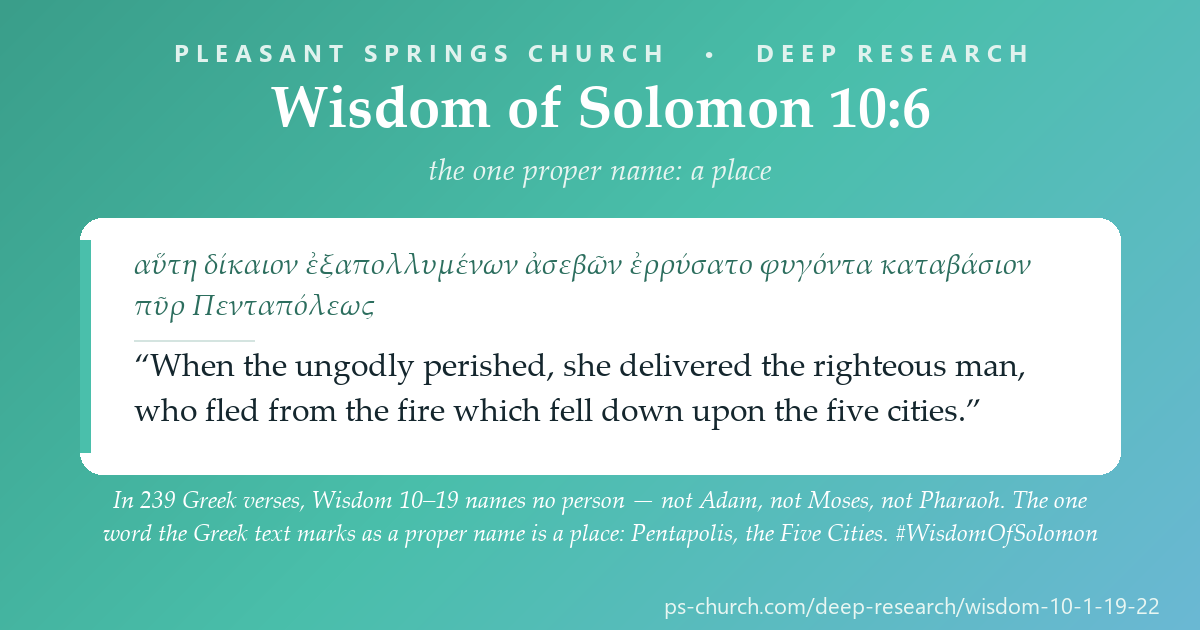
The one word in 10:1–19:22 that the Greek text marks as a proper name — Πενταπόλεως, of the Five Cities, and it is a place. The KJV English has it as a common phrase, “the five cities”; the Latin keeps it as a name, Pentapolim. The man rescued is δίκαιον, a righteous man. Measured too: this row shares no two consecutive words with any verse of the Greek New Testament — one of 13 rows in the ten chapters that reach only one.
VULGATE 10:6 Hæc justum a pereuntibus impiis liberavit fugientem, descendente igne in Pentapolim
Sold, not forsaken, delivered — the figure Genesis names Joseph, and the text calls πραθέντα δίκαιον, a righteous man who was sold. The verse ends in a different place in each witness: the KJV’s 10:13 ends “she went down with him into the pit” and the Latin’s ends descenditque cum illo in foveam, words the Greek row puts at the start of 10:14, συγκατέβη αὐτῷ εἰς λάκκον. Measured: this row and Acts 7:9, Stephen’s sentence about the same sale, share no word at all.
VULGATE 10:13 Hæc venditum justum non dereliquit, sed a peccatoribus liberavit eum descenditque cum illo in foveam,
The rule chapters 11–19 illustrate: the things by which their enemies were punished are the things by which they were benefited. Who the enemies are, and who they are, the Greek does not say. The Latin divides the verse in two, and its 11:5 carries words the Greek row does not have — a defectione potus sui et in eis cum abundarent filii Israël lætati sunt — and with them filii Israël, the children of Israel, a name no row of the Greek book contains.
VULGATE 11:5–6 Per quæ enim pœnas passi sunt inimici illorum a defectione potus sui, et in eis cum abundarent filii Israël lætati sunt per hæc, cum illis deessent, bene cum illis actum est.
The verdict on those who worshipped the elements: not even they are pardonable, συγγνωστοί. Romans 1:20 reaches a like verdict on those it speaks of, in a different word, ἀναπολογήτους, without excuse. Measured: of the 69 rows of Wisdom 13–15 this is the one that shares no word form at all with Romans 1:18–32.
VULGATE 13:8 Iterum autem nec his debet ignosci.
They — the images — entered into the world. The three words εἰς τὸν κόσμον stand in 2 of the 30,348 Greek Old Testament units screened, both in this book (2:24, of death; 14:14, of the images), and 22 times in the Greek New Testament. The bolded four words are the deepest contact chapters 13–15 make with the New Testament — John 3:19, band 1 from both sides — and the fourth word is and.
VULGATE 14:14 Supervacuitas enim hominum hæc advenit in orbem terrarum, et ideo brevis illorum finis est inventus.
A list of vices. Romans 1:29 has one too, and both name murder and deceit — φόνος and δόλος here, φόνου and δόλου there. Different case endings, so a run screen sees nothing: Romans 1:29 shares no word form with any row of Wisdom 13–15. The Latin ends this verse with tumultus bonorum, which the Greek row carries as θόρυβος ἀγαθῶν at the start of 14:26.
VULGATE 14:25 et omnia commista sunt sanguis, homicidium, furtum et fictio, corruptio et infidelitas, turbatio et perjurium, tumultus bonorum,
Greek 18:16 καὶ στὰς ἐπλήρωσεν τὰ πάντα θανάτου καὶ οὐρανοῦ μὲν ἥπτετο βεβήκει δ' ἐπὶ γῆς18:15–16KJV 18:15–16 “Thine Almighty word leaped down from heaven out of thy royal throne, as a fierce man of war into the midst of a land of destruction, And brought thine unfeigned commandment as a sharp sword, and standing up filled all things with death; and it touched the heaven, but it stood upon the earth.”
The all-powerful word as a warrior, leaping down from heaven. Against John 1:1–18 and Revelation 19:11–16, every verse pair shares at most ONE word in a row. The sword is ξίφος ὀξὺ here and ῥομφαία ὀξεῖα in Revelation 19:15 — two different nouns; the Latin uses gladius for both. And the sword is not in the same verse in every witness: the Greek row closes 18:15 with it; the KJV opens 18:16 with “And brought thine unfeigned commandment as a sharp sword”, and the Latin opens its 18:16 with gladius acutus.
VULGATE 18:15–16 omnipotens sermo tuus de cælo, a regalibus sedibus, durus debellator in mediam exterminii terram prosilivit, gladius acutus insimulatum imperium tuum portans et stans, replevit omnia morte, et usque ad cælum attingebat stans in terra.
The Greek says οἱ μὲν γὰρ, for those, and names no one. The KJV English reads “the Sodomites”. The Latin — its 19:13, which also carries the end of Greek 19:13 — reads alii quidem ignotos non recipiebant advenas, others. What the Greek itself offers is an echo: three verses on, the oppressors are struck with ἀορασίᾳ, “as those were at the doors of the righteous man” — ἐπὶ ταῖς τοῦ δικαίου θύραις. That noun is the noun of Genesis 19:11, where the men at Lot’s door are struck blind. The KJV’s name is an identification the echo supports and the Greek words do not make.
VULGATE 19:13 Etenim detestabiliorem inhospitalitatem instituerunt alii quidem ignotos non recipiebant advenas alii autem bonos hospites in servitutem redigebant.
The last verse: in all things, Lord, you magnified your people — who are not named here either. The Latin has no separate verse for it: its 19:20 runs Greek 19:21 and 19:22 together.
VULGATE 19:20 Flammæ e contrario corruptibilium animalium non vexaverunt carnes coambulantium, nec dissolvebant illam, quæ facile dissolvebatur sicut glacies, bonam escam. In omnibus enim magnificasti populum tuum, Domine, et honorasti, et non despexisti, in omni tempore et in omni loco assistens eis.
On the columns. The Greek is the CATSS morphological Septuagint (Rahlfs’s text), quoted at verse level with attribution, and it is the only Greek text of this book held here. The English is the King James Apocrypha, standardised 1769 text, public domain, quoted verbatim from the verse-per-line file on this disk, its spelling untouched (“shewed”). It is quotation, aligned to the Greek by content, and every line where its verse division differs is flagged. The Latin is the Clementine Vulgate, a fourth witness with its own count, printed beside the English and never used as a source for it.
Versification — stated, as on every page here, including where the usual frame does not exist.
There is no Masoretic text of this book and no versification-table entry for it, so there is no Hebrew–Greek offset to state. There are three witnesses with their own counts, and every offset in count between them is measured; the boundary moves are listed as read:
• Greek (CATSS, Rahlfs): 10:1–19:22 = 239 rows; chapters 10–19 hold 21 · 26 · 27 · 19 · 31 · 19 · 29 · 20 · 25 · 22; the whole book 435.
• KJV Apocrypha (1769): 240 verses in the same chapters; the whole book 436. One chapter differs in count, 17 (21 against 20): the KJV divides Greek 17:9 into two verses, so from there to the chapter’s end KJV 17:n+1 answers to Greek 17:n, with one boundary inside that run drawn elsewhere (below) — its 17:10 is “They died for fear”, and its 17:21, “Over them only was spread an heavy night”, is Greek 17:20.
• Clementine Vulgate: 238 verses; the whole book 439. Two chapters differ: 11 (27 against 26) — the Latin divides Greek 11:5 into its 11:5–6, so Latin 11:n+1 = Greek 11:n from there — and 19 (20 against 22): Greek 19:12–14 = Latin 19:12–13, and Greek 19:21–22 = Latin 19:20.
Agreement of count is not agreement of division. Read row by row against the KJV, the boundary also falls differently at 10:13/14, 12:5/6 (“With their priests out of the midst of their idolatrous crew” opens the KJV’s 12:6, words the Greek row ends 12:5 with, μύστας θιάσου), 13:17/18 (the KJV’s 13:18 opens “For health he calleth upon that which is weak”, the clause that ends the Greek row 13:17, καὶ περὶ μὲν ὑγιείας τὸ ἀσθενὲς ἐπικαλεῖται; the Latin’s 13:18 opens with it too, Et pro sanitate quidem infirmum deprecatur), 14:16/17 and 18:15/16; and inside chapter 17’s offset once more: the Greek row 17:17 ends ἢ κτύπος ἀπηνὴς καταρριπτομένων πετρῶν, and the KJV opens its 17:19 with “Or a terrible sound of stones cast down”. Twice the KJV carries a clause in another verse altogether: at 11:9, “thirsting in another manner than the just”, a clause the Greek row has at the end of 11:14, οὐχ ὅμοια δικαίοις διψήσαντες; and at 12:3, “For it was thy will to destroy by the hands of our fathers”, words the Greek row has at the end of 12:6, ἐβουλήθης ἀπολέσαι διὰ χειρῶν πατέρων ἡμῶν. The Latin, read row by row in chapters 10, 11 and 19, moves the boundary at 10:1/2, 10:13/14 and 10:19/20 (its 10:19 ends Ideo justi tulerunt spolia impiorum, the Greek row’s διὰ τοῦτο δίκαιοι ἐσκύλευσαν ἀσεβεῖς at the start of 10:20), and — at rows printed or quoted here — at 14:16/17 (its 14:16 ends et tyrannorum imperio colebantur figmenta), 14:25/26 and 18:15/16. The KJV’s 14:16, too, carries “graven images were worshipped by the commandments of kings”, which the Greek row puts at the start of 14:17, καὶ τυράννων ἐπιταγαῖς ἐθρησκεύετο τὰ γλυπτά. Every printed line where this matters is flagged.
The Shape of the Passage
A sequence — measured markers, not a chiasmNot measured: the boundaries of the panels themselves. The preposition marks a turn inside a panel, not its edge; every boundary drawn above is this page’s reading of the content. So is the count of seven. Published analyses of the structure of these chapters were not consulted (Stage 5) and may divide them differently.
This is NOT offered as a chiasm. The contrasts run broadly, not strictly, in the order of the Exodus story, not a mirror: there is no centre, and nothing in the second half answers the first in reverse. It is a sequence, interrupted twice, and it is labelled as one.
⚠️ Where this page sits. The Wisdom of Solomon is canonical in the Roman Catholic and Orthodox churches, was printed among the Apocrypha in the Protestant Bibles of the Reformation era (the King James of 1611 among them), and is absent from the Hebrew Bible. This library reads it as a Second-Temple witness and files it under Apocrypha / Deuterocanon. Nothing taught at Pleasant Springs rests on it.
Author
Anonymous, and speaking in a king’s voice. Chapters 7–9 are the first-person story and prayer of a king who asked for wisdom and was told to build a temple (9:7–8) — Solomon, as the book’s traditional title, Wisdom of Solomon, identifies him; whether the Greek manuscripts carry that title is not verifiable here, since the file used has no title row. The book never writes his name. Measured: no form of the name in any of its 435 Greek rows.
Writing in Greek, by the usual account. The book is commonly dated between the late first century BC and the early first century AD and commonly placed in Alexandria. Reported from the commentaries, not measured here; nothing on this page depends on it. What the files can show is that its vocabulary is its own: παντοδύναμος, all-powerful, stands 3 times in the 30,348 Greek Old Testament units screened, and all 3 are in this book.
And he retells by description. Chapter 10 identifies every figure by an act or an epithet — the first-formed father, a righteous man, the servant of the Lord — and leaves the naming to a reader who already knows Genesis and Exodus.
Audience
Readers who know the story already. A retelling that never names Joseph assumes an audience that will supply the name. The book reads as written for insiders, and its pronouns — your people, your sons, our fathers — place the reader inside the people the plagues spared.
People living beside animal-worship and image-making. Near the end of chapter 15 the book says of the oppressors “they worshipped those beasts also that are most hateful” (15:18), and chapters 13–15 explain, at length and with scorn, how a carved log comes to be prayed to. Who exactly is meant is not said; the page does not supply it.
And people asking whether God is just. The rules of 11:5 and 11:16 — the oppressor punished through the very things by which the oppressed are helped, and a sinner punished through his own sin — are an answer to that question, offered from inside the story of the Exodus.
Orient on the book, on its retelling of the Exodus, and on what “Wisdom” means in it.
Search by topic: Wisdom of Solomon; Wisdom (personified); Exodus traditions; plagues of Egypt; idolatry; Logos; Alexandrian Judaism; Apocrypha.
Which articles are relevant?
- Anchor Bible Dictionary — “Wisdom of Solomon,” “Wisdom in the OT,” “Idolatry,” “Plagues in Egypt,” “Apocrypha, Old Testament.”
- Eerdmans Dictionary of Early Judaism — “Wisdom of Solomon,” “Alexandria,” “Exodus Traditions.”
- Dictionary of New Testament Background (IVP) — “Wisdom of Solomon,” “Logos,” “Apocrypha and Pseudepigrapha.”
- On the text — any article that names the edition it quotes. This page quotes one file, which follows Rahlfs’s hand edition; the critical edition is Ziegler’s in the Göttingen series, which is not held here.
Bibliography surfaced:
- David Winston, The Wisdom of Solomon (Anchor Bible 43, 1979).
- Chrysostome Larcher, Le Livre de la Sagesse ou la Sagesse de Salomon (Études bibliques, three volumes, 1983–1985).
- Lester L. Grabbe, Wisdom of Solomon (Guides to Apocrypha and Pseudepigrapha, 1997).
- Joseph Ziegler, ed., Sapientia Salomonis (Septuaginta, Göttingen) — the critical text. Not held here.
- NETS (A New English Translation of the Septuagint) — “Wisdom of Salomon.” Not the English quoted on this page; named as the obvious next step for a reader.
Three other retellings of the same history, and how many names each one uses.
A retelling of Israel’s story is a recognisable thing in this period, and it can be counted. The table below counts the words each edition marks as proper names — in CATSS a capitalised form, in the SBLGNT a capitalised lemma — so the two conventions differ slightly (MorphGNT capitalises the Red Sea; CATSS does not), and the page says so.
How many names does a retelling use?
| retelling | text | verse units | words | proper-name tokens |
|---|---|---|---|---|
| Wisdom 10 | CATSS | 21 | 318 | 1 — a place |
| Wisdom 10–19 | CATSS | 239 | 3,981 | 1 — the same one |
| Sirach 44–50 | CATSS | 164 | 2,657 | 108 |
| Acts 7 (Stephen) | SBLGNT | 60 | 1,116 | 74 (28 different) |
| Hebrews 11 | SBLGNT | 40 | 631 | 33 (24 different) |
Sirach 44–50, one of the Greek Old Testament’s other long reviews of the fathers (Psalms 77, 104 and 105 in the Greek numbering, 78, 105 and 106 in English Bibles, are others, and name them too), opens αἰνέσωμεν δὴ ἄνδρας ἐνδόξους καὶ τοὺς πατέρας ἡμῶν τῇ γενέσει (Sirach 44:1) KJV Apocrypha 44:1 “Let us now praise famous men, and our fathers that begat us.” — and then names them, 108 times in 164 rows. Stephen in Acts 7 and the writer to the Hebrews in chapter 11 tell the same history in the New Testament and name Abraham, Isaac, Jacob, Joseph and Moses in it; between them, 107 proper-name tokens in 100 verses. Wisdom 10 tells it in 21 rows and uses none for a person.
The Red Sea is the one honest qualification. The Greek has it twice in these chapters, θάλασσαν ἐρυθρὰν (10:18) and ἐρυθρᾶς θαλάσσης (19:7), and the CATSS edition prints it as an adjective and a common noun; MorphGNT capitalises the same phrase in Acts 7:36. Count it as a name and Wisdom 10–19 has three proper-name tokens, two places and no persons.
Who is who — the epithets, and who supplies the names
| row | what the Greek calls him | KJV | the name a reader supplies |
|---|---|---|---|
| 10:1 | πρωτόπλαστον πατέρα κόσμου | “the first formed father of the world” | Adam |
| 10:3 | ἄδικος | “the unrighteous” | Cain |
| 10:4 | τὸν δίκαιον | “directed the course of the righteous” | Noah |
| 10:5 | τὸν δίκαιον | “she found out the righteous” | Abraham |
| 10:6 | δίκαιον | “she delivered the righteous man” | Lot |
| 10:10 | δίκαιον | “When the righteous fled” | Jacob |
| 10:13 | πραθέντα δίκαιον | “When the righteous was sold” | Joseph |
| 10:15 | λαὸν ὅσιον | “the righteous people” | Israel |
| 10:16 | θεράποντος κυρίου | “the servant of the Lord” | Moses |
| 11:1 | προφήτου ἁγίου | “the holy prophet” | Moses |
| 18:21 | ἀνὴρ ἄμεμπτος | “the blameless man” | Aaron |
| 19:17 | ἐπὶ ταῖς τοῦ δικαίου θύραις | “at the doors of the righteous man” | Lot |
Every name in the right-hand column is the reader’s, not the text’s. Each identification rests on the Genesis or Exodus story the row retells, and some of them have a verbatim anchor the screen can find: the στήλη ἁλός of 10:7 (“a standing pillar of salt”) stands in 2 of the 30,348 Greek Old Testament units screened, and the other is Genesis 19:26; the noun ἀορασίᾳ of 19:17 occurs 6 times in those units, once at Genesis 19:11. Others — the righteous man of the flood at 10:4 (KJV “directed the course of the righteous”), or θεράποντος κυρίου at 10:16 — are identified by the story alone.
The form these chapters take
A comparison, carried on for nine chapters. Each panel sets what happened to them beside what happened to your people, through the same element — water, animals, fire, light, the sea. The commentaries commonly describe this as synkrisis, the Greek rhetorical figure of sustained comparison. That label is reported, not measured; what this page measures is the preposition that stands in five of the seven panels, at the turn itself in four of them (see the diagram).
Retold in the Second-Temple period by others, with names. Philo’s Life of Moses, the fragments of Ezekiel the Tragedian’s Exagoge and of Artapanus all retell the Exodus and all name Moses. None of them is held on this disk, and nothing here is measured against them; they are named so a reader can see that anonymity was a choice available to a Jewish writer in Greek, not a convention of the genre.
These chapters make heavy accusations. Chapter 12 charges the land’s earlier inhabitants with τέκνων τε φονὰς ἀνελεήμονας, “merciless murderers of children” (12:5), and with rites of blood. Chapter 19 says the oppressors practised χαλεπωτέραν μισοξενίαν, “a more hard and hateful behaviour toward strangers” (19:13), and sets them beside those who would not receive strangers at the righteous man’s door (19:14–17). These are the book’s charges, made in the polemical idiom of its time, about peoples it does not name. This page reports what the text says, as the text’s; it does not repeat the charges as its own, extend them, or apply them to anyone.
A pronoun, an epithet, a word that stops, and a preposition that marks the turns.
Every count below is over the 30,348 Greek Old Testament units screened here (the Odes excluded) or the 7,927 verses of the Greek New Testament, and the page says which. It is not a count over “the Septuagint”. Counts are of word tokens unless the sentence says rows or verses.
Six rows of the Wisdom of Solomon open with this word, and all six are in chapter 10 (10:1, 5, 6, 10, 13, 15). She is Wisdom, named outright at 10:4, 10:8, 10:9 and 10:21. Each she introduces a person rescued; none of the persons is named. In the KJV English the last verse with she for Wisdom is 11:1, whose Greek verb has no expressed subject; from 11:4 the book speaks to you.
Five times in chapter 10 a single man is called righteous — 10:4, 5, 6, 10 and 13 — and by the stories they retell they are five different men. One epithet doing the work of five names. The plural follows at 10:20, of the whole people.
30 times in the book: 24 in chapters 1–9 and 6 in 10–19 — four in chapter 10, then τεχνῖτις δὲ σοφία (14:2, the shipwright’s skill) and τὰ τῆς σοφίας σου ἔργα (14:5). Then none: the last 115 rows of the Wisdom of Solomon, 15:1–19:22, never use the word. The book that bears the name stops saying it five chapters before the end.
8 times in the book; 7 of them in chapters 11–19, in the contrasts at 11:6 (ἀντὶ μὲν πηγῆς), 11:15 (ἀντὶ δὲ λογισμῶν), 16:2 (ἀνθ' ἧς κολάσεως), 16:20 (ἀνθ' ὧν ἀγγέλων τροφὴν) and 18:3 (ἀνθ' ὧν πυριφλεγῆ στῦλον), and twice in the look back at 19:10; four of these (11:6, 16:2, 16:20, 18:3) stand at the turn from them to your people. Zero times in 11:17–15:19. The one measurable marker of the structure — and it marks contrasts inside the panels, not their boundaries.
3 occurrences in the 30,348 Greek Old Testament units screened, all in this book — of the spirit in Wisdom at 7:23, of God’s hand at 11:17, and of God’s word at 18:15. None in the Greek New Testament. Revelation 19:15 calls God pantokratōr, a different word.
The only word in 10:1–19:22 the Greek text marks as a proper name (10:6). The KJV English has “the five cities”; the Latin has Pentapolim. A name that is itself a description: five, and cities.
Counted here, not assumed:
- Greek: 239 rows and 3,981 words in 10:1–19:22. Per chapter, 10 to 19: 21 · 26 · 27 · 19 · 31 · 19 · 29 · 20 · 25 · 22. Every label parses; none is lettered.
- Searched for in the Greek of the whole book and found zero times: Egypt, Israel, Moses, Aaron, Pharaoh, Adam, Cain, Abel, Noah, Abraham, Isaac, Jacob, Esau, Joseph, Lot, Sodom, Canaan, Jerusalem, Zion, David, Solomon. Exact forms and stems, over all 435 rows.
- In the Latin of 10–19 the names are Pentapolim (10:6), the Red Sea twice (10:18, 19:7) and filii Israël (11:5) — one more than the Greek has, and it stands in a clause the Greek row lacks.
- In the KJV English of 10–19 the names are “Red sea” twice (10:18, 19:7) and “the Sodomites” (19:14) — where the Greek row has οἱ μὲν γὰρ. The Greek’s one marked name the KJV prints as “the five cities”.
- βασιλείαν θεοῦ — a kingdom of God (10:10). Wisdom shows it to the righteous fugitive. The two-word sequence stands in 1 of the 30,348 Greek Old Testament units screened — this one — and in 3 New Testament verses (1 Corinthians 6:10, 15:50; Galatians 5:21). The KJV has “shewed him the kingdom of God”.
- λόγος, word, 4 times in 10–19 (12:9, 16:12, 18:15, 18:22), against 11 in chapters 1–9. At 16:12 it heals (ὁ σός κύριε λόγος); at 18:15 it kills.
Four words with Stephen, four with John, two with Romans — and what each of them is.
Every one of the 239 Greek rows screened against all 7,927 verses of the Greek New Testament (SBLGNT): contiguous runs of whole word forms, accents and breathings dropped, never lemmas. The tie band — how many verses reach the same depth — is printed beside every run, and for the deepest runs from both sides: the NT verse’s own deepest contact across the 30,348 Greek Old Testament units screened. This finds verbatim contact. It does not find allusion.
The distribution, and the ceiling:
| Greek rows screened against all 7,927 Greek NT verses | reach 2 | reach 3 | reach 4 | reach 5 |
|---|---|---|---|---|
| 10:1–19:22 (239 rows) | 226 | 59 | 3 | 0 |
| 1:1–9:18 (196 rows) | 187 | 70 | 7 | 0 |
| the whole book (435 rows) | 10 | 0 | ||
Nothing in the Wisdom of Solomon reaches five consecutive words with any verse of the Greek New Testament. In chapters 10–19 every row reaches at least one; 13 reach only one. The per-chapter ceiling is four in chapters 10, 14 and 16 and three in the other seven.
| Wisdom row | shared words | NT verse(s) | band among NT verses | seen from the NT verse’s side |
|---|---|---|---|---|
| 10:1 | καὶ ἐξείλατο αὐτὸν ἐκ | Acts 7:10 | 1 | Acts 7:10 reaches 5 in the Greek Old Testament, band 2 — with two psalms, not with Wisdom (below). The four words themselves stand in 1 Greek Old Testament unit: this one. |
| 14:14 | εἰς τὸν κόσμον καὶ | John 3:19 | 1 | John 3:19’s deepest Greek Old Testament contact is this row, alone: four, band 1. |
| 16:8 | ὅτι σὺ εἶ ὁ | Mark 3:11; Luke 4:41; John 6:69; John 11:27; Revelation 3:17 | 5 | The four words stand in 11 Greek Old Testament units. A formula. |
A four-word run: Wisdom’s first man, and Stephen’s Joseph
Wisdom 10:1 → Acts 7:10 — four words, band 1. καὶ ἐξείλατο αὐτὸν ἐκ, and delivered him out of. In Wisdom the man delivered is the first-formed father, out of his own transgression. In Acts it is Joseph:
καὶ ἐξείλατο αὐτὸν ἐκ πασῶν τῶν θλίψεων αὐτοῦ, καὶ ἔδωκεν αὐτῷ χάριν καὶ σοφίαν ἐναντίον Φαραὼ βασιλέως Αἰγύπτου, καὶ κατέστησεν αὐτὸν ἡγούμενον ἐπ’ Αἴγυπτον καὶ ὅλον τὸν οἶκον αὐτοῦ. (Ac 7:10)
literal gloss, this page’s own, not a published translation: and rescued him out of all his afflictions, and gave him favour and wisdom before Pharaoh king of Egypt; and he made him governor over Egypt and over all his household.
The three-word core ἐξείλατο αὐτὸν ἐκ stands in 3 Greek Old Testament units — Jeremiah 38:11 in the Greek numbering, Wisdom 10:1, and Genesis 37:21, where the one rescued is also Joseph, by Reuben:
ἀκούσας δὲ Ρουβην ἐξείλατο αὐτὸν ἐκ τῶν χειρῶν αὐτῶν καὶ εἶπεν οὐ πατάξομεν αὐτὸν εἰς ψυχήν (Genesis 37:21)
literal gloss, this page’s own, not a published translation: And Reuben, hearing, rescued him out of their hands, and said, We will not strike him to death.
And Acts 7:10’s own deepest Greek Old Testament contact is not Wisdom at all: ἐκ πασῶν τῶν θλίψεων αὐτοῦ, five words, band 2 — Psalms 24:22 and 33:7 in the Greek numbering (25:22 and 34:6 in English Bibles):
οὗτος ὁ πτωχὸς ἐκέκραξεν καὶ ὁ κύριος εἰσήκουσεν αὐτοῦ καὶ ἐκ πασῶν τῶν θλίψεων αὐτοῦ ἔσωσεν αὐτόν (Psalm 33:7 Greek)
literal gloss, this page’s own, not a published translation: this poor man cried, and the Lord heard him, and saved him out of all his afflictions
So the verse is made of two pieces, and the longer piece is shared with two psalms. The page does not say Stephen read Wisdom, or that either read Genesis here; the run is reported, and so is everything around it.
⚠️ The counter-example is in the same two chapters. Wisdom 10:13 and Acts 7:9 tell the same event — Joseph sold — and share no word at all:
Καὶ οἱ πατριάρχαι ζηλώσαντες τὸν Ἰωσὴφ ἀπέδοντο εἰς Αἴγυπτον· καὶ ἦν ὁ θεὸς μετ’ αὐτοῦ, (Ac 7:9)
literal gloss, this page’s own, not a published translation: And the patriarchs, jealous of Joseph, sold him into Egypt; and God was with him,
Wisdom 10:14 and Acts 7:10, both about Joseph raised up, share καὶ ἔδωκεν αὐτῷ — three words, band 5 among New Testament verses, and the three words stand in 38 of the 30,348 Greek Old Testament units screened: a formula. The four-word run at 10:1 joins Wisdom’s first-formed father to Stephen’s Joseph; the two Joseph passages share nothing longer than a formula. A shared run does not mean a shared subject, and a shared subject does not produce a shared run.
“Into the world” — Wisdom 14:14 and John 3:19
Four words, band 1 from both sides: εἰς τὸν κόσμον καὶ. No other New Testament verse reaches four with this row, and no other Greek Old Testament unit reaches four with John 3:19.
αὕτη δέ ἐστιν ἡ κρίσις ὅτι τὸ φῶς ἐλήλυθεν εἰς τὸν κόσμον καὶ ἠγάπησαν οἱ ἄνθρωποι μᾶλλον τὸ σκότος ἢ τὸ φῶς, ἦν γὰρ αὐτῶν πονηρὰ τὰ ἔργα. (Jn 3:19)
literal gloss, this page’s own, not a published translation: And this is the judgement: that the light has come into the world, and people loved the darkness rather than the light, for their works were evil.
Then look at the three words without the and. εἰς τὸν κόσμον stands in 2 of the 30,348 Greek Old Testament units screened, and both are in this book, both with the same verb: εἰσῆλθεν εἰς τὸν κόσμον — death, at 2:24 — and εἰσῆλθεν εἰς τὸν κόσμον — the images, at 14:14. In the Greek New Testament the three words occur 22 times in 21 verses, most of them in John. The four-word form with the verb occurs in no New Testament verse; Romans 5:12 has the same four words in another order, εἰς τὸν κόσμον εἰσῆλθεν:
Διὰ τοῦτο ὥσπερ δι’ ἑνὸς ἀνθρώπου ἡ ἁμαρτία εἰς τὸν κόσμον εἰσῆλθεν καὶ διὰ τῆς ἁμαρτίας ὁ θάνατος, καὶ οὕτως εἰς πάντας ἀνθρώπους ὁ θάνατος διῆλθεν ἐφ’ ᾧ πάντες ἥμαρτον— (Ro 5:12)
literal gloss, this page’s own, not a published translation: Therefore, just as through one man sin entered into the world, and through sin death, and so death spread to all people, because all sinned —
What enters the world in Wisdom is death and the images; in Romans 5:12 it is sin, with death behind it; in John 3:19 it is the light. The page reports the words and leaves the subjects side by side.
⚠️ The formula that ties at four:
Wisdom 16:8 → five New Testament verses at once. ὅτι σὺ εἶ ὁ ῥυόμενος ἐκ παντὸς κακοῦ — that you are the one who delivers from every evil. The four words ὅτι σὺ εἶ ὁ are the frame of a confession, and the New Testament fills it with the Son of God, the Holy One of God, the Christ — and once, at Revelation 3:17, with the wretched one. Band 5 on the New Testament side, 11 Greek Old Testament units on the other. It reaches four because the frame is common, and it is printed so that the two band-1 fours above are not read as more than they are.
Romans 1:18–32 against Wisdom 13–15 — at run level
The fifteen verses of Romans 1:18–32 against the 69 rows of Wisdom 13–15: 8 verses reach two, 5 reach one, and 2 share no word form at all; nothing reaches three. From the Wisdom side: 9 rows reach two, 59 reach one, 1 reaches none. Every two is a pair like of God, the God, because of this or and the; the nearest to content is ὡς θεὸν, as a god, which Wisdom 14:15 says of a dead child honoured with an image and Romans 1:21 says of God not honoured:
διότι γνόντες τὸν θεὸν οὐχ ὡς θεὸν ἐδόξασαν ἢ ηὐχαρίστησαν, ἀλλὰ ἐματαιώθησαν ἐν τοῖς διαλογισμοῖς αὐτῶν καὶ ἐσκοτίσθη ἡ ἀσύνετος αὐτῶν καρδία· (Ro 1:21)
literal gloss, this page’s own, not a published translation: because, knowing God, they did not glorify him as God or give thanks, but became futile in their reasonings, and their senseless heart was darkened.
This re-derives exactly what this shelf’s Romans 1–2 page reports from the Romans side. Widening the target to the whole book lifts the ceiling to three, twice, and neither is in chapters 13–15 (1:14 with Romans 1:20, 3:8 with Romans 1:25).
The two places where the ideas are closest are where the words are furthest. Wisdom 13:8 says the worshippers of the elements are not pardonable; Romans 1:20 says those it speaks of are without excuse — and 13:8 is the one row of the 69 that shares no word form with any verse of Romans 1:18–32. Both passages carry a vice list naming murder and deceit (Wisdom 14:25, Romans 1:29), in different cases — and Romans 1:29 shares no word form with any row of Wisdom 13–15.
πεπληρωμένους πάσῃ ἀδικίᾳ πονηρίᾳ πλεονεξίᾳ κακίᾳ, μεστοὺς φθόνου φόνου ἔριδος δόλου κακοηθείας, ψιθυριστάς, (Ro 1:29)
literal gloss, this page’s own, not a published translation: filled with all unrighteousness, wickedness, covetousness, malice; full of envy, murder, strife, deceit, malignity; whisperers,
τὰ γὰρ ἀόρατα αὐτοῦ ἀπὸ κτίσεως κόσμου τοῖς ποιήμασιν νοούμενα καθορᾶται, ἥ τε ἀΐδιος αὐτοῦ δύναμις καὶ θειότης, εἰς τὸ εἶναι αὐτοὺς ἀναπολογήτους, (Ro 1:20)
literal gloss, this page’s own, not a published translation: For his invisible attributes, from the creation of the world, are clearly seen, being understood through the things made, his eternal power and divinity, so that they are without excuse;
— and at the level of vocabulary
A run screen cannot see two lists naming the same vices in different cases, so this page also compared dictionary forms. Romans 1:18–32 uses 109 different nouns, verbs and adjectives (MorphGNT’s lemmas). 30 of them occur somewhere in Wisdom 13–15 (CATSS’s lemmas, compound verbs rebuilt from the edition’s preverb column). Most are common — God, man, heaven, heart, glory, do, have, be. 11 are rare in the New Testament, found in no more than 20 of its 7,927 verses: impiety, deceit, image, create, perceive, appetite, arrogant, perishable, murder, nature, use.
| Romans 1:18–32 among every run of 15 consecutive verses in the NT (7,550 of them), by how much of its vocabulary Wisdom 13–15 contains | Romans 1:18–32 | rank |
|---|---|---|
| number of shared lemmas (median 23) | 30 | 613th |
| share of the passage’s own lemmas (median 28.7%) | 27.5% | 4,429th — below the median |
| shared lemmas that are rare in the NT | 11 | 11th — top of the table is Jude 1–15 (13) |
So the answer depends on the question, and the page prints all three. Counted plainly, Romans 1:18–32 is in the top tenth; as a share of its own vocabulary it is below the median; counted by rare words only, just ten windows of 7,550 share more. The rare-word measure is the most favourable to Romans, and it still does not put Romans first: windows of Jude and of 2 Peter — passages full of the vocabulary of ungodliness — stand above it, and so do two windows of Romans itself that start a few verses later, at 1:22 and 1:23 (12 each); and Romans 1:18–32 shares its count of 11 with 6 other windows.
From the other side. Slide a window the size of Wisdom 13–15 (1,210 words) along every CATSS file — 26,753 windows — and ask how much of Romans 1:18–32’s vocabulary each holds. The median window holds 14 of the 109; Wisdom 13–15 holds 30. 239 windows hold more, and every one of them is in the Wisdom of Solomon (171) or Proverbs (68); the best, with 36, is a stretch of Wisdom that ends at 13:1. Counting the 74 NT-rare lemmas only, the median window holds 2, Wisdom 13–15 holds 11, and the 207 windows that hold more are in Wisdom (134), Proverbs (37) and Sirach (36); the best, with 17, is a stretch of Wisdom that ends at 14:9.
⚠️ And then the control, which this page ran because the result looked too good. The same window test, run for other New Testament passages, also lands in the Wisdom of Solomon: the best Greek Old Testament window for Jude 1–15 is in Wisdom (52 lemmas), for Acts 17:16–30 in Wisdom (43), for 1 Timothy 6:3–17 in Wisdom (41). For Mark 4:1–15 it is Isaiah (33); for Hebrews 11:1–15, counted by rare words, it is Sirach 44–47 (10) — the review of the fathers, and among the ten shared rare words are the names Enoch, Noah and Isaac. By this measure the Wisdom of Solomon’s vocabulary sits close to the vocabulary of several New Testament passages, not of Romans 1 alone. The vocabulary closeness between Romans 1 and Wisdom is real; on this evidence it is not special to Romans 1, and it is not special to chapters 13–15.
The all-powerful word — Wisdom 18:15–16 against John 1 and Revelation 19
Run level: one. Each of the two Greek rows against each of the 18 verses of John 1:1–18 and the 6 verses of Revelation 19:11–16: no pair shares two consecutive words. Against the whole New Testament 18:15 reaches two (ἀπ' οὐρανῶν with Hebrews 12:25, in a band of 3; seen from Hebrews 12:25, its deepest Greek Old Testament contact is two words, in a band of 76 units) and 18:16 reaches two in a band of 57.
Ἐν ἀρχῇ ἦν ὁ λόγος, καὶ ὁ λόγος ἦν πρὸς τὸν θεόν, καὶ θεὸς ἦν ὁ λόγος. (Jn 1:1)
literal gloss, this page’s own, not a published translation: In the beginning was the Word, and the Word was with God, and the Word was God.
καὶ περιβεβλημένος ἱμάτιον βεβαμμένον αἵματι, καὶ κέκληται τὸ ὄνομα αὐτοῦ ὁ Λόγος τοῦ Θεοῦ. (Re 19:13)
literal gloss, this page’s own, not a published translation: and he is clothed in a robe dipped in blood, and his name is called the Word of God.
καὶ ἐκ τοῦ στόματος αὐτοῦ ἐκπορεύεται ῥομφαία ὀξεῖα, ἵνα ἐν αὐτῇ πατάξῃ τὰ ἔθνη, καὶ αὐτὸς ποιμανεῖ αὐτοὺς ἐν ῥάβδῳ σιδηρᾷ· καὶ αὐτὸς πατεῖ τὴν ληνὸν τοῦ οἴνου τοῦ θυμοῦ τῆς ὀργῆς τοῦ θεοῦ τοῦ παντοκράτορος. (Re 19:15)
literal gloss, this page’s own, not a published translation: and from his mouth goes out a sharp sword, so that with it he may strike the nations; and he will shepherd them with a rod of iron; and he treads the winepress of the wine of the fury of the wrath of God the Almighty.
Vocabulary level: what is shared, and what is not. The two Wisdom rows use 22 different nouns, verbs and adjectives. With John 1:1–18 they share two — word and all. With Revelation 19:11–16 they share three — word, sharp and heaven. Not shared: the sword (ξίφος in Wisdom, 16 times in the Greek Old Testament and never in the New; Revelation’s ῥομφαία is a different noun, 259 times in the Greek Old Testament and 7 in the New); all-powerful (Wisdom’s word, against Revelation’s pantokratōr); warrior (πολεμιστής, 51 times in the Greek Old Testament, never in the New). Revelation’s name is ὁ Λόγος τοῦ Θεοῦ, of God; Wisdom’s is ὁ παντοδύναμός σου λόγος, your word. John’s word is in the beginning; Wisdom’s leaps down in the middle of the night into a land of destruction and fills everything with death.
And the Latin turns the picture round. In the Clementine, Wisdom 18:15 has omnipotens sermo tuus and 18:16 gladius acutus; Revelation 19:13 has Verbum Dei, 19:15 gladius ex utraque parte acutus, and John 1:1 In principio erat Verbum. In Greek the word matches and the swords do not; in Latin the swords match and the word does not. This shelf’s own Revelation 19 page lists Wisdom 18:15–16 among the streams behind the rider; measured, the stream is one word wide in Greek, and a different word in Latin.
It settles that no New Testament verse reproduces a sentence of Wisdom 10–19. The ceiling is four words; one of the three fours is a confession formula; the two that stand alone are and delivered him out of and into the world, and.
It does not settle that the book was unread. A run screen cannot see a shared argument, and the vocabulary screen shows that Wisdom’s vocabulary sits close to that of several New Testament passages — Romans 1 among them, and Jude, Acts 17 and 1 Timothy as much.
The honest sentence is the narrow one: on this corpus, with these screens, Wisdom 10–19 shares phrases of four words at most with the New Testament, its two band-1 fours are with Acts 7:10 and John 3:19, and its closeness to Romans 1 is a closeness of vocabulary that it shares with other New Testament passages too. Direction of influence is not measurable, and is not asserted.
What this page could not check, what it built for itself, and where it is weakest.
This is the section that makes the shelf trustworthy. It is long for a ten-chapter page because more than usual rests on one Greek file and a method this shelf had not used before.
⚠️ What this page built that the shelf’s tools do not have:
The vocabulary comparison in Stage 4 is this page’s own, and it is new. The shelf’s measurement tools compare word forms only. To compare dictionary forms the page read the lemma column of the CATSS file and the lemma column of MorphGNT and matched them. The two editions do not spell lemmas alike: CATSS lists a compound verb as its root plus a separate preverb column, so every compound was rebuilt with the ordinary Greek sound changes; CATSS writes gignōskō where MorphGNT writes ginōskō, and that was folded. Every one of Romans 1:18–32’s lemmas the method did not find in Wisdom 13–15 was checked by eye against the forms in those chapters; the misses are true misses (cognates such as unjustly for injustice, which a lemma match is right to miss). The method lives in this page’s self-check, which re-runs it in full.
Its limits: nouns, verbs and adjectives only; proper names count as nouns; “rare” is a threshold this page chose (20 New Testament verses), and the rank of Romans moves with it (it is 34th at a threshold of 10). That is why three measures are printed and none is crowned.
⚠️ What this page could NOT check:
- Any Hebrew or Aramaic behind the Greek. None is held; the acrostic and Hebrew-parallel screens cannot run. There is no result to report, not even a null one.
- The critical text. Ziegler’s Göttingen edition and its apparatus are not held. Every Greek figure on this page is a figure for one file, CATSS, which follows Rahlfs. Where the manuscripts differ — and at the verse divisions this page flags, they may — the page cannot say how.
- Why the KJV reads “the Sodomites” at 19:14, and why its 11:9 and 12:3 carry clauses the Greek rows have at 11:14 and 12:6. The Greek text the 1611 translators used is not held here. The page reports what the 1769 English reads, and does not explain it.
- Why the Latin reads filii Israël at 11:5. The same: what the Clementine reads is reported; whether an older Latin or a Greek manuscript stands behind the extra clause is not checkable here.
- The Latin’s verse divisions in full. Read row by row in chapters 10, 11 and 19 and at every row printed here; in chapters 12–18 only the counts and the printed rows were compared.
- Published analyses of the structure. Addison G. Wright’s article on the structure of the book (Biblica, 1967) and the commentaries’ outlines were not consulted; the diagram is built from the text and may not match them.
- Whether the vocabulary closeness is genre, date or reading. The control in Stage 4 shows it is not special to Romans 1. What it is, the screen cannot say.
- Philo, Ezekiel the Tragedian, Artapanus. Named in Stage 2; none is held, none measured.
⚠️ Where this page is weakest:
- The names in the “who is who” table are inference. They are the identifications a reader who knows Genesis and Exodus makes, and two have a verbatim anchor in Genesis; the rest rest on the story alone. The page’s thesis is the count, not the identifications.
- “Proper name” is an editor’s decision. The count of one depends on CATSS printing the Red Sea in lower case. Counted the other way it is three tokens — still two places and no persons; Stage 2 prints both.
- The English column is quotation. The KJV Apocrypha is aligned to the Greek by content, and it does not always agree on where a verse ends: 10:13/14, 12:5/6, 13:17/18, 14:16/17 and 18:15/16 differ, chapter 17 is split differently (and inside its offset the Greek 17:17/18 boundary falls elsewhere again), and at 11:9 and 12:3 the KJV carries a clause the Greek row has in another verse. The list is as read, row by row; a boundary missed here would change no count on the page. Every printed row where this matters is flagged.
- The structure’s count of seven is this page’s. A measured preposition stands in five of the panels, at the turn in four of them; every boundary is a reading of the content. It is labelled as a sequence, not a chiasm.
- Dating and place of writing are taken from the commentaries and nothing here tests them.
Commentaries & studies:
- David Winston, The Wisdom of Solomon (Anchor Bible 43, 1979).
- Chrysostome Larcher, Le Livre de la Sagesse ou la Sagesse de Salomon (1983–1985).
- James M. Reese, Hellenistic Influence on the Book of Wisdom and Its Consequences (1970).
- Samuel Cheon, The Exodus Story in the Wisdom of Solomon (1997) — on chapters 10–19 as a retelling.
- Peter Enns, Exodus Retold (1997) — on Wisdom 10:15–21 and 19:1–9.
- Jonathan A. Linebaugh, God, Grace, and Righteousness in Wisdom of Solomon and Paul’s Letter to the Romans (2013) — the Romans comparison at book length.
- Addison G. Wright, “The Structure of the Book of Wisdom” (Biblica, 1967). Not consulted for this page.
A history told without names, for readers who already know them.
Name what you learned, why it matters, and one concrete response.
What should we carry away — and do?
- The story can be told without the names, if the hearers know it. Wisdom 10 names no person and a reader who knows Genesis can still say who was sold and who was rescued from the fire. The later witnesses have names the Greek lacks — Israël in the Latin, “the Sodomites” in the English. Read slowly enough to notice what is not there.
- “A righteous man” is five different men in one chapter. The epithet does the work of five names: it says what each man was, rather than who.
- The book called Wisdom stops saying the word. After 14:5 it never uses it again, and from chapter 11 it speaks to God directly.
- Measure before you repeat. The comparison the commentaries draw — Romans 1 and Wisdom 13–15 — shares no phrase longer than two words, and its vocabulary closeness is shared by Jude and Acts 17. The longest phrases the book shares with the New Testament are four words long, and 10 of its rows reach four; one of them is in Stephen’s speech, and it is about a different man.
- One concrete response. Read Acts 7 and Wisdom 10 side by side this week, and write the names into the margin of Wisdom yourself. Then notice which ones you could not supply.
Wisdom of Solomon 10:6 · to share
Greek (CATSS) · KJV Apocrypha (1769 standard text, public domain) · LatinVULGATE 10:6 Hæc justum a pereuntibus impiis liberavit fugientem, descendente igne in Pentapolim
Every Deep Research page traces its passage across the whole sweep — the Old Testament, the Second-Temple world between the testaments (historical witnesses, not Scripture), and the New Testament. Follow the thread:
Pleasant Springs Church — Deep Research
Research method after Michael S. Heiser’s Bible Research Method (examine dictionaries → ancient literature → important words → textual connections → academic publications → share), with the Pleasant Springs “Author & Audience” foundation. Scripture set in the Hebrew, the Greek editions named on each page and the ESV (Old Testament), and the Greek New Testament and the ESV (New Testament), per the practice of Pleasant Springs Church. ⚠️ Status: the Wisdom of Solomon is not part of the Protestant canon. It is canonical in the Roman Catholic and Orthodox churches, was printed among the Apocrypha in the Reformation-era Protestant Bibles, and is absent from the Hebrew Bible. This study is filed under Apocrypha / Deuterocanon and nothing taught at Pleasant Springs rests on it. Greek text: the CATSS morphologically analysed Septuagint (Rahlfs’s text), Wisdom.mlxx, quoted at verse level with attribution; every row, count, run, band and lemma figure was re-derived from that file for this study, and a self-check compares every printed Greek line to it character for character. English: the King James Apocrypha, standardised 1769 text, public domain (the verse-per-line edition from eBible.org, held on this disk), quoted verbatim and aligned to the Greek by content, with every differing verse division flagged. Canonical New Testament and Old Testament comparison verses are printed in Greek with this page’s own literal gloss, marked as such. Latin: the Clementine Vulgate (public domain), printed as a further witness with its own verse count and never as a source for the English. Greek New Testament: SBLGNT via MorphGNT. ⚠️ NOT HELD: any Hebrew or Aramaic text of the book, the Göttingen edition and its apparatus, any manuscript, and the Old Latin. Direction of influence is nowhere asserted. Scholarship after Winston, Larcher, Reese, Cheon, Enns and Linebaugh.
Scripture quotations marked ESV are from the ESV® Bible (The Holy Bible, English Standard Version®), © 2001 by Crossway, a publishing ministry of Good News Publishers. ESV Text Edition: 2016. Used by permission. All rights reserved. The ESV text may not be quoted in any publication made available to the public by a Creative Commons license, and the ESV may not be translated in whole or in part into any other language. www.esv.org
|
Did this study bless you today? 💚 Give to Support PS Church100% of gifts go to the General Fund — thank you. |