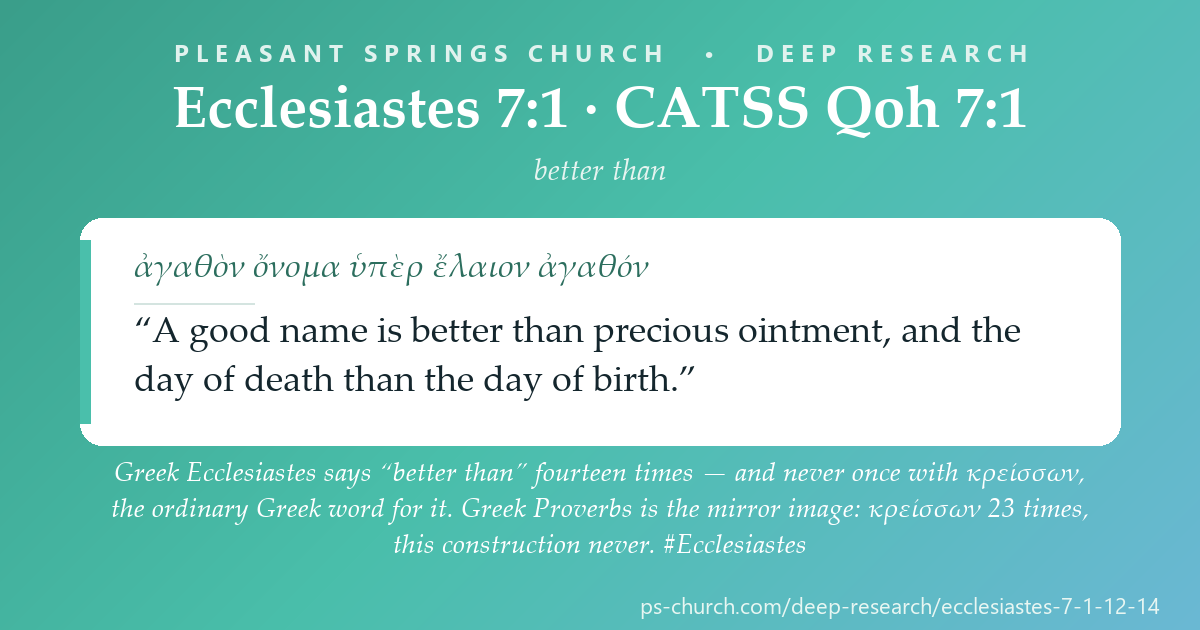
Ecclesiastes 7 opens with a run of comparisons — a good name is better than ointment, the house of mourning better than the house of feasting, the end of a thing better than its beginning. In the Greek file not one of them uses the Greek word for better. Fourteen times across the book the comparison is built instead out of a positive adjective and a preposition — ἀγαθός … ὑπέρ, good … beyond — and κρείσσων, the ordinary comparative, stands in this file zero times. Greek Proverbs is the mirror image: κρείσσων twenty-three times, and this construction never. Eight of the fourteen are in this passage and five of those are in chapter 7. Then the book closes: the frame returns at 12:8, and the last two verses stop describing and start speaking to whoever is reading. See the method →
Ecclesiastes 7:1–12:14 (selections)
Hebrew · Greek (CATSS, Rahlfs’ Septuaginta) · ESVWhat is worth watching here is how the Greek says better. Fourteen times in this book it builds the comparison out of a positive adjective and a preposition — ἀγαθός … ὑπέρ, good … beyond — and it never once reaches for κρείσσων, the ordinary Greek word for better. Eight of the fourteen are in this passage, and five of those are in chapter 7.
The Shape of the Passage
Sequence — sayings, a hard middle, and an endingThis is where the book hands itself back. 1:1–2 spoke about Qoheleth; 1:12 onward spoke as him; and at 12:8 the third person returns and stays to the end. This page reports where each voice stands and does not settle who wrote the frame.
Author
Six of the seven times the name stands, it is the frame speaking. 1:1, 1:2, 1:12 at the front; 12:8, 12:9, 12:10 at the back. Strictly between 1:12 and 12:8 there is exactly one — 7:27, in this study, where the speech names its own speaker.
And a spelling trap worth naming. At 12:8 the Hebrew reads הַקּוֹהֶלֶת — six consonants, with both the article and a plene waw — against קֹהֶלֶת everywhere else. A search on the plain spelling returns six of the seven and silently misses this one, which is the very verse that closes the frame.
The book never names Solomon. Not here and not anywhere.
Audience
By the end, somebody is being addressed directly. 12:13 gives two imperatives — fear God, keep his commandments — and 12:12 calls the reader בְּנִי, my son, the address of a teacher.
That last detail also breaks a tidier claim. It is true that the book’s last first-person finite verb stands well before the end, and that אֲנִי stops at 9:16. It is not true that the closing chapters carry no first person at all: בְּנִי at 12:12 is one, and so is the Greek υἱέ μου beside it. An earlier draft of this page said otherwise.
Whoever they are, they are not promised an answer. 7:24 says that which has been is far off and deep, very deep; who can find it out? The book does not withdraw that before it ends.
Orient on the sayings, the epilogue, and the question of who is speaking.
Which articles are relevant?
- Anchor Bible Dictionary — “Ecclesiastes, Book of,” “Qoheleth,” “Proverb.”
- Dictionary of the OT: Wisdom, Poetry & Writings (IVP) — “Frame Narrative,” “Better-Than Proverb,” “Death,” “Old Age.”
- NIDOTTE — טוֹב, סוֹף, יָרֵא.
The verse numbers are safe again here
Masoretic, CATSS and ESV all give chapters 7–12 as 29, 17, 18, 20, 10 and 14 verses. The one-verse offset that runs through Hebrew chapters 4 and 5 — set out on the previous study — has closed before this passage begins.
Chapters 7, 9 and 12 were checked verse by verse against the ESV text held here. Chapters 8, 10 and 11 are matched on verse counts and chapter openings only; that is weaker, and it is stated rather than glossed.
How a Greek book chooses to say “better.”
Fourteen comparisons, and not one κρείσσων
Greek has an ordinary comparative for better: κρείσσων. The CATSS Greek Ecclesiastes never uses it. Instead it says good and then beyond.
| Greek book | rows | ἀγαθός … ὑπέρ | κρείσσων |
|---|---|---|---|
| Ecclesiastes | 222 | 14 | 0 |
| Proverbs | 939 | 0 | 23 |
| Sirach | 1,402 | 1 | 14 |
| Job | 1,083 | 0 | 0 |
| Song of Songs | 117 | 1 | 0 |
Fourteen in 222 rows is the highest count of any of the 63 CATSS Greek Old Testament files screened here (of 64 held) — the next is 1 Kingdoms with four, in 773 rows — and the band at that maximum has one member. (Re-run 2026-09-24 on the current corpus and it held: none of the 29 files added since reaches more than one. Until then this line read “any of the twenty-five Greek books on this disk”.)
The fourteen stand at 4:3, 4:6, 4:9, 4:13, 6:3, 6:9, 7:1, 7:3, 7:5, 7:8, 7:10, 9:4, 9:16, 9:18. Eight are in this study; five are in chapter 7. Two further rows, 5:4 and 7:2, build the same comparison with ἤ instead of ὑπέρ.
What was counted, and what it is not. A row counts if a token with the lemma ἀγαθός stands before a token with the lemma ὑπέρ in the same row; κρείσσων is a lemma count over the same files. Both are lemma counts and are labelled so. This is a fact about which construction each file uses, scoped to the 63 CATSS Greek Old Testament files screened here (of 64 held; not the whole Septuagint) and to the lemmas named — re-run 2026-09-24, when the table’s five rows and the one-member maximum all held; the 29 files added since the first count carry ἀγαθός … ὑπέρ in three rows and κρείσσων 13 times, and Ecclesiastes still carries it none. Until 2026-09-24 this read “scoped to the 35 CATSS files on this disk”. It says nothing about why, nothing about which text came first, and nothing about anyone’s hand.
The one verse where the speech names its speaker.
7:27, and the six that frame it
קֹהֶלֶת stands seven times. Six are the frame; one is not.
| verse | voice | what stands there |
|---|---|---|
| 1:1, 1:2 | frame, third person | the words of… / says Qoheleth |
| 1:12 | the speech begins | אֲנִי קֹהֶלֶת — I, Qoheleth |
| 7:27 | inside the speech | אָמְרָה קֹהֶלֶת — and the verb is feminine |
| 12:8 | frame returns | הַקּוֹהֶלֶת — with the article |
| 12:9, 12:10 | frame, third person | Qoheleth also taught… / sought to find |
Six of the seven take masculine forms. 7:27 is the exception, and it is also the only one of the seven that falls between the opening of the speech and the closing of the frame.
Two things this page will not say about it. It will not ask the Greek row to show gender — Greek finite verbs carry no gender at all, so the test has no answer available. And it will not call the name “feminine-looking”; that is an impression, not a measurement. What can be reported is that the CATSS part-of-speech tag reads N1M at all seven.
The last “I”
The independent pronoun אֲנִי stands twenty-eight times in Ecclesiastes, and the last is at 9:16. Per chapter the count runs 3, 11, 2, 5, 1, 0, 2, 3, 1, 0, 0, 0 — chapters 10, 11 and 12 carry none. In the Greek file ἐγώ behaves the same way.
A tidier version of this was drafted and is wrong. “The closing chapters carry no first person” is false: 12:12 reads בְּנִי, my son, and the Greek row has υἱέ μου. The claim holds only for the independent pronoun and for first-person finite verbs, and it is stated that way.
The construction that runs to the last sentence — and three links that are not there.
σύν, to the end of the book
The construction traced across this shelf — σύν governing an accusative, which no other Greek book on this disk does once — runs right through to the final verse.
Thirty-four tokens in the file; eighteen of them in this study. Chapter 6 is the only chapter without one. Two stand in chapter 12, at 12:9 and at 12:14 — σὺν πᾶν τὸ ποίημα, in the book’s closing sentence.
And the single exception is in this passage. At 9:15 alone the following word is a genitive: σὺν τοῦ ἀνδρὸς τοῦ πένητος. Thirty-three accusative, one genitive, none dative.
What this page does not pair it with. The CATSS file carries no Hebrew alignment column. Any sentence saying this preposition “stands where” a particular Hebrew word stands would be unverified on these files and would smuggle in a claim about one text acting on the other. The construction is reported on the Greek side alone.
Three links that were measured and are not there
Ecclesiastes 12:14 and 2 Corinthians 5:10 — both speak of God bringing every deed into judgment. Measured as shared word-forms, the run is zero.
James 4:14 and the book’s הֶבֶל — “you are a mist that appears for a little time.” The idea is close; the measured overlap is nothing.
Ecclesiastes 9:9 and Luke 16:25 — a six-word run does turn up here, and it is five function words plus life. For scale, the same screen puts Proverbs 3:12 against Hebrews 12:6 at eleven words — nearly double, and every one of them carrying weight.
Ecclesiastes is not quoted anywhere in the Greek New Testament with a citation formula. Scoped to the SBL edition and to a search for the standard formulae.
Four results that failed, and what could not be reached.
Records that dissolved when the screen was allowed to crown something else
“Three consecutive better-than verses at 7:1–3 is a record.” It is a real run of three with a band of one — and the same consecutive-run screen returns nine for the relative particle אֲשֶׁר and eight for words beginning with מ. A record whose own screen crowns a function word three times higher is not a record.
“12:1–7 is a spike of rare vocabulary.” The passage does run at 2.74 times the book’s baseline rate of once-only lemmas — but across all 216 seven-row windows it ranks ninth, and the outright winners are 12:3–9 and 10:6–12. The ratio is worth printing; the word “spike” is not.
“The book’s first-person voice stops four and a half chapters before the end.” Withdrawn twice over: the arithmetic was wrong (10:7 to 12:14 is about two chapters, not four and a half), and the claim itself holds only for finite verbs.
A tagging artefact worth knowing about
At 12:7 the CATSS file tags two identical tokens as second-person singular in a clause whose subjects are the dust and the spirit. Counting address forms straight off the tags gives chapter 12 seven of them; reading the clause gives five — 12:1 twice, 12:12 once, 12:13 twice. The page uses five.
The lesson is the shelf’s standing one. A tag is evidence, not a verdict, and where a count depends on one it has to be read as well as summed.
What could not be checked at all
No Hebrew or Greek critical apparatus. No Qumran fragment. No Targum, Syriac, Vulgate, Aquila, Symmachus or Theodotion — which bears directly on the construction in stage 4 and is not reachable here. No ESV text for chapters 8, 10 and 11 was held on this disk, so their verse alignment rests on counts and openings rather than on verse-by-verse reading.
And nothing on date or authorship, in either language.
How a book like this ends.
It stops describing and starts speaking to you
For eleven and a half chapters Ecclesiastes reports. I saw, I said, I hated, I turned. Then at 12:13 the sentences change person: fear God, and keep his commandments.
The book does not arrive there by solving anything. 7:24 says the thing is far off and deep, very deep, and who can find it out — and nothing after that takes it back. The two imperatives are offered on the far side of a question left standing.
And the very last verse is about everything being brought into the light — every deed, and every secret thing. A book that has spent twelve chapters saying how little can be seen ends by saying that nothing finally goes unseen.
Every Deep Research page traces its passage across the whole sweep — the Old Testament, the Second-Temple world between the testaments (historical witnesses, not Scripture), and the New Testament. Follow the thread:
Pleasant Springs Church — Deep Research
Research method after Michael S. Heiser’s Bible Research Method (examine dictionaries → ancient literature → important words → textual connections → academic publications → share), with the Pleasant Springs “Author & Audience” foundation. Scripture set in the Hebrew, the Greek editions named on each page and the ESV (Old Testament), and the Greek New Testament and the ESV (New Testament), per the practice of Pleasant Springs Church. Ecclesiastes research grounded in Seow (Ecclesiastes, Anchor Yale), Fox (A Time to Tear Down and a Time to Build Up), Longman (NICOT) and Krüger (Hermeneia). Text: Hebrew from the Masoretic text as printed in the editions consulted — Sefaria’s Miqra according to the Masorah; no critical apparatus was consulted for the Hebrew. Greek from Rahlfs’ Septuaginta as digitized by CATSS; Greek New Testament from the SBL edition. The standing caution for this shelf applies: these pages say “the CATSS Greek text reads…” and never call a Greek reading early or late. ⚠️ Verse numbering. Masoretic, CATSS and ESV all give chapters 7–12 as 29, 17, 18, 20, 10, 14. Chapters 7, 9 and 12 were checked verse by verse against the ESV text held here; chapters 8, 10 and 11 are matched on verse counts and chapter openings only, which is weaker and is said so in stage 1. The one-verse offset in Hebrew chapters 4–5 is documented on the previous study. ⚠️ The comparative counts are LEMMA counts — a row counts for the construction if a token with lemma ἀγαθός precedes a token with lemma ὑπέρ in that row; κρείσσων is counted as a lemma over the same 25 files. Scoped to those files and those lemmas. Two further Ecclesiastes rows use ἤ rather than ὑπέρ and are reported separately rather than folded in. ⚠️ The σύν figures are reported on the GREEK SIDE ONLY. The .mlxx files carry no Hebrew alignment column, so this page never says the preposition stands where any particular Hebrew word stands — that would be unverified here and would assert a direction of influence. Counted as tokens whose part-of-speech field is preposition and whose lemma field reads σύν; CATSS also writes prepositions into the preverb field of compound verbs, eleven times in this file alone, and those are excluded by requiring both fields. ⚠️ Three results were withdrawn as records and are named in stage 5 — the run of three better-than verses, the rare-vocabulary spike at 12:1–7, and the claim that the first-person voice stops long before the end. In each case the screen that produced them was allowed to crown something else, and did. ⚠️ Hebrew counts are FORM counts. Split on whitespace and maqqef; a token counts only if it carries a letter in the range א–ת; ketiv/qere once. Ecclesiastes is 2,987 words in 222 verses. קֹהֶלֶת is seven mentions only if the articled plene spelling at 12:8 is included — a plain-spelling search returns six and misses the frame’s closing verse. Typology is handled per the house position: what the text says, what the New Testament itself draws, and what we see from this side of the cross — with the seeing left to the reader.
Scripture quotations marked ESV are from the ESV® Bible (The Holy Bible, English Standard Version®), © 2001 by Crossway, a publishing ministry of Good News Publishers. ESV Text Edition: 2016. Used by permission. All rights reserved. The ESV text may not be quoted in any publication made available to the public by a Creative Commons license, and the ESV may not be translated in whole or in part into any other language. www.esv.org
|
Did this study bless you today? 💚 Give to Support PS Church100% of gifts go to the General Fund — thank you. |