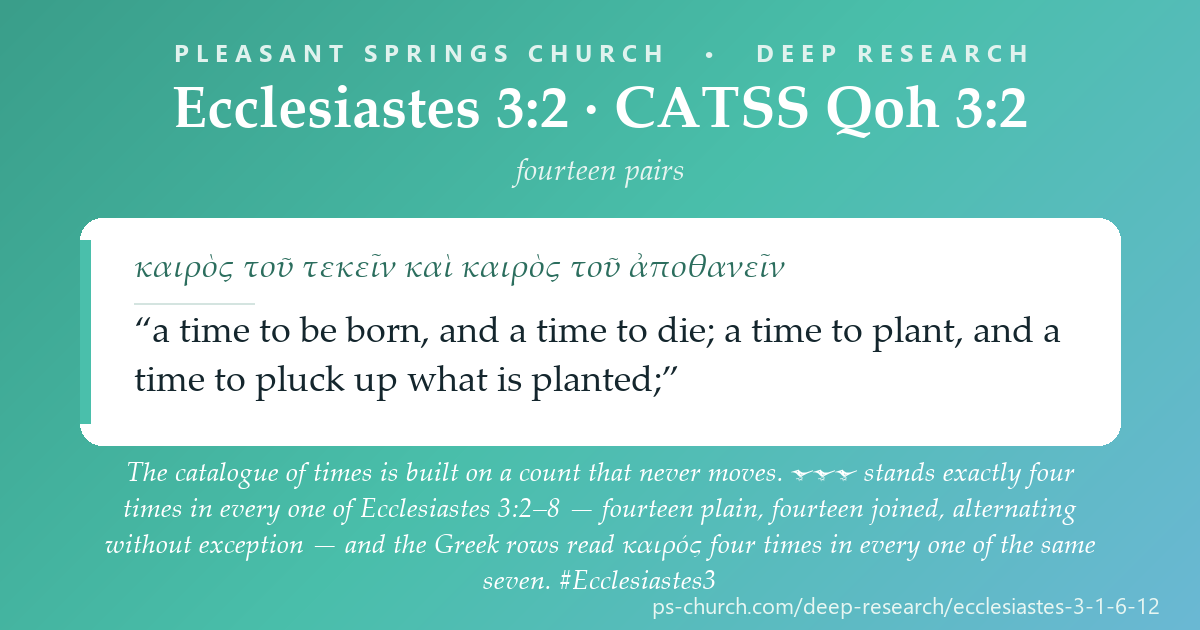
Everyone knows the catalogue of times. What is less often noticed is that it is built on a number that never moves. The Hebrew word עֵת stands exactly four times in every one of Ecclesiastes 3:2–8 — twenty-eight in all, fourteen plain and fourteen carrying the conjunction, alternating plain-then-joined without a single exception. The Greek rows keep the same count: καιρός four times in each of the same seven, twenty-eight in all, every one of them nominative singular. Screen all 17,421 verse labels in the twenty-five Greek files on this disk, and all 23,206 verses of the thirty-nine Hebrew books, for a word repeated four or more times in each of a run of consecutive verses — and this is the longest run anywhere whose repeated word carries meaning of its own and whose count per verse never varies. It is not the longest run of anything; that is eleven verses of and in Judges. It is the longest run of something being counted on purpose. See the method →
Ecclesiastes 3:1–6:12 (selections)
Hebrew · Greek (CATSS, Rahlfs’ Septuaginta) · ESVEvery reference on this page is given in Hebrew and CATSS numbering, with the ESVnumber printed beside it wherever the two differ.
The Shape of the Passage
Sequence — a poem, then four chapters of accountingThe voice of 1:12–2:26 continues here, but it is not constant. 3:1–8 has no first-person form at all — it is the one stretch of the book that reads like something quoted rather than said. From 3:9 the “I” returns and stays.
Author
The catalogue does not sound like the man who made the gardens. 3:2–8 carries no first-person verb, no אֲנִי, and no קֹהֶלֶת. Its members are bare infinitives. Whether it was composed for this place or set into it is a question this page cannot answer, and it does not try.
What can be said is that both columns carry it the same way. Four to a verse in the Hebrew and four to a row in the Greek, across all seven, with the Greek matching the Hebrew’s twenty-six verbal members and two nominal ones exactly.
Audience
Someone who has to live in time without being able to see it. The catalogue names the seasons; 3:11 says a man cannot find out what God has done from beginning to end. The list and its limit sit three verses apart.
And someone who might be about to make a vow. 4:17–5:6 (ESV5:1–7) is the only sustained second-person instruction in the book: guard your steps, let your words be few, do not delay paying. It is addressed to a worshipper, not to a philosopher.
Orient on the catalogue, and on a chapter division that is not the same everywhere.
Search by topic: Ecclesiastes 3, the catalogue of times; Qoheleth and determinism; עוֹלָם in Ecclesiastes 3:11; vows in the Hebrew Bible; chapter and verse divisions, history of.
Which articles are relevant?
- Anchor Bible Dictionary — “Ecclesiastes, Book of,” “Time,” “Chapter and Verse Divisions.”
- Dictionary of the OT: Wisdom, Poetry & Writings (IVP) — “Time,” “Carpe Diem,” “Retribution.”
- NIDOTTE — עֵת, עוֹלָם, זְמָן.
Get the chapter 5 numbering right before anything else
This is the single most likely thing to go wrong in a study of this passage, so it is settled first, from content.
| Hebrew & CATSS | ESV | opening words |
|---|---|---|
| 4:16 | 4:16 | There was no end of all the people… |
| 4:17 | 5:1 | Guard your steps when you go to the house of God… |
| 5:1 | 5:2 | Be not rash with your mouth… |
| 5:9 | 5:10 | He who loves money will not be satisfied… |
| 5:19 | 5:20 | For he will not much remember the days of his life… |
| 6:1 | 6:1 | There is an evil that I have seen under the sun… |
Chapter verse counts: Hebrew and CATSS both 22 / 17 / 19 / 12 for chapters 3–6; the ESV 22 / 16 / 20 / 12. The same seventy verses, broken one verse earlier. The shift is uniform: every verse of Hebrew chapter 5 is one lower than its ESVnumber.
How the catalogue is built, counted in both columns.
Four to a verse, and the alternation never breaks
| verse | Hebrew words | עֵת | Greek words | καιρός |
|---|---|---|---|---|
| 3:1 (heading) | 7 | 1 | 11 | 1 |
| 3:2 | 9 | 4 | 15 | 4 |
| 3:3 | 8 | 4 | 14 | 4 |
| 3:4 | 8 | 4 | 14 | 4 |
| 3:5 | 11 | 4 | 18 | 4 |
| 3:6 | 8 | 4 | 14 | 4 |
| 3:7 | 8 | 4 | 14 | 4 |
| 3:8 | 8 | 4 | 12 | 4 |
| 3:2–8 | 60 | 28 | 101 | 28 |
Fourteen of the twenty-eight are plain עֵת and fourteen carry the conjunction, and they alternate plain-joined-plain-joined through all seven verses without an exception.
Twenty-six of the twenty-eight members are verbs; two are nouns. The two are war and peace, at the very end. The Greek column matches exactly: 26 infinitives, then πολέμου and εἰρήνης at 3:8. Twenty-three of the twenty-six Hebrew verbal heads carry the ל prefix; the three that do not are at 3:4 and 3:5.
The one verse that runs long is 3:5, at eleven words, and it is long because it is the only pair that names its object — stones, twice.
Is a run like that unusual? The screen, and what it says
The test. A verse fires for a word if that word stands four or more times in it. A run is a stretch of consecutive verses all firing for the same word. A run is constant if the count never varies across it. Every word reaching four is flagged, so no tie is ever broken arbitrarily.
| Greek: 17,421 labels, 25 files | Hebrew: 23,206 verses, 39 books | |
|---|---|---|
| longest run of any word | 11 — καί, Judges A 7:15–25 (band 1) | 15 — אֵת, 1 Chr 6:52–66 (band 1) |
| runs of length ≥ 5 | 61, of which 57 are καί | — |
| content word + constant count, length ≥ 4 | 2 — Qoh 3:2–8 (7), 1 Chr 6:19–23 (5) | 1 — Eccl 3:2–8 (7) |
The screen does not flatter Ecclesiastes. Its outright winners are and in Judges and the object particle in Chronicles, both by a wide margin. What Ecclesiastes 3:2–8 holds is the longest run in which the repeated word means something and the count per verse never moves.
Four things a reader should be able to check. (1) The Hebrew result requires stripping one leading ו before comparing, so that עת and ועת count as one word. Without that step nothing in Ecclesiastes reaches four and the passage does not appear in the Hebrew screen at all. That step is load-bearing and is stated rather than buried. (2) “Content word” is a judgement, not a measurement — the article τοῦ also stands four times in each of 3:2–7, a constant run of six, and is excluded as a function word. (3) At six of the seven verses καιρός ties with τοῦ at four apiece and is the sole holder only at 3:8, so the screen must flag every word reaching the threshold and never take a single most-frequent one. (4) The count of runs is threshold-bound: at four repetitions there are two in the Greek, at three there are five, at five there are none. Ecclesiastes holds the longest at every threshold that returns anything — that ordinal claim is what is published, not the count.
Scoped to the 25 CATSS files on this disk and the exact form counted, and to the 39 books of the Masoretic text as printed in the edition consulted, on the waw-stripped consonantal skeleton. A catalogue built on synonyms, or one whose frame word changes form across its members, is invisible to a surface test like this — its absence from the results is not evidence of its absence from the corpus.
The word at 3:11, and what can honestly be said about it.
הָעֹלָם at 3:11
“He has put eternity into man’s heart” is the ESV. The word is also read as the world, and as what is hidden. The Greek row carries τὸν αἰῶνα.
What the counting can establish, and it is less than the commentaries want. The consonants העלם stand in four verses of the thirty-nine books, and as stored they are four different strings — Leviticus 20:4, 1 Samuel 17:56, Ecclesiastes 3:11 and 1 Chronicles 16:36. Ecclesiastes 3:11 and 1 Chronicles 16:36 differ in accent alone, so the “distinct vocalisations” claim holds for the pointing, not for the stored token, and it is scoped that way here.
This page does not adjudicate the meaning. It reports what each column reads and leaves the choice where the commentaries have left it.
A result withdrawn, and why it looked good
“The Hebrew word and the Greek αἰών correspond one to one — seven tokens in the same seven verses.” True, and worthless. In two files that agree 222 verse numbers to 222, a same-verse co-location test has no other answer available: ἄνθρωπος/אדם passes the identical test at 49 tokens, seven times the volume.
What survives is the part that never mentioned the Greek — that the token at 12:14 is a verb, not the noun, and so is not a fifth instance. That is settled from the Hebrew column alone.
What is shared, measured rather than assumed.
σύν again, and a claim not made about it
The construction traced on the previous study runs through this one: σύν governing an accusative, which no other Greek book on this disk does once. Thirteen of the book’s thirty-four stand in chapters 3–5, and 3:11 alone carries two — σὺν τὰ πάντα and σὺν τὸν αἰῶνα.
But not “the densest stretch in the book.” Chapters 2–4 also hold exactly thirteen, so on raw count the maximum is a tie of two windows; chapters 3–5 lead only on per-word density. And thirteen of thirty-four is about 1.45 times the expected share, which does not reach significance on any test run here. The construction is a fact about the book; its distribution inside the book is not a finding.
Ecclesiastes 5:14 and 1 Timothy 6:7
“As he came from his mother’s womb he shall go again, naked as he came, and shall take nothing for his toil” — Hebrew and CATSS 5:14, ESV 5:15. 1 Timothy 6:7 says we brought nothing into the world and can take nothing out; Job 1:21 says naked I came and naked I shall return.
The three are a family of thought, and the shared wording between them is thin. This page prints the runs it measured rather than the resemblance it felt, and the runs are short. Where a shelf page has claimed a connection on one shared lexeme before, it has been withdrawn on the next page; the same standard is applied here in advance.
No citation formula anywhere
Ecclesiastes is not quoted in the Greek New Testament with a citation formula. Scoped to the SBL edition and to a search for the standard introductory formulae. Allusion is a different question and is not settled by a word-run test.
What the run screen cannot see, and what was not reached.
The honest limits of the carrier
A surface-form screen finds surface forms. A catalogue built on synonyms — or one whose frame word inflects across its members — would be invisible to it. That Ecclesiastes 3:2–8 comes out on top says it is unusually regular, not that no comparably designed passage exists.
And the two columns are not independent witnesses. The Greek screen matches exact surface forms and the Hebrew screen a normalised skeleton; they are different tests, and they run on parallel texts. Their agreement is a robustness check, not confirmation.
What could not be checked at all
No Hebrew or Greek critical apparatus. No Qumran fragment. No Targum, Syriac, Vulgate, Aquila, Symmachus or Theodotion. Nothing on the origin or date of the catalogue, and nothing on whether it was composed for this place.
Nor is anything claimed about how the two columns came to agree. The page says what each carries at the number they share, and stops.
A list that is exact, and a limit three verses later.
The catalogue and the sentence that follows it
Fourteen pairs, four words to a verse, seven verses, and the count never moves. It is the most carefully built thing in the book. And three verses after it ends, 3:11 says a man cannot find out what God has done from the beginning to the end.
The list is exact and the seeing is not. Ecclesiastes puts those two facts next to each other and does not resolve them.
Then 4:9 says the first good thing in three chapters — not wisdom, not wealth, but that two are better than one. After a poem about time and a chapter about oppression, the book’s first plain commendation is company.
Every Deep Research page traces its passage across the whole sweep — the Old Testament, the Second-Temple world between the testaments (historical witnesses, not Scripture), and the New Testament. Follow the thread:
Pleasant Springs Church — Deep Research
Research method after Michael S. Heiser’s Bible Research Method (examine dictionaries → ancient literature → important words → textual connections → academic publications → share), with the Pleasant Springs “Author & Audience” foundation. Scripture set in the Hebrew, the Greek editions named on each page and the ESV (Old Testament), and the Greek New Testament and the ESV (New Testament), per the practice of Pleasant Springs Church. Ecclesiastes research grounded in Seow (Ecclesiastes, Anchor Yale), Fox (A Time to Tear Down and a Time to Build Up), Longman (NICOT) and Krüger (Hermeneia). Text: Hebrew from the Masoretic text as printed in the editions consulted — Sefaria’s Miqra according to the Masorah; no critical apparatus was consulted for the Hebrew. Greek from Rahlfs’ Septuaginta as digitized by CATSS; Greek New Testament from the SBL edition. The standing caution for this shelf applies: these pages say “the CATSS Greek text reads…” and never call a Greek reading early or late. ⚠️ VERSE NUMBERING. Every reference on this page is Hebrew and CATSS numbering. Masoretic and CATSS chapters 3–6 are 22 / 17 / 19 / 12; the ESV is 22 / 16 / 20 / 12. Hebrew 4:17 = ESV 5:1, and Hebrew 5:1–19 = ESV 5:2–20 uniformly; chapters 3 and 6 agree in all three. Established from content at the seam, not from verse counts. The verse cited everywhere as “Ecclesiastes 5:10” is Hebrew 5:9. ⚠️ THE RUN SCREEN, in full, so it can be repeated. A verse fires for a word if that word stands ≥ K times in it; a run is a maximal stretch of consecutive labels firing for the same word; a run is constant if the count never varies. Every word reaching K is flagged — a most-frequent-only implementation would resolve six of these seven verses by an arbitrary tie-break, since καιρός and τοῦ both stand four times in each of 3:2–7. Greek counts are FORM counts of the exact string; the lemma καιρός stands 39 times in the file across three forms, and 28 of the 32 nominative-singular forms fall in these seven rows. Hebrew counts are consonantal FORM counts after the mandatory cleaner, with one leading ו stripped — a step without which the Hebrew result does not exist. “Content word” excludes function words and that exclusion is a judgement, not a measurement. Threshold sweep published in stage 2: the ordinal claim holds at every K that returns anything; the count of runs does not. ⚠️ Absolute negatives are scoped twice — to the 25 CATSS files on this disk and the exact form counted, and to the 39 books of the MAM text and the waw-stripped skeleton. A catalogue built on synonyms is invisible to this test and its absence from the results is not evidence of its absence. ⚠️ Two results were withdrawn and both are named on the page — an עולם/αἰών co-location result, which any ordinary word pair in these files also passes; and “chapters 3–5 are the densest stretch for σύν”, which is a tie of two windows on raw count and does not reach significance. ⚠️ Direction of influence is never asserted. Typology is handled per the house position: what the text says, what the New Testament itself draws, and what we see from this side of the cross — with the seeing left to the reader.
Scripture quotations marked ESV are from the ESV® Bible (The Holy Bible, English Standard Version®), © 2001 by Crossway, a publishing ministry of Good News Publishers. ESV Text Edition: 2016. Used by permission. All rights reserved. The ESV text may not be quoted in any publication made available to the public by a Creative Commons license, and the ESV may not be translated in whole or in part into any other language. www.esv.org
|
Did this study bless you today? 💚 Give to Support PS Church100% of gifts go to the General Fund — thank you. |