Two chapters in, Ecclesiastes has already said the two things it will keep saying. One of them it says five times in a single eight-word verse — no verse in the thirty-nine books carries more tokens of הֶבֶל than 1:2, and the set reaching that maximum has exactly one member. The other is a phrase that belongs to this book alone: under the sun stands 29 times in Ecclesiastes and, on the spelling counted, nowhere else in the thirty-nine books — nine of them in these two chapters. And in the Greek file there is a third thing, which took a test that could have come back the other way and did not: σύν, the ordinary Greek word for with, stands 34 times and governs an accusative 33 of them — while across the other sixty-two Greek Old Testament files screened here it stands 194 times and governs an accusative never. (Until 2026-09-24 this read “across the other thirty-four Greek books on this disk it stands 68 times”; re-run that day over the larger corpus, the count grew and the never held.) See the method →
Ecclesiastes 1:1–2:26 (selections)
Hebrew · Greek (CATSS, Rahlfs’ Septuaginta) · ESVSo the interesting things are inside the agreement. A phrase that stands 29 times in this book and in no other. A verse that says one word five times in eight. And a Greek preposition governing a case that, across the other sixty-two Greek Old Testament files screened here (of 64 held), it never governs once. (Re-run on the current corpus 2026-09-24 and it held. Until then this line read “across the twenty-four other Greek books on this disk” — a slip for the thirty-four of the count as first published.)
The Shape of the Passage
Sequence — a frame, a survey, and an experimentThe book names a speaker but not an author, and the two are not the same thing. 1:1 and 1:2 speak about Qoheleth; 1:12 onward speaks as him; and 12:9–14, outside this study, speaks about him again. This page reports where each voice stands and does not settle who wrote the frame.
Author
קֹהֶלֶת stands seven times, and three of the seven are here. 1:1, 1:2, 1:12 in this study; then 7:27, 12:8, 12:9, 12:10. The word is not a name anywhere else in the thirty-nine books.
Two of the seven are spelled or construed unlike the rest. At 12:8 the Hebrew carries the article, הַקּוֹהֶלֶת — so a search on the bare spelling finds six and misses the seventh. At 7:27 the verb is אָמְרָה, feminine, where the other six take masculine forms. In the Greek file the CATSS part-of-speech tag reads N1M at all seven.
An earlier draft added that “the Greek row at 7:27 does not mark the feminine.” That was withdrawn: Greek finite verbs do not inflect for gender at all, so the test had no other answer available to it.
“Son of David, king in Jerusalem” is what 1:1 says. The book never uses the name Solomon. That is a fact about the text, not an argument about authorship.
Audience
Someone who has been told that wisdom pays. Chapter 2 is built as a test of exactly that, run by a man with the means to run it — and 2:13–14 concedes the point (wisdom really is better) before 2:14–16 takes back what the reader wanted it to mean.
And someone who can hear a hard sentence. 2:17 says “I hated life.” The book does not soften it, and neither does the row beside it. Whatever comfort arrives at 2:24 arrives after that, not instead of it.
Orient on Qoheleth, hevel, and a book that argues with itself.
Search by topic: Ecclesiastes, book of; Qoheleth; hevel / vanity; wisdom literature, sceptical; the epilogue of Ecclesiastes.
Which articles are relevant?
- Anchor Bible Dictionary — “Ecclesiastes, Book of,” “Qoheleth.”
- Dictionary of the OT: Wisdom, Poetry & Writings (IVP) — “Ecclesiastes: Book of,” “Hebel,” “Frame Narrative,” “Carpe Diem.”
- NIDOTTE — הֶבֶל, יִתְרוֹן, עָמָל.
What the exact verse agreement is worth
222 and 222, chapter by chapter, with nothing absent and no lettered rows. That is unusual on this shelf. Job carries fourteen lettered labels and a 150-word appendix; Proverbs carries 48 lettered rows, 24 absent numbers and a re-ordered second half. Ecclesiastes has none of it.
What that does and does not mean. It means these two files can be laid side by side without a mapping table. It says nothing about how either text came to be, and this page draws nothing from it beyond the convenience.
The parser used here does detect lettered rows — run against Esther it returns 3:13f, 8:12n and 8:12r. Ecclesiastes has none for it to find.
A phrase that stays inside one book.
“Under the sun” is confined to Ecclesiastes
Counted across all thirty-nine books, the two words תַּחַת and הַשָּׁמֶשׁ stand adjacent 29 times, and all 29 are in Ecclesiastes.
| phrase | occurrences | books | in 1:1–2:26 |
|---|---|---|---|
| תַּחַת הַשָּׁמֶשׁ — under the sun | 29 | Ecclesiastes only | 9 |
| תַּחַת הַשָּׁמַיִם — under the heavens | 3 | Ecclesiastes only | 1 (1:13) |
The nine here are 1:3, 1:9, 1:14, 2:11, 2:17, 2:18, 2:19, 2:20 and 2:22. The Greek rows carry ὑπὸ τὸν ἥλιον.
Scope. Counted on the MAM spelling as cleaned, on adjacent tokens under the shelf word rule, in the thirty-nine books on this disk. A different spelling, a different tokenisation, or a search allowing words between them would give a different number. The claim is about this counting, and it is stated so that it can be repeated.
Five in eight — and the same verse again, eleven chapters later.
Ecclesiastes 1:2 is the maximum in the thirty-nine books
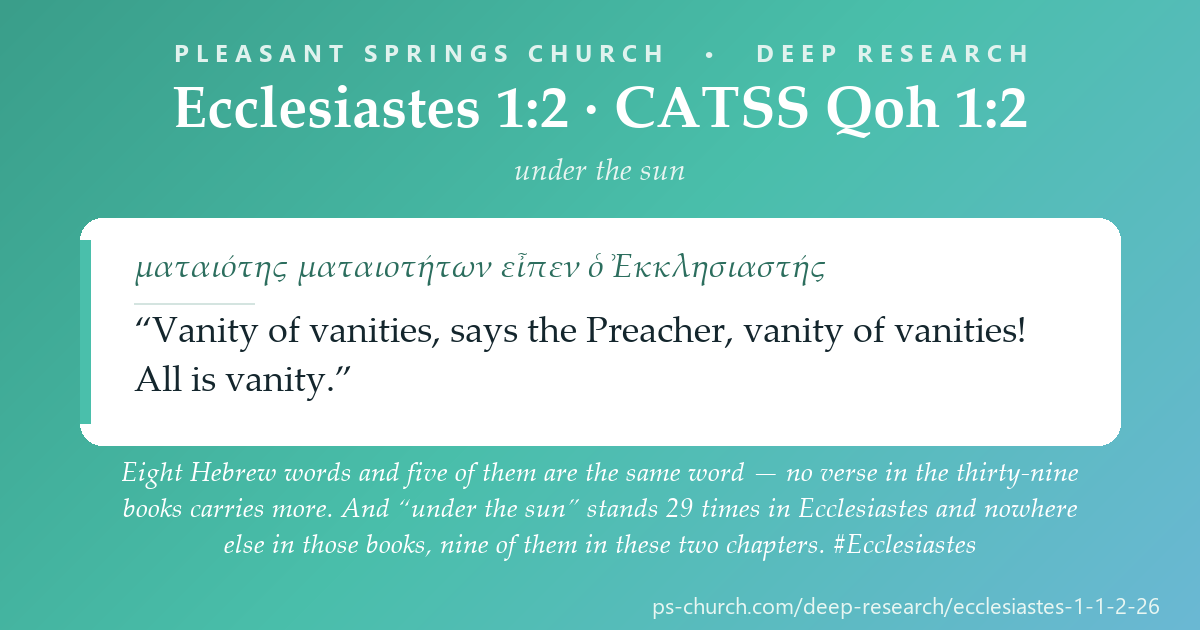
Eight words; five of them carry הבל. No verse in the thirty-nine books carries more, and the set of verses reaching that maximum has exactly one member. Second is 12:8 with three, at the other end of this book.
Ecclesiastes holds 38 of these tokens in 30 of its verses — about half of all of them in the thirty-nine books.
The screen, and why the share is given as a range. A substring search on the skeleton הבל returns 90 tokens across the thirty-nine books, and it over-collects. Named false positives: 8 tokens of the name Abel in Genesis 4, which is the same three consonants; 3 of הבליעל; 1 of הבלעי; and the verb forms ויהבלו and תהבלו. Removing them leaves between 74 and 78 depending on how the verbs are treated, so Ecclesiastes’ share runs between 48.7% and 52.1% — hence “about half” rather than a single figure. Ecclesiastes’ own 38 does not move, because none of the false-positive classes occurs in this book. Narrower whitelists are worse, not better: two mutually incompatible three-skeleton screens both return exactly 33 tokens in 26 verses, so “33” cannot be checked by a reader who is not told which one was used.
And a control that keeps this honest. 371 verses in the thirty-nine books repeat some identical skeleton four times or more; the record-holders are וְאֵת at Joshua 7:24 (ten times in 36 words) and בֶּן in the genealogies. Nor is a book “owning” a word rare — Esther’s הַמֶּלֶךְ runs at more than four times הֶבֶל’s rate here. Repetition alone is not the finding. What is unusual at 1:2 is that the repeated word is the book’s subject, in a verse of eight words.
Delete the repeated pair from 1:2 and you have 12:8
In the Greek file the match is exact. Row 1:2 runs to ten words. Remove the second ματαιότης ματαιοτήτων — slots six and seven — and what is left is the eight words of row 12:8, form for form, in order, with nothing over.
| Greek row 1:2, less the repeated pair | Greek row 12:8 | |
|---|---|---|
| 1 | ματαιότης | ματαιότης |
| 2 | ματαιοτήτων | ματαιοτήτων |
| 3 | εἶπεν | εἶπεν |
| 4 | ὁ | ὁ |
| 5 | Ἐκκλησιαστής | Ἐκκλησιαστής |
| 6 | τὰ | τὰ |
| 7 | πάντα | πάντα |
| 8 | ματαιότης | ματαιότης |
In the Hebrew the same deletion leaves a difference at exactly one slot — and it is the speaker’s name. 1:2 less its repeated pair gives הבל הבלים אמר קהלת הכל הבל; 12:8 reads הבל הבלים אמר הקוהלת הכל הבל. Six slots, five identical, and at the fourth the Hebrew has קֹהֶלֶת at the front of the book and הַקּוֹהֶלֶת at the end of it.
Compared on the consonantal skeleton after the mandatory cleaner, slot for slot. The page reports that the two verses stand in this relation and says nothing about which was written first or why they differ.
A preposition governing a case it governs nowhere else on this disk.
σύν with an accusative — 33 times here, never once elsewhere
σύν is the ordinary Greek word for with, and in Greek it takes a dative. In the CATSS Greek Qoheleth it stands 34 times across 4,546 words, and 33 of those 34 are immediately followed by an accusative. The thirty-fourth, at label 9:15, is followed by a genitive.
Set that against every other Greek book in the same directory, as it stood when this page was first published (35 CATSS files; the re-run on today’s corpus follows the table):
| words | σύν | governing accusative | governing dative | |
|---|---|---|---|---|
| Ecclesiastes | 4,546 | 34 | 33 | 0 |
| the other 34 Greek books | 354,473 | 68 | 0 | 65 |
| of which Job | 13,561 | 4 | 0 | 4 |
| of which Proverbs | 11,164 | 1 | 0 | 1 |
| of which Sirach · Song of Songs | 20,683 | 0 | 0 | 0 |
⚠️ Re-run 2026-09-24 on the current corpus — the zero held. The directory now holds 64 CATSS files, 63 of them screened (the Odes are withdrawn because they duplicate passages held elsewhere). Across the other 62 screened files — 614,952 words — σύν stands 194 times (68 when first counted) and governs an accusative 0 times. The Odes add three more, all dative. Qoheleth’s own figures are unchanged: 34, of which 33 accusative and one genitive.
This is the one test on this page that could have come back the other way and did not. Every token had four cases available to it. Qoheleth’s 34 could have been ordinary σύν-plus-dative, in which case a high count would have meant only that this book talks about accompaniment a lot; and accusatives could have turned up scattered across the comparison books, making Qoheleth unremarkable in kind. Neither happened.
The honest weakness, stated up front. Seventeen of the 33 are neuter forms — τά, πάντα, πᾶν, ὅσα, τοῦτο — in which nominative and accusative look identical, so the case there is the tagger’s reading rather than a fact about the form. Sixteen are forms that cannot be anything but accusative — τήν (4), τόν (8), τούς, πάσας, πᾶσαν, πάντας. On those sixteen alone the contrast is still sixteen against nothing.
And where it is not. Only three of the 34 — 1:14, 2:17, 2:18 — fall inside this study, which holds about a fifth of the book’s words. That shortfall is not distinguishable from chance and no claim is made that these two chapters differ in kind from the rest of the book. This is a fact about Ecclesiastes, reported on the page that opens it.
Two related results this page ran and will NOT publish
1. “Every one of the 29 rows carrying σύν answers a Hebrew verse containing אֶת.” The arithmetic is right — 29 of 29, with no exceptions. It is still not evidence. Run the identical test on ordinary word pairs in the same two files and they all pass: θεός/אלהים 36 of 36, ἥλιος/שמש 32 of 33, ματαιότης/הבל 30 of 31, μόχθος/עמל 24 of 24. In two files that agree 222 numbers to 222, a co-occurrence test has no other answer available. And σύν/אֶת is the weakest of the five: 55 Hebrew verses carry an אֶת and only 29 of them have a σύν in the matching row.
2. “σύν stands at the same point in the verse that אֶת does — positions correlate at r = 0.997.” Also withdrawn. Every ordinary pair in these files lands at about the same figure: πᾶς/כל 0.993, καρδία/לב 0.996, ἄνθρωπος/אדם 0.992. The correlation measures that these two texts run in the same order, which is known already, and says nothing about σύν.
And there is a reason underneath both failures that is worth stating on its own. The CATSS file carries no Hebrew alignment column. It records, for each Greek word, that word’s own form, part of speech, parse and lemma — and nothing about which Hebrew word it answers. So a test of that kind cannot be run on these files at all; what was actually being measured both times was co-occurrence inside a shared verse number.
What survives is the case, not the correspondence. The page publishes the construction, on the Greek side alone, and does not claim word-for-word alignment with anything.
Three more results that failed, and what could not be reached.
A zero worth printing, and a word that must not go with it
The CATSS Greek Qoheleth carries δέ exactly zero times in 4,546 words. Against Job at 53.7% of rows and Proverbs at 55.8%, that is striking.
But it is not unique, and an earlier draft of this page said it was. Greek Song of Songs is also exactly zero, in 2,025 words, and Sirach is near-zero at 51 tokens in 3.6% of its rows. The count stands; the word “alone” does not, and has been removed.
A broken instrument, caught and thrown away
The first attempt to show that 1:2 is exceptional used a crude root-finder that stripped a leading ה as though it were the definite article. On הֶבֶל that is wrong — the ה is part of the root — so the verse’s five tokens were split across two buckets and 1:2 did not appear in the results at all.
The tables in stage 3 use no root-finder — only exact spellings, with the screen printed.
Romans 8:20 and Ecclesiastes 1:2 do not share wording
Paul writes that the creation was subjected to ματαιότης, and it is tempting to run that back to this verse. The measurement does not support it. The longest shared run of word-forms between Romans 8:20 and Ecclesiastes 1:2 is zero; the two verses share no form at all. Romans 8:20’s best run against any of the 222 rows is one word. And the dative form Romans carries, ματαιότητι, stands in this file at row 6:4 — not at 1:2.
They share a lexeme. That is worth saying, and it is all that is worth saying.
What could not be checked at all
No Hebrew or Greek critical apparatus. No Qumran fragment (4QQoha exists and was not consulted). No Targum, Syriac, Vulgate, Aquila, Symmachus or Theodotion — which matters most here, because the σύν construction is exactly the sort of evidence those witnesses bear on, and this page reaches none of them.
And nothing on date. The relative שֶׁ־, the Persian-period loanwords and the σύν usage are all cited in the literature as dating evidence. This page counts what is on disk and draws no conclusion about when anything was written, in either language, or about who wrote it.
Eight words, and what the book does after saying them.
The book says its worst line before it says its best one
Chapter 2 spends twenty-three verses building houses, vineyards, gardens and pools, and then says I hated life. Only after that does 2:24 arrive: eat, drink, find enjoyment in your toil — and this is from the hand of God.
The order is not incidental. The comfort in this book is never offered instead of the hard sentence; it is offered on the far side of it.
And the counting has a limit worth naming. Twenty-nine occurrences of a phrase, five tokens in eight words, and thirty-three accusatives are facts a script can establish. Whether הֶבֶל means vanity, or breath, or something a reader only recognises after a long enough life, is not.
Every Deep Research page traces its passage across the whole sweep — the Old Testament, the Second-Temple world between the testaments (historical witnesses, not Scripture), and the New Testament. Follow the thread:
Pleasant Springs Church — Deep Research
Research method after Michael S. Heiser’s Bible Research Method (examine dictionaries → ancient literature → important words → textual connections → academic publications → share), with the Pleasant Springs “Author & Audience” foundation. Scripture set in the Hebrew, the Greek editions named on each page and the ESV (Old Testament), and the Greek New Testament and the ESV (New Testament), per the practice of Pleasant Springs Church. Ecclesiastes research grounded in Seow (Ecclesiastes, Anchor Yale), Fox (A Time to Tear Down and a Time to Build Up), Longman (NICOT) and Krüger (Hermeneia). Text: Hebrew from the Masoretic text as printed in the editions consulted — Sefaria’s Miqra according to the Masorah; no critical apparatus was consulted for the Hebrew. Greek from Rahlfs’ Septuaginta as digitized by CATSS; Greek New Testament from the SBL edition. The standing caution for this shelf applies: these pages say “the CATSS Greek text reads…” and never call a Greek reading early or late. ⚠️ Verse agreement. Masoretic Ecclesiastes 222 verses (18, 26, 22, 17, 19, 12, 29, 17, 18, 20, 10, 14); the CATSS file 222 rows with the same twelve chapter counts, no Masoretic number without a row, and zero lettered rows — so the parse trap that governs Job and Proverbs does not arise here. Number-matched Greek-to-Hebrew word ratio 1.522 for the book and 1.564 for this study; both number-matched, never by label. ⚠️ How σύν was counted. Tokens whose CATSS lemma column reads σύν and whose part-of-speech is preposition; the form count and the lemma count are both 34 because the word is indeclinable. CATSS also writes it in the preverb field of compound verbs — eleven times in Qoheleth alone — and a parser taking the lemma as the last whitespace field sweeps those in; they are excluded here by reading the fixed columns. Case was read from the parse code of the token immediately following. The comparison now covers the 63 CATSS Greek Old Testament files screened here (of 64 held; not the whole Septuagint) — re-run 2026-09-24: 194 σύν tokens outside Qoheleth, none governing an accusative; six have a particle, numeral or mis-tagged word between them and their noun, and every one of those nouns is dative. Until 2026-09-24 this note read: “The comparison covers the 35 CATSS books present on this disk and no others — a corpus that has since grown by the ten Minor Prophets added for that shelf, which contribute three more σύν tokens, all of them dative; books absent from it — Isaiah, Jeremiah, Ezekiel, Numbers, Leviticus, Joshua, Daniel, Lamentations and most of the Twelve — are not spoken for.” The Minor Prophets clause was wrong: the 354,473-word figure in the table reproduces only with all twelve Minor Prophet files inside the 35, which already carried their seven σύν tokens (Amos 1, Hosea 4, Micah 2), all dative. A parser hazard worth recording: four files carry a slash inside the book tag (1/3Kgs, 2/4Kgs, 1Sam/K, 2Sam/K) and a naive header pattern silently returns zero rows for all four. ⚠️ Hebrew counts are FORM counts and the screens are printed with their false positives. No Hebrew lemmatiser is held here. Word counts follow the shelf rule: split on whitespace and maqqef, count a token only if it carries a letter in the range א–ת, count a ketiv/qere pair once. Under that rule Ecclesiastes is 2,987 words and the thirty-nine books are 305,579. The הֶבֶל substring screen returns 90 tokens and its false positives are named in stage 3 — the eight Abel tokens of Genesis 4 first among them. קֹהֶלֶת is seven mentions only if the articled spelling at 12:8 is included; a bare-spelling search returns six. ⚠️ Five results were withdrawn before publication and every one is named on the page — the σύν/אֶת co-occurrence test and the word-position correlation, both of which any ordinary word pair in these files also passes; the claim that Greek Qoheleth is alone in carrying no δέ, which Song of Songs also does; a root-finder that mis-analysed הֶבֶל; and a reading of 7:27 that asked Greek finite verbs to show gender, which they cannot. ⚠️ Direction of influence is never asserted. Where the two columns differ this page says what each carries at the number they share, and nothing about how the difference arose, who made it, or when. Typology is handled per the house position: what the text says, what the New Testament itself draws, and what we see from this side of the cross — with the seeing left to the reader.
Scripture quotations marked ESV are from the ESV® Bible (The Holy Bible, English Standard Version®), © 2001 by Crossway, a publishing ministry of Good News Publishers. ESV Text Edition: 2016. Used by permission. All rights reserved. The ESV text may not be quoted in any publication made available to the public by a Creative Commons license, and the ESV may not be translated in whole or in part into any other language. www.esv.org
|
Did this study bless you today? 💚 Give to Support PS Church100% of gifts go to the General Fund — thank you. |