Everybody hears Luke 12:19 behind Ecclesiastes — the rich fool with his barns full, saying eat, drink, be merry. It is the standard cross-reference and it feels obvious. Measured word-form against word-form, the longest thing Ecclesiastes 9:7 and Luke 12:19 have in common is one word. φάγε. Against 8:15 it is not even that — the shared word is καί. The deepest verbatim contact between Greek Ecclesiastes and all 7,927 verses of the Greek New Testament is six words long, with a tie band of one — and it is the other rich man, the one already in torment: Luke 16:25, you received your good things in your life. This study walks 6:1–11:10, the stretch where the book keeps saying that wisdom cannot reach the answer and then keeps telling you what to do anyway — and it prints what the six words are worth as well as what they are. See the method →
Ecclesiastes 6:1–11:10 (selections)
Hebrew · Greek (CATSS, Rahlfs’ Septuaginta) · ESVWhat to watch for is where the commands are. The Greek file carries twenty-five imperative-tagged verbs in 6:1–11:10. Chapters 7, 9 and 11 hold twenty-four of them. Chapters 6 and 10 hold none at all, and chapter 8 holds one — φύλαξον at 8:2, about a king.
The Shape of the Passage
Sequence — three chapters that watch, three that tell you what to doThis passage is the middle of a first-person report, and then it is not. Chapters 6, 8 and 10 describe. Chapters 7, 9 and 11 turn and address somebody. This page reports where the address falls and does not settle who wrote the frame.
Author
The speaker of this passage never names himself in it. The name קֹהֶלֶת stands seven times in the book. Six are the frame at 1:1, 1:2, 1:12, 12:8, 12:9 and 12:10. The seventh is 7:27, and it is the only one inside the speech — it falls in chapter 7, and it is handled on the Better Than study.
The first-person pronoun is still running through the front of this passage and stops inside it. אֲנִי stands twenty-eight times in the book; the last is at 9:16. Chapters 10 and 11 carry none. 8:2 is worth naming here: the Hebrew opens אֲנִי פִּי־מֶלֶךְ שְׁמֹר — the pronoun and then a command — and the CATSS Greek row has no pronoun at all, opening straight on στόμα βασιλέως φύλαξον.
That difference is reported, not explained. Nothing on this page says which text is prior, whether a pronoun was dropped or added, or whose hand did it. The two rows read differently; that is the whole claim.
The book never names Solomon. Not in this passage and not anywhere.
Audience
Somebody is being told to do things, and the telling is not evenly spread. Twenty-five imperative-tagged verbs stand in the Greek of 6:1–11:10. Chapter 11 alone has ten — more than any other chapter of the book, including the epilogue. Chapters 6 and 10 have none.
At 11:9 the addressee is named. בָּחוּר, νεανίσκε — young man, in the vocative. It is the only place in this passage where the person being addressed is given a description rather than just a verb ending.
And what he is told is double. Walk in the ways of your heart and the sight of your eyes — and know that God will bring you into judgment for all of it. The book puts both halves in one verse and does not soften either.
Orient on the sayings, the “who knows” refrain, and the counsel to act.
Which articles are relevant?
- Anchor Bible Dictionary — “Ecclesiastes, Book of,” “Qoheleth,” “Wisdom in the OT.”
- Dictionary of the OT: Wisdom, Poetry & Writings (IVP) — “Carpe Diem,” “Better-Than Proverb,” “Death,” “Retribution,” “Fool.”
- NIDOTTE — חֵלֶק (portion), מִקְרֶה (event, chance), סָכָל (fool), שְׁאוֹל.
- TDNT / TDOT — μερίς, ᾅδης, ματαιότης.
The verse numbers are safe through this whole passage
Masoretic, CATSS and ESV all give chapters 6 through 11 as 12, 29, 17, 18, 20 and 10 verses. The chapter breaks fall in the same places in all three, so every reference on this page means the same verse in every column. That is stated because it is not true of this book everywhere: Hebrew 4:17 is ESV 5:1, and Hebrew 5:1–19 is ESV 5:2–20. That offset closes before 6:1.
How firmly this was checked. Chapters 6 and 9 were read verse by verse against an ESV text held on this disk. Chapters 8, 10 and 11 were not — no local ESV file exists for them, and there is no Crossway API key in this project. Their alignment rests on verse counts and chapter openings, which is weaker. It is said here rather than glossed.
What kind of thing chapters 6 to 11 are
Two kinds of thing, alternating. 6, 8 and 10 report. 7, 9 and 11 instruct. The structure diagram above is built from that alternation and from nothing else, and the counts beside it are measured, not borrowed from an outline.
Chapter 10 is the odd one. Short sayings about fools, kings, serpents and pits — it reads like a page of Proverbs dropped into the middle of Qoheleth. Stage 4 reports what happened when that impression was measured, and the answer was not what the impression predicted.
Eat, drink and be merry — and who actually says it.
Five verses pair eating with drinking, and every one follows something bleak
Screen the Greek file for rows that carry a form of φαγεῖν and a form of πιεῖν together, and exactly five rows come back.
| verse | the Greek form | what stands just before it |
|---|---|---|
| 2:24 | future indicative — ὃ φάγεται καὶ ὃ πίεται | hating all his toil, and leaving it to a man who comes after |
| 3:13 | future indicative — ὃς φάγεται καὶ πίεται | God has put eternity into man’s heart, yet he cannot find out God’s work |
| 5:17 (ESV 5:18) | infinitive — τοῦ φαγεῖν καὶ τοῦ πιεῖν | as he came, so shall he go; what gain has he that toils for the wind? |
| 8:15 | infinitive — τοῦ φαγεῖν καὶ τοῦ πιεῖν | the righteous get what the wicked deserve, and the wicked what the righteous deserve |
| 9:7 | imperative — φάγε … καὶ πίε | the same event happens to all; the dead know nothing |
Two of the five are in this passage, and only one of the five is a command. 9:7 is the single row where the counsel is put in the imperative rather than described. That is also the row people reach for when they cite Luke 12:19 — and stage 4 measures that.
What the screen was. A row counts if it carries a form beginning φαγ/φάγ and a form of πίνω in the same row, over the CATSS Qoheleth file. It is a count of rows that pair the two verbs; it is not a count of every place the book counsels enjoyment, and the wider list that commentators draw — adding 3:22, 5:18 and 11:7–10 — is a judgement about sense rather than a measurement.
“Who knows?” — a question this book asks more than any other
The exact Greek sequence τίς οἶδεν stands eleven times across the 30,348 CATSS verse units held here.
| book | occurrences | where |
|---|---|---|
| Ecclesiastes | 5 | 2:19, 3:21, 6:12, 8:1 (twice) |
| 2 Kingdoms | 1 | 12:22 — David, over the dying child |
| Esther | 1 | 4:14 — Mordecai to Esther |
| Job | 1 | 26:14 |
| Joel | 1 | 2:14 |
| Jonah | 1 | 3:9 — the king of Nineveh |
| Wisdom | 1 | 8:8 |
No other book has more than one. Ecclesiastes has five, and two of them are in this passage.
And the Greek New Testament has none of them adjacent. Zero hits for τίς οἶδεν across 7,927 verses. Allow one word between and it becomes one: 1 Corinthians 2:11, τίς γὰρ οἶδεν ἀνθρώπων. Both figures are given because reporting only the zero would be a trick. Scoped to the SBL edition as digitized by MorphGNT and to that exact word sequence — it is a search on forms, not on the idea.
Where the commands are, and where they are not.
9:10 — the aorist imperative of ποιέω. Whatever your hand finds to do, do. The Hebrew imperative under it is עֲשֵׂה.
11:1 — cast your bread upon the waters. The Greek verb is send away, not throw; the Hebrew is שַׁלַּח, the ordinary verb for sending a messenger.
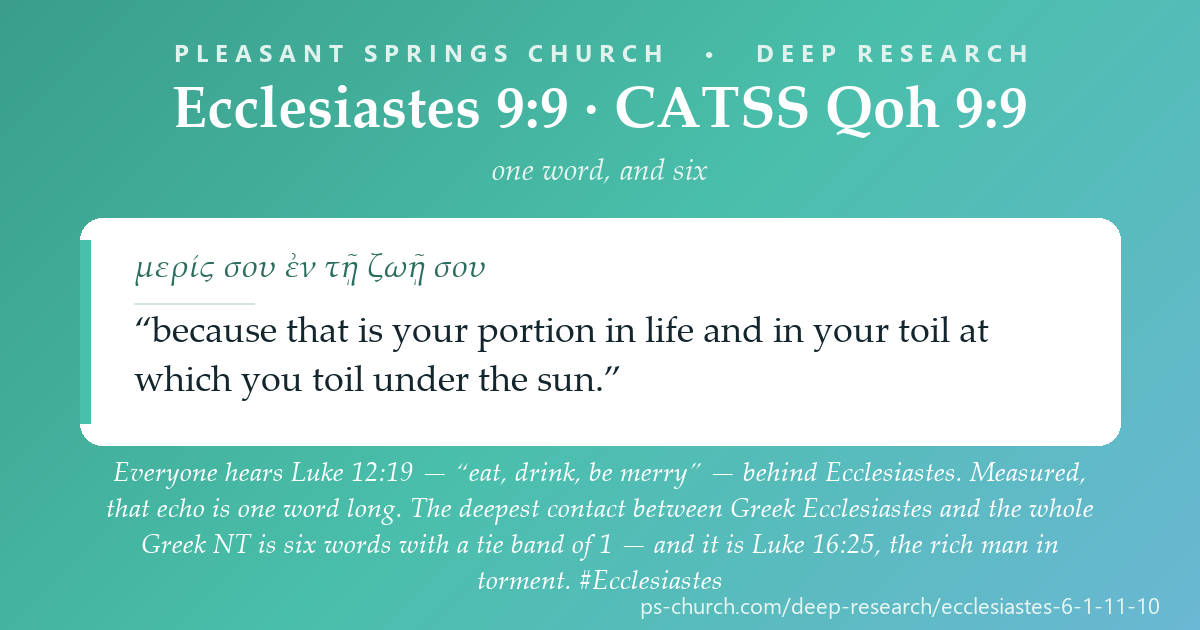
9:9 — חֶלְקְךָ, your portion, rendered μερίς σου. The word the deepest run on this page stands beside.
9:2 — rendered συνάντημα, a meeting, a thing that befalls. What happens to the righteous and the wicked alike.
Twenty-five imperatives, and twenty-four of them in three chapters
The CATSS Greek file tags mood. Counting every token whose mood field reads D — imperative — gives thirty-seven across the whole book:
| chapter | 1 | 2 | 3 | 4 | 5 | 6 | 7 | 8 | 9 | 10 | 11 | 12 |
|---|---|---|---|---|---|---|---|---|---|---|---|---|
| imperatives | 1 | 1 | 0 | 1 | 5 | 0 | 8 | 1 | 6 | 0 | 10 | 4 |
Twenty-five of the thirty-seven fall in this study. Twenty-four of those twenty-five are in chapters 7, 9 and 11. The twenty-fifth is φύλαξον at 8:2 — keep the king’s command — which is an instruction about court conduct and not about how to face a life you cannot read.
Chapter 11 is the imperative peak of the entire book — ten in ten verses, more than the epilogue and more than chapter 7. Four of the ten are in 11:9 alone: εὐφραίνου, ἀγαθυνάτω, περιπάτει, γνῶθι.
Three limits on this count, all of them real. (1) It is a count off the Greek file, because the Greek file is the only one on this disk that carries mood tags at all. The Sefaria Masoretic text held here has no morphological tagging, so the same count cannot be run on the Hebrew mechanically. Read by eye, the Hebrew has the same imperatives in the same verses — לֵךְ אֱכֹל at 9:7, שַׁלַּח at 11:1, שְׂמַח at 11:9 — but reading by eye is not the same evidence as counting, and the number printed is the Greek number. (2) Third-person imperatives are included: ἀγαθυνάτω at 11:9 and ἀφέτω at 11:6 are counted. Restrict to second person and chapter 11 falls from ten to eight, and the shape does not change. (3) The particle ἰδού is excluded. CATSS gives it no parse code, so its lemma column falls where the parse column normally sits; counting straight off column position adds six false imperatives at 1:14, 1:16, 2:1, 2:11, 4:1 and 5:17 and turns thirty-seven into forty-three. An earlier pass on this page produced forty-three and it was wrong.
The famous echo, the real maximum, and a run of four that is not a signal.
The whole passage against the whole Greek New Testament
The 106 CATSS rows of Ecclesiastes 6–11 were screened against all 7,927 verses of the Greek New Testament. 100 rows reach a shared run of two; 60 reach three; 5 reach four; one reaches six; nothing reaches seven.
| row | run | tie band | New Testament verse | the shared words |
|---|---|---|---|---|
| 9:9 | 6 | 1 | Luke 16:25 | σου ἐν τῇ ζωῇ σου καί |
| 11:9 | 4 | 1 | Luke 10:27 | καρδίας σου καὶ ἐν |
| 7:2 | 4 | 1 | John 13:31 | τοῦ ἀνθρώπου καὶ ὁ |
| 8:15 | 4 | 1 | Revelation 1:1 | ἔδωκεν αὐτῷ ὁ θεός |
| 8:17 | 4 | 1 | Galatians 1:20 | τοῦ θεοῦ ὅτι οὐ |
| 10:11 | 3 | 7 | Mark 12:32, Acts 4:12, Colossians 3:25 … | καὶ οὐκ ἔστιν |
| 10:7 | 3 | 52 | Matthew 6:19, 9:6, 16:19 … | ἐπὶ τῆς γῆς |
That last row is the calibration. A run of three with a band of fifty-two is not a connection; it is what a common prepositional phrase looks like.
The echo everyone hears, measured: one word
Luke 12:19 — the rich fool — is the standard cross-reference for Ecclesiastes’ counsel to eat and drink. The Greek reads ἀναπαύου, φάγε, πίε, εὐφραίνου: four imperatives in a row.
| pair | longest shared run | the run |
|---|---|---|
| Ecclesiastes 9:7 ↔ Luke 12:19 | 1 | φάγε |
| Ecclesiastes 8:15 ↔ Luke 12:19 | 1 | καί |
| Ecclesiastes 9:7 ↔ 1 Corinthians 15:32 | 1 | ἐν |
| Ecclesiastes 8:15 ↔ 1 Corinthians 15:32 | 1 | καί |
Ecclesiastes 9:7 does not say φάγε πίε. It says φάγε ἐν εὐφροσύνῃ ἄρτον σου καὶ πίε — five words stand between the two imperatives, and the run is cut at every one of them. 8:15 does not use imperatives at all; it uses infinitives, τοῦ φαγεῖν καὶ τοῦ πιεῖν, which share no form with Luke’s φάγε πίε.
What that does and does not show. It shows there is no verbatim contact. It does not show that Luke had nothing of Ecclesiastes in mind, and this page does not claim that. A writer can carry a book’s whole posture without reproducing four of its words. The screen finds quotation; it cannot find temperament.
The maximum: six words, band one, and the other rich man
Ecclesiastes 9:9 against Luke 16:25 is the deepest measured contact between Greek Ecclesiastes and any verse of the Greek New Testament — six shared word-forms, tie band one.
… ὅτι αὐτὸ μερίς σου ἐν τῇ ζωῇ σου καὶ ἐν τῷ μόχθῳ σου…CATSS Ecclesiastes 9:9 — “that is your portion in life and in your toil”
τέκνον, μνήσθητι ὅτι ἀπέλαβες τὰ ἀγαθά σου ἐν τῇ ζωῇ σου, καὶ Λάζαρος ὁμοίως τὰ κακά…Luke 16:25 — “Child, remember that you in your lifetime received your good things, and Lazarus in like manner bad things”
Both sides are rare.
| sequence | Greek OT (30,348 units) | Greek NT (7,927 verses) |
|---|---|---|
| ἐν τῇ ζωῇ σου | 1 — Ecclesiastes 9:9, and nowhere else | 1 — Luke 16:25 |
| σου ἐν τῇ ζωῇ σου καί | 1 — Ecclesiastes 9:9 | 1 — Luke 16:25 |
| ἐν τῇ ζωῇ (no possessive) | 16 — including Ecclesiastes 6:12 and 9:9 | 3 — Luke 16:25, Romans 5:10, 1 Corinthians 15:19 |
In Ecclesiastes the phrase blesses: that is your portion in your life. In Luke it is a verdict pronounced across a fixed gulf: you received your good things in your life. Same six words, and the next word in both is καί introducing what else there is — your toil, in one; Lazarus, in the other.
Now the three things that cut it back, printed here and not in a footnote.
(1) Five of the six words are function words. Two possessives, a preposition, an article and a conjunction. The only lexical word in the run is ζωῇ. For scale, run the same screen on a real citation: Proverbs 3:12 against Hebrews 12:6 comes back at eleven — ὃν γὰρ ἀγαπᾷ κύριος παιδεύει, μαστιγοῖ δὲ πάντα υἱὸν ὃν παραδέχεται — nearly double, and almost every word of it carrying weight. That is what a quotation looks like on this screen. Six function words is not that.
(2) The run depends on a word the Hebrew does not have. The Masoretic text of 9:9 reads חֶלְקְךָ בַּחַיִּים — your portion in life — with the possessive suffix on portion and none at all on life. The CATSS Greek reads μερίς σου ἐν τῇ ζωῇ σου, with a possessive on both. The sixth word of the deepest run on this shelf for this book has no counterpart in the Hebrew. That is a report of a difference between two texts. It is not a claim that anybody added anything, and this page does not make one.
(3) Luke 16:25 carries no citation formula. No as it is written, no the scripture says. Nothing in the passage signals a quotation, so nothing here says one is being made. What is reported is that the two verses share six consecutive word-forms and that no other verse in the Greek New Testament shares more than four with anything in these six chapters.
Its own counter-example: a band of one that is still a formula
Ecclesiastes 11:9 runs four words with Luke 10:27 — καρδίας σου καὶ ἐν — and the tie band is one. By the rule this shelf runs on, a band of one is supposed to mean a signal. Here it does not, and the page prints it so its other runs are not read as more than they are.
Drop one word off each end and the picture changes. The three-word sequence καρδίας σου καί stands ten times in the 30,348 CATSS verse units held here — and seven of the ten are one Deuteronomic sentence: Deuteronomy 4:29, 6:5, 10:12, 11:13, 30:2, 30:6 and 30:10, every one of them with all your heart, and with all your soul. Two of the remaining three are Ecclesiastes 11:9 and 11:10. The tenth is 4 Kingdoms 10:15, which is not that sentence at all — it is Jehu asking Jehonadab whether his heart is straight with Jehu’s, and it is counted here as what it is.
Luke 10:27 is that Deuteronomic sentence. It is the lawyer reciting Deuteronomy 6:5. The four-word run is the joint between two items of a list, and both texts happen to have a list with a joint in the same place. Ecclesiastes is not making the Deuteronomy point — it is saying περιπάτει ἐν ὁδοῖς καρδίας σου, walk in the ways of your own heart, which is close to the opposite instruction.
The lesson, stated plainly. A tie band of one says that no other verse in the target corpus reaches this depth. It does not say the sequence is rare. Where a run sits on top of a shorter sequence that is common, the band can be one and the contact still nothing. Check the shorter unit underneath before believing a band.
The chapter that looks most like Proverbs shares the least with it
Chapter 10 reads like Proverbs. Twenty short sayings — dead flies, a serpent that bites before it is charmed, a man who digs a pit, a servant on horseback and a prince on foot, a bird of the air carrying the report. It is the least Qoheleth-sounding chapter in Qoheleth.
Screened against the rest of the Hebrew Bible, it is the least connected chapter in the book.
| chapter | verses sharing NO two consecutive words with any other verse in the Hebrew Bible | rate |
|---|---|---|
| 10 | 7 of 20 — 10:1, 3, 6, 8, 9, 13, 18 | 35% |
| 3 | 6 of 22 — 3:2–7 | 27% |
| 4 | 2 of 17 — 4:11, 12 | 12% |
| 7 | 3 of 29 — 7:5, 12, 25 | 10% |
| 11 | 1 of 10 — 11:10 | 10% |
| 6 | 1 of 12 — 6:4 | 8% |
| 1, 2, 5, 8, 12 | 1 each — 1:4, 2:4, 5:11, 8:2, 12:4 | 4–7% |
| 9 | none | 0% |
How this screen was run, because it decides the numbers. One verse at a time against all 23,203 other verse units of the Masoretic corpus held here — the verse’s own chapter left in the target, which is exactly where a repeat is most likely to be found. Running it a chapter at a time instead takes the whole source chapter out of the target and inflates the count: that method gives chapter 10 eight, chapter 7 four, and a zero at 9:2. An earlier pass of this page printed those inflated figures and they were wrong.
And immediately, the deflator. Chapter 10 also has the shortest verses in the book: a mean of 9.8 Hebrew word-forms per verse against a book mean of 13.5 and a chapter-9 mean of 17.2. A short verse offers fewer adjacent pairs and has fewer chances to match anything, so part of that 35% is arithmetic and not character. This page cannot separate the two effects and does not pretend to. Both numbers are printed together so the reader can hold them together. What survives without qualification is the list of seven verse references, which is exact.
Three links inside the passage, pointing back at the book itself
6:2 ↔ 5:18 (Hebrew and CATSS 5:18 = ESV 5:19) — four Hebrew words, band one: לוֹ הָאֱלֹהִים עֹשֶׁר וּנְכָסִים. Two verses about the same man, one given the power to enjoy it and one not.
8:11 ↔ 9:3 — three Hebrew words, band one: לֵב בְּנֵי־הָאָדָם. The heart of the children of man, twice.
10:14 ↔ 8:7 and 9:12 — three words each, band two: מִי יַגִּיד לוֹ and לֹא יֵדַע הָאָדָם. Chapter 6 closed with the same question at 6:12.
And one pointing outward: 9:10 ↔ 1 Samuel 10:7 and 25:8 — אֲשֶׁר תִּמְצָא יָדְךָ, three words, band two, and those are the only two other verses in the Hebrew Bible that carry it. At 1 Samuel 10:7 Samuel tells Saul to do what his hand finds to do because God is with him. Qoheleth gives the same instruction and gives Sheol as the reason. The screen shows the shared words. It says nothing about which text is prior, whether either writer knew the other, or whether both are using a stock phrase — and none of those is claimed here.
What was withdrawn, what was not consulted, and where this page is weakest.
Claims this page drafted and then cut
“Luke 16:25 quotes Ecclesiastes 9:9.” Cut. The run is real, deepest in the book, and band one — and it is five function words plus life, with no citation formula in Luke and no counterpart in the Hebrew for the word the run turns on. Every one of those qualifications is now printed in stage 4 beside the finding rather than under it.
“Ecclesiastes 11:9 and Luke 10:27 are connected: four words, band one.” Cut, by this page’s own follow-up measurement. The three-word core is a Deuteronomy formula seven times over. The band was true and the inference was wrong.
“Chapter 10 is the least connected chapter in the Hebrew Bible.” Cut. It is the least connected chapter in Ecclesiastes, on this screen; no such comparison across all 929 Old Testament chapters was run, and the verse-length effect has not been controlled for. The wording was narrowed twice.
“Thirty-seven imperatives” was almost “forty-three.” Six ἰδού tokens were counted as imperatives because CATSS gives the particle no parse code and the lemma slides into the parse column. Caught, corrected, and named in stage 3.
What was not consulted
No Hebrew or Greek critical apparatus. No Qumran evidence — and for this book that matters: 4QQoha and 4QQohb exist and were not reachable here, and 4QQoha carries text from chapters 5 to 7, immediately beside this passage. No Targum, Syriac Peshitta, Vulgate, Aquila, Symmachus or Theodotion. No Ecclesiastes Rabbah. No collation of Rahlfs against Gentry’s work on the Greek text of Ecclesiastes, which bears directly on every Greek figure above.
Nothing was consulted on date, provenance or authorship in either language, and nothing here bears on any of them.
Where this page is weakest
The ESV alignment for chapters 8, 10 and 11. No local ESV text exists for those three chapters and there is no Crossway API key in this project, so their verse alignment rests on verse counts and chapter openings rather than on verse-by-verse reading. Chapters 6 and 9 were read against a local copy. Eight of the fifteen codex rows on this page — 8:2, 8:11, 8:17, 10:1, 10:14, 11:1, 11:9, 11:10 — sit in the unread chapters.
The imperative count is a Greek count standing in for a claim about the book. The alternation in the structure diagram would be much better evidenced if the Hebrew could be counted the same way. It cannot be, on this disk. The claim is therefore about the Greek file, and the diagram says so.
The 10:1 divergence is reported and not explained. The Hebrew and the Greek of that verse point in opposite directions and this page has no apparatus, no Hexaplaric evidence and no way to weigh them. It prints both.
Every Greek figure on this page is scoped to the 64 CATSS files held here, screened to 30,348 verse units. The Odes are excluded from that screen, deliberately: Ode 9 is Luke 1 and Ode 13 is Luke 2 copied into a Greek Old Testament manuscript, and ten further Odes are second copies of passages already in the corpus — Exodus 15, Deuteronomy 32, 1 Samuel 2, Habakkuk 3, Isaiah 5, Isaiah 26, Isaiah 38, Jonah 2 and Daniel 3. Leaving them in would have let a New Testament text be counted as an Old Testament witness to itself, and would have doubled any tie band touching a canticle.
What a book does when it admits it cannot see.
It tells you to act anyway
Six chapters. Three of them say the same thing three ways: you cannot find out the work that is done under the sun; who knows what is good for man; no man knows what is to be. And they carry, between them, one command.
The other three chapters carry twenty-four. Eat. Drink. Look at your life. Do what your hand finds. Send your bread out. Sow in the morning. Rejoice. Walk. Know. The counsel is not offered as a conclusion drawn from the observation — it is offered beside it, unreconciled, in alternating chapters.
And the last of the commands has judgment attached to it. 11:9 tells a young man to walk in the ways of his heart, and in the same breath tells him that God will bring him into judgment for all of it. The book does not choose between those two sentences.
Which is why the measurement at 9:9 is worth sitting with even after it has been cut down to size. Six words, mostly small ones: your … in your life … and. In Ecclesiastes they are a gift handed to a man who cannot see ahead. In Luke 16 the same six words are said to a man who can see, at last, and too late. Whether that is contact or coincidence, the screen cannot tell you. What it can tell you is that this exact phrase occurs once in the Greek Old Testament held here and once in the Greek New Testament, and those two are each other.
Every Deep Research page traces its passage across the whole sweep — the Old Testament, the Second-Temple world between the testaments (historical witnesses, not Scripture), and the New Testament. Follow the thread:
Pleasant Springs Church — Deep Research
Research method after Michael S. Heiser’s Bible Research Method (examine dictionaries → ancient literature → important words → textual connections → academic publications → share), with the Pleasant Springs “Author & Audience” foundation. Scripture set in the Hebrew, the Greek editions named on each page and the ESV (Old Testament), and the Greek New Testament and the ESV (New Testament), per the practice of Pleasant Springs Church. Ecclesiastes research grounded in Seow (Ecclesiastes, Anchor Yale), Fox (A Time to Tear Down and a Time to Build Up), Longman (NICOT) and Krüger (Hermeneia). Text: Hebrew from the Masoretic text as printed in the editions consulted — Sefaria’s Miqra according to the Masorah; no critical apparatus was consulted for the Hebrew. Greek from Rahlfs’ Septuaginta as digitized by CATSS; Greek New Testament from the SBL edition as digitized by MorphGNT. The standing caution for this shelf applies: these pages say “the CATSS Greek text reads…” and never call a Greek reading early or late, and never say which text acted on which. ⚠️ Verse numbering. There is no offset in this passage. Masoretic, CATSS and ESV all give chapters 6–11 as 12, 29, 17, 18, 20, 10, with the chapter breaks in the same places. The book’s one offset — Hebrew 4:17 = ESV 5:1, Hebrew 5:1–19 = ESV 5:2–20 — closes before 6:1 and is documented on the Ecclesiastes 3:1–6:12 study. Chapters 6 and 9 were checked verse by verse against an ESV text held here; chapters 8, 10 and 11 were matched on verse counts and chapter openings only, which is weaker and is said so in stages 1 and 5. ⚠️ Cross-corpus run figures on this page were measured on or after 30 August 2026 and apply MorphGNT’s own spelling equivalences — οὐ/οὐκ/οὐχ, ἐκ/ἐξ and the movable nu — so that a shared run is not cut at a word the two editions merely spell differently. Figures published on this shelf before that date are lower for that reason and were not copied here; every number above was re-measured. ⚠️ The imperative counts are GREEK counts. Tokens whose CATSS mood field reads D, over the Qoheleth file. Third-person imperatives are included; restricting to second person moves chapter 11 from ten to eight and does not change the shape. The particle ἰδού is excluded — CATSS gives it no parse code, and counting straight off column position inflates the book total from thirty-seven to forty-three. The Masoretic text held here carries no morphological tagging, so the equivalent Hebrew count could not be run and is not claimed. ⚠️ A run of zero on the Hebrew screen means NO TWO CONSECUTIVE WORDS. The Hebrew-side screen runs with the unigram fallback off, so max = 0 means the verse shares no adjacent word pair with any other verse in the corpus — it does not mean the verse shares no words. All four zeros on this page share individual words freely. Consonantal forms; cantillation and vowel points removed; qere read; final letters folded to medial; maqqef a separator and never a weld. ⚠️ Greek figures are scoped to the 64 CATSS files held here, screened to 30,348 verse units with the Odes excluded — Ode 9 is Luke 1, Ode 13 is Luke 2, and ten further Odes are second copies of passages already counted elsewhere in the corpus. ⚠️ Four claims were withdrawn while this page was built and all four are named in stage 5 — a quotation claim at Luke 16:25, a connection claim at Luke 10:27 that its own tie band appeared to support, an over-broad statement about chapter 10, and an imperative total inflated by a tagging artefact. Typology is handled per the house position: what the text says, what the New Testament itself draws, and what we see from this side of the cross — with the seeing left to the reader.
Scripture quotations marked ESV are from the ESV® Bible (The Holy Bible, English Standard Version®), © 2001 by Crossway, a publishing ministry of Good News Publishers. ESV Text Edition: 2016. Used by permission. All rights reserved. The ESV text may not be quoted in any publication made available to the public by a Creative Commons license, and the ESV may not be translated in whole or in part into any other language. www.esv.org
|
Did this study bless you today? 💚 Give to Support PS Church100% of gifts go to the General Fund — thank you. |