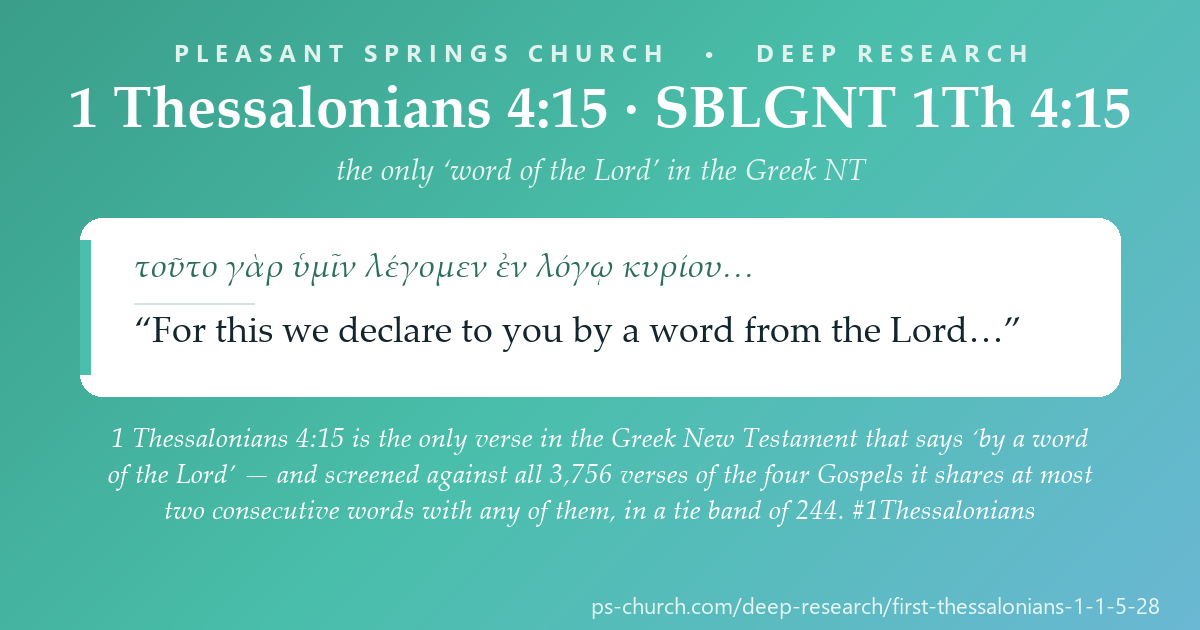
One sentence in this letter announces that it is repeating something the Lord said. 1 Thessalonians 4:15 — ἐν λόγῳ κυρίου, by a word of the Lord. That exact phrase occurs once in the Greek New Testament, and this is it. So the obvious question is which word of the Lord — and the obvious place to look is the Gospels. This page looked, by measurement rather than by memory: all seventeen verses of 4:13–5:11 against all 3,756 verses of Matthew, Mark, Luke and John. Not one of the seventeen shares as many as four consecutive words with any Gospel verse. 4:15 itself reaches two, tied with 244 other verses. Against Matthew 24:30–31, Mark 13:26–27 and Luke 21:27 individually, it reaches one. Meanwhile the deepest verbatim run in the whole letter belongs to no quotation at all — it is the address, eleven words shared with 2 Thessalonians 1:1. None of that settles where 4:15 came from. It does show, precisely, that the letter is not reproducing wording we can find. See the method →
1 Thessalonians 1:1–5:28 (selections)
Greek New Testament (SBLGNT, via MorphGNT) · ESV★ The one measured surprise this page is built on. ἐν λόγῳ κυρίου — by a word of the Lord — occurs exactly once in the Greek New Testament, at 4:15. Screened against all 3,756 verses of the four Gospels, that verse reaches a longest run of two consecutive words, in a tie band of 244. The deepest verbatim run anywhere in the letter is not a quotation at all: it is the address at 1:1, eleven words shared with 2 Thessalonians 1:1.
The Shape of the Passage
Two panels, each sealed by a wish-prayer — a bracket, not a chiasmThe letter names three senders and then, once, drops into the singular. Παῦλος stands twice in 1 Thessalonians: at 1:1 in the list of three, and at 2:18, ἐγὼ μὲν Παῦλος — I, Paul. Everywhere else the letter says we. That is a count, not an argument about composition.
Author
Paul, with Silvanus and Timothy — and no title claimed in the address. Every other undisputed Pauline letter that opens with his name attaches something to it: apostle, servant, prisoner. Here there is nothing — three names and the church. The word ἀπόστολος does appear later, at 2:7, and in the plural: ὡς Χριστοῦ ἀπόστολοι, as apostles of Christ, said of the whole party.
What the letter itself supplies for a date. It says Timothy has just come back from Thessalonica with news (3:6), that the writers were in Athens and sent him from there (3:1–2), and that they had earlier been shamefully treated at Philippi (2:2). Those are the letter’s own coordinates. The usual placement in the early 50s comes from lining them up with Acts 17–18 and the Gallio inscription from Delphi — neither of which was checked here, because Acts is on this disk and the inscription is not.
Audience
A gentile congregation in a Macedonian capital, and the letter says so in one word. 1:9 — ἐπεστρέψατε πρὸς τὸν θεὸν ἀπὸ τῶν εἰδώλων, you turned to God from idols. εἴδωλον occurs once in this letter and that is where. Nothing in the letter quotes the Old Testament and nothing in it argues from the Law — the first of which is what stage 4 measures rather than assumes.
Under pressure from their own neighbours. 2:14 says they suffered ὑπὸ τῶν ἰδίων συμφυλετῶν, from their own countrymen. συμφυλέτης is a hapax legomenon — it occurs once in the whole Greek New Testament, here. The pressure the letter answers is local and social, not imperial and legal, so far as the letter itself says.
And they had a specific worry. Some of their number had died, and 4:13 says they were grieving καθὼς καὶ οἱ λοιποὶ οἱ μὴ ἔχοντες ἐλπίδα — as others do who have no hope. Chapters 4 and 5 are an answer to a bereavement, not a lecture on prophecy.
Orient on Thessalonica, on the letter’s place in the Pauline corpus, and on what parousia meant before it was a theological term.
Search by topic: Thessalonica; Thessalonians, First Letter to the; parousia; day of the Lord; resurrection of the dead; eschatology, Pauline; politarch; wish-prayer; paraenesis.
Which articles are relevant?
- Anchor Bible Dictionary — “Thessalonians, First Epistle to the,” “Thessalonica,” “Parousia,” “Eschatology of the NT.”
- Dictionary of Paul and His Letters (IVP) — “Thessalonians, Letters to the,” “Eschatology,” “Resurrection,” “Afflictions, Trials, Hardships.”
- New International Dictionary of NT Theology and Exegesis — παρουσία, ἁρπάζω, ἀπάντησις, ἁγιασμός, κοιμάομαι.
- Dictionary of NT Use of the OT (Beale & Carson) — on 1 Thessalonians, the letter with no explicit Old Testament citation; stage 4 measures that rather than assuming it.
Settle the numbering — and note that there is nothing to settle
1 Thessalonians is a New Testament book, so two of this shelf’s usual columns do not exist for it.
| ch 1 | ch 2 | ch 3 | ch 4 | ch 5 | total | |
|---|---|---|---|---|---|---|
| SBL Greek NT | 10 | 20 | 13 | 18 | 28 | 89 |
| ESV | 10 | 20 | 13 | 18 | 28 | 89 |
There is no Hebrew text and no Septuagint text of this book, so the codex above runs two columns rather than three, and the MT/LXX offset question that governs the Old Testament pages on this shelf simply does not arise. Every reference on this page means the same verse in every edition.
One numbering hazard that is real. The chapter break between 4 and 5 falls inside a single argument. 4:13 opens Οὐ θέλομεν δὲ ὑμᾶς ἀγνοεῖν and the subject does not change until 5:12; 5:1 begins Περὶ δὲ τῶν χρόνων, which is a new sub-topic and not a new discourse. Chapter divisions here are mediaeval and the verse divisions are sixteenth-century — neither is part of the text, and a reader who stops at the end of chapter 4 stops halfway through the answer.
A civic word for a royal arrival, a slogan that is not Scripture, and the limits of a disk that holds no Latin epigraphy.
παρουσία and ἀπάντησις — the vocabulary of an official arrival
Both words in 4:15–17 are ordinary Greek before they are theological Greek.
| word | Greek NT | in 1 Thessalonians | Greek OT held here |
|---|---|---|---|
| παρουσία — presence, arrival | 24 | 4 — 2:19, 3:13, 4:15, 5:23 | 0 |
| ἀπάντησις — a meeting, a going-out-to-meet | 3 | 1 — 4:17 | 58, of which 34 are the fixed phrase εἰς ἀπάντησιν |
In the Greek Old Testament held here, εἰς ἀπάντησιν is the ordinary phrase for people coming out of a place to meet someone approaching it. The men of Beth-shemesh see the ark and go out to it (1 Kingdoms 6:13); Saul goes out to meet Samuel and bless him (1 Kingdoms 13:10); David goes out to the men who have come to him and asks whether they come in peace (1 Chronicles 12:18 in the Greek). Thirty-four occurrences of the phrase, and that is the commonest shape — but not the only one: at Judges 14:5 in the A text a lion roars εἰς ἀπάντησιν Samson in a vineyard, and at Jeremiah 28:31 in the Greek one runner runs to meet another.
— but not always to welcome. At 1 Kingdoms 4:1 Israel goes out εἰς ἀπάντησιν to the Philistines for battle. The idiom is about going out to meet, not about being pleased to.
⚠️ What that does and does not settle. It is frequently argued from this idiom that the meeting in the air is a welcome party that turns round and escorts the arriving Lord back down. The idiom is consistent with that and does not establish it. 1 Thessalonians 4:17 does not say which direction anyone goes afterwards; it says and so we will always be with the Lord. The count above is a measurement; the escort is an inference, and it is somebody else’s.
Εἰρήνη καὶ ἀσφάλεια — a slogan the letter quotes and does not source
5:3 puts three words in someone else’s mouth, and they are not a quotation of Scripture.
| corpus searched | verse units | εἰρήνη καὶ ἀσφάλεια |
|---|---|---|
| Greek New Testament | 7,927 | 1 — 1 Thess 5:3, and nothing else |
| Greek Old Testament and Second-Temple Greek held here (64 files — the whole CATSS shelf, including Sirach, 1 Maccabees, 1 Esdras, Wisdom, Tobit, Judith, 2–4 Maccabees and the Psalms of Solomon, less the Odes) | 30,348 | 0 |
The zero was measured over 23,061 units in 44 files when this page was written, re-measured over 30,637 units in 64 files on 2026-08-30, and measured a third time over the 30,348 units that remain once the Odes are set aside. It did not move at any of the three. Every deuterocanonical book the shelf lacked is now searched, and the slogan is in none of them — nor in the canticles, which were searched before they were excluded.
The standard commentary move is to read it against the Latin pax et securitas on Roman coinage and in imperial rhetoric — a claim about the political air a Macedonian colony breathed. This page cannot check that claim and does not repeat it as measured. The only Latin held on this disk is the Clementine Vulgate, which carries Pax et securitas at 5:3 because it is translating this very verse and so settles nothing about Roman propaganda; there is no epigraphic database and no numismatic catalogue here. What the page can say is what it searched, and that the phrase is not in the Greek Scriptures it holds.
The city itself — the one detail that is measurable is in Acts, not here
Acts 17:6 and 17:8 call the magistrates of Thessalonica πολιτάρχαι. The word occurs twice in the Greek New Testament, both times in that chapter, of that city. It is an unusual civic title, and it is the sort of detail that inscriptions can confirm or refuse.
⚠️ Not checked here. The Macedonian inscriptions that carry πολιτάρχης are not on this disk. The count of two in the Greek New Testament is measured; everything about the epigraphy is reported from reference works and is flagged as such.
Four words that occur once or twice in the whole Greek New Testament, and one adverb that keeps coming back.
1 Thessalonians 4:16 — the only occurrence in the Greek New Testament. In the Greek Old Testament held here it stands once as well, at Proverbs 30:27, where the locusts have no king and yet march out ἀφ’ ἑνὸς κελεύσματος εὐτάκτως — at a single word of command, in good order. The word is a shout, not a trumpet; the trumpet is named separately in the same verse.
1 Thessalonians 4:16 — twice in the Greek New Testament, here and Jude 9, and not once in the Greek Old Testament held on this disk. Jude names his (Michael); this verse does not name its own. The page reports the count and leaves the identification where the text leaves it.
1 Thessalonians 4:15 and 4:17 — twice in the Greek New Testament, both in this paragraph, three verses apart, and nowhere else. A present participle: the ones being left behind, as survivors are left after a battle. It is paired both times with οἱ ζῶντες, the living.
1 Thessalonians 4:9 — the only occurrence in the Greek New Testament, and it does not occur in the Greek Old Testament held here either. The letter declines to instruct them about brotherly love on the ground that they have already been taught it by God. Whether the word is coined here cannot be established from the corpora on this disk; what can be said is that it occurs nowhere else in them.
1 Thessalonians 1:2, 2:13 and 5:17 — three of the six occurrences of the word-group in the Greek New Testament are in this letter. Twice it describes what the writers do (give thanks, remember); the third time it is a command to the readers: ἀδιαλείπτως προσεύχεσθε. The letter asks of its readers the thing it has twice reported of itself.
1 Thessalonians 4:3, 4:4 and 4:7 — three of the ten occurrences in the Greek New Testament, inside five verses. The related verb ἁγιάσαι then opens the closing prayer at 5:23. What the letter commands in chapter 4 it asks God to do in chapter 5, using the same root.
Night and day, counted
The letter uses νύξ and ἡμέρα six times each in 89 verses — and it uses them for two different things.
| where | what night and day are doing |
|---|---|
| 2:9 · 3:10 | Working night and day; praying night and day. A merism for ‘without stopping’. |
| 5:2 · 5:4–8 | Night and day become two conditions: the thief comes in the night, and the readers are υἱοὶ φωτός… καὶ υἱοὶ ἡμέρας, sons of light and sons of day. |
Between 2:9 and 5:5 the same pair of nouns stops measuring time and starts naming who you belong to. That is an observation about how the words are used in this letter, not a claim that the writer planned the turn.
The measurement, the counter-examples, and a citation formula with nothing behind it that can be found.
Screen 1: the whole letter against the rest of the Greek New Testament
All 89 verses of 1 Thessalonians were screened against the other 7,838 verses of the Greek New Testament. The three deepest runs are eleven, ten and nine — and none of them is a quotation of anything.
| verse | deepest partner | run | tie band | the shared words |
|---|---|---|---|---|
| 1 Thess 1:1 | 2 Thessalonians 1:1 | 11 | 1 | Παῦλος καὶ Σιλουανὸς καὶ Τιμόθεος τῇ ἐκκλησίᾳ Θεσσαλονικέων ἐν θεῷ πατρί |
| 1 Thess 2:9 | 2 Thessalonians 3:8 | 10 | 1 | νυκτὸς καὶ ἡμέρας ἐργαζόμενοι πρὸς τὸ μὴ ἐπιβαρῆσαί τινα ὑμῶν |
| 1 Thess 5:28 | Romans 16:20 | 9 | 1 | ἡ χάρις τοῦ κυρίου ἡμῶν Ἰησοῦ Χριστοῦ μετὰ ὑμῶν |
| 1 Thess 5:9 | Romans 5:1 and three others | 6 | 4 | διὰ τοῦ κυρίου ἡμῶν Ἰησοῦ Χριστοῦ |
| 1 Thess 5:2 | 2 Peter 3:10 | 5 | 1 | ἡμέρα κυρίου ὡς κλέπτης ἐν |
| 1 Thess 3:13 | 1 Thess 5:23 (within the letter) | 7 | 1 | ἐν τῇ παρουσίᾳ τοῦ κυρίου ἡμῶν Ἰησοῦ |
Across the 89 rows against the rest of the Greek New Testament: 85 reach two, 72 reach three, 23 reach four, 12 reach five, 4 reach six, 3 reach nine, 2 reach ten, 1 reaches eleven, and nothing reaches twelve. Thirty-two of the 89 rows have a verse of 2 Thessalonians somewhere in their deepest tie band.
⚠️ Read the top three lines the right way round. An eleven-word address, a ten-word autobiographical clause and a nine-word farewell blessing are the shared furniture of letter-writing, not textual dependence on a source. The nine-word match at 5:28 is with Romans, not with 2 Thessalonians — which is the cleanest proof available on this page that a deep run can mean nothing more than a standing formula. The page states the numbers and asserts no direction of influence in either case.
Screen 2: ‘by a word of the Lord’ against the four Gospels
4:15 announces a word of the Lord. So the seventeen verses of 4:13–5:11 were screened against all 3,756 verses of Matthew, Mark, Luke and John.
| row | deepest run vs the Gospels | tie band | the shared words |
|---|---|---|---|
| 1 Thess 4:15 — by a word of the Lord | 2 | 244 | τοῦτο γάρ, γὰρ ὑμῖν and the like — 244 Gospel verses tie at two words |
| 1 Thess 4:14 | 3 | 9 | οὕτως καὶ ὁ · καὶ ὁ θεός |
| 1 Thess 4:16 | 3 | 1 | ἀπὸ οὐρανοῦ καί — with Luke 17:29, fire and sulphur on Sodom |
| 1 Thess 4:17 | 2 | 21 | ἐν νεφέλαις (Mark 13:26) · εἰς ἀπάντησιν (Matthew 25:6) |
| 1 Thess 5:1 | 3 | 1 | περὶ δὲ τῶν — with Mark 12:26, on the bush |
| 1 Thess 5:3 | 3 | 4 | καὶ οὐ μή |
Across all seventeen rows: every one reaches two, four reach three, and nothing reaches four. And the four that reach three are function-word strings — and so the, from heaven and, now concerning the, and not — each of them landing in a Gospel verse about something else entirely. 1 Thessalonians 4:16’s deepest Gospel contact is Luke 17:29, which is fire raining on Sodom.
| named comparison | run | shared |
|---|---|---|
| 1 Thess 4:15 vs Matthew 24:30 | 1 | ἐν |
| 1 Thess 4:15 vs Matthew 24:31 | 1 | τούς |
| 1 Thess 4:15 vs Mark 13:26 | 1 | ἐν |
| 1 Thess 4:15 vs Luke 21:27 | 1 | ἐν |
| 1 Thess 4:16 vs 1 Corinthians 15:52 | 3 | καὶ οἱ νεκροί |
What follows from this, stated carefully. It does not follow that Paul invented the saying, that he is quoting a saying we no longer have, that he is reporting a fresh revelation, or that the Gospel writers knew nothing of it. Those are four live proposals in the literature and the measurement adjudicates none of them. What follows is only this: the sentence that announces a word of the Lord does not reproduce the wording of any recorded saying of the Lord in the four Gospels as they stand. Whatever ἐν λόγῳ κυρίου is doing at 4:15, it is not doing what Matthew 21:5 does with Zechariah 9:9.
For the sense of the formula itself, the Greek Old Testament held here supplies seven occurrences of ἐν λόγῳ κυρίου, in the CATSS numbering: 3 Kingdoms 13:1, 13:2, 13:5 and 13:32; 3 Kingdoms 21:35; 2 Chronicles 30:12; and Sirach 48:3. Four of the seven are in a single chapter — English 1 Kings 13, ἄνθρωπος τοῦ θεοῦ ἐξ Ιουδα… ἐν λόγῳ κυρίου εἰς Βαιθηλ, the man of God from Judah who arrives at the altar in Bethel. A fifth, 3 Kingdoms 21:35 (English 1 Kings 20:35, because the Greek Kingdoms swaps these two chapters), is a son of the prophets telling his neighbour ἐν λόγῳ κυρίου· πάταξον δή με, strike me. Five of the seven, then, are a person doing or saying something under a commission he did not compose. The other two are not: 2 Chronicles 30:12 is a people given one heart to obey, and Sirach 48:3 is Elijah shutting up heaven. So this is a usage with a dominant shape and two exceptions, not a rule — and it is offered as background to the phrase, not as proof of what Paul meant by it.
Screen 3: the whole letter against the whole Greek Old Testament held here
All 89 verses were screened against 30,348 verse units of Greek Old Testament and Second-Temple Greek. One row reaches five consecutive words, and it did not before 2026-08-30.
| run | rows reaching it (64 files) | before, at 44 files |
|---|---|---|
| two or more | 85 of 89 | 85 |
| three or more | 56 | 55 |
| four | 12 | 10 |
| five | 1 | 0 |
⚠️ This page used to say, in these words, that “nothing in the letter reaches five consecutive words.” That was true of 23,061 verse units in 44 files. It is false of the 30,348 screened in 64. 1 Thessalonians 1:9 shares five consecutive words with Exodus 2:23 — πρὸς τὸν θεὸν ἀπὸ τῶν, to God from the — in a tie band of one. And it is a coincidence, which is why it is printed rather than buried: Exodus has Israel’s cry go up to God from the labours, Paul has the Thessalonians turn to God from the idols. Five identical words carrying two unrelated senses, joined by a prepositional frame. Exodus was one of the five books this page named as missing, and the first thing it did on arrival was break the page’s headline negative.
All twelve of the fours, with their tie bands (ten at 44 files; 1:5 and 5:9 joined when the deuterocanon arrived, and 3:2’s band grew):
| row | the four shared words | tie band |
|---|---|---|
| 1:5 new | ἐν πνεύματι ἁγίῳ καί — Psalms of Solomon 17:37, a witness, not Scripture | 1 |
| 1:8 | ὁ λόγος τοῦ κυρίου | 4 |
| 2:2 | ἐν τῷ θεῷ ἡμῶν | 1 |
| 2:9 | ἡμῶν καὶ τὸν μόχθον | 1 |
| 2:15 | καὶ τοὺς προφήτας καί | 1 |
| 2:18 | ἅπαξ καὶ δὶς καί | 1 |
| 3:2 | τὸν ἀδελφὸν ἡμῶν καί | 5 (3 before; Tobit 7:1 and 7:4 in the S recension joined — a witness, not Scripture) |
| 3:11 | καὶ ὁ κύριος ἡμῶν | 2 |
| 4:5 | ἔθνη τὰ μὴ εἰδότα — Jeremiah 10:25 | 2 |
| 4:13 | καὶ οἱ λοιποὶ οἱ | 4 |
| 5:9 new | ἡμᾶς ὁ θεὸς εἰς — Judith 7:25, a witness, not Scripture | 1 |
| 5:23 | δὲ ὁ θεὸς τῆς | 2 |
Eleven of the twelve are function-word chains. The one with any content is 4:5 against Jeremiah 10:25 — ἔθνη τὰ μὴ εἰδότα, nations that do not know, four words in a tie band of two (the other is Ezekiel 39:4, sharing a different four). It is the Old Testament’s standard description of the gentiles, used at 4:5 of what the readers used to be. This is what a letter with no explicit Old Testament citation looks like when you measure it rather than assert it.
⚠️ ONE OF THE TWENTY NEW FILES HAS SINCE BEEN TAKEN BACK OUT OF THE SCREENING CORPUS, AND THIS PAGE’S ANSWER TO THAT IS THE SHORT ONE: NOTHING MOVED.
The Odes — the fourteen liturgical canticles bound after the Greek Psalter — are no longer screened as part of the Greek Old Testament, for two reasons. Two of them are New Testament text: Ode 9 is Luke 1, the Magnificat and the Benedictus, and Ode 13 is Luke 2, the Nunc Dimittis. Screened, Odes 9:48 matches Luke 1:48 at eighteen consecutive words, which is Luke matching Luke under an Old Testament shelfmark, and a run fewer than a dozen pairs on the whole shelf exceed. Ten more are second copies of passages already in the corpus — Ode 1 is Exodus 15, Ode 2 Deuteronomy 32, Ode 3 1 Samuel 2, Ode 4 Habakkuk 3, Ode 5 Isaiah 26, Ode 6 Jonah 2, Odes 7 and 8 Daniel (Th) 3, Ode 10 Isaiah 5, Ode 11 Isaiah 38 — so a verse standing once appears to stand twice and any tie band touching a canticle is doubled. The shelf holds 30,637 verse units in 64 files and screens 30,348; the 289-unit difference is the Odes, which stay on the disk.
Every figure in this section was re-run over the smaller corpus and every one of them held. 85 of 89 rows still reach two, 56 still reach three, twelve still top out at exactly four, and 1:9 is still the single row at five against Exodus 2:23 at a tie band of one. Not one of the twelve tie bands in the table below changed by so much as one — 3:2 is still 5, 1:8 and 4:13 still 4, and the rest as printed. No run reported on this page ever landed in a canticle. Seventeen rows elsewhere in the letter did have their tie bands shaved by one or two, but not one of them is published here: they all top out at one, two or three, where a band in the hundreds is already being reported as a formula rather than as a figure. The page reports the null result because a null result from a re-run is worth exactly as much as a change, and only saying so when something moves is how a shelf becomes untrustworthy.
⚠️ The counter-example this page prints against its own method
1 Thessalonians 5:8 puts on a breastplate and a helmet. Isaiah 59:17 in the Septuagint puts on a breastplate and a helmet. Their longest shared run is one word.
| text | |
|---|---|
| 1 Thess 5:8 | …ἐνδυσάμενοι θώρακα πίστεως καὶ ἀγάπης καὶ περικεφαλαίαν ἐλπίδα σωτηρίας |
| Isaiah 59:17 (CATSS) | καὶ ἐνεδύσατο δικαιοσύνην ὡς θώρακα καὶ περιέθετο περικεφαλαίαν σωτηρίου… |
| longest verbatim run | 1 — θώρακα |
The same verb (ἐνδύω, in different forms), the same breastplate, the same helmet, the same salvation, in the same order — and the measurement returns one, because every other word is inflected differently or separated by different filler. Several of the ‘fours’ in the table above are worth far less than this ‘one’.
This is the standing caution on this shelf, and here is its clearest case: the screen measures verbatim contact, not allusion. A deep run can be an accident and a shallow run can sit on top of an obvious borrowing. The numbers are reported because they are checkable, not because they are the whole answer.
Where this page is weakest, what was not consulted, and what could not be checked at all.
The limits of the measurements themselves
The Gospel screen is a negative, and a negative is only as wide as its corpus. It shows that 1 Thessalonians 4:15 does not reproduce the wording of the four canonical Gospels as printed in the SBL Greek New Testament. It cannot show that no saying of Jesus stands behind the verse, because a saying can be transmitted, translated and paraphrased without leaving four consecutive words anywhere. The absence measured here is an absence of verbatim wording, and nothing larger.
The Old Testament screen had a real hole in it, and the hole is closed. This page was written when Exodus, Leviticus, Numbers, Joshua and Wisdom were not on this disk, along with Judith, Tobit, 2–4 Maccabees, Odes, Psalms of Solomon, Baruch, the Epistle of Jeremiah, Bel and Susanna. It said in terms that ‘nothing in 1 Thessalonians reaches five words’ was a claim about the 44 files held here, not about the whole Septuagint. All twenty files arrived on 2026-08-30, the shelf went to 64 files and 30,637 verse units held, and the caution turned out to be exactly right: the claim failed. 1 Thessalonians 1:9 reaches five against Exodus 2:23. Screen 3 above now reports the post-growth figures, with the old ones beside them.
And Wisdom 5:17–20 has now been searched. The page named it as “a standard comparison for the armour of 5:8” that could not be run. Run, it gives a clean negative: 1 Thessalonians 5:8 and Wisdom 5:17–20 share no two consecutive words. They share one content word in the whole comparison — θώρακα, breastplate (Wisdom 5:18 puts righteousness in it, Paul faith and love). Across the whole letter against all 435 verse units of Wisdom the deepest run is three. The Wisdom of Solomon is a witness, not Scripture, and on this measurement it is not a verbal source for 5:8 at all. The conceptual parallel may stand; the wording does not carry it, and this page reports the wording.
There is no critical apparatus on this disk, which limits 2:7 badly. The page can print what the SBLGNT prints (ἤπιοι) and can say that other editions print νήπιοι. It cannot tell you which manuscripts read which, how they are dated, or how the editors weighed them. That is a gap in the page, and it is the row where a reader should go elsewhere.
No date, no chronology, no Gallio inscription. The usual early-50s dating of this letter rests on Acts 17–18 plus the Delphi inscription naming Gallio. Acts is on this disk; the inscription is not, and no chronological argument on this page rests on either.
What was not consulted
No commentaries were opened for the measurements. No Latin beyond the Clementine Vulgate, no epigraphy, no numismatics — so the pax et securitas reading of 5:3 is reported as somebody else’s argument and is not endorsed. No papyri. No Qumran material. No patristic citation evidence, which matters more here than usual: the reception history of 4:15–17 is a large literature and none of it was read for this page.
And four questions the page deliberately leaves open.
| question | this page’s position |
|---|---|
| What is the word of the Lord of 4:15? | Not settled. The measurement rules out verbatim reproduction of the canonical Gospels and rules in nothing. |
| Does 4:17 imply a return journey downward? | Not settled. The ἀπάντησις idiom is consistent with it; the verse does not say it. |
| Does 5:23 teach that a person has three parts? | Not argued here. The words stand inside a prayer for the whole person, and the page prints the prayer. |
| Is 2:7 gentle or infants? | Not adjudicated. No apparatus on disk. |
Reading list
- Abraham J. Malherbe, The Letters to the Thessalonians (Anchor Bible 32B).
- Gordon D. Fee, The First and Second Letters to the Thessalonians (NICNT).
- Charles A. Wanamaker, The Epistles to the Thessalonians (NIGTC).
- F. F. Bruce, 1 and 2 Thessalonians (Word Biblical Commentary 45).
- Michael W. Holmes, The Greek New Testament: SBL Edition — the edition actually measured on this page.
- None of these were consulted for the measurements above, which were run on the text files named in the footer.
A letter written to people who had buried someone.
What the measurement leaves standing
The letter is short, it is early, and it is answering a grief. Somebody in Thessalonica had died, and the congregation had begun to fear that the dead had missed it — that whatever was coming, it was coming for the living only. 4:13 does not scold them for asking. It says they were grieving as others do who have no hope, and then gives them one.
Then, at 4:15, comes the one phrase in the Greek New Testament that reads ἐν λόγῳ κυρίου — and the search for what stands behind it comes back with two consecutive words and a tie band of 244. That is not an embarrassment and this page does not treat it as one. It is a limit, stated precisely, on what a concordance can do. The apostle says he has it from the Lord. The measurement can say where the wording is not. It cannot say where the word came from.
What it can do is show you the shape of the letter. Two panels — what happened, and what to do — and each one sealed with the same prayer: Αὐτὸς δὲ ὁ θεός… may he himself keep you blameless… ἐν τῇ παρουσίᾳ τοῦ κυρίου ἡμῶν Ἰησοῦ. Seven words, twice in the whole New Testament, both times in this letter, both times at the end of a prayer. The letter does not argue its way to the coming of the Lord. It keeps stopping there.
The last word of the letter before the grace is an oath: 5:27, ἐνορκίζω ὑμᾶς τὸν κύριον ἀναγνωσθῆναι τὴν ἐπιστολὴν πᾶσιν τοῖς ἀδελφοῖς — I put you under oath before the Lord to have this letter read to all the brothers. Somebody wanted to be sure that the people who were grieving actually heard it.
Every Deep Research page traces its passage across the whole sweep — the Old Testament, the Second-Temple world between the testaments (historical witnesses, not Scripture), and the New Testament. Follow the thread:
Pleasant Springs Church — Deep Research
Research method after Michael S. Heiser’s Bible Research Method (examine dictionaries → ancient literature → important words → textual connections → academic publications → share), with the Pleasant Springs “Author & Audience” foundation. Scripture set in the Hebrew, the Greek editions named on each page and the ESV (Old Testament), and the Greek New Testament and the ESV (New Testament), per the practice of Pleasant Springs Church. 1 Thessalonians research grounded in Malherbe (Anchor), Fee (NICNT), Wanamaker (NIGTC) and Bruce (WBC). Text: Greek New Testament from the SBL edition as digitized by MorphGNT; Greek Old Testament, where it is compared, from Rahlfs’ Septuaginta as digitized by CATSS. This is a New Testament book, so there is no Hebrew column and no Septuagint column — the codex runs Greek New Testament and ESV. ⚠️ VERSE NUMBERING — there is no offset in this book. The SBL Greek New Testament and the ESV both run 10 / 20 / 13 / 18 / 28 = 89 verses, and every reference on this page means the same verse in both columns. Stated because the shelf states it everywhere, including where there is nothing to convert. The one hazard worth naming is that the chapter break between 4 and 5 falls inside a single discourse (4:13–5:11). ⚠️ The measurement, in full. Greek against Greek. MorphGNT field 6, the normalised word (the column that already resolves elision and the movable nu); CATSS FORM column (cols 0–24), beta-code transliterated first, wherever the Greek Old Testament is compared. Both sides lowercased, accents and breathings dropped, final sigma folded, then filtered to Greek letters — the same filter applied to both corpora. Contiguous runs of whole word FORMS, never lemmas. Corpora: the 89 verses of 1 Thessalonians against 7,838 other verses of the Greek New Testament; the 17 verses of 4:13–5:11 against the 3,756 verses of Matthew, Mark, Luke and John; and the whole letter against 30,348 verse units screened across the 64 CATSS files held here — the shelf holds 30,637 and sets aside the 289 units of the Odes, two of whose canticles are New Testament text (Ode 9 is Luke 1, Ode 13 is Luke 2) and ten of which are second copies of passages already in the corpus (44 files and 23,061 units before 2026-08-30; deuterocanonical hits are labelled witnesses, not Scripture). ⚠️ Every figure in stage 4 was re-run when the Odes came out and not one of them moved — no run reported on this page ever landed in a canticle. Exhaustive and deterministic; nothing sampled, so no seed applies. ⚠️ Every run on this page is printed with its tie band. A run of eleven with a band of one is a signal; a run of two with a band of 244 is a formula. The page prints both kinds and labels them. ⚠️ The page’s own counter-example is printed in stage 4. 1 Thessalonians 5:8 and Isaiah 59:17 share the breastplate, the helmet and salvation in the same order, and their longest verbatim run is one word — so several of this page’s deeper runs are worth less than that shallow one. ⚠️ Not held on this disk, and therefore not searched. This list is historical — all twenty arrived on 2026-08-30: Greek Exodus, Leviticus, Numbers, Joshua and Wisdom; Judith, Tobit, 2–4 Maccabees, Odes, Psalms of Solomon, Baruch, the Epistle of Jeremiah, Bel and Susanna. The Odes are held but no longer screened, for the reasons given in stage 4. No critical apparatus for the Greek New Testament, which is why 2:7 is printed and not adjudicated. No Latin epigraphy and no numismatics — the only Latin held here is the Clementine Vulgate — which is why the pax et securitas reading of 5:3 is attributed and not measured. ⚠️ Direction of influence is never asserted. Nothing here says Paul is drawing on 2 Peter or 2 Peter on Paul, that 1 Thessalonians is prior to or later than 2 Thessalonians, or that any Gospel writer knew this letter. The page reports runs and tie bands. Typology is handled per the house position: what the text says, what the New Testament itself draws, and what we see from this side of the cross — with the seeing left to the reader.
Scripture quotations marked ESV are from the ESV® Bible (The Holy Bible, English Standard Version®), © 2001 by Crossway, a publishing ministry of Good News Publishers. ESV Text Edition: 2016. Used by permission. All rights reserved. The ESV text may not be quoted in any publication made available to the public by a Creative Commons license, and the ESV may not be translated in whole or in part into any other language. www.esv.org
|
Did this study bless you today? 💚 Give to Support PS Church100% of gifts go to the General Fund — thank you. |