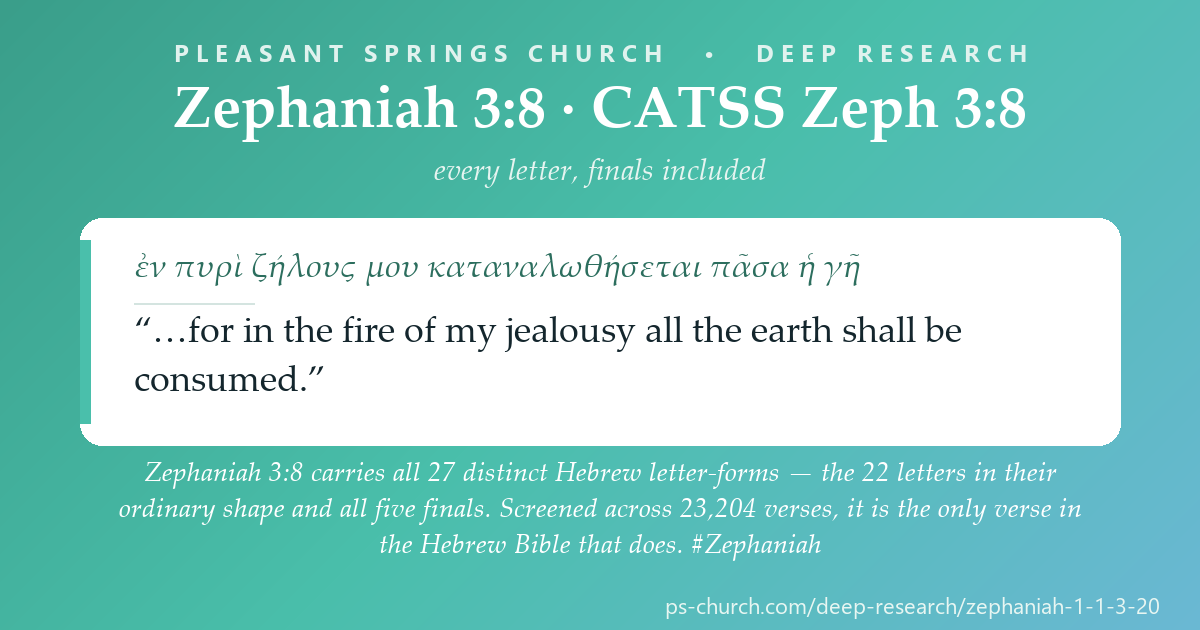
Zephaniah 3:8 contains every letter of the Hebrew alphabet. Not most of them — all twenty-two, and then all five of the final forms as well: ך ם ן ף ץ. This page screened the whole thirty-nine-book Hebrew corpus it holds, 23,204 verse units, under the ketiv and under the qere, and the result is the same both ways: one verse in the Hebrew Bible carries all twenty-seven distinct letter-forms, and it is this one. Counted the looser way, where a final kaph simply is a kaph, Ezekiel 38:12 joins it — and stage 2 prints both counts rather than only the flattering one. Twenty-two verses carry the twenty-two ordinary letters; only Zephaniah 3:8 also carries the finals. Two things sit either side of it. The book opens by naming the creatures of Genesis 1 in reverse order and taking each one away, and the verse immediately after the alphabet verse is about God changing the speech of the peoples. Neither of those is a claim about what the writer intended. They are what is on the page, in the order the page has them. See the method →
Zephaniah 1:1–3:20 (selections)
Hebrew · Greek (CATSS, Rahlfs’ Septuaginta) · ESV★ And one verse of this book is unlike any other verse in the Hebrew Bible. Zephaniah 3:8 carries all twenty-seven distinct letter-forms — the twenty-two letters in their ordinary shape and all five finals. Screened across the whole corpus held here, it is the only one. Counted the looser way, where a final kaph is simply a kaph, Ezekiel 38:12 joins it; stage 2 gives both counts.
The Shape of the Passage
Concentric — the earth swept, the earth consumed, and one door betweenZephaniah is the only prophet in the Twelve whose superscription runs back four generations, and the fourth name is Hezekiah. Whether that is the king is not stated and cannot be shown from the text. What can be counted is the length of the list, and it is longer than any other in the Twelve.
Author
A genealogy that raises a question it does not answer. צְפַנְיָה means the Lord has hidden or has treasured — and 2:3 says perhaps you may be hidden, which is the same idea from a different root. His father is כּוּשִׁי, Cushi, which is also the gentilic for a Cushite. The text supplies the name and nothing about what it means.
Counted across the Twelve. Zephaniah: four ancestors. Zechariah: two. Hosea, Joel and Jonah: one each. Amos, Obadiah, Micah, Nahum, Habakkuk, Haggai and Malachi: no father named for the prophet at all. Amos 1:1 and Haggai 1:1 do carry a son of, but it belongs to someone else in the verse — a king in Amos, a governor and a high priest in Haggai — never to the prophet.
Audience
Judah under Josiah — and the book knows what is still in the city. The superscription dates it to Josiah’s reign (640–609 BC). Chapter 1 names what is being worshipped: the remnant of Baal, the host of the heavens on the rooftops, Milcom, and people who swear by the Lord and by their king at the same time (1:4–5).
Which places it before or during the reform. 2 Kings 22–23 puts Josiah’s reform in his eighteenth year. A book that describes rooftop star-worship as a present problem reads most naturally as spoken before that was cleared out — but the book does not mention the reform, and this page does not date it more closely than the reign.
Orient on the day of the Lord, on Josiah’s Judah, and on what a pangram is and is not.
Search by topic: Zephaniah, book of; day of the Lord; Josiah; Deuteronomic reform; oracles against the nations; remnant; acrostic and alphabetic composition.
Which articles are relevant?
- Anchor Bible Dictionary — “Zephaniah, Book of,” “Day of the Lord,” “Josiah,” “Remnant.”
- Dictionary of the OT: Prophets (IVP) — “Zephaniah, Book of,” “Day of the Lord,” “Justice and Righteousness,” “Nations.”
- NIDOTTE — אָסַף, יוֹם, עֶבְרָה, סָתַר, בָּרַר.
- Dictionary of NT Use of the OT (Beale & Carson) — on Romans 2:5 and the day-of-wrath language, which is where Zephaniah’s vocabulary surfaces.
Settle the numbering — there is nothing to convert here
Zephaniah is one of the books where the three columns agree throughout.
| ch 1 | ch 2 | ch 3 | total | |
|---|---|---|---|---|
| Masoretic | 18 | 15 | 20 | 53 |
| CATSS Greek | 18 | 15 | 20 | 53 |
| ESV | 18 | 15 | 20 | 53 |
Every reference on this page therefore means the same verse in all three columns. The book before it in the Twelve does not have that luxury — Nahum carries a one-verse offset in chapters 1 and 2, so Nahum 1:15 and Nahum 2:1 can be the same verse depending on which Bible is open.
The alphabet verse, counted — and the hymn that came out of chapter 1.
Zephaniah 3:8 and every letter in the alphabet
The claim is old and it is checkable, so this page checked it.
| screen | result |
|---|---|
| Verses containing all 22 ordinary letters | 22 verses — Exodus 16:16, Deuteronomy 4:34, Joshua 23:13, 2 Kings 4:39 and 6:32, Isaiah 5:25, Jeremiah 22:3, 32:29 and 41:10, Ezekiel 17:9, Hosea 13:2, Amos 9:13, Zephaniah 3:8, Esther 3:13, Daniel 2:45, 3:22, 4:20, 5:7 and 7:19, Ezra 7:28, Nehemiah 3:7 and 3:15 |
| Verses also containing all five final forms ך ם ן ף ץ | 1 verse — Zephaniah 3:8, and nothing else |
Run over 23,204 verse units of the thirty-nine-book Masoretic corpus held here, consonants only, with the whole screen repeated twice — once reading every ketiv and once reading every qere. Both passes returned the same single verse. So the result does not depend on which side of a ketiv/qere the reader takes.
What ‘all twenty-two’ means here, and three honest caveats. The screen requires each of the 22 letters in its ordinary, non-final form. Counted the looser way — taking ך ם ן ף ץ as the letters they are — Ezekiel 38:12 also carries all 22 letters and all five final forms; Zephaniah 3:8 remains the only verse in the corpus that carries all 27 distinct forms. (1) This is a feature of the consonantal text as printed in the edition named in the footer; a different edition could in principle differ by a letter. (2) It is a property of the Hebrew alone — no translation carries it, and the Greek column does not have it. (3) Nothing here claims the writer did it on purpose. Long verses full of varied vocabulary are where a result like this is most likely to fall out by itself, and Zephaniah 3:8 is a long verse full of varied vocabulary. What the page reports is that it is the only one.
Set beside the book before it, the pair is worth a moment. Nahum opens with a poem that walks down the alphabet and stops at kaph, eleven letters in. Zephaniah has a single verse that holds all twenty-seven forms at once. Neither fact is a connection between the two books — they are simply next to each other in the Twelve, and they do opposite things with the same alphabet.
Dies irae, dies illa — where the hymn comes from
Zephaniah 1:15 opens יוֹם עֶבְרָה הַיּוֹם הַהוּא — a day of wrath is that day. In the Vulgate that is dies irae, dies illa, and it is the first line of the mediaeval sequence.
The Dies irae became part of the Requiem Mass and, through it, of the requiems of Mozart, Verdi, Berlioz and Dvořák; its plainchant melody is one of the most quoted tunes in Western music. The hymn is not a translation of Zephaniah — it is a mediaeval poem that borrows its opening from this verse and then goes its own way.
⚠️ What this page did not check. The Vulgate is not among the text files held here, and neither is the hymn. The Latin wording and the attribution to the thirteenth century are reported from the standard reference works, not measured. What was measured is the Hebrew: six occurrences of יוֹם in verse 15, ten in 1:14–18, fourteen in chapter 1 and twenty in the book.
The day of wrath between the testaments — a search that came back empty
The Greek row’s phrase for the day is ἡμέρα ὀργῆς, and it stands at 1:15, 1:18 and 2:3. The three Second-Temple Greek books held on this disk were searched for it and it does not occur once.
| book | verses scanned | day + wrath adjacent |
|---|---|---|
| Sirach | 1,366 | 0 |
| 1 Maccabees | 924 | 0 |
| 1 Esdras | 434 | 0 |
2,724 verses, no hits. That is a negative result on a small sample and it is reported as one — three books are not the Second-Temple literature, and Wisdom, Tobit, Judith, 2 Maccabees, Baruch, 1 Enoch, Jubilees and the Qumran material are not among the Greek files held here. What the page can say is that in the Second-Temple Greek it can read, the phrase is absent; and that in the New Testament it is not (Romans 2:5).
A sweeping that is a gathering, a hush, and a verb the two columns hear differently.
Zephaniah 1:2. The root אסף ordinarily means to gather in — it is the verb for harvest, and for gathering a people. Here it is a gathering that removes. The row does not keep the first person: ἐκλείψει ἐκλιπέτω, all shall fail; let it fail.
Zephaniah 1:7 — one syllable, an interjection rather than a verb, the sound you make to silence a room. The row does not reproduce it: εὐλαβεῖσθε, be reverent. Habakkuk 2:20 and Zechariah 2:17 (ESV 2:13) use the same interjection before the same kind of sentence, and Amos does twice (6:10; 8:3) — six occurrences in the Hebrew Bible in all.
Zephaniah 1:15, in the pair שֹׁאָה וּמְשׁוֹאָה — the ESV’s ruin and devastation, two words from one root. The same noun is the word modern Hebrew uses for the Holocaust; that usage is of the twentieth century, and the page notes it as a later use of the word and draws nothing from it.
Zephaniah 2:3, the hinge of the book. The verb it governs, תִּסָּתְרוּ, you may be hidden, is from סתר, a different root from the one behind the prophet’s own name but the same idea — צְפַנְיָה, the Lord has hidden.
Zephaniah 3:17. The ESV renders it he will quiet you by his love. The Greek row has καινιεῖ σε, he will renew you — a different verb altogether. The consonants חרש and חדש differ by one letter, and the page notes that and claims nothing about how the reading arose.
The word day, counted
Zephaniah 1 is a chapter about a day, and it says so with the word.
| where | occurrences of יוֹם |
|---|---|
| 1:15 — one verse | 6 |
| 1:14–18 | 10 |
| chapter 1 | 14 |
| the whole book | 20 |
The Greek row keeps every one of the six in verse 15: ἡμέρα six times, in the same slots. Whatever else the two columns do differently in this book, they agree completely about the hammering of that word.
A book whose deepest New Testament run is an accident.
The measurement, and what its top line turns out to be
All 53 CATSS rows of Zephaniah were screened against all 7,927 verses of the Greek New Testament. The deepest run in the book is five, two rows reach it, and both are coincidences.
| row | deepest NT partner | run | tie band | the shared words |
|---|---|---|---|---|
| Zeph 1:3 | Matthew 13:32 | 5 | 1 | τὰ πετεινὰ τοῦ οὐρανοῦ καί |
| Zeph 3:14 | Mark 12:30 | 5 | 2 | εκ ολησ τησ καρδιασ σου |
| Zeph 1:7 | 2 Thessalonians 2:2 | 4 | 1 | ἡ ἡμέρα τοῦ κυρίου |
| Zeph 1:18 | Acts 19:10 | 4 | 1 | πάντας τοὺς κατοικοῦντας τήν |
| Zeph 3:13 | Revelation 18:21–22 | 4 | 4 | καὶ οὐ μὴ εὑρεθῇ |
| Zeph 2:3 | Romans 2:5 | 3 | 1 | ἐν ἡμέρᾳ ὀργῆς |
Zephaniah 1:3 is God sweeping the birds of the heavens off the earth. Matthew 13:32 is the mustard seed, where the birds of the heavens come and nest in its branches. Five consecutive Greek words, a tie band of one, and the two sentences are doing opposite things with the same creatures. Both of the book’s deepest New Testament runs are false positives, and the page leads with that rather than burying it.
Across the 53 rows: 52 reach two, 40 reach three, 16 reach four, 2 reach five.
Where the language does travel: the day of wrath
The one line in the table that is worth something is the shortest one.
The Greek row of Zephaniah 2:3 ends ἐν ἡμέρᾳ ὀργῆς κυρίου, on the day of the wrath of the Lord. Romans 2:5 reads ἐν ἡμέρᾳ ὀργῆς καὶ ἀποκαλύψεως δικαιοκρισίας τοῦ θεοῦ — on the day of wrath and revelation of the righteous judgement of God. Three shared words, and a tie band of one: no other verse in the Greek New Testament carries that sequence.
Three words is a short run, and the page will not call it a citation. Paul does not signal a quotation there and the phrase is a natural one to arrive at independently. What can be said is that the wording Zephaniah’s Greek uses three times for the day — and which is absent from the 2,724 verses of Second-Temple Greek this page could search — turns up in Romans in a sentence about the same subject.
The alphabet verse in the New Testament: nothing
Zephaniah 3:8, the verse that holds every letter, has one of the shallowest footprints in the book: a deepest run of two, in a tie band of 153 New Testament verses. The two words are διὰ τοῦτο, therefore.
There is no irony to draw out of that and the page draws none. What is remarkable about the verse is a property of the Hebrew consonants, and it could not survive into Greek even in principle.
Where this page is weakest, and what was not reached.
The limits
The alphabet result is a measurement, not an interpretation, and the page keeps them apart. That Zephaniah 3:8 is the only verse of its kind in this corpus is a fact about the letters. Whether it was intended, and whether it means anything if it was, are questions the count cannot answer — and a long verse with unusually varied vocabulary is exactly where such a thing is most likely to occur without design.
The Vulgate and the Dies irae were not checked. Neither text is held here. The Latin first line and the hymn’s date and attribution are reported from reference works.
The Second-Temple search covered three books. Sirach, 1 Maccabees and 1 Esdras. A negative across 2,724 verses is worth reporting and is not worth much; the literature it does not cover is far larger than the literature it does.
And 3:17 is genuinely contested. The Hebrew יַחֲרִישׁ and the row’s καινιεῖ are not two renderings of one word; the page prints both and does not adjudicate.
What could not be checked at all
No Hebrew or Greek critical apparatus. No Qumran material — Zephaniah is present in the Minor Prophets finds, including the Greek scroll from Naḥal Ḥever, and none of it was consulted. No Targum, Syriac, Vulgate, Aquila, Symmachus or Theodotion. No archaeological material bearing on Josiah’s reform.
And the question the genealogy raises stays open. Whether the Hezekiah of 1:1 is the king cannot be settled from the verse, which supplies a name and no title.
Reading list
- Adele Berlin, Zephaniah (Anchor Bible 25A).
- Marvin A. Sweeney, Zephaniah (Hermeneia).
- O. Palmer Robertson, The Books of Nahum, Habakkuk, and Zephaniah (NICOT).
- Michael De Roche, “Zephaniah I 2–3: The ‘Sweeping’ of Creation,” Vetus Testamentum 30 (1980).
- None of these were consulted for the measurements on this page, which were run on the text files named in the footer.
The whole alphabet, in the verse about the fire.
Every letter
Zephaniah opens by taking creation apart in the order it was made, backwards — man, beast, the birds of the heavens, the fish of the sea — and then spends a chapter on a single word. Day. Six times in one verse; ten in five verses; fourteen in the chapter. The only opening in it is a perhaps.
And then, at 3:8, in the sentence about waiting, and gathering the nations, and all the earth being consumed in the fire of God’s jealousy, the Hebrew happens to carry every letter-form it has — all twenty-two letters in their ordinary shape, and the five finals as well. One verse in the whole Hebrew Bible does that; count the looser way and Ezekiel 38:12 stands beside it.
The next thing the book says is that God is going to change how people speak. שָׂפָה בְרוּרָה — a purified lip, so that all of them call on one name and serve him with one shoulder. Babel, run backwards. And the book that began by unmaking the world ends with God in the middle of his people, singing.
Eleventh whole book of the Twelve on this shelf. Eleven complete: Hosea, Joel, Amos, Obadiah, Jonah, Micah, Nahum, Habakkuk, Zephaniah, Haggai, Malachi. One to go — Zechariah.
Every Deep Research page traces its passage across the whole sweep — the Old Testament, the Second-Temple world between the testaments (historical witnesses, not Scripture), and the New Testament. Follow the thread:
Pleasant Springs Church — Deep Research
Research method after Michael S. Heiser’s Bible Research Method (examine dictionaries → ancient literature → important words → textual connections → academic publications → share), with the Pleasant Springs “Author & Audience” foundation. Scripture set in the Hebrew, the Greek editions named on each page and the ESV (Old Testament), and the Greek New Testament and the ESV (New Testament), per the practice of Pleasant Springs Church. Zephaniah research grounded in Berlin (Zephaniah, Anchor), Sweeney (Hermeneia), Robertson (NICOT) and De Roche on 1:2–3. Text: Hebrew from the Masoretic text as printed in the editions consulted — Sefaria’s Miqra according to the Masorah; no critical apparatus was consulted for the Hebrew. Greek from Rahlfs’ Septuaginta as digitized by CATSS; Greek New Testament from the SBL edition. The standing caution for this shelf applies: these pages say “the CATSS Greek row reads…” and never call a Greek reading early or late. ⚠️ VERSE NUMBERING — there is no offset in this book. Masoretic, CATSS and ESV Zephaniah all run 18 / 15 / 20 = 53 verses, and every reference on this page means the same verse in all three columns. Stated because the shelf states it everywhere, including where there is nothing to convert. ⚠️ The alphabet screen, in full. Hebrew consonants only. Every verse of the 39-book Masoretic corpus held here — 23,204 verse units — reduced to its consonantal letters with cantillation, vowel points and punctuation removed, then tested for the presence of each of the 22 ordinary letters and, separately, of the five final forms ך ם ן ף ץ. The whole screen was run twice, once reading every ketiv and once reading every qere, and both passes returned Zephaniah 3:8 and nothing else. 22 verses carry all 22 ordinary letters. Exhaustive and deterministic; nothing sampled, so no seed applies. This is a property of the consonantal text as this edition prints it, and the page makes no claim that it was intended. ⚠️ The Greek measurement, in full. Greek against Greek. CATSS FORM column (cols 0–24), beta-code transliterated first; MorphGNT field 6, the normalised word (the column that already resolves elision and the movable nu). Both sides lowercased, accents and breathings dropped, final sigma folded, then filtered to Greek letters — the same filter applied to both corpora. Word forms, never lemmas. Corpus: the 53 CATSS rows of Zephaniah against 7,927 verses across 27 MorphGNT files; and, for the Second-Temple search, 2,724 verses across Sirach, 1 Maccabees and 1 Esdras. ⚠️ The book’s deepest New Testament run is a false positive, and the page says so first. Zephaniah 1:3 against Matthew 13:32, five words, tie band of one — and one sentence sweeps the birds of the heavens away while the other has them nesting in a mustard tree. ⚠️ Not measured here: the Vulgate and the Dies irae. Neither is among the files held on this disk. The Latin first line, the hymn’s thirteenth-century date and its use in the Requiem Mass are reported from reference works, not checked. ⚠️ Direction of influence is never asserted. Nothing here says Paul is reading Zephaniah, that Matthew is, or what produced any reading — including the third-person Greek at 1:2, the missing pure at 3:9, and the quieting and the renewing at 3:17. Typology is handled per the house position: what the text says, what the New Testament itself draws, and what we see from this side of the cross — with the seeing left to the reader.
Scripture quotations marked ESV are from the ESV® Bible (The Holy Bible, English Standard Version®), © 2001 by Crossway, a publishing ministry of Good News Publishers. ESV Text Edition: 2016. Used by permission. All rights reserved. The ESV text may not be quoted in any publication made available to the public by a Creative Commons license, and the ESV may not be translated in whole or in part into any other language. www.esv.org
|
Did this study bless you today? 💚 Give to Support PS Church100% of gifts go to the General Fund — thank you. |