Sing aloud, O daughter of Zion!” After a whole book of the “great day of the Lord,” Zephaniah ends in astonishing joy: the judgments taken away, the enemy cleared, and “the King of Israel, the Lord, in your midst.” Then the tenderest picture of God in the Old Testament — “a mighty one who will save… he will exult over you with loud singing.” God himself, singing over his people. This study works Zephaniah 3:14–17 — the King in the midst, the God who sings — from the day of the Lord to “God with us.” See the method →
Zephaniah 3:14, 15, 17 (same numbering in MT, LXX & English)
Hebrew · LXX · ESVThe Shape of the Passage
ConcentricZephaniah prophesied in Judah under King Josiah (7th c. BC), mostly of the coming “day of the Lord” — a day of darkness and judgment (1:14–18). But the book turns at its close: judgment gives way to a purified, rejoicing remnant with God himself singing in their midst.
Author
Zephaniah is the prophet of “the great day of the Lord” — the phrase that gave the medieval hymn its Dies Irae. Most of the book is warning. But it does not end there. After the judgment has done its purifying work (3:11–13), the final oracle (3:14–20) calls Zion to sing: the sentence has been lifted, the enemy removed, and “the King of Israel, the Lord, is in your midst.”
The God who sings. The center of the joy is not the people’s relief but God’s delight: “he will rejoice over you with gladness… he will exult over you with loud singing” (3:17). It is one of the very few places in Scripture where God himself sings — and the object of his song is his rescued people. The “mighty one who will save” (gibbor yoshia) does not merely tolerate his people; he sings over them like a bridegroom.
Audience
The remnant of Judah on the far side of judgment — those who “seek refuge in the name of the Lord” (3:12). To a people who had known only the threat of the day of the Lord, Zephaniah promises that the same day ends in gladness: fear gone, judgments lifted, God present and singing.
How it points forward. Zephaniah is not quoted in the New Testament, but its heart — “the King… the Lord, is in your midst” and “a mighty one who will save” — runs straight toward the incarnation: God with us (Matt 1:23) in one named for salvation, Jesus (“the Lord saves”), and toward the day when “the dwelling place of God is with man” and every tear is wiped away (Rev 21:3–4).
Orient on the day of the LORD, the remnant, God’s presence, and joy.
Search by topic: Zephaniah, day of the LORD, remnant, presence of God, King, joy / rejoicing.
Which articles are relevant?
- Anchor Bible Dictionary — “Zephaniah,” “Day of the Lord,” “Zion,” “Remnant.”
- Dictionary of the OT: Prophets — “Zephaniah, Book of,” “Day of the Lord,” “Kingship of God,” “Joy.”
- NIDOTTE / TDOT — קֶרֶב (qereḇ, midst), יָשַׁע (yāšaʿ, save), גִּבּוֹר (gibbôr, mighty one), רִנָּה (rinnâ, loud singing).
Bibliography surfaced:
- O. Palmer Robertson (NICOT, Nahum, Habakkuk, Zephaniah), J. J. M. Roberts (OTL), Marvin A. Sweeney (Hermeneia, Zephaniah), Adele Berlin (Anchor Yale) on Zephaniah.
- Kenneth Barker & Waylon Bailey (NAC); studies of the 3:17 yacharish/“renew” crux and the day-of-the-Lord theme.
- Beale & Carson, NT Use of the OT (the presence-and-joy trajectory).
Joy through judgment, the King in the midst, and a God who sings.
Let the joy rise through the removed judgment, weigh the 3:17 reading honestly, then follow “God in your midst” to the incarnation.
Which parallels shed light on religion and worldview?
Joy on the far side of judgment. The gladness of Zephaniah 3 is not a denial that the day of the Lord was real. The song is possible because “the Lord has taken away the judgments against you” and “cleared away your enemies” (3:15). The sentence has been served and lifted; the fear is gone. This is the shape of biblical joy — not the absence of judgment but its resolution, so that the King can dwell with a cleansed people.
The King in the midst. Twice the oracle says God is “in your midst” (bə-qirbēḵ) — and names him “the King of Israel, the Lord” and “a mighty one who will save” (gibbor yoshia). The verb “save” is yāšaʿ — the root of the name Yeshua, Jesus, “the Lord saves.” Zephaniah did not know how literally God would come to be “in the midst” of his people; but the New Testament hears here the note it names Immanuel, “God with us.”
One line, two ancient readings. Verse 17 says God “will yaḥărîš in his love.” The Hebrew verb means “to be silent, still” — hence the ESV’s tender “he will quiet you by his love,” a love that stills its beloved (the same paradox as being silent yet then bursting into “loud singing”). The Septuagint read the consonants slightly differently and rendered “he will renew you in his love” (καινιεῖ σε). Both are ancient and beautiful — a love that quiets, a love that renews — and this study shows them side by side rather than hiding the difference.
- Zephaniah 1:14–18; 3:11–13 — “the great day of the Lord” and the humble remnant it leaves: the judgment the final joy comes through.
- Isaiah 12:6; 62:5; Zechariah 2:10–11 — “great in your midst is the Holy One”; God rejoicing over his people “as the bridegroom”; “I will dwell in your midst” (see Zechariah 9).
- Exodus 34:6–7; Deuteronomy 30:9 — the Lord “will again take delight in prospering you”: the God who rejoices over his people (see Exodus 34).
- Second-Temple restoration prayers (e.g. Sirach 36; Psalms of Solomon 11 — witnesses, not Scripture) — the joy and regathering of Zion; the motif Zephaniah’s song feeds (no formal citation of Zeph 3).
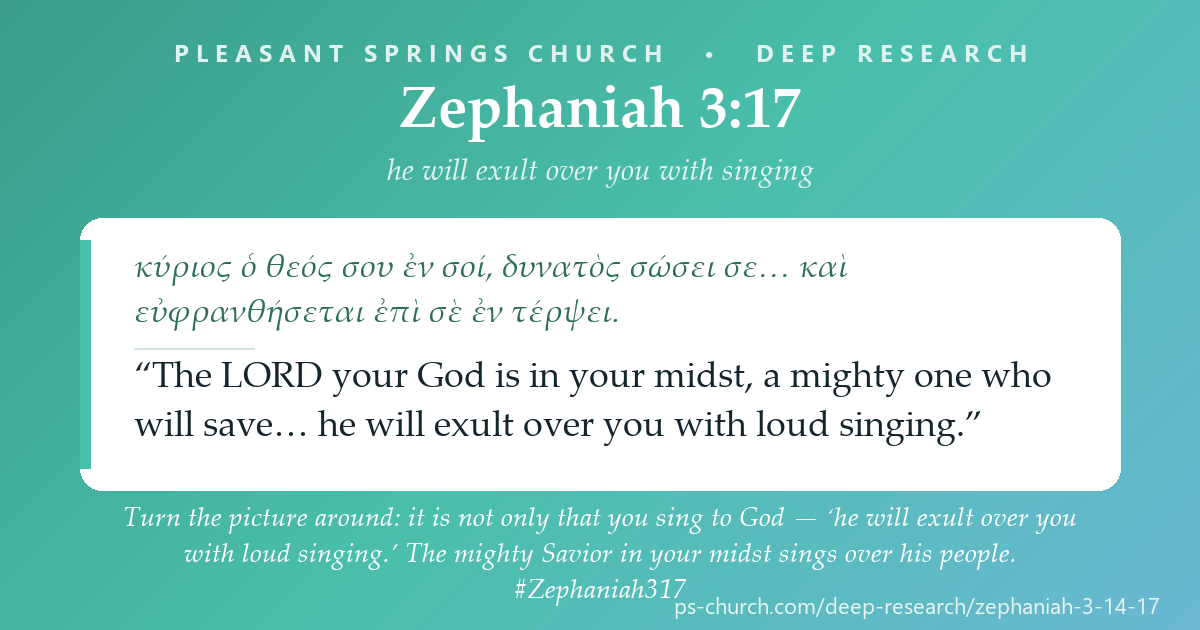
Zephaniah 3:17 is many believers’ favorite verse for a reason: it turns the camera around. We are used to picturing ourselves singing to God; here God sings over us. The “mighty one” (gibbor, a warrior-word) is not too fierce to be tender, nor too tender to be mighty: he saves with strong arm and then rejoices over the saved “with loud singing.” The New Testament never quotes Zephaniah, but it does not need to — it fulfills him. The God who promised to be “in your midst” came in the flesh as Immanuel; the “mighty one who will save” was named Jesus, “for he will save his people from their sins” (Matt 1:21–23), the two truths of Zephaniah 3:17 joined in one name. Heaven still rings with this joy: there is “joy before the angels of God over one sinner who repents” (Luke 15:10), the same delight of the shepherd rejoicing on his way home with the found sheep. And it ends where Zephaniah pointed: “the dwelling place of God is with man… he will wipe away every tear” (Rev 21:3–4) — God in the midst of his people forever, still glad over them. Whether his love “quiets” you or “renews” you, it is the same astonishing fact: you are sung over.
The vocabulary of the midst, the mighty Savior, and the song.
Watch “in your midst” and the God who sings over the saved.
“In your midst” — God present among his people, not merely over them. Twice repeated; fulfilled in the incarnation (“God with us”) and the indwelling Spirit.
“The King of Israel, the Lord” — God himself is Zion’s King, present in her midst. The title the crowds would one day give Jesus (John 12:13).
“A mighty one who will save” — gibbor, a warrior; yôšîaʿ from yāšaʿ, “save” — the root of the name Yeshua / Jesus. Strong to rescue, tender to rejoice.
“He will be silent / quiet” — from ḥāraš, to be still; ESV “he will quiet you by his love.” The LXX read it as “renew” (καινιεῖ) — a love that stills, or a love that makes new.
“Loud/ringing singing” — a shout of joy. God “will exult over you with rinnâ”: one of the few places in Scripture where God himself sings, and his song is his people.
How the canon carries these themes:
- Matthew 1:21–23 — “you shall call his name Jesus, for he will save… Immanuel (God with us)”: the “mighty one who will save” “in your midst” (see Isaiah 7:14).
- John 1:49; 12:13 — “You are the King of Israel”; “Blessed… the King of Israel!”: the title of Zephaniah 3:15 acclaimed of Jesus.
- Luke 15:7, 10, 23–24 — heaven’s rejoicing over the found: the God who sings over his people (thematic echo).
- Revelation 21:3–4 — “the dwelling place of God is with man… he will wipe away every tear”: “in your midst” consummated.
From the King in Zion’s midst to God dwelling with man forever.
Trace “God in your midst” from Zephaniah’s joy through the incarnation to the new creation.
Which cross-references matter?
- Zephaniah 1:14–18; 3:11–13 — the day of the Lord and the humble remnant: the judgment the joy comes through.
- Isaiah 12:6; 62:5; Zechariah 2:10–11; 9:9 — the Holy One great in the midst; God rejoicing as a bridegroom; the King coming to the daughter of Zion (see Zechariah 9).
- Matthew 1:21–23; John 1:14 — God with us; the Word who “dwelt among us”: “in your midst” in the flesh (see Immanuel).
- Luke 1:46–55; 15:7–24 — the Magnificat’s joy of the saved; heaven’s rejoicing over the found.
- Revelation 21:1–4; 22:3–4 — God dwelling with his people, every tear wiped away: the everlasting “in your midst.”
Zephaniah moves from one of the darkest openings in the prophets to one of the brightest closings. Interpreters note the deliberate reversal: the “day of the Lord” that began as terror (1:15, “a day of wrath… distress… darkness”) ends as festival (3:14–17, “sing aloud… rejoice… loud singing”). The hinge is God’s presence: judgment made a place clean, and into that place the King comes to dwell. The much-loved 3:17 places God’s own joy at the center — a striking anthropomorphism the text does not apologize for: the mighty Savior sings. The two ancient readings of the middle line (“quiet you by his love” / “renew you in his love”) are both worth keeping; each says something true of how divine love acts. And the whole scene is prophetic in the deepest sense — not because the New Testament quotes it, but because it describes what the New Testament announces: God come to be with his people, mighty to save, glad over the saved. The believer’s answer to Zephaniah is simply to let it be true: to be quieted, renewed, and sung over.
The scholarship on Zephaniah 3:14-17.
The commentators on Zephaniah; the studies of the 3:17 crux and the day-of-the-Lord reversal.
Commentaries & studies:
- O. Palmer Robertson (NICOT, Nahum, Habakkuk, Zephaniah), J. J. M. Roberts (OTL), Marvin A. Sweeney (Hermeneia, Zephaniah), Adele Berlin (Anchor Yale, Zephaniah).
- Kenneth L. Barker & Waylon Bailey (NAC); Ehud Ben Zvi (BZAW 198); studies of the yacharish/“renew” textual crux.
- G. K. Beale & D. A. Carson, eds., Commentary on the NT Use of the OT.
Interpretation notes worth keeping:
- Joy through judgment. The gladness of 3:14–17 comes because the judgments are “taken away” (3:15), not around them — biblical joy is resolved judgment, not denied judgment.
- The 3:17 crux. MT yaḥărîš (“be silent/quiet”) → ESV “quiet you by his love”; LXX καινιεῖ (“renew you in his love”). Show both; both are ancient and edifying. (The LXX also makes God the giver of joy in 17a.)
- No versification offset. Zephaniah 3:14–17 is the same in MT, LXX, and English (unlike its batch-neighbor Nahum, where English 1:15 = MT 2:1).
- Not quoted in the NT. The links (Matt 1:23; Rev 21:3) are fulfillment-by-theme, not citations; the “daughter of Zion, your King” the Gospels quote is Zechariah 9:9, not Zephaniah.
From the King in your midst to a God who sings over you.
Name what you learned, why it matters, and one concrete response.
What should we carry away — and do?
- God is in your midst. Not distant, not merely watching — present, and in Christ, “God with us.” The nearest fact about your trouble is that the King is in it with you.
- He is mighty to save. The tenderness of Zephaniah 3:17 is not weakness: the one who sings over you is a warrior who saves. Strong enough to rescue, gentle enough to rejoice.
- You are sung over. Turn the picture around: it is not only that you sing to God; God sings over you. Let his gladness, not your self-assessment, tell you who you are to him.
Step in response: this week, when the accusing voice is loudest, answer it with Zephaniah 3:17 — picture the mighty Savior in your midst, quieting you by his love and exulting over you with loud singing — and let that be the truest thing you know about yourself. Then carry that gladness to someone who cannot yet believe God could delight in them.
Zephaniah 3:17 · to share
ESVEvery Deep Research page traces its passage across the whole sweep — the Old Testament, the Second-Temple world between the testaments (historical witnesses, not Scripture), and the New Testament. Follow the thread:
Pleasant Springs Church — Deep Research
Research method after Michael S. Heiser’s Bible Research Method (examine dictionaries → ancient literature → important words → textual connections → academic publications → share), with the Pleasant Springs “Author & Audience” foundation. Scripture set in the Hebrew, the Greek editions named on each page and the ESV (Old Testament), and the Greek New Testament and the ESV (New Testament), per the practice of Pleasant Springs Church. Zephaniah 3:14–17 research grounded in Robertson, Roberts, Sweeney, and Berlin, with Barker & Bailey; the 3:17 yacharish/“renew” textual crux shown from the MT and LXX; New Testament links presented as fulfillment-by-theme, not citations.
Scripture quotations marked ESV are from the ESV® Bible (The Holy Bible, English Standard Version®), © 2001 by Crossway, a publishing ministry of Good News Publishers. ESV Text Edition: 2016. Used by permission. All rights reserved. The ESV text may not be quoted in any publication made available to the public by a Creative Commons license, and the ESV may not be translated in whole or in part into any other language. www.esv.org
|
Did this study bless you today? 💚 Give to Support PS Church100% of gifts go to the General Fund — thank you. |