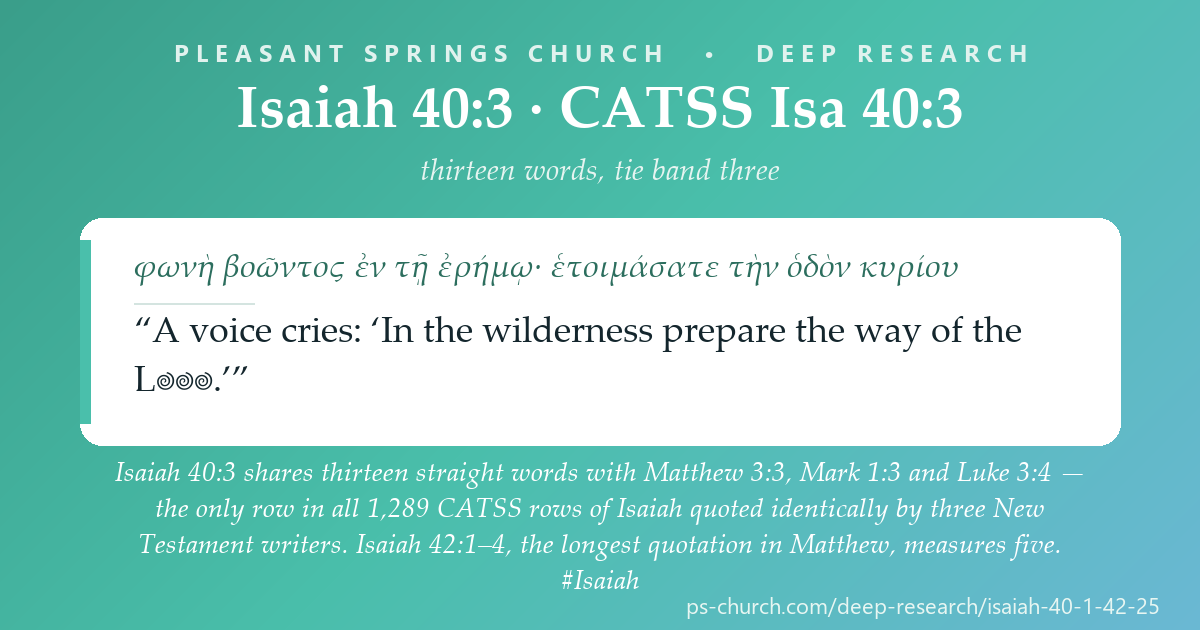
Two passages in these three chapters are quoted by name in the New Testament, and the measurements come out on opposite sides of the shelf. Isaiah 40:3 shares thirteen consecutive words with Matthew 3:3, Mark 1:3 and Luke 3:4 — run 13, tie band 3 — and of the 26 rows in all 1,289 CATSS rows of Isaiah that reach a run of eight or more it is the only one whose deepest run is carried by three different New Testament verses. The next two rows keep going: 40:4 runs eleven with Luke 3:5 and 40:5 runs eight with Luke 3:6, each with a tie band of one. Isaiah 42:1–4 is the longest formal quotation in Matthew’s Gospel, introduced with this was to fulfill what was spoken by the prophet Isaiah — and against the same Greek column its deepest run is five, tie band one. What Matthew drops are the two proper names the Greek column has and the Hebrew does not: Ιακωβ and Ισραηλ. And the deepest contact anywhere in chapter 42 is not the citation at all — it is Revelation 10:6 at seven, tie band one, an oath formula with nothing to do with a servant. This page measures all of it and says what a measurement can and cannot conclude. See the method →
Isaiah 40:1–42:25 (selections)
Hebrew · Greek (CATSS, Rahlfs’ Septuaginta) · ESV⚠️ These three chapters were dark on this shelf until now. No page had quoted a verse from Isaiah 40, 41 or 42 — which means the shelf carried the fourth Servant Song at 52:13–53:12 and the Spirit-anointed herald at 61:1–3 without ever quoting the first Servant Song. Isaiah is a long book and this page does not close it; it closes three of its dark chapters.
The Shape of the Passage
A sequence — two court scenes, three servants, and one prison-house opened and shutAt Isaiah 39:8 Hezekiah is alive and Babylon has not yet come. At Isaiah 40:2 the warfare is over and the sentence has been served. Nothing in the book narrates the gap. That silent seam is the reason chapters 40–66 have been assigned to a later hand since the eighteenth century. This page takes no position on that question. It quotes these chapters because they were dark on this shelf and because they belong to the assigned span.
Author
The book names Isaiah son of Amoz (1:1), and these chapters name nobody at all. There is no superscription at 40:1, no date, no king and no prophet’s name anywhere in chapters 40–42. The only persons named inside these three chapters are Abraham (41:8), Jacob and Israel — all of them ancestors. No contemporary is named until Cyrus at 44:28 and 45:1, outside this study, and that is the single largest reason the section is dated where it is.
What the page can say is what stands on the page. Chapters 40–42 are anonymous speech. They are also the place where the New Testament goes first for the beginning of the gospel: all four Gospels open John the Baptist with Isaiah 40:3, and Mark 1:2–3 puts it inside his opening sentence. The page reports that as a measured fact about the Gospels, not as an argument about who wrote Isaiah.
Audience
People who have been punished and are being told it is over. 40:2 says the term is served and the payment is double. The imperatives are plural and the addressee shifts: comfort my people; speak to Jerusalem; you, Israel my servant; you, Jacob. The audience is a nation addressed in the second person singular as one man.
And then a second audience, in court. Twice the speech turns and summons the nations and their gods to trial (41:1–7, 41:21–29). The charge is a failure to predict. Tell us what is to come hereafter, that we may know that you are gods (41:23). The whole argument of these chapters runs on announcement in advance — 41:22, 41:26, 42:9 — and that, not consolation, is what the court scenes are for.
Orient on the servant, the herald, the court scene, and the seam at chapter 40.
Search by topic: Servant Songs; Servant of the Lord; Deutero-Isaiah; the trial speeches (rîb) of Isaiah 40–48; herald / evangelist (mebaśśēr); Comfort literature; John the Baptist and Isaiah 40; Isaiah in the New Testament; LXX-Isaiah.
Which articles are relevant?
- Anchor Bible Dictionary — “Isaiah, Book of,” “Servant of the Lord,” “Suffering Servant,” “Cyrus,” “Exile.”
- Dictionary of the OT: Prophets (IVP) — “Servant Songs,” “Israel,” “Idols, Idolatry,” “Zion,” “Divine Council.”
- NIDOTTE — נחם, עֶבֶד, בשׂר, מִשְׁפָּט, יחל, כֶּלֶא.
- Dictionary of NT Use of the OT (Beale & Carson) — on Matthew 3:3, Mark 1:2–3, Luke 3:4–6, John 1:23; on Matthew 12:18–21; on 1 Peter 1:24–25; on Romans 11:34 and 1 Corinthians 2:16. Those entries argue for relationships this page’s screen can only partly see, and stage 4 prints both the argument and the numbers.
Settle the numbering first — and it was derived here, not copied
The shelf’s stored note for Isaiah was marked PROVISIONAL and named one seam. Reading the three columns off the files on this disk turned up four differences, and none of them is in chapters 40–42.
| where | Hebrew | CATSS Greek | English (ESV) | what it means |
|---|---|---|---|---|
| 2:22 | 22 verses | 21 verses | 22 verses | the Greek column has no row at all for Isaiah 2:22 |
| 8:23 / 9:1 | ch 8 = 23, ch 9 = 20 | ch 8 = 23, ch 9 = 20 | ch 8 = 22, ch 9 = 21 | Hebrew and Greek 8:23 = English 9:1, and Hebrew and Greek 9:1–20 = English 9:2–21 |
| 56:12 | 12 verses | 11 verses | 12 verses | the Greek column has no row at all for Isaiah 56:12 |
| 63:19 / 64:1 | ch 64 = 11 | ch 64 = 11 | ch 64 = 12 | the second half of Hebrew 63:19 is printed as English 64:1, so English 64:2–12 = Hebrew 64:1–11 |
| 40–42 | 31, 29, 25 | 31, 29, 25 | 31, 29, 25 | ★ identical — no offset anywhere in this study |
The Hebrew shapes are Sefaria’s Miqra according to the Masorah; the Greek shapes are the CATSS Isaiah file; the English shapes were taken from a complete public-domain English Bible held on this disk, which carries the same versification as the ESV. The Greek column has a row for every one of the 85 verses of chapters 40–42 — no gaps, no merged rows. It is worth saying out loud even though the answer is nothing: a page that does not state its offset has not checked it.
What the dictionaries will tell you about “the Servant Songs,” and what that phrase is
The four passages usually called the Servant Songs — 42:1–4, 49:1–6, 50:4–9 and 52:13–53:12 — were grouped and named by Bernhard Duhm in 1892. The grouping is a modern editorial judgement, not a feature of the manuscripts: there is no heading over 42:1 in the Hebrew, in the Greek, or in the ESV. The page uses the phrase because everyone does, and flags that it is a label.
What is measurable is narrower and more interesting. The Greek column uses ὁ παῖς μου in exactly four verse units out of 30,348 — Isaiah 20:3, 42:1, 52:13 and Joshua (B) 1:7. Three of the four are in Isaiah, and the three are the prophet himself walking barefoot (20:3), the servant of the first song (42:1), and the servant of the fourth (52:13). The fourth is Moses. That is a distribution, not a doctrine, and the page prints it as one.
A courtroom, a herald, a road built for a god, and a wick that has gone dim.
The trial speech, and why it is about prediction
Twice in this study the speech stops addressing Israel and convenes a court — 41:1–7 and 41:21–29.
The form is legal: parties are summoned, silence is called for, and the two sides approach for judgement. The charge is not immorality. It is a failure to announce things in advance. Tell us what is to come hereafter, that we may know that you are gods (41:23); there was none who declared it (41:26); before they spring forth I tell you of them (42:9). The whole argument turns on prior announcement.
⚠️ What was not consulted. Neo-Babylonian and Neo-Assyrian royal inscriptions, the Cyrus Cylinder, and the Akkadian prophecy texts are the comparative material the commentaries use here, and none of it is on this disk. The ANET collection held elsewhere in this project is a catalogue, not a searchable corpus for this tooling. No claim on this page rests on any of it.
The herald — and a Greek column that keeps comforting
The Hebrew participle מְבַשֵּׂר is a runner who arrives with news from a battle.
It stands three times in two verses of this study — 40:9, where Zion and Jerusalem are themselves the heralds sent up a high mountain, and 41:27, where a herald is given to Jerusalem. It is the word behind the Greek εὐαγγελίζομαι, and the Greek column uses that verb at 40:9 twice.
★ But at 41:27 the Greek column does something else: it comforts. Where the Hebrew has a herald I will give, the Greek row has παρακαλέσω, I will comfort — the verb of 40:1. Counted across the three chapters, the Greek column uses a παρακαλ- word five times (40:1 twice, 40:2, 40:11, 41:27) and the Hebrew root נחם stands twice, both in 40:1. At 40:11 the Hebrew has יְנַהֵל, he gently leads, and the Greek has παρακαλέσει. The page counts the difference and does not say what produced it.
A road built for a god to travel on
40:3–4 is not landscaping. It is the preparation of a processional way.
Valleys filled, mountains lowered, crooked places made straight: in the ancient Near East that is what is done before a divine image travels in procession, and readers of Mesopotamian religion have made the comparison for a century. The comparative material is not held here and nothing on this page depends on it. What is on the page is that the road is built לֵאלֹהֵינוּ, for our God, and that the Greek column says the same: τὰς τρίβους τοῦ θεοῦ ἡμῶν.
★ And that is the word all four Gospels replace. Matthew, Mark and Luke all read τὰς τρίβους αὐτοῦ, his paths. The thirteen-word run ends precisely there. The page reports the break and does not say who changed what, or whether anything was changed at all: two different Greek readings of one Hebrew clause is all the evidence there is on this disk.
A bruised reed and a wick going out
Both images in Isaiah 42:3 are of things a person would ordinarily throw away.
A cracked reed is a spoiled measuring rod or a spoiled pen; a flax wick (פִּשְׁתָּה) that has gone כֵהָה is a lamp about to fail. The adjective כֵהָה stands in ten verses of the Hebrew Bible and five of the ten are in Leviticus 13, the chapter of priestly skin diagnostics, where it describes a mark that has faded and so is not to be acted on. The overlap is lexical, and the page reports it as such.
The Hebrew then does something the Greek cannot. 42:3 says the servant will not quench a wick that is כֵהָה; 42:4 says the servant himself לֹא יִכְהֶה — will not go dim. Same root, two verses apart, subject and object exchanged. The Greek row at 42:4 has ἀναλάμψει, he shall blaze up — the opposite image, and no chime.
A doubled comfort, a servant, a herald, a prison-house, and a verb that occurs once.
Isaiah 40:1. The exact consonantal form stands twice in the whole Masoretic corpus, and both are in this verse. The doubled phrase נַחֲמוּ נַחֲמוּ stands in exactly one verse. The root נחם stands nowhere else in chapters 40–42. The Greek row doubles it too: παρακαλεῖτε παρακαλεῖτε, one CATSS verse unit out of 30,348.
Four occurrences in Isaiah 40–42: 41:8, 41:9, 42:1, 42:19, and thirteen in the book, counting only the bare form where it means my servant, singular. At 41:8 the servant is named and addressed, at 41:9 addressed without a name; at 42:1 he is described and unnamed; at 42:19 he is blind. The Greek column renders it ὁ παῖς μου, which stands in four CATSS verse units out of 30,348 — Isaiah 20:3, 42:1, 52:13 and Joshua (B) 1:7 — and in four verses of the Greek New Testament: Matthew 8:6 and 8:8 and Luke 7:7, all of them the centurion’s servant, and Matthew 12:18.
Three occurrences in two verses of this study: 40:9 twice, feminine (Zion and Jerusalem are the heralds), and 41:27. The Greek column has εὐαγγελιζόμενος at 40:9 and παρακαλέσω at 41:27 — the second is not a herald word at all. The same Hebrew participle is behind Isaiah 52:7 and 61:1, both of which the shelf already carries.
Exactly two verses in Isaiah, and both are in chapter 42. At 42:7 the servant brings out מִבֵּית כֶּלֶא, from the prison-house, those who sit in darkness. At 42:22 the people are וּבְבָתֵּי כְלָאִים הָחְבָּאוּ, hidden in prison-houses. The chapter opens the prison and closes with the servant inside it. That is a repetition in the text; what to make of it is left to the reader.
Isaiah 42:4. This form stands in exactly one verse of the Hebrew Bible. The Hebrew clause is and for his תּוֹרָה the coastlands wait. The Greek row has neither noun: it reads ἐπὶ τῷ ὀνόματι αὐτοῦ ἔθνη ἐλπιοῦσιν, in his name the nations will hope, and that is the clause Matthew 12:21 ends on.
The Greek row’s reading at Isaiah 40:5, where the Hebrew column has no salvation word at all — it has and all flesh shall see it together. The phrase stands in four CATSS verse units (Isaiah 38:11, 40:5, Psalm 49:23 and Psalm 97:3 in the Greek numbering) and in two verses of the Greek New Testament: Luke 3:6 and Acts 28:28 — the last sentence Acts puts in Paul’s mouth.
The two proper names the Greek row has at Isaiah 42:1 and the Hebrew column does not. Ιακωβ ὁ παῖς μου stands in exactly one CATSS verse unit; ὁ ἐκλεκτός μου likewise stands in exactly one. Matthew 12:18 has neither name, and has ὁ ἀγαπητός μου where the Greek row has ὁ ἐκλεκτός μου.
And five more places the columns part company
| verse | Hebrew | CATSS Greek row |
|---|---|---|
| 40:2 | an unaddressed plural imperative: speak upon the heart of Jerusalem | ἱερεῖς λαλήσατε — O priests, speak; one CATSS verse unit |
| 40:5 | וְרָאוּ כׇל־בָּשָׂר יַחְדָּו — all flesh shall see it together | ὄψεται πᾶσα σὰρξ τὸ σωτήριον τοῦ θεοῦ — all flesh shall see the salvation of God |
| 40:7 | twelve words, including the breath of the Lord blows on it; surely the people are grass | seven words, and none of that clause |
| 40:13 | רוּחַ יְהוָה — the spirit of the Lord | νοῦν κυρίου — the mind of the Lord |
| 42:1 | הֵן עַבְדִּי — behold my servant, unnamed | Ιακωβ ὁ παῖς μου… Ισραηλ ὁ ἐκλεκτός μου — named twice |
⚠️ The page prints these and explains none of them. It does not say the Greek column added or dropped anything, does not say which reading is older, and does not say what Hebrew stood in front of whoever produced the Greek. It says what stands in each column and where.
A run of thirteen that is a citation, a run of seven that is an accident, and a citation that measures five.
Everything these three chapters reach in the Greek New Testament
All 85 CATSS rows of Isaiah 40–42 were screened against all 7,927 verses of the Greek New Testament. 83 reach two, 59 reach three, 19 reach four, 7 reach five, 5 reach seven, 3 reach eight, 2 reach eleven, 1 reaches thirteen, and nothing reaches fourteen.
| row | NT partner | run | tie band | the shared words | what it is |
|---|---|---|---|---|---|
| Isa 40:3 | Mt 3:3; Mk 1:3; Lk 3:4 | 13 | 3 | φωνὴ βοῶντος ἐν τῇ ἐρήμῳ ἑτοιμάσατε τὴν ὁδὸν κυρίου εὐθείας ποιεῖτε τὰς τρίβους | A citation, in three Gospels, word for word |
| Isa 40:4 | Lk 3:5 | 11 | 1 | πᾶσα φάραγξ πληρωθήσεται καὶ πᾶν ὄρος καὶ βουνὸς ταπεινωθήσεται καὶ ἔσται | Luke alone keeps going — Matthew and Mark stop after 40:3 |
| Isa 40:5 | Lk 3:6 | 8 | 1 | καὶ ὄψεται πᾶσα σὰρξ τὸ σωτήριον τοῦ θεοῦ | The clause the Hebrew column does not have |
| Isa 40:7 | 1 Pe 1:24 | 7 | 1 | ἐξηράνθη ὁ χόρτος καὶ τὸ ἄνθος ἐξέπεσεν | The entire Greek verse, inside one NT verse |
| Isa 42:5 | Re 10:6 | 7 | 1 | τὴν γῆν καὶ τὰ ἐν αὐτῇ καὶ | An accident — see the row below |
| Isa 42:1 | Mt 12:18 | 5 | 1 | τὸ πνεῦμά μου ἐπ' αὐτόν | A named citation that measures five |
| Isa 42:4 | Mt 12:21 | 5 | 1 | τῷ ὀνόματι αὐτοῦ ἔθνη ἐλπιοῦσιν | the end of the same citation |
| Isa 40:17 | Ac 15:17 | 4 | 1 | καὶ πάντα τὰ ἔθνη | a formula |
| Isa 41:10 | 1 Co 15:9 | 4 | 1 | ἐγὼ γάρ εἰμι ὁ | An accident — for I am your God against for I am the least of the apostles |
| Isa 42:16 | Lk 3:5 | 4 | 1 | τὰ σκολιὰ εἰς εὐθεῖαν | ★ the clause Luke’s run into 40:4 breaks off into — see below |
| Isa 40:8 | Jn 8:35; Jn 12:34; 2 Co 9:9; and two more | 4 | 5 | μένει εἰς τὸν αἰῶνα | A formula |
One row in eighty-five reaches thirteen, and it is a citation. Two rows reach seven, and one of them is an accident. The famous quotation of 42:1–4 sits below both of them at five.
Why the run of thirteen is worth its own paragraph
Of the 26 rows in all 1,289 CATSS rows of Isaiah that reach a run of eight or more, Isaiah 40:3 is the only one whose deepest run is carried by three different New Testament verses. Say it that way and not more broadly: shallow rows tie freely, and 887 of the 1,289 rows have a tie band of three or more at their own maximum — nearly all of them at a run of two or three.
The whole book was screened to check that. Twenty-six of Isaiah’s 1,289 rows reach a run of eight or more; twenty-two of the twenty-six have a tie band of one, three have a band of two, and 40:3 alone has a band of three. Isaiah 6:10 runs twenty-four with a band of two (Matthew 13:15 and Acts 28:27); Isaiah 54:1 runs twenty-three with a band of one (Galatians 4:27). Nothing else in the book is quoted identically by three separate New Testament writers at that depth.
★ And the depth holds for three consecutive rows. 40:3 runs 13, 40:4 runs 11, 40:5 runs 8. Isaiah 40:3–5 and Isaiah 53:7–9 are the only two places in the book where three consecutive rows each reach eight. The shelf already carried the second; it had never quoted the first.
⚠️ What the thirteen does not prove. It does not prove that any evangelist held a scroll that read exactly like the CATSS column, and it does not tell you which of the three Gospels wrote first. A verbatim run measures contact between two texts as we now have them. What makes this one safe to call a citation is not its length: it is that Matthew, Mark and Luke each say in the sentence before it that they are quoting Isaiah.
Where Luke’s run breaks — and what it breaks into
Luke 3:5 runs eleven words with Isaiah 40:4 and then stops on a single word: πάντα.
| the clause | |
|---|---|
| CATSS Isa 40:4 | …καὶ ἔσται πάντα τὰ σκολιὰ εἰς εὐθεῖαν καὶ ἡ τραχεῖα εἰς πεδία |
| Luke 3:5 | …καὶ ἔσται τὰ σκολιὰ εἰς εὐθείαν καὶ αἱ τραχεῖαι εἰς ὁδοὺς λείας |
| CATSS Isa 42:16 | …ποιήσω αὐτοῖς τὸ σκότος εἰς φῶς καὶ τὰ σκολιὰ εἰς εὐθεῖαν |
★ The four words Luke’s run breaks off into stand verbatim in the Greek column at Isaiah 42:16 — the last chapter of this study — without the πάντα. τὰ σκολιὰ εἰς εὐθεῖαν stands in two CATSS verse units (40:4 and 42:16) and one verse of the Greek New Testament (Luke 3:5). ⚠️ The page does not conclude that Luke was reading 42:16. It reports where the four words stand: two places in the Greek column of Isaiah, one of them with an extra word and one without, and Luke matching the one without. That is all the screen can see.
The counter-example this page has to print
The joint fourth-deepest run in these three chapters has a tie band of one and means nothing whatever — and it is still deeper than Matthew’s announced citation of the Servant Song. The three runs above it are 40:3 at thirteen, 40:4 at eleven and 40:5 at eight — all three of them one quotation.
| the clause | |
|---|---|
| CATSS Isa 42:5 | …ὁ στερεώσας τὴν γῆν καὶ τὰ ἐν αὐτῇ καὶ διδοὺς πνοὴν τῷ λαῷ… |
| Revelation 10:6 | …ὃς ἔκτισεν τὸν οὐρανὸν καὶ τὰ ἐν αὐτῷ καὶ τὴν γῆν καὶ τὰ ἐν αὐτῇ καὶ τὴν θάλασσαν… |
Isaiah 42:5 is the formula that introduces the servant’s commission; Revelation 10:6 is an angel swearing an oath that there will be no more delay. Seven consecutive words, a tie band of one, and no citation on either side. It is a creation formula, and creation formulas are built out of the same handful of words. Read the table in stage 4 with this row in mind: the deepest thing in chapter 42 is not the quotation.
The same warning applies to Isaiah 41:10 and 1 Corinthians 15:9, run 4, band 1: ἐγὼ γάρ εἰμι ὁ. Isaiah’s sentence continues your God and Paul’s continues least of the apostles. Four words, a band of one, and nothing at all in common.
The longest quotation in Matthew, measured
Matthew 12:18–21 quotes Isaiah 42:1–4 and introduces it as a quotation. Against the Greek column the four verses measure 5, 1, 2 and 5.
| verse | CATSS Greek row | Matthew | run |
|---|---|---|---|
| 42:1 | Ιακωβ ὁ παῖς μου, ἀντιλήμψομαι αὐτοῦ· Ισραηλ ὁ ἐκλεκτός μου, προσεδέξατο αὐτὸν ἡ ψυχή μου· ἔδωκα τὸ πνεῦμά μου ἐπ' αὐτόν, κρίσιν τοῖς ἔθνεσιν ἐξοίσει | ἰδοὺ ὁ παῖς μου ὃν ᾑρέτισα, ὁ ἀγαπητός μου εἰς ὃν εὐδόκησεν ἡ ψυχή μου· θήσω τὸ πνεῦμά μου ἐπ' αὐτόν, καὶ κρίσιν τοῖς ἔθνεσιν ἀπαγγελεῖ | 5, band 1 |
| 42:2 | οὐ κεκράξεται οὐδὲ ἀνήσει οὐδὲ ἀκουσθήσεται ἔξω ἡ φωνὴ αὐτοῦ | οὐκ ἐρίσει οὐδὲ κραυγάσει, οὐδὲ ἀκούσει τις ἐν ταῖς πλατείαις τὴν φωνὴν αὐτοῦ | 1 |
| 42:3 | κάλαμον τεθλασμένον οὐ συντρίψει καὶ λίνον καπνιζόμενον οὐ σβέσει | κάλαμον συντετριμμένον οὐ κατεάξει καὶ λίνον τυφόμενον οὐ σβέσει | 2, band 7 |
| 42:4 | …καὶ ἐπὶ τῷ ὀνόματι αὐτοῦ ἔθνη ἐλπιοῦσιν | καὶ τῷ ὀνόματι αὐτοῦ ἔθνη ἐλπιοῦσιν | 5, band 1 |
★ Read the first row and the last row together. At 42:1 Matthew does not have what the Greek column adds — the two proper names, which the Hebrew column does not have either. At 42:4 Matthew has exactly what the Greek column has and the Hebrew column does not — nations where the Hebrew has coastlands, and his name where the Hebrew has his Torah. The same quotation lines up with the Hebrew at one end and with the Greek at the other.
⚠️ What the page will not say. It will not say Matthew translated from Hebrew, or used a lost Greek version, or corrected anything, or that any column is prior to any other. Other Greek versions of Isaiah existed and none of them is held on this disk — no Aquila, no Symmachus, no Theodotion — and those are exactly the witnesses the literature cites on this verse. All the page can report is what stands in the one Greek column it holds, and that measured against it, Matthew’s deepest run is five.
The connection the screen cannot see at all
The voice at the baptism and at the transfiguration measures a run of one against Isaiah 42:1.
| verse | the words | run vs CATSS Isa 42:1 |
|---|---|---|
| Matthew 3:17 | οὗτός ἐστιν ὁ υἱός μου ὁ ἀγαπητός, ἐν ᾧ εὐδόκησα | 1 |
| Matthew 17:5 | οὗτός ἐστιν ὁ υἱός μου ὁ ἀγαπητός, ἐν ᾧ εὐδόκησα | 1 |
| Luke 9:35 | οὗτός ἐστιν ὁ υἱός μου ὁ ἐκλελεγμένος | 1 |
| 2 Peter 1:17 | ὁ υἱός μου ὁ ἀγαπητός μου οὗτός ἐστιν, εἰς ὃν ἐγὼ εὐδόκησα | 1 |
Every commentary on Isaiah 42:1 discusses these four verses. The screen sees a definite article. The reason is visible in the columns: the Greek row has ὁ παῖς μου and ὁ ἐκλεκτός μου and προσεδέξατο, and the heavenly voice has ὁ υἱός μου and ὁ ἀγαπητός and εὐδόκησα. Different nouns, different verb, same shape.
⚠️ This is the most important row on the page and it is a warning. A verbatim screen finds contact, not allusion. The connection between the servant of Isaiah 42:1 and the voice at the Jordan is one that the whole Christian tradition has read and that Matthew himself makes explicit by quoting the verse nine chapters later. The measurement is blind to it. A page that printed only its deep runs would leave a reader thinking this connection does not exist — which is exactly why this page prints its shallow ones.
Where these chapters are connected in the Hebrew Bible
All 85 rows were screened against every verse unit of the Masoretic corpus outside their own chapter. 67 reach two, 17 reach three, 9 reach four, 4 reach five, and nothing reaches six.
⚠️ Those figures are corrected, and the correction is worth printing. The shelf’s Hebrew screen reads the Masoretic section letters פ and ס as words. On six of these eighty-five rows that inflated the measured run or its band by one, because the shared material ran to the end of a verse and over a section break. The raw screen returns 68 / 19 / 9 / 5; the figures printed here were re-derived with the section letters filtered out and are 67 / 17 / 9 / 4. The six affected rows are 40:5 (raw 5, real 4), 40:8 and 42:17 (band inflated, run unchanged), 40:20 and 41:7 (raw 3, real 2) and 42:9, whose only two-word partner was אֶתְכֶם פ — so its real result is nought. Every Hebrew number on this page is the corrected one, and the Greek screens are unaffected because the Greek files carry no such markers.
| row | deepest Hebrew partner | run | tie band | the shared words |
|---|---|---|---|---|
| Isa 40:5 | Isaiah 1:20; Isaiah 58:14 | 4 | 2 | כי פי יהוה דבר — three verses in the Hebrew Bible |
| Isa 40:10 | Isaiah 62:11 | 5 | 1 | הנה שכרו אתו ופעלתו לפניו |
| Isa 41:18 | Psalm 107:35 | 5 | 1 | מדבר לאגם מים וארץ ציה |
| Isa 41:20 | Job 12:9 | 5 | 1 | כי יד יהוה עשתה זאת |
| Isa 42:10 | Psalm 149:1 | 5 | 1 | שירו ליהוה שיר חדש תהלתו |
| Isa 42:6 | Isaiah 49:8 | 4 | 1 | ואצרך ואתנך לברית עם |
Nothing in these three chapters reaches six in Hebrew. The strongest ties run inside Isaiah itself (40:5 to 1:20 and 58:14; 40:10 to 62:11; 42:6 to 49:8) and to two psalms. ⚠️ The screen was run chapter by chapter, so a match between Isaiah 41 and Isaiah 42 would have been counted and a match inside one chapter would not. That is why the 42:7 / 42:22 prison-house pair reported in the structure diagram does not appear in this table: it was found by a phrase search, not by the screen.
The verses with no neighbours
Eighteen of the eighty-five rows share no two consecutive words with any verse unit of the Masoretic corpus outside their own chapter — and four of the eighteen are the passages this study is named for.
נַחֲמוּ נַחֲמוּ עַמִּי יֹאמַר אֱלֹהֵיכֶם
“Comfort, comfort my people, says your God.”Isaiah 40:1 — Masoretic text; ESV
The eighteen are 40:1, 40:15, 40:16, 40:19, 40:24, 40:27, 40:29, 40:30, 41:15, 41:27, 42:1, 42:3, 42:4, 42:9, 42:11, 42:14, 42:18 and 42:21. ★ Three of the four verses of the first Servant Song are on that list. Only 42:2 has a partner at all, and it is ולא ישא shared with 2 Samuel 14:14 — two words, tie band one. The most influential four verses in the section are, verbally, without relatives in the Hebrew Bible.
⚠️ Say what the zero means. This is the Hebrew-side screen, which does not fall back to single words, so nought here means no two consecutive words shared, not no word shared. Every word in Isaiah 40:1 and 42:1 is common. It is the combinations that are unique. The Greek-side screens do fall back to single words, and a nought there would mean something different.
What this page could not check, and where it is weakest.
The limits, named
The biggest hole is the one the page’s central comparison depends on: this shelf holds one Greek column of Isaiah and no others. There is no Aquila, no Symmachus, no Theodotion, no Lucianic recension and no critical apparatus on this disk. Matthew’s quotation of Isaiah 42:1–4 is one of the most argued-over citations in the New Testament precisely because it matches neither the Masoretic text nor the Greek column cleanly, and the later Greek versions are exactly the witnesses the literature brings to it. The page reports that against the one column it holds Matthew’s deepest run is five, and it cannot tell you what any other Greek column of Isaiah says.
No Qumran material was consulted. The Great Isaiah Scroll (1QIsaᵃ) carries all three of these chapters and is roughly a thousand years older than the Masoretic manuscripts. It is not on this disk. Every Hebrew figure on this page is against one printed edition — Sefaria’s Miqra according to the Masorah — and that is a narrower claim than “the Hebrew text.” This matters more here than on most pages, because 1QIsaᵃ is known to differ from the Masoretic text at 40:6–8 and at 42:1–4, which are two of the places this page measures.
The identity of the servant is not settled here and cannot be. The Greek column names him Jacob and Israel at 42:1; the Hebrew column names nobody; 42:19 calls the servant blind; 49:3 names him Israel and 49:5–6 sends him to Israel. The page reports what stands in each column at 42:1 and does not adjudicate a question that two millennia of reading have not closed.
The date and authorship of Isaiah 40–66 is not addressed. All three chapters here fall in the most argued-over section of the book. The page quotes them without entering the question, which is a real limitation on anything said about them as Isaiah’s.
The Hebrew screen counts the Masoretic section letters as words, and this page had to correct for it. The stored screen reads פ and ס — the petuḥah and setumah paragraph markers printed in the edition — as ordinary words, so a run that reaches the end of a verse can be reported one word longer than it is. Six of the eighty-five rows here were affected and all six are identified in stage 4, with the corrected figures printed in place of the raw ones. This is a limitation of the tool, not of the text, and it is stated here because pages published on this shelf before today may carry the uncorrected form of the same kind of figure.
No comparative Near Eastern corpus was searched. The processional-way background to 40:3–4 and the royal-inscription background to the trial speeches are reported in stage 2 as things others have argued. No cuneiform corpus is held here and no weight rests on either.
What the counts do and do not cover
The Greek Old Testament figures on this page were run over all 64 CATSS files held here, but the screening corpus is 30,348 verse units, not the 30,637 the files contain. The Odes are excluded from run screens, and they should be: Ode 9 is Luke 1 and Ode 13 is Luke 2 copied into a Greek Old Testament manuscript, and ten further Odes are second copies of Exodus 15, Deuteronomy 32, 1 Samuel 2, Habakkuk 3, Isaiah 26, Jonah 2, Daniel 3, Isaiah 5 and Isaiah 38. Leaving them in would have counted the same text twice and, worse, would have produced Greek-Old-Testament ‘matches’ for Luke that are Luke. Every “stands in N verse units” figure on this page is against 30,348. Note that three of the excluded Odes are second copies of Isaiah (Isaiah 5, Isaiah 26 and Isaiah 38), and none of the three falls inside chapters 40–42, so nothing in this study is affected either way — though it is worth saying that Isaiah 38:11 is one of the four units carrying τὸ σωτήριον τοῦ θεοῦ and it was counted once, from the Isaiah file, not twice.
Twenty of the sixty-four files are deuterocanonical — witnesses, not Scripture on this shelf, and named as such wherever one carries a hit. Exactly one count on this page includes deuterocanonical files. Of the 42 CATSS verse units carrying μὴ φοβοῦ, six are in Tobit — 4:8, 4:21 and 6:18 in the B/A text, and 4:21, 5:22 and 6:18 in the Sinaiticus text — and since those are two recensions of one book, two of the six are second copies of two of the others. Take the deuterocanonical files out and the count is 36. Either way it is a formula, which is the only thing the page uses it for. The Joshua (B) unit counted among the four carrying ὁ παῖς μου is canonical Joshua in its second Greek recension, not a deuterocanonical file.
The Hebrew screen was run chapter by chapter, each of the three chapters against every verse unit of the Masoretic corpus outside that chapter — 23,173, 23,175 and 23,179 target verses respectively. A match between Isaiah 40 and Isaiah 42 would have been counted; a match inside a single chapter would not. The 42:7 / 42:22 prison-house pair and the 42:3 / 42:4 root-chime were therefore found by phrase and lexeme searches, and are reported as such.
Every Greek run on this page was measured after 30 August 2026, when the cross-corpus screen began applying MorphGNT’s own spelling equivalences (ου/ουκ/ουχ, εκ/εξ, the movable nu) across the two editions. No figure here was copied from a sibling page, and figures printed before that date on other pages may be lower than the same measurement would now return.
Nothing here is an argument from silence about Hebrew or Greek outside these corpora. “The only verse in the Hebrew Bible” means the 23,204 verse units of Sefaria’s Miqra according to the Masorah held on this disk, and nothing more.
Reading list
- Joseph Blenkinsopp, Isaiah 40–55 (Anchor Yale Bible 19A).
- John N. Oswalt, The Book of Isaiah, Chapters 40–66 (NICOT).
- Claus Westermann, Isaiah 40–66 (Old Testament Library).
- Shalom M. Paul, Isaiah 40–66 (Eerdmans Critical Commentary).
- Ronald L. Troxel, LXX-Isaiah as Translation and Interpretation — on the kind of divergence this page prints and refuses to explain.
- Richard Beaton, Isaiah’s Christ in Matthew’s Gospel — on the text-form of Matthew 12:18–21.
- Rikki E. Watts, Isaiah’s New Exodus in Mark — on Mark 1:2–3.
- None of these were consulted for the measurements on this page, which were run on the text files named in the footer.
Thirteen words, and a servant with no name.
The two things worth carrying out of this study
The first is a road. Eighty-five verses were screened against the whole Greek New Testament, and one of them reaches thirteen consecutive words. It is the instruction to build a highway across a desert for someone to walk on. A voice cries: prepare the way.
Matthew, Mark and Luke all print those thirteen words identically, and no other verse in the whole of Isaiah is quoted that way by three writers. Then Matthew and Mark stop, and Luke keeps reading for two more verses — eleven words, then eight — until he reaches a clause that stands in the Greek column and not in the Hebrew: all flesh shall see the salvation of God. He uses the same four words again as the last thing Paul says in Acts. Whatever else is true, Luke read further down the page than the others did.
The second is a name that is not there. Isaiah 42:1 in Hebrew says Behold my servant and stops. The Greek column fills the blank twice over — Jacob my servant… Israel my chosen — and when Matthew quotes the verse he leaves it blank again. The oldest surviving argument about who the servant is, is an argument carried in the columns themselves. And the section will not let the question rest: at 41:8 the servant is named, at 42:1 he is not, and at 42:19 the question comes back as an accusation — who is blind but my servant?
And then there is the shape of the whole thing. It opens with words spoken עַל־לֵב, upon the heart of Jerusalem (40:2), and it closes with a people burning and not laying it עַל־לֵב (42:25). Chapter 42 opens the prison-house and shuts it: the servant brings prisoners out at 42:7 and the people are hidden in prison-houses at 42:22, and those are the only two verses in Isaiah with that noun in them.
⭐ Three chapters that were dark on this shelf are now quoted. The shelf already carried the fourth Servant Song and the Spirit-anointed herald of chapter 61; it had never quoted the first Servant Song, or the verse all four Gospels use to begin. Isaiah is a long book and this page does not close it. What it does is put Isaiah 40, 41 and 42 on the record with their runs and their tie bands attached — including the connection its own screen measures at one.
Every Deep Research page traces its passage across the whole sweep — the Old Testament, the Second-Temple world between the testaments (historical witnesses, not Scripture), and the New Testament. Follow the thread:
Pleasant Springs Church — Deep Research
Research method after Michael S. Heiser’s Bible Research Method (examine dictionaries → ancient literature → important words → textual connections → academic publications → share), with the Pleasant Springs “Author & Audience” foundation. Scripture set in the Hebrew, the Greek editions named on each page and the ESV (Old Testament), and the Greek New Testament and the ESV (New Testament), per the practice of Pleasant Springs Church. Isaiah 40–42 research grounded in Blenkinsopp (Anchor Yale 19A), Oswalt (NICOT), Westermann (OTL) and Shalom Paul. Text: Hebrew from the Masoretic text as printed in the edition consulted — Sefaria’s Miqra according to the Masorah, 23,204 verse units; no critical apparatus was consulted for the Hebrew, and no Qumran manuscript — including 1QIsaᵃ, which carries all three of these chapters. Greek from Rahlfs’ Septuaginta as digitized by CATSS; Greek New Testament from the SBL edition via MorphGNT. The standing caution for this shelf applies: these pages say “the CATSS Greek row reads…” and never call a Greek reading early or late. ⚠️ VERSE NUMBERING — derived, and there is no offset here. The verse counts of Isaiah 40–42 were read off the files on this disk and agree in all three columns: 31, 29, 25. Isaiah’s four measured seams all fall outside this study — the CATSS column has no row for 2:22 or 56:12; Hebrew and Greek 8:23 is English 9:1, so Hebrew and Greek 9:1–20 = English 9:2–21; and the second half of Hebrew 63:19 is printed as English 64:1, so English 64:2–12 = Hebrew 64:1–11. The shelf’s stored note for Isaiah was marked PROVISIONAL and named only the last of these four. ⚠️ The Greek measurement, in full. Greek against Greek. CATSS FORM column (cols 0–24), beta-code transliterated first; MorphGNT field 6, the normalised word. Both sides lowercased, accents and breathings dropped, final sigma folded, then filtered to Greek letters — the same filter applied to both corpora — and, since 30 August 2026, MorphGNT’s own spelling equivalences applied across the two editions (ου/ουκ/ουχ, εκ/εξ, the movable nu), so that a shared run is not cut at a word the two editions merely spell differently. Every figure on this page was measured after that change and none was copied from a sibling page. Contiguous runs of whole word FORMS, never lemmas. Corpus for the New Testament screen: the 85 CATSS rows of Isaiah 40–42 against 7,927 verses across 27 MorphGNT files. Across those 85 rows: 83 reach two, 59 reach three, 19 reach four, 7 reach five, 5 reach seven, 3 reach eight, 2 reach eleven, 1 reaches thirteen, and nothing reaches fourteen. The whole book was also screened, to establish that 40:3 is the only DEEP row in Isaiah whose deepest run carries a tie band of three: of the 26 of Isaiah’s 1,289 rows reaching eight or more, 22 have a band of one, three have a band of two, and 40:3 has three. Shallow rows tie freely — 887 of the 1,289 rows carry a band of three or more at their own maximum — so the claim is about deep rows and is stated that way. Exhaustive and deterministic; nothing sampled, so no seed applies. ⚠️ The Greek Old Testament screening corpus is 30,348 verse units, not 30,637. Sixty-four CATSS files are held here and they contain 30,637 verse units, but the Odes are excluded from run screens because they are not independent witnesses: Ode 9 is Luke 1 and Ode 13 is Luke 2, copied into a Greek Old Testament manuscript, and ten further Odes are second copies of Exodus 15, Deuteronomy 32, 1 Samuel 2, Habakkuk 3, Isaiah 26, Jonah 2, Daniel 3, Isaiah 5 and Isaiah 38. Every “stands in N verse units” count on this page — 1 for παρακαλεῖτε παρακαλεῖτε, 1 for ἱερεῖς λαλήσατε, 1 for φωνὴ βοῶντος, 4 for τὸ σωτήριον τοῦ θεοῦ, 4 for ὁ παῖς μου, 1 for Ιακωβ ὁ παῖς μου, 1 for κάλαμον τεθλασμένον, 3 for φῶς ἐθνῶν, 3 for ἔθνη ἐλπιοῦσιν, 2 for τὰ σκολιὰ εἰς εὐθεῖαν and 42 for μὴ φοβοῦ — is against 30,348. Twenty of the sixty-four files are deuterocanonical: witnesses, not Scripture. Exactly one count on this page has hits in them — six of the 42 CATSS units carrying μὴ φοβοῦ are in Tobit (4:8, 4:21 and 6:18 in the B/A text; 4:21, 5:22 and 6:18 in the Sinaiticus text), and with the deuterocanonical files out that count is 36. Every other count on this page is canonical throughout. ⚠️ What a zero means on the Hebrew screen. The Hebrew-side screen runs with no single-word fallback, so the nought reported for Isaiah 40:1, 42:1, 42:3, 42:4 and fourteen other rows means they share no two consecutive words with any verse unit outside their own chapter — not that they share no word. Every individual word in Isaiah 40:1 is common. The Greek-side screens do fall back to single words, and a nought there would mean something different. ⚠️ The two citations: what is claimed and what is not. Claimed: measured against the CATSS Greek rows, Matthew 3:3, Mark 1:3 and Luke 3:4 each run thirteen shared words with Isaiah 40:3 and break at τοῦ θεοῦ ἡμῶν; Luke 3:5 runs eleven with 40:4 and Luke 3:6 runs eight with 40:5; and Matthew 12:18–21 runs 5, 1, 2 and 5 against Isaiah 42:1–4, with neither of the Greek row’s two proper names appearing in Matthew. Not claimed: that any New Testament writer read Hebrew, used a different Greek text, corrected anything, or that any column is prior to any other. Only one Greek column of Isaiah is held on this disk — no Aquila, no Symmachus, no Theodotion — and those are exactly the witnesses that would bear on Matthew 12:18. The page reports the run it can measure and stops. ⚠️ Direction of influence is never asserted. Nothing here says which text is prior or what produced any reading — including the priests at 40:2, the salvation of God at 40:5, the short seventh verse at 40:7, the mind for the spirit at 40:13, the hunger for the fainting at 40:31, the comfort for the herald at 41:27, the two proper names at 42:1, the blazing for the dimming at 42:4, or the plural for the singular at 42:25. ⚠️ ESV footprint. This page quotes fragments of 16 verses of Isaiah, a book of 1,292 verses — 1.2% of the book on this page alone. The whole shelf’s Isaiah footprint is remeasured before every deploy against Crossway’s half-a-book limit and stands far inside it — under a fifth of the book when this page went up. The English column is the ESV throughout; there is no second English column on this shelf. Typology is handled per the house position: what the text says, what the New Testament itself draws, and what we see from this side of the cross — with the seeing left to the reader.
Scripture quotations marked ESV are from the ESV® Bible (The Holy Bible, English Standard Version®), © 2001 by Crossway, a publishing ministry of Good News Publishers. ESV Text Edition: 2016. Used by permission. All rights reserved. The ESV text may not be quoted in any publication made available to the public by a Creative Commons license, and the ESV may not be translated in whole or in part into any other language. www.esv.org
|
Did this study bless you today? 💚 Give to Support PS Church100% of gifts go to the General Fund — thank you. |