Paul’s shortest letter is twenty-five verses about one man with a name. A slave called Onesimus has left Philemon’s household, reached Paul in prison, and become a Christian there; Paul is sending him home with this letter in his hand. Measured here: all 25 verses were screened against the other 7,902 verses of the Greek New Testament, and the letter’s two deepest runs are both in the packaging — the greeting at twelve words, the closing grace at ten. Between them, where Paul actually asks for something, nothing reaches six. And the one verse that shares no two consecutive words with any verse in the New Testament is the list of five names — the same five named in Colossians 4. This study works the whole letter. See the method →
Philemon 1–25 · fifteen of the letter’s twenty-five verses
Greek NT (SBLGNT) · ESVThe Shape of the Passage
Sequence, with one measured inclusioA slave has run from a Christian household and found the apostle in prison. Paul sends him home carrying a letter about himself — and copies it to the congregation that meets in his owner’s living room.
Author
Paul, in chains, with Timothy beside him. The address does not say “Paul, an apostle.” It says Παῦλος δέσμιος Χριστοῦ Ἰησοῦ — Paul, a prisoner of Christ Jesus. He returns to the word at verse 9, and to the chain itself (δεσμός) at verses 10 and 13. In a letter that is entirely about one man’s status, Paul opens by naming his own. He has authority and he says so out loud — “though I am bold enough in Christ to command you to do what is required” (v. 8) — and then declines to use it: “for love’s sake I prefer to appeal to you.” Every commentator on this letter notices the same thing: Paul spends twenty-five verses arranging matters so that Philemon will do the right thing freely, “not by compulsion but of your own accord” (v. 14).
Where he is, and when, are not stated in the letter. He is imprisoned (vv. 1, 9, 10, 13, 23) and expects release soon enough to ask for a guest room (v. 22). Rome is the traditional answer; Ephesus and Caesarea have both been argued, chiefly on the ground that Colossae is a hundred miles from Ephesus and a thousand from Rome. The letter does not say, and this page does not decide. What is on the page is the overlap of names: Epaphras, Mark, Aristarchus, Demas and Luke greet Philemon in verses 23–24, and the same five stand in Colossians 4:10–14 — where Onesimus himself is named, and called “our faithful and beloved brother, who is one of you.”
And Paul signs the note. “I, Paul, write this with my own hand: I will repay it” (v. 19). The Greek there, ἐγὼ ἀποτίσω, is the language of a legal undertaking, and ἐλλόγα in verse 18 (charge it to my account) is a bookkeeper’s word. He makes himself the security for a slave’s debt in writing — and then adds, in the same breath, that Philemon owes him a rather larger sum.
Audience
Four addressees, and the room is watching. The letter is directed to Philemon, to Apphia our sister, to Archippus our fellow soldier, and to the church in your house. Then the number changes. Counted from the parsing codes of the file this page reads: every second-person form — pronoun, possessive, reflexive or verb — from verse 4 to verse 21 is singular — twenty-eight of them — and the only plurals in the letter are the ὑμῖν of the grace in verse 3, the “your prayers / to you” of verse 22, and the ὑμῶν of the closing grace in verse 25. So this is a personal letter that is opened and closed in front of a congregation. Philemon will make his decision, and he will make it where everyone can see.
Onesimus. A slave — δοῦλος, the word Paul uses twice in verse 16 — who has left his master’s house and turned up wherever Paul is being held. The letter never says he stole anything; verse 18 says only “if he has wronged you at all, or owes you anything.” It never says he ran; verse 15 uses a passive, he was parted from you, and hedges it with perhaps. Paul will not state the charge, and he will not deny it either. What he does instead is change the category: “no longer as a bondservant but more than a bondservant, as a beloved brother.”
What the letter asks for, and what it does not say. It asks, plainly, that Onesimus be received as Paul himself would be (v. 17) and that any debt be billed to Paul (v. 18). It hints, without asking, that Paul would like him back (vv. 13–14). And it closes with "knowing that you will do even more than I say" (v. 21). The word “free” never appears. Whether verse 21 means manumission is the oldest argument about this letter, and it is an argument precisely because Paul left it unsaid — which the page reports as a fact about the text, not as a verdict.
Orient on slavery in the Roman household, the letter of recommendation, and the names.
Search by topic: Philemon; Onesimus; slavery (Greco-Roman); manumission; letter of recommendation; household codes; Colossae; Archippus.
Which articles are relevant?
- Anchor Bible Dictionary — “Philemon, Epistle to,” “Onesimus,” “Slavery (Greco-Roman),” “Colossae,” “Archippus.”
- Dictionary of Paul and His Letters — “Philemon, Letter to,” “Slave, Slavery,” “Households and Household Codes,” “Letters, Letter Forms,” “Prison, Prisoner.”
- NIDNTT / TDNT — σπλάγχνον (splanchnon), δοῦλος (doulos), κοινωνία (koinōnia), παρακαλέω (parakaleō), ἀναπαύω (anapauō).
What the dictionaries settle, and what they do not
Settled: the letter is genuinely Pauline — it is in Marcion’s canon and the Muratorian list, and is disputed by almost nobody. It belongs with Colossians by its name-list. Philemon is a householder wealthy enough to own slaves and house a congregation.
Not settled: where Paul was imprisoned; whether Onesimus ran away, was sent, or went to Paul deliberately as an amicus domini to get a hearing; whether Archippus is Philemon’s son or the actual owner; and what verse 21 is asking for. Every one of those is an inference, and the letter supplies no sentence that settles any of them.
Bibliography surfaced:
- Douglas J. Moo, The Letters to the Colossians and to Philemon (Pillar).
- James D. G. Dunn, The Epistles to the Colossians and to Philemon (NIGTC).
- Markus Barth & Helmut Blanke, The Letter to Philemon (Eerdmans Critical Commentary).
- John M. G. Barclay, “Paul, Philemon and the Dilemma of Christian Slave-Ownership,” New Testament Studies 37 (1991).
- S. Scott Bartchy, MALLON CHRESAI: First-Century Slavery and the Interpretation of 1 Corinthians 7:21.
A runaway slave, a Roman letter of intercession, and a law in Deuteronomy.
Read the letter as what its own form makes it — a letter of intercession for a slave — and set beside it the one biblical law about a runaway and the one surviving pagan letter that does the same job.
What kind of document is this?
Formally it is a litterae commendaticiae — a letter of recommendation or intercession, one of the commonest documents in the Greco-Roman world. Its moves are the standard ones: name the writer’s relationship to the addressee, praise the addressee, name the person on whose behalf you write, admit his fault or minimise it, take responsibility, ask for a specific reception, express confidence, offer a return favour. Philemon does every one of these in order.
The best-known pagan parallel is Pliny the Younger, Letters 9.21, to Sabinianus, on behalf of a freedman who had angered him. Pliny reports that the man wept, that he is truly sorry, that Sabinianus should be angry but should also forgive, and that Pliny would rather not have to ask twice. The resemblance is real and it is worth having in front of you — but note the two differences. Pliny asks Sabinianus to set aside his anger; Paul asks Philemon to change the man’s category. And Pliny writes privately to one man; Paul writes to one man in front of a church. ⚠️ Pliny’s letters are not among the texts held on this disk. That paragraph is reported from reference works and was not checked against the Latin.
The one law in the Old Testament about a runaway slave
Deuteronomy 23:15–16 — LXX 23:16–17 — forbids handing a runaway back. “You shall not give up to his master a slave who has escaped from his master to you. He shall dwell with you, in your midst, in the place that he shall choose within one of your towns, wherever it suits him. You shall not wrong him.” That is the opposite of the Roman law, under which harbouring a fugitivus was itself an offence and the owner could recover the man and punish him at will.
And Paul does not cite it. The screen in stage 4 confirms this mechanically: the deepest verbal run between any verse of Philemon and any verse of the Greek Old Testament held on this disk is four words, once. Paul sends Onesimus back — carrying, instead of a citation, a letter that makes the return safe and asks for something the law never contemplated. The page notes the tension and does not resolve it (see Deuteronomy 22:1–23:25).
- Deuteronomy 23:15–16 · LXX 23:16–17 — the runaway is not to be returned; the one law in the Torah on the case (the study).
- Exodus 21:2–6; Leviticus 25:39–46; Deuteronomy 15:12–18 — the Hebrew slave is released in the seventh year and sent away furnished; the categories Israel was given.
- Colossians 3:22–4:1; Ephesians 6:5–9; 1 Corinthians 7:20–24; 1 Timothy 1:10 — how Paul addresses masters and slaves elsewhere, including “there is no partiality with him” and the listing of slave-traders among the lawless.
- Galatians 3:28; Colossians 3:11 — “neither slave nor free”: the sentence Philemon puts to work on one specific man with a name.
It is fair to say plainly what disappoints a modern reader here: Paul does not denounce slavery, and he does not tell Philemon to free Onesimus. He sends a slave back to his owner. Any honest study has to put that sentence on the page and leave it standing. What Paul does instead is quieter and, in the long run, more corrosive to the institution than a denunciation would have been. He addresses the letter to the church that meets in the owner’s house, so that the decision is public. He refuses to command, so that whatever Philemon does he does freely. He puts his own name on the debt. He calls the slave his own child and his own heart. And then he asks the owner to receive the slave “as you would receive me” — which is to say, as an apostle, as a guest, as an equal at the table. A man who has done that cannot afterwards own the person he did it to in any sense the word normally carries. It is worth adding what a first-century reader would have felt and a modern one may miss: the risk here is Onesimus’s. Under Roman law his owner could have had him branded, flogged, or worse, and no one would have blinked. Paul is asking a man with every legal right on his side to give all of it up, in public, for a reason that exists only inside the gospel — and he is asking Onesimus to walk back into that house on the strength of a letter. Both men are being asked to trust the same thing. The letter is one page long and it does not settle the question of slavery. It does something a page can do: it puts one slave and one owner in the same word, ἀδελφός, and leaves them there.
Names, and what they were worth
‘Onesimus’ — Ὀνήσιμος, useful, profitable — is a common slave name in the inscriptions, of the same family as Χρήσιμος and Ὠφέλιμος. Slaves were routinely given names that described what they were for. Verse 11 plays on it directly: once ἄχρηστον to you, now εὔχρηστον.
⚠️ One thing frequently said about verse 11 is reported here, not measured. In Koine of this period χρηστός (useful, good) and Χριστός had fallen together in pronunciation, and it is often suggested that ἄχρηστος would have been heard as “Christless.” That is a claim about first-century sound, and no file on this disk can test it. It is set down as a suggestion of the commentaries and nothing more.
Bowels, rest, usefulness, brother — and three words from a ledger.
Every count below is from the MorphGNT lemma column across all 27 New Testament files, not from a concordance of English words.
The inward parts — ESV heart. Eleven occurrences in the Greek New Testament; three of them are here, in a letter that is 334 of the New Testament’s 137,554 words. Philemon refreshes the saints’ (v. 7); Onesimus is Paul’s (v. 12); Paul asks for his own to be refreshed (v. 20).
To refresh, give rest. Twelve in the New Testament, two here — and the two sit in the same two verses as the first and last σπλάγχνα. This pairing is the letter’s one verbally verifiable frame. Perfect passive at v. 7 (have been refreshed), aorist imperative at v. 20 (refresh!): a report, then a request.
Useless / useful. ἄχρηστος occurs once in the Greek New Testament, here; εὔχρηστος three times (here, 2 Tim 2:21, 2 Tim 4:11). Both stand in the same ten-word verse, and the name Ὀνήσιμος means the second of them.
May I have benefit of you. From ὀνίνημι — a New Testament hapax legomenon: one occurrence, and this is it. It is the verb behind the name Onesimus, and it lands ten verses after the name. The Latin on this disk reads ego te fruar, let me enjoy you.
Slave, bondservant — twice in one verse, and only in that verse: “no longer as a δοῦλον but beyond a δοῦλον.” Paul does not say “free” and does not say “still a slave.” He says beyond, and then supplies the new term: ἀδελφὸν ἀγαπητόν.
Brother. Four times in twenty-five verses: Timothy is one, Philemon is one twice over, and Onesimus is made one. The category the slave is moved into is the category his owner was already standing in — which is the entire argument of the letter in a single noun.
Partnership / partner. The prayer of v. 6 asks that the κοινωνία of Philemon’s faith become effective; the demand of v. 17 says “if you have me as a κοινωνόν, receive him.” The prayer names the thing the request then cashes.
Charge it to me · I will repay · you owe besides. Three accounting words in two verses. ἀποτίνω and προσοφείλω occur nowhere else in the New Testament; ἐλλογέω only here and Romans 5:13. The transfer of a debt from one name to another, written in the creditor’s hand.
The vocabulary control — and the claim this page will NOT make
Philemon has seven lemmas that occur exactly once in the whole Greek New Testament: Φιλήμων, Ἀπφία, ἄχρηστος, ἑκούσιος, ἀποτίνω, προσοφείλω, ὀνίνημι. Seven in 334 words is 21.0 per thousand.
That sounds impressive until you run the same count on the other twenty-six books, and then it stops sounding impressive. Philemon comes twelfth. 2 Timothy is at 48.6 per thousand, 2 Peter 47.4, Titus 47.0, 1 Timothy 42.1, Jude 34.9, 1 Peter 33.4, James 31.6, Hebrews 26.7, Philippians 24.6, Colossians 23.4, Acts 22.8 — all of them ahead of it. So this page does not say Philemon has unusual vocabulary. It does not. What is unusual about Philemon is not which words it uses; it is where its long shared sequences sit, and that is the next stage.
The deepest runs in the letter are the greeting and the goodbye.
The measurement
All 25 verses of Philemon were screened against the other 7,902 verses of the Greek New Testament — longest contiguous run of identical normalised word forms, with the tie band (how many target verses reach the same maximum) reported beside every row.
| row | deepest NT partner | run | tie band | the shared words |
|---|---|---|---|---|
| Phlm 3 | Rom 1:7 · 1 Cor 1:3 · 2 Cor 1:2 · Eph 1:2 · Phil 1:2 | 12 | 5 | χάρις ὑμῖν καὶ εἰρήνη ἀπὸ θεοῦ πατρὸς ἡμῶν καὶ κυρίου Ἰησοῦ Χριστοῦ |
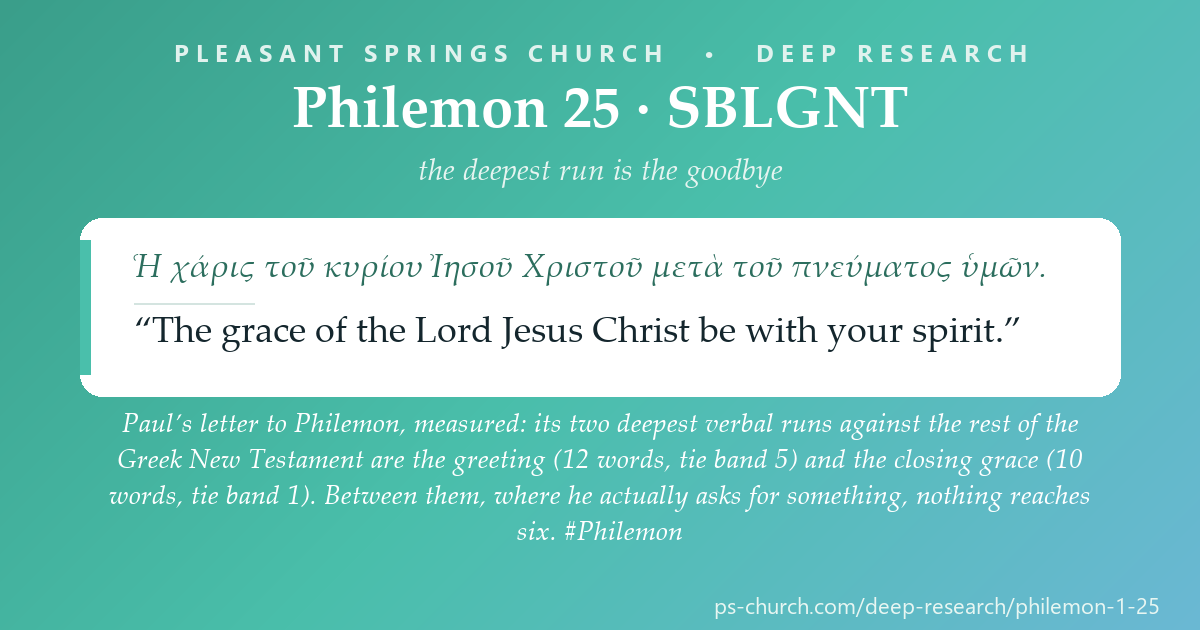
| Phlm 25 | Philippians 4:23 | 10 | 1 | ἡ χάρις τοῦ κυρίου Ἰησοῦ Χριστοῦ μετὰ τοῦ πνεύματος ὑμῶν |
| Phlm 4 | 1 Cor 1:4 | 5 | 2 | εὐχαριστῶ τῷ θεῷ μου πάντοτε |
| Phlm 5 | Revelation 2:19 | 5 | 1 | τὴν ἀγάπην καὶ τὴν πίστιν |
| Phlm 1 | 2 Cor 1:1 · Col 1:1 | 4 | 2 | καὶ Τιμόθεος ὁ ἀδελφός |
| Phlm 19 | Galatians 6:11 | 4 | 1 | ἔγραψα τῇ ἐμῇ χειρί |
| Phlm 23 | Romans 16:3 | 4 | 1 | μου ἐν Χριστῷ Ἰησοῦ |
| Phlm 24 | 1,399 verses, one word each | 1 | 1,399 | Μᾶρκος · Ἀρίσταρχος · Δημᾶς · Λουκᾶς · συνεργοί |
Across the 25 verses: 24 reach two, 13 reach three, 7 reach four, 4 reach five, 2 reach ten, 1 reaches twelve. Nothing in the letter reaches six, seven, eight or nine. There is a hole in the distribution between five and ten, and the two rows on the far side of it are the greeting and the closing grace.
What that shape means
Philemon’s deepest verbal contact with the rest of the New Testament is entirely in the packaging. Verse 3 and verse 25 are the envelope. Between them, verses 4 to 22 — the letter’s whole business — never reach six; the deepest two there are five, and both are formulas of thanksgiving (“I thank my God always”) and of praise (“the love and the faith”).
Inside the appeal itself — verses 8 to 21, where Paul actually asks for something — the deepest run in the whole passage is four, and it is not theology. It is Paul picking up the pen. ἔγραψα τῇ ἐμῇ χειρί, I wrote with my own hand, shared with Galatians 6:11 and no other verse in the Greek New Testament. Ten of those fourteen verses top out at two.
And the run of twelve is the one to be least impressed by. A tie band of five is the definition of a formula: five other letters open with the identical twelve words. This shelf’s first rule is that a run without its band is misleading, and verse 3 is why. The run of ten at verse 25 has a band of one, which looks stronger — until you notice what it depends on. See the last block of this stage.
The counter-example this page prints against itself: verse 24
Verse 24 is the one verse in Philemon that shares no two consecutive words with any other verse in the New Testament. Its maximum is 1. On the Greek-side convention used throughout this shelf, a maximum of 1 means the verse matched no two-word sequence anywhere and fell back to single words — 1,399 verses share one word with it. It does not mean the verse is unique; it means its sequences are.
Now put Colossians 4:10–14 beside it. Philemon 23–24 greets from Epaphras, Mark, Aristarchus, Demas and Luke. Colossians 4:10–14 sends greetings from Aristarchus, Mark, Jesus called Justus, Epaphras, Luke and Demas. The same five men, and on the usual reading out of the same imprisonment — which neither letter says. Run verse by verse, the deepest match between Philemon 24 and any verse of Colossians 4 is one word: Μᾶρκος and Ἀρίσταρχος at Colossians 4:10, Δημᾶς and Λουκᾶς at 4:14.
That is this measurement’s limit, in one row. It finds verbatim sequences, not shared facts, not shared situations, and not allusion. Anyone tempted to read the low numbers in verses 8–21 as evidence that Philemon stands apart from the rest of Paul should read verse 24 first, where the numbers are lowest of all and the connection is beyond dispute. The page prints this against itself deliberately.
One row does register. Philemon 23 shares three words with Colossians 4:10 — ὁ συναιχμάλωτός μου, my fellow prisoner. In Philemon the phrase is applied to Epaphras; in Colossians, to Aristarchus. Three words is short, the page does not call it a citation, and it asserts nothing about which text came first.
The Old Testament: nothing, measured — and why that is weaker than it sounds
All 25 verses were also screened against the Greek Old Testament held on this disk — 30,348 verse units in 63 CATSS files screened, of 64 held. The deepest run in the whole letter is four, it happens once, and it is not a quotation. First run over 44 files and 23,061 units; re-run on 24 September 2026 over the enlarged corpus, and every row in this table held, run and band alike.
| row | deepest Greek OT partner | run | tie band | the shared words |
|---|---|---|---|---|
| Phlm 5 | 1 Macc 14:35 | 4 | 2 | καὶ τὴν πίστιν ἥν |
| Phlm 5 | 1 Samuel 30:31 | 4 | καὶ εἰς πάντας τούς — a different four words, in a different book | |
| Phlm 10, 13 | Sirach 28:19 | 3 | 1 | ἐν τοῖς δεσμοῖς |
| Phlm 25 | Ezekiel 11:5 · Isaiah 33:11 | 3 | 2 | τοῦ πνεύματος ὑμῶν |
Across the 25 verses against the Greek Old Testament: 24 reach two, 11 reach three, 1 reaches four, and nothing reaches five. ⚠️ Corrected 24 September 2026: over the 44-file corpus this read 10 reach three. The enlarged corpus lifts one row — Philemon 15, γὰρ διὰ τοῦτο, now also stands in Exodus 5:8 (a run of three, tie band 1; it was two before). A common phrase, not a quotation, and nothing else in the letter moved.
⚠️ A control, because a negative on its own proves nothing. The same screen was run on Galatians 3 — a chapter with six explicit Old Testament quotations. The Genesis 15:6 citation at Galatians 3:6 comes out at seven words, tie band of one. The other five do not clear four. Genesis 12:3 at 3:8 measures three; Habakkuk 2:4 at 3:11 measures three; Deuteronomy 21:23 at 3:13 measures three; Deuteronomy 27:26 at 3:10 measures two; and Leviticus 18:5, quoted at 3:12, measures three — ζήσεται ἐν αὐτοῖς, shall live by them. Worse: the deepest run in Galatians 3 that the screen finds at 3:10 — five words, band of six — is not the citation Paul is making there. It is a Deuteronomic formula. ⚠️ Corrected 24 September 2026, on the enlarged corpus. Until then this read that Leviticus 18:5 “cannot be checked at all because Leviticus is not among the files on this disk”; Leviticus is now held and the citation measures three, so the control still stands at five of six not clearing four. And the band at 3:10 was five over the 44-file corpus; it is six now, because Joshua 23:6 carries the same ἐν τῷ βιβλίῳ τοῦ νόμου.
So the honest statement is this. Philemon shows no run deep enough to look like a quotation, which is consistent with the standard judgement that this letter quotes no Scripture. But the control shows the screen misses five citations out of six, so the measurement supports that judgement and does not prove it. A page that reported the Philemon number without the Galatians control would be overselling it.
And one number on this page depends on which edition you print
The run of ten at verse 25, with its tie band of one, is edition-dependent, and the page would rather say so than be caught at it.
The SBL text printed here reads ἡ χάρις τοῦ κυρίου Ἰησοῦ Χριστοῦ. Other editions read of our Lord, with ἡμῶν — and the Latin Vulgate on this disk does exactly that: Gratia Domini nostri Jesu Christi cum spiritu vestro. Amen. Re-run with ἡμῶν in place, Philemon 25 drops to six against Philippians 4:23 and matches Galatians 6:18 instead — eleven consecutive words, tie band of one. Same verse, same screen, a different partner and a different number, on the strength of one word the SBL editors themselves flag.
Two more of their flags are visible in the same Latin file. At verse 12 the Vulgate carries a clause the Greek printed here does not — Tu autem illum, ut mea viscera, suscipe, “but you, receive him as my own heart” — which is why the King James has “thou therefore receive him” and the ESV does not. And verse 25 ends Amen in the Latin and does not in the Greek. Counted from the file: the SBL editors mark 17 points of edition-difference, printed with 21 sigla, across 14 of Philemon’s 25 verses. Your Bible’s footnotes are not hiding anything; they are showing you these.
Where this page is weakest, and what was not reached.
The limits of the measurement
The screen finds verbatim contact. It does not find allusion, and verse 24 is the proof. The same five men, the same prison, a maximum run of one. Any conclusion on this page that depends on a low number is weaker than it looks, and the Galatians 3 control shows the same thing from the other side: five of six known quotations do not clear four.
The Greek Old Testament corpus is the CATSS text, not the whole Septuagint. Every CATSS book is now held — 64 files, 30,637 verse units — and 63 files, 30,348 units, are screened; the Odes are held but withdrawn, because Odes 9 and 13 are Luke 1–2 and ten others duplicate passages already in the corpus. So “no Old Testament quotation” means “none in the 30,348 verse units screened.” Until 24 September 2026 this read: “44 CATSS files are held; twenty are not, including Exodus, Leviticus, Numbers, Joshua, Wisdom, Judith, Tobit, 2–4 Maccabees, Odes, Psalms of Solomon, Baruch, the Letter of Jeremiah, Bel and Susanna” — and “none in the 23,061 verse units searched.” The re-run over the full corpus is reported in stage 4.
The tie band for verse 24 is not a normal tie band. 1,399 is the number of verses sharing a single word once the two-word search returned nothing. It is a count of a fallback, not of a rival match, and it should not be read as if it were the 5 at verse 3.
And the run of ten depends on the printed edition, as the last block of stage 4 says. So does any inference drawn from it.
What was not consulted at all
No Greek critical apparatus beyond the SBL edition’s own sigla as they appear in the file — the marks were counted, and the readings behind them were not collated. No papyri: 𝔓87, the third-century fragment of Philemon, was not examined. No Codex Sinaiticus, Vaticanus, Alexandrinus or Claromontanus. The Textus Receptus was not read; what it is said to contain at verses 2, 12 and 25 is reported from reference works and cross-checked only against the Clementine Latin held here.
No Greco-Roman documentary papyri on slavery or manumission. Pliny’s Letters 9.21 is not on this disk and was not read in Latin. No inscriptional evidence for the name Onesimus was checked; the statement that it is a common slave name is reported from the commentaries. No patristic reception — Ignatius’s letter to the Ephesians, which names a bishop Onesimus and which some have connected to this man, was not consulted, and this page takes no position on that identification.
And no history of interpretation was examined for the use of this letter in the slavery debates of the eighteenth and nineteenth centuries — where it was quoted hard on both sides. That is a serious omission for a page on this subject and it is named as one.
Where this page is weakest
The literary structure. Only the A / A′ frame is verifiable word by word. The B / B′ correspondence is thematic and the diagram says so; a reader who thinks it is over-read is not being unreasonable. The page deliberately does not call Philemon a chiasm, because the evidence supports an inclusio inside an ordinary letter form and nothing stronger.
The question of what verse 21 asks for is not settled here and cannot be. “Knowing that you will do even more than I say” has been read as a request for manumission, as a request for Onesimus to be sent back to Paul, and as deliberate vagueness. All three are readings of a sentence Paul left open. This page reports the openness.
The English. Fifteen of the letter’s twenty-five verses are quoted in the ESV column, several only in part. The standing note on this shelf’s English quotation applies.
Reading list
- Douglas J. Moo, The Letters to the Colossians and to Philemon (Pillar NTC).
- James D. G. Dunn, The Epistles to the Colossians and to Philemon (NIGTC).
- Markus Barth & Helmut Blanke, The Letter to Philemon (ECC).
- John M. G. Barclay, “Paul, Philemon and the Dilemma of Christian Slave-Ownership,” NTS 37 (1991).
- N. T. Wright, Colossians and Philemon (Tyndale NTC).
- None of these were consulted for the measurements on this page, which were run on the text files named in the footer.
Charge it to my account.
What to carry away
The measurement says something plain about this letter, and it is worth saying before anything devotional. Philemon’s greeting and its closing grace are the most conventional sentences Paul ever wrote — twelve words shared with five other letters, ten shared word for word with Philippians. Everything in between is unlike anything else in the New Testament. Paul reached for the standard envelope, and then wrote, in language he never used again, the hardest letter of his life.
He had the authority to command and he refused to use it. “Though I am bold enough in Christ to command you … for love’s sake I prefer to appeal to you.” There is a whole doctrine of Christian leadership in that refusal. Paul wanted the right thing done, but he wanted it done freely — “not by compulsion but of your own accord” — because a good deed extracted under pressure is not the good deed he was after.
And he paid. “If he has wronged you at all, or owes you anything, charge that to my account” — and then, in his own handwriting, ἐγὼ ἀποτίσω, I will repay. It is the same shape as the gospel and the letter does not have to say so: a debt that belongs to one name is written against another, by the one who is owed. Then Paul adds the line that makes the whole thing sting: “to say nothing of your owing me even your own self.” Philemon has been asked to forgive a debt he could collect, by a man to whom he owes his life.
Step in response: think of one relationship where you are in the right and you know it, and where you could enforce it. Then read verse 17 and decide what to do about the one person you would least like to receive “as you would receive me.”
Philemon 16 · to share
Greek NT + ESVEvery Deep Research page traces its passage across the whole sweep — the Old Testament, the Second-Temple world between the testaments (historical witnesses, not Scripture), and the New Testament. Follow the thread:
Pleasant Springs Church — Deep Research
Research method after Michael S. Heiser’s Bible Research Method (examine dictionaries → ancient literature → important words → textual connections → academic publications → share), with the Pleasant Springs “Author & Audience” foundation. Scripture set in the Hebrew, the Greek editions named on each page and the ESV (Old Testament), and the Greek New Testament and the ESV (New Testament), per the practice of Pleasant Springs Church. Philemon research grounded in Moo (Pillar), Dunn (NIGTC), Barth & Blanke (ECC), Barclay (NTS 37) and Wright (TNTC). Text: Greek New Testament from the SBL edition as digitized by MorphGNT (file 78-Phm.txt); English from the ESV; Latin from the Clementine Vulgate held on this disk. ⚠️ VERSE NUMBERING — there is no offset in this book, and no Septuagint column on this page. Philemon is a New Testament letter, so its two columns are the Greek New Testament and the English; the Masoretic / Septuagint numbering question that governs most pages on this shelf does not arise here at all. Philemon has a single chapter of 25 verses in the SBL Greek and 25 in the ESV, and every reference on this page means the same verse in both. The Greek file indexes them 1:1–1:25 and the ESV prints bare verse numbers 1–25; this page uses the chapter-and-verse form throughout. Stated because the shelf states it everywhere, including where there is nothing to convert. One cross-reference does carry an offset: the runaway law is Deuteronomy 23:15–16 in the ESV and 23:16–17 in the Greek held here, and both numbers are printed. ⚠️ The measurement, in full. Greek against Greek. MorphGNT field 6, the normalised word — the column that already resolves elision and the movable nu — lowercased, accents and breathings dropped, final sigma folded, then filtered to Greek letters. Word FORMS, never lemmas. Contiguous runs only; gaps and reordering do not count. Source: the 25 verses of Philemon. Targets: the other 7,902 verses of the Greek New Testament across 27 MorphGNT files, and separately the 30,348 verse units of the Greek Old Testament screened across 63 CATSS files (of 64 held; the Odes are held but not screened) — first run over 23,061 units in 44 files, re-run 24 September 2026; one row moved, as stage 4 records. Exhaustive and deterministic; nothing sampled, so no seed applies. The tie band is printed beside every run. Lemma counts are taken from MorphGNT field 7 across all 27 files. ⚠️ What a maximum of 1 means here. This page uses the Greek-side convention (unigram_fallback=True): a verse that matches no two-word sequence anywhere falls back to single words, so 1 means ‘shares no two consecutive words with any other verse’ and 0 would mean ‘shares no word at all’. Philemon 24 is a 1, and its band of 1,399 counts single-word fallbacks, not rival matches. ⚠️ The page prints its own counter-example. Philemon 24 and Colossians 4:10–14 name the same five men and measure one shared word. And in the Galatians 3 control, five of six known Old Testament citations fail to clear a run of four. Both results are printed because both limit what the rest of the numbers on this page are worth. ⚠️ One number is edition-dependent. Philemon 25 reaches ten against Philippians 4:23 in the SBL text; read with ἡμῶν, as the Latin here does, that partner is gone and Galatians 6:18 stands in its place at eleven. The 17 points of difference (21 apparatus sigla) across 14 verses were counted from the file; the readings behind them were not collated. ⚠️ Direction of influence is never asserted. Nothing here says that Philemon is prior to Colossians or later, that Paul is quoting himself, or what produced any reading. And the letter’s hardest question — what verse 21 asks Philemon to do — is reported as open, because the text leaves it open. Typology is handled per the house position: what the text says, what the New Testament itself draws, and what we see from this side of the cross — with the seeing left to the reader.
Scripture quotations marked ESV are from the ESV® Bible (The Holy Bible, English Standard Version®), © 2001 by Crossway, a publishing ministry of Good News Publishers. ESV Text Edition: 2016. Used by permission. All rights reserved. The ESV text may not be quoted in any publication made available to the public by a Creative Commons license, and the ESV may not be translated in whole or in part into any other language. www.esv.org
|
Did this study bless you today? 💚 Give to Support PS Church100% of gifts go to the General Fund — thank you. |