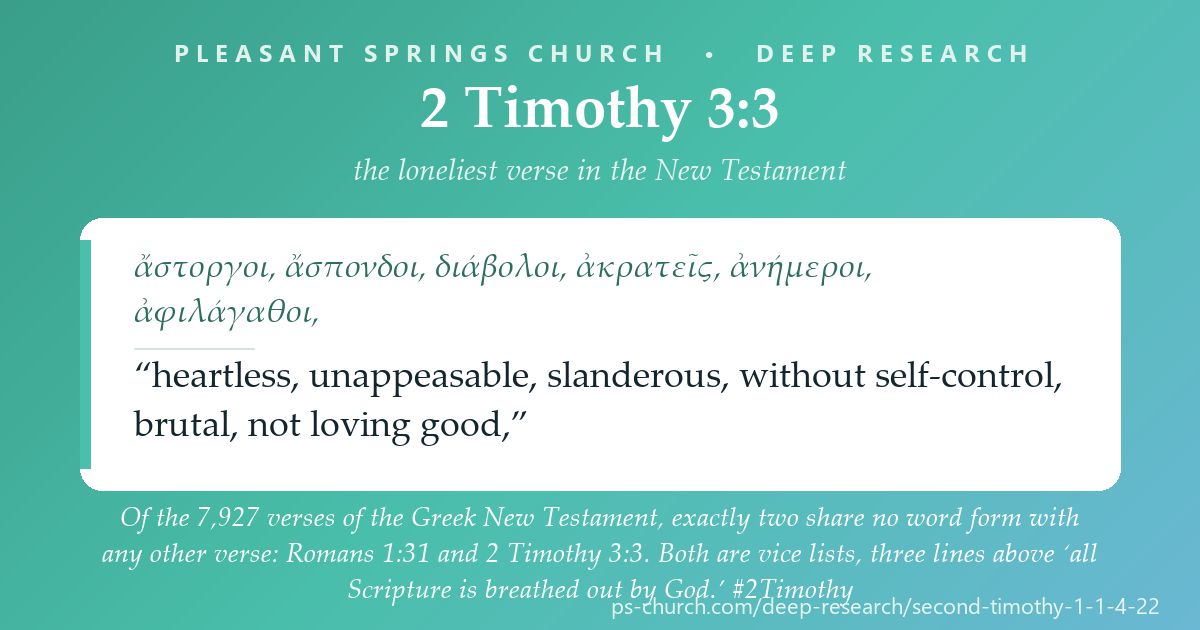
We came to 2 Timothy for 3:16. Everyone does. All Scripture is breathed out by God is the sentence the church builds its doctrine of the Bible on, and θεόπνευστος turns out to occur exactly once in the Greek New Testament and not once in the 30,348 verse units of the complete Greek Old Testament screened on this disk. But the measurement that stopped us was three verses earlier. Screen every verse of the Greek New Testament against every other verse, asking only does this verse share a single word form with anything else, and 7,925 of the 7,927 say yes. Two say no. One is Romans 1:31. The other is 2 Timothy 3:3 — ἄστοργοι, ἄσπονδοι, διάβολοι, ἀκρατεῖς, ἀνήμεροι, ἀφιλάγαθοι — six words for what a person becomes. Both are vice lists. And the one lemma the two verses hold in common, ἄστοργος, which occurs twice in the New Testament and only in these two verses, stands in two different case forms, so the run engine cannot see the link at all. The letter that tells us where Scripture comes from contains the loneliest sentence in the New Testament, and it is a list of what love looks like when it is gone. See the method →
2 Timothy 1:1–4:22 (selections)
Greek New Testament (SBLGNT / MorphGNT) · ESV★ And the row at 3:3 was not what we expected. We went into this book looking at 3:16, and found that the verse three lines above it is one of only two verses in the entire Greek New Testament that share no word form with any other verse. The other is Romans 1:31. Stage 4 gives the pair, the measurement, the tie bands and the counter-examples.
The Shape of the Passage
A sequence of charges, framed by two rolls of names — not a chiasmTwo counts were run for this panel rather than repeated from a commentary: the letter’s vocabulary against the whole Greek New Testament, and its proper nouns against the other twelve Pauline letters. They point in opposite directions, and the panel says so.
Author
The letter names Paul in its first word. Παῦλος ἀπόστολος Χριστοῦ Ἰησοῦ — and 1:1 continues διὰ θελήματος θεοῦ, seven consecutive words that open 2 Corinthians, Ephesians and Colossians in exactly the same order. That is the page’s starting point and its position.
And the vocabulary is the most unusual in the corpus. Counted here from the MorphGNT lemma column across all 27 books: 59 lemmas occur in 2 Timothy, once, and in no other book of the Greek New Testament, in a letter of 1,235 words. That is 47.8 per thousand — the highest of the thirteen letters that name Paul. But the honest reading of the table cuts against the easy conclusion. Titus comes in at 47.0 and 1 Timothy at 40.9, so the three Pastorals sit together at the top and the gap between 2 Timothy and Titus is smaller than the correction for tagging artefacts that had to be applied to get there. The ordering inside that top group is not robust and this page does not lean on it.
Audience
One man, and then a room full of named people. Everything addressed to Timothy is second-person singular — guard, entrust, preach, come before winter. The letter’s last words are ἡ χάρις μεθ’ ὑμῶν — grace be with you, plural — exactly as 1 Timothy ends. A letter to one man that expects a room to be listening.
And it is the most crowded short letter Paul is credited with. Counted from the MorphGNT lemma column — capitalised lemmas, with the divine names Christos and Iesous struck out on every book alike, since they stand in every letter and would drown the signal: 41 distinct proper nouns in 1,235 words, 33.2 per thousand. Only Philemon is comparable, at 32.9 in 334 words. Romans has 70 names across 7,055 words, which is 9.9. 1 Timothy has 11. Whatever else this letter is, it is not abstract: it names who left, who stayed, who did harm, who is sick, where the coat is, and who sends greetings.
Orient on the Pastoral Epistles as a group, on Roman imprisonment, on the vice-list form, and on the word behind inspiration.
Search by topic: Timothy, Second Letter to; Pastoral Epistles; inspiration of Scripture; theopneustos; vice lists / catalogues of vices; Jannes and Jambres; testament (literary form); Roman imprisonment and the Mamertine; parchment and codex; deposit (paratheke).
Which articles are relevant?
- Anchor Bible Dictionary — “Timothy, Second Epistle to,” “Pastoral Epistles,” “Jannes and Jambres,” “Inspiration,” “Virtue/Vice Lists.”
- Dictionary of Paul and His Letters (IVP) — “Pastoral Letters,” “Virtues and Vices,” “Pseudepigraphy,” “Suffering.”
- Dictionary of the Later New Testament (IVP) — “Creeds and Hymns,” “Faithful Sayings,” “Scripture, Use and Interpretation of.”
- New International Dictionary of NT Theology and Exegesis — θεόπνευστος, γραφή, γράμμα, παραθήκη, ἄστοργος.
- Dictionary of NT Background (IVP) — “Moses Traditions,” “Damascus Document,” “Testaments.”
Settle the numbering — there is nothing to convert inside this book
A New Testament letter has no Hebrew column and no Septuagint column of its own. The Greek printed on this page is the language the letter was composed in, not a translation of a Hebrew original. What still has to be checked is whether the verse divisions agree, and here they do.
| 1 | 2 | 3 | 4 | total | |
|---|---|---|---|---|---|
| SBL Greek NT | 18 | 26 | 17 | 22 | 83 |
| ESV | 18 | 26 | 17 | 22 | 83 |
| Public-domain English edition (counted off disk; a numbering source consulted, not a column printed) | 18 | 26 | 17 | 22 | 83 |
Counted from the corpora themselves, not from a table: 83 verse units in the MorphGNT file and 83 addressable verses in the public-domain English edition held here, a file consulted for numbering and printed nowhere on this page. ⚠️ The ESV row in the table above is not a local count — no ESV file for this book is held on this disk — and is given as the standard English versification. Every reference on this page therefore means the same verse in every column. Old Testament pages on this shelf frequently do not have that luxury, which is exactly why the question is asked every time.
Where this page does cross a numbering seam
2 Timothy 4:17 shares three consecutive Greek words with a Psalm, and the Psalter is the worst offender on this shelf for numbering. The verse is CATSS Greek Psalm 21:22 · Masoretic 22:22 · ESV 22:21, and all three numbers are printed wherever it appears below. The Greek Psalter runs one chapter behind the Masoretic from 9/10 through 147; inside Psalm 22 the Hebrew counts the superscription as verse 1 and the English does not, which costs a further one. Nothing was converted silently.
2 Timothy 2:19 is the other place a source would be named. ★ This note used to read: “it is worse — the line commentators place at Numbers 16:5 cannot be checked here at all, because Numbers is one of the twenty CATSS files not on this disk.” Numbers arrived 30 August 2026, the check was run, and it came back with Numbers 16:5 as the verse’s single unrivalled partner in all 30,348 screened units. Stage 4 prints the run, the band, and the one-word divine-name difference that keeps the exact string at zero.
A Greek moral form, two names from outside the Bible, a libation, and a request for a coat.
The vice list is a form, and both of the New Testament’s most isolated verses are inside one
Catalogues of vices are standard equipment in Hellenistic moral writing — Stoic handbooks, Hellenistic Jewish paraenesis, and the New Testament all use them. The form piles up adjectives with no connectives, often alliterating, often building compounds with an alpha-privative — the a- that turns a word into its negation.
That form is the mechanical reason for this page’s central measurement. Of the six words in 2 Timothy 3:3, five begin with that alpha-privative: ἄ-στοργος, ἄ-σπονδος, ἀ-κρατής, ἀν-ήμερος, ἀ-φιλάγαθος. All four of Romans 1:31’s words do the same. A writer coining negations on the spot will produce words nobody else in the corpus happens to have used, and the measurement is detecting that as much as anything theological. The page reports the number and reports the reason.
No Stoic handbook, no Hellenistic Jewish paraenetic text and no papyrus was read for this page. The description of the form above is reported from reference works. Stage 5 repeats that.
Jannes and Jambres — two names the Old Testament does not have
Measured: Ἰάννης and Ἰαμβρῆς each occur once in the Greek New Testament (2 Timothy 3:8) and zero times in the complete 64 Greek Old Testament files held here. The letter treats them as common knowledge and does not explain who they are. Reference works place the tradition in Second Temple Judaism — the Damascus Document names an opponent pair, and later Greek and Latin writers know the name Iannes — but none of that literature is on this disk and none of it was read.
A near-miss printed so nobody else trips on it: a stem search on the local Greek Old Testament returns two hits for Ἰαμβρ-, at 1 Maccabees 9:36 and 9:37. They are Ιαμβρι — the sons of Jambri, a Transjordanian clan. A different man and a different name. Not a match, and it is reported here rather than quietly dropped.
A drink offering, a cloak and a stack of parchment
σπένδομαι at 4:6 is sacrificial vocabulary: two occurrences in the Greek New Testament (Philippians 2:17 and here) and nineteen in the complete 64-file Greek Old Testament. ★ This page published thirteen, over 44 files. Greek Exodus and Numbers arrived 30 August 2026 and the count is nineteen. The thirteen were Genesis 35:14, 1 Chronicles 11:18, Hosea 9:4, Jeremiah 7:18, 19:13, 39:29, 51:17, 51:19 (twice) and 51:25, Ezekiel 20:28, Daniel (Th) 2:46 and Sirach 50:15. The six new ones are Exodus 25:29, 30:9, 38:12 and Numbers 4:7, 28:7 — the tabernacle drink offering itself — and 4 Maccabees 3:16, a witness, not Scripture.
⚠️ And the re-run corrected two things in the old sentence besides the number. It named 2 Samuel 23:16 among the thirteen; the CATSS lemma is not there — 2 Kingdoms 23:16 tells the story with ἡθέλησεν and no libation verb, and it is the parallel at 1 Chronicles 11:18 that carries it. And it said “every one of them a libation poured out.” That is now too tidy: 1 Chronicles 11:18 and 4 Maccabees 3:16 are both David pouring out the water his men risked their lives for, which is a libation by extension, not an altar rite. The corrected sentence: nineteen occurrences, seventeen of them cultic drink offerings, two of them David’s water. The letter is still not saying I am tired. It is saying I am the wine at the base of the altar, and the shelf can now show the altar.
Against that, 4:13. φαιλόνης is a heavy travelling cloak and μεμβράνα is the Latin membrana, prepared animal skin, in Greek endings. Both occur once in the Greek New Testament and zero times in the Greek Old Testament held here. The same paragraph that says the drink offering is being poured out asks for a coat and some parchment. Whatever one concludes about who wrote this letter, that combination is not what a forger reaches for.
The claim that μεμβράνα is a Latin loan, and the claim that these would be notebooks rather than scrolls, are reported from lexica and reference works. No documentary papyri were consulted, and the papyri are precisely where that would be demonstrated.
Seven words, each counted rather than characterised.
Counts are of NORMALISED word forms over the SBL Greek New Testament as digitised by MorphGNT (7,927 verses), and over the complete 64 CATSS Greek Old Testament files held here (30,637 verse units held, 30,348 of them screened — the 289-unit difference is the Odes, which stay on disk and are excluded from every screen; see Stage 5). Word forms and lemmas are counted separately and the page says which.
1 occurrence in the Greek New Testament (3:16) and 0 in the 30,348 screened verse units of Greek Old Testament. The doctrine is named after a word that stands in one verse.
2 occurrences, and only in the New Testament’s two most isolated verses — Romans 1:31 and 2 Timothy 3:3. Different case forms, so no run-screen can see the link.
3 occurrences in the Greek New Testament and 0 in the local Greek Old Testament. All three are in these two letters: 1 Timothy 6:20, 2 Timothy 1:12 and 1:14.
11 occurrences in the Greek New Testament, and 3 of them are in 2 Timothy 1 — 1:8, 1:12, 1:16. The adjective ἀνεπαίσχυντος at 2:15 occurs once in the New Testament.
1 occurrence in the Greek New Testament (2:15) and 2 in the local Greek Old Testament — Proverbs 3:6 and 11:5, both of a path made straight.
2 in the Greek New Testament (Philippians 2:17 and 2 Timothy 4:6) and 13 in the local Greek Old Testament, every one a drink offering.
Exactly 1 verse in the Greek New Testament carries this two-word sequence (3:15), and 0 in the Greek Old Testament held here. πᾶσα γραφή at 3:16 is likewise a one-verse phrase.
The fifty-nine, and the one row struck out of the count
Counted from the MorphGNT lemma column over all 27 books: 59 lemmas occur in 2 Timothy, once, and in no other book of the Greek New Testament. Widen the test to lemmas found only in 2 Timothy at any frequency and the figure is 62 — the three extra are ἀθλέω, συγκακοπαθέω and the name Ὀνησίφορος, each twice. Both counts are given because they answer different questions.
⚠️ One entry in the raw list is a tagging artefact and the page removes it rather than banking it. MorphGNT tags the neuter plural χρυσᾶ at 2 Timothy 2:20 with the lemma χρύσεος, while the same normalised surface form elsewhere is tagged χρυσοῦς. That is a decision about which lexical form to head an entry with, not a rare word. The raw screen returned 60 and 63; the figures printed everywhere on this page are 59 and 62.
Some of the fifty-nine, so the reader can judge the class of word: μάμμη (grandmother, 1:5), στρατολογέω (to enlist as a soldier, 2:4), γάγγραινα (gangrene, 2:17), γυναικάριον (a weak little woman, 3:6), κνήθομαι (to have itching ears, 4:3), φαιλόνης (cloak, 4:13), μεμβράνα (parchment, 4:13), χαλκεύς (coppersmith, 4:14). These are not theological neologisms. They are the words a letter needs when a man in custody talks about his family, his infections, his luggage and the tradesman who hurt him.
Every verse of 2 Timothy screened against the rest of the Greek New Testament and against the Greek Old Testament held here — with the tie band beside every run.
Greek against Greek. MorphGNT field 6, the normalised word form (the column that already resolves elision and the movable nu), lowercased with accents and breathings dropped and final sigma folded; the CATSS FORM column put through the same filter after beta-code transliteration. Word forms, never lemmas. Contiguous runs only. The tie band is how many other verses reach the same depth; a run without its band is misleading.
First, the counter-examples — because the deepest runs in this book prove nothing
The two deepest runs 2 Timothy has anywhere in the Greek New Testament are a greeting and a doxology.
| 2 Timothy | against | run | tie band | what it is |
|---|---|---|---|---|
| 1:2 | 1 Timothy 1:2 | 12 | 1 | The salutation. grace, mercy, peace from God the Father and Christ Jesus our Lord — a form, twice used. Eight of the twelve also stand in Titus 1:4. |
| 4:18 | Galatians 1:5 | 9 | 1 | A doxology. Tie band of one, and still not a citation: drop the leading relative and the eight-word form stands in Galatians 1:5, Philippians 4:20 and here. |
| 1:1 | 2 Corinthians 1:1 · Ephesians 1:1 · Colossians 1:1 | 7 | 3 | Paul, an apostle of Christ Jesus by the will of God. Deep, and shared with three verses at once. |
| 4:8 | 1 Chronicles 29:22, 1 Maccabees 5:34 and 25 others (local Greek OT) | 4 | 27 | in that day. Four words in a band of twenty-seven is a formula, not a contact. |
Print those first and the reader is properly warned: depth alone is not evidence of quotation. A greeting, a doxology and a date-formula can all run deep because they are fixed forms. What makes a run interesting is depth with a narrow band and a reason to look.
Now the measurement this page is built on — 2 Timothy 3:3 and Romans 1:31
The question asked was the simplest one the substrate can ask: does this verse share a single word form with any other verse in the Greek New Testament? Not a phrase. Not two consecutive words. One word. Run over all 7,927 verses, each against the other 7,926.
7,925 verses say yes. Two say no.
| verse | text | word forms | run | tie band |
|---|---|---|---|---|
| Romans 1:31 | ἀσυνέτους, ἀσυνθέτους, ἀστόργους, ἀνελεήμονας | 4 | 0 | 0 |
| 2 Timothy 3:3 | ἄστοργοι, ἄσπονδοι, διάβολοι, ἀκρατεῖς, ἀνήμεροι, ἀφιλάγαθοι | 6 | 0 | 0 |
⚠️ What a zero means here, said exactly. This screen runs with unigram_fallback=True, the Greek-side convention on this shelf: a verse that shares only isolated single words still reports 1. So a reported 0 means the verse shares no word form at all — the strong sense. It is not the Hebrew-side convention, where 0 means only that no two consecutive words are shared.
And the two verses are joined by a word the measurement cannot see. ἄστοργος — without natural affection — occurs exactly twice in the Greek New Testament, and the two occurrences are these two verses and no others. But Romans has the accusative ἀστόργους and 2 Timothy has the nominative ἄστοργοι. This shelf counts word forms, never lemmas. Two forms of the same word do not match. So the only lexical link between the New Testament’s two loneliest verses is invisible to the method that found them. That is not a flaw being confessed; it is the method working as designed and the page saying what the design costs.
Why it happens, and why the page will not make it mean more than it does
The mechanical reason is the alpha-privative. Five of 2 Timothy 3:3’s six words and all four of Romans 1:31’s begin with the negating a-. Piling up negated compounds is what a Greek vice list does, and a compound coined for a list is exactly the kind of word that will not occur twice in a corpus of 137,554 words. The measurement is detecting a literary form at least as much as anything else.
And the words are not all rare as lemmas. διάβολος is the ordinary New Testament word for the devil and its lemma occurs 37 times in 35 verses; it is only the masculine nominative plural διάβολοι that occurs once. ἀσύνετος in Romans 1:31 occurs five times as a lemma. The zero is a zero of FORMS. Say ‘these verses contain no word found anywhere else in the New Testament’ and you have overstated it, and this page does not.
What is left when both of those deductions are made is still worth printing: of 7,927 verses, these two and only these two are cut off at the level the run engine works at, they are both catalogues of what a person becomes, and they are tied to each other by a single word for the loss of natural love.
★ 2 Timothy 2:19 — the measurement this page could not make, made
The verse reads: ἔχων τὴν σφραγῖδα ταύτην· Ἔγνω κύριος τοὺς ὄντας αὐτοῦ, καί· Ἀποστήτω ἀπὸ ἀδικίας πᾶς ὁ ὀνομάζων τὸ ὄνομα κυρίου.
| line | searched against | result |
|---|---|---|
| as published — 44 files, 23,061 units | now — 64 files, 30,348 screened units | |
| The Lord knows those who are his, as a five-word sequence | 0 | 0 |
| who names the name of the Lord, as a sequence | 0 | 0 |
| the whole verse, as a row, deepest partner | run 3, tie band 38 — the formula τὸ ὄνομα κυρίου, shared with thirty-eight rows and pointing nowhere | run 4, tie band 1 — NUMBERS 16:5, the four words τοὺς ὄντας αὐτοῦ καί |
★ What this page could not do, and now has. Until 30 August 2026 this section read: “this zero is weaker than it looks… standard commentary places the first line at Numbers 16:5, and Numbers is one of the twenty CATSS files not on this disk. So the correct sentence is: the line is not in the forty-four Greek Old Testament books searchable here, and the book it is usually traced to was not among them.” Numbers came onto the shelf that day. The screen has been re-run and it found the verse the commentators name, unrivalled. Where the whole verse used to drift into a band of thirty-eight rows all sharing one stock phrase, it now lands on one row out of 30,348, and that row is Numbers 16:5.
⚠️ And the exact string still returns zero — for a reason that is now known, and is one word wide.
| text | the line |
|---|---|
| 2 Timothy 2:19 | ἔγνω κύριος τοὺς ὄντας αὐτοῦ — the Lord knew those who are his |
| CATSS Numbers 16:5 | …ἐπέσκεπται καὶ ἔγνω ὁ θεός τοὺς ὄντας αὐτοῦ καὶ τοὺς ἁγίους… — and God knew those who are his, and the holy ones |
Four of the five words match, in order. The one that does not is the divine name. The letter has κύριος where this Greek Numbers has ὁ θεός, and that single substitution is the whole of why an exhaustive search for the five-word string returns nothing. The zero is real and it is not a finding about absence any more; it is a finding about a divine-name difference between 2 Timothy’s line and the Greek Numbers on this disk. Whether Paul is quoting a Greek text that read κύριος, translating the Hebrew himself, or citing from memory, a run-length screen cannot say and this page does not guess.
The second line is a separate question and it did not resolve. Commentators variously send let everyone who names the name of the Lord depart from iniquity to Numbers 16:26, Isaiah 26:13, Sirach 17:26 or Job 36:10. Now that all of those are on disk, the shelf has measured all four: Numbers 16:26 reaches 1 (ἀπό), Isaiah 26:13 reaches 2 (τὸ ὄνομα), Sirach 17:26 reaches 2 (ἀπὸ ἀδικίας, and Sirach is a witness, not Scripture), Job 36:10 reaches 1. None of them is contact at the level this screen measures. The seal’s first line now has a partner on this shelf and its second line still does not — and that asymmetry could not be seen at all while Numbers was missing, because then neither line had one.
What can be said cleanly: 2 Timothy never uses a citation formula. γέγραπται, it is written, occurs zero times in this letter — but it also occurs zero times in Ephesians, Philippians, Colossians, 1 and 2 Thessalonians, 1 Timothy, Titus and Philemon, so that is a fact about short letters and not about this one in particular. What 2:19 has instead is ἔχων τὴν σφραγῖδα ταύτην — bearing this seal — which is an inscription formula, not a Scripture formula.
The one real Old Testament contact in the letter, and it is not flagged
2 Timothy 4:17 ends καὶ ἐρρύσθην ἐκ στόματος λέοντος — and I was rescued from the lion’s mouth.
| sequence | Greek OT held here | Greek NT |
|---|---|---|
| ἐκ στόματος λέοντος | 1 — Psalm 21:22 (MT 22:22 · ESV 22:21) | 1 — 2 Timothy 4:17 |
Three consecutive words, and the three-word sequence occurs exactly once in each corpus. A tie band of one on both sides. The Greek Psalm reads σῶσόν με ἐκ στόματος λέοντος, save me from the lion’s mouth.
And this is the row that proves the shelf’s first rule. 4:17’s deepest run against the Greek Old Testament is not this. It is four — πάντα τὰ ἔθνη καί, all the nations, and — in a tie band of twelve. The deeper run is the formula and the shallower run is the contact. Reporting only the maximum would have hidden the interesting result entirely.
And it still asserts nothing about direction. A man in a Roman prison reaching for the language of Psalm 21/22 is one explanation; a stock phrase for deliverance is another; a Greek idiom neither of them invented is a third. Three shared words is a shape, not a lineage.
The whole book, screened
All 83 verses of 2 Timothy against the other 7,844 verses of the Greek New Testament.
Across the 83 rows: 81 reach two consecutive shared words, 51 reach three, 31 reach four, 8 reach five, 5 reach seven, 2 reach nine, one reaches twelve, and nothing reaches thirteen. One row reaches only one, in a tie band of 5,343 — 2:12, the middle of the trustworthy saying — and one row, 3:3, reaches zero.
Against the Greek Old Testament held here, the profile is much flatter: 77 of the 83 rows reach two, 34 reach three, 9 reach four, 2 reach five, and nothing reaches six. The two that reach five are 1:18 (in that day, band of five) and 4:18 (the doxology, band of two). Neither is a citation, and the book’s single clearest Old Testament contact — the lion’s mouth at 4:17 — sits at three and never appears in a maximum-only table at all.
That is a statement about verbatim contact, not about dependence. This letter is soaked in Old Testament thought — a seal, a foundation, a crown, a drink offering, an opponent of Moses — and a run-screen cannot see an allusion that shares no consecutive Greek words. The method finds verbatim contact; the absence of a run is not the absence of a source.
And the Pastorals against each other
Screened against 1 Timothy alone, 14 of 2 Timothy’s 83 rows reach four consecutive words or more; against Titus alone, 7 do. The deepest against 1 Timothy is the greeting at twelve (1:2 against 1 Timothy 1:2); the deepest against Titus is the same greeting at eight (Titus 1:4). After the greetings the shared runs are 1:11 against 1 Timothy 2:7 at seven (for which I was appointed a preacher and apostle), 4:1 against 1 Timothy 5:21 at seven (I charge you in the presence of God and Christ Jesus), 4:18 against 1 Timothy 1:17 at seven (the doxology), and 4:9 against Titus 3:12 at four (do your best to come to me). Every run named in this paragraph stands in a tie band of one inside its own restricted screen.
Shared formulae between three short letters addressed to two co-workers are what anyone would expect on any account of their origin. The numbers are reported; no conclusion about authorship is drawn from them here.
Where this page is weakest, and what was not reached.
The limits of the 3:3 finding — there are four, and they are real
1. It is a fact about word FORMS, and forms are an arbitrary unit. Fold the corpus to lemmas and the finding changes shape completely: διάβολος appears 37 times, ἀσύνετος five, and neither verse is isolated any more. The result exists at one level of description and dissolves at another. That is stated plainly rather than buried, because a reader who learns it elsewhere first will rightly distrust everything else here.
2. The literary form explains most of it. Alpha-privative compounds in an asyndetic list are precisely the words a corpus of 137,554 words will only see once. A different genre would not produce this result no matter how isolated the theology.
3. One edition, one digitisation. The screen ran on the SBL Greek New Testament as digitised by MorphGNT. A different critical text, a different normaliser, or a different treatment of the movable nu could move a verse in or out of the zero set. No critical apparatus was consulted for any verse on this page.
4. Two is a very small number. Any claim built on a set of size two is one tagging decision away from being a claim about a set of size one or three. The page reports the pair; it does not build a doctrine on the pair.
The vocabulary count, and what it cannot settle
The hapax count is a real count and a weak argument, in both directions. 59 words in 1,235 is a genuine measurement. It does not establish that Paul did not write this letter — the shelf’s position is stated in the Author panel above; the letter names him. It also does not establish that he did. Subject matter, a secretary, an interval of years, a change of opponent and a prison cell would each raise the number, and the count cannot distinguish them.
⚠️ And this page’s table disagrees with its own sibling by one row. The 1 Timothy study on this shelf struck one tagging artefact by hand and printed 66 New Testament hapax legomena and 41 per thousand. The automatic filter used here — strike any lemma whose normalised surface form is tagged to a different lemma elsewhere in the corpus — flags two rows in 1 Timothy and yields 65 and 40.9. The two pages differ, the difference is one word, and it is named here rather than smoothed over. It does not change either page’s conclusion, and neither figure should be quoted as a published statistic.
The comparison across the other twelve letters is indicative, not definitive. The same automatic filter was applied to every book, which is more than most such tables do, but it catches only one class of artefact. And the top three — 2 Timothy 47.8, Titus 47.0, 1 Timothy 40.9 — are close enough that the ordering between the first two is not something this page would defend.
And this page did not attempt the harder tests. P. N. Harrison’s study and the stylometric literature after it measure particles, connectives and sentence structure, not rare nouns. None of that was run here. Nothing on this page replicates or refutes it.
What could not be checked at all
No Greek critical apparatus, for any verse. No documentary papyri, which is where παραθήκη and μεμβράνα would actually be tested. No Apostolic Fathers — 1 Clement and Polycarp both overlap this material and neither is held here. No Damascus Document, no Targum, no rabbinic literature, and no Greek or Latin author outside the New Testament: the whole Jannes and Jambres tradition is described on this page from reference works and was not read. No Stoic or Hellenistic Jewish vice catalogue, which is the comparative material the central finding most needs.
★ Twenty Greek Old Testament files used to be unsearchable, and this section used to end there. They arrived on 30 August 2026, and what they did to this page is set out rather than absorbed. This paragraph read: “Exodus, Leviticus, Numbers, Joshua, Judith, Tobit, 2–4 Maccabees, Odes, Wisdom, Psalms of Solomon, Baruch, the Epistle of Jeremiah, Bel and Susanna are not on this disk. Numbers is the one that matters most here, because it is where 2:19’s first line is normally placed. Every zero reported against the Greek Old Testament on this page is a zero over 44 files, not over the Septuagint.” All twenty are now on disk; the corpus is the complete CATSS set, 64 files and 30,637 verse units held; and every count on this page has been re-derived against it.
⚠️ AND THEN ONE OF THE TWENTY CAME BACK OUT OF THE SCREEN, LATER THE SAME DAY. THE PAGE PRINTS THE HISTORY RATHER THAN A NEW NUMBER ON ITS OWN. The Odes are the fourteen liturgical canticles bound after the Greek Psalter, and they were in that list of twenty. They stay on disk. They are no longer inside what this shelf screens as ‘the Greek Old Testament’, for two independent reasons.
(1) Two of them are New Testament text. Ode 9 is Luke 1 — the Magnificat and the Benedictus — and Ode 13 is Luke 2, the Nunc Dimittis. Screened, Ode 9:48 matches Luke 1:48 at eighteen consecutive words. That is not a contact between two Testaments; it is Luke matching Luke under an Old Testament shelfmark, and a page could report such a hit as a Gospel’s deepest Old Testament contact while measuring its own text. This page is built almost entirely on zeroes — θεόπνευστος, Λωϊς, Εὐνίκη, Ἰάννης, Ἰαμβρῆς, ἱερὰ γράμματα, the two quotation-shaped lines at 2:19 — and a zero cannot be broken by taking text away. A phantom hit, though, is the one thing that could have broken one, and the Odes are where this shelf found that the instrument can produce them. (2) Ten of them are second copies of passages already in the corpus — Ode 1 = Exodus 15, 2 = Deuteronomy 32, 3 = 1 Samuel 2, 4 = Habakkuk 3, 5 = Isaiah 26, 6 = Jonah 2, 7 and 8 = Daniel (Th) 3, 10 = Isaiah 5, 11 = Isaiah 38 — so a verse standing once appeared to stand twice, and any tie band touching a canticle was doubled for no textual reason.
HELD and SCREENED are therefore two different numbers, and this page uses whichever one a sentence means. The shelf holds 30,637 verse units in 64 files; a screen sees 30,348, the difference being exactly the 289 Odes units.
★ Every figure in the table below was re-derived a second time against the 30,348-unit corpus, and not one of them moved. παραθήκη still stands three times — Leviticus 5:21, 5:23 and Tobit (S) 10:13, none of them a canticle; μάμμη still once at 4 Maccabees 16:9; σπένδω still nineteen; 2:19 is still a run of 4 in a tie band of 1 against Numbers 16:5; and every zero is still a zero. The only thing this correction changes on this page is the number the zeroes are zeroes against — and that number is now smaller, cleaner, and free of a book that would have let a Gospel match itself.
| count | over 44 files | over 64 files | what moved it |
|---|---|---|---|
| παραθήκη, the deposit (1:12, 1:14) | 0 | 3 | Leviticus 5:21, 5:23 — the law of the deposit — and Tobit (S) 10:13 |
| μάμμη, grandmother (1:5) | 0 | 1 | 4 Maccabees 16:9 — a witness, not Scripture |
| σπένδω, poured out as a drink offering (4:6) | 13 | 19 | Exodus 25:29, 30:9, 38:12; Numbers 4:7, 28:7; 4 Maccabees 3:16 |
| 2:19 as a row, deepest Greek OT partner | run 3, band 38 | run 4, band 1 | Numbers 16:5 — the verse the commentators name |
| θεόπνευστος (3:16) | 0 | 0 | unchanged — the zero survived a third more corpus |
| Λωϊς, Εὐνίκη, Ἰάννης, Ἰαμβρῆς, ἱερὰ γράμματα, φαιλόνης, μεμβράνα | 0 | 0 | unchanged |
Three counts moved and one of them changed a finding. The παραθήκη zero was this page’s evidence that Paul’s word for the guarded deposit had no Greek Old Testament home. It has one, and it is the Levitical law of goods left with a trustee — which is the word’s own legal sense, and makes the metaphor sharper rather than weaker. The remaining zeroes held.
⚠️ What is still true about every zero on this page. It is now a zero over the complete CATSS digitisation of Rahlfs — a far stronger scope than 44 files — but still one edition, and never a zero over “the Septuagint” as such. And the deuterocanonical books now inside the count are WITNESSES, NOT SCRIPTURE: Wisdom, Sirach, Judith, Tobit, Baruch, the Maccabees and the Psalms of Solomon are measurement partners for the Greek, and this page names what they are at every hit.
Nor is the meaning of 3:16 settled here. Whether πᾶσα γραφὴ θεόπνευστος is all Scripture is God-breathed or every God-breathed Scripture is also profitable turns on Greek syntax with no verb in the clause, not on any count. A page that reported a count and then announced a translation would be overreaching, and this one stops at the count.
Reading list
- I. Howard Marshall, The Pastoral Epistles (ICC, 1999).
- William D. Mounce, Pastoral Epistles (WBC 46, 2000).
- Luke Timothy Johnson, The First and Second Letters to Timothy (Anchor Bible 35A, 2001).
- Philip H. Towner, The Letters to Timothy and Titus (NICNT, 2006).
- B. B. Warfield, “God-Inspired Scripture,” Presbyterian and Reformed Review 11 (1900) — the study that fixed the passive sense of θεόπνευστος in English-language discussion.
- P. N. Harrison, The Problem of the Pastoral Epistles (Oxford, 1921) — the study that put the vocabulary question on the table.
- Albrecht Pietersma, The Apocryphon of Jannes and Jambres the Magicians (Brill, 1994) — the primary collection for the tradition behind 3:8.
- None of these were consulted for the measurements on this page, which were run on the text files named in the footer.
One letter, forty-one names, fifty-nine words nobody else uses, and one verse alone in the New Testament.
The deposit and the names
2 Timothy is a short letter written by a man who expects to die. It names forty-one people and places in 1,235 words — who left, who stayed, who did harm, where the coat is. It uses fifty-nine words no other book of the New Testament uses, and most of them are not lofty: a grandmother, a gangrene, an itch, a coppersmith, a parchment.
And it is the letter the church quotes when it wants to say where Scripture comes from. All Scripture is breathed out by God — a sentence whose key word occurs once in the Bible, and whose verse, measured against the whole Greek New Testament, shares two words with anything else, and those two words are the and in.
We came for that verse and stopped three lines above it. Of 7,927 verses in the Greek New Testament, exactly two share no word form with any other verse: Romans 1:31 and 2 Timothy 3:3. Both are lists of what a person becomes. The one word that ties them together — ἄστοργος, without natural affection, twice in the New Testament and only in these two verses — stands in two different case forms, so the machine that found the isolation cannot see the bond. A vice list is the one place in the New Testament where the language itself runs out of company.
Which leaves the letter’s own answer standing where it put it. Not a chain of citations — there is not one citation formula in the whole letter. A deposit: something handed to you that is not yours, which you guard and then hand on. Guard the good deposit (1:14). What you have heard from me … entrust to faithful men (2:2). And behind both, the seal at 2:19: the Lord knows those who are his.
New Testament shelf: this is the whole of 2 Timothy, all four chapters, 83 verses, Greek New Testament and ESV.
Every Deep Research page traces its passage across the whole sweep — the Old Testament, the Second-Temple world between the testaments (historical witnesses, not Scripture), and the New Testament. Follow the thread:
Pleasant Springs Church — Deep Research
Research method after Michael S. Heiser’s Bible Research Method (examine dictionaries → ancient literature → important words → textual connections → academic publications → share), with the Pleasant Springs “Author & Audience” foundation. Scripture set in the Hebrew, the Greek editions named on each page and the ESV (Old Testament), and the Greek New Testament and the ESV (New Testament), per the practice of Pleasant Springs Church. 2 Timothy research grounded in Marshall (ICC), Mounce (WBC), Johnson (Anchor) and Towner (NICNT), with Warfield (1900) named on θεόπνευστος and Harrison (1921) as the origin of the vocabulary question. Text: Greek New Testament from the SBL edition as digitized by MorphGNT; Greek Old Testament from Rahlfs’ Septuaginta as digitized by CATSS. ⚠️ VERSE NUMBERING — there is no offset in this book. The SBL Greek New Testament and the public-domain English edition kept here as a numbering source both run 18 / 26 / 17 / 22 = 83 verses, counted from the files themselves; the ESV, the English column printed here, whose text is not held on this disk, carries the same divisions. Every reference to 2 Timothy on this page means the same verse in every one of them. The one place a seam is crossed is Psalm 21:22 — Masoretic 22:22, ESV 22:21 — and all three numbers are printed every time it appears. ⚠️ The measurement, in full. Greek against Greek. MorphGNT field 6, the normalised word form; the CATSS FORM column (cols 0–24) beta-code transliterated first. Both sides lowercased, accents and breathings dropped, final sigma folded, then filtered to Greek letters — the same filter applied to both corpora. Word forms, never lemmas, except where the page says ‘lemma’ explicitly, which is the vocabulary count and the proper-noun count. Corpus: the 83 MorphGNT rows of 2 Timothy against 7,844 other New Testament verses across 27 files, and against 30,348 screened verse units across all 64 CATSS files — 30,637 held, less the 289 Odes units. The isolation screen ran over all 7,927 verses, each against the other 7,926. Exhaustive and deterministic; nothing sampled, so no seed applies. ⚠️ WHAT ZERO MEANS ON THIS PAGE. Every Greek-side screen here runs with unigram_fallback=True, so a verse sharing only isolated single words still reports 1, and a reported 0 means the verse shares no word form at all. That is the strong sense, and it is not the convention the Hebrew-side pages on this shelf use. ⚠️ The book’s deepest runs are formulae and the page says so first. 2 Timothy 1:2 against 1 Timothy 1:2, twelve consecutive words, tie band of one — and it is a letter greeting. 4:18 reaches nine against Galatians 1:5 and is a doxology. 4:8 reaches four against the Greek Old Testament in a band of twenty-seven and is a date formula. Depth alone is not evidence of quotation. ⚠️ The vocabulary count carries one struck-out row, and it disagrees with a sibling page by one. The raw lemma screen returned 60 New Testament hapax legomena and 63 2 Timothy-exclusive lemmas. MorphGNT tags χρυσᾶ at 2:20 with the lemma χρύσεος while tagging the same normalised form χρυσοῦς elsewhere; that row is a lexicographical decision, not a rare word, and it is removed. The figures printed here are 59 and 62. The same automatic filter applied to 1 Timothy strikes two rows and yields 65 / 40.9, where the published 1 Timothy page struck one by hand and printed 66 / 41. The two pages differ by one word and the difference is disclosed rather than reconciled. ⚠️ Not measured here. No critical apparatus for any verse. No documentary papyri. No Apostolic Fathers. No Damascus Document, Targum or rabbinic literature, so the Jannes and Jambres tradition is reported from reference works only. No Stoic or Hellenistic Jewish vice catalogue, which is the comparative material the central finding most needs. ⚠️ THE CORPUS GREW UNDER THIS PAGE ON 30 AUGUST 2026, AND IT MOVED A FINDING. This attribution used to end “twenty CATSS files are absent — Exodus, Leviticus, Numbers, Joshua, Judith, Tobit, 2–4 Maccabees, Odes, Wisdom, Psalms of Solomon, Baruch, the Epistle of Jeremiah, Bel and Susanna. Numbers is where 2:19’s first line is normally placed, so that zero is a zero over 44 books and not over the Septuagint.” All twenty arrived; the corpus is now 64 files and 30,637 verse units held; every count has been re-derived. ⚠️ One of the twenty was then taken back out of the screen the same day: the Odes. The canticles stay on disk and are excluded from every screen here, because Ode 9 is Luke 1 and Ode 13 is Luke 2 (Ode 9:48 matches Luke 1:48 at eighteen consecutive words — Luke matching Luke under an Old Testament shelfmark) and because ten more are second copies of Exodus 15, Deuteronomy 32, 1 Samuel 2, Habakkuk 3, Isaiah 26, Jonah 2, Daniel (Th) 3 twice, Isaiah 5 and Isaiah 38, which doubled any tie band that touched them. So the shelf HOLDS 30,637 verse units and every screen on this page SEES 30,348. All of them were re-run against the smaller corpus and nothing on this page moved: no count, no run, no tie band, and no zero — a zero cannot be broken by removing text. See Stage 5. 2 Timothy 2:19’s deepest Greek Old Testament partner went from a run of 3 in a tie band of 38 to a run of 4 in a tie band of 1, and the partner is Numbers 16:5 — the verse the commentators always named and this page could not reach. The exact five-word string still returns zero, because CATSS Numbers reads ἔγνω ὁ θεός where 2 Timothy reads ἔγνω κύριος — one word, and it is the divine name. παραθήκη went from 0 to 3 (Leviticus 5:21, 5:23; Tobit S 10:13), μάμμη from 0 to 1 (4 Maccabees 16:9), σπένδω from 13 to 19. θεόπνευστος is still zero. Deuterocanonical hits are labelled WITNESS, NOT SCRIPTURE wherever they appear. Stage 5 sets it out in a table. ⚠️ Direction of influence is never asserted. Nothing here says 2 Timothy is quoting a Psalm, or that Romans and 2 Timothy depend on each other, or that either list is drawn from the other. Two isolated verses joined by one lemma in two forms is a shape, not a lineage. Typology is handled per the house position: what the text says, what the New Testament itself draws, and what we see from this side of the cross — with the seeing left to the reader.
Scripture quotations marked ESV are from the ESV® Bible (The Holy Bible, English Standard Version®), © 2001 by Crossway, a publishing ministry of Good News Publishers. ESV Text Edition: 2016. Used by permission. All rights reserved. The ESV text may not be quoted in any publication made available to the public by a Creative Commons license, and the ESV may not be translated in whole or in part into any other language. www.esv.org
|
Did this study bless you today? 💚 Give to Support PS Church100% of gifts go to the General Fund — thank you. |