Daniel survives in two Greek texts, the Old Greek and Theodotion, and through almost the whole book they are never the same. Of the 337 verse labels the two files share outside one stretch of chapter 3, not one is identical word for word, and the median longest run of words they share is four. Then three young men are thrown bound into a furnace, and for sixty-seven verses — a prayer, a short prose bridge and a long song, none of it in the Aramaic — the same two texts are identical at thirty-one, and their median shared run triples, to twelve. No other book this shelf holds in two Greek files comes near it: Judges’ two texts are identical at 14 of 617 labels, Tobit’s at 3 of 230, and the Greek texts of Susanna and of Bel — the other two additions to Daniel — at none. This page prints both Greek texts on every line, the King James Apocrypha, which measurably reads with Theodotion, and the Latin as a fourth witness. It does not explain the convergence; it measures it, and says where an explanation would have to come from. Along the way: the litany is in four different orders in five witnesses, the copy of it in the Greek Odes is not quite a copy of either text, and the English file on this disk calls on the mountains where every other witness calls on the springs. Not Scripture for us — filed with the Apocrypha, a Second-Temple witness, read closely. See the method →
The Prayer of Azariah and the Song of the Three Young Men stand inside chapter 3 of both Greek texts of Daniel, after the three have been thrown bound into the furnace and before the king starts up astonished. They are not in the Aramaic. They are canonical in Roman Catholic and Orthodox Bibles, printed among the Apocrypha of the King James Bible as a separate book, and copied again as two of the Odes, the canticles appended to the Greek Psalter. Apocrypha — witnesses, not Scripture in our confession. We read them the way we read the other Second-Temple books: closely, gratefully for what they show of how Jews prayed under foreign rule, and critically, testing everything by the canon. The Daniel study on this shelf quotes none of these 67 verses in its codex and gives every figure they could distort with them and without them; this page is where they are read.
⚠️ What this page can and cannot measure — read this first.
HELD: both Greek texts of Daniel in full (CATSS DanielOG.mlxx, 413 rows including one unnumbered row, and DanielTh.mlxx, 424 rows), each carrying these verses as 3:24–90; the Greek Odes (Odes.mlxx), where the prayer and the song stand again as Odes 7 and 8; the Greek New Testament (7,927 verses); the Greek Old Testament files held here, of which 30,348 units are screened (the Odes excluded by house convention); the King James Apocrypha (its book of these verses: 68 verses); the Clementine Vulgate’s Daniel 3 (100 verses).
NOT HELD: any Hebrew or Aramaic form of these verses — the Masoretic Daniel has none, and no medieval Semitic version is on this disk; papyrus 967 and the other manuscripts behind the Old Greek; the Syro-Hexapla; the Göttingen apparatus; the Old Latin; and any printed facsimile of the King James Apocrypha.
CONSEQUENCE: the Hebrew-side screens cannot run on these verses at all, and nothing on this page is a claim about a Semitic original behind the Greek. Where scholarship says something about that, it is reported and labelled.
Greek Daniel 3:24–90 — twelve rows, both Greek texts on every line
Greek: Daniel (Th) and Daniel (OG), named on every line · English: KJV Apocrypha (1769 standard text, public domain) · Latin: Clementine VulgateDaniel (OG) οὕτως οὖν προσηύξατο Ανανιας καὶ Αζαριας καὶ Μισαηλ καὶ ὕμνησαν τῷ κυρίῳ ὅτε αὐτοὺς ὁ βασιλεὺς προσέταξεν ἐμβληθῆναι εἰς τὴν κάμινον3:24KJV v. 1 “And they walked in the midst of the fire, praising God, and blessing the Lord.”
The least alike label in the whole insert: the longest run the two Greek texts share here is ONE word. Theodotion has the three walking about in the flame, singing to God; the Old Greek has a summary instead — so Hananiah and Azariah and Mishael prayed and sang to the Lord (our gloss). The King James verse and the Latin both read with Theodotion.
VULGATE Dn 3:24 Et ambulabant in medio flammæ, laudantes Deum, et benedicentes Domino.
Daniel (OG) εὐλογητὸς εἶ κύριε ὁ θεὸς τῶν πατέρων ἡμῶν καὶ αἰνετὸν καὶ δεδοξασμένον τὸ ὄνομά σου εἰς τοὺς αἰῶνας3:26KJV v. 3 “Blessed art thou, O Lord God of our fathers: thy name is worthy to be praised and glorified for evermore:”
The prayer opens on eight words that open the song as well (3:52) — and in the 30,348 Greek Old Testament units screened, those eight words stand in four units only: 3:26 and 3:52, in each Greek text. Here the Old Greek reads αἰνετὸν where Theodotion reads αἰνετός.
VULGATE Dn 3:26 [Benedictus es, Domine Deus patrum nostrorum,/ et laudabile, et gloriosum nomen tuum in sæcula :/
Daniel (OG) καὶ μὴ ἀποστήσῃς τὸ ἔλεός σου ἀφ' ἡμῶν διὰ Αβρααμ τὸν ἠγαπημένον ὑπὸ σοῦ καὶ διὰ Ισαακ τὸν δοῦλόν σου καὶ Ισραηλ τὸν ἅγιόν σου3:35KJV v. 12 “And cause not thy mercy to depart from us, for thy beloved Abraham’s sake, for thy servant Issac’s sake, and for thy holy Israel’s sake;”
Twenty-five words in each text, identical once elision is set aside — and the only one of the 31 identical verses that is not identical character for character: Theodotion elides, δι' Αβρααμ, and the Old Greek does not, διὰ Αβρααμ. The English file spells the second patriarch Issac’s (Stage 5).
VULGATE Dn 3:35 neque auferas misericordiam tuam a nobis,/ propter Abraham, dilectum tuum,/ et Isaac, servum tuum,/ et Israël, sanctum tuum,/
Daniel (OG) καὶ οὐκ ἔστιν ἐν τῷ καιρῷ τούτῳ ἄρχων καὶ προφήτης οὐδὲ ἡγούμενος οὐδὲ ὁλοκαύτωσις οὐδὲ θυσία οὐδὲ προσφορὰ οὐδὲ θυμίαμα οὐδὲ τόπος τοῦ καρπῶσαι ἐνώπιόν σου καὶ εὑρεῖν ἔλεος3:38KJV v. 15 “Neither is there at this time prince, or prophet, or leader, or burnt offering, or sacrifice, or oblation, or incense, or place to sacrifice before thee, and to find mercy.”
No prince, no prophet, no leader, no offering, no place to offer it. The two Greek texts differ in small words — Theodotion καὶ ἡγούμενος, Old Greek οὐδὲ ἡγούμενος — and agree on the list. The next verse offers a crushed soul in place of the burnt offerings; see Stage 3. The Latin verse printed here stops short of the Greek’s last clause, and to find mercy: the Clementine carries it at the head of its 3:39, ut possimus invenire misericordiam tuam (Versification).
VULGATE Dn 3:38 Et non est in tempore hoc princeps, et dux, et propheta,/ neque holocaustum, neque sacrificium,/ neque oblatio, neque incensum,/ neque locus primitiarum coram te,/
Daniel (OG) καὶ διεχεῖτο ἡ φλὸξ ἐπάνω τῆς καμίνου ἐπὶ πήχεις τεσσαράκοντα ἐννέα3:47KJV v. 24 “So that the flame streamed forth above the furnace forty and nine cubits.”
Identical in both Greek texts, and the one verse of the six-verse prose bridge that is. The two words for forty-nine stand together in two of the 30,348 screened units: these two.
VULGATE Dn 3:47 et effundebatur flamma super fornacem cubitis quadraginta novem :
Daniel (OG) εὐλογητὸς εἶ κύριε ὁ θεὸς τῶν πατέρων ἡμῶν καὶ αἰνετὸς καὶ ὑπερυψούμενος εἰς τοὺς αἰῶνας καὶ εὐλογημένον τὸ ὄνομα τῆς δόξης σου τὸ ἅγιον καὶ ὑπεραινετὸν καὶ ὑπερυψωμένον εἰς πάντας τοὺς αἰῶνας3:52KJV vv. 29–30 “29 Blessed art thou, O Lord God of our fathers: and to be praised and exalted above all for ever. 30 And blessed is thy glorious and holy name: and to be praised and exalted above all for ever.”
The deepest agreement anywhere in Greek Daniel: twenty-seven consecutive words. Outside 3:24–90 the deepest is twenty-five, at 10:6. Not identical — the last phrase differs. The King James English divides this one Greek verse into two, which is where its numbering moves from Greek-minus-23 to Greek-minus-22.
VULGATE Dn 3:52 [Benedictus es, Domine Deus patrum nostrorum :/ et laudabilis, et gloriosus, et superexaltatus in sæcula./ Et benedictum nomen gloriæ tuæ sanctum :/ et laudabile, et superexaltatum in omnibus sæculis./
Daniel (OG) εὐλογητὸς εἶ ὁ βλέπων ἀβύσσους καθήμενος ἐπὶ χερουβιμ καὶ αἰνετὸς καὶ δεδοξασμένος εἰς τοὺς αἰῶνας3:55KJV v. 32 “Blessed art thou that beholdest the depths, and sittest upon the cherubims: and to be praised and exalted above all for ever.”
In the Theodotion file this row stands BEFORE 3:54 — the deeps and the cherubim, then the throne. The Old Greek and the Clementine put the throne first; the King James English and the Odes put the deeps first (Stage 4). And this is the shallowest agreement in the song: three words.
VULGATE Dn 3:55 Benedictus es, qui intueris abyssos, et sedes super cherubim :/ et laudabilis, et superexaltatus in sæcula./
Daniel (OG) εὐλογεῖτε ῥῖγος καὶ ψῦχος τὸν κύριον ὑμνεῖτε καὶ ὑπερυψοῦτε αὐτὸν εἰς τοὺς αἰῶνας3:67KJV v. 45 “O ye winter and summer, bless ye the Lord: praise and exalt him above all for ever.”
Theodotion pairs a cold with a heat; the Old Greek pairs two colds. ψῦχος καὶ καύσων against ῥῖγος καὶ ψῦχος. The King James winter and summer and the Latin frigus et æstus are both Theodotion’s pair.
VULGATE Dn 3:67 Benedicite, frigus et æstus, Domino :/ laudate et superexaltate eum in sæcula./
Daniel (OG) εὐλογεῖτε αἱ πηγαί τὸν κύριον ὑμνεῖτε καὶ ὑπερυψοῦτε αὐτὸν εἰς τοὺς αἰῶνας3:77KJV v. 55 “O ye mountains, bless ye the Lord: Praise and exalt him above all for ever.”
Every Greek witness held, and the Latin, calls on the springs here. The English file does not: its verse 55 calls on the mountains, which its verse 53 has already called (mountains and little hills). The Latin reads Benedicite, fontes. The page prints the English file as it stands and flags it; see Stage 5.
VULGATE Dn 3:77 Benedicite, fontes, Domino :/ laudate et superexaltate eum in sæcula./
Daniel (OG) εὐλογεῖτε Ισραηλ τὸν κύριον ὑμνεῖτε καὶ ὑπερυψοῦτε αὐτὸν εἰς τοὺς αἰῶνας3:83KJV v. 61 “O Israel, bless ye the Lord: praise and exalt him above all for ever.”
Both Greek Daniels call on Israel in the second person. Two other witnesses do not. The Odes copy reads εὐλογείτω Ισραηλ and the Clementine Benedicat Israël Dominum — let Israel bless. In both Greek texts the only third-person call in the litany is the earth at 3:74. The King James keeps the second person.
VULGATE Dn 3:83 Benedicat Israël Dominum :/ laudet et superexaltet eum in sæcula./
Daniel (OG) εὐλογεῖτε Ανανια Αζαρια Μισαηλ τὸν κύριον ὑμνεῖτε καὶ ὑπερυψοῦτε αὐτὸν εἰς τοὺς αἰῶνας ὅτι ἐξείλετο ἡμᾶς ἐξ ᾅδου καὶ ἔσωσεν ἡμᾶς ἐκ χειρὸς θανάτου καὶ ἐρρύσατο ἡμᾶς ἐκ μέσου καιομένης φλογὸς καὶ ἐκ τοῦ πυρὸς ἐλυτρώσατο ἡμᾶς3:88KJV v. 66 “O Ananias, Azarias, and Misael, bless ye the Lord: praise and exalt him above all for ever: for he hath delivered us from hell, and saved us from the hand of death, and delivered us out of the midst of the furnace and burning flame: even out of the midst of the fire hath he delivered us.”
The three are named — by their Hebrew names. In both Greek texts of chapter 3 the Babylonian names never stand inside 3:24–90 and the Hebrew names never stand after it (Stage 3). The Odes copy of this verse stops at the refrain: Ode 8:88 has thirteen words, Theodotion’s 3:88 thirty-eight, and the clause about Hades is not in the Ode at all.
VULGATE Dn 3:88 Benedicite, Anania, Azaria, Misaël, Domino :/ laudate et superexaltate eum in sæcula :/ quia eruit nos de inferno,/ et salvos fecit de manu mortis :/ et liberavit nos de medio ardentis flammæ,/ et de medio ignis eruit nos./
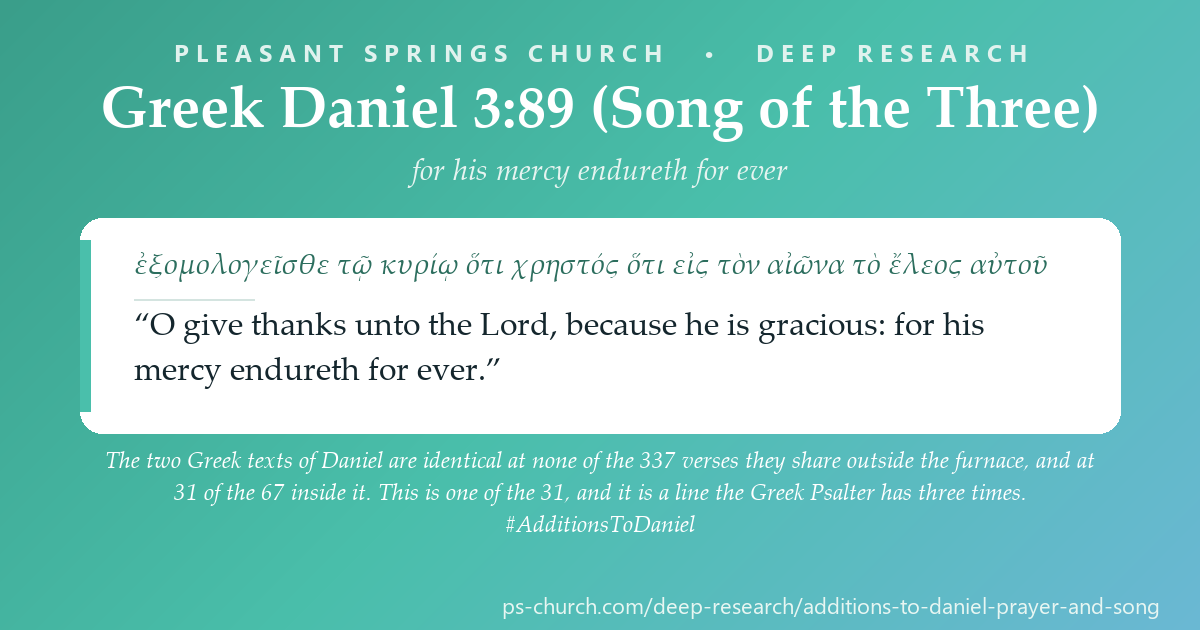
Daniel (OG) ἐξομολογεῖσθε τῷ κυρίῳ ὅτι χρηστός ὅτι εἰς τὸν αἰῶνα τὸ ἔλεος αὐτοῦ3:89KJV v. 67 “O give thanks unto the Lord, because he is gracious: for his mercy endureth for ever.”
Identical in both Greek texts — and, after its opening Alleluia, identical to Greek Psalm 135:1 (= Psalm 136:1 in the Hebrew and English numbering), and to the opening of Greek Psalms 105 and 106 (= Psalms 106:1 and 107:1 in the Hebrew and English numbering) as well. ESV Psalm 136:1: “Give thanks to the Lord, for he is good, for his steadfast love endures forever.” The Odes copy of the song ends before this verse.
VULGATE Dn 3:89 Confitemini Domino, quoniam bonus :/ quoniam in sæculum misericordia ejus./
On the columns. The Greek is the CATSS morphological Septuagint, quoted at verse level with attribution. There is no Hebrew or Aramaic of these verses on this disk. The only English column is the KJV Apocrypha (1769 standard text, public domain), read verse by verse from the eBible.org file held on this disk and printed verbatim, spelling and all; it numbers the passage as a separate book of 68 verses, and every row above gives its own verse number. The Latin is the Clementine Vulgate’s Daniel 3, printed as a fourth witness and never as a source for the English. Where this page quotes the ESV, it is for a canonical psalm, and it says which.
Versification — a third state, stated in full. There is no Masoretic text of these verses, so the usual Masoretic/Septuagint/English offset does not exist for them. What exists instead, measured from the files:
• Greek. Both Greek files carry the insert as 67 rows labelled 3:24–3:90, between the rows that answer to Aramaic 3:23 and 3:24. Greek 3:91–97 is Aramaic 3:24–30. Greek Daniel 3 has 97 rows in both files; the Masoretic Daniel 3 has 33 verses, and its last three (3:31–33, the king’s letter) are Theodotion’s 4:1–3 — the Old Greek file has no rows at those labels. The Theodotion file prints four stretches of the litany out of numerical order — 3:55 before 3:54, 3:59 before 3:58, 3:71–72 before 3:69–70, 3:78 before 3:77 — so label order and reading order are not the same thing in Theodotion.
• KJV Apocrypha. A separate book of 68 verses. KJV verse n is Greek 3:n+23 from v. 1 (= 3:24) to v. 28 (= 3:51) — though inside that stretch the English divides four Greek pairs at different points (KJV 6–7 = 3:29–30, 16–17 = 3:39–40, 18–19 = 3:41–42, 20–21 = 3:43–44). KJV 29–30 is Greek 3:52 cut in two, and from there KJV n is Greek 3:n+22 to the end (v. 68 = 3:90), except where the English has Theodotion’s reading order: v. 32 = 3:55, v. 33 = 3:54; v. 36 = 3:59, v. 37 = 3:58; vv. 47–48 = 3:71–72, vv. 49–50 = 3:69–70. And v. 55 has no Greek counterpart by content: it stands where the springs (3:77) stand in the Old Greek’s order, and calls on mountains. Aligned by content, verse by verse, every pairing anchored in the self-check, never by label.
• Clementine Vulgate. Daniel 3 runs to 100 verses: 3:24–90 label for label with the Greek — though it divides four Greek pairs at points of its own (3:29–30, 3:38–39, 3:39–40, 3:41–42), so that, for one, its 3:38 lacks the Greek 3:38’s and to find mercy, which opens its 3:39 — and 3:91–100 = Masoretic 3:24–33. Its reading order is the Old Greek’s at all four of Theodotion’s transpositions.
• Odes. The prayer is Ode 7 (20 rows, 7:26–45 = 3:26–45) and the song is Ode 8 (37 rows, 8:52–88 = 3:52–88), each under its own unnumbered title. The Odes number consecutively, so Ode 8:54 carries 3:55’s words and 8:55 carries 3:54’s. They have nothing for 3:24–25, 3:46–51 or 3:89–90.
The Shape of the Passage
A sequence: two speeches with a twin opening (measured) and a prose bridge between — not a chiasmThis is NOT offered as a chiasm. Nothing in the song mirrors the prayer in reverse; they are two different kinds of speech — a confession and a litany — set one after the other with a narrative bridge, sharing an opening line. And the litany’s own order is not fixed across the witnesses: five witnesses, four orders (Stage 4).
⚠️ Where this page sits. These verses are canonical in the Roman Catholic and Orthodox churches, printed among the Apocrypha in the older Protestant Bibles, and absent from the Aramaic of Daniel. This library reads them as a witness and files them under Apocrypha / Deuterocanon. Nothing taught at Pleasant Springs rests on them.
Author
Anonymous, and visible only in Greek. Whoever composed the prayer and the song, the earliest form this shelf can read is Greek, in two texts that agree here far more than they agree anywhere else. Whether a Hebrew or Aramaic original lay behind them is argued in the literature and cannot be tested on this disk; this page reports the question and does not answer it.
Two voices, different in kind. The prayer is one man, Azariah, confessing the sins of a whole nation in the first person plural. The song is three men as from one mouth, and it does not confess anything: it calls on everything that exists to bless the Lord.
Dating is reported, not measured. The prayer’s unjust king, the most wicked in all the earth (3:32) and its no prince, prophet or leader, no offering, no place (3:38) are commonly read against the persecution under Antiochus IV in the 160s BC. Nothing on this page depends on that reading and nothing here tests it.
Audience
People praying without a temple. The prayer names, item by item, what is missing — leader, prophet, burnt offering, sacrifice, oblation, incense, a place to offer — and then asks that a crushed soul and a humbled spirit be accepted instead. Whatever its date, it is written in the voice of worshippers cut off from worship.
The Psalter’s language. The song’s two-verse coda opens on a line that stands word for word at the head of three Greek psalms (after their Alleluia), and its last verse carries that line’s refrain again; its catalogue of sky, earth and creatures covers the ground Psalm 148 covers — in different words (Stage 2).
And readers of the Greek Psalter’s appendix. The Odes carry both pieces again as canticles, the prayer under the title προσευχὴ Αζαριου and the song under ὕμνος τῶν τριῶν παίδων. Stage 4 shows what that copy looks like against both Greek Daniels.
Orient on the additions, on Daniel’s two Greek texts, and on the canticles.
Search by topic: Azariah, Prayer of; Three Young Men, Song of the; Daniel, Additions to; Theodotion; Old Greek; papyrus 967; Odes (canticles); Benedicite. No dictionary is held on this disk: the titles below are headwords to look for, and none was opened or checked for this page.
Which articles should a reader look for?
- Anchor Bible Dictionary — “Daniel, Additions to,” “Azariah, Prayer of,” “Three Young Men, Song of the,” “Theodotion.”
- Eerdmans Dictionary of Early Judaism — “Daniel, Additions to,” “Prayer,” “Penitential Prayer.”
- Dictionary of New Testament Background (IVP) — “Daniel, Esther and Jeremiah, Additions to,” “Septuagint/Greek Old Testament.”
- On the text — any article that keeps the Old Greek and Theodotion apart. An article that speaks of ‘the Greek of Daniel’ without that distinction cannot be used for these verses, because here the two texts converge and everywhere else they do not.
Bibliography surfaced:
- Carey A. Moore, Daniel, Esther and Jeremiah: The Additions (Anchor Bible) — the English commentary on all the Greek additions together.
- John J. Collins, Daniel (Hermeneia) — the major critical commentary on the book.
- Tim McLay, The OG and Th Versions of Daniel — on how the two Greek texts relate.
- Curt Kuhl, Die drei Männer im Feuer — the older monograph on these verses.
- NETS (A New English Translation of the Septuagint) — whose Daniel prints the Old Greek and Theodotion as two translations. Named as the next step for a reader; not the English quoted here.
A confession, a litany, two psalms, and the people who remembered three men in a furnace.
Each parallel below is measured where this shelf can measure it, and says so where it cannot. Runs are contiguous identical word forms; a band is the number of target units that reach the same depth.
Which parallels shed light on the world of the text?
The prayer belongs to a family of national confessions. Daniel 9, Ezra 9, Nehemiah 9, Baruch 1:15–3:8 and Esther’s prayer in Addition C of the Greek Esther each confess the people’s sin and call God just; Daniel 9 and Baruch ask for mercy for your own sake (our gloss), because God’s name is called upon his city and people (Daniel 9:19; Baruch 2:14–15). (Mordecai’s prayer, which stands before Esther’s in Addition C, asks God to spare his people and confesses no sin.) This page set the twenty rows of the prayer (3:26–45) against all five. The deepest verbatim contact with any of them is five words. Each family’s deepest run is printed with the number of the 30,214 screened Greek Old Testament units outside the insert that carry it, because most of them are stock phrases:
- Daniel 9:4–19, Daniel’s own prayer (either Greek text): deepest run four, from either text of the prayer — τῶν πατέρων ἡμῶν Ιερουσαλημ (3:28, against 9:16) and, from the Old Greek only, ἐπὶ τὴν πόλιν σου (against 9:19), each carried by 2 of the 30,214 units, Daniel 9 in its two Greek texts; and ἐν πάσῃ τῇ γῇ (3:37, against Theodotion’s 9:7), carried by 37.
- Nehemiah 9:6–37 (Greek 2 Esdras 19:6–37): three from the Old Greek — ten different three-word runs, carried by between 2 (ἐλάλησας πρὸς αὐτοὺς) and 529 (κύριος ὁ θεὸς) of the 30,214 units — and five from Theodotion: 3:45, σὺ εἶ κύριος ὁ θεὸς, carried by 3 of the 30,214 units, Nehemiah 9:7 and Elijah’s prayer at 1 Kings 18:36–37.
- Ezra 9:6–15 (Greek 2 Esdras 9:6–15): three — κύριε ὁ θεὸς (87 of the 30,214 units), κύριος ὁ θεὸς (529), and from the Old Greek also ὅτι οὐκ ἔστιν (56).
- Baruch 1:15–3:8: four, in both texts — four different four-word runs, carried by between 1 and 10 of the 30,214 units. The one carried by a single unit is ἐπιείκειάν σου καὶ κατὰ (3:42), and that unit is Baruch 2:27 itself; the commonest is τὸ ὄνομά σου καὶ (10).
- Addition C of the Greek Esther (4:17a–z), the prayers of Mordecai (4:17a–i) and of Esther (4:17k–z): five, from both texts, at 3:32 — καὶ παρέδωκας ἡμᾶς εἰς χεῖρας, and you gave us into the hands (our gloss), against Esther’s own words at 4:17n, καὶ παρέδωκας ἡμᾶς εἰς χεῖρας. In the whole screened Greek Old Testament those five words stand in three units: the two Daniel rows and Esther 4:17n.
The family resemblance is in the shape, not the wording. And the deepest contact the prayer has with Daniel itself is not with Daniel’s prayer at all: Theodotion’s 3:28 shares six words, tie band 1 across the screened corpus, with Theodotion’s 9:24 — καὶ ἐπὶ τὴν πόλιν τὴν ἁγίαν, and upon the holy city (our gloss) — the verse of the seventy weeks. The Old Greek’s 3:28 reads τὴν πόλιν σου τὴν ἁγίαν and the run breaks.
The song belongs with the psalms that call on creation. Psalm 148 calls on angels, hosts, sun and moon, stars, the waters above the heavens, fire, snow, wind, mountains, beasts and cattle, kings and young men. Psalm 136 carries one refrain on every verse. The song has Psalm 148’s catalogue in content and Psalm 136’s refrain in form, and its two-verse coda opens on Psalm 136’s first line (3:89).
- Psalm 148 → 3:52–90. Measured: the longest run of words any verse of the song shares with any verse of Greek Psalm 148 is three in Theodotion and four in the Old Greek — and the Old Greek’s four is καὶ εἰς τὸν αἰῶνα, at its closing line — a stock phrase, carried by 20 of the 30,214 screened units outside the insert. Across the litany proper (3:57–88) it is three in both, and three of those threes are stock as well (πᾶσαι αἱ δυνάμεις, 8 units; καὶ πάντα τὰ, 167; Theodotion’s τὰ θηρία καὶ, 6). The fourth is not: ἥλιος καὶ σελήνη, sun and moon (3:62, both texts), is carried outside the insert by Psalm 148:3 alone of the 30,214 units. The psalm’s verb is αἰνεῖτε, eight times in five of its fourteen verses; the song’s is εὐλογεῖτε, thirty-two times in each Greek text, and Psalm 148 never uses it. Same ground, different words — with that one three-word exception.
- Psalm 136 (Greek 135) → 3:89–90. All 26 verses of Greek Psalm 135 end ὅτι εἰς τὸν αἰῶνα τὸ ἔλεος αὐτοῦ. Song 3:89 is the psalm’s first verse after its Alleluia, word for word, in both Greek texts. Hebrew Psalm 136:1: הוֹד֣וּ לַיהֹוָ֣ה כִּי־ט֑וֹב כִּ֖י לְעוֹלָ֣ם חַסְדּֽוֹ׃.
- 1 Maccabees 2:59 — Mattathias on his deathbed: Ανανιας Αζαριας Μισαηλ πιστεύσαντες ἐσώθησαν ἐκ φλογός (Hananiah, Azariah, Mishael believed and were saved from the flame, our gloss). 4 Maccabees names the three at 16:21 and 18:12, and Mishael’s furnace at 16:3. Measured: the Old Greek’s entry verse 3:24 has its deepest Greek Old Testament contact — five words, tie band 1 — in 4 Maccabees 16:21, and the five words are the three names: Ανανιας καὶ Αζαριας καὶ Μισαηλ. These books remember the furnace and the deliverance; they share names with the insert, not lines.
- Hebrews 11:34 — ἔσβεσαν δύναμιν πυρός, quenched the power of fire (our gloss), commonly read as recalling the furnace; it has no word for furnace. Measured against all 67 rows, in both Greek texts, its deepest run is one word: it shares three single words with them (πυρός, ἀπὸ, ἐν) and no two in a row. The three words ἔσβεσαν δύναμιν πυρός stand in none of the 30,348 screened Greek Old Testament units.
- The Greek Odes. In the Odes appendix the prayer is the seventh canticle and the song the eighth, between Jonah’s prayer (προσευχὴ Ιωνα) and Mary’s (προσευχὴ Μαριας τῆς θεοτόκου). Read off the file’s own titles. The song’s later life in Christian worship — the Book of Common Prayer appoints it, as the Benedicite, among the canticles of Morning Prayer — is named here from that book, not held or checked on this disk.
A refrain verb found nowhere else, two words for “blessed,” and two sets of names.
Every count below is over the Greek Old Testament files screened here — 30,348 verse units, the Odes excluded — or the 7,927 verses of the Greek New Testament, and it says which. It is not a count over “the Septuagint.” Every word in this insert is counted twice, once in each Greek text, because both are screened.
Sixty-two occurrences in the 30,348 Greek Old Testament units screened, and every one is in Daniel 3:57–88 — thirty-one in each Greek text. Zero in the Greek New Testament. It is the litany’s refrain verb, and the nine-word refrain τὸν κύριον ὑμνεῖτε καὶ ὑπερυψοῦτε αὐτὸν εἰς τοὺς αἰῶνας stands in those same 62 units and nowhere else screened. The one row of the litany without it is 3:74, where the earth is called in the third person: ὑπερυψούτω. The King James renders it exalt him above all. The New Testament has the compound verb once, in another form and another sentence: Philippians 2:9, ὑπερύψωσεν. A shared verb is not a shared phrase; the longest run Philippians 2:9 shares with any row of the insert is two words.
The five Blessed are you lines of 3:52–56 do not open on the same word in the two texts. The Old Greek has εὐλογητὸς four times and εὐλογημένος once (3:53); Theodotion has εὐλογητὸς once (3:52) and the participle four times. The Odes follow Theodotion’s pattern exactly. Blessed art thou with the participle stands in five units of the screened corpus: Old Greek 3:53 and Theodotion 3:53–56.
In Theodotion’s chapter 3 the Babylonian names Σεδραχ Μισαχ καὶ Αβδεναγω occur twelve times each, and every one stands outside 3:24–90. Inside the insert the Hebrew names occur five times (Azariah at 3:25, 3:49 and 3:88; Hananiah and Mishael at 3:88) — and nowhere else in the chapter. In the Old Greek the Babylonian names occur nine times each, all outside; the Hebrew names occur eight times inside (3:24, 3:25, 3:49, 3:88) and once outside, at 3:23, the verse before the insert opens. In neither Greek text do the Hebrew names occur anywhere in the book after 3:88. Daniel 1:6 gives the men their Hebrew names and 1:7 renames them; inside the furnace both texts call them by the names they bore before the renaming.
3:39 offers, in place of the missing sacrifices, a crushed soul and a humbled spirit. The two words stand in two units of the screened corpus, and they are the two Greek texts of this verse. The thought is Psalm 51:17 (Greek 50:19), πνεῦμα συντετριμμένον καρδίαν συντετριμμένην; measured against that verse, 3:39 shares a run of one word in both texts — καὶ. The idea is nearer than the wording. The King James renders in a contrite heart where both Greek texts read ψυχῇ, soul; the Latin has in animo contrito.
What the angel makes of the middle of the furnace: a whistling wind of dew. The two words stand in two units of the screened corpus — this verse, in the two Greek texts. The King James has a moist whistling wind. Dew comes back in the litany twice (3:64 and 3:68), among the things called on to bless the Lord.
Where the two Greek Daniels meet, what the copies did with them, and what the New Testament shares.
Five screens, all exhaustive, nothing sampled. (1) The two Greek texts of Daniel against each other, label by label: identical or not, and the longest contiguous run of whole word forms they share — and every other book this shelf holds in two Greek files, measured the same way. (2) The Odes copies against both. (3) The order of the litany in every witness held. (4) The 67 rows against the Greek Old Testament — the 30,348 screened units less the 134 insert rows themselves, 30,214 units. (5) The 67 rows against all 7,927 verses of the Greek New Testament. The tie band — how many target units reach the same depth — is printed beside every run, from both sides where the reverse matters. Word forms, never lemmas; contact, never allusion; direction of influence never asserted.
1. The two Greek texts against each other — the gradient:
Daniel’s two Greek texts share 404 verse labels. 337 of them lie outside 3:24–90, and at none of the 337 are the two identical. The other 67 are the insert, and at 31 of those they are identical word for word (30 even to accents and the elision mark; at 3:35 one text elides through and the other does not).
| Stretch of Greek Daniel | verse labels both texts carry | identical word for word | median longest shared run | shallowest–deepest |
|---|---|---|---|---|
| All of Daniel outside 3:24–90 | 337 | 0 | 4 | 1–25 |
| Daniel 3 outside the insert (3:1–23, 3:91–97) | 30 | 0 | 4.5 | 2–13 |
| The insert, 3:24–90 | 67 | 31 | 12 | 1–27 |
| 3:24–25, the entry | 2 | 0 | 4.5 | 1–8 |
| 3:26–45, the prayer | 20 | 7 | 13 | 5–25 |
| 3:46–51, the prose bridge | 6 | 1 | 9 | 5–11 |
| 3:52–56, Blessed are you | 5 | 1 | 7 | 3–27 |
| 3:57–88, the litany | 32 | 21 | 13 | 9–16 |
| 3:89–90, the coda | 2 | 1 | 13 | 12–14 |
Outside the furnace the two texts share a median of four consecutive words per verse. In the prayer and the litany they share a median of thirteen, and agree outright at a third of the prayer’s rows and two thirds of the litany’s.
And no other book this shelf holds in two Greek files behaves like it. Every book the shelf holds in two Greek files, measured the same way:
| Two Greek texts of one book | shared verse labels | identical word for word | median longest shared run |
|---|---|---|---|
| Daniel (OG) / (Th), 3:24–90 | 67 | 31 | 12 |
| Daniel (OG) / (Th), everywhere else | 337 | 0 | 4 |
| Judges (A) / (B) | 617 | 14 | 9 |
| Joshua (A) / (B) — the A file holds chapters 15, 18, 19 only | 96 | 4 | 4 |
| Tobit (BA) / (S) | 230 | 3 | 5 |
| Susanna (OG) / (Th) | 31 | 0 | 3 |
| Bel (OG) / (Th) | 34 | 0 | 3 |
The highest rate of identical verses anywhere else on the shelf is Joshua’s 4 of 96 — about four per cent. The insert’s is 31 of 67, forty-six per cent. Judges’ two texts share the longest median run of the other books (nine words, against the insert’s twelve) and are still identical at only 14 of 617 labels. And the two other additions to Daniel, Susanna and Bel, are identical at none.
“It is only the refrain.” The litany’s nine-word refrain does inflate its figures: 21 of its 32 rows are identical. But the prayer has no refrain, and it is identical at 7 of 20 rows — against 0 of 337 outside the insert. And the deepest agreement in all of Greek Daniel, twenty-seven words, is at 3:52, which is not a refrain line.
“Shorter verses are easier to agree on.” They are, and the insert’s rows are shorter: 17.42 words on average in the Old Greek and 16.36 in Theodotion, against 26.69 and 26.45 for the 337 labels outside. So compare like with like. Outside the insert there are 82 labels where both texts run to twenty words or fewer, and none of the 82 is identical. Inside, there are 50 such labels, and 30 are identical. Among the 49 outside labels of seventeen words or fewer, again none.
“It is the whole of chapter 3.” It is not. The 30 labels of chapter 3 that the Aramaic also has are identical at none, with a median shared run of 4.5 — the same as the rest of the book.
It does not start where the insert starts. At 3:24, the first verse with no Aramaic counterpart, the two texts share a run of one word — the least alike label in all 67. At 3:25 they share eight. The convergence begins with the prayer, though not with its first verse: 3:26 shares nine words, no more than the canonical 3:15 or 3:20 (and fewer than 3:14’s thirteen); 3:27 shares fifteen; and the first identical label is 3:30.
It stops where the song stops. 3:90 shares fourteen words; 3:91, the first verse back in step with the Aramaic, shares three. And both texts, in their own words, put the singing into that seam — them singing, ὑμνούντων αὐτῶν, stands in the two 3:91 rows and nowhere else of the 30,348 screened. The Aramaic verse they answer to has the king astonished and rising in haste, and no verb of hearing (our reading of the Aramaic).
It does not say why. How the two Greek texts of Daniel are related — whether Theodotion’s text revises the Old Greek or stands apart from it, and whether the answer is the same for every part of the book — is argued at length in the literature named in Stage 1, and the additions, where the two agree most, are part of that argument. This page has not weighed that argument and does not adjudicate it. It reports only what the two files share, where, and how much. Any explanation has to account for a convergence that begins with the prayer, holds through the song, and ends at the seam.
2. The Odes copies — a copy of which?
The shelf’s loader describes Odes 7 and 8 as second copies of Theodotion’s Daniel 3, and excludes them from every screen so that no verse is counted twice. Measured, row by row, aligned by content (Ode 8:54 against 3:55 and 8:55 against 3:54):
- 57 Ode rows. Identical to Theodotion at 41; identical to the Old Greek at 27; to both at 25.
- Identical to Theodotion and not the Old Greek: 16. Identical to the Old Greek and not Theodotion: 2 — Ode 7:26, which reads αἰνετὸν with the Old Greek, and Ode 8:61, which reads δυνάμεις κυρίου with the Old Greek.
- Identical to neither: 14. Among them Ode 7:27, ending ἀληθεῖς where the Old Greek has ἀληθιναί and Theodotion ἀλήθεια; Ode 8:83, εὐλογείτω Ισραηλ, in the third person where both Daniel texts have the second; and Ode 8:88, which stops after the refrain.
- The third person at 8:83 is not the Ode’s alone. The Clementine has it too: Benedicat Israël Dominum. Two witnesses, Greek and Latin, read let Israel bless where both Greek Daniels read bless, Israel. The words εὐλογείτω Ισραηλ stand in none of the 30,348 screened units.
- And in two lines the Ode carries Psalm 148’s words where neither Daniel text does. Ode 8:81 reads τὰ θηρία καὶ πάντα τὰ κτήνη; Greek Psalm 148:10 reads τὰ θηρία καὶ πάντα τὰ κτήνη (ESV: “Beasts and all livestock, creeping things and flying birds!”). In the screened corpus those six words stand only in Psalm 148:10 and Genesis 8:19. Theodotion’s 3:81 has them in another order and the Old Greek’s does not have them. Ode 8:60 likewise reads ὑπεράνω τῶν οὐρανῶν with Psalm 148:4, where both Daniel texts read ἐπάνω τοῦ οὐρανοῦ.
So the Odes lean to Theodotion, sixteen readings to two, but are a copy of neither text. In places they read with the Psalter, and in places with the Latin against both Greek Daniels: at 8:83; at 8:60, whose plural heavens the Clementine has too (super cælos); and at 7:45, where the Ode opens καὶ γνώτωσαν, and let them know (our gloss), as the Clementine opens et sciant and neither Greek Daniel has the and. The page does not say why; it reports that a liturgical copy of a song is not the same witness as the book it stands in, and that excluding it from screens loses something as well as preventing double-counting.
3. Five witnesses, four orders — and an English that reads with Theodotion:
The Theodotion file prints the litany in a different order from the Old Greek at four places. Here is every witness held, at each of the four:
| Where Theodotion’s file departs from numerical order | Old Greek | Theodotion | Odes 8 | KJV | Clementine |
|---|---|---|---|---|---|
| the throne (3:54) and the deeps above the cherubim (3:55) | 54, 55 | 55, 54 | 55, 54 (labelled 8:54, 8:55) | 55, 54 (vv. 32, 33) | 54, 55 |
| the angels (3:58) and the heavens (3:59) | 58, 59 | 59, 58 | 58, 59 | 59, 58 (vv. 36, 37) | 58, 59 |
| frost and cold, hoarfrost and snow (3:69–70); nights and days, light and darkness (3:71–72) | 69, 70, 71, 72 | 71, 72, 69, 70 | 69, 70, 71, 72 | 71, 72, 69, 70 (vv. 47–50) | 69, 70, 71, 72 |
| the springs (3:77) and the seas and rivers (3:78) | 77, 78 | 78, 77 | 77, 78 | no springs line: “mountains” (v. 55), then the seas (v. 56) | 77, 78 |
The Old Greek and the Clementine agree throughout; Theodotion stands alone; the Odes take Theodotion’s order once and the Old Greek’s three times; the King James takes Theodotion’s at three and, at the fourth, has no springs line at all. Four orders among five witnesses. Reading order is evidence, and a dictionary built from labels would miss every one of these.
Whose Greek does the King James English read with? The two Greek texts differ in sense at many points; at ten of them, chosen for this table and not an exhaustive list, the difference is plain enough to read off an English and a Latin line. They are printed whole so that the reader can check every one:
| Greek | Theodotion reads | Old Greek reads | KJV reads — agrees with | Clementine reads — agrees with |
|---|---|---|---|---|
| 3:24 | περιεπάτουν ἐν μέσῳ τῆς φλογὸς | οὕτως οὖν προσηύξατο | walked in the midst of the fire — Th | ambulabant in medio flammæ — Th |
| 3:27 | αἱ κρίσεις σου ἀλήθεια | αἱ κρίσεις σου ἀληθιναί | all thy judgments truth — Th | omnia judicia tua vera — OG |
| 3:56 | στερεώματι τοῦ οὐρανοῦ | στερεώματι καὶ | firmament of heaven — Th | firmamento cæli — Th |
| 3:61 | δυνάμεις τὸν κύριον | δυνάμεις κυρίου | powers of the Lord — OG | virtutes Domini — OG |
| 3:67 | ψῦχος καὶ καύσων | ῥῖγος καὶ ψῦχος | winter and summer — Th | frigus et æstus — Th |
| 3:81 | πάντα τὰ θηρία καὶ τὰ κτήνη | τετράποδα καὶ θηρία τῆς γῆς | beasts and cattle — Th | bestiæ et pecora — Th |
| 3:84 | ἱερεῖς κυρίου | ἱερεῖς τὸν κύριον | priests of the Lord — Th | sacerdotes Domini — Th |
| 3:85 | δοῦλοι κυρίου | δοῦλοι τὸν κύριον | servants of the Lord — Th | servi Domini — Th |
| 3:88 | ἐκ μέσου καμίνου καιομένης φλογὸς | ἐκ μέσου καιομένης φλογὸς | out of the midst of the furnace — Th | de medio ardentis flammæ — OG |
| 3:90 | οἱ σεβόμενοι τὸν κύριον τὸν θεὸν | οἱ σεβόμενοι τὸν θεὸν | worship the Lord, bless the God of gods — Th | Domino Deo deorum — Th |
The King James agrees with Theodotion at nine of the ten and with the Old Greek at one; the Clementine with Theodotion at seven and the Old Greek at three. Two further points, outside the table, cut against the Clementine tally: at 3:32 Theodotion reads εἰς χεῖρας ἐχθρῶν ἀνόμων and the Old Greek εἰς χεῖρας ἐχθρῶν ἡμῶν ἀνόμων, and the Clementine has the Old Greek’s our (inimicorum nostrorum iniquorum) where the King James has lawless enemies; at 3:40 Theodotion reads οὐκ ἔσται αἰσχύνη, the Old Greek οὐκ ἔστιν αἰσχύνη, and the Clementine has the Old Greek’s present (non est confusio) where the King James has the future, they shall not be confounded. Counted in, they make the Clementine seven to five and the King James eleven to one. The King James’s lean holds; the Clementine’s is slighter than the table alone suggests. Together with the order, that is why the codex prints Theodotion first. This is a reading of an English and a Latin line against two Greek lines; it says what each column has, not where its translators found it.
4. Against the Greek Old Testament — the prayer talks like other prayers:
Every row of the insert, both texts, against the 30,214 screened units outside the insert. Old Greek: all 67 reach two, 63 three, 29 four, 15 five, 7 six, 3 eight, 2 twelve, and nothing thirteen. Theodotion: all 67 reach two, 62 three, 29 four, 17 five, 9 six, 3 seven, 2 twelve, and nothing thirteen. Canonical Daniel stays in the target, in both its Greek texts, so a match in Daniel can count twice.
- 3:36 → Genesis 22:17 — twelve words, tie band 1, in both texts. τοῦ οὐρανοῦ καὶ ὡς τὴν ἄμμον τὴν παρὰ τὸ χεῖλος τῆς θαλάσσης — of heaven, and as the sand beside the shore of the sea (our gloss): the promise to Abraham after Moriah, which the prayer is pleading. Outside the two Daniel rows, the twelve words stand in Genesis 22:17 and nowhere else in the screened corpus.
- 3:89 → Greek Psalms 105:1, 106:1 and 135:1 — twelve words, tie band 3, in both texts. The coda opens on a whole psalm line, three times over in the Psalter (Greek Psalms 105, 106 and 135 are Psalms 106, 107 and 136 in the Hebrew and English numbering).
- ⚠️ Depth is not rarity — the page’s own Greek Old Testament counter-example. The next deepest row is the Old Greek’s 3:90, at eight words, tie band 2 (2 Chronicles 5:13 and Greek Jeremiah 40:11, which is Jeremiah 33:11 in the Hebrew and English numbering). Theodotion’s 3:90 measures seven, tie band 42. Both are the psalm refrain ὅτι εἰς τὸν αἰῶνα τὸ ἔλεος αὐτοῦ — forty-six screened units carry those seven words, four of them the insert’s own 3:89 and 3:90 — and the Old Greek’s eighth word is and. The seven-word refrain is the common phrase (46 units); the eighth word, and, is all that takes the band from 42 to 2. A run of eight with a band of 2 looks rare; it is a formula and a conjunction.
- Theodotion 3:45 → 1 Kings 18:36–37 — six words, tie band 2. ὅτι σὺ εἶ κύριος ὁ θεὸς — that you are the Lord, the God (our gloss): Elijah’s prayer on Carmel, twice. The Old Greek puts μόνος (alone) in the middle of the phrase and measures four, tie band 9. The figure depends on which Greek text is screened.
- Theodotion 3:34 → Jeremiah 14:21 — five words, tie band 1. μὴ διασκεδάσῃς τὴν διαθήκην σου, do not break your covenant (our gloss). The Old Greek’s word order (μὴ διασκεδάσῃς σου τὴν διαθήκην) measures four, with a tie band of 12.
- 3:42 → Nehemiah 13:22 (Greek 2 Esdras 23:22) — six words, tie band 1, both texts. κατὰ τὸ πλῆθος τοῦ ἐλέους σου, according to the abundance of your mercy (our gloss) — one of the remember me prayers that close Nehemiah. 3:35 → Psalms of Solomon 16:6 — six, tie band 1, both texts: μὴ ἀποστήσῃς τὸ ἔλεός σου ἀφ'…
The prayer shares its form with Daniel 9, Ezra 9, Nehemiah 9, Baruch and the prayers of Greek Esther (Stage 2) and its longest verbatim runs with other texts altogether — the promise to Abraham, Elijah’s prayer, Jeremiah’s, Nehemiah’s closing prayers, a Psalm of Solomon.
5. Against the Greek New Testament — the distribution, both texts:
Old Greek 3:24–90, 67 rows against 7,927 verses: all 67 reach two, 64 three, 11 four, 4 five, and nothing reaches six. Theodotion, the same 67 labels: all 67 reach two, 62 three, 13 four, 4 five, and nothing reaches six. The same four rows reach five in both texts. For scale: the 30 rows of chapter 3 that the Aramaic also has reach five at six rows in each Greek text.
- 3:25 → Matthew 5:2 and 17:27 — five words, tie band 2. καὶ ἀνοίξας τὸ στόμα αὐτοῦ, and opening his mouth (our gloss). From the other side the band is also 2: Matthew 5:2’s deepest contact in the whole screened Greek Old Testament is five words, and the two units that reach it are the two Greek texts of Daniel 3:25. The five words stand in those two rows and nowhere else of the 30,348, and in those two Matthew verses and nowhere else of the 7,927. Rare on both sides — and still not a citation: in Matthew 17:27 the mouth is a fish’s, opened to find a coin. The idiom around the phrase is common: τὸ στόμα αὐτοῦ stands in 25 screened Greek Old Testament units and 8 New Testament verses. A rare five-word sequence made of a common idiom is a coincidence of wording until something else says otherwise; here nothing does.
- 3:26 and 3:52 → Acts 3:13, 5:30 and 22:14 — five words, tie band 3. ὁ θεὸς τῶν πατέρων ἡμῶν, the God of our fathers (our gloss). From the other side: Acts 5:30 and 22:14 reach five against ten screened Greek Old Testament units — the four Daniel rows and six others (1 Chronicles 12:18, which is 12:17 in English; 2 Chronicles 20:6; 2 Esdras 7:27, which is Ezra 7:27; Judith 10:8; and Tobit 8:5 in both recensions); Acts 3:13 reaches six, but at 1 Chronicles 29:18 and 1 Kings 18:36, not here. A formula, ten times over.
- 3:36 → Hebrews 11:12 — five words, tie band 1. παρὰ τὸ χεῖλος τῆς θαλάσσης, beside the shore of the sea (our gloss). From the other side, it dissolves: Hebrews 11:12’s deepest Greek Old Testament contact is nine words at 1 Maccabees 11:1, tie band 1, and the five-word phrase stands in five screened units (Genesis 22:17, Exodus 14:30, 1 Maccabees 11:1 and the two Daniel rows). The shared phrase is the promise to Abraham, which the prayer and Hebrews both have in view.
- ⚠️ The page’s own counter-example. A New Testament verse commonly read as recalling the furnace, Hebrews 11:34, measures one against every row of the insert in both texts (Stage 2), and its own deepest contact anywhere in the screened Greek Old Testament is two words, ἐν πολέμῳ, tie band 28. It has no word for furnace. Four other New Testament verses do (Matthew 13:42 and 13:50, Revelation 1:15 and 9:2), and the deepest of them against the insert is three words, εἰς τὴν κάμινον, into the furnace (our gloss), from Matthew 13:42 and 13:50, reached by four of the 134 insert rows (Old Greek 3:24, 3:46 and 3:49; Theodotion 3:49). From the other side, those two verses reach five, tie band 8 — εἰς τὴν κάμινον τοῦ πυρός, into the furnace of fire (our gloss) — and all eight units are the canonical Daniel 3 outside the insert (3:6, 3:11, 3:15 and 3:20, in both Greek texts). The verse commonly read as recalling the event shares no two consecutive words with these verses; the verses that share five are about other things.
It settles that no New Testament verse shares more than five consecutive word forms with these 67 verses on this screen: the four deepest contacts are a speech idiom, a patriarchal formula, and a phrase from Genesis, and Hebrews 11:34, commonly read as recalling the furnace, measures one.
It does not settle that the song or the prayer was unknown. A verbatim screen cannot see a hymn sung in another language, or an idea. The scope is the Greek: 67 rows in each text, 7,927 New Testament verses, contiguous identical word forms.
What this page could not check, what it found on the way, and where it is weakest.
This is the section that makes the shelf trustworthy. It is long because a great deal about these verses lies outside the files on this disk.
⚠️ Found on the way — reported, not buried:
- The English file has three readings no Greek or Latin witness held supports. At v. 55 it reads O ye mountains where every Greek witness and the Clementine call on the springs (Stage 4); at v. 12 it spells the patriarch Issac’s; and at v. 47 its refrain reads bless and exalt him where its other thirty-one refrain lines read praise and exalt him and the Greek has the same verb throughout. Whether printed editions of the King James Apocrypha read the same was not checked: no facsimile of the 1611 or the 1769 printing is held here, and the page reads its English only from the one file. It prints the file verbatim and flags the three lines rather than silently correcting them.
- The loader’s description of the Odes is approximate. It excludes the Odes partly because Odes 7 and 8 are “Daniel (Th) 3” a second time. Measured: they are identical to Theodotion at 41 of 57 rows and to neither Greek text at 14. The exclusion is still right for screening; the description should say “close to”.
- Label order is not reading order. Any loader that sorts Theodotion’s Daniel 3 by verse number silently puts four stretches of the song into the Old Greek’s order. This page reads the file in file order.
- In whole-corpus hit lists the Old Greek is tagged plain “Dan” and Theodotion “DanTh”. A hit reported as “Dan 3:25” is the Old Greek, not “Daniel” in general. Every band on this page that touches Daniel was counted with the two files kept apart.
⚠️ What this page could NOT check:
- Any Semitic form of these verses. The Masoretic Daniel has none, and no medieval Hebrew or Aramaic version is on this disk. Whether the prayer and the song were composed in Hebrew, Aramaic or Greek is not verifiable from local corpora; the literature named in Stage 1 argues it.
- The manuscripts behind the Old Greek. The Old Greek of Daniel survives in very few witnesses — papyrus 967, one minuscule, and the Syro-Hexapla are the ones the literature names. None is held. The CATSS file is a digitisation of Rahlfs’s edition and inherits whatever that edition chose. So the convergence this page measures is a convergence between two edited texts as CATSS encodes them, and the page cannot say how much of it any one manuscript carries.
- Whether Theodotion’s reading order is the printed edition’s. The four transpositions are in the CATSS file. Whether Rahlfs’s printed page, or the Göttingen edition, prints Theodotion in the same order was not checked. The King James English has the same order at three of the four places, which shows that a text with that order existed — no more.
- Why the two Greek texts converge here. The literature on the relation of the Old Greek to Theodotion (Stage 1) was named, not read for this page. The convergence is measured; its explanation is not offered.
- The liturgical history. The song’s use as the Benedicite is named in Stage 2 from the Book of Common Prayer, which is not held here and was not checked.
- The Clementine is Jerome’s Latin as the Clementine edition prints it, not the Old Latin, which is not held.
⚠️ Where this page is weakest:
- The KJV/Clementine diagnostics are readings of English and Latin against Greek. “Winter and summer” is counted as Theodotion’s cold-and-heat; “truth” as Theodotion’s noun against the Old Greek’s adjective, and the Latin vera as the Old Greek’s adjective. Every item is printed whole so that a reader can disagree with any one of them; the tally would move by one or two, not reverse. The ten were chosen, not drawn exhaustively; the two further points printed after the table move the Clementine from seven-to-three to seven-to-five and the King James from nine-to-one to eleven-to-one.
- The structure’s inner divisions are by content. Only the twin opening, the third-person turn at 3:74 and the two seams are textual markers; the rest of the outline is a reading.
- Identical-verse counts depend on the normaliser. They are computed after accents, breathings and elision are set aside, as on every page of this shelf; the stricter, character-for-character count is given beside them (30 against 31).
- The cross-shelf comparison is coarse. The two Joshua files overlap in three chapters only, and the books differ in genre and length. The comparison shows that the insert is unlike every other two-text book held; it does not rank the others.
- Every word of the insert is in the screened corpus twice, once per Greek text. Where a count includes both, the page says so; a reader comparing it with a count over one text should halve it.
- The English column is quotation, not a measured parallel. It is the only public-domain English of these verses held here, and it reads with Theodotion; the Old Greek has no English on this page at all.
Commentaries & studies:
- Carey A. Moore, Daniel, Esther and Jeremiah: The Additions (Anchor Bible).
- John J. Collins, Daniel (Hermeneia).
- Tim McLay, The OG and Th Versions of Daniel.
- Curt Kuhl, Die drei Männer im Feuer.
- Joseph Ziegler’s Göttingen edition of Susanna, Daniel, Bel et Draco — the critical text with apparatus. Not held here.
- NETS, Daniel — the Old Greek and Theodotion as two English translations.
Two texts that disagree everywhere else, agreeing in a furnace.
Name what you learned, why it matters, and one concrete response.
What should we carry away — and do?
- “The Greek” of Daniel is two texts — and where they agree is itself a finding. Identical at none of 337 verse labels outside these verses, at 31 of 67 inside them, and no other two-text book on this shelf above Joshua’s 4 of 96 (4.2 per cent). Ask which copy, every time.
- The verse commonly read as recalling the furnace measures one; the five-word links are formulae and coincidences. Hebrews 11:34 shares no two consecutive words with these verses; Matthew 5:2 shares a rare five-word run of common words, and so does a fish in Matthew 17:27. Measure before you repeat.
- A canticle copy is a witness of its own. The Odes copy leans to Theodotion but agrees with neither text at fourteen of its rows, twice reads with Psalm 148, and more than once with the Latin against both Greek Daniels.
- A prayer offered without the furniture of worship. No prince, no prophet, no sacrifice, no place — and still, in the King James words, we follow thee with all our heart, we fear thee, and seek thy face (KJV v. 18, Greek 3:41). That Greek line is identical in both texts.
- One concrete response. The song’s two-verse coda opens on a line the Psalter has three times — in the ESV of Psalm 136:1, “Give thanks to the Lord, for he is good, for his steadfast love endures forever.” Pray Psalm 136 aloud this week, refrain and all — it is Scripture, and its first line is where this song’s coda begins.
Greek Daniel 3:89 · to share
Both Greek texts · KJV Apocrypha (1769 standard text, public domain) · LatinDaniel (OG) ἐξομολογεῖσθε τῷ κυρίῳ ὅτι χρηστός ὅτι εἰς τὸν αἰῶνα τὸ ἔλεος αὐτοῦ3:89KJV v. 67 “O give thanks unto the Lord, because he is gracious: for his mercy endureth for ever.”
VULGATE Dn 3:89 Confitemini Domino, quoniam bonus :/ quoniam in sæculum misericordia ejus./
Every Deep Research page traces its passage across the whole sweep — the Old Testament, the Second-Temple world between the testaments (historical witnesses, not Scripture), and the New Testament. Follow the thread:
Pleasant Springs Church — Deep Research
Research method after Michael S. Heiser’s Bible Research Method (examine dictionaries → ancient literature → important words → textual connections → academic publications → share), with the Pleasant Springs “Author & Audience” foundation. Scripture set in the Hebrew, the Greek editions named on each page and the ESV (Old Testament), and the Greek New Testament and the ESV (New Testament), per the practice of Pleasant Springs Church. ⚠️ Status: the Prayer of Azariah and the Song of the Three are not part of the Protestant canon; they are canonical in the Roman Catholic and Orthodox churches and absent from the Aramaic of Daniel. This study is filed under Apocrypha / Deuterocanon and nothing taught at Pleasant Springs rests on it. Greek text: the CATSS morphologically analysed Septuagint, quoted at verse level with attribution — two files, DanielOG.mlxx and DanielTh.mlxx, never merged, the text named on every line, and Odes.mlxx for the canticle copies. Greek New Testament from SBLGNT via MorphGNT. Hebrew of canonical comparison verses from the Masoretic Text (Sefaria, Miqra according to the Masorah). English: the KJV Apocrypha (1769 standard text, public domain), the verse-per-line file from eBible.org held on this disk, printed verbatim and checked by the page’s self-check; it is the only English column, and ESV text appears on this page only for canonical Psalm verses. Latin: the Clementine Vulgate, a fourth witness. Every run is reported with its tie band; direction of influence is nowhere asserted; the structure is labelled a sequence, not a chiasm. Scholarship after Moore, Collins, McLay and Kuhl.
Scripture quotations marked ESV are from the ESV® Bible (The Holy Bible, English Standard Version®), © 2001 by Crossway, a publishing ministry of Good News Publishers. ESV Text Edition: 2016. Used by permission. All rights reserved. The ESV text may not be quoted in any publication made available to the public by a Creative Commons license, and the ESV may not be translated in whole or in part into any other language. www.esv.org
|
Did this study bless you today? 💚 Give to Support PS Church100% of gifts go to the General Fund — thank you. |