Daniel survives in two Greek texts, the Old Greek and Theodotion, and in the two stories attached to the Greek book they are hardly ever the same sentence. At the 72 verse labels where the two can be lined up in Susanna and in Bel, they are identical word for word in none; the median longest run of words they share is 3 in each story; and at Susanna 38 — the elders’ testimony — they share no word at all, the only one of 476 aligned labels in Greek Daniel where that happens. Then Daniel separates the two elders and asks each, under what tree? And here both Greek texts carry the same joke. One elder names a σχῖνον and is told the angel will σχίσει him; the other names a πρῖνον and is told of a saw. Neither tree-name stands in any other unit of the 30,348 Greek Old Testament units screened here. The wording differs; the trees do not. Bel, for its part, opens in the Old Greek with Habakkuk; its lions’ den, set row by row against Daniel 6, shares a median best run of only 2 words in the Old Greek and 2.5 in Theodotion; and the rarest contacts either story makes with the New Testament turn out to be formulae and accidents of word order. Not Scripture for us — filed with the Apocrypha, a Second-Temple witness, read closely. See the method →
Susanna and Bel and the Dragon are two short narratives attached to the Greek book of Daniel and absent from its Hebrew and Aramaic. They are canonical in Roman Catholic and Orthodox Bibles, where the Latin tradition numbers them Daniel 13 and 14, and were printed among the Apocrypha of the King James Bible as two separate books. Apocrypha — witnesses, not Scripture in our confession. We read them as the shelf reads the other Second-Temple books: closely, gratefully for what they show of Jewish faith under foreign rule, and critically, testing everything by the canon. The Daniel 1–6 study on this shelf quotes neither story and keeps both out of every figure; the companion study of the Prayer of Azariah and the Song of the Three reads the verses inside Greek Daniel 3. This page is where Susanna and Bel are read. Susanna is a story of attempted sexual coercion, a false accusation and two executions; Bel ends with killings and men thrown to lions. The page reports what each text says and does not dwell on it.
⚠️ What this page can and cannot measure — read this first.
HELD: both Greek texts of each story (CATSS SusOG 37 rows, SusTh 64, BelOG 37, BelTh 42); both Greek texts of Daniel 1–12; the Greek Old Testament files held here, of which 30,348 units are screened (of 30,637 held; the Odes excluded by house convention); the Greek New Testament (7,927 verses); the King James Apocrypha (Susanna 64 verses, Bel 42); the Clementine Vulgate’s Daniel 13 (65) and 14 (42).
NOT HELD: any Hebrew or Aramaic form of either story; papyrus 967 and the other Old Greek manuscripts; the Syro-Hexapla; the Göttingen edition and its apparatus; the third-century letters of Julius Africanus and Origen that argue about these stories (Stage 2); and any ESV of these stories, which this shelf neither holds nor prints.
CONSEQUENCE: the Hebrew-side screens cannot run on either story, and nothing on this page is a claim about a Semitic original behind the Greek. Where the literature says something about that, it is reported and labelled.
Susanna and Bel — fourteen places, both Greek texts on every line
Greek: Theodotion (Th) and Old Greek (OG), named on every line · English: KJV Apocrypha (1769 standard text, public domain) · Latin: Clementine VulgateSusanna (OG) 9 διέστρεψαν τὸν νοῦν αὐτῶν καὶ ἐξέκλιναν τοὺς ὀφθαλμοὺς αὐτῶν τοῦ μὴ βλέπειν εἰς τὸν οὐρανὸν μηδὲ μνημονεύειν κριμάτων δικαίωνSus. 9KJV Sus. 9 “And they perverted their own mind, and turned away their eyes, that they might not look unto heaven, nor remember just judgments.”
The longest run of words the two Greek texts share anywhere in either story: 15, in bold. It is the two elders turning their eyes away from heaven. Even here the verses are not identical: Theodotion writes τὸν ἑαυτῶν νοῦν, the Old Greek τὸν νοῦν αὐτῶν.
VULGATE Dn 13:9 et everterunt sensum suum, et declinaverunt oculos suos ut non viderent cælum, neque recordarentur judiciorum justorum.
Susanna (OG) 38 καὶ αὐτοὶ οὐκ ᾔδεισαν ὅτι εἱστήκειμεν τότε συνειπάμεθα ἀλλήλοις λέγοντες μάθωμεν τίνες εἰσὶν οὗτοιSus. 38KJV Sus. 38 “Then we that stood in a corner of the garden, seeing this wickedness, ran unto them.”
Here the two Greek texts share NO word — not even and. Of the 476 verse labels at which Daniel’s two Greek texts can be lined up — 404 in chapters 1–12 and 72 in these two stories — this is the only one. It is the elders’ testimony: Theodotion has them in a corner of the garden, running at the pair; the Old Greek has them standing unseen and agreeing to find out who the pair were. The King James reads as Theodotion does. The Clementine’s 13:38 runs on into what Theodotion numbers 39.
VULGATE Dn 13:38 Porro nos cum essemus in angulo pomarii, videntes iniquitatem, cucurrimus ad eos, et vidimus eos pariter commisceri.
Susanna (OG) — no row at this verse number in the Old Greek file —Sus. 46KJV Sus. 46 “Who cried with a loud voice, I am clear from the blood of this woman.”
The Old Greek file has no row here — nor at 42–43, 47 or 49–50. Theodotion’s Daniel cries out that he is clean of this woman’s blood. Its deepest New Testament contact is the four words in bold, shared with Acts 18:6 and with no other New Testament verse — and in Acts the four straddle a break between clauses (Stage 4).
VULGATE Dn 13:46 et exclamavit voce magna : Mundus ego sum a sanguine hujus.
Susanna (OG) 54 νῦν οὖν ὑπὸ τί δένδρον καὶ ποταπῷ τοῦ παραδείσου τόπῳ ἑώρακας αὐτοὺς ὄντας σὺν ἑαυτοῖς καὶ εἶπεν ὁ ἀσεβής ὑπὸ σχῖνονSus. 54KJV Sus. 54 “Now then, if thou hast seen her, tell me, Under what tree sawest thou them companying together? Who answered, Under a mastick tree.”
Both Greek texts: under what tree? — under a σχῖνον. The tree-name stands in 2 of the 30,348 Greek Old Testament units screened here: these two. The two Greek verses share a longest run of only 3 words.
VULGATE Dn 13:54 Nunc ergo, si vidisti eam, dic sub qua arbore videris eos colloquentes sibi. Qui ait : Sub schino.
Susanna (OG) 55 εἶπεν δὲ ὁ νεώτερος ὀρθῶς ἔψευσαι εἰς τὴν σεαυτοῦ ψυχήν ὁ γὰρ ἄγγελος κυρίου σχίσει σου τὴν ψυχὴν σήμερονSus. 55KJV Sus. 55 “And Daniel said, Very well; thou hast lied against thine own head; for even now the angel of God hath received the sentence of God to cut thee in two.”
Both Greek texts answer the tree with the same verb, in the same form: σχίσει, will split. That form stands in 2 units of 30,348: these two. What is split is not the same: the Old Greek’s angel splits σου τὴν ψυχὴν (your soul), Theodotion’s splits σε μέσον (you down the middle). The King James: “to cut thee in two”.
VULGATE Dn 13:55 Dixit autem Daniel : Recte mentitus es in caput tuum : ecce enim angelus Dei, accepta sententia ab eo, scindet te medium.
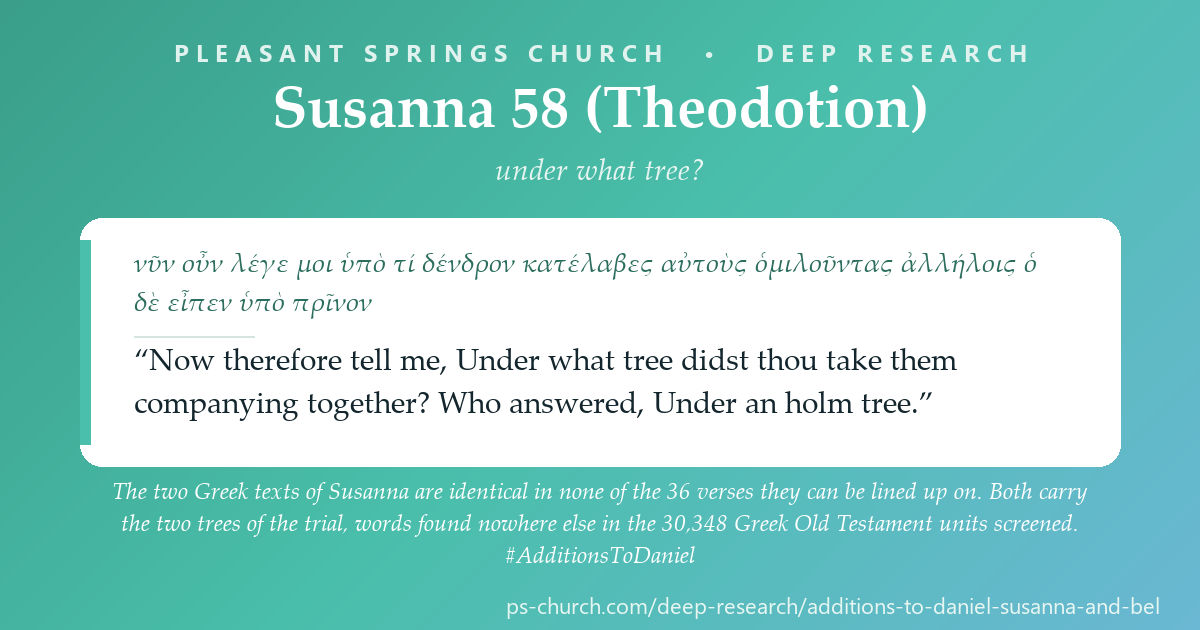
Susanna (OG) 58 νῦν οὖν λέγε μοι ὑπὸ τί δένδρον καὶ ἐν ποίῳ τοῦ κήπου τόπῳ κατέλαβες αὐτοὺς ὁμιλοῦντας ἀλλήλοις ὁ δὲ εἶπεν ὑπὸ πρῖνονSus. 58KJV Sus. 58 “Now therefore tell me, Under what tree didst thou take them companying together? Who answered, Under an holm tree.”
The two texts’ longest shared run in the whole cross-examination: 9 words, ending on the second tree. πρῖνον stands in 2 units of 30,348: these two.
VULGATE Dn 13:58 Nunc ergo, dic mihi sub qua arbore comprehenderis eos loquentes sibi. Qui ait : Sub prino.
Susanna (OG) 59 καὶ εἶπεν Δανιηλ ἁμαρτωλέ νῦν ὁ ἄγγελος κυρίου τὴν ῥομφαίαν ἕστηκεν ἔχων ἕως ὁ λαὸς ἐξολεθρεύσει ὑμᾶς ἵνα καταπρίσῃ σεSus. 59KJV Sus. 59 “Then said Daniel unto him, Well; thou hast also lied against thine own head: for the angel of God waiteth with the sword to cut thee in two, that he may destroy you.”
Here the two Greek texts part: the Old Greek καταπρίσῃ, Theodotion πρίσαι — two forms of a verb to saw, each form standing in one unit of the screened corpus, its own. The King James says “cut thee in two” again, as at 55, and the English carries neither pun. The Clementine has the Greek tree-names and answers them scindet te medium and ut secet te medium.
VULGATE Dn 13:59 Dixit autem ei Daniel : Recte mentitus es et tu in caput tuum : manet enim angelus Domini, gladium habens, ut secet te medium, et interficiat vos.
Susanna (OG) 63 διὰ τοῦτο οἱ νεώτεροι ἀγαπητοὶ Ιακωβ ἐν τῇ ἁπλότητι αὐτῶν καὶ ἡμεῖς φυλασσώμεθα εἰς υἱοὺς δυνατοὺς νεωτέρους εὐσεβήσουσι γὰρ νεώτεροι καὶ ἔσται ἐν αὐτοῖς πνεῦμα ἐπιστήμης καὶ συνέσεως εἰς αἰῶνα αἰῶνοςSus. 63KJV Sus. 63 “Therefore Chelcias and his wife praised God for their daughter Susanna, with Joacim her husband, and all the kindred, because there was no dishonesty found in her.”
The two endings share 1 word. Theodotion: the parents and the husband praise God, and a sixty-fourth verse makes Daniel great before the people. The Old Greek has no 64; it ends on the young — διὰ τοῦτο οἱ νεώτεροι ἀγαπητοὶ Ιακωβ therefore the young are beloved of Jacob (this page’s own literal gloss).
VULGATE Dn 13:63 Helcias autem et uxor ejus laudaverunt Deum pro filia sua Susanna cum Joakim marito ejus, et cognatis omnibus, quia non esset inventa in ea res turpis.
Bel (Th) 2 καὶ ἦν Δανιηλ συμβιωτὴς τοῦ βασιλέως καὶ ἔνδοξος ὑπὲρ πάντας τοὺς φίλους αὐτοῦ
Bel (OG) unnumbered opening line ἐκ προφητείας Αμβακουμ υἱοῦ Ἰησοῦ ἐκ τῆς φυλῆς Λευι
Bel (OG) 2 ἄνθρωπός τις ἦν ἱερεύς ᾧ ὄνομα Δανιηλ υἱὸς Αβαλ συμβιωτὴς τοῦ βασιλέως ΒαβυλῶνοςBel 1–2KJV Bel 1–2 “1 And king Astyages was gathered to his fathers, and Cyrus of Persia received his kingdom. 2 And Daniel conversed with the king, and was honoured above all his friends.”
The two Greek texts do not begin the same story. Theodotion opens on the death of Astyages and the accession of Cyrus. The Old Greek opens on an unnumbered line — from the prophecy of Habakkuk son of Jesus (that is, Joshua), of the tribe of Levi (this page’s own literal gloss) — and then makes Daniel a priest, son of Abal. The name Αβαλ stands in 1 unit of the screened corpus. The Clementine prints Theodotion’s first verse as the last verse of Susanna (Dn 13:65), so its Bel begins at 14:1.
VULGATE Dn 13:65, Dn 14:1 Et rex Astyages appositus est ad patres suos, et suscepit Cyrus Perses regnum ejus. Erat autem Daniel conviva regis, et honoratus super omnes amicos ejus.
Bel (OG) 3 καὶ ἦν εἴδωλον Βηλ ὃ ἐσέβοντο οἱ Βαβυλώνιοι ἀνηλίσκετο δὲ αὐτῷ καθ' ἑκάστην ἡμέραν σεμιδάλεως ἀρτάβαι δέκα δύο καὶ πρόβατα τέσσαρα καὶ ἐλαίου μετρηταὶ ἕξBel 3KJV Bel 3 “Now the Babylons had an idol, called Bel, and there were spent upon him every day twelve great measures of fine flour, and forty sheep, and six vessels of wine.”
Four sheep a day, or forty; six measures of oil, or of wine. The Old Greek reads πρόβατα τέσσαρα and ἐλαίου; Theodotion πρόβατα τεσσαράκοντα and οἴνου. The King James (“forty sheep, and six vessels of wine”) and the Clementine both have Theodotion’s. The longest run the two Greek verses share is 3 words.
VULGATE Dn 14:2 Erat quoque idolum apud Babylonios nomine Bel : et impendebantur in eo per dies singulos similæ artabæ duodecim, et oves quadraginta, vinique amphoræ sex.
Bel (OG) 9 εἶπε δὲ Δανιηλ πρὸς τὸν βασιλέα γινέσθω οὕτως ἐὰν μὴ παραδείξω ὅτι οὐκ ἔστιν ὁ Βηλ ὁ κατεσθίων ταῦτα ἀποθανοῦμαι καὶ πάντες οἱ παρ' ἐμοῦ ἦσαν δὲ τῷ Βηλ ἱερεῖς ἑβδομήκοντα χωρὶς γυναικῶν καὶ τέκνωνBel 9KJV Bel 9–10 “9 But if ye can certify me that Bel devoureth them, then Daniel shall die: for he hath spoken blasphemy against Bel. And Daniel said unto the king, Let it be according to thy word. 10 Now the priests of Bel were threescore and ten, beside their wives and children. And the king went with Daniel into the temple of Bel.”
Theodotion’s nine runs over two English verses: the King James breaks it after “according to thy word”, exactly where the Clementine breaks 14:8 from 14:9. The five words in bold are the deepest contact Luke 1:38 makes with any unit of the 30,348 screened — tie band 1 from both sides — and they are a four-word formula plus the and that begins the next sentence (Stage 4).
VULGATE Dn 14:8, Dn 14:9 Si autem ostenderitis quoniam Bel comedat hæc, morietur Daniel, quia blasphemavit in Bel. Et dixit Daniel regi : Fiat juxta verbum tuum. Erant autem sacerdotes Bel septuaginta, exceptis uxoribus, et parvulis, et filiis. Et venit rex cum Daniele in templum Bel.
Bel (OG) 24 καὶ εἶπεν ὁ βασιλεὺς τῷ Δανιηλ μὴ καὶ τοῦτον ἐρεῖς ὅτι χαλκοῦς ἐστιν ἰδοὺ ζῇ καὶ ἐσθίει καὶ πίνει προσκύνησον αὐτῷBel 24KJV Bel 24 “And the king said unto Daniel, Wilt thou also say that this is of brass? lo, he liveth, he eateth and drinketh; thou canst not say that he is no living god: therefore worship him.”
The English has both Greek texts in one verse. Wilt thou also say that this is of brass? lo, he liveth, he eateth and drinketh is the Old Greek’s question (bold); thou canst not say that he is no living god is Theodotion’s (bold). The Clementine has only Theodotion’s. The page reports what the English column carries, not where its translators found it.
VULGATE Dn 14:23 Et dixit rex Danieli : Ecce nunc non potes dicere quia iste non sit deus vivens : adora ergo eum.
Bel (OG) 31/32 ἦν δὲ λάκκος ἐν ᾧ ἐτρέφοντο λέοντες ἑπτά οἷς παρεδίδοντο οἱ ἐπίβουλοι τοῦ βασιλέως καὶ ἐχορηγεῖτο αὐτοῖς καθ' ἑκάστην ἡμέραν τῶν ἐπιθανατίων σώματα δύο καὶ ἐνεβάλοσαν τὸν Δανιηλ οἱ ὄχλοι εἰς ἐκεῖνον τὸν λάκκον ἵνα καταβρωθῇ καὶ μηδὲ ταφῆς τύχῃ καὶ ἦν ἐν τῷ λάκκῳ Δανιηλ ἡμέρας ἕξBel 31KJV Bel 31 “Who cast him into the lions’ den: where he was six days.”
The deepest run either Bel text makes with any unit of the Greek Old Testament: 8 words, tie band 1 — Theodotion’s Bel 31 against Theodotion’s Daniel 6:17, they cast him into the den of the lions and. From the other side it is not Daniel 6:17’s deepest: that verse runs 9 words with two verses of Daniel itself. The Old Greek carries Bel 31 and 32 as one row, sharing a run of 3 words with Theodotion’s two (bold); in it the seven lions are fed each day on τῶν ἐπιθανατίων σώματα δύο, two bodies of the condemned, and it is οἱ ὄχλοι, the crowds, who throw Daniel in.
VULGATE Dn 14:30 Qui miserunt eum in lacum leonum, et erat ibi diebus sex.
Bel (OG) 41 καὶ ἀναβοήσας εἶπεν ὁ βασιλεύς μέγας ἐστὶ κύριος ὁ θεός καὶ οὐκ ἔστι πλὴν αὐτοῦ ἄλλοςBel 41KJV Bel 41 “Then cried the king with a loud voice, saying, Great art thou, O Lord God of Daniel, and there is none other beside thee.”
The king’s second confession, and it is built like his first (Bel 18, KJV “Great art thou, O Bel”) in both Greek texts — see the structure below. The Old Greek’s deepest contact anywhere in the screened Greek Old Testament is the five words in bold, shared with Isaiah 45:5 and 45:6 (tie band 2). The two Greek verses themselves share a run of only 2 as this page counts word forms: the Old Greek’s καὶ οὐκ ἔστι πλὴν against Theodotion’s καὶ οὐκ ἔστιν πλὴν — a movable nu, which the New Testament screen folds — is all that cuts a run of 4, and there is not, except. The Clementine’s 14:40 is shorter and runs on into the next verse.
VULGATE Dn 14:40 Et exclamavit voce magna rex, dicens : Magnus es, Domine Deus Danielis. Et extraxit eum de lacu leonum.
And yet both Susannas carry the trial’s two trees — the same two tree-names, at the same two verses, answered by verbs of splitting and sawing. That is the thesis of this page, and Stage 4 sets it out word by word.
On the columns. The Greek is the CATSS morphological Septuagint, quoted at verse level with attribution. There is no Hebrew or Aramaic of either story on this disk, and no ESV of them — the ESV text held on this shelf is of the sixty-six-book canon only, and these stories are not in it. The English is the KJV Apocrypha (1769 standard text, public domain), read verse by verse from the eBible.org file held on this disk and printed verbatim, spelling included; every row gives its own verse number. English in quotation marks and tagged as the King James’s is its text, verbatim; short italic English set beside Greek or Latin, in the notes, the diagram and the stages, is this page’s own rendering. The Latin is the Clementine Vulgate’s Daniel 13–14, printed as a fourth witness and never as a source for the English.
Versification — a third state, stated in full. There is no Masoretic text of either story, and no ESV text of them is held here, so the usual MT/LXX/ESV offset cannot be stated for them. What exists instead, measured from the files:
• Greek Susanna. Theodotion: 64 rows, 1–64, 1,134 words. Old Greek: 37 rows labelled 6–63, 792 words; 5 of its labels carry more than one verse number (7/8, 10/11, 13/14, 44/45, 60–62) and one is lettered (35a). Its labels cover 42 of Theodotion’s 64 numbers; 22 have no Old Greek label at all (1, 2, 3, 4, 5, 15, 16, 17, 18, 20, 21, 24, 25, 26, 27, 42, 43, 46, 47, 49, 50, 64). The lettered 35a is Susanna’s prayer, which Theodotion places at 42–43, after the verdict instead of before the testimony; aligned by content, the two share a run of 7 words.
• Greek Bel. Theodotion: 42 rows, 1–42, 871 words. Old Greek: 37 rows — one unnumbered opening line of 9 words and 36 rows labelled 2–42, 2 of them carrying more than one number (15–17, 31/32); no label 1, 12, 29; 901 words. The Old Greek Bel is the longer of its pair; the Old Greek Susanna the much shorter.
• Citation. Both stories are verse-only books; the tooling labels their rows “1:N”, and that “1” is the parser’s, not the text’s. This page cites Sus. 38 and Bel 9.
• KJV Apocrypha. Susanna 64 verses and Bel 42 — Theodotion’s counts, and aligned by content the English verse n is Theodotion’s n, except where the two divide the same text at different clauses. In Susanna that happens at four places: 13/14, 19/20, 40/41, 61/62. In Bel it happens between verses 4 and 26: the English breaks a verse inside Theodotion’s 5, 8, 9, 11, 21 and 25, and runs Theodotion’s 13 and 14 together. From Bel 27 to the end the two coincide verse for verse.
• Clementine Vulgate. Daniel 13 has 65 verses: 13:1–64 is Susanna, label for label with Theodotion apart from clause-level shifts at 12/13, 19/20, 27/28, 38/39 and 40/41; and 13:65 is Theodotion’s Bel 1, Astyages and Cyrus. Daniel 14 has 42 verses: 14:n is Theodotion’s Bel n+1, and 14:42 has no counterpart in either Greek text (Stage 4). At every one of the seven places where the English re-divides Theodotion’s Bel, it divides exactly as the Clementine does. In Susanna the English and the Clementine agree at two of the English’s four re-divisions (19/20, 40/41).
• Daniel 6, cited for comparison. It is cited by the Aramaic and Theodotion number: the Masoretic Daniel 6 has 29 verses and Theodotion’s file 29 rows, numbered alike. The Clementine numbers one lower: its Daniel 5 has 31 verses, its 5:31 is their 6:1 (Darius the Mede, aged sixty-two), its Daniel 6 has 28, and so its 6:16 is their 6:17 (Daniel cast into the den) and its 6:27 their 6:28. English Bibles number as the Clementine does here; no ESV of Daniel is cached on this disk, and the offset is the one the Daniel 1–6 study on this shelf states (MT and Theodotion 6:1 = ESV 5:31). The CATSS Old Greek file has 30 rows in chapter 6, with a 6:13a, and is cited by its own labels. Every pairing above is anchored by quoted words in the page’s self-check; none is assumed from a label. Whether the English divisions derive from a Latin Bible is not established here.
The Shape of the Passage
Two stories in sequence — each an ordeal and a reversal, with measured markers; not a chiasmThis is NOT offered as a chiasm. Nothing in either story mirrors itself in reverse. Each is a sequence — an accusation or an ordeal, a turn, a reversal in which the accusers suffer what they intended — and the stage labels are by content except where a marker is counted above.
⚠️ Where this page sits. These stories are canonical in the Roman Catholic and Orthodox churches, printed among the Apocrypha in the older Protestant Bibles, and absent from the Hebrew and Aramaic of Daniel. This library reads them as witnesses and files them under Apocrypha / Deuterocanon. Nothing taught at Pleasant Springs rests on them.
Author
Anonymous, and visible only in Greek — twice. Each story survives here in two Greek texts that tell the same plot in different sentences. Whether either story was first told in Hebrew or Aramaic is argued in the literature and cannot be tested on this disk; the puns of Susanna 54–59 were brought into that argument as early as the third century (Stage 2).
A storyteller with a courtroom in mind. Susanna turns on procedure: two witnesses, a public hearing, the law of false witness, and a cross-examination that separates the witnesses before it questions them. Bel turns on proof: sealed doors, ash on the floor, footprints.
Dating is not attempted. The commentaries named in Stage 1 discuss it; nothing on this page depends on a date and nothing here tests one.
Audience
Jews governing themselves inside a foreign empire. Susanna is set in Babylon, in a community with its own elders, its own judges and its own assembly, and its danger comes from inside: the judges are the villains. The story asks what a community does when its own authorities lie.
Jews living among temples. Bel is a satire on gods that are fed and do not eat, and on a crowd that turns on its king for siding with a Jew. It is told for readers surrounded by other people’s worship.
Readers who knew Daniel — or met him here. Theodotion’s Susanna introduces him as a young man ᾧ ὄνομα Δανιηλ (whose name was Daniel, 45), and the Old Greek’s Bel as ἄνθρωπός τις ἦν ἱερεύς ᾧ ὄνομα Δανιηλ (a certain man, a priest, whose name was Daniel, 2). Whether the first readers knew the canonical book is not tested here; a reader who does will notice how little of Daniel 6’s wording Bel’s den shares (Stage 4).
Orient on the two stories, on Daniel’s two Greek texts, and on why both matter here.
Search by topic: Susanna; Bel and the Dragon; Daniel, Additions to; Theodotion; Old Greek; papyrus 967; Habakkuk; Julius Africanus.
Where to look, and what to look up:
- Dictionaries — the Anchor Bible Dictionary, the Eerdmans Dictionary of Early Judaism and the IVP Dictionary of New Testament Background. Headings to search: Susanna; Bel and the Dragon; Daniel, Additions to; Theodotion; Septuagint. These are the headings this page would search, not a claim about any one dictionary’s table of contents; none of the three was read for this page.
- On the text — any article that keeps the Old Greek and Theodotion apart. An article that quotes ‘the Greek of Susanna’ without saying which cannot be used for these stories, because the two agree word for word in no verse.
Bibliography surfaced:
- Carey A. Moore, Daniel, Esther and Jeremiah: The Additions (Anchor Bible) — a commentary whose title names the additions to Daniel, Esther and Jeremiah together.
- John J. Collins, Daniel (Hermeneia) — a critical commentary on the book.
- Tim McLay, The OG and Th Versions of Daniel — on how the two Greek texts relate.
- NETS (A New English Translation of the Septuagint) — whose Daniel, Susanna and Bel print the Old Greek and Theodotion as two translations. Named as the next step for a reader; not the English quoted here.
A law cited by name, a law obeyed without citation, a prophet carried by his hair, and an argument about puns.
Each parallel below is measured where this shelf can measure it, and says so where it cannot. Canonical Hebrew is printed from the Masoretic text; its English is the ESV where this disk holds it and the page’s own labelled gloss where it does not.
Which parallels shed light on the world of the text?
- Exodus 23:7 → Sus. 53. Daniel tells the first elder he has condemned the innocent although the Lord says — Theodotion λέγοντος τοῦ κυρίου, the Old Greek τοῦ κυρίου λέγοντος — and then five words: ἀθῷον καὶ δίκαιον οὐκ ἀποκτενεῖς. Measured: those five words stand in 3 units of the screened Greek Old Testament — Exodus 23:7 and the two Greek texts of Sus. 53 — and in 0 New Testament verses. From Exodus’s side, Exodus 23:7’s deepest partners in the whole screened corpus are those two Susanna rows (5 words, tie band 2). Hebrew: וְנָקִ֤י וְצַדִּיק֙ אַֽל־תַּהֲרֹ֔ג — the innocent and the righteous do not kill (this page’s own literal gloss). The text itself marks the words as the Lord’s; this is the one place in either story where a citation formula introduces Scripture.
- Deuteronomy 19 → Sus. 61–62. The false witnesses are done to as they meant to do according to the law of Moses (Theodotion κατὰ τὸν νόμον Μωυσῆ; the Old Greek ὡς ὁ νόμος διαγορεύει). The law is named, not cited. Measured: Theodotion’s 61 shares 2 consecutive words with Deuteronomy 19:19, and the closing αἷμα ἀναίτιον (innocent blood) stands in 4 units: Deuteronomy 19:10, 21:8, and the two Greek texts of Susanna.
- Jeremiah 29:21–23 (Greek Jeremiah 36:21–23) — set beside Susanna by this page because of what both describe: two men in Babylon, adultery with their neighbours’ wives, and a death by fire at the hand of the king of Babylon. Hebrew 29:22: כְּצִדְקִיָּ֣הוּ וּכְאֶחָ֔ב אֲשֶׁר־קָלָ֥ם מֶֽלֶךְ־בָּבֶ֖ל בָּאֵֽשׁ׃ — like Zedekiah and like Ahab, whom the king of Babylon roasted in the fire (this page’s own literal gloss). Measured, the wording is not shared: the longest run either Greek Susanna has with Greek Jeremiah 36:21–23 is 2 words. The Old Greek’s ending, where the angel throws fire between the condemned (ἔρριψε πῦρ διὰ μέσου αὐτῶν), is the nearest it comes, in content only. Whether the story knew Jeremiah’s two men is not measurable.
- Habakkuk → Bel 33–39. The prophet named in the title of the canonical book — ESV Habakkuk 1:1: “The oracle that Habakkuk the prophet saw.” הַמַּשָּׂא֙ אֲשֶׁ֣ר חָזָ֔ה חֲבַקּ֖וּק הַנָּבִֽיא׃ — is the man carried to Babylon by the hair to feed Daniel. Measured: the Greek name Αμβακουμ occurs 14 times in the screened Greek Old Testament: 12 times in the two texts of Bel (7 in the Old Greek, counting its opening line; 5 in Theodotion) and 2 times in the book of Habakkuk (1:1, 3:1). From the other side, Habakkuk 1:1’s deepest partner in the whole screened corpus is Theodotion’s Bel 33 — Αμβακουμ ὁ προφήτης, 3 words, tie band 1. The Old Greek heads its story with ἐκ προφητείας Αμβακουμ, from the prophecy of Habakkuk (this page’s own literal gloss). The Greek book of Habakkuk names neither Daniel nor Bel (0 occurrences).
- The idol polemic — Isaiah 44–46 and the Letter of Jeremiah mock gods that are made, carried and served. Measured: the name, in its indeclinable form Βηλ, occurs 28 times in the screened Greek Old Testament, 1 of them outside the two Bel texts (Isaiah 46:1). Declined, it stands in 2 more units: Βῆλος at Jeremiah 27:2 (Greek numbering), and τὸν Βῆλον in the Letter of Jeremiah itself (EpJer 40). The Letter of Jeremiah, whose idols’ priests sell the sacrifices and use the proceeds (EpJer 27, τὰς δὲ θυσίας αὐτῶν ἀποδόμενοι οἱ ἱερεῖς αὐτῶν καταχρῶνται), shares a longest run of 2 words with the Old Greek Bel and 3 with Theodotion. The Old Greek’s closing confession (41) runs 5 words with Isaiah 45:5–6, κύριος ὁ θεός καὶ οὐκ — the Lord God, and there is no … (this page’s own literal gloss) (tie band 2); from Isaiah’s side both verses run deeper with other verses of Isaiah (Stage 4). Same argument, different words.
- 1 Maccabees 2:60 — Mattathias on his deathbed: Δανιηλ ἐν τῇ ἁπλότητι αὐτοῦ ἐρρύσθη ἐκ στόματος λεόντων Daniel in his simplicity was rescued from the mouth of lions (this page’s own literal gloss). Against both texts of Bel its deepest run is 2 words; against the Old Greek’s last verse of Susanna it is 3 (ἐν τῇ ἁπλότητι, in their/his simplicity — a noun that stands in 7 units of the screened corpus). It remembers a den; it does not quote this one.
- Julius Africanus and Origen. In the third century Julius Africanus wrote to Origen arguing that Susanna could not belong with Daniel, and among his reasons were the tree-puns of verses 54–59, which he took to show that the story was composed in Greek; Origen’s reply defended the story and disputed the inference. Neither letter is on this disk; this is reported from outside reading and not checked here. What this page can add is narrow and measured: the puns are not in one Greek text only, but in both (Stage 4).
Two trees, two cuts, a prophet’s name, a living god, and four loud cries.
Every count below is over the Greek Old Testament files screened here — 30,348 verse units, the Odes excluded — or the 7,927 verses of the Greek New Testament, and says which. It is not a count over “the Septuagint.” Both Greek texts of each story are screened, so every word in these stories is in the corpus twice where the two texts agree.
2 units of the 30,348 screened, and 0 verses of the Greek New Testament: the tree occurs only at Sus. 54, in both Greek texts. Its answer, σχίσει (will split), likewise stands in only 2 units — Sus. 55, both texts. The verb is not confined to Susanna: other forms of it stand elsewhere in the Greek Old Testament (Stage 4), and in the Greek New Testament this same form occurs 1 time, at Luke 5:36, σχίσει, the tearing of a garment in the parable of the patch. The Clementine has the same tree, Sub schino, and answers it with scindet.
2 units: Sus. 58, both texts. And here the two Greek texts answer the tree with different words: the Old Greek καταπρίσῃ (1 unit), Theodotion πρίσαι (1 unit). The Greek New Testament has the simple verb to saw 1 time: Hebrews 11:37, ἐπρίσθησαν, (they were sawn in two) — a different form, and the verse shares no word at all with either Greek Sus. 59 (0 and 0). The compound διεπρίοντο (literally, they were sawn through) stands in 2 verses, Acts 5:33 and 7:54, both figurative, and is not counted. Theodotion pairs its two sentences closely: both carry σε μέσον (2 units: Theodotion 55 and 59).
14 occurrences in the screened Greek Old Testament; 12 of them in Bel, 2 in the book that bears his name. The Old Greek names him first in its unnumbered opening line, with a father, υἱοῦ Ἰησοῦ, and a tribe, ἐκ τῆς φυλῆς Λευι; Theodotion introduces him at 33 as Αμβακουμ ὁ προφήτης ἐν τῇ Ιουδαίᾳ. 0 occurrences in the Greek New Testament.
Theodotion’s Bel turns on the word living: it stands in 4 of its rows — Daniel worships τὸν ζῶντα θεὸν (5); the king asks whether Bel is not a living god (6); the dragon is offered as one (24); Daniel answers that his God is (25). The Old Greek has the word in 1 row, where the dragon ἰδοὺ ζῇ (look, it lives, 24). The phrase εἴδωλα χειροποίητα (idols made by hand, 5) stands in 1 unit of the screened corpus: this one.
4 times in Theodotion’s Susanna (24, 42, 46, 60); 0 in the Old Greek. Susanna cries out in the garden and again before her death; Daniel cries out; the assembly cries out. The Old Greek has no row at 24, 42 or 46, and its 60–62 has the verb without the phrase. A structure that runs on four cries is a Theodotion structure, and the diagram above says so.
Counted here, not assumed:
- Susanna is named 10 times in Theodotion and 3 in the Old Greek. Daniel is named 6 and 5 times. Where Theodotion names her at 22, the Old Greek calls her ἡ Ιουδαία, the Jewess.
- The Old Greek has no bath. It has no rows at all for verses 15–18, 20–21 or 24–27; the washing, the oil, the closed garden doors and the side door are Theodotion’s (15, 17–18). In the Old Greek the elders simply agree to go to her (πορευθῶμεν πρὸς αὐτήν, 19).
- Both Greek texts have Daniel tell the second elder he is no true son of Judah — Theodotion σπέρμα Χανααν καὶ οὐκ Ιουδα, the Old Greek ὡς Σιδῶνος καὶ οὐχ ὡς Ιουδα. An insult in a character’s mouth, measured against Judah; reported, not endorsed.
- Theodotion’s king comes to the den τῇ ἡμέρᾳ τῇ ἑβδόμῃ, on the seventh day; the Old Greek’s μετὰ ταῦτα, after these things. In both texts Daniel is in the den six days (31; 31/32).
- The word for Daniel’s place at court, συμβιωτὴς (one who lives with the king), stands in 3 units of the screened corpus, all of them in Bel.
Two texts that are never identical, the two trees they both carry, a den that shares little wording with Daniel 6, and a New Testament screen whose rarest contacts are accidents.
Five screens, all exhaustive, nothing sampled. (1) The two Greek texts of each story against each other, label by label — an Old Greek row carrying several verse numbers is compared with Theodotion’s verses run together. (2) The tree-words across every witness held. (3) Bel 31–42 against both Greek texts of Daniel 6. (4) Every row of all four texts against the screened Greek Old Testament, each story’s own two files left out (30,247 units for Susanna, 30,269 for Bel). (5) Every row against all 7,927 verses of the Greek New Testament. The tie band — how many target units reach the same depth — is printed beside every run, from both sides. Word forms, never lemmas; contact, never allusion; direction of influence never asserted. Screens (1) to (4) compare forms with the movable nu kept, so esti and estin are two forms; screen (5) folds it, with the other spelling equivalences the shelf’s New Testament screen uses. Where that changes a figure, the page says so.
1. The two Greek texts against each other:
Susanna: 36 Old Greek rows can be lined up with Theodotion. Identical: 0. Median longest shared run: 3. 15 of the 36 share no more than two consecutive words, and verse 38 shares none. The deepest agreement is 15 words, at verse 9. Bel: 36 rows; identical 0; median 3; 8 share no more than two; the deepest agreement 13 words, at verse 5 — Daniel’s confession of the God who made heaven and earth. With the movable nu folded, Bel’s rows sharing no more than two fall from 8 to 6 (verses 38 and 41 rise), and no figure in the table below changes. Counting only the labels the two files share exactly — 31 in Susanna and 34 in Bel, the counts the companion study prints — the answers do not change: identical in 0 and 0, median 3 and 3, and the single zero at verse 38.
| Where the two Greek texts of Daniel are compared | labels aligned | identical word for word | median longest shared run | labels sharing no word at all |
|---|---|---|---|---|
| Susanna (Old Greek rows against Theodotion) | 36 | 0 | 3 | 1 (verse 38) |
| Bel (Old Greek rows against Theodotion) | 36 | 0 | 3 | 0 |
| Daniel 1–12 outside 3:24–90 | 337 | 0 | 4 | 0 |
| of which Daniel 4, 5, 6 and 11 | 0 | 2, 2, 3, 3 | 0 | |
| Daniel 3:24–90 (the companion study) | 67 | 31 | 12 | 0 |
Read the table honestly. Susanna and Bel sit at the low end of Greek Daniel, with chapters 4–6 and 11 — not below them: chapters 4 and 5 run lower still, at a median of 2. A first draft of this page said these two stories were where the two Greek Daniels are furthest apart; measured, they are not, and the claim is withdrawn here rather than quietly dropped. What is unique to Susanna is the zero: of the 476 labels aligned across Greek Daniel, verse 38 is the only one at which the two texts share no word.
Which Greek text does the English column agree with? Theodotion’s, at every diagnostic this page checked. The King James has the verses the Old Greek lacks — Susanna’s opening, There dwelt a man in Babylon, and the bath, she was desirous to wash herself in the garden; it has Theodotion’s prayer after the verdict, O everlasting God (Sus. 42); forty sheep, and six vessels of wine (Bel 3); and Upon the seventh day (Bel 40). The one exception is Bel 24, where it carries both texts (the codex).
The verse at which the two Greek texts share nothing is the elders’ testimony — the lie — in a story whose verdict turns on two tellings of one lie failing to agree. That is a coincidence of the two texts as held, not a design in either of them, and nothing on this page rests on it.
2. The two trees — carried by both texts:
In the cross-examination (9 rows, 51–59) the two Greek texts share a median run of 4 words — barely more than the stories’ median of three. But they share its skeleton exactly: the same question twice, ὑπὸ τί δένδρον (4 units in the screened corpus — these four), the same two tree-names, and at 55 the same verb in the same form.
| Verse | Old Greek | Theodotion | KJV Apocrypha | Clementine |
|---|---|---|---|---|
| 54 | ὑπὸ σχῖνον | ὑπὸ σχῖνον | Under a mastick tree. | Sub schino. |
| 55 | σχίσει σου τὴν ψυχὴν σήμερον | σχίσει σε μέσον | to cut thee in two | scindet te medium |
| 58 | ὑπὸ πρῖνον | ὑπὸ πρῖνον | Under an holm tree. | Sub prino. |
| 59 | ἵνα καταπρίσῃ σε | πρίσαι σε μέσον | to cut thee in two | ut secet te medium |
None of the five tree-words — the two names, the splitting verb, the two sawing verbs — stands anywhere else in the 30,348 screened units in these forms. The tree-names, in any form: 2 and 2 units, both Greek texts each time. The splitting verb in this form: 2 units, both texts. The sawing verbs in these forms: 1 unit and 1, each text its own. The verbs themselves are not rare: other forms of the splitting verb stand elsewhere — σχίσας (Genesis 22:3), ἐσχίσθη (Exodus 14:21), σχισθήσεται (Zechariah 14:4) among them — and other saw verbs at Amos 1:3 (ἔπριζον), 1 Chronicles 20:3 (διέπρισεν) and Wisdom 13:11 (ἐκπρίσας). Two texts that agree word for word in no verse agree on the tree-name at 54, the verb at 55 and the tree-name at 58, and part only on the form of the saw at 59.
The English and the Latin do different things with the joke. The King James names two real trees and answers both with “to cut thee in two”, so the English carries neither pun. The Clementine has the Greek tree-names (schino, prino) and answers them with two different verbs. This page reports what each column has; whether the Latin is heard as a pun is a judgement for a Latinist.
3. Bel 31–42 against Daniel 6 (Aramaic and Theodotion verse numbers, one above the Clementine’s and the English; the Old Greek by its own file labels — see the versification note):
Every row of Bel’s den story, in both texts, against every verse of both Greek texts of Daniel 6. Old Greek: 11 rows, median best run 2, deepest 6. Theodotion: 12 rows, median 2.5, deepest 8. One phrase recurs on both sides: εἰς τὸν λάκκον τῶν λεόντων (into the den of the lions) stands in 14 units of the screened Greek Old Testament, every one in Daniel 6 or Bel, and in 0 verses of the New Testament. It is not the only run the two share: across the four texts, 6 distinct five-word sequences stand both in Bel 31–42 and in Daniel 6, and every Bel row that reaches five or more words with Daniel 6 is listed below.
- Theodotion Bel 31 → Theodotion Daniel 6:17 — 8 words, tie band 1. The deepest run either Bel text makes with anything in the screened Greek Old Testament. From Daniel’s side it is not the deepest: Daniel 6:17 reaches 9 words with two verses of Daniel itself (tie band 2). Aramaic 6:17: וּרְמ֕וֹ לְגֻבָּ֖א דִּ֣י אַרְיָוָתָ֑א — and they cast [him] into the pit of the lions (this page’s own literal gloss).
- Old Greek Bel 34 → Old Greek Daniel 6:15 — 6 words, tie band 1; and Theodotion Bel 34 reaches the same Old Greek verse at 6. From Daniel 6:15’s side the band is 3: the two Bel 34s and another verse of the Old Greek Daniel.
- Old Greek Bel 42 → Theodotion Daniel 6:24 — 5 words, tie band 1 from both sides. Δανιηλ ἐκ τοῦ λάκκου καὶ — Daniel out of the pit, and.
- So the recensions cross. Theodotion’s Bel runs deepest with Theodotion’s Daniel at 31, but with the Old Greek’s Daniel at 34; the Old Greek’s Bel runs deepest with Theodotion’s Daniel at 42. The page reports the pairings and does not explain them.
- ⚠️ The page’s own counter-example. Hebrews 11:33, ἔφραξαν στόματα λεόντων, (stopped the mouths of lions), measures 1 at best, against any row of the Old Greek Bel, and 1 at best, against any row of Theodotion’s. Its deepest Greek Old Testament contact anywhere is 2 words, tie band 3, and Bel is not among them. The live Daniel study measured the same verse against Theodotion Daniel 6:23 and found one word as well.
4. Against the Greek Old Testament:
Old Greek Susanna, 37 rows against 30,247 units: all 37 reach two, 30 reach three, 15 four, 2 five, and nothing reaches six. Theodotion Susanna, 64 rows: all 64 reach two, 57 three, 38 four, 12 five, 2 six, and nothing seven. Old Greek Bel, 37 rows against 30,269 units: all 37 reach three, 28 four, 10 five, 3 six, and nothing seven. Theodotion Bel, 42 rows: all 42 reach two, 38 three, 33 four, 15 five, 6 six, 2 seven, 1 eight, and nothing nine.
- Sus. 53 → Exodus 23:7 — 5 words, tie band 1, in both texts (Stage 2): the one run in either story introduced by a citation formula.
- Theodotion Sus. 64 → 1 Samuel 18:9 — 6 words, tie band 1. ἀπὸ τῆς ἡμέρας ἐκείνης καὶ ἐπέκεινα — from that day and onward. In 1 Samuel it is Saul eyeing David with suspicion; here, Daniel held in honour. From 1 Samuel 18:9’s side the band is 2. A time formula, 2 units.
- Theodotion Bel 16 → 1 Maccabees 6:33 — 7 words, tie band 1. καὶ ὤρθρισεν ὁ βασιλεὺς τὸ πρωὶ καὶ — and the king rose early in the morning, and: a king going to inspect a temple, and a king going to battle.
- Old Greek Bel 41 → Isaiah 45:5 and 45:6 — 5 words, tie band 2 (Stage 2): the king’s confession and Isaiah’s there is no other share these five words. From Isaiah’s side the picture is different: Isaiah 45:5 reaches 8 words (tie band 2) and 45:6 reaches 8 (tie band 1), with other verses of Isaiah, not with Bel.
5. Against the Greek New Testament — the distribution, all four texts:
Old Greek Susanna, 37 rows against 7,927 verses: all 37 reach two, 27 reach three, 8 four, and nothing five. Theodotion Susanna, 64 rows: all 64 reach two, 46 three, 18 four, and nothing five. Old Greek Bel, 37 rows: all 37 reach two, 33 three, 7 four, 1 six, and nothing seven. Theodotion Bel, 42 rows: all 42 reach two, 33 three, 11 four, 3 five, 2 six, and nothing seven.
- Bel 5, both texts → Acts 4:24, Acts 14:15 and Revelation 14:7 — 6 words, tie band 3. τὸν οὐρανὸν καὶ τὴν γῆν καὶ — the heaven and the earth, and; its first five words stand in 26 units of the screened Greek Old Testament. From the other side it dissolves: Acts 4:24 and 14:15 run 13 words with Exodus 20:11, and Revelation 14:7 runs 7 with Psalm 113:23 (Greek numbering). A creator formula.
- Theodotion Bel 1 → Acts 13:36 — 6 words, tie band 1. προσετέθη πρὸς τοὺς πατέρας αὐτοῦ καὶ — was added to his fathers, and: Astyages’ death and David’s. From Acts’ side the band is 2: Theodotion’s Bel 1 and 1 Maccabees 2:69, Mattathias’ death. A formula for dying, shared equally with 1 Maccabees.
Luke 1:38 ←→ Theodotion Bel 9: 5 words, tie band 1 from Bel’s side and 1 from Luke’s. Of every unit in the screened Greek Old Testament, the one that runs deepest with Mary’s answer to the angel is Daniel agreeing to a test of Bel’s priests. Look at the words: Luke κατὰ τὸ ῥῆμά σου. καὶ, Bel κατὰ τὸ ῥῆμά σου καὶ. The first four, according to your word, stand in 8 units of the Greek Old Testament and 2 verses of the New; the fifth is the and that begins the next sentence in both. That is all the rarity is.
Acts 18:6 ←→ Theodotion Sus. 46: 4 words, tie band 1 from Susanna’s side, 4 from Acts’. Both verses are about blood-guilt, and that is what makes this one interesting. But look at the printed Greek: Acts καθαρὸς ἐγώ· ἀπὸ τοῦ, Susanna καθαρὸς ἐγὼ ἀπὸ τοῦ. In Acts the last two words begin a new clause — from now on I will go to the Gentiles. The sense Susanna has, clean of the blood, is nearer Acts 20:26 (καθαρός εἰμι ἀπὸ τοῦ αἵματος), whose deepest Greek Old Testament contacts (4 words, tie band 2) are elsewhere and not in Susanna; and Matthew 27:24, Pilate’s Ἀθῷός εἰμι ἀπὸ τοῦ αἵματος, which reaches only 3 words with anything in the Greek Old Testament — ἀπὸ τοῦ αἵματος, in a tie band of 35 that includes this verse of Susanna. The phrase stands in 35 units of the Greek Old Testament.
Philippians 1:8 ←→ Theodotion Bel 38: 4 words, tie band 1 from Bel’s side and 1 from Philippians’. Paul γάρ μου ὁ θεός, (for God is my witness), Daniel γάρ μου ὁ θεός (for you remembered me, O God). The same four words in two different sentences — in one, God is the subject; in the other, the one addressed.
Acts 27:21 ←→ Sus. 48, both texts: 4 words, tie band 1 from Susanna’s side and 2 from Acts’ (the two Susanna 48s). ἐν μέσῳ αὐτῶν εἶπεν· — Paul standing among the sailors, Daniel among the assembly, and each said. The four words stand in 2 units of the Greek Old Testament (the two Susanna 48s) and 1 New Testament verse. A stage direction.
Acts 12:7 ←→ Old Greek Sus. 44/45: 4 words, tie band 1 from Susanna’s side and 1 from Acts’. καὶ ἰδοὺ ἄγγελος κυρίου — an angel at the rescue of someone about to die. Without the ‘and’, the three words stand in 4 New Testament verses, three of them in Matthew 1–2.
It settles that no New Testament verse quotes either story on this screen. Nothing in Susanna reaches five; Bel reaches six only with a creator formula, which the three New Testament verses share more deeply with Exodus 20:11 and Psalm 113:23, and a formula for dying, which Acts 13:36 shares just as deeply with 1 Maccabees 2:69. And the New Testament verse that remembers lions’ mouths shares one word with Bel.
It does not settle that the stories were unknown. A verbatim screen cannot see a story retold in other words. The scope is the Greek: four texts, 7,927 New Testament verses, contiguous identical word forms.
What this page could not check, what it got wrong on the way, and where it is weakest.
This is the section that makes the shelf trustworthy. It is long because a great deal about these stories lies outside the files on this disk.
⚠️ Found on the way — reported, not buried:
- A thesis this page did not keep. The first framing was that Susanna and Bel are where Daniel’s two Greek texts are furthest apart. Measured against every chapter of Daniel, they are not: Daniel 4 and 5 have a lower median (2 and 2) than either story (3). The claim is withdrawn in Stage 4; what survives is the single zero at Sus. 38.
- A shorthand this page nearly printed. The working notes for this page called the second pun “prinos / prisei,” on the model of schinos / schisei. Neither Greek file reads prisei: the Old Greek has καταπρίσῃ and Theodotion πρίσαι. The tree-name is shared; the saw is not.
- The English file has one verb that no witness held here has. Bel 38 in the King James reads neither hast thou forsaken them that seek thee and love thee; Theodotion has only τοὺς ἀγαπῶντάς σε (those who love you), the Old Greek τοὺς ἀγαπῶντας αὐτόν, and the Clementine diligentes te. Where seek came from is not established here.
- The English file carries both Greek texts at Bel 24 (the codex), and the Clementine only Theodotion’s. Which Greek or Latin witness the 1611 translators read there is not established here.
- The Clementine carries a verse that neither Greek Bel nor the King James has. Daniel 14:42 — Paveant omnes habitantes in universa terra Deum Danielis — has no counterpart in either Greek Bel or in the King James. Measured on the Latin files: its last 8 words are the last 8 of the Clementine’s Daniel 6:27 (in terra : qui liberavit Danielem de lacu leonum; Theodotion’s and the Aramaic 6:28), and that is the only verse in the whole Clementine it shares four or more consecutive words with (1). The Latin’s Bel ends on the same 8 words as the decree in the Latin’s Daniel 6.
⚠️ What this page could NOT check:
- Any Semitic form of either story. The Masoretic Daniel has none, and no Hebrew or Aramaic retelling is on this disk. Whether Susanna or Bel was composed in Hebrew, Aramaic or Greek is not verifiable from local corpora — and the puns, which Africanus already brought into the question (Stage 2), are evidence about the Greek texts we hold, not about what preceded them.
- The manuscripts. No manuscript of either Greek text is held — not papyrus 967, not the Syro-Hexapla, not the uncials. The CATSS files are digitisations of Rahlfs’s edition and inherit its choices, including where the Old Greek of Susanna begins (at verse 6 in this file).
- Where the stories stand in the manuscripts — at the head of Daniel or after it. The CATSS files are separate books and carry no position, and this page did not check it. The numbering 13–14 used here is the Clementine’s.
- The letters of Julius Africanus and Origen (Stage 2) — reported, not read for this page.
- Why the two Greek texts differ as they do. The literature on the relation of the Old Greek to Theodotion (Stage 1) was named, not read. The figures are measured; an explanation is not offered.
- The Clementine is Jerome’s Latin as the Clementine edition prints it, not the Old Latin, which is not held.
⚠️ Where this page is weakest:
- Alignment of the Old Greek. Where an Old Greek row carries several verse numbers (7/8, 60–62, 15–17, 31/32) it is compared with Theodotion’s verses run together, and the lettered 35a is set aside from the label count. Measured both ways: at exact labels only (31 and 34; 469 across Greek Daniel) the identical-verse counts, the medians and the single zero are unchanged.
- Comparisons across the Daniel table are not perfectly like for like. Chapters 1–12 are compared at labels the two files share exactly; the two stories, in the table, at labels lined up as just described.
- The English and Latin divisions were read, not computed. Every pairing in the versification note is anchored by quoted words that the self-check confirms, but the reading of each clause is a reader’s.
- The structure’s stages are by content. The counted markers are Theodotion’s four loud cries, the two under what tree? questions, the king’s two confessions and the eating verbs; the stage boundaries between them are a reading.
- The English column is quotation, not a measured parallel. It is the only public-domain English held here, it agrees with Theodotion, and the Old Greek has no verse-length English on this page at all — only this page’s glosses of phrases.
Commentaries & studies:
- Carey A. Moore, Daniel, Esther and Jeremiah: The Additions (Anchor Bible).
- John J. Collins, Daniel (Hermeneia).
- Tim McLay, The OG and Th Versions of Daniel.
- Joseph Ziegler’s Göttingen edition of Susanna, Daniel, Bel et Draco — the critical text with apparatus. Not held here.
- NETS, Susanna, Daniel and Bel and the Dragon — the Old Greek and Theodotion as two English translations.
Two tellings of one story, a lie that would not agree with itself, and a question worth asking twice.
Name what you learned, why it matters, and one concrete response.
What should we carry away — and do?
- “The Greek” of a story can be two stories’ worth of Greek. Susanna’s two texts agree word for word in none of 36 verses. Whenever someone tells you what an ancient text says, it is fair to ask which copy.
- What both copies carry is worth noticing. The wording differs; the two trees do not. In this story, the detail both texts carry is the one the story turns on.
- The rarest contacts are not always the real ones. Luke 1:38 runs deepest with Bel 9, and the reason is a common phrase and a conjunction. Hebrews 11:33 remembers lions’ mouths and shares one word with this story. Measure before you repeat.
- The story’s own lesson is procedural. Two witnesses agreed; the assembly believed them; an innocent woman was led out to die. In both Greek texts the rescue is God’s — in Theodotion the Lord hears her and rouses the spirit of a young man, in the Old Greek an angel of the Lord gives him a spirit of understanding — and it comes through him, a man who would not accept an unexamined account. Both Greek texts give him the same words for it: οὐκ ἀνακρίναντες οὐδὲ τὸ σαφὲς ἐπιγνόντες, without examining, without learning what is plain.
- One concrete response. Exodus 23:7 is the one verse Daniel cites in this story, and it sits in a passage (23:1–9) that opens לֹ֥א תִשָּׂ֖א שֵׁ֣מַע שָׁ֑וְא — you shall not take up an empty report (this page’s own literal gloss) — and at verse 7 forbids killing the innocent and the righteous. Read it this week, and the next time you are asked to pass on an account you have not examined, examine it first.
Susanna 58 · to share
Both Greek texts · KJV Apocrypha (1769) · LatinSusanna (OG) 58 νῦν οὖν λέγε μοι ὑπὸ τί δένδρον καὶ ἐν ποίῳ τοῦ κήπου τόπῳ κατέλαβες αὐτοὺς ὁμιλοῦντας ἀλλήλοις ὁ δὲ εἶπεν ὑπὸ πρῖνονSus. 58KJV Sus. 58 “Now therefore tell me, Under what tree didst thou take them companying together? Who answered, Under an holm tree.”
VULGATE Dn 13:58 Nunc ergo, dic mihi sub qua arbore comprehenderis eos loquentes sibi. Qui ait : Sub prino.
Every Deep Research page traces its passage across the whole sweep — the Old Testament, the Second-Temple world between the testaments (historical witnesses, not Scripture), and the New Testament. Follow the thread:
Pleasant Springs Church — Deep Research
Research method after Michael S. Heiser’s Bible Research Method (examine dictionaries → ancient literature → important words → textual connections → academic publications → share), with the Pleasant Springs “Author & Audience” foundation. Scripture set in the Hebrew, the Greek editions named on each page and the ESV (Old Testament), and the Greek New Testament and the ESV (New Testament), per the practice of Pleasant Springs Church. ⚠️ Status: Susanna and Bel and the Dragon are not part of the Protestant canon; they are canonical in the Roman Catholic and Orthodox churches and absent from the Hebrew and Aramaic of Daniel. This study is filed under Apocrypha / Deuterocanon and nothing taught at Pleasant Springs rests on it. Greek text: the CATSS morphologically analysed Septuagint, quoted at verse level with attribution — four files, SusOG, SusTh, BelOG and BelTh, never merged, the text named on every line — screened against 30,348 of the 30,637 Greek Old Testament units held (the Odes excluded). Greek New Testament from SBLGNT via MorphGNT (7,927 verses). Hebrew and Aramaic of canonical comparison verses from the Masoretic Text (Sefaria, Miqra according to the Masorah); there is no Hebrew or Aramaic of either story. English: the KJV Apocrypha (1769 standard text, public domain), the verse-per-line file from eBible.org held on this disk, printed verbatim and re-checked by the page’s self-check; no ESV of these stories is held or printed here, and the ESV appears on this page only for Habakkuk 1:1; other canonical verses carry the page’s own labelled gloss. Latin: the Clementine Vulgate, a fourth witness, never a source for the English. Every run is reported with its tie band; direction of influence is nowhere asserted; the structure is labelled a sequence, not a chiasm. Scholarship after Moore, Collins and McLay; the Africanus–Origen correspondence reported, not read.
Scripture quotations marked ESV are from the ESV® Bible (The Holy Bible, English Standard Version®), © 2001 by Crossway, a publishing ministry of Good News Publishers. ESV Text Edition: 2016. Used by permission. All rights reserved. The ESV text may not be quoted in any publication made available to the public by a Creative Commons license, and the ESV may not be translated in whole or in part into any other language. www.esv.org
|
Did this study bless you today? 💚 Give to Support PS Church100% of gifts go to the General Fund — thank you. |