Baruch is five chapters long and it is three things: a prose confession in the voice of the exiles, a poem to Israel about where wisdom is to be found, and a poem of comfort spoken to and by Jerusalem. Screened word by word against the other 30,207 Greek Old Testament units screened here, those parts do not behave alike. In the prose half, 28 of 65 verses share a run of six or more consecutive words with some other book; in the poetic half, 3 of 76 do. And the longest prose runs land somewhere an outline would not tell you: in Daniel’s prayer — but never in “the Greek of Daniel”, because there are two Greek Daniels, and Baruch’s confession keeps company with one of them in one verse and with the other in the next. Twelve consecutive words at 2:11 stand, among the 30,348 Greek Old Testament units screened, only in Baruch and in Theodotion’s Daniel 9:15; nine at 1:21 stand only in Baruch and in the Old Greek’s 9:10; and at 1:18 one sentence runs six words with the Old Greek and then, at its close, five with Theodotion. The page prints both Daniels, the Hebrew of Daniel 9, and its own counter-examples — including the Psalm of Solomon that Gigot (1907) called closely connected with Baruch’s last poem, which the run engine scores at three. It is not Scripture for us: it is filed with the Apocrypha, and nothing taught here rests on it. See the method →
Baruch is a short Second-Temple book that presents itself as written in Babylon by Baruch son of Neriah, Jeremiah’s scribe (1:1), and dates itself to ‘the fifth year’, at the time the Chaldeans took and burned Jerusalem (1:2). The book itself is usually dated much later — commonly somewhere in the last two centuries BC — and this page does not test that. It is canonical in the Roman Catholic and Orthodox churches, was printed among the Apocrypha in the Protestant Bibles of the Reformation era — the King James Bible among them, and the 1769 text of that Bible is the English on this page — and is absent from the Hebrew Bible. It is not Scripture for us. We read it as a witness: a window on how Jews of the centuries between the Testaments confessed their sins, talked about wisdom and the law, and hoped for Jerusalem. We read it critically, gratefully for the light it throws, and we test everything by the canon. Nothing taught at Pleasant Springs rests on it.
⚠️ What this page can and cannot measure — read this first.
HELD: the Greek of Baruch 1–5 in full (CATSS Baruch.mlxx, 141 rows); the Greek Old Testament files it is screened against — 30,348 verse units screened of 30,637 held, the Odes left out by house convention — including both Greek texts of Daniel, Greek Jeremiah, Greek Isaiah and the Psalms of Solomon; the Greek New Testament (7,927 verses); the Masoretic Hebrew of the canonical books; the King James Apocrypha; the Clementine Vulgate.
NOT HELD: any Hebrew or Aramaic Baruch. The Masoretic corpus has no Baruch, and no other Semitic text of the book is on this disk. Consequence: every Hebrew-side screen this shelf owns cannot be run on Baruch, and the Greek of Baruch cannot be measured against the Hebrew of Daniel 9 at all — word runs do not cross languages. What the page can do, and does, is measure Baruch against the two Greek Daniels, and measure the Hebrew of Daniel 9 against the rest of the Hebrew Bible, and keep the two results apart. No licensed modern English of Baruch is held; the English is the public-domain King James Apocrypha.
Baruch — nine verses, each beside what it measurably touches
Greek: CATSS Baruch, with both Greek Daniels named on every line · English: King James Apocrypha (1769 standard text, public domain) · Latin: Clementine VulgateJeremiah 43:10 (Greek) · MT 36:10 καὶ ἀνεγίνωσκε Βαρουχ ἐν τῷ βιβλίῳ τοὺς λόγους Ιερεμιου ἐν οἴκῳ κυρίου ἐν οἴκῳ Γαμαριου υἱοῦ Σαφαν τοῦ γραμματέως ἐν τῇ αὐλῇ τῇ ἐπάνω ἐν προθύροις πύλης τοῦ οἴκου κυρίου τῆς καινῆς ἐν ὠσὶ παντὸς τοῦ λαοῦ
Revelation 22:9 (SBLGNT) καὶ λέγει μοι· Ὅρα μή· σύνδουλός σού εἰμι καὶ τῶν ἀδελφῶν σου τῶν προφητῶν καὶ τῶν τηρούντων τοὺς λόγους τοῦ βιβλίου τούτου· τῷ θεῷ προσκύνησον.1:3KJV 1:3 “And Baruch did read the words of this book in the hearing of Jechonias the son of Joachim king of Juda, and in the ears of all the people that came to hear the book,”
Two five-word runs in one verse, each tie band 1 from Baruch’s side. The brown run stands in 3 units of the 30,348 screened — here, again at 1:4, and Greek Jeremiah 43:10, where Baruch reads Jeremiah’s scroll in the temple; from Jeremiah’s side the band is 3 (Baruch 1:3, Baruch 1:4, and 1 Chronicles 9:23 with a different five words). The blue run stands in 1 Greek Old Testament unit, this one, and 1 New Testament verse, Revelation 22:9 — and Baruch 1:3 is Revelation 22:9’s only deepest partner among the 30,348 Greek Old Testament units screened. It is also simply what anyone calls the words of a book. The page reports the five and does not say who read whom.
VULGATE 1:3 Et legit Baruch verba libri hujus ad aures Jechoniæ filii Joakim regis Juda, et ad aures universi populi venientis ad librum,
Revelation 22:9 …and of those keeping the words of this book. (this page’s own literal gloss)
Daniel (Th) 9:7 σοί κύριε ἡ δικαιοσύνη καὶ ἡμῖν ἡ αἰσχύνη τοῦ προσώπου ὡς ἡ ἡμέρα αὕτη ἀνδρὶ Ιουδα καὶ τοῖς ἐνοικοῦσιν ἐν Ιερουσαλημ καὶ παντὶ Ισραηλ τοῖς ἐγγὺς καὶ τοῖς μακρὰν ἐν πάσῃ τῇ γῇ οὗ διέσπειρας αὐτοὺς ἐκεῖ ἐν ἀθεσίᾳ αὐτῶν ᾗ ἠθέτησαν ἐν σοί
Daniel (OG) 9:7 σοί κύριε ἡ δικαιοσύνη καὶ ἡμῖν ἡ αἰσχύνη τοῦ προσώπου κατὰ τὴν ἡμέραν ταύτην ἀνθρώποις Ιουδα καὶ καθημένοις ἐν Ιερουσαλημ καὶ παντὶ τῷ λαῷ Ισραηλ τῷ ἔγγιστα καὶ τῷ ἀπωτέρω ἐν πάσαις ταῖς χώραις εἰς ἃς διεσκόρπισας αὐτοὺς ἐκεῖ ἐν τῇ πλημμελείᾳ ᾗ ἐπλημμέλησαν ἐναντίον σου1:15KJV 1:15 “And ye shall say, To the Lord our God belongeth righteousness, but unto us the confusion of faces, as it is come to pass this day, unto them of Juda, and to the inhabitants of Jerusalem,”
The confession opens with the same sentence as Daniel’s prayer — and the run engine scores it 4 against Theodotion and 2 against the Old Greek. Righteousness to the Lord, shame of face to us, as at this day, to the men of Judah and those living in Jerusalem: the content and the order are the same; the person, the number of face, the particles and several words are not. The four words that do run, ὡς ἡ ἡμέρα αὕτη, stand in 22 of the 30,348 screened units, 5 of them in Baruch. This is the page’s first counter-example: the parallel a reader sees first is not where the long runs are.
VULGATE 1:15 et dicetis : [Domino Deo nostro justitia,/ nobis autem confusio faciei nostræ,/ sicut est dies hæc omni Juda,/ et habitantibus in Jerusalem :/
Daniel (OG) 9:10 καὶ οὐκ ἠκούσαμεν τῆς φωνῆς κυρίου τοῦ θεοῦ ἡμῶν κατακολουθῆσαι τῷ νόμῳ σου ᾧ ἔδωκας ἐνώπιον Μωσῆ καὶ ἡμῶν διὰ τῶν παίδων σου τῶν προφητῶν
Daniel (Th) 9:10 καὶ οὐκ εἰσηκούσαμεν τῆς φωνῆς κυρίου τοῦ θεοῦ ἡμῶν πορεύεσθαι ἐν τοῖς νόμοις αὐτοῦ οἷς ἔδωκεν κατὰ πρόσωπον ἡμῶν ἐν χερσὶν τῶν δούλων αὐτοῦ τῶν προφητῶν1:18KJV 1:18 “And disobeyed him, and have not hearkened unto the voice of the Lord our God, to walk in the commandments that he gave us openly:”
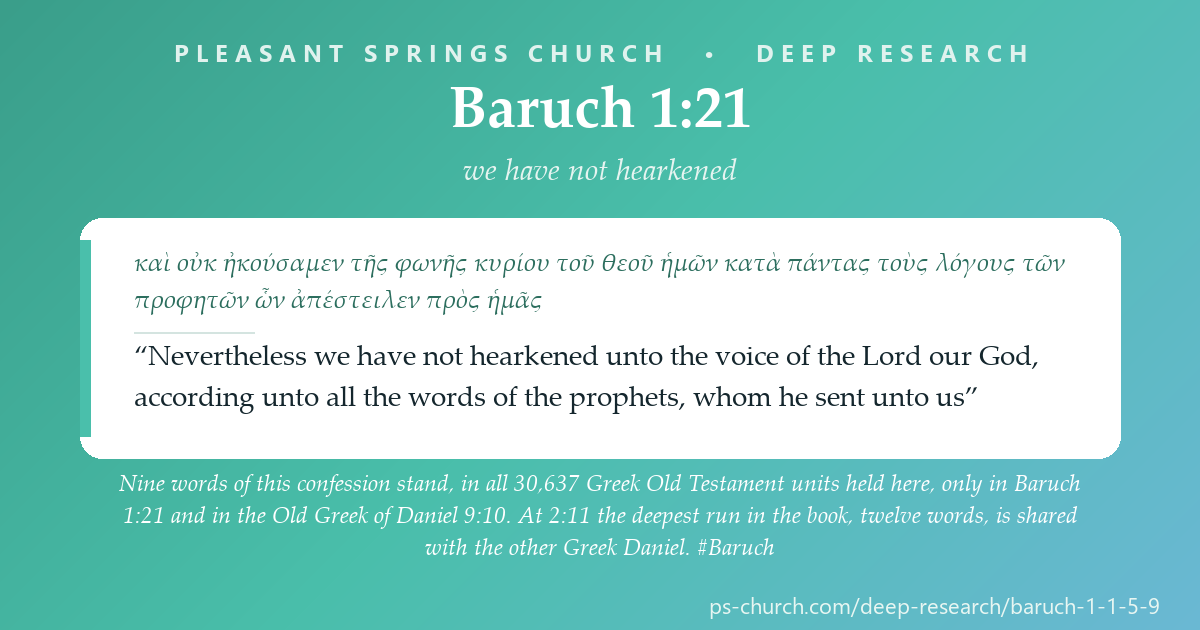
One sentence of Baruch, two Greek Daniels. A run of 6 near its start (rust) is the Old Greek of Daniel 9:10; its last 5 words (purple) are Theodotion’s. The Old Greek has Baruch’s verb, ἠκούσαμεν; Theodotion has εἰσηκούσαμεν. Theodotion has Baruch’s closing clause; the Old Greek has instead ᾧ ἔδωκας ἐνώπιον Μωσῆ καὶ ἡμῶν, which you gave before Moses and us. Baruch 2:10 repeats the pattern — the two Baruch verses share 9 consecutive words with each other.
VULGATE 1:18 et non fuimus subjectibiles illi,/ et non audivimus vocem Domini Dei nostri,/ ut ambularemus in mandatis ejus, quæ dedit nobis./
Daniel 9:10, Hebrew And we did not listen to the voice of the LORD our God, to walk in his teachings which he set before us by the hand of his servants the prophets. (this page’s own literal gloss)
Daniel (Th) 9:15 καὶ νῦν κύριε ὁ θεὸς ἡμῶν ὃς ἐξήγαγες τὸν λαόν σου ἐκ γῆς Αἰγύπτου ἐν χειρὶ κραταιᾷ καὶ ἐποίησας σεαυτῷ ὄνομα ὡς ἡ ἡμέρα αὕτη ἡμάρτομεν ἠνομήσαμεν
Daniel (OG) 9:15 καὶ νῦν δέσποτα κύριε ὁ θεὸς ἡμῶν ὁ ἐξαγαγὼν τὸν λαόν σου ἐξ Αἰγύπτου τῷ βραχίονί σου τῷ ὑψηλῷ καὶ ἐποίησας σεαυτῷ ὄνομα κατὰ τὴν ἡμέραν ταύτην ἡμάρτομεν ἠγνοήκαμεν2:11KJV 2:11 “And now, O Lord God of Israel, that hast brought thy people out of the land of Egypt with a mighty hand, and high arm, and with signs, and with wonders, and with great power, and hast gotten thyself a name, as appeareth this day:”
The deepest run in the book: 12 consecutive words with Theodotion’s Daniel 9:15, tie band 1 — and those words stand in 2 of the 30,348 screened units, this verse and that one. More than that: 24 of the 27 words of Theodotion’s verse stand in Baruch 2:11 (of 39) in the same order, in three blocks; the same in-order count against the Old Greek’s 9:15 is 15. Between the second and third blocks Baruch has a list of the Exodus wonders that Theodotion lacks, and that list runs 8 words with Deuteronomy 4:34 (ἐν σημείοις καὶ ἐν τέρασιν stands in 4 units). The Old Greek of the same verse reaches 5, at the seam: the list ends on βραχίονι ὑψηλῷ, and high is the Old Greek’s word (τῷ βραχίονί σου τῷ ὑψηλῷ); Theodotion has a mighty hand and no arm.
VULGATE 2:11 [Et nunc, Domine Deus Israël,/ qui eduxisti populum tuum de terra Ægypti/ in manu valida, et in signis, et in prodigiis,/ et in virtute tua magna, et in brachio excelso,/ et fecisti tibi nomen sicut est dies iste :/
Jeremiah 38:33 (Greek) · MT 31:33 ὅτι αὕτη ἡ διαθήκη ἣν διαθήσομαι τῷ οἴκῳ Ισραηλ μετὰ τὰς ἡμέρας ἐκείνας φησὶν κύριος διδοὺς δώσω νόμους μου εἰς τὴν διάνοιαν αὐτῶν καὶ ἐπὶ καρδίας αὐτῶν γράψω αὐτούς καὶ ἔσομαι αὐτοῖς εἰς θεόν καὶ αὐτοὶ ἔσονταί μοι εἰς λαόν
Hebrews 8:10 (SBLGNT) ὅτι αὕτη ἡ διαθήκη ἣν διαθήσομαι τῷ οἴκῳ Ἰσραὴλ μετὰ τὰς ἡμέρας ἐκείνας, λέγει κύριος, διδοὺς νόμους μου εἰς τὴν διάνοιαν αὐτῶν, καὶ ἐπὶ καρδίας αὐτῶν ἐπιγράψω αὐτούς, καὶ ἔσομαι αὐτοῖς εἰς θεόν καὶ αὐτοὶ ἔσονταί μοι εἰς λαόν.2:35KJV 2:35 “And I will make an everlasting covenant with them to be their God, and they shall be my people: and I will no more drive my people of Israel out of the land that I have given them.”
Baruch’s deepest New Testament run — 9 words with Hebrews 8:10, tie band 1 — and it is not contact with Baruch. The nine words stand in 2 of the 30,348 screened Greek Old Testament units, Baruch 2:35 and Greek Jeremiah 38:33, and in 1 New Testament verse. Hebrews introduces the oracle as speech (he says, 8:8), and Hebrews 8:10’s own deepest Greek Old Testament partner is Jeremiah 38:33, at 13 words. Only 2 Greek Old Testament units reach nine with Hebrews 8:10: Jeremiah 38:33 and this one. The Latin reads testamentum alterum sempiternum, another everlasting covenant; the Greek and the KJV have no another.
VULGATE 2:35 et statuam illis testamentum alterum sempiternum,/ ut sim illis in Deum,/ et ipsi erunt mihi in populum :/ et non movebo amplius populum meum, filios Israël,/ a terra quam dedi illis.]
Hebrews 8:10, end …and I will be to them for God, and they shall be to me for a people. (this page’s own literal gloss)
Proverbs 30:4 (Greek) τίς ἀνέβη εἰς τὸν οὐρανὸν καὶ κατέβη τίς συνήγαγεν ἀνέμους ἐν κόλπῳ τίς συνέστρεψεν ὕδωρ ἐν ἱματίῳ τίς ἐκράτησεν πάντων τῶν ἄκρων τῆς γῆς τί ὄνομα αὐτῷ ἢ τί ὄνομα τοῖς τέκνοις αὐτοῦ ἵνα γνῷς
Deuteronomy 30:12 (Greek) οὐκ ἐν τῷ οὐρανῷ ἄνω ἐστὶν λέγων τίς ἀναβήσεται ἡμῖν εἰς τὸν οὐρανὸν καὶ λήμψεται αὐτὴν ἡμῖν καὶ ἀκούσαντες αὐτὴν ποιήσομεν
Romans 10:6 (SBLGNT) ἡ δὲ ἐκ πίστεως δικαιοσύνη οὕτως λέγει· Μὴ εἴπῃς ἐν τῇ καρδίᾳ σου· Τίς ἀναβήσεται εἰς τὸν οὐρανόν; τοῦτ’ ἔστιν Χριστὸν καταγαγεῖν·3:29KJV 3:29 “Who hath gone up into heaven, and taken her, and brought her down from the clouds?”
The verse this shelf’s Deuteronomy 29–30 study sets beside Deuteronomy 30:12 runs longest with neither Deuteronomy nor Romans 10:6. Its deepest Greek Old Testament partner is Proverbs 30:4, 6 words, tie band 1 from both sides — because Baruch and Proverbs have the past tense, τίς ἀνέβη, who went up — 2 units, these two — where Deuteronomy and Paul have the future, τίς ἀναβήσεται. Against Deuteronomy 30:12 it measures 4; against Romans 10:6, 3 — the same 3 that Deuteronomy itself scores with Romans. Its deepest New Testament run is 4, tie band 3, and two of the three are the prodigal’s I have sinned against heaven (Luke 15:18, 21); the third is Mark 16:19.
VULGATE 3:29 Quis ascendit in cælum, et accepit eam,/ et eduxit eam de nubibus ?/
ESV Proverbs 30:4 “Who has ascended to heaven and come down? Who has gathered the wind in his fists? Who has wrapped up the waters in a garment? Who has established all the ends of the earth? What is his name, and what is his son’s name? Surely you know!”
The English verse for this Greek row is numbered 3:37. The KJV joins Greek 3:34–35 into one verse and runs one behind from there to the end of the chapter. The two Greek verbs have no expressed subject and no gender. The verse before ends with God giving the way of knowledge (feminine) to Jacob; the verse after opens αὕτη ἡ βίβλος, this is the book, feminine. The Latin visus est is masculine; the KJV prints he. Measured: ἐπὶ τῆς γῆς ὤφθη stands in 1 of the 30,348 units, and συνανεστράφη in 1; its deepest New Testament run is 3 words in a tie band of 57, and against John 1:14 it scores 1. See Stage 2 for who read it how.
VULGATE 3:38 Post hæc in terris visus est,/ et cum hominibus conversatus est.]
Deuteronomy 32:17 (Greek) ἔθυσαν δαιμονίοις καὶ οὐ θεῷ θεοῖς οἷς οὐκ ᾔδεισαν καινοὶ πρόσφατοι ἥκασιν οὓς οὐκ ᾔδεισαν οἱ πατέρες αὐτῶν
1 Corinthians 10:20 (SBLGNT) ἀλλ’ ὅτι ἃ θύουσιν, δαιμονίοις καὶ οὐ θεῷ θύουσιν, οὐ θέλω δὲ ὑμᾶς κοινωνοὺς τῶν δαιμονίων γίνεσθαι.4:7KJV 4:7 “For ye provoked him that made you by sacrificing unto devils, and not to God.”
4 words, tie band 1 from Baruch’s side and 2 from Paul’s. The phrase stands in 2 Greek Old Testament units — the Song of Moses and this verse — and in one New Testament verse. This is the figure the 1 Corinthians 9–11 study already prints, and it is the same figure here. The Latin carries Deum æternum, the eternal God, which the Greek of this verse does not have.
VULGATE 4:7 Exacerbastis enim eum qui fecit vos, Deum æternum,/ immolantes dæmoniis, et non Deo./
1 Corinthians 10:20 …they sacrifice to demons and not to God. (this page’s own literal gloss)
Psalms of Solomon 11:5 οἱ δρυμοὶ ἐσκίασαν αὐτοῖς ἐν τῇ παρόδῳ αὐτῶν πᾶν ξύλον εὐωδίας ἀνέτειλεν αὐτοῖς ὁ θεός5:8KJV 5:8 “Moreover even the woods and every sweetsmelling tree shall overshadow Israel by the commandment of God.”
The Psalm of Solomon that Gigot (1907) called closely connected with Baruch’s last poem, and the run engine nearly cannot see it. The run is 3 words. ξύλον εὐωδίας stands in 2 of the 30,348 units, these two; ἐσκίασαν in 2, these two. Stage 4 sets out the rest of Psalms of Solomon 11 beside Baruch 4:36–5:9: three of the same images in the same order, and never more than 3 words in a row.
VULGATE 5:8 Obumbraverunt autem et silvæ,/ et omne lignum suavitatis Israël/ ex mandato Dei./
Psalms of Solomon 11:5 the woods shaded them in their passing; every tree of fragrance God made spring up for them. (this page’s own literal gloss)
On the columns. The Greek is the CATSS morphological Septuagint, quoted at verse level with attribution, as on every page of this shelf; the New Testament Greek is the SBL edition as digitised by MorphGNT. The English for Baruch is quoted from the King James Apocrypha, standard text of 1769, public domain, from the verse-per-line file held on this disk, verbatim and in its own spelling; it is quotation, not a measured parallel. Italic English in the running prose is this page’s own literal gloss of the Greek unless it is marked KJV or attributed to a named writer; it is not the King James text. For the canonical comparison texts the English is the ESV only where this disk holds it (Proverbs 30:4); elsewhere the page gives its own literal gloss and labels it so. The Latin is the Clementine Vulgate, printed as a fourth witness and never as a source for the English.
Versification — stated, as on every page here, and here in a third state: no Masoretic text and no licensed English.
There is no Masoretic Baruch, so there is no Hebrew/Greek offset to report. The offsets that exist are between the three witnesses this page prints, and all three were counted:
• Greek (CATSS): 141 rows, chapters 1–5 = 22, 35, 38, 37, 9; 2,608 words. Every label parses; no lettered or verse-only labels.
• KJV Apocrypha: 140 verses in chapters 1–5 = 22, 35, 37, 37, 9. The one difference in verse count is chapter 3. Aligned by content, KJV 3:34 is Greek 3:34 and 3:35 in one verse (The stars shined… Here we be), and from there the KJV runs one behind: Greek 3:36, 3:37, 3:38 = KJV 3:35, 3:36, 3:37. So the verse this page prints as Greek 3:38 is KJV 3:37. Chapters 1, 2, 4 and 5 align label for label. One further internal shift: KJV 3:10 runs on into the first clause of Greek 3:11 (that thou art defiled with the dead), so KJV 3:10 and 3:11 divide Greek 3:10–11 differently while ending together.
• Clementine Vulgate: 141 verses = 22, 35, 38, 37, 9, the Greek’s count in every chapter, but not always at the same places. Vulgate 2:22 runs on into the opening clause of Greek 2:23 (defectionem vestram faciam de civitatibus Juda); Vulgate 3:10 stops before the clause that closes Greek 3:10, which opens Vulgate 3:11 (inveterasti in terra aliena); Vulgate 3:17 holds only the first clause of Greek 3:17, and the rest of it opens Vulgate 3:18; and the clause that closes Greek 4:15 opens Vulgate 4:16 (qui non sunt reveriti senem). The Vulgate is printed by its own numbers, and none of the Latin lines in the codex falls at one of these places. Found by comparing verse lengths across the three witnesses and reading every verse that stood out; the 141 were not all read side by side, so a shift of a word or two could remain unreported.
• Chapter 6. The KJV (73 verses) and the Vulgate (72) both print the Letter of Jeremiah as Baruch 6. The Greek files keep it as a separate book, and so does this shelf: it has its own study.
• The canonical comparison texts are cited by their Greek numbering, with the Masoretic number beside it where Greek Jeremiah differs (Greek 43:10 = MT 36:10; 38:33 = 31:33; 39:12 = 32:12; 36:1 = 29:1; 33:16 = 26:16; 50:6–7 = 43:6–7; 51:31–35 = 45:1–5). Greek Psalms keep their Greek number too: Psalm 39:7 = MT 40:7 (KJV 40:6), 43:16 = MT 44:16 (KJV 44:15), 106:3 = MT 107:3; and Joshua (B) 9:2e is a lettered Greek verse, MT Joshua 8:34. Daniel 9 has 27 verses in the Masoretic text and in both Greek texts, numbered alike.
The Shape of the Passage
Sequence of four parts — and a seam you can measure⚠️ Where this page sits. Baruch is canonical in the Roman Catholic and Orthodox churches, printed among the Apocrypha in the older Protestant Bibles, and absent from the Hebrew Bible. This library treats it as a witness worth reading closely and files it under Apocrypha / Deuterocanon.
Author
The book names Baruch son of Neriah, and gives him three more ancestors than Jeremiah does. Greek Jeremiah 39:12 (MT 32:12) has Baruch son of Neriah son of Maaseiah; Baruch 1:1 continues the line through Sedekias, Asadias and Chelkias. The two share 3 consecutive words. The author is not measurable, and the page does not guess.
What is measurable is that the voice changes four times — a narrator (1:1–14), a we who confess (1:15–3:8), a teacher who addresses Israel (3:9–4:4), and Jerusalem herself, then a voice that answers her (4:5–5:9) — and that the verbatim echoes change with it: 28 of 65 prose verses reach six shared words with another Greek Old Testament text, 3 of 76 poetic verses do. Whether that reflects two writers, two kinds of writing, or the history of the Greek, the count cannot say.
Audience
A congregation, by its own account. The book is sent to Jerusalem with instructions that it be read aloud in the house of the Lord, on feast days and appointed days, as a confession (1:14). It is written to be said by a we — the exiles in Babylon and the remnant in Jerusalem, saying the same prayer in two places.
People who had been told to pray for the empire that ruined them. The exiles ask Jerusalem to pray for the life of Nebuchadnezzar and of Belshazzar his son, that their days may be upon earth as the days of heaven (KJV 1:11). Those last seven Greek words run 7 with Deuteronomy 11:21, tie band 1, where they are the promise of Israel’s own days in its land.
And a city that had lost its children. The last poem speaks to Jerusalem as a widow and promises her sons and daughters back from east and west. The book that began in Babylon ends facing Jerusalem.
Orient on the book, on its parts, and on the two Greek Daniels it keeps meeting.
Search by topic: Baruch, Book of; Baruch son of Neriah; penitential prayer; Daniel 9 (Old Greek and Theodotion); Wisdom and Torah; Psalms of Solomon; Letter of Jeremiah.
Which articles are relevant?
- Anchor Bible Dictionary — “Baruch, Book of,” “Baruch (Person),” “Jeremiah, Additions to.”
- Eerdmans Dictionary of Early Judaism — “Baruch, Book of,” “Prayer, Penitential,” “Psalms of Solomon.”
- Dictionary of New Testament Background (IVP) — “Apocrypha and Pseudepigrapha,” “Wisdom.”
- F. Gigot, “Baruch,” The Catholic Encyclopedia (1907) — read for this page (online). It divides the book as 1:1–14, 1:15–3:8, 3:9–4:4 and 4:5–5:9; says the prayer section has much in common with the Book of Daniel (Dan. 9:4-19); and calls the closing psalm closely connected with the eleventh of the apocryphal Psalms of Solomon. Stage 4 measures both statements.
- On the text — any article on Greek Daniel that separates the Old Greek from Theodotion. An article that speaks of ‘the Septuagint of Daniel 9’ without that distinction cannot be used to compare Baruch with Daniel.
Bibliography surfaced — titles confirmed, contents NOT consulted for this page:
- Carey A. Moore, Daniel, Esther, and Jeremiah: The Additions (Anchor Bible, 1977) — the commentary that treats Baruch and the Letter of Jeremiah under ‘Jeremiah.’
- Emanuel Tov, The Septuagint Translation of Jeremiah and Baruch (1976), and Tov, The Book of Baruch also called I Baruch (Greek and Hebrew) (1975).
- David G. Burke, The Poetry of Baruch (1982) — on 3:9–5:9.
- Odil Hannes Steck, Das apokryphe Baruchbuch (1993).
- Sean A. Adams, Baruch and the Epistle of Jeremiah (Brill, 2014).
- NETS (A New English Translation of the Septuagint), “Barouch” — the obvious next English for a reader of the Greek; not the edition quoted here.
Jeremiah’s scribe, Daniel’s prayer, a psalm of Solomon — and three Church Fathers who read the book as Jeremiah.
Every contact named below was measured on the files held here; every historical or reception claim is attributed to the source it was read in.
Which parallels shed light on the world of the text?
- Jeremiah’s own story, re-entered. The frame of 1:1–14 runs longest with Greek Jeremiah: 1:9 with Jeremiah 24:1, 8 words, tie band 1 from both sides (the deportation of Jeconiah with the princes and the prisoners); 1:7 with Jeremiah 36:1 (MT 29:1), 6, band 1 from Baruch’s side — the opening of Jeremiah’s letter to the exiles in Babylon, though the six words are a list of addressees, and to the priests and to, and from Jeremiah 36:1’s side the deepest partner is Jeremiah 33:16 (MT 26:16), at 7, not Baruch 1:7; 1:3 with Jeremiah 43:10 (MT 36:10), 5, band 1 from Baruch’s side and 3 from Jeremiah’s — in the ears of all the people, where Baruch reads the scroll in the temple. The Jeremiah 33–38 study prints the same five and says what this page says: a measurement, not a claim about who used whom.
- Where Baruch was. Baruch 1:1 puts him in Babylon. Greek Jeremiah 50:6–7 (MT 43:6–7) lists καὶ Βαρουχ υἱὸν Νηριου among those taken down to Egypt, to Taphnas. The two books place the same man in two countries, and Baruch gives no account of how he came to the other one. The page reports both and resolves neither. The Jeremiah 45–48 study prints the word to Baruch that stands at Greek 51:31–35 (MT 45:1–5).
- The date. Baruch 1:2 reads ἐν τῷ ἔτει τῷ πέμπτῳ ἐν ἑβδόμῃ τοῦ μηνὸς, in the fifth year, on the seventh of the month. Greek 2 Kings 25:8 dates the burning to ἐν τῷ μηνὶ τῷ πέμπτῳ ἑβδόμῃ τοῦ μηνός, the fifth month, the seventh of the month, and Greek Jeremiah 52:12 to the fifth month and the tenth day. Year in Baruch, month in Kings; the run between them is 3. Which year Baruch means it does not say.
- Praying for the king. Jeremiah’s letter tells the exiles to pray for the city of their captivity (Greek Jeremiah 36:7, MT 29:7; the run with Baruch 1:11 is 3, and pray for). Baruch names the king, and his son: Nebuchadnezzar and Belshazzar. This shelf’s Daniel 1–6 study, citing the Nabonidus Chronicle and the Verse Account of Nabonidus, makes Belshazzar the son of Nabonidus; Daniel 5 calls Nebuchadnezzar his father (5:2), as Baruch does. This page did not consult the Babylonian records.
- Daniel’s prayer (Daniel 9:4–19). The same confession in a canonical book, held here in Hebrew and in two Greek texts. The Hebrew of Daniel 9:4–19, screened against the other 23,188 verse units of the Hebrew Bible, reaches 5 consecutive words and no more — at 9:4 (Deuteronomy 7:9 and Nehemiah 1:5) and 9:10 (Jeremiah 3:25) — and two of its 16 verses, 9:5 and 9:9, share no two consecutive words with any other verse. This is the figure the Daniel 8–11 study prints. A Hebrew run and a Greek run are not the same unit: the five Hebrew words of 9:10’s run with Jeremiah 3:25 are nine Greek words in the Old Greek of 9:10 and in Baruch 1:21; their Greek tail, τῆς φωνῆς κυρίου τοῦ θεοῦ ἡμῶν, stands in 5 Greek units, two of them Jeremiah. The page does not compare depths across languages.
- The Psalms of Solomon. 18 psalms in Greek, usually dated to the first century BC; the eleventh shares Baruch’s closing images. Measured in Stage 4, and no direction is claimed: two texts can share a source neither copied.
Who read it, and as what — read at first hand for this page (English translations online):
- Irenaeus, Against Heresies 5.35.1 quotes Baruch 4:36–5:9 — introduced as the words of Jeremiah the prophet — to argue that the promises to Jerusalem are to be read of an earthly Jerusalem and not allegorised.
- Cyprian, To Quirinus (Testimonies) 2.6, under the heading That Christ is God, quotes the verses the KJV numbers Baruch 3:35–37 (Greek and Latin 3:36–38), introduced in Jeremiah, ending After this He was seen upon earth, and He conversed with men.
- Augustine, City of God 18.33 quotes the same verses among Jeremiah’s prophecies of Christ, and says that some ascribe the testimony to Baruch, Jeremiah’s secretary, though it is more commonly ascribed to Jeremiah.
What the Greek says: μετὰ τοῦτο ἐπὶ τῆς γῆς ὤφθη — after this, upon the earth, appeared, and among men lived. The verbs carry no subject and no gender. The verse before has God giving her — the way of knowledge, feminine — to Jacob; the verse after begins This is the book of the commandments of God, also feminine. Read of Christ by Cyprian and Augustine, who both quote it as Jeremiah’s. The other reading — that what appeared on earth is the wisdom the poem has been seeking, which 4:1 goes on to call the book of the law — is the one the Greek’s own next verse makes available; this page names no modern commentator for it because none was consulted.
This page makes no identification the text does not make. It reports the Greek, the Latin’s masculine visus est, the KJV’s he, and two Fathers by name. And it reports a measurement that cuts against easy use of the verse: its deepest run with any New Testament verse is 3 words, tie band 57, and against John 1:14 it is 1.
A shame that is plural, a wisdom poem whose Greek says wisdom twice, and a name for God the King James Bible prints only in this poem.
Every count below is over the Greek Old Testament files held on this disk — 30,348 verse units screened, the Odes excluded — or the 7,927 verses of the Greek New Testament, and the page says which. It is not a count over “the Septuagint.”
2 units of the 30,348, and both are Baruch — 1:15 and its echo at 2:6. Both Greek Daniels have the singular, ἡ αἰσχύνη τοῦ προσώπου, which stands in 6 units: Daniel 9:7 and 9:8 in each Greek text, Isaiah 3:9 and Psalm 43:16 (MT 44:16). The Hebrew of Daniel 9:7 has בֹּ֥שֶׁת הַפָּנִ֖ים, and the Hebrew noun for face is plural in form. Reported as what each column reads. The page draws no conclusion about what stood behind Baruch’s Greek; no Hebrew Baruch is held.
The poem Gigot (1907) called a panegyric of Divine Wisdom uses the Greek word for wisdom, σοφίας, 2 times (3:12, 3:23). The KJV prints wisdom 6 times in the same poem, because it also gives wisdom for the Greek words for prudence (3:9, 3:14, 3:28) and understanding (3:23). The Greek says prudence (3 times), knowledge (3) and understanding (4 tokens) more often. Against Job 28 — the other poem that asks where wisdom is found — its deepest run is 3 words, reached by 2 of its 34 verses; 32 reach two or fewer. The kinship with Job 28 is a matter of question and theme, not of wording.
A name for God that the KJV prints as the Everlasting only in this poem. In 4:5–5:9 the Greek has the adjective everlasting 10 times. The KJV prints the Everlasting, capitalised, 8 times — and all 8, in the whole King James file held here, canonical books and Apocrypha alike, are in Baruch 4:10–5:2. The Greek pair itself is not confined to Baruch: it stands in 5 of the 30,348 units — Baruch 4:10 and 4:14, and Isaiah 26:4, Susanna 35a and Theodotion’s Susanna 42, where it follows the word God in the same phrase. The KJV count is case-sensitive; lower-case everlasting is not counted.
4 times, counting every form of the verb: 4:5 (to the people), 4:21 and 4:27 (Jerusalem to her children), 4:30 (to Jerusalem). The consolation comes back to the imperative four times: twice where a new voice begins (4:5, 4:30), and twice inside Jerusalem’s own speech.
1 occurrence of this form in the 30,348 screened Greek Old Testament units, and it is Baruch 3:38. The verb itself is not confined to Baruch: other forms of it stand at Genesis 30:8 and Sirach 41:5, and the related noun at Wisdom 8:16 and 3 Maccabees 2:31, 2:33 and 3:5. No form of either stands in the 7,927 verses of the Greek New Testament (0 hits). See Stage 2.
Counted here, not assumed:
- Greek Baruch: 141 rows, 2,608 words, chapters 1–5 = 22, 35, 38, 37, 9.
- KJV Baruch 1–5: 140 verses (22, 35, 37, 37, 9); Vulgate: 141 (22, 35, 38, 37, 9). The only offset in verse numbers is KJV chapter 3, one behind from Greek 3:36 on; the places where a clause sits in a neighbouring verse are listed under Versification above.
- Baruch’s own internal echoes: 1:15 and 2:6 share 8 words; 1:18 and 2:10 share 9; 4:37 and 5:5 share 4 — and where 4:37 has the sons gathered from east to west, 5:5 has them from the setting of the sun to the east.
- The triple confession at 2:12 — ἡμάρτομεν ἠσεβήσαμεν ἠδικήσαμεν — stands in 1 unit of the 30,348, this one. The Old Greek of Daniel 9:5 has the same three verbs in another order (ἡμάρτομεν ἠδικήσαμεν ἠσεβήσαμεν), and the run engine scores the pair 1. A reordered list is invisible to a contiguous run, and this is the cleanest example on the page.
- The prayer of the dead (3:4). The Greek reads τῆς προσευχῆς τῶν τεθνηκότων Ισραηλ, the prayer of the dead of Israel; the KJV, the prayers of the dead Israelites. Earlier the same prayer says that the dead in Hades give God no glory (2:17), and the poem that follows calls the living exiles counted with those in Hades (3:10–11). It is a prayer said by the dead of Israel, not a prayer for the dead, and the page draws no teaching about the dead from it.
Two Greek Daniels, split down the middle; a seam at 3:9; and the Psalm of Solomon Gigot (1907) linked to the last poem, which measures three.
Every Baruch verse screened against all 7,927 verses of the Greek New Testament, and separately against the other 30,207 screened units of the Greek Old Testament. Contiguous runs of whole word forms after normalisation; never lemmas. The tie band — how many verses reach the same depth — is printed beside every run, and for the runs that matter it is printed from both sides. The New Testament screen uses the shelf’s cross-edition comparison (the spellings MorphGNT treats as one word are treated as one word); Greek Old Testament against Greek Old Testament is one edition and uses the plain normalisation.
The New Testament: the distribution first.
Baruch 1–5, 141 rows against 7,927 verses of the Greek New Testament: 138 reach two, 100 reach three, 19 reach four, 3 reach five, nothing reaches six, seven or eight, and 1 row reaches 9. 8 rows reach four or more with a tie band of 1.
The 9 is not contact with Baruch (see 2:35 in the codex): it is the covenant formula of Greek Jeremiah 38:33, which Hebrews 8 introduces as speech and matches for 13 words. The two fives are 1:3 with Revelation 22:9 (5 words, the words of this book; tie band 1 from Baruch’s side and 1 from Revelation’s, whose deepest Greek Old Testament run is this one, at 5) and 2:2 with Luke 24:44, the things written in the law — 5 words, band 1 from Baruch’s side, but from Luke’s side 7 Greek Old Testament units reach five and Joshua (B) 9:2e (MT Joshua 8:34) reaches 6. A band of 1 on one side and 7 on the other is a formula. The 4 with Paul — 4:7 with 1 Corinthians 10:20 — is band 1 from Baruch and 2 from Paul, whose deepest Greek Old Testament run is 4: Deuteronomy 32:17 and Baruch 4:7.
⚠️ Other New Testament pairings, measured:
- Baruch 3:29 → Romans 10:6 — 3. Paul’s Who will go up into heaven? scores 3 with Deuteronomy 30:12 too; its own deepest Greek Old Testament partners are Deuteronomy 8:17 and 9:4 at 6 — Μὴ εἴπῃς ἐν τῇ καρδίᾳ σου·, do not say in your heart — and 114 Greek Old Testament units reach three with it. Baruch 3:30 → Romans 10:7: 1. Baruch crosses the sea; Paul goes down into the abyss.
- Baruch 3:38 → John 1:14 — 1. Deepest New Testament run for 3:38: 3 (upon the earth), tie band 57.
- Baruch 1:10 → Hebrews 10:6 and 10:8 — 4, tie band 2: whole burnt offerings and for sin. From Hebrews’ side the band is 2: Baruch 1:10 and Greek Psalm 39:7 (MT 40:7, KJV 40:6), which is the psalm Hebrews 10 introduces with he says. A sacrificial list, not contact.
The Greek Old Testament: the distribution, and the seam.
Baruch’s 141 rows against the other 30,207 screened Greek Old Testament units: all reach two, 123 reach three, 90 four, 46 five, 31 six, 15 seven, 10 eight, 4 nine, 2 ten, and 1 reaches 12.
| Verses | Part | Rows | Median deepest run | Rows reaching six | Deepest |
|---|---|---|---|---|---|
| 1:1–14 | narrative frame (prose) | 14 | 5 | 5 | 8 |
| 1:15–3:8 | confession and prayer (prose) | 51 | 5 | 23 | 12 |
| 3:9–4:4 | wisdom poem | 34 | 3 | 2 | 6 |
| 4:5–5:9 | consolation of Jerusalem | 42 | 3 | 1 | 6 |
The prose half and the poetic half are different kinds of text by this measure. 28 of 65 prose rows reach six; 3 of 76 poetic rows do, and those three are Proverbs 30:4 (3:29, the who went up), Genesis 3:1 (3:16, the beasts upon the earth) and Judges (A) 9:13 (4:36, the joy that is from God).
The two Greek Daniels — the page’s finding.
Across the 27 verses of 1:15–2:19, each Baruch verse was measured against the 16 verses of Daniel 9:4–19 in each Greek text. Theodotion is the nearer at 7, the Old Greek at 7, and they tie at 13. Theodotion holds the deepest run (12, at 2:11); the Old Greek’s deepest is 9, at 1:21.
| Baruch | Daniel (OG) 9:4–19, deepest run | Daniel (Th) 9:4–19, deepest run |
|---|---|---|
| 1:16 | 5 | 10 |
| 1:18 | 6 | 5 |
| 1:21 | 9 | 6 |
| 2:1 | 6 | 6 |
| 2:7 | 3 | 7 |
| 2:8 | 2 | 7 |
| 2:10 | 6 | 5 |
| 2:11 | 5 | 12 |
| 2:15 | 6 | 4 |
| 2:16 | 5 | 5 |
| 2:17 | 5 | 5 |
Then the wider screen, in the same breath. Against all 30,207 other Greek Old Testament units, 6 verses of the confession have a Greek Daniel as their only deepest partner — 3 of them Theodotion (1:16 at 10, 2:8 at 7, 2:11 at 12) and 3 the Old Greek (1:18 at 6, 1:21 at 9, 2:10 at 6). And from Daniel’s side: Theodotion’s 9:15 has Baruch 2:11 as its only deepest partner (12); the Old Greek’s 9:10 has Baruch 1:21 (9); Theodotion’s 9:8 ties at 10 between Baruch 1:16 and its own Old Greek twin (2 partners; Baruch 1:16 against the Old Greek’s 9:8 is only 5).
The runs are exclusive. Each of these sequences stands in exactly two of the 30,348 units — Baruch and one Daniel: the twelve of 2:11 (and even its six-word core, from the land of Egypt with a mighty hand, which has 2; the three-word with a mighty hand alone has 12); the six-word core of 1:16 (2); the nine of 1:21 (2); we did not entreat the face of the Lord at 2:8 (2); all these evils came upon us at 2:7 (2).
What this does not show. It does not show which way anything went, and it does not date anything. A text can sit between two Greek translations because it used both, because both drew on something like it, or because a later hand brought one text towards another. The page measures the position and declines the story.
⚠️ The counter-examples, printed so the Daniel finding is not read as more than it is:
- The sentence a reader matches first is not the long run. 1:15 and Daniel 9:7 say the same thing and score 4 (Theodotion) and 2 (Old Greek); the four is as at this day, which stands in 22 units.
- Not every deep confession run is Daniel. 2:7’s deepest partner is Jeremiah 16:10 (8 words), not Daniel; 2:17’s is Hezekiah’s prayer, 2 Kings 19:16 (7, open, O Lord, your eyes and see); 2:35’s is Jeremiah 38:33 (9). The deepest partners of the prayer’s verses lie in Greek Jeremiah, Deuteronomy, Kings and other books as well as Daniel — 12 of the 27 confession verses have a Daniel 9 verse anywhere among their deepest partners.
- The triple confession at 2:12 scores 1 against the Old Greek of Daniel 9:5, which has the same three verbs in a different order. Contiguity is the engine’s rule, and here it hides an agreement a reader sees at once.
The poems: Job 28, Proverbs 30, Deuteronomy 30, Isaiah 40–66 — and the Psalms of Solomon.
- Job 28: deepest run 3, at 2 verses of the wisdom poem.
- Deuteronomy 30:12–13: 3:29 scores 4 with 30:12 — and those words, into heaven and, stand in 25 Greek Old Testament units and 3 New Testament verses — and 3:30 scores 4 with 30:13 — tie band 1 for 3:30 (across the sea and). Proverbs 30:4: 6, band 1 both ways. The errand into heaven runs longer with Proverbs; the errand across the sea runs only with Deuteronomy.
- Greek Isaiah 40–66: across the 42 verses of the consolation the deepest run is 4, reached by 6, and nothing reaches five; Isaiah 1–39 also tops out at 4, reached by 2. 5:7’s levelled mountains score 2 with Isaiah 40:4. Whatever the consolation shares with Isaiah 40–66 in theme, it shares no more than 4 consecutive words with it.
Gigot (1907) called Baruch’s closing psalm closely connected with Psalms of Solomon 11, and a reader can see why in a minute. PsSol 11:2 has Jerusalem stand on a height and see her children gathered from east and west; Baruch 5:5 has the same. PsSol 11:4 has the high mountains brought low εἰς ὁμαλισμὸν; Baruch 5:7 has εἰς ὁμαλισμὸν τῆς γῆς. PsSol 11:5 has the woods give shade and every fragrant tree; so does Baruch 5:8. Those three images come in the same order; the call to put on garments of glory does not — it opens Baruch 5 (5:1) and closes the psalm (11:7).
Measured: the deepest run between Baruch 4:5–5:9 and the 9 verses of Psalms of Solomon 11 is 3 words. 5:5 against 11:2 is 2; 5:7 against 11:4 is 2; 5:1 against 11:7 is 3. And from the psalm’s side Baruch barely registers: PsSol 11:5’s deepest run is 3 words in a tie band of 16; 11:4’s is 2 in a band of 37; 11:2’s deepest partner is not Baruch at all but Greek Psalm 106:3 (MT 107:3), at 4.
The vocabulary tells the other story. Levelling, in this form, stands in 3 of the 30,348 units (Baruch 5:7, Micah 7:12, PsSol 11:4); gave shade in 2 (Baruch 5:8, PsSol 11:5); tree of fragrance in 2 (the same two); gathered in this neuter form in 3 (Baruch 5:5, Isaiah 60:4, PsSol 11:2). This is the shape of relation the run engine is worst at: rare words, same order, rearranged clauses. Which text is prior is not measurable here and is not asserted; both may draw on a common hymn. Irenaeus, quoting 4:36–5:9, called it Jeremiah.
It settles, on these files, that no verse of the 7,927 in the Greek New Testament shares more than 9 consecutive words with Baruch — and a verbatim screen cannot rule out an allusion. The one deep run is the covenant formula of Jeremiah’s oracle, which Hebrews introduces with he says; the rest are four and five words, and the pairings with Romans 10:6, Romans 10:7 and John 1:14 score 3, 1 and 1.
It settles, on these files, where Baruch’s prose stands among the Greek Bibles: beside Jeremiah in its frame, and in its confession between two Greek Daniels, with exclusive runs to each.
It does not settle the poems. A verbatim screen finds words shared in the same order, and the poems of Baruch do not share their words that way. The Psalms of Solomon parallel shows it: the psalm Gigot set beside the last poem scores three.
What this page could not check, what it relies on others for, and where it is weakest.
This is the section that makes the shelf trustworthy. For a book with no Semitic text on the disk, it is longer than usual.
⚠️ What this page could NOT check:
- Anything Semitic behind the Greek. No Hebrew or Aramaic Baruch is held. Whether the prose half, the poems, or neither were composed in Hebrew is reported in the literature both ways and is not tested here. Gigot (1907) reports Syro-Hexaplar marginal notes saying some Greek words ‘are not found in the Hebrew’; the Syro-Hexapla is not on this disk, and the page cannot check what those notes say or what Hebrew they mean.
- Tov’s argument about the Greek. An encyclopedia summary read online (Wikipedia, ‘Book of Baruch’) reports that Emanuel Tov, in The Septuagint Translation of Jeremiah and Baruch (1976), found the revision that marks the second half of Greek Jeremiah continuing into Baruch 1:1–3:8. The page did not read Tov. Its seam at 3:9 is a run-depth count and is not offered as a test of his thesis — a count can agree with a thesis for a different reason.
- The dates of the two Greek Daniels. The usual account puts the Old Greek earlier and the Theodotion text later, and scholars debate how much of the Theodotion-type text is older than the man it is named for. This page consulted none of that literature and draws no chronology from its runs. That Baruch shares exclusive runs with both is measured; what that implies about dates is not.
- The commentaries. Moore (1977), Burke (1982), Steck (1993) and Adams (2014) were identified and not consulted. Nothing on this page claims their support.
- The date of Baruch, and of the Psalms of Solomon. Taken from the reference works, not measured, and nothing here depends on them.
- Belshazzar’s father. The Babylonian records were not consulted; the page reports that Baruch and Daniel 5 agree with each other, and what the Daniel 1–6 study says of the records.
⚠️ Where this page is weakest:
- The English column is quotation, not a measured parallel. The KJV Apocrypha is a translation of a Greek text close to, but not identical with, the CATSS edition, and it divides chapter 3 differently. The page marks the offset and the internal shifts, and aligns by content.
- A clause the Greek file does not have. At 2:2 the KJV and the Vulgate both open with a clause that the CATSS row lacks — KJV To bring upon us great plagues, Vulgate ut adduceret Dominus super nos mala magna — and both Greek Daniels have such a clause at 9:12, ἐπαγαγεῖν ἐφ' ἡμᾶς κακὰ μεγάλα. No other Greek text of Baruch is held, so the page cannot say whether the file has dropped words or the Greek it was made from differs. Every Baruch figure on this page is a count of the file as held, and at 2:2 a fuller text could change the Daniel figures.
- Contiguous runs miss reordering — the 2:12 triad scores 1 against verbs a reader can see are the same — and miss vocabulary shared out of order, which is the whole of the Psalms of Solomon relation. The Daniel finding is strong because it is long, contiguous and exclusive; the page’s weaker findings are weaker for exactly the reasons this screen is blind.
- Two normalisations. The New Testament screen folds the spellings MorphGNT treats as one (ou/ouk/ouch, ek/ex, the movable nu); the Greek Old Testament screen, one edition against itself, does not. The 30,207 target units include both Greek Daniels, so a run shared by both counts twice in a band — which is why the page reports the Daniels separately.
- Verse length is not controlled in the headline seam. The prose verses average 22.3 words and the poetic ones 15.3, and a longer verse has more chances to share a run. Restricted to verses of 14 words or more, 26 of 54 prose verses reach six and 3 of 42 poetic verses do; restricted to verses of 10 to 20 words, 10 of 25 and 3 of 50. The seam survives the control, but the counts in the introduction do not show that by themselves.
- The structure diagram claims one thing: the seam, which it counts. The four parts are the text’s own divisions, and the page expressly declines to make a chiasm of them.
- Hebrew and Greek depths are different units and are never compared on this page as if they were the same.
Commentaries & studies:
- Carey A. Moore, Daniel, Esther, and Jeremiah: The Additions (Anchor Bible, 1977).
- Emanuel Tov, The Septuagint Translation of Jeremiah and Baruch (1976).
- David G. Burke, The Poetry of Baruch (1982).
- Odil Hannes Steck, Das apokryphe Baruchbuch (1993).
- Sean A. Adams, Baruch and the Epistle of Jeremiah (Brill, 2014).
- F. Gigot, “Baruch,” The Catholic Encyclopedia (1907) — read.
- Irenaeus, Against Heresies 5.35.1; Cyprian, To Quirinus 2.6; Augustine, City of God 18.33 — read in English translation online.
A confession said in two places, and a book that kept company with two Daniels.
Name what you learned, why it matters, and one concrete response.
What should we carry away — and do?
- “The Greek of Daniel” is two texts. Baruch’s confession runs twelve words with one of them and nine with the other, and in one sentence it runs with both. Whenever someone tells you what ‘the Greek’ of a book reads, it is fair to ask which Greek.
- The obvious parallel is not where the evidence is. 1:15 and Daniel 9:7 say the same thing and score four; the twelve-word run is at 2:11. Measure before you repeat.
- Some kinship cannot be counted in a row. Baruch 5 and Psalms of Solomon 11 share rare words and the order of three images, and never more than three words running. A screen that finds only copying would call them strangers.
- The book’s own subject is a prayer said in two cities. The exiles write it; Jerusalem is to read it aloud on feast days. Confession, here, is something a people does together, in public, and at a distance from each other.
- One concrete response. Baruch’s confession has a line the canon shares, in Daniel’s mouth: we did not listen to the voice of the Lord our God (Daniel 9:10, this page’s gloss of the Hebrew). Pray Daniel 9:4–19 aloud this week, with someone else, in the first person plural.
Baruch 1:21 · to share
Greek · KJV Apocrypha · LatinDaniel (OG) 9:10 καὶ οὐκ ἠκούσαμεν τῆς φωνῆς κυρίου τοῦ θεοῦ ἡμῶν κατακολουθῆσαι τῷ νόμῳ σου ᾧ ἔδωκας ἐνώπιον Μωσῆ καὶ ἡμῶν διὰ τῶν παίδων σου τῶν προφητῶν1:21KJV 1:21 “Nevertheless we have not hearkened unto the voice of the Lord our God, according unto all the words of the prophets, whom he sent unto us:”
VULGATE 1:21 Et non audivimus vocem Domini Dei nostri,/ secundum omnia verba prophetarum quos misit ad nos :/
Every Deep Research page traces its passage across the whole sweep — the Old Testament, the Second-Temple world between the testaments (historical witnesses, not Scripture), and the New Testament. Follow the thread:
Pleasant Springs Church — Deep Research
Research method after Michael S. Heiser’s Bible Research Method (examine dictionaries → ancient literature → important words → textual connections → academic publications → share), with the Pleasant Springs “Author & Audience” foundation. Scripture set in the Hebrew, the Greek editions named on each page and the ESV (Old Testament), and the Greek New Testament and the ESV (New Testament), per the practice of Pleasant Springs Church. ⚠️ Status: Baruch is not part of the Protestant canon. It is canonical in the Roman Catholic and Orthodox churches, was printed among the Apocrypha in the Reformation-era Protestant Bibles, and is absent from the Hebrew Bible. This study is filed under Apocrypha / Deuterocanon and nothing taught at Pleasant Springs rests on it. Greek text: the CATSS morphologically analysed Septuagint, quoted at verse level with attribution — Baruch.mlxx (141 rows), screened against the other 30,207 of the 30,348 Greek Old Testament units screened (30,637 held, the Odes excluded), with Daniel (OG) and Daniel (Th) kept as two books and named on every line; the Greek New Testament is the SBL edition as digitised by MorphGNT (7,927 verses). Hebrew: Sefaria’s Miqra according to the Masorah, for Daniel 9 only; there is no Hebrew Baruch. English: the King James Apocrypha, standard text of 1769, public domain, quoted verbatim from the verse-per-line file held here; every English line on this page is re-checked against that file by the page’s self-check. English for canonical comparison texts is the ESV only where this disk holds it (Proverbs 30:4), otherwise the page’s own labelled gloss. Latin: the Clementine Vulgate, a fourth witness, never a source for the English. Reception history (Irenaeus, Cyprian, Augustine) and Gigot’s 1907 article were read online in English for this page; the modern commentaries named in Stage 5 were not. Direction of influence is nowhere asserted.
Scripture quotations marked ESV are from the ESV® Bible (The Holy Bible, English Standard Version®), © 2001 by Crossway, a publishing ministry of Good News Publishers. ESV Text Edition: 2016. Used by permission. All rights reserved. The ESV text may not be quoted in any publication made available to the public by a Creative Commons license, and the ESV may not be translated in whole or in part into any other language. www.esv.org
|
Did this study bless you today? 💚 Give to Support PS Church100% of gifts go to the General Fund — thank you. |