Seventy-two verses, one argument. The Letter of Jeremiah watches the gods of Babylon being carried through the streets, dressed, robbed of their gold, wiped clean of dust, bolted in at night and left to the bats and the cats — and after each scene it gives the same verdict: they are not gods. This page counts that verdict — fifteen verses state it, no two of them identical — and then asks where its words stand anywhere else. The answer is not where one would look first. The clause seven of its verses carry stands in the other 30,275 screened Greek Old Testament units only twice, both in Jeremiah, at 2:11 and 16:20 — and the Hebrew words behind it there, in that order, occur in no other verse of the 23,204 Masoretic verse units held here. Jeremiah 10, the canonical chapter on idols that C. J. Ball’s 1913 commentary cites again and again, shares no more than three consecutive Greek words with it. The Letter is not Scripture for us: it is filed with the Apocrypha, there is no Hebrew text of it on this disk, and its English here is the King James Apocrypha of 1769, in which it is the sixth chapter of Baruch. See the method →
A Second-Temple Jewish tract against idol worship, framed as a letter from the prophet Jeremiah to the people about to be deported to Babylon. In the Greek tradition it is a book of its own (here, a CATSS file of its own); in the Latin Vulgate and the King James Apocrypha it is printed as the sixth chapter of Baruch. It is canonical for Roman Catholic and Orthodox Christians, was printed among the Apocrypha in the Reformation-era Protestant Bibles, and is absent from the Hebrew Bible. It is not Scripture for us. We read it as a witness to how Jews of the Second-Temple period argued with the gods around them — by watching what happens to an idol in the course of an ordinary week and saying, every few verses, what that proves — and we test everything by the canon.
⚠️ What this page can and cannot measure — read this first.
HELD: the Greek Letter (CATSS EpJer.mlxx: one heading row and 72 verse rows, 1,285 words); the Greek Old Testament as screened here, the Letter included (30,348 verse units, the Odes excluded by house convention, out of 30,637 held); the Greek New Testament (7,927 verses, SBLGNT via MorphGNT); the Masoretic text (23,204 verse units) for the canonical comparison verses; the Clementine Vulgate’s Baruch 6; the King James Apocrypha of 1769.
NOT HELD: any Hebrew or Aramaic Letter of Jeremiah. None is on this disk; C. J. Ball (1913) argued that the Greek translates a lost Hebrew original, and that argument is reported in Stage 2, not tested. The Greek papyrus fragment from Qumran Cave 7 (7Q2) — not held in any form. The Syriac, the critical apparatus of the Göttingen edition, and every commentary — not consulted. An ESV of this book — none is held, and none is printed.
CONSEQUENCE: the Hebrew-side screens of this shelf cannot be run on the Letter at all. Hebrew appears on this page only for canonical verses it is compared with — Jeremiah 2:11, 10:5, 10:9, 10:11 and 16:20, Isaiah 1:8 and 37:19, and Psalm 115:4 — and every statement about a Semitic original is reported from outside scholarship and labelled so.
Letter of Jeremiah — eleven of its seventy-three Greek rows
Greek: CATSS (Rahlfs) · English: KJV Apocrypha (1769 standard text, public domain) · Latin: Clementine VulgateThe only place in the Greek where the name Jeremiah appears — once, in this unnumbered heading. CATSS prints it before verse 1; the King James numbers it 6:1, so the English starts one verse ahead; the Clementine Latin puts it inside its 6:1 together with the Greek’s first verse (the file marks it off in angle brackets, shown here in square brackets).
VULGATE BARUCH 6:1 [Exemplar epistolæ quam misit Jeremias ad abducendos captivos in Babyloniam a rege Babyloniorum, ut annuntiaret illis secundum quod præceptum est illi a Deo] Propter peccata quæ peccastis ante Deum, abducemini in Babyloniam captivi a Nabuchodonosor rege Babylonis.
Gods of silver, gold and wood carried on shoulders, showing fear to the nations (this page’s gloss of the Greek; the King James wording is in the line above). The Latin names four materials — it has stone too, lapideos — where the Greek row and the King James name three.
VULGATE BARUCH 6:3 Nunc autem videbitis in Babylonia deos aureos et argenteos, et lapideos et ligneos, in humeris portari, ostentantes metum gentibus.
οὐ δύνανται λαλεῖν — they cannot speak — stands nowhere else in the 30,348 screened Greek Old Testament units. The Hebrew of Jeremiah 10:5 says the idols do not speak; the Greek row of Jeremiah 10:5 has no such clause (Stage 4).
VULGATE BARUCH 6:7 Nam lingua ipsorum polita a fabro ; ipsa etiam inaurata et inargentata : falsa sunt, et non possunt loqui.
The refrain’s first statement — and the only one built as οὐκ ὄντες θεοί, not being gods. The Latin draws a verse boundary through the middle of it: its 6:14 ends on non sunt dii and its 6:15 opens with the command not to fear them, so in the Vulgate the refrain is split between two verses.
VULGATE BARUCH 6:14–15 14 Habet etiam in manu gladium et securim, se autem de bello et a latronibus non liberat. Unde vobis notum sit quia non sunt dii : 15 non ergo timueritis eos. Sicut enim vas hominis confractum inutile efficitur, tales sunt et dii illorum.
Bats, swallows, birds — and cats. αἴλουροι is the only cat in the 30,348 screened Greek Old Testament units, and none appears in the Greek New Testament.
VULGATE BARUCH 6:21 Supra corpus eorum et supra caput eorum volant noctuæ, et hirundines, et aves etiam, similiter et cattæ.
The refrain in its commonest form. The three words οὔκ εἰσιν θεοί — they are not gods — stand in seven verses of the Letter. In the rest of the screened Greek Old Testament they stand in two: Jeremiah 2:11 and 16:20. See Stage 4.
VULGATE BARUCH 6:22 Unde sciatis quia non sunt dii : ne ergo timueritis eos.
Here the Greek and English numbers coincide — from Greek 43 to 50 each Greek verse begins in the King James verse of the same number, not one ahead. The bolded five words are the Letter’s only five-word contact with the Greek New Testament at a tie band of one: Acts 19:26, a silversmith reporting what Paul says (Stage 4, which also shows that the fifth bolded word is a relative pronoun here and the article in Acts). The Latin here asks the question the other way round — how they should be thought to be gods.
VULGATE BARUCH 6:49 Quomodo ergo sentiri debeant quoniam dii sunt, qui nec de bello se liberant, neque de malis se eripiunt ?
One Greek verse, two English verses. The four words ἀλλὰ ἔργα χειρῶν ἀνθρώπων — but works of human hands — stand in one other unit of the screened Greek Old Testament: Isaiah 37:19, Hezekiah’s prayer about the gods the Assyrians burned. This verse spells the refrain without the final nu, οὔκ εἰσι θεοὶ.
VULGATE BARUCH 6:50 Nam cum sint lignea, inaurata et inargentata, scietur postea quia falsa sunt ab universis gentibus et regibus : quæ manifesta sunt quia non sunt dii, sed opera manuum hominum, et nullum Dei opus cum illis.
οἱ ψευδεῖς θεοί — the false gods — three times in one verse, and nowhere else in the screened Greek Old Testament. The King James keeps all three (than such false gods); the Latin has the comparison once (quam falsi dii) and has no pillar. The full stop before the lower-case “or” in 6:59 is the punctuation of the file this page reads, reproduced as it stands.
VULGATE BARUCH 6:58 Itaque melius est esse regem ostentantem virtutem suam, aut vas in domo utile, in quo gloriabitur qui possidet illud, vel ostium in domo, quod custodit quæ in ipsa sunt, quam falsi dii.
A scarecrow in a cucumber field. σικυηράτῳ occurs twice in the screened Greek Old Testament — here and Isaiah 1:8 — and προβασκάνιον only here. The Hebrew of Jeremiah 10:5 opens with this image; the Greek row of Jeremiah 10:5 does not have it.
VULGATE BARUCH 6:69 Nam sicut in cucumerario formido nihil custodit, ita sunt dii illorum lignei, et argentei, et inaurati.
The last verse drops the refrain and says what is better instead: a righteous man who has no idols. King James 6:73 = Greek 72 = Latin 6:72 — at the end, as at the start, the English runs one ahead and the Latin runs level.
VULGATE BARUCH 6:72 Melior est homo justus qui non habet simulacra, nam erit longe ab opprobriis.
On the columns. The Greek is the CATSS morphological Septuagint, quoted at verse level with attribution. No ESV of this book is held or printed here — the shelf uses the ESV for canonical passages only — so the English is the King James Apocrypha, standardised text of 1769, public domain, read line by line out of the verse-per-line edition held on this disk, KJV spelling and all. It is quotation, not a measured parallel. The Latin is a fourth witness and is never a source for the English.
Versification — stated, measured, and in three states at once.
There is no Masoretic text of this book and no ESV, so the usual Hebrew/Greek/English offset does not exist. What exists instead is three numberings of one text, and every offset between them was measured here by content: for each Greek verse, a word in the Greek row and its counterpart in the English or Latin verse, both read out of the files (the self-check re-proves all 167 anchors).
• Greek. CATSS: one unnumbered heading row and verses 1–72, verse numbers only (the loader labels them “1:N”; the “1” is the parser’s, and this page cites EpJer N).
• King James (Baruch 6), 73 verses. The heading is 6:1, and at both ends the English runs one ahead (Greek 1 = 6:2; Greek 72 = 6:73). In between it does not stay one ahead. Of the 72 Greek verses, 56 begin in KJV 6:(n+1), 12 begin in 6:n (Greek 5, 40, 43–50, 56–57) and 4 begin in 6:(n+2) (Greek 12–15). 10 Greek verses are divided between two English verses (5, 9–11, 25, 27, 40, 50, 57, 61) and 10 English verses join two Greek ones.
• Clementine Vulgate (Baruch 6), 72 verses. The heading sits inside 6:1 with Greek 1. 66 Greek verses begin in the Latin verse of the same number; 3 begin one later (Greek 11–13) and 3 one earlier (Greek 19, 56–57). 11 Greek verses are divided between two Latin verses (8–10, 14–15, 19, 25, 27, 40, 57, 61), and 11 Latin verses join two Greek ones besides 6:1.
So a reference of the form “Baruch 6:N” cannot be converted to the Greek by adding or subtracting one. This page cites the Greek as EpJer N throughout and gives the English and Latin verse beside it.
| Greek (CATSS) | King James, Baruch | Clementine Vulgate, Baruch |
|---|---|---|
| Heading | 6:1 | 6:1 (with EpJer 1) |
| EpJer 5 | 6:5–6 | 6:5 |
| EpJer 8 | 6:9 | 6:8–9 |
| EpJer 9 | 6:10–11 | 6:9–10 |
| EpJer 10 | 6:11–12 | 6:10–11 |
| EpJer 11 | 6:12–13 | 6:12 |
| EpJer 12 | 6:14 | 6:13 |
| EpJer 13 | 6:15 | 6:14 |
| EpJer 14 | 6:16 | 6:14–15 |
| EpJer 15 | 6:17 | 6:15–16 |
| EpJer 19 | 6:20 | 6:18–19 |
| EpJer 25 | 6:26–27 | 6:25–26 |
| EpJer 27 | 6:28–29 | 6:27–28 |
| EpJer 40 | 6:40–41 | 6:40–41 |
| EpJer 43 | 6:43 | 6:43 |
| EpJer 44 | 6:44 | 6:44 |
| EpJer 45 | 6:45 | 6:45 |
| EpJer 46 | 6:46 | 6:46 |
| EpJer 47 | 6:47 | 6:47 |
| EpJer 48 | 6:48 | 6:48 |
| EpJer 49 | 6:49 | 6:49 |
| EpJer 50 | 6:50–51 | 6:50 |
| EpJer 56 | 6:56 | 6:55 |
| EpJer 57 | 6:57–58 | 6:56–57 |
| EpJer 61 | 6:62–63 | 6:61–62 |
| Every Greek verse not listed falls wholly in KJV 6:(n+1) and in Vulgate 6:n. | ||
The Shape of the Passage
Sequence with a refrain — 15 refrain verses in 11 clusters (measured)14 ὅθεν γνώριμοί εἰσιν οὐκ ὄντες θεοί μὴ οὖν φοβηθῆτε αὐτούς
22 ὅθεν γνώσεσθε ὅτι οὔκ εἰσιν θεοί μὴ οὖν φοβεῖσθε αὐτά
28 γνόντες οὖν ἀπὸ τούτων ὅτι οὔκ εἰσιν θεοί μὴ φοβηθῆτε αὐτούς · 29 πόθεν γὰρ κληθείησαν θεοί ὅτι γυναῖκες παρατιθέασιν θεοῖς ἀργυροῖς καὶ χρυσοῖς καὶ ξυλίνοις
39 πῶς οὖν νομιστέον ἢ κλητέον αὐτοὺς ὑπάρχειν θεούς
44 πάντα τὰ γινόμενα αὐτοῖς ἐστιν ψευδῆ πῶς οὖν νομιστέον ἢ κλητέον ὥστε θεοὺς αὐτοὺς ὑπάρχειν
46 αὐτοί τε οἱ κατασκευάζοντες αὐτὰ οὐ μὴ γένωνται πολυχρόνιοι πῶς τε δὴ μέλλει τὰ ὑπ' αὐτῶν κατασκευασθέντα εἶναι θεοί
49 πῶς οὖν οὐκ ἔστιν αἰσθέσθαι ὅτι οὔκ εἰσιν θεοί οἳ οὔτε σῴζουσιν ἑαυτοὺς ἐκ πολέμου οὔτε ἐκ κακῶν · 50 ὑπάρχοντα γὰρ ξύλινα καὶ περίχρυσα καὶ περιάργυρα γνωσθήσεται μετὰ ταῦτα ὅτι ἐστὶν ψευδῆ τοῖς ἔθνεσι πᾶσι τοῖς τε βασιλεῦσι φανερὸν ἔσται ὅτι οὔκ εἰσι θεοὶ ἀλλὰ ἔργα χειρῶν ἀνθρώπων καὶ οὐδὲν θεοῦ ἔργον ἐν αὐτοῖς ἐστιν · 51 τίνι οὖν γνωστέον ἐστὶν ὅτι οὔκ εἰσιν θεοί
56 πῶς οὖν ἐκδεκτέον ἢ νομιστέον ὅτι εἰσὶν θεοί
63 ὅθεν οὔτε νομιστέον οὔτε κλητέον ὑπάρχειν αὐτοὺς θεούς οὐ δυνατῶν ὄντων αὐτῶν οὔτε κρίσιν κρῖναι οὔτε εὖ ποιεῖν ἀνθρώποις · 64 γνόντες οὖν ὅτι οὔκ εἰσιν θεοί μὴ φοβηθῆτε αὐτούς
68 κατ' οὐδένα οὖν τρόπον ἐστὶν ἡμῖν φανερὸν ὅτι εἰσὶν θεοί διὸ μὴ φοβηθῆτε αὐτούς
71 ἀπό τε τῆς πορφύρας καὶ τῆς μαρμάρου τῆς ἐπ' αὐτοῖς σηπομένης γνώσεσθε ὅτι οὔκ εἰσιν θεοί αὐτά τε ἐξ ὑστέρου βρωθήσονται καὶ ἔσται ὄνειδος ἐν τῇ χώρᾳ
The fear thread is measured too. The word group fear occurs in 7 verses: twice at the start as what the idols cause (3, 4), and then 5 times as do not fear them closing a refrain (14, 22, 28, 64, 68) — never after 68.
This is NOT offered as a chiasm. Nothing in the second half answers anything in the first. It is a list that keeps arriving at the same verdict, and the page claims no shape beyond where that verdict falls. The summaries of each stretch are a reader’s summaries, not measurements.
⚠️ Where this page sits. Filed under Apocrypha / Deuterocanon. Nothing taught at Pleasant Springs rests on it.
Author
Anonymous, writing under a name the body of the letter never uses. Measured: the name Ιερεμιας occurs once in the Greek, in the unnumbered heading, and in no verse. C. J. Ball made the same observation in 1913 — “It is nowhere stated in the body of the letter that Jeremiah wrote it” — and suggested the heading might be an editor’s, while judging it probably original.
The voice slides. In verse 2 God speaks in the first person — ἐξάξω ὑμᾶς ἐκεῖθεν, I will bring you out from there; in verse 6, ὁ γὰρ ἄγγελός μου μεθ' ὑμῶν ἐστιν, for my angel is with you. By verse 68 the writer is one of his readers: ἐστὶν ἡμῖν φανερὸν, it is plain to us. Those three are the only first-person forms in the Greek.
He writes in lists and verdicts. Nine of the fourteen tokens of verbal adjectives in -teon (“one must …”) in the 30,348 screened Greek Old Testament units are his, in five verses. Whether he wrote in Greek or was translated into it is the open question of Stage 2, and this page does not decide it.
Audience
People about to be marched to Babylon — τοὺς ἀχθησομένους αἰχμαλώτους, the captives who were going to be led, says the heading. Not exiles settled there, as in Jeremiah’s own letter (Jeremiah 29 in the Hebrew, 36 in the Greek), but people on the road.
People who would see the gods before they had settled anywhere. νυνὶ δὲ ὄψεσθε ἐν Βαβυλῶνι θεοὺς ἀργυροῦς — now you will see in Babylon gods of silver — carried on shoulders, showing fear to the nations, with a crowd in front and behind. Before any argument, the Letter gives them a sentence to say inwardly: say in your mind, you, O Master, must be worshipped (5).
And people who were afraid. Fear is named in verses 3 and 4 as what the idols produce, and the Letter answers it five times with do not fear them. The audience the text imagines is not a seminar on idolatry. It is a frightened crowd.
Orient on the book, on its three numberings, and on the one ancient fragment of it.
Search by topic: Letter (Epistle) of Jeremiah; Epistle of Jeremy; Baruch 6; idolatry, polemic against; Bel; Babylonian religion; 7Q2; Jeremiah, additions to. Check which numbering every article uses — “Baruch 6:N” and “EpJer N” differ, and not by a constant.
Which articles are relevant?
- Anchor Bible Dictionary — “Jeremiah, Additions to” (Carey A. Moore). Named from the reference list of the English Wikipedia article on the Letter; not consulted for this page.
- Any dictionary entry on the Letter, Epistle, or “Epistle of Jeremy” — the older English name, which the King James uses (Jeremy) in its heading verse.
- Entries on idolatry and on Bel / Marduk — the one god the Letter names (verse 40).
- Entries on the Dead Sea Scrolls, Cave 7 — for the Greek fragment 7Q2.
Bibliography surfaced:
- C. J. Ball, “Epistle of Jeremy,” in R. H. Charles (ed.), The Apocrypha and Pseudepigrapha of the Old Testament in English, vol. 1 (Oxford, 1913), pp. 596–611. Public domain, and the one commentary this page actually read (the scanned text on the Internet Archive). It numbers the verses as the King James does.
- Carey A. Moore, Daniel, Esther, and Jeremiah: The Additions (Anchor Bible 44, 1977). Not consulted.
- Bruce M. Metzger, An Introduction to the Apocrypha (1957). Not consulted; quoted second-hand in Stage 4 and labelled so.
- Joseph Ziegler (ed.), Ieremias, Baruch, Threni, Epistula Ieremiae (Göttingen Septuagint, 1957) — the critical edition. Not held.
- M. Baillet, J. T. Milik and R. de Vaux, Les ‘Petites Grottes’ de Qumrân (Discoveries in the Judaean Desert III, 1962) — where 7Q2 was published. Not held.
Jeremiah’s real letter, a reference in 2 Maccabees, and a long tradition of mocking idols.
Each parallel below is measured where it can be — contiguous runs of whole Greek word forms, row against row — and the number is printed beside it.
Which parallels shed light on the world of the text?
Jeremiah did write a letter to the exiles — Jeremiah 29 in the Hebrew, chapter 36 in the Greek — and the Letter’s heading uses the same verb for sending it. Measured: the heading and Greek Jeremiah 36:1 share two consecutive words, ἀπέστειλεν Ιερεμιας, and nothing longer — though in the screened Greek Old Testament that pair stands in those two places and no others. Ball (1913) noted the difference in setting: the canonical letter goes to exiles already living in Babylon, this one to people about to be taken.
Seventy years, or seven generations? Jeremiah’s letter promises a return when ἑβδομήκοντα ἔτη — seventy years — are complete (Greek 36:10). The Letter says ἕως γενεῶν ἑπτά, up to seven generations — a phrase that occurs in no other unit of the screened Greek Old Testament. Ball took it as a clue to the writer’s own date: at forty years a generation, counted from 597 or 586 BC, it reaches about 317 or 306 BC. That is his computation, reported here, not this page’s.
The idol satire is an old genre in Israel’s own scriptures — Isaiah 44:9–20 and 46:1–7, Psalm 115 (in the Greek, 113:9–26), Jeremiah 10 — and has Second-Temple relatives in Wisdom 13–15 and in Bel and the Dragon. Measured, each against every verse of the Letter:
| Greek passage | longest shared run with any verse of the Letter | what the run is | units of the screened Greek OT carrying those words |
|---|---|---|---|
| Jeremiah 10:1–16 (12 rows) | 3 | οὐκ ἔστιν πνεῦμα — EpJer 24 / Jer 10:14, there is no breath | 3: EpJer 24, Jer 10:14 and its doublet Jer 28:17 (Hebrew 51:17) — a Jeremiah phrase |
| Isaiah 44:9–20 (12 rows) | 3 | αὐτῶν καὶ ἐπ' — EpJer 21 / Isa 44:16, a pronoun, a conjunction and a preposition | 15 |
| Psalm 113:12–16 (= Hebrew 115:4–8) | 3 | ἔργα χειρῶν ἀνθρώπων — EpJer 50, works of human hands | 7 |
| Wisdom 13–15 (69 rows) | 3 | the same three words, EpJer 50 / Wis 13:10 | 7 |
| Isaiah 46:1–7 | 2 | — | — |
| Bel and the Dragon, Old Greek / Theodotion | 2 / 3 | Theodotion: καὶ αἱ γυναῖκες, and the women | 34 |
| Isaiah 37:19 | 4 | ἀλλὰ ἔργα χειρῶν ἀνθρώπων — EpJer 50 | 2: EpJer 50 and Isaiah 37:19 only |
The Letter’s vocabulary runs through all of these — silver, gold, wood, craftsmen, carrying, speechlessness. Its wording, measured in Greek, meets each of them for three words at most, with the single exception of Hezekiah’s prayer in Isaiah 37. That needs setting beside what is said about the Letter. The Wikipedia article reports that most scholars take it to depend on Isaiah 44:9–20 and 46:5–7, citing Moore (1992), Schürer and Pfeiffer (1949). Measured in Greek, the Letter’s longest run with the first is three function words and with the second two. That does not refute a dependence of ideas, or one on the Hebrew of Isaiah, which this screen cannot see; it says the dependence, if it is there, is not in shared Greek wording.
- Babylonian processions and temple life. Ball (1913) read the gods “borne upon shoulders” (3) against the carried statues of Assyrian sculpture, and the women with cords by the roadside (42–43) against a custom Herodotus describes at Babylon (Histories 1.199). Reported from Ball; this page has checked neither. The Letter names one god: Βῆλον, Bel (40).
- The Latin does not match the Greek word for word. At verse 3 the Clementine text lists four materials, including lapideos, stone, where the Greek has three; Ball noted that the Syriac has the stone too. Measured on the Latin file; the Syriac is not held.
2 Maccabees 2:1–3 reports that it is found in the records that the prophet Jeremiah commanded the deportees not to be led astray in their thoughts on seeing ἀγάλματα χρυσᾶ καὶ ἀργυρᾶ — gold and silver statues (2:2). Ball (1913) set it beside this Letter. Measured: the longest run 2 Maccabees 2:1–3 shares with any verse of the Letter is two words, καὶ τὸν — and the, a pair found in 545 of the 30,348 screened Greek Old Testament units. Each of 2:1, 2:2 and 2:3 reaches two and no more: 2:1 with ἐν ταῖς (EpJer 42), 2:2 with that pair (EpJer 19 and 57), 2:3 with καρδίας αὐτῶν, their hearts (EpJer 19). Verse 2:2 shares no word form with the Letter at all once articles, conjunctions, particles, prepositions and pronouns are set aside: its statues are ἀγάλματα, a word the Letter never uses; its metals are χρυσᾶ καὶ ἀργυρᾶ, forms the Letter never uses (its own gold and silver come in other forms and in compounds); and its thoughts are ταῖς διανοίαις where the Letter has τῇ διανοίᾳ.
So 2 Maccabees describes a warning of this kind and shares no more than two consecutive words with this text. Whether it refers to this Letter is a judgement the measurement cannot make; the Wikipedia article on the Letter reports both scholars who take it as a reference and scholars who reject the connection. Both are reported, neither adopted.
Opinion has divided. The Wikipedia article reports E. H. Gifford (1888) saying that in his day most critics took Greek to be the original language, and C. C. Torrey (1945) unpersuaded by the contrary case. That contrary case is C. J. Ball’s, who argued in 1913 that the Letter is “a free translation of a lost Hebrew original”, and built it on places where the Greek reads oddly — idols not saved “from rust and foods” (ἀπὸ ἰοῦ καὶ βρωμάτων, verse 10), which he took for a misread Hebrew word for devourer, that is, moth or grub; priests who διφρεύουσιν in the temples (30), a verb he read as drive chariots and proposed was a misread verb for weep; and others. This disk holds no Hebrew Letter, so none of it can be measured here, and the page neither adopts the theory nor dismisses it. What the page can add is narrower: in Stage 4 the Letter shares two images with the Hebrew of Jeremiah 10:5 that no Greek row of Jeremiah 10:1–16 has (Stage 4 also prints the Greek clause that may stand where the first of them stands). That is compatible with Ball’s view and does not prove it — a Greek writer who knew the Hebrew Jeremiah would leave the same trace.
A refrain, a grammatical fingerprint, a scarecrow, and the only cats in the Greek Old Testament.
Every count is over the Greek Old Testament files screened on this disk — 30,348 verse units, the Odes excluded — or the 7,927 verses of the Greek New Testament, and says which. It is not a count over “the Septuagint.” Counts are of word forms after accents are removed, never of lemmas.
In seven verses of the Letter (22, 28, 49, 50, 51, 64, 71 — at 50 spelled οὔκ εἰσι θεοὶ, without the final nu). In the rest of the 30,348 screened Greek Old Testament units: twice, Jeremiah 2:11 and 16:20. In the 7,927 New Testament verses: once, Acts 19:26. The commonest form of the refrain is also a sentence of Greek Jeremiah.
Verbal adjectives of obligation, and the Letter’s fingerprint. The screened Greek Old Testament has fourteen tokens of words ending -teon (nine different words); nine are in this Letter, in five refrain verses (39, 44, 51, 56, 63). Four are in 2 Maccabees, one in Proverbs. νομιστέον occurs four times and κλητέον three, every one of them here. The Greek New Testament has one such word, at Luke 5:38.
Twice in the screened Greek Old Testament: here (69) and Isaiah 1:8. With it stands προβασκάνιον, a charm or scarecrow, found nowhere else in the screened Greek Old Testament. In the Hebrew, Jeremiah 10:5 begins כְּתֹ֨מֶר מִקְשָׁ֥ה. Its second word is the noun Hebrew Isaiah 1:8 has (בְמִקְשָׁ֖ה) where Greek Isaiah 1:8 has σικυηράτῳ — so the phrase can be read like a post in a cucumber field — and the Greek row of Jeremiah 10:5 has no such words. The noun מִקְשָׁ֥ה is a homograph: the same consonants mean hammered work in Exodus 25.
The only cats in the 30,348 screened Greek Old Testament units, and there are none in the New Testament. They share verse 21 with bats, νυκτερίδες (elsewhere in the food laws, Leviticus 11:19 and Deuteronomy 14:18, and at Isaiah 2:20, in a verse about idols of silver and gold, νυκτερίσιν), and swallows, χελιδόνες (elsewhere Isaiah 38:14 and Jeremiah 8:7).
Three times in verse 58, and nowhere else in the screened Greek Old Testament. A refrain inside a single verse: better a king, better a pot, better a door, better a pillar than the false gods. The King James keeps it three times; the Clementine Latin has it once.
The word group occurs in seven verses. Twice as what the idols cause (3, 4: φόβον, φόβος); five times as do not fear them (14, 22, 28, 64, 68). The three words μὴ φοβηθῆτε αὐτούς stand in three of those and, outside the Letter, in Numbers 14:9 and Joshua 10:25 (the B text) — Joshua and Caleb on the people of the land (Numbers), Joshua to Israel and its commanders over five captured kings (Joshua). Four of the five end αὐτούς, agreeing with gods; verse 22 ends αὐτά, the neuter, as Greek Jeremiah 10:5 does.
Counted here, not assumed:
- The Greek: 73 rows — one unnumbered heading (24 words) and verses 1–72 (1,261 words).
- The refrain: 15 verses by the stated rule, in 11 clusters; 7 of them carry οὔκ εἰσιν θεοί. No two of the 15 are identical. The nearest pair, 28 and 64, share seven consecutive words and differ only in that 28 also has ἀπὸ τούτων, from these things; 39 and 44 share the five words πῶς οὖν νομιστέον ἢ κλητέον and then put the last three in a different order (44 also has ὥστε before them, and opens with a clause of its own, πάντα τὰ γινόμενα αὐτοῖς ἐστιν ψευδῆ).
- The other witnesses keep count differently. The King James has fear them not five times (6:16, 23, 29, 65, 69), matching the Greek’s five. The Clementine Latin has non sunt dii in seven verses — but not the same seven: its 6:14 has it where the Greek has οὐκ ὄντες θεοί, and its 6:49 asks the question the other way round where the Greek has ὅτι οὔκ εἰσιν θεοί. It has timueritis or timeatis five times, the first in its 6:15.
- How the Letter names God. θεοῦ, of God, four times — the heading and verses 1, 50 and 61 — and once in address, δέσποτα, Master (5). The word κύριος, Lord, never occurs in it in any form (the form here is quoted from Jeremiah 10:2).
Where the Letter’s words stand elsewhere — Jeremiah 2 and 16, one silversmith, and not much of Jeremiah 10.
Contiguous runs of whole word forms, accents and breathings removed. Against the New Testament the shelf’s cross-edition spelling rule applies (MorphGNT’s normalised οὐ ≡ CATSS οὔκ, and the movable nu); within the Greek Old Testament it is not needed. Every run carries its tie band — how many verses reach the same depth — from both sides. A 1 means the row shares only isolated words.
The New Testament, the whole distribution:
All 73 Greek rows, heading included, against all 7,927 verses of the Greek New Testament: 70 reach two, 39 reach three, 12 reach four, 2 reach five, and nothing reaches six.
| Letter | run | NT verses at that depth | New Testament verse | that verse against the 30,348 Greek OT units |
|---|---|---|---|---|
| 49 | 5 | 1 | Acts 19:26 | 5, band 1 — EpJer 49 |
| 53 | 5 | 2 | Matthew 11:25, Luke 10:21 | 5, band 4 (Ezra 5:11, EpJer 53, Tobit 7:17 BA, 10:14 S) |
| 22, 28, 50, 51, 64, 71 | 4 | 1 each | Acts 19:26 | (as above) |
| 14 | 4 | 1 | Matthew 10:26 | 4, band 1 — EpJer 14 |
| 60 | 4 | 2 | Matthew 27:44, Philippians 2:18 | 4, band 1 each — EpJer 60 |
| 61 | 4 | 1 | Acts 11:28 | 4, band 3 (Daniel 3:45 in both Greek texts, EpJer 61) |
| 21 | 4 | 3 | Hebrews 10:16, Revelation 19:12, Luke 20:31 | 5 (band 1, Greek Jeremiah 38:33 = Hebrew and ESV 31:33), 4 (band 23), 4 (band 2, EpJer 21 and Judith 15:5) |
Seven of the twelve rows that reach four point at one New Testament verse. Acts 19:26 is Demetrius the silversmith complaining that Paul has persuaded a crowd, λέγων ὅτι οὐκ εἰσὶν θεοὶ οἱ διὰ χειρῶν γινόμενοι. — saying that those made with hands are not gods (this page’s gloss; no ESV of Acts is held here). Seven verses of the Letter’s refrain meet the sentence at four or five words, each at a tie band of one, and from the other side the sentence’s deepest Old Testament contact is EpJer 49, also alone.
First, it rests on a spelling rule. In Acts 19:26 MorphGNT’s normalised column writes the negative before εἰσὶν as οὐ; the printed SBLGNT has οὐκ, and CATSS writes οὔκ. The two printed texts read the same word, and the shelf treats the two spellings as one. Without that rule, eight rows change and the picture is different: 70 reach two, 34 reach three, 5 reach four, 1 reaches five — and EpJer 49 against Acts 19:26 is a run of 3. The Acts 19 page of this shelf reported the same reliance on the rule from the other side.
Second, the fifth word is a different word. In EpJer 49 it is οἳ, the relative pronoun who; in Acts 19:26 it is οἱ, the article. The two are one form only once accents and breathings are removed, which is how every run on this shelf is counted — so the contact is four shared words and a fifth shared in its letters alone.
Third, it is a clause, not a quotation. There is no citation formula; the speaker in Acts is a pagan craftsman summarising preaching he wants stopped; and the clause he uses also stands twice in Greek Jeremiah (below). Direction of influence is not asserted, in either direction.
The page’s own counter-examples — band 1, and nothing at all:
EpJer 14 → Matthew 10:26, four words, tie band 1 from both sides. μὴ οὖν φοβηθῆτε αὐτούς / Μὴ οὖν φοβηθῆτε αὐτούς· — so do not fear them. In the whole screened Greek Old Testament only this verse has the four words; in the New Testament only Matthew. It looks like a find. It is a formula with one particle added: the three words μὴ φοβηθῆτε αὐτούς stand in five Greek Old Testament units (EpJer 28, 64, 68; Numbers 14:9; Joshua 10:25), and Jesus in Matthew 10 is speaking about persecutors, not idols.
EpJer 60 → Matthew 27:44, four words, band 1 from the New Testament side. τὸ δ' αὐτὸ καὶ — and in the same way. An adverbial idiom: the Letter uses it of the wind, Matthew of the robbers crucified with Jesus. A band of one from the New Testament side — two from the Letter’s, where Philippians 2:18 ties with Matthew — can still be nothing, and this page prints the case so that its others are read at their true weight.
EpJer 53 → Matthew 11:25 and Luke 10:21, five words, band 2 — τοῦ οὐρανοῦ καὶ τῆς γῆς, of the heaven and of the earth, which the New Testament side shares with four Greek Old Testament units. A formula.
The Greek Old Testament: where the refrain’s clause lives
Every row of the Letter against the other 30,275 screened Greek Old Testament units: all 73 reach two, 49 reach three, 16 reach four, 4 reach five, 1 reaches seven, and nothing reaches eight. The seven is EpJer 57 against Exodus 31:4 and 35:32 (band 2): τὸ χρυσίον καὶ τὸ ἀργύριον καὶ τὸν — the gold and the silver and the — a list of metals, robbers stripping an idol in one and Bezalel’s craftsmanship in the other. The deepest run in the whole screen is an inventory.
The refrain’s clause is a different matter. οὔκ εἰσιν θεοί stands in nine units of the screened Greek Old Testament: seven are this Letter, and the other two are
Jeremiah 2:11 and 16:20 — the clause outside the Letter
Hebrew: Masoretic text · Greek: CATSS · English: this page’s glossAnd the Hebrew behind them is just as narrow. וְהֵ֖מָּה לֹ֣א אֱלֹהִ֑ים — and they are not gods — occurs in exactly two of the 23,204 Masoretic verse units: Jeremiah 2:11 and 16:20. (Without the opening and they, the two words לֹ֣א אֱלֹהִ֑ים also stand in 2 Kings 19:18 and Isaiah 37:19 — there as כִּי֩ לֹ֨א אֱלֹהִ֜ים הֵ֗מָּה, for they are not gods, the same predication in another order, which Greek 4 Kingdoms 19:18 also has, as οὐ θεοί εἰσιν (Greek Isaiah 37:19 has the past tense, οὐ γὰρ θεοὶ ἦσαν) — and in Nehemiah 6:12 in another sense; with a letter prefixed to the negative they also stand in Jeremiah 5:7, Hosea 8:6 and 2 Chronicles 13:9.) So the sentence the Letter keeps returning to is, in its exact word order and measured in both languages, a sentence of the canonical Jeremiah — from chapters 2 and 16; Hezekiah’s prayer says it of the gods the Assyrians burned, in another order. The page reports where the words stand. It does not say the writer took them from there.
And Jeremiah 10 — the chapter Ball’s notes keep citing
Ball’s 1913 notes cite Jeremiah 10 again and again, and the English Wikipedia article on the Letter quotes Bruce Metzger (1957): “one might perhaps characterize it as an impassioned sermon which is based on a verse from the canonical Book of Jeremiah” — the verse being identified there, with references to Torrey (1945), Metzger and Moore (1992), as 10:11, the one Aramaic verse in Jeremiah. This page has not seen Metzger’s, Torrey’s or Moore’s text and quotes them second-hand. Measured: the Aramaic form שְׁמַיָּ֖א, the heavens, occurs 32 times as a word in the Masoretic corpus — 22 in Daniel, 8 in Ezra, and twice in Jeremiah, both in 10:11.
In Greek, Jeremiah 10:1–16 is twelve CATSS rows (the Greek has no rows for Hebrew 10:6, 7, 8 and 10, and stands 10:9 before 10:5). Against them, the Letter’s 73 rows reach: three words at most, and only twice — 40 rows reach one, 30 reach two, 2 reach three, and 1 (verse 39) shares no word at all. The two threes are οὐκ ἔστιν πνεῦμα (24 / Jer 10:14) and ἀπὸ τῆς γῆς (19 / Jer 10:11, from the earth). The first stands in three units of the screened Greek Old Testament — this Letter, Jeremiah 10:14 and its doublet 28:17 — and so is, again, a Jeremiah phrase; the second stands in 85. Against Greek 10:11 itself, nothing longer than those three common words.
Yet the Letter’s images line up with the Hebrew of Jeremiah 10:5 clause by clause — including two clauses the Greek row of 10:5 does not have:
| Hebrew Jeremiah 10:5 (with this page’s gloss) | Greek Jeremiah 10:5 (CATSS) | Letter of Jeremiah |
|---|---|---|
| כְּתֹ֨מֶר מִקְשָׁ֥ה הֵ֙מָּה֙ like a post (scarecrow) in a cucumber field are they | — nothing in this row — (but see the row before it, below) | 69 ὥσπερ γὰρ ἐν σικυηράτῳ προβασκάνιον |
| וְלֹ֣א יְדַבֵּ֔רוּ and they do not speak | — nothing in this row — (but see the row before it, below) | 7 οὐ δύνανται λαλεῖν |
| נָשׂ֥וֹא יִנָּשׂ֖וּא כִּ֣י לֹ֣א יִצְעָ֑דוּ they must be carried, for they do not walk | αἰρόμενα ἀρθήσονται ὅτι οὐκ ἐπιβήσονται | 25 ἄνευ ποδῶν ἐπ' ὤμοις φέρονται |
| אַל־תִּֽירְא֤וּ מֵהֶם֙ do not fear them | μὴ φοβηθῆτε αὐτά | 68 μὴ φοβηθῆτε αὐτούς |
| כִּי־לֹ֣א יָרֵ֔עוּ וְגַם־הֵיטֵ֖יב אֵ֥ין אוֹתָֽם׃ for they do no harm, and doing good is not in them either | ὅτι οὐ μὴ κακοποιήσωσιν καὶ ἀγαθὸν οὐκ ἔστιν ἐν αὐτοῖς | 63 οὔτε εὖ ποιεῖν ἀνθρώποις |
Measured: the longest run any of those five Letter verses shares with the Greek row of Jeremiah 10:5 is two words (μὴ φοβηθῆτε, EpJer 68, a pair found in 12 of the 30,348 screened units). The correspondence is of images, read by a reader, not of wording; the table is offered as reading, and the right-hand column picks one verse for each image where the Letter has several (3 and 25 both carry the gods on shoulders; 33–37 and 63 all say what they cannot do). What is measured is that the scarecrow and the silence are in the Hebrew of 10:5, in the Letter, and in no Greek row of Jeremiah 10:1–16. That is not the same as saying the Greek has nothing at that point. The row CATSS places immediately before 10:5, labelled 10:9, opens ἀργύριον τορευτόν ἐστιν οὐ πορεύσονται — it is embossed silver; they will not walk (this page’s gloss) — and Hebrew 10:9 has no counterpart to that clause: it opens כֶּ֣סֶף מְרֻקָּ֞ע, beaten silver, as the Greek row goes on ἀργύριον προσβλητὸν, plated silver. The word τορευτόν belongs to a family found in seven units of the screened Greek Old Testament, three of them Exodus 25:18, 31 and 36 — the three verses of Hebrew Exodus 25 that have מִקְשָׁ֥ה, hammered work, the homograph of Stage 3. If that clause answers the opening of Hebrew 10:5 (no aligned Hebrew–Greek file on this disk can show it), the Greek reads those consonants in their Exodus sense, and what it lacks is the post in the cucumber field and the not speaking — not the clause. The shelf’s Jeremiah 7–10 page found the same two gaps in the Greek column from the other side.
For comparison, a canonical verse with the ESV: Psalm 115:4, which Greek numbers 113:12 — the Greek row that carries the three-word run in the table in Stage 2.
Psalm 115:4 (Greek 113:12)
Hebrew · Greek · ESVWhat this measurement does and does not settle
- It settles that nothing in the 7,927 New Testament verses reads as a quotation of this Letter on the evidence of wording: the deepest run is a five-word clause in a pagan’s mouth, it depends on a spelling rule, its fifth word is the same word only in its letters, and the clause is Jeremiah’s too.
- It settles where the refrain’s exact clause, in this word order, stands in the corpora held: seven verses of the Letter, Jeremiah 2:11 and 16:20 in Greek and in Hebrew, and Acts 19:26.
- It does not settle the Letter’s relation to Jeremiah 10. Wording measured in Greek says three words; images read against the Hebrew say much more. Both are printed, and the reader can weigh them.
- It cannot see allusion, and a run of one is no proof of independence any more than a run of five is proof of borrowing.
What this page could not check, what it depends on, and where it is weakest.
This is the section that makes the shelf trustworthy.
⚠️ What this page could NOT check:
- Any Semitic text of the Letter. None is held. Ball’s case for a Hebrew original is reported in Stage 2 and is untested here; so is the alternative that the Letter was composed in Greek.
- 7Q2. A Greek papyrus fragment from Qumran Cave 7, published in Discoveries in the Judaean Desert III (1962), is identified in the literature as the Letter of Jeremiah and is reported (in reference works this page consulted, not in the edition) to preserve parts of verses 43–44 and to date from the first century BC. Not held; not measured; and the references do not all say which numbering they use — which, as the versification table shows, matters for these very verses: Greek 42–43 are both inside King James 6:43.
- The Syriac (which Ball cites repeatedly), the Old Latin, and the Göttingen apparatus — none held. The CATSS text is Rahlfs’s; where manuscripts differ, this page cannot say.
- Moore (Anchor Bible 44), Metzger, and every modern commentary — not consulted. Metzger is quoted second-hand from Wikipedia and labelled so. The only commentary read is Ball (1913), which is a century old.
- Whether 2 Maccabees 2:1–3 refers to this Letter. The measurement says the two share no wording; it cannot say what the writer of 2 Maccabees had in mind.
- Herodotus, the Assyrian reliefs, Babylonian ritual — reported from Ball, checked against nothing.
⚠️ What the numbers depend on:
- The refrain count is a rule’s count. Fifteen verses by the stated rule; a looser rule (any verse with gods and a negative) or a tighter one (only the exact clause, seven verses) gives another number. The page prints the rule and the list so the count can be redone.
- The Acts 19:26 contact rests on the spelling rule — five words with it, three without — and its fifth word is a relative pronoun in the Letter and the article in Acts. Both are stated in Stage 4 beside the number.
- The versification table rests on one anchor word per verse-part. The anchors are proved from the files; where a Greek verse is divided between two English verses is a reading of the sentence, made once and printed so it can be checked.
- The heading row is counted with the verses in the New Testament and Greek Old Testament distributions (73 rows). Without it, the New Testament figures are 69 reach two, 38 reach three, 12 reach four, 2 reach five.
⚠️ Where this page is weakest:
- The Jeremiah 10:5 table is reading, not measurement. The two absences in the Greek row are measured; the matching of images to Letter verses is a judgement, and a different reader would pick different verses. And the Greek row CATSS places before 10:5 opens with a clause (it is embossed silver; they will not walk) that may be the Greek’s reading of the opening of Hebrew 10:5; without an aligned Hebrew–Greek file the page cannot say.
- The English column is quotation. The King James Apocrypha is a translation of a Greek text close to, but not identical with, the CATSS text, and it divides the verses differently: 10 Greek verses are split between two English verses and 10 English verses join two Greek ones (the table under the codex). It is printed as a witness, not measured against the Greek.
- Dating and provenance are not measured at all. Ball’s computation from seven generations is his; the Cave 7 fragment’s date is the literature’s. Nothing on this page depends on either.
- A tooling note. The Letter’s file uses verse-only labels and one unnumbered heading row. The loader labels the verses “1:N” and the heading “0:0”; a page that cites “Letter of Jeremiah 1:12” is citing the parser, not the text. This page cites EpJer N and builds its verse table with a loop rather than a dictionary, so the heading row cannot be overwritten.
Commentaries & studies:
- C. J. Ball, “Epistle of Jeremy,” in Charles (ed.), The Apocrypha and Pseudepigrapha of the Old Testament in English I (Oxford, 1913), 596–611. Read.
- Carey A. Moore, Daniel, Esther, and Jeremiah: The Additions (Anchor Bible 44, 1977). Not consulted.
- Bruce M. Metzger, An Introduction to the Apocrypha (1957). Not consulted.
- Joseph Ziegler (ed.), Ieremias, Baruch, Threni, Epistula Ieremiae (Göttingen, 1957). Not held.
- A. Rahlfs (ed.), Septuaginta (1935) — the text behind the CATSS files.
- Baillet, Milik and de Vaux, Les ‘Petites Grottes’ de Qumrân (DJD III, 1962) — 7Q2. Not held.
A letter to frightened people, and a sentence whose measured home is Jeremiah 2 and 16.
Name what you learned, why it matters, and one concrete response.
What should we carry away — and do?
- The refrain, in its exact words, is a sentence of the canonical Jeremiah. οὔκ εἰσιν θεοί stands in the screened Greek Old Testament in this Letter and in Jeremiah 2:11 and 16:20, and the Hebrew words of the clause in those two verses stand in no other Masoretic verse held here; Hezekiah’s prayer (2 Kings 19:18, Isaiah 37:19) says the same in another order. Whatever the Letter is, its verdict is one Scripture also gives.
- The obvious parallel is not the measured one. Jeremiah 10 is the chapter Ball’s notes cite again and again, and in Greek it shares three consecutive words with the Letter. Measure before you repeat.
- A band of one is not a proof. “So do not fear them” is shared with Matthew 10:26 and with nothing else in either corpus held here, and it is still a formula.
- The Letter is written to people who were afraid. It does not tell them the gods of Babylon are dangerous; it tells them to watch what happens to those gods at night, in a fire, in a war, in the hands of robbers — and then to stop being afraid.
- One concrete response. Name one thing you are afraid of that has never once acted — and say over it, as the Letter does fifteen times, what it is not.
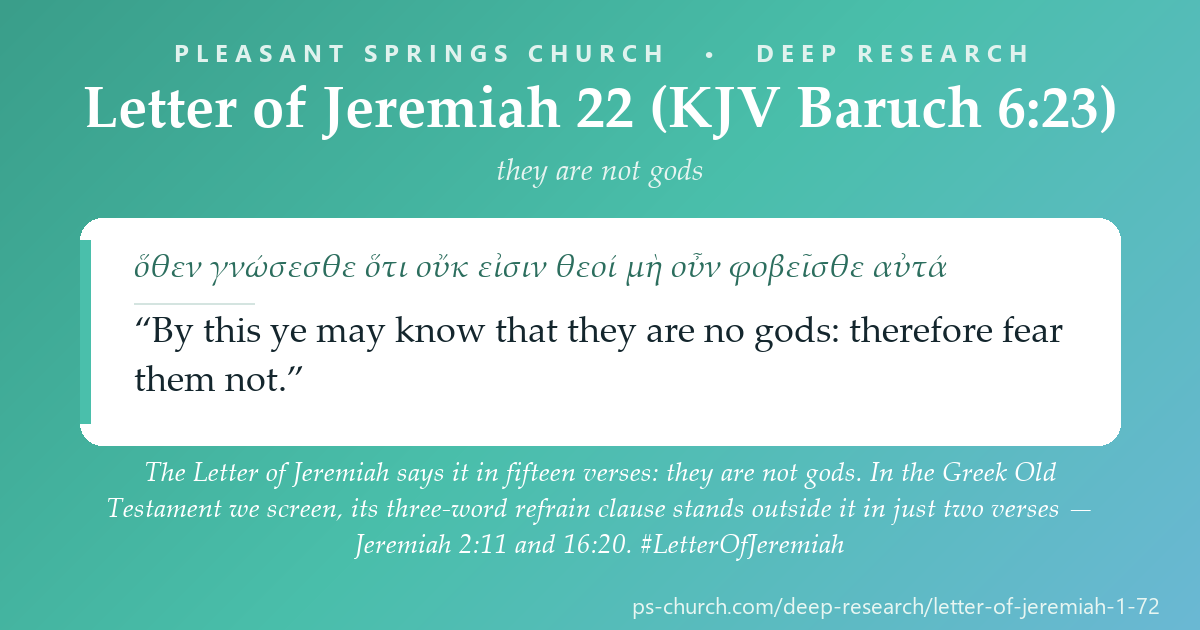
Letter of Jeremiah 22 · to share
Greek · KJV Apocrypha (1769) · LatinVULGATE BARUCH 6:22 Unde sciatis quia non sunt dii : ne ergo timueritis eos.
Every Deep Research page traces its passage across the whole sweep — the Old Testament, the Second-Temple world between the testaments (historical witnesses, not Scripture), and the New Testament. Follow the thread:
Pleasant Springs Church — Deep Research
Research method after Michael S. Heiser’s Bible Research Method (examine dictionaries → ancient literature → important words → textual connections → academic publications → share), with the Pleasant Springs “Author & Audience” foundation. Scripture set in the Hebrew, the Greek editions named on each page and the ESV (Old Testament), and the Greek New Testament and the ESV (New Testament), per the practice of Pleasant Springs Church. ⚠️ Status: the Letter of Jeremiah is not part of the Protestant canon. It is canonical in the Roman Catholic and Orthodox churches, was printed among the Apocrypha in the Reformation-era Protestant Bibles (as Baruch 6), and is absent from the Hebrew Bible. This study is filed under Apocrypha / Deuterocanon and nothing taught at Pleasant Springs rests on it. Greek text: the CATSS morphologically analysed Septuagint (Rahlfs), file EpJer.mlxx, quoted at verse level with attribution; every Greek string on this page is read out of the corpus files when the page is built. English: the King James Apocrypha, standardised text of 1769, public domain (the verse-per-line edition from eBible.org held on this disk), quoted verbatim; no ESV of this book is held on this disk and none is printed for it. One canonical verse (Psalm 115:4) is quoted in the ESV from the shelf’s cached file; other canonical verses carry this page’s own glosses, marked as such. Latin: the Clementine Vulgate (public domain), a fourth witness with its own verse division. Hebrew: the Masoretic text (Sefaria, Miqra according to the Masorah) for canonical comparison verses only. Greek New Testament: SBLGNT via MorphGNT. Verse offsets between the three numberings were measured by content anchors. Direction of influence is nowhere asserted. The one commentary read is C. J. Ball (1913); see Stage 5 for everything that was not.
Scripture quotations marked ESV are from the ESV® Bible (The Holy Bible, English Standard Version®), © 2001 by Crossway, a publishing ministry of Good News Publishers. ESV Text Edition: 2016. Used by permission. All rights reserved. The ESV text may not be quoted in any publication made available to the public by a Creative Commons license, and the ESV may not be translated in whole or in part into any other language. www.esv.org
|
Did this study bless you today? 💚 Give to Support PS Church100% of gifts go to the General Fund — thank you. |