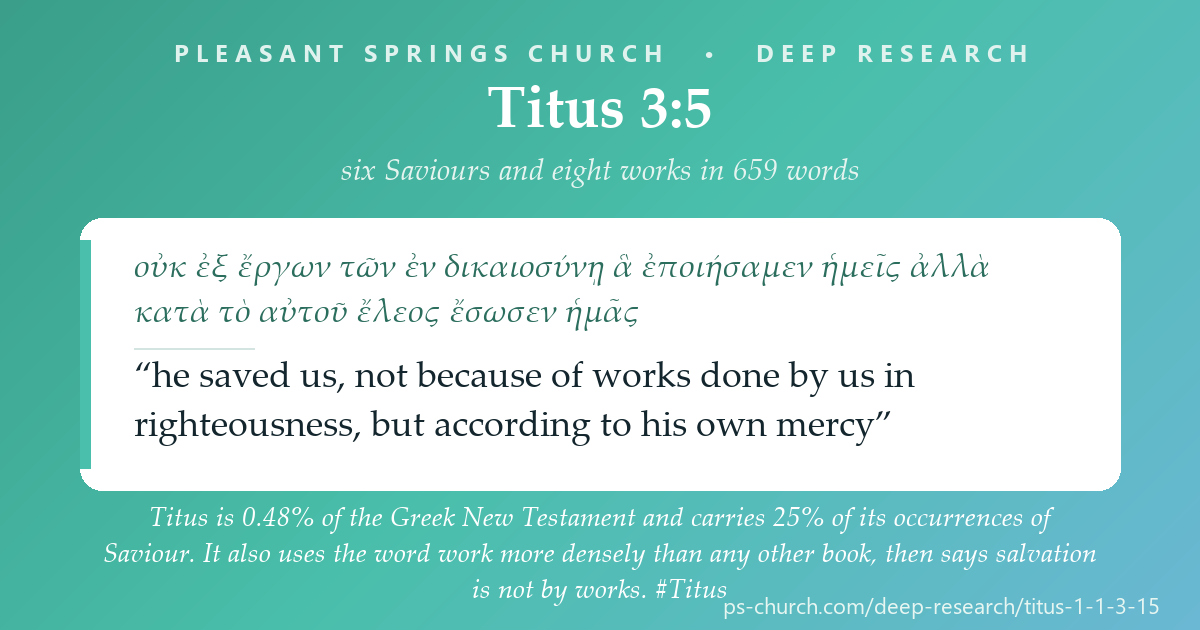
Titus is 659 words long — less than half of one per cent of the Greek New Testament. We came to it for the word σωτήρ, Saviour, because a letter this short using it six times is already a curiosity. What we did not expect was the second count. The same 659 words carry eight occurrences of ἔργον, work — 12.1 per thousand words, which is the highest concentration of that word in the New Testament, ahead of James at 8.6. And at 3:5 this letter says, as plainly as anything in Paul, that he saved us οὐκ ἐξ ἔργων — not because of works. The two words the church has argued over for five hundred years reach their highest density in the New Testament in the same three chapters. Meanwhile the Saviour count turned out to have a shape nobody guesses: six occurrences, two in every chapter, God first and Christ second in every chapter, and all six reading σωτῆρος ἡμῶν — our Saviour, without a single exception. See the method →
Titus 1:1–3:15 (selections)
Greek New Testament (SBLGNT / MorphGNT) · ESV★ And the count that stopped us was not the one we came for. Titus is 659 words — less than half of one per cent of the Greek New Testament. It carries six of the New Testament’s twenty-four occurrences of σωτήρ, which we expected. It also carries eight of the 169 occurrences of ἔργον, which we did not: at 12.1 per thousand words that is the highest concentration of the word work in the New Testament, ahead of James. Both superlatives sit in the letter that says at 3:5 that he saved us not by works.
The Shape of the Passage
Three Saviour-pairs in a straight line — a sequence, not a chiasmThree counts were run for this panel rather than repeated from a commentary: the letter’s opening formula against the other twelve Pauline letters, its vocabulary against the whole Greek New Testament, and its proper nouns against the two letters it is usually read beside. The third one cuts against the easy conclusion, and the panel prints it anyway.
Author
The letter names Paul in its first word — and then does something he does nowhere else. Two verses in the Greek New Testament open Παῦλος δοῦλος: Romans 1:1 and Titus 1:1. Romans continues Χριστοῦ Ἰησοῦ. Titus continues θεοῦ, and the two words δοῦλος θεοῦ occur in exactly one verse of the Greek New Testament — this one. Nobody else in the New Testament is called a servant of God in those two words in that order.
The vocabulary is unusual, and the page will not lean on the ranking. Counted here from the MorphGNT lemma column across all 27 books: 31 lemmas occur in Titus and in no other book of the Greek New Testament, each of them once, in a letter of 659 words — 47.0 per thousand. Because no lemma occurs twice in Titus and nowhere else, that is also the letter’s count of New Testament hapax legomena. On that second measure, filtered the way the sibling Pastoral pages filter it, Titus is second of the thirteen letters that name Paul, behind 2 Timothy at 47.8 and ahead of 1 Timothy at 40.9. Counted the first way, book-exclusive with the same filter applied to every book, the order is the same and those two comparators read 50.2 and 46.5. ⚠️ With no filter at all, 1 Timothy edges past Titus on that measure, 47.8 against 47.0 — which is one word in a 659-word book, and is exactly why nothing here rests on the ranking. The gap between the top two on the hapax measure is 0.8 per thousand, which is half of one word in a book this size. The three Pastorals sit together at the top; the ordering inside that group is not robust and nothing on this page rests on it.
A hapax count does not settle authorship in either direction, and Stage 5 says why at length. The shelf’s position is the one stated here: the letter names Paul.
Audience
One man on one island, and then a room. Τίτος is named thirteen times in the Greek New Testament — nine in 2 Corinthians (twice at 12:18), two in Galatians, once in 2 Timothy, and once here, at 1:4. The letter addressed to him names him once. Everything after that is second-person singular — appoint, rebuke, teach, avoid. Then the last words turn plural: ἡ χάρις μετὰ πάντων ὑμῶν. A letter to one man that expects a congregation to be listening.
And it is far less crowded than its neighbour, which is worth saying because the three Pastorals are usually described as one thing. Counted from the MorphGNT lemma column — capitalised lemmas, with the divine names Christos and Iesous struck out on every book alike: Titus carries 10 proper-noun tokens and 10 distinct proper nouns in 659 words, 15.2 per thousand. 2 Timothy carries 41 distinct in 1,235 words, 33.2 per thousand — more than twice the rate. Every one of Titus’s ten occurs exactly once. Paul, Titus, Crete, Cretans, Jewish, Artemas, Tychicus, Nicopolis, Zenas, Apollos. Five of the ten are in the last four verses.
The setting is an island the New Testament otherwise only sails past. Κρήτη occurs five times in the New Testament: four of them are the storm voyage of Acts 27, and the fifth is Titus 1:5. And in the 64 Greek Old Testament files held here, Κρῆτες occurs once, at Ezekiel 30:5 — though four other forms of the same two words stand at 1 Maccabees 10:67, Ezekiel 25:16 and Zephaniah 2:5–6. Word forms, never lemmas.
Orient on the Pastoral Epistles as a group, on Crete, on the household code, on the Saviour title, and on the grammar of 2:13.
Search by topic: Titus, Letter to; Pastoral Epistles; Crete; Cretans; Epimenides; household codes (Haustafeln); Saviour (soter) as a title; ruler cult and epiphany language; Granville Sharp rule; regeneration / palingenesia; elder and overseer; good works in Paul.
Which articles are relevant?
- Anchor Bible Dictionary — “Titus, Epistle to,” “Pastoral Epistles,” “Crete,” “Savior,” “Epiphany.”
- Dictionary of Paul and His Letters (IVP) — “Pastoral Letters,” “Households and Household Codes,” “Salvation,” “Works of the Law.”
- Dictionary of the Later New Testament (IVP) — “Faithful Sayings,” “Church Order,” “Baptism, Baptismal Rites.”
- New International Dictionary of NT Theology and Exegesis — σωτήρ, ἐπιφάνεια, παλιγγενεσία, περιούσιος, ἔργον.
- Dictionary of NT Background (IVP) — “Ruler Cult,” “Benefactor,” “Moral Philosophy, Greco-Roman.”
Settle the numbering — there is nothing to convert inside this book
A New Testament letter has no Hebrew column and no Septuagint column of its own. The Greek printed on this page is the language the letter was composed in, not a translation of a Hebrew original. What still has to be checked is whether the verse divisions agree, and here they do.
| 1 | 2 | 3 | total | |
|---|---|---|---|---|
| SBL Greek NT | 16 | 15 | 15 | 46 |
| ESV | 16 | 15 | 15 | 46 |
| Full English versification | 16 | 15 | 15 | 46 |
Counted from the corpora themselves, not from a table: 46 verse units in the MorphGNT file and 46 addressable verses in the complete English versification held here. ⚠️ The ESVrow above is not a local count — no ESV file for this book is held on this disk — and is given as the standard English versification. Every reference on this page therefore means the same verse in every column. Old Testament pages on this shelf frequently do not have that luxury, which is exactly why the question is asked every time.
Where this page does cross a numbering seam
Three of the Greek Old Testament references below are Psalms, and the Psalter is the worst offender on this shelf for numbering. The Greek Psalter runs one chapter behind the Masoretic from 9/10 through 147, and inside individual psalms the treatment of the superscription can cost a further verse. All three numbers are printed every time:
| CATSS Greek | Masoretic | ESV | why it is here |
|---|---|---|---|
| Psalm 64:6 | 65:6 | 65:5 | ὁ θεὸς ὁ σωτὴρ ἡμῶν — the title Titus uses, in a different case. The ESV number is one behind the Masoretic here because the Hebrew counts the superscription as verse 1. |
| Psalm 78:9 | 79:9 | 79:9 | The same title again. No further shift inside this psalm. |
| Psalm 94:1 | 95:1 | 95:1 | τῷ θεῷ τῷ σωτῆρι ἡμῶν, dative. The Greek psalm carries a superscription the Hebrew does not have, inside verse 1. |
| Psalm 134:4 | 135:4 | 135:4 | A near-miss on περιούσιος, printed in Stage 4 so nobody else trips on it. |
Deuteronomy 7:6, 14:2 and 26:18 — the other Old Testament references on this page — carry the same numbers in the Greek, the Hebrew and the English, and were checked rather than assumed.
An island with a reputation, a line of foreign verse called prophecy, a household code, and a title an emperor also wore.
Titus 1:12 — the only pagan verse the New Testament calls prophecy
The letter says ἴδιος αὐτῶν προφήτης — a prophet of their own — and then quotes seven words of Greek verse, and then says ἡ μαρτυρία αὕτη ἐστὶν ἀληθής, this testimony is true.
Measured, because the measurement is the interesting part: that quotation is the most verbally isolated thing in the letter. Screened on its own against the other 7,926 verses of the Greek New Testament it reaches a run of one, in a tie band of fourteen. Screened against 30,348 verse units of Greek Old Testament it reaches one, in a tie band of 272 — and that band is printed with its whole history rather than swapped out twice in silence: it was 244 when the shelf held 23,061 units in 44 files; on 2026-08-30 Exodus, Leviticus, Numbers, Joshua and the deuterocanon took the shelf to 64 files and 30,637 units and the band read 277; and later that same day the Odes came out of the screening corpus, taking five rows with them and leaving 272. A tie band moves when the corpus moves, and the run has never moved at all. The isolation of the quotation is a fact about the run; the band is a fact about the corpus. ⚠️ The five rows that left are worth naming, because of what the Odes are. They were Odes 2:23, 5:15, 7:44, 8:81 and 12:13, and four of the five are second copies of text already in the corpus — Ode 2 is Deuteronomy 32, Ode 5 is Isaiah 26, Odes 7 and 8 are Greek Daniel 3. A band of 277 was counting Deuteronomy 32 twice. The other half of the reason the canticles were removed does not touch this row but does touch the instrument: Ode 9 is Luke 1 and Ode 13 is Luke 2, so a screen that keeps the Odes can report a Gospel matching itself as an Old Testament contact — Ode 9:48 against Luke 1:48 runs to eighteen consecutive words. No two of its seven words stand together anywhere else in either corpus. Two of the seven — ψεῦσται and γαστέρες — stand in no other verse of the Greek New Testament in these forms. The lemmas behind them are ordinary words — ψεύστης occurs ten times in the Greek New Testament and γαστήρ nine. This shelf counts forms, and the isolation is an isolation of forms.
Reference works identify the line with Epimenides of Knossos and note that its first three words are also quoted by Callimachus in the Hymn to Zeus. Neither text is on this disk and neither was read. Everything this page can say about the source of the quotation is reported from reference works; everything it says about the quotation’s isolation was measured here. The two claims are kept apart.
Crete, and a word that means to lie
Greek writers had a proverb about Cretan dishonesty and a verb for it, and the letter is plainly using the local reputation against the local troublemakers. That is a reported fact about Greek usage, from lexica, not a measurement.
What can be measured here is thinner and more interesting. Κρῆτες occurs in two verses of the Greek New Testament: Acts 2:11, where Cretans are in the Pentecost crowd, and Titus 1:12, where they are always liars. In the 64 Greek Old Testament files held here that form occurs once, at Ezekiel 30:5, in a list of nations that will fall with Egypt — re-run 2026-08-30 over the enlarged shelf — 30,637 units held, 30,348 screened — and Exodus, Leviticus, Numbers, Joshua and the whole deuterocanon add nothing to it; four other forms of Κρήτη and Κρῆς stand at 1 Maccabees 10:67, Ezekiel 25:16 and Zephaniah 2:5–6, where the English versions mostly read Cherethites. Counted as word forms the island is barely in the Greek Bible, and this letter is set on it.
A household code, and a Saviour title that was not only Christian
2:2–10 addresses older men, older women, younger women, younger men, Titus himself and slaves in turn — the form reference works call a Haustafel, a household code, and it is shared with Colossians 3, Ephesians 5–6 and 1 Peter 2–3. The form is reported; no Greco-Roman household code was read for this page.
And the title. Reference works record that σωτήρ and ἐπιφάνεια were both current in the imperial cult, so that a letter putting them together on God and on Jesus is using vocabulary an inscription could also use. ⚠️ That is reported, not measured — no inscription and no papyrus was consulted for this page, and the inscriptions are exactly where the claim would be demonstrated. What was measured is that the same title is Septuagint Greek: ὁ θεὸς ὁ σωτὴρ ἡμῶν stands in Greek Psalm 64:6 (MT 65:6 · ESV 65:5) and Psalm 78:9 (MT/ESV 79:9), and τῷ θεῷ τῷ σωτῆρι ἡμῶν in Psalm 94:1 (MT/ESV 95:1). Stage 4 explains why the run screen still returns zero for it.
Seven words, each counted rather than characterised.
Counts are of NORMALISED word forms over the SBL Greek New Testament as digitised by MorphGNT (7,927 verses, 137,554 word tokens), and over the 64 CATSS Greek Old Testament files held here (30,637 verse units held, 30,348 of them screened — enlarged from 44 files and 23,061 units on 2026-08-30, when Exodus, Leviticus, Numbers, Joshua and the deuterocanon arrived and every Greek figure on this page was re-run; the 289-unit difference is the Odes, which stay on disk and are excluded from every screen — see Stage 5). The seven word cards below are lemma counts, and so is every codex row that counts a dictionary word; every run and every phrase search on this page is a form count. The page says which each time.
24 occurrences in the Greek New Testament; 6 of them in Titus. 9.1 per thousand words — twice the next book (2 Peter, 4.6) and nearly five times 1 Timothy (1.9). Two per chapter, God then Christ, all six with ἡμῶν.
169 occurrences in the Greek New Testament; 8 in Titus. 12.1 per thousand — the highest rate of any book, ahead of James (8.6) and 2 Timothy (4.9). Seven verses carry it: 1:16 (twice), 2:7, 2:14, 3:1, 3:5, 3:8, 3:14.
4 occurrences in the Greek New Testament; 2 are Titus 2:11 and 3:4. In the other two — Luke 1:79 and Acts 27:20 — what shines is a dawn and the sun and stars. The noun ἐπιφάνεια occurs 6 times, and all 6 are in these three letters and 2 Thessalonians.
1 occurrence in the Greek New Testament (2:14) and 5 in the local Greek Old Testament — ★ this card said 3 until 2026-08-30, and the two it was missing were both in Exodus. Deuteronomy 7:6, 14:2 and 26:18 carry the accusative λαὸν περιούσιον, which is the form Titus 2:14 has; Exodus 19:5 and 23:22 carry the nominative λαὸς περιούσιος. Which is why the lemma count moved and the run screen in Stage 4 did not.
2 occurrences in the Greek New Testament — Matthew 19:28, of the renewal of all things, and Titus 3:5, of a washing — and 0 in the 30,348 screened verse units of Greek Old Testament held here, re-run 2026-08-30 over the enlarged shelf.
12 occurrences in the Greek New Testament and 4 of them in Titus (1:9, 1:13, 2:1, 2:2) — more than any other book. The English hygiene is the same root.
1 occurrence in the Greek New Testament (1:2, of God) and ⚠️ 1 — not 0 — in the local Greek Old Testament. This card read 0 until 2026-08-30, and it was correct on a 44-file shelf. Wisdom of Solomon 7:17 has ἀψευδῆ — of God’s unerring knowledge of what exists — and Wisdom was one of the twenty CATSS files not then on disk. Wisdom is held here as a measurement witness and not as Scripture, and the page names it rather than quietly moving a zero to a one. Ten verses later the letter quotes a line about people who always lie.
The thirty-one, and what kind of words they are
Counted from the MorphGNT lemma column over all 27 books: 31 lemmas occur in Titus, once, and in no other book of the Greek New Testament. The two questions a vocabulary count can be asked — which lemmas are New Testament hapax legomena? and which lemmas occur only in this book? — return the same 31 here, because no lemma occurs twice in Titus and nowhere else. In 2 Timothy the two questions give 59 and 62.
The whole list, so the reader can judge the class of word: ἀψευδής (God who never lies, 1:2), ἐπιδιορθόω (set right what is left, 1:5), ὀργίλος (quick-tempered, 1:7), ἐγκρατής (self-controlled, 1:8), φιλάγαθος (a lover of good, 1:8), ματαιολόγος (empty talker, 1:10), φρεναπάτης (deceiver of minds, 1:10), ἐπιστομίζω (to stop a mouth, 1:11), Ἰουδαϊκός (Jewish, 1:14), βδελυκτός (detestable, 1:16), ἱεροπρεπής (reverent, 2:3), κατάστημα (demeanour, 2:3), πρεσβῦτις (older woman, 2:3), καλοδιδάσκαλος (teacher of good, 2:3), σωφρονίζω (to train to be sensible, 2:4), φίλανδρος (husband-loving, 2:4), φιλότεκνος (child-loving, 2:4), οἰκουργός (working at home, 2:5), ἀφθορία (integrity, 2:7), ἀκατάγνωστος (beyond reproach, 2:8), περιούσιος (2:14), σωφρόνως (sensibly, 2:12), περιφρονέω (to disregard, 2:15), στυγητός (hateful, 3:3), φροντίζω (to be careful, 3:8), αἱρετικός (factious, 3:10), αὐτοκατάκριτος (self-condemned, 3:11), ἐκστρέφομαι (twisted, 3:11), and the three names Ἀρτεμᾶς, Ζηνᾶς and Νικόπολις.
Read the list and the pattern is not theological. Nine of the thirty-one stand inside the household code of 2:3–5 and its echo at 2:12, describing what a person is like at home — older woman, demeanour, reverent, teacher-of-good, trained-to-be-sensible, husband-loving, child-loving, working-at-home, sensibly. (Only five of the thirty-one are φιλ- or σωφρ- compounds; the nine are a subject matter, not a prefix.) This is the vocabulary of a household, not of a doctrinal dispute, and any argument built on the raw count has to reckon with the subject matter first.
Titus 2:13, and the question this page does not settle
The verse reads τοῦ μεγάλου θεοῦ καὶ σωτῆρος ἡμῶν Ἰησοῦ Χριστοῦ — one article, two nouns joined by καί, then a name.
What is measurable: the three words τοῦ μεγάλου θεοῦ occur in exactly one verse of the Greek New Testament, this one. And this is the only one of Titus’s six Saviour occurrences in which θεός and σωτήρ stand together under one article. The measured pattern and the disputed grammar land on the same verse, which is a genuine coincidence worth printing and not an argument for either reading.
What is not measurable, and is therefore left open: whether the single article makes God and Saviour two titles of one person — the reading usually associated with Granville Sharp’s 1798 rule and the one the ESV and the NIV both print — or whether it is the great God, and our Saviour Jesus Christ, which older English versions print. That turns on Greek syntax and on a body of comparative examples, not on any count this shelf can run. No critical apparatus and no Greek grammar was consulted for this page. The page reports the collocation and stops.
Every verse of Titus screened against the rest of the Greek New Testament and against the Greek Old Testament held here — with the tie band beside every run.
Greek against Greek. MorphGNT field 6, the normalised word form (the column that already resolves elision and the movable nu), lowercased with accents and breathings dropped and final sigma folded; the CATSS FORM column put through the same filter after beta-code transliteration. Word forms, never lemmas. Contiguous runs only. The tie band is how many other verses reach the same depth; a run without its band is misleading.
First, the counter-examples — because the deepest runs in this book prove nothing
The two deepest runs Titus has anywhere in the Greek New Testament are a greeting and a benediction.
| Titus | against | run | tie band | what it is |
|---|---|---|---|---|
| 1:4 | 1 Timothy 1:2 · 2 Timothy 1:2 | 8 | 2 | The salutation. peace from God the Father and Christ Jesus — a form, three times used. |
| 3:15 | Hebrews 13:25 | 5 | 1 | A benediction. Grace be with you all. Tie band of one, and still not a citation. |
| 2:5 | Luke 8:11, John 10:35 and 9 others | 4 | 11 | ὁ λόγος τοῦ θεοῦ — ten of the eleven. Four words in a band of eleven is a formula. |
| 1:7 | 1 Timothy 3:3 | 4 | 1 | μὴ πάροινον μὴ πλήκτην — two items of an overseer list, in the same order in both. |
Print those first and the reader is properly warned: depth alone is not evidence of quotation. A greeting and a benediction run deep because they are fixed forms. What makes a run interesting is depth with a narrow band and a reason to look.
The whole book, screened against the Greek New Testament
All 46 verses of Titus against the other 7,881 verses of the Greek New Testament.
| run reaches | 1 | 2 | 3 | 4 | 5 | 6 | 7 | 8 |
|---|---|---|---|---|---|---|---|---|
| rows at exactly this depth | 4 | 11 | 15 | 14 | 1 | 0 | 0 | 1 |
| rows reaching at least | 46 | 42 | 31 | 16 | 2 | 1 | 1 | 1 |
The shape is a hump with a long thin tail. Thirty-one of the 46 rows reach three or more; sixteen reach four; then it stops. Nothing in Titus reaches six or seven at all — there is one row at five (the benediction) and one at eight (the greeting), and nothing in between. Four rows reach only one: 1:8, 1:11, 2:4 and 2:6, in tie bands of 632, 1,205, 993 and 646 respectively.
On the Greek-side convention this shelf uses, a reported 1 means the verse shares single words but no two consecutive words with any other verse. No verse of Titus reports 0, so unlike 2 Timothy 3:3 this letter has no verse that is cut off entirely.
And the Pastorals against each other
Screened against 1 Timothy alone, 7 of Titus’s 46 rows reach four consecutive words or more; against 2 Timothy alone, 7 do. The deepest against each is the same row — 1:4, the greeting, at eight, in a tie band of one inside each restricted screen. After the greetings the shared runs are 1:3 and 2:10 and 3:4 against 1 Timothy 2:3 at four (τοῦ σωτῆρος ἡμῶν θεοῦ), 1:7 against 1 Timothy 3:3 at four, 2:12 against 1 Timothy 6:17 at four (in the present age), 1:16 and 3:1 against 2 Timothy 3:17 at four (for every good work), 2:13 against 2 Timothy 1:10 at four (our Saviour Jesus Christ), 3:12 against 2 Timothy 4:9 at four (do your best to come to me), 3:8 against 1 Timothy 1:15 and 4:9 at four (the saying is trustworthy, and), 2:2 against 2 Timothy 3:10 at four, and 2:5 against 2 Timothy 2:9 at four. That is all seven rows on each side.
Shared formulae between three short letters addressed to two co-workers are what anyone would expect on any account of their origin. The numbers are reported; no conclusion about authorship is drawn from them here.
★ The Greek Old Testament — a ceiling of three that the corpus broke
⚠️ THIS SECTION’S HEADLINE FINDING WAS FALSIFIED ON 2026-08-30, AND THE PAGE PRINTS WHAT IT SAID, ON WHAT CORPUS, AND WHAT IT SAYS NOW.
What it said, measured against 23,061 verse units in 44 CATSS files: “All 46 verses of Titus against 23,061 verse units of Greek Old Testament held here. Six rows reach one, twenty-five reach two, fifteen reach three. Nothing reaches four… Titus makes no verbatim contact with the Greek Old Testament deeper than three consecutive words anywhere in its three chapters.”
What it says now, against 30,348 screened verse units in 64 files (30,637 held, less the 289 Odes units — see Stage 5):
| run reached | rows of the 46, on 23,061 units | rows of the 46, on 30,348 units |
|---|---|---|
| 1 | 6 | 4 |
| 2 | 25 | 25 |
| 3 | 15 | 16 |
| 4 | 0 | 1 |
The one row that reaches four is Titus 2:13, and its partner is Tobit. Titus 2:13 has ἐπιφάνειαν τῆς δόξης τοῦ μεγάλου θεοῦ — the appearing of the glory of our great God. Tobit (BA) 3:16 has ἐνώπιον τῆς δόξης τοῦ μεγάλου, of the prayer of Tobit and Sarah being heard. The shared run is four words — τῆς δόξης τοῦ μεγάλου — in a tie band of one.
⚠️ Tobit is a WITNESS held here for measurement, and it is not Scripture. It is on this shelf on the same footing as Psalm 151, the Psalms of Solomon and Jubilees: a Greek text worth measuring against, named as what it is every time it appears. Nothing about this contact is a citation claim, and the page makes none.
And the two Greek Tobits do not agree at the word that makes the match. CATSS carries Tobit twice, in the B/A recension and in the Sinaiticus recension, and they are not variants of one another any more than the two Greek Daniels are. Tobit (S) 3:16 reads τῆς δόξης τοῦ θεοῦ — the glory of God, not the glory of the great one. The four-word run exists in one recension and not in the other. A finding that hangs on which Tobit you open is a finding that has to say so.
What survives, restated honestly. By comparison 2 Timothy, a letter not quite twice as long, has rows reaching five. Titus still makes no verbatim contact deeper than three consecutive words with any book of the Hebrew canon in Greek — the single four is with a deuterocanonical witness, in one of its two recensions, on four function-heavy words. And the sixteen rows that reach three are reaching it on things like τὸν λόγον αὐτοῦ and δὲ καὶ οἱ. The letter’s thinness against the Greek Old Testament is not in question; only the word “nothing” was.
★ And now the row that proves the shelf’s first rule harder than any row on the shelf. Titus 2:14 runs καὶ καθαρίσῃ ἑαυτῷ λαὸν περιούσιον — and purify for himself a people for his own possession. Those last two words occur in three verses of the Greek Old Testament held here, and in one verse of the Greek New Testament. It is the clearest verbal contact the letter has with the Torah.
| Titus 2:14 — every two-word contact it has with the Greek OT | verses hit |
|---|---|
| ἀπὸ πάσης | 31 · was 18 |
| ἡμᾶς ἀπό | 16 · was 10 |
| ὃς ἔδωκεν | 7 · unchanged |
| ἀνομίας καί | 9 · was 7; the two new ones include Exodus 34:7 |
| ἡμῶν ἵνα | 11 · was 5 |
| λαὸν περιούσιον | 3 — Deuteronomy 7:6, 14:2, 26:18 · unchanged, and that is the finding |
| ἔδωκεν ἑαυτόν | 2 · unchanged |
| ἑαυτῷ λαόν | 2 · unchanged |
The second column is there because on 2026-08-30 the Greek Old Testament on this shelf went from 44 files and 23,061 verse units to 64 and 30,637, and every row of this table was re-run. Five of the eight moved, three did not, and the one the section is about did not.
Titus 2:14’s maximum against the whole Greek Old Testament is two, in a tie band of eighty. (Fifty-four against 23,061 units; eighty-one against all 30,637 held; eighty now that the Odes are out of the screening corpus. The run did not move and the band did twice, which is what a band does when a corpus does. The row that left was Ode 7:44, and Ode 7 is a second copy of Greek Daniel 3 — so the band of eighty-one was counting Daniel twice. See Stage 5.) The Deuteronomy phrase measures exactly the same depth as from all and who gave. A table of maxima would print ἀπὸ πάσης and lose the shared phrase entirely. This is why every page on this shelf prints the band, and why the shelf’s first rule is that the deepest run is not the interesting one.
★ The first of this section’s two limits has been lifted, and the way it lifted is the most instructive thing on this page. Until 2026-08-30 this paragraph read: “First: Exodus is not on this disk. Reference works place λαὸς περιούσιος at Exodus 19:5 and 23:22 as well, and Exodus is one of the twenty CATSS files absent here, so three is a count over 44 books and not over the Septuagint.” Greek Exodus is on this disk now, and the reference works were right: λαὸς περιούσιος stands at Exodus 19:5 and at Exodus 23:22, and a stem search across all 30,348 screened units returns those two and nothing further.
And the count in the table above still reads three. Because Titus 2:14, Deuteronomy 7:6, 14:2 and 26:18 all have the accusative λαὸν περιούσιον, and both Exodus verses have the nominative λαὸς περιούσιος. This shelf counts forms, never lemmas, so the run screen does not see them and the table does not move. The word card in Stage 3 does move — it is a lemma count, and it went from 3 to 5. Two figures on one page, both correct, disagreeing because they are counting different things, and both now measured rather than one of them deferred to a reference work. Three is now a count over the whole Greek Old Testament and not over 44 books — and it is still three.
The second limit stands unchanged. A near-miss, printed so nobody else trips on it: a stem search returns two further hits for περιουσι-, at Greek Psalm 134:4 (MT/ESV 135:4) and Ecclesiastes 2:8. Both are περιουσιασμός, a different noun. Not a match, and reported rather than quietly dropped. And nothing here asserts direction. A letter reaching for Deuteronomy’s phrase is one explanation; a phrase already worn smooth by synagogue use is another. Two shared words is a shape, not a lineage.
God our Saviour — a zero that is a fact about forms, not about ideas
The four words τοῦ σωτῆρος ἡμῶν θεοῦ return 0 hits across 30,348 screened verse units of Greek Old Testament — re-run 2026-08-30 over the enlarged shelf, and Exodus, Leviticus, Numbers, Joshua and the deuterocanon add nothing to either. So does the two-word σωτῆρος ἡμῶν on its own. Read carelessly that is a striking result — the letter’s signature title, absent from the Greek Old Testament. It is not a striking result. It is an artefact of counting word forms.
| where | Greek | case |
|---|---|---|
| Psalm 64:6 (MT 65:6 · ESV 65:5) | ὁ θεὸς ὁ σωτὴρ ἡμῶν | nominative |
| Psalm 78:9 (MT/ESV 79:9) | ὁ θεὸς ὁ σωτὴρ ἡμῶν | nominative |
| Psalm 94:1 (MT/ESV 95:1) | τῷ θεῷ τῷ σωτῆρι ἡμῶν | dative |
| Titus 1:3, 2:10, 3:4 | τοῦ σωτῆρος ἡμῶν θεοῦ | genitive, and the nouns in the other order |
The Greek Psalter says God our Saviour three times, and the run screen cannot see any of them. This shelf counts word forms, never lemmas, and it counts contiguous runs, so a genitive does not match a nominative and a reversed word order does not match at all. The zero is true and it means nothing about whether the title is Septuagint language. It is. This is the same failure mode as 2 Timothy 3:3 and Romans 1:31, where the one word joining the New Testament’s two loneliest verses stands in two different cases and is invisible. The method is working as designed, and the page says what the design costs.
Inside the Greek New Testament the picture is different and the screen does see it: σωτῆρος ἡμῶν stands in exactly nine verses, and all nine are in these three letters — 1 Timothy 1:1 and 2:3, 2 Timothy 1:10, and the six in Titus.
The two counts this page is built on, side by side
Titus is 659 word tokens, 0.48% of the Greek New Testament.
| word | in the whole Greek NT | in Titus | per 1,000 words | next-highest book |
|---|---|---|---|---|
| σωτήρ Saviour | 24 occurrences | 6 (25%) | 9.1 | 2 Peter, 4.6 |
| ἔργον work | 169 occurrences | 8 | 12.1 | James, 8.6 |
⚠️ A density in a 659-word book is a noisy statistic and the page says so where it prints it. One occurrence either way moves the ἔργον rate by 1.5 per thousand, so the gap to James (3.5) is about two words wide. What is not noisy is the raw fact that a letter of 46 verses uses the word work eight times in seven of them and then says salvation is not by works. The good-work clauses are 1:16, 2:7, 2:14, 3:1, 3:8 and 3:14; the denial is 3:5, and it sits between the fourth and the fifth.
That is a statement about verbatim vocabulary, not about theology. Whether Titus’s good works and Paul’s works of the law are the same category is a question about arguments, not about counts, and no count on this page answers it.
Where this page is weakest, and what was not reached.
The limits of the two density counts — there are four, and they are real
1. The book is tiny. 659 words. Every rate on this page has a granularity of 1.5 per thousand, because that is what one word is worth. The ἔργον lead over James is about two words wide and the σωτήρ lead over 2 Peter is about three. Neither would survive a different versification of the corpus, and neither is offered as a robust ranking. The raw counts — 6 of 24, 8 of 169 — are what the page rests on.
2. Density is driven by subject matter. A letter about church order and household conduct will use the word work often for reasons that have nothing to do with soteriology. Nine of the thirty-one hapax legomena stand inside the household code of 2:3–5 and its echo at 2:12. The count is detecting a genre at least as much as a theology.
3. Lemmas, not forms. The two density counts on this page are lemma counts, taken from the MorphGNT lemma column, while every run and every phrase search is a form count. Those are different units and mixing them silently would be a real error. The page says which it means every time, and this paragraph exists so a reader can check that it did.
4. One edition, one digitisation. Everything ran on the SBL Greek New Testament as digitised by MorphGNT. A different critical text or a different lemmatisation could move a count. No critical apparatus was consulted for any verse on this page, so no variant reading anywhere in Titus has been weighed here.
The vocabulary count, and what it cannot settle
31 hapax legomena in 659 words is a real count and a weak argument, in both directions. It does not establish that Paul did not write this letter — the shelf’s position is stated in the Author panel above; the letter names him. It also does not establish that he did. Subject matter, a secretary, an interval of years, a change of opponent and an island setting would each raise the number, and the count cannot distinguish them.
⚠️ And the sibling pages on this shelf do not all use the same filter. The 2 Timothy study applied an automatic filter that strikes any lemma whose normalised surface form is tagged to a different lemma elsewhere in the corpus, and printed 59 for 2 Timothy and 47.0 per thousand for Titus. The raw count run for this page returns 31 lemmas, 47.0 per thousand, and the filter strikes nothing in Titus — the two agree here, which is worth saying because on 1 Timothy the automatic filter strikes two rows, 67 down to 65, where the published 1 Timothy page struck one by hand and printed 66. Neither figure should be quoted as a published statistic.
And this page did not attempt the harder tests. P. N. Harrison’s study and the stylometric literature after it measure particles, connectives and sentence structure, not rare nouns. None of that was run here. Nothing on this page replicates or refutes it, and nothing on this page should be read as a contribution to the authorship question.
What could not be checked at all
No Greek critical apparatus, for any verse. No Greek grammar and no collection of Granville Sharp examples, which is exactly the material 2:13 turns on — the page reports the collocation and refuses the verdict. No inscriptions and no papyri, which is where the imperial-cult use of σωτήρ and ἐπιφάνεια would actually be demonstrated. No Epimenides and no Callimachus, so everything this page says about the source of the line quoted at 1:12 is reported from reference works; only the line’s isolation was measured. No Greco-Roman household code. No Apostolic Fathers — 1 Clement and Polycarp both overlap this material and neither is held here.
★ Twenty Greek Old Testament files used to be unsearchable. They are on the disk now, and this paragraph is the record of what that did. Until 2026-08-30 this section read: “Exodus, Leviticus, Numbers, Joshua, Judith, Tobit, 2–4 Maccabees, Odes, Wisdom, Psalms of Solomon, Baruch, the Epistle of Jeremiah, Bel and Susanna are not on this disk. Exodus is the one that matters here, because 19:5 and 23:22 are two of the five places λαὸς περιούσιος is normally cited.” All twenty were fetched. The shelf went from 44 files and 23,061 verse units to 64 and 30,637 held, and every Greek count on this page was re-run against it.
Three things came out of that, and two of them cost this page a claim. (1) Exodus 19:5 and 23:22 do carry λαὸς περιούσιος, exactly where the reference works put it — and because it is nominative and Titus 2:14 is accusative, the form count in Stage 4 stayed at three while the lemma count in Stage 3 went from three to five. (2) The ceiling of three was broken: Titus 2:13 reaches four against Tobit (BA) 3:16. (3) The zero for ἀψευδής was broken: Wisdom 7:17. Tobit and Wisdom are held here as measurement WITNESSES and not as Scripture, and both are named as such wherever they appear.
Every count reported against the Greek Old Testament on this page is now a count over 64 files — the whole of CATSS, with nothing missing, and the page says so where it prints them.
⚠️ AND THEN ONE BOOK CAME BACK OUT OF THE SCREEN, LATER THE SAME DAY. THE PAGE PRINTS THAT RATHER THAN LETTING TWO BANDS CHANGE IN SILENCE. The Odes — the fourteen liturgical canticles bound after the Greek Psalter, which arrived with those same twenty files — were removed from the screening corpus. They stay on disk. They are no longer inside what this shelf screens as ‘the Greek Old Testament’, for two independent reasons.
(1) Two of them are New Testament text. Ode 9 is Luke 1 — the Magnificat and the Benedictus — and Ode 13 is Luke 2, the Nunc Dimittis. Screened, Ode 9:48 matches Luke 1:48 at eighteen consecutive words. That is not a contact between two Testaments; it is Luke matching Luke under an Old Testament shelfmark, and a page could report it as a Gospel’s deepest Old Testament contact while measuring its own text. No hit removed from this page was one of those — Titus never reaches Ode 9 or Ode 13 — but the instrument that produced this page’s bands could do it, and a reader is owed that. (2) Ten of them are second copies of passages already in the corpus — Ode 1 = Exodus 15, 2 = Deuteronomy 32, 3 = 1 Samuel 2, 4 = Habakkuk 3, 5 = Isaiah 26, 6 = Jonah 2, 7 and 8 = Daniel (Th) 3, 10 = Isaiah 5, 11 = Isaiah 38. That is the reason both of this page’s corrections exist: a verse standing once in Deuteronomy 32 or Daniel 3 appeared to stand twice, so every tie band that touched a canticle was inflated.
HELD and SCREENED are therefore two different numbers. The shelf holds 30,637 verse units in 64 files; a screen sees 30,348, the difference being exactly the 289 Odes units.
| figure | 44 files · 23,061 | 64 files · 30,637 held | screened · 30,348 | what left |
|---|---|---|---|---|
| the 1:12 Epimenides line, tie band | 244 | 277 | 272 | Odes 2:23, 5:15, 7:44, 8:81, 12:13 — four of the five are Deuteronomy 32, Isaiah 26 and Daniel 3 counted twice |
| Titus 2:14, tie band at two | 54 | 81 | 80 | Ode 7:44 — Greek Daniel 3 counted twice |
| the 1:12 run, and every run on the page | unchanged at every corpus size | nothing | ||
| Titus 2:13 against Tobit (BA) 3:16 | — | 4, band 1 | 4, band 1 | nothing |
| the distribution 4 / 25 / 16 / 1 | 6 / 25 / 15 / 0 | unchanged | nothing | |
| every zero on this page | still zero | nothing — taking text out of a corpus cannot create a hit | ||
Two bands moved and nothing else did, which is the shape this correction ought to have. Both are counts of how many Greek Old Testament rows share the shallowest possible contact with a Titus row, and both were inflated by the same thing: text the corpus already contained, bound a second time into a service book. The two findings this section exists for — that the Cretan quotation is the most verbally isolated thing in the letter, and that the one Torah phrase Titus shares is invisible in a table of maxima — are exactly as they were.
Nor is the relation between this letter and Paul’s longer arguments settled here. Whether not because of works done by us in righteousness (3:5) says the same thing as not by works of the law (Galatians 2:16) is a question about arguments, not about word counts. A page that reported a density and then announced a doctrine of justification would be overreaching, and this one stops at the density.
Reading list
- I. Howard Marshall, The Pastoral Epistles (ICC, 1999).
- William D. Mounce, Pastoral Epistles (WBC 46, 2000).
- Luke Timothy Johnson, Letters to Paul’s Delegates: 1 Timothy, 2 Timothy, Titus (Trinity Press, 1996).
- Philip H. Towner, The Letters to Timothy and Titus (NICNT, 2006).
- Jerome D. Quinn, The Letter to Titus (Anchor Bible 35, 1990) — the fullest English treatment of this letter on its own.
- Daniel B. Wallace, Granville Sharp’s Canon and Its Kin (Peter Lang, 2009) — the collection of examples the grammar of 2:13 turns on.
- P. N. Harrison, The Problem of the Pastoral Epistles (Oxford, 1921) — the study that put the vocabulary question on the table.
- None of these were consulted for the measurements on this page, which were run on the text files named in the footer.
Forty-six verses, six Saviours, eight works, and one line of foreign poetry that shares nothing with anything.
Our Saviour, and every good work
Titus is three chapters long and is mostly about behaviour: who to appoint, what to teach, how a household runs, when to stop arguing with someone. It is the kind of letter that gets read as church administration and put down again.
But the two words it uses most densely in the whole New Testament are Saviour and work. Six times and eight times, in 659 words, and in both cases no other book comes close.
And the Saviours are arranged. God at 1:3, Christ at 1:4. God at 2:10, Christ at 2:13. God at 3:4, Christ at 3:6. Two in every chapter, God first every time, and every one of the six says our. Nobody plans a letter that way by accident and nobody notices it without counting.
Then the works. Unfit for any good work (1:16). A model of good works (2:7). Zealous for good works (2:14). Ready for every good work (3:1). Devoted to good works (3:8). Learning to devote themselves to good works (3:14). And in the middle of them, 3:5: he saved us, not because of works done by us in righteousness, but according to his own mercy. The letter that talks about works more than any other book in the New Testament is the letter that most flatly denies they save.
Which leaves the strangest verse in it standing where it was put. A line of Cretan verse, seven words long, called a prophet of their own, and measured against every other verse in the Greek New Testament and every verse unit of Greek Old Testament held here it shares no two consecutive words with anything. The most verbally isolated sentence in the letter is a quotation from outside the Bible, and the letter’s comment on it is this testimony is true.
New Testament shelf: this is the whole of Titus, all three chapters, 46 verses, Greek New Testament and ESV.
Every Deep Research page traces its passage across the whole sweep — the Old Testament, the Second-Temple world between the testaments (historical witnesses, not Scripture), and the New Testament. Follow the thread:
Pleasant Springs Church — Deep Research
Research method after Michael S. Heiser’s Bible Research Method (examine dictionaries → ancient literature → important words → textual connections → academic publications → share), with the Pleasant Springs “Author & Audience” foundation. Scripture set in the Hebrew, the Greek editions named on each page and the ESV (Old Testament), and the Greek New Testament and the ESV (New Testament), per the practice of Pleasant Springs Church. Titus research grounded in Marshall (ICC), Mounce (WBC), Quinn (Anchor) and Towner (NICNT), with Wallace (2009) named on the grammar of 2:13 and Harrison (1921) as the origin of the vocabulary question. Text: Greek New Testament from the SBL edition as digitized by MorphGNT; Greek Old Testament from Rahlfs’ Septuaginta as digitized by CATSS. ⚠️ VERSE NUMBERING — there is no offset in this book. The SBL Greek New Testament runs 16 / 15 / 15 = 46 verses, counted from the file itself, and a complete English versification counted the same way agrees; the ESV, whose text is not held on this disk, carries the same divisions. Every reference to Titus on this page means the same verse in every column. The seams this page does cross are all in the Psalter — Greek 64:6 = MT 65:6 = ESV 65:5; Greek 78:9 = MT/ESV 79:9; Greek 94:1 = MT/ESV 95:1; Greek 134:4 = MT/ESV 135:4 — and all three numbers are printed every time one appears. ⚠️ The measurement, in full. Greek against Greek. MorphGNT field 6, the normalised word form; the CATSS FORM column (cols 0–24) beta-code transliterated first. Both sides lowercased, accents and breathings dropped, final sigma folded, then filtered to Greek letters — the same filter applied to both corpora. Word forms, never lemmas, except where the page says ‘lemma’ explicitly, which is the σωτήρ and ἔργον density table, the seven word cards in Stage 3, the codex rows that count a dictionary word, the hapax count and the proper-noun count. Corpus: the 46 MorphGNT rows of Titus against 7,881 other New Testament verses across 27 files, and against 30,348 screened verse units across 64 CATSS files — 30,637 held, less the 289 Odes units. Exhaustive and deterministic; nothing sampled, so no seed applies. ⚠️ THE CORPUS GREW ON 2026-08-30 AND TWO OF THIS PAGE’S CLAIMS DID NOT SURVIVE IT. Exodus, Leviticus, Numbers, Joshua (A and B) and the deuterocanon — Judith, Tobit (BA and S), Wisdom, Baruch, the Letter of Jeremiah, 2–4 Maccabees, Susanna, Bel, Odes and Psalms of Solomon — took the Greek Old Testament shelf from 44 files / 23,061 verse units to 64 files / 30,637 held, and every Greek figure here was re-run. Falsified: (1) “Nothing in Titus reaches four against the Greek Old Testament” — Titus 2:13 reaches four against Tobit (BA) 3:16, band one, on τῆς δόξης τοῦ μεγάλου, and the other Greek Tobit does not carry it; (2) “ἀψευδής: 0 in the local Greek Old Testament” — Wisdom 7:17 has ἀψευδῆ. Bands grew, as bands do: the Epimenides quotation 244→277, Titus 2:14 fifty-four→eighty-one — and then shrank again to 272 and 80 when the Odes were taken out of the screening corpus later the same day. The Odes stay on disk; they are excluded because Ode 9 is Luke 1 and Ode 13 is Luke 2 (Ode 9:48 matches Luke 1:48 at eighteen consecutive words — Luke matching Luke under an Old Testament shelfmark) and because ten more are second copies of Exodus 15, Deuteronomy 32, 1 Samuel 2, Habakkuk 3, Isaiah 26, Jonah 2, Daniel (Th) 3 twice, Isaiah 5 and Isaiah 38, which doubled any band that touched them. The six rows this page lost were all of the second kind, not the first, and both bands are printed with all three of their values in Stage 4 and Stage 5. Confirmed rather than falsified: the reference-work claim that λαὸς περιούσιος stands at Exodus 19:5 and 23:22, now read off the disk — and because those are nominatives and Titus 2:14 is accusative, the form count stayed at three while the lemma count went to five. Held unchanged: ἐπιδιορθόω and παλιγγενεσία at zero, Κρῆτες at one (Ezekiel 30:5), and the zero for σωτῆρος ἡμῶν. The deuterocanonical books are held here as measurement WITNESSES and NOT as Scripture — the standing Psalm 151 and Jubilees have on this shelf — and this page names the book every time a hit lands in one, which on this page is Tobit, Wisdom, 3 Maccabees, 4 Maccabees, 1 Esdras and 1 Maccabees. ⚠️ WHAT ZERO AND ONE MEAN ON THIS PAGE. Every Greek-side screen here runs with unigram_fallback=True, so a verse sharing only isolated single words reports 1, and a reported 0 would mean the verse shares no word form at all. No verse of Titus reports 0. That is the strong sense, and it is not the convention the Hebrew-side pages on this shelf use. ⚠️ The book’s deepest runs are formulae and the page says so first. Titus 1:4 against 1 Timothy 1:2 and 2 Timothy 1:2, eight consecutive words, tie band of two — and it is a letter greeting. 3:15 reaches five against Hebrews 13:25 and is a benediction. Nothing in the letter reaches six or seven. Depth alone is not evidence of quotation, and the letter’s one real Torah phrase measures two in a tie band of eighty-one. ⚠️ The density figures are lemma counts on a 659-word book. One occurrence is worth 1.5 per thousand, so the leads over 2 Peter and James are a few words wide and are not offered as robust rankings. The raw counts — 6 of the New Testament’s 24 σωτήρ and 8 of its 169 ἔργον — are what the page rests on. ⚠️ Not measured here. No critical apparatus for any verse. No Greek grammar and no Granville Sharp corpus, so 2:13 is reported and not decided. No inscriptions or papyri, so the imperial-cult background of σωτήρ is reported from reference works. No Epimenides and no Callimachus, so the attribution of the line at 1:12 is reported and only its isolation is measured. No Greco-Roman household code. No Apostolic Fathers. ✅ And the gap this list used to end with is closed. It read: “twenty CATSS files are absent — Exodus, Leviticus, Numbers, Joshua, Judith, Tobit, 2–4 Maccabees, Odes, Wisdom, Psalms of Solomon, Baruch, the Epistle of Jeremiah, Bel and Susanna… so that count is a count over 44 books and not over the Septuagint.” All twenty are on the disk as of 2026-08-30. Every Greek Old Testament count on this page is a count over all 64 CATSS files — 30,637 verse units held and 30,348 screened. The two Exodus occurrences of λαὸς περιούσιος have been read and are reported in Stage 3 and Stage 4. ⚠️ Direction of influence is never asserted. Nothing here says Titus is quoting Deuteronomy, or a Psalm, or that the three Pastorals depend on one another. Shared words are a shape, not a lineage. Typology is handled per the house position: what the text says, what the New Testament itself draws, and what we see from this side of the cross — with the seeing left to the reader.
Scripture quotations marked ESV are from the ESV® Bible (The Holy Bible, English Standard Version®), © 2001 by Crossway, a publishing ministry of Good News Publishers. ESV Text Edition: 2016. Used by permission. All rights reserved. The ESV text may not be quoted in any publication made available to the public by a Creative Commons license, and the ESV may not be translated in whole or in part into any other language. www.esv.org
|
Did this study bless you today? 💚 Give to Support PS Church100% of gifts go to the General Fund — thank you. |