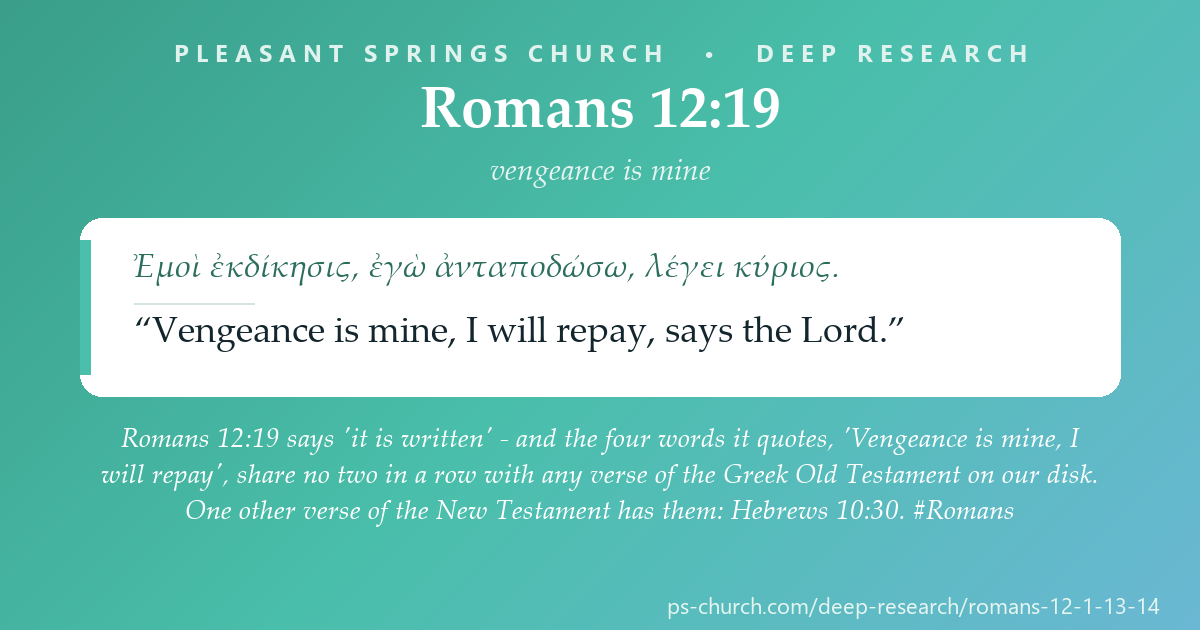
Sixteen times in Romans Paul writes γέγραπται — it is written — and quotes. Romans 12:19 is one of the sixteen, and it is the one the Greek Old Testament held on this disk does not support. The four words God speaks in it, Ἐμοὶ ἐκδίκησις, ἐγὼ ἀνταποδώσω — Vengeance is mine, I will repay — share no two consecutive word forms with any of the 30,348 Greek Old Testament verse units screened here, Deuteronomy 32:35 included, whose Greek opens ἐν ἡμέρᾳ ἐκδικήσεως ἀνταποδώσω, in the day of vengeance I will repay. Against the rest of the Greek New Testament the same four words reach four, tie band one, and the one verse is Hebrews 10:30. Each half of the saying — Ἐμοὶ ἐκδίκησις and ἐγὼ ἀνταποδώσω — stands in exactly two verses across both Greek corpora, and they are the same two, both in the New Testament. The Hebrew of Deuteronomy 32:35 opens לִי נָקָם, to me, vengeance — the two ideas in Paul’s order. One verse later Paul quotes again with no formula at all, and Romans 12:20 follows the Greek Proverbs for twenty of its twenty-two words — the deepest run on the page. The quotation he announces shares no two words in a row with the Greek held here; the one he does not announce matches it almost word for word. The measurement says where words agree. It never says who read what, and neither does this page. Stage 4 prints the runs that are exactly as deep as Hebrews 10:30 and mean nothing at all. See the method →
Romans 12:1–13:14 (seventeen of thirty-five verses)
Greek New Testament (SBLGNT, via MorphGNT) · ESVBut the Old Testament texts this page sets beside them do carry offsets, and one of them is large. Every one is stated where it is used, and gathered here: Exodus 20 and Deuteronomy 5 — the Hebrew file read here prints the four short commandments as ONE verse: Masoretic Exodus 20:13 = Greek and ESV 20:13–16, Masoretic 20:14 = Greek and ESV 20:17, and the Hebrew then runs three behind to the end of the chapter (23 verses against 26). Masoretic Deuteronomy 5:17 = Greek and ESV 5:17–20, 5:18 = 5:21, and the Hebrew runs three behind (30 against 33). Proverbs 25:21–22 is filed by the CATSS Greek as 32:21–22: the Greek Proverbs arranges its last chapters in a different order and the file numbers the moved blocks 30–36; matched here by content. Ezekiel 7:4 in the Greek holds what the Masoretic text and the ESV have at 7:7. Psalm 134:14 in the Greek = Psalm 135:14 Hebrew and ESV. Jeremiah 9:23 Greek and Hebrew = ESV 9:24. Deuteronomy 32, Leviticus 19, Proverbs 3, Lamentations 2 and 4, Jeremiah 3 and Zephaniah 3 are numbered alike in all three.
Reading the Greek column. Bold marks the words each note is about — the measured run, where the row has one worth printing; underline marks a second set. Seventeen of the thirty-five verses are printed; the rest are named in the structure diagram and the stages.
The Shape of the Passage
A sequence of six units inside two nested brackets — both measured, both crossing the chapter number, and NOT a chiasmThe letter’s own words first, and the inference kept apart from them. Every count in this section is read off the MorphGNT parsing of Romans 12–13 held on this disk: 574 words, 35 verses.
Author
Paul, appealing before he commands. The first verb of the section is not an imperative. It is Παρακαλῶ, I appeal, first person singular, grounded διὰ τῶν οἰκτιρμῶν τοῦ θεοῦ — by the mercies of God. The next first-person verb, at 12:3, frames his authority as a gift: διὰ τῆς χάριτος τῆς δοθείσης μοι.
Then eighteen imperatives in thirty-five verses — and the way they are distributed is the most interesting thing about them. Eleven are second person plural, addressed to the congregation. Six are second person singular, and two of those six are inside the Proverbs quotation at 12:20. The other four are 12:21 (twice), 13:3 and 13:4. Paul’s own singular you, then, stands only in 12:21–13:4 — it begins where the quotation hands it to him and runs across the chapter number. One imperative is third person: Πᾶσα ψυχὴ… ὑποτασσέσθω.
And a passage that stops commanding. 12:9–13 is five verses with ten participles and no finite verb and no imperative at all — τῇ ἐλπίδι χαίροντες, τῇ θλίψει ὑπομένοντες. The grammar describes a people before it instructs one.
Audience
Brothers, and beloved. The only two vocatives in the section are ἀδελφοί (12:1) and ἀγαπητοί (12:19) — and the second stands in the verse that forbids revenge.
People who already pay taxes. 13:6 φόρους τελεῖτε is parsed in the file as present indicative — you pay — though the form could be an imperative. Either way the letter assumes its readers stand inside the Roman system of φόρος and τέλος. It addresses that fact; it does not open a debate about it.
A congregation with gifts and with enemies. Seven gifts in 12:6–8; τοὺς διώκοντας at 12:14; ὁ ἐχθρός σου at 12:20. And people who remember when they first believed — 13:11 ὅτε ἐπιστεύσαμεν, an aorist: a past occasion, set by when.
Orient on Romans 12–13, on sacrifice and worship, on love and the law, on vengeance and on the state — before touching a single number.
Search by topic: Romans, Letter to the; sacrifice; worship (latreia); renewal; body of Christ; spiritual gifts; love (agapē); vengeance, avenger; wrath of God; state, Paul and the; authorities, powers; taxation in the Roman empire; Decalogue; love command; Day of the Lord; armour imagery; parousia.
Which articles are relevant?
- Anchor Bible Dictionary — “Romans, Epistle to the,” “Sacrifice and Sacrificial Offerings,” “Love (NT),” “Vengeance,” “Decalogue,” “Taxes, Taxation.”
- Dictionary of Paul and His Letters (IVP) — “Romans, Letter to the,” “Ethics,” “Love,” “State, Paul and the,” “Principalities and Powers,” “Body of Christ,” “Gifts of the Spirit,” “Day of the Lord.”
- New International Dictionary of NT Theology & Exegesis — λογικός, λατρεία, μεταμορφόομαι, ἐκδίκησις, ἐξουσία, ἀνακεφαλαιόω.
- Commentary on the New Testament Use of the Old Testament, ed. G. K. Beale and D. A. Carson (Baker, 2007) — the Romans chapter, on 12:19–20 and 13:9.
- These were not consulted for the measurements below. The measurements were run on the text files named in the footer.
Settle the numbering first
Every page on this shelf states its versification offset, including the pages where the answer is that there is none. For Romans 12–13 itself the answer is none. For the Old Testament texts beside it, the answer is four different things.
| text | Greek (CATSS) | Hebrew (MAM) | ESV | how it was checked |
|---|---|---|---|---|
| Romans 12–13 | Greek NT (MorphGNT): 21 + 14 verses | 21 + 14 | counted off disk | |
| Deuteronomy 32:35 | 32:35 | 32:35 | 32:35 | chapter 52 verses in all three; content |
| Proverbs 25:21–22 | 32:21–22 | 25:21–22 | 25:21–22 | the CATSS file numbers its chapters 1–24 then 30–36; matched by content |
| Leviticus 19:18 | 19:18 | 19:18 | 19:18 | 37 verses in all three |
| Exodus 20:13–17 | 20:13, 14, 15, 16, 17 | 20:13 (four commandments), 20:14 | 20:13–17 | Hebrew 23 verses, Greek 26; the Hebrew 20:13 holds murder, adultery, theft and false witness in one verse |
| Deuteronomy 5:17–21 | 5:17, 18, 19, 20, 21 | 5:17 (four commandments), 5:18 | 5:17–21 | Hebrew 30 verses, Greek 33; same arrangement |
| Ezekiel 7 (“the day is near”) | 7:4 | 7:7 | 7:7 | 27 units in both, arranged differently in 7:3–9; content |
| Psalm 135:14 | 134:14 | 135:14 | 135:14 | the Greek Psalter runs one behind |
| Jeremiah 9:24 | 9:23 | 9:23 | 9:24 | content |
In the Septuagint this book is Exodus — Ἔξοδος (Exodos); the Hebrew titles it Šəmôṯ, “Names”. In the Septuagint this book is Deuteronomy — Δευτερονόμιον (Deuteronomion); the Hebrew titles it Dəḇārîm, “Words”. The two shaded rows matter for this page: a reader holding a Hebrew Bible numbered as this file is will find “Exodus 20:14” to be the coveting commandment, not adultery.
Three orders of the commandments, two ancient preachers on the coals and the authorities, and the sentence a fourth-century teacher of rhetoric read in a garden.
The commandments in Romans 13:9 — whose order?
Paul lists four of the ten, and he lists them in an order neither Hebrew text of the commandments uses. The ESV of Exodus and Deuteronomy follows the Hebrew: “You shall not murder.” “You shall not commit adultery.” “You shall not steal.” — and Deuteronomy: “You shall not murder.” “And you shall not commit adultery.” “And you shall not steal.” The two Greek books do not agree with the Hebrew, and they do not agree with each other.
| text | the order | as it stands |
|---|---|---|
| Hebrew Exodus 20:13 (= ESV 20:13–16) | murder · adultery · theft | לֹא תִּרְצָח לֹא תִּנְאָף לֹא תִּגְנֹב |
| Hebrew Deuteronomy 5:17 (= ESV 5:17–20) | murder · adultery · theft | לֹא תִּרְצָח וְלֹא תִּנְאָף וְלֹא תִּגְנֹב |
| Greek Exodus 20:13–15 | adultery · theft · murder | οὐ μοιχεύσεις · οὐ κλέψεις · οὐ φονεύσεις |
| Greek Deuteronomy 5:17–19 | adultery · murder · theft | οὐ μοιχεύσεις · οὐ φονεύσεις · οὐ κλέψεις |
| Romans 13:9 | adultery · murder · theft · covet | Οὐ μοιχεύσεις, Οὐ φονεύσεις, Οὐ κλέψεις, Οὐκ ἐπιθυμήσεις |
| Luke 18:20 | adultery · murder · theft · false witness | Μὴ μοιχεύσῃς, Μὴ φονεύσῃς, Μὴ κλέψῃς |
| James 2:11 | adultery · murder | Μὴ μοιχεύσῃς εἶπεν καί Μὴ φονεύσῃς |
| Matthew 19:18 | murder · adultery · theft · false witness | Οὐ φονεύσεις, Οὐ μοιχεύσεις, Οὐ κλέψεις |
| Mark 10:19 | murder · adultery · theft · false witness · defraud | Μὴ φονεύσῃς, Μὴ μοιχεύσῃς, Μὴ κλέψῃς |
Romans and Luke agree with the Greek Deuteronomy’s order. James’s two fit either Greek book, since both put adultery before murder. Matthew and Mark agree with the Hebrew’s. And no New Testament recital of the commandments has the Greek Exodus’s theft before murder. Measured as runs: Romans 13:9 against Greek Deuteronomy 5:17–21 joined into one sequence reaches 7 (the three commandments and the negative that begins the next); against Greek Exodus 20:13–17 joined, 3. ⚠️ And here the screen is blind to its own subject: Luke 18:20 agrees with Romans in order and shares none of its commandment forms with it (the run is 1, on an incidental and), because Luke uses Μὴ μοιχεύσῃς where Romans uses Οὐ μοιχεύσεις. An order is not a run, and the table above is the measurement.
⚠️ Not checked. The adultery-first order is reported for the Nash Papyrus and for Philo; neither is held on this disk. Manuscripts of the Greek Exodus are reported to differ on the order; the CATSS file prints one edited text (Rahlfs) and no apparatus is held. The page says which printed texts agree with Romans, and does not say which Romans was reading.
“Burning coals on his head” — how a fourth-century preacher read it
Proverbs 25:22 goes on past where Romans stops. “for you will heap burning coals on his head, and the Lord will reward you.” The Greek has ὁ δὲ κύριος ἀνταποδώσει σοι ἀγαθά; the Hebrew וַיהֹוָה יְשַׁלֶּם־לָךְ. Romans stops at the coals and does not have the reward.
Something about the clause he leaves out is measurable. Its Greek verb, ἀνταποδώσει, is the verb of the line he quoted one verse earlier — ἐγὼ ἀνταποδώσω — and its Hebrew verb is built on the same root as Deuteronomy 32:35’s וְשִׁלֵּם. The two texts Paul sets side by side share a word for repay in both languages. Whether that is why they stand side by side, the count cannot say.
John Chrysostom, Homily 22 on Romans (late fourth century), took the coals at face value and explained why Paul would say it:
And this he said both to humble the one by fear, and to make the other more ready-minded through hope of a recompense. For he that is wronged, when he is feeble, is not so much taken with any goods of his own as with the vengeance upon the person who has pained him. … Then he further declares him victor, by saying, ‘be not overcome of evil, but overcome evil with good.’ And he gives a kind of gentle hint, that one is not to do it with that intention, since cherishing a grudge still would be ‘being overcome of evil.’John Chrysostom, Homilies on Romans 22, on 12:20–21 — Nicene and Post-Nicene Fathers, First Series, vol. 11 (public domain), read from the local text
So the oldest reading on this page takes the coals as punishment offered to the weak and then withdrawn by the next verse. Other readings are well known — the coals as the burning shame that leads to repentance, and an Egyptian ritual of penitence carrying coals on the head (S. Morenz, 1953; W. Klassen, 1963) — and neither was checked here: no Egyptian source is held on this disk. The page reports the readings and does not choose among them.
Romans 13:1–7 — what the text says, and how it has been read
What the text says, counted. ἐξουσία four times in 13:1–3; God six times in 13:1–6; the ruler called θεοῦ γὰρ διάκονός ἐστιν twice in one verse and λειτουργοὶ γὰρ θεοῦ in 13:6; his role defined by good and evil (13:3–4) — rulers are no terror τῷ ἀγαθῷ ἔργῳ, to good conduct; and the whole passage sitting inside the love bracket of 12:9–13:10.
Chrysostom again, Homily 23, on how the subject arrives:
And observe too how well-timed his entering upon this subject is. For when he had demanded that great spirit of heroism, and made men fit to deal either with friends or foes … and had discharged anger, and taken down recklessness, and had in every way made their mind even, he then introduces his exhortation upon these matters also. For if it be right to requite those that injure us with the opposite, much more is it our duty to obey those that are benefactors to us.Chrysostom, Homilies on Romans 23, on 13:1 — NPNF1 11
And on what no authority except from God covers:
What say you? it may be said; is every ruler then elected by God? This I do not say, he answers. Nor am I now speaking about individual rulers, but about the thing in itself.Chrysostom, Homilies on Romans 23 — NPNF1 11
A second reading turns on one word, and the word can be counted. The plural authorities stands eight times in the Greek New Testament. Four are plainly heavenly powers — Ephesians 3:10 ταῖς ἀρχαῖς καὶ ταῖς ἐξουσίαις ἐν τοῖς ἐπουρανίοις, Ephesians 6:12, Colossians 2:15, 1 Peter 3:22; Colossians 1:16 names things visible and invisible; and three are human — Luke 12:11, Titus 3:1 (ἀρχαῖς ἐξουσίαις ὑποτάσσεσθαι, to be subject to rulers, to authorities) and, on the usual reading, this verse. Oscar Cullmann argued that Paul’s plural here means both: the human rulers and the unseen powers behind them. What the text offers against that: 13:3 calls them οἱ γὰρ ἄρχοντες (the only ἄρχων in Romans), and 13:6–7 has them collecting taxes. What it offers for it: the plural. And the one other verse in which believers are told to be subject (ὑποτάσσω) to authorities in the plural is Titus 3:1, which is civil — so the word study cuts both ways.
The page stops there. It reports what the seven verses say and the two major lines of reading; it draws no present-day application, partisan or otherwise. Cullmann’s argument is reported from the literature and was not checked against his text.
The sentence Augustine read, and the one his friend read next
Milan, AD 386. Augustine hears a child’s voice chanting take up and read, opens the volume of the apostle, and reads Romans 13:13–14:
I grasped, opened, and in silence read that paragraph on which my eyes first fell,—‘Not in rioting and drunkenness, not in chambering and wantonness, not in strife and envying; but put ye on the Lord Jesus Christ, and make not provision for the flesh, to fulfil the lusts thereof.’ No further would I read, nor did I need; for instantly, as the sentence ended,—by a light, as it were, of security infused into my heart,—all the gloom of doubt vanished away.Augustine, Confessions 8.12.29, tr. J. G. Pilkington — NPNF1 1 (public domain), read from the local text
He stopped at the end of 13:14. His friend Alypius did not. Augustine goes on: Alypius “looked even further than I had read” and found Him that is weak in the faith, receive ye — Romans 14:1, Τὸν δὲ ἀσθενοῦντα τῇ πίστει προσλαμβάνεσθε, μὴ εἰς διακρίσεις διαλογισμῶν. — “As for the one who is weak in faith, welcome him, but not to quarrel over opinions.” — which is the verse the next study on this shelf begins with: Romans 14:1–16:27. Augustine quotes an old Latin Bible; the English above is a nineteenth-century translation of his Latin, not the ESV.
Six words, how rare each actually is — and four words of 12:1–2 the Greek Old Testament held here never uses.
Two occurrences in the Greek New Testament — Romans 12:1, λογικὴν λατρείαν, and 1 Peter 2:2, τὸ λογικὸν ἄδολον γάλα, the pure spiritual milk. None in the 30,348 Greek Old Testament units screened. The word belongs to the philosophers’ Greek, not the Septuagint’s; Stage 5 names the philosophical texts this disk does not hold.
Four occurrences: the transfiguration (Matthew 17:2; Mark 9:2), 2 Corinthians 3:18 (being transformed into the same image), and here. Paired in this verse with συσχηματίζομαι (twice in the New Testament: here and 1 Peter 1:14, μὴ συσχηματιζόμενοι) and with ἀνακαίνωσις (twice: here and Titus 3:5). None of the three in the Greek Old Testament held here.
116 in the New Testament, nine in Romans, three here — 12:9 and 13:10 twice — and those three make the outer bracket of the structure. The verb ἀγαπάω is confined in these chapters to 13:8–9; the address ἀγαπητός stands once, at 12:19, in the verse about revenge.
Nine in the New Testament. Its family threads through the passage: the verb ἐκδικέω (6 in the New Testament) and the noun here at 12:19; the agent noun ἔκδικος at 13:4 — twice in the whole New Testament, here and 1 Thessalonians 4:6, and three times in the Greek Old Testament held here (Wisdom 12:12, Sirach 30:6, 4 Maccabees 15:29). And Leviticus 19:18, quoted at 13:9, opens in the Greek with καὶ οὐκ ἐκδικᾶταί σου ἡ χείρ, your hand shall not take vengeance, and in the Hebrew with לֹא־תִקֹּם, on the root of Deuteronomy 32:35’s לִי נָקָם. Stage 4.
Twice in the New Testament: here, where every commandment is summed up in one word, and Ephesians 1:10, where all things are summed up in Christ. None in the Greek Old Testament held here.
The perfect ἤγγικεν stands 14 times in the New Testament and 4 in the Greek Old Testament held here, and the two corpora give it different subjects. In the New Testament its subject is the kingdom six times (ἤγγικεν ἡ βασιλεία τοῦ θεοῦ), then the hour, the betrayer (twice), the time, the desolation, the day (here), the coming (ἡ παρουσία τοῦ κυρίου ἤγγικεν) and the end (Πάντων δὲ τὸ τέλος ἤγγικεν). In the Greek Old Testament it is doom every time: the day (Ezekiel 7:4), ἤγγικεν ἡ ἐκδίκησις τῆς πόλεως (Ezekiel 9:1), and our time (Lamentations 4:18; 1 Maccabees 9:10). And once it is on the lips of deceivers: Luke 21:8, Ὁ καιρὸς ἤγγικεν — “And he said, ‘See that you are not led astray. For many will come in my name, saying, ‘I am he!’ and, ‘The time is at hand!’ Do not go after them.”
The two chapters counted, word by word
574 words, 35 verses — against 7,055 words and 430 verses for the whole of Romans. Counted off the MorphGNT file by lemma.
| word | Greek NT | Romans | Rom 12–13 | where, here |
|---|---|---|---|---|
| κακός | 50 | 15 | 8 | 12:17 (2×), 12:21 (2×), 13:3, 13:4 (2×), 13:10 — all eight inside 12:17–13:10 |
| ἀγαθός | 101 | 21 | 6 | 12:2, 12:9, 12:21, 13:3 (2×), 13:4 |
| ἀγάπη | 116 | 9 | 3 | 12:9, 13:10 (2×) — the bracket |
| ἀγαπάω | 143 | 8 | 3 | 13:8 (2×), 13:9 |
| ὀργή | 36 | 12 | 3 | 12:19, 13:4, 13:5 |
| ἐξουσία | 102 | 5 | 4 | 13:1 (2×), 13:2, 13:3 |
| μηδείς (the form μηδενὶ) | 21 | 2 | 2 | 12:17, 13:8 — the second bracket |
| νόμος | 193 | 74 | 2 | 13:8, 13:10 |
| πίστις | 242 | 39 | 2 | 12:3, 12:6 — both the measure of faith given |
| φόρος | 5 | 3 | 3 | 13:6, 13:7 (2×); the other two are Luke 20:22 and 23:2 |
| ἐνδύω | 28 | 2 | 2 | 13:12, 13:14 — every occurrence in Romans |
The row worth staring at is νόμος. Romans uses the word 74 times, and in the two chapters about how to live it uses it twice, both inside 13:8–10, both in the sentence that love fulfils it. πίστις fares the same — 39 in the letter, two here, both about the measure God gives. The page counts the absence and builds no theology on it.
Seven words that occur nowhere else in the New Testament
Lemmas in Romans 12–13 that the MorphGNT lemma column records nowhere else in the Greek New Testament: ὑπερφρονέω (12:3), ἀναλογία (12:6), ἱλαρότης (12:8), ἀποστυγέω (12:9), φιλόστοργος and προηγέομαι (12:10), ἄνθραξ (12:20). Seven in 574 words, and six of the seven in 12:3–10. An eighth, ἐγγύτερον, is an artefact of the lemma file, which files the comparative of a common word as a headword of its own; it is not counted.
The marked quotation shares one word with the Greek Old Testament held here and four with one New Testament verse; the unmarked one matches the Greek almost word for word — and the runs exactly as deep as Hebrews 10:30 that mean nothing.
The screen, in full
Against the Greek Old Testament. The 35 Greek rows of Romans 12–13 against 30,348 CATSS verse units (64 files, the Odes held but not screened): 34 reach two, 16 reach three, 4 reach four, 2 reach six, 1 reaches ten, and nothing reaches eleven.
| Romans | Greek OT partner | run | tie band | what it is |
|---|---|---|---|---|
| 12:20 | Proverbs 25:22 (CATSS 32:22) | 10 | 1 | Citation, unannounced. 15 with 25:21 joined. |
| 13:9 | Leviticus 19:18 | 6 | 1 | Citation, introduced by ἐν τῷ, not by γέγραπται. |
| 12:2 | 1 Esdras 8:16 | 4 | 1 | Accident: Artaxerxes’ letter to Ezra, κατὰ τὸ θέλημα τοῦ θεοῦ σου. Witness, not Scripture. |
| 13:5 | 4 Maccabees 15:9 | 4 | 1 | Accident: ἀλλὰ καὶ διὰ τὴν, grammar. Witness. |
| 12:1 | 2 Maccabees 9:26 | 3 | 1 | Accident: the dying Antiochus IV, παρακαλῶ οὖν ὑμᾶς. Witness. |
| 13:11 | Jeremiah 3:23 | 3 | 1 | Accident: ἡμῶν ἡ σωτηρία across a phrase boundary in Romans. |
| 13:13 | Lamentations 2:7, Sirach 40:6, Zephaniah 3:17 | 3 | 3 | Formula: ὡς ἐν ἡμέρᾳ. |
| 12:19 | — | 2 | 636 | The marked citation. 623 of the 636 are λέγει κύριος; the quoted four alone reach 1. |
Against the rest of the Greek New Testament. The same 35 rows against the other 7,892 verses: 34 reach two, 20 reach three, 6 reach four, 1 reaches eight, and nothing reaches nine. The edition-equivalence table (the ou/ouk fold) changes no row.
| Romans | Greek NT partner | run | tie band | what it is |
|---|---|---|---|---|
| 13:9 | Galatians 5:14 | 8 | 1 | Paul against Paul: ἐν τῷ + Leviticus 19:18 in both letters. |
| 12:19 | Hebrews 10:30 | 4 | 1 | ★ The shared citation. The only verse in either corpus with either half. |
| 12:20 | Revelation 10:1 and 19:12 | 4 | 2 | ⚠️ Accident, at the same depth: ἐπὶ τὴν κεφαλὴν αὐτοῦ — a rainbow on an angel’s head, many diadems on the Rider’s. |
| 13:14 | Acts 11:17 | 4 | 1 | Formula: a name. |
| 12:6 | Romans 15:15, Galatians 2:9, 2 Timothy 1:9 | 4 | 3 | Formula: τὴν χάριν τὴν δοθεῖσαν. |
| 12:2 | eleven verses | 4 | 11 | Formula: τὸ θέλημα τοῦ θεοῦ. |
| 12:17 | 1 Thessalonians 5:15, 1 Peter 3:9 | 3 | 2 | A shared saying, cut short by a moved word. |
The verdicts in the last column are judgements made by reading both verses; the run cannot make them. Romans 12:15 is the one row that reaches 1 on both screens (codex note).
★ Sixteen times “it is written” — and one that the Greek does not have
The form γέγραπται stands in sixteen verses of Romans. Measured against the Greek Old Testament, fifteen reach at least three consecutive words with some verse. Romans 12:19 reaches two.
| Romans | deepest Greek OT run in the verse | tie band | note |
|---|---|---|---|
| 15:21 | 11 | 1 | Isaiah 52:15 |
| 8:36 | 9 | 1 | Psalm 43:23 Greek (44:22 ESV) |
| 3:4 · 15:3 | 8 · 8 | 1 · 1 | Greek Psalms 50:6 and 68:10 (ESV 51:4, 69:9) |
| 4:17 · 9:33 · 14:11 · 15:9 | 6 each | 1 each | Genesis 17:5, Isaiah 28:16, Isaiah 45:23, Greek Psalm 17:50 (ESV 18:49) |
| 1:17 | 5 | 1 | Habakkuk 2:4 |
| 2:24 · 9:13 · 11:26 | 4 each | 1 each | Isaiah 52:5, Malachi 1:3, Isaiah 59:20 (11:27 continues the quotation at 7) |
| 11:8 | 4 | 23 | 11:9 opens a new quotation (And David says) at 5, band 1 |
| 3:10 · 10:15 | 3 · 3 | 58 · 4 | 3:10’s quotation continues into 3:11 (4, band 1); 10:16 opens a new one (For Isaiah says) at 6, band 1 |
| 12:19 | 2 | 636 | no word pair from the four words the Lord speaks; the pairs are the attribution and Paul’s lead-in. The next verse is a different quotation |
Across the whole Greek New Testament, 67 verses carry the form. Two reach no more than two: 1 Corinthians 1:31 (band 35) and Romans 12:19 (band 636). In 1 Corinthians 1:31 two words of the quotation itself do match — Ὁ καυχώμενος, at Greek Jeremiah 9:23 (ESV 9:24) and Greek 1 Kingdoms 2:10 (1 Samuel 2:10) — in a different order from Paul’s. In Romans 12:19 the pairs that match anything are the attribution λέγει κύριος, which stands 649 times in the Greek Old Testament held here, and two words of Paul’s own lead-in (13 units); of the four words the Lord speaks, none. The census counts the form γέγραπται only; other introductions (as Scripture says, and again, the participle) are not in it, and Stage 5 says so.
One line in four texts
| text | the line | against Romans 12:19’s four words |
|---|---|---|
| Hebrew Deuteronomy 32:35 | לִי נָקָם וְשִׁלֵּם לְעֵת תָּמוּט רַגְלָם כִּי קָרוֹב יוֹם אֵידָם וְחָשׁ עֲתִדֹת לָמוֹ “Vengeance is mine, and recompense, for the time when their foot shall slip; for the day of their calamity is at hand, and their doom comes swiftly.” | different language; opens לִי נָקָם וְשִׁלֵּם, to me vengeance and recompense — Paul’s two ideas in Paul’s order |
| Greek Deuteronomy 32:35 | ἐν ἡμέρᾳ ἐκδικήσεως ἀνταποδώσω ἐν καιρῷ ὅταν σφαλῇ ὁ ποὺς αὐτῶν ὅτι ἐγγὺς ἡμέρα ἀπωλείας αὐτῶν καὶ πάρεστιν ἕτοιμα ὑμῖν | 1 — ἀνταποδώσω only; the Greek opens in the day of vengeance; the one shared word is the Greek’s verb, where the ESV renders the Hebrew as a noun, and recompense |
| Romans 12:19 | Ἐμοὶ ἐκδίκησις, ἐγὼ ἀνταποδώσω, λέγει κύριος | — plus λέγει κύριος, which neither Deuteronomy has |
| Hebrews 10:30 | οἴδαμεν γὰρ τὸν εἰπόντα· Ἐμοὶ ἐκδίκησις, ἐγὼ ἀνταποδώσω· καὶ πάλιν· Κρινεῖ κύριος τὸν λαὸν αὐτοῦ. “For we know him who said, ‘Vengeance is mine; I will repay.’ And again, ‘The Lord will judge his people.’” | 4, tie band 1 |
The Hebrews verse is the calibration. It quotes two lines of the same song, one after the other. The second — Κρινεῖ κύριος τὸν λαὸν αὐτοῦ — matches Greek Deuteronomy 32:36 for five words, tie band 2 (the other is Greek Psalm 134:14, Psalm 135:14 in Hebrew and English, which has the same line). The first matches the Greek for one. Same author, same sentence, same song: one line agrees with the Greek word for word and the other agrees with Romans. And run the other way, the Greek Deuteronomy 32:35 never finds either letter: its deepest New Testament contact is two words, tie band 103, and only 15 of the 103 are ἐν ἡμέρᾳ (68 are their, and).
⚠️ What this does not say. It does not say Paul translated the Hebrew himself, or that Hebrews copied Romans, or the reverse, or that both used a Greek form of Deuteronomy that is lost. All three have been proposed. The count shows two New Testament letters agreeing with each other against every Greek Old Testament text held here, and agreeing in shape with the Hebrew. Stage 5 names the texts — the Targums above all — that would be needed to go further, and that this disk does not hold.
The burning coals, word by word
| text | the verse |
|---|---|
| Greek Proverbs 25:21–22 (CATSS 32:21–22) | ἐὰν πεινᾷ ὁ ἐχθρός σου τρέφε αὐτόν ἐὰν διψᾷ πότιζε αὐτόν τοῦτο γὰρ ποιῶν ἄνθρακας πυρὸς σωρεύσεις ἐπὶ τὴν κεφαλὴν αὐτοῦ ὁ δὲ κύριος ἀνταποδώσει σοι ἀγαθά |
| Hebrew Proverbs 25:21–22 | אִם־רָעֵב שֹׂנַאֲךָ הַאֲכִלֵהוּ לָחֶם וְאִם־צָמֵא הַשְׁקֵהוּ מָיִם כִּי גֶחָלִים אַתָּה חֹתֶה עַל־רֹאשׁוֹ וַיהֹוָה יְשַׁלֶּם־לָךְ |
| ESV Proverbs 25:21–22 | “If your enemy is hungry, give him bread to eat, and if he is thirsty, give him water to drink,” “for you will heap burning coals on his head, and the Lord will reward you.” |
| Romans 12:20 | ἀλλὰ ἐὰν πεινᾷ ὁ ἐχθρός σου, ψώμιζε αὐτόν· ἐὰν διψᾷ, πότιζε αὐτόν· τοῦτο γὰρ ποιῶν ἄνθρακας πυρὸς σωρεύσεις ἐπὶ τὴν κεφαλὴν αὐτοῦ. |
Twenty of Paul’s twenty-two words stand in the Greek, in the same order. The two that do not are his connective ἀλλὰ and the verb ψώμιζε for the Greek’s τρέφε. ψώμιζε stands nowhere in the Greek Old Testament held here and once in the New; τρέφε stands once in the Greek Old Testament held here, in this verse, and never in the New. Paul agrees with the Greek against the Hebrew twice: no לָחֶם and no מָיִם. And ἄνθρακας πυρὸς stands in two Greek Old Testament units, this one and Isaiah 47:14, in an oracle against Babylon; in the New Testament only here.
Leviticus 19:18 — one verse in the Old Testament, seven in the New, and it begins with vengeance
“You shall not take vengeance or bear a grudge against the sons of your own people, but you shall love your neighbor as yourself: I am the Lord.”
The Greek: καὶ οὐκ ἐκδικᾶταί σου ἡ χείρ καὶ οὐ μηνιεῖς τοῖς υἱοῖς τοῦ λαοῦ σου καὶ ἀγαπήσεις τὸν πλησίον σου ὡς σεαυτόν ἐγώ εἰμι κύριος. The clause ἀγαπήσεις τὸν πλησίον σου ὡς σεαυτόν stands in one verse of the Greek Old Testament held here, and in six verses of the Greek New Testament — Matthew 19:19 and 22:39, Mark 12:31, Romans 13:9, Galatians 5:14, James 2:8 — with Luke 10:27 carrying the last five words: seven in all. Romans 13:9’s deepest New Testament partner is Galatians 5:14 — “For the whole law is fulfilled in one word: ‘You shall love your neighbor as yourself.’” — 8, tie band 1, because both letters introduce the clause with ἐν τῷ and both say the law is fulfilled in it. Matthew 19:19 reaches 7 against the Leviticus verse, because Matthew keeps the καὶ ἀγαπήσεις of the Greek Leviticus.
And the verse opens with the subject of Romans 12:19. Its first clause in the Greek is καὶ οὐκ ἐκδικᾶταί σου ἡ χείρ — the same root as μὴ ἑαυτοὺς ἐκδικοῦντες — and in the Hebrew לֹא־תִקֹּם, the root of Deuteronomy 32:35’s לִי נָקָם. The one verse Paul quotes in 13:9 forbids, in its first words, the thing 12:19 forbids. Paul quotes only its last clause. The page reports that the two halves of Leviticus 19:18 have their counterparts on either side of 13:1 — 12:19 and 13:9 — and does not say Paul arranged them so.
1 Peter: the rarest vocabulary, the shallowest wording
Take every lemma in Romans 12–13 that is rare in the New Testament and ask which book shares the most of them, word for word of its own length.
| a lemma counts as rare if the whole NT has it | rare lemmas | highest rate per word of text | runner-up |
|---|---|---|---|
| ≤ 3 times | 27 | 1 Peter — 3 | Titus |
| ≤ 5 times | 39 | 1 Peter — 5 | 1 Thessalonians |
| ≤ 10 times | 60 | Titus — 5 in 659 words | 1 Peter — 12 in 1,678 |
| ≤ 15 times | 73 | 1 Peter — 14 | Titus |
| ≤ 20 times | 83 | 1 Peter — 17 | Titus |
| ≤ 30 times | 100 | 1 Peter — 23 | Titus |
At five of six thresholds 1 Peter, 105 verses, shares the rare vocabulary of these chapters at a higher rate than any other book. At the threshold of ten, the twelve it shares include λογικός, συσχηματίζομαι, ἀνυπόκριτος, φιλαδελφία, ἐκδίκησις, ὑπερέχω, ἀντιτάσσομαι and κῶμος — and 1 Peter 2:13–14 has subjection, the one who is supreme, and vengeance on evildoers in two verses. And the wording barely touches. Romans 13:1 against 1 Peter 2:13: 0 — not one shared word form. 13:3 and 13:4 against 2:14: 1 each. The deepest contact anywhere between the two texts is four words of formula (τὸ θέλημα τοῦ θεοῦ) and, after that, three (twice; the other is a formula, 13:6 / 1 Peter 4:6): κακὸν ἀντὶ κακοῦ, where 1 Peter 3:9 reads “Do not repay evil for evil or reviling for reviling, but on the contrary, bless, for to this you were called, that you may obtain a blessing.”
Depth is not dependence, and neither is vocabulary. Whether 1 Peter knew Romans, or both drew on the same teaching, is an open question in the literature, and this page does not answer it. Rates for short books are unstable — four words move Titus, 659 words long, from fourth place to first between two neighbouring thresholds — which is why all six are printed. See the 1 Peter study.
⚠️ The page’s own counter-examples
- Romans 12:20 ↔ Revelation 10:1 and 19:12 — 4, tie band 2. Exactly the depth of Romans 12:19 ↔ Hebrews 10:30. A rainbow on an angel’s head and diadems on the Rider’s, against burning coals. Identical numbers; nothing alike. What makes the Hebrews contact real is not its depth but that each half of the saying stands in those two verses and in no Greek Old Testament unit.
- Romans 12:1 ↔ 2 Maccabees 9:26 — 3, tie band 1. The deepest Greek Old Testament contact for I appeal to you therefore is a persecuting king’s deathbed letter. Romans 12:2’s is Artaxerxes’ letter in 1 Esdras (4, band 1).
- Romans 13:14 ↔ Acts 11:17 — 4, tie band 1; Galatians 3:27 — 1. The real parallel measures one; a name measures four.
- Romans 13:11–13 ↔ 1 Thessalonians 5:1–8 — never more than 1. Night, day, sleep, drunkenness, armour — and no two consecutive shared words.
- Romans 13:1 ↔ Wisdom 6:3 and 1 Peter 2:13 — 0. No shared word form at all.
- Romans 12:16 ↔ Proverbs 3:7 — 1; Romans 12:17 ↔ Proverbs 3:4 — 2. “Be not wise in your own eyes; fear the Lord, and turn away from evil.” — μὴ ἴσθι φρόνιμος παρὰ σεαυτῷ, against Paul’s μὴ γίνεσθε φρόνιμοι παρ’ ἑαυτοῖς: the same thought in different forms. And “So you will find favor and good success in the sight of God and man.” — the Greek καὶ προνοοῦ καλὰ ἐνώπιον κυρίου καὶ ἀνθρώπων — shares καλὰ ἐνώπιον with 12:17. Two passages of Proverbs 3 often set beside Romans measure 1 and 2; one quotation of Proverbs 25 measures 10.
- Romans 13:7 ↔ Matthew 22:21, Mark 12:17, Luke 20:25 — 1 each. The imperative and one article, never side by side.
- Romans 12:4–5 ↔ 1 Corinthians 12:12–27 — 3 at most (γὰρ ἐν ἑνὶ, 12:13), for the passage nearest in idea.
- Romans 12:15 ↔ Sirach 7:34 — 1.
Where this page is weakest, what it could not reach, and what would break it.
The largest hole is under the headline: the Targums are not here
The finding is negative — Romans 12:19’s quoted words are not in any Greek Old Testament text held here — and a negative is only as wide as the corpus.
On the disk: one edited Greek Old Testament (Rahlfs, via CATSS: 64 files held, 63 screened, 30,348 units screened), one Greek New Testament (SBLGNT via MorphGNT), one Masoretic text (Sefaria’s Miqra according to the Masorah). Not on the disk: the Aramaic Targums of Deuteronomy, which are reported to render 32:35 with something close to vengeance is before me and I will repay — Paul’s shape; the fragments of the later Greek versions (Aquila, Symmachus, Theodotion) and any Greek revision of Deuteronomy; the Qumran manuscripts of Deuteronomy; the Samaritan Pentateuch, reported to read for the day of vengeance as the Greek does. Every one of those sentences is reported from the literature and none was checked. Any one of them, held here, could turn “matches nothing in the Greek” into “matches a text this page did not have”.
What the claim is, exactly. No two consecutive word forms of Ἐμοὶ ἐκδίκησις, ἐγὼ ἀνταποδώσω stand in any of 30,348 CATSS units; the four stand in Hebrews 10:30 and nowhere else in 7,926 verses of the Greek New Testament. That is checkable by anyone with the same files, and the page claims nothing wider.
No apparatus, and the variants this passage is known for
No critical apparatus is held for either testament. The SBLGNT file marks where its editions differ with sigla and does not say how: 30 sigla-bearing words in these 574 (52 per thousand), against 282 in all 7,055 words of Romans (40 per thousand). Two of the 30 are the imperatives of 12:2; one is ἀπόδοτε. The famous variant at 12:11 — serving the Lord against serving the time — is reported in the textual commentaries and is not marked in this file at all. Hebrews 10:30 is reported to add says the Lord in some manuscripts, which would make its run with Romans 12:19 six; the SBLGNT text does not have it, and that was not checked, though the file marks a variant at that very word and another on the Lord will judge.
What the numbers depend on, and how they could be wrong
Word forms, contiguous, after normalisation. Both sides are lowercased, accents and breathings dropped, final sigma folded, and compared as whole forms in order. That is why 12:20 breaks at one verb, why 12:17 and 1 Peter 3:9 score three for four shared words, why Luke 18:20 scores 1 while agreeing with Romans in order, and why 13:12 cannot see Ezekiel 7:4. A lemma screen or an order-free screen would give different numbers on almost every row, and would be a different measurement, not a better one.
The census. It counts the form γέγραπται only. Romans also introduces Scripture with for Scripture says, and again, Isaiah cries, and with no formula at all (12:20 is one); none of those is in the sixteen. Romans 12:19 is the shallowest of the sixteen by one word — 2 against the next lowest 3 — and that margin is reported as what it is.
The brackets. Each rests on a word that occurs two or three times. A bracket built on small counts is a pattern a reader can check, not a proof of design. The chapter number at 13:1 is a medieval addition (the system in use goes back to Stephen Langton in the early thirteenth century — reported, not checked); the page uses it as a landmark and claims nothing about why it falls where it does.
The 1 Peter rates rest on the editors’ lemmatisation (one artefact is named in Stage 3) and on a threshold the page chose; that is why six are printed.
Romans 12:15’s isolation is a fact about forms: χαίρειν and κλαιόντων both occur elsewhere, and one of the six words carries a siglum.
What could not be checked at all
No Targums; no Qumran texts — including the Community Rule’s vow not to repay evil but to pursue a man with good and leave judgment to God (1QS X), which K. Stendahl set beside Romans 12:19–21; no Philo; no Nash Papyrus; no Epictetus or other Stoic texts, where logikos worship is reported; no Testament of Levi in Greek (its logikē offering of the angels is reported); no Tacitus on the tax complaints of Nero’s Rome, often cited for 13:6–7; no Egyptian ritual texts for the coals. No commentary on Romans was read for any figure on this page. The four patristic quotations are nineteenth-century English translations read from a local text and not checked against the Greek or Latin.
And the page’s weakest sentence. “Paul’s two ideas in Paul’s order” compares a Hebrew line with a Greek one. No screen on this shelf crosses languages; that comparison is a reading of two texts, made by eye, and it is printed so a reader can make it too.
Reading list
- C. E. B. Cranfield, Romans (ICC, 2 vols., 1975–79).
- Douglas J. Moo, The Letter to the Romans (NICNT, 2nd ed., 2018).
- Robert Jewett, Romans (Hermeneia, 2007).
- James D. G. Dunn, Romans 9–16 (WBC 38B, 1988).
- Michael B. Thompson, Clothed with Christ: The Example and Teaching of Jesus in Romans 12.1–15.13 (JSNTSup 59, 1991) — on the sayings of Jesus behind 12:14–21.
- Krister Stendahl, “Hate, Non-Retaliation, and Love: 1QS x, 17–20 and Rom. 12:19–21,” Harvard Theological Review 55 (1962).
- William Klassen, “Coals of Fire: Sign of Repentance or Revenge?” New Testament Studies 9 (1962–63).
- Oscar Cullmann, The State in the New Testament (1956).
- Richard B. Hays, Echoes of Scripture in the Letters of Paul (1989) — the terms of the argument about allusion, which this page’s method cannot measure.
- None of these were consulted for the measurements on this page, which were run on the text files named in the footer.
A living sacrifice, a love that has no verb, a vengeance handed back to God — and a day that is nearer than it was.
What the passage asks
Romans 12 opens with bodies on an altar — a living sacrifice — in a word pair the Greek Old Testament held here never uses, and a mind changed in words it never uses either. Then it does something the counting makes visible: it stops commanding. Five verses, ten participles, no main verb — a portrait of a people who love without pretending, hold on to what is good, rejoice in hope and are patient in trouble. Romans 12:1–2 was preached at Pleasant Springs on 8 November 2026: A Living Sacrifice.
And then it reaches the hardest thing. Repay no one evil for evil. Never avenge yourselves. For it is written, ‘Vengeance is mine, I will repay.’ The line Paul leans on is not the line of any Greek Bible on this disk; it is the line he shares with Hebrews, and it says in two words what the Hebrew says in two: to me, vengeance. Vengeance is not abolished. It is handed back to the One who can be trusted with it — and the hand that would have struck is told to feed the enemy instead.
The two brackets say the same thing in structure. The passage on the governing authorities does not stand alone: it sits inside repay no one … owe no one, and inside let love be genuine … love is the fulfilling of the law. The page will not tell you what to do with that. It will tell you where the words fall.
And the day. The church that keeps this shelf reads the day of Romans 13:12 as the day of the Lord’s return, and the text gives that day no date. It says nearer — nearer than when we first believed — and the same verb that announces it here is put in the mouths of deceivers in Luke 21:8, with the command not to follow them. The salvation that is nearer is the salvation already given, coming to its completion. Put on the Lord Jesus Christ. That was enough for Augustine; he stopped reading there.
Every Deep Research page traces its passage across the whole sweep — the Old Testament, the Second-Temple world between the testaments (historical witnesses, not Scripture), and the New Testament. Follow the thread:
Pleasant Springs Church — Deep Research
Research method after Michael S. Heiser’s Bible Research Method (examine dictionaries → ancient literature → important words → textual connections → academic publications → share), with the Pleasant Springs “Author & Audience” foundation. Scripture set in the Hebrew, the Greek editions named on each page and the ESV (Old Testament), and the Greek New Testament and the ESV (New Testament), per the practice of Pleasant Springs Church. Romans research grounded in Cranfield (ICC), Moo (NICNT), Jewett (Hermeneia), Dunn (WBC), Thompson on the Jesus tradition in Romans 12, Stendahl and Klassen on 12:19–21 and Cullmann on 13:1–7 — none of which were consulted for any number on this page. Text: Greek New Testament from the SBL edition as digitized by MorphGNT; Greek Old Testament from Rahlfs’ Septuaginta as digitized by CATSS; Hebrew from the Masoretic text as printed in Sefaria’s Miqra according to the Masorah; Chrysostom and Augustine from the public-domain Nicene and Post-Nicene Fathers. No critical apparatus was consulted on any side. ⚠️ VERSE NUMBERING. Romans is a New Testament book: MorphGNT Romans 12 has 21 verses and Romans 13 has 14, the ESV the same, and there is no offset in the passage. The Old Testament texts beside it: Masoretic Exodus 20:13 = Greek and ESV 20:13–16 and Masoretic 20:14 = 20:17, the Hebrew then three behind (23 verses against 26); Masoretic Deuteronomy 5:17 = Greek and ESV 5:17–20, 5:18 = 5:21, then three behind (30 against 33); Proverbs 25:21–22 = CATSS 32:21–22; Greek Ezekiel 7:4 = Masoretic and ESV 7:7; Greek Psalm 134:14 = Psalm 135:14; Jeremiah 9:23 Greek and Hebrew = ESV 9:24; Deuteronomy 32, Leviticus 19, Proverbs 3, Lamentations, Jeremiah 3 and Zephaniah 3 numbered alike in all three. ⚠️ The measurement, in full. Greek against Greek. MorphGNT normalised word; CATSS FORM column, beta-code transliterated first. Both sides lowercased, accents and breathings dropped, final sigma folded, filtered to Greek letters, and passed through the shelf’s edition-equivalence table (ou/ouk/ouch, ek/ex, movable nu) on cross-corpus screens. Contiguous runs of whole word FORMS, never lemmas. Corpus: the 35 MorphGNT rows of Romans 12–13 against the other 7,892 verses of the Greek New Testament, and against 30,348 verse units — the 64 CATSS files less the Odes, which are held (30,637 units) but not screened because several are second copies of other books (Odes 2:35 is Deuteronomy 32:35 again, and reads the same). The census: all 67 New Testament verses carrying the form γέγραπται. Word counts by the MorphGNT lemma column. Exhaustive and deterministic; nothing sampled, so no seed applies. On the Greek convention a single shared word scores 1, so 0 means no shared word at all. The tie band — how many target verses reach the same maximum — is printed beside every run. ⚠️ What was NOT measurable. No Targums, no Qumran, no Samaritan Pentateuch, no later Greek versions, no apparatus, no papyri, no Philo, no Nash Papyrus, no Stoic or Egyptian texts. Every sentence on this page about them is reported, not measured. ⚠️ Direction of influence is never asserted. Nothing here says Paul translated the Hebrew, that Hebrews used Romans or the reverse, that 1 Peter knew Romans, or that the Greek Deuteronomy’s translator read a different text. The page reports where the words agree, prints the tie bands and its own counter-examples, and stops.
Scripture quotations marked ESV are from the ESV® Bible (The Holy Bible, English Standard Version®), © 2001 by Crossway, a publishing ministry of Good News Publishers. ESV Text Edition: 2016. Used by permission. All rights reserved. The ESV text may not be quoted in any publication made available to the public by a Creative Commons license, and the ESV may not be translated in whole or in part into any other language. www.esv.org
|
Did this study bless you today? 💚 Give to Support PS Church100% of gifts go to the General Fund — thank you. |