The Hebrew book of Esther never names God — counted, not repeated: not in one of its 167 verses. The Greek Esther names him forty-seven times, and forty-three of those stand in six blocks of Greek the Hebrew does not have at all: a dream, a royal decree, two prayers, an audience with the king, a second decree, and the dream decoded. This page reads those six blocks — 88 verse rows, lettered A to F — as one study, with the King James Apocrypha of 1769 as the English and the Latin of the Clementine Vulgate as a fourth witness. Measured, the six are not one register. Four share much of their phrasing with the rest of the Greek Old Testament; the two royal decrees share far less of theirs (4.9% and 5.1% of their words sit in a four-word sequence found elsewhere, against 16.0% for the rows that carry the Hebrew’s verse numbers). The two decrees open with the same thirteen words. Only the second names God. These chapters are not Scripture for us: they are filed with the Apocrypha, and nothing taught here rests on them. See the method →
The Additions to Esther are six passages found in the Greek Esther and absent from the Hebrew. They are canonical in the Roman Catholic and Orthodox churches; the Clementine Vulgate on this disk prints all of them after the Hebrew book’s last verse, as 10:4–16:24, and the King James Apocrypha keeps that numbering. They are not Scripture for us. We read them as we read the other Second-Temple books — as a window into how Greek-speaking Jews heard, retold and prayed a book whose Hebrew text never names God — critically, gratefully for the light they throw, and testing everything by the canon.
⚠️ What this page can and cannot measure — read this first.
HELD: Greek Esther in full (CATSS Esther.mlxx, Rahlfs’s text, 252 rows, every label parsing); the Masoretic Esther (167 verses); the Clementine Vulgate’s Esther (275 verses); the King James Apocrypha’s Additions to Esther (105 verses); the Greek New Testament (7,927 verses); and 30,348 screened units of the Greek Old Testament (63 CATSS files, the Odes excluded by house convention), of which 30,096 are not Esther.
NOT HELD: the Alpha text, the second and shorter Greek Esther, which carries the Additions in its own wording; any Hebrew or Aramaic form of any Addition (none is held, and the question whether some were first written in a Semitic language is argued in the literature, not measurable here); and any ESV of Esther — the shelf’s ESV cache holds no chapter of the book, so the few canonical Hebrew clauses quoted carry our own gloss, marked (our gloss); the short italic English after a Greek phrase in Stages 2–4 is likewise our own literal gloss, not the King James text.
HELD BUT NOT MEASURED: Josephus’s retelling (Antiquities 11, in Niese’s Greek); the Old Latin of Esther (Sabatier’s 1743 edition, as raw OCR); and Brenton’s 1851 English of Greek Esther. None of the three was screened or quoted for this page.
CONSEQUENCE: every count below is a count of Rahlfs’s Greek Esther. Where the page says “the Greek,” it means that text and no other.
Greek Esther — ten rows from the six Additions, A to F
Greek: CATSS / Rahlfs, the label named on every line · English: KJV Apocrypha (1769 standard text, public domain) · Latin: Clementine VulgateThe first time the Greek book names God — inside the dream, before the Hebrew book has begun. The Hebrew Esther never names him. The five bold words stand in one other unit of the 30,096 non-Esther units screened, Judith 4:12 — tie band 1 from both sides. The English divides the verse differently: Then they cried unto God opens its next verse, and so does the Latin: Clamaveruntque ad Deum.
VULGATE 11:9 Conturbataque est gens justorum timentium mala sua, et præparata ad mortem.
The heading of the decree against the Jews. The thirteen bold words recur verbatim, in the same order, at 8:12b, the heading of the counter-decree (Addition E). Addition B, all seven rows, names God nowhere — the one Addition of six of which that is true.
VULGATE 13:1 Rex maximus Artaxerxes ab India usque Æthiopiam, centum viginti septem provinciarum principibus et ducibus qui ejus imperio subjecti sunt, salutem.
Mordecai’s prayer, and its deepest run anywhere: seven words. They stand in three other units of the Greek Old Testament — Hezekiah’s prayer in 2 Kings 19:15 and Isaiah 37:16, and Jeremiah’s at Greek Jeremiah 39:17 (32:17 in the Hebrew numbering). Tie band 3. The KJV divides one Greek row into two verses here (13:10–11).
VULGATE 13:10–11 10 Tu fecisti cælum et terram, et quidquid cæli ambitu continetur. 11 Dominus omnium es, nec est qui resistat majestati tuæ.
Esther’s first word to God is the vocative Lord. She uses it seven times in this prayer. At 5:2a (below) she uses it twice more — to the king. The English and the Latin divide the rows differently: And she prayed unto the Lord God of Israel opens KJV 14:3 (and Et deprecabatur Dominum Deum Israël opens Vulgate 14:3), but in the Greek those words end the row before this one, 4:17k.
VULGATE 14:3–4 3 Et deprecabatur Dominum Deum Israël, dicens : Domine mi, qui rex noster es solus, adjuva me solitariam, et cujus præter te nullus est auxiliator alius. 4 Periculum meum in manibus meis est.
The one place in Addition D where the narrator says what God did. The five words ὁ θεὸς τὸ πνεῦμα τοῦ stand in no other screened Greek Old Testament unit and in one New Testament verse, Galatians 4:6 — tie band 1 from both sides, and a coincidence of grammar (Stage 4). Vulgate and KJV number this chapter three apart: the Latin’s 15:11 is the English 15:8.
VULGATE 15:11 Convertitque Deus spiritum regis in mansuetudinem, et festinus ac metuens exilivit de solio, et sustentans eam ulnis suis donec rediret ad se, his verbis blandiebatur :
The vocative again — addressed to the king. Twice in one row: εἶδόν σε κύριε and θαυμαστὸς εἶ κύριε. These are the only two of Greek Esther’s 23 + 2 uses of the word that do not refer to God.
VULGATE 15:16–17 16 Quæ respondit : Vidi te, domine, quasi angelum Dei, et conturbatum est cor meum præ timore gloriæ tuæ. 17 Valde enim mirabilis es, domine, et facies tua plena est gratiarum.
The counter-decree opens on the same thirteen words as the decree. Then the two part: B ends its heading τάδε γράφει, E ends its heading with a greeting, χαίρειν. The row before this one, 8:12a, has no verse in the KJV at all.
VULGATE 16:1 Rex magnus Artaxerxes ab India usque Æthiopiam, centum viginti septem provinciarum ducibus ac principibus qui nostræ jussioni obediunt, salutem dicit.
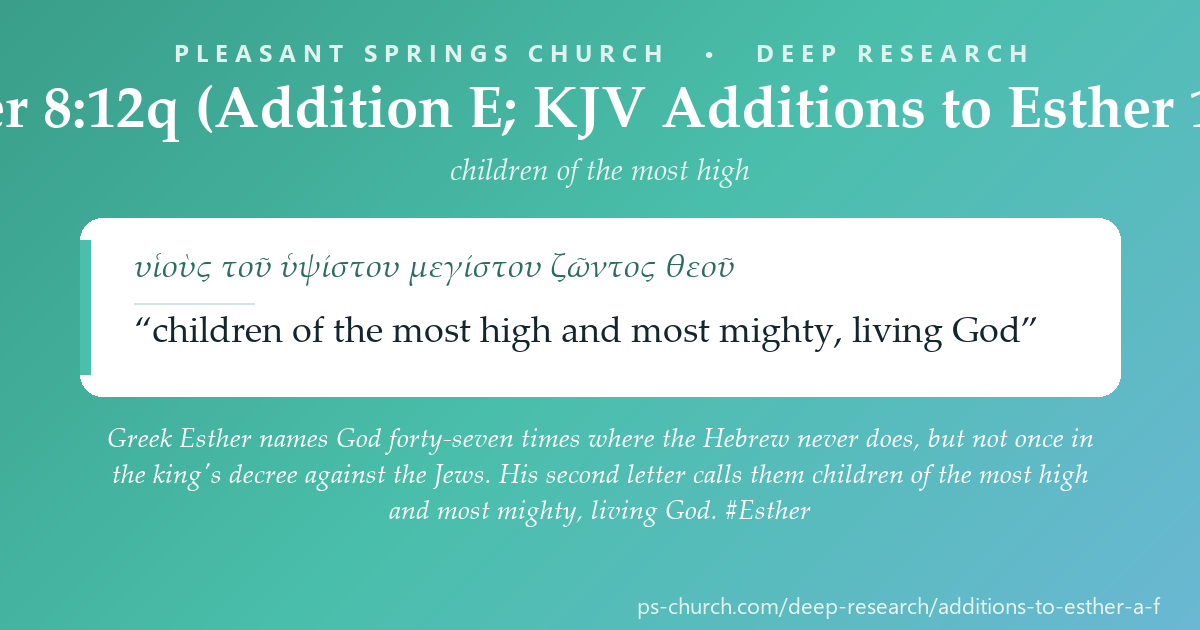
The same king, of the same people, now naming their God. Addition E names God four times, every one of them with the word for God, never once with Lord. The four bold words stand nowhere else in the screened Greek Old Testament.
VULGATE 16:16 et filios altissimi et maximi semperque viventis Dei, cujus beneficio et patribus nostris et nobis regnum est traditum, et usque hodie custoditur.
The first words of the King James book. The English and the Latin both open the Additions here, at 10:4, after the Hebrew’s last verse — so their reader meets the dream decoded before the dream itself. Addition F names God nine times in eleven rows.
VULGATE 10:4 Dixitque Mardochæus : A Deo facta sunt ista.
The colophon. A date (the fourth year of a Ptolemy and a Cleopatra), two men who brought the letter, and a translator, Lysimachus son of Ptolemy, of those in Jerusalem. In the Greek it is the last row of the book; in the English and the Latin (11:1) it stands between the dream decoded and the dream itself.
VULGATE 11:1 Anno quarto regnantibus Ptolemæo et Cleopatra, attulerunt Dosithæus, qui se sacerdotem et Levitici generis ferebat, et Ptolemæus filius ejus, hanc epistolam phurim, quam dixerunt interpretatum esse Lysimachum Ptolemæi filium in Jerusalem.
On the columns. The Greek is the CATSS morphological Septuagint (Rahlfs’s text), quoted at verse level with attribution. There is no Hebrew of these verses — the Additions have no Masoretic counterpart — so the Hebrew column is empty here and Hebrew appears on this page only where a canonical verse is set beside the Greek. The English is the KJV Apocrypha (1769 standard text, public domain), read verse by verse from the eBible.org file held on this disk and printed verbatim, spelling included; it is the only English this page prints for these verses. Its verse numbers are not the Greek’s: it prints the six blocks as a separate book, 10:4–16:24, in a different order, and every row above gives its own KJV and Vulgate verse. The Latin is the Clementine Vulgate, printed as a fourth witness and never as a source for the English.
Versification — a third state, stated in full. The six Additions have no Masoretic text and no ESV, so the usual Hebrew/Greek/English offset does not exist for them. What exists instead, every figure measured from the files:
• Masoretic Esther: 167 verses in ten chapters (22 · 23 · 15 · 17 · 14 · 14 · 10 · 17 · 32 · 3). No Additions.
• Greek Esther (CATSS/Rahlfs): 252 rows in ten chapters (39 · 23 · 22 · 40 · 22 · 14 · 10 · 38 · 30 · 14) — 163 with plain numbers and 89 with a letter. The lettering never uses j; Addition E also skips v and w, and C skips v. So 1:1a–r is seventeen rows, not eighteen, and the 89th lettered row, 1:1s, is the Hebrew’s own 1:1 (and it came to pass after these words, in the days of Artaxerxes). The Additions are therefore 88 rows, 2,065 words: A 17 · B 7 · C 24 · D 8 · E 21 · F 11. The other 164 rows carry the Hebrew’s verse numbers — 167 less 4:6, 9:5 and 9:30, which the Greek lacks.
• And a label is not a boundary. The plain rows 5:1 and 5:2 carry Addition D’s narrative woven round the Hebrew’s own beats (the third day, the royal dress, the golden sceptre; the English prints them inside its chapter 15), and the plain row 4:8 carries a sentence the Hebrew lacks, which the Latin prints as 15:2–3 (its 15:1 repeats the charge already at Vulgate 4:8) and the English does not print at all. Counting by letters is a convenience; this page says where it misleads.
• KJV Apocrypha, “Additions to Esther”: 105 verses, chapters 10:4–16:24 (10 · 12 · 6 · 18 · 19 · 16 · 24), in the order F, A, B, C, D, E. Aligned by content, its 105 verses carry 89 Greek rows; the English divides many Greek rows in two or three, and draws four boundaries a clause away from the Greek (1:1d, 1:1h, 4:17a, 4:17k). The Latin draws the last three in the same places as the English; at 1:1d it divides where the Greek does.
• Clementine Vulgate: Esther 1:1–10:3 is 167 verses, the Masoretic shape exactly; 10:4–16:24 is 108 more. The numbering is the KJV’s verse for verse except chapter 15, which has 19 verses where the KJV has 16: Vulgate 15:1–3 is the Latin of the end of Greek 4:8 (15:1 repeats the charge to go in to the king, which the Hebrew 4:8 and Vulgate 4:8 also have; 15:2–3 is the Greek-only matter), so Vulgate 15:n+3 = KJV 15:n.
| Addition | Greek (CATSS/Rahlfs) | rows | KJV Apocrypha | verses | Clementine Vulgate |
|---|---|---|---|---|---|
| F dream decoded, colophon | 10:3a–l | 11 | 10:4–11:1 | 11 | 10:4–11:1 |
| A the dream; the eunuchs’ plot | 1:1a–r | 17 | 11:2–12:6 | 17 | 11:2–12:6 |
| B the decree | 3:13a–g | 7 | 13:1–7 | 7 | 13:1–7 |
| C the two prayers | 4:17a–z | 24 | 13:8–14:19 | 30 | 13:8–14:19 |
| D the audience | 5:1a–f, 5:2a–b (and the rows 5:1, 5:2) | 8 (+2) | 15:1–16 | 16 | 15:4–19 |
| E the counter-decree | 8:12a–x | 21 | 16:1–24 (8:12a has none) | 24 | 16:1–24 |
| — the Greek tail of 4:8 | 4:8 (a plain row) | — | none | 0 | 15:1–3 |
The Shape of the Passage
Two nested frames (measured) around a prayer and its answer — not a chiasmThis is NOT offered as a chiasm. C and D are not a mirrored pair: they are one continuous scene, the prayer and then the audience it prays for, and D begins with the words that end the praying. The canonical stretches between the Additions are of very unequal length. What can be counted is two frames, one inside the other, around a sequence — and the King James order, which prints F first, does not show even that.
⚠️ Where this page sits. The Additions are canonical in the Roman Catholic and Orthodox churches, printed among the Apocrypha in the Reformation-era Protestant Bibles, and absent from the Hebrew Bible. This library reads them as a Second-Temple witness and files them under Apocrypha / Deuterocanon. Nothing taught at Pleasant Springs rests on them. The canonical book is read in Esther 1–5 and Esther 6–10.
Author
Anonymous — and the measurements show more than one register. Four of the six blocks (A, C, D, F) share much of their phrasing with the rest of the Greek Old Testament; the two royal letters (B, E) share far less of theirs, and more of their words have forms found nowhere else in it (Stage 4). That is a measurement of register. Whether it is also a measurement of authorship, or of an original language, this page cannot say.
One name is given, by the book itself. The colophon (10:3l) says a letter about Phrourai — Purim — was brought by Dositheus, who said he was a priest and a Levite, and his son Ptolemy, in the fourth year of a Ptolemy and a Cleopatra, and that Lysimachus son of Ptolemy, of those in Jerusalem, had translated it. Several Ptolemies reigned with a Cleopatra, and which one is meant is disputed. The colophon dates a translation; it does not say which of the six blocks it covered.
Audience
Greek-speaking Jews. The colophon is commonly read as recording the book’s arrival in Ptolemaic Egypt; the text itself says only that it was brought.
Prayer, counted. The Hebrew book has a fast and, in the Masoretic Esther held here, no form of the root pll (to pray). The Greek has a prayer for each of the two characters, twenty-four rows between them, and names God in sixteen of the twenty-four.
And two royal letters. The two decrees are written in a register the Stage 4 screen separates from the prayers — and the counter-decree’s few four-word runs with the rest of the Greek Old Testament held here go mostly to 1 Esdras and the books of Maccabees, one of them four function words (Stage 4).
Orient on the six Additions, on the two Greek forms of Esther, and on why the numbering is three different things.
Search by topic: Esther, Additions to; Esther, Greek versions of; Alpha text; Lysimachus; Purim; Mordecai; Haman; Artaxerxes; Apocrypha; Deuterocanon.
Which articles are relevant?
- Anchor Bible Dictionary — “Esther, Additions to”; “Esther, Book of”; “Purim”; “Apocrypha, Old Testament.”
- Eerdmans Dictionary of Early Judaism — entries on Esther and its Greek Additions, on prayer and on royal letters. Entry titles not checked against the volume.
- Dictionary of New Testament Background (IVP) — entries on the Apocrypha and Second-Temple Jewish literature. Entry titles not checked against the volume.
- On the text — any article that distinguishes the majority Greek text (Rahlfs’s, the one measured here) from the Alpha text. An article that speaks of ‘the Greek Esther’ as one thing is describing one of two.
Bibliography surfaced:
- Carey A. Moore, Daniel, Esther and Jeremiah: The Additions (Anchor Bible) — a commentary on the Additions.
- Carey A. Moore, “On the Origins of the LXX Additions to the Book of Esther” (Journal of Biblical Literature, 1973) — an article arguing that B and E were composed in Greek and the others may not have been. Named, not read for this page.
- Elias Bickerman, “The Colophon of the Greek Book of Esther” (Journal of Biblical Literature, 1944) — on the date in 10:3l.
- Karen H. Jobes, The Alpha-Text of Esther — on the second Greek form.
- Robert Hanhart’s Göttingen edition of Greek Esther — which prints the Alpha text beside the majority text. Not held here.
A king’s letter answered by a prayer — a scene the Greek Old Testament also tells.
Each parallel below is printed with what the run engine measured between the two texts. A shared run shows where wording is shared; it does not show who read whom, and nothing on this page asserts direction of influence.
Which parallels shed light on the world of the text?
- Hezekiah and the Assyrian letter (2 Kings 19:14–19; Isaiah 37:14–20) → Mordecai’s prayer (C). A hostile king’s letter, then a prayer that opens on the creator: σὺ ἐποίησας τὸν οὐρανὸν καὶ τὴν γῆν. Seven words, and Esther 4:17c has the same seven; so does Jeremiah’s prayer at Greek Jeremiah 39:17. From the Kings side the deepest partner is Isaiah 37:16, at nine — the two Hezekiah prayers are one prayer told twice. Esther ties at seven with the three of them, and with nothing else in the screened Greek Old Testament.
- The Prayer of Azariah (Greek Daniel 3:26–45, in both Greek texts) → Esther’s confession (4:17n): καὶ παρέδωκας ἡμᾶς εἰς χεῖρας — five words Esther shares with Daniel 3:32 in the Old Greek and Theodotion, and with no other unit. Two prayers that exist only in the Greek forms of their books, confessing the same thing in the same five words.
- The royal letters of 3 Maccabees (3:12–29, 18 rows; 7:1–9, 9 rows) → B and E. A Ptolemy orders the Jews of Egypt destroyed and then releases them, in two letters given in full. Every letter row screened against every edict row: two runs of four, one of three, nothing else above two — the same figures the 3 Maccabees study on this shelf reports. One of the fours: καὶ τοῖς ἑαυτῶν εὐεργέταις, and their own benefactors, which stands in 3 Maccabees 3:19 and Esther 8:12c and in no other screened unit.
- 2 Maccabees 15:36 → B and E. The decree to keep the thirteenth of Adar as a feast names it the day before τῆς Μαρδοχαϊκῆς ἡμέρας, the day of Mordecai. It shares four words with both edicts, τοῦ δωδεκάτου μηνὸς Αδαρ — tie band 2 from the Maccabees side, the two edicts.
- Persian and Hellenistic royal correspondence → B and E. The decrees open in the letter form of the period — sender, addressees, then he writes these things or greeting. The word for the document itself, τὸ ἀντίγραφον, the copy, stands with its word group twenty-two times in the screened Greek Old Testament (one of them, 1 Maccabees 12:23, is the verb we write back): thirteen in 1 Maccabees, six in Esther, two in 1 Esdras, one in the heading of the Letter of Jeremiah. The word group is not used in the Greek New Testament at all.
Measured here, on the one Greek text held: Rahlfs’s Esther, 252 rows, with the six Additions as 88 lettered rows.
Reported, not measured: a second Greek form of Esther survives, shorter, with a different ending, called in the literature the Alpha text (or L text). It carries the Additions too, in wording of its own. No file of it is on this disk, so every figure on this page — the divine-name count, the run depths, the two registers — is a figure for Rahlfs’s text and may not hold for the other.
Also reported, not measured: Josephus’s retelling in Antiquities 11 is commonly said to draw on some Additions and not others. Held on this disk in Niese’s Greek; not measured for this page.
The name, the vocative, the word for a copy — and what each column calls Haman.
Counts are over Greek Esther (252 rows), the Masoretic Esther (167 verses), the 30,348 screened Greek Old Testament units and the 7,927 verses of the Greek New Testament. They are not counts over ‘the Septuagint’ — the Odes are excluded, and the Alpha text of Esther is not held.
Forty-seven times in Greek Esther, as a name for God. Twenty-four with the word for God, twenty-three with the word for Lord. By Addition: A 2 · B 0 · C 25 · D 3 · E 4 · F 9 — forty-three in 88 rows. In the 164 rows that carry the Hebrew’s verse numbers: four. Left out of the count, and said so: the two plurals for the nations’ gods (4:17n, 4:17r) and the two times Esther calls the king lord (5:2a). The Masoretic Esther: none.
Esther says it seven times in her prayer (4:17l, m, n, q, r, t, y), Mordecai five times in his. Then, fainting before the king, she says it twice to him — εἶδόν σε κύριε ὡς ἄγγελον θεοῦ, I saw you, lord, as an angel of God. The same vocative, the same speaker, two addressees. Measured and set side by side; the page draws no lesson from it the text does not draw.
How both decrees are introduced (3:13a, 8:12a), and how the second is ordered published (8:12s). Across the screened Greek Old Testament the word group stands twenty-two times — thirteen in 1 Maccabees, six in Esther (three in Additions, three in the rows that carry Hebrew verse numbers) — and not once in the Greek New Testament. A chancery word, and in this corpus it lives in Esther and 1 Maccabees (two more in 1 Esdras, one in the heading of the Letter of Jeremiah).
What the three columns call Haman. The Hebrew calls him הָאֲגָגִ֖י, the Agagite, five times. The Greek never does: it has Βουγαῖος three times (1:1r, 3:1, 9:10) and Macedonian two times (8:12k, 9:24). And the King James English at 12:6, the verse that answers to Greek 1:1r, reads Aman the son of Amadathus the Agagite — where the Greek reads Bougaean and the Latin Bugæus. Three columns, three readings, reported as they stand.
The name, counted in three witnesses:
| column | units | divine names |
|---|---|---|
| Masoretic Esther | 167 verses | 0 |
| Clementine Vulgate, Esther 1:1–10:3 | 167 verses | 0 |
| Greek Esther, rows with the Hebrew’s numbers | 164 rows | 4 |
| Greek Esther, the six Additions | 88 rows | 43 |
| Clementine Vulgate, 10:4–16:24 | 108 verses | 39 |
⚠️ How the Hebrew zero was counted, so a reader can repeat it. No word in the Masoretic Esther is YHWH, any form of Elohim or Eloah, Adonai or Shaddai. The consonants of the short word El do stand alone 47 + 2 times — every one of them pointed as the preposition to (47) or the negative do not (2), never as the noun God. A consonant-only search reports them; the pointing settles them. Not counted, because it is not a word: the first letters of four consecutive words at 5:4, יָב֨וֹא הַמֶּ֤לֶךְ וְהָמָן֙ הַיּ֔וֹם, spell YHWH, an acrostic the Esther 1–5 study reports as observable and of unproven intent. The Latin counts are of the capitalised forms of Deus and Dominus; the edition lowercases the two places Esther calls the king domine.
The four rows with the Hebrew’s numbers where the Greek names God and the Hebrew does not:
- 2:20. Greek: φοβεῖσθαι τὸν θεὸν καὶ ποιεῖν τὰ προστάγματα αὐτοῦ — to fear God and to do his commandments. Hebrew: וְאֶת־מַאֲמַ֤ר מׇרְדֳּכַי֙ אֶסְתֵּ֣ר עֹשָׂ֔ה — and Esther did what Mordecai said (our gloss).
- 4:8. Greek: ἐπικάλεσαι τὸν κύριον — call upon the Lord, inside a sentence the Hebrew does not have at all. The Hebrew verse ends וּלְבַקֵּ֥שׁ מִלְּפָנָ֖יו עַל־עַמָּֽהּ׃ — and to plead before him for her people (our gloss).
- 6:1. Greek: ὁ δὲ κύριος ἀπέστησεν τὸν ὕπνον ἀπὸ τοῦ βασιλέως — but the Lord took the sleep from the king. Hebrew: בַּלַּ֣יְלָה הַה֔וּא נָדְדָ֖ה שְׁנַ֣ת הַמֶּ֑לֶךְ — that night the king’s sleep fled (our gloss).
- 6:13. Greek: ὅτι θεὸς ζῶν μετ' αὐτοῦ — for a living God is with him, said by Haman’s wife and friends. Hebrew: כִּֽי־נָפ֥וֹל תִּפּ֖וֹל לְפָנָֽיו׃ — but you will surely fall before him (our gloss).
Every one of the four has a Hebrew verse beside it, and in none of the four does the Hebrew name God. The Latin of the same four verses, in chapters that have the Masoretic shape exactly, names him in none of the four either. So the difference between the Greek and Hebrew books is not confined to the Additions — the Esther 6–10 study prints 6:1 in full.
The prayers share their wording with the rest of the Greek Old Testament. The decrees barely do. And neither reaches the New Testament except through formulae.
Two screens. First, every Greek Esther row against the 30,096 screened Greek Old Testament units that are not Esther. Second, every row against all 7,927 verses of the Greek New Testament. Contiguous runs of whole word forms; the tie band — how many units reach the same depth — beside every run, from both sides. Two further measures in the table: the share of an Addition’s words that sit inside some three- or four-word sequence found elsewhere in the screened Greek Old Testament, and the share whose form occurs nowhere else in it (proper names left out). Forms, not lemmas: a rare inflection of a common word counts as rare.
Six Additions, one screen — and they sort into two groups:
| Addition | rows | words | divine names | rows reaching 4 | deepest run | words inside a shared 4-word sequence | words inside a shared 3-word sequence | words whose form is found nowhere else |
|---|---|---|---|---|---|---|---|---|
| A | 17 | 300 | 2 | 12 | 5 | 24.3% | 47.0% | 4.0% |
| B | 7 | 245 | 0 | 2 | 4 | 4.9% | 22.4% | 18.4% |
| C | 24 | 597 | 25 | 18 | 7 | 19.3% | 45.2% | 4.9% |
| D | 8 | 218 | 3 | 5 | 6 | 23.9% | 45.0% | 8.8% |
| E | 21 | 471 | 4 | 6 | 4 | 5.1% | 21.4% | 16.6% |
| F | 11 | 234 | 9 | 6 | 7 | 28.6% | 56.0% | 1.4% |
| rows with the Hebrew’s numbers | 164 | 3,778 | 4 | 93 | 7 | 16.0% | 43.2% | 5.0% |
Read down the last three columns. A, C, D and F sit with the rows that carry Hebrew verse numbers: 19.3–28.6% of their words lie inside a four-word sequence the rest of the Greek Old Testament also has, and 1.4–8.8% of their words have a form found nowhere else. B and E do not: 4.9% and 5.1% of their words in a shared four-word sequence, and 18.4% and 16.6% of their words with a form found nowhere else. Three measures, the same split every time.
What the split is and is not. It is a measurement of how much of each block’s wording the Greek Old Testament held here shares. It is not a measurement of who wrote the block, or in what language: a prayer composed in Greek in biblical idiom would score like C. Moore’s 1973 account — that B and E were composed in Greek, and that some of the others may first have been written in Hebrew or Aramaic — is reported in Stage 5, not confirmed here.
The prayers: where their deepest runs go
- 4:17c → 2 Kings 19:15, Isaiah 37:16, Jeremiah 39:17 (Greek) — seven words, tie band 3. σὺ ἐποίησας τὸν οὐρανὸν καὶ τὴν γῆν. From the Jeremiah side the band is 3 as well: the seven words stand in those four units and nowhere else screened. From the Kings and Isaiah sides the deepest partner is each other, at nine.
- 4:17n → Daniel 3:32, Old Greek and Theodotion — five words, tie band 2 (the Prayer of Azariah; from the Daniel side each text’s deepest partner is the other Daniel, at eleven).
- 1:1h → Judith 4:12 — five words, tie band 1 from both sides. καὶ ἐβόησαν πρὸς τὸν θεόν, and they cried to God — in Mordecai’s dream, and in Judith’s Jerusalem, afraid of Holofernes’s approach.
- 10:3f → Deuteronomy 7:19 and 29:2 (29:3 in English Bibles) — seven words, tie band 2. τὰ σημεῖα καὶ τὰ τέρατα τὰ μεγάλα, the signs and the great wonders. From the Deuteronomy side each verse’s deepest partner is the other, at eleven.
- ⚠️ The counter-example: 4:17f — five words, tie band 9. καὶ νῦν κύριε ὁ θεὸς, and now, Lord God, stands six times in Solomon’s prayers in Kings and Chronicles, once in Hezekiah’s (2 Kings 19:19), and in the penitential prayers of Baruch 2:11 and Daniel 9:15 (Theodotion) — nine partners. A run of five with a band of nine is a formula, and the page prints it so the bands above are read for what they are.
Of C’s eighteen rows that reach four, none find all their partners in 1 Esdras or the books of Maccabees, and only two find any partner there. Their partners include Deuteronomy, Judges, Samuel, Kings, Chronicles, the Psalms, Isaiah, Jeremiah and Daniel.
The decrees: twins in their opening, and the little company they keep
B and E open with the same thirteen words — βασιλεὺς μέγας Ἀρταξέρξης τοῖς ἀπὸ τῆς Ἰνδικῆς ἕως τῆς Αἰθιοπίας ἑκατὸν εἴκοσι ἑπτὰ — and then part: B’s heading ends τάδε γράφει, writes these things; E’s ends χαίρειν, greeting. Past the heading, the two letters share three runs longer than two words, the longest four, τοῦ δωδεκάτου μηνὸς Αδαρ, of the twelfth month, Adar.
Against the rest of the Greek Old Testament, neither decree has a row that reaches five. Of E’s six rows that reach four, five find every partner at that depth in 1 Esdras or the books of Maccabees: 8:12b with 1 Esdras 3:2 (ἑκατὸν εἴκοσι ἑπτὰ σατραπείαις, a hundred and twenty-seven satrapies), 8:12c with 3 Maccabees 3:19, 8:12q with 1 Esdras 8:50 (ἡμῖν τε καὶ τοῖς, to us and to the, four function words), 8:12s with 2 Maccabees 15:36, and 8:12x with 1 Maccabees 10:30, 11:36, 15:8 and 3 Maccabees 5:43 (εἰς τὸν ἅπαντα χρόνον, for all time). The sixth, 8:12h, finds Jeremiah 5:31 and Sirach 3:31.
The tie bands, from both sides. Esther side first, then the partner’s: 8:12b, 1 and 3 (1 Esdras 3:2 also reaches four with Esther 3:12 and 8:9); 8:12c, 1 and 1; 8:12q, 1 and 1; 8:12s, 1 and 2 (2 Maccabees 15:36 also reaches four with B’s 3:13f); 8:12x, 4, and from 3 Maccabees 5:43, 5 (Esther 9:28 among them), while each of the three 1 Maccabees verses has a deeper partner elsewhere; 8:12h, 2, and from Sirach 3:31, 2, from Jeremiah 5:31, 16. Two of these phrases, 8:12b’s and 8:12x’s, also stand in Esther’s own rows (8:9, 9:28), which this screen leaves out. The prayers’ company is the Law, the histories and the prophets; the counter-decree’s few fours go mostly to 1 Esdras and the Maccabean books, and one of them is four function words.
⚠️ And B’s two fours are not evidence of anything. 3:13e reaches four with Greek Jeremiah 42:9 (35:9 in the Hebrew numbering) on καὶ πρὸς τὸ μὴ — and so as not, four function words, tie band 1 from both sides. 3:13f reaches four with 3 Maccabees 3:25 and 2 Maccabees 15:36, tie band 2 (from 3 Maccabees 3:25, 1; from 2 Maccabees 15:36, 2). A depth is a number; only reading the words says what it is.
The New Testament: the distribution, both groups of rows, side by side
The six Additions, 88 rows, against the 7,927 verses of the Greek New Testament: all 88 reach two, 61 reach three, 13 reach four, 2 reach five, one reaches six, and nothing reaches seven.
The 164 rows that carry the Hebrew’s verse numbers, on the same screen: 161 reach two, 131 reach three, 33 reach four, 3 reach five, and nothing reaches six.
Addition E, 21 rows and 471 words, never reaches four. Its deepest New Testament contact is three words.
The deepest run, and the page’s two counter-examples:
4:17c → Acts 4:24, Acts 14:15, Revelation 14:7 — six words, tie band 3. τὸν οὐρανὸν καὶ τὴν γῆν καὶ against τὸν οὐρανὸν καὶ τὴν γῆν καὶ. Mordecai’s creator-clause and the church’s prayer after the first arrest. It looks like the find of the page. It is not. From the New Testament side, Acts 4:24 and Acts 14:15 each reach thirteen words with Exodus 20:11, tie band 1, and Revelation 14:7 reaches seven with Greek Psalm 113:23, tie band 1 (115:15 in the Hebrew numbering). Esther is not the nearest Greek Old Testament text to any of the three. The six words are a creator formula, and the formula’s fullest form is the Decalogue’s — see the Acts 14–16 study.
5:1e → Galatians 4:6 — five words, tie band 1 from BOTH sides. ὁ θεὸς τὸ πνεῦμα τοῦ against ὁ θεὸς τὸ πνεῦμα τοῦ. In the whole screened Greek Old Testament, Galatians 4:6’s best partner is this row and no other. And it is grammar: in Esther, God changed the spirit of the king; in Galatians, God sent the Spirit of his Son. A run of five with a band of one in each direction, between two sentences that share a subject, an article and a noun. The page prints it so that no band-1 run on this shelf is read as more than it is.
Short, and rarer than the deep ones:
- 10:3g → Hebrews 4:9 and 11:25 — four words. τῷ λαῷ τοῦ θεοῦ, to the people of God, in exactly this form: once in the screened Greek Old Testament, and that is Addition F; twice in the New Testament, both in Hebrews (τῷ λαῷ τοῦ θεοῦ). Tie band 2 from the Esther side, 1 from each Hebrews verse.
- 5:2a → Galatians 4:14 — three words. ὡς ἄγγελον θεοῦ, as an angel of God: once in the screened Greek Old Testament (Esther to the king), once in the New (ὡς ἄγγελον θεοῦ, Paul of himself). The run engine does not surface it, because this row’s deepest New Testament run is four common words. Depth and rarity are different measurements.
On this screen, nothing in the Greek New Testament reads as a citation of the Additions. No New Testament verse names Esther or an Addition as a source. One of the verses that reach four words with an Addition row, Hebrews 10:30 (with 10:3f, κύριος τὸν λαὸν αὐτοῦ), does sit inside a quotation formula, and again; but what the formula introduces is a line the Greek Old Testament also has at Deuteronomy 32:36 and Greek Psalm 134:14 (135:14 in the Hebrew numbering), five words, tie band 2 from the Hebrews side, and the four shared words stand in eight screened Greek Old Testament units, 10:3f among them. And the deepest contact dissolves into Exodus 20:11 from the other side.
For comparison only: the rows that carry Hebrew verse numbers reach five three times, and two of the three are band 1 from the New Testament side — 8:17, διὰ τὸν φόβον τῶν Ιουδαίων, for fear of the Jews, five words that stand in no other screened Greek Old Testament unit and in three verses of John (διὰ τὸν φόβον τῶν Ἰουδαίων, 7:13; also 19:38 and 20:19; band 3 from the Esther side); and 8:3, Esther falling at the king’s feet, five words with Mark 7:25 and Acts 5:10 (band 2 from the Esther side, band 1 from each of the two). The third, 8:6, reaches five with Acts 7:34 alone, and from the Acts side that verse’s nearest Greek is Exodus 3:7, at eleven. Measured, not interpreted: no formula names Esther as a source, and the phrases are ordinary narrative Greek.
It does not settle that the Additions were unread. A screen for verbatim contact cannot see a shared habit of prayer.
What this page could not check, what it corrected on the shelf, and where it is weakest.
This is the section that makes the shelf trustworthy. It is long because a great deal about the Additions is argued in the literature and not measurable from the files held here.
⚠️ A count the shelf had wrong — corrected here, not buried:
Two live Esther studies count the Additions as 89 Greek verses with no Hebrew counterpart, and the Esther 1–5 study gives Addition A as eighteen. Measured on the file: 1:1a–r is seventeen rows, because the lettering skips j; the 89th lettered row is 1:1s, which is the Hebrew’s 1:1, and both studies also count it among the 164 canonical rows. 89 + 164 would be 253 rows; the file has 252. The Greek-only rows are 88. The third Esther study already had A at seventeen. The two figures are reported to the shelf for correction; nothing on this page depends on the old one.
⚠️ What this page could NOT check:
- The Alpha text. The second Greek Esther, with its own Additions, is not on this disk. Every figure here is for Rahlfs’s text only.
- Whether any Addition was first written in Hebrew or Aramaic. Moore’s 1973 article argues that B and E were composed in Greek and that A, C, D and F may go back to a Semitic original. The register split measured in Stage 4 is consistent with the first half of that and cannot test the second: no Semitic text of any Addition is held, and a Greek author writing in biblical idiom would produce exactly C’s numbers.
- The colophon’s date. Which Ptolemy and which Cleopatra is argued (Bickerman’s 1944 article is one treatment). Not checkable from any file here.
- Josephus and the Old Latin. Both are on this disk (Niese’s Greek Josephus; Sabatier’s 1743 Old Latin, as raw OCR); neither was measured for this page. What Josephus includes of the Additions is reported in the literature and not verified here. This is the page’s most obvious next measurement.
- Qumran. No manuscript of Esther is reported among the Dead Sea Scrolls. Checked on the scrolls corpus held here, the ETCBC transcription of the Abegg–Bowley–Cook data: its biblical book tags include Ezra and Daniel, and no word is tagged Esther. Reported as an absence; no conclusion drawn.
- The English of the canonical verses. The shelf’s ESV cache holds no chapter of Esther, so the four canonical Hebrew clauses in Stage 3 carry our own gloss, marked.
⚠️ Where this page is weakest:
- The register measures are form-based and the samples are small. B is 245 words. A rare inflection of a common verb counts as a rare form, and long subordinate clauses produce more rare inflections. That is why three measures are printed, not one — and why the page reports the split, not its size, as the finding.
- The divine-name count rests on three classification decisions, all stated: the two plurals for the nations’ gods are left out, the two vocatives to the king are left out, and titles such as the Most High and Saviour are not counted as names. Change any of them and the forty-seven moves by a few; the Hebrew’s zero and B’s zero do not move.
- B’s zero is a count, not an argument. B is 245 words; D, at 218, names God three times, F at 234 names him nine times, and A at 300 names him two times. Whether the absence in the decree is designed is not something a count can show, and this page does not claim it.
- Labels are not boundaries. The rows 5:1, 5:2 and 4:8 carry Greek-only material under canonical numbers. The table in Stage 4 keeps them with the canonical rows, as the file labels them; a reader who moved them would shift the canonical figures slightly and the Addition figures not at all.
- The King James column is a 1769 standardisation, and in at least four places it reads differently from both the Greek and the Latin: at 12:6 it calls Haman the Agagite; at 14:12 it has O King of the nations where the Greek has βασιλεῦ τῶν θεῶν, King of the gods, and the Latin rex deorum; at 13:15 it has O Lord God and King where the Greek and the Latin carry God of Abraham (Deus Abraham); at 10:13 it ends among his people where both have Israel. Reported, not explained; the 1611 printing was not checked.
Commentaries & studies (none of them held on this disk; named for the reader, not consulted for the measurements):
- Carey A. Moore, Daniel, Esther and Jeremiah: The Additions (Anchor Bible).
- Jon D. Levenson, Esther (Old Testament Library) — comments on the Hebrew and the Greek Additions together.
- David J. A. Clines, The Esther Scroll — on how the Hebrew and Greek books relate.
- Karen H. Jobes, The Alpha-Text of Esther — on the Greek form not held here.
- Noah Hacham, “3 Maccabees and Esther: Parallels, Intertextuality, and Diaspora Identity” (Journal of Biblical Literature) — on the letters. Not read for this page; its measurements here are independent of it.
Two letters with the same heading, and a name that appears in only one of them.
Name what you learned, why it matters, and one concrete response.
What should we carry away — and do?
- Count before you characterise. “The Greek Esther has God in it” is true and blunt. Counted, it is forty-seven names: twenty-five in the prayers, none in the decree, and four in rows the Hebrew also has. The shape of the difference is more interesting than the fact of it.
- The Hebrew book’s silence is a count, not a verdict. Canonical Esther never names God; the Greek is a different book, and it does. Read the Hebrew as it stands, and read the Greek as what it is: a Second-Temple witness, not Scripture.
- Two registers in one appendix. The prayers share their wording with other prayers in the Greek Old Testament — Hezekiah’s, Jeremiah’s, Azariah’s — and with Deuteronomy. The decrees share far less of theirs. Learning to hear that difference is learning to read.
- One concrete response. In its second sentence Mordecai’s prayer says what Hezekiah’s says when a threatening letter has arrived: For thou hast made heaven and earth. The next time a letter like that arrives for you, begin there.
Greek Esther 8:12q · to share
Greek (Rahlfs) · KJV Apocrypha · VulgateVULGATE 16:16 et filios altissimi et maximi semperque viventis Dei, cujus beneficio et patribus nostris et nobis regnum est traditum, et usque hodie custoditur.
Every Deep Research page traces its passage across the whole sweep — the Old Testament, the Second-Temple world between the testaments (historical witnesses, not Scripture), and the New Testament. Follow the thread:
Pleasant Springs Church — Deep Research
Research method after Michael S. Heiser’s Bible Research Method (examine dictionaries → ancient literature → important words → textual connections → academic publications → share), with the Pleasant Springs “Author & Audience” foundation. Scripture set in the Hebrew, the Greek editions named on each page and the ESV (Old Testament), and the Greek New Testament and the ESV (New Testament), per the practice of Pleasant Springs Church. ⚠️ Status: the Additions to Esther are not part of the Protestant canon. They are canonical in the Roman Catholic and Orthodox churches, were printed among the Apocrypha in the Reformation-era Protestant Bibles, and are absent from the Hebrew Bible. This study is filed under Apocrypha / Deuterocanon and nothing taught at Pleasant Springs rests on it. Greek text: the CATSS morphologically analysed Septuagint (Rahlfs), Esther.mlxx, quoted at verse level with attribution; every row, word, divine name, run depth and tie band re-derived from the files for this study. Hebrew: the Masoretic text (Sefaria, Miqra according to the Masorah), for canonical comparison clauses only, with our own glosses. English: the KJV Apocrypha (1769 standard text, public domain), the verse-per-line edition from eBible.org held on this disk, printed verbatim and aligned to the Greek by content, with every pairing stated. Latin: the Clementine Vulgate (public domain), a fourth witness. ⚠️ NOT HELD: the Alpha text of Esther, any Semitic text of any Addition. HELD BUT NOT MEASURED: Josephus (Niese’s Greek), the Old Latin (Sabatier, raw OCR), Brenton’s English. Direction of influence is nowhere asserted. Scholarship named, none of it held on this disk or consulted for the measurements: Moore, Levenson, Clines, Jobes, Hacham.
Scripture quotations marked ESV are from the ESV® Bible (The Holy Bible, English Standard Version®), © 2001 by Crossway, a publishing ministry of Good News Publishers. ESV Text Edition: 2016. Used by permission. All rights reserved. The ESV text may not be quoted in any publication made available to the public by a Creative Commons license, and the ESV may not be translated in whole or in part into any other language. www.esv.org
|
Did this study bless you today? 💚 Give to Support PS Church100% of gifts go to the General Fund — thank you. |