Ask how many genders there are and you will be handed a number — two, fifty-six, seventy-one, or “no fixed number.” This study does what the Deep Research library does with every text: it counts, says where each count comes from, and prints the counts that cut against its own conclusions. In humans, and in every species that makes sperm and eggs, biology counts two kinds of reproductive cell and has never described a third. Scripture names humanity male and female at creation, and Jesus quotes the line. Then, eight verses later in the same conversation, Jesus speaks without contempt of men “who have been so from birth” — men whose bodies the ancient world, like ours, argued over. See the method →
Every figure below was checked against the publication it is credited to, except where Stage 5 says otherwise. Where the version of a number usually repeated is wrong, the corrected form is printed and the correction is said out loud. Copyrighted papers are paraphrased or quoted only a few words at a time.
What biology and medicine measure
| Question | The number | Source · and what the number does not show |
|---|---|---|
| Kinds of reproductive cell (gamete) a human body makes | 2 — sperm and egg. No third or in-between gamete has ever been described. | Lehtonen & Parker, Molecular Human Reproduction 20 (2014) 1161–68; Janicke et al. (Parker and Lehtonen among them), Ecology Letters 29 (2026) e70426. Biology defines male and female by which of the two kinds a body produces. The 2026 authors add, and this page prints it, that defining biological sex “places no constraints on the diverse spectrum of human gender identities” — they keep the two domains apart. |
| People documented as having both fathered and borne a child | 0. No human self-fertilisation has ever been reported. | Bayraktar, J Matern Fetal Neonatal Med 31 (2018); Krob, Braun & Kuhnle, Eur J Pediatr 153 (1994). Ovotesticular DSD (once called “true hermaphroditism”) is very rare — several hundred reported cases (367 by 1976; 283 more in 1980–92). Of those 283, sperm production was reported twice. Some have carried pregnancies; rarely one has fathered a child. Every gamete such a person makes is a sperm or an egg. |
| “Intersex”, broad definition | 1.728% — the famous “1.7%” | The condition table in Blackless et al. (Fausto-Sterling among them), Am J Hum Biol 12 (2000) 151–66 (the abstract itself says “as high as 2%”). It counts any departure from an ideal male or female type. 1.5 of the 1.728 points — about 87% — is late-onset congenital adrenal hyperplasia, a hormonal condition with ordinary genitals at birth, whose rate (about 1 in 66) is some fifteen times the usual general figure. The National Library of Medicine gives about 1 in 1,000, and notes that the rate varies between ethnic populations. |
| “Intersex”, narrow definition | 0.018% — “fewer than 2 out of every 10,000 live births” | Sax, Journal of Sex Research 39 (2002) 174–78. Counts only conditions in which the chromosomes and the body disagree, or the body cannot be classed male or female. Sax gathered no new data: he removed five conditions from Blackless’s own table, so his total inherits her estimates. “1 in 5,500” is a figure derived from his, not his wording. |
| A baby whose genitals are atypical at birth | about 1 in 4,500 (estimate) · about 2 in 10,000 (measured) | Hughes et al., Arch Dis Child 91 (2006) — the international consensus statement, where the figure carries no reference; Thyen et al., Horm Res 66 (2006) — a German registry, 80 cases in two years. The same 2006 consensus replaced “intersex” and “hermaphrodite” with “disorders (now often ‘differences’) of sex development”, DSD. |
| Sex-chromosome variations | Klinefelter (XXY): about 1 in 650 male newborns · Turner (X): about 1 in 2,000 female newborns | MedlinePlus Genetics, U.S. National Library of Medicine (pages updated 2023). These are variations within the two sexes, not additional ones: a man with Klinefelter syndrome is a man, a woman with Turner syndrome a woman. Most men with Klinefelter syndrome — about three in four — go undiagnosed (Denmark; Bojesen et al. 2003). |
| Genes that are expressed differently in men and women | 6,500+ in at least one tissue — but 6,123 differ in breast tissue, and only 1,145 differ in any other tissue (some genes are in both counts) | Gershoni & Pietrokovski, BMC Biology 15 (2017) 7, from 544 adult donors. The popular “6,500 genes” is true only with that caveat. Outside the breast the tissues that differ most include skeletal muscle, skin, fat, the heart’s left ventricle and part of the brain’s cortex. |
| The gene that starts the development of testes | SRY, on the Y chromosome, identified 1990 | Sinclair et al., Nature 346 (1990) 240–44; Berta et al. 1990; Koopman et al. 1991. Shown to be necessary in humans and sufficient in mice — not, strictly, proven sufficient in humans. |
What the word, and the culture, count
| Question | The number | Source · and what the number does not show |
|---|---|---|
| When “gender” first appeared in a scientific title in a sense other than grammar | 1955 — John Money’s “gender role” | Money, Bulletin of the Johns Hopkins Hospital 96 (1955) 253–64, as traced by Haig, Archives of Sexual Behavior 33 (2004) across thirty million academic titles. “Gender identity” followed in 1963–64 (Stoller and Greenson). Before that, English used “gender” mainly for grammar and only occasionally for sex — a use the Oxford English Dictionary of 1899 called jocular. The Latin genus meant “kind” — and also a person’s sex. |
| How many gender options Facebook offered | “more than 50” (US, 2014; journalists counted 56) · 71 (UK, 2014) · no fixed number since 2015 | Slate, 13 Feb 2014; The Telegraph, June 2014. Facebook never published a list. In February 2015 it added a free-text box beside the preset terms, up to ten per person — so the honest answer to “how many does Facebook offer?” is that there is no fixed number. |
| U.S. adults who say they are transgender or nonbinary | 1.6% of adults · 5.1% of adults under 30 | Pew Research Center, 10,188 adults, May 2022. Gallup’s 2024 figure for transgender alone is 1.3%; its report on 2025 (February 2026) gives only a range, 1–2%. These are self-identification surveys whose questions are worded differently; they do not measure any diagnosis, and they cannot be set side by side as if they were one series. |
| What the psychiatric manual calls the distress | “Gender identity disorder” became “gender dysphoria” in 2013 | American Psychiatric Association, DSM-5. The APA’s stated reason: not conforming to expectations is not itself a disorder; the diagnosis turns on clinically significant distress. This page prints no prevalence figure from the 2022 revision (DSM-5-TR) — it could not be verified. |
What Scripture counts
| Question | The number | Scope · and what the number does not show |
|---|---|---|
| Verses of the Hebrew Bible where זָכָר and נְקֵבָה, “male” and “female,” stand together | 15 | Humanity at creation (Gen 1:27; 5:2); the animals of the flood (Gen 6:19; 7:3, 9, 16); offerings (Lev 3:1, 6); persons in the law (Lev 12:7; 15:33; 27:5–7; Num 5:3); the forbidden image (Deut 4:16). Exhaustive over 23,204 verse units of the Masoretic text. The consonants זכר also spell remember, so every hit was read in context. |
| Of those, the verses about humanity being created | 2 — Genesis 1:27 and 5:2 | The pair is not only a creation word — the law applies it to people (Lev 12:7; 27:5–7; Num 5:3) — but only these two use it of humanity being made. |
| The Greek phrase ἄρσεν καὶ θῆλυ in the Greek Old Testament | 10 times in 8 verses, all in Genesis 1–7 | Gen 1:27; 5:2; 6:19, 20; 7:2 (twice), 3 (twice), 9, 16. Twice the Greek has the pair where the Hebrew does not: at 6:20, and at 7:2, where the Hebrew has אִישׁ וְאִשְׁתּוֹ, literally ‘a man and his wife’ (ESV: “the male and his mate”). Scope: 30,348 verse units in 63 of the 64 CATSS files held — the Odes left out so no canticle is counted twice; one edition, not the whole Septuagint. |
| The five-word clause ἄρσεν καὶ θῆλυ ἐποίησεν αὐτούς, “male and female he made them” | 2 verses in the Greek OT · 2 in the New Testament | Genesis 1:27 and 5:2; Matthew 19:4 and Mark 10:6. Each Gospel verse shares exactly those five words with the Greek OT: run 5, tie band 2 — and the two are both Genesis verses. The measurement cannot say whether Jesus’ words stand closer to 1:27 or to 5:2: the clause ends one and begins the other. |
| Galatians 3:28’s verbatim contact with Genesis | run 3, tie band 8 | Only ἄρσεν καὶ θῆλυ, shared with eight Genesis verses, six of them in the flood story. Three words in a band of eight is a stock phrase, not a citation. What readers hear as an echo of 1:27 rests on Paul’s change of conjunction (Stage 4), not on a long run. |
| ἄρσην and θῆλυς in the whole Greek New Testament | 9 and 5 occurrences | Together only at Matt 19:4, Mark 10:6, Rom 1:27 and Gal 3:28; as the phrase “male and female” only at Matt 19:4, Mark 10:6 and Gal 3:28. Exhaustive over 7,927 verses of the SBLGNT. (ἀρσενοκοίτης, 1 Cor 6:9 and 1 Tim 1:10, is a different word and is not counted.) |
| The Hebrew סָרִיס, “eunuch” or “court official” | 45 verses | Most plainly name an office, and Potiphar is a סָרִיס with a wife (Gen 39:1, 7). No verse defines the word by a physical act; Isaiah 56:3–5 (“a dry tree,” “better than sons and daughters”) points to the loss of descendants. Deuteronomy 23:1 (MT/LXX 23:2) does not use the word. |
| The Greek εὐνοῦχος | 38 verses of the Greek OT · 10 times in the NT, with its verb | Old Testament: among them Isaiah 56:3–4. Seven of the 38 stand outside the Hebrew canon — Esther’s Greek Addition A (three verses), Judith 12:11, Sirach 20:4 and 30:20, and Wisdom 3:14 (Apocrypha — witnesses, not Scripture). New Testament: εὐνοῦχος 8 times and εὐνουχίζω twice — five of the ten in Matthew 19:12, the other five about one man in Acts 8. The verb stands nowhere else in the New Testament. |
A zero or a total here is a statement about the files searched and nothing more: the Masoretic text, one edition of the Greek Old Testament, and the SBLGNT. No Dead Sea Scroll, no Greek apparatus and no rabbinic text is held as a corpus, so how Genesis 1:27 was read at Qumran is not measured here.
Biology counts two. Not two because the people who do not fit are ignored, but two because every gamete any human body makes — in the rarest conditions too — is one of two kinds, and no third kind has ever been found. Some bodies make no gametes at all, and for a very few, which of the two patterns the body follows is hard to tell; medicine treats those cases one person at a time. The conditions behind the 0.018% and the 1.7% are real, and the people who live with them are real; they are variations of a two-sexed pattern, not additional sexes.
The culture’s count is not a count of the same thing. “Gender” in its modern sense is a word of the 1950s and 60s for a person’s role (1955) and sense of self (1963–64), and lists of genders — 56, 71, unlimited — are lists of names for that. They are not claims about gametes, and reading them as if they were is where most of the confusion starts.
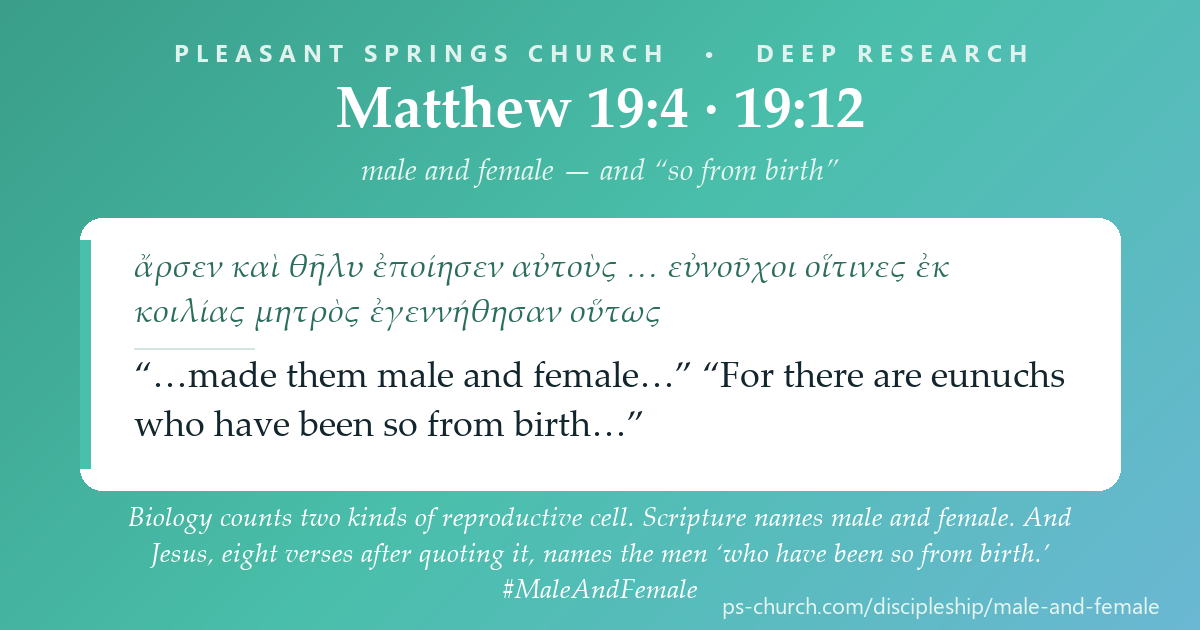
Scripture names two — and in the one conversation where Jesus quotes that line, he goes on, eight verses later, to speak of men “who have been so from birth.” The rest of this study reads those two verses together, as Matthew wrote them.
Male and female — and the eunuch: six texts across the canon
Hebrew · Greek · ESVThe Shape of Matthew 19:3–12
Two framed panelsA topical study has more than one author. Two matter most here: Genesis, which first says “male and female,” and Matthew, who reports Jesus quoting it — and what he said next.
Author
Genesis sets “male and female he created them” as the last line of the short poem at the summit of the creation week (1:27; see the Image of God study), and repeats it at the head of Adam’s genealogy (5:2), where God “blessed them and named them Man” — one name for both. The pair arrives with a blessing attached, before any law about it.
Matthew reports Jesus quoting that line to answer a test about divorce, and then, when his own disciples say it would be better not to marry, speaking about eunuchs — three kinds of them. Matthew is the only Gospel that records the eunuch saying; it stands nowhere else in the New Testament.
Audience
Jesus’ hearers knew the law that kept a castrated man out of “the assembly of the Lord” (Deut 23:1 · MT/LXX 23:2). They knew the eunuchs of foreign courts, and may have known of the Galli of the cities of Syria and Asia Minor — priests who castrated themselves for the mother goddess, whom Josephus, writing some sixty years later, told Jews to shun. And they knew, as every age has, that some boys are born whose bodies do not develop as a man’s: the case the rabbis would later call the “eunuch of the sun.”
How they heard it. Jesus names the man born so and the man made so by others plainly, without a word of contempt — and then adds a third kind that the later rabbinic list does not have: men who make themselves eunuchs “for the sake of the kingdom of heaven.” His subject is who can receive a life without marriage (19:10–12), and he makes it by naming, plainly and first, the man born so.
Orient on the words before the debate.
Search by topic: male and female; image of God; eunuch; sexuality; marriage. Then by word: זָכָר, נְקֵבָה, סָרִיס; ἄρσην, θῆλυς, εὐνοῦχος.
Where to look
- TDNT, s.v. εὐνοῦχος — the eunuch in the Greek and Jewish world and in the New Testament.
- NIDOTTE / TDOT — זָכָר (zāḵār), נְקֵבָה (nəqēḇâ), סָרִיס (sārîs).
- A dictionary of biblical theology on image of God and marriage, for the frame Genesis 1–2 sets around both.
A caution about the dictionaries themselves
Most Bible dictionaries in print were written before the 2006 medical consensus renamed “intersex” and “hermaphroditism” as disorders (or differences) of sex development. Read them for the ancient world, which they know well, and not for the modern medicine, which they often do not. The articles named above were not opened for this page — they are where to start, not what this page relied on.
Bibliography surfaced
- Hayim Tadmor, “Was the Biblical sārîs a Eunuch?” in Z. Zevit et al. (eds.), Solving Riddles and Untying Knots (Eisenbrauns, 1995), 317–25.
- Mary Frazer, “Heads and Beds: On the Origin of the Akkadian Term for Eunuch or Courtier,” Journal of Ancient Near Eastern History 9 (2022) 95–112.
- Harry A. Hoffner Jr., “Symbols for Masculinity and Femininity,” JBL 85 (1966); Harold T. Vedeler, “Reconstructing Meaning in Deuteronomy 22:5,” JBL 127 (2008) 459–76.
The ancients were not naive about bodies.
Read the Greek, Jewish and early Christian witnesses on the same three questions: how many kinds of human there are, what to do with a body that does not fit, and who the eunuch is. Every one of these is a witness to the world of the text, never a source of doctrine. Each was read in the edition named.
How many kinds of human? Three answers that are not Genesis’
- Plato, Symposium 189d–190d (c. 380 BC; not Scripture) — Aristophanes’ comic myth: humans were once τρία… γένη, three kinds (Lamb: “three kinds of human beings”), “not two as they are now” (Jowett) — each a double being, male-male, female-female and male-female, children of the sun, the earth and the moon, until Zeus cut them in half. Only one of the three was the “androgynous”; the myth explains desire, not the origin of the sexes.
- Philo of Alexandria, On the Creation 134 (early 1st century AD; not Scripture) — the man made “according to the image of God” (Genesis 1:27) was “an idea… incorporeal, neither male nor female”; the man moulded from dust in Genesis 2:7 is “man or woman, by nature mortal” (Yonge). Philo’s first man is sexless, not androgynous.
- Genesis Rabbah 8:1 (Palestine, c. AD 400–450; not Scripture) — Rabbi Jeremiah ben Eleazar: when God created the first man, אַנְדְּרוֹגִינוֹס בְּרָאוֹ, “he created him androgynous”; Rabbi Samuel bar Nahman: he made him with two faces and then sawed him in two. The proof text is Genesis 5:2, “male and female he created them,” read as describing one double creature. The Babylonian Talmud gives the two-faces saying to Rabbi Jeremiah instead (Berakhot 61a; Eruvin 18a).
What to do with a body that does not fit? The rabbis legislated — often
The early rabbinic law-books name two people the Bible never names. The tumtum is a person whose sex cannot be determined because the genitals are concealed; the androgynos has the features of both. Counted across the whole Mishnah, the androgynos appears 20 times in 14 paragraphs and the tumtum 16 times in 12, usually as a pair (both are named in 11 of the 15 paragraphs that name either) — in the laws of the festivals, of vows, of priests’ food, of inheritance, of purity. (Counted from Sefaria’s Hebrew base text, every hit checked by eye; other editions may differ by a few. Without the disputed chapter below: 18 in 12 and 15 in 11.)
One text gives the androgynos a whole chapter: in some ways like men, in some ways like women, in some ways like both, in some ways like neither. It closes with a rabbi — Rabbi Yose in the Tosefta, Rabbi Meir in the Mishnah texts that carry it — calling the androgynos בְּרִיָּה בִּפְנֵי עַצְמָהּ, “a creature unto itself,” which the sages could not decide was man or woman (the Tosefta’s wording is בריה לעצמו, printed in editorial brackets on Sefaria). Printed against the grain of this page: here is an ancient voice that came close to naming a third category. The text is a Tosefta passage (Bikkurim 2; numbered 2:2–6 on Sefaria, 2:3–7 in Lieberman) later copied into some editions of the Mishnah as “Bikkurim chapter 4”; most scholars hold it is not part of the original Mishnah (some editions print it as if it were), and the Jerusalem Talmud never comments on it.
Who is the eunuch? The closest parallel to Matthew 19:12
- Mishnah Yevamot 8:4 (c. AD 200; not Scripture) — Rabbi Akiva distinguishes the סְרִיס אָדָם, the “eunuch of man,” made so by human action, from the סְרִיס חַמָּה, the “eunuch of the sun,” born so. The Talmud, citing Rabbi Ammi, glosses the second as one “impaired from his mother’s womb” (b. Yevamot 79b–80a) — the same idiom Matthew 19:12 uses in Greek, ἐκ κοιλίας μητρός, a stock biblical phrase. Jesus’ first two kinds correspond closely to the rabbis’ two kinds. His third — “for the sake of the kingdom of heaven” — has no counterpart in the Mishnah.
- Babylonian Talmud, Yevamot 75b (compiled c. AD 500; not Scripture) — Shmuel, as cited by Rav Yehuda, on Deuteronomy 23:1 (MT 23:2): פְּצוּעַ דַּכָּא בִּידֵי שָׁמַיִם כָּשֵׁר, one “crushed” by the hand of Heaven — not by human injury — is fit to marry into Israel. Printed against the grain of this page: the rabbis read the law that barred the injured man as not barring the man made so by God.
- Josephus, Antiquities 4.290–291 (AD 93/94; not Scripture) — expanding Deuteronomy 23: “Let those that have made themselves eunuchs be had in detestation… In like manner do you treat all that is of a monstrous nature when it is looked on; nor is it lawful to geld men or any other animals” (Whiston). His Greek word is Γάλλους, the Galli — the self-castrated priests; his first target is self-castration. But the next clause widens the rule to πᾶν τὸ νομιζόμενον τέρας, everything “reckoned a portent” by those who see it — a word also used of a monstrous birth — and he does not say whom it covers. Printed against the grain of this page: it may have reached the man born so.
- On the Syrian Goddess 51 (2nd century AD, attributed to Lucian; not Scripture) — at the festival of Hierapolis a young man “castrates himself” and “receives women’s raiment” (Strong & Garstang). This is the world Josephus wanted Jews kept clear of.
- Wisdom of Solomon 3:13–14 (Apocrypha — a valued witness, not Scripture) — “…blessed is the barren… And blessed is the eunuch, which with his hands hath wrought no iniquity… for unto him shall be given… an inheritance in the temple of the Lord” (KJV Apocrypha). The Greek of 3:14 has no “blessed”; it carries over from 3:13. The promise runs on the same theme as Isaiah 56; measured, the two share single words such as εὐνοῦχος and no two in a row.
How the early church read “for the sake of the kingdom”
- Eusebius, Church History 6.8 — the young Origen “took the words… in too literal and extreme a sense” and castrated himself; his bishop first admired it and later called it “most foolish” (NPNF). Justin, First Apology 29 (c. AD 155) records — approvingly, as proof of Christian chastity — a young Christian who asked the governor to let a surgeon make him a eunuch; the governor refused, and the youth remained single.
- Council of Nicaea (AD 325), Canon 1 — a man who “in sound health has castrated himself” may not serve as clergy; a man made a eunuch by physicians, by barbarians or by his masters may. Apostolic Canon 21 (late 4th century) goes further: a eunuch “born so,” if otherwise worthy, “may be made a bishop.”
- Clement of Alexandria, Stromata 3.15 (c. AD 200; the ANF prints this book in Latin only, and it is rendered here from that Latin) — the eunuch is so called “not because his parts have been cut off by force, nor even because he is unmarried”; the blessed are those who have made themselves eunuchs “from every sin” for the kingdom. Clement read Jesus’ third kind as continence chosen for God’s sake, not the knife; by the fourth century the church’s canons had shut the door on self-castration.
Plato’s Aristophanes imagined three kinds of human; Philo a first man who was neither; one rabbi an androgynous Adam, another a two-faced Adam sawn in two; and one rabbinic text a creature unto itself. The ancients met bodies that did not follow the pattern, and they argued about them. Against that whole range, Genesis says two, Jesus repeats it — and then names the man born otherwise without contempt, beside a third kind the later rabbinic list does not have. One early church law kept a place open for him: the man born so, if otherwise worthy, could be a bishop.
Six words, counted.
Every count below is from the library’s own corpora — the Masoretic Hebrew, the Greek Old Testament (CATSS, with the Odes excluded so that no canticle is counted twice) and the SBLGNT — and carries its scope.
Male — 82 times in 80 verses of the Masoretic text as the noun (the same consonants spell remember, so every hit was read in context). Beside נְקֵבָה in 15 verses: humanity at creation, the animals of the flood, offerings, persons in the law, and the forbidden image of Deuteronomy 4:16.
Female — 22 times in 22 verses, 15 of them beside זָכָר. It also stands alone in the law (Lev 12:5; 27:4; Num 31:15). Genesis 2 tells the same creation with other words — אִישׁ and אִשָּׁה, man and woman (2:23–24).
The Greek pair, neuter, exactly as the Greek of Genesis 1:27 has it. In the Greek Old Testament the phrase stands 10 times, all in Genesis 1–7; in the New Testament only at Matthew 19:4, Mark 10:6 and Galatians 3:28. Paul alone changes the frame around it: neither…nor, neither…nor, then and.
45 verses. Most name an office — the Rab-saris of Assyria (2 Kgs 18:17), Ebed-melech the Ethiopian (Jer 38:7 · LXX 45:7), Ashpenaz in Babylon (Dan 1:3) — and Potiphar has a wife (Gen 39:1, 7). Yet the Greek calls Potiphar σπάδων and εὐνοῦχος (37:36; 39:1), and the rabbis read him as castrated (Genesis Rabbah 86:3; b. Sotah 13b): “official, not eunuch” is a modern inference, and a reasonable one. The word is usually traced to the Assyrian court title ša rēši, and whether that meant eunuch or courtier is still argued (Frazer 2022).
38 verses of the Greek Old Testament, among them Isaiah 56:3–4 and Wisdom 3:14. In the New Testament the word and its verb stand 10 times in 6 verses: five in Matthew 19:12 and five about one man in Acts 8. Traditionally explained from εὐνή, “bed,” and ἔχω, “keep” — the keeper of the bedchamber.
The verb that frames the eunuch saying (19:11, 19:12 twice). Its root sense is spatial — to have room for something — and the ESV’s “receive” carries it well: Jesus does not say the saying is for everyone; he says to make room for it if you can. Ten times in the SBLGNT; three of them are 19:11–12.
And the word that is not in the Bible
“Gender” comes through French from the Latin genus, “kind” — a cousin of Plato’s γένη. In English it named a kind, then a class of nouns (masculine, feminine, neuter), and from the fifteenth century, now and then, a person’s sex. Its modern sense — a social role, distinguished from bodily sex — dates from John Money’s “gender role” in 1955; “gender identity,” the inner sense of self, followed in 1963–64. The biblical writers therefore never use the category the modern question is asked in. Scripture speaks about bodies (male and female), about dress (Deuteronomy 22:5), and about eunuchs. A careful reader brings the modern question to those texts honestly, and does not pretend they used the modern word.
Two threads through the canon: the pattern, and the people the law shut out.
Trace “male and female” from Genesis to Paul, then trace the eunuch from the law that excluded him to the baptism that welcomed him. Measured contact is reported with its tie band; a theme carried without shared wording is called a theme.
The pattern — male and female
- Genesis 1:27 → 5:2 — the pair at creation and again at the head of the human family, both times with a blessing (1:28; 5:2).
- Matthew 19:4; Mark 10:6 — Jesus quotes the line. Both verses share the five Greek words ἄρσεν καὶ θῆλυ ἐποίησεν αὐτούς with the Greek Old Testament — run 5, tie band 2 — and the two are Genesis 1:27 and 5:2, so the measurement cannot say which of them Jesus’ words stand closer to. Matthew marks the line as Scripture read: “Have you not read…?” The Mark figure is the one printed on this library’s Mark 10–11 page.
- Galatians 3:28 — “there is no male and female.” Paul writes neither… nor twice and then changes conjunction: ἄρσεν καὶ θῆλυ, male and female — the pairing of Genesis 1:27 in the Greek, and the ESV keeps the “and.” Read in its letter: Paul is saying who inherits the promise — all who are Christ’s, “sons of God, through faith” (3:26, 29) — not that the sexes have been abolished. The same apostle writes to wives and husbands as such (Colossians 3:18–19; Ephesians 5:22–33). In Christ, being male or female does not decide anyone’s standing before God.
The people the law shut out — the eunuch
Deuteronomy 23:1 · MT/LXX 23:2 — “No one whose testicles are crushed or whose male organ is cut off shall enter the assembly of the Lord.” (θλαδίας καὶ ἀποκεκομμένος, “crushed and cut off.”) The law is about bodies that have been cut or crushed, and it does not use the word סָרִיס at all. It is the hardest verse on this page, and it is printed. (The rabbis later read it as barring the man injured, not the man made so “by the hand of Heaven” — b. Yevamot 75b, in Stage 2.)
Isaiah 56:3–5 — “…let not the eunuch say, ‘Behold, I am a dry tree.’… To the eunuchs who keep my Sabbaths… and hold fast my covenant, I will give in my house and within my walls a monument and a name better than sons and daughters.” Measured on this library’s Isaiah page: Isaiah 56:3–7 and Deuteronomy 23:1–9 (MT/LXX numbering; English 22:30–23:8) share no run deeper than two words in either language, and every two is a pair of function words. The reversal is a reversal of content; the wording is not reused.
Acts 8:26–39 — an Ethiopian court official, five times called εὐνοῦχος, is reading Isaiah 53 in his chariot (Acts 8:32–33 quotes Isaiah 53:7–8), three chapters before the promise to eunuchs. Philip tells him the good news about Jesus. “See, here is water! What prevents me from being baptized?” Nothing did. The eunuch “went on his way rejoicing” (8:36, 39).
Three more texts the question always reaches
- Deuteronomy 22:5 — the Torah’s one law about men’s and women’s dress: “A woman shall not wear a man’s garment, nor shall a man put on a woman’s cloak, for whoever does these things is an abomination to the Lord your God.” The Hebrew כְלִי־גֶבֶר (LXX σκεύη ἀνδρός) is literally “a man’s gear”, and the verse uses גֶבֶר and אִשָּׁה, not the creation pair (no versification offset); one early rabbi read it as weapons (b. Nazir 59a), and Maimonides gave two reasons, one against idolatrous ritual and one moral (Guide 3.37). Its exact scope is debated, and this page does not settle it; that the law assumes a real difference between a man and a woman is not debated.
- Psalm 139:13–14 · LXX 138:13–14 — “…you knitted me together in my mother’s womb. I praise you, for I am fearfully and wonderfully made.” Said of every body — including the ones in the tables above.
- Romans 8:22–23 — “…the whole creation has been groaning… And not only the creation, but we ourselves, who have the firstfruits of the Spirit, groan inwardly as we wait eagerly for adoption as sons, the redemption of our bodies.” Every believer’s body waits for redemption, and the creation with it — not some bodies more than others.
The pattern runs Genesis → Matthew 19:4 → Galatians 3:28. The people the law shut out run Deuteronomy 23 → Isaiah 56 → Matthew 19:12 → Acts 8. Matthew 19 is the only chapter where both threads are in Jesus’ own mouth, eight verses apart. A reading that keeps the first and drops the second, or keeps the second and drops the first, is not reading Matthew 19.
The sources — and where this page is weakest.
The science is cited to primary papers and to the U.S. National Library of Medicine; the ancient texts to the editions named in Stage 2. This stage also says what could not be checked.
The science, in the order the tables use it
- J. Lehtonen & G. A. Parker, “Gamete competition, gamete limitation, and the evolution of the two sexes,” Mol Hum Reprod 20 (2014) 1161–68; T. Janicke et al., “Biological Sex Is Binary and Rooted in Anisogamy,” Ecology Letters 29 (2026) e70426.
- M. Blackless et al., “How sexually dimorphic are we?” Am J Hum Biol 12 (2000) 151–66; L. Sax, “How common is intersex?” J Sex Res 39 (2002) 174–78; C. L. Hull’s critique of Blackless, Am J Hum Biol 15 (2003) 112–15.
- I. A. Hughes et al., “Consensus statement on management of intersex disorders,” Arch Dis Child 91 (2006) 554–63; U. Thyen et al., Horm Res 66 (2006) 195–203.
- G. Krob et al., Eur J Pediatr 153 (1994) 2–10; Z. Bayraktar, J Matern Fetal Neonatal Med 31 (2018) 542–47.
- M. Gershoni & S. Pietrokovski, BMC Biology 15 (2017) 7; A. H. Sinclair et al., Nature 346 (1990) 240–44.
- J. Money, Bull Johns Hopkins Hosp 96 (1955) 253–64; D. Haig, “The inexorable rise of gender and the decline of sex,” Arch Sex Behav 33 (2004) 87–96.
- Pew Research Center, 7 June 2022; Gallup, 20 February 2025 and 16 February 2026; MedlinePlus Genetics (Klinefelter, Turner, androgen insensitivity, congenital adrenal hyperplasia); S. Bojesen, A. Juul & C. H. Gravholt, J Clin Endocrinol Metab 88 (2003) 622–26.
- P. Berta et al., Nature 348 (1990) 448–50; P. Koopman et al., Nature 351 (1991) 117–21; “US proposal for defining gender has no basis in science,” Nature 563 (2018) 5; W. Oremus, Slate, 13 February 2014; American Psychiatric Association, DSM-5 “Gender Dysphoria” fact sheet (2013).
- H. Cass, Independent Review of Gender Identity Services for Children and Young People: Final Report (NHS England, 10 April 2024); J. Taylor et al., Arch Dis Child 109 Suppl 2 (2024) s33–47 and s48–56; C. Noone et al., BMC Med Res Methodol 25 (2025) 128; M. McNamara et al., Yale white paper (2024; not peer-reviewed).
Where the scholars disagree — said evenly
On the intersex figure. Fausto-Sterling’s group counted every departure from an ideal type; Sax counted only conditions in which chromosomal and bodily sex disagree, or the body cannot be classed as male or female. Each is consistent with its own definition, and the hundredfold gap between them is a gap of definition, not of data — both totals come from the same table. Hull (2003) argued the broad figure was also inflated by its sources; her corrected total is reported secondhand as about 0.37%, and this page could not read her letter to confirm it.
On “sex is a spectrum.” Some scientific editorials (e.g. Nature, 2018) define sex by a range of bodily characteristics and argue that no single trait settles it, given how variable chromosomes, hormones and anatomy are; the 2026 Ecology Letters authors answer that sex is defined by gametes precisely so that it holds “irrespective of variation” in those. Neither side proposes a third gamete.
On treatment of minors. This page gives no medical counsel. It records what one review measured: the independent review for England’s health service (the Cass Review, April 2024) called this “an area of remarkably weak evidence” — adding that results are “exaggerated or misrepresented by people on all sides of the debate.” Its systematic reviews rated 1 of 50 studies on puberty blockers as high quality and 25 as moderate, and 1 of 53 on hormones as high quality and 33 as moderate; the high- and moderate-quality studies were the ones synthesised. Critics have challenged the review’s methods (a Yale white paper, 2024; Noone et al., BMC Med Res Methodol, 2025), and the review’s defenders have answered them.
What this page could not check
- DSM-5-TR (2022) — whether the revision kept the old clinic-based prevalence figures. No number from it is printed.
- Blackless 2000, full text — behind a paywall; its condition table is known through Sax (2002), who reproduces it, and through Hull’s letter (2003) as quoted secondhand; the condition values sum exactly to 1.728.
- Craigie and Tigay on Deuteronomy 22:5; the contents (not the existence) of Tadmor’s two articles on the sārîs; a Hebrew lexicon on the Akkadian origin of סָרִיס. None is relied on.
- The manuscripts of Mishnah “Bikkurim 4” — which ones carry it was not checked.
- The dictionary articles in Stage 1 — named as places to start, not opened.
- The corpus counts — exhaustive over 23,204 verse units of the Masoretic text, 30,348 of the Greek Old Testament (63 of the 64 CATSS files held; the Odes left out; one edition, not the whole Septuagint) and 7,927 of the SBLGNT. Where the Greek Old Testament has rival recensions (Judges A and B, for instance) a merged count can double a place. ESV quotations were taken from Crossway’s ESV API on 4 October 2026.
From the count to the person in front of you.
Name what you learned, why it matters, and one concrete response.
What should we carry away — and do?
- Two is a blessing before it is a boundary. “Male and female he created them, and he blessed them and named them Man” (Gen 5:2). The first thing God does with the two is bless them; the first thing he calls them is one name.
- Hold both verses Jesus held. He quoted “male and female” as the pattern “from the beginning” — and, eight verses later, named without contempt the men born otherwise. A church that keeps only one of those verses is quoting half of Jesus.
- The eunuch got a better name. Shut out of the assembly by one text, promised by another “a name better than sons and daughters,” he was baptized on a desert road and “went on his way rejoicing.” In Christ no one is kept out of the people of God by what their body is from birth, or by what others did to it.
- Do not use the numbers as weapons. Every figure on this page is about a person who bears the image of God (Gen 1:27; James 3:9). The child with an atypical body, the man who learns at forty he has an extra X, the young person in real distress — each is owed truth and tenderness at once.
- Distress is real, and so is grace. Our own Statement of Beliefs says it: “We reject the lie that we must hide our wounds to be acceptable to God.” Whatever anyone carries about their body, the door of this church is the same door for everyone. If you are struggling with your body right now, you do not have to carry it alone: talk to a parent, a pastor (contact us) or your doctor — and if you are in crisis, call or text 988.
Step in response: read Matthew 19:3–12 aloud, all ten verses, without stopping at verse 6. Then pray for one person you know whose body, or whose sense of it, is a burden — by name, and without telling anyone you did.
Father, you made us male and female and blessed us before we had done anything at all. Thank you that Jesus spoke without contempt of those whom others turned away, and that the eunuch went home rejoicing. Give us your truth without hardness and your mercy without fear. Where any of us is at odds with our own body, meet us there, and not only once we have hidden it. Make us a people who honor every bearer of your image. In the name of Jesus, Amen.
Matthew 19:4 · 19:12 · to share
Greek NT + ESVEvery Deep Research page traces its passage across the whole sweep — the Old Testament, the Second-Temple world between the testaments (historical witnesses, not Scripture), and the New Testament. Follow the thread:
← Back to the Lesson Archive · Doctrine & Creeds
Pleasant Springs Church — Deep Research
Research method after Michael S. Heiser’s Bible Research Method (examine dictionaries → ancient literature → important words → textual connections → academic publications → share), with the Pleasant Springs “Author & Audience” foundation. Scripture set in the Hebrew, the Greek editions named on each page and the ESV (Old Testament), and the Greek New Testament and the ESV (New Testament), per the practice of Pleasant Springs Church. This topical study’s science figures were checked against their primary publications on 4 October 2026; ancient witnesses read in the editions named (Jowett, Yonge, Whiston, Strong & Garstang, NPNF/ANF; Sefaria: Midrash Rabbah 2022 (CC-BY), the William Davidson Talmud (CC-BY-NC), Joshua Kulp’s Mishnah Yomit (CC-BY)); corpus counts from the library’s own Masoretic, CATSS and SBLGNT files. All extra-biblical texts are read as witnesses, not Scripture. Nothing here is medical or legal counsel.
Scripture quotations marked ESV are from the ESV® Bible (The Holy Bible, English Standard Version®), © 2001 by Crossway, a publishing ministry of Good News Publishers. ESV Text Edition: 2016. Used by permission. All rights reserved. The ESV text may not be quoted in any publication made available to the public by a Creative Commons license, and the ESV may not be translated in whole or in part into any other language. www.esv.org
|
Did this study bless you today? 💚 Give to Support PS Church100% of gifts go to the General Fund — thank you. |