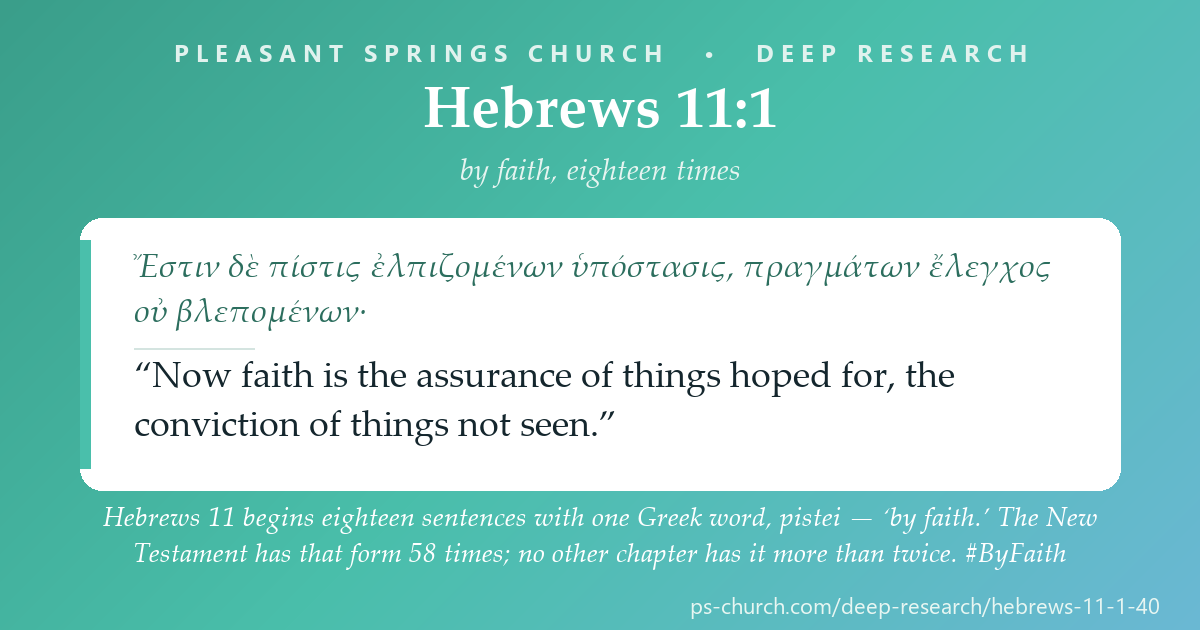
Eighteen sentences of Hebrews 11 begin with the same Greek word, πίστει, by faith — from the framing of the worlds to Rahab, every one of them the first word of its verse. The New Testament has that form 58 times; no other chapter has it more than twice. Then, at 11:32, the writer says he has run out of time, and the word never comes back. The chapter is built on a word, not on quotations. It introduces one verse of Scripture as a quotation; and measured against the whole Greek Old Testament, its deepest run — nine words, unique — is not Abraham’s promise but an Egyptian army in 1 Maccabees, because Hebrews tells the promise as kept. Three times it tells a story the way the Greek Old Testament tells it and the Hebrew does not: Enoch pleased God, Jacob bowed over his staff, Moses’ parents hid him. This study measures every verse, sets the roll beside four other rolls of the fathers in Greek, and says what it could not check. See the method →
Hebrews 11:1–40
Greek NT · ESVVersification — none in Hebrews, and none in the Old Testament verses beside it but four named below. Hebrews 11 has forty verses in the SBLGNT and in the ESV, numbered alike, and Hebrews is a New Testament book, so there is no Septuagint column in the codex. Genesis 4:4, 5:22–24, 6:9, 21:12, 22:17, 47:31, 48:2 and 49:33; Exodus 2:2, 4:2 and 32:13; Deuteronomy 1:10; Joshua 2:1, 6:25 and 24:4; Judges 7:12; 1 Samuel 13:5: no offset — each chapter checked for the same verse count in the Masoretic and CATSS files, verse by verse, before the claim was made (CATSS has no Greek for Exodus 32:9, Joshua 6:4 or 1 Samuel 13:1, none of them used here, and numbers the rest of those chapters alike; Greek Joshua 24 also carries three units the Hebrew lacks, 24:31a, 24:33a and 24:33b, after the verse used here). Genesis 32:13 in Hebrew and Greek is ESV 32:12; Septuagint Psalm 38:13 is Masoretic 39:13 and ESV 39:12. Joshua and Judges are cited from CATSS’s B text unless the A text is named (CATSS holds Joshua A only for 15:21–19:45); 1 and 2 Kings are CATSS 3 and 4 Kingdoms, renamed, not renumbered, in the verses used here, except 3 Kingdoms 5:9 (Masoretic 1 Kings 5:9, ESV 1 Kings 4:29; 2:35a and 2:46a are Greek additions with no Hebrew or ESV verse); 1 Samuel 21:14 in Hebrew and Greek is ESV 21:13. Daniel 3:36 is printed from both Greek columns, Old Greek and Theodotion, and named each time. Witnesses that are not Scripture on this shelf (Sirach, Wisdom, 1–4 Maccabees, 1 Esdras, the Greek additions to Esther and to Daniel) are cited by their CATSS numbers.
The Shape of the Passage
A framed anaphora in panels — a sequence with one pause; NOT a chiasmHebrews 10 ends with a warning and a line of Habakkuk; Hebrews 11 is what the writer does with the line. Hebrews 12 begins by turning the whole roll into a crowd watching a race.
Author
The writer of Hebrews is unnamed, and this page will not name him. What the chapter shows is a preacher who knows the Greek Scriptures well enough to retell them without quoting them. In forty verses he introduces one line as a quotation (11:18, Genesis 21:12). Everything else is told in his own words, and where his words and the Greek Old Testament’s coincide for more than five in a row it is as often an accident as a citation (Stage 4).
He says so himself. At 11:32 he stops: “And what more shall I say? For time would fail me to tell of Gideon, Barak, Samson, Jephthah, of David and Samuel and the prophets—” He has not run out of heroes; he has run out of time, and from there to 11:38 the roll becomes a list of deeds and sufferings without a single name. The form is a preacher’s. Eighteen sentences open the same way, πίστει, by faith, and a listener who has heard eight of them is waiting for the ninth.
Audience
People who had already suffered, and were tired. The verses just before this chapter remind them of former days when they endured, and then give the words of Habakkuk 2:4 — ὁ δὲ δίκαιός μου ἐκ πίστεως ζήσεται, my righteous one, out of faith, shall live — and end: ἀλλὰ πίστεως εἰς περιποίησιν ψυχῆς, but of faith, to the preserving of the soul (Hebrews 10:38–39; the renderings are the page’s). Chapter 11 is the proof of that last sentence: a line of people who kept faith without seeing the end of it.
People who knew the stories. The writer never explains who Barak was, why Jephthah is awkward, or what happened at Jericho; he expects his hearers to fill in each name. The chapter is a memory test as much as a lesson, and the hearer who knows Genesis in Greek will hear Enoch pleasing God and Jacob bowing over his staff, because that is how the Greek tells it (Stage 4).
And people who would be told the roll was about them. It begins with we (11:3) and ends with us (11:40), and the next sentence draws the line: since we have τοσοῦτον ἔχοντες περικείμενον ἡμῖν νέφος μαρτύρων, so great a cloud of witnesses lying around us, let us run (Hebrews 12:1; the rendering is the page’s).
Orient on faith, the patriarchs, the judges, the martyrs and the lists of the fathers.
Search by topic: faith, hope, assurance, witness, Enoch, translation, Abraham, Sarah, Jacob’s blessing, Moses’ parents, Passover, Rahab, Gideon, Barak, Samson, Jephthah, martyrdom, Maccabean martyrs, Isaiah (Ascension of), example lists, Praise of the Fathers. None of these reference works is held on this disk, and none was opened for any sentence on this page. They are listed as orientation, as on every page of the shelf.
Which articles are relevant?
- Anchor Bible Dictionary — “Faith,” “Hebrews, Epistle to the,” “Enoch,” “Rahab,” “Jephthah,” “Martyr, Martyrdom,” “Isaiah, Ascension of.”
- Dictionary of the Later New Testament & Its Developments — “Hebrews,” “Faith,” “Old Testament in Hebrews.”
- Dictionary of New Testament Background — “Example Lists,” “Maccabean Literature,” “Martyrdom and Noble Death,” “Sirach.”
- NIDNTTE / TDNT — the word families of πίστις, ὑπόστασις, ἔλεγχος, μαρτυρέω and τελειόω.
Bibliography surfaced:
- Harold W. Attridge (Hermeneia, 1989); William L. Lane (WBC 47B, 1991); Paul Ellingworth (NIGTC, 1993); F. F. Bruce (NICNT, rev. 1990); Craig R. Koester (Anchor Bible, 2001); Peter T. O’Brien (Pillar, 2010; withdrawn by the publisher, 2016); Gareth Lee Cockerill (NICNT, 2012) on Hebrews.
- Michael R. Cosby, The Rhetorical Composition and Function of Hebrews 11 (1988); Pamela M. Eisenbaum, The Jewish Heroes of Christian History: Hebrews 11 in Literary Context (1997).
- Thomas R. Lee, Studies in the Form of Sirach 44–50 (1986).
Four other rolls of the fathers, measured; 2 Maccabees 6–7 behind 11:35; two witnesses on 11:3; and an early Christian roll of the fathers beside it.
Heiser’s method asks what a first reader brought to a passage. A first-century reader of Hebrews 11 knew that lists of the fathers were a form: Ben Sira had written one, the dying Mattathias was remembered for one, Wisdom had one with no names in it. Each is on this disk in Greek, and each was measured against Hebrews 11, row by row. All of them are witnesses, not Scripture, and none is said here to be a source of Hebrews or to depend on it.
Hebrews 11 against the other rolls of the fathers, measured:
| roll (Greek) | units | names it shares with Hebrews 11’s 19 | words of the pist- family | its most frequent first word | deepest run with any verse of Hebrews 11 |
|---|---|---|---|---|---|
| Hebrews 11 | 40 | — | 26 | πίστει ×18 | — |
| Sirach 44:1–50:24 | 159 | 9 | 6 | καὶ ×36 (and) | 3 (5 rows, all stock phrases) |
| 1 Maccabees 2:51–60 | 10 | 3 | 2 | the hero’s name, in nine of ten | 2 |
| Wisdom 10:1–21 | 21 | 0 | 0 | αὕτη ×6 (she — Wisdom) | 2 |
| 4 Maccabees 16:20–23 | 4 | 2 | 1 | καὶ ×2 (and) | 2 |
| 4 Maccabees 18:11–19 | 9 | 6 | 0 | τὸν ×4 (the) | 2 |
The form is shared; the wording is not. No verse of Hebrews 11 shares more than three consecutive word forms with any of the five, and the five rows that reach three with Sirach are phrases like upon the earth and of the sons of Israel (the shelf’s Sirach 44–51 study measured the same five from the other side). What none of them has is Hebrews’ refrain. Sirach’s three πίστει (45:4 of Moses, 46:15 of Samuel, 49:10 of the Twelve) each follow ἐν and stand inside the sentence, where they may mean faithfulness; Mattathias’ list opens on the names; Wisdom 10 opens six of its units on αὕτη, she, and the one doing the saving in Wisdom 10 is Wisdom — its righteous men have no names at all.
Two things Hebrews has that the others lack, counted. It names two women, Sarah and Rahab; Sirach names none in 44:1–50:24 (the Sirach study counts the same), and the lists of 1 Maccabees 2 and 4 Maccabees name none either. And it names four judges — Gideon, Barak, Samson, Jephthah — where Sirach 46:11 says καὶ οἱ κριταί ἕκαστος τῷ αὐτοῦ ὀνόματι, and the judges, each by his name, and then names none of them. One thing the others have that Hebrews lacks: Aaron and Phinehas. Sirach gives them long sections (45:6–26); Mattathias names Phinehas (2:54); 4 Maccabees 18:12 names him too. Hebrews, whose argument turns on priesthood, names neither in its roll — and at Jericho it names Rahab and not Joshua, whom Sirach (46:1) and Mattathias (2:55) both name. These are absences, counted; the page does not explain them.
2 Maccabees 6–7 behind 11:35b–36 — vocabulary and a scene, not a phrase:
“Women received back their dead by resurrection. Some were tortured, refusing to accept release, so that they might rise again to a better life.” And 11:36: ἕτεροι δὲ ἐμπαιγμῶν καὶ μαστίγων πεῖραν ἔλαβον, ἔτι δὲ δεσμῶν καὶ φυλακῆς·
The scene. In 2 Maccabees 6 the old scribe Eleazar is offered a way out and goes ἐπὶ τὸ τύμπανον, to the instrument (the word is drum; 6:19, again 6:28), saying as he dies δυνάμενος ἀπολυθῆναι τοῦ θανάτου, though I could have been released from death (6:30). In chapter 7 seven brothers are scourged (μάστιξιν, 7:1), the second is led ἐπὶ τὸν ἐμπαιγμὸν, to the mocking (7:7), and two of them die speaking of being raised (7:9; 7:14, ἀνάστασις εἰς ζωὴν, resurrection to life). The renderings are the page’s.
Measured. Against 6:19, 7:9, 7:14 and 7:7 the deepest run of 11:35–36 is one word. Taking eight word families from 11:35b–36 (drum, release, better, resurrection, mocking, scourge, chains, prison), no unit of the Greek Old Testament carries more than two of them; chapter by chapter, 2 Maccabees 7 carries four (tied with Old Greek Daniel 4 when each family is matched at the start of the word; counting augmented forms such as enepaizon and anestē, 1 Maccabees 9 and Judges 16, A text, reach four too), and 2 Maccabees 6 and 7 together carry five. Words beginning tympan- stand in 21 Greek Old Testament units, and in nineteen of them they are drums or drummers; the two where the drum is an instrument of torture are Eleazar’s (the compound verb, apotympanizō, beaten to death, stands twice more, 3 Maccabees 3:27 and Old Greek Daniel 7:11). Hebrews’ word for the release, ἀπολύτρωσιν, is one 2 Maccabees does not use. So the contact is real and is not verbatim: a reader who knew 2 Maccabees would hear Eleazar and the seven, and the shelf’s 2 Maccabees 6–10 study reached the same result from the other side. 2 Maccabees is a witness, not Scripture; Hebrews names no one in these verses.
11:3 — two witnesses, two different sentences:
“By faith we understand that the universe was created by the word of God, so that what is seen was not made out of things that are visible.”
2 Maccabees 7:28, the mother to her youngest son: οὐκ ἐξ ὄντων ἐποίησεν αὐτὰ ὁ θεός, God made them not out of things that are. Wisdom 11:17, of God’s hand: κτίσασα τὸν κόσμον ἐξ ἀμόρφου ὕλης, having created the world out of formless matter. Hebrews says neither: μὴ ἐκ φαινομένων, not out of things that appear. Against each witness the run is one word. The page prints the three because a reader should see that the question was already being answered more than one way before Hebrews; it does not say which answer Hebrews meant (Stage 5).
An early Christian roll beside the chapter — 1 Clement, quoted from the file on this disk:
Let us take (for instance) Enoch, who, being found righteous in obedience, was translated, and death was never known to happen to him. Noah, being found faithful, preached regeneration to the world through his ministry; and the Lord saved by him the animals which, with one accord, entered into the ark.1 Clement 9 (ANF 1)
On account of her faith and hospitality, Rahab the harlot was saved.1 Clement 12 (ANF 1)
Let us be imitators also of those who in goat-skins and sheep-skins went about proclaiming the coming of Christ; I mean Elijah, Elisha, and Ezekiel among the prophets,1 Clement 17 (ANF 1)
Clement of Rome has his own roll — Enoch, Noah, Abraham, Lot, Rahab — and where Hebrews says Rahab was spared by faith and James says she was justified by works when she received the messengers, Clement says both: faith and hospitality. He names the men in sheepskins and goatskins (Hebrews 11:37 does not): Elijah, Elisha, Ezekiel. The Greek Old Testament held here agrees about the first two: μηλωτή, sheepskin, stands in five Greek Old Testament units and every one is Elijah’s cloak, at Horeb, thrown over Elisha, and parting the Jordan (1 Kings 19:13, 19:19; 2 Kings 2:8, 2:13, 2:14). The date of 1 Clement (commonly the 90s) is reported, not established here; nothing on this page depends on it.
Sawn in two — the one witness on this disk:
as they did those about the death of Isaiah, whom you sawed asunder with a wooden saw.Justin Martyr, Dialogue with Trypho 120 (ANF 1)
Hebrews 11:37 names no one. Justin, in the second century, says the prophet sawn asunder was Isaiah, and the Martyrdom (or Ascension) of Isaiah tells the same story; that text is not held on this disk. The Greek Old Testament held here saws people in four places: David and the Ammonites (1 Chronicles 20:3; and 2 Samuel 12:31, where he puts them to the saw), Damascus and the pregnant women of Gilead (Amos 1:3), and the angel’s sentence on the elder in Susanna 59 (both Greek columns; a witness, not Scripture). No prophet is sawn in the Greek Old Testament held here.
The word the chapter is built on, the words its frame is built from, and the rare words of its last verses.
Every headword below is the MorphGNT lemma read off the verse; every count is that lemma counted across all 7,927 verses of the SBLGNT, or a regular expression run over the 30,348 screened Greek Old Testament units. A count is a count of word forms in these two corpora, nothing more.
The anaphora, measured:
πίστει stands eighteen times in Hebrews 11, at 11:3, 11:4, 11:5, 11:7, 11:8, 11:9, 11:11, 11:17, 11:20, 11:21, 11:22, 11:23, 11:24, 11:27, 11:28, 11:29, 11:30, 11:31. In eighteen of the eighteen it is the first word of its verse, and in the SBLGNT’s punctuation the first word of its sentence (both the verse numbers and the punctuation are later than the text, but every edition the SBLGNT apparatus compares has the word at all eighteen; see below). It never stands anywhere else in the chapter. It is never absent for more than two verses running, except once, 11:12–16 — the stars and the sand, and the four verses of the pause — and after 11:31 it does not come back. Of the SBLGNT’s apparatus entries in these eighteen verses, the only one that touches the word itself is at 11:8, Πίστει WH NA28 RP ] + ὁ Treg: Tregelles adds an article after it.
Where else the form stands. In twenty of the 30,348 Greek Old Testament units — nine of them in Chronicles and Kings, of officials who served in trust, and three in Sirach’s roll (Stage 2). No Greek Old Testament chapter has it more than three times (1 Chronicles 9; 2 Chronicles 31).
24 times in Hebrews 11, the most of any chapter of the New Testament (Galatians 3 comes next, with 14); 242 in all. The dative form πίστει stands 58 times in the New Testament, 19 in Hebrews, 18 in this chapter; no other chapter has it more than twice (Romans 4, 1 Timothy 1, 1 Timothy 2, Jude). The figure agrees with the shelf’s Romans 4 study, which counted the noun there.
Five New Testament verses, three in Hebrews: 1:3 (τῆς ὑποστάσεως αὐτοῦ, of God’s own being), 3:14 (τὴν ἀρχὴν τῆς ὑποστάσεως, the confidence held from the beginning) and 11:1, where the ESV has the assurance of things hoped for. English versions give the noun different words in each place; the page does not decide between substance and assurance at 11:1.
Once in the New Testament. In the Greek Old Testament held here the nominative stands in eight units (Job three times, Proverbs, a psalm, Sirach twice, Wisdom), where it is reproof, a case made against someone.
Five times in Hebrews 11 (11:2; 11:4 twice; 11:5; 11:39). The verb frames the chapter, and its noun-cousin μάρτυς opens the next: the people God bore witness to become witnesses.
Three New Testament verses, all in Hebrews (11:5, 11:6, 13:16). In Greek Genesis the verb stands in seven units, and in six of them the Hebrew has the verb walk — with God or before him (5:22, 5:24, 6:9, 17:1, 24:40, 48:15). The seventh, 39:4, is Joseph serving Potiphar.
Once in the New Testament, and in no Greek Old Testament unit held here. Its cousin μισθαποδοσία, reward, stands three times, all in Hebrews (2:2, 10:35, 11:26).
Twelve times in the New Testament, four in Hebrews (the sceptre of 1:8, twice; Aaron’s rod, 9:4; and here). See Stage 4 for the bed.
Twice in the New Testament, Acts 7:20 and here, both of the infant Moses — the word of Greek Exodus 2:2. Where the Hebrew says the mother saw that he was good, the Greek says fine, and Stephen and Hebrews both have the Greek word.
Twelve times in the New Testament; twice of Rahab (Hebrews 11:31; James 2:25). The Hebrew of Joshua 2:1 has זוֹנָה, and the Greek Joshua renders it with the same noun as Hebrews and James.
Once in the New Testament; in this form in no Greek Old Testament unit. The stem stands in the Greek Old Testament mostly as the drum (Miriam’s timbrel, Exodus 15:20); the verb, uncompounded, once, of David drumming on the gate at Gath (1 Samuel 21:14; ESV 21:13).
Once in the New Testament. The SBLGNT, Tregelles and NA28 read it alone; its apparatus: ἐπρίσθησαν Treg NA28 ] ἐπειράσθησαν ἐπρίσθησαν WH; ἐπρίσθησαν ἐπειράσθησαν RP — so Westcott–Hort and Robinson–Pierpont add they were tested, in opposite orders. The ESV follows NA28.
23 New Testament verses, nine of them in Hebrews — the book uses it of the Son (2:10; 5:9; 7:28), of what the law could not do (7:19; 9:9; 10:1), of what one offering did (10:14), of the spirits of the righteous (12:23), and here. Stage 5 sets the readings of 11:40 against those uses.
Every row measured, the tie bands beside the runs, the accidents printed beside the citations, and the three places where Hebrews tells the Greek Old Testament’s version of the story.
Greek against Greek: the 40 MorphGNT rows of Hebrews 11 against the 30,348 screened CATSS units (the 64 files held, less the Odes, by house convention), with the shelf’s edition-equivalence table, and against the other 7,887 verses of the Greek New Testament. Contiguous runs of whole word forms, never lemmas; the tie band is the number of target units reaching the same depth. This finds verbatim contact. It does not find allusion. Across the 40 rows against the Greek Old Testament: all 40 reach two, 27 reach three, 10 reach four, 5 reach five and 4 reach six; one row (11:12) goes past six, to nine; nothing reaches ten. Against the rest of the New Testament: 36 reach two, 19 reach three, 5 reach four, 1 reaches five, and nothing reaches six. A zero here would mean no shared word at all (the Greek-side screens count single words); no row of Hebrews 11 is a zero against the Greek Old Testament.
The ten rows that reach four words:
| Hebrews | deepest Greek OT partner | run | band | the shared words | is the partner the episode retold? |
|---|---|---|---|---|---|
| 11:12 | 1 Maccabees 11:1 | 9 | 1 | ὡς ἡ ἄμμος ἡ παρὰ τὸ χεῖλος τῆς θαλάσσης | no — an Egyptian army; Genesis 22:17 shares 5 |
| 11:18 | Genesis 21:12 | 6 | 1 | ὅτι Ἐν Ἰσαὰκ κληθήσεταί σοι σπέρμα | yes — the chapter’s one introduced quotation |
| 11:20 | Joshua 24:4 (B) | 6 | 1 | Ἰσαὰκ τὸν Ἰακὼβ καὶ τὸν Ἠσαῦ | no — a recital of the fathers; Genesis 27 shares 1 |
| 11:21 | Genesis 47:31 | 6 | 1 | ἐπὶ τὸ ἄκρον τῆς ῥάβδου αὐτοῦ | yes — the Greek reading, not the Hebrew |
| 11:22 | Exodus 19:1; Numbers 33:38 | 5 | 2 | τῆς ἐξόδου τῶν υἱῶν Ἰσραὴλ | no — a dating formula |
| 11:4 | Genesis 4:4; Isaiah 59:2 | 4 | 2 | ἐπὶ τοῖς δώροις αὐτοῦ | yes (Genesis); the tie is an accident |
| 11:5 | Genesis 5:24 | 4 | 1 | μετέθηκεν αὐτὸν ὁ θεός | yes — the Greek wording |
| 11:9 | Deuteronomy 9:27; Exodus 32:13; 2 Maccabees 1:2 | 4 | 3 | Ἰσαὰκ καὶ Ἰακὼβ τῶν | no — a formula |
| 11:25 | Esther 10:3g (Greek addition) | 4 | 1 | τῷ λαῷ τοῦ θεοῦ | no |
| 11:28 | 1 Esdras 1:17 | 4 | 1 | τὸ πάσχα καὶ τὴν | no — Josiah’s Passover |
Four of the ten meet the verse Hebrews is retelling — Genesis 4:4, 5:24, 21:12 and 47:31. Six meet something else, and among them is the deepest row of the chapter and one of the three that tie at six. That is the same lesson the shelf learned from Zechariah: the measurement finds verbatim contact, and verbatim contact is not the same as a citation. The tie bands keep it honest: 11:12, 11:18, 11:20 and 11:21 all stand at band one, so depth and uniqueness alone cannot tell the citations from the accidents. Reading the partner can.
Against the rest of the New Testament the deepest rows are the expected neighbours: 11:18 and Romans 9:7, five words, band 1 (both have the words of Genesis 21:12); 11:31 and James 2:25, four, band 1 (Rahab); 11:20 and Acts 7:8, four, band 1 (Stephen’s recital); 11:25 and Hebrews 4:9, four, band 1 (the people of God). Four verses — 11:24, 11:30, 11:34, 11:37 — share no two consecutive word forms with any other New Testament verse.
⚠️ The counter-example — the sand by the seashore (11:12):
“Therefore from one man, and him as good as dead, were born descendants as many as the stars of heaven and as many as the innumerable grains of sand by the seashore.”
| exact form | Greek OT units (of 30,348) | where | NT verses |
|---|---|---|---|
| ὡς ἡ ἄμμος ἡ παρὰ τὸ χεῖλος τῆς θαλάσσης — Hebrews | 1 | 1 Maccabees 11:1: the king of Egypt’s forces | 1 |
| ὡς τὴν ἄμμον τὴν παρὰ τὸ χεῖλος τῆς θαλάσσης — the promise | 3 | Genesis 22:17; Daniel 3:36, Old Greek and Theodotion (Azariah’s prayer, recalling it) | 0 |
| παρὰ τὸ χεῖλος τῆς θαλάσσης — the shore alone | 5 | the three above, 1 Maccabees 11:1, and Exodus 14:30 — the Egyptians dead on the shore | 1 |
| ἡ ἄμμος ἡ — the sand with its relative article | 8 | 1 Samuel 13:5 (the Philistines); 2 Samuel 17:11 (Hushai’s muster of Israel); Judges 7:12, both texts (Midian); 1 Maccabees 11:1 (Egypt); 3 Kingdoms 2:35a and 5:9 (ESV 1 Kings 4:29; Solomon’s breadth of mind); 3 Kingdoms 2:46a (Judah and Israel) | 1 |
| τὰ ἄστρα τοῦ οὐρανοῦ τῷ πλήθει — Hebrews’ stars | 4 | Exodus 32:13; Deuteronomy 1:10, 10:22, 28:62 — every one in the mouth of Moses | 1 |
| τοὺς ἀστέρας τοῦ οὐρανοῦ — Genesis’ stars | 4 | Genesis 22:17, 26:4; 1 Chronicles 27:23; 2 Esdras 19:23 (Nehemiah 9:23) | 0 |
Read the table from the bottom. The promise of Genesis 22:17 is in the accusative, because it is the object of I will multiply; Hebrews tells what happened, were born, and its comparison follows the verb into the nominative. Once it does, its closest wording in the Greek Old Testament is no longer the promise. The stars match Moses’ four speeches, where Israel will be (Exodus 32:13, the promise recalled), already is, or was (Deuteronomy), as the stars of heaven in multitude — Exodus 32:13 (run 7) and Deuteronomy 1:10: “The Lord your God has multiplied you, and behold, you are today as numerous as the stars of heaven.” The sand matches 1 Maccabees 11:1 for nine words, band one, and of the eight Greek Old Testament units that put the sand in the same construction, five are armies or a muster for battle (the two texts of Judges 7:12 counted separately). The run of nine is real and means nothing about borrowing. It is the page’s counter-example, printed so that the runs of six beside it are not read as more than they are. Genesis 22:17 itself shares 5, and Romans 4:18’s Genesis 15:5 shares 1 with this verse.
Where Hebrews tells the Greek version of the story — MT and LXX side by side:
| where | Masoretic | Greek OT (CATSS) | Hebrews (SBLGNT) | what differs |
|---|---|---|---|---|
| Genesis 5:24 · Heb 11:5–6 | וַיִּתְהַלֵּךְ חֲנוֹךְ אֶת־הָאֱלֹהִים · וְאֵינֶנּוּ · כִּי־לָקַח אֹתוֹ אֱלֹהִים | καὶ εὐηρέστησεν Ενωχ τῷ θεῷ · καὶ οὐχ ηὑρίσκετο · ὅτι μετέθηκεν αὐτὸν ὁ θεός | εὐαρεστηκέναι τῷ θεῷ · οὐχ ηὑρίσκετο · διότι μετέθηκεν αὐτὸν ὁ θεός | walked with / pleased; he was not / he was not found; took / translated. Hebrews has the Greek at every point, and 11:6 builds on pleased |
| Genesis 47:31 · Heb 11:21 | עַל־רֹאשׁ הַמִּטָּה | ἐπὶ τὸ ἄκρον τῆς ῥάβδου αὐτοῦ | ἐπὶ τὸ ἄκρον τῆς ῥάβδου αὐτοῦ | the Hebrew points the noun as bed; the Greek reads staff; Hebrews has the Greek |
| Exodus 2:2 · Heb 11:23 | וַתֵּרֶא אֹתוֹ כִּי־טוֹב הוּא וַתִּצְפְּנֵהוּ | ἰδόντες δὲ αὐτὸ ἀστεῖον ἐσκέπασαν αὐτὸ | ὑπὸ τῶν πατέρων αὐτοῦ | she hid him (Hebrew) / they hid him (Greek) / his parents (Hebrews) |
| Genesis 22:17 · Heb 11:12 | כְּכוֹכְבֵי הַשָּׁמַיִם וְכַחוֹל אֲשֶׁר עַל־שְׂפַת הַיָּם | τοὺς ἀστέρας τοῦ οὐρανοῦ … ὡς τὴν ἄμμον τὴν παρὰ τὸ χεῖλος τῆς θαλάσσης | τὰ ἄστρα τοῦ οὐρανοῦ τῷ πλήθει … ὡς ἡ ἄμμος ἡ παρὰ τὸ χεῖλος τῆς θαλάσσης | Hebrew and Greek agree; Hebrews differs from the Greek in case and in its word for stars |
| Genesis 21:12 · Heb 11:18 | כִּי בְיִצְחָק יִקָּרֵא לְךָ זָרַע | ὅτι ἐν Ισαακ κληθήσεταί σοι σπέρμα | ὅτι Ἐν Ἰσαὰκ κληθήσεταί σοι σπέρμα | none — Hebrew, Greek and Hebrews agree |
Enoch (11:5–6). The Hebrew of Genesis says Enoch walked with God, and says it twice (5:22, 5:24). The Greek says he pleased God, and does the same with Noah (6:9), with God’s command to Abraham (17:1, walk before me), with Abraham’s servant’s report (24:40) and with Jacob’s blessing of Joseph’s sons (48:15): wherever Genesis has a man walking with or before God, the Greek has him pleasing God. Hebrews 11:5 has the Greek, and 11:6 makes a rule of it: without faith it is impossible to please him. The page does not say that the Greek translators changed the text, or that Hebrews corrected it. It says what each text reads.
Jacob’s staff (11:21). The Hebrew word at Genesis 47:31 is the article and a noun of three consonants, המטה. Pointed one way it is bed, as the Masoretes point it here, הַמִּטָּה; pointed another way it is staff, as at Exodus 4:2, מַטֶּה, the same consonants מטה. The Greek of Genesis 47:31 reads staff; the Greek of Genesis 48:2 and 49:33, where the Masoretic text has the same pointed word, reads bed (ἐπὶ τὴν κλίνην; ἐπὶ τὴν κλίνην). The ESV of Genesis has bed at all three, and the ESV of Hebrews has staff. Both are honest translations of the texts in front of them. The vowel points were written down centuries after the Greek translation was made; the consonants are older than both readings. The shelf’s Genesis 47 study sets out the same pointing.
Moses’ parents (11:23). The Hebrew of Exodus 2:2 has the mother alone (she saw … she hid him); the Greek has a plural; Hebrews has his parents. In both texts Exodus 2:1 has already given the child a father and a mother; the page does not say which reading is older.
The order of the names in 11:32:
Γεδεών, Βαράκ, Σαμψών, Ἰεφθάε, Δαυίδ τε καὶ Σαμουὴλ. Where each is first named in the Greek narrative of Judges and Samuel: Barak, Judges 4:6; Gideon, Judges 6:11; Jephthah, Judges 11:1; Samson, Judges 13:24; Samuel, 1 Samuel 1:20; David, 1 Samuel 16:12. So the six come in three pairs, and in each pair the one whose story comes later is named first. (David’s name stands earlier still, in the genealogy at the end of Ruth, 4:17; his story begins in 1 Samuel 16.) The page reports the pattern; commentators explain it differently, and Stage 5 says so.
The readings of 11:39–40, the honest limits on 11:3, 11:31 and 11:32, and everything this page could not check.
None of the modern works named on this page was re-read for it. The positions are reported as the literature commonly summarises them, and a reader who wants to rely on an attribution should check it in the book. The Fathers in Stage 2 are the exception: they are quoted from files on this disk, in the Schaff translations.
Commentaries & studies:
- Harold W. Attridge, The Epistle to the Hebrews (Hermeneia, 1989); William L. Lane, Hebrews 9–13 (WBC 47B, 1991); Paul Ellingworth (NIGTC, 1993); F. F. Bruce (NICNT, rev. 1990); Craig R. Koester (AB 36, 2001); Peter T. O’Brien (Pillar, 2010; withdrawn by the publisher, 2016); Gareth Lee Cockerill (NICNT, 2012).
- On the form: Michael R. Cosby, The Rhetorical Composition and Function of Hebrews 11 (1988); Pamela M. Eisenbaum, The Jewish Heroes of Christian History (1997); Thomas R. Lee, Studies in the Form of Sirach 44–50 (1986).
- On the Greek of Genesis: John William Wevers, Notes on the Greek Text of Genesis (1993).
Hebrews 11:39–40 — the readings, fairly stated:
“And all these, though commended through their faith, did not receive what was promised,” “since God had provided something better for us, that apart from us they should not be made perfect.”
Each reading is stated as its holders would state it. The church’s historic premillennialism, with its hope of a first resurrection, sits comfortably with any of the three and requires none of them; the page does not choose.
1. Perfected at the resurrection, together.
The something better is the final resurrection and the full inheritance of the promise; the saints of the old covenant wait for it, and receive it with the church, at the end. Apart from us means not before us.
Leans on: 11:35 (so that they might rise again to a better life); 11:13 and 11:39 (the promise not yet received); 11:16 (the city prepared).
Hardest text for it: 12:23, where the writer’s readers have already come to πνεύμασι δικαίων τετελειωμένων, the spirits of the righteous made perfect.
A common reading in the commentaries; no attribution to a named scholar is made here.
2. Perfected through Christ’s once-for-all offering.
The something better is the new covenant itself, and perfected means what it means elsewhere in Hebrews: brought to God by the one sacrifice. The faithful of chapter 11 could not be perfected before Christ offered himself; since then they are, with us.
Leans on: 10:14, μιᾷ γὰρ προσφορᾷ τετελείωκεν εἰς τὸ διηνεκὲς, by one offering he has perfected for all time (the page’s rendering); and 12:23, the righteous made perfect.
Hardest text for it: 11:39–40 set the not-yet in the past tense of the faithful and say nothing explicit of the cross.
A common reading in the commentaries; no attribution to a named scholar is made here.
3. Both, in two stages.
Perfected in principle when Christ offered himself, so that the righteous dead are now spirits made perfect (12:23); perfected in full at the resurrection, which they and we will share (11:35, 11:40).
Leans on: 12:22–24 and 11:35 read together.
Hardest text for it: It is a synthesis, and has to show the writer meant both; the verse itself is brief.
A common modern synthesis; no attribution to a named scholar is made here.
11:3 — what the text says, and what it does not settle:
“By faith we understand that the universe was created by the word of God, so that what is seen was not made out of things that are visible.” The verse says that the ages, or the worlds, were set in order by the word of God, and that what is seen did not come from what appears. It does not say how, or how long, and its Greek can be construed two ways (the negative with the phrase, not out of visible things, or with the whole clause). Stage 2 printed two older answers that disagree with each other. Pleasant Springs has no ratified position on the mechanics of creation, and this page does not supply one. What the verse puts first is the knowing: by faith we understand.
11:31 and 11:32 — Rahab, Samson, Jephthah, told straight:
Rahab. Hebrews calls her what Joshua calls her, and so does James; the ESV says prostitute in Joshua 2:1, the prostitute in Hebrews and the prostitute in James. Neither New Testament writer explains it away, and neither makes a sermon of it. Hebrews says she did not perish with the disobedient because she welcomed the spies in peace; James says she was justified by works for the same welcome; Clement says faith and hospitality (Stage 2). The page adds nothing to any of them.
Samson and Jephthah. Hebrews names them in one breath with Gideon, Barak, David and Samuel and tells none of their stories. It does not commend Jephthah’s vow or Samson’s life, and it does not apologise for them; what it says of the whole company is that they were commended through their faith. The shelf’s studies of Judges 10–12 and Judges 13–16 read those chapters without softening them, and the church’s Right in His Own Eyes lesson says it plainly: they are on the list not because they were good, but because God was.
The order of 11:32 (Stage 4) has been explained as rhetoric, as an order of importance, and as no order at all; the page reports the pattern and leaves it there.
⚠️ What this page could not check — and where it is weakest:
- The modern literature was not re-read. Every attribution of a reading to a scholar in this stage is reported, not verified against the book.
- No apparatus of the Greek Old Testament. CATSS is Rahlfs’ hand edition, not Göttingen. Whether any Greek witness of Genesis 47:31 reads bed, of Genesis 5:24 reads walked, or of Exodus 2:2 reads a singular, cannot be checked here. Every MT/LXX statement on this page is about the Masoretic file and the CATSS file on this disk, and nothing wider.
- No Hebrew witness older than the Masoretic text. The Dead Sea Scrolls and the Samaritan Pentateuch are not held; nor are the Targums. What they read at Genesis 47:31 is not reported here.
- The New Testament apparatus is the SBLGNT’s (Holmes; CC BY 4.0), which compares four printed editions and reports no manuscripts. The statement that every edition has πίστει at all eighteen places means only that the apparatus records no difference there.
- The Martyrdom (Ascension) of Isaiah, the Lives of the Prophets and the Targums are not on this disk. The tradition that Isaiah was sawn in two is quoted only from Justin.
- The Sirach comparison is the Greek of Sirach. The Hebrew manuscripts of Ben Sira are not measured on this page (the shelf’s Sirach 44–51 study works with them).
- The ESV’s footnotes were not fetched. Where the page says what the ESV reads, it means the text the Crossway API returns with footnotes switched off.
- The structure’s panels are the page’s. The anaphora, the pause, the break and the frame are counted; the division of the eighteen into five panels follows the people named and could be drawn differently.
- The weakest claim on the page is the one about grammar at 11:12: that the change of case explains why the deepest partner is 1 Maccabees. It is the plainest explanation of the numbers, not a proof of what the writer had in his ear.
- Doctrine. The church’s positions are labelled where they appear. Nothing measured here establishes or refutes them.
Eighteen sentences that begin the same way, and a list that ends with us.
Name what you learned, why it matters, and one concrete response.
What should we carry away — and do?
- Faith, in this chapter, is something people do. After by faith come the verbs: offered, built, went out, lived in tents, offered up, blessed, gave directions, refused, left, kept the Passover, crossed, did not perish.
- The list does not edit its people. Rahab is named with her trade; Samson and Jephthah are named without a word of comment. What it says of them all is that God bore witness to them through their faith (11:39).
- Most of them died waiting. These all died in faith, not having received the things promised. Faith is not measured by whether you see the end in this life.
- The list ends with us. They will not be made perfect apart from us, and the next chapter puts them in the stands.
Step in response: this week, write your own sentence that begins by faith — one thing you will do because God has promised, without seeing how it ends. Then read Hebrews 12:1 and run.
Hebrews 11:1 · to share
Greek NT + ESVEvery Deep Research page traces its passage across the whole sweep — the Old Testament, the Second-Temple world between the testaments (historical witnesses, not Scripture), and the New Testament. Follow the thread:
Pleasant Springs Church — Deep Research
Research method after Michael S. Heiser’s Bible Research Method (examine dictionaries → ancient literature → important words → textual connections → academic publications → share), with the Pleasant Springs “Author & Audience” foundation. Scripture set in the Hebrew, the Greek editions named on each page and the ESV (Old Testament), and the Greek New Testament and the ESV (New Testament), per the practice of Pleasant Springs Church. Further reading on Hebrews: Attridge, Lane, Ellingworth, Bruce, Koester, O’Brien and Cockerill, with Cosby and Eisenbaum on the form of the chapter and Lee on Sirach 44–50 — none of which were consulted for any number on this page. Text: Greek New Testament from the SBL edition as digitized by MorphGNT (text, lemma and parsing columns); SBLGNT apparatus, Michael W. Holmes (ed.), Society of Biblical Literature and Logos Bible Software, CC BY 4.0; Greek Old Testament from Rahlfs’ Septuaginta as digitized by CATSS; Hebrew from the Masoretic text as printed in Sefaria’s Miqra according to the Masorah; 1 Clement and Justin Martyr from the public-domain Schaff Ante-Nicene Fathers. ⚠️ VERSE NUMBERING. Hebrews has no offset. Genesis 32:13 (Hebrew and Greek) = ESV 32:12; Septuagint Psalm 38:13 = Masoretic 39:13 = ESV 39:12; 1 and 2 Kings = CATSS 3 and 4 Kingdoms; Joshua and Judges from CATSS’s B text unless A is named; 1 Samuel 21:14 = ESV 21:13; 3 Kingdoms 5:9 = ESV 1 Kings 4:29; every other Old Testament verse used here numbered alike in all three. ⚠️ The measurement, in full. Greek against Greek; MorphGNT normalised word; CATSS FORM column, beta-code transliterated first; both sides lowercased, accents and breathings dropped, final sigma folded, filtered to Greek letters, with the shelf’s edition-equivalence table on cross-corpus screens. Contiguous runs of whole word forms, never lemmas. 40 rows against 30,348 verse units — the 64 CATSS files less the Odes, which are held but not screened by house convention — and against the other 7,887 verses of the Greek New Testament. Exhaustive and deterministic. It finds verbatim contact, not allusion.
Scripture quotations marked ESV are from the ESV® Bible (The Holy Bible, English Standard Version®), © 2001 by Crossway, a publishing ministry of Good News Publishers. ESV Text Edition: 2016. Used by permission. All rights reserved. The ESV text may not be quoted in any publication made available to the public by a Creative Commons license, and the ESV may not be translated in whole or in part into any other language. www.esv.org
|
Did this study bless you today? 💚 Give to Support PS Church100% of gifts go to the General Fund — thank you. |