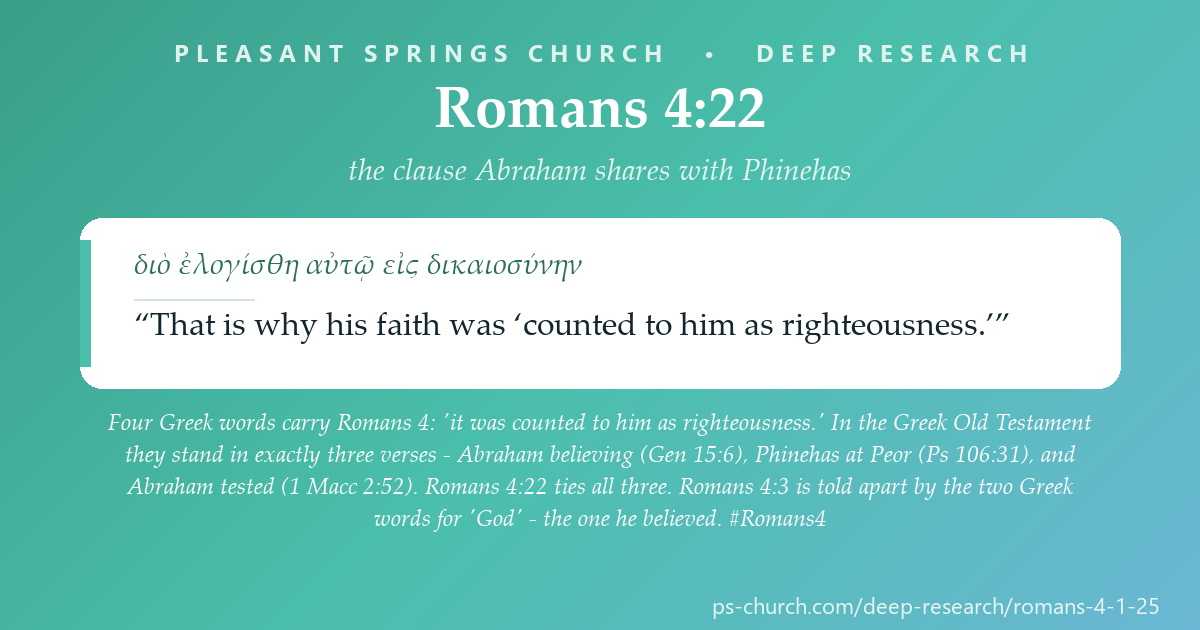
Romans 4 hangs on four Greek words — ἐλογίσθη αὐτῷ εἰς δικαιοσύνην, it was counted to him as righteousness. They come from Genesis 15:6, and Paul quotes them at 4:3 and says them again at 4:22. Screened against the 30,348 verse units of Greek Old Testament this shelf screens, those four words stand in exactly three verses. One is Genesis 15:6, where Abram believes. One is Psalm 106:31 (Septuagint 105:31), where they are said of Phinehas, who stood up and intervened at Peor. And one is 1 Maccabees 2:52 — a witness, not Scripture — where they are said of Abraham found faithful in testing. So when Romans 4:22 repeats the four words on their own, the measurement cannot say which of the three it is: a run of four, tie band three. Romans 4:3 can be told apart — seven words, tie band one — and the two words that do it are τῷ θεῷ: God, the one he believed. In Hebrew the word-for-word likeness does not hold. Genesis 15:6 shares no two consecutive words with any other verse of the Hebrew Bible, and with Psalm 106:31 it shares one, to him. The verbatim likeness is a fact about the Greek; the Hebrew ties the two verses by root instead — they are two of the only three verses in the Hebrew Bible that hold the verb count and a righteousness word together (Stage 3). Around that one tie, the chapter’s quoting is clean: its five deepest rows against the Greek Old Testament are the five verses that quote it under an introduction — 4:3, 4:7, 4:8, 4:17 and 4:18, every one at a tie band of one — and apart from 4:22 itself, nothing else in the twenty-five verses reaches four. See the method →
Romans 4:1–25 (selections)
Greek New Testament (SBLGNT via MorphGNT) · ESV⚠️ The verses this chapter quotes DO carry offsets, and every one is labelled with both numbers. Romans 4:7–8 quote Septuagint Psalm 31:1–2 = Hebrew and English Psalm 32:1–2; the Phinehas verse is Septuagint Psalm 105:31 = Hebrew and English 106:31. Inside both psalms the verse numbers agree across all three columns: in Psalm 32 the Hebrew and the Greek count the title within verse 1 and the ESV prints it as a heading above verse 1, so nothing shifts; Psalm 106 has 48 verses in both files. Genesis 15 and 17 have the same verse count in the Hebrew and the Greek files (21 and 27), and the ESV numbers them the same way; the Jacob verse in Stage 4 is Genesis 32:29 in the Hebrew and the Greek = ESV 32:28.
★ The result that set this page’s thesis. The four Greek words Romans 4 turns on stand in three verses of the Greek Old Testament, and only one of the three is about Abraham believing. Romans 4:22 cannot be told apart from Psalm 106:31 by the measurement; Romans 4:3 can, by two words. Stage 4 has the run, the band, the Hebrew, and the counter-examples.
Twenty-three of the chapter’s 25 verses are quoted here (4:14 and 4:15 are not). The English is the ESV, fetched from Crossway’s API and not retyped; the Greek is pulled from the files at build time and not typed either.
The Shape of the Passage
A sequence inside one measured frame — and this page will not call it a chiasmNobody disputes who wrote Romans. What is worth noticing in chapter 4 is who the word our includes, and how it changes. The chapter’s argument is about who belongs to Abraham, and its pronouns make the same argument in miniature. What follows separates what the text says, what can be counted, and what cannot.
Author
Paul, writing as a Jew to a church he had not founded. The letter names Paul in its first word and its scribe near its last (16:22, Tertius). Romans 4 opens with Paul counting himself among Abraham’s physical descendants — Ἀβραὰμ τὸν προπάτορα ἡμῶν κατὰ σάρκα, Abraham, our forefather according to the flesh. That pronoun is one of the three words in 4:1 carrying an apparatus siglum, and the sentence it sits in can be punctuated more than one way; Stage 5 says what is at stake.
Then the our widens, and the widening can be counted. The first-person plural pronoun stands seven times in the chapter: at 4:1, our forefather according to the flesh; at 4:12, our father Abraham, of the circumcised who walk in his faith; at 4:16, πατὴρ πάντων ἡμῶν, the father of us all; and four times in the last two verses, of us who believe. The chapter starts with a father according to the flesh and ends with a father of all who believe.
And he argues from the order of Genesis, the way a reader of the scroll would. The case in 4:10 rests on narrative sequence — the counting of 15:6 comes before the circumcision of chapter 17 — and the quotations come from Genesis 15:5, 15:6 and 17:5 and from a psalm of David. Five rows of this chapter reproduce the Greek of those verses at a tie band of one. A reader who knew the Greek Bible could hear it behind these sentences; what Paul expected of Rome the wording alone cannot say.
Audience
A church in Rome of Jews and Gentiles, addressed as people who know the story. Nothing in Romans 4 explains who Abraham, Sarah or David were. The chapter assumes its readers know that Abram became Abraham, that circumcision came in Genesis 17, and that the stars were promised in Genesis 15. It assumes a Gentile reader can be told that Abraham is the father of all who believe without being circumcised (4:11) and a Jewish reader that he is the father of the circumcised who walk in his footsteps (4:12) — and that both will keep reading.
The chapter keeps its readers waiting for a name. Counted on the MorphGNT lemma column: Ἰησοῦς occurs once in Romans 4, in its twenty-fourth verse, and Χριστός not at all. Of the 87 chapters in the thirteen letters that carry Paul’s name, five have no Christ in them, and this is one. That is a fact about the wording and not an argument about the theology — the chapter ends on the death and resurrection of the Lord — but it means the readers hear twenty-three verses about Abraham before they are told, in 4:24, whom they believe in.
And then they are told directly: the words “it was counted to him” were not written for his sake alone, but for ours also (4:23–24). The chapter names its own audience as the reason Genesis 15:6 was written down.
Orient on Abraham, on the verb, on circumcision — and on a priest the chapter never mentions.
Search by topic: Abraham; Faith; Justification; Righteousness; Imputation (reckoning, counting); Circumcision; Covenant; Promise; Seal; David; Psalm 32; Phinehas; Romans, Letter to the; Abraham in Second Temple Judaism.
Which articles are relevant, and what each is for
- Anchor Bible Dictionary — “Abraham,” “Faith,” “Justification,” “Righteousness,” “Circumcision,” “Phinehas,” “Romans, Epistle to the.”
- Dictionary of Paul and His Letters (IVP) — “Abraham,” “Faith,” “Justification,” “Righteousness, Righteousness of God,” “Circumcision,” “Law of Moses.”
- TDNT / NIDNTT / EDNT — λογίζομαι (the article that will tell you the verb belongs to bookkeeping as well as to thought), δικαιοσύνη, πίστις, σφραγίς, μακαρισμός.
- Commentary on the New Testament Use of the Old Testament (Beale & Carson) — on Romans 4 and its quotations of Genesis 15:6, Psalm 32:1–2, Genesis 17:5 and 15:5.
Read the Phinehas article, even though Romans 4 never names him
Because the clause Romans 4 is built on is also said of him, in the Psalter. Numbers 25 tells how Phinehas son of Eleazar ran a spear through an Israelite man and a Midianite woman at Peor and the plague stopped; Psalm 106:30–31 remembers it, and ends: “And that was counted to him as righteousness from generation to generation forever.” A dictionary article on Phinehas will trace that remembering through Sirach 45, 1 Maccabees 2 and 4 Maccabees — witnesses, not Scripture — where he becomes the model of zeal. An article on justification often will not mention him at all. This page reads the two together because the Greek puts them together; see the study of Numbers 25 and Psalm 106.
Settle the numbering first — and in Romans 4 there is nothing to settle
Romans is a New Testament book. There is no Masoretic column and no Septuagint column for it, and no offset. The shelf says so everywhere, including where the answer is nothing, because a page that mentions numbering only when it is awkward teaches readers to assume agreement the rest of the time.
| text | Greek / Hebrew numbering | English (ESV) numbering | checked how |
|---|---|---|---|
| Romans 4 | SBLGNT 4:1–25 | 4:1–25 | counted off the MorphGNT file and off the API response |
| Genesis 15:5–6; 17:4–5; 17:17 | MT = CATSS | the same | chapter lengths 21 / 27 in both files; content read |
| David’s psalm (4:7–8) | MT 32:1–2 · LXX 31:1–2 | 32:1–2 | 11 verses in both files; the title sits inside verse 1 in both |
| Phinehas | MT 106:31 · LXX 105:31 | 106:31 | 48 verses in both files; content read |
| Jacob renamed (Stage 4) | MT = CATSS 32:29 | 32:28 | CATSS follows the Hebrew; the English counts 31:55 as the Hebrew’s 32:1 |
| 1 Maccabees 2:52 · Sirach 44:19–21 | CATSS | KJV Apocrypha, the same numbers | content read: the KJV 2:52 and 44:19–21 are the same sentences |
The Greek Psalter numbers one behind the Hebrew for most of Psalms 10 to 147, because it joins Psalms 9 and 10 (and 114 and 115) and divides 116 and 147. Every psalm cited on this page carries both numbers.
The clause had a life before Romans and around it — and in the texts held here from outside the New Testament, every use of it except Genesis 15:6 and Jubilees’ retelling of that verse is attached to something done.
Two kinds of evidence in this stage, and they are kept apart. The Greek of 1 Maccabees, Sirach and the Psalms of Solomon is held on this disk and was measured (all three are witnesses, not Scripture). Jubilees is held only in R. H. Charles’s English (1902) and was read, not measured. Qumran, Philo and the rabbis are not held at all; where this stage mentions them it is reporting what the commentaries cite, and says so.
Mattathias, dying, puts Abraham and Phinehas two verses apart
1 Maccabees 2 ends with the priest Mattathias charging his sons to remember the deeds of the fathers. Abraham is the first name on his list, and Phinehas the third. In the Greek held here:
| verse | Greek (CATSS) | KJV Apocrypha (1769) |
|---|---|---|
| 1 Macc 2:52 | Αβρααμ οὐχὶ ἐν πειρασμῷ εὑρέθη πιστός καὶ ἐλογίσθη αὐτῷ εἰς δικαιοσύνην | Was not Abraham found faithful in temptation, and it was imputed unto him for righteousness? |
| 1 Macc 2:54 | Φινεες ὁ πατὴρ ἡμῶν ἐν τῷ ζηλῶσαι ζῆλον ἔλαβεν διαθήκην ἱερωσύνης αἰωνίας | Phinees our father in being zealous and fervent obtained the covenant of an everlasting priesthood. |
Measured: the last five words of 2:52 run verbatim with Greek Genesis 15:6 and with Psalm 105:31 (English 106:31) — five words, tie band two, the same three verses every time. Its first clause, ἐν πειρασμῷ εὑρέθη πιστός, four words, stands in one other verse of the corpus, Sirach 44:20, and in no verse of the New Testament. So in the one Greek text outside the canon, of those held here, that uses Genesis 15:6’s clause, the clause is attached to a testing. Genesis itself uses the verb of testing once of Abraham, ὁ θεὸς ἐπείραζεν at 22:1, before Isaac is bound; against that verse 1 Maccabees 2:52 measures one word, the name, because the forms differ. The link is the root, which a form screen cannot see.
1 Maccabees is a witness on this shelf, not Scripture. The study of 1 Maccabees 1–4 measures the same verse from its own side.
Sirach 44: the father of a multitude, who kept the law
Ben Sira’s praise of the fathers gives Abraham three verses, and they say things Romans 4 also talks about — in different words.
| verse | Greek (CATSS) | KJV Apocrypha (1769) | against Romans 4 |
|---|---|---|---|
| Sir 44:19 | Αβρααμ μέγας πατὴρ πλήθους ἐθνῶν καὶ οὐχ εὑρέθη ὅμοιος ἐν τῇ δόξῃ | Abraham was a great father of many people: in glory was there none like unto him; | shares Genesis 17:4’s phrase (3 words with it); Romans 4:17 uses 17:5’s — 1 |
| Sir 44:20 | ὃς συνετήρησεν νόμον ὑψίστου καὶ ἐγένετο ἐν διαθήκῃ μετ' αὐτοῦ ἐν σαρκὶ αὐτοῦ ἔστησεν διαθήκην καὶ ἐν πειρασμῷ εὑρέθη πιστός | Who kept the law of the most High, and was in covenant with him: he established the covenant in his flesh; and when he was proved, he was found faithful. | shares ἐν πειρασμῷ εὑρέθη πιστός with 1 Maccabees 2:52 (4 words); against every verse of Romans 4, one word at most |
| Sir 44:21 | διὰ τοῦτο ἐν ὅρκῳ ἔστησεν αὐτῷ ἐνευλογηθῆναι ἔθνη ἐν σπέρματι αὐτοῦ πληθῦναι αὐτὸν ὡς χοῦν τῆς γῆς καὶ ὡς ἄστρα ἀνυψῶσαι τὸ σπέρμα αὐτοῦ καὶ κατακληρονομῆσαι αὐτοὺς ἀπὸ θαλάσσης ἕως θαλάσσης καὶ ἀπὸ ποταμοῦ ἕως ἄκρου τῆς γῆς | Therefore he assured him by an oath, that he would bless the nations in his seed, and that he would multiply him as the dust of the earth, and exalt his seed as the stars, and cause them to inherit from sea to sea, and from the river unto the utmost part of the land. | the inheritance — Romans 4:13 measures 2 |
Sirach says Abraham kept the law of the Most High and established the covenant in his flesh, and was found faithful when tested. Romans 4 says the promise did not come through the law, and that the counting came before the circumcision. Both texts are talking about Genesis 15–17. The measurement finds no sentence they share. Whether Paul knew Sirach, and whether Romans 4 is written against anything like it, are questions this page does not answer — it prints the two side by side because they are the two Abrahams a first-century reader of Greek could have had in front of him. See the study of Sirach 44–51.
Jubilees retells Genesis 15:6 — and uses the same formula for a massacre
Read in Charles’s English only; no Greek or Hebrew of Jubilees is held, so nothing below is measured.
| Jubilees (Charles, 1902) | what it says |
|---|---|
| 14:6 | And he believed in the Lord, and it was counted to him for righteousness. — Genesis 15:6, retold |
| 17:18 | And in everything wherein He had tried him, he was found faithful, and his soul was not impatient, and he was not slow to act; for he was faithful and a lover of the Lord. |
| 30:17 | For this reason I have commanded thee, saying: "Testify this testimony to Israel: see how the Shechemites fared and their sons: how they were delivered into the hands of two sons of Jacob, and they slew them under tortures, and it was (reckoned) unto them for righteousness, and it is written down to them for righteousness. — of Simeon and Levi at Shechem |
| 30:18 | And the seed of Levi was chosen for the priesthood, and to be Levites, that they might minister before the Lord, as we, continually, and that Levi and his sons may be blessed for ever; for he was zealous to execute righteousness and judgment and vengeance on all those who arose against Israel. |
| 31:23 | And he made the two sons of Jacob sleep, the one on his right hand and the other on his left and it was counted to him for righteousness. — the third and last use of the formula in Charles’s Jubilees |
So the formula travels. In Jubilees it is said of Abraham believing, and then of two sons of Jacob who killed the men of Shechem — and the next verse calls Levi zealous, the word the tradition attaches to Phinehas. This page reports that and stops: the Ethiopic text behind Charles is not held, and the English cannot be screened. See Jubilees 30–34 and Jubilees 17–23, where Abraham’s ten trials are counted.
Qumran, Philo and the rabbis — named, not consulted
None of these is held on this disk, and nothing in this answer was checked against a text. The commentaries on Romans 4 regularly cite three more places where Genesis 15:6 or its formula was read:
- 4QMMT, the Qumran letter on works of the law, which ends by telling its addressee that it will be reckoned to him as righteousness when he does what is right and good before God (section C, line 31 in the composite text of Qimron and Strugnell, DJD X, 1994). Not seen here in Hebrew or in the edition; the sense is given as it is usually cited.
- Philo of Alexandria, who comments on Abraham believed God at length, notably in Who Is the Heir of Divine Things? (as cited in the commentaries).
- The Mekhilta on Exodus 14:31, a rabbinic text later than the New Testament, which cites Genesis 15:6 in praise of faith (as cited in the commentaries).
A negative here would be worthless, and none is offered. These are pointers for a reader who wants to go further than this disk can.
Circumcision as a seal
Genesis calls circumcision a sign; Romans 4:11 calls it a sign and a seal. Counted: the noun σφραγίς stands sixteen times in the New Testament, thirteen of them in Revelation; no form of it occurs anywhere in Greek Genesis, where circumcision is to be ἐν σημείῳ διαθήκης (17:11). Calling circumcision a seal appears in later Jewish and Christian writing as well; none of that is held here, and this page does not date the usage or say who had it first.
Nine entries, each counted rather than characterised — and the one that matters most is a word a form-by-form screen cannot see.
Counts are of MorphGNT lemmas over the SBL Greek New Testament (7,927 verses, 27 files) unless the entry says form; Greek Old Testament counts are of forms over the 30,348 verse units the shelf screens (64 CATSS files held, the Odes left out); Hebrew counts are of consonantal forms over the 23,204 verse units of the Masoretic text held here.
11 occurrences in Romans 4 — more than in any other chapter of the New Testament (2 Corinthians 10 is next, with 4). Romans has 19, the New Testament 40. In the Greek Old Testament held here the verb stands 120 times in 117 verse units (counted on the CATSS lemma column). Its form ἐλογίσθη stands in seven of them, and three are the clause of this page; two more are the Servant of Isaiah 53 — not esteemed at 53:3, numbered with the lawless at 53:12.
8 occurrences in Romans 4 — again more than any other chapter of the New Testament (Romans 10 is next, with 6). The phrase εἰς δικαιοσύνην stands in nine New Testament verses, and four of them are in this chapter.
10 in Romans 4, the most of any chapter of Romans (chapter 3 has 9), and six more of the verb πιστεύω. Hebrews 11 (24), Galatians 3 (14) and James 2 (13) carry more. Compare Romans 6–7, where the noun does not occur at all.
6 in Romans 4, the most of any New Testament chapter, all in 4:9–12, together with all six of the chapter’s περιτομή. In the Greek Old Testament held here the noun stands in 16 verse units, five of them in Genesis 17.
3 in the New Testament — Romans 4:6, 4:9, Galatians 4:15 — and 0 in the Greek Old Testament held here. Paul names what the psalm does with a noun the psalm does not use.
Once in the New Testament, at 4:1, and once in the Greek Old Testament held here, of God, at 3 Maccabees 2:21 (a witness, not Scripture). It carries a siglum: the King James Version, from a different Greek text, reads Abraham our father.
Once in the New Testament, at 4:19; once in the Greek Old Testament held here, in the form ἑκατονταετεῖ at Genesis 17:17 — Abraham laughing at the promise. A rare word shared by exactly the right two verses, which the run screen scores at one because the forms differ.
This participle stands twice in the New Testament, Romans 4:19 and Hebrews 11:12 (νενεκρωμένου), and both times of Abraham (in Romans, of his body). The noun beside it, νέκρωσις, stands twice (here and 2 Corinthians 4:10) and not in the Greek Old Testament held here.
0 occurrences in the Greek New Testament. 66 in 52 verse units of the Greek Old Testament held here, from Genesis 11:26 to 17:5, and once at 2 Esdras 19:7 (= Nehemiah 9:7), which recalls the renaming. Every New Testament quotation of Genesis 15:6 — Romans 4:3, Galatians 3:6, James 2:23 — gives the man the name he did not yet have when the verse was said of him.
The word the argument runs on, and why a form screen cannot see it
Romans 4:6–9 joins its two quotations by one verb. Genesis 15:6 says righteousness was counted; Psalm 32:2 says the Lord does not count sin. Paul reads one by the other — Is this blessing then only for the circumcised… For we say that faith was counted to Abraham as righteousness (4:9).
| verse | Hebrew | Greek |
|---|---|---|
| Genesis 15:6 | וַיַּחְשְׁבֶהָ | ἐλογίσθη |
| Psalm 32:2 (LXX 31:2) | יַחְשֹׁב | λογίσηται |
| Psalm 106:31 (LXX 105:31) | וַתֵּחָשֶׁב | ἐλογίσθη |
Three verses, one Hebrew root, one Greek verb — and three different forms in Hebrew, two in Greek. The run screen on this shelf matches whole word forms, never roots or lemmas, so between Genesis 15:6 and Psalm 32:2 it sees one word in each language and nothing more — לּוֹ, to him, in Hebrew, and the article τῷ in Greek. The link the chapter’s argument is made of is real and is invisible to the instrument. That is said here so that nobody reads the low number in Stage 4 as a verdict on Paul’s reading.
Counted on the Hebrew side: exactly three verses of the Hebrew Bible hold a form of this root and a form of the word for righteousness together — Genesis 15:6, Psalm 106:31, and Job 35:2 (Do you think this to be just? Do you say, ‘It is my right before God,’). In the Greek Old Testament held here, four verse units hold a form of the verb and the noun together: Genesis 15:6, Psalm 105:31, 1 Maccabees 2:52 and Psalms of Solomon 1:3 (a witness, not Scripture). In the Greek New Testament, eight — and six of the eight are in Romans 4.
All 25 verses screened against the Greek Old Testament held here and against the whole Greek New Testament — with the tie band beside every run, the counter-examples first, and the Hebrew last.
Greek against Greek. MorphGNT field 6, the normalised word form (the column that resolves elision and the movable nu); the CATSS FORM column, beta-code transliterated first; both put through the same filter — lowercased, accents and breathings dropped, final sigma folded — plus MorphGNT’s own spelling equivalences (ou/ouk/ouch, ek/ex, movable nu) on both sides. Word forms, never lemmas. Contiguous runs only. The tie band is how many target verses reach the same depth; a run without its band is misleading. Single shared words count as 1 on this side, so a Greek 0 would mean no word in common. Exhaustive and deterministic; nothing sampled, so no seed applies.
First, the counter-examples — five rows where the number and the meaning part company
| Romans | against | run | tie band | what it is |
|---|---|---|---|---|
| 4:12 | John 8:53 | 4 | 1 | τοῦ πατρὸς ἡμῶν Ἀβραάμ — “Are you greater than our father Abraham, who died? And the prophets died! Who do you make yourself out to be?” Band one, and no contact. |
| 4:24 | 1 Corinthians 9:1 | 4 | 1 | Ἰησοῦν τὸν κύριον ἡμῶν — a title of the Lord, in a sentence about Paul’s apostleship. A formula. |
| 4:25 | Psalms of Solomon 13:5 (a witness, not Scripture) | 3 | 1 | διὰ τὰ παραπτώματα — “The righteous was troubled on account of his errors, Lest he should be taken away along with the sinners” (Gray, 1913). The deepest Greek Old Testament contact Romans 4:25 has. |
| 4:25 | Isaiah 53:12 | 1 | — | παρεδόθη — the verse the commentaries most often set beside 4:25. Isaiah 53:5 does a little better: two words, ἡμῶν καὶ. |
| 4:5 | Exodus 23:7 · Isaiah 5:23 · Proverbs 24:24 | 2 | 12 verses hold the two words | τὸν ἀσεβῆ — God justifies the ungodly, in words the Greek Old Testament uses of what judges must never do. The row’s own maximum is three, band one, with Micah 7:7: δὲ ἐπὶ τὸν, but… on the. |
Read the 4:25 rows together. A three-word run with a tie band of one points at a pious man worrying about his own sins in a non-canonical psalm, and the passage every commentary hears behind the verse scores one. Depth is not dependence, and a low number is not absence. That is why the band is printed beside every run, and why the finding below is argued from a tie rather than from a depth.
The whole chapter against the Greek Old Testament — the quoting is clean
The 25 MorphGNT rows of Romans 4 against all 30,348 verse units of Greek Old Testament this shelf screens. Across the 25 rows: all 25 reach two, 18 reach three, 6 reach four, 5 reach five, 4 reach six, 3 reach seven, 2 reach eight, 1 reaches ten, and nothing reaches eleven.
| Romans | deepest Greek Old Testament partner | run | tie band | introduced as Scripture? |
|---|---|---|---|---|
| 4:7 | Psalm 31:1 (= MT/ESV 32:1) | 10 | 1 | yes — David also speaks (4:6) |
| 4:8 | Psalm 31:2 (= MT/ESV 32:2) | 8 | 1 | yes — the same introduction |
| 4:3 | Genesis 15:6 | 7 | 1 | yes — what does the Scripture say? |
| 4:17 | Genesis 17:5 | 6 | 1 | yes — as it is written |
| 4:18 | Genesis 15:5 | 5 | 1 | yes — as he had been told |
| 4:22 | Genesis 15:6 · Psalm 105:31 (= 106:31) · 1 Maccabees 2:52 | 4 | 3 | no — That is why |
| everything else — nineteen rows — three or less | ||||
The five rows that quote Scripture under an introduction are the five deepest rows in the chapter, and every one of them has a tie band of one. Below them, nothing in the twenty-five verses reaches four except the verse that says the clause again. Compare the other Romans pages on this shelf: in Romans 1–2 an accident (1:3 against Genesis 21:3) ties the deepest citation; in Romans 6–7 the quoting nearly stops. That makes the one row with a band above one the row to look at.
★ The finding — four words, three verses, and two of them are not about Abraham believing
The phrase search first, both corpora, exhaustively.
| the four words ἐλογίσθη αὐτῷ εἰς δικαιοσύνην | verses | where |
|---|---|---|
| Greek Old Testament, 30,348 verse units screened | 3 | Genesis 15:6 · Psalm 105:31 (= MT/ESV 106:31) · 1 Maccabees 2:52 (a witness, not Scripture) |
| Greek New Testament, 7,927 verses | 4 | Romans 4:3 · Romans 4:22 · Galatians 3:6 · James 2:23 |
Then the three Greek Old Testament verses, whole:
The three verses that carry the clause
Hebrew (MT, where there is one) · Greek (CATSS) · ESV / KJV ApocryphaNow measure the two Romans verses against all three.
| Genesis 15:6 | Psalm 105:31 (106:31) | 1 Maccabees 2:52 | deepest, with band | |
|---|---|---|---|---|
| Romans 4:3 | 7 | 5 | 5 | 7, band 1 — Genesis only |
| Romans 4:22 | 4 | 4 | 4 | 4, band 3 — all three tied |
The two words that separate Abraham’s verse from Phinehas’s are τῷ θεῷ — God, the one he believed. Take them away and what Romans 4:3 shares with Genesis 15:6 is exactly what it shares with Psalm 106:31. From the other side the picture is identical: screened against the whole Greek New Testament, Genesis 15:6 reaches seven words, tie band three (Romans 4:3, Galatians 3:6, James 2:23), and Psalm 105:31 and 1 Maccabees 2:52 each reach five, against the same three verses. Each New Testament verse that quotes Genesis 15:6 whole — Romans 4:3, Galatians 3:6, James 2:23 — is closer to Genesis than to the psalm by exactly those two words. The one that repeats only the clause, Romans 4:22, is not.
What the tie does and does not mean. It does not mean Romans 4:22 is about Phinehas: that is why ties it to the four verses before it and, through them, to 4:3, and this page knows of no reading that takes it otherwise. It does not mean Paul had Psalm 106 or 1 Maccabees in mind; this page cannot see minds, and asserts no direction of influence between any of these texts. It means that the sentence Romans 4 is built on was not Abraham’s alone in the Greek Bible. The same five words credited a believing in Genesis, Phinehas’s intervention at Peor — the spear of Numbers 25 — in the Psalter, and a test passed in 1 Maccabees. Romans 4:4–5 argues that what is counted is not a wage — and the identical words, in the other two verses, are attached to something done. A reader who knew the Greek Psalter could have heard both; Romans 4 leaves no doubt which it means, by quoting the two words the psalm does not have.
In Hebrew, the verbatim likeness is not there
The Masoretic text screened the same way, against 23,203 other verse units, with single shared words NOT counted — so here 0 means no two consecutive words shared.
| pair | Hebrew (MAM) | Greek (CATSS) |
|---|---|---|
| Genesis 15:6 against every other verse | 0 — no two consecutive words with any of them | 5, band 2 (Psalm 105:31, 1 Maccabees 2:52) |
| Genesis 15:6 ↔ Psalm 106:31 (LXX 105:31) | one word, לּוֹ | five words |
| Genesis 15:6 ↔ Psalm 32:2 (LXX 31:2) | one word, the same לוֹ | one word, the article τῷ |
Set the two clauses side by side. Genesis 15:6: וַיַּחְשְׁבֶהָ לּוֹ צְדָקָה — an active verb with an object suffix, and he counted it to him, and righteousness with no preposition. Psalm 106:31: וַתֵּחָשֶׁב לוֹ לִצְדָקָה — a passive verb, and it was counted to him, and for righteousness with the preposition. The Greek of both verses has the passive and the preposition. In grammar, then, Greek Genesis 15:6 matches the Hebrew of Psalm 106:31 more closely than the Hebrew of Genesis 15:6. This page does not say why. The Hebrew behind the Greek translators is not held, and asserting that anyone assimilated one verse to the other would be asserting a direction of influence the evidence here cannot carry.
You can see it in the ESV. The English follows each source text: Genesis 15:6 he counted it to him, Psalm 106:31 that was counted to him, Romans 4:3 it was counted to him. Counted word by word, the ESV of Romans 4:3 runs 6 consecutive English words with the ESV of Psalm 106:31 and 4 with the ESV of Genesis 15:6 (and Genesis with the psalm, 4). That is a fact about a translation, not a measurement on this shelf’s corpora — but it is the same fact, visible in an English Bible.
How much the Hebrew zero is worth by itself. Not much. 2,247 of the 23,204 Masoretic verse units (9.7%) share no two consecutive words with any other verse; in Genesis it is 36 of 1,533 (2.3%); and among verses as short as this one — two to five words, and Genesis 15:6 is five — it is 414 of 934, nearly half. The zero is ordinary for a five-word verse. What is not ordinary is the contrast: in Greek the same verse has two verbatim partners at five words.
Two more places where the Greek and the Hebrew disagree about which verses are alike
Both touch the other Genesis verse this chapter quotes.
| pair | Hebrew | Greek | the wording |
|---|---|---|---|
| Genesis 17:5 ↔ Genesis 32:29 (ESV 32:28) | 1 — single words only (עוֹד, שִׁמְךָ, כִּי) | 6, band 1 | οὐ κληθήσεται ἔτι τὸ ὄνομά σου — Abram renamed, and Jacob renamed, in the same six Greek words. The Hebrew uses different verbs. |
| Genesis 17:4 ↔ Genesis 17:5 | 2 | 1 | הֲמוֹן גּוֹיִם in both Hebrew verses; πατὴρ πλήθους ἐθνῶν then πατέρα πολλῶν ἐθνῶν in Greek. Romans 4:17 and 4:18 have the second; Sirach 44:19 has the first. |
So the Greek joins verses the Hebrew keeps apart (15:6 with 106:31; 17:5 with 32:29) and parts a phrase the Hebrew repeats (17:4 with 17:5). Wherever the Greek and the Hebrew of a verse Romans 4 quotes differ, Romans agrees with the Greek — which is a statement about wording, and not about where anyone got it.
The five verses Romans 4 quotes, in Hebrew, Greek and English
Romans 4’s Old Testament
Hebrew (MT, MAM) · Greek (CATSS / Rahlfs) · ESVAgainst the New Testament — one deep row, and it is not the deepest quotation
The same 25 rows against the 7,497 verses of the New Testament outside Romans. All 25 reach two, 14 reach three, 4 reach four, 1 reaches ten, and nothing reaches eleven.
| Romans | against | run | tie band |
|---|---|---|---|
| 4:3 | James 2:23 | 10 | 1 |
| 4:3 | Galatians 3:6 | 7 | — (pair) |
| 4:22 | Galatians 3:6 · James 2:23 | 4 | 2 |
| 4:12 | John 8:53 | 4 | 1 |
| 4:24 | 1 Corinthians 9:1 | 4 | 1 |
| 4:7 | Matthew 9:2 and ten others | 2 | 11 |
| 4:8 | James 1:12 and ninety-seven others | 2 | 98 |
Romans 4:3 and James 2:23 share ten consecutive words — three more than either shares with Genesis — because both write Ἐπίστευσεν δὲ Ἀβραὰμ where the Greek of Genesis has καὶ ἐπίστευσεν Αβραμ. The study of James is built on that row; it is measured the same way here and agrees. Galatians 3:6 keeps a different order and shares seven. And the chapter’s deepest quotation, Psalm 32, has no verbatim New Testament partner elsewhere — two words, in bands of 11 and 98.
“and the Scripture was fulfilled that says, ‘Abraham believed God, and it was counted to him as righteousness’—and he was called a friend of God.” — and two verses earlier James asks whether Abraham was not ἐξ ἔργων ἐδικαιώθη when he offered up his son Isaac, the three words Romans 4:2 uses in its conditional. Measured against Greek Genesis 22, James 2:21 reaches four words (Ἰσαὰκ τὸν υἱὸν αὐτοῦ, band two: 22:3 and 22:9). Romans 4 against the same chapter reaches three, τὸ σπέρμα σου, which stands in Genesis 15:5 as well.
Where each text attaches the clause
| text | the clause is attached to | measured |
|---|---|---|
| Genesis 15:6 | the night of the stars — So shall your offspring be | the source |
| Psalm 106:31 (LXX 105:31) | Phinehas’s act at Peor | 5 Greek words with Genesis 15:6; 1 Hebrew |
| 1 Maccabees 2:52 (a witness, not Scripture) | Abraham found faithful in testing | 5 Greek words with Genesis; 4 with Sirach 44:20 |
| James 2:21–23 | Isaac on the altar — Genesis 22 | 10 words with Romans 4:3; 4 with Genesis 22:3/22:9 |
| Galatians 3:6–9 | the blessing of the nations | 7 with Romans 4:3 and with Genesis 15:6 |
| Romans 4 | the stars (15:5), the new name (17:5), a body as good as dead (17:17) — and a time before circumcision (17:24) | 5, 6, 1, —; never deeper than 3 into Genesis 22 |
Romans 4 keeps the clause where Genesis put it — inside chapters 15 to 17, among promises made before Isaac is born — and so, with the blessing of the nations, does Galatians 3. James and 1 Maccabees attach it to a testing, and James names the testing: Genesis 22. Romans 4 does not mention the binding of Isaac at all. That is a description of which verses each text reaches for, not an argument that any of them is answering another; see Genesis 15, Genesis 17 and Genesis 22.
Where this page is weakest, what it could not check, and the arguments it leaves to the commentaries.
Where this page is weakest
The thesis rests on a tie of four words, and two more words dissolve it. That is the honest size of the finding. Romans 4:22’s band of three is real, and it is the only band above one among the chapter’s six deepest Greek Old Testament rows; but this page knows of no reading of Romans that doubts 4:22 means Abraham, and it does not pretend otherwise. What the tie shows is a fact about the Greek Bible whose wording the chapter’s quotations share, not a puzzle in the chapter.
One of the five words is in dispute. The SBL text marks διὸ with a siglum; the King James Version, from a text that adds and, reads And therefore it was imputed to him for righteousness. Measured with that word restored, the run rises from four to five — and the band stays at three, the same three verses, because all three Greek Old Testament verses have the and. The finding does not depend on the variant. Against the New Testament the band with the extra word is two (Galatians 3:6, James 2:23).
The English comparison is not a measurement. The ESV runs in Stage 4 are counts on a translation, done to let a reader see the Greek difference in an English Bible. They are printed as illustration and nowhere used as evidence.
The apparatus was not consulted, and fourteen words of this chapter carry sigla
No critical apparatus was read for any verse on this page. 14 of the 399 MorphGNT word rows of Romans 4 carry an SBL siglum — 35.1 per thousand, against 40.0 for the letter as a whole. Where they fall: 4:1 (three), 4:2, 4:8, 4:9, 4:11, 4:12 (a two-word span), 4:13, 4:15, 4:19 (two), 4:22.
Four of them touch sentences on this page.
- 4:22 — above. It does not move the band.
- 4:8 — the relative οὗ. With the alternative ᾧ the run with Psalm 31:2 is five, not eight, still band one. (The psalm’s own Greek manuscripts may differ here as well; CATSS prints one text, and the Göttingen apparatus was not consulted.)
- 4:19 — the King James Version reads he considered not his own body now dead, with a negative and an adverb the SBL text does not print. Which manuscripts carry which reading was not checked. No run on this page crosses either word.
- 4:1 — three sigla in ten words, and a sentence whose punctuation is itself an argument: Richard Hays proposed reading it as two questions, What then shall we say? Have we found Abraham to be our forefather according to the flesh? The word order of the infinitive and the choice between forefather and father are among the variants marked here. This page reports the proposal and does not adopt it.
What could not be checked at all
- The Hebrew the Greek translators read. The Greek of Genesis 15:6 and Psalm 105:31 agree with each other against the Masoretic Genesis; whether their Hebrew source already read so, or the translation produced the likeness, cannot be decided from a Masoretic file and a Rahlfs file. No Dead Sea Scrolls are held — not the Genesis fragments, not the Psalms scrolls, not 4QMMT.
- The Septuagint’s own variants. CATSS prints Rahlfs’ hand edition; the Göttingen apparatus for Genesis (Wevers) and Psalms was not consulted, so the five-word identity of the three Greek verses is a fact about one edition.
- Jubilees in Greek or Ethiopic, Philo, Josephus, the Mekhilta and the rest of the rabbinic tradition on Abraham’s faith: none is held. Stage 2 names them and measures nothing.
- Allusion. The screen finds verbatim contact. Romans 4:19’s about a hundred years old and Genesis 17:17 share a rare word and score one; Romans 4:25 and Isaiah 53 score one; Romans 4:6–9’s joining of Genesis 15:6 to Psalm 32:2 rests on a verb whose forms differ and scores nothing. Low numbers here are not verdicts.
- Patristic reading. No Church Father was consulted for this page, and the history of how Romans 4 was read — from Origen and Chrysostom through Augustine and the Reformation — is not here. Its absence is a gap, not neutrality.
What the commentaries argue about, and the measurement cannot settle
What is it that is counted? Romans 4 says that God counts faith as righteousness (4:5, 4:9), counts righteousness apart from works (4:6), and does not count sin (4:8). Whether this means that a righteousness not one’s own is credited to the believer (the Reformation doctrine of imputation, defended in recent commentary by Moo and Schreiner), that faith itself is reckoned as righteousness, or that God declares who belongs to Abraham’s family (the emphasis of Dunn and Wright, after Sanders) is the long argument about this chapter. A word count cannot decide it. What the count can say is reported above: Paul uses the verb eleven times in twenty-five verses.
Does Romans 4 have Psalm 106 and 1 Maccabees 2 in view? The standard commentaries discuss 1 Maccabees 2:52 at Romans 4:2–3, as part of the Jewish picture of Abraham faithful under testing. This page has not re-checked which of them say so, or which also take up Psalm 106:31 at this point, and does not claim that any of them sets the three verses side by side the way the measurement does.
Is Romans 4:25 drawing on Isaiah 53? Commonly said, and discussed in the major commentaries listed below. The measurement gives one word, and the commentaries argue from sense and from the verb, not from a run. Both facts stand.
Reading list
- C. E. B. Cranfield, The Epistle to the Romans, vol. 1 (ICC, 1975).
- James D. G. Dunn, Romans 1–8 (WBC 38A, 1988).
- Douglas J. Moo, The Letter to the Romans (NICNT, 2nd ed. 2018).
- Thomas R. Schreiner, Romans (BECNT, 2nd ed. 2018).
- Joseph A. Fitzmyer, Romans (Anchor Bible 33, 1993).
- Robert Jewett, Romans (Hermeneia, 2007).
- Richard N. Longenecker, The Epistle to the Romans (NIGTC, 2016).
- N. T. Wright, “The Letter to the Romans,” New Interpreter’s Bible X (2002).
- Richard B. Hays, “‘Have We Found Abraham to Be Our Forefather according to the Flesh?’ A Reconsideration of Rom 4:1,” Novum Testamentum 27 (1985).
- E. P. Sanders, Paul and Palestinian Judaism (1977).
- Mark A. Seifrid, “Romans,” in G. K. Beale and D. A. Carson (eds.), Commentary on the New Testament Use of the Old Testament (2007).
- None of these were consulted for the measurements on this page, which were run on the text files named in the footer.
Four words, three men in the Greek Bible, and the two words that choose between them.
What the tie is worth
Romans 4 is the chapter the church has read justification by faith from for two thousand years, and its sentence is a sentence from Genesis: Abraham believed God, and it was counted to him as righteousness. Measured, the last part of that sentence was not Abraham’s alone. In the Greek Bible a first-century reader held, the same words were said of Phinehas, and — in a book outside the canon — of Abraham passing a test.
So it matters which words Paul quotes. He does not quote only it was counted to him as righteousness; at 4:3 he quotes believed God as well, and the two Greek words for God in it, τῷ θεῷ, are exactly the two words that make the measurement point at Genesis and nowhere else. Then he spends eighteen verses on what that believing was — not a wage (4:4), not circumcision (4:10), not the law (4:13), but trust in the God who gives life to the dead and calls into existence the things that do not exist (4:17), held while his own body was as good as dead. Only then does he say the four words again, at 4:22. By then there is no doubt whose they are.
And then he turns them on the reader. The words were not written for Abraham’s sake alone, but for ours, who believe in him who raised from the dead Jesus our Lord (4:23–24). In the New Testament the form ἐλογίσθη stands in eight verses. Seven are about what was counted to Abraham. The eighth is Luke 22:37, where Jesus quotes Isaiah 53:12 of himself: “For I tell you that this Scripture must be fulfilled in me: ‘And he was numbered with the transgressors.’” What we see in that pairing from this side of the cross is left to the reader — the count is the claim.
New Testament shelf: Romans 4:1–25, Greek New Testament and ESV, with the Hebrew and Greek of the verses it quotes. The other Romans studies on this shelf are 1:1–2:29, 3:21–26, 5:1–11, 6:1–7:25, 8:31–39 and 14:1–16:27.
Every Deep Research page traces its passage across the whole sweep — the Old Testament, the Second-Temple world between the testaments (historical witnesses, not Scripture), and the New Testament. Follow the thread:
Pleasant Springs Church — Deep Research
Research method after Michael S. Heiser’s Bible Research Method (examine dictionaries → ancient literature → important words → textual connections → academic publications → share), with the Pleasant Springs “Author & Audience” foundation. Scripture set in the Hebrew, the Greek editions named on each page and the ESV (Old Testament), and the Greek New Testament and the ESV (New Testament), per the practice of Pleasant Springs Church. Romans research grounded in Cranfield (ICC), Dunn (WBC), Moo (NICNT), Schreiner (BECNT), Fitzmyer (AB), Jewett (Hermeneia) and Longenecker (NIGTC), with Hays (1985) for the punctuation of 4:1 and Sanders (1977) and Wright for the covenantal reading. Text: Greek New Testament from the SBL edition as digitized by MorphGNT; Greek Old Testament from Rahlfs’ Septuaginta as digitized by CATSS; Hebrew from Miqra according to the Masorah (Sefaria); English of 1 Maccabees and Sirach from the KJV Apocrypha (1769), of the Psalms of Solomon from G. B. Gray (1913), of Jubilees from R. H. Charles (1902), all public domain; KJV lines in the notes from the public-domain 1769 text. ⚠️ VERSE NUMBERING — there is no offset in Romans 4. The SBL Greek New Testament and the ESV both give the chapter 25 verses, counted from the files and from the API response. The texts this page measures against do carry offsets, and each is labelled: Septuagint Psalm 31:1–2 = Hebrew and ESV 32:1–2; Septuagint Psalm 105:30–31 = Hebrew and ESV 106:30–31; Septuagint Psalm 67:35 = Hebrew 68:35 = ESV 68:34; Genesis 32:29 in Hebrew and Greek = ESV 32:28; 2 Esdras 19:7 = Nehemiah 9:7; 4 Kingdoms = 2 Kings. Genesis 15 and 17 are aligned in all three. ⚠️ The measurement, in full. Greek against Greek: MorphGNT field 6, the normalised word form; the CATSS FORM column, beta-code transliterated; both lowercased, accents and breathings dropped, final sigma folded, and MorphGNT’s own spelling equivalences applied to both sides. Contiguous runs of whole word forms, never lemmas, except where the page says lemma. Corpus: the 25 MorphGNT rows of Romans 4 against the 7,497 New Testament verses outside Romans, and against 30,348 screened verse units of the 30,637 held in 64 CATSS files — the 289 units of the Odes are held and not screened, because two of the fourteen canticles are New Testament text (Ode 9 is Luke 1, Ode 13 Luke 2) and ten are second copies of passages already held. Hebrew against Hebrew: the MAM text, qere read, points and cantillation removed, final letters folded, maqqef treated as a word break; Genesis 15:6 against the other 23,203 verse units, single shared words not counted. Exhaustive and deterministic; nothing sampled, so no seed applies. ⚠️ No Greek or Hebrew on this page was typed. Every Greek and Hebrew string is a slice pulled from the files at build time; the ESV is fetched from Crossway’s API and not retyped. ⚠️ Direction of influence is never asserted. Nothing here says that Romans used Psalm 106, 1 Maccabees, Sirach or James, that James used Romans, that the Greek translators assimilated Genesis 15:6 to anything, or that any of these texts was written in answer to another. A run of four in a band of three is a shape, not a verdict. Typology is handled per the house position: what the text says, what the New Testament itself draws, and what we see from this side of the cross — with the seeing left to the reader.
Scripture quotations marked ESV are from the ESV® Bible (The Holy Bible, English Standard Version®), © 2001 by Crossway, a publishing ministry of Good News Publishers. ESV Text Edition: 2016. Used by permission. All rights reserved. The ESV text may not be quoted in any publication made available to the public by a Creative Commons license, and the ESV may not be translated in whole or in part into any other language. www.esv.org
|
Did this study bless you today? 💚 Give to Support PS Church100% of gifts go to the General Fund — thank you. |