Deep Research • Isaiah · 43:1–44:28

Witnesses, Idols, and the First and the Last

Isaiah 43:1–44:28 — I am he, the new thing, the idol-maker and Cyrus, measured in Hebrew and Greek against the New Testament

Isaiah 43–44 open on “Fear not, for I have redeemed you” and go on to “You are my witnesses”, “I am he”, “Behold, I am doing a new thing” and “I am the first and I am the last”. Then a smith works his iron and a carpenter makes a god from part of a tree and is warmed by the rest; and at the end a Persian king is named. This page measured the two chapters against the whole Greek New Testament and the whole Hebrew Bible. The New Testament’s best-known title from them — the first and the last, three times in Revelation — is not in any verse of the Greek Old Testament held here, and Greek Isaiah’s three self-titles never use its word for last; the Hebrew of 44:6 and 48:12 has first and last side by side. Against the Greek of 44:6, Revelation 1:17 runs two words. John’s that I am he runs three with 43:10. The deepest run in the two chapters is a five-word messenger formula shared with Revelation 1:8. And what God says of Cyrus at 44:28 runs four words, tie band one, with what God says of David in Acts 13:22. Every run is printed with its tie band, and the counter-examples beside them. See the method →

The Passage

Isaiah 43:1–44:28 (28 of the 56 verses)

Hebrew (Masoretic) · Greek (CATSS/Rahlfs) · ESV
וְעַתָּה כֹּה־אָמַר יְהֹוָה בֹּרַאֲךָ יַעֲקֹב וְיֹצֶרְךָ יִשְׂרָאֵל אַל־תִּירָא כִּי גְאַלְתִּיךָ קָרָאתִי בְשִׁמְךָ לִי־אָתָּהκαὶ νῦν οὕτως λέγει κύριος ὁ θεὸς ὁ ποιήσας σε Ιακωβ ὁ πλάσας σε Ισραηλ μὴ φοβοῦ ὅτι ἐλυτρωσάμην σε ἐκάλεσά σε τὸ ὄνομά σου ἐμὸς εἶ σύ43:1 = MT 43:1 · CATSS Isa 43:1 · ESV 43:1“But now thus says the Lord, he who created you, O Jacob, he who formed you, O Israel: ‘Fear not, for I have redeemed you; I have called you by name, you are mine.”Translation noteThe passage opens on the two words it will close its last call on. כִּי גְאַלְתִּיךָ, for I have redeemed you, stands in exactly two verses of the Hebrew Bible: this one and 44:22. The deepest Hebrew run is four, band 2 — וְעַתָּה כֹּה־אָמַר יְהֹוָה with Jeremiah 44:7 and Haggai 1:5, a messenger formula. The deepest Greek run with the New Testament is five, band 1, and it is also a formula: λέγει κύριος ὁ θεὸς ὁ with Revelation 1:8, a sequence that stands in 12 verses of the Greek Old Testament screened here. ⚠️ Hebrew and Greek differ here. The Greek has ὁ θεὸς where the Hebrew has no word for God, and ὁ ποιήσας σε, who made you, for בֹּרַאֲךָ, who created you.
כִּי־תַעֲבֹר בַּמַּיִם אִתְּךָ־אָנִי וּבַנְּהָרוֹת לֹא יִשְׁטְפוּךָ כִּי־תֵלֵךְ בְּמוֹ־אֵשׁ לֹא תִכָּוֶה וְלֶהָבָה לֹא תִבְעַר־בָּךְκαὶ ἐὰν διαβαίνῃς δι' ὕδατος μετὰ σοῦ εἰμι καὶ ποταμοὶ οὐ συγκλύσουσίν σε καὶ ἐὰν διέλθῃς διὰ πυρός οὐ μὴ κατακαυθῇς φλὸξ οὐ κατακαύσει σε43:2 = MT 43:2 · CATSS Isa 43:2 · ESV 43:2“When you pass through the waters, I will be with you; and through the rivers, they shall not overwhelm you; when you walk through fire you shall not be burned, and the flame shall not consume you.”Translation noteA Second-Temple writer names this verse as Isaiah’s. 4 Maccabees 18:14 (a witness, not Scripture) speaks of τὴν Ησαιου γραφὴν, the scripture of Isaiah, and then runs four words with this verse, φλὸξ οὐ κατακαύσει σε — a sequence in exactly two verses of the Greek Old Testament held here, these two. Psalm 65:12 (LXX) = Hebrew/ESV 66:12 shares διὰ πυρός, two words, a pair in 11 Greek verses; in Hebrew the two verses share not one word form (“we went through fire and through water” is בָּאנוּ־בָאֵשׁ וּבַמַּיִם). Daniel 3, in either Greek column, never runs more than two with this verse. ⚠️ Hebrew and Greek differ here. None that bears on a claim: the Greek μετὰ σοῦ εἰμι renders אִתְּךָ־אָנִי word for word.
כִּי אֲנִי יְהֹוָה אֱלֹהֶיךָ קְדוֹשׁ יִשְׂרָאֵל מוֹשִׁיעֶךָ נָתַתִּי כׇפְרְךָ מִצְרַיִם כּוּשׁ וּסְבָא תַּחְתֶּיךָὅτι ἐγὼ κύριος ὁ θεός σου ὁ ἅγιος Ισραηλ ὁ σῴζων σε ἐποίησά σου ἄλλαγμα Αἴγυπτον καὶ Αἰθιοπίαν καὶ Σοήνην ὑπὲρ σοῦ43:3 = MT 43:3 · CATSS Isa 43:3 · ESV 43:3“For I am the Lord your God, the Holy One of Israel, your Savior. I give Egypt as your ransom, Cush and Seba in exchange for you.”Translation note⚠️ A band-1 run that is a formula. כִּי אֲנִי יְהֹוָה אֱלֹהֶיךָ runs four with Isaiah 41:13 and with nothing else — but אֲנִי יְהֹוָה by itself stands in 196 verses of the Hebrew Bible (the pronoun bare or with and), and in 207 if the longer pronoun is counted too. A band of 1 can sit on a phrase two hundred verses deep. ⚠️ Hebrew and Greek differ here. The Greek names the third ransom Σοήνην, Syene, where the Hebrew has וּסְבָא, Seba.
אַל־תִּירָא כִּי אִתְּךָ־אָנִי מִמִּזְרָח אָבִיא זַרְעֶךָ וּמִמַּעֲרָב אֲקַבְּצֶךָּμὴ φοβοῦ ὅτι μετὰ σοῦ εἰμι ἀπὸ ἀνατολῶν ἄξω τὸ σπέρμα σου καὶ ἀπὸ δυσμῶν συνάξω σε43:5 = MT 43:5 · CATSS Isa 43:5 · ESV 43:5“Fear not, for I am with you; I will bring your offspring from the east, and from the west I will gather you.”Translation noteFour Hebrew words, band 1, and the partner is Genesis 26:24 — the night the Lord appears to Isaac: “Fear not, for I am with you”. The ESV renders both verses with the same six English words. The screen reports the words; it does not say the prophet had Isaac in mind. אַל־תִּירָא with any form of the verb stands in 74 verses of the Hebrew Bible, 13 of them in Isaiah. ⚠️ Hebrew and Greek differ here. None that bears on a claim.
אַתֶּם עֵדַי נְאֻם־יְהֹוָה וְעַבְדִּי אֲשֶׁר בָּחָרְתִּי לְמַעַן תֵּדְעוּ וְתַאֲמִינוּ לִי וְתָבִינוּ כִּי־אֲנִי הוּא לְפָנַי לֹא־נוֹצַר אֵל וְאַחֲרַי לֹא יִהְיֶהγένεσθέ μοι μάρτυρες κἀγὼ μάρτυς λέγει κύριος ὁ θεός καὶ ὁ παῖς ὃν ἐξελεξάμην ἵνα γνῶτε καὶ πιστεύσητε καὶ συνῆτε ὅτι ἐγώ εἰμι ἔμπροσθέν μου οὐκ ἐγένετο ἄλλος θεὸς καὶ μετ' ἐμὲ οὐκ ἔσται43:10 = MT 43:10 · CATSS Isa 43:10 · ESV 43:10“‘You are my witnesses,’ declares the Lord, ‘and my servant whom I have chosen, that you may know and believe me and understand that I am he. Before me no god was formed, nor shall there be any after me.”Translation noteThe verse John is heard in — and the measured contact is three words. ὅτι ἐγώ εἰμι runs three with John 8:24, 8:28 and 13:19 alike, and the three-word sequence stands in 51 verses of the Greek Old Testament and 10 of the New; 33 New Testament verses reach three with this one. Read with gaps allowed, John 13:19 agrees in order on five words — ἵνα πιστεύσητε … ὅτι ἐγώ εἰμι — and ἵνα γνῶτε καὶ πιστεύσητε stands in this verse alone. Stage 4 sets them out. ⚠️ Hebrew and Greek differ here. The Greek has κἀγὼ μάρτυς, and I a witness, which the Hebrew does not; it says οὐκ ἐγένετο ἄλλος θεὸς, no other god came to be, where the Hebrew uses the craftsman’s verb, לֹא־נוֹצַר — the verb of the idol-makers in 44:9–10.
אָנֹכִי אָנֹכִי יְהֹוָה וְאֵין מִבַּלְעָדַי מוֹשִׁיעַἐγὼ ὁ θεός καὶ οὐκ ἔστιν πάρεξ ἐμοῦ σῴζων43:11 = MT 43:11 · CATSS Isa 43:11 · ESV 43:11“I, I am the Lord, and besides me there is no savior.”Translation noteThe Hebrew doubles the pronoun; the Greek does not. אָנֹכִי אָנֹכִי stands in three verses of the Hebrew Bible — 43:11, 43:25 and 51:12. The doubled Greek ἐγώ εἰμι ἐγώ εἰμι also stands in three verses of the Greek Old Testament held here — 43:25, 45:19 and 51:12 — and in no verse of the New. The two lists share two verses and differ by one each way: here the Hebrew doubles and the Greek has ἐγὼ ὁ θεός; at 45:19 the Greek doubles (ἐγώ εἰμι ἐγώ εἰμι κύριος) where the Hebrew has אֲנִי יְהֹוָה. ⚠️ Hebrew and Greek differ here. The Greek has ὁ θεός for the divine name, and no εἰμι.
אָנֹכִי הִגַּדְתִּי וְהוֹשַׁעְתִּי וְהִשְׁמַעְתִּי וְאֵין בָּכֶם זָר וְאַתֶּם עֵדַי נְאֻם־יְהֹוָה וַאֲנִי־אֵלἀνήγγειλα καὶ ἔσωσα ὠνείδισα καὶ οὐκ ἦν ἐν ὑμῖν ἀλλότριος ὑμεῖς ἐμοὶ μάρτυρες κἀγὼ μάρτυς λέγει κύριος ὁ θεός43:12 = MT 43:12 · CATSS Isa 43:12 · ESV 43:12“I declared and saved and proclaimed, when there was no strange god among you; and you are my witnesses,’ declares the Lord, ‘and I am God.”Translation note⚠️ A counter-example the consonants set. The deepest Hebrew partners of this verse and of 43:10 are Amos 4:6, 8, 9, 10 and 11, run three: עָדַי נְאֻם־יְהֹוָה. In Amos the word is unto me — yet you did not return to me, five times — and here it is my witnesses. The vowels differ; the screen reads consonants. Band 6 for both verses (with Ezekiel 13:7 here, Isaiah 52:6 at 43:10). אַתֶּם עֵדַי, you are my witnesses, with or without and, stands in exactly three verses of the Hebrew Bible: 43:10, 43:12 and 44:8. ⚠️ Hebrew and Greek differ here. The Greek has ὠνείδισα, I reproached, for וְהִשְׁמַעְתִּי, I proclaimed; and it repeats κἀγὼ μάρτυς where the Hebrew ends וַאֲנִי־אֵל, and I am God.
גַּם־מִיּוֹם אֲנִי הוּא וְאֵין מִיָּדִי מַצִּיל אֶפְעַל וּמִי יְשִׁיבֶנָּהἔτι ἀπ' ἀρχῆς καὶ οὐκ ἔστιν ὁ ἐκ τῶν χειρῶν μου ἐξαιρούμενος ποιήσω καὶ τίς ἀποστρέψει αὐτό43:13 = MT 43:13 · CATSS Isa 43:13 · ESV 43:13“Also henceforth I am he; there is none who can deliver from my hand; I work, and who can turn it back?’”Translation noteBand 1, and the partner is the Song of Moses. אֲנִי הוּא וְאֵין runs three with Deuteronomy 32:39 and nothing else (“See now that I, even I, am he”); in Greek the two verses share ἐκ τῶν χειρῶν μου, four words. וּמִי יְשִׁיבֶנָּה, and who will turn it back, stands in three verses — Isaiah 14:27, this one, and Jeremiah 2:24, where it is a wild donkey in heat. Stage 2 gives the readings of this clause and of 44:24–28. ⚠️ Hebrew and Greek differ here. The Greek has no I am he here. It opens ἔτι ἀπ' ἀρχῆς, still from the beginning. Of the three places in these chapters where the Hebrew has the pronoun with הוּא (43:10, 43:13, 43:25), the Greek has ἐγώ εἰμι at two.
כֹּה־אָמַר יְהֹוָה גֹּאַלְכֶם קְדוֹשׁ יִשְׂרָאֵל לְמַעַנְכֶם שִׁלַּחְתִּי בָבֶלָה וְהוֹרַדְתִּי בָרִיחִים כֻּלָּם וְכַשְׂדִּים בָּאֳנִיּוֹת רִנָּתָםοὕτως λέγει κύριος ὁ θεὸς ὁ λυτρούμενος ὑμᾶς ὁ ἅγιος Ισραηλ ἕνεκεν ὑμῶν ἀποστελῶ εἰς Βαβυλῶνα καὶ ἐπεγερῶ πάντας φεύγοντας καὶ Χαλδαῖοι ἐν πλοίοις δεθήσονται43:14 = MT 43:14 · CATSS Isa 43:14 · ESV 43:14“Thus says the Lord, your Redeemer, the Holy One of Israel: ‘For your sake I send to Babylon and bring them all down as fugitives, even the Chaldeans, in the ships in which they rejoice.”Translation noteA formula row, and printed as one. Redeemer, then Holy One, then Israel, in a row, with any suffix, stands in four verses of the Hebrew Bible, all in Isaiah (41:14, 43:14, 48:17, 54:5). The row’s Hebrew maximum is three, band 288 — כֹּה־אָמַר יְהֹוָה. In Greek, λέγει κύριος ὁ θεὸς ὁ is again five with Revelation 1:8, band 1. ⚠️ Hebrew and Greek differ here. The last clause differs: the Greek has the Chaldeans ἐν πλοίοις δεθήσονται, bound in ships, where the Hebrew has בָּאֳנִיּוֹת רִנָּתָם, in ships, their cry.
אַל־תִּזְכְּרוּ רִאשֹׁנוֹת וְקַדְמֹנִיּוֹת אַל־תִּתְבֹּנָנוּμὴ μνημονεύετε τὰ πρῶτα καὶ τὰ ἀρχαῖα μὴ συλλογίζεσθε43:18 = MT 43:18 · CATSS Isa 43:18 · ESV 43:18“‘Remember not the former things, nor consider the things of old.”Translation noteMeasured against the rest of the Hebrew Bible, this verse returns zero — it shares no two consecutive words with any other verse. In Greek it reaches two, band 100: τὰ ἀρχαῖα with 2 Corinthians 5:17 (“The old has passed away”), and τὰ πρῶτα with Revelation 21:4 (“the former things have passed away”). τὰ ἀρχαῖα stands in four verses of the Greek Old Testament and in one of the New. ⚠️ Hebrew and Greek differ here. None that bears on a claim.
הִנְנִי עֹשֶׂה חֲדָשָׁה עַתָּה תִצְמָח הֲלוֹא תֵּדָעוּהָ אַף אָשִׂים בַּמִּדְבָּר דֶּרֶךְ בִּישִׁמוֹן נְהָרוֹתἰδοὺ ποιῶ καινὰ ἃ νῦν ἀνατελεῖ καὶ γνώσεσθε αὐτά καὶ ποιήσω ἐν τῇ ἐρήμῳ ὁδὸν καὶ ἐν τῇ ἀνύδρῳ ποταμούς43:19 = MT 43:19 · CATSS Isa 43:19 · ESV 43:19“Behold, I am doing a new thing; now it springs forth, do you not perceive it? I will make a way in the wilderness and rivers in the desert.”Translation noteThree shared words, reordered, and a run of one. Revelation 21:5 has Ἰδοὺ καινὰ ποιῶ (“Behold, I am making all things new”); Isaiah has ἰδοὺ ποιῶ καινὰ. ποιῶ καινὰ stands in this verse alone of the Greek Old Testament held here, and καινὰ ποιῶ in Revelation 21:5 alone of the New. The contiguous run is one. עֹשֶׂה חֲדָשָׁה stands in this verse alone of the Hebrew Bible. ⚠️ Hebrew and Greek differ here. Where the Hebrew asks הֲלוֹא תֵּדָעוּהָ, will you not know it?, the Greek states καὶ γνώσεσθε αὐτά, and you will know them.
תְּכַבְּדֵנִי חַיַּת הַשָּׂדֶה תַּנִּים וּבְנוֹת יַעֲנָה כִּי־נָתַתִּי בַמִּדְבָּר מַיִם נְהָרוֹת בִּישִׁימֹן לְהַשְׁקוֹת עַמִּי בְחִירִיεὐλογήσει με τὰ θηρία τοῦ ἀγροῦ σειρῆνες καὶ θυγατέρες στρουθῶν ὅτι ἔδωκα ἐν τῇ ἐρήμῳ ὕδωρ καὶ ποταμοὺς ἐν τῇ ἀνύδρῳ ποτίσαι τὸ γένος μου τὸ ἐκλεκτόν43:20 = MT 43:20 · CATSS Isa 43:20 · ESV 43:20“The wild beasts will honor me, the jackals and the ostriches, for I give water in the wilderness, rivers in the desert, to give drink to my chosen people,”Translation note1 Peter 2:9 opens γένος ἐκλεκτόν (“a chosen race”); the Greek here is τὸ γένος μου τὸ ἐκλεκτόν, with two words between. The pair run is one. Two verses of the Greek Old Testament held here carry the noun and the adjective together: this one, with two words between, and the Greek Esther’s 8:12t (a witness, not Scripture), where they stand side by side in the other order and the genitive, τοῦ ἐκλεκτοῦ γένους. The pair as 1 Peter has it, γένος ἐκλεκτόν, stands in no verse of the Greek Old Testament held here. ⚠️ Hebrew and Greek differ here. The Greek has σειρῆνες, sirens, for תַּנִּים, jackals, and γένος, race, for עַמִּי, my people.
עַם־זוּ יָצַרְתִּי לִי תְּהִלָּתִי יְסַפֵּרוּλαόν μου ὃν περιεποιησάμην τὰς ἀρετάς μου διηγεῖσθαι43:21 = MT 43:21 · CATSS Isa 43:21 · ESV 43:21“the people whom I formed for myself that they might declare my praise.”Translation note1 Peter 2:9’s deepest contact with these chapters: two words, band 4. τὰς ἀρετάς stands in four verses of the Greek Old Testament held here, all four in Isaiah (42:8, 42:12, 43:21, 63:7), and in one of the New, 1 Peter 2:9. The row ties with Matthew 2:6, Romans 9:25 and Matthew 12:18 at two. ⚠️ Hebrew and Greek differ here. Both words 1 Peter shares belong to the Greek column. Where the Greek has περιεποιησάμην, whom I acquired, and τὰς ἀρετάς μου, my excellencies, the Hebrew has יָצַרְתִּי, I formed, and תְּהִלָּתִי, my praise. 1 Peter’s λαὸς εἰς περιποίησιν (“a people for his own possession”) and τὰς ἀρετὰς (“that you may proclaim the excellencies”) agree with the Greek column.
אָנֹכִי אָנֹכִי הוּא מֹחֶה פְשָׁעֶיךָ לְמַעֲנִי וְחַטֹּאתֶיךָ לֹא אֶזְכֹּרἐγώ εἰμι ἐγώ εἰμι ὁ ἐξαλείφων τὰς ἀνομίας σου καὶ οὐ μὴ μνησθήσομαι43:25 = MT 43:25 · CATSS Isa 43:25 · ESV 43:25“‘I, I am he who blots out your transgressions for my own sake, and I will not remember your sins.”Translation noteThe doubled pronoun in both columns. אָנֹכִי אָנֹכִי הוּא runs three with Isaiah 51:12 and nothing else (band 1); in Greek the same two verses share five, ἐγώ εἰμι ἐγώ εἰμι ὁ. Against the New Testament the row reaches three, band 26, and the band holds John 4:26 (Ἐγώ εἰμι, ὁ) and Hebrews 10:17 (οὐ μὴ μνησθήσομαι). οὐ μὴ μνησθήσομαι stands in two verses of the Greek Old Testament, this one and Jeremiah 40:8 (= Hebrew/ESV 33:8); Stage 4 shows why Hebrews 10:17 is a counter-example. ⚠️ Hebrew and Greek differ here. The Greek has no לְמַעֲנִי, for my own sake, and no object for remember, where the Hebrew has וְחַטֹּאתֶיךָ.
אָבִיךָ הָרִאשׁוֹן חָטָא וּמְלִיצֶיךָ פָּשְׁעוּ בִיοἱ πατέρες ὑμῶν πρῶτοι καὶ οἱ ἄρχοντες αὐτῶν ἠνόμησαν εἰς ἐμέ43:27 = MT 43:27 · CATSS Isa 43:27 · ESV 43:27“Your first father sinned, and your mediators transgressed against me.”Translation noteWho is the first father? Readers have proposed Jacob, Abraham and Adam (reported; no commentary was consulted for this page). The verse names a sin; it says nothing about how a sin is passed on, and the page does not build on it. The Greek row’s deepest New Testament partner is Acts 13:27, four words, band 1 — καὶ οἱ ἄρχοντες αὐτῶν (Acts: καὶ οἱ ἄρχοντες αὐτῶν), a sequence in five Greek Old Testament verses and an accident. ⚠️ Hebrew and Greek differ here. The columns differ in number. The Hebrew has אָבִיךָ הָרִאשׁוֹן חָטָא, your first father sinned, singular; the Greek has οἱ πατέρες ὑμῶν πρῶτοι, your fathers first, plural.
כֹּה־אָמַר יְהֹוָה עֹשֶׂךָ וְיֹצֶרְךָ מִבֶּטֶן יַעְזְרֶךָּ אַל־תִּירָא עַבְדִּי יַעֲקֹב וִישֻׁרוּן בָּחַרְתִּי בוֹοὕτως λέγει κύριος ὁ θεὸς ὁ ποιήσας σε καὶ ὁ πλάσας σε ἐκ κοιλίας ἔτι βοηθηθήσῃ μὴ φοβοῦ παῖς μου Ιακωβ καὶ ὁ ἠγαπημένος Ισραηλ ὃν ἐξελεξάμην44:2 = MT 44:2 · CATSS Isa 44:2 · ESV 44:2“Thus says the Lord who made you, who formed you from the womb and will help you: Fear not, O Jacob my servant, Jeshurun whom I have chosen.”Translation noteThe second fear not oracle opens like the first. In Greek, 43:1 and 44:2 share eight consecutive words, οὕτως λέγει κύριος ὁ θεὸς ὁ ποιήσας σε; in Hebrew three, כֹּה־אָמַר יְהֹוָה. The Hebrew row reaches four, band 3 — אַל־תִּירָא עַבְדִּי יַעֲקֹב with Jeremiah 30:10, 46:27 and 46:28, a formula of the same promise. The Greek row is the third to reach five with Revelation 1:8, band 1. ⚠️ Hebrew and Greek differ here. The Greek has ὁ ἠγαπημένος Ισραηλ, the beloved Israel, for וִישֻׁרוּן, Jeshurun.
כִּי אֶצׇּק־מַיִם עַל־צָמֵא וְנֹזְלִים עַל־יַבָּשָׁה אֶצֹּק רוּחִי עַל־זַרְעֶךָ וּבִרְכָתִי עַל־צֶאֱצָאֶיךָὅτι ἐγὼ δώσω ὕδωρ ἐν δίψει τοῖς πορευομένοις ἐν ἀνύδρῳ ἐπιθήσω τὸ πνεῦμά μου ἐπὶ τὸ σπέρμα σου καὶ τὰς εὐλογίας μου ἐπὶ τὰ τέκνα σου44:3 = MT 44:3 · CATSS Isa 44:3 · ESV 44:3“For I will pour water on the thirsty land, and streams on the dry ground; I will pour my Spirit upon your offspring, and my blessing on your descendants.”Translation noteThe Spirit poured — and the measured contact with Pentecost is two words. Against Joel 3:1 (Hebrew and Greek; ESV 2:28) the run is two in Hebrew (רוּחִי / אֶת־רוּחִי עַל־כׇּל־בָּשָׂר) and two in Greek; against Acts 2:17, two (μου ἐπὶ; “I will pour out my Spirit on all flesh”), one of 301 New Testament verses that reach two with this row. רוּחִי followed by the bare preposition upon stands in three verses of the Hebrew Bible: Isaiah 44:3, Ezekiel 39:29 and Joel 3:1 (Isaiah 42:1 has it with a suffix, upon him). ⚠️ The deepest New Testament run is four, band 2 — τὸ πνεῦμά μου ἐπὶ with Matthew 12:18 and Luke 1:47. Stage 4 prints both. ⚠️ Hebrew and Greek differ here. The Greek does not pour. It has ἐπιθήσω, I will put, for אֶצֹּק; and its first half gives water τοῖς πορευομένοις ἐν ἀνύδρῳ, to those travelling through waterless country, where the Hebrew pours water on the thirsty and streams on dry ground.
זֶה יֹאמַר לַיהֹוָה אָנִי וְזֶה יִקְרָא בְשֵׁם־יַעֲקֹב וְזֶה יִכְתֹּב יָדוֹ לַיהֹוָה וּבְשֵׁם יִשְׂרָאֵל יְכַנֶּהοὗτος ἐρεῖ τοῦ θεοῦ εἰμι καὶ οὗτος βοήσεται ἐπὶ τῷ ὀνόματι Ιακωβ καὶ ἕτερος ἐπιγράψει τοῦ θεοῦ εἰμι ἐπὶ τῷ ὀνόματι Ισραηλ44:5 = MT 44:5 · CATSS Isa 44:5 · ESV 44:5“This one will say, ‘I am the Lord’s,’ another will call on the name of Jacob, and another will write on his hand, ‘The Lord’s,’ and name himself by the name of Israel.’”Translation noteBelonging, said twice. ⚠️ Hebrew and Greek differ here. The Greek says τοῦ θεοῦ εἰμι, I am God’s, twice; the Hebrew has the pronoun once (לַיהֹוָה אָנִי) and the second time writes only לַיהֹוָה. The Greek has no counterpart for יָדוֹ, his hand: its man simply writes. Of the seven Greek εἰμι in chapters 43–44, two are here, two at 43:25, and one each at 43:2, 43:5 and 43:10.
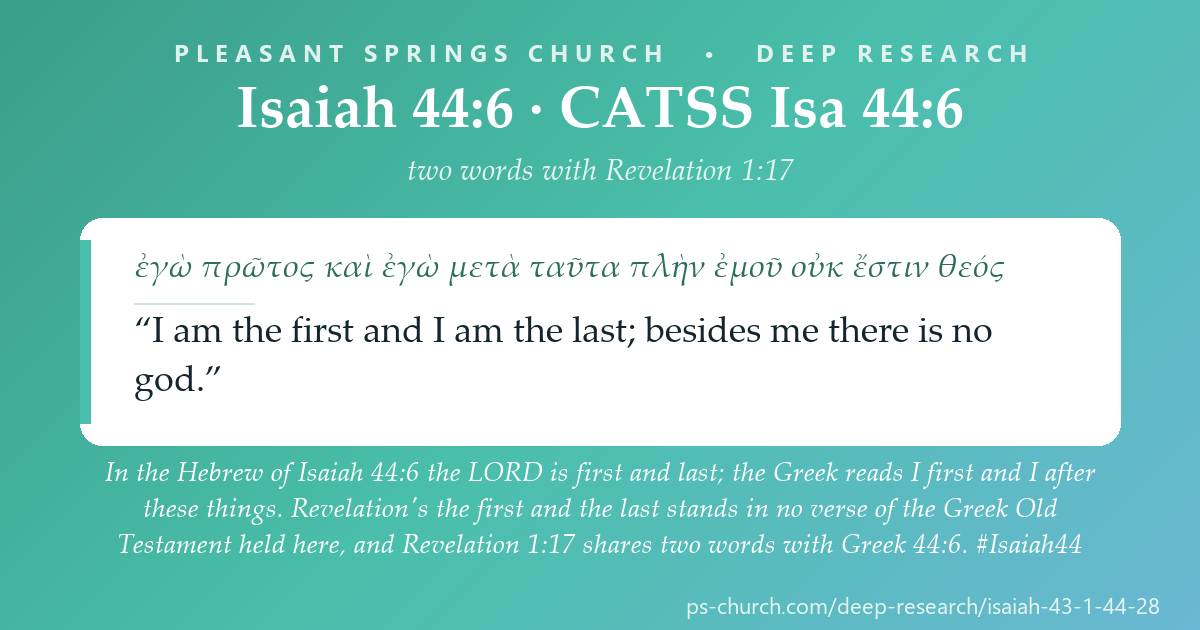
כֹּה־אָמַר יְהֹוָה מֶלֶךְ־יִשְׂרָאֵל וְגֹאֲלוֹ יְהֹוָה צְבָאוֹת אֲנִי רִאשׁוֹן וַאֲנִי אַחֲרוֹן וּמִבַּלְעָדַי אֵין אֱלֹהִיםοὕτως λέγει ὁ θεὸς ὁ βασιλεὺς τοῦ Ισραηλ ὁ ῥυσάμενος αὐτὸν θεὸς σαβαωθ ἐγὼ πρῶτος καὶ ἐγὼ μετὰ ταῦτα πλὴν ἐμοῦ οὐκ ἔστιν θεός44:6 = MT 44:6 · CATSS Isa 44:6 · ESV 44:6“Thus says the Lord, the King of Israel and his Redeemer, the Lord of hosts: ‘I am the first and I am the last; besides me there is no god.”Translation note★ The page’s finding. The Hebrew says אֲנִי רִאשׁוֹן וַאֲנִי אַחֲרוֹן, I first and I last. The Greek says ἐγὼ πρῶτος καὶ ἐγὼ μετὰ ταῦτα, I first and I after these things. Revelation’s ὁ πρῶτος καὶ ὁ ἔσχατος stands in zero verses of the 30,348 screened units of the Greek Old Testament, and in three of the New (1:17, 2:8, 22:13). Measured against this verse, Revelation 1:17 runs two (πρῶτος καὶ) — one of 423 New Testament verses that reach two with it. Stage 4 sets the three Isaiah titles side by side. ⚠️ Hebrew and Greek differ here. Besides last: the Greek has ὁ θεὸς for the first divine name, ὁ ῥυσάμενος αὐτὸν, who rescued him, for וְגֹאֲלוֹ, and θεὸς σαβαωθ for יְהֹוָה צְבָאוֹת.
אַל־תִּפְחֲדוּ וְאַל־תִּרְהוּ הֲלֹא מֵאָז הִשְׁמַעְתִּיךָ וְהִגַּדְתִּי וְאַתֶּם עֵדָי הֲיֵשׁ אֱלוֹהַּ מִבַּלְעָדַי וְאֵין צוּר בַּל־יָדָעְתִּיμὴ παρακαλύπτεσθε οὐκ ἀπ' ἀρχῆς ἠνωτίσασθε καὶ ἀπήγγειλα ὑμῖν μάρτυρες ὑμεῖς ἐστε εἰ ἔστιν θεὸς πλὴν ἐμοῦ καὶ οὐκ ἦσαν τότε44:8 = MT 44:8 · CATSS Isa 44:8 · ESV 44:8“Fear not, nor be afraid; have I not told you from of old and declared it? And you are my witnesses! Is there a God besides me? There is no Rock; I know not any.’”Translation noteThe fourth Fear not in the ESV of these chapters — and a different Hebrew verb. At 43:1, 43:5 and 44:2 the Hebrew is אַל־תִּירָא; here it is אַל־תִּפְחֲדוּ וְאַל־תִּרְהוּ, and the form וְאַל־תִּרְהוּ stands in this verse alone of the Hebrew Bible. The Greek of this verse has no fear not at all: μὴ παρακαλύπτεσθε, do not hide yourselves, a verb found in only one other verse of the Greek Old Testament held here, Ezekiel 22:26 (παρεκάλυπτον). And וְאַתֶּם עֵדָי is the third and last of the three verses in the Hebrew Bible that have it. ⚠️ Hebrew and Greek differ here. The Greek has no counterpart for וְאֵין צוּר בַּל־יָדָעְתִּי, there is no Rock; I know not any; it ends καὶ οὐκ ἦσαν τότε, and they were not then.
יֹצְרֵי־פֶסֶל כֻּלָּם תֹּהוּ וַחֲמוּדֵיהֶם בַּל־יוֹעִילוּ וְעֵדֵיהֶם הֵׄמָּׄהׄ בַּל־יִרְאוּ וּבַל־יֵדְעוּ לְמַעַן יֵבֹשׁוּοἱ πλάσσοντες καὶ γλύφοντες πάντες μάταιοι οἱ ποιοῦντες τὰ καταθύμια αὐτῶν ἃ οὐκ ὠφελήσει αὐτούς ἀλλὰ αἰσχυνθήσονται44:9 = MT 44:9 · CATSS Isa 44:9 · ESV 44:9“All who fashion idols are nothing, and the things they delight in do not profit. Their witnesses neither see nor know, that they may be put to shame.”Translation noteThe satire begins, and its Hebrew returns zero — no two consecutive words shared with any other verse. The idol-makers are יֹצְרֵי־פֶסֶל, built on the verb God uses of forming Israel (Stage 3), and their gods have witnesses too, וְעֵדֵיהֶם — the word of 43:9, 43:10, 43:12 and 44:8. The Masoretic file carries dots above the letters of the next word, הֵׄמָּׄהׄ; the page notes the marks and does not interpret them. πλάσσοντες stands in two verses of the Greek Old Testament: this one and the next. ⚠️ Hebrew and Greek differ here. The Greek has no counterpart for the witnesses clause. Where the Hebrew says their witnesses neither see nor know, the Greek goes on ἃ οὐκ ὠφελήσει αὐτούς, which will not profit them.
מִי־יָצַר אֵל וּפֶסֶל נָסָךְ לְבִלְתִּי הוֹעִילπάντες οἱ πλάσσοντες θεὸν καὶ γλύφοντες ἀνωφελῆ44:10 = MT 44:10 · CATSS Isa 44:10 · ESV 44:10“Who fashions a god or casts an idol that is profitable for nothing?”Translation noteThe verb of 43:10 again — with a maker this time. At 43:10 לֹא־נוֹצַר אֵל, no god was formed; here a man forms one. The same root stands ten times in these two chapters (Stage 3). ⚠️ Hebrew and Greek differ here. The Greek states what the Hebrew asks: πάντες οἱ πλάσσοντες θεὸν καὶ γλύφοντες ἀνωφελῆ, all who form a god and carve useless things.
לֹא יָדְעוּ וְלֹא יָבִינוּ כִּי טַח מֵרְאוֹת עֵינֵיהֶם מֵהַשְׂכִּיל לִבֹּתָםοὐκ ἔγνωσαν φρονῆσαι ὅτι ἀπημαυρώθησαν τοῦ βλέπειν τοῖς ὀφθαλμοῖς αὐτῶν καὶ τοῦ νοῆσαι τῇ καρδίᾳ αὐτῶν44:18 = MT 44:18 · CATSS Isa 44:18 · ESV 44:18“They know not, nor do they discern, for he has shut their eyes, so that they cannot see, and their hearts, so that they cannot understand.”Translation noteFour Hebrew words, band 1, and the partner is Psalm 82:5 (LXX 81:5): לֹא יָדְעוּ וְלֹא יָבִינוּ — “They have neither knowledge nor understanding”. The four words stand in exactly two verses of the Hebrew Bible. Psalm 82 is the divine-council psalm, and Stage 2 gives the readings of who they are there. Here they are the idol-makers. The screen finds the words; it says nothing about which way they travelled. ⚠️ Hebrew and Greek differ here. The finding is Hebrew only. The Greek has οὐκ ἔγνωσαν φρονῆσαι, they did not know how to think, with no second clause, and runs two with the Greek psalm.
רֹעֶה אֵפֶר לֵב הוּתַל הִטָּהוּ וְלֹא־יַצִּיל אֶת־נַפְשׁוֹ וְלֹא יֹאמַר הֲלוֹא שֶׁקֶר בִּימִינִיγνῶτε ὅτι σποδὸς ἡ καρδία αὐτῶν καὶ πλανῶνται καὶ οὐδεὶς δύναται ἐξελέσθαι τὴν ψυχὴν αὐτοῦ ἴδετε οὐκ ἐρεῖτε ὅτι ψεῦδος ἐν τῇ δεξιᾷ μου44:20 = MT 44:20 · CATSS Isa 44:20 · ESV 44:20“He feeds on ashes; a deluded heart has led him astray, and he cannot deliver himself or say, ‘Is there not a lie in my right hand?’”Translation noteWisdom of Solomon 15:10 (a witness, not Scripture) shares three Greek words with this verse, σποδὸς ἡ καρδία, and the three stand in exactly two verses of the Greek Old Testament held here. ⚠️ Hebrew and Greek differ here. The Wisdom contact runs with the Greek column’s reading. The Hebrew has רֹעֶה אֵפֶר לֵב — the ESV divides it, feeds on ashes; a deluded heart; the Greek makes one clause of ash and heart, γνῶτε ὅτι σποδὸς ἡ καρδία αὐτῶν, know that their heart is ash, and has γνῶτε, know, where the Hebrew has רֹעֶה, feeding. See 44:28.
מָחִיתִי כָעָב פְּשָׁעֶיךָ וְכֶעָנָן חַטֹּאותֶיךָ שׁוּבָה אֵלַי כִּי גְאַלְתִּיךָἰδοὺ γὰρ ἀπήλειψα ὡς νεφέλην τὰς ἀνομίας σου καὶ ὡς γνόφον τὰς ἁμαρτίας σου ἐπιστράφητι πρός με καὶ λυτρώσομαί σε44:22 = MT 44:22 · CATSS Isa 44:22 · ESV 44:22“I have blotted out your transgressions like a cloud and your sins like mist; return to me, for I have redeemed you.”Translation noteThe Hebrew frame closes. כִּי גְאַלְתִּיךָ — the two words of 43:1, and their only other verse. And blot out with transgressions מָחִיתִי … פְּשָׁעֶיךָ stands in three verses of the Hebrew Bible: 43:25, this one, and Psalm 51:3 (ESV 51:1), where they are my transgressions. ⚠️ Hebrew and Greek differ here. The Greek has no frame. It reads ἐπιστράφητι πρός με καὶ λυτρώσομαί σε, turn back to me, and I will redeem you — return first, then redemption, future — where the Hebrew gives return its reason in a redemption already done. 43:1 in Greek is ὅτι ἐλυτρωσάμην σε, past.
כֹּה־אָמַר יְהֹוָה גֹּאֲלֶךָ וְיֹצֶרְךָ מִבָּטֶן אָנֹכִי יְהֹוָה עֹשֶׂה כֹּל נֹטֶה שָׁמַיִם לְבַדִּי רֹקַע הָאָרֶץ מֵאִתִּיοὕτως λέγει κύριος ὁ λυτρούμενός σε καὶ ὁ πλάσσων σε ἐκ κοιλίας ἐγὼ κύριος ὁ συντελῶν πάντα ἐξέτεινα τὸν οὐρανὸν μόνος καὶ ἐστερέωσα τὴν γῆν τίς ἕτερος44:24 = MT 44:24 · CATSS Isa 44:24 · ESV 44:24“Thus says the Lord, your Redeemer, who formed you from the womb: ‘I am the Lord, who made all things, who alone stretched out the heavens, who spread out the earth by myself,”Translation noteBand 1 with Isaiah 48:17, four words: כֹּה־אָמַר יְהֹוָה גֹּאֲלֶךָ. ⚠️ One word is read one way and written another. The Masoretic file reads מֵאִתִּי, by myself — the ESV prints that — and writes two words, מי אתי, who was with me? The Greek ends with a question, τίς ἕτερος, who else? ⚠️ Hebrew and Greek differ here. As stated; and the Greek has ὁ λυτρούμενός σε καὶ ὁ πλάσσων for the two participles, the second from the verb of 43:1 and 44:9–10.
מֵפֵר אֹתוֹת בַּדִּים וְקֹסְמִים יְהוֹלֵל מֵשִׁיב חֲכָמִים אָחוֹר וְדַעְתָּם יְסַכֵּלδιασκεδάσει σημεῖα ἐγγαστριμύθων καὶ μαντείας ἀπὸ καρδίας ἀποστρέφων φρονίμους εἰς τὰ ὀπίσω καὶ τὴν βουλὴν αὐτῶν μωρεύων44:25 = MT 44:25 · CATSS Isa 44:25 · ESV 44:25“who frustrates the signs of liars and makes fools of diviners, who turns wise men back and makes their knowledge foolish,”Translation note⚠️ A counter-example from John. The Greek εἰς τὰ ὀπίσω καὶ runs four, band 3, with John 6:66, 18:6 and 20:14 — and John 18:6 is the night the soldiers fall back at Ἐγώ εἰμι (“they drew back and fell to the ground”). The sequence stands in seven Greek Old Testament verses and three New. A reader who wants 18:6 to echo Isaiah has four words and a tie with two unrelated verses; the page prints the tie. The Hebrew of this verse returns zero. ⚠️ Hebrew and Greek differ here. The Greek has ἐγγαστριμύθων, ventriloquists, for בַּדִּים, liars, and ἀπὸ καρδίας, from the heart, which the Hebrew does not.
הָאֹמֵר לְכוֹרֶשׁ רֹעִי וְכׇל־חֶפְצִי יַשְׁלִם וְלֵאמֹר לִירוּשָׁלַ͏ִם תִּבָּנֶה וְהֵיכָל תִּוָּסֵדὁ λέγων Κύρῳ φρονεῖν καὶ πάντα τὰ θελήματά μου ποιήσει ὁ λέγων Ιερουσαλημ οἰκοδομηθήσῃ καὶ τὸν οἶκον τὸν ἅγιόν μου θεμελιώσω44:28 = MT 44:28 · CATSS Isa 44:28 · ESV 44:28“who says of Cyrus, ‘He is my shepherd, and he shall fulfill all my purpose’; saying of Jerusalem, ‘She shall be built,’ and of the temple, ‘Your foundation shall be laid.’’”Translation noteFour words, band 1, and one of two fours in these chapters whose sequence stands in a single verse of each corpus (the other is John 12:13’s title, Stage 4) — πάντα τὰ θελήματά μου with Acts 13:22, where God says it of David: “who will do all my will”. The four-word sequence stands in one verse of the Greek Old Testament held here and one of the New, and the verb ποιήσει stands in both verses, on the far side of the phrase in each. Acts 13:22’s other clauses run three with 1 Samuel 13:14 and three with Psalm 88:21 (LXX). No claim is made about why. ⚠️ Hebrew and Greek differ here. A real difference, at the name. The Hebrew says לְכוֹרֶשׁ רֹעִי, to Cyrus: my shepherd. The Greek says Κύρῳ φρονεῖν, to Cyrus: to be wise (or to think). In these chapters the consonants of the shepherd verb stand twice, here and at 44:20, and at both the Greek has a verb of knowing or thinking. The Greek also has θεμελιώσω, I will lay the foundation, where the Hebrew has the passive, your foundation shall be laid.
What the two screens found. All 56 CATSS rows of Isaiah 43–44 were run against all 7,927 verses of the Greek New Testament. Three reach five and none goes higher — 43:1, 43:14 and 44:2, every one of them on λέγει κύριος ὁ θεὸς ὁ with Revelation 1:8, a messenger formula in 12 Greek Old Testament verses. Nine reach four, 25 three, 19 two. For scale: 74 of the 1,289 CATSS rows of the whole of Isaiah reach five or more, and the book’s deepest run is 24. The New Testament contacts every reader knows measure less than the formula: John 8:24, 8:28 and 13:19 with 43:10, three; Revelation 1:17 and 22:13 with 44:6, two; 1 Peter 2:9 with 43:21, two; Acts 2:17 with 44:3, two; 2 Corinthians 5:17 with 43:18, two; Revelation 21:5 with 43:19, one.

And the Hebrew. Each chapter against the 23,176 verse units outside it: six rows reach four, nine three, 32 two, and nine share no two consecutive words with any other verse — 43:7, 43:8, 43:18, 43:23, 43:24, 44:9, 44:25, 44:26 and 44:27. On this screen a zero means no two consecutive words shared; every one of the nine still shares single words.

Twenty-eight of the fifty-six verses are printed. Bold marks exactly the words each note measures. Every row carries a Hebrew/Greek note, because in these chapters the two columns differ often, and at 43:13, 44:6, 44:22 and 44:28 the difference reaches the claim. No direction of influence is asserted on this page.

The Shape of the Passage

Two panels with repeated markers — a sequence, not a chiasm
A43:1–7Fear not. Opens וְעַתָּה; אַל־תִּירָא at 43:1 and 43:5; God as וְיֹצֶרְךָ, your former; its last verse has יְצַרְתִּיו.
B43:8–13The trial. The nations bring עֵדֵיהֶם; Israel is told אַתֶּם עֵדַי (43:10, 43:12); אֲנִי הוּא (43:10, 43:13).
C43:14–21The new thing. Opens כֹּה־אָמַר יְהֹוָה גֹּאַלְכֶם, the Redeemer formula; a road through the sea (43:16), הִנְנִי עֹשֶׂה חֲדָשָׁה, rivers in the desert; ends on the people יָצַרְתִּי.
D43:22–28The charge, and the blotting out. No offerings, only sins; then אָנֹכִי אָנֹכִי הוּא מֹחֶה פְשָׁעֶיךָ.
A′44:1–5Fear not, again. Opens וְעַתָּה; וְיֹצֶרְךָ; אַל־תִּירָא; the Spirit poured on offspring.
B′44:6–8The trial, again. The first and the last; וְאַתֶּם עֵדָי, the third and last time in the Hebrew Bible.
Satire44:9–20Unpaired. The idol-makers, יֹצְרֵי־פֶסֶל, and their וְעֵדֵיהֶם. Nothing on the first side matches its length or its subject.
D′44:21–23Remember, and the blotting out. יְצַרְתִּיךָ; מָחִיתִי פְּשָׁעֶיךָ; כִּי גְאַלְתִּיךָ — the words of 43:1.
C′44:24–28The one who speaks. Opens כֹּה־אָמַר יְהֹוָה גֹּאֲלֶךָ, the Redeemer formula; the deep dried and its rivers (44:27); Cyrus.
This is not offered as a chiasm, and the colours say only what was counted. Teal (A, A′): the only two units opened by וְעַתָּה in these chapters, and the only two holding אַל־תִּירָא (43:1, 43:5, 44:2). Blue (B, B′): אַתֶּם עֵדַי (with or without and) stands in exactly three verses of the Hebrew Bible, all inside these two units. Brass (C, C′): the only two verses of the two chapters where thus says the Lord is followed at once by the Redeemer participle (43:14, 44:24), with water dried or given in each — the weakest pairing, because rivers also stand in 43:2. Slate (D, D′): blot out with transgressions, in three verses of the Hebrew Bible, two of them 43:25 and 44:22. Grey (Satire): unpaired. The order is A B C D, then A′ B′, the satire, D′ C′ — the second panel runs parallel for two units and then turns, which is neither a mirror nor a repeat, and the page draws it as what it is: a sequence. The indent shows the pairing, not a centre.

A Hebrew frame sits across both panels. כִּי גְאַלְתִּיךָ stands in 43:1 and 44:22 and nowhere else, so the passage’s first oracle and its last call share their reason. In Greek the frame does not hold: 44:22 has I will redeem you, future. And the verb God uses for forming Israel (A, C, A′, D′, C′) is the verb of the satire’s idol-makers and of 43:10’s god that was never formed.
Author & Audience
The Method

This page fills chapters 43 and 44 on the shelf, between Isaiah 40–42 and Isaiah 45–50. The name Cyrus enters at its last verse; the next page opens with it.

Author

Who wrote Isaiah 40–55, and when, is a real question, and the page gives the answers as their holders give them.

(1) Isaiah of Jerusalem, in the eighth century BC, naming Cyrus in advance. On this reading 44:28 is predictive prophecy, and the naming is part of the passage’s own argument: the God who challenges the idols to foretell (44:7) names the deliverer before his birth. Held by, among others, E. J. Young, J. Alec Motyer and John N. Oswalt (reported).

(2) A prophet of the exile, about 550–539 BC, whose oracles were joined to Isaiah’s book — “Second Isaiah.” Associated with Bernhard Duhm (1892) and held in some form by most critical commentators, among them Claus Westermann and Joseph Blenkinsopp (reported).

(3) The book as one deliberate whole, whatever its prehistory, to be read as a single witness. Brevard Childs and Christopher Seitz, in different ways (reported).

What the files can say, which is less. In Isaiah the name stands in 44:28 and 45:1 and nowhere else, in Hebrew and Greek alike. The New Testament says Isaiah when it prints words from chapter 40 (Matthew 3:3, διὰ Ἠσαΐου τοῦ) and chapter 53 (John 12:38). And 4 Maccabees 18:14 (a witness, not Scripture) calls the fire-and-flame words of 43:2 τὴν Ησαιου γραφὴν. None of that settles a date, and the page does not use it to. Pleasant Springs’ statement of beliefs has no article on the authorship or dating of the books of Scripture, and the church has not ratified a position on Isaiah’s.

Audience

Jacob and Israel, addressed by both names, again and again. The text places them among Chaldeans (43:14), charged with offerings not brought (43:23–24), and told that Jerusalem will be inhabited and the cities of Judah rebuilt (44:26–28). On reading (1) the words reach an audience the prophet foresees; on reading (2) they are spoken to it.

People surrounded by gods that can be seen. Twelve verses (44:9–20) follow the craftsmen from forge and forest to fire and prayer. The satire assumes hearers who have watched a cult image made and may be tempted by one.

And the readers of the New Testament, who would hear its I am he, its new, its chosen race and its first and last in these chapters. How many words of these chapters they would actually see on the page is Stage 4’s question.

The Research, Stage by Stage
1Examine Bible Dictionaries

Orient on Cyrus, on idols, on the trial speeches, and on the two Greek words that carry the passage into the New Testament.

The Method

Search by topic: Cyrus; Persia; Second Isaiah / Deutero-Isaiah; trial speech; salvation oracle; redeemer (גֹּאַלְכֶם); witness; idolatry; image; ego eimi; first and last; Jeshurun; Rahlfs and Ziegler Isaiah.

Which articles are relevant?

  • Anchor Bible Dictionary — “Cyrus,” “Isaiah, Book of (Second Isaiah),” “Idol, Idolatry,” “Redeemer,” “Jeshurun.”
  • Dictionary of Deities and Demons in the Bible (van der Toorn, Becking, van der Horst) — “Bel,” “Nebo,” “Rock,” and the articles on cult images.
  • NIDOTTE / TDOT — יְצַרְתִּיו (form), גֹּאַלְכֶם (redeem), עֵדַי (witness), רִאשׁוֹן and אַחֲרוֹן (first, last), חֲדָשָׁה (new), each printed as it stands in these chapters.
  • On the Greek — any introduction to the Septuagint will say that Greek Isaiah is a free translation in places. Ziegler’s Göttingen Isaiah is not held here; the Greek on this page is the CATSS digitisation of Rahlfs. See Stage 5.

Bibliography surfaced:

  • John N. Oswalt, The Book of Isaiah, Chapters 40–66 (NICOT); J. Alec Motyer, The Prophecy of Isaiah; E. J. Young, The Book of Isaiah; Claus Westermann, Isaiah 40–66 (OTL); Joseph Blenkinsopp, Isaiah 40–55 (Anchor); Klaus Baltzer, Deutero-Isaiah (Hermeneia); Brevard S. Childs, Isaiah (OTL); John Goldingay and David Payne (ICC).
  • Richard Bauckham, God Crucified and Jesus and the God of Israel — the standard argument that the New Testament places Jesus inside Isaiah 40–55’s divine identity.
  • Michael S. Heiser, The Unseen Realm (2015), and his article “Monotheism, Polytheism, Monolatry, or Henotheism?” Bulletin for Biblical Research 18 (2008).
  • Kenneth Keathley, Salvation and Sovereignty: A Molinist Approach (2010); William Lane Craig on middle knowledge.
  • James B. Pritchard, ed., Ancient Near Eastern Texts (ANET), 315–316 — the Cyrus Cylinder and Cyrus’s Babylon texts (held in this church’s research library).
  • Gregory of Nazianzus, Oration 31 (NPNF2 7); Lactantius, Divine Institutes 4 (ANF 7) — both held, both read for Stage 2.
2Ancient Literature & Culture

Cyrus in his own words, three idol satires beside this one, a witness that names Isaiah, two Fathers, and the readings of 43:13 and 44:28.

The Method

Read 44:9–20 beside Jeremiah 10:1–16, Wisdom 13:10–19 and 15:7–17, and the Letter of Jeremiah. Count the shared words before deciding they belong together.

Cyrus in his world

Cyrus II of Persia entered Babylon in 539 BC. His own account, the clay Cyrus Cylinder, is printed in ANET 315–316, and the volume is held in this church’s research library; it is usually described as recording the return of displaced peoples and the restoring of their sanctuaries (reported). The page did not re-read the translation for this study and does not quote it. In the Hebrew Bible his name stands in 23 words in 19 verses — two in Isaiah, three in Daniel, twelve in Ezra, two in 2 Chronicles, counting the shorter spelling of Ezra 1:1–2 and the Aramaic of Ezra 5–6 and Daniel 6:29. In the Greek Old Testament held here, 48 times in 40 verses, most in 1 and 2 Esdras; in the Greek New Testament, never.

Three idol satires beside this one — measured

witnessrowsdeepest run with Isaiah 44:9–20words
Jeremiah 10 (Hebrew)25one — no two consecutive words—
Jeremiah 10 (Greek)21three (44:14 / 10:3)ἐκ τοῦ δρυμοῦ
Wisdom 13:10–19 (a witness, not Scripture)10twoparticles only
Wisdom 15:7–17 (a witness, not Scripture)11three (44:20 / 15:10)σποδὸς ἡ καρδία
Letter of Jeremiah (a witness, not Scripture)73three (44:16 / EpJer 21)αὐτῶν καὶ ἐπὶ
Psalm 113 LXX / 115 and 135 Hebrew26 / 18, 21two / one, one—

The idol satires of the Bible and of the Greek books beside it share themes and almost no consecutive words with this one. The Hebrew of Isaiah 44:9–20 and the Hebrew of Jeremiah 10 — “Their idols are like scarecrows in a cucumber field” — share single words and never two in a row. The deepest Greek contact, three, is with Wisdom 15:10, and it is the three words that agree with the Greek column’s reading of 44:20 (see the codex). There is a lexical thread the run screen cannot see: Wisdom 15:7–17 uses the verb of forming, πλάσσει, seven times in five verses (with a noun on the same stem, for a bronze-smith, at 15:9) for the potter who forms a god from the clay he came from (15:8), the verb Greek Isaiah uses seven times in these chapters. The page reports the words. It does not say Wisdom or the Letter of Jeremiah knew Isaiah, or the reverse; both are witnesses, not Scripture.

A witness that names Isaiah

4 Maccabees 18:14 (a witness, not Scripture): the mother of the seven martyrs recalls their father’s teaching — ὑπεμίμνῃσκεν δὲ ὑμᾶς καὶ τὴν Ησαιου γραφὴν τὴν λέγουσαν κἂν διὰ πυρὸς διέλθῃς φλὸξ οὐ κατακαύσει σε — and he reminded you of the scripture of Isaiah, the one that says, even if you go through fire, the flame will not burn you up (the page’s rendering). Against 43:2 it runs four, φλὸξ οὐ κατακαύσει σε, and the clause before it is the same three words in another order (διὰ πυρὸς διέλθῃς / διέλθῃς διὰ πυρός). The book names the prophet; the run is four.

And Daniel 3, the furnace. Both Greek columns of the chapter, 97 rows each, never run more than two with 43:2, and never on the fire words. Their 3:94 (= Aramaic/ESV 3:27) is the scene the reader brings to 43:2 — “the fire had not had any power over the bodies of those men” — in other words.

Two Fathers on the first and the last

What are these passages?--I am the first, and I am the last, and before Me there was no God, neither shall there be after Me. For all that depends on that Am makes for my side, for it has neither beginning nor ending.Gregory of Nazianzus, Oration 31.23 (the Fifth Theological Oration), NPNF2 7

Gregory joins 44:6 to the end of 43:10 in one breath, to defend words Scripture implies without printing.

And he also speaks to the same purport in another place: "Thus saith God the King of Israel, and His Redeemer, the everlasting God; I am the first, and I am the last; and beside me there is no God." When he had set forth two persons, one of God the King, that is, Christ, and the other of God the Father, who after His passion raised Him from the dead, as we have said that the prophet Hosea showed, who said, "I will redeem Him from the power of the grave:" nevertheless, with reference to each person, he introduced the words, "and beside me there is no God," when he might have said "beside us;"Lactantius, Divine Institutes 4.29, ANF 7

Lactantius reads 44:6 as two persons. His text — the everlasting God — agrees with neither column: the Hebrew has יְהֹוָה צְבָאוֹת, the Greek θεὸς σαβαωθ. The Greek has one figure, ὁ ῥυσάμενος αὐτὸν. The page reports the reading and does not adopt it.

“besides me there is no god” — and the divine council

Michael Heiser read the monotheism sentences of Isaiah 43–46 as statements of incomparability: the Lord alone is uncreated and sovereign, and the sentences do not deny that other elohim exist (reported, from The Unseen Realm and his 2008 article; neither was consulted for this page). The more common reading takes them to deny the existence of any other god at all (reported). This is Heiser’s reading, not a position of Pleasant Springs Church, which has ratified none on the divine council.

What the Hebrew of these chapters does, measured: it uses one verb, לֹא־נוֹצַר, for no god was formed (43:10) and for the man who forms one (44:10). And 44:18’s לֹא יָדְעוּ וְלֹא יָבִינוּ runs four, band 1, with Psalm 82:5 — the psalm Heiser builds on, where God stands in the council of the gods. Readers divide on who they are there: the gods of 82:1 and 82:6 (Heiser, reported) or unjust human judges (reported). The run is a fact about four words; it does not decide either reading.

Who can turn it back? — 43:13 and Cyrus (44:24–28)

readingholders (reported)what 43:13 and 44:28 say
Decreethe Reformed tradition (e.g. Calvin, Westminster)God ordains what Cyrus does; Cyrus acts willingly, inside the decree.
Simple foreknowledgeclassical ArminiansGod foresees what Cyrus will freely do and announces it.
Middle knowledge (the church’s frame)Luis de Molina; William Lane Craig; Kenneth KeathleyGod knows what Cyrus would freely do in any circumstances, and brings about the ones in which he does it — so the shepherd fulfils all my purpose freely, and no one turns God’s work back.
Open theismGregory Boyd, John SandersThe naming is God announcing what he himself will bring about, not foreseeing a settled future.
Pleasant Springs holds a Molinist account of providence and salvation (Keathley’s ROSES), and labels it as ours. The text says God works and none turns it back, and that Cyrus will fulfil his purpose. It does not say how, and each reading above is an answer to that, not a reading of a word the text supplies.
3Important Words

Form, witness, I am he, first and last, redeem, new, shepherd, Cyrus.

The Method

Every count below is an exhaustive search of the corpus named — 23,204 Masoretic verse units, 30,348 screened Greek Old Testament verse units, 7,927 Greek New Testament verses — and every only, never and nowhere was tested unanchored, with prefixes, augments, the article, both Hebrew spellings and the written and read text, before it was printed.

יְצַרְתִּיוyāṣar43:1, 7, 10, 21; 44:2, 9, 10, 12, 21, 24

“Form, fashion.” Ten times in these two chapters: six of God forming Israel (43:1, 43:7, 43:21, 44:2, 44:21, 44:24); once of the god that was not formed (43:10, לֹא־נוֹצַר); three times of men forming gods (44:9, 44:10, 44:12). Counted by stem and form: four are participles — וְיֹצֶרְךָ three times of God, your Former, and יֹצְרֵי־פֶסֶל once of the idol-makers — and six are finite verbs. 43:10’s form hides its first letter, so a search on the three letters together misses it; it was counted by hand and checked. Greek Isaiah uses πλάσσοντες and its kin seven times in the same verses, but not at 43:10, 43:21 or 44:12.

עֵדַיʿēḏ43:9, 10, 12; 44:8, 9

“Witness.” Five verses, three sides: the nations’ witnesses (43:9), Israel as God’s (43:10, 43:12, 44:8), the idols’ (44:9). אַתֶּם עֵדַי, with or without and, stands in exactly three verses of the Hebrew Bible, all here. The Greek μάρτυρες stands in 10 verses of the Greek Old Testament held here; Acts 1:8, “you will be my witnesses”, shares one word with 43:10.

כִּי־אֲנִי הוּאʾănî hūʾ43:10, 13; 43:25

“I am he.” With the short pronoun, eight verses of the Hebrew Bible; with the long one (אָנֹכִי הוּא), two more. Eight of the ten are in Isaiah. The Greek of these chapters has ἐγώ εἰμι three times, in two verses — once at 43:10, twice at 43:25 — and nothing at 43:13, where the Hebrew has it. The Greek doubled form stands in three verses of the Greek Old Testament held here and in none of the New.

רִאשׁוֹןriʾšôn … ʾaḥărôn41:4; 44:6; 48:12

“First … last.” The Hebrew sets the pair in each of the three self-titles (אֲנִי רִאשׁוֹן at 44:6 and 48:12, two verses; 41:4 with the plural). Greek Isaiah never does. No verse of Greek Isaiah has both πρῶτος and ἔσχατος; it does speak of former and last things, τὰ πρότερα … τὰ ἔσχατα at 41:22 and πρότερον τὰ ἔσχατα at 46:10, but of events, never as a name. Of the 28 verses of the Greek Old Testament held here in which a form of πρῶτος and a form of ἔσχατος stand together, zero are in Isaiah; and the one with both ὁ πρῶτος and ὁ ἔσχατος is Sirach 24:28, about wisdom, which the first man did not finish knowing and the last will not track down. The plural, οἱ πρῶτοι καὶ οἱ ἔσχατοι, the first and the last of a king’s acts, stands in seven verses of 2 Chronicles (9:29, 12:15, 16:11, 20:34, 25:26, 26:22, 35:27); the singular title, never. The Greek of the three titles renders the Hebrew last three different ways: εἰς τὰ ἐπερχόμενα, μετὰ ταῦτα, εἰς τὸν αἰῶνα.

גֹּאַלְכֶםgōʾēl / gāʾal43:1, 14; 44:6, 22, 23, 24

“Redeemer / redeem.” Six times, and the page separates the noun-like participle from the verb, by its vowels: participle three times (גֹּאַלְכֶם, וְגֹאֲלוֹ, גֹּאֲלֶךָ), finite verb three times (גְאַלְתִּיךָ at 43:1 and 44:22, כִּי־גָאַל at 44:23). The kinsman’s word: the one who buys back what belongs to his family.

חֲדָשָׁהḥădāšā43:19

“A new thing.” עֹשֶׂה חֲדָשָׁה stands in this verse alone. The Greek is καινὰ, which stands as that exact form in seven verses of the Greek Old Testament held here (three of them Isaiah 42:9, 43:19, 48:6) and three of the New — 2 Corinthians 5:17 and Revelation 21:5 among them.

רֹעִיrōʿî44:28 (and 44:20)

“My shepherd.” The shepherd-king title of David’s line, given to a Persian. The Greek has φρονεῖν, and at 44:20, where the same consonants mean feeding, γνῶτε. The page reports two places where one Hebrew verb stands and a Greek verb of knowing stands in its place; it does not say why.

לְכוֹרֶשׁləḵôreš44:28; 45:1

“To Cyrus.” Two verses in Isaiah, 19 in the Hebrew Bible. ⚠️ A count that depends on spelling: Ezra 1:1–2 write the name without its middle letter, and a search for the full spelling finds 21 words, not 23.

Counted here, not assumed:

  • The Hebrew, verse by verse, against the rest of the Hebrew Bible. Chapter 43: 4, 2, 4, 2, 4, 2, 0, 0, 2, 3, 2, 3, 3, 3, 2, 3, 2, 0, 2, 2, 2, 2, 0, 0, 3, 2, 2, 2. Chapter 44: 2, 4, 2, 2, 2, 3, 2, 2, 0, 2, 2, 2, 2, 2, 2, 2, 2, 4, 2, 3, 2, 2, 3, 4, 0, 0, 0, 2. None above four. Zero means no two consecutive words shared.
  • The Greek, verse by verse, against the New Testament. Chapter 43: 5, 3, 3, 2, 3, 2, 3, 2, 3, 4, 3, 4, 3, 5, 4, 3, 2, 2, 3, 3, 2, 2, 2, 3, 3, 2, 4, 2. Chapter 44: 2, 5, 4, 2, 3, 4, 4, 2, 2, 2, 2, 3, 3, 2, 2, 3, 3, 3, 3, 3, 3, 3, 3, 3, 4, 3, 2, 4. On the Greek screen a 1 means isolated words and a 0 no word at all; no row falls below 2.
  • The formulas, so they are not read as findings. כֹּה־אָמַר יְהֹוָה: 288 verses tie at three. אֲנִי יְהֹוָה, I am the Lord: 196 verses (193 tie with 43:15’s two). אַל־תִּירָא and its forms: 74 verses. Redeemer, Holy One, Israel: four, all Isaiah. λέγει κύριος ὁ θεὸς ὁ: 12 Greek verses and Revelation 1:8.
  • Greek εἰμι in chapters 43–44: seven times in five verses; with ἐγώ before it, three times in two (43:10, 43:25).
4Textual Connections

Every New Testament contact the page names, with its depth; the first and the last set side by side; and the counter-examples.

The Method

Read Revelation 1:17 beside the Greek of Isaiah 44:6, then beside the Hebrew. Read John 13:19 beside 43:10 and count the words you can see in order. Then count how many are in a row.

Every New Testament contact the page names:

IsaiahNew Testamentrunband / depthshared words
43:1, 43:14, 44:2Revelation 1:851 each — a formula in 12 Greek OT versesλέγει κύριος ὁ θεὸς ὁ
44:28Acts 13:22 (of David)41 — the sequence in 1 Greek OT verse and 1 NT verseπάντα τὰ θελήματά μου
44:3Matthew 12:18; Luke 1:4742 — the twoτὸ πνεῦμά μου ἐπὶ
44:6John 12:1341 — but the title stands 69 times in the Greek OT without the second articleὁ βασιλεὺς τοῦ Ισραηλ
44:25John 18:6 (and 6:66, 20:14)43εἰς τὰ ὀπίσω καὶ
43:27Acts 13:2741 — a sequence in five Greek OT versesκαὶ οἱ ἄρχοντες αὐτῶν
43:10John 8:24; 8:28; 13:19332 NT verses at three, Revelation 1:8 at fourὅτι ἐγώ εἰμι
43:25John 4:26; Hebrews 10:17326 (the band)ἐγώ εἰμι ὁ / οὐ μὴ μνησθήσομαι
44:6Revelation 1:17; 22:132423 NT verses reach twoπρῶτος καὶ
48:12; 41:4Revelation 1:17; 2:8; 22:132— (pair runs)ἐγώ εἰμι / πρῶτος καὶ
44:3Acts 2:172301 NT verses reach twoμου ἐπὶ
43:211 Peter 2:924 (the row’s band)τὰς ἀρετάς
43:182 Corinthians 5:17; Revelation 21:42100 (the row’s band)τὰ ἀρχαῖα / τὰ πρῶτα
43:19Revelation 21:51—Ἰδοὺ καινὰ ποιῶ — three shared, reordered
43:10Acts 1:81—μάρτυρες
45:23 (next page)Romans 14:1161for scale: a marked citation

Reading the table. The first row is a formula. The second is one of two band-1 fours in these chapters whose four words stand in a single verse of each corpus — the other is John 12:13’s title, a counter-example below — and it is about David. Rows three to six are a quotation of another chapter tied with an accident (Matthew 12:18 prints Isaiah 42:1; Luke 1:47 is Mary’s song), a title, and two accidents. The contacts every reader knows are the rows from 43:10 down to Acts 1:8, and they measure three, two and one. A thematic heir and a verbal one are different things, and the screen sees only the second. The Romans row is from the next chapter, printed so the reader can see what a marked citation of this prophet measures.

The first and the last · three titles and Revelation

Hebrew · Greek (CATSS; SBLGNT for Revelation) · ESV
מִי־פָעַל וְעָשָׂה קֹרֵא הַדֹּרוֹת מֵרֹאשׁ אֲנִי יְהֹוָה רִאשׁוֹן וְאֶת־אַחֲרֹנִים אֲנִי־הוּאτίς ἐνήργησεν καὶ ἐποίησεν ταῦτα ἐκάλεσεν αὐτὴν ὁ καλῶν αὐτὴν ἀπὸ γενεῶν ἀρχῆς ἐγὼ θεὸς πρῶτος καὶ εἰς τὰ ἐπερχόμενα ἐγώ εἰμιIsa 41:4“Who has performed and done this, calling the generations from the beginning? I, the Lord, the first, and with the last; I am he.”
כֹּה־אָמַר יְהֹוָה מֶלֶךְ־יִשְׂרָאֵל וְגֹאֲלוֹ יְהֹוָה צְבָאוֹת אֲנִי רִאשׁוֹן וַאֲנִי אַחֲרוֹן וּמִבַּלְעָדַי אֵין אֱלֹהִיםοὕτως λέγει ὁ θεὸς ὁ βασιλεὺς τοῦ Ισραηλ ὁ ῥυσάμενος αὐτὸν θεὸς σαβαωθ ἐγὼ πρῶτος καὶ ἐγὼ μετὰ ταῦτα πλὴν ἐμοῦ οὐκ ἔστιν θεόςIsa 44:6“Thus says the Lord, the King of Israel and his Redeemer, the Lord of hosts: ‘I am the first and I am the last; besides me there is no god.”
שְׁמַע אֵלַי יַעֲקֹב וְיִשְׂרָאֵל מְקֹרָאִי אֲנִי־הוּא אֲנִי רִאשׁוֹן אַף אֲנִי אַחֲרוֹןἄκουέ μου Ιακωβ καὶ Ισραηλ ὃν ἐγὼ καλῶ ἐγώ εἰμι πρῶτος καὶ ἐγώ εἰμι εἰς τὸν αἰῶναIsa 48:12“‘Listen to me, O Jacob, and Israel, whom I called! I am he; I am the first, and I am the last.”
Καὶ ὅτε εἶδον αὐτόν, ἔπεσα πρὸς τοὺς πόδας αὐτοῦ ὡς νεκρός· καὶ ἔθηκεν τὴν δεξιὰν αὐτοῦ ἐπ’ ἐμὲ λέγων· Μὴ φοβοῦ· ἐγώ εἰμι ὁ πρῶτος καὶ ὁ ἔσχατος,Rev 1:17“When I saw him, I fell at his feet as though dead. But he laid his right hand on me, saying, ‘Fear not, I am the first and the last,”
Read down the middle column. Greek Isaiah has the first word every time and the last word never: εἰς τὰ ἐπερχόμενα, μετὰ ταῦτα, εἰς τὸν αἰῶνα. Revelation’s ὁ πρῶτος καὶ ὁ ἔσχατος stands in zero verses of the Greek Old Testament held here; Revelation 2:8 and 22:13 have the same five words (“The words of the first and the last”; “the first and the last, the beginning and the end”). In sense it agrees with the Hebrew column; in words it shares two with the Greek. What lay before John — Hebrew, a Greek Isaiah unlike this file, or his own translation — the measurement cannot say, and the page does not guess. ⚠️ Hebrew and Greek differ here. 41:4: the Greek has ἐγὼ θεὸς for I the Lord. 48:12: the Hebrew has אֲנִי־הוּא before I am the first; the Greek moves straight to ἐγώ εἰμι πρῶτος.

I am he: what John shares with 43:10, three ways of counting

  • Contiguous run: three. ὅτι ἐγώ εἰμι — with John 8:24 (“unless you believe that I am he”), 8:28 (“then you will know that I am he”) and 13:19 (“that when it does take place you may believe that I am he”). The three words stand in 51 Greek Old Testament verses; 33 New Testament verses reach three with 43:10.
  • In order, gaps allowed: five with John 13:19. ἵνα πιστεύσητε … ὅτι ἐγώ εἰμι, against Isaiah’s ἵνα … πιστεύσητε … ὅτι ἐγώ εἰμι. ἵνα γνῶτε καὶ πιστεύσητε stands in one verse of the Greek Old Testament held here — this one. This is not a run, and the page does not print it as one.
  • ⚠️ Counter-example: John 8:28’s four words stand in Ezekiel. γνώσεσθε ὅτι ἐγώ εἰμι stands in three verses of the Greek Old Testament — Ezekiel 36:11, 37:6 and 37:13 — and not in Isaiah. John 8:24’s πιστεύσητε ὅτι ἐγώ εἰμι stands in no verse of the Greek Old Testament held here.

The counter-examples, printed on purpose:

  • ⚠️ Revelation 1:8 — five, band 1, three times. The deepest run in these chapters, on λέγει κύριος, ὁ θεός, ὁ (“says the Lord God”). The Greek Old Testament has the sequence in 12 verses (Amos five times, Isaiah six, Nahum once). Band 1 in a small corpus can sit on a formula in a large one.
  • ⚠️ Luke 1:47 — four, tied with Matthew 12:18. τὸ πνεῦμά μου ἐπὶ: Mary’s song and the Spirit poured on offspring share four words because both have my spirit and upon. Matthew 12:18 shares them because it prints Isaiah 42:1, the only other Greek Old Testament verse with the four.
  • ⚠️ John 18:6 — four, band 3. The soldiers fall back at I am he, and the four words they share with 44:25 are shared as fully by John 6:66 and 20:14.
  • ⚠️ John 12:13 — four, band 1. ὁ βασιλεὺς τοῦ Ἰσραήλ (“even the King of Israel”) stands in one Greek Old Testament verse with both articles — 44:6 — and the title itself, without the second article, 69 times.
  • ⚠️ Hebrews 10:17 — three with 43:25, and not with the Jeremiah verse it prints. Hebrews prints Jeremiah 31:34 (LXX 38:34), and Hebrews 8:12 runs 14 with it. Hebrews 10:17 runs four with the same verse, and its verb, οὐ μὴ μνησθήσομαι, agrees not with Jeremiah 38:34’s οὐ μὴ μνησθῶ but with Isaiah 43:25 and Jeremiah 40:8. “I will remember their sins and their lawless deeds no more”. Three words, two homes, and the passage Hebrews is printing has a different form.
  • ⚠️ Hebrew 43:10 and 43:12 — Amos 4. עָדַי נְאֻם־יְהֹוָה is unto me; עֵדַי נְאֻם־יְהֹוָה is my witnesses. Same consonants, band 6.
  • ⚠️ Hebrew 43:3 — band 1 on a phrase in 196 verses.
  • Joel and Acts — two. רוּחִי … and אֶת־רוּחִי; μου ἐπὶ and μου ἐπὶ. “I will pour out my Spirit on all flesh” (Joel 3:1 in Hebrew and Greek): the English verb is the same and the Hebrew verbs are not (אֶצֹּק / אֶשְׁפּוֹךְ). The Greek of 44:3 does not pour at all.

And the Hebrew parallels the screen found:

  • 43:5 ↔ Genesis 26:24 — אַל־תִּירָא כִּי אִתְּךָ־אָנִי, four, band 1 (Genesis ends with the longer pronoun, so the shared four stop at with you). The promise to Isaac.
  • 44:2 ↔ Jeremiah 30:10, 46:27, 46:28 — אַל־תִּירָא עַבְדִּי יַעֲקֹב, four, band 3.
  • 44:18 ↔ Psalm 82:5 — four, band 1; the sequence in two verses.
  • 44:24 ↔ Isaiah 48:17 — כֹּה־אָמַר יְהֹוָה גֹּאֲלֶךָ, four, band 1.
  • 43:13 ↔ Deuteronomy 32:39 — three, band 1; “there is none that can deliver out of my hand” stands there, and 43:13’s וְאֵין מִיָּדִי מַצִּיל is its Hebrew.
  • 43:25 ↔ Isaiah 51:12 — אָנֹכִי אָנֹכִי הוּא, three, band 1.
  • 44:28 ↔ Isaiah 46:10 — וְכׇל־חֶפְצִי, two, band 1: the only Hebrew partner of the Cyrus verse.
  • 43:2 ↔ Psalm 66:12 — zero, and no shared word form at all.
5Academic Publications

What was not consulted, what could not be checked, and where this page is weakest.

The Method

Named first, because the honesty of the rest depends on it.

Named but not consulted:

  • Oswalt, Motyer, Young, Westermann, Blenkinsopp, Baltzer, Childs, Goldingay and Payne, Seitz. None is held here; none was consulted. The three authorship readings in Author & Audience are summaries of well-known positions, not reports of what any one of them argues.
  • Bauckham, Heiser, Keathley, Craig, Boyd, Sanders, Calvin, Molina. Named so the reader can find the arguments. Not quoted, not consulted. The divine-council and providence paragraphs keep to what the text says on the files held here.
  • Ziegler’s Göttingen Isaiah, the Hexaplaric fragments, and studies of the translator of Greek Isaiah. Not held. These are what could say whether after these things at 44:6, to be wise at 44:28 or I will put at 44:3 stood in every early Greek copy.
  • The Great Isaiah Scroll (1QIsaa). Not held. Every Hebrew figure is a figure about the Masoretic text alone, including the written and read forms at 44:24.
  • The Akkadian of the Cyrus Cylinder. Only the ANET translation is held, and the page reports its subject without quoting it.

What this page cannot do, stated plainly:

  • It cannot say what Greek Isaiah the New Testament writers had. The first-and-last finding is that Revelation’s phrase is in no Greek Old Testament file on this disk. Whether John translated the Hebrew, knew another Greek form, or used a phrase already current — the measurement cannot decide, and the page reports the profile and refuses the explanation.
  • It cannot see allusion. The New Testament’s debt to these chapters is mostly in ideas — the Redeemer, the witnesses, the new thing, the Spirit poured, the one God besides whom there is no other — and a run screen counts words. Three, two and one are floors.
  • The Hebrew zeros are about word forms. Hebrew glues prefixes to words, so two verses can share a phrase and not a form. The nine zeros are real and they are floors; the Amos 4 row shows the opposite trap, a match on consonants that is not a match in meaning.
  • It found errors on three sibling pages, since corrected. The Isaiah 45–50 study counted the name Cyrus thirteen times in Ezra (21 in all); with the shorter spelling of Ezra 1:1–2 it is fifteen there and 23 in all. The Revelation 1:9–18 study printed 44:6 as Revelation’s first and last without saying that the Greek of 44:6 reads after these things. The John 8:58 study listed 43:25 under the short pronoun, where the Hebrew has the long one, and did not say that the Greek of 43:13 has no I am. Those pages now say so.
  • The structure is the weakest thing on the page. The teal, blue and slate pairs are counted; the brass pair rests on one formula and on water, which also stands in 43:2; the satire has no partner. Form critics label the units differently (salvation oracle, trial speech, disputation), and the page uses plain labels so as not to claim a certainty it has not measured.
  • The readings in Stage 2 are summaries. Four accounts of providence and three of authorship, each compressed. The page has a position on providence and labels it; on authorship the church has none, and the page takes none.
  • It could not read the SBLGNT apparatus, so the New Testament forms are the edition’s printed text only.
  • Renderings. English for the Wisdom, 4 Maccabees, Sirach and Letter of Jeremiah passages, and the italic glosses of Hebrew and Greek words, are the page’s own. The ESV is printed for 30 verses of Isaiah, and the rest is given in the ancient columns.
  • Tooling scope. The Greek Old Testament corpus is 64 CATSS files holding 30,637 verse units, of which 30,348 are what a screen sees; the Odes are excluded as second copies. The Greek New Testament is MorphGNT/SBLGNT, compared with the edition’s spelling folds (ou/ouk/ouch, ek/ex, the movable nu). The Masoretic corpus is Sefaria’s Miqra according to the Masorah, read text, 23,204 verse units.
6Share Your Insights

Called by name, kept through fire, and told who is first and last.

The Method

Name what you learned, why it matters, and one concrete response.

What should we carry away — and do?

  • The New Testament speaks these chapters more than it prints them. The witnesses, the new thing, the Spirit poured, the people acquired, the first and the last — each is plainly there in the apostles’ writing, and each measures two or three words. That is a reason to read Isaiah 43–44 for itself, not only as a quarry for the New Testament.
  • The title Revelation gives the risen Christ agrees with the Hebrew of 44:6. “Fear not, I am the first and the last”. The Hebrew of 44:6 has first and last; the Greek of 44:6 does not. Christian readers have long taken Revelation 1:17 as Jesus taking the name the Lord gives himself in Isaiah, and the measurement leaves that reading where it was — it only shows that the words are closer in sense to the Hebrew column than to the Greek.
  • A God who forms, among people who form gods. One verb for God shaping Israel and for a smith shaping an idol. The satire’s point is that the second maker is warmed by half his god. The first maker says “I have called you by name, you are mine”.
  • Article 1 of our statement of beliefs, God, says: “God is not distant, disinterested, or waiting to condemn, but actively seeks the lost, the broken, and the weary.” Article 10, Hope, says: “We believe there is no depth of sin, addiction, failure, or despair beyond the reach of God's grace.” 43:22–25 and 44:22 are those sentences in the prophet’s mouth: a people who brought nothing, and a God who blots out.
  • One concrete response. Read 43:1–3 aloud with your own name where it says Jacob, then read 44:22 aloud. The first says for I have redeemed you, and so does the second. In Hebrew they are the only two verses in the Bible that say it in those two words.

Isaiah 44:6 and Revelation 1:17 · to share

Hebrew · Greek (CATSS; SBLGNT) · ESV
כֹּה־אָמַר יְהֹוָה מֶלֶךְ־יִשְׂרָאֵל וְגֹאֲלוֹ יְהֹוָה צְבָאוֹת אֲנִי רִאשׁוֹן וַאֲנִי אַחֲרוֹן וּמִבַּלְעָדַי אֵין אֱלֹהִיםοὕτως λέγει ὁ θεὸς ὁ βασιλεὺς τοῦ Ισραηλ ὁ ῥυσάμενος αὐτὸν θεὸς σαβαωθ ἐγὼ πρῶτος καὶ ἐγὼ μετὰ ταῦτα πλὴν ἐμοῦ οὐκ ἔστιν θεόςIsa 44:6“Thus says the Lord, the King of Israel and his Redeemer, the Lord of hosts: ‘I am the first and I am the last; besides me there is no god.”
Καὶ ὅτε εἶδον αὐτόν, ἔπεσα πρὸς τοὺς πόδας αὐτοῦ ὡς νεκρός· καὶ ἔθηκεν τὴν δεξιὰν αὐτοῦ ἐπ’ ἐμὲ λέγων· Μὴ φοβοῦ· ἐγώ εἰμι ὁ πρῶτος καὶ ὁ ἔσχατος,Rev 1:17“When I saw him, I fell at his feet as though dead. But he laid his right hand on me, saying, ‘Fear not, I am the first and the last,”
Caption to share: “I am the first and the last” (Revelation 1:17) stands in no verse of the Greek Old Testament held here. Greek Isaiah 44:6 reads, word for word, I first and I after these things (our rendering); the Hebrew says first and last. Measured against the Greek, Revelation 1:17 shares two words. #Isaiah44
The Thread — OT · Between the Testaments · NT

Every Deep Research page traces its passage across the whole sweep — the Old Testament, the Second-Temple world between the testaments (historical witnesses, not Scripture), and the New Testament. Follow the thread:
Share this card Share card — “I am the first and the last” (Revelation 1:17) stands in no verse of the Greek Old Testament held here. Greek Isaiah 44:6 reads, word for word, I first and I after these things (our rendering); the Hebrew says first and last. Measured against the Greek, Revelation 1:17 shares two words. #Isaiah44
Facebook X / Twitter Download

Pleasant Springs Church — Deep Research

Research method after Michael S. Heiser’s Bible Research Method (examine dictionaries → ancient literature → important words → textual connections → academic publications → share), with the Pleasant Springs “Author & Audience” foundation. Scripture set in the Hebrew, the Greek editions named on each page and the ESV (Old Testament), and the Greek New Testament and the ESV (New Testament), per the practice of Pleasant Springs Church. VERSE NUMBERING — Isaiah 43–44. There is no offset in these chapters, and that was derived from the files on this disk. The Masoretic text carries 28 verses in chapter 43 and 28 in chapter 44; the CATSS Greek carries the same 56 labels, 43:1–44:28; every ESV verse printed here (30 of Isaiah) carries the same number. Isaiah’s one known seam, English 64:2–12 = Hebrew 64:1–11, lies outside this passage. Other books printed here: Joel — Hebrew and Greek 3:1 = ESV 2:28. Psalms — Greek 65:12 = Hebrew/ESV 66:12; Greek 81:5 = Hebrew/ESV 82:5; Greek 88:21 = Hebrew 89:21 = ESV 89:20; Greek 113 = Hebrew/ESV 114 + 115 (Greek 113:9–26 = Hebrew 115:1–18); Hebrew 135 = Greek 134; Psalm 51:3 in Hebrew is ESV 51:1. Daniel — the two Greek columns (Old Greek and Theodotion) insert 67 verses in chapter 3, so Greek 3:94 = Aramaic/ESV 3:27. Jeremiah — Greek 38:34 = Hebrew/ESV 31:34, Greek 40:8 = Hebrew/ESV 33:8, and the Greek of chapter 10 has no verses 6–8 or 10 and sets verse 9 between 4 and 5. Wisdom of Solomon, 4 Maccabees and Sirach have no Hebrew column and no ESV here; CATSS numbering. The Letter of Jeremiah is cited by CATSS verse (EpJer 21; the KJV prints the letter as Baruch 6). The New Testament references are SBLGNT numbering, which the ESV agrees with at every verse cited. Text: Hebrew from Sefaria’s Miqra according to the Masorah, the read text, markup and section marks stripped for display; Greek Old Testament from the CATSS digitisation of Rahlfs; Greek New Testament from MorphGNT/SBLGNT, apparatus sigla removed for display; ESV from Crossway’s API. No Greek or Hebrew on this page was typed by hand. The measurements: the Hebrew screen ran each chapter against the 23,176 verse units outside it, points and cantillation removed, final forms folded, maqqef treated as a separator; a zero there means no two consecutive words shared. The Greek screen ran all 56 CATSS rows against all 7,927 Greek New Testament verses with the cross-edition spelling folds, and the 1,289 rows of the whole of Isaiah for scale. Lexical counts are exhaustive over 30,348 screened Greek Old Testament verse units (of 30,637 held) and 7,927 New Testament verses, and every uniqueness claim was tested unanchored. Every run is printed with its tie band, and the counter-examples — Revelation 1:8, Luke 1:47, John 18:6, John 12:13, Hebrews 10:17, Amos 4, Isaiah 41:13 — are printed so the findings are not read as more than they are. No direction of influence is asserted anywhere on this page. The literary shape is labelled a sequence, with its weakest pairing and its unpaired unit named. The commentators and theologians in Stage 5 are named and were not consulted; Gregory of Nazianzus and Lactantius were read in the NPNF and ANF translations held in this church’s research library. The providence frame of Stage 2 is Pleasant Springs’ Molinism, labelled as ours; on the authorship of Isaiah the church holds no ratified position.

Scripture quotations marked ESV are from the ESV® Bible (The Holy Bible, English Standard Version®), © 2001 by Crossway, a publishing ministry of Good News Publishers. ESV Text Edition: 2016. Used by permission. All rights reserved. The ESV text may not be quoted in any publication made available to the public by a Creative Commons license, and the ESV may not be translated in whole or in part into any other language. www.esv.org

Did this study bless you today?

💚  Give to Support PS Church

100% of gifts go to the General Fund — thank you.