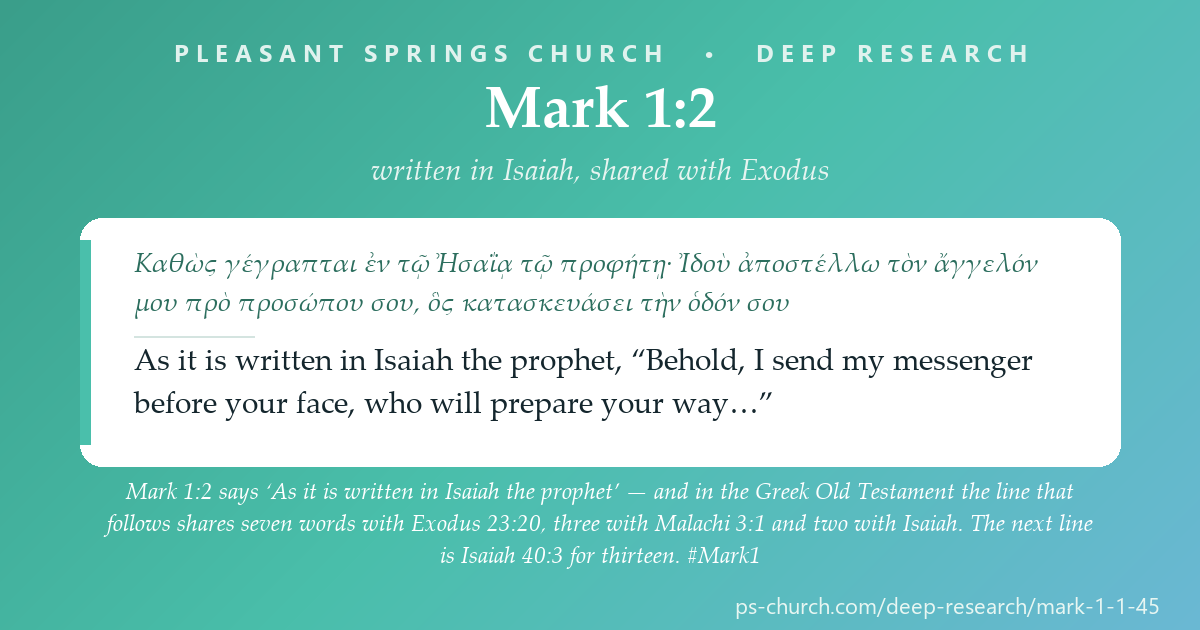
Mark begins with a title and a quotation: “As it is written in Isaiah the prophet”. The line that follows is the first thing this page measured. Against all 30,348 screened verse units of the Greek Old Testament it shares seven consecutive words with Exodus 23:20 (tie band 1), three with Malachi 3:1 and two with Isaiah 40:3. The line after it is Isaiah 40:3 — thirteen words, tie band 1 — and it stops on one pronoun, his paths where Isaiah has our God’s. In Hebrew, Malachi’s line and Isaiah’s are joined by a verb and a noun, clear the way; in Greek they are not. The page then follows the chapter through the baptism, the testing, the first preaching, the four fishermen, Capernaum and the leper, prints its counter-examples beside its findings, and never says who borrowed from whom. See the method →
Mark 1:1–45
Greek NT · ESVVersification. Mark 1 carries no offset: the SBLGNT on this disk numbers the chapter to 45 verses and so does the ESV, and there is no Septuagint column because Mark is a New Testament book. The offsets are in the Old Testament texts the page measures, checked verse by verse against the Masoretic and CATSS files: ESV Malachi 4:4–6 = Masoretic 3:22–24, and the Greek orders the three verses differently again — ESV 4:4 (Moses) = MT 3:22 = LXX 3:24; ESV 4:5 (Elijah) = MT 3:23 = LXX 3:22; ESV 4:6 = MT 3:24 = LXX 3:23. Malachi 3:1 is numbered alike in all three. ESV Isaiah 64:1 = the end of 63:19 in the Hebrew and the Greek. Psalm 106:18 = Septuagint 105:18. 2 Kings 1:8 = Greek 4 Kingdoms 1:8 and 1 Kings 17:18 = Greek 3 Kingdoms 17:18 (CATSS files 4Kgdms and 3Kgdms, same verse numbers). Psalm 2:7, Isaiah 40:3 and 42:1, Exodus 23:20 and 34:28, Genesis 1:9, 8:9, 22:2 and 27:21, Leviticus 13:45–46, 13:49, 14:2 and 14:19, Lamentations 4:18, Zechariah 13:2 and Jeremiah 16:16 are numbered alike in all three. Judges is measured in both CATSS texts, A and B, and every Judges reference names which.
The Shape of the Passage
A sequence with two measured word-chains — NOT a chiasmMark has no birth narrative and no genealogy. The book begins with a title, a quotation and a man in the wilderness, and by the end of its first chapter Jesus has been baptised, tested, has called four men, taught, cast out a spirit, healed a fever and a leper, and cannot enter a town.
Author
Tradition from Papias onward names Mark, interpreter of Peter. The broader tradition identifies him with the John Mark of Acts 12:12 and 12:25. This page cannot test that from the text and does not try. The shelf’s Mark 2–3 study states the same position.
What the text does show is a writer in a hurry. εὐθύς, immediately, as the adverb form, stands in 50 verses of the Greek New Testament, and 40 of them are in Mark. Mark 1 is 7% of Mark’s verses and 6% of its words, and carries 11 of its 41 occurrences (27%). The other form of the adverb, eutheōs, stands in 35 New Testament verses and in none of Mark (as the SBLGNT prints it). Stage 3 shows that this count belongs to an edition.
He also writes Scripture first. Of the four Gospels, Mark is the only one whose first sentence after its title is a quotation, and the only one in which the messenger line stands under Isaiah’s name. In Matthew and Luke the same line is in Jesus’ mouth, about John, with no prophet named (Matthew 11:10, Luke 7:27), and Isaiah’s name goes with Isaiah 40:3 alone (Matthew 3:3, Luke 3:4; John 1:23 likewise).
Audience
Most locate Mark’s first readers in Rome in the 60s. The Gospel explains Jewish custom (7:3–4) and translates its Aramaic. This page reports that location and does not argue it.
Readers who knew the Greek Scriptures. A congregation that heard Isaiah and Exodus and Kings read in Greek would hear Isaiah 40:3 at 1:3 for thirteen words, and Elijah’s leather belt at 1:6 in a phrase the Greek Old Testament uses of no one else. What they would not hear in the Greek of Malachi is the verb that joins Malachi’s line to Isaiah’s in Hebrew (Stage 4).
And readers who would be called unclean. The chapter ends with a man whom the law put outside the camp and Jesus outside the towns. Whatever the community’s exact situation — and the page does not reconstruct it — the chapter’s last scene is about who may come near.
Orient on the gospel, John, the baptism, the testing, the kingdom, the synagogue and the law of leprosy.
Search by topic: Mark, Gospel of; Gospel (euangelion); John the Baptist; Elijah; Baptism of Jesus; Temptation of Jesus; Kingdom of God; Capernaum; Synagogue; Demon, unclean spirit; Leprosy; Clean and unclean.
Which articles are relevant?
- Anchor Bible Dictionary — “Mark, Gospel of,” “John the Baptist,” “Kingdom of God,” “Leprosy,” “Capernaum,” “Synagogue.”
- Dictionary of Jesus and the Gospels (IVP) — “Gospel (Good News),” “Baptism,” “Temptation of Jesus,” “Kingdom of God,” “Clean and Unclean,” “Demon, Devil, Satan.”
- New International Dictionary of NT Theology and Exegesis — εὐαγγέλιον, ἀρχή, κηρύσσω, καιρός, καθαρίζω.
- Commentary on the New Testament Use of the Old Testament (Beale & Carson, 2007) — the Mark chapter, on 1:2–3 and 1:11.
Settle the numbering first
Mark 1 has no offset of its own. The Old Testament texts it is measured against do, and Malachi is the one to watch: the ESV has four chapters where the Hebrew and the Greek have three, and the Greek also reorders the last three verses.
| ESV | Masoretic | Septuagint (CATSS) | |
|---|---|---|---|
| the messenger | Malachi 3:1 | 3:1 | 3:1 |
| Remember the law of my servant Moses | Malachi 4:4 | 3:22 | 3:24 |
| I will send you Elijah | Malachi 4:5 | 3:23 | 3:22 |
| turn the hearts | Malachi 4:6 | 3:24 | 3:23 |
| rend the heavens | Isaiah 64:1 | 63:19 (end) | 63:19 (end) |
| fire in their company | Psalm 106:18 | 106:18 | 105:18 |
The Greek order was read off the file, not a table: CATSS Malachi 3:22 is ἰδοὺ ἐγὼ ἀποστέλλω ὑμῖν Ηλιαν and 3:24 is μνήσθητε νόμου Μωυσῆ. The ESV of the Elijah verse: “Behold, I will send you Elijah the prophet before the great and awesome day of the Lord comes.”
Elijah’s clothing, a Psalm of Solomon, Josephus on John, and the law of the leper.
John dressed as Elijah
“Now John was clothed with camel’s hair and wore a leather belt around his waist and ate locusts and wild honey.” Set beside “They answered him, ‘He wore a garment of hair, with a belt of leather about his waist.’ And he said, ‘It is Elijah the Tishbite.’”
The measured link is the belt, not the hair. ζώνην δερματίνην stands in one Greek Old Testament unit — 4 Kingdoms 1:8 — and the two words with a form of zōn- and of dermatin- anywhere in one unit, unanchored, still find only that one. Malachi names Elijah as the one who comes before the day (ESV 4:5, Greek 3:22, above). Mark never says Elijah in chapter 1; he describes the belt. The diet, ἀκρίδας καὶ μέλι ἄγριον: meli agrion stands in no Greek Old Testament unit, and the locust word akrid- stands in seventeen, one of them the list of insects Israel may eat (Leviticus 11:22).
Two phrases whose nearest Greek Old Testament partner is a Psalm of Solomon
The Psalms of Solomon are a Jewish collection usually dated to the first century BC, held in the CATSS corpus; they are a witness, not Scripture. Two of Mark 1’s phrases find their only Greek Old Testament partner in the seventeenth psalm.
| Mark | the phrase | Greek OT units | where |
|---|---|---|---|
| 1:8 | ἐν πνεύματι ἁγίῳ | 1 | Psalms of Solomon 17:37: δυνατὸν ἐν πνεύματι ἁγίῳ |
| 1:15 | ἡ βασιλεία τοῦ θεοῦ | 1 with the article; 2 with any case of basilei- before (tou) theou | Psalms of Solomon 17:3: ἡ βασιλεία τοῦ θεοῦ ἡμῶν; and Wisdom 10:10: βασιλείαν θεοῦ |
So the kingdom of God, in those words, is not a phrase of the Hebrew Bible’s Greek at all on this disk; it stands in two books outside the Hebrew canon. The shelf’s Psalms of Solomon 10–18 study reads the seventeenth psalm whole. The New Testament has the phrase in 27 verses.
Josephus on John — held here only in English, through Eusebius
The page holds no Greek of Josephus. It holds Eusebius’ Church History 1.11, in McGiffert’s English (NPNF second series, vol. 1), which quotes Antiquities 18:
For Herod slew him, a good man and one who exhorted the Jews to come and receive baptism, practicing virtue and exercising righteousness toward each other and toward God; for baptism would appear acceptable unto Him when they employed it, not for the remission of certain sins, but for the purification of the body, as the soul had been already purified in righteousness.Josephus, Antiquities 18, as quoted by Eusebius, Church History 1.11.5 (McGiffert)
Mark 1:4 says John preached a baptism of repentance for the forgiveness of sins; Josephus, in this translation, says John’s baptism was not for the remission of certain sins. The two descriptions are printed side by side; the page does not harmonise them, and it has not checked the Greek of Josephus.
⚠️ The leper: impurity is not sin
The law of Leviticus 13 diagnoses a condition; it does not accuse a person. “The leprous person who has the disease shall wear torn clothes and let the hair of his head hang loose, and he shall cover his upper lip and cry out, ‘Unclean, unclean.’” “He shall remain unclean as long as he has the disease. He is unclean. He shall live alone. His dwelling shall be outside the camp.”
| units | hamart- (sin) words | what the chapter is about | |
|---|---|---|---|
| Leviticus 13 (diagnosis) | 59 | 0 | the skin, the garment, the house; unclean and clean |
| Leviticus 14 (cleansing) | 57 | 6 | the rite; five name the offering for sin, and one (14:19, Greek only) the man’s own sin |
| Mark 1:40–45 | 6 | 0 | kathar- 4 times |
The honest complication: the cleansing rite of Leviticus 14 does include an offering the ESV calls the sin offering (τὸ περὶ τῆς ἁμαρτίας). And the Greek of the same verse goes further than the Hebrew: atonement is made for the one being cleansed ἀπὸ τῆς ἁμαρτίας αὐτοῦ, from his sin, where the Masoretic text has מִטֻּמְאָתוֹ (ESV from his uncleanness); and at 14:21 the Greek has εἰς ὃ ἐπλημμέλησεν, for what he trespassed, where the Hebrew names a guilt offering. The offering is required of the mother after childbirth too (Leviticus 12:6, 12:8, the same Greek), where the text speaks of uncleanness and names no wrongdoing; for that reason some render it purification offering — Jacob Milgrom, Leviticus 1–16 (AB 3, 1991), is the best-known holder (reported, not checked here). The man in Mark 1 asks to be made clean, Jesus says be clean, and the word sin does not occur. The page treats his condition as impurity and not as sin, because that is what the Hebrew of Leviticus 13–14 and Mark 1:40–45 call it — the Greek of Leviticus 14:19 and 14:21, which speaks of his sin and trespass, is the exception, and is printed above.
The chapter’s word-chains, and a count that turns out to belong to an edition.
Which words carry the chapter?
Three times in Mark 1 (1:1, 1:14, 1:15) of 8 in Mark as MorphGNT holds it (1 of them in the longer ending, 16:15). Matthew has 4, Acts 2, Luke and John none. In the screened Greek Old Testament the singular noun stands in no unit; its plural stands in one (2 Kingdoms 4:10) and the feminine noun of the same family in five (2 Kingdoms 18:20, 18:22, 18:25, 18:27; 4 Kingdoms 7:9) — news carried from a battlefield, and at 4 Kingdoms 7:9 by four lepers who have found the enemy camp empty: ἡμέρα εὐαγγελίας.
50 New Testament verses, 40 of them in Mark, 11 in Mark 1. The table below gives both forms of the adverb by Gospel.
Six times in Mark 1 (1:4, 1:7, 1:14, 1:38, 1:39, 1:45); 14 in Mark as MorphGNT holds it, 2 of those in 16:9–20. John, Jesus, and the leper.
Six times in Mark 1 (1:3, 1:4, 1:12, 1:13, 1:35, 1:45) of 9 in all of Mark. Four at the start, two at the end.
Twice in Mark: the heavens at 1:10, the temple curtain at 15:38. At the baptism Matthew and Luke have opened.
Four times in Mark 1 (1:12, 1:34, 1:39, 1:43): of the Spirit and Jesus, of demons, and of the leper.
In the Greek Old Testament it renders the Hebrew yāḥîd, only, at Genesis 22:2 (and again at 22:12 and 22:16) (τὸν υἱόν σου τὸν ἀγαπητόν for אֶת־בִּנְךָ אֶת־יְחִידְךָ). The phrase my beloved son with both articles stands in no Greek Old Testament unit and in 6 New Testament verses.
5 times in the New Testament (Mt 9:30, Mk 1:43, Mk 14:5, Jn 11:33, Jn 11:38); the ESV here: sternly charged.
⚠️ Immediately, counted — and counted again by edition
By Gospel, on the SBLGNT (distinct verses carrying each form):
| euthys | eutheōs | |
|---|---|---|
| Matthew | 5 | 13 |
| Mark | 40 | 0 |
| Luke | 1 | 6 |
| John | 3 | 3 |
| Acts | 1 | 9 |
On this text Mark uses one form and never the other, and Matthew, Luke and Acts lean the other way. But that is a fact about the SBLGNT. The SBLGNT apparatus records, for each of Mark 1’s 11 euthys, what four other editions print. Counted off the file:
| edition (as the apparatus names it) | euthys in Mark 1 | eutheōs in Mark 1 |
|---|---|---|
| SBLGNT (Holmes) | 11 | 0 |
| Westcott–Hort | 11 | 0 |
| NA28 | 11 | 0 |
| Tregelles | 8 | 2 |
| Robinson–Pierpont | 2 | 9 |
Robinson–Pierpont prints eutheōs at eight of the eleven places, omits the word at 1:23, and adds one at 1:31 (πυρετός WH Treg NA28 ] + εὐθέως RP). On that text, Mark 1 is no longer an euthys chapter. The apparatus compares editions, not manuscripts, and the page makes no manuscript claim.
The composite citation, run by run; the deepest contacts both ways; and the counter-examples.
★ As it is written in Isaiah the prophet — where each run starts and stops
As it is written in Isaiah the prophet, “Behold, I send my messenger before your face, who will prepare your way, the voice of one crying in the wilderness: ‘Prepare the way of the Lord, make his paths straight,’
| Mark | Exodus 23:20 | Malachi 3:1 | Isaiah 40:3 | |
|---|---|---|---|---|
| Greek, run with Mark 1:2 | ἀποστέλλω τὸν ἄγγελόν μου πρὸ προσώπου σου | 7 — ἀποστέλλω τὸν ἄγγελόν μου πρὸ προσώπου σου | 3 — τὸν ἄγγελόν μου | 2 — the way |
| where it starts | Ἰδοὺ ἀποστέλλω | after ἰδοὺ ἐγὼ (Mark has no egō) | after ἰδοὺ ἐγὼ ἐξαποστέλλω (Malachi’s verb is the compound) | — |
| where it stops | ὃς κατασκευάσει τὴν ὁδόν σου | ἵνα φυλάξῃ σε ἐν τῇ ὁδῷ, to guard you on the way | καὶ ἐπιβλέψεται ὁδὸν πρὸ προσώπου μου, and he will look upon a way before my face | — |
| Hebrew | — | הִנֵּה אָנֹכִי שֹׁלֵחַ מַלְאָךְ לְפָנֶיךָ — before you | הִנְנִי שֹׁלֵחַ מַלְאָכִי וּפִנָּה־דֶרֶךְ לְפָנָי — before me | פַּנּוּ דֶּרֶךְ — clear the way |
| ESV | — | Behold, I send an angel before you | Behold, I send my messenger, and he will prepare the way before me | prepare the way of the Lord |
| Greek, run with Mark 1:3 | φωνὴ βοῶντος ἐν τῇ ἐρήμῳ· Ἑτοιμάσατε τὴν ὁδὸν κυρίου, εὐθείας ποιεῖτε τὰς τρίβους | — | 1 | 13, tie band 1 — stops at τοῦ θεοῦ ἡμῶν |
What the table shows. The first line’s deepest Greek Old Testament partner is Exodus 23:20, at seven, tie band 1 (the runner-up is Exodus 33:2, at six); its Malachi run is three. The sequence ἀποστέλλω τὸν ἄγγελόν μου stands in one Greek Old Testament unit, Exodus 23:20; ton angelon mou alone stands in three (Exodus 23:20, Exodus 33:2, Malachi 3:1); and κατασκευάσει τὴν ὁδόν stands in none. The second line matches Isaiah 40:3 for thirteen words and diverges at Mark’s last word, where Isaiah has three.
The Hebrew joins what the Greek does not. Exodus 23:20 has לְפָנֶיךָ, before you, and so does Mark (before your face); Malachi 3:1 has לְפָנָי, before me. The possessive runs the other way: Hebrew Exodus has מַלְאָךְ, an angel (so the ESV), where its Greek and Mark have my, and Hebrew Malachi has מַלְאָכִי, my messenger. But Malachi’s verb is וּפִנָּה־דֶרֶךְ, and Isaiah 40:3 opens its command with פַּנּוּ דֶּרֶךְ. Consonantally, pnw drk stands in three Masoretic verses, all Isaiah (40:3, 57:14, 62:10), and wpnh drk in one, Malachi 3:1. In Greek the four verses get four different verbs: ἑτοιμάσατε (Isaiah 40:3), ἐπιβλέψεται (Malachi 3:1), καθαρίσατε (57:14) and ὁδοποιήσατε (62:10). Greek Isaiah 40:3 and Greek Malachi 3:1 share one word, hodon (pair run 1). Masoretic Malachi 3:1 and Exodus 23:20 share one form, shlḥ, send (pair run 1), and Malachi 3:1 and Isaiah 40:3 one, drk (pair run 1) — contiguous forms only, so the shared root pnh does not register.
Where the wilderness goes. The Masoretic accents on Isaiah 40:3 put a disjunctive on קוֹרֵא (zaqef qatan) and another on בַּמִּדְבָּר (zaqef gadol), and the ESV of Isaiah reads A voice cries: In the wilderness prepare the way — the wilderness is where the way is made. The Greek, φωνὴ βοῶντος ἐν τῇ ἐρήμῳ, and the ESV of Mark, the voice of one crying in the wilderness, put the voice there. The Hebrew’s second place-word, בָּעֲרָבָה, in the desert, has no counterpart in the Greek of Isaiah and none in Mark.
Where the other Gospels put the two lines. Matthew and Luke have the messenger line (Matthew 11:10, run 12 with Mark; Luke 7:27, run 13) in Jesus’ mouth, with it is written and no prophet’s name, and they have Isaiah 40:3 under Isaiah’s name in their third chapters (run 14 each). John 1:23 has the Isaiah line only, in five words, with make straight (Εὐθύνατε) for prepare. Across the four Gospels, Isaiah is named in fourteen verses, and Mark 1:2 is the only one of them carrying the messenger line.
⚠️ One more run, on another edition. Robinson–Pierpont prints behold, I send with ἐγὼ, I (Ἰδοὺ WH Treg NA28 ] + ἐγὼ RP). Re-run with that one word, the first line reaches 9 with Exodus 23:20 (still tie band 1), 3 with Malachi 3:22 — the Elijah verse in Greek numbering, ἰδοὺ ἐγὼ ἀποστέλλω — and still 3 with Malachi 3:1. A single pronoun moves the Exodus run from seven to nine; it does not move Malachi.
The deepest runs out of Mark 1 into the Greek Old Testament
Forty-five rows against the 30,348 screened units (the 64 CATSS files less the Odes; 30,637 are held with the Odes): all 45 reach one, 44 reach two, 39 reach three, 16 reach four, 4 reach five, 2 reach seven, 1 reaches thirteen, and nothing reaches fourteen.
| Mark | deepest run | tie band | partner | what it is |
|---|---|---|---|---|
| 1:3 | 13 | 1 | Isaiah 40:3 | the citation |
| 1:2 | 7 | 1 | Exodus 23:20 | the first line of the citation |
| 1:11 | 5 | 2 | Genesis 27:21, 27:24 | accident: Isaac to the disguised Jacob |
| 1:36 | 5 | 2 | 1 Maccabees 9:62, 9:67 | accident: Σιμων καὶ οἱ μετ' αὐτοῦ, a different Simon |
| 1:15 | 4 | 1 | Psalms of Solomon 17:3 | the kingdom of God (Stage 2) |
| 1:26 | 4 | 1 | Zechariah 13:2 | τὸ πνεῦμα τὸ ἀκάθαρτον: the spirit of uncleanness |
| 1:39 | 4 | 1 | Genesis 1:9 | accident, in a Greek plus (codex note) |
| 1:41 | 4 | 1 | Genesis 8:9 | accident: Noah’s hand and the dove |
| 1:25 | 4 | 1 | Genesis 37:10 | accident: καὶ ἐπετίμησεν αὐτῷ ὁ — Jacob rebuking Joseph |
| 1:23 | 4 | 1 | Psalm 105:18 (ESV 106:18) | accident: ἐν τῇ συναγωγῇ αὐτῶν, fire in their company |
| 1:9 | 4 | 1 | Judith 8:1 | formula: ἐν ἐκείναις ταῖς ἡμέραις — band 1 only because the Greek Old Testament prefers the other order, which stands in 53 units |
| 1:22 | 4 | 1 | Sirach 28:18 | accident: and not as the |
| 1:6 | 4 | 6 | 4 Kingdoms 1:8 and five others | formula — but the belt phrase inside it has one partner |
| 1:17 | 4 | 9 | — | formula: καὶ εἶπεν αὐτοῖς ὁ |
| 1:19 | 4 | 9 | — | formula: τὸν ἀδελφὸν αὐτοῦ, καὶ |
| 1:32 | 4 | 5 | Tobit 2:7 and four others | formula: ὅτε ἔδυ ὁ ἥλιος |
| 1:44 | 3 | 7 | — | Moses named; Leviticus not quoted |
Of the sixteen rows that reach four or more, two are the citation, two are a phrase whose only partner is Psalms of Solomon 17:3 or Zechariah 13:2, five are formulas (tie bands of 5 to 9, or an idiom in its rarer order), and seven are accidents with a tie band of 1 or 2. The seven accidents are on the page so that no other four or five on it is read as a finding by itself.
The deepest runs out of Mark 1 into the rest of the Greek New Testament
Against the 7,254 verses outside Mark: all 45 reach one, 44 reach two, 43 three, 30 four, 18 five, 14 six, 9 eight, 7 nine, 5 ten, 4 twelve, 3 thirteen, 2 fourteen, 1 seventeen, and nothing reaches eighteen.
| Mark | deepest run | tie band | partner |
|---|---|---|---|
| 1:24 | 17 | 1 | Luke 4:34 — the unclean spirit |
| 1:3 | 14 | 2 | Matthew 3:3, Luke 3:4 |
| 1:2 | 13 | 1 | Luke 7:27 (Matthew 11:10 measures 12) |
| 1:22 | 12 | 1 | Matthew 7:29 |
| 1:11 | 10 | 1 | Luke 3:22 (Matthew 3:17 measures 6) |
| 1:19 | 9 | 1 | Matthew 4:21 |
| 1:25 | 9 | 1 | Luke 4:35 |
| 1:6 | 8 | 1 | Matthew 3:4 |
| 1:44 | 8 | 2 | Matthew 8:4, Luke 5:14 |
Seventeen at 1:24 is one of 14 cross-book verse-pairs in the New Testament that reach seventeen or more; only 10 go deeper (the shelf’s Mark 10–11 study counts the same ten). The ransom saying, Mark 10:45 with Matthew 20:28, also measures seventeen. The table says nothing about who read whom.
The baptismal voice, set beside its three usual texts
“And a voice came from heaven, ‘You are my beloved Son; with you I am well pleased.’”
| text | Greek | pair run with Mark 1:11 | ESV |
|---|---|---|---|
| Psalm 2:7 | υἱός μου εἶ σύ (Hebrew בְּנִי אַתָּה) | 2 | You are my Son |
| Isaiah 42:1 | προσεδέξατο αὐτὸν ἡ ψυχή μου | 1 | in whom my soul delights |
| Genesis 22:2 | τὸν υἱόν σου τὸν ἀγαπητόν | 1 | your only son Isaac, whom you love |
| Matthew 12:18 (Isaiah 42:1 as Matthew gives it) | ὁ ἀγαπητός μου εἰς ὃν εὐδόκησεν ἡ ψυχή μου | 2 | my beloved with whom my soul is well pleased |
| Genesis 27:21 | εἰ σὺ εἶ ὁ υἱός μου Ησαυ ἢ οὔ | 5 | whether you are really my son Esau or not |
Psalm 2:7’s order, υἱός μου εἶ σύ, stands in one Greek Old Testament unit and in the three New Testament verses that cite the psalm — Acts 13:33, which names it, and Hebrews 1:5 and 5:5; Mark’s order, sy ei ho huios mou, stands in the Greek Old Testament only in Genesis 27:21 and 27:24. Neither beloved nor well pleased is in the Greek of Isaiah 42:1; both are in Matthew’s own wording of it at 12:18, which measures 5 against the Greek of Isaiah. This is an echo the run screen cannot hear, and the page says so rather than pretending the numbers carry it.
The readings with their holders, the church’s frame labelled as the church’s, and everything this page could not check.
None of the modern works named on this page was re-read for it. Positions are reported as the literature commonly summarises them; a reader who wants to rely on an attribution should check it in the book. Two ancient texts are quoted from files on this disk, in English: Jerome’s Letter 57 and Eusebius’ Church History (both NPNF). Every number on the page was measured on files on this disk and can be re-derived.
Commentaries & studies:
- R. T. France, The Gospel of Mark (NIGTC, 2002); Joel Marcus, Mark 1–8 (AB 27, 2000); Robert A. Guelich, Mark 1–8:26 (WBC 34A, 1989); William L. Lane, The Gospel according to Mark (NICNT, 1974); Adela Yarbro Collins, Mark (Hermeneia, 2007).
- Rikki E. Watts, “Mark,” in Beale and Carson, Commentary on the New Testament Use of the Old Testament (2007), and Isaiah’s New Exodus in Mark (1997).
- Bruce M. Metzger, A Textual Commentary on the Greek New Testament (2nd ed., 1994); Michael W. Holmes, ed., The Greek New Testament: SBL Edition (2010) and its apparatus.
- On the kingdom: C. H. Dodd (1935); Albert Schweitzer (1906); George Eldon Ladd, The Presence of the Future (1974).
- On Mark 1:41: Bart D. Ehrman (2003); Peter J. Williams, NovT 54 (2012).
⚠️ In Isaiah the prophet — what the apparatus file shows, and the readings
The file. The SBLGNT apparatus for 1:2 has four entries, and the second is the ascription: τῷ Ἠσαΐᾳ τῷ προφήτῃ WH Treg NA28 ] τοῖς προφήταις RP. Westcott–Hort, Tregelles and NA28 print what the SBLGNT prints; Robinson–Pierpont prints in the prophets. The same edition also reads Καθὼς WH Treg NA28 ] Ὡς RP and adds σου WH Treg NA28 ] + ἔμπροσθέν σου RP. That is everything the file says. No manuscript is named in it, and this page names none.
An ancient reader asked the question.
On what grounds then has Mark in the very beginning of his book set the words: “As it is written in the prophet Isaiah, Behold I send my messenger,” when, as we have said, it is not written in Isaiah at all, but in Malachi the last of the twelve prophets?Jerome, Letter 57.9, to Pammachius (NPNF second series, vol. 6)
Jerome names Malachi; he does not name Exodus. The run screen finds the Greek of the line nearer to Exodus than to Malachi. Both are true and neither settles the question below. In that same letter Jerome quotes the line as ending prepare thy way before thee — the wording Robinson–Pierpont prints — but the page holds his Latin only in this English translation and has not checked it.
| reading of in Isaiah the prophet | in brief | held by (reported) |
|---|---|---|
| 1. The heading names the principal text | a composite is cited under the name of its main or best-known source; the Isaiah line governs the passage (wilderness, way) and the other line is subordinate | R. T. France, The Gospel of Mark (NIGTC, 2002); Joel Marcus, Mark 1–8 (AB 27, 2000) |
| 2. An error of attribution | the first line is not in Isaiah, and the ascription is simply mistaken | Jerome poses the question himself and names Celsus, Porphyry and Julian as the kind of critic who would call such things falsification (Letter 57.9, held); among moderns, Bart D. Ehrman, Misquoting Jesus (2005) |
| 3. A shared anthology | the lines were already joined in early Christian collections of proof-texts before Mark | J. Rendel Harris, Testimonies (1916–20) |
| 4. The reading in the prophets is secondary | a later text smoothed the ascription; the harder reading is earlier | Bruce M. Metzger, A Textual Commentary on the Greek New Testament (2nd ed., 1994) |
⚠️ The kingdom of God is at hand — four readings, and the church’s frame
What the verb can and cannot settle: ἤγγικεν is a perfect, and in the New Testament the same form is used of the kingdom (Matthew 3:2, 4:17, 10:7; Luke 10:9, 10:11), of the hour and the betrayer (Matthew 26:45–46; Mark 14:42), of what false claimants will say (Luke 21:8), of Jerusalem’s desolation (Luke 21:20) and of the end (Romans 13:12; James 5:8; 1 Peter 4:7). In the Greek Old Testament it stands in four units, among them Lamentations 4:18 (codex note at 1:15). Usage includes both is at the door and is arriving; the form alone does not choose between readings 1 and 3.
| reading of the kingdom of God is at hand (1:15) | in brief | held by (reported) |
|---|---|---|
| 1. Realised | the kingdom has arrived in Jesus’ ministry; ēngiken means has come | C. H. Dodd, The Parables of the Kingdom (1935) |
| 2. Consistent (imminent end) | Jesus announced an end of the age he expected at once | Albert Schweitzer, The Quest of the Historical Jesus (German 1906; English 1910) |
| 3. Inaugurated | the kingdom is present in Jesus and still to come in fullness — already and not yet | George Eldon Ladd, The Presence of the Future (1974) |
| 4. Offered and postponed | a kingdom offered to Israel, refused, and deferred; the church age is a parenthesis | classic dispensationalism; the notes of the Scofield Reference Bible (1909, 1917) |
The church’s frame, labelled as the church’s. Pleasant Springs holds historic premillennialism and rejects the Darby–Scofield system (see what we believe). On that frame reading 3 is at home — Ladd, its best-known modern advocate, was himself a historic premillennialist — and reading 4 is the one tied to the system the church rejects. That is the church’s position; nothing measured on this page establishes it, and nothing measured on it refutes the other readings.
⚠️ Moved with pity or being angry (1:41)
The Greek column prints ὀργισθεὶς; the English column prints Moved with pity. The apparatus: ὀργισθεὶς Holmes WHmarg ] σπλαγχνισθεὶς WH Treg NA28 RP.
| reading at 1:41 | argument in brief | held by (reported, except where marked) |
|---|---|---|
| orgistheis, angry | the harder reading; a scribe would soften anger to pity, not the reverse | the SBLGNT editor, Michael W. Holmes, who prints it (checked: the apparatus); Bart D. Ehrman, “A Leper in the Hands of an Angry Jesus” (2003) |
| splanchnistheis, moved with pity | the far wider attestation; the angry reading is explained otherwise | Westcott–Hort, Tregelles, NA28, Robinson–Pierpont (checked: the apparatus); the ESV; Peter J. Williams, Novum Testamentum 54 (2012) |
Mark has splanchnizomai elsewhere three times (6:34, 8:2, 9:22) and orgizomai nowhere else; the shelf’s Mark 2–3 study names the same difference at 3:5. The page prints both texts and decides nothing.
The leper, and what the church teaches about inherited sin
The church’s frame, labelled as the church’s. Pleasant Springs teaches that what Adam’s children inherit is mortality and corruption, not guilt. Applied here — and the application is this page’s, not a ratified statement — a man’s disease belongs to the mortal condition all share, not to a charge laid against him, which is consistent with what the texts here measure: Leviticus 13 diagnoses with no word for sin, and Mark 1:40–45 cleanses with none. Scripture does also tell of skin disease falling as judgment on a named act — Miriam (Numbers 12:10), Gehazi (2 Kings 5:27), Uzziah (2 Chronicles 26:19–20) — and the page reports that tension; Leviticus 13 and Mark 1 make no such charge. The page labels the doctrine as the church’s and claims no more for the counts than that they agree with it.
What this page did NOT check, and where it is weakest:
- The apparatus compares printed editions, not manuscripts (in Mark 1, the SBLGNT against WH, Tregelles, NA28 and RP; elsewhere in Mark the file also carries an NIV siglum). Every textual statement on the page — at 1:1, 1:2, 1:38, 1:41 and the euthys table — is a statement about what those editions print, read off the SBLGNT apparatus file. No manuscript, papyrus or codex was consulted, and none is named.
- Jerome and Josephus are quoted in nineteenth-century English. Jerome’s Latin and Josephus’ Greek are not on this disk; Josephus is held only as Eusebius quotes him.
- Qumran is not held. The use of Isaiah 40:3 in the Community Rule (1QS 8–9) is often set beside Mark 1:3; no Dead Sea text is on this disk, and the comparison is not made here.
- The Greek Old Testament is Rahlfs as digitised by CATSS, screened as 30,348 units (30,637 held with the Odes). No Göttingen apparatus and no other Greek witness to Exodus, Malachi or Isaiah was searched; a different Greek text of Malachi 3:1 could change the Malachi run.
- The run screen hears verbatim contact only. Psalm 2:7 scores 2 and Isaiah 42:1 scores 1 against the voice at 1:11; Leviticus scores 2 against 1:44; the forty days score nothing because of a vowel. The page names these uses from the text and the commentaries and reports the scores as the limit of the method, not as evidence against the use.
- The Hebrew join at Malachi 3:1 and Isaiah 40:3 is consonantal. It counts forms, not lemmas; the reading of the Masoretic accents on Isaiah 40:3 reports the two accent names and the ESV’s punctuation, and does not settle the Hebrew syntax.
- The structure diagram is ours. It is built from counted word-chains, not from any commentary’s outline, and is labelled a sequence, expressly not a chiasm.
- The Psalms of Solomon, Wisdom, Judith, Sirach, Tobit and 1 Maccabees are witnesses, not Scripture. They are screened because CATSS holds them, and labelled wherever they are named.
- Direction of influence is never asserted. Where Mark’s wording stands nearer Exodus than Malachi, or nearer the Hebrew of Isaiah 63:19 than the Greek, the page reports the match and nothing more.
- The author is reported from tradition; the place and date of writing are reported, not argued.
The way is prepared from more than one direction.
Name what you learned, why it matters, and one concrete response.
What should we carry away — and do?
- The gospel begins with Scripture already speaking. Before Jesus says a word in Mark, Isaiah and the law and the prophets have spoken — the angel sent before Israel, the messenger before the Lord, the voice in the wilderness.
- The kingdom comes near with a demand. “repent and believe in the gospel” — two imperatives, side by side, a pairing that stands in no other verse of the Greek New Testament and in no Greek Old Testament unit screened here.
- He calls ordinary people from ordinary work. “Follow me, and I will make you become fishers of men”
- He touches the one the law kept outside. The leper asked to be made clean, not forgiven, and was. By the end of the chapter it is Jesus who is out in desolate places, and people are coming to him from every quarter.
Step in response: read Exodus 23:20, Malachi 3:1 and Isaiah 40:3 one after another, then Mark 1:2–3. Notice who is sent, who goes before whom, and where the way runs. Then read Mark 1:40–45 and ask who in your own town lives outside the camp.
Mark 1:2 · to share
Greek NT + ESVEvery Deep Research page traces its passage across the whole sweep — the Old Testament, the Second-Temple world between the testaments (historical witnesses, not Scripture), and the New Testament. Follow the thread:
Pleasant Springs Church — Deep Research
Research method after Michael S. Heiser’s Bible Research Method (examine dictionaries → ancient literature → important words → textual connections → academic publications → share), with the Pleasant Springs “Author & Audience” foundation. Scripture set in the Hebrew, the Greek editions named on each page and the ESV (Old Testament), and the Greek New Testament and the ESV (New Testament), per the practice of Pleasant Springs Church. Mark works named on this page (none re-read for it): France, Marcus, Guelich, Lane, Yarbro Collins, Watts, Metzger, with Dodd, Schweitzer and Ladd on the kingdom and Ehrman and Williams on 1:41 — none of which were consulted for any number on this page. Text: Greek New Testament from the SBL edition as digitized by MorphGNT (text and lemma columns); SBLGNT apparatus, Michael W. Holmes (ed.), Society of Biblical Literature and Logos Bible Software, CC BY 4.0; Greek Old Testament from Rahlfs’ Septuaginta as digitized by CATSS; Hebrew from the Masoretic text as printed in Sefaria’s Miqra according to the Masorah; Jerome and Eusebius from the Nicene and Post-Nicene Fathers, second series. ⚠️ VERSE NUMBERING. Mark 1 has no offset. ESV Malachi 4:4 = MT 3:22 = LXX 3:24; ESV 4:5 = MT 3:23 = LXX 3:22; ESV 4:6 = MT 3:24 = LXX 3:23. ESV Isaiah 64:1 = MT and LXX 63:19 (end). Psalm 106:18 = Septuagint 105:18. 2 Kings = 4 Kingdoms and 1 Kings = 3 Kingdoms, same verse numbers here. The other texts are numbered alike in all three. ⚠️ The measurement, in full. Greek against Greek; MorphGNT normalised word; CATSS form column, beta-code transliterated first; both sides lowercased, accents and breathings dropped, final sigma folded, with the shelf’s edition-equivalence table on cross-corpus screens. Contiguous runs of whole word forms, never lemmas. 45 rows against 30,348 verse units — the 64 CATSS files less the Odes — and against the 7,254 verses of the Greek New Testament outside Mark. Hebrew phrase counts consonantal, over 23,204 Masoretic verse units. Exhaustive and deterministic. It finds verbatim contact, not allusion.
Scripture quotations marked ESV are from the ESV® Bible (The Holy Bible, English Standard Version®), © 2001 by Crossway, a publishing ministry of Good News Publishers. ESV Text Edition: 2016. Used by permission. All rights reserved. The ESV text may not be quoted in any publication made available to the public by a Creative Commons license, and the ESV may not be translated in whole or in part into any other language. www.esv.org
|
Did this study bless you today? 💚 Give to Support PS Church100% of gifts go to the General Fund — thank you. |