Magi from the east, a star, a king who is troubled and a city troubled with him; the scribes who know the text and are not said to go; the flight by night to Egypt; the boys of Bethlehem; and the return, not to Bethlehem but to Nazareth. Matthew gives each of the four scenes a text of Scripture. Measured against the Greek Old Testament, the quotations of Micah, Hosea and Jeremiah share 3, 2 and 4 consecutive words with their sources, and the Nazarene matches no verse — while Matthew’s own formula lines repeat Matthew 1:22 and 27:9 for 10 and 9. And where the quotations leave the Greek, twice the word that stands there is the Hebrew’s — my son and to be comforted — and once, rulers, it fits the Hebrew consonants. See the method →
Matthew 2:1–23
Greek NT · ESVVersification. Matthew 2 carries no offset: the Greek New Testament on this disk and the ESV both number the chapter to 23 verses, and there is no Septuagint column because Matthew is a New Testament book. The offsets are in the Old Testament texts the page measures, checked verse by verse against the Masoretic and CATSS files before being stated: Micah 5:2 (ESV) = Micah 5:1 in the Hebrew and the Greek, and ESV 5:4 = 5:3 (the Hebrew and Greek chapter 5 begin one verse later, the ESV 5:1 being their 4:14); Jeremiah 31:15–16 (Hebrew and ESV) = Septuagint Jeremiah 38:15–16, because the Greek Jeremiah orders its chapters differently; Psalm 72:10–11 = Septuagint 71:10–11 (chapter only); Psalm 77:2 (ESV) = Masoretic 77:3 = Septuagint 76:3; 2 Samuel = 2 Kingdoms (2 Reigns), 1 Chronicles = 1 Paraleipomena. Hosea 11:1, Exodus 1:22, 2:15, 2:23, 4:19, 4:20 and 4:22, Numbers 23:22, 24:8 and 24:17, Genesis 35:19 and 37:35, Judges 13:5 and 16:17, Isaiah 11:1, 47:13, 49:6, 60:3 and 60:6, Lamentations 4:7, Daniel 2:2 and 11:7, 1 Samuel 23:23 and Zechariah 12:5–6 are numbered alike in all three. Judges is measured in both CATSS texts (A and B); Daniel in both Greek versions (Old Greek and Theodotion), and each is named where it is printed.
The Shape of the Passage
A sequence of four scenes; the last three framed by repeated words — NOT a chiasmMatthew 1 ended with a name — All this took place to fulfill what the Lord had spoken by the prophet — and a child called Jesus. Chapter 2 asks where he belongs. Four places, four texts, and a king who wants him dead.
Author
The Gospel does not name its writer. Second-century tradition attaches it to Matthew the tax collector, and the oldest witness to that tradition is Papias, as Eusebius quotes him:
So then Matthew wrote the oracles in the Hebrew language, and every one interpreted them as he was able.Papias, as quoted by Eusebius, Church History 3.39.16 (NPNF2 1, held in the shelf’s library)
What Papias meant by the Hebrew language and by oracles is disputed, and this page does not settle it. It notes one thing the measurement shows, and draws nothing from it: the formula lines of Matthew 2 repeat Matthew’s own Greek word for word across chapters (runs of 10 and 9) — while two of its quotations have, at the point where they leave the Septuagint, a word that matches the Hebrew, and a third one that matches the Hebrew consonants (Stage 4).
He writes as one who searched the Scriptures for where the Messiah belongs. Bethlehem is answered from Micah by the scribes; Egypt, Ramah and Nazareth he answers himself, each with fulfilled.
Audience
Readers who would know the stories under the story. The chapter never says Moses or Pharaoh; it lets a king kill boys, a child escape, and an angel say those who sought the child’s life are dead — and its first two Greek words, τεθνήκασιν γὰρ, stand in Exodus 4:19 and in no other Greek Old Testament unit held here. A reader who catches that has to know Exodus.
Readers asked where a Messiah from Nazareth could come from. The question is in the New Testament itself: “Nathanael said to him, ‘Can anything good come out of Nazareth?’ Philip said to him, ‘Come and see.’” and “Has not the Scripture said that the Christ comes from the offspring of David, and comes from Bethlehem, the village where David was?” Matthew 2 is, among other things, an answer: born in Bethlehem, raised in Nazareth, and both by Scripture. Who first read it, and where, the page does not reconstruct.
Orient on the magi, the star, Herod and his sons, Bethlehem and Ramah, Nazareth, and the fulfilment formula.
Search by topic: magi, star of Bethlehem, Herod the Great, Archelaus, Bethlehem, Ramah, Rachel’s tomb, Nazareth, Nazarene / Nazorean, Nazirite, frankincense and myrrh, dreams, fulfilment quotations, Moses typology.
Which articles are relevant?
- Anchor Bible Dictionary — “Magi,” “Herod,” “Archelaus,” “Bethlehem,” “Ramah,” “Nazareth,” “Nazarene.”
- Dictionary of Jesus and the Gospels (2nd ed.) — “Birth of Jesus,” “Matthew, Gospel of,” “Old Testament in the Gospels,” “Herodian Dynasty.”
- NIDNTTE / TDNT — μάγος (magus), ἀστήρ (star), ἀνατολή (rising, east), ὄναρ (dream), Ναζωραῖος (Nazarene), πληρόω (fulfil).
Bibliography surfaced:
- Raymond E. Brown, The Birth of the Messiah (1977; updated ed. 1993).
- W. D. Davies and Dale C. Allison, Matthew 1–7 (ICC, 1988); Donald A. Hagner, Matthew 1–13 (WBC 33A, 1993); R. T. France, The Gospel of Matthew (NICNT, 2007); Ulrich Luz, Matthew 1–7 (Hermeneia, 2007); Craig S. Keener, The Gospel of Matthew (2009).
- Krister Stendahl, The School of St. Matthew (1954) and “Quis et Unde? An Analysis of Mt 1–2” (1960); Robert H. Gundry, The Use of the Old Testament in St. Matthew’s Gospel (1967); Maarten J. J. Menken, Matthew’s Bible (2004).
- Craig L. Blomberg, “Matthew,” in G. K. Beale and D. A. Carson, eds., Commentary on the New Testament Use of the Old Testament (2007).
- On the star: Michael R. Molnar, The Star of Bethlehem: The Legacy of the Magi (1999); Colin J. Humphreys, “The Star of Bethlehem — a Comet in 5 BC — and the Date of the Birth of Christ,” QJRAS 32 (1991).
Magi in Daniel, a star-gazer from the east in Numbers, Herod in Josephus, and the earliest Christian readers.
Read the Greek Old Testament’s magi and star-gazers, the Moses story the chapter echoes, and the second-century Christian writers who first read the chapter. Josephus is not on this disk, so everything this stage says from him is reported, not checked.
Which parallels shed light on religion and worldview?
Magi in the Greek Bible are Babylon’s. Measured: the noun μάγος stands in 10 Greek Old Testament units, and every one of them is in Daniel (two in the Old Greek, eight in Theodotion) — the court experts who cannot tell the king his dream (chapters 2 and 4) or read the writing on the wall (chapter 5). At Daniel 2:2 Theodotion’s list is τοὺς ἐπαοιδοὺς καὶ τοὺς μάγους καὶ τοὺς φαρμακοὺς καὶ τοὺς Χαλδαίους, and the Hebrew list it stands beside is rendered by the ESV the magicians, the enchanters, the sorcerers, and the Chaldeans — the magoi standing second, where the ESV has enchanters. In Matthew the magi come to worship and are then warned in a dream; Daniel’s could not tell the king his dream at all. Isaiah 47:13 mocks the star-gazers of Babylon who cannot save her: those who divide the heavens, who gaze at the stars (Greek οἱ ἀστρολόγοι τοῦ οὐρανοῦ οἱ ὁρῶντες τοὺς ἀστέρας).
A seer from the east who saw a star. Balaam came ἀπ' ἀνατολῶν, from the east, and in his fourth oracle said a star shall come out of Jacob. Measured: from the east stands in 42 Greek Old Testament units, so it points nowhere by itself; Matthew 2:2 against Numbers 24:17 is a pair run of 1; and the star-word differs — Numbers has ἀνατελεῖ ἄστρον, Matthew τὸν ἀστέρα ἐν τῇ ἀνατολῇ. What the two share is a root: Numbers’ verb shall rise and Matthew’s noun rising are both anatel- / anatol-. The run screen cannot see that, and the page reports it as a shared root, not a quotation.
Herod and his sons (reported). Josephus, the main source for Herod’s last years, his killing of three of his own sons, his death and the division of his kingdom — Archelaus over Judea, Idumea and Samaria, Antipas over Galilee — is not held here. Commentators commonly report that Josephus does not mention the killing at Bethlehem, and that a village of Bethlehem’s size would have had perhaps a few dozen boys under two; neither report is checked on this page. Matthew’s note at 2:22, that Joseph was afraid to go there, stands in the text without comment.
The earliest Christian readers. Writers of the second to fourth centuries held on this disk read the chapter closely, and each is a witness to how it was heard, not Scripture. Ignatius, early in the second century, made the star a cosmic sign:
A star shone forth in heaven above all the other stars, the light of which was inexpressible, while its novelty struck men with astonishment.Ignatius, To the Ephesians 19 (shorter recension; ANF 1, held)
Justin, in the middle of the century, retells the scene to a Jewish interlocutor and says where the magi came from — which Matthew does not:
Now this king Herod, at the time when the Magi came to him from Arabia, and said they knew from a star which appeared in the heavens that a King had been born in your country, and that they had come to worship Him, learned from the elders of your people that it was thus written regarding Bethlehem in the prophetJustin Martyr, Dialogue with Trypho 78 (ANF 1, held)
Justin’s Arabia is his, not the text’s; Matthew says only wise men from the east. The tradition that they were three and kings is later still, and the text has neither: three is the number of the gifts.
- Exodus 1–4 — Pharaoh’s decree against the boys (1:22), Moses’ flight (2:15), the king’s death (2:23), the command to return (4:19) and the firstborn son (4:22). See Exodus 1, Exodus 2 and Exodus 4.
- Numbers 22–24 — Balaam, the seer from the east (see Numbers 24:15–19).
- Daniel 2, 4, 5 — the magi of Babylon.
- Genesis 35:16–20; 48:7 — Rachel dies on the way to Ephrath (that is, Bethlehem). The Bethlehem of 2:16 and the Rachel of 2:18 meet already in Genesis.
- Ignatius, Ephesians 19; Justin, Dialogue 78; Chrysostom, Homilies on Matthew 6 and 9 — held in the shelf’s library (ANF 1; NPNF1 10).
The chapter calls Herod Herod the king and the child king of the Jews, and it never lets the two meet. Herod hears of him, asks about him, sends men to find him, kills boys to be rid of him — and dies, and the angel announces it in the plural. The man on the throne could not find the one the title belonged to. When Matthew next uses the title, the king of the Jews, Pilate asks it of a prisoner (27:11); then it is written over a cross (27:37).
Magi, the star, the dream, the withdrawal, comfort, and a title no prophet uses.
Each count below was run against the corpora on this disk, not quoted from a lexicon: 7,927 verses of Greek New Testament (MorphGNT lemma column) and 30,348 verse units of Greek Old Testament screened out of the 64 CATSS files held (30,637 held; the 289 units of the Odes are held but not screened, by house convention, and where a word’s absence is claimed the Odes were searched too). Every nowhere and only on this page was run on the normalised word form without anchoring the start of the word, so that augments, prefixes and apparatus sigla cannot hide a form.
Magi. Measured: 4 occurrences in Matthew 2, 6 in the New Testament (the others are the magician of Acts 13:6, 8). In the Greek Old Testament the noun stands in 10 units, all in Daniel. Matthew neither praises nor condemns their craft; he tells what they did.
Star. 4 of Matthew’s 5 uses are in this chapter. In the Greek Old Testament the forms of astēr stand in 21 screened units and those of astron in 39; Numbers 24:17 has astron.
Dream, always in the phrase kat’ onar, in a dream. Measured: 6 New Testament verses, every one of them in Matthew (Matthew 1:20, 2:12, 2:13, 2:19, 2:22, 27:19), and the word stands in no Greek Old Testament unit, screened or held — the Greek Old Testament’s dream-word is another.
To withdraw, to depart. 4 of Matthew’s 10 uses are in this chapter: the magi withdraw (2:12, 13), and Joseph withdraws twice (2:14, 22). The form anechōrēsen stands in 6 Greek Old Testament units, one of them Moses fleeing Pharaoh (Exodus 2:15).
To be comforted. This form, the aorist passive infinitive, stands in one Greek Old Testament unit — Psalm 76:3 (ESV 77:2), my soul refuses to be comforted — and not in Jeremiah, whose Greek has to cease (Stage 4).
Nazarene / Nazorean. Measured: the lemma stands 13 times in the New Testament; no form beginning nazōr- or nazar- stands in any Greek Old Testament unit, screened or held. The Nazirite word, nazir-, stands in 6 units (Judges 13:5, 13:7, 16:17 in the A text; Judges 13:5 in the B text; Lamentations 4:7; 1 Maccabees 3:49), and it differs in its second vowel.
Word chains, counted rather than asserted:
- Herod ×9 — of Matthew’s 13. He is named in every scene; in the last, only as the dead father of Archelaus (2:22).
- The child ×9 — παιδίον, never his name after 2:1. τὸ παιδίον καὶ τὴν μητέρα αὐτοῦ four times (2:13, 14, 20, 21), and nowhere else in the New Testament.
- Worship ×3 — 2:2, 2:8, 2:11: the magi come to worship, Herod says he will, the magi do.
- kat’ onar ×4 — 2:12, 13, 19, 22; with 1:20 and 27:19, every use in the New Testament.
- Fulfilled ×3 — Matthew 2:15, 2:17, 2:23. The first text (2:6) is written, not fulfilled.
- what was spoken — τὸ ῥηθὲν stands in 12 New Testament verses, all in Matthew, and in no Greek Old Testament unit; in order that what was spoken might be fulfilled in 8. Only 1:22 and 2:15 add by the Lord.
Four texts, measured against the Greek and set beside the Hebrew — and the deepest run is Matthew’s own.
The method: every verse of Matthew 2 (23 rows) was screened against the 30,348 screened Greek Old Testament units for the longest contiguous run of identical normalised word forms, with the tie band — how many units reach that depth — beside each run; then against the other 7,904 verses of the Greek New Testament. Word forms, never lemmas; a change of case or of order breaks the run. It finds verbatim contact, not allusion. Each Old Testament text the passage is said to use was then set against its verse one to one. Greek cannot be screened against Hebrew, so the Hebrew columns below are an alignment read off the texts, word by word, and labelled as that.
What the screen returned:
Against the Greek Old Testament, the 23 rows: all 23 reach two, 21 reach three, 13 reach four, 5 reach five, and nothing reaches six. Against the rest of the Greek New Testament: all 23 reach two, 20 reach three, 10 reach four, 6 reach five, 2 reach nine, 1 reaches ten, and nothing reaches eleven.
| Matthew | against the Greek OT | against the rest of the Greek NT | what it is |
|---|---|---|---|
| 2:6 | 5, band 4 (2 Samuel 5:2 and three others) | 2, band 190 | signalled (for so it is written); Micah for 3, 2 Samuel for 5 |
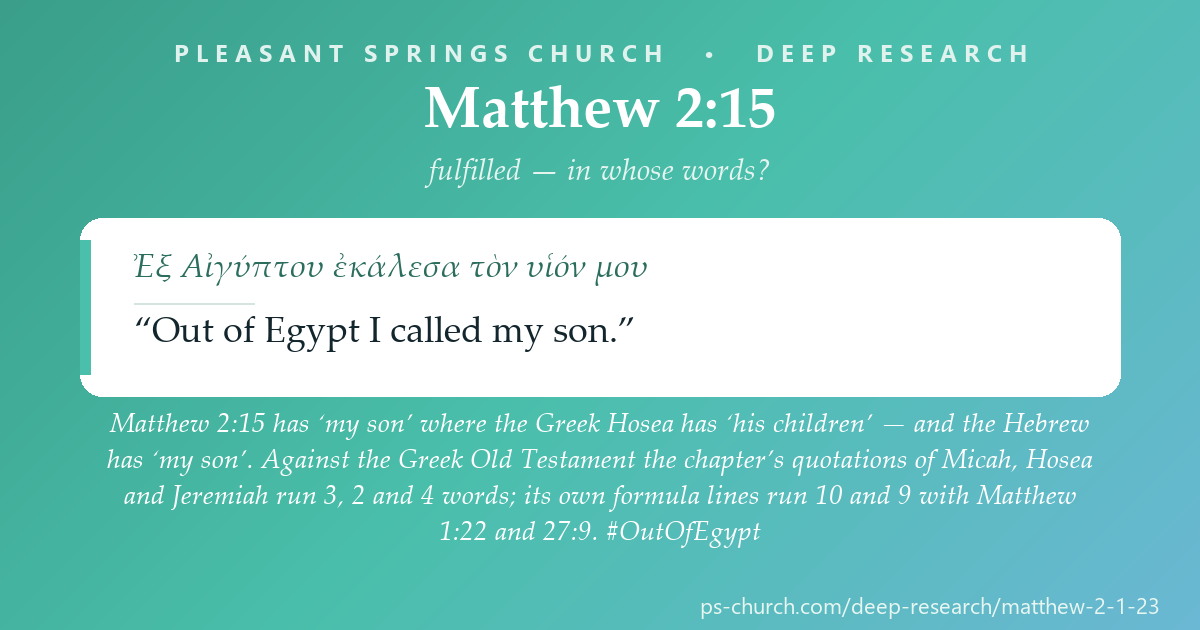
| 2:15 | 3, band 30 (τὸν υἱόν μου in 16 of them) | 10, band 1 (Matthew 1:22) | Hosea 11:1 itself measures 2 |
| 2:17 | 3, band 2 | 9, band 1 (Matthew 27:9) | the formula alone |
| 2:18 | 4, band 5 (Jeremiah 38:15 and four accidents) | 3, band 7 | signalled; tied with τὰ τέκνα αὐτῆς, καὶ |
| 2:23 | 3, band 1 (Jeremiah 23:16, τῶν προφητῶν ὅτι) | 5, band 2 (Matthew 8:17, 13:35) | signalled; no source; the 3 is formula words |
| 2:1, 2:5, 2:9, 2:12 | 4, band 1 each | — | accidents — counter-examples |
| 2:13, 2:16, 2:20, 2:21 | 5, band 2 each | — | accidents (and his mother and; and in all the regions) |
Read it slowly. No row in Matthew 2 reaches six consecutive words against the Greek Old Testament. The five rows that reach five are one citation whose five words are not in the text it quotes (2:6: shared with 2 Samuel 5:2 and three other units, not with Micah) and four accidents. The four quotations measure 3 (Micah), 2 (Hosea), 4 (Jeremiah, tied with four accidents) and 1 (none). And against the New Testament, the two deepest rows in the chapter are not quotations at all. They are the lines that introduce quotations — 2:15 with 1:22, ten words, and 2:17 with 27:9, nine words, each at a tie band of one. Inside the chapter, the angel’s command and Joseph’s obedience repeat each other at ten. The deepest verbatim contact in Matthew 2 is Matthew with Matthew.
Shallow runs against the Septuagint are not, by themselves, interesting: a paraphrase scores low. What is interesting is where each quotation leaves the Greek, and what stands there instead. In two of the four, at the point of departure, Matthew’s word matches the Hebrew; in a third it fits the Hebrew consonants; the fourth has no source to depart from.
Hosea 11:1. Where the Greek has τὰ τέκνα αὐτοῦ, his children, Matthew has τὸν υἱόν μου, and the Hebrew has לִבְנִי, my son. The three words the Greek of Hosea lacks are the commonest of the three-word sequences at Matthew 2:15’s deepest run against the whole Greek Old Testament (16 of the 30 tied units). Jerome saw the same difference in the fourth century and said so (Stage 5).
Jeremiah 31:15. Where Jeremiah’s Greek has οὐκ ἤθελεν παύσασθαι, she would not cease, Matthew has οὐκ ἤθελεν παρακληθῆναι, and the Hebrew has מֵאֲנָה לְהִנָּחֵם, she refused to be comforted. Then a second measurement: the form παρακληθῆναι stands in exactly one Greek Old Testament unit, Psalm 76:3 (ESV 77:2; Masoretic 77:3) — and there it renders the same two Hebrew words, without Jeremiah’s prefix l-, מֵאֲנָה הִנָּחֵם. In Hebrew, the pairing refuse + be comforted stands in three verses (table below), and one of the other two is Jacob mourning Rachel’s son.
Micah 5:1. Where Micah’s Greek has ἐν χιλιάσιν Ιουδα, among the thousands, Matthew has ἐν τοῖς ἡγεμόσιν Ἰούδα, among the rulers. The Hebrew’s בְּאַלְפֵי יְהוּדָה is pointed thousands in the Masoretic text; but the same consonants, ’lpy yhwdh, with or without a prefix, stand in four Masoretic verses, and in two of them (Zechariah 12:5, 12:6) they are pointed אַלֻּפֵי יְהוּדָה, the chiefs of Judah — the ESV renders both Micah and Zechariah the clans of Judah. The Greek Zechariah has οἱ χιλίαρχοι Ιουδα, the commanders of thousands. Here the match is to the Hebrew consonants, not to the Masoretic pointing, and the page says so.
And one echo goes the other way. Exodus 4:19 is not a quotation, but here the chapter’s wording and an Old Testament verse meet on a pair of words found once in each Testament (one of twenty such pairs in the chapter, most of them accidents): τεθνήκασιν γὰρ. In the Greek Exodus, 4:19 itself begins with the king’s death (ἐτελεύτησεν ὁ βασιλεὺς Αἰγύπτου), so that the dead king and they are dead stand in one verse, as Herod’s death (2:19) and the angel’s they are dead (2:20) stand together in Matthew. The Hebrew of Exodus 4:19 has no such clause; it puts the king’s death two chapters earlier, at 2:23 (וַיָּמׇת מֶלֶךְ מִצְרַיִם, the king of Egypt died). The Greek has the clause at both places.
What this does not show. It does not show that Matthew translated from Hebrew, or used a revised Greek text, or a collection of proof-texts, or a Gospel source; all four are proposed in the literature (Stage 5), and the disk holds no Greek text of these prophets other than Rahlfs’ as digitized by CATSS. Where the Greek and Matthew differ, the page reports which text has Matthew’s word. It does not say who had it first.
Hosea 11:1, word by word:
| Matthew 2:15 | Septuagint Hosea 11:1 | Masoretic Hosea 11:1 | |
|---|---|---|---|
| out of Egypt | Ἐξ Αἰγύπτου | ἐξ Αἰγύπτου | וּמִמִּצְרַיִם |
| I called | ἐκάλεσα | μετεκάλεσα | קָרָאתִי |
| whom | τὸν υἱόν μου my son | τὰ τέκνα αὐτοῦ his children | לִבְנִי my son |
Pair run against the Greek: 2. The Hebrew קָרָאתִי לִבְנִי (I called to my son) stands in one Masoretic verse, this one. The Greek of Numbers 24:8, sometimes proposed as a second source, measures 2 (θεὸς ὡδήγησεν αὐτὸν ἐξ Αἰγύπτου, God led him out of Egypt); Exodus 4:22, Israel is my firstborn son, measures 1.
Jeremiah 31:15 (LXX 38:15), word by word:
| Matthew 2:18 | Septuagint Jeremiah 38:15 | Masoretic Jeremiah 31:15 | |
|---|---|---|---|
| a voice in Ramah | Φωνὴ ἐν Ῥαμὰ ἠκούσθη | φωνὴ ἐν Ραμα ἠκούσθη | קוֹל בְּרָמָה נִשְׁמָע |
| the cry | κλαυθμὸς καὶ ὀδυρμὸς πολύς | θρήνου καὶ κλαυθμοῦ καὶ ὀδυρμοῦ | נְהִי בְּכִי תַמְרוּרִים |
| Rachel weeping | Ῥαχὴλ κλαίουσα | Ραχηλ ἀποκλαιομένη | רָחֵל מְבַכָּה |
| for her children | τὰ τέκνα αὐτῆς | ἐπὶ τοῖς υἱοῖς αὐτῆς | עַל־בָּנֶיהָ (twice) |
| refused | οὐκ ἤθελεν | οὐκ ἤθελεν | מֵאֲנָה |
| to be comforted | παρακληθῆναι to be comforted | παύσασθαι to cease | לְהִנָּחֵם to be comforted |
| they are no more | ὅτι οὐκ εἰσίν | ὅτι οὐκ εἰσίν | כִּי אֵינֶנּוּ |
Pair run against the Greek: 4. κλαυθμὸς καὶ ὀδυρμὸς in the nominative stands in no Greek Old Testament unit; Jeremiah’s Greek has three nouns in the genitive, the Hebrew three nouns, and Matthew two nouns and much. The Hebrew says for her children twice; the Greek and Matthew once.
| verse | the Hebrew: refused to be comforted | the Greek Old Testament | the ESV |
|---|---|---|---|
| Genesis 37:35 — Jacob, for Joseph | וַיְמָאֵן לְהִתְנַחֵם | οὐκ ἤθελεν παρακαλεῖσθαι | he refused to be comforted |
| Jeremiah 31:15 (LXX 38:15) — Rachel | מֵאֲנָה לְהִנָּחֵם | οὐκ ἤθελεν παύσασθαι | she refuses to be comforted for her children |
| Psalm 77:3 (ESV 77:2; LXX 76:3) | מֵאֲנָה הִנָּחֵם | ἀπηνήνατο παρακληθῆναι | my soul refuses to be comforted |
| Matthew 2:18 | — | οὐκ ἤθελεν παρακληθῆναι | she refused to be comforted |
The Hebrew pairing is counted consonantally, a refuse form followed directly by a comfort form, over 23,204 Masoretic verse units: 3 verses. Pair runs with Matthew 2:18: Genesis 37:35 = 3 (καὶ οὐκ ἤθελεν), Psalm 76:3 = 2.
Micah 5:1 (ESV 5:2) and 2 Samuel 5:2, word by word:
| Matthew 2:6 | Septuagint Micah 5:1 | Masoretic Micah 5:1 | 2 Samuel 5:2 (Greek) | |
|---|---|---|---|---|
| and you, Bethlehem | Καὶ σύ, Βηθλέεμ | καὶ σύ Βηθλεεμ | וְאַתָּה בֵּית־לֶחֶם | — |
| of Judah / Ephrathah | γῆ Ἰούδα | οἶκος τοῦ Εφραθα | אֶפְרָתָה | — |
| least | οὐδαμῶς ἐλαχίστη εἶ by no means least | ὀλιγοστὸς εἶ you are very few | צָעִיר לִהְיוֹת little to be | — |
| among the … of Judah | ἐν τοῖς ἡγεμόσιν Ἰούδα rulers | ἐν χιλιάσιν Ιουδα thousands | בְּאַלְפֵי יְהוּדָה consonants also read chiefs (below) | — |
| from you shall come | ἐκ σοῦ γὰρ ἐξελεύσεται | ἐκ σοῦ μοι ἐξελεύσεται | מִמְּךָ לִי יֵצֵא for me, as in the Greek; not in Matthew | — |
| a ruler | ἡγούμενος | εἰς ἄρχοντα | מוֹשֵׁל | εἰς ἡγούμενον |
| who will shepherd my people Israel | ποιμανεῖ τὸν λαόν μου τὸν Ἰσραήλ | ἐν τῷ Ισραηλ | בְּיִשְׂרָאֵל | ποιμανεῖς τὸν λαόν μου τὸν Ισραηλ |
Pair runs: Micah 5:1 = 3; 2 Samuel 5:2 = 5; 1 Chronicles 11:2 = 5. Matthew’s verb form ποιμανεῖ is not 2 Samuel’s (you shall shepherd); it stands in 6 Greek Old Testament units, one of them two verses on in Micah, ποιμανεῖ τὸ ποίμνιον αὐτοῦ (ESV 5:4, shepherd his flock). ἡγεμόσιν stands in one Greek Old Testament unit (1 Esdras 6:26). The consonants בְּאַלְפֵי יְהוּדָה stand in four Masoretic verses: 1 Samuel 23:23 (all the thousands of Judah), Micah 5:1, and Zechariah 12:5 and 12:6. The ESV Micah’s too little to be among the clans of Judah is a rendering of the Hebrew; Matthew’s by no means least reverses it, and neither the Greek nor the Hebrew has the negative.
⚠️ He shall be called a Nazarene: the candidates, measured
| candidate | the word | Greek Old Testament | pair run with 2:23 |
|---|---|---|---|
| Judges 13:5 (A); also 13:7, 16:17 | כִּי־נְזִיר | ναζιραῖον — B text ναζιρ | 1 |
| Lamentations 4:7 (Tertullian) | נְזִירֶיהָ | ναζιραῖοι αὐτῆς — ESV Her princes | 1 |
| Isaiah 11:1 (Jerome) | וְנֵצֶר — ESV a branch | ἄνθος — a flower | 1 |
| Isaiah 49:6 | וּנְצוּרֵי — ESV the preserved of Israel | τὴν διασπορὰν — the dispersion | 1 |
| Matthew 2:23 | — | Ναζωραῖος κληθήσεται | — |
No Old Testament verse says it. The phrase Ναζωραῖος κληθήσεται stands in no Greek Old Testament unit, and no form beginning nazōr- or nazar- stands in any of the 30,637 units held. Every candidate scores 1 against 2:23, and what is shared is a single function word (and, the, that, into). The sound links are real but they are not one: the Nazirite word is spelled with Hebrew zayin (כִּי־נְזִיר), the branch word with tsade (וְנֵצֶר); pointed nēṣer stands in four Masoretic verses (Isaiah 11:1, 14:19, 60:21; Daniel 11:7), and in none of them does the Greek render it with a naz- sound. So the branch reading, if it is right, works only in Hebrew. The formula itself is the only one of Matthew’s twelve what was spoken lines with the plural prophets and with ὅτι for saying; readers who take 2:23 as a summary of a theme rather than a quotation of a verse point to exactly that (Stage 5).
Echoes, measured and not over-read:
- Numbers 24:17 and the star. Pair run with 2:2 = 1. Numbers’ ἄστρον is not Matthew’s ἀστέρα; the Hebrew is כּוֹכָב. What the two share is the anatel- root (above) and a figure from the east. Matthew does not cite Numbers.
- Isaiah 60:3, 6 and Psalm 72:10–11 (LXX 71) and the gifts. Pair runs with 2:2 and 2:11: 1, 2, 1 and 1. “A multitude of camels shall cover you, the young camels of Midian and Ephah; all those from Sheba shall come. They shall bring gold and frankincense, and shall bring good news, the praises of the Lord.” “May all kings fall down before him, all nations serve him!” Gold and frankincense, kings, and bowing down — the picture is shared; beyond and frankincense and gifts, the forms are not; myrrh is in neither; Matthew calls the visitors magi, not kings, and does not cite either text.
- Exodus 1–4 and the Moses pattern. A king kills boys (Exodus 1:22; pair run with 2:16 = 1); the one he seeks escapes (2:15, Moses fled from Pharaoh; the form ἀνεχώρησεν in both); the king dies; and the word comes, all the men who were seeking your life are dead. The deepest verbatim contact in the whole pattern is two words (three such pairs at Exodus 4:19), and the rarest is τεθνήκασιν γὰρ — once in each Testament — with οἱ ζητοῦντες τὴν ψυχὴν beside it, a phrase found in this exact form in 3 Greek Old Testament units (all in the Psalter) and with your between its words in Exodus. The direction of the pattern runs against itself, too: Moses flees from Egypt, Jesus to it.
Counter-examples this page prints against itself:
- 2:1, 2:5, 2:9, 2:12 — run 4, tie band 1 each. Tobit 1:18, Genesis 40:8, Daniel 9:21, 1 Maccabees 14:31: of Judea in the days, and they said to him, which they saw in the, to their country. Four signals as clean as any on the page, and none means anything. Hosea 11:1, the text 2:15 quotes, scores 2.
- 2:13, 2:20, 2:21 — run 5, tie band 2 — Genesis 2:24 and Judges 14:9 (B). καὶ τὴν μητέρα αὐτοῦ καὶ: a man leaving father and mother. The deepest Greek Old Testament run in the chapter is a conjunction, an article, a noun and a pronoun.
- 2:16 — run 5, tie band 2 — Jeremiah 15:13 and 1 Maccabees 10:43. And in all the regions.
- 2:6 — the deepest citation run, 5, is not in the text the chapter quotes. Micah measures 3; the 5 is 2 Samuel 5:2, shared with three other verses.
- 2:18 — the citation ties. Jeremiah 38:15 reaches 4, and so do four verses that share only her children and.
Matthew’s formula lines, measured against each other:
| Matthew | the formula | followed by |
|---|---|---|
| 1:22 | ἵνα πληρωθῇ τὸ ῥηθὲν ὑπὸ κυρίου διὰ τοῦ προφήτου λέγοντος | Isaiah 7:14 |
| 2:15 | ἵνα πληρωθῇ τὸ ῥηθὲν ὑπὸ κυρίου διὰ τοῦ προφήτου λέγοντος | Hosea 11:1 — run 10 with 1:22 |
| 2:17 | τότε ἐπληρώθη τὸ ῥηθὲν διὰ Ἰερεμίου τοῦ προφήτου λέγοντος | Jeremiah 31:15 |
| 27:9 | τότε ἐπληρώθη τὸ ῥηθὲν διὰ Ἰερεμίου τοῦ προφήτου λέγοντος | ‘Jeremiah’ — run 9 with 2:17 |
| 2:23 | ὅπως πληρωθῇ τὸ ῥηθὲν διὰ τῶν προφητῶν ὅτι | no text |
The two verses with by the Lord (1:22, 2:15) are the two whose quotations speak of a son born or called (1:23, 2:15); the Greek word for son also stands in the quotations at 21:5 and 27:9. The two with then (2:17, 27:9) are the two that name Jeremiah. The page reports these patterns; it does not say what Matthew meant by them.
The readings of the star, the Nazarene and the slaughter with their holders, the church’s frame labelled as the church’s, and everything this page could not check.
None of the modern works named on this page was re-read for it. Their positions are reported as the literature commonly summarises them, and are marked reported. The ancient writers quoted — Papias in Eusebius, Ignatius, Justin, Tertullian, Jerome, Chrysostom — are quoted from the public-domain ANF and NPNF translations held in the shelf’s library, and are marked held. Every number on the page was measured on files on this disk.
Commentaries & studies:
- Raymond E. Brown, The Birth of the Messiah (1977; updated 1993); W. D. Davies and Dale C. Allison (ICC, 1988); Donald A. Hagner (WBC 33A, 1993); R. T. France (NICNT, 2007); Ulrich Luz (Hermeneia, 2007); Craig S. Keener (2009) — all reported, none re-read.
- On the quotations: Krister Stendahl, The School of St. Matthew (1954); Robert H. Gundry, The Use of the Old Testament in St. Matthew’s Gospel (1967); Maarten J. J. Menken, Matthew’s Bible (2004); Craig L. Blomberg in Beale and Carson (2007) — reported.
- On the church’s frame: Kenneth Keathley, Salvation and Sovereignty: A Molinist Approach (2010); William Lane Craig, The Only Wise God (1987) — reported.
Where do Matthew’s non-Septuagint words come from? The proposals, with holders:
- Matthew translated from the Hebrew himself, or worked from it, at the points where he leaves the Greek — a common view of the formula quotations (Gundry, reported; Jerome, held, says only that the Hebrew has my son:
in Hosea the true Hebrew text has the following:--“When Israel was a child then I loved him, and called my son out of Egypt.” Which the Septuagint renders thus:--“When Israel was a child then I loved him, and called his sons out of Egypt.”Jerome, Letter 57.7, to Pammachius (NPNF2 6, held)
). - Matthew used a Greek text revised toward the Hebrew, of the kind later associated with Aquila, Symmachus and Theodotion; Aquila is commonly reported to read my son at Hosea 11:1 (reported; no revision is on this disk).
- Matthew drew on a collection of proof-texts already in Greek, or on a school of interpreters (Stendahl, reported).
- Matthew’s wording is his own interpretive rendering, shaped to the story, with Micah’s by no means least as the clearest case (Menken and others, reported).
- The measurements above bear on all four and decide none. They show where the wording matches which text; they cannot show how it got there.
⚠️ The star: five readings, and the church’s caution
The text first. “After listening to the king, they went on their way. And behold, the star that they had seen when it rose went before them until it came to rest over the place where the child was.” Matthew calls it his star, says it was seen when it rose, and has it move and stop over a house. The ancient readers already argued about it:
this star was not of the common sort, or rather not a star at all, as it seems at least to me, but some invisible power transformed into this appearance, is in the first place evident from its very course.John Chrysostom, Homilies on Matthew 6.3 (NPNF1 10, held)
| reading of the star | in brief | held by |
|---|---|---|
| 1. A sign, not a star | a light or power that moved and stopped as no star does; Matthew’s words went before them and came to rest are read literally | John Chrysostom (held, quoted above); many since |
| 2. A conjunction of planets | the triple conjunction of Jupiter and Saturn in Pisces in 7 BC, read by eastern astrologers as a royal sign | Johannes Kepler (reported); others since (reported) |
| 3. A comet or nova | a new light in the sky about 5 BC, recorded in Chinese annals | Colin J. Humphreys, QJRAS 32 (1991) (reported) |
| 4. A royal horoscope | the occultation of Jupiter by the moon in Aries in 6 BC, a sign of a king in Judea to an astrologer | Michael R. Molnar, The Star of Bethlehem (1999) (reported) |
| 5. A literary sign | the star is Matthew’s way of saying the heavens announced the Messiah, after Numbers 24:17, with no claim about an observed event | Raymond E. Brown, The Birth of the Messiah (reported); others |
The church’s caution — stated plainly. Nothing on this page endorses astrology. Scripture mocks the star-gazers of Babylon (Isaiah 47:13, above) and the magi of Daniel fail; in Matthew the magi are led to the child, and once they have worshiped him, they are directed by a dream, not by the sky. Readings 2–4 describe what the magi might have seen and how they might have read it; to hold one of them is not to say the magi’s art was sound; the text says only that they saw the star and came. The page does not choose among the five. Reading 1 takes the motion of 2:9 as the text gives it; readings 2–4 must take came to rest over the place as a manner of speaking; reading 5 must take the whole as one. That is the hard point for every reading, and the page leaves it hard.
⚠️ He shall be called a Nazarene: the readings, with holders
Three ancient readings are on this disk, and they disagree:
in the Hebrew idiom it is written thus, “There shall come forth a rod out of the root of Jesse and a Nazarene shall grow from his root.”Jerome, Letter 57.7 (NPNF2 6, held)
For we are they of whom it is written, “Her Nazarites were whiter than snow;”Tertullian, Against Marcion 4.8 (ANF 3, held)
And what manner of prophet said this? Be not curious, nor overbusy. For many of the prophetic writings have been lostJohn Chrysostom, Homilies on Matthew 9.6 (NPNF1 10, held)
- Isaiah 11:1, the branch (nēṣer) — Jerome (held); many modern commentators (reported). Measured above: the link works only in Hebrew, and the Greek of Isaiah has a flower.
- The Nazirite (Judges 13:5, 16:17; Lamentations 4:7) — Tertullian on Lamentations (held); others on Samson (reported). Measured: nazir- differs in a vowel, the Hebrew has another consonant, and Matthew’s Jesus is not presented as a Nazirite.
- A lost prophecy — Chrysostom (held).
- A summary of the prophets’ theme that the Messiah would be despised, with Nazareth as the byword of John 1:46 — D. A. Carson (Expositor’s Bible Commentary, 1984) and R. T. France, reported; the plural prophets and the hoti of the formula (measured, Stage 4) are its strongest support.
- These are not exclusive, and several commentators hold more than one at once (reported).
⚠️ The slaughter at Bethlehem: why were the children not spared?
The text first. “Then Herod, when he saw that he had been tricked by the wise men, became furious, and he sent and killed all the male children in Bethlehem and in all that region who were two years old or under, according to the time that he had ascertained from the wise men.” Joseph was warned; Matthew says nothing of any other household, and gives no explanation. He gives Rachel weeping, and a formula without in order that. The question is as old as the commentaries:
For if he did unjustly, wherefore did God permit it?John Chrysostom, Homilies on Matthew 9.2, stating the objection (NPNF1 10, held)
Chrysostom’s own answer is that wrong suffered from another is reckoned by God either to the doing away of sins or to reward (9.2, held). The page reports it as his.
- Meticulous providence — God decreed the event, Herod is wholly responsible for it, and the two are not in competition (John Calvin and the Reformed tradition, reported).
- Molinist providence — God, knowing what every free creature would freely do in every circumstance, brought about a world in which his Son was preserved through Herod’s free and wicked choice, without causing that choice (Keathley; Craig, reported).
- Open theism — God did not know with certainty what Herod would freely choose, and responded to it (Gregory A. Boyd, God of the Possible, 2000, reported).
- Lament before theodicy — take Matthew’s own response, Jeremiah’s weeping, as the place to stand, without a justification of the event. The page names no holder for this; it is how the text itself proceeds.
The church’s frame — labelled as the church’s, not as a result. Pleasant Springs reads providence on a Molinist frame, summarised by ROSES rather than the Canons of Dort: God is sovereign over what his free creatures do without being the author of their evil. On that frame the second reading is the church’s; the first, in its Dortian form, and the third are the ones it does not hold, and the fourth is welcome beside it. And the church’s view of ancestral sin — that Adam’s children inherit mortality, not his guilt — means the page will not say these boys died for guilt of their own. Nothing measured on this page establishes the frame or refutes it. What the text does say is that Rachel refused to be comforted, and that Jeremiah, whom Matthew quotes, goes straight on: “Keep your voice from weeping, and your eyes from tears, for there is a reward for your work” … “they shall come back from the land of the enemy”.
What this page did NOT check, and where it is weakest:
- No Greek Old Testament but Rahlfs’ (as digitized by CATSS) was searched. No Göttingen apparatus, no codex readings, and no text of Aquila, Symmachus or Theodotion for Hosea, Jeremiah or Micah is on this disk. Reports that some Greek manuscript of Jeremiah has to be comforted, or that Aquila has my son, are unchecked. Every closer to the Hebrew on this page means: closer than Rahlfs.
- The Hebrew is the Masoretic text only, as printed by Sefaria. No Qumran manuscript of Hosea, Micah or Jeremiah was consulted, and the Micah point rests on unpointed consonants, which is a possibility, not a reading attested in any manuscript checked here.
- Greek cannot be screened against Hebrew. The alignment tables in Stage 4 are read off the texts word by word; they are a judgement, laid out so a reader can check it, not a measurement.
- Josephus is not on this disk. Everything said about Herod’s last years, Archelaus, and the silence of Josephus on Bethlehem is reported, not checked. The date of Herod’s death, and with it the date of the star, is disputed and not settled here.
- The astronomical readings of the star are reported, not checked; no ephemeris was run and no Chinese record consulted.
- The run screen cannot see most of what this chapter does with the Old Testament. The Moses pattern, the star and Balaam, the gifts and Isaiah 60 score 1 or 2. The page names them from the text and the commentaries and reports their scores as the limit of the method, not as evidence against the echo.
- The structure diagram is ours. It is built from repeated words counted in the chapter, not from Brown, Stendahl or Davies and Allison, none of whom was re-read; it is labelled a sequence with one measured frame, expressly not a chiasm.
- Direction of influence is never asserted. Where Matthew matches the Hebrew against the Greek (2:15, 2:18; at 2:6 the consonants only) or the order of the Greek Exodus against the Hebrew (2:19–20), the page reports the match and nothing more.
- Tobit (Sinaiticus text), 1 Maccabees, 1 Esdras and Susanna are witnesses, not Scripture. They were screened as part of the Greek Old Testament corpus because CATSS holds them, and are named only as counter-examples or counts.
Bethlehem, Egypt, Ramah, Nazareth — and Scripture at every stop.
Name what you learned, why it matters, and one concrete response.
What should we carry away — and do?
- Matthew reads Scripture closely, and his wording is not always the Septuagint’s. At Hosea he has my son, which the Hebrew has and the Greek does not. The point he presses is the point the wording carries: one Son, called out of Egypt as Israel was.
- The child is hunted from the first chapter he is in. The king of the Jews is sought to be destroyed (2:13) long before the title is set over his head. The Gospel never pretends that the coming of the King is safe.
- Grief is given words, not explanations. Matthew does not justify Bethlehem. He quotes a mother who refused to be comforted — and in Jeremiah that verse is followed by a promise that the children shall come back from the land of the enemy.
- Obedience in the same words as the command. Rise, take the child and his mother; And he rose and took the child and his mother. Twice. Joseph says nothing in the whole Gospel. He does what he is told, in the words he was told.
Step in response: read Exodus 1–4 and Matthew 2 on the same day, and mark every place where one story sounds like the other. Then read Jeremiah 31:15–17 to the end, and notice that the verse about Rachel is not the last word about her children.
Matthew 2:15 · to share
Greek NT + ESVEvery Deep Research page traces its passage across the whole sweep — the Old Testament, the Second-Temple world between the testaments (historical witnesses, not Scripture), and the New Testament. Follow the thread:
Pleasant Springs Church — Deep Research
Research method after Michael S. Heiser’s Bible Research Method (examine dictionaries → ancient literature → important words → textual connections → academic publications → share), with the Pleasant Springs “Author & Audience” foundation. Scripture set in the Hebrew, the Greek editions named on each page and the ESV (Old Testament), and the Greek New Testament and the ESV (New Testament), per the practice of Pleasant Springs Church. Matthew works named on this page (none re-read for it, all reported): Brown, Davies and Allison, Hagner, France, Luz and Keener, with Stendahl, Gundry, Menken and Blomberg on the quotations, Molnar and Humphreys on the star, and Keathley and Craig on providence — none of which were consulted for any number on this page. Ancient writers quoted from the ANF and NPNF translations held in the shelf’s library: Papias (in Eusebius), Ignatius, Justin, Tertullian, Jerome, Chrysostom. Text: Greek New Testament from the SBL edition as digitized by MorphGNT (text and lemma columns); Greek Old Testament from Rahlfs’ Septuaginta as digitized by CATSS; Hebrew from the Masoretic text as printed in Sefaria’s Miqra according to the Masorah. ⚠️ VERSE NUMBERING. Matthew 2 has no offset. ESV Micah 5:2 = Hebrew and Greek 5:1, and ESV 5:4 = 5:3; Hebrew and ESV Jeremiah 31:15–16 = Septuagint 38:15–16; Psalm 72:10–11 = Septuagint 71:10–11; ESV Psalm 77:2 = Masoretic 77:3 = Septuagint 76:3; 2 Samuel = 2 Kingdoms; 1 Kings = 3 Kingdoms; 1 Chronicles = 1 Paraleipomena; the other texts are numbered alike in all three. ⚠️ The measurement, in full. Greek against Greek; MorphGNT normalised word; CATSS form column, beta-code transliterated first; both sides lowercased, accents and breathings dropped, final sigma folded, with the shelf’s edition-equivalence table on cross-corpus screens. Contiguous runs of whole word forms, never lemmas. 23 rows against 30,348 verse units — the 64 CATSS files less the Odes — and against the other 7,904 verses of the Greek New Testament; absence claims also searched the 30,637 units held. Hebrew counts consonantal, over 23,204 Masoretic verse units. Exhaustive and deterministic. It finds verbatim contact, not allusion.
Scripture quotations marked ESV are from the ESV® Bible (The Holy Bible, English Standard Version®), © 2001 by Crossway, a publishing ministry of Good News Publishers. ESV Text Edition: 2016. Used by permission. All rights reserved. The ESV text may not be quoted in any publication made available to the public by a Creative Commons license, and the ESV may not be translated in whole or in part into any other language. www.esv.org
|
Did this study bless you today? 💚 Give to Support PS Church100% of gifts go to the General Fund — thank you. |