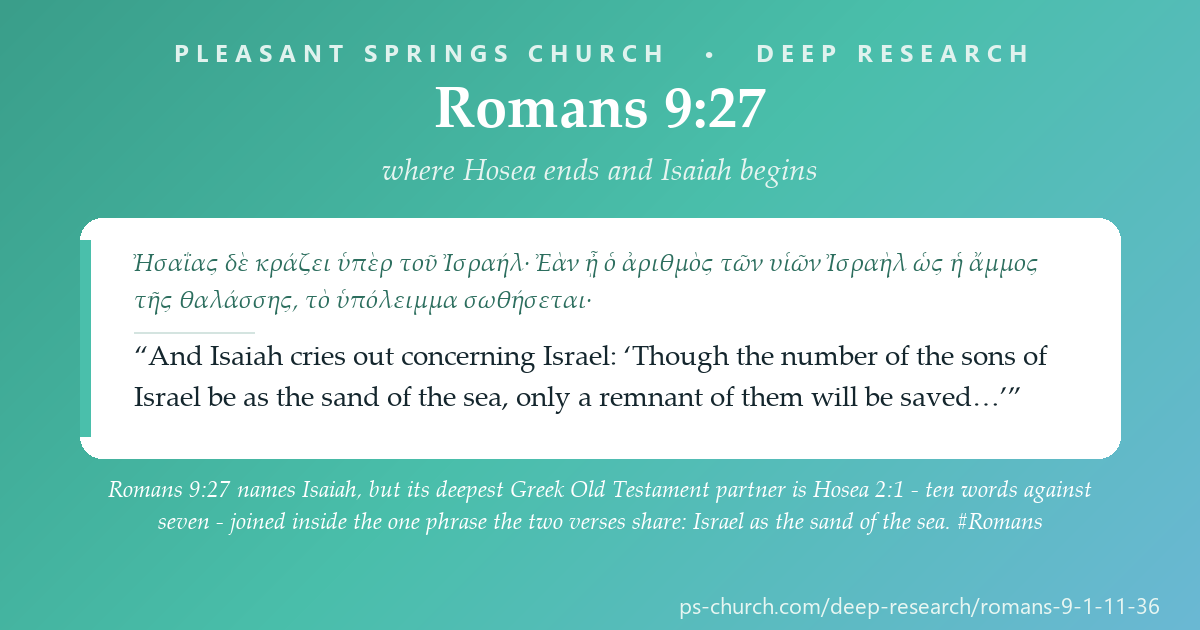
Romans 9–11 is where the letter’s Old Testament runs deepest. Screen all 430 Greek verses of Romans against the 30,348 Greek Old Testament units held here and the three deepest runs in the whole letter — seventeen, seventeen and sixteen consecutive words, each at a tie band of one — are all in these ninety verses, with fifteen of the thirty-five rows that reach six. But measure the quotations one at a time and the names in the citation formulas stop lining up with the words. At 9:25 Paul says as indeed he says in Hosea, and the verse shares one word with the Hosea verse it quotes. At 9:27 he says Isaiah cries out concerning Israel, and the verse’s deepest partner is not Isaiah: it is Hosea 2:1 (ESV 1:10), ten words, tie band one, against seven with Isaiah 10:22. That Hosea verse is the one he has just finished quoting — 9:26 is its second half; 9:27, after one word of Isaiah’s, carries its first. And the join falls inside six words the two prophets share, Israel as the sand of the sea: a phrase that stands in exactly those two verses of the Hebrew Bible, and exactly those two of the Greek Old Testament screened here. These chapters are often called the densest stretch of Old Testament quotation in the New Testament; measured by shared runs, they are not — Hebrews 1–3, in 51 verses to these 90, has more rows reaching six and more than twice as many reaching ten — and Stage 4 prints that beside everything else, along with the famous quotations that measure one. The measurement says agreement. It never says who read whom, and it cannot settle election or all Israel — Stage 5 sets out the readings fairly. See the method →
Romans 9:1–11:36 (selections)
Greek New Testament (SBLGNT, via MorphGNT) · ESVHow to read the marks. Bold and underline in the Greek mark the words of a measured run, and each row’s note says which text each mark is measured against. Where the two overlap (9:27) the words are both. Twenty-four of the ninety verses are printed — the ones the argument below needs; the ESV is quoted under Crossway’s standing permission.
The Shape of the Passage
A frame and three returning themes — measured word by word. The remnant returns in mirror position; election and mercy come back in the same order, not in reverse: this is not a chiasmThis is the only place in Romans where Paul names his own people and tribe, and the only verse in the New Testament that begins Ὑμῖν δὲ λέγω τοῖς ἔθνεσιν. The author is a Jew writing about Israel in tears; the audience, at the point where the argument turns sharpest, is addressed as Gentiles. Both are on the page in the letter’s own words.
Author
An Israelite under oath. The section opens with a double oath — Ἀλήθειαν λέγω ἐν Χριστῷ, οὐ ψεύδομαι — and a wish to be ἀνάθεμα, cut off from Christ, for the sake of τῶν ἀδελφῶν μου τῶν συγγενῶν μου κατὰ σάρκα. At 11:1 he names himself: ἐγὼ Ἰσραηλίτης εἰμί, ἐκ σπέρματος Ἀβραάμ, φυλῆς Βενιαμίν. The word Israelite occurs twice in Romans — of his people at 9:4, of himself at 11:1.
A Scripture-reader in full view. He names his sources more often here than anywhere else in the letter: Isaiah four times (9:27, 9:29, 10:16, 10:20 — of five in Romans), Moses three times (9:15, 10:5, 10:19 — of four), Hosea once (the only time the name stands in the New Testament), David once, Elijah once. And the page’s whole finding is that the names and the measured words do not always line up.
Audience
Gentiles, told so. Ὑμῖν δὲ λέγω τοῖς ἔθνεσιν (11:13) stands once in the Greek New Testament. Then, for eight verses (11:17–24), Paul addresses one imagined Gentile reader as σὺ, singular, eight times — do not be arrogant toward the branches (11:18), do not become proud, but fear (11:20).
A mixed congregation in the capital. The letter’s own greetings (16:3–16) name Jewish believers such as Prisca and Aquila alongside Gentile names, and Acts 18:2 has that couple leaving Rome when Claudius expelled the Jews. That a Gentile-majority church might look down on Israel is the problem 11:17–24 is written against — the text says so; a reconstruction of the Roman house churches is reported from the reference works and was not checked here.
Orient on Israel, election, the remnant and the olive tree — and settle a dozen Old Testament verse numbers before touching a single run.
Search by topic: Israel; election / predestination; remnant; hardening; jealousy; olive tree, grafting; mystery; the Deliverer from Zion; Romans 9–11 in Pauline theology; Paul’s use of the Old Testament; composite citation; Elijah; Pharaoh, hardening of; Jacob and Esau; Edom.
Which articles are relevant?
- Anchor Bible Dictionary — “Romans, Epistle to the,” “Election,” “Remnant,” “Israel, History of.”
- Dictionary of Paul and His Letters (IVP, 2nd ed. 2023) — “Israel,” “Election and Predestination,” “Remnant,” “Old Testament in Paul.”
- New International Dictionary of NT Theology & Exegesis — ἐκλογή, λεῖμμα, πώρωσις, μυστήριον, παραζηλόω.
- Commentary on the New Testament Use of the Old Testament, ed. G. K. Beale and D. A. Carson (Baker, 2007) — the Romans chapter, which treats every quotation in these three chapters.
- These were not consulted for the measurements below. The measurements were run on the text files named in the footer.
Settle the numbering first — one boundary in Romans, and a dozen in its sources
Every page on this shelf states its versification offset, including when the answer is none. For Romans 9–11 the answer is almost none. Romans has no Hebrew or Septuagint form, so there is no MT/LXX offset; the SBLGNT file held here and the ESV both number 33, 21 and 36 verses. But at one place they cut the same words at a different point:
| words | SBLGNT (on disk) | ESV |
|---|---|---|
| οὐκ ἐξ ἔργων ἀλλ’ ἐκ τοῦ καλοῦντος — not because of works but because of him who calls | start of 9:12 | end of 9:11 |
Found because this page’s builder looks every Greek phrase up in the verse it is said to stand in, and this one was not in 9:11. Every other verse boundary was then checked: all three ESV chapters were fetched from Crossway’s API (held in memory, not stored) and each verse’s length compared with its Greek; only 9:11/9:12 is out of line, and its content confirms it. A reader citing “Romans 9:12” from the Greek and a reader citing it from the ESV are pointing at slightly different words.
Its quotations are another matter. Twelve of the Old Testament verses this page measures carry different numbers or a different book name in the Greek, the Hebrew and the English:
| Romans | Septuagint (CATSS, on disk) | Masoretic (MAM, on disk) | ESV |
|---|---|---|---|
| 9:25 | Hosea 2:25 | Hosea 2:25 | Hosea 2:23 |
| 9:26–27 | Hosea 2:1 | Hosea 2:1 | Hosea 1:10 |
| 10:13 | Joel 3:5 | Joel 3:5 | Joel 2:32 |
| 10:15 | Nahum 2:1 (and Isaiah 52:7) | Nahum 2:1 | Nahum 1:15 |
| 10:18 | Psalm 18:5 | Psalm 19:5 | Psalm 19:4 |
| 11:1–2 | Psalm 93:14 | Psalm 94:14 | Psalm 94:14 |
| 11:2–4 | 3 Kingdoms 19:10, 14, 18 | 1 Kings 19:10, 14, 18 | 1 Kings 19:10, 14, 18 |
| 11:1 | 1 Kingdoms 12:22 | 1 Samuel 12:22 | 1 Samuel 12:22 |
| 11:8 | Deuteronomy 29:3 | Deuteronomy 29:3 | Deuteronomy 29:4 |
| 11:9–10 | Psalm 68:23–24 | Psalm 69:23–24 | Psalm 69:22–23 |
| 11:27 | Jeremiah 38:33–34 (often cited; run 1) | Jeremiah 31:33–34 | Jeremiah 31:33–34 |
| 11:35 | Job 41:3 | Job 41:3 | Job 41:11 |
How each was established. Not from a printed table: every English verse was fetched from Crossway’s API and the same sentence found under the other numbers. ESV Hosea 1:10 is the sand of the sea verse that the Hebrew and Greek number 2:1; ESV Hosea 2:23 is I will have mercy on No Mercy at 2:25; ESV Joel 2:32 is everyone who calls on the name of the Lord at 3:5; ESV Psalm 19:4 is their voice goes out at Masoretic 19:5 (the Hebrew counts the superscription as verse 1) and at Greek 18:5 (the Greek Psalter runs one psalm behind from 9/10 to 147); ESV Deuteronomy 29:4 is to this day the Lord has not given you a heart to understand at 29:3 (the Hebrew and Greek begin chapter 29 one verse later); ESV Job 41:11 is who has first given to me at 41:3 (the Hebrew and Greek begin chapter 41 eight verses later). Psalm 94 has no superscription, so Greek 93:14 differs from it by the psalm number alone.
Aligned in all three, checked on the files: Genesis 18, 21 and 25; Exodus 9 and 33; Leviticus 18; Deuteronomy 8, 9, 30 and 32; Malachi 1; 1 Kings 19 and 1 Samuel 12 (book names apart); and every Isaiah verse quoted here (chapters 1, 8, 10, 27, 28, 29, 40, 45, 49, 52, 53, 59, 65) — the two places Isaiah’s English numbering parts from the Hebrew, 8:23/9:1 and 63:19/64:1, are not touched by this page. Hosea is aligned chapter for chapter between the Hebrew and the Greek; the English parts from both inside chapters 1–2, which is the offset this page meets, and again in chapters 11–14, which it meets once: Hosea 14:7 is ESV 14:6.
In the Septuagint this book is 3 Kingdoms (3 Reigns) — Βασιλειῶν Γʹ (Basileiōn G). In the Septuagint this book is 1 Kingdoms (1 Reigns) — Βασιλειῶν Αʹ (Basileiōn A).
A first-century-BC Jewish psalm book that uses one word for God’s choosing and the soul’s — the two things every reading of Romans 9 holds together; what all Israel means in the Greek histories; the potter; and the olive grower.
★ The only two places ἐκλογή stands in the Greek Old Testament held here — and they are not in the canon
Search the 30,348 screened units for the noun Paul uses at 9:11, 11:5, 11:7 and 11:28, and it is not in a single canonical book. It stands twice, both in the Psalms of Solomon. (Four more hits on the same letters are Tobit 1:21–22, an accountant, a different word.)
| text | the sentence (CATSS) |
|---|---|
| Psalms of Solomon 9:4 | τὰ ἔργα ἡμῶν ἐν ἐκλογῇ καὶ ἐξουσίᾳ τῆς ψυχῆς ἡμῶν τοῦ ποιῆσαι δικαιοσύνην καὶ ἀδικίαν ἐν ἔργοις χειρῶν ἡμῶν καὶ ἐν τῇ δικαιοσύνῃ σου ἐπισκέπτῃ υἱοὺς ἀνθρώπων Our works are in the choice and power of our soul, to do righteousness and injustice in the works of our hands; and in your righteousness you visit the sons of men. |
| Psalms of Solomon 18:5 | καθαρίσαι ὁ θεὸς Ισραηλ εἰς ἡμέραν ἐλέους ἐν εὐλογίᾳ εἰς ἡμέραν ἐκλογῆς ἐν ἀνάξει χριστοῦ αὐτοῦ May God cleanse Israel for the day of mercy in blessing, for the day of election, at the bringing in of his Messiah. |
God’s choosing and the soul’s choosing stand under one word in one Jewish book of the century before Paul. At 9:4 the choice is the human soul’s, and the deeds of righteousness and injustice are its own; at 18:5 the election is God’s day for Israel, beside mercy and his Messiah — the very words, ἔλεος, Ἰσραήλ and Χριστός, that Romans 9–11 puts together. The Psalms of Solomon are a witness and not Scripture on this shelf, and the page does not say Paul read them. It says only that a Jewish writer of the period could hold God’s choosing and the soul’s choosing in the same book without apology — which is the ground every reading of Romans 9 has to stand on.
The English renderings of the two verses are this page’s own, kept literal; the dating of the Psalms of Solomon to the first century BC is reported from the reference works, not measured. See Psalms of Solomon 1–9 and 10–18 on this shelf.
What all Israel means in the Greek histories
πᾶς Ἰσραὴλ occurs once in the Greek New Testament, at 11:26. In the screened Greek Old Testament it occurs 73 times in 72 verse units (2 Chronicles 31:1 has it twice; and four of the 72 units are two verses each counted twice, because the shelf holds two Greek recensions of Judges and of Daniel: Judges 8:27 and Daniel 9:11 each appear in both) — 12 in 1 Kingdoms, 12 in 3 Kingdoms, 8 in 2 Chronicles, 8 in Joshua (the B text), 7 in 1 Chronicles, 7 in 2 Kingdoms, and a scattering elsewhere. Three of them, from the files:
| text | CATSS | what is happening |
|---|---|---|
| 1 Kingdoms 25:1 (1 Samuel) | καὶ ἀπέθανεν Σαμουηλ καὶ συναθροίζονται πᾶς Ισραηλ καὶ κόπτονται αὐτὸν καὶ θάπτουσιν αὐτὸν ἐν οἴκῳ αὐτοῦ ἐν Αρμαθαιμ καὶ ἀνέστη Δαυιδ καὶ κατέβη εἰς τὴν ἔρημον Μααν | Samuel dies, and all Israel gathers and mourns — an assembly. |
| 3 Kingdoms 12:1 (1 Kings) | καὶ πορεύεται βασιλεὺς Ροβοαμ εἰς Σικιμα ὅτι εἰς Σικιμα ἤρχοντο πᾶς Ισραηλ βασιλεῦσαι αὐτόν | All Israel came to Shechem to make Rehoboam king — the tribes as a body. |
| Daniel 9:11 (Theodotion) | καὶ πᾶς Ισραηλ παρέβησαν τὸν νόμον σου καὶ ἐξέκλιναν τοῦ μὴ ἀκοῦσαι τῆς φωνῆς σου καὶ ἐπῆλθεν ἐφ' ἡμᾶς ἡ κατάρα καὶ ὁ ὅρκος ὁ γεγραμμένος ἐν νόμῳ Μωυσέως δούλου τοῦ θεοῦ ὅτι ἡμάρτομεν αὐτῷ | All Israel has transgressed your law — confessed by Daniel, who is praying. |
In the histories the phrase names the people as a body, and in the narratives of Samuel’s burial and Rehoboam’s coronation it plainly does not mean every individual. Daniel, confessing that all Israel transgressed, counts himself in: the same verse ends we have sinned against him. Whether Paul uses the phrase that way at 11:26 is precisely the question the readings divide on, and a count of the phrase cannot decide it. It can rule out one assumption: that all in this idiom must mean each.
⚠️ Reported, not held here. The best-known rabbinic parallel is Mishnah Sanhedrin 10:1 (11:1 in some editions), All Israel have a share in the world to come — followed at once by a list of those who do not. It is regularly cited on Romans 11:26 for exactly that reason. No rabbinic text is on this disk, the Mishnah was compiled around AD 200, and the page reports the citation from the reference works without having checked it.
The potter: Wisdom of Solomon 15:7, and the Scriptures Paul does use
Romans 9:20–21 — Will what is molded say to its molder…? Has the potter no right over the clay? — is regularly set beside Wisdom 15:7, where a potter makes clean and unclean vessels from the same clay.
| comparison | run | tie band | shared words |
|---|---|---|---|
| Romans 9:20 vs Isaiah 29:16 | 6 | 1 | μὴ ἐρεῖ τὸ πλάσμα τῷ πλάσαντι |
| Romans 9:21 vs Wisdom 15:7 witness, not Scripture | 3 | 4 — tied with Wisdom 15:8 and Job 4:19, 33:6 | ἐκ τοῦ αὐτοῦ |
| Romans 9:21 vs Jeremiah 18:6 | 2 | below the row’s maximum; 896 units reach two | ὁ κεραμεὺς |
The verse with the deep, unique contact is Isaiah’s, at 9:20. The Wisdom parallel is real in theme and shallow in words: three, and those three — from the same — tie with two verses of Job. A thematic parallel is not a measured one, and the page prints both numbers so neither is mistaken for the other.
The olive grower, and the phrase Paul uses for grafting
Romans 11:24 says the Gentile branch was grafted παρὰ φύσιν, contrary to nature. The phrase stands twice in the Greek New Testament: here, and Romans 1:26. Grafting a cultivated branch onto wild stock is ordinary horticulture; Paul describes the reverse, and says so.
⚠️ Reported, not read here. Commentaries cite the Roman agricultural writer Columella (On Agriculture 5.9) for the practice of grafting a wild-olive slip into an old cultivated tree to reinvigorate it, and argue over whether Paul knew it. No Latin agricultural text is held on this disk; the citation is reported and was not checked. What was checked is the Old Testament olive: Jeremiah 11:16 and Hosea 14:7 (ESV 14:6) share one word (branches) with Romans 11:19 and two (the branches) with 11:16, and Jeremiah 11:16 shares no word form with 11:17.
Eight words — and how completely some of them belong to these three chapters.
Eleven times in Romans, and every one is in chapters 9–11 (9:6 twice, 9:27 twice, 9:31, 10:19, 10:21, 11:2, 11:7, 11:25, 11:26). Its adjective Israelite twice, 9:4 and 11:1 — also both here. 9:6 uses the noun twice in two senses: not all who are from Israel are Israel. That sentence is why 11:26 is argued over at all.
Seven times in the New Testament; four are in Romans, and all four are here — 9:11, 11:5, 11:7, 11:28. The other three: Acts 9:15 (Paul, a chosen instrument), 1 Thessalonians 1:4, 2 Peter 1:10 (confirm your calling and election). In the screened Greek Old Testament it occurs nowhere in the canon — only Psalms of Solomon 9:4 and 18:5 (Stage 2).
Romans 11:5, and nowhere else in the New Testament; ὑπόλειμμα (9:27) likewise once. The five leave / left / remnant words of Romans stand at 9:27, 9:29, 11:3, 11:4, 11:5 — and nowhere else in the letter. (Two more words from the same root, unceasing at 1:9 and 9:2, mean something else and are not counted.) Four of the five are inside quotations; the last is Paul’s own: λεῖμμα κατ’ ἐκλογὴν χάριτος, a remnant, chosen by grace.
Eight in Romans: four at 9:15–18, three at 11:30–32, one at 12:8; the noun at 9:23, 11:31 and 15:9. The mercy words open the argument and close it, and the sixty verses between have none. Inside that stretch stands the one quotation whose Greek source has the mercy verb — Hosea 2:25 — and Romans has beloved instead (9:25) — in the Rahlfs text held here (see the unchecked manuscript report in Stage 5).
Six times in the New Testament, every one in Romans 11 (11:17, 11:19, 11:23 twice, 11:24 twice), and nowhere in the screened Greek Old Testament. With it: ἀγριέλαιος (twice, both here), καλλιέλαιος (once, 11:24), ἐκκλάω (three times in the New Testament, all here). The olive tree is built from words the Old Testament in Greek does not have — all but the last, whose verb stands once, at Leviticus 1:17, of a bird torn by its wings.
Three times in the New Testament (Mark 3:5, Romans 11:25, Ephesians 4:18) and nowhere in the screened Greek Old Testament. The verb πωρόω at 11:7. Paul qualifies the noun twice in one breath: ἀπὸ μέρους, in part, and ἄχρι οὗ, until. Pharaoh’s hardening at 9:18 is a different verb, σκληρύνω.
Four times in the New Testament; three are here (10:19, 11:11, 11:14), and the fourth is 1 Corinthians 10:22. It arrives inside a quotation — Deuteronomy 32:21, which in the Greek has it twice: αὐτοὶ παρεζήλωσάν με … κἀγὼ παραζηλώσω αὐτοὺς — and Paul keeps it: the word of the quotation becomes the word of his own argument at 11:11 and 11:14.
Romans 11:29 and 2 Corinthians 7:10, and nowhere else in the New Testament. It governs τὰ χαρίσματα καὶ ἡ κλῆσις τοῦ θεοῦ — the gifts and the calling of God — and they are said of Israel, one verse after enemies for your sake.
The three chapters counted — and where in them each word falls
Counted off the MorphGNT lemma column: 90 verses here, 430 in the Greek Romans.
| word | in 9–11 | in all Romans | where |
|---|---|---|---|
| Ἰσραήλ | 11 | 11 | every one |
| ἐκλογή | 4 | 4 | 9:11, 11:5, 11:7, 11:28 |
| ἐγκεντρίζω | 6 | 6 | 11:17–24 |
| δικαιοσύνη | 10 | 33 | all ten in 9:30–10:10 |
| πιστεύω | 8 | 21 | all eight in 9:33–10:16 |
| νόμος | 4 | 74 | 9:31 (twice), 10:4, 10:5 — and nowhere else in 9–11 |
| πίστις | 6 | 39 | 9:30, 9:32, 10:6, 10:8, 10:17 — and 11:20 |
| ἐλεάω / ἔλεος | 9 | 11 | 9:15–23 and 11:30–32 — none between |
| σῴζω | 5 | 8 | 9:27, 10:9, 10:13, 11:14, 11:26 |
| κλάδος | 5 | 5 | 11:16–21 |
| ἔθνος | 9 | 28 | 9:24, 9:30, 10:19 (twice), 11:11, 11:12, 11:13 (twice), 11:25 |
The rows worth staring at are the third block. νόμος stands 74 times in Romans and only four times in these ninety verses, all within 9:31–10:5. Righteousness and believing are packed into the middle movement and are absent from the outer ones. The vocabulary of human response sits at the centre; the vocabulary of mercy and election sits at the edges. The page reports the distribution, which is a fact, and leaves what it means to the reader and to Stage 5.
★ σωθήσεται — thirteen times in the New Testament, three in Romans, one in each of these chapters
| Romans | the clause | whose words | Greek column | Hebrew column |
|---|---|---|---|---|
| 9:27 | τὸ ὑπόλειμμα σωθήσεται | Isaiah 10:22, quoted | σωθήσεται | יָשׁוּב — will return |
| 10:13 | ἐπικαλέσηται τὸ ὄνομα κυρίου σωθήσεται | Joel 3:5, quoted | σωθήσεται | יִמָּלֵט — will escape |
| 11:26 | πᾶς Ἰσραὴλ σωθήσεται | Paul’s own | not a quotation | |
The other ten in the Greek New Testament: Matthew 10:22 and 24:13, Mark 13:13 and 16:16, Luke 8:50, John 10:9 and 11:12, Acts 2:21, 1 Corinthians 3:15, 1 Timothy 2:15. The spine of the argument is a verb that, in both of the quotations it comes from, is the Greek column’s word. At Isaiah 10:22 the Hebrew says something else, will return; at Joel 3:5 the Hebrew verb, will escape, is close in sense, and the ESV renders it shall be saved. The remnant, whoever calls, all Israel: three subjects for one verb, one per chapter. The page states the agreement and makes no claim about direction.
The deepest Old Testament contact in Romans, the place where two prophets are joined, and the famous quotations that measure one.
The measurement
All 90 verses of Romans 9–11 were screened twice: against the 30,348 verse units of Greek Old Testament this shelf screens, and against the other 7,837 verses of the Greek New Testament. Contiguous runs of whole word forms, never lemmas, with the tie band — how many target verses reach the same maximum — beside every run. Then every quotation was measured pair by pair against the verse it is drawn from.
⚠️ Isaiah IS on this disk. The shelf’s older working notes warn that the Greek of Isaiah, Jeremiah, Lamentations, Ezekiel and Daniel may not be held. That warning is out of date: dr_tools coverage reports 64 CATSS files, 30,637 verse units held, no known gaps. Every Isaiah figure on this page is measured, not estimated. Screened: the 63 CATSS Greek Old Testament files screened here (of 64 held; NOT the whole Septuagint). Held but not screened: Odes.mlxx, 289 verse units — the Odes appendix, left out by house convention (see corpora.lxx_all): Odes 9 and 13 are Luke 1–2, and ten others are second copies of passages in other books. Neither a count nor a zero here covers the Prayer of Manasseh (Ode 12), or the lines of Ode 14 that stand in no other book.
Against the Greek Old Testament, across the 90 rows: all 90 rows reach one, 89 reach two, 71 reach three, 36 reach four, 27 reach five, 15 reach six, 11 reach seven, 8 reach eight and nine, 6 reach ten, 5 reach eleven, 4 reach fourteen, 3 reach sixteen, 2 reach seventeen, and nothing reaches eighteen. Against the rest of the Greek New Testament: all 90 reach two, 63 reach three, 31 reach four, 13 reach five, 3 reach six, and nothing reaches seven.
Scope, verbatim: Greek against Greek. CATSS FORM column (cols 0-24), beta-code transliterated first; MorphGNT field 6, the normalised word (the column that already resolves elision and the movable nu). Both sides lowercased, accents and breathings dropped, final sigma folded, then filtered to Greek letters — the same filter applied to both corpora. Contiguous runs of whole word FORMS, never lemmas. Exhaustive and deterministic; nothing sampled, so no seed applies. Caveat, verbatim: This finds verbatim contact. It does NOT find allusion. Report the tie band beside every run, and check by eye whether a deep run is a citation or a formula. A zero on this page uses the Greek-side convention: 0 means the two texts share no word at all.
★ Where Hosea ends and Isaiah begins
Romans 9:25–29 is introduced as two quotations: as indeed he says in Hosea (9:25) and Isaiah cries out concerning Israel (9:27). Measured, the Hosea material does not stop where the name Isaiah starts.
| text | the sentence |
|---|---|
| CATSS Hosea 2:1 (ESV 1:10) | καὶ ἦν ὁ ἀριθμὸς τῶν υἱῶν Ισραηλ ὡς ἡ ἄμμος τῆς θαλάσσης ἣ οὐκ ἐκμετρηθήσεται οὐδὲ ἐξαριθμηθήσεται καὶ ἔσται ἐν τῷ τόπῳ οὗ ἐρρέθη αὐτοῖς οὐ λαός μου ὑμεῖς ἐκεῖ κληθήσονται υἱοὶ θεοῦ ζῶντος |
| CATSS Isaiah 10:22 | καὶ ἐὰν γένηται ὁ λαὸς Ισραηλ ὡς ἡ ἄμμος τῆς θαλάσσης τὸ κατάλειμμα αὐτῶν σωθήσεται λόγον γὰρ συντελῶν καὶ συντέμνων ἐν δικαιοσύνῃ |
| Romans 9:26 | καὶ ἔσται ἐν τῷ τόπῳ οὗ ἐρρέθη αὐτοῖς· Οὐ λαός μου ὑμεῖς, ἐκεῖ κληθήσονται υἱοὶ θεοῦ ζῶντος. — run 17 with Hosea 2:1, tie band 1 |
| Romans 9:27 | Ἠσαΐας δὲ κράζει ὑπὲρ τοῦ Ἰσραήλ· Ἐὰν ᾖ ὁ ἀριθμὸς τῶν υἱῶν Ἰσραὴλ ὡς ἡ ἄμμος τῆς θαλάσσης, τὸ ὑπόλειμμα σωθήσεται· — run 10 with Hosea 2:1 (bold), tie band 1; 7 with Isaiah 10:22 (underlined) |
In the Hosea row, bold is the run with Romans 9:26 and underline the run with 9:27. In the Isaiah row, underline is the run with Romans 9:27 and bold the run with Hosea 2:1 — the two prophets’ verses share 6 consecutive words with each other.
Read it slowly, because it is the page’s whole finding.
- One Hosea verse, used back to front. 9:26 is the second half of the Hosea row, seventeen words unbroken; 9:27, after Isaiah’s opening if, carries the first half, ten words unbroken. The Hosea 2:1 row is 34 words long, and 27 of them stand in these two verses of Romans.
- The seam sits inside an overlap — and it is a weave, not a cut. Hosea 2:1 and Isaiah 10:22 share six consecutive words in Greek, Ισραηλ ὡς ἡ ἄμμος τῆς θαλάσσης. The quotation in 9:27 opens with Ἐὰν, which is Isaiah’s (καὶ ἐὰν γένηται ὁ λαὸς; Hosea has καὶ ἦν); its verb ᾖ matches neither; its subject, ὁ ἀριθμὸς τῶν υἱῶν, the number of the sons, is Hosea’s alone — Isaiah has ὁ λαὸς; then come the six words both prophets wrote; and then Isaiah’s τὸ…σωθήσεται. There is no single word at which Hosea stops and Isaiah starts: the crossing is made in the middle, where the two prophets say the same thing.
- And the overlap is unique in both Bibles. ὡς ἡ ἄμμος τῆς θαλάσσης stands in 2 of the 30,348 screened Greek units — Hosea 2:1 and Isaiah 10:22. In the Masoretic text יִשְׂרָאֵל כְּחוֹל הַיָּם stands in 2 of 23,204 verses — the same two (shorten it to כְּחוֹל הַיָּם and Genesis 32:13 (ESV 32:12) and 41:49 join them). In Hebrew the two verses share three consecutive words; in Greek, six.
- What Romans does not carry. The seven words of the Hosea row in neither verse of Romans are its opening καὶ ἦν and the clause ἣ οὐκ ἐκμετρηθήσεται οὐδὲ ἐξαριθμηθήσεται, which will not be measured or counted. Where that clause stood, 9:27 continues with Isaiah’s the remnant will be saved.
| the two Hebrew verses | Masoretic text (MAM) |
|---|---|
| Hosea 2:1 (ESV 1:10) | וְהָיָה מִסְפַּר בְּנֵי־יִשְׂרָאֵל כְּחוֹל הַיָּם אֲשֶׁר לֹא־יִמַּד וְלֹא יִסָּפֵר וְהָיָה בִּמְקוֹם אֲשֶׁר־יֵאָמֵר לָהֶם לֹא־עַמִּי אַתֶּם יֵאָמֵר לָהֶם בְּנֵי אֵל־חָי |
| Isaiah 10:22 | כִּי אִם־יִהְיֶה עַמְּךָ יִשְׂרָאֵל כְּחוֹל הַיָּם שְׁאָר יָשׁוּב בּוֹ כִּלָּיוֹן חָרוּץ שׁוֹטֵף צְדָקָה |
| the two English verses | ESV |
|---|---|
| Hosea 1:10 (MT/LXX 2:1) | “Yet the number of the children of Israel shall be like the sand of the sea, which cannot be measured or numbered. And in the place where it was said to them, ‘You are not my people,’ it shall be said to them, ‘Children of the living God.’” |
| Isaiah 10:22 | “For though your people Israel be as the sand of the sea, only a remnant of them will return. Destruction is decreed, overflowing with righteousness.” |
⚠️ What the page will and will not say. It will say that the words Romans introduces under Isaiah’s name begin with ten words that stand, in that order, in Hosea 2:1 and in no other Greek verse held here; that the join falls inside the one phrase the two prophets share; and that the phrase is unique to those two verses in both the Greek and the Hebrew. It will not say Paul misattributed anything — 9:27–28 is Isaiah’s from the middle onward, and the name is accurate for what follows. Commentators commonly describe this as joining two passages on a shared catchword; that description is theirs and is reported, not measured. Nor will it say that this is a discovery. The conflation is noticed in the literature. What this page adds is the measurement: ten against seven, six shared, two verses in each Bible.
Two pages on this shelf measured these verses from the other side. The Hosea 1–3 study found 9:26 whole inside Hosea 2:1; the Isaiah 8–11 study found 9:27 at seven against Isaiah 10:22, stopping where κατάλειμμα and ὑπόλειμμα part. Both figures stand. Neither page had reason to measure 9:27 against Hosea.
Every quotation in Romans 9–11, measured
Thirty-five rows. For each: the run with the verse it is drawn from; how many of the 30,348 Greek Old Testament units reach at least that depth with the same Romans verse (a band for a run that is not the row’s maximum); and the row’s own deepest partner with its tie band.
| Romans | how Romans signals it | source (Greek numbering) | run with that source | Greek OT units reaching that depth | row’s deepest run | tie band | row’s deepest partner |
|---|---|---|---|---|---|---|---|
| 9:7 | no formula | Genesis 21:12 | 5 | 1 | 5 | 1 | the same verse |
| 9:9 | “this is what the promise said” | Genesis 18:14 (and 18:10, run 4) | 5 | 1 | 5 | 1 | the same verse |
| 9:12 | “she was told” | Genesis 25:23 | 5 | 1 | 5 | 1 | the same verse |
| 9:13 | as it is written | Malachi 1:3 (and 1:2, run 2) | 4 | 1 | 4 | 1 | the same verse |
| 9:15 | names Moses | Exodus 33:19 | 9 | 1 | 9 | 1 | the same verse |
| 9:17 | “the Scripture says to Pharaoh” | Exodus 9:16 | 11 | 1 | 11 | 1 | the same verse |
| 9:20 | no formula | Isaiah 29:16 (45:9 = 2) | 6 | 1 | 6 | 1 | the same verse |
| 9:25 | names Hosea | Hosea 2:25 · ESV 2:23 | 1 | 28,193 | 4 | 1 | Ezekiel 45:8 — an accident |
| 9:26 | continues | Hosea 2:1 · ESV 1:10 | 17 | 1 | 17 | 1 | the same verse |
| 9:27 | names Isaiah | Isaiah 10:22 | 7 | 2 | 10 | 1 | Hosea 2:1 · ESV 1:10 |
| 9:28 | continues | Isaiah 10:22 (10:23 = 1) | 5 | 1 | 5 | 1 | the same verse |
| 9:29 | names Isaiah | Isaiah 1:9 | 16 | 1 | 16 | 1 | the same verse |
| 9:33 | as it is written | Isaiah 28:16 (8:14 = 2) | 6 | 1 | 6 | 1 | the same verse |
| 10:5 | names Moses | Leviticus 18:5 | 4 | 1 | 4 | 1 | the same verse |
| 10:6 | “the righteousness based on faith says” | Deuteronomy 30:12 | 3 | 114 | 6 | 2 | Deuteronomy 9:4, 8:17 |
| 10:7 | continues | Deuteronomy 30:13 | 1 | 16,089 | 2 | 809 | a two-word formula |
| 10:8 | “what does it say?” | Deuteronomy 30:14 | 9 | 1 | 9 | 1 | the same verse |
| 10:11 | “the Scripture says” | Isaiah 28:16 | 5 | 1 | 5 | 1 | the same verse |
| 10:13 | no formula | Joel 3:5 · ESV 2:32 | 7 | 1 | 7 | 1 | the same verse |
| 10:15 | as it is written | Isaiah 52:7 (Nahum 2:1 · ESV 1:15 = 2) | 1 | 16,191 | 3 | 4 | 2 Chronicles 25:4 on the formula itself; Isaiah 5:28; Joshua (B) 3:13, 3:15 |
| 10:16 | names Isaiah | Isaiah 53:1 | 6 | 1 | 6 | 1 | the same verse |
| 10:18 | no formula | Psalm 18:5 · MT 19:5 · ESV 19:4 | 17 | 1 | 17 | 1 | the same verse |
| 10:19 | names Moses | Deuteronomy 32:21 | 7 | 1 | 7 | 1 | the same verse |
| 10:20 | names Isaiah | Isaiah 65:1 | 5 | 1 | 5 | 1 | the same verse |
| 10:21 | “of Israel he says” | Isaiah 65:2 | 5 | 1 | 5 | 1 | the same verse |
| 11:1 | no formula | Psalm 93:14 · MT/ESV 94:14; 1 Kingdoms 12:22 = 3 | 3 | 97 | 5 | 1 | Isaiah 49:13 — an accident |
| 11:3 | names Elijah (11:2) | 3 Kingdoms 19:10, 19:14 · 1 Kings | 4 | 3 | 4 | 3 | 3 Kingdoms 19:10, 19:14; 2 Esdras 19:26 (= Neh 9:26) |
| 11:4 | “what is God’s reply to him?” | 3 Kingdoms 19:18 · 1 Kings | 1 | 14,526 | 2 | 109 | a two-word formula |
| 11:8 | as it is written | Deuteronomy 29:3 · ESV 29:4 (Isaiah 29:10 = 1) | 3 | 47 | 4 | 23 | a four-word formula, 23 ways |
| 11:9 | names David | Psalm 68:23 · MT 69:23 · ESV 69:22 | 5 | 1 | 5 | 1 | the same verse |
| 11:10 | continues | Psalm 68:24 · MT 69:24 · ESV 69:23 | 14 | 1 | 14 | 1 | the same verse |
| 11:26 | as it is written | Isaiah 59:20 | 4 | 1 | 4 | 1 | the same verse |
| 11:27 | continues | Isaiah 59:21 (27:9 = 2) | 7 | 1 | 7 | 1 | the same verse |
| 11:34 | no formula | Isaiah 40:13 | 3 | 2 | 3 | 2 | Isaiah 40:13 and Job 25:4 |
| 11:35 | no formula | Job 41:3 · ESV 41:11 | 2 | 252 | 2 | 252 | a two-word formula, 252 ways |
Read the shaded rows. A run of one has tens of thousands of units at its depth — it is a single common word, and it is printed so that the reader can see what one means. The names in the second column range from one to sixteen: the verse that names Hosea measures one; the verses that name Isaiah measure 7 (10 with Hosea), 16, 6 and 5; Moses 9, 4 and 7; David 5 (and 14 in the next verse); Elijah 4 and 1. The unmarked psalm at 10:18 ties 9:26 for the deepest row of all.
The 9:25 row is 1 on the shelf’s standard normaliser and 2 if the CATSS hyphenated names are split; the 11:3 row is the same four words at 3 Kingdoms 19:10 and 19:14 and at 2 Esdras 19:26 (Nehemiah 9:26, they killed your prophets) — a band of three, one of which is not Elijah at all.
Where the quotations agree with the Greek column, and where with the Hebrew
⚠️ This table is a reading by eye, not a measurement. It sets each divergence between Romans and the CATSS row beside the Masoretic text and asks which column Romans’ word resembles in sense. That is a judgement about translation, and it is labelled as one.
| Romans | Romans has | CATSS has | Masoretic has | Romans resembles |
|---|---|---|---|---|
| 9:26 | ἐκεῖ κληθήσονται | ἐκεῖ κληθήσονται | יֵאָמֵר לָהֶם it will be said to them | Greek |
| 9:27 | σωθήσεται | σωθήσεται | יָשׁוּב will return | Greek |
| 9:29 | σπέρμα | σπέρμα | שָׂרִיד a survivor | Greek |
| 9:33 | οὐ καταισχυνθήσεται | οὐ μὴ καταισχυνθῇ | לֹא יָחִישׁ will not hurry | Greek |
| 10:13 | σωθήσεται | σωθήσεται | יִמָּלֵט will escape | Greek |
| 10:16 | Κύριε | κύριε | no vocative | Greek |
| 10:18 | ὁ φθόγγος αὐτῶν | ὁ φθόγγος αὐτῶν | קַוָּם their line | Greek |
| 11:10 | τὸν νῶτον αὐτῶν | τὸν νῶτον αὐτῶν | וּמׇתְנֵיהֶם their loins | Greek |
| 11:26b | ἀποστρέψει ἀσεβείας ἀπὸ Ἰακώβ | ἀποστρέψει ἀσεβείας ἀπὸ Ιακωβ | וּלְשָׁבֵי פֶשַׁע בְּיַעֲקֹב to those in Jacob who turn from transgression | Greek |
| 11:34 | νοῦν κυρίου | νοῦν κυρίου | רוּחַ יְהֹוָה the Spirit of the Lord | Greek |
| 9:17 | ἐξήγειρά σε | διετηρήθης you were preserved | הֶעֱמַדְתִּיךָ I caused you to stand | Hebrew |
| 9:33 | λίθον προσκόμματος (affirmed) | οὐχ ὡς λίθου προσκόμματι (negated) | וּלְאֶבֶן נֶגֶף (affirmed) | Hebrew |
| 11:4 | Κατέλιπον ἐμαυτῷ I kept | καταλείψεις you will leave | וְהִשְׁאַרְתִּי I will leave | Hebrew |
| 11:35 | τίς προέδωκεν αὐτῷ, καὶ ἀνταποδοθήσεται αὐτῷ | τίς ἀντιστήσεταί μοι καὶ ὑπομενεῖ who will withstand me and endure? | מִי הִקְדִּימַנִי וַאֲשַׁלֵּם who has gone before me, that I should repay? | Hebrew |
| 9:25 | ἠγαπημένην beloved | ἐλεήσω I will have mercy | וְרִחַמְתִּי I will have mercy | neither |
| 11:26a | ἐκ Σιὼν from | ἕνεκεν Σιων for the sake of | לְצִיּוֹן to | neither |
Ten resemble the Greek column, four the Hebrew, two neither — and one of the ten is the very verb the argument hangs on (9:27; at 10:13 the Hebrew is close in sense). Three explanations are commonly offered for the Hebrew-like readings: that Paul rendered the Hebrew himself at those points; that he used a Greek text revised toward the Hebrew, of a kind known from later witnesses; or that he adapted the wording to his argument. This page cannot choose between them — no revised Greek text, no Hexaplaric column and no manuscript apparatus is held here — and it does not try. It prints the agreements both ways so that neither column is credited with a quotation it does not carry.
The deep half and the thin half
| chapter | verses | rows reaching six | rows reaching ten | deepest |
|---|---|---|---|---|
| Romans 9 | 33 | 7 | 4 | 17 (9:26) |
| Romans 10 | 21 | 6 | 1 | 17 (10:18) |
| Romans 11 | 36 | 2 | 1 | 14 (11:10) |
Chapters 9 and 10 carry thirteen of the fifteen rows that reach six; chapter 11, two. And inside chapter 11 the fifteen verses 11:11–25 — jealousy, the olive tree, the warning, the mystery — never reach four against the Greek Old Testament; 11:19 reaches only one, at a tie band of 2,229. The quotations that do stand in chapter 11 are mostly shallow: Elijah 4 and 1, the Deliverer from Zion 4, Isaiah 40:13 three, Job 41 two. The climax of the three chapters is in Paul’s own words.
| rows of Romans reaching… | in all 430 | in these 90 |
|---|---|---|
| ≥ 6 | 35 | 15 |
| ≥ 9 | 15 | 8 |
| ≥ 10 | 12 | 6 |
| ≥ 14 | 5 | 4 |
| ≥ 16 | 3 | 3 |
Ninety verses are 21% of the Greek Romans. (These counts fold MorphGNT’s spelling equivalences; the Romans 6–7 study, measured without the fold, prints 33, 13 and 10 for six, nine and ten.) They hold 43% of its rows that reach six, and all three of its rows that reach sixteen.
Against the rest of the New Testament
The deepest New Testament runs are three sixes, all at a tie band of one — two of them the same Old Testament verse in another writer, one a doxology.
| Romans | partner | run | band | what it is |
|---|---|---|---|---|
| 9:33 | 1 Peter 2:6 | 6 | 1 | both quote Isaiah 28:16 |
| 10:16 | John 12:38 | 6 | 1 | both quote Isaiah 53:1 |
| 11:36 | Hebrews 13:21 | 6 | 1 | a doxology formula, ἡ δόξα εἰς τοὺς αἰῶνας, ἀμήν |
| 11:34 | 1 Corinthians 2:16 | 5 | 1 | Paul matching Paul better than either matches Isaiah 40:13 (3 each): both have γὰρ |
| 10:13 | Acts 2:21 | 5 | 1 | both carry Joel 3:5 |
| 9:27 | Revelation 20:8 | 5 | 1 | as the sand of the sea — in Revelation, the number of Gog and Magog’s army |
| 9:6 | 2 Timothy 2:9 | 5 | 1 | ὁ λόγος τοῦ θεοῦ … has not failed / is not bound — an accident with a family likeness |
The middle of 9:33 is the one New Testament agreement this page cannot trace to any Greek Old Testament verse: Romans 9:33 and 1 Peter 2:8 both have stone of stumbling and rock of offence (λίθον προσκόμματος / λίθος προσκόμματος), which the screened Greek Old Testament has nowhere; they measure only 2 against each other because one is accusative and the other nominative. Direction of influence is not asserted — not that Peter read Romans, nor the reverse, nor that both used a common collection of texts, though that last is a common proposal.
The counter-examples, printed against the page
1. “The densest stretch of Old Testament quotation in the New Testament.” Measured by shared runs, it is not.
| three-chapter block | verses | rows reaching six | rows reaching ten |
|---|---|---|---|
| Hebrews 1–3 | 51 | 17 | 14 |
| Acts 2–4 | 110 | 14 | 10 |
| Acts 6–8 | 114 | 18 | 8 |
| Romans 9–11 | 90 | 15 | 6 |
Every Greek New Testament verse was screened against the Greek Old Testament and every three-chapter block ranked. Hebrews 1–3 beats Romans 9–11 at six and at ten, and is denser per verse at every depth from four up — though Romans 9–11 has more rows at thirteen to sixteen — Hebrews 1 alone has eight rows of ten or more in fourteen verses — and Acts 2–4 and 6–8 beat it at ten. Romans 9–11 is the densest stretch of Romans, which is a smaller claim and a true one. What this measures is verbatim depth, not the number of citations; a count of citation formulas is a different measurement and was not made, because it depends on a citation index this disk does not hold.
2. Romans 9:25 names Hosea and shares 1 word with him. Its deepest partner is Ezekiel 45:8, four words, tie band one, about land allotment.
3. Romans 10:15 says as it is written and shares 1 word with Isaiah 52:7. Its deepest partners are a tie of four at three words, one of them the citation formula in 2 Chronicles 25:4.
4. Romans 11:1’s echo measures 3; an accident measures 5. Psalm 93:14 against Isaiah 49:13 — will not reject against had mercy on.
5. Romans 10:21 and Isaiah 65:2 carry exactly the same twelve Greek words — verified as identical multisets — and measure 5. Paul fronts Ὅλην τὴν ἡμέραν. At 10:20 he swaps Isaiah 65:1’s two verbs and again gets five. (First published on the Isaiah 62–66 study; re-measured here.)
6. Romans 11:4 shares 1 word with the verse it quotes, and Romans 11:35 2 with Job 41:3, at a tie band of 252 — two of the best-known quotations in the chapter, both answering the Hebrew more closely than the Greek column.
7. Romans 11:34, unsignalled but read by everyone as Isaiah 40:13, measures 3 — tied with Job 25:4, which shares the words Lord, or who and, apart from for, nothing else.
8. Romans 11:32 and Job 3:23: four words, tie band one, and no way to tell. συνέκλεισεν γὰρ ὁ θεὸς is in both. Job’s words stand three verses later. A reader may hear an echo; the screen reports a run.
How the readings of Romans 9 and of 11:26 divide, what the measurements bear on and what they cannot touch, and where this page is weakest.
Romans 9: the readings, stated fairly
Four families of reading, each held by serious interpreters, each with verses it leans on.
| reading | in brief | leans on |
|---|---|---|
| Individual, unconditional election (Augustine; Calvin; the Reformed confessions; recently John Piper, The Justification of God, and Thomas Schreiner) | 9:6–23 concerns the eternal destiny of persons, chosen before birth apart from any foreseen faith or works. Its confessions also teach reprobation (double predestination), mostly in an asymmetrical form — God passing over the rest — and few in a symmetrical one. | 9:11 not because of works; 9:16; 9:18 he hardens whomever he wills; 9:22–23 |
| Corporate and historical election (many Wesleyan and Arminian readers; in another form N. T. Wright) | Jacob and Esau stand for peoples, and the question of the chapter is God’s freedom to shape redemptive history and to say who belongs to his people — not each person’s final destiny. | Genesis 25:23 two nations; Malachi 1:4 Edom; 9:24 not from the Jews only; 9:30–10:21 |
| Corporate election in Christ (William W. Klein, The New Chosen People; Brian Abasciano) | God elects a people in Christ; individuals share that election by faith-union with him. | 9:30–33; 10:9–13; 11:20 you stand fast through faith |
| Molinist / middle knowledge (Kenneth Keathley, Salvation and Sovereignty; William Lane Craig) | God’s choice is sovereign and unconditioned by works, made in full knowledge of what every free creature would do in every circumstance; grace overcomes, without being irresistible in the Dortian sense; faith is a real response, not a cause of election. | 9:11–16 with 9:30–10:21 held together; 9:22 endured with much patience; 10:21 all day long I have held out my hands |
What the measurements bear on — and what they cannot decide.
- The two source verses Paul quotes for Jacob and Esau are about peoples in their own contexts: Genesis 25:23 begins two nations, and Malachi 1:4 names Edom (codex, 9:13). Paul quotes only the last five words of the first. Corporate readers press this; individual readers answer that 9:11 — not yet born, done nothing good or bad — is about persons.
- 9:22–23 uses two different verb forms: the vessels of wrath fitted, perfect passive participle, no agent named; the vessels of mercy which he prepared beforehand, aorist active, God the subject (codex, 9:22). Readers who deny a symmetrical reprobation press the asymmetry; readers who hold one answer that the agent is implied.
- The vocabulary of response — righteousness, believe, call upon, whoever — is concentrated in 9:30–10:21, between the two mercy brackets (Stage 3). Every reading has to hold 9:16 and 10:13 in one argument; the distribution shows that Paul does, side by side.
Where Pleasant Springs stands. The church reads Romans 9 within the ancient creeds and not the Canons of Dort, on a Molinist frame summarised by ROSES: election that is God’s sovereign choice and not fatalism, grace that overcomes, provision in Christ for all, offered to all who call (10:12–13), and eternal life that God keeps. It declines double predestination, and it declines the conclusion that a true believer can finally lose salvation. The measurements on this page do not prove that frame. They are the text any frame has to fit, and the page has tried to print them so that a reader holding a different reading can check every one.
Romans 11:26 — all Israel will be saved: the readings
| reading | in brief |
|---|---|
| A future turning of the Jewish people as a whole to Christ (John Murray; Douglas Moo; Thomas Schreiner; among historic premillennialists George Eldon Ladd) | All Israel is the nation as a body, not every individual; and in this way follows until the fullness of the Gentiles has come in (11:25); the natural branches are grafted back if they do not continue in their unbelief (11:23), into the one tree. |
| The elect remnant of ethnic Israel, gathered through history (William Hendriksen; O. Palmer Robertson) | All Israel is the sum of the remnant of 11:5, Jew by Jew, until the end. |
| The whole people of God, Jew and Gentile together (often traced to Calvin; N. T. Wright) | Israel in 11:26 is the second sense of 9:6 — the people of promise, now including the grafted branches. |
| A separate path for Israel apart from Christ (the “two covenants” proposal) | Pressed against by the text itself: 10:12–13 no distinction… everyone who calls; 11:23 if they do not continue in their unbelief; 11:27 when I take away their sins. |
What the text says — and what the church draws from it. There is one olive tree (11:17–24), with one root; Gentile branches are grafted into it and Israel’s natural branches can be grafted back into their own olive tree, τῇ ἰδίᾳ ἐλαίᾳ (11:24). The church reads that as sitting against any framing of two peoples of God with two destinies — the Darby/Scofield scheme, whose defenders commonly answer that the root is the covenant blessing, not one people. And God has not rejected his people (11:1); they are beloved for the sake of their forefathers, and the gifts and the calling of God are irrevocable (11:28–29). The church reads that as sitting against any claim that the church has simply replaced Israel and Israel has no future in God’s purpose.
What the measurements bear on. πᾶς Ἰσραὴλ occurs once in the New Testament and 73 times in the screened Greek Old Testament, almost all in the histories, of the people as a body (Stage 2); Israel is used in two senses inside 9:6; the quotation at 11:26 reads from Zion where the Greek column reads for the sake of Zion and the Hebrew to Zion. None of that decides between the first three readings, and the page does not pretend it does.
Where Pleasant Springs stands. The church’s confession is historic premillennial and rejects Darby/Scofield dispensationalism. The first reading above is the one most commonly held within historic premillennialism; the confession does not require it, and this page does not argue for it beyond what the text says. What the frame rules out is the same pair of errors the church reads the olive tree as ruling out: a separate plan for Israel apart from the one people of God in Christ, and a church that has written Israel out of the story.
And the warning in the middle (11:20–22). Otherwise you too will be cut off is addressed to the Gentile branch as σὺ, singular. Readers take it as a real conditional on the Gentile church as a body; as a means by which God keeps his own; or as conditional security for individuals. The church’s frame is the second: warnings are a real means by which He holds us fast. The page reports the readings and leaves the verse to say what it says.
What this page could not check — and where it is weakest
No manuscripts, no apparatus, no revised Greek texts. The Greek New Testament here is one digitised edition (SBLGNT via MorphGNT); the Greek Old Testament is Rahlfs’ edition as digitised by CATSS; the Hebrew is one printed Masoretic text. Every run is an agreement between two printed editions, and a different edition could lengthen or shorten any of them. Three reports this page relies on and could not verify: that some Greek manuscripts of Hosea 2:25 read a verb of loving where the CATSS row reads mercy, which would bear directly on 9:25; that some Greek manuscripts of Isaiah 40:14 carry a line close to Romans 11:35, which the CATSS row does not; and that later Greek revisions (the kaige tradition, Aquila, Theodotion, Symmachus) read closer to the Hebrew at several of the four places Romans does. No apparatus, no Hexapla and no Qumran text is on this disk, so all three are pointers for further reading and not findings.
A frozen normaliser, and one place it bites. The shelf’s normaliser strips everything that is not a Greek letter and so welds CATSS’s hyphenated names into single words — twenty such tokens in the whole screened corpus, six of them in Hosea 1–2. It cannot be changed without changing every published number on the shelf. The one row on this page it affects is 9:25, which is printed both ways (1 and 2).
The agreement table in Stage 4 is a judgement. Whether ἐξήγειρά σε “resembles” הֶעֱמַדְתִּיךָ is a question about translation, not a count. A reader with the Hebrew can redo it; the page shows its working so that they can.
The seam is not a discovery. That Romans 9:27 joins Hosea 2:1 to Isaiah 10:22 is noticed in the literature on Paul’s citations. The two works that would most directly test this page — J. Ross Wagner, Heralds of the Good News (2002), and Christopher D. Stanley, Paul and the Language of Scripture (1992) — were not consulted, nor Dietrich-Alex Koch’s Die Schrift als Zeuge des Evangeliums (1986). What the page claims is narrower than discovery: the measured depths (ten and seven), the six-word overlap, and its uniqueness in both Bibles.
The doctrinal readings are summarised, not measured. The tables of readings above are drawn from the standard commentaries and theologies named in them, reported in brief, and every reading has more nuance than a table row allows. No commentary was read for any figure on this page. Not consulted: the rabbinic sources (Mishnah Sanhedrin 10:1 is reported only), the Targums, Philo, Josephus, Columella on grafting, any Qumran pesher on Isaiah, Hosea or Deuteronomy.
Where the page is weakest. The structure diagram. Every rung is a count, but choosing which counts make rungs is a reader’s decision, and a different choice of words would draw a different shape. The page has tried to keep that honest by showing where the shape fails to mirror — and a reader is entitled to think the shape less significant than the page does.
Reading list
- J. Ross Wagner, Heralds of the Good News: Isaiah and Paul “In Concert” in the Letter to the Romans (Brill, 2002) — the major study of Isaiah in these chapters.
- Christopher D. Stanley, Paul and the Language of Scripture (Cambridge, 1992) — Paul’s citation technique, quotation by quotation.
- Richard B. Hays, Echoes of Scripture in the Letters of Paul (Yale, 1989) — on allusion, which this page’s method cannot measure.
- Douglas J. Moo, The Letter to the Romans (NICNT, 2nd ed., 2018).
- C. E. B. Cranfield, Romans (ICC, 2 vols., 1975–79).
- John Piper, The Justification of God: An Exegetical and Theological Study of Romans 9:1–23 (2nd ed., 1993).
- William W. Klein, The New Chosen People: A Corporate View of Election (rev. ed., 2015).
- Kenneth Keathley, Salvation and Sovereignty: A Molinist Approach (B&H, 2010) — the ROSES framework.
- George Eldon Ladd, A Theology of the New Testament (rev. ed., 1993) — a historic premillennial reading of Romans 11.
- N. T. Wright, Paul and the Faithfulness of God (2013), on Romans 9–11.
- None of these were consulted for the measurements on this page, which were run on the text files named in the footer.
A man in anguish for his own people, a word that has not failed, and a verb that comes three times.
What the counting found, said plainly
Romans 9 opens with Paul under oath, saying he could wish himself cut off from Christ for the sake of his own flesh and blood. Romans 11 closes with him unable to do anything but praise. In between, he reaches for the Scriptures more often and more deeply than anywhere else in the letter — and at the place where he joins Hosea to Isaiah, he joins them on the very words both prophets used for a people too many to count: as the sand of the sea. Then he takes Isaiah’s next words, which say something harder: only a remnant.
And the remnant is not the last word. The verb that comes after it — will be saved, in the one Greek form the three verses share — comes three times, once in each chapter: of the remnant (9:27); of everyone who calls on the name of the Lord (10:13); and of all Israel (11:26). The first two stand in the prophets’ Greek. The third he wrote himself.
Between the mercy that opens the argument — I will have mercy on whom I have mercy — and the mercy that closes it — that he may have mercy on all — stand every believe and every call upon in the three chapters. Mercy at the edges, faith in the middle. Whatever a reader concludes about election, the shape of the passage will not let either one be spoken without the other.
The page will not tell you how to settle Romans 9 or 11:26. It will tell you that the word of God has not failed (9:6), that the gifts and the calling of God are irrevocable (11:29), and that a man who began these chapters in tears ended them in a doxology — to him be glory forever. Those three are not readings. They are what the text says.
Every Deep Research page traces its passage across the whole sweep — the Old Testament, the Second-Temple world between the testaments (historical witnesses, not Scripture), and the New Testament. Follow the thread:
Pleasant Springs Church — Deep Research
Research method after Michael S. Heiser’s Bible Research Method (examine dictionaries → ancient literature → important words → textual connections → academic publications → share), with the Pleasant Springs “Author & Audience” foundation. Scripture set in the Hebrew, the Greek editions named on each page and the ESV (Old Testament), and the Greek New Testament and the ESV (New Testament), per the practice of Pleasant Springs Church. Romans 9–11 research grounded in Moo (NICNT), Cranfield (ICC), Wagner and Stanley on Paul’s citations, Hays on echoes, and the readings of election and of 11:26 named in Stage 5 — none of which were consulted for any number on this page. Text: Greek New Testament from the SBL edition as digitized by MorphGNT; Greek Old Testament from Rahlfs’ Septuaginta as digitized by CATSS; Hebrew from the Masoretic text as printed in Sefaria’s Miqra according to the Masorah. No critical apparatus was consulted on any side. ⚠️ VERSE NUMBERING — Romans is a New Testament book: there is no Masoretic or Septuagint Romans and no MT/LXX offset; the SBLGNT and the ESV both number 33, 21 and 36 verses, but divide one clause differently: not because of works but because of him who calls begins 9:12 in the Greek and ends 9:11 in the ESV; every other boundary in the ninety verses was checked and agrees. The Old Testament offsets that do reach this page, each confirmed by finding the same sentence under both numbers: Hosea 2:1 (MT/LXX) = ESV 1:10; Hosea 2:25 = ESV 2:23; Joel 3:5 = ESV 2:32; Nahum 2:1 = ESV 1:15; Greek Psalm 18:5 = MT 19:5 = ESV 19:4; Greek Psalm 68:23–24 = MT 69:23–24 = ESV 69:22–23; Greek Psalm 93:14 = MT/ESV 94:14; Deuteronomy 29:3 = ESV 29:4; Job 41:3 = ESV 41:11; Greek Jeremiah 38:33–34 = MT/ESV 31:33–34; 3 Kingdoms 19 = 1 Kings 19 and 1 Kingdoms 12 = 1 Samuel 12 (book names only). Genesis, Exodus, Leviticus, Malachi and every Isaiah verse quoted are aligned in all three (Isaiah’s two English seams, 8:23/9:1 and 63:19/64:1, are not touched). ⚠️ The measurement, in full. Greek against Greek. CATSS FORM column (cols 0-24), beta-code transliterated first; MorphGNT field 6, the normalised word (the column that already resolves elision and the movable nu). Both sides lowercased, accents and breathings dropped, final sigma folded, then filtered to Greek letters — the same filter applied to both corpora. Contiguous runs of whole word FORMS, never lemmas. Exhaustive and deterministic; nothing sampled, so no seed applies. Corpus: the 90 MorphGNT rows of Romans 9–11 against 30,348 CATSS verse units (the 63 CATSS Greek Old Testament files screened here (of 64 held; NOT the whole Septuagint)) and against the other 7,837 verses of the Greek New Testament; plus, for the comparisons, all 430 rows of Romans and all 7,927 rows of the Greek New Testament against the same Greek Old Testament. The tie band — how many target verses reach the same maximum — is printed beside every run, and for a pair run below a row’s maximum, the number of units reaching that depth. Hebrew phrase counts over 23,204 Masoretic verse units, consonantal forms, final letters folded. The Psalms of Solomon, Wisdom, Tobit, the Maccabees and 1 Esdras are held as witnesses, not Scripture, and are labelled so whenever they supply a result. ⚠️ What was NOT measurable. No manuscripts, apparatus, Hexapla, Qumran or revised Greek texts; no rabbinic texts; no Latin agricultural writers. The count of citation formulas across the New Testament was not made. The agreement table in Stage 4 is a reading by eye and is labelled as one. ⚠️ Direction of influence is never asserted. Nothing here says Paul translated the Hebrew, used a revised Greek text, borrowed from 1 Peter or lent to it, or read the Psalms of Solomon. Where Romans names its source, the page says so; where the measured words point elsewhere, the page says that too, and stops. Doctrine is handled per the house position — ancient-creedal, Molinist (ROSES), historic premillennial — with the major alternative readings stated fairly beside it.
Scripture quotations marked ESV are from the ESV® Bible (The Holy Bible, English Standard Version®), © 2001 by Crossway, a publishing ministry of Good News Publishers. ESV Text Edition: 2016. Used by permission. All rights reserved. The ESV text may not be quoted in any publication made available to the public by a Creative Commons license, and the ESV may not be translated in whole or in part into any other language. www.esv.org
|
Did this study bless you today? 💚 Give to Support PS Church100% of gifts go to the General Fund — thank you. |