Stephen retells Israel’s story in fifty-two verses — Abraham, Joseph, Moses, the tent and the house — and then he is stoned, and the church scatters to Samaria and the Gaza road. Put the speech on a scale and a pattern appears that no outline shows. Against the Greek Old Testament, the retelling runs deep almost only where somebody else is speaking: of the nine rows that reach a run of eight or more, eight lie inside the words of God, of the Hebrew who pushed Moses aside, or of the people at the calf. The deepest is not Genesis or Exodus but Isaiah 66, fifteen words, verse by verse (across the verse break, 7:27–28 runs nineteen with Exodus 2:14). The deepest in the two chapters is the eunuch’s Isaiah 53, twenty. And when Stephen sees the Son of Man, his line runs six words with Jesus’ saying at the trial in Mark and stops on one word: seated there, standing here. This study works Acts 7:1–8:40 in the Greek New Testament and the ESV, sets every detail Stephen tells differently beside the Hebrew and the Greek, and prints its own counter-examples. See the method →
Acts 7:2–8:39 (selections)
Greek NT (SBLGNT) · ESVThe Shape of the Passage
A sequence with one long echo — NOT a chiasmVersification of the texts measured. Deuteronomy 23:2 in the Hebrew and the Greek = ESV 23:1 (the eunuch law). Jeremiah 9:25 in the Hebrew and the Greek = ESV 9:26. Jeremiah 38:7 in the Hebrew and the ESV = Greek Jeremiah 45:7 (the Greek Jeremiah runs its chapters in another order). Psalms: the Greek numbering is one lower through most of the Psalter, so Greek Psalm 28:3 = Hebrew and ESV 29:3; Greek 109:1 = 110:1; Greek 108:6 and 108:31 = 109:6 and 109:31; Greek 131:5 = 132:5; Greek 77:37 = 78:37; and three numberings for three verses, Greek 30:6 = Hebrew 31:6 = ESV 31:5, Greek 44:10 = Hebrew 45:10 = ESV 45:9 and Greek 67:32 = Hebrew 68:32 = ESV 68:31 (the Hebrew counts the title as verse 1). Kingdoms: 1–2 Samuel are Greek 1–2 Kingdoms and 1–2 Kings are Greek 3–4 Kingdoms; ESV 1 Kings 4:30 = Hebrew and Greek 1 Kings (3 Kingdoms) 5:10, while 1 Kings 18:12, 22:19 and 2 Kings 2:16, 22:17 carry the same numbers in all three. Deuteronomy 29:17 in the Hebrew and the Greek = ESV 29:18. Greek Proverbs 36:1 (as the CATSS file labels it) = Hebrew and ESV Proverbs 29:1. Nehemiah 9:7 and 9:26 = Greek 2 Esdras 19:7 and 19:26. Joshua is held in the CATSS B text (Joshua 5:7, 5:15, 24:32 at the same numbers as the ESV). Genesis, Exodus, Leviticus, Amos and Isaiah 53, 56 and 66 carry no offset at the verses printed. Daniel 7:13 is held in two Greek texts, the Old Greek and Theodotion, named on every line; both number it as the Aramaic and the ESV do. Judith, Wisdom, Baruch, Sirach, Tobit and Bel are Greek witnesses, not Scripture, and have no Hebrew numbering to differ from.
The longest speech in Acts, given by a man who is not an apostle, ends in his death and sends the church out of Jerusalem for the first time. This page measures the speech before it interprets it.
Author
Luke gives Stephen fifty-two verses — more than any speech in Acts — and builds them as a retelling: Abraham, Joseph, Moses, the tent, the house. Then he lets the speech break off into accusation and the accusation into a vision. He introduces Saul in passing, as the young man at whose feet the witnesses laid their garments, and a few verses later shows him dragging men and women to prison. And he turns the scattering that comes after it from a disaster into a mission: Philip goes down to Samaria, and then south on a desert road.
He writes the retelling in the Greek of the Greek Bible. That is measurable, and Stage 4 measures it: where Stephen’s sentences touch the Greek Old Testament verbatim, they do so mostly at the words of other speakers — God, a quarrelling Hebrew, the people at the calf, Amos, Isaiah. Stephen’s own narrating voice runs shallower.
Audience
Inside the story, the council. Stephen opens with Ἄνδρες ἀδελφοὶ καὶ πατέρες and speaks for most of the speech of our fathers. The pronoun is measurable: τῷ πατρὶ ἡμῶν at 7:2 and the fathers of us at eight more places through 7:45; then, at 7:51 and 7:52, οἱ πατέρες ὑμῶν. He counts himself among the fathers’ children until the moment he turns to charge his hearers.
Outside it, Theophilus and every reader since. The two chapters answer a question Acts 1:8 left open — how the word gets from Jerusalem to Judea and Samaria — and the answer is an execution and a dispersion. The reader is also shown three kinds of hearer in a row: a council that stops its ears, a city that pays attention to Philip, and a court official who asks to have the Scripture explained.
Orient on Stephen, the Hellenists, the tabernacle and temple, Samaria, Simon, Philip and Ethiopia before reading a word of commentary.
Search by topic: Stephen · Hellenists · Sanhedrin · tabernacle · temple · Moloch · Rephan · stoning · Samaria and the Samaritans · Simon Magus · Philip the evangelist · Candace · eunuch · Gaza · Azotus.
Which articles are relevant?
- Anchor Bible Dictionary — “Stephen,” “Hellenists,” “Samaria,” “Simon Magus,” “Philip (Evangelist),” “Candace,” “Eunuch,” “Moloch,” “Rephan.”
- Dictionary of the Later New Testament / Dictionary of New Testament Background — “Speeches in Acts,” “Temple,” “Samaritans,” “Magic,” “Ethiopia.”
- NIDNTTE / TDNT — σκληροτράχηλος, ἀπερίτμητος, χειροποίητος, εὐνοῦχος, εὐαγγελίζω.
- What dictionaries will not settle. Several entries list Stephen’s “discrepancies” with Genesis and Exodus. Stage 4 sets each one beside the Hebrew and the Greek and reports what the texts show without adjudicating.
Bibliography surfaced:
- Craig Keener (Acts, 4 vols.), C. K. Barrett (ICC), Darrell Bock (BECNT), David Peterson (Pillar), F. F. Bruce (NICNT), Joseph Fitzmyer (AB), Richard Pervo (Hermeneia) on Acts 7–8.
- Studies of the Stephen speech and its use of Scripture, and of the Samaritan and Ethiopian episodes.
- Bruce Metzger, A Textual Commentary on the Greek New Testament, on Acts 7:43, 7:46 and 8:37.
Josephus on Haran, the Samaritan Pentateuch on Terah, Jubilees on the angel at Sinai, and Simon in Justin and Irenaeus.
Read the ancient witnesses for what they say, and say where each was read. Every quotation below is from a file on this disk.
Where was Abraham called? What the ancient retellings say
Josephus. In the Whiston translation of Antiquities Book 1, held here, Terah’s household “they all removed to Haran of Mesopotamia” (1.6.5), and Abram “he left the land of Chaldea when he was seventy-five years old” (1.7.1). Josephus, like Stephen, calls the region Mesopotamia; and he puts the age of seventy-five on the departure from Chaldea, where Genesis 12:4 puts it on the departure from Haran. Niese’s Greek is held here and reads the same at 1.152 and 1.154, but is not quoted; these are an English translation’s words.
The Samaritan Pentateuch. Stephen says Abraham moved on from Haran μετὰ τὸ ἀποθανεῖν τὸν πατέρα αὐτοῦ (“after his father died”). By the numbers of the Hebrew and the Greek Genesis, Terah was seventy when he fathered Abram and his brothers (11:26, read as the age at Abram’s birth), Abram left Haran at seventy-five (12:4), and Terah died at חָמֵשׁ שָׁנִים וּמָאתַיִם שָׁנָה, two hundred and five (11:32) — sixty years later. The Samaritan Pentateuch, in the Copenhagen (UCPH) transcription held here, gives Terah’s years at 11:32 as חמשׁ שׁנים וארבעים ומאת שׁנה, one hundred and forty-five, which is seventy plus seventy-five. This is edition-dependent: on the Masoretic and Septuagint numbers Terah outlives the departure; on the Samaritan number he dies the year Abram leaves. The page reports the three texts and does not choose between them.
The law “delivered by angels”: Deuteronomy 33:2 and Jubilees
Stephen puts an angel at Mount Sinai at the bush (7:30), and twice ties the law to angels — μετὰ τοῦ ἀγγέλου τοῦ λαλοῦντος αὐτῷ (7:38) and “received the law as delivered by angels” (7:53). Exodus 19–20 names no angel (no form of the noun stands there in the Greek; ἀναγγελεῖς at 19:3 and 20:22 is a homograph, you shall declare). The Greek of Deuteronomy 33:2 has one: ἐκ δεξιῶν αὐτοῦ ἄγγελοι μετ' αὐτοῦ, where the Hebrew reads מִימִינוֹ אֵשׁ דָּת לָמוֹ (“with flaming fire at his right hand”). The book of Jubilees, a Second Temple retelling of Genesis and Exodus as revealed to Moses on Sinai, makes the angel the scribe: “And He said to the angel of the presence: "Write for Moses from the beginning of creation till My sanctuary has been built among them for all eternity.” (1:27); “And the angel of the presence spake to Moses according to the word of the Lord” (2:1; R. H. Charles’s translation, 1917 reprint). A witness, not Scripture. Measured against the Greek of Deuteronomy 33:2, Acts 7:53 shares no word form but καὶ: Acts has the genitive ἀγγέλων, Deuteronomy the nominative. Galatians 3:19 and Hebrews 2:2 share that genitive with Acts 7:53 and nothing longer (1 each).
Simon in the second century
Justin Martyr, writing in Rome in the 150s, says: “There was a Samaritan, Simon, a native of the village called Gitto, who in the reign of Claudius Cæsar, and in your royal city of Rome, did mighty acts of magic” (First Apology 26). Irenaeus, a generation later, opens his account of Simon by setting out Acts 8:9–11, and then writes: “This Simon, then--who feigned faith” (Against Heresies 1.23.1), going on in the same sentence to Peter’s rebuke at 8:20–23. Irenaeus reads Simon’s believing as feigned; Acts itself says “Even Simon himself believed”. Stage 6 gives the readings of that verse fairly. Note also what Acts does not say: the noun magus is not in the chapter; Luke uses the verb μαγεύων (8:9) and the noun ταῖς μαγείαις (8:11), each once in the New Testament, and reserves the noun magus (μάγος, six times in the New Testament) for Bar-Jesus in Acts 13. The name “Simon Magus” is the later tradition’s.
Every point at which Stephen’s retelling differs from Genesis or Exodus has a long history of harmonising and of accusing. The texts on this disk are enough to show that the ancient retellings themselves differ: Josephus calls Haran Mesopotamian and sets the age of seventy-five at a different departure; the Samaritan Pentateuch’s number for Terah fits Stephen’s order and the Masoretic and Septuagint numbers do not; the Greek Deuteronomy puts angels at Sinai and the Hebrew puts fire. Stephen’s speech stands inside a world of retelling. That is a description, not a verdict on any one detail.
Stiff necks, uncircumcised ears, things made by hands, a man standing, a eunuch, and a verb for good news.
Lemmas from the MorphGNT columns; word forms from the SBLGNT and the CATSS Greek Old Testament. Every search is unanchored (substring matching on normalised forms), and every homograph found is named.
“Stiff-necked.” Once in the New Testament, here. In the Greek Old Testament the stem stands in eight units — Exodus 33:3, 33:5, 34:9, Deuteronomy 9:6, 9:13, Proverbs 29:1 (Greek 36:1), Baruch 2:30, Sirach 16:11 — and every form there is singular; the plural Σκληροτράχηλοι is Acts’. In Exodus it is said of Israel after the calf, by God (33:3, 33:5) and by Moses (34:9).
“Uncircumcised.” Once in the New Testament. In the Greek Old Testament the stem stands in thirty-two units; with heart in four (Leviticus 26:41, Jeremiah 9:25, Ezekiel 44:7, 44:9) and with a form of ear in one, Jeremiah 6:10. (Joshua 5:7 also matches, on the relative pronoun οὓς, a homograph of ears, and is set aside by name.)
“Made by hands.” Six times in the New Testament (Mark 14:58, Acts 7:48, 17:24, Ephesians 2:11, Hebrews 9:11, 9:24). In the Greek Old Testament the stem stands in fifteen units, from Leviticus 26:1 to Wisdom 14:8; read one by one, every one of them is about idols or the shrines of idols. That is a reading of a listed set, not a count.
“Standing.” Twice in two verses. The lemma ἵστημι stands with a form of right in five New Testament verses: an angel at the right of the altar (Luke 1:11), the sheep set at the right (Matthew 25:33), an angel in Revelation 10:5, and these two. Stage 4 measures it against Psalm 110 and Mark 14:62.
“Eunuch.” Five times in this one scene, and the man is never named. The New Testament has the lemma 8 times; the other three are Matthew 19:12. Stage 4 measures it against Deuteronomy 23 and Isaiah 56.
Bringing good news — the verb, five times in chapter 8, once at every stage of the road. The noun from the same stem, εὐαγγέλιον, stands in Acts only two times (15:7, 20:24) and never in these chapters. Acts 8 tells the news as something people do.
“Passage” (of Scripture). Once in the New Testament. The word marks a section of a scroll: the eunuch is reading a piece of Isaiah with edges, and Stage 4 shows where the edges fall.
Verbs and nouns of one stem, kept apart
Magic. μαγεύω (verb, 8:9) and μαγεία (noun, 8:11) each stand once in the New Testament; μάγος (noun, magus) stands six times, none in Acts 8. Good news. The verb εὐαγγελίζω: 54 times in the New Testament, 15 in Acts, five in Acts 8. The noun εὐαγγέλιον: 75 times in the New Testament, two in Acts. Buying. ὠνέομαι stands once in the New Testament, at 7:16, and the letter string ὠνήσατο stands in no unit of the Greek Old Testament held here; Genesis 23 and 33 use other verbs.
Where the New Testament picks these up:
- Hebrews 11 — the other long retelling of Israel’s story in the New Testament, told as a roll of faith where Stephen’s is a roll of refusal. The Hebrews 11 study measures its own; Stage 4 here measures the two retellings against each other.
- Acts 13:16–25 — Paul’s retelling at Pisidian Antioch, from Egypt to David to John.
- Acts 3:22 — Peter’s use of the same Moses saying Stephen gives at 7:37.
- Mark 14:62; Luke 22:69 — the Son of Man at the right hand, at Jesus’ trial. See the Luke 22 study and the Mark 14 study.
- Matthew 19:12 — the only other place in the New Testament with εὐνοῦχος.
A retelling that runs deep where others speak, a man standing, and a scroll with edges.
Method: longest contiguous run of identical normalised word forms, with the tie band — the number of target units reaching the same maximum. Runs find verbatim contact, not allusion. Greek screens use the unigram fallback, so a reported 1 means shares only isolated word forms and 0 would mean shares no word form at all. The Greek Old Testament is Rahlfs as encoded by CATSS: 30,348 units screened (the Odes set aside, because they repeat other books), 30,637 held with the Odes. Every figure on this page is about these editions.
First: the speech against the whole Greek Old Testament
Every one of the 99 verses of Acts 7:1–8:40 was screened against the 30,348 Greek Old Testament units. The distribution, split at the speech:
| deepest run against the Greek OT | rows of the speech (7:2–53) | rows outside it (7:1, 7:54–8:40) |
|---|---|---|
| 20 | 0 | 1 |
| 15 | 1 | 0 |
| 11 | 4 | 0 |
| 10 | 1 | 1 |
| 9 | 1 | 0 |
| 8 | 2 | 0 |
| 6 | 7 | 0 |
| 5 | 5 | 2 |
| 4 | 18 | 10 |
| 3 | 10 | 26 |
| 2 | 3 | 7 |
Nine rows of the speech reach a run of eight or more. In eight of them the run lies inside a reported speech.
| row | deepest Greek OT partner | run | tie band | who is speaking inside the run |
|---|---|---|---|---|
| Acts 7:49 | Isa 66:1 | 15 | 1 | the Lord, through Isaiah |
| Acts 7:3 | Gen 12:1 | 11 | 1 | God, to Abraham |
| Acts 7:28 | Exod 2:14 | 11 | 1 | the man wronging his neighbour |
| Acts 7:34 | Exod 3:7 | 11 | 1 | the Lord, at the bush |
| Acts 7:43 | Amos 5:26 | 11 | 1 | the Lord, through Amos |
| Acts 7:40 | Exod 32:1 | 10 | 2 | the people, to Aaron |
| Acts 7:18 | Exod 1:8 | 9 | 1 | narrative |
| Acts 7:27 | Exod 2:14 | 8 | 1 | the man wronging his neighbour |
| Acts 7:33 | JoshB 5:15 | 8 | 1 | the Lord, at the bush |
Five of the eight are the Lord’s own first-person words (to Abraham, at the bush, through Amos, through Isaiah), two are the Hebrew who pushed Moses away (“Who made you a ruler and a judge over us?”), one is the people to Aaron at the calf. The ninth, Acts 7:18, is narrative: nine consecutive forms of Exodus 1:8’s eleven, βασιλεὺς ἕτερος ἐπ’ Αἴγυπτον, ὃς οὐκ ᾔδει τὸν Ἰωσήφ, and the tenth, ἀνέστη, is shared out of the run. The deepest row of the speech is Isaiah 66:1 at 15, alone; four rows tie below it at 11 (7:3, 7:28, 7:34, 7:43). The deepest row of the two chapters is outside the speech: Acts 8:33 against Isaiah 53:8 at 20, band 1. The speech retells Genesis and Exodus, yet its deepest contact with the Greek Old Testament verse by verse and the deepest of the two chapters are both in Isaiah; across the verse break, 7:27–28 runs nineteen with Exodus 2:14 (below).
Why inside a reported speech is a description and not a theory. The selfcheck locates each run and confirms that it starts after the colon that opens the quotation, and, where the quotation began in an earlier verse, that the ESV’s quotation marks are still open. It does not say why. One plain explanation is that a speaker retelling a story repeats what was said in it more exactly than what happened in it; the measurement cannot test that.
Second: the sixes, which are mostly formulae — the page’s own counter-examples
Seven rows of the speech reach six. Read them before reading anything into the eights.
| row | deepest partner | run | band | the shared words |
|---|---|---|---|---|
| Acts 7:4 | 2 Chronicles 22:4 (Ahaziah’s counsellors) | 6 | 1 | μετὰ τὸ ἀποθανεῖν τὸν πατέρα αὐτοῦ |
| Acts 7:5 | Genesis 17:19, Exodus 28:43, Numbers 25:13 | 6 | 3 | καὶ τῷ σπέρματι αὐτοῦ μετ’ αὐτόν |
| Acts 7:23 | Exodus 2:11 | 6 | 1 | τοὺς ἀδελφοὺς αὐτοῦ τοὺς υἱοὺς Ἰσραήλ |
| Acts 7:32 | 1 Chronicles 29:18 and 1 Kings (3 Kingdoms) 18:36 | 6 | 2 | ὁ θεὸς Ἀβραὰμ καὶ Ἰσαὰκ καὶ |
| Acts 7:35 | Exodus 2:14 | 6 | 1 | Τίς σε κατέστησεν ἄρχοντα καὶ δικαστήν |
| Acts 7:41 | 2 Kings (4 Kingdoms) 22:17 (Huldah) | 6 | 1 | ἐν τοῖς ἔργοις τῶν χειρῶν αὐτῶν |
| Acts 7:42 | Amos 5:25 | 6 | 1 | Μὴ σφάγια καὶ θυσίας προσηνέγκατέ μοι |
Acts 7:4 runs six with a verse about King Ahaziah’s counsellors, band 1; Acts 7:41 runs six with Huldah’s oracle, band 1. Neither is a reference to anything. They are what Septuagintal Greek sounds like. And the bush scene supplies the sharpest counter-example: the voice from the bush at 7:32 runs only 3 against the bush verse itself, Exodus 3:6, because Exodus repeats θεὸς Αβρααμ καὶ θεὸς Ισαακ where Acts has ὁ θεὸς Ἀβραὰμ καὶ Ἰσαὰκ καὶ Ἰακώβ — and it runs six with Elijah on Carmel and David’s prayer (band 2), where the form without the repeated noun happens to stand. A band tells how many verses reach a depth; it does not tell which verse a writer had in mind.
Third: where each run stops
A run is only half a measurement; the other half is the word it breaks on.
| Acts | against | run | where the run stops |
|---|---|---|---|
| 7:3 | Genesis 12:1 | 11 | At the words καὶ ἐκ τοῦ οἴκου τοῦ πατρός σου (“your father’s house”), which Acts 7:3 has no counterpart for. After Acts’ δεῦρο a second run of seven picks up: εἰς τὴν γῆν ἣν ἄν σοι δείξω. |
| 7:27–28 | Exodus 2:14 | 8 + 11; joined 19 | Nowhere inside the question: the joined run crosses the verse break and ends where Acts 7:28 ends, at τὸν Αἰγύπτιον. Exodus goes on to Moses’ fear. |
| 7:33 | Exodus 3:5 / Joshua 5:15 | 6 / 8 | Against Exodus the run stops at the preposition: Acts has ἐφ’ ᾧ where Exodus has ἐν ᾧ; Greek Joshua has ἐφ' ᾧ and runs on two words further. Then Acts’ last four words, ἕστηκας γῆ ἁγία ἐστίν, are Exodus’s and not Joshua’s (ἅγιός ἐστιν). Both Hebrew verses read עָלָיו. |
| 7:34 | Exodus 3:7 | 11 | Where Exodus has the cry, τῆς κραυγῆς αὐτῶν, and Acts the groaning, τοῦ στεναγμοῦ αὐτοῦ (the noun of Exodus 2:24). |
| 7:40 | Exodus 32:1 and 32:23 (tie band 2) | 10 | At ὁ ἄνθρωπος, which Acts’ sentence does not have. Then four more (ὃς ἐξήγαγεν ἡμᾶς ἐκ), then Acts’ γῆς, which the Greek Exodus has no word for and the Hebrew does (מֵאֶרֶץ), then four more, then ἐγένετο against Exodus’s γέγονεν. |
| 7:42–43 | Amos 5:25–27 | 6, 11, 4; joined 13 | The joined run crosses the verse break (οἶκος Ἰσραήλ into καὶ ἀνελάβετε) and stops at τοῦ θεοῦ, where Amos has τοῦ θεοῦ ὑμῶν. It stops again at Amos’s αὐτῶν and ἑαυτοῖς, and finally at the place name (below). |
| 7:49–50 | Isaiah 66:1–2 | 15; 3 | At λέγει κύριος, which Acts sets in mid-verse and Isaiah at the head (οὕτως λέγει κύριος); then Acts’ ἢ τίς against Isaiah’s ἢ ποῖος. Acts 7:50 is a question and Isaiah 66:2 a statement: the run is three, but six of Acts 7:50’s seven forms stand in Isaiah 66:2 in another order. |
| 8:32–33 | Isaiah 53:7–8 | 10 and 20; joined 28 | 8:32 stops at the participle: Acts τοῦ κείραντος, Rahlfs τοῦ κείροντος (the SBLGNT file marks a variation unit at that very word). 8:33 runs to its own end; Isaiah 53:8 has nine more forms, ἀπὸ τῶν ἀνομιῶν τοῦ λαοῦ μου ἤχθη εἰς θάνατον. |
The parallel texts, Hebrew, Greek and ESV, with a note on each verse:
An edition-dependent figure. The ESV of Acts 7:43 reads “the star of your god Rephan”; the SBLGNT on our disk has no ὑμῶν there, and marks a variation unit at the word before it. With that word read, the run against Amos 5:26 would be 15 and the joined run 17, not 11 and 13. Which manuscripts read it cannot be checked here.
A spelling that blocks every run through “forty.” The SBLGNT spells the numeral τεσσεράκοντα in all 23 New Testament verses that have it; the CATSS Greek Old Testament spells it τεσσαράκοντα in all 137 units. The normaliser does not fold them, so Acts 7:30, 7:36 and 7:42 can never run through the word against anything in the Greek Old Testament. Acts 7:42 also has the words in the other order (ἔτη τεσσεράκοντα ἐν τῇ ἐρήμῳ against ἐν τῇ ἐρήμῳ τεσσαράκοντα ἔτη).
Fourth: Stephen’s details beside Genesis and Exodus
These are the details commentators list as cruxes. The page sets the texts side by side and adjudicates nothing.
1. “In Mesopotamia, before he lived in Haran” (7:2). “The God of glory appeared to our father Abraham when he was in Mesopotamia, before he lived in Haran”. Genesis 11:31 has Terah lead the family out and settle in Haran; Genesis 12:1 gives the call in the narrative after that; Genesis 15:7 and Nehemiah 9:7 (Greek 2 Esdras 19:7) say God brought Abram out of Ur of the Chaldeans in the Hebrew and, in the Greek, out of the Chaldeans’ land. In the Greek Genesis the word Μεσοποταμίᾳ stands in thirteen units, all from 24:10 on, and one of them, 27:43, puts Haran inside it (εἰς τὴν Μεσοποταμίαν … εἰς Χαρραν; the Hebrew of 27:43 has only חָרָנָה, to Haran: the Mesopotamia there is the Greek’s alone). Acts 7:2 shares no two consecutive word forms with Genesis 12:1 (run 1); its deepest Greek Old Testament partner is ὁ θεὸς τῆς δόξης in Psalm 29:3 (Greek 28:3), 4 words, band 1 (“the God of glory thunders”).
2. Seventy-five persons (7:14). “seventy-five persons in all”. This is an MT/LXX difference, and Acts’ number is the Greek’s. Genesis 46:27 and Exodus 1:5 read seventy-five in the Greek and seventy in the Hebrew; Deuteronomy 10:22 reads seventy in both. The Greek of Genesis 46:27 also counts Joseph’s sons born in Egypt as nine where the Hebrew counts two. A Hebrew Exodus manuscript from Qumran is reported to read seventy-five; no Qumran Exodus is held here.
3. The tomb at Shechem (7:16). “the tomb that Abraham had bought for a sum of silver from the sons of Hamor in Shechem”. In Genesis 23 Abraham buys the cave at Machpelah, near Hebron, from Ephron the Hittite; in Genesis 33:19 Jacob buys a field at Shechem; in Joshua 24:32 Joseph’s bones are buried in that field. Here the difference runs the other way from 7:14: Acts’ phrase τῶν υἱῶν Ἑμμὼρ has its counterpart in the Hebrew of both verses and in neither Greek verse. Run against Genesis 33:19: 1 (shared out of order: Ἑμμὼρ, καὶ, παρὰ, Συχὲμ). Against Genesis 23:16: 2.
4. Four hundred years (7:6). “four hundred years”. Genesis 15:13 has four hundred in both Hebrew and Greek; Acts’ ἔτη τετρακόσια is Genesis’s τετρακόσια ἔτη in the other order, so the run is 3 (ἔσται τὸ σπέρμα). Exodus 12:40 has four hundred and thirty and differs between Hebrew and Greek on where they were spent; Galatians 3:17 has four hundred and thirty. Joined, Acts 7:6–7 against Genesis 15:13–14 never runs past three: a retelling in Stephen’s own words, with God’s κρινῶ ἐγώ still in place.
5. “All the wisdom of the Egyptians” (7:22). “Moses was instructed in all the wisdom of the Egyptians”. Exodus says nothing about Moses’ schooling. The nearest Old Testament wording is about Solomon, and it stands in the Hebrew and not the Greek of 1 Kings 4:30. The Greek Old Testament puts a word of the stem of σοφίᾳ and Egypt together in four units: Pharaoh’s τοὺς σοφοὺς αὐτῆς at Genesis 41:8 and τοὺς σοφιστὰς at Exodus 7:11, Isaiah 19:12 (οἱ σοφοί σου, spoken against Egypt), and Judith 5:11, where the king of Egypt κατεσοφίσατο the Hebrews — the verb Exodus 1:10 has (κατασοφισώμεθα) and Acts 7:19 has in another form (κατασοφισάμενος), so that Acts 7:19 and Exodus 1:10 share the verb but none of its forms (run 1). Acts 7:22 runs 1 against 1 Kings 5:10. And Acts’ δυνατὸς ἐν λόγοις stands beside Moses’ own “I am slow of speech and of tongue”; both are in the texts, and the page does not reconcile them.
Fifth: “stiff-necked people, uncircumcised in heart and ears” (7:51)
“You stiff-necked people, uncircumcised in heart and ears”. Every word sounds like the Old Testament, and the measurement says how little of it is verbatim. Acts 7:51’s deepest Greek Old Testament run is 4, band 4, and the four words are οἱ πατέρες ὑμῶν καὶ.
| search (unanchored, Odes in) | Greek OT units | New Testament |
|---|---|---|
| the stem Σκληροτράχηλοι | eight: Bar 2:30, Deut 9:6, Deut 9:13, Exod 33:3, Exod 33:5, Exod 34:9, Prov 36:1, Sir 16:11 | Acts 7:51 only |
| the stem ἀπερίτμητοι | thirty-two | Acts 7:51 only |
| uncircumcised + heart | Ezek 44:7, Ezek 44:9, Jer 9:25, Lev 26:41 | — |
| uncircumcised + a form of ear | Jer 6:10 (Joshua 5:7 set aside: the relative pronoun) | — |
| stiff-necked + uncircumcised in one unit | none | Acts 7:51 |
| the synonyms: a hard- word + circumcise | Deut 10:16, Jer 4:4 | — |
No Greek Old Testament unit held here has both σκληροτράχηλος and an uncircumcised form. The nearest verse that holds both images is Deuteronomy 10:16, where the Greek has τὴν σκληροκαρδίαν and τὸν τράχηλον ὑμῶν — and Acts 7:51 shares two consecutive words with it, both ordinary. The verse shares its vocabulary with Exodus, Leviticus, Deuteronomy and Jeremiah, and it is not a sentence from any of them. One counter-signal: three verses later, Acts 7:57 — the hearers stop their ears — has its band-1 deepest partner in Jeremiah 6:10, the uncircumcised-ears verse, on τὰ ὦτα αὐτῶν, καὶ (4). But τὰ ὦτα αὐτῶν stands in seven Greek Old Testament units, and the measurement cannot distinguish an echo from a common phrase.
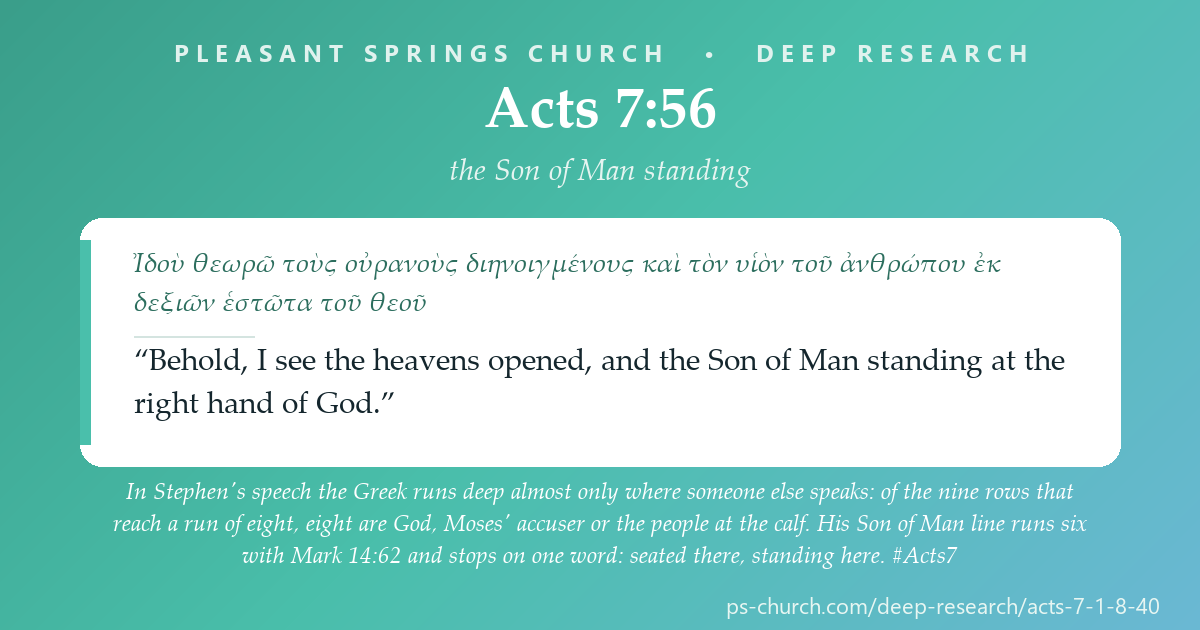
Sixth: the Son of Man standing (7:55–56)
“Behold, I see the heavens opened, and the Son of Man standing at the right hand of God.” The articular phrase the Son of Man stands in 77 verses of the Greek New Testament, and every one but this is in a Gospel. Counted unanchored over every case (τὸν υἱὸν τοῦ ἀνθρώπου, the nominative, genitive and dative alike); the anarthrous a son of man stands separately in John 5:27, Hebrews 2:6, Revelation 1:13 and 14:14.
| against | run | the shared words, and where the run stops |
|---|---|---|
| Mark 14:62 (Jesus before the council) | 6, band 1 | τὸν υἱὸν τοῦ ἀνθρώπου ἐκ δεξιῶν — and the next word is the posture: Mark καθήμενον, Acts ἑστῶτα. |
| Matthew 26:64 | 4 | τὸν υἱὸν τοῦ ἀνθρώπου; Matthew has καθήμενον before ἐκ δεξιῶν. |
| Luke 22:69 (Luke’s own council scene) | 2 | τοῦ ἀνθρώπου; Luke’s saying is in the nominative and has καθήμενος. |
| Psalm 110:1 (Greek 109:1) | 2 | ἐκ δεξιῶν; the psalm says κάθου. |
| Daniel 7:13, Theodotion and Old Greek | 1 and 1 | Isolated forms only: ἀνθρώπου, Ἰδοὺ, καὶ, τοῦ. Daniel’s υἱὸς ἀνθρώπου is anarthrous and nominative. |
The New Testament’s one six with 7:56 is Mark’s trial saying, and it stops on the one word that differs: seated there, standing here. Acts 7:55 has the same participle, ἑστῶτα ἐκ δεξιῶν. Why the Son of Man stands is a question the commentaries answer in several ways (all reported): to welcome the martyr, to act as witness or advocate, to rise as judge. The measurement settles none of them. What it can add is the Greek Old Testament’s own usage. A figure stands at someone’s right hand, in the wording ἐκ δεξιῶν with a verb of standing just before it, in seven units held here (other wordings add Asaph at Heman’s right, 1 Chronicles 6:39, Greek 6:24, and the men at Ezra’s right, Nehemiah 8:4, Greek 2 Esdras 18:4, and 1 Esdras 9:43): the host of heaven (2 Chronicles 18:18; 1 Kings 22:19), the cherubim (Ezekiel 10:3), the queen (Psalm 45:9, Greek 44:10), the accuser (Zechariah 3:1; Psalm 109:6, Greek 108:6) — and the Lord, in the verse immediately before Psalm 110:1: ὅτι παρέστη ἐκ δεξιῶν πένητος τοῦ σῶσαι — for he has stood at the poor man’s right hand, to rescue (our rendering) (Greek 108:31 = ESV 109:31). Acts 7:56 shares two words with it, ἐκ δεξιῶν. That is a reader’s observation about neighbouring verses, not a measured link.
Old Greek: ἐθεώρουν ἐν ὁράματι τῆς νυκτὸς καὶ ἰδοὺ ἐπὶ τῶν νεφελῶν τοῦ οὐρανοῦ ὡς υἱὸς ἀνθρώπου ἤρχετο καὶ ὡς παλαιὸς ἡμερῶν παρῆν καὶ οἱ παρεστηκότες παρῆσαν αὐτῷDan 7:13I saw in the night visions, and behold, with the clouds of heaven there came one like a son of man, and he came to the Ancient of Days and was presented before him.Translation noteGreek and Hebrew agree in substance here — the Aramaic כְּבַר אֱנָשׁ and both Greek texts’ ὡς υἱὸς ἀνθρώπου say one like a son of man; the Old Greek and Theodotion differ elsewhere in the verse, and both are printed.
Seventh: the two last sayings, beside Luke 23
And as they were stoning Stephen, he called out, “Lord Jesus, receive my spirit.” (7:59). And falling to his knees he cried out with a loud voice, “Lord, do not hold this sin against them.” And when he had said this, he fell asleep. (7:60). The two sayings are often set beside two of Jesus’ words from the cross in Luke. Measured:
| Acts | against | run | the shared words |
|---|---|---|---|
| 7:59 | Luke 23:46 — “Father, into your hands I commit my spirit!” | 3 | τὸ πνεῦμά μου |
| 7:59 | Psalm 31:5 (Greek 30:6) — “Into your hand I commit my spirit” | 3 | τὸ πνεῦμά μου |
| 7:60 | Luke 23:34 — “Father, forgive them, for they know not what they do.” | 2 (the saying alone: 1) | δὲ τὰ (another clause, the parting of the garments); in the saying, αὐτοῖς only |
| 7:60 | Luke 23:46 | 2 | φωνῇ μεγάλῃ |
The likeness is in what is said, not in the words: Stephen addresses Κύριε Ἰησοῦ where Jesus says Πάτερ, and asks μὴ στήσῃς αὐτοῖς ταύτην τὴν ἁμαρτίαν where Jesus says ἄφες αὐτοῖς. Luke 23:46 runs three with the psalm, no deeper than Stephen. And Luke 23:34’s saying is itself textually uncertain: the SBLGNT file encloses it, from ὁ δὲ Ἰησοῦς to the end of the saying, in variation-unit half-brackets, and the apparatus held for Luke reads ὁ δὲ … ποιοῦσιν Treg NA28 RP ] ⟦WH⟧ — that is, Tregelles, NA28 and the Robinson–Pierpont text read the words, as the SBLGNT does, and Westcott and Hort set them in double brackets.
Eighth: the eunuch and his scroll (8:26–40)
Isaiah 53:7–8. The Luke 22 study measured it and this page re-derives the figures: Acts 8:32 runs 10 against Isaiah 53:7 and Acts 8:33 runs 20 against 53:8, each band 1; joined, the run is 28 and crosses the verse break; and counting forms in order with gaps allowed, Acts 8:32–33 carries 38 of its 48 forms in Isaiah’s order (Isaiah 53:7–8 has 57). Luke signals the text himself: ἡ δὲ περιοχὴ τῆς γραφῆς. The eunuch’s line is the Greek’s, and the Hebrew of 53:8 differs at the very words he reads (the note on Isaiah 53:8 below).
The eunuch beside the law and the prophet. Nothing in Acts 8 names Deuteronomy 23 or Isaiah 56; the scene is unsignalled. Measured anyway:
| Acts | against | run | what is shared |
|---|---|---|---|
| 8:27 | Deuteronomy 23:2 (ESV 23:1) | 1 | isolated forms (εἰς, καὶ); the Greek law has no form of eunuch |
| 8:27 | Isaiah 56:3 | 1 | the noun, out of order |
| 8:34, 36, 38, 39 | Isaiah 56:3 | 2 | ὁ εὐνοῦχος — which stands in four Greek Old Testament units (Esth 2:14, Esth 2:15, Gen 39:1, Isa 56:3) |
| 8:27 | Jeremiah 38:7 (Greek 45:7), Ebed-melech | 1 | isolated forms, among them Αἰθίοψ |
The measured surprise in this scene is Ebed-melech. An Ethiopian who is also a eunuch stands in one verse of the Hebrew Bible, Jeremiah 38:7 (searched unanchored over every word containing the consonants of Cush and of saris; 1 Chronicles 28:1 also matches, on כׇל־רְכוּשׁ־וּמִקְנֶה, property, a homograph, set aside by name). In the Greek the two words never stand in one unit: the Greek of that verse calls him the Ethiopian and has no word for eunuch. So the one Old Testament figure who matches Acts 8:27 on both counts matches it only in the Hebrew. Ebed-melech is the man who drew Jeremiah out of the cistern. The page notes the coincidence and claims no link.
Two smaller contacts, for completeness. Peter’s “You have neither part nor lot in this matter” runs 3 with the Levites’ formula in Deuteronomy, μερὶς οὐδὲ κλῆρος (Deut 12:12, Deut 14:27, Deut 14:29, Deut 18:1); and “your heart is not right before God” runs 1 against Psalm 78:37 (Greek 77:37), with ἐν, εὐθεῖα, ἡ, καρδία, οὐκ, οὐδὲ shared out of order. Peter’s εἰς γὰρ χολὴν πικρίας has the two nouns of Deuteronomy 29:18 (Greek 29:17), ἐν χολῇ καὶ πικρίᾳ, in other cases, so the two share no word form but καὶ — the same words, no shared form. And σύνδεσμον ἀδικίας stands in one Greek Old Testament unit, Isaiah 58:6 (2).
Ninth: against the New Testament, and the other retellings
The 99 verses against the 7,828 Greek New Testament verses outside Acts 7–8.
| deepest run | rows |
|---|---|
| 8 | 1 |
| 7 | 1 |
| 6 | 3 |
| 5 | 3 |
| 4 | 28 |
| 3 | 42 |
| 2 | 21 |
| row | partner | run | band |
|---|---|---|---|
| Acts 7:37 | Ac 3:22 | 8 | 1 |
| Acts 7:32 | Ac 3:13 | 7 | 1 |
| Acts 7:56 | Mk 14:62 | 6 | 1 |
| Acts 8:12 | Lk 9:11 | 6 | 1 |
| Acts 8:16 | Ac 19:5 | 6 | 1 |
The two deepest are Acts against Acts: Stephen’s Moses saying against Peter’s at 3:22 (8), and the God of Abraham, Isaac and Jacob against Peter at 3:13 (7). Three rows tie at six: Mark 14:62, and two Lukan phrases (περὶ τῆς βασιλείας τοῦ θεοῦ; εἰς τὸ ὄνομα τοῦ κυρίου Ἰησοῦ). Deuteronomy 18:15: Acts 7:37 is introduced as Moses’ saying and runs only 3 against it (ἐκ τῶν ἀδελφῶν, with ὡς ἐμὲ shared after a gap) — the figure the Mark 9 study reports — and its screen ceiling is that same three with a tie band of 158. A signalled citation, measuring like noise: the run engine finds wording, and here the wording is Luke’s, shared eight deep with Acts 3:22. See also the Deuteronomy 18:15–19 study.
The other retellings. Stephen’s speech (7:2–53) against Hebrews 11, verse by verse: the deepest pair is 4, Ἰσαὰκ τὸν Ἰακώβ, καὶ (Acts 7:8 with Hebrews 11:20), and of 2,080 verse pairs 1,994 share no two consecutive word forms. Against Paul’s retelling at Pisidian Antioch (Acts 13:16–25), also 4 — and that four is τὸ ὑπόδημα τῶν ποδῶν, Moses’ sandals at the bush against John the Baptist’s sandals at 13:25. Hebrews 11, by another writer, and Acts 13, by the same writer, each share no more than four consecutive words with Stephen’s retelling; and the two fours are a list of names and a different pair of sandals.
Stephen retells Israel’s story from Abraham to Solomon in fifty-two verses, and the measurement shows two voices in it. Where Stephen narrates, the Greek is mostly his own — one narrative line, 7:18, runs nine with Exodus 1:8 — and its contact with the Greek Bible is otherwise the ordinary furniture of Septuagintal prose — sixes with Ahaziah’s counsellors and Huldah. Where someone in the story speaks, the Greek runs deep: the Lord to Abraham, the Lord at the bush, the man who shoved Moses, the people at the calf, the Lord through Amos and through Isaiah. The deepest single verse is the line that ends the retelling, “Heaven is my throne, and the earth is my footstool”.
Then the scene moves, and the deepest run in the two chapters turns up on a desert road, in a scroll another man is reading. The phrase that introduces Isaiah at the end of the speech, ὁ προφήτης λέγει, is the phrase the eunuch uses to ask about Isaiah, and the New Testament has it in that form nowhere else. The speech ends by saying the Most High does not live in houses made by hands, and gives a prophet’s words for it; the chapter ends with a eunuch — of the kind Deuteronomy 23:1 is commonly read to keep from the assembly and Isaiah 56:4–5 promises a name (both reported readings) — baptized beside a road. And between the two, Stephen sees the Son of Man in the posture no trial saying gives him: the six words run with Mark and stop on ἑστῶτα.
What was consulted, what was not, and where this page is weakest.
This section is what makes the shelf trustworthy. Read it before using anything above.
Commentaries and studies a reader should consult:
- Craig S. Keener, Acts: An Exegetical Commentary; C. K. Barrett (ICC); Darrell L. Bock (BECNT); David G. Peterson (Pillar); F. F. Bruce (NICNT); Joseph A. Fitzmyer (Anchor); Richard I. Pervo (Hermeneia). None was opened for this page; they are named as the standard discussions a reader should consult.
- Bruce Metzger, A Textual Commentary on the Greek New Testament, on Acts 7:43, 7:46 and 8:37 (reported; not held).
What this page could NOT check — stated plainly
- No apparatus for Acts is held. The SBLGNT apparatus on this disk covers Luke, Romans, Jude and Revelation. The SBLGNT file for Acts marks 107 variation-unit signs in chapters 7–8, and several fall exactly where a run on this page stops or would change: 7:3 (ἐκ), 7:28 (ἐχθὲς), 7:33 (ἐφ), 7:40 (ἐγένετο), 7:43 (θεοῦ), 7:46 (θεῷ), 8:32 (κείραντος) and 8:33 (ταπεινώσει). What the other editions read at these places is not verifiable here. At 7:46 the commentaries report a well-known variant, a dwelling for the house of Jacob against the SBLGNT’s σκήνωμα τῷ θεῷ Ἰακώβ (which runs 4 with Psalm 132:5, Greek 131:5); reported only.
- Acts 8:37. Measured: the SBLGNT has no 8:37; the KJV prints it (Codex above); Irenaeus gives the confession in Against Heresies 3.12.8. Reported, not checked: that the Textus Receptus the KJV rests on carries it, while most Byzantine manuscripts do not; that the critical editions (Westcott–Hort, Tregelles, NA28) and the Robinson–Pierpont Byzantine text do not print it in their text; that the ESV gives it in a footnote (this page fetches the ESV without footnotes); and that the main witness to the “Western” text, Codex Bezae, has a gap here. The Western text is reported only. That includes the longer Western reading at 8:39 in which the Spirit falls on the eunuch, reported in the commentaries and not checked.
- One Greek Old Testament edition. Rahlfs, as encoded by CATSS. No Göttingen apparatus: the κείραντος/κείροντος difference at Isaiah 53:7, and whether any Greek manuscript of Amos 5:27 reads Babylon, are reported questions, not checked ones. The Odes are set aside from the screen and checked separately in the selfcheck.
- No Qumran Exodus, no Targum of these verses (the Targums held cover Genesis 6), no Philo beyond De Gigantibus; the Greek Josephus (Niese) checked only at Antiquities 1.152 and 1.154. The seventy-five of a Qumran Exodus is reported. Josephus is quoted in Whiston’s English, Book 1 only. The Samaritan Pentateuch is read in the UCPH transcription of Genesis 5–11 only, so its Exodus 12:40 is not checked.
- A spelling the normaliser does not fold (τεσσεράκοντα against τεσσαράκοντα) means no run through the word forty is possible. Every figure is a figure about two encoded editions and the frozen normaliser.
- Word forms, not lemmas, for every run. Lemma counts are labelled as lemma counts (the MorphGNT column). Ears in the structure diagram is a lemma link and is labelled so.
- The historical questions are untouched. Where Abraham’s call came, how the four hundred and the four hundred and thirty years relate, how Shechem and Machpelah relate, whether Stephen’s speech is a record or Luke’s composition, and the legal standing of the stoning are history. NOT VERIFIABLE FROM LOCAL CORPORA.
- Hebrew was not screened against Greek. Every Hebrew point is a reading of the Masoretic line beside the Greek, not a run.
Where this page is weakest
Its headline is a pattern in nine rows, and nine is a small number. Eight of the nine rows at eight or more have their run inside a reported speech is exact, and it rests on the cut-off: at six the pattern dissolves, because most sixes are narrative formulae. The page prints the sixes so that a reader can see that. It does not show that Luke treated reported speech differently; it shows where the verbatim contact is.
Second, the structure diagram is a reading. The units are not in dispute; the three colour pairs are measured (one phrase, one lemma, one name) and the rest is editorial.
Third, several findings move with the edition — 7:43 with ὑμῶν, 7:46 with its variant, 8:37 entirely, and 8:32 at the participle. They are flagged where they stand. The SBLGNT file also marks variation units inside measured runs whose readings are not checkable here: in the speech’s deepest row (7:49, at and the earth), in the chapters’ deepest (8:33, at his generation), in the narrative exception (7:18, at over Egypt), in the eight of 7:37 against Acts 3:22 (at God), at both ands of the 7:32 counter-example, and at the last word of 7:27’s question.
Fourth, the doctrinal readings in Stage 6 are reported, and the church’s own positions are given in its own words. Where the church has no article (baptism, the Spirit at 8:16), the page says so and claims none.
The voices in the retelling, the man standing, and a road out of Jerusalem.
Name what you learned, why it matters, and one concrete response.
Readings, given fairly — and what the church holds
1. Simon: he believed, was baptized, and was rebuked. Even Simon himself believed, and after being baptized he continued with Philip. And seeing signs and great miracles performed, he was amazed. (8:13). Then, when he offered money: You have neither part nor lot in this matter, for your heart is not right before God. (8:21), μετανόησον οὖν ἀπὸ τῆς κακίας σου ταύτης — turn away from this evil of yours and plead with the Lord, in case the purpose of your heart can still be forgiven you (our rendering; the ESV of this verse is not printed here) (8:22). Readers take Simon in several ways (all reported): that his faith was never genuine — a belief in the signs rather than a trust in Christ — which is how Irenaeus read it (“This Simon, then--who feigned faith”, Stage 2) and how many Reformed and other commentators read it; that he was a real believer who sinned gravely and was called to repent, as many Wesleyan and some other readers hold; and that Luke leaves the question open, since the story ends with Simon asking for prayer (8:24) and no outcome. The church’s position is in its own words in /beliefs, Article 10, Hope: “all who genuinely receive Christ are held secure”, and “Scripture’s warnings are themselves a real means by which He holds us fast.” The article is not written about Simon and the page does not make him a proof-text for or against it. It notes what the text itself does: it puts a warning and a call to repent in the apostle’s mouth in the same breath. The church’s Article 6, Repentance, begins: “We believe repentance is not driven by fear of punishment, but by encountering mercy.” This page does not say what Simon was.
2. Baptism (8:12, 13, 16, 36–38). Acts 8 has baptism five times and describes one: And he commanded the chariot to stop, and they both went down into the water, Philip and the eunuch, and he baptized him. (8:38). Readers draw different conclusions (all reported): that the going down into the water describes immersion; that the prepositions εἰς τὸ ὕδωρ and ἐκ τοῦ ὕδατος can mean to and from as well as into and out of; that the order in 8:12 (believing, then baptism) bears on who is baptized; and that household and covenant texts elsewhere bear on it differently. The church’s /beliefs page has no article on baptism or the ordinances, and this page claims no church position.
3. “Not yet fallen on any of them” (8:16). for he had not yet fallen on any of them, but they had only been baptized in the name of the Lord Jesus. (8:16). The readings (all reported): a second experience after conversion, in many Pentecostal readings; a rite of laying on of hands completing baptism, in sacramental traditions; a unique hold-back so that Samaria’s reception would be joined to the Jerusalem apostles; and the view that the Samaritans’ faith was defective until then. The church has no article on this, and the page claims none.
4. The indictment (7:51–53), and its history. Stephen is a Jewish speaker addressing a Jewish council, and the measurement above shows him speaking of our fathers until the moment he charges his hearers. His words come out of Israel’s own Scriptures, where Moses and the prophets brought the same charges against their own generations (Exodus 33:5; Jeremiah 6:10). This speech has been misused in Christian history as a charge against the Jewish people as a whole (reported; a matter of record in the history of interpretation). The text does not support that: it is an intra-Israel prophetic indictment, spoken by one Jew to his own leaders, and the Son of Man he sees is Israel’s Messiah. This page reads it so.
5. Isaiah 53 and the provision of the cross. From the eunuch’s scroll Philip εὐηγγελίσατο αὐτῷ τὸν Ἰησοῦν — he announced Jesus to him as good news (our rendering; the ESV of this verse is not printed here) (8:35). The church teaches that in his death Jesus “bore our sin” (/beliefs, Article 2, Jesus Christ) and holds an unlimited-provision atonement — offered for all, without universalism, received by faith. Acts 8:35 does not argue that position, and the page does not press it on the verse.
What should we carry away — and do?
- Listen to the voices inside the story. Stephen’s retelling runs nearest to the Greek Bible where God speaks and where people refuse him. A church that knows its story should know those lines.
- Standing. The trial sayings have the Son of Man seated; Stephen sees him standing. Whatever the reason, the one who sees him is a man about to die for him, and he dies praying for the men who are killing him.
- Scattered is not stopped. Now those who were scattered went about preaching the word. The worst day of the Jerusalem church is the day the word reaches Samaria.
- Explain the Scripture to whoever asks. The eunuch has the right scroll and no guide. Philip starts where the man is reading.
Step in response: this week, read Acts 7 aloud and mark every line where someone other than Stephen is speaking. Then find one person who is reading the Bible alone and offer to read with them.
Acts 7:56 · to share
Greek NT + ESVEvery Deep Research page traces its passage across the whole sweep — the Old Testament, the Second-Temple world between the testaments (historical witnesses, not Scripture), and the New Testament. Follow the thread:
Pleasant Springs Church — Deep Research
Research method after Michael S. Heiser’s Bible Research Method (examine dictionaries → ancient literature → important words → textual connections → academic publications → share), with the Pleasant Springs “Author & Audience” foundation. Scripture set in the Hebrew, the Greek editions named on each page and the ESV (Old Testament), and the Greek New Testament and the ESV (New Testament), per the practice of Pleasant Springs Church. Acts 7:1–8:40 measured with dr_tools against the SBLGNT (via MorphGNT, 7,927 verses) and the CATSS Greek Old Testament (30,348 units screened, 30,637 held with the Odes); longest-contiguous-run screens with tie bands throughout, word forms and not lemmas, unigram fallback on. Masoretic Hebrew from Sefaria; the Samaritan Pentateuch from the UCPH Text-Fabric transcription; Josephus in Whiston’s translation; Jubilees in R. H. Charles’s translation; Justin and Irenaeus from the ANF. No direction of influence is asserted anywhere on this page. Stage 5 states what could not be checked: no Acts apparatus, one Greek edition of each Testament, no Qumran, no Targum, and the edition-dependence of 7:43, 7:46, 8:32 and 8:37, and variation units inside the runs at 7:18, 7:27, 7:32, 7:37, 7:49 and 8:33.
Scripture quotations marked ESV are from the ESV® Bible (The Holy Bible, English Standard Version®), © 2001 by Crossway, a publishing ministry of Good News Publishers. ESV Text Edition: 2016. Used by permission. All rights reserved. The ESV text may not be quoted in any publication made available to the public by a Creative Commons license, and the ESV may not be translated in whole or in part into any other language. www.esv.org
|
Did this study bless you today? 💚 Give to Support PS Church100% of gifts go to the General Fund — thank you. |